O R I G I N A L A R T I C L E
The Brain Basis of Positive and Negative Affect:
Evidence from a Meta-Analysis of the Human
Neuroimaging Literature
Kristen A. Lindquist
1,2,
†
, Ajay B. Satpute
3,
†
, Tor D. Wager
4
, Jochen Weber
5
,
and Lisa Feldman Barrett
6,7
1
Department of Psychology, University of North Carolina, Chapel Hill, NC, USA,
2Biomedical Research Imaging
Center, University of North Carolina at Chapel Hill, NC, USA,
3Pomona College, Claremont, CA, USA,
4Department
of Psychology and Neuroscience, University of Colorado, Boulder, CO, USA,
5Department of Psychology, Columbia
University, New York, NY, USA,
6Department of Psychology, Northeastern University, Boston, MA, USA, and
7Department of Psychiatry and Radiology, Massachusetts General Hospital/Harvard Medical School/Martinos
Center for Biomedical Imaging, Boston, MA, USA
Address correspondence to Kristen A. Lindquist, Department of Psychology, University of North Carolina, Davie Hall 321, CB # 3270, Chapel Hill, NC 27510, USA. Email: [email protected]
†K.A.L. and A.B.S. contributed equally to this work.
Abstract
The ability to experience pleasant or unpleasant feelings or to represent objects as“positive”or“negative”is known as representing hedonic“valence.”Although scientists overwhelmingly agree that valence is a basic psychological phenomenon, debate continues about how to best conceptualize it scientifically. We used a meta-analysis of 397 functional magnetic resonance imaging (fMRI) and positron emission tomography studies (containing 914 experimental contrasts and 6827 participants) to test 3 competing hypotheses about the brain basis of valence: the bipolarity hypothesis that positive and negative affect are supported by a brain system that monotonically increases and/or decreases along the valence dimension, the bivalent hypothesis that positive and negative affect are supported by independent brain systems, and the affective workspace hypothesis that positive and negative affect are supported by aflexible set of valence-general regions. We found little evidence for the bipolar or bivalent hypotheses. Findings instead supported the hypothesis that, at the level of brain activity measurable by fMRI, valence isflexibly implemented across instances by a set of valence-general limbic and paralimbic brain regions.
Key words:affect, meta-analysis, neuroimaging, valence, value
There is the good and the bad, the great and the low, the just and the unjust. . . all that will never change.
-Albert Camus
Introduction
Every person on the planet (barring illness) can tell good from bad, positive from negative, pleasure from displeasure. The
basic ability to experience pleasant or unpleasant feelings and represent objects as positive or negative, or as pleasing or displeasing, is known as hedonic“valence.”Valence is thought to be a fundamental, universal property of human experience. Representations of valence contribute to emotional feelings, morality, and personality. They are at the core of judgments about strangers, partners, friends, and leaders. Representations of valence inform decision-making, attitudes and preferences,
© The Author 2015. Published by Oxford University Press. All rights reserved. For Permissions, please e-mail: [email protected]
1910 doi: 10.1093/cercor/bhv001
and the valuation of goods and services (for a review seeBarrett and Bliss-Moreau 2009). Cultures all over the world differ in the specific types of emotions they experience and recognize, but no culture lacks the concepts for valence (Osgood 1952;Wierzbicka 1992). Even infants as young as a few days old feel pleasure and discomfort (Lewis 1993) and can differentiate between pleasant and unpleas-ant facial expressions in others (Farroni et al. 2007). Although scien-tists overwhelmingly agree that valence is an integral aspect of most psychological phenomena, debate continues about how to best conceptualize the nature of valence (Barrett and Bliss-Moreau 2009). In this paper, we use evidence from functional magnetic res-onance imaging (fMRI) to investigate how valence is represented as distributed brain activity in healthy human adults.
To date, research on the nature of valence has received the most attention within the psychological literature using behavioral re-sponses and self-reported feelings as data. Dimensional methods (e.g., multidimensional scaling, factor analysis, and structural equation modeling) consistently reveal that valence is a funda-mental property of self-reported affect and emotion when people view movies, images, and during momentary life experiences (for reviews, seeWatson and Tellegen 1985;Larsen and Diener 1992; Feldman 1995;Barrett and Russell 1998;Russell and Barrett 1999; Bradley et al. 2001), but scientists disagree on the relation of positiv-ity to negativpositiv-ity (all studies also identify a second property known as arousal, which refers to the degree of activation vs. quiescence that a person is feeling at a given moment). In some models, arou-sal is explicitly represented as its own dimension, and in other models it is not. Although arousal is an important aspect of affect, we do not focus on it in the present paper for several reasons. First, valence and arousal are difficult to separate in the context of ex-periments because most stimuli used to induce positivity or nega-tivity also induce some change in arousal (e.g., the International Affective Picture System;Lang et al. 2005) (for a discussion, also seeKuppens et al. 2013;Lang and Bradley 2010). Second, valence and arousal are separable properties in some, but not all, indi-viduals’self-reports of emotional experiences (Feldman 1995). Third, the concept of arousal, as a psychological property, is vague and underspecified. The term“arousal”is varyingly used to refer to enhanced attention, behavioral engagement, intensity of feeling, physiological activation, and subjective feelings of activation, and measures of each operationalization tend not to correlate with each other. As such, it is difficult to accurately quantify the degree of arousal that a given study is inducing in the context of a meta-analysis. Finally, fewer hypotheses about the nature of arousal have been put forth in the psychological literature to date than have models of valence). We use existing models of valence to test hypotheses about the brain’s representation of valence.
Psychological Models of Valence: Predictions
for the Brain Basis of Valence
Thefirst psychological model of valence was initially put forth by Wundt (1897/1998)and hypothesizes that positivity and negativ-ity constitute opposite ends of a single dimension; this view is referred to as the“bipolarity”hypothesis. Factor analyses and multidimensional scaling studies of humans’subjective experi-ences, perceptions of other people’s facial movements and vocalizations, the semantic structure of emotion words, and the mathematics of measurement theory all support the view that positivity and negativity are bipolar opposites (Larsen and Diener 1992;Barrett and Russell 1999;Carroll et al. 1999).
A second psychological model of valence developed in the mid-twentieth century, based on evidence that self-reports of
positive and negative affective experience are often uncorrelated. These data were taken as evidence that positivity and negativity might be independent dimensions; this idea is referred to as the
“bivalence”hypothesis to indicate that there are 2 distinct con-structs of valence that range from positivity-neutral and negativ-ity-neutral (e.g.,Watson and Tellegen 1985;Cacioppo et al. 1999; Norris et al. 2010). Whereas bipolarity was merely a descriptive hypothesis about conscious affect in reports of experience and perception, the bivalence view went further to hypothesize that there are separate physical systems for generating and represent-ing positivity and negativity; evidence for bivalence includes self-report ratings (e.g., people can self-report experiencing positivity and negativity in response to the same stimulus or over the course of the same experimental trial;Larsen et al. 2001;Larsen et al. 2004) as well as biological data (e.g., relative differences in neurotrans-mitter activity for appetitive versus aversive stimuli, and evi-dence that spinal neurons can simultaneously cause activation offlexion and extraction muscles;Norris et al. 2010).
There has been a long and tortured debate over the structure of affect, largely because behavioral studies to date have been unable to show clear evidence for one model or the other (Barrett and Bliss-Moreau 2009). Bipolar and bivalence hypotheses are relatively untested in the domain of neuroscience, but each model makes unique predictions for how valence might be repre-sented in neuronal activity. Support for the bipolarity hypothesis would be found if a given network of regions responds monoton-ically as affect changes from negative, to neutral, to positive or vice versa. In this view, neurons associated with increased posi-tive affect would also be associated with reduced negaposi-tive affect, and vice versa. Support for the bivalence hypothesis would be found in separate and independent networks for positivity and negativity, such that across studies, the same regions show consistent increases in activity for positive but not negative affect, and other regions show consistent increases in activity for negative but not positive affect. The networks would be independent insofar as information from neural areas respon-sive during negative affect would not provide any information about the state of activity from neural areas responsive during positive affect—neurons representing negativity would not sys-tematically changefiring rates based on increases or decreases in positivity, and vice versa. Technically, the networks“could”
be negatively correlated in a given study and such a correlation would mean the 2 systems are reciprocally activating. Reciprocal activation would remain evidence for bivalence as long as the networks were not spatially dependent; if the networks are truly independent, then it should be possible for co-activation to occur sometimes (Berntson et al. 1991).
(Belova et al. 2008). In some studies, there is even evidence for in-hibitory relationships between positive-encoding and negative-encoding cells, such that in the presence of a positive stimulus (e.g., juice), positive-encoding amygdala cells increase their rate offiring, whereas negative-encoding cells decrease their rate of
firing (Belova et al. 2008).
Yet even amidst evidence for functional selectivity at the cel-lular level, there exists evidence for moreflexible cellular encod-ing of valence, suggestencod-ing that a strict relationship between positivity or negativity and single cells is not ubiquitous through-out the brain. For instance, certain cells in the monkey OFC (area 13) respond equally to appetitive and aversive stimuli (Morrison and Salzman 2009). Even those cells that show a preference for stimuli associated with reward (e.g., juice) also sometimes re-spond to stimuli associated with aversion (e.g., an air puff ) (and vice versa) (Morrison and Salzman 2009). Findings from rats, and even the nematodeCaenorhabditis elegans, also demonstrate the existence of cells with a valence-general response profile. In rats that are in neutral, safe circumstances, glutamate disrup-tions to rostral pordisrup-tions of the nucleus accumbens shell generate appetitive behaviors, whereas glutamate disruptions to caudal portions of the shell generate aversive responses. Yet, when rats are in a threatening context, glutamate disruptions to the same rostral cells begin to generate aversive responses instead of appetitive responses (Reynolds and Berridge 2008). Whether neurons code for approach versus avoidance behavior shifts according to context, even inC. elegans, a nematode with only 302 neurons. For instance, the olfactory neuron AWCON directs approach and avoidance behavior toward the same exact odor depending on the presence or absence of other neurochemicals in the brain (Tsunozaki et al. 2008). Thesefindings might suggest that it is not neurons, but neurochemicals, that are valence spe-cific, but research shows that neurochemicals such as opiods and dopamine are general to both pleasure and pain in mammals (Leknes and Tracey 2008).
Taken together, thefindings from non-human animals imply that a third hypothesis on the structure of valence is possible: A representation of positivity or negativity emerges at the popu-lation level, as a“brain state”(Salzman and Fusi 2010) but is not necessarily consistently associated with a specific brain region or set of regions. Using the logic of large-scale brain organization that is available from neuroimaging studies (Smith et al. 2009; Biswal et al. 2010; Poldrack 2010; Yeo et al. 2011), this third hypothesis is a valence-general“affective workspace”hypothesis (Barrett and Bliss-Moreau 2009). We use the term“affective work-space”in a manner akin to Edelman’s“neural reference space”
(Edelman 1989). According to Edelman, a neural reference space is a set of neurons that are probabilistically involved in realizing a class of mental events (such as positivity or negativity) (for a discussion, also seeLindquist, Wager, Kober et al. 2012)—it is the neuronal workspace in which a mental state is likely to be implemented when it is experienced. In this view, on any given occasion, voxels of neurons are functionally selective for positiv-ity or negativpositiv-ity, even if they do not consistently show increased activation exclusively for one or the other. Different instances of positivity and negativity are implemented dynamically as
flexible neuronal assemblies within the same neural reference space. A given neuron might participate in both instances of negativity and positivity across contexts, with its receptivefield being determined by the neural context. Because neuronal assemblies areflexible, a given neuron need not participate in every brain state within a class (e.g., positivity), or even in the exact same mental state at 2 different points in time (e.g., positiv-ity at seeing a friend at work vs. at a pub). Such valence-general
flexibility can account for both the behavioral evidence of biva-lence and bipolarity (Barrett and Bliss-Moreau 2009).
To test the 3 hypotheses about the structure of valence in hu-mans, we summarize almost 20 years of human neuroimaging studies (using functional magnetic resonance imaging; fMRI and positron emission tomography; PET). Several early attempts (e.g.,Murphy et al. 2003;Wager et al. 2003;Kringelbach and Rolls 2004) covering thefirst 10 years or so of neuroimaging data (87, 65, 106 studies, respectively) examined which brain areas respond more frequently during positive versus negative affect. More recently, several meta-analyses assessed the neural correlates of subjective pleasantness (Kuhn and Gallinat 2012; 40 studies), reward-related decision-making (Liu et al. 2011; 142 studies) and the experience of subjective value during economic deci-sions (Bartra et al. 2013; 206 studies;Clithero and Rangel 2013; 81 studies).
Our meta-analysis is distinct from these other meta-analyses in several ways. First, our database of 397 studies of affective (i.e., positive and negative) and discrete emotional (i.e., anger, disgust, fear, sadness, happiness, etc.) experiences and perceptions (spanning January 1993–December 2011) is the largest existing database of neuroimaging studies on valence. Second, our meta-analysis is distinct from at least the most recent meta-analyses because it does not include studies of reward/loss. Other recent meta-analyses summarized studies of liking and attractiveness (Kuhn and Gallinat 2012) or focused explicitly on reward (Liu et al. 2011;Bartra et al. 2013;Clithero and Rangel 2013). Our data-base explicitly excludes studies of reward since the motivational processes underlying reward are thought to be distinct from the experience of pleasure per se (Robinson and Berridge 2013).
Finally, our meta-analysis is distinct because no previous meta-analyses were designed to compare different theoretical formulations on the nature of valence. We used our database to test whether valence is supported by bipolar brain systems, bivalent systems, or whether the brain regions that represent valence do so in aflexible context-specific manner consistent with the idea of a valence-general affective workspace.
Materials and Methods
Database
Wilson-Mendenhall et al. 2014). The resulting database includes 397 studies containing 6827 participants and reports peak coordi-nates from 914 contrasts that compared neural activity during presentation of positive or negative affective stimuli (e.g., images, film clips, imagery, facial/vocal/bodily expressions, sounds, odors, etc.) either against each other or against neutral stimuli.
We analyzed only those study contrasts that were relevant for examining brain regions associated with positive and nega-tive affecnega-tive responses (see Table1). We limited our analysis to study contrasts that reported whole-brain analyses or a combin-ation of whole-brain and region of interest (ROI) analyses. We excluded study contrasts that reported ROI analyses only (e.g., study contrasts in which researchers investigated only the amyg-dala and did not report whole-brain analyses). We further excluded contrasts in which the baseline condition involved merelyfixation or in which the baseline condition involved an altogether different class of stimuli, such as comparing smiling ( positive) or sneering (negative) faces to abstract shapes or to non-face stimuli.
Multilevel Peak Kernel Density Analysis
The Multilevel Peak Kernel Density Analysis (MKDA) (Wager et al. 2007) (software available from http://wagerlab.colorado.edu/ tools) summarizes the spatial overlap of peak coordinates reported in individual studies to reveal voxels that consistently show increases in brain activity during a particular class of psychological events (e.g., positivity) relative to some baseline. For more information about the MKDA and its validation against other coordinate-based meta-analytic methods such as the Activation Likelihood Estimation technique or“image-based”
methods that use statistical maps from individual studies, see Wager et al. (2007);Kober et al. (2008); Salimi-Khorshidi et al. (2009);Kober and Wager (2010).
Following the standard MKDA procedure used in other pub-lished studies, peak coordinates from each study contrast in the database werefirst convolved with 12-mm spheres to form binary indicator maps. Rather than treating peak coordinates from individual studies as the unit of analysis, the MKDA treats study contrasts as the unit of analysis to prevent a single study that reports many peaks (because of more liberal thresholding or differences in statistical power in the study) from unduly bias-ing the results (Wager et al. 2007). To control for quality of the data entering the meta-analysis, study contrast maps are further weighted by the square root of the sample size and studies usingfixed-effects analyses are down-weighted by 0.75 so that less rigorous statistical analyses contribute less strongly to the meta-analytic results. The MKDA creates binary indicator maps from peak coordinates, rather than using voxel-levelzscores, and weighs the contribution of coordinates by study-level vari-ables (sample size and rigor of analysis) rather than voxel-level variables (z-scores) for several reasons. First, between-study factors such as preprocessing decisions or the analysis method
used can impactzscores, making them incomparable between studies. Second, the sample size of a study impacts variance es-timates, with the result that smaller, more variable studies can have inflatedz-scores. Weighting voxels byz-score would thus allow smaller, high variance studies to weigh more heavily to-ward the meta-analysis results. Treating all peak coordinates equally but weighing them by study-level factors such as the sample size and rigor of the statistical methods ensures that studies more likely to be diagnostic of the population at large con-tribute more strongly to the meta-analytic results. For further discussion of the implications of usingz-scores versus binary in-dicator maps based on peak coordinates, seeWager et al. (2007) andKober et al. (2008).
The next step in the MKDA is to compute a point estimate of the proportion of study contrasts that reported increased activa-tion near each voxel in the brain. The MKDA uses the statistic P for each voxel, or the proportion of study contrasts in the database reporting activation near that voxel. MKDA maps were generated for study contrasts comparing: 1)“positive affect”
versus “neutral,” (ii) “negative affect” versus “neutral,” (iii)
“positive affect”versus“negative affect,”and (iv)“negative affect”
versus“positive affect”task conditions.
Finally, we computed meta-analytic contrasts and conjunc-tions to test the bivalent, bipolar, and affective workspace hypotheses (described in more detail later). To determine signifi -cance for comparisons, a Monte Carlo simulation with 5000 iterations was performed to produce a null distribution of prob-abilities that a given study contrast activated near a voxel of the brain. To produce a null distribution with similar characteristics to the database, the Monte Carlo simulation randomly assigned the center of clusters to different locations in the brain (excluding the ventricles and white matter) while still preserving the total number of study contrasts and coordinates within those con-trasts. For each iteration, the MKDA map was calculated and the probability of observing a given proportion of study contrasts activating near a given voxel was calculated. Using the null distribution produced by the Monte Carlo simulation, we then obtained results corrected for multiple comparisons across the whole brain by using 3 levels of correction: for voxel-wise analyses, we used a false discovery rate (FDR) threshold, and for cluster-level analyses, we used family-wise error rate (FWER) thresholds to assess the cluster-size required given voxels that were significant atP< 0.01 andP< 0.05.
For conjunction analyses, wefirst thresholded each map individually using the FWER-corrected thresholds and then ex-amined the overlap using a“global null”conjunction analysis that defines the conjunction as the intersection of individually thresholded maps (as inNichols et al. 2005). Our global null conjunction was constrained on whether the conjunction of the 2 maps contained at least 12 contiguous voxels.
Testing the Bipolarity Hypothesis
The bipolarity hypothesis can be operationalized as a set of brain regions that respond monotonically across affective valence. Areas exhibiting activity that correlate with either of the follow-ing 2 patterns: negative affect > neutral > positive affect or posi-tive affect > neutral > negaposi-tive affect would provide neural evidence consistent with the bipolarity hypothesis. Part of this ordinal relationship involves showing that areas with an increase in activity during negative affect also show a decrease in activity during positive affect (relative to neutral). However, we were un-able to test whether“deactivations”for positive affect or negative affect relative to neutral were present because our meta-analytic
Table 1Frequency of contrasts used in the database for the MKDA
Contrasts Frequency
Positive versus neutral 110
Negative versus neutral 255
Positive versus negative 36
database did not include any neutral > negative or neutral > posi-tive contrasts. Like other meta-analyses of neuroimaging studies (e.g.,Vytal and Hamann 2010;Lindquist, Wager, Kober et al. 2012), we did not include contrasts reporting such neural“ deactiva-tions”in our database because they are reported infrequently across individual studies. We also did not include“deactivations” due to problems of interpretation; a“deactivation”is really a situ-ation where the experimental condition shows less activity than the control condition and so is dependent upon the nature of the neural responses during the control (i.e., they might not re-present“deactivation”per se; for a discussion, seeLindquist, Wager, Bliss-Moreau et al. 2012). We were thus unable to provide a complete test of the bipolarity hypothesis in the context of a meta-analysis because it required examining decreases in activ-ity relative to neutral affect. Given this limitation (which is inher-ent to the studies in the literature themselves, and not to our meta-analytic methods per se), we opted to search for regions that would meet the bipolarity hypothesis as closely as was feas-ible. That is, we searched for regions that were consistent with an
“ordinal relationship”with valence (e.g., positive > neutral > negative or negative> neutral > positive).
To do so, wefirst masked out voxels that were“valence gen-eral”(i.e., responding more frequently during both positive affect and negative affect relative to neutral affect), since these voxels already violate the monotonic relationship predicted by bipolar-ity. Next, we examined whether there were any brain regions in which there was greater activity when one type of valence was compared against another as opposed to against neutral (e.g.,
“positive affect”vs.“negative affect”>“positive affect”vs.“ neu-tral”). The logic here was that if positive and negative are truly bipolar opposites, then activations would be more likely to be observed when contrasting them against one another than when, say, contrasting positive versus neutral. In essence, this sort of contrast assumes that the neural differences between positive and negative affect are greater than the neural differ-ences between negative and neutral affect or positive and neutral affect, which would be consistent with bipolarity.
Testing the Bivalence Hypothesis
The bivalent hypothesis can be operationalized as a 2 sets of brain regions: one set that responds during negative affect and another set that responds during positive affect. Activity in these brain regions should, at least in principle, be independent of one another. Areas exhibiting activity that correlates with either of the following 2 patterns: negative affect > neutral and no difference in response during positive affect, or positive affect > neutral and no difference in response during negative affect, would provide neural evidence consistent with the bivalent hypothesis. Part of these patterns involves showing that a region that responds more during negative affect also has no increase dur-ing positive affect, and vice versa. In the context of a meta-analysis, there are 2 ways of testing this hypothesis. One approach would be tofirst exclude voxels that are valence general (i.e., respond more during positive affect vs. neutral and negative affect vs. neutral), since these would violate the bivalent hypothesis at the outset and then to search outside of these areas for voxels that are more frequently engaged during“positive affect”versus“neutral”
contrasts, and other voxels that are more frequently engaged during“negative affect”versus“neutral”contrasts.
However, we opted for a more conservative approach that may provide a better test of the bivalence hypothesis. First, we excluded voxels that were valence general. Because it is par-ticularly critical that a region that responds during negative affect
certainly does not respond during positive affect, we then com-pared“negative affect”versus“positive affect”directly and fur-ther compared the probability of these activations to study contrasts of“positive affect”versus“neutral affect.”This is a more conservative test of the bivalence hypothesis because a re-gion that is truly selective for negative affect should be more like-ly to be significantly active during negative affect versus positive affect even controlling for any chance activations that occur dur-ing positive versus neutral. We also performed a complimentary analysis for positive affect—that is, we compared the probability that a voxel was active during“positive affect”versus“negative affect”contrasts beyond“negative affect”versus“neutral” con-trasts. Voxels meeting these criteria could be considered to be uniquely sensitive to one type of valence and not the other.
Testing the Affective Workspace Hypothesis
Identifying Valence-General Voxels
Valence-general voxels were identified as those consistently activated during both positive and negative valence across studies (i.e., were significant in the global null conjunction of positive versus neutral and negative versus neutral contrasts; Nichols et al. 2005).
Identifying Voxels within the Valence-General Affective Workspace that Show Preference for Positive versus Negative or Negative versus Positive Affect
It is possible that even among voxels that respond more frequent-ly to positive and negative affect than neutral affect, there exist voxels that show a“relative”preference for positive versus nega-tive affect, or neganega-tive versus to posinega-tive affect. To assess this possibility, we addressed whether any voxels within the va-lence-general affective workspace (the conjunction of positive > neutral and negative > neutral) had more frequent activity during the“positive”versus“negative”study contrasts or“negative”
versus“positive”study contrasts in our database. We note that these study contrasts were independent of the contrasts used to identify the valence-general workspace, providing a rigorous means of testing this hypothesis.
Identifying Distributed Patterns for Positivity and Negativity
Finally, we performed a classification analysis using a linear support vector machine (SVM) to test whether information about valence is contained within patterns of neural activation distributed across the whole-brain space (implemented with the libSVM toolbox:http://www.csie.ntu.edu.tw/~cjlin/libsvm) (Chang and Lin 2011). As in the MKDA, indicator maps were gen-erated by diluting peak coordinates from a contrast with a 12-mm binary sphere. Matrices were transformed into vectors that served as the features for the SVM. The model was implemented (cost parameter = 1) to classify whether a given study contrast map involved a comparison of positive versus neutral affect or negative versus neutral affect. For training, a random selection of 80“positive”versus“neutral”study contrasts and 80“negative”
versus“neutral”study contrasts were used, and for testing a ran-dom selection of 20“positive”versus“neutral”and 20“negative”
contrasts out of the group of contrasts that were classified as positive (or negative). Evidence for the above chance classification accuracy was tested using a binomial probability distribution.
Results
The Bipolar Hypothesis: Regions that Respond Monotonically along a Single Valence Dimension?
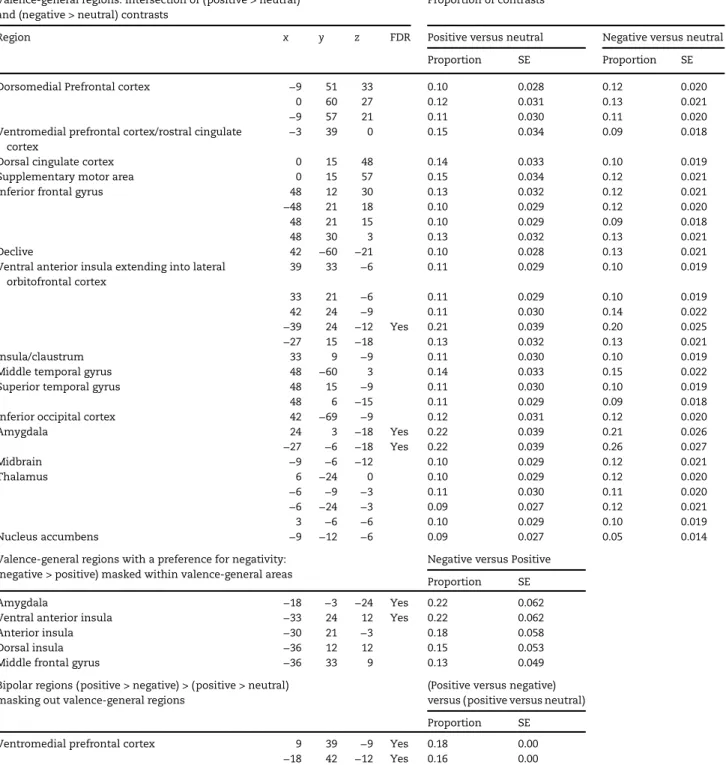
First, we assessed whether any clusters of voxels were more frequently engaged during“positive”versus“negative”study contrasts than during“positive”versus“neutral”study contrasts across studies (while excluding any voxels that were valence gen-eral; also see Materials and Methods for our operationalization of the bipolarity hypothesis). This analysis revealed a cluster in a ventral portion of the rostral anterior cingulate cortex (ACC) and medial prefrontal cortex (MPFC) (MNI = [9, 39,−9],k= 178) (Fig.1; Table2). We next tested for clusters of voxels that were more often engaged during“negative”versus“positive”than by
“negative”versus “neutral” study contrasts (while excluding voxels that were valence general) but were unsuccessful in iden-tifying any. Thesefindings suggest that the ventral MPFC and ACC areas may be candidate regions of interest coding for valence along the lines specified by the bipolarity hypothesis.
The Bivalence Hypothesis: Two Unipolar Dimensions?
First, we tested for voxels that responded exclusively to positive affect (i.e., a unipolar dimension ranging from positive to neu-tral), by assessing whether any voxels were more frequently engaged during “positive” versus “negative” study contrasts than during“negative”versus“neutral”study contrasts. Contrary to the bivalence hypothesis, no voxels displayed a significant profile of increased activation exclusively for positivity across studies. Next, we performed a complimentary analysis to test for voxels that responded selectively to negative affect (i.e., a second unipolar dimension); we were again unsuccessful in iden-tifying any. Thesefindings suggest that the bivalence view that positivity and negativity correspond to spatially separable and distinct brain systems is not a viable framework for understand-ing the brain basis of valence.
The Affective Workspace Hypothesis
Valence-General Voxels
We found the conjunction of voxels that showed consistent in-creases in activation during study contrasts comparing“positive”
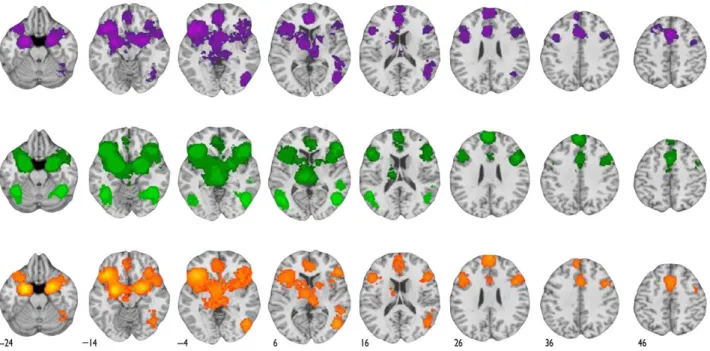
versus“neutral”baselines and“negative”versus“neutral” base-lines using the global null conjunction (Nichols et al. 2005). In es-sence, these are regions of the brain that respond more frequently to positive AND negative valence than to neutral va-lence. Figure2shows the maps for“positive”versus“neutral”
and“negative”versus“neutral”contrasts as well as their con-junction (also see Table2; seeSupplementary Fig. 1for sagittal, coronal, and transaxial views of valence-general regions). Con-sistent with the hypothesis that valence-general voxels make up the brain’s affective workspace, our conjunction revealed va-lence general increases in activity in the bilateral anterior insula, bilateral lateral orbitofrontal cortex, bilateral amygdala, the ven-tral striatum, thalamus, dorsomedial prefrontal cortex (∼BA 9), dorsal ACC, supplementary motor area (∼BA 6), bilateral ventro-lateral prefrontal cortex, and ventro-lateral portions of the right tem-poral/occipital cortex. This set of regions has been referred to as a“salience network,”on the assumption that it is involved in representing the body’s reaction to affective stimuli in the envir-onment (Seeley et al. 2007). In our view, the name“salience net-work”does not imply that there is one process termed“salience”
that is being performed by this network. Rather, based on its anatomical connections, we hypothesize that this network might serve as a body-based form of attention that contributes
flexibly to a wide variety of self-relevant mental phenomena (including, positive and negative“emotions”but also“cognitions”
such as goal-oriented visual attention;Lindquist and Barrett 2012).
Voxels within the Valence-General Affective Workspace that Show Preference for Positive versus Negative Affect or Negative versus Positive Affect
Next, we searched within the valence-general affective work-space for voxels that, despite being valence-general, were rela-tively more likely across studies to show frequent activity for one type of valence than another. These voxels can be thought of as voxels that show a preference to one type of valence versus another, despite the fact that they on the whole respond to both positive and negative affect more frequently than neutral affect. To do so, wefirst sought voxels within the previously identified valence-general affective workspace (the conjunction of positive > neutral and negative > neutral) that had more frequent activity during the“positive”versus“negative”contrasts in our database. We note that these contrasts were independent of the contrasts used to identify the valence-general workspace, providing a rigorous means of testing this hypothesis.
No voxels within the valence-general affective workspace were relatively more likely to respond to positive than negative affect across studies in the literature. We next searched for voxels within the valence-general affective workspace that had more frequent activity during the“negative”versus“positive” con-trasts in our database and observed activation in the left amyg-dala and both ventral and dorsal portions of the left anterior insula (Fig.3and Table2). Voxels within the left amygdala and left anterior insula are therefore relatively more likely to show in-creased activation during negative than positive affect despite the fact that they respond to both positive and negative affect more so than neutral affect. Importantly, this relative distinction does not suggest an absolute distinction, insofar as the voxels identified consistently respond to both positive and negative affect more so than neutral affect across studies.
Distributed Patterns for Positivity and Negativity?
Even if individual brain areas are not functionally selective for positivity or negativity, it is possible that patterns of activity across the brain might reveal evidence for regions with a
functional preference during positivity or negativity. To explore this possibility, we performed a classification analysis across the whole brain using an SVM (Chang and Lin 2011) on the study con-trast maps investigating“negative”versus“neutral”and“positive”
versus“neutral”conditions. Average classification accuracy was 52% (accuracy for positive contrasts = 52%, accuracy for negative contrasts = 52%), and average classification precision was 53% ( precision for positive contrasts = 51%, precision for negative contrasts = 54%). Classification accuracy was not significantly
greater than chance (P> 0.6), meaning that the classifier was un-able to diagnose whether individual contrast maps involved either a“negative”versus“neutral”or a“positive”versus“neutral” com-parison. Together, thesefindings suggest that the distribution of activity in voxels across the brain is also insufficient to classify va-lence. In combination with the otherfindings, the affective work-space may be best considered as valence general; brain regions mayflexibly and interchangeably represent both positivity and negativity across different instances as we discuss later.
Table 2Meta-analytic results
Valence-general regions: intersection of (positive > neutral) and (negative > neutral) contrasts
Proportion of contrasts
Region x y z FDR Positive versus neutral Negative versus neutral
Proportion SE Proportion SE
Dorsomedial Prefrontal cortex −9 51 33 0.10 0.028 0.12 0.020
0 60 27 0.12 0.031 0.13 0.021
−9 57 21 0.11 0.030 0.11 0.020
Ventromedial prefrontal cortex/rostral cingulate cortex
−3 39 0 0.15 0.034 0.09 0.018
Dorsal cingulate cortex 0 15 48 0.14 0.033 0.10 0.019
Supplementary motor area 0 15 57 0.15 0.034 0.12 0.021
Inferior frontal gyrus 48 12 30 0.13 0.032 0.12 0.021
−48 21 18 0.10 0.029 0.12 0.020
48 21 15 0.10 0.029 0.09 0.018
48 30 3 0.13 0.032 0.13 0.021
Declive 42 −60 −21 0.10 0.028 0.13 0.021
Ventral anterior insula extending into lateral orbitofrontal cortex
39 33 −6 0.11 0.029 0.10 0.019
33 21 −6 0.11 0.029 0.10 0.019
42 24 −9 0.11 0.030 0.14 0.022
−39 24 −12 Yes 0.21 0.039 0.20 0.025
−27 15 −18 0.13 0.032 0.13 0.021
Insula/claustrum 33 9 −9 0.11 0.030 0.10 0.019
Middle temporal gyrus 48 −60 3 0.14 0.033 0.15 0.022
Superior temporal gyrus 48 15 −9 0.11 0.030 0.10 0.019
48 6 −15 0.11 0.029 0.09 0.018
Inferior occipital cortex 42 −69 −9 0.12 0.031 0.12 0.020
Amygdala 24 3 −18 Yes 0.22 0.039 0.21 0.026
−27 −6 −18 Yes 0.22 0.039 0.26 0.027
Midbrain −9 −6 −12 0.10 0.029 0.12 0.021
Thalamus 6 −24 0 0.10 0.029 0.12 0.020
−6 −9 −3 0.11 0.030 0.11 0.020
−6 −24 −3 0.09 0.027 0.12 0.021
3 −6 −6 0.10 0.029 0.10 0.019
Nucleus accumbens −9 −12 −6 0.09 0.027 0.05 0.014
Valence-general regions with a preference for negativity: (negative > positive) masked within valence-general areas
Negative versus Positive
Proportion SE
Amygdala −18 −3 −24 Yes 0.22 0.062
Ventral anterior insula −33 24 12 Yes 0.22 0.062
Anterior insula −30 21 −3 0.18 0.058
Dorsal insula −36 12 12 0.15 0.053
Middle frontal gyrus −36 33 9 0.13 0.049
Bipolar regions ( positive > negative) > (positive > neutral) masking out valence-general regions
(Positive versus negative) versus ( positive versus neutral)
Proportion SE
Ventromedial prefrontal cortex 9 39 −9 Yes 0.18 0.00
−18 42 −12 Yes 0.16 0.00
Discussion
Our meta-analysis of the neuroimaging literature on positive and negative affect is the most comprehensive to date and helps to answer questions about valence that have existed in the psycho-logical literature since the 1960s. Although ourfindings can only speak directly to function at the organizational level of topo-graphical regions across the human brain, it remains a possibility that function extends beyond this level of analysis.
Little Evidence for Bipolar or Bivalent Models of Neural Function
Our meta-analysis of neuroimaging studies was thefirst to as-sess bipolar versus bivalent models of affect and revealed little to no support for either model. Our findings suggest that
portions of the ventromedial prefrontal cortex and ACC may serve as candidate ROIs for the bipolarity hypothesis but did not reveal any other brain regions that responded in a bipolar manner. VMPFC/ACC showed greater differences between
“positive affect”versus“negative affect”than it did“positive affect”versus“neutral affect.”Thisfinding suggests there is more dissimilarity between brain responses to positive and negative affect than positive and neutral affect in this region, consistent with a bipolar view. However, we refer to these areas as candidate ROIs because we were only able to test whether this area increased more as positive affect increased (relative to different baselines), but we were unable to test whether it also showed decreasing activity during negative affect. Future studies that incorporate active, yet neutral, base-lines would be helpful to fully test the bipolarity hypothesis. The need for active baseline conditions that provide a suitable
Figure 2.Neural regions consistently associated with valence-general activations. The top and middle rows of thefigure illustrate regions that were frequently correlated with positive versus neutral study contrasts (illustrated in purple) and negative versus neutral study contrasts (illustrated in green), respectively. For these maps, the color codes reflect whole-brain statistical correction at the voxel level (bright purple and bright green) using FDR procedures, or at 2 different cluster-level thresholds (given voxel-levelP-values of 0.05 and 0.01; see Materials and Methods) using FWER procedures. The bottom row of thefigure illustrates valence-general neural regions. These regions were frequently engaged by both positive versus neutral study contrasts and by negative versus neutral study contrasts, as revealed by a conjunction analysis. In common, contrasts that compare positive or negative valence with neutral baselines engage several regions including the dorsomedial prefrontal cortex, supplementary motor area, ventrolateral prefrontal cortex, anterior insula, amygdala, ventral striatum, and thalamus. SeeSupplementary Figure 1for additional views of the valence-general regions.
comparison to conditions of interest is not new in neuroima-ging (Stark and Squire 2001).
The link of VMPFC to positive affect is consistent with other recentfindings. Another recent meta-analysis found relatively more frequent activity in a similar region of VMPFC during positive as compared with negative feelings (but did not exclude valence-general regions;Roy et al. 2012). Regions on the medial orbital surface of the brain (which are slightly more ventral still to the region we observed) are also associated with the represen-tation of reward (Kringelbach and Rolls 2004). A recent study observed that activity in medial OFC, slightly ventral still to the region we observed in our analysis, parametrically increased as participants’self-reported ratings of unpleasantness to evocative scenarios decreased and ratings of pleasure increased ( Wilson-Mendenhall et al. 2014). However, another recent study observed that mean VMPFC/mOFC activity correlates with increasing rat-ings of both the pleasantness and unpleasantness of evocative pictures (Chikazoe et al. 2014).
In contrast, we found no neuroimaging support for the biva-lence hypothesis. Of note, both the bipolar and bivalent hypoth-eses were developed based on human behavioral data and may not translate cleanly into hypotheses about large-scale function-al brain activity. Indeed, function-alternative operationfunction-al definitions of these hypotheses may yield different analytical tests. We cau-tion, however, that it is certainly possible to observe greater activity in brain regions for either positive relative to negative affect or negative relative to positive affect (Liu et al. 2011;Bartra et al. 2013), but this is only evidence that a brain region has a
“relative”preference for one type of valence over another and is not support for the bivalent hypothesis that independent brain systems support positivity and negativity.
A Valence-General Affective Workspace
The bulk of our meta-analytic evidence fell in support of aflexible affective workspace that correlates with both positive and nega-tive valence across instances. Thesefindings suggest that, at the level of regional brain activity, there is no single region or even voxel that uniquely represents positivity or negativity. Limbic tissue, including the anterior insula, rostral ACC/ventromedial prefrontal cortex, dorsal ACC, amygdala, ventral striatum, as well as several other regions including the thalamus and occipitotemporal cortex, appears to contain cells that are part of the brain’s valence-general affective workspace or“affective neur-al reference space”(Barrett and Bliss-Moreau 2009). Consistent with ourfindings, these regions consistently show increased activ-ity across neuroimaging studies when affective valence is being re-presented during emotion experience and perception, pain, aversion, and orgasm (for a review, seeLindquist and Barrett 2012). Importantly, regions in this workspace are involved in representing and regulating activity in the viscera (i.e., interocep-tive cues;Craig 2009). Indeed, the affective workspace is routinely engaged not just when people experience an affective feeling but even in so-called cognitive states when internal sensations in the body, including afferent signals and central nervous system representations, are used to guide the allocation of attention (Corbetta et al. 2008). Given that interoceptive information is the basis of affective feeling and changes across a wide range of mental states, thisfinding is consistent with the hypothesis that every conscious moment has some affective tone(Wundt 1897/1998); circuitry within the affective workspace may infuse each and every conscious moment with some degree of positivity or negativity (for a review, seeCraig 2009;Lindquist and Barrett 2012).
Although no other meta-analyses of neuroimaging data have explicitly compared different models of valence, our valence-general findings are largely consistent with other existing meta-analyses of valence. For instance, like our own meta-ana-lysis,Murphy et al. (2003)did notfind spatial differentiation be-tween the brain activity correlated with experiencing and perceiving positive and negative emotions. The more recent meta-analysis of reward and loss performed byLiu et al. (2011) re-vealed a valence-general affective workspace that is largely simi-lar to our own. In particusimi-lar,Liu et al. (2011)observed activity in the dorsomedial prefrontal cortex, medial orbitofrontal cortex, amygdala, insula, ACC, ventral striatum, brainstem, and thal-amus when participants were anticipating events involving re-ward/loss, experiencing reward/loss or evaluating a reward/ loss. WhereLiu et al.’s (2011)findings differ from our own is in their observation of activity within the posterior cingulate cortex. Posterior cingulate cortex is part of a network involved in project-ing oneself into the future (Buckner and Carroll 2007) and so it is possible that this brain area is linked to the anticipation of reward across studies, but not valence per se. Other recent meta-ana-lyses that examined valence in the context of reward-related tasks (Kuhn and Gallinat 2012;Bartra et al. 2013;Clithero and Rangel 2013) also identified a similar cluster within posterior cin-gulate cortex. Our meta-analysis may not have observed this cluster because our database intentionally did not include stud-ies of reward or loss/punishment (on the basis that these are like-ly distinct phenomena from the representation of valence per se). The fact that we did not include studies of reward versus loss/ punishment in our database could also explain why ourfindings do not replicate those of Kringelbach and Rolls (2004), who focused exclusively on the OFC and identified a medial to lateral spatial trend that corresponded to studies of monetary gain versus loss.
Our meta-analytic neuroimagingfindings, which have both temporal and spatial limitations, are perhaps most importantly convergent with evidence from other methods including electro-encephalography, lesion, electrical stimulation, and neurochem-ical studies in humans and non-human animals. For example, the human P300, an event-related potential originating in the ACC, responds to both positive and negative stimuli (Schupp et al. 2000;Junghofer et al. 2001;Keil et al. 2002;Moratti et al. 2004;Moratti et al. 2011); for a review seeOlofsson et al. (2008). Similarly, human amygdala lesions are related to difficulties in perceiving both fearful (Adolphs et al. 1995) and happy faces (Kipps et al. 2007). Electrical stimulation of the human medial temporal lobe (Halgren et al. 1978) produces experiences of both pleasure and displeasure across instances. Indeed, a more recent review of human intracranial electrophysiological record-ings reveals that when stimulated, limbic, paralimbic, and cor-tical regions produce both positive and negative affective responses across instances (Guillory and Bujarski 2014).
throughout limbic cortex (e.g., the amygdala and orbitofrontal cortex; seeSalzman and Fusi 2010) and have excitatory and inhibitory relationships to one another, then this renders inert the question of whether there truly exists a“positive system”
and“negative system”in the brain.
Consistent with the interpretation that cells for positive and negative affect are spread throughout brain regions,Chikazoe et al. (2014)recently observed populations of neurons within mOFC, lOFC, anterior insula, ACC and ventral temporal cortex that showed population-level coding for positive versus negative affect within the brains of humans. To do so, they used a repre-sentational similarity analysis (RSA) of neuroimaging data to as-sess whether there are correlations between the spatial patterns of brain activity across a given event (e.g., viewing affective pictures) and patterns in the dimensions that characterize those events (e.g., valence ratings of pictures). RSA reveals the structure of representations in terms of distances between re-sponse vectors within a given representational space (Haxby et al. 2014). Rather thanfinding different regions or networks that separately support positivity versus negativity, Chikazoe et al.’sfindings suggest that there are representations for positiv-ity versus negativpositiv-ity both within the same brain region and spread across the brain. In essence, theirfindings, like ours, sug-gest that there are not brain systems for positivity or negativity per se, but populations of neurons within regions across the brain regions that support positive and negative valence.
The fact that Chikazoe et al. (2014) were able to classify patterns for positivity versus negativity within regions across the brain appears to be in conflict with our own pattern classifi ca-tion analysis. However, a closer look reveals that Chikazoe et al.’s
findings are not really so different from our meta-analytic results. First, Chikazoe et al.’s univariate analyses using the general lin-ear model replicate our ownfindings that brain areas such as the mOFC, ACC, insula, and ventral temporal cortex respond to both positive and negative valence across instances. Theirfindings, along with our meta-analyticfindings, indicate that the majority of the BOLD signal within limbic and paralimbic regions of the brain is not in fact valence specific. Chikazoe et al. do show, how-ever, that a small amount of variance at the level of the individual is accounted for byfine-grained spatial patterns within a given region of the brain (e.g., mOFC, mOFC, lOFC, anterior insula, ACC, and ventral temporal cortex). However, Chikazoe et al. are only able to predict patterns between individuals at 5.6% better than chance. What we do not know is how stable this small amount of variance is across studies of different methods. It is also possible that this relatively small proportion of the variance in brain activity actually reflects some other stimulus property that tracks with valence in the stimuli or experimental task that was not controlled for in Chikazoe et al.’s analysis (e.g., arou-sal level is confounded with valence in the International Pictures System;Bradley et al. 2001that was used by Chikazoe et al.). Indeed, standard multivariate analyses are known to systematic-ally admit certain confounds related to the individual or task (e.g., reaction time differences on different trial types) into ana-lyses and as a result canfind spurious patterns of brain activity that are not found with standard univariate analyses or multi-variate analyses that properly control for sources of individual-level variation that are unrelated to the phenomenon of interest (Todd et al. 2013). Arousal was less likely to be a confound in our meta-analysis because we summed across many studies, and whereas some use stimuli that confound valence and arousal (e.g., the International Pictures System), others use other stimuli that may be less likely to confound valence and arousal (e.g., pic-tures of emotional facial expressions). Of course, these questions
remain a topic of future research, which should assess whether the valence-specific similarity-based patterns revealed by Chikazoe et al. are replicable across people, studies, and para-digms. The benefit of the present meta-analysis is that it sum-marizes whether there is valence specificity across people, studies, and paradigms at the level of brain regions. We found that there are not classifiable patterns of brain activity in any re-gion of the brain that corresponds to positivity versus negativity across people, studies, and paradigms. Thisfinding is important because researchers still widely assume that valence specificity is present at the regional brain level (e.g., areas in the salience network form an“aversion network”;Hayes and Northoff 2011). Our meta-analysis thus suggests that assertions about valence specificity are not warranted; it is more appropriate to talk about regions as valence-general. If some regions show relatively more frequent activity for one type of valence over another, as we found, then this meta-analytic finding reflects that region’s relative preference for one type of valence versus another but not valence specificity per se.
Brain Regions within the Affective Workspace with Relative Preference for Negativity
We found several regions that showed a relative preference for negativity over positivity. Within the brain’s affective workspace, the left amygdala and both ventral and dorsal portions of the left anterior insula demonstrated relatively more consistent in-creases during negativity than during positivity—even though responding occurred to both positivity and negativity at levels consistently greater than chance in these regions across studies. No brain activity in any of these regions was classifiable using a pattern classification analysis, however, meaning that there were no identifiable patterns within the affective workspace that can definitively classify whether a study contrast specifically invoked positivity or negativity.
The relatively greater frequency of response for negativity that we observed within the left amygdala and insula might in-stead be related to the negativity bias (Baumeister et al. 2001) that is observed in the behavioral literature: negative valence has greater psychological impact than positive valence when it comes to reactions to life events, outcomes in relationships, and even fundamental psychological processes such as learning and attention. Since negative stimuli recruit relatively more at-tention than positive stimuli (Baumeister et al. 2001), ourfindings converge with literature demonstrating increases in dorsal as-pects of the affective workspace (e.g., dorsal anterior insula and dorsal ACC). This network is also called the“ventral attention network”and is frequently identified during tasks involving vis-ual orienting (for reviews, seeCorbetta et al. 2008;Lagner and Eickhoff 2013). Fluctuations in connectivity strength within the ventral aspects of the affective workspace (ventral anterior insula and pregenual ACC) correlate with subjective reports of arousal while participants look at unpleasant images (Touroutoglou et al. 2012). It thus remains a possibility that the negative stimuli used in experiments tend, on average, to be more subjectively arousing than the positive stimuli, producing the observed nega-tivity bias.
The Role of Arousal
deactivation associated with a valenced state (Larsen and Diener 1992;Salzman and Fusi 2010;Kuppens et al. 2013). This is often a possible interpretation when studies fail to identify differences in mean brain activity to positive versus negative affect (cf., Chikazoe et al. 2014). However,Chikazoe et al.’s (2014)RSA indi-cated that the positive and negative valence of pictures corre-lated with brain patterns that were maximally distinct from one another, suggesting that evidence for valence-general mean brain activity in univariate analyses does not merely reflect arousal (although as we note earlier, it is still possible that the arousal properties of affect could have contributed to Chikazoe et al.’s multivariatefindings).
Nonetheless, the question of whether valence-general activa-tions represent arousal is complex, both theoretically and empir-ically. Statistically, changes in arousal and valence are impossible to separate because affective responses are arrayed as a circumplex, such that changes in valence always accompany some change in arousal (Barrett & Bliss-Moreau 2009). Experi-mentally, valence and arousal are also difficult to separate be-cause most stimuli used to induce positivity or negativity also induce some change in arousal (e.g., the International Affective Picture System;Lang et al. 2005). Theoretically, the concept of arousal, itself, is vague and underspecified. As a psychological property, the term“arousal”is used to refer to enhanced atten-tion, behavioral engagement, intensity of feeling, and/or physio-logical activation. In self-reports of affective experience, valence and arousal are separable properties for some, but not for all, in-dividuals (Feldman 1995). Nonetheless, consistent with this arousal-based interpretation of ourfindings, increased activation within the affective workspace, such as the amygdala ( Wilson-Mendenhall et al. 2013) and the anterior insula (Moriguchi et al. 2014), is associated with more intense subjective experiences of arousal. Stronger intrinsic connectivity within the affective workspace is also associated with more intense experiences of arousal (Touroutoglou et al. 2012). It thus certainly remains a pos-sibility that activity in the brain regions we observed in our meta-analysis is in some way related to the arousing nature of affect.
A possibility that should be further investigated through more specifically controlled neuroimaging studies is that some aspects of the affective workspace encode general arousal and others encode valence more specifically. Ourfindings, in concordance with other recent neuroimaging studies (Wilson-Mendenhall et al. 2013;Chikazoe et al. 2014), suggest that the vmPFC and perhaps more specifically the mOFC is a candidate region for representing the subjective valence of otherwise ambiguous arousal.
Outstanding Questions and Future Directions
Questions about the neural representation of positivity and nega-tivity remain that cannot be addressed by the present meta-ana-lysis. First, as we have discussed throughout, it is possible that there are distributed functional networks that specifically sup-port positive valence and other networks that specifically sup-port negative valence and that these networks have an inhibitory relationship with one another. This hypothesis should be addressed in individual neuroimaging studies using function-al connectivity anfunction-alyses. It is sometimes assumed that neurfunction-al
“deactivations”can be harnessed to assess inhibition between brain regions in neuroimaging studies, but there are several rea-sons why“deactivations”would not help address this hypothesis in the context of a analysis. As is standard in many meta-analyses of neuroimaging studies (e.g.,Vytal and Hamann 2010; Lindquist, Wager, Kober et al. 2012), our database did not include contrasts reporting neural “deactivations” because they are
reported infrequently across individual studies. Furthermore,
“deactivations”are problematic because their interpretation depends on what other condition they are compared with (i.e., they might not represent“deactivation”per se; for a discussion, seeLindquist, Wager, Bliss-Moreau et al. 2012). More generally, since it is not clear whether BOLD activity generally reflects activations, inhibitions, or both, this hypothesis seems un-answerable by neuroimaging. Second, it remains a possibility that specificity will be observed at morefine-grained levels of analysis. AsChikazoe et al. (2014)demonstrate, positivity and negativity are represented by distributed populations of neurons spread throughout a given brain region. It might thus be more fruitful to regard function (i.e., the representation of positivity and negativity) as emerging out of populations of cells that inter-act with one another to produce a given mental representation in a given context. Of course, what we do not know fromChikazoe et al. (2014)is whether the same cells within the mOFC, lOFC, insula and ACC consistently represent positivity and negativity on every instance or whether they show degeneracy, with a sin-gle cell representing positive affect on 1 occasion and negative affect on another. Degeneracy occurs when different structures (i.e., cells and brain regions) perform the same function across instances (Edelman and Gally, 2001). The degenerate representa-tion of valence would also ultimately be consistent with the valence-general affective workspace but appears unanswerable by neuroimaging. Non-human animal research that addresses this question seems to suggest that valence specificity is not the rule at the level of single cells, however.
These limitations notwithstanding, ourfindings make a key contribution toward understanding how valence is represented in regional brain activity. Twenty years after the advent of neuroi-maging technology, the body of neuroineuroi-maging data suggests that the interpretation of behavioral data might be leading research-ers to ask the wrong questions when it comes to the brain basis of valence. Although people can experience positivity and nega-tivity as distinct states that contribute independently to attitudes and decisions (consistent with a bivalent view;Watson and Tellegen 1985;Cacioppo et al. 1999;Norris et al. 2010), they can also experience them as negatively correlated across instances (consistent with a bipolar view;Larsen and Diener 1992;Carroll et al. 1999). Yet, neither of these observations means that the brain is divisible into separate positive and negative systems or consists of a single system that encodes opposing positive and negative states. To assume so would be to conflate the content of experience (feelings of ambivalence or feelings of opposition between positivity and negativity) with the processes that produce those experiences.
Supplementary Material
Supplementary material can be found at: http://www.cercor. oxfordjournals.org/
Funding
This work was supported by National Institute of Health Director’s Pioneer Award (DP1OD003312) and by the U.S. Army Research Institute for the Behavioral and Social Sciences (contract W5J9CQ-11-C-0046) awarded to L.F.B.Conflict of Interest
Notes
Department of the Army of DOD position, policy, or decision.
Conflict of Interest: None declared.
References
Adolphs R, Tranel D, Damasio H, Damasio AR. 1995. Fear and the human amygdala. J Neurosci. 15:5879–5891.
Barrett LF, Bliss-Moreau E. 2009. Affect as a psychological primi-tive. Adv Exp Soc Psychol. 41:167–218.
Barrett LF, Russell JA. 1998. Independence and bipolarity in the structure of current affect. J Pers Soc Psychol. 74:967–984. Barrett LF, Russell JA. 1999. Structure of current affect. Curr Direct
Psychol Sci. 8:10–14.
Bartra O, McGuire JT, Kable JW. 2013. The valuation system: a coordinate-based meta-analysis of BOLD fMRI experiments examining neural correlates of subjective value. Neuroimage. 76:412–427.
Baumeister RF, Bratslavsky E, Finkenauer C, Vohs KD. 2001. Bad is stronger than good. Rev Gen Psychol. 54:323–370.
Belova MA, Paton JJ, Salzman CD. 2008. Moment-to-moment track-ing of state value in the amygdala. J Neurosci. 28:10023–10030. Berntson GG, Cacioppo JT, Quigley KS. 1991. Autonomic deter-minism: the modes of autonomic control, the doctrine of autonomic space, and the laws of autonomic constraint. Psychol Rev. 98:459–487.
Biswal BB, Mennes M, Zuo XN, Gohel S, Kelly C, Smith SM, Beckmann CF, Adelstein JS, Buckner RL, Colcombe S, et al. 2010. Toward discovery science of human brain function. Proc Natl Acad Sci USA. 107:4734–4739.
Bliss-Moreau E, Bauman MD, Amaral DG. 2011. Neonatal amyg-dala lesions result in globally blunted affect in adult rhesus macaques. Behav Neurosci. 125:848–858.
Bradley MM, Codispoti M, Cuthbert BN, Lang PJ. 2001. Emotion and motivation I: defensive and appetitive reactions in picture processing. Emotion. 1:276–298.
Buckner RL, Carroll DC. 2007. Self-projection and the brain. Trends Cog Sci. 11:49–57.
Cacioppo JT, Gardner WL, Berntson GG. 1999. The affect system has parallel and integrative processing components: form follows function. J Pers Soc Psychol. 76:839–855.
Carroll JM, Yik M, Russell JA, Barrett LF. 1999. On the psychometric principles of affect. RevGen Psychol. 3:14–22.
Chang C, Lin C. 2011. LIBSVM: a library for support vector machines. ACM Transact Intell Syst Technol. 2:1–27. Chikazoe J, Lee DH, Kriegeskorte N, Anderson AK. 2014.
Popula-tion coding of affect across stimuli, modalities and indivi-duals. Nat Neurosci. 17:1114–1122.
Clithero JA, Rangel A. 2013. Informatic parcellation of the network involved in the computation of subjective value. Soc Cogn Affect Neurosci. 9:1289–1302.
Corbetta M, Patel G, Shulman GL. 2008. The reorienting system of the human brain: from environment to theory of mind. Neuron. 58:306–324.
Craig AD. 2009. How do you feel–now? The anterior insula and human awareness. Nat Rev Neurosci. 10:59–70.
Edelman GM. 1989. The Remembered Present: a Biological Theory of Consciousness. New York: Basic Books.
Edelman GM, Gally JA. 2001. Degeneracy and complexity in bio-logical systems. Proc Natl Acad Sci USA. 98:13763–13768. Farroni T, Menon E, Rigato S, Johnson MH. 2007. The perception
of facial expressions in newborns. Eur J Develop Psychol. 4:2–13.
Feldman LA. 1995. Variation in the circumplex structure of affect. Personal Soc Psychol Bull. 21:806–817.
Guillory SA, Bujarski KA. 2014. Exploring emotions using invasive methods: review of 60 years of human intracranial electro-physiology. Soc Cogn Affect Neurosci. 9:1880–1889.
Halgren E, Walter RD, Cherlow DG, Crandall PH. 1978. Mental phe-nomena evoked by electrical stimulation of the human hippo-campal formation and amygdala. Brain. 101:83–115. Haxby JV, Connolly AC, Guntupalli JS. 2014. Decoding neural
rep-resentational spaces using multivariate pattern analysis. Annu Rev Neurosci. 37:435–456.
Hayes DJ, Northoff G. 2011. Identifying a network of brain regions involved in aversion-related processing: across species trans-lational investigation. Front Integr Neurosci. 5:1–21.
Junghofer M, Bradley MM, Elbert TR, Lang PJ. 2001. Fleeting images: a new look at early emotion discrimination. Psychophysiology. 38:175–178.
Keil A, Bradley MM, Hauk O, Rockstroh B, Elbert T, Lang PJ. 2002. Large-scale neural correlates of affective picture processing. Psychophysiology. 39:641–649.
Kipps CM, Duggins AJ, McCusker EA, Calder AJ. 2007. Disgust and happiness recognition correlate with anteroventral insula and amygdala volume respectively in preclinical huntington’s disease. J Cogn Neurosci. 19:1206–1217.
Kober H, Barrett LF, Joseph J, Bliss-Moreau E, Lindquist KA, Wager TD. 2008. Functional grouping and cortical-subcortical interactions in emotion: a meta-analysis of neuroimaging studies. Neuroimage. 42:998–1031.
Kober H, Wager TD. 2010. Meta-analyses of neuroimaging data. Wiley Interdiscipl Rev. 1:293–300.
Kringelbach ML, Rolls ET. 2004. The functional neuroanatomy of the human orbitofrontal cortex: evidence from neuroimaging and neuropsychology. Prog Neurobiol. 72:341–372.
Kuhn S, Gallinat J. 2012. The neural correlates of subjective pleas-antness. Neuroimage. 61:289–294.
Kuppens P, Tuerlinckx F, Russell JA, Barrett LF. 2013. The relation-ship between valence and arousal in subjective experience. Psychol Bull. 139:917–940.
Lagner R, Eickhoff SB. 2013. Sustaining attention to simple tasks: a meta-analytic review of the neural mechanisms of vigilant attention. Psychol Bull. 139:870–900.
Lang PJ, Bradley MM. 2010. Emotion and the motivational brain. Biol Psychol. 84:437–450.
Lang PJ, Bradley MM, Cuthbert BN, et al. 2005. International Affective Picture System (IAPS): Affective Ratings of Pictures and Instruction Manual. Gainesville, FL: NIMH, Center for the Study of Emotion & Attention.
Larsen JT, McGraw AP, Cacioppo J. 2001. Can people feel happy and sad at the same time? J Pers Soc Psychol. 81:684–696. Larsen JT, McGraw AP, Mellers BA, Cacioppo JT. 2004. The agony
of victory and the thrill of defeat: Mixed emotional reactions to dissapointing wins and releiving losses. Psychol Sci. 15:325–330.
Larsen RJ, Diener E. 1992. Promises and Problems with the Circumplex Model of Emotion. Newbury Park, CA: Sage. p. 25–59. Leknes S, Tracey I. 2008. A common neurobiology for pain and
pleasure. Nat Rev Neurosci. 9:314–320.
Lewis M. 1993. The emergence of human emotions. In: Lewis M, Haviland-Jones JM, editors. Handbook of Emotions. 2 ed. New York: Guilford. p. 253–322.
Lindquist KA, Barrett LF. 2012. A functional architecture of the human brain: Insights from emotion. Trends Cog Sci. 16: 533–554.