M
ANAGING
P
UBLIC
S
ECTOR
R
ECORDS
A Training Programme
T
he
M
anagement of
P
ublic
S
ector
R
ecords:
P
rinciples and
C
ontext
M
ANAGINGP
UBLICS
ECTORR
ECORDS:
A
S
TUDYP
ROGRAMMET
HE
M
ANAGEMENT OF
P
UBLIC
S
ECTOR
M
ANAGING
P
UBLIC
S
ECTOR
R
ECORDS
A
S
TUDY
P
ROGRAMME
General Editor, Michael Roper; Managing Editor, Laura Millar
T
HE
M
ANAGEMENT OF
P
UBLIC
S
ECTOR
R
ECORDS
:
P
RINCIPLES AND
C
ONTEXT
M
ANAGINGP
UBLICS
ECTORR
ECORDS:
A
S
TUDYP
ROGRAMME The Management of Public Sector Records: Principles and Context© International Records Management Trust, 1999. Reproduction in whole or in part, without the express written permission of the International Records Management Trust, is strictly prohibited.
Produced by the International Records Management Trust 12 John Street
London WC1N 2EB UK
Printed in the United Kingdom.
Inquiries concerning reproduction or rights and requests for additional training materials should be addressed to
International Records Management Trust
12 John Street London WC1N 2EB UK Tel: +44 (0) 20 7831 4101 Fax: +44 (0) 20 7831 7404 E-mail: [email protected] Website: http://www.irmt.org Version no. 1/1999MPSR Project Personnel
Project Director
Anne Thurston has been working to define international solutions for the management of public sector records for nearly three decades. Between 1970 and 1980 she lived in Kenya, initially conducting research and then as an employee of the Kenya National Archives. She joined the staff of the School of Library, Archive and Information Studies at University College London in 1980, where she developed the MA course in Records and Archives Management (International) and a post-graduate research programme. Between 1984 and 1988 she undertook an onsite survey of record-keeping systems in the Commonwealth. This study led to the foundation of the International Records Management Trust to support the development of records management through technical and capacity-building projects and through research and education projects.
General Editor
Michael Roper has had a wide range of experience in the management of records and archives. He served for thirty-three years in the Public Record Office of the United Kingdom, from which he retired as Keeper of Public Records in 1992. He has also taught on the archives courses at University College London and the University of British Columbia, Canada. From 1988 to 1992 he was Secretary General of the International Council on Archives and since 1996 he has been Honorary Secretary of the Association of Commonwealth Archivists and Records Managers (ACARM). He has undertaken consultancy missions and participated in the delivery of training programmes in many countries and has written extensively on all aspects of records and archives management.
Managing Editor
Laura Millar has worked extensively not only as a records and archives management consultant but also in publishing and distance education, as an editor, production manager and instructional designer. She received her MAS degree in archival studies from the University of British Columbia, Canada, in 1984 and her PhD in archival studies from the University of London in 1996. She has developed and taught archival education courses both in Canada and internationally, including at the University of British Columbia, Simon Fraser University and the University of Alberta. She is the author of a number of books and articles on various aspects of archival management, including A Manual for Small Archives (1988), Archival Gold: Managing and Preserving Publishers’ Records (1989) and A Handbook for Records Management and College Archives in British Columbia (1989).
Project Steering Group
Additional members of the Project Steering Group include Association of Records Managers and
Administrators (ARMA International): Hella Jean Bartolo International Council on Archives: George MacKenzie
Project Management Consultant: Tony Williams
University College London: Elizabeth Shepherd
Video Production Co-ordinator: Janet Rogers
Educational Advisers
Moi University: Justus Wamukoya
Universiti Teknologi Mara: Rusnah Johare
University of Botswana: Nathan Mnjama
University of Ghana: Harry Akussah, Pino Akotia
University of New South Wales: Ann Pederson
University of West Indies: Victoria Lemieux
Project Managers
Lynn Coleman (1994-6) Laura Millar (1996-7) Elizabeth Box (1997-8) Dawn Routledge (1999)Production Team
Additional members of the production team include Jane Cowan Nicki Hall Greg Holoboff Barbara Lange Jennifer Leijten Leanne Nash
Donors
The International Records Management Trust would like to acknowledge the support and assistance of the following:
Association of Records Managers and Administrators (ARMA International) British Council
British High Commission Ghana British High Commission Kenya
Caribbean Centre for Development Administration (CARICAD) Canadian International Development Agency (CIDA)
Commonwealth Secretariat
Department for International Development (East Africa) Department for International Development (UK)
DHL International (UK) Limited
Foreign and Commonwealth Office Human Rights Fund Hays Information Management
International Council on Archives Nuffield Foundation
Organisation of American States Royal Bank of Scotland
The Management of Public Sector Records:
Principles and Context
Principal Author
LAURA MILLAR
For information on Laura Millar, see her biography above as Managing Editor. Contributors
Michael Cook
Rosemary Murray Lachapelle Michael Roper
Anne Thurston. Reviewers
Rick Barry, Barry Associates, US
Christian Cook, Simon Fraser University, Canada Richard Valpy, Northwest Territories Archives, Canada Testers
Belize Archives Department
Department of Archives, The Bahamas
Kenya National Archives and Documentation Services National Archives of Ghana
National Archives of Malawi National Archives of Malaysia National Archives of Malta National Archives, Singapore
National Records Service, The Gambia St Lucia National Archives
State Archives and Heraldic Services, South Africa University of Botswana
University of Legon, Ghana
C
ONTENTS
Introduction 1
Lesson 1 Theories and Principles of Records and
Archives Management 5
Lesson 2 Recognising Records as a Strategic Resource 33
Lesson 3 Developing an Integrated Records
Management Programme 55
Lesson 4 Restructuring Existing Systems 68
Lesson 5 Key Activities in Records and Archives Management 89
Lesson 6 Supporting and Sustaining an Integrated
Records Management Programme 121
F
IGURES
1. The Life-cycle Concept of Records 19
2. Four Actions of Records Care 20
3. The Continuum Approach to Managing Records through the Life Cycle 22
4. Levels of Arrangement and Description 26
5. Governance Objectives and Records 35
6. Assumptions and Realities about Records Care 43
7. The Hierarchy of Information Management 56
8. Stages of an Integrated Records Management Programme 62 9. Key Activities in the Development of an
Integrated Records Management Programme 63
10.Location of the Records Management Unit within an Agency 79 11.Sample Strategic Plan for the ‘Republic of Erewhon’ 84
12.Requirements of a Filing System 94
13.Classification and Coding Scheme 96
14.Sample Records Retention and Disposal Schedule 98
I
NTRODUCTION
I
NTRODUCTION TO
T
HE
M
ANAGEMENT OF
P
UBLIC
S
ECTOR
R
ECORDS
:
P
RINCIPLES
AND
C
ONTEXT
The Management of Public Sector Records: Principles and Context outlines the purpose of records and archives management and defines the key terminology, theories and principles underpinning records and archives care. The module examines the importance of good record keeping, particularly within the public sector, and discusses the need to manage information as a strategic resource. It also presents a rationale for developing an integrated records management programme. It discusses the work involved in restructuring existing information and records systems and then outlines the key activities undertaken in records and archives management. It concludes with a discussion of the importance of supporting and sustaining an integrated records management programme.
The information presented in this and the other modules can be used in government, corporate, organisational or personal settings; the principles apply equally whether the agency is public or private. Many examples, including the fictitious ‘Erewhon National Archives’, are based on government situations, but the concepts illustrated should be easily applied to non-government situations or local or regional government environments.
This module discusses records care in terms of ‘best practice’, offering information and proposing actions that would result in the ‘ideal’ information management programme. However, it is recognised that the development and implementation of new systems and procedures is a time-consuming process. You should learn from this module what actions could be taken; subsequent modules will discuss how to prioritise your programmes and improve your existing practices.
As you read through this module, remember that it offers an introduction to and overview of information described in more detail in other modules. In order to gain a clear overview of the steps involved in the ‘ideal’ information management programme, you are encouraged to complete this module in its entirety before progressing to the other modules in this study programme. But do not expect this module to address all issues in detail; you will need to move on to other modules for more information on specific topics such as managing current records, electronic records management, preservation and so on.
Remember, all topics introduced here are discussed in more detail in the other modules in this study programme.
The Management of Public Sector Records: Principles and Context consists of seven lessons:
Lesson 1: Theories and Principles of Records and Archives Management Lesson 2: Recognising Records as a Strategic Resource
Lesson 3: Developing an Integrated Records Management Programme Lesson 4: Restructuring Existing Systems
Lesson 5: Key Activities in Records and Archives Management
Lesson 6: Supporting and Sustaining an Integrated Records Management Programme
Lesson 7: What to Do Next?.
A
IMS AND
O
UTCOMES
Aims
This module has seven primary aims. These are
1. to explain the purpose of records and archives management
2. to outline the theories and principles of records and archives management
3. to outline the importance of managing records for government accountability and the value of seeing records as a strategic resource
4. to outline the key organisational and administrative issues necessary to understanding and restructuring records and archives management within government
5. to outline the key activities in records care
6. to explain the steps that may be taken to support and sustain an integrated records management programme
Outcomes
When you have completed this module, you will be able to 1. explain the purpose of records and archives management
2. understand the theories and principles of records and archives management 3. understand the importance of managing records for government accountability 4. recognise the value of records as a strategic resource
5. understand organisational and administrative issues relating to records and archives management
6. explain the key activities in records care
7. understand the steps involved with developing an integrated records management programme
8. know how to find information on records issues.
M
ETHOD OF
S
TUDY AND
A
SSESSMENT
This module of seven lessons should occupy about 80 hours of your time. You should plan to spend about:
15 hours on Lesson 1 15 hours on Lesson 2 8 hours on Lesson 3 12 hours on Lesson 4 15 hours on Lesson 5 8 hours on Lesson 6 7 hours on Lesson 7.
This includes time spent doing the reading and considering the study questions.
At the end of each lesson there is a summary of the major points. Sources for additional information are provided in Lesson 7.
Throughout each lesson, activities have been included to help you think about the information provided. Each activity is a ‘self-assessed’ project; there is no ‘right’ or ‘wrong’ answer. Rather, the activity is designed to encourage you to explore the ideas presented and relate them to the environment in which you are studying or working. If you are studying these modules independently and are not part of a records or archives management organisation, you should try to complete the activities with a hypothetical situation if possible. If the activity suggests writing something, you should keep this brief and to the point; this is not a marked or graded exercise and you should only spend as much time on the activity as you feel necessary to understand the information being taught. At the end of each lesson are comments on the activities that will help you assess your work.
Following the summary at the end of each lesson are a number of self-study questions. Note that these self-study questions are designed to help you review the material in this module. They are not intended to be graded or marked exercises. You should complete as many of the questions as you feel will help you to understand the concepts presented. External assessments, such as assignments or exams, will be included separately when this module becomes part of a graded educational programme.
W
HAT
R
ESOURCES
W
ILL
Y
OU
N
EED
?
This is an introductory module and anyone working through this should not require any additional resources to understand the concepts and ideas expressed here. However, the module will assume that you have access to a records office, records centre or archival institution or that you have some involvement with the management of records; the various activities may ask you to draw on your own experiences and compare those with the information provided in the lessons. If you do not have access to such facilities, you may need to develop a fictitious scenario for your activities. Alternately, you may wish to discuss this module with friends or colleagues who work with records and archives so that you can discuss principles and concepts with them and compare your understanding with theirs.
Case Studies
The following case studies may be useful additions to this module:
27: Terry Cook, Ed Dahl and Ann Pederson, Australia and Canada. ‘Living with Your Conscience at the End of the Day: Ethical Issues and Archives/Records Managers.’
29: Ann Pederson, Australia. ‘Advocacy/Marketing for Record Keeping: A Case Study.’
L
ESSON
1
T
HEORIES AND
P
RINCIPLES OF
R
ECORDS
AND
A
RCHIVES
M
ANAGEMENT
Lesson 1 examines the central theories of records and archives management, particularly within the context of the public sector. It defines records and archives and outlines the purpose and nature of managing them. It then explains the key principles governing records care and discusses their importance in an integrated records management system.
The lesson considers the following questions. • What is information?
• What are records? • Who uses records?
• What is the principle of respect des fonds?
• What are the principles of provenance and original order? • What is the concept of the life cycle of the record?
• What is the concept of a continuum of care?
• What are the levels of arrangement and description of records?
W
HAT
I
S
I
NFORMATION
?
Information is knowledge that human beings perceive through one or more of their senses. It remains intangible until it is represented in a formal manner as data. When represented as data in a document, information can then be stored, communicated and used.
Information: Knowledge that is communicated.
Data (pl.): The representation of information in a formalised manner suitable for communication, interpretation and processing, generally by a computer system. Note: the term ‘raw data’ refers to unprocessed information.
Information is not tangible until it is represented as data or recorded in a document.
Activity 1
Think of three types of ‘information’ you receive every day. Then think of three types of information that are converted into data. Can any of the information be converted into documents? Write down your answers so that you can look back on them later if you wish.
W
HAT
A
RE
R
ECORDS
?
Activity 2
Before reading further, write down in your words the meaning of the term ‘records’. What do you think records are? Why are records different from information? List as many different types of records as you can think of.
The term ‘records’ includes all the documents that institutions or individuals create or receive in the course of administrative and executive transactions. The records themselves form a part of or provide evidence of such transactions. As evidence, they are subsequently maintained by or on behalf of those responsible for the transactions, who keep the records for their own future use or for the use of their successors or others with a legitimate interest in the records. Although records may ultimately have significant research value, they are not created in the interests of or for the information of archivists or future researchers.
Record: A document regardless of form or medium created, received, maintained and used by an organisation (public or private) or an individual in pursuance of legal obligations or in the transaction of business, of which it forms a part or provides evidence.
Records come in a wide variety of forms. Most are still created on paper, in the form of correspondence, minutes, reports and memoranda, and they are normally filed systematically. In addition, information may be recorded on paper in ledgers, registers, notebooks, appointment diaries and other volumes, or they may be in the form of maps and plans (cartographic records), architectural and engineering drawings, pictures (iconographic records) or computer printouts. Such records may be handwritten (manuscript), hand-drawn, typed (typescript) or printed.
Records may also be created on media other than paper: in roll microfilm, microfiche or computer output microfiche (COM) formats (microforms); as photographs, including prints, negatives, transparencies and x-ray films; as sound recordings on disk or tape; as moving images on film or video (audiovisual records); as electronic text or images copied on magnetic tape or magnetic or optical disk or held in online databases (electronic records; formerly known as machine-readable records); as three-dimensional models, scientific specimens or other objects; or as combinations of any of the above formats in an electronic form (multimedia).
All of these items are records if they were created by individuals or agencies in the course of their business or activities.
Records are documents created or received by institutions or individuals in the course of administrative and executive
transactions.
The Nature of Records
While all records convey information, not all sources of information are necessarily records. For example, a published book or an externally provided database (on- or offline) will not be a record, although information selected from it and reused in a new context may itself become a record.
Records arise from actual happenings; they are a ‘snapshot’ of an action or event. They offer a picture of something that happened. Records have four important qualities or characteristics. They are static in form; they have authority; they are unique; and they are authentic.
Records are Static
During the process of creating a record, a document will go through a phase of development and change. For example, minutes of a meeting will be produced in draft form and reviewed by the members of the committee before being approved. Once this process of creation, or drafting, is finished and the document is considered complete, it may be regarded as a record. In order to provide evidence, the record must now be fixed and must not be susceptible to change. If a record is changed or manipulated in some way, it no longer provides evidence of the transaction it originally documented. If someone alters the minutes of a meeting after they have been approved, the minutes can no longer be considered an accurate record of the meeting.
However, drafts themselves, such as the draft minutes, may be considered ‘records’, since they can be considered completed documents at a certain stage of development; that is, as draft minutes.
Records should be static.
Records Have Authority
Records provide the ‘official’ evidence of the activity or transaction they document. Records must be reliable and trustworthy. The reliability of a record is linked to its creation. Who generated or issued the record? Under what authority? Can this authority be proved? Consider again the case of the draft and final minutes. The committee has the authority to confirm that the minutes represent accurately the events of the meeting. If someone changed the minutes after the committee had approved them, he or she perhaps did not have the authority; those revised minutes may be evidence of that person’s view of the meeting but they are not the ‘official’ record of the meeting, as authorised by the committee.
Signatures, letterheads, seals and office stamps are obvious indicators of the official nature of records. However, not all records have official stamps or seals. The continuous safekeeping of records can also protect their reliability. If the official version of the minutes is filed by the records manager and thus protected from change, the unauthorised version will not form part of the official record. The authority of the official version will remain intact.
Records Are Unique
Records are unique in the sense that, maintained in their appropriate context, they are a component in a unique compilation or sequence of transactions. Records are not isolated bits of information. They have meaning because they were generated during a particular transaction or business process. The records make sense within the context of the overall functions and activities of the individual or organisation that created or used them. They have a relationship with other records that makes them unique. The minutes may not be ‘unique’ in that there may be ten copies made available to all members of the committee. But the minutes are unique within the context of that organisation, because the official copy represents one event – the meeting – that only took place with those committee members on that day at that place.
Copies of a record may be unique within another context. For example, if one member of the committee gives his copy of the minutes to a colleague, with a cover note suggesting that the format used for minute-taking may be of value to the colleague’s organisation, those minutes become a new record. They are part of a separate set of transactions between that one member and his colleague. For this reason, the context of the record (the activity and authority that gave rise to it) is vital and must be preserved. Only by knowing how and why a record was created and used can its contents be fully understood.
Records should be unique.
Records Are Authentic
It must be possible to prove that records are what they say they are. The authenticity of a record is derived from the record-keeping system in which it was created or received, maintained and used. A record is authentic if it can be verified that it is now exactly as it was when first transmitted or set aside for retention. For example, a letter received in an office may be date-stamped, registered and placed on a file. The file containing the letter is tracked throughout its use and stored when not in use in a records office.
Think again of the minutes. In order to prove that the ‘official’ minutes are in fact authentic, it is necessary to be able to show that they were produced, approved and then filed appropriately in the organisation’s record-keeping system. Without this process for authenticating records, the ‘unofficial’ version produced by that one member after the fact could be mistaken for the official record.
Records today may be produced in a range of systems and stored in a range of media, including paper and electronic forms; different versions may be stored in different media in different locations. One of the dangers today, with the advent of sophisticated information technologies such as computers, is that information can be extracted from the record that originally conveyed it and taken out of its context.
An electronic version of the minutes can be altered and could replace the original version without anyone noticing the difference. Similarly, new versions of the minutes could be made using electronic technologies, just as in the examples earlier, and as a result no copy can be guaranteed to be authentic.
Consider another example. A government department may be responsible for buildings and physical plant maintenance; as part of its responsibilities, it might create architectural plans for a new building. It might also take photographs of that building as it is built and it might create minutes and reports of various stages of construction. Each type of material is a record. The architectural drawings, photographs, and minutes gain meaning as records by being retained as part of the entirety of records relating to the construction of that particular building. The materials would lose their meaning if they were removed from the whole body of records relating to the work of that government department and kept as single items, without information about their origins or context.
Records should be authentic.
Activity 3
Look at how two types of records – reports and correspondence – are created, used, maintained and stored in your organisation. Explain if you believe these types of records are static in form. Do they have authority and how is that authority provided? Are they unique? How? Are they authentic? How is that authenticity guaranteed? Be as descriptive as possible in your explanations.
P
UBLIC AND
P
RIVATE
R
ECORDS
Records are created by all sorts of people and institutions. Individuals, families, businesses, associations and groups, political parties and governments all create and use records every day. Records created by government agencies or other institutions within the public sector are usually specifically designated as ‘public records’; their management is — or ought to be — governed by legislation, which determines how they are to be managed throughout their life.
Public records: Records created or received and
maintained in any public sector agency.
Private records: Records created, received and
maintained by non-governmental organisations, families or individuals relating to their private and public affairs.
It is a primary responsibility of government to care for its own public records, particularly when those records are needed for the administration of government services. However, it is often the case that central archival institutions, such as National Archives, Provincial or State Archives or University Archives, acquire and preserve private records for use by members of the public.
When acquiring privately created records, repositories may have to consider issues of confidentiality or privacy. In general, whether the repository cares only for its own government or corporate records or acquires a broader range of materials, the agency must adhere to principles of access and codes of ethics laid down in legislation or in corporate or professional guidelines.
It is a primary responsibility of government to care for its own records.
Records and Archives
Many records are kept by an organisation for only a short time, to provide evidence or information for the creating agency. Other records have a longer value, as evidence of or information about the actions or functions of an agency over time. Those records worth preserving for their enduring value are called ‘archives’. Archives are normally preserved in an archival institution.
Archives: Records, usually but not necessarily
non-current records, of enduring value selected for permanent preservation. Archives will normally be preserved in an archival repository.
Archival institution: The agency responsible for
selecting, acquiring, preserving, and making available archives. Also known as an archival agency, archival facility or archives; sometimes referred to as an archival repository.
Archival repository: A building or part of a building in
which archives are preserved and made available for consultation. Also known as an archives.
Records can be identified as archival at the time of their creation, indeed even before their creation, but they are usually not transferred to an archival repository for permanent preservation until they have ceased to be of immediate administrative use to the creating agency.
In this module, the terms ‘archival repository’ and ‘archival institution’ are used interchangeably to mean the organisation responsible for acquiring, preserving and making available archival materials. The term ‘National Archives’ has been used when referring specifically to a national archival institution. The term ‘archives’ refers to the materials themselves.
Activity 4
Imagine you are responsible for determining which records in your organisation have ongoing value and which do not. In your own words, explain in detail whether each of the following records should be considered archives and why.
a draft report on procedures for parking at the office a final report on procedures for parking at the office extra copies of correspondence
copies of correspondence with handwritten notes in the margin master copies of correspondence
a draft report on revisions to legislation that defines the department’s work a final report on revisions to legislation that defines the department’s work original signed contracts for provision of janitorial services
original signed contracts for a legislative consultant to assist with revisions to the legislation that defines the department’s work.
W
HO
U
SES
R
ECORDS
?
Within both government and the private sector, records are created and used on a daily basis to document actions, confirm decisions, identify rights and responsibilities and communicate information. Without records, governments and businesses today could not operate. It is no longer possible to ‘remember’ vast quantities of information without creating an independent account: a record.
Governments use records for such wide-ranging purposes as • documenting the work of employees
• confirming pensions, leave and health benefits • confirming or reviewing policies and procedures
• confirming citizens’ rights, such as benefits or land ownership • providing information about past actions or decisions.
On behalf of the citizens of a country, government employees rely on records to provide core information for conducting their public business.
While many of those records do not need to be kept permanently, a small but significant portion have enduring value. It is this portion of a government’s records that are preserved within public archival institutions. Together with a country’s National Library, National Museum and other national institutions, the National Archives is one of the country’s essential research resources. Users come to it from all sectors. Other government archival facilities, such as state or provincial archival institutions, or private-sector archival facilities in businesses or associations, are equally important research resources.
Activity 5
Before reading further, write down as many different types of users you can think of who might want to access information in an archival institution. Think as creatively as possible and identify as many types of people as possible.
Typical users in national and other archival institutions include
• government representatives requiring information about government activities • professional or academic researchers from a wide range of disciplines
• journalists
• amateur researchers • genealogists
• members of the public
• others wishing to have some contact with the primary sources of their national culture and tradition
• anyone with an urgent problem that can only be solved by referring to records. Equally, corporate, organisational or local archival institutions hold records of research use to a wide variety of people.
An archival institution — national, local or corporate — is useful not just to the nation and its citizens. There is international interest in the health and efficiency of a country’s archival repository and the records it protects. Many issues documented by public and private records are of international concern.
The following are examples of such issues that are documented by records that should be accessible, most likely in a National Archives:
• citizenship rights and responsibilities • medical and health concerns
• intergovernmental politics • economic planning.
A significant number of users of any national or other major archival institutions are researchers from other countries. This use of archival facilities will continue to grow in importance as international information networks develop and as the international community increasingly recognises its need to share information about culture and heritage.
Records can be used by anyone, from government officials and academic researchers to genealogists and members of
the public.
P
RINCIPLES OF
R
ECORDS AND
A
RCHIVES
C
ARE
Records should be well managed in order to ensure they are protected for both administrative purposes and to serve as evidence of the organisation’s work. The process of caring for records is known as records management.
Records management: That area of general
administrative management concerned with achieving economy and efficiency in the creation, maintenance, use and disposal of the records of an organisation throughout their entire life cycle and in making the information they contain available in support of the business of that organisation.
The care of records and archives is governed by four important concepts introduced here. These are (1) that records must be kept together according to the agency responsible for their creation or accumulation, in the original order established at the time of their creation; (2) that records follow a life cycle; (3) that the care of records should follow a continuum; and (4) that records can be organised according to hierarchical levels in order to reflect the nature of their creation.
These principles and concepts are known as • the principle of respect des fonds
• the life-cycle concept • the continuum concept
• the principle of levels of arrangement and description.
These principles and concepts are also discussed in other modules; the information provided here should familiarise you with the concepts.
The Principle of Respect des Fonds
One of the longstanding principles of records and archives management is the concept of respect des fonds. Originally a French term, respect des fonds is often defined simply as ‘respect for the creator of the records.’ The principle of respect des fonds consists of two related concepts: provenance and original order. Provenance refers to the ‘office of origin’ of the records; original order refers to the order and organisation in which the documents were created or stored by that office of origin.
Respect des fonds: Respect for the creator of the
records or archives, involving the maintenance of provenance and original order.
Provenance: The organisation or individual that
created or received, maintained and used records while they were still current.
Original order: The order in which documents were
created, arranged and maintained by the office of origin.
The principal of provenance emphasises the conceptual rather than the physical characteristics of records. As we have seen, it is the ‘evidential’ nature of records, rather than their physical format, that distinguishes them from other kinds of information. Provenance also provides the basis for retrieving information from records. Knowing who created or used a record, and where, when and why, provides the key to retrieval rather than format, subject matter or content of the records. This is true for modern electronic records as well as the more common paper-based records. Fundamentally, there is no difference between understanding and preserving the provenance of electronic records – that is, the inter-connections between electronic records and their creators and users – and preserving the connections between a large sequence of nineteenth-century official letters and the registers and indexes that keep track of them.
Respect des fonds means respect for the creator of the records or archives.
• The records of separate agencies or organisations must be managed separately, even if the agencies in question were involved with similar activities or were managed by the same people. Do not combine the records of two agencies or organisations. Similarly, the private records of individuals must not be integrated, even if the individuals were related or experienced the same events.
• Records must be maintained according to their ‘original order’: that is according to the filing, classification and retrieval methods established by the organisation as part of an efficient records management programme. Records offices and records centres must create, maintain and store records according to logical and well-structured records management procedures. Archival institutions must not change the original order in which records were received, as that order reflects the way in which the records were created and used.
Public archival repositories that receive government records through functioning registry systems often receive records in a clear and usable original order. The registry process ensures that the creating agency and the contents of the files are clearly identified. When records are received in an identifiable order, the archival institution should not reorganise records by subject, date or medium of material. If registry systems cease to function adequately, there is a grave danger that, as records build up in storage rooms, cupboards or hallways, information about their creating agency and original order may be lost. This is one of the reasons records management is so important in ensuring the preservation of a valuable, identifiable record.
Organisations today are creating electronic and paper records in greater and greater quantities; record-keeping systems often do not manage this material as well as one would like. In order to ensure records are retain their administrative use and archival value, records and archives managers must be significantly involved with the record-creating process itself, rather than be passive recipients of records that may no longer be authentic or reliable.
Records and archives managers must also become more involved with and understand the processes that lead to the creation of records. It is not sufficient to study the record and its physical nature and characteristics. Records professionals must understand the business functions, activities and working practices that cause documents to be made, used and maintained.
Records and archives managers must be involved from the beginning. For example, it is no use designing a classification scheme that does not match the business processes that give rise to the records to be classified. Records and archives management must be concerned with all the processes relating to records throughout their existence.
Records and archives managers must be involved with records care from the beginning, when records are created,
through all stages of the life cycle, in order to provide a continuum of care.
These modules emphasise the importance of participating in the record-keeping process from the beginning, rather than wait and hope that records arrive in the archival institution in a meaningful order. Records follow a ‘life cycle’, which records managers and archivists must understand, and records and archives management must follow a ‘continuum’ of care. These concepts are discussed below.
Activity 6
In your own words, explain the concept of respect des fonds. Do you believe it is an appropriate way to manage records?
Write down your ideas about the benefits and drawbacks of organising and maintaining records according to the following methods:
by the date the records were created by the subject of the records
by the type of record (photograph, map, letter).
The Life Cycle of the Record
Life-cycle concept: A concept that draws an analogy
between the life of a biological organism, which is born, lives and dies, and that of a record, which is created, is used for so long as it has continuing value and is then disposed of by destruction or by transfer to an archival institution.
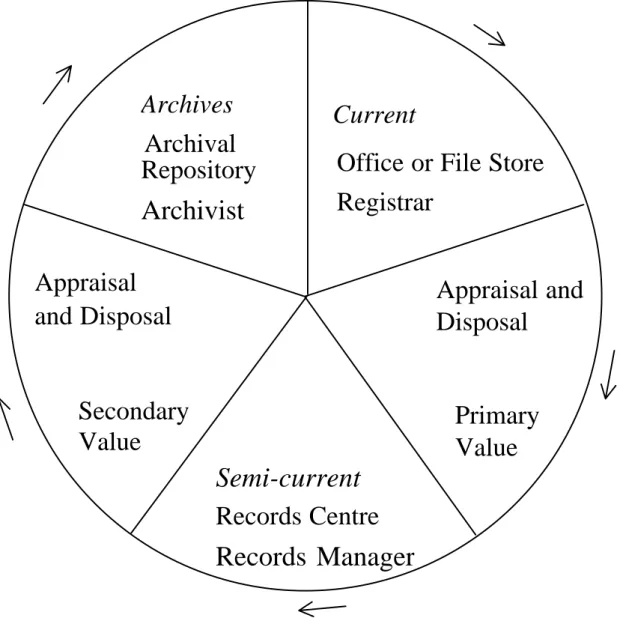
The life-cycle concept of the record is an analogy from the life of a biological organism, which is born, lives and dies. In the same way, a record is created, is used for so long as it has continuing value and is then disposed of by destruction or by transfer to an archival institution. Figure 1 illustrates the life-cycle concept of records. The effective management of records throughout their life cycle is a key issue in civil service reform. Without it, vast quantities of inactive records clog up expensive office space, and it is virtually impossible to retrieve important administrative, financial and legal information. Such a situation undermines the accountability of the state and endangers the rights of the citizen.
Without a management programme that controls records through the earlier phases of their life cycle, those of archival value cannot readily be identified and safeguarded so that they can take their place in due course as part of the nation’s historical and cultural heritage.
Phases of the Life Cycle of Records
In the simplest version of the life-cycle concept, three biological ages are seen as the equivalents of the three phases of the life of a record.
In the current phase, records are regularly used in the conduct of current business and are maintained in their place of origin or in the file store of an associated records office or registry.
Current records: Records regularly used for the
conduct of the current business of an organisation or individual. Also known as active records. Current records will normally be maintained in or near their place of origin or in a registry or records office.
In the semi-current phase, records are still used, but only infrequently, in the conduct of current business and are maintained in a records centre.
Semi-current records: Records required only
infrequently in the conduct of current business. Also known as semi-active records. Semi-current records will normally be maintained in a records centre or other offsite intermediate storage pending their ultimate disposal.
In the non-current phase, records are no longer used for the conduct of current business and are therefore destroyed unless they have a continuing value for other purposes, which merits their preservation as archives in an archival institution. (The definition of ‘archives’ was provided earlier in this lesson.)
Non-current records: Recordsno longer needed for the
conduct of current business. Also known as inactive records.
Some records management systems recognise only two phases: current and non-current. Figure 1 outlines the life-cycle concept of records.
Semi-current
Records Centre
Records Manager
Archives
Archival
Repository
Archivist
Current
Office or File Store
Appraisal
and Disposal
Secondary
Value
Appraisal and
Disposal
Primary
Value
Registrar
The Continuum Concept
The life-cycle principle recognises that records are created, used, maintained then disposed of, either by destruction as obsolete or by preservation as archives for their ongoing value. The continuum concept suggests that four actions continue or recur throughout the life of a record: identification of records; intellectual control of them; provision of access to them; and physical control of them.
Continuum concept: A consistent and coherent process
of records management throughout the life of records, from the development of record-keeping systems through the creation and preservation of records, to their retention and use as archives.
According to the continuum concept, the distinction between records management and archives management need not be rigidly maintained. These four actions are outlined in Figure 2.
Process Records management
actions
Archives management actions
1 identification and acquisition
creation of receipt selection or acquisition
2 intellectual control classification within a logical system
arrangement and description
3 access maintenance and use reference and use 4 physical control disposal by destruction or
transfer as archives
preservation
From this principle a unified model has been developed. The model reflects the pattern of a continuum. Four actions continue or recur throughout the life of a record and cut across the traditional boundary between records management and archival administration. These are
• the creation or acquisition of the record
• its placement within a logical, documented system that governs its arrangement and facilitates its retrieval throughout its life
• its appraisal for continuing value, recorded in a disposal schedule and given effect at the due time by appropriate disposal action
• its maintenance and use, that is, whether it is maintained in the creating office, a records office, a records centre or an archival repository, and whether the use is by its creator or a successor in function or by a third party, such as a researcher or other member of the public.
Phase Current Semi-current Archives
Operations
Analysis Business Systems
Analysis
Receipt into Accession to
Creation Creation or Receipt Records Centre Archival
Repository
Control Classification Filing
Documentation
Maintain Arrangements and Documentation
Arrangement and Description
Appraisal Schedule Review
[Primary and [Secondary Value]
Secondary Values] Office/File Store Safekeeping in Records Centre Preservation and Conservation Maintenance and Use
Official Access Official Access Public Access/
Outreach Disposal Transfer to Records Centre Transfer to Archival Repository or or Destroy Destroy
Responsibility Action Officer Records Manager Archivist
Records Manager Archivist
Archivist
The division of activities between records managers and archivists can be artificial; records care should follow a
continuum approach.
This division of activities into records management and archival phases, with the consequent division of responsibility between the records manager (or registrar) and the archivist, is seen by some as artificial and restrictive. The several stages are not really seen as distinct and separate. Consider the following tasks, for example.
• Acquisition in the archives phase is the mirror image of disposal in the records management phase.
• Reference and use in the archives phase are essentially the same tasks as maintenance and use in the records management phase.
• Arrangement and description in the archives phase is vitally dependent on classification in the records management phase.
The continuum approach means the end of the traditional demarcation between the functions of the records manager (or registrar) and the archivist. A person responsible for care of records at a particular phase in their life cycle will certainly need specific knowledge and expertise. However, input will be needed from others who have been or will be responsible for records at other phases of the life cycle. The registrar, records manager, records centre manager and archivist will all still perform their own duties, but their work will be undertaken within an integrated structure, with no rigid boundaries to limit professional collaboration and development.
This collaboration between records and archives managers is most successful if the archival institution can be restructured to serve as a records and archives institution, responsible for all aspects of records care throughout the life cycle. A records and archives institution would establish a new records service for the whole of the government, corporation or organisation that would include staff working in records offices (registries), records centres and archival repositories. It would also develop an appropriate scheme of service and job descriptions for all records staff, and it would develop training schemes to prepare staff at all the necessary levels to provide efficient records services throughout the life cycle.
Where records management and archival activities are not integrated, records managers and archivists find that they are often duplicating each other’s work or, worse, undoing or redoing tasks that could have been completed more efficiently had the two phases been considered part of a unified whole.
Throughout these modules, the term ‘life cycle’ is used when discussing the record; the term ‘continuum’ is used when discussing the management of the record according to the continuum concept.
The concept of integrated records management is discussed in more detail in Lesson 4.
Activity 7
Explain in your own words the concept of the life cycle of the records and the concept of the continuum of care. Next, examine how records are managed in your organisation. Do you think they are cared for according to a life cycle? Do you think there is a continuum of care? Explain how records are managed and how you think the process could be altered to ensure records are cared for throughout their life cycle.
Levels of Arrangement and Description
Another key principle to understand when dealing with records and archives is the concept of levels of arrangement and description.
Arrangement and description are two integrated practices designed to make records and archives physically and intellectually available for use. When arranging records or archives, the institution must recognise the internationally accepted principles of respect des fonds, or respect for provenance and original order, as discussed above. Archival institutions in particular must be sure to respect the original arrangement of records and ensure their descriptions reflect that arrangement, because they have to make records available and understandable to people who were not involved with the creation or original use of the records. Archival institutions, therefore, must not only make the materials available; they must also provide information about the content and context of the archives in their care.
Records and archives can be arranged and described according to hierarchical levels.
Central to the activities of arrangement and description is the understanding that records can be arranged and described according to levels. These levels place records into categories according to hierarchy, allowing records to be managed as groups rather than individual items. The terms used to distinguish the different levels of records and archives can be confusing. For example, in addition to ‘item’, terms that have been used to refer to an assembly of related documents include file, unit, piece, file unit or unit of handling. And ‘item’ may also be used to refer to the single documents that make up such an assembly. For the purpose of clarity, the following terms, with their definitions, will be used in this study programme.
Group: The primary division in the arrangement of
records and archives at the level of the independent originating organisation. Also known as archives group, fonds, record group.
Subgroup: A discrete subdivision in the arrangement of archives below the level of the group, usually the archives of a subordinate administrative unit with its own record-keeping system.
Series: The level of arrangement of the files and other
records of an organisation or individual that brings together those relating to the same function or activity or having a common form or some other relationship arising from their creation, receipt or use. Also known as a file series, records series or class.
File (1): An organized physical assembly (usually within
a folder) of documents grouped together for current use or in the process of archival arrangement because they relate to the same subject, activity or transaction. Note: A file is usually the basic unit within a record series.
Item: The basic physical unit of arrangement and
description within a series. Also known as a piece.
Note that the term ‘file’ is also used when discussing computerisation, as follows:
File (2): A logical assembly of data stored within a
computer system. Note: In word-processing systems it is the intellectual representation of a physical document.
The term ‘institution’ is used as a level ofdescription to refer to the institution holding the records being described, such as the National Archives or the Corporate Archives. Figure 4 illustrates the concept of levels of arrangement. Note that Figure 4 identifies both the item and the file. The term ‘item’ is used most often in the archival environment, when discussing the physical units of arrangement. The term ‘file’ is often used in the records office or records centre, as that is the unit of management in those environments.
Activity 8
Using records in your own institution, try to identify the fonds, series, and item for at least four or five different bodies of records. Write each one down and then compare your answers with the information in this section to see if you have defined the various levels according to the definitions provided here.
Levels Examples
government corporate
institution National Archives of Erewhon Jimtech Corporation, Erewhon
group or fonds Ministry of Education Jimtech Corporation, Erewhon
subgroup Primary Schools Division
series school assessments financial records
file Primary Schools District A annual financial statements, assessments, 1967 1996
item Primary Schools District A balance sheet, 2 April 1996 assessment, January 1967
S
UMMARY
Lesson 1 has provided definitions of the following types of records and information: • information • data • document • records • public records • private records • archives • current records • semi-current records • non-current records.
The difference between public and private records has been discussed, and so has the question of who uses records and archives.
Lesson 1 has also introduced the following principles and concepts of records and archives management:
• respect des fonds • provenance • original order • the life cycle • the continuum
• levels of arrangement and description.
In particular, this lesson has emphasised the importance of the life-cycle of records and the continuum concept of management, which ensures the management of recorded information through all stages of its life cycle.
This lesson is intended to introduce important concepts and ideas, and it was noted that many topics are discussed in more detail in other modules.
S
TUDY
Q
UESTIONS
1. What is information? 2. What is a document? 3. Define data.
4. Define records and archives.
5. What types of form or medium can records come in? 6. Explain the four important qualities of records. 7. What are public records?
8. What are private records?
9. Name five reasons people might use records. 10.Name three types of users of archives. 11.Explain the principle of respect des fonds. 12.Explain the concept of provenance. 13.Explain the concept of original order.
14.What guidelines must records and archives managers follow to respect the concepts of provenance and original order.
15.Explain why records and archives managers must be involved with records from their point of creation in order to respect the concepts of provenance and original order. 16.Explain the life cycle and continuum concepts of records care, and discuss why the
life-cycle and continuum approaches mean the end of a demarcation between the records manager and the archivist.
17.What are the phases of the life cycle?
18.What four actions of records care take place throughout a records life?
A
CTIVITIES
:
C
OMMENTS
Activity 1We receive information all day long. When we share ideas in a meeting, we are giving and receiving information. If someone tells us that it is time to go to lunch, we are receiving information.
Information is converted into data when we record it so that it becomes widely accessible. When the results of the meeting are recorded, they become data; the facts have made available in a formalised manner; the information can be communicated, interpreted and processed.
A document is a unit of recorded information. The minutes of our staff meeting provide us with information about what happened in the meeting; the minutes ‘record’ the event and provide evidence that it took place.
Information is everywhere, but not all information is recorded. This point will be important later as we discuss the difference between records and information.
Activity 2
Read the definition provided in this lesson for an explanation of records. This section of the lesson also explains why records are different from information. Records can include such diverse materials as correspondence, photographs, minutes of meetings, receipts, invoices, reports, drawings, maps and so on.
Activity 3
The important lesson to learn in this activity is to recognise that records gain meaning from their relationship to other records, and that their value as records relates in large part to how they are created and maintained. How are reports generated? Who approves them or authorises their completion? How are they stored and protected? What about correspondence? Who is responsible for writing letters? Who types them? Who files them? Does any step in this process place the records at risk of loss or damage? Do the records still provide authentic and reliable evidence?
Activity 4
This activity is designed to how you (1) that not all records have ongoing value and (2) that determining which records are worth keeping as archives involves more than just identifying ‘drafts’ and ‘final versions’ and ‘master copies’. The process of appraisal is complicated and is considered one of the most difficult and important tasks an archivist can do.
For the records identified in this lesson, the following issues will arise during appraisal; that is, when you are determining which records have ongoing value and which do not. This activity is not intended to provide you with answers but to show you some of the issues that must be considered during the appraisal process. Bear this in mind as you read through the rest of this module and proceed with the rest of this study programme.
a draft report on
procedures for parking at the office
The fact that this is a draft report suggests it may not have long term value. The fact that it is about parking at the office suggests the subject is not part of the central business of the organisation but instead is an administrative issue. The draft report is likely not worth keeping permanently.
a final report on
procedures for parking at the office
While a final report is usually more significant than a draft report, this report on parking procedures refers to administrative, not operational, issues and so is likely not worth keeping on an ongoing basis.
extra copies of correspondence
Extra copies are usually not worth keeping, if the originals are on hand, unless the copies are in another file because they relate specifically to an event or issue other than the one for which the correspondence was created. In that case, they have become ‘new’ records; they provide evidence of that new event or issue.
copies of correspondence with handwritten notes in the margin
When someone ‘annotates’ a copy; that is, writing additional information on it, the copy becomes a ‘new’ records; it is now unique and provides evidence of the ideas or actions of the person who wrote on it. However, even though the copy has now become a new record, it may not be worth keeping, as the subject or purpose of the record may not be significant. If it is a letter about parking, it may not be worth keeping; if it is a letter about legislation; it may indeed have ongoing value.
master copies of correspondence
master copies are usually the best evidence; they are the ‘official’ records. Again, the decision to retain master copies of correspondence will depend in large part on the subject or purpose of the letters.
a draft report on revision of legislation that defines the work of the
department
Draft reports often do not have ongoing value, but on a topic such as revision to legislation, it may be worth keeping both drafts and final versions, since the topic relates fundamentally to the very purpose of the department.
a final report on revision of legislation that defines the work of the
department
Again, the topic is significant and the report is the ‘official’ version, so it is very likely this is worth retaining.
original signed contracts for provision of janitorial services
Original contracts are ‘official’ records, but the service being contracted is an administrative service; once the service has been rendered and the terms of the contract have expired, it may not be worth keeping the document.
original signed contracts for a legislative
consultant to assist with revisions to the legislation that defines the work of the department.
An original contract for such a significant service may well be worth keeping; it can provide evidence of a key activity within the department: an analysis of its purpose and work.
Activity 5
As noted in the module, typical users include government representatives, professional or academic researchers, amateur researchers, genealogists and members of the public. Other users may include journalists researching stories; school children learning about their history; lawyers conducting legal research; writers gathering background information for stories, novels or plays; actors studying characters by reading biographies or listening to oral histories or interviews on tape; and artists examining visual records for ideas for paintings. There are as many reasons to use archival material as there are people!
Activity 6
Many people have difficult at first accepting that it is best to keep records according to the agency that created them, rather than by some order more appealing to users. It can be difficult to see that, with good finding aids, it is easy to gain access to records that are managed according to the principle of respect des fonds.
This activity will help you see that the disadvantages of other methods far outweigh their advantages, and that respect des fonds is the most suitable method, because it allows the most flexibility for use.
If records were kept only by date, how would anyone make relationships between different records relating to the same topic? A letter that arrived on 22 September may be followed by a response written on 10 November and filed on 22 November; how will people know where to look to find the two ‘halves’ of that discussion? The only benefit to filing by date is for those people who remember precisely when an event took place; the secretary who did the filing might know where to look but fifty years from now no one will know.
Many people believe records should be kept by subject; after all, researchers arrive studying ‘subjects’ not government departments. But what subject should material be filed under? Imagine a letter that discusses a political rally, a government news briefing, and the weather on a particular day. Under what subject should that letter be filed? Politics? Media? Weather? Some people might suggest making copies and filing in each subject. Even if that were logical, and it is not!, people would still be confined to the subjects they thought were important.
What if a particular person was mentioned in the letter but it wasn’t filed by his or her name? That person is then effectively ‘lost’, because no one thought to file the letter by that name. Identifying subjects is a very ‘subjective’ activity and can never be completely accurate or comprehensive. The best course of action is to organise records by who created them and then provide a history of the creators that explains enough about them that people will then begin to make relationships between the ‘subjects’ they are interested in and the ‘functions’ or ‘activities’ the creator of the records performed.
Filing by type of record, such as photograph, map or letter, may seem logical as it puts like materials together. Indeed, when it comes to storage, this method is very useful. However, storing records is not the same as organising them; organising is as much an intellectual activity as a physical one and the only way to reflect the meaning of records is to show who made them and why.
Activity 7
This activity is designed to help you compare the reality of your own environment with the principles and concepts outlined in this lesson. You may find that records are cared for in a way that reflects the concepts of the life cycle and the continuum, or you may find your organisation’s operations are very different. As you work through the modules in this study programme, you will be introduced to a variety of methods for adjusting your institution’s operations so that they better reflect the life cycle and continuum approaches to records care.
Activity 8
This activity will help you practice your understanding of the concepts and terminology relating to levels of arrangement. However, it is difficult to know if you have identified the various levels appropriately. If possible, discuss your answers with someone in your institution familiar with these terms and see if he or she agrees with your findings. This topic is discussed in more detail in later modules in this programme.