Effect of Hybrid Problem-Based Learning versus the
Conventional Teaching Method on Dental Students’ Knowledge
and Performance in Endodontics
Mandana Naseri1, Yazdan Shantiaee1,Negar Norouzi2, Ali Mohammad Tavakol3, Atefeh Gohari4
1 Associate Professor, Iranian Center for Endodontic Research, Research Institute of Dental Sciences, School of Dentistry,
Shahid Beheshti University of Medical Sciences, Tehran, Iran
2 Assistant Professor, Department of Endodontics, Dental School, Mazandaran University of Medical Sciences, Sari, Iran
3 Private Practice, Tehran, Iran
4 Assistant Professor, Department of Endodontics, School of Dentistry, Shahid Beheshti University of Medical Sciences,
Tehran, Iran
Corresponding author:
Atefeh Gohari, Assistant Professor, Department of Endodontics, School of Dentistry, Shahid Beheshti University of Medical Sciences, Tehran, Iran
Received: 22 April 2019 Accepted: 15 Sep 2019
Abstract
Background and Aim: With the advent of problem-based learning (PBL), pioneer universities across the world started using this method to improve learning quality. One of its modifications, hybrid-PBL, incorporates a combination of PBL and traditional teaching skills. This study compared the efficacy of hybrid PBL and the conventional instruction in terms of preclinical test scores and clinical procedural errors, representing dental students’ knowledge and performance, respectively.
Materials and Methods: This quasi-experimental study was conducted on 8th (preclinical) and 9th (clinical) semester dental students. Students at each educational level were randomly divided into two groups of conventional PBL and hybrid PBL using permuted block randomization. Students in group 1 received conventional PBL and those in group 2 received hybrid PBL for the preclinical course on endodontic diagnosis and treatment planning. Similarly, students who took the clinical course were divided into two groups, and received instructions on prevention of canal transportation and zipping. Both groups were compared at the end of the semester regarding level of knowledge and clinical performance of students in preclinical and clinical courses, respectively. The acquired scores were analyzed using independent t-test and the logistic regression analysis.
Results: No significant difference was detected between the two learning methods regarding knowledge. The hybrid PBL caused a significant reduction in the frequency of transportation and zipping errors (P=0.0001).
Conclusion: Hybrid PBL resulted in superior clinical performance with fewer transportation and zipping errors by dental students, while its effect was comparable to the conventional method on preclinical knowledge level of students.
Key Words: Endodontics; Education, Dental, Knowledge, Academic Performance, Problem-Based Learning
Cite this article as: Naseri M, Shantiaee Y,Norouzi N, Tavakol AM, Gohari A. Effect of Hybrid Problem-Based Learning versus the Conventional Teaching Method on Dental Students’ Knowledge and Performance in Endodontics. J Islam Dent Assoc Iran. 2019; 31(4):189-194. DOI: 10.30699/jidai.31.4.189
Introduction
The role of information technology in educational systems, the changed pattern of
diseases, and the higher expectations of patients forced the medical education programmers to come up with new learning strategies and
revise the educational system (1). Accordingly, new teaching aids and techniques were introduced (2,3). In 1994, the World Health Organization suggested a major revision in dental education worldwide in order to render it problem-based, community-oriented, and socially and culturally relevant (1). As a result, many countries revised the dental education curriculum and designed new teaching techniques which were mainly student-based and focused on clinical dental skills and expertise, and encouraging teamwork (1). Problem-based learning (PBL) is defined as an approach in which a problem serves as the stimulus for active learning. The PBL approach is student-centered and based on small groups of students working together and collaborating
with faculty facilitators to achieve
understanding (4). In the process of PBL, a problem is presented to the students who collaborate in small groups to solve the problem and at the same time build on their previous knowledge. In this process, students can easily find the gaps in their previous knowledge resulting in higher learning quality compared with the conventional methods (4).
Sadr and Raouf Kateb (5) reported that students receiving PBL combined with educational films scored better on their final exams compared with those in the conventional curriculum. In a systematic review on the efficacy of PBL for undergraduate pre-clinical medical education, it was concluded that PBL does not enhance the acquisition of knowledge (6). In a more recent systematic review, it was concluded that PBL does not negatively influence the acquisition of knowledge; in contrast, it enhances the ability of students in applying their knowledge to clinical situations. In addition, PBL positively affects the students’ perceived preparedness (4).
Various factors such as the need for highly skilled instructors, time consuming nature, highly motivated students and the need for educational programs have led to the development of modified PBL systems (7). One of these modifications is the combination of PBL and the conventional lecturing methods, which is referred to as hybrid PBL (8). Although hybrid PBL has often been used in preclinical
courses and less commonly in clinical courses by far (9), this study evaluated the effect of this method on both preclinical and clinical endodontic courses.
In recent years, the number of complex root canal therapies performed by general dentists has increased leading to some concerns regarding precise diagnosis and perfect treatments. On the other hand, endodontic procedural errors are inevitable but measures can be taken to decrease their prevalence (8), as the clinical skills in general dentistry involve mainly mechanical hand activities that rely on developing psychomotor skills (10).
Considering the importance of endodontic diagnosis and procedural errors, and also the need for more efficient teaching strategies, this study sought to compare the effect of hybrid PBL and the conventional teaching methods on the level of knowledge and performance of dental students.
Materials and Methods
This quasi-experimental study was conducted
on 74 students in the 8th semester (taking
preclinical endodontic course) and 82 students in the 9th semester (taking clinical endodontic course) at the Dental School of Shahid Beheshti University of Medical Sciences, Tehran,
Iran (ethical approval code:
IR.SBMU.DRC.REC.1398.113).
To evaluate the knowledge level, the preclinical group first participated in a pre-test with questions on endodontic diagnosis and treatment planning based on the learning objectives. They were then randomly divided into two equal groups, who were both exposed to endodontic diagnosis and treatment planning topics as follows: group A was taught using the conventional methods; whereas, group B experienced hybrid PBL. Randomization was performed using permuted block randomization according to the class list. The hybrid PBL was carried out in 30-minute sessions twice a week for a total of four sessions with special emphasis on endodontic diagnosis and treatment planning. At the end of the course, a post-test was run, and the knowledge scores of students in the two groups were compared.
The performance of students in the 9th semester clinical group was then assessed in two random groups of A and B who received one of the two
methods, i.e., conventional demonstration and
hybrid PBL. In the PBL group which consisted of 5-6 students working together, teaching was carried out in 30-minute sessions twice a week for a total of four sessions with special emphasis on canal transportation and zipping errors. All students treated patients (n=419 premolar or molar teeth in total) and obtained four radiographs from each tooth (initial file, master apical file, master apical cone, and final cone). At the end of the course, the students’ performance in the two groups was evaluated and compared using the clinical data including patients’ dental records and radiographs. The procedural errors under investigation included transportation and zipping, which were included in the PBL teaching sessions. Other procedural errors such as gouging, crown perforation, broken instrument/foreign body in the canal, ledge formation, flaring, missed canal, over- and under-filling, and void formation were not included in the PBL teaching sessions, but were compared between the two groups. The level of students’ knowledge (in preclinical course) in both groups was compared via independent t-test, and P≤0.05 was considered statistically significant. Data were analyzed using SPSS software version 22 (SPSS Inc., IL, USA). The frequency and percentage of different endodontic procedural errors were reported for students in the two groups. The effect of the type of teaching on the students’ performance in terms of procedural errors was assessed using the logistic regression analysis.
Results
Knowledge acquisition of preclinical students:
The mean pre-test score of students was 19.21±2.42 out of 37 in the conventional and 18.83±3.12 out of 37 in the hybrid PBL teaching group. The baseline scores of the two groups did not differ significantly, using independent t-test (P=0.54).
The mean post-test score of students was 21.73±2.65 out of 37 in the conventional and 21.45±4.51 out of 37 in the hybrid PBL teaching
groups. Independent t-test showed that the teaching method caused no significant difference in the level of knowledge of preclinical students in the two groups (P=0.73). Based on the results of this study, no significant difference was found between the two groups of preclinical students in terms of knowledge acquisition.
Performance of clinical students:
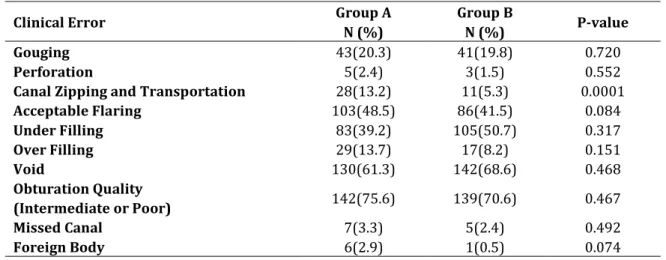
The logistic regression analysis was applied to assess the effect of teaching method on the performance of students in terms of endodontic procedural errors (Table 1). This analysis showed that the method of education only affected the frequency of canal transportation and zipping error (educational subjects), and had no significant effect on the frequency of other procedural errors (P=0.0001). The hybrid PBL implemented on the clinical group was found to be significantly superior to the conventional method in terms of reducing the probability of these errors. Still, no significant difference was observed in other clinical errors (P>0.05)
Discussion
This study compared the effect of hybrid PBL and the conventional teaching methods on the level of knowledge and performance of dental students. The results of the present study showed that the teaching method did not affect the level of knowledge of preclinical students; while the hybrid PBL method decreased the frequency of procedural errors (canal transportation and zipping) in clinical students. PBL is defined as a teaching method attempting to solve a problem or clarifying an issue (11). The learner in this method becomes more and more engaged with the problem and seeks information until the solution to the problem is found (12). Hybrid PBL is a student-centered teaching method with special emphasis on teamwork and project management. It incorporates a combination of traditional didactic knowledge acquisition and learner-centered contribution (8).
Most previous studies have compared acquired cognitive skills between the two methods of conventional instruction and PBL, showing the
Table 1. Effect of conventional and hybrid PBL teaching methods on dental students’ performance
superiority or at least equality of the efficacy of PBL and that of traditional learning in knowledge acquisition of students (11,13-16). In contrast, Ratzmann et al. (17) evaluated the effects of PBL in the orthodontic curriculum on the knowledge of students and found that the two groups of PBL and conventional learning were not significantly different in exams. In addition, Galvao et al. (18) stated that PBL tutorials did not have a direct influence on knowledge acquisition of dental students in oral radiology. Regarding the endodontic curriculum of undergraduate students, Shao et al. (19,20) showed that the conventional group was better than the PBL group with regard to basic theoretical knowledge scores; however, the teaching method did not affect the theoretical knowledge of postgraduate students. Our study showed no difference between the two groups of conventional and hybrid PBL in terms of knowledge acquisition in endodontics.
Endodontic procedural errors are among the
obstacles encountered during the
undergraduate teaching of endodontics.
Numerous efforts have been made to prevent these errors by improving the knowledge of students to prevent subsequent inconveniences and costs imposed on patients. In the present study, the hybrid PBL improved the performance of students in reducing the
procedural errors. In other words, the frequency of canal transportation and zipping which were among the taught topics by the PBL method, significantly decreased in this group compared with the conventional group. This finding was in agreement with the results of previous studies on endodontic fields, which showed significant improvements in case analysis, dental procedures and clinical examination in both undergraduate and postgraduate education (19,20).
PBL has been shown to be more effective in creating a positive professional attitude than traditional teaching (21). Moreover, it can greatly improve the skills of students (22). In a meta-analysis on the efficacy of PBL in comparison with conventional classroom teaching, PBL was found to be more effective in terms of long-term retention of knowledge, skills and satisfaction of students and
instructors. Yet conventional classroom
teaching was concluded to be superior for short-term retention of instructed topics (23). Katsuragi et al. (24) added PBL to the traditional lecture-based educational system
and reported successful results. They
mentioned that PBL prepares the students for group discussions and allocates adequate time for self-learning (24). Albanese et al, (25) in a review study evaluated studies on PBL and
Clinical Error Group A
N (%)
Group B
N (%) P-value
Gouging 43(20.3) 41(19.8) 0.720
Perforation 5(2.4) 3(1.5) 0.552
Canal Zipping and Transportation 28(13.2) 11(5.3) 0.0001
Acceptable Flaring 103(48.5) 86(41.5) 0.084
Under Filling 83(39.2) 105(50.7) 0.317
Over Filling 29(13.7) 17(8.2) 0.151
Void 130(61.3) 142(68.6) 0.468
Obturation Quality
(Intermediate or Poor) 142(75.6) 139(70.6) 0.467
Missed Canal 7(3.3) 5(2.4) 0.492
Foreign Body 6(2.9) 1(0.5) 0.074
Group A: Conventional method; Group B: Hybrid PBL
showed that students receiving PBL performed well in clinical exams, but they had weaknesses in basic science exams. These results were also confirmed in a systematic review by Vernon et al (26). Our study also showed that PBL was not successful for enhancing the preclinical knowledge of endodontic topics in students but was effective on their clinical performance. Positive effects of PBL have also been reported by other researchers (27-29), which is in agreement with our findings. A systematic review of the literature by Polyzois et al. (30) demonstrated that studies evaluating the whole curricula did not find significant differences between PBL and conventional teaching; whereas, those comparing a single PBL intervention in a traditional curriculum yielded results in favor of PBL. This paradox suggests that designing multiple PBLs in a traditional curriculum may have greater efficacy than exclusively switching to PBL. The results of the current study were in accordance with previous reports that teaching one educational topic by means of PBL method significantly decreased the prevalence of procedural errors.
The educational environment in which PBL takes place is very important as well. PBL requires a larger educational environment, educational aids, and more human resources than the traditional technique. Also, its success depends on accurate programming and allocating time to this issue by the instructors. One limitation of the present study was its short-term course; thus, future studies are required to evaluate the long-term efficacy of hybrid PBL.
Conclusion
Within the limitations of this study, it may be concluded that hybrid PBL, which means PBL in combination with the traditional curriculum, can be successfully applied for teaching endodontics to improve performance and reduce the frequency of endodontic procedural errors (including canal transportation and zipping) by dental students. However, its effect on knowledge acquisition needs to be further investigated.
Acknowledgement
The authors deny any conflict of interest related to this study.
References
1. Garetto L, Weissinger P, Goldblatt L. Introducing critical thinking into dental education. Alpha Omegan. 2004 Jul;97(2):28-34. 2. Naseri M, Ahangari Z, Shantiaee Y, Rasekhi J, Kangarlou A. The efficacy of an endodontic
instructional multimedia program for
enhancing the knowledge and skills of dental students. J Islam Dent Assoc Iran. 2013; 25(3): 162-8.
3. Naseri M, Shantiaee Y, Rasekhi J, Zadsirjan S, Bidabadi MM, Khayat A. Efficacy of video-assisted instruction on knowledge and performance of dental students in access cavity preparation. Iran Endod J. 2016 Fall;11(4):329-331.
4. Bassir SH, Sadr-Eshkevari P, Amirikhorheh S, Karimbux NY. Problem-based learning in dental education: a systematic review of the literature. J Dent Educ. 2014 Jan;78(1):98-109.
5. Lahijani MSS, Kateb HRR. The effect of PBL and film showing, frequent quizzes and
lecture-based method on short-term
performance of dentistry students. J Med Educ. 2004;4(2):77-80.
6. Hartling L, Spooner C, Tjosvold L, Oswald A. Problem-based learning in pre-clinical medical education: 22 years of outcome research. Med Teach. 2010 Jan;32(1):28-35.
7. Use of problem-based learning in Canadian and U.S. dental schools: results of a survey. J Can Dent Assoc. 2002 Jan;68(1):26.
8. Berman LH, Hargreaves KM, Cohen's S, Burns RC. Cohen’s Pathways of the pulp. 11 ed: Else-vier Mosby; 2015:e 193.
9. Dent J, Harden R. A practical guide for medical teachers. 4th ed: Churchill Livingstone; 2013:240.
10. Suksudaj N, Townsend G, Kaidonis J, Lekkas D, Winning T. Acquiring psychomotor skills in operative dentistry: do innate ability and motivation matter? Eur J Dent Educ. 2012 Feb; 16(1):e187-e94.
11. Last K, Appleton J, Stevenson H. Basic
science knowledge of dental students on
conventional and problem‐based learning
(PBL) courses at Liverpool. Eur J Dent Educ. 2001 Dec;5(4):148-54.
12. Schmidt HG, Rotgans JI, Yew EH. The
process of problem‐based learning: what
works and why. Med Educ. 2011 Aug; 45(8): 792-806.
13. Rich SK, Keim RG, Shuler CF. Problem-based learning versus a traditional educational methodology: a comparison of preclinical and clinical periodontics performance. J Dent Educ. 2005 Jun;69(6):649-62.
14. Pau AK, Croucher R. The use of PBL to facilitate the development of professional attributes in second year dental students. Eur J Dent Educ. 2003 Aug;7(3):123-9.
15. Login GR, Ransil BJ, Meyer M, Truong NT, Donoff RB, McArdle PJ. Assessment of preclinical problem-based learning versus lecture-based learning. J Dent Educ. 1997 Jun; 61(6):473-9.
16. Prosser M. A student learning perspective on teaching and learning, with implications for problem-based learning. Eur J Dent Educ 2004 Apr;8(2):51-8.
17. Ratzmann A, Wiesmann U, Proff P, Kordaß B, Gedrange T. Student evaluation of problem-based learning in a dental orthodontic curriculum–A Pilot study. GMS Z Med Ausbild. 2013; 30(3):Doc34.
18. Galvão NS, Oliveira ML, Panzarella FK, Raitz R, Junqueira JLC. Traditional lecture versus PBL tutorials in Dental students’ knowledge acquisition. Revista da ABENO. 2018;18(4):76- 84.
19. Shao LN, Qiu LH, Zhan FL, Xue M. [Application of PBL combined with SP method in during-course practice of endodontics for undergraduate dental students]. Shanghai kou qiang yi xue. 2016 Oct;25(5):621-625.
20. Shao LN, Wang XM, Qiu LH, Zhan FL, Xue M. [Application of problem-based learning in pre-job training of postgraduate students in department of endodontics]. Shanghai kou qiang yi xue. 2013 Aug;22(4):462-5.
21. Brown G, Manogue M, Rohlin M. Assessing attitudes in dental education: Is it worthwhile? Br Dent J. 2002 Dec 21;193(12):703-7.
22. Fincham A, Baehner R, Chai Y, Crowe D, Fincham C, Iskander M, et al. Problem-based learning at the University of Southern California School of Dentistry. J Dent Edu. 1997 May; 61 (5):417-25.
23. Strobel J, van Barneveld A. When is PBL
more effective? A meta-synthesis of
meta-analyses comparing PBL to conventional classrooms. Interdiscip J Probl Based Learn. 2009;3(1):4.
24. Katsuragi H. Adding problem-based learning tutorials to a traditional lecture-based curriculum: a pilot study in a dental school. Odontology. 2005 Sep;93(1):80-5.
25. Albanese MA, Mitchell S. Problem-based learning: A review of literature on its outcomes and implementation issues. Acad Med. 1993 Jan; 68(1):52-81.
26. Vernon DT, Blake RL. Does problem-based learning work? A meta-analysis of evaluative
research. Acad Med. 1993Jul;68(7):550-63.
27. Kawai Y, Yazaki T, Matsumaru Y, Senzaki K, Asai H, Imamichi Y, et al. [Comparative analysis of learning effect for students who experienced both lecture-based learning and problem-based learning in a complete denture course]. Nihon Hotetsu Shika Gakkai Zasshi. 2007 Jul; 51(3): 572-81.
28. Reich S, Simon JF, Ruedinger D, Shortall A, Wichmann M, Frankenberger R. Evaluation of two different teaching concepts in dentistry using computer technology. Adv Health Sci Educ. 2007 Aug;12(3):321-9.
29. Blake RL, Hosokawa MC, Riley SL. Student performances on Step 1 and Step 2 of the United States Medical Licensing Examination following implementation of a problem-based learning
curriculum. Acad Med. 2000Jan;75(1):66-70.
30. Polyzois I, Claffey N, Mattheos N.
Problem‐based learning in academic health
education. A systematic literature review. Europ
J Dent Educ. 2010Feb;14(1):55-64.