Abstract
North Carolina has one of the nation’s top 10 largest refugee populations. Refugee resettlement is pivotal to refugee adolescents, who usually have sporadic educational experience, poor English language skills, and low socioeconomic status. These disadvantages become
barriers and hinder their chances of higher education and career outcome. Many academic researches have been conducted to evaluate social capital’s role in the adaptation and integration of involuntary displaced refugees. By social capital, I mean refugees’ social networks with others in the community, at schools, or at work settings. However, I will focus on examining refugee adolescents’ high school experience and how school structures shape their success and failure. While local high schools seek specialized educational program (academic strategy program, ESL classes) to help refugee adolescents adapt to American society, a question occurs. Is the school-based social network helpful in achieving academic success among refugee adolescents? This case study conducted in Carrboro/Chapel Hill area will help answer the question. I argue that school-based network is essential to refugee students’ academic attainment. However,
specialized educational programs and groupings of refugee students might lead to their
I. Introduction A. The Study
Previous research on adolescent refugees has mostly been included in studies of immigrant populations. Although Karen refugees are the fastest growing refugee groups in the United States, few study looks specifically into the experiences of Karen refugees. Many of the Karen adolescent refugees often do not graduate from high school (Kenny & Lockwood-Kenny, 2011). For those who enroll in schools are significantly older than their classmates and they choose to work to support their family rather than continuing education (Kenny & Lockwood-Kenny, 2011). In my study, I will focus on examining Karen adolescent refugees’ high school experience and how school structures shape their success and failure.
This research project will employ a mixed-method research design, including observational study in classrooms, semi-structured interviews with teachers and conversations with refugee students, and quantitative data analysis from local high schools. This case study will generate new findings regarding the effectiveness of school-based social network and inform future immigrant education policy. The results can demonstrate which theories play predominant role in refugee education. The results can also be applied to other regions and countries that share the same problem in the process of accepting and accommodating refugee adolescents who do not speak new countries’ language.
In this paper, I will provide an introduction of refugee problems in the world, an overview of some sociological theories related to immigrants and refugees, a description of my own case study on adolescent refugees, and a policy recommendation regarding refugee education.
II. Literature Review A. The problem
Refugee and Trends
The United Nations defines a refugee as a person who is outside the country of his nationality and is unable or, owing to a well-founded fear, is unwilling to avail himself of the protection of that country (UNHCR). As a means of survival, refugees are forcibly displaced to other countries or completely new environments.
because of sea-level rise, extreme weather events, drought, and water scarcity (Biermann & Boas, 2010).
Current Refugee Crisis
More than a million refugees migrated into Europe in 2015, sparking a most current refugee crisis (BBC). 84 percent of them originate from Syria, Afghanistan, Eritrea, Somalia, and Iraq. All of these countries are experiencing conflicts, political upheavals, widespread violence or insecurity (UNHCR). This large-scale crisis shows that not only the EU, but also the international community as a whole has a role in addressing this global challenge.
Refugee Resettlement in the United States
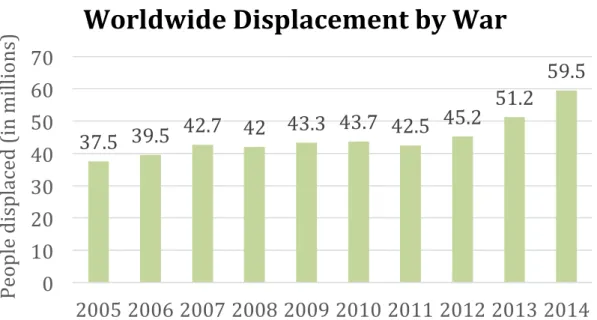
As wars and conflicts around the world continue to grow, the number of displaced refugees continues to increase. Resettlement involves the transfer of refugees from their home countries to a third State that has granted them permanent residence status
(UNHCR, 2015).
Refugee resettlement is pivotal to refugees as it is a life transitioning process. Refugees need to start a new life in a place they are not familiar with. One strategy of refugee resettlement is local integration. It is a process that refugees legally,
economically, and socially integrate in the host country (UNHCR, 2015). For the United States, the government needs to incorporate this large group of people into social
institutions, such as schools, local communities, housing and employment.
Different problems encountered by immigrants and refugees
Immigrants migrate to a new country in the lure of better life. The main driving force for immigration includes more lucrative jobs, higher quality of education, more freedom to practice religious belief, and better political environment (Bryant). The
United States, as a land of opportunity, remains the chief receiving nation of immigrants. Refugees are usually categorized as a subgroup of immigrants because they share many commonalities. Refugees are immigrants who flee their countries because of
persecution, war, or disaster. However, refugees should be distinguished from immigrants since there are major differences between refugees and other types of immigrants, legal or illegal. For example, refugees need to find jobs to support their families with no established connections. Moreover, most of the refugees are only fluent in their native language. Karen refugees who come from mountainous regions in Southeast Asia are also illiterate and uneducated. They only have farming skills and have no previous
employment experience. Refugees are facing more severe problems when being displaced in a new country.
Voluntary vs. Involuntary
Immigrants typically go through voluntary migration when coming to a new country. Immigrants are active throughout the migration process. They have specific purposes to improve their status in a new country. Anthropologist John Ogbu (1998) classified them as “voluntary immigrants”. However, refugees experience involuntary migration and they usually do not freely choose to settle in a new country. Refugees are passive during the migration process that is sponsored by international organizations such as the United Nations. After arriving in the host country, refugees are forcibly displaced and do not choose their final destinations. The government and voluntary agencies of the host county decide where is the best place to resettle depends on local public policy and the availability of social services. Additionally, refugees do not have the choice to go to their home countries because they experience wars, conflicts, and extreme circumstances there.
2) Ability to survive
Who helped immigrants and who will help refugees?
Social Capital: Immigrants usually have substantive support from family members or employers. In a new country, they can find preexisting communities that immigrants can cluster together, share job information, and find attorneys who can address their concerns. Their social networks are powerful and helpful. In contrast, local
communities for refugees rarely exist. Their social networks are weak so that it limits their abilities to find assistance.
selective, which disproportionately favors people from urban middle-class
backgrounds (Zhou & Kim, 2006). They have resources to prepare themselves for comprehend English prior to entering the country. However, many refugees spend a long time in refugee camps prior to their displacement. For example, Karen refugees are from the mountainous border regions of Myanmar and Thailand. They have been living in Thailand refugee camps for years before coming to the United States. Their difficult situations constrain their educational opportunities.
Culture Capital: Previous immigrants started establishing local communities. They celebrate their traditional festivals and incorporate their cultures into the new society. Immigrants’ cultural patterns may continue to flourish in the new country. However, refugees’ own culture is not emphasized in the new society. They struggle to fit in the new culture pattern when they first arrive in the country.
3) Views from society
A burden to the society: For immigrants with high level of education, they bring skills with them at the time of arrival. They can meet the needs of local economy and can join the labor market quickly. For refugees, with the rise of current refugee crisis, people are unwilling to accommodate a large number of them in their own society. Not the model minority: Past studies have recognized the extraordinary Asian American educational achievements. Asians have significantly higher grade point average, while Blacks and Hispanics have worse performances in schools (Portes & MacLeod, 1996). Although all of them are phenotypically “Asian”, Asian immigrants and Southeast Asian refugees have distinctive characteristics. Aside from the
socio-economic backgrounds and level of freedom. The “model minority” is misleading to ethnic groups that are disadvantaged. Researches show that Japanese, Chinese, and Asian Indians have much higher educational attainment levels than Laotions, Hmong, and Vietnamese (Miller, 1995). Rumbaut (1994) found out that there are wide
differences in socioeconomic status among immigrants. Levels of parental education of Laotians and Cambodians are among the lowest and they also exhibit the highest rate of poverty in the United States.
Problems for refugee adolescents
Refugee youth who resettle in their adolescence (age 13+) is a subgroup of
refugees. For refugee adolescents, they are facing different challenges. They usually have sporadic educational experience, poor English language skills, low socioeconomic status, and feeling of alienation from American culture. These disadvantages become barriers to higher education and hinder their chances of career success.
1) Sporadic educational experience
Refugee adolescents have often experienced interrupted formal schooling, due to poor quality education in refugee camps, or no education at all (Stewart, 2010). Many of them are at risk for academic failure.
2) Insufficient English language skills
A high percentage of refugee adolescents have severe problems with the English language when they first arrive at school.
Refugee families flee away their home countries and usually have meager socioeconomic resources in the new country.
4) Sense of alienation from mainstream culture
It is common at school that there is a lack of culturally responsive texts suitable for refugee students (MacNevin, 2012). Refugee students’ previous cultural experience is not mentioned in the new environment.
Education is especially important for refugee adolescents because it is a key factor affecting their future. Refugee adolescents gain knowledge, skills, and credentials
through education. The link between academic performance, educational attainment, and career success is well documented (Coleman 1961, Jencks 1972). Educational
advancement are important markers and give them better chances of integration into the labor market and upward social mobility. In terms of career choices and suggestions, parents of refugee adolescents are new to the society and share the same language and cultural barriers with their children. Moreover, many parents tend to work several jobs and they do not have flexible schedules to take care of their children’s school
B. Previous Studies and Theories of Immigrant Accommodation and Adaptation Four Strategies
Upon arrival in a new country, refugees’ accommodation and adaptation process can be categorized into four strategies: integration, separation, assimilation, or
marginalization (Berry, 2001). Integration means that refugee students are able to
maintain their own cultural integrity, while learning and accepting new values and norms. Separation means that refugee students are reluctant to interact with new cultures and wish to hold on to their original culture. Assimilation means that refugee students seek daily interaction with mainstream culture and do not wish to maintain their own cultural heritage. Marginalization means that refugees have little interest in both cultural
maintenance and interactions with new cultures. Among these four strategies, integration promotes multiculturalism and is found out to be the most effective strategy for
immigrants.
Segmented Assimilation Theory
Segmented assimilation theory is based on the nature of the American society that it is now diverse, stratified, and segmented. Portes and Zhou (1993) describes that upon arrival, new immigrants may choose three different assimilation paths. The first path is upward assimilation into American white middle-class majority. Some scholars have argued that immigrants with more resources, including social capital, are more likely to follow this path. For refugees from South East Asia, this path is unlikely to happen because of the limited resources available to them. The second path is downward
struggling with poverty and unemployment. The third path is selective acculturation (Portes and Rumbaut, 2001), that there is an economic integration accompanied by a preservation of immigrants’ own cultures. Scholars argue that this limited assimilation is beneficial (Bankston and Zhou 1995, Portes and Rumbaut, 2001). This theory explains why some groups of immigrants are susceptible to poverty and what allows some groups to have more desirable outcomes (Portes and Zhou, 1993). Segmented assimilation framework predicts that the third path, limited assimilation will have a protective effect for immigrants, leading to better outcomes.
Social Capital Theory
One of the benefits of school setting for refugee adolescents is the creation and formation of social capital. Social capital is the resources provided by people’s social networks with others in the community, at schools, or at work settings. The concept of social capital has been evolved and redefined over time. Sociologist James Coleman defined social capital as the resources available to individuals through the structure of their social relations that facilitate individual goal attainment (Coleman, 1988). He emphasized the positive part of social capital. In my case, social capital refers to
1998). Immigrants depend greatly on their networks and bonds of solidarity in order to adapt into the American society (Portes, 2000).
Portes’ explanation largely focuses on parental guidance, school involvements and networks. However, when refugee students first come to the United States, they do not have existing social relationships, with other family members, friends and
communities. Family members are not helpful in their social networks and success in the United States. Because family members are also new to the society and they do not have the ability to provide help to refugee adolescents. In this case, ESL teachers of
specialized educational program are resources available to refugee students. The program provides refugee students with social capital. Their guidance helps their integration into American society.
There is a book that comprehensively examines the resettlement experiences of one group of Asian refugees. In Growing up American: How Vietnamese Children Adapt to Life in the United States (Zhou and Bankston, 1998), the authors examine how
Vietnamese immigrants used their common ethnicity to overcome socioeconomic
1998). Their community solidarity and preservation of cultural traditions lead to their success in American society.
Social Mirroring Theory
On the other hand, some literature suggests the failure of school settings. A theory that might highlight refugee adolescents’ experience is social mirroring. Social mirroring means that new immigrants internalize negative attitudes the host country projects toward their group (Suarez-Orozco, 2000). Even if refugees and their native peers are studying in the same building, they are not generating enough interactions with each other.
Tracking and teacher’s expectation
study supports the argument that educational advancement is shaped at least in part by students’ positions within the school hierarchy, the tracks (Gonzales 2010).
Additionally, when teachers cast doubts on the ability of this whole group of students, language learners may face lowered expectations and insufficient exposure to high-level academic content and critical-thinking skills (Suarez-Orozco et al. 2008).
C. The Synthesis
Four different strategies during the accommodation process and segmented assimilation theory suggest different degrees that refugees interact with host country and new culture. Social capital theory, social mirroring theory and teacher’s expectation theory indicate that school settings can have great influence on refugee adolescents’ higher education and career choices. However, different theories might predict different outcomes. Social capital theory might predict positive educational outcome of refugee adolescents. They benefit from their social networks they build with their teachers and peer. Social mirroring theory might suggest that refugee students are marginalized in the society as well as in schools, without a sense of belonging. During their cultural
transitioning process, they face hostile social attitudes and remarkable ethnic contrasts (Suarez-Orozco, 2000). This sentiment can be an internal factor that discourages students from active learning. Teacher’s low expectation and tracking of students might result in unmotivated refugee students. This can serve as an external factor that students will eventually lose confidence and enthusiasm in learning.
This project is a case study that takes place in Chapel Hill/Carrboro area in North Carolina. I chose this particular site because North Carolina has one of the nation’s top 10 largest refugee populations. Local high schools in North Carolina seek specialized
educational program, including after-school homework program and ESL classes, to help refugee adolescents adapt to American society. This program can be fundamental to a student’s success as parents of refugee adolescents are usually poor in English language skills and they cannot help much with their children’s schoolwork and career advices. Specialized educational program establishes a closer relationship between teachers and students. Students can participate in small group English classes to achieve extra help. They receive more attention and individual assistance from teachers.
In my proposed study, I will focus on examining refugee adolescents’ high school experience and how school structures shape their success and failure. I will examine the theories offered by scholars in the school settings and in the context of specialized educational programs. I will address the following research question: Is the school-based social network helpful in achieving academic success among refugee adolescents? I argue that school-based network is essential to refugee students’ academic attainment.
However, specialized educational programs and groupings of refugee students might lead to their disconnection with other students and negative learning experience. In general, I will specify how school structure supports, constrains, or derails individual goal-seeking behaviors.
To understand social capital formation process and educational attainment of adolescent refugees, I chose to zoom in on an educational institution in Carrboro, North Carolina. I chose Carrboro High School as the target school of my research. Two main considerations lead to my focus on this specific high school. First, according to the staffs of Chapel Hill/Carrboro school district, Carrboro High School provides a welcoming environment for immigrants and teachers have more experience in instructing immigrant students. Second, I have been a volunteer at Carrboro High school since the summer of 2014 and I am familiar with the school structure. By working closely with students and teachers in this school, I can reveal the life of adolescent refugees and their destinies in the United States.
Refugee students’ educational outcome, whether they drop out of high school, attain higher education, or work directly after high school, is an indicator of educational attainment and academic success in high school. Their life after high school can also be compared with their native peers within the same school system.
B. Procedures
The data will be drawn from three stages. Participants include teachers who work closely with refugees and refugee students in Carrboro High School.
1) To have an overall understanding of the background of this specific group of students, I acquired data from the ESL specialist of the Carrboro-Chapel Hill City Schools ESL Instruction/Curriculum Department.
addressed most thoroughly by a methodology of intensive participant observation (MaCleod, 2010). To answer the question of whether local high school provides an environment to support adolescent refugees, I did classroom observations. This process aims at establishing solid relationship with research participants. As a
researcher, I have the opportunity to build trust with students and teachers and record their classroom conversations. To gain familiarity and build close relationships with refugee adolescents and their specialized education program teachers, I involved in their classroom over a long period of time, from May 2014 to March, 2016.
My classroom observations take place mostly during the spring. This time period is critical to my research. First, some students need substantial help to pass their annual State Exams. It helps me understand their academic levels comparing to the State’s requirement. Second, 11th grade students need to prepare for their senior year and post-graduation plan. During the specialized education program, I can have a brief understanding of their thoughts, how they communicate with teachers and advisors and teachers’ advice. Third, the majority of the 12th grade students are settled for their post-graduation plan, such as going to community colleges, colleges, or work.
As a researcher, I have an advantage that I am also not a native-speaker of English. I share some similarities with these refugee students that I cannot fully comprehend dialogues and class materials when I first came to the United States. As a result, I do not have biases and misconceptions about refugees in host countries bringing to my data collection process. To remain objective, I did not expose my intention to do research until the last stage of my data collection, the interview processes.
3) Aside from observable details, I want to conduct semi-structured interviews with students and teachers to explore more hidden details, such as their inner feelings and their points of view. Also, I can compare my observations with students and teachers’ answers to see if their behaviors and feelings are consistent. During the process, I talked to 2 staff members of the Carrboro/Chapel Hill school district, 2 ESL teachers who are not very familiar with each student and 2 ESL teachers who know each student individually at Carrboro High School. Though I have maintained a trusting relationship with refugee students, it was extremely difficult to gain a substantial amount of information from refugee students. I tried to ask them simple questions. However, I usually needed three other students to translate my questions for me so that the respondent could understand what I meant. In the end, I chose to know more about them from art classes, when they can accurately express themselves in an art piece. I also encouraged them to write more about themselves in English classes when they were expected to use new words to make sentences.
A. Theoretical Models 1) Population
According to the school district’s data and teacher’s accounts, there are 203 ESL students who are receiving ESL services in high schools in the Carrboro and Chapel Hill district. Among these students, only 16 ESL students in the whole school district
graduated at the end of school year 2014-2015. Apparently, the graduation rate is low and only a few students can graduate during each school year. There are no formal data on their further education. Community college is usually the option that students seek the most while they work to help support their families.
Myanmar is one of the main countries of origin. Among these ESL students, refugees from Myanmar started coming to the country from their refugee camps in Thailand about 10 years ago. The ESL population in Carrboro High School runs from 50 to 70 students on a given year. This year, there are 65 ESL students. Over half of the ESL students are of Karen group, a minority group in Myanmar.
2) Students and Educational Outcome
Refugees kids seem like appreciate (people who help them) more. We are impressed by this group and they have a good reputation in the school amongst the faculty. They have high morale. We have lot of exceptional kids, in terms of their academics and personality. I am just grateful to have such nice kids.
They barely go to schools. In refugee camps, there are no actual instructions
available. They have to catch up with the language and the level of subjects they are supposed to have to be in ESL. Their mathematic ability and what they know about the world is like a second-grade level for some of them.
They come here too late so it is difficult for them to get them through four years in high school.
There are students that we have are very focused and determined to go to a four-year college. Or my plan is to go two-year community college and transfer to four-year college. I want to be a teacher or I want to be a social worker.
Some of them are just working in a fast-food restaurant. Three guys are working at a golf course, doing lawn maintenance and grounds keeping in the morning.
During the last two years, I have worked with over 30 Karen refugee students. Through my classroom observation and interviews, evidence indicates that refugee students’ language skills are lower than the skills required by schools and employers. Refugee students behave better than other ESL students, but they are not able to reach the same level of proficiency as other students in high school. In high school, refugee
students preserve their ethnic identity by studying and living with refugee students of the same ethnic origins. Most of refugee students do not know previously know each other. They establish friendships at school. Information about higher education and career is exchanged between ESL teachers and students, and between the students in ESL classrooms. Refugee students are usually placed on vocational tracks and are
predetermined to go to community colleges. Few refugees can graduate from high school in four years. Refugee students have similar career choices. Among the students I know, only one student went to higher education. He went to community college to study mechanics. The majority of students are still in high school after two years.
earth sciences classes.” Through the conversations with them, they also show a lack of confidence and a sense of uncertainty in their future. Whenever they talk about their goals in the future, they say, “ I like drawing. I try to be an artist.” “Do you know what USMC stands for? It is US Marine Corps. I am trying to join it because I got to travel.” “I hope that I can be a soldier or a teacher for refugee kids…I hope so.” Their responses are hesitant. It seems like they are unsure that if they can achieve their goals.
It is an interesting thing that a lot of boys and some girls want to be soldiers. There is an abnormal amount. Maybe it’s because the Karen has been repressed by the Burmese military. They have been bullied by people. Most of them are aware that their parents were repressed. They are pretty naïve. They have the mentality that they will be trained to be soldiers. The table will be turned. Or it’s one way you can get permanent employment and money. That is just the avenue they knew to get wages perhaps.
While most youth in the United States nowadays report extremely high
educational aspirations (Kao & Thompson, 2003), almost all of the refugee students are interested in joining in the military and becoming soldiers. One possible explanation is that research has found that there is no relation between formal education and success in the military and civil service (Rossides, 2004). The other possible explanation is that refugees are greatly influenced by their past experience at refugee camps.
Refugees not only break into a new culture, without any preparation. They are also trying to preserve their own culture. In this way, they are struggling with their national identity. For example, a student in an art class draws two national flags to represent himself, a flag of his country of origin and a national flag of the United States.
American educational standard, they do try their best to remain in school. From their behaviors, they are self-motivated and self-disciplined. One explanation can be that social capital is important in reducing the likelihood of dropping out and social capital can reduce the negative effects associated with foreign birth and low socioeconomic status (Kao & Thompson, 2003). In this case, teachers and their peers provide support and have positive effect on keeping refugees in school.
In the next sections, I will explain in details how different factors, such as parents, ESL classes, teachers, community and school environment, affect adolescent refugees academic achievement and educational attainment.
3) Parents
I don’t think the parents are really involved in their education because they are usually working a lot. Most of them work cleaning jobs and they work at night. I don’t see much education in their parents. They will not come to high schools and get all involved. They won’t feel so comfortable, plus the language issue. The parents, from my view, are giving up the most for their kids to come here. I really admire them. It’s only because their parents are willing to do that so that the kids have the opportunity. They just trust us, the teachers, to do a good job for them. The district has interpreters. That’s the way we can communicate with these parents for some important information.
Parental social class has a considerable influence on a child’s educational
outcome (Bankston & Caldas, 1998). Their involvement in children’s education can lead to different outcomes.
For refugees, due to language barriers and labor-intensive work schedules, parents have little involvement and are detached from their children’s education. They do not have communications with teachers and the school systems.
they also feel kind of intimidated by the whole school system. Also, a lot of parents don’t have high education level. So I don’t know how much they value schooling over working.
Typically the girls have done well. They boys are struggle, not all of them, but most of them. I think that has to do with culture differences and how they are treated back home. It seems like girls have to take more responsibilities than boys. When boys grow up, they don’t think they have to work as hard. I think their parents treat them differently and I don’t think that they have higher expectations for the boys. In general, boys don’t have to work as much as girls.
Maybe there’s a cultural aspect as well, like school is a kind of different place and teachers are in charge there and parents don’t need to be involved there.
Due to cultural differences, parents have different expectations toward their children. Cultural orientation toward schooling is different for ethnic groups (Rosen, 1959). Rosen (1959) argues that Jews, Greeks, and Protestants have greater motivation toward achievement, leading to their higher socioeconomic ability. However, blacks, Southern Italians, and French Canadians have lower scores on achievement motivation. It is possible that education is not valued as important in their own culture.
Because of parents’ disadvantaged socioeconomic status, parents do not place much positive influence on adolescent refugees. Consequently, quality of schools, teachers who directly work with refugees, and peers play dominant roles in guiding students in achieving higher academic performance.
4) School Environment
Carrboro is kind of a special place. Most people there understand about the Karen and they adopt them at schools. We have a lot of teachers with special interests in Karen. They just naturally care about them.
native language, Karen. It is noticeable that on the wall of the ESL classroom, where most classes take place, there are simple translations of Karen to English. Also, Carrboro High School frequently hosts Karen Culture Night to celebrate their culture with the rest of the school.
5) ESL Classes
As newcomers, they spend almost half of the day in ESL classes. Then they will go to other classes like gym class, arts class or colorist class. As they get older, they start to take more regular classes.
They take both regular classes and ESL classes. Years ago, we only teach them in ESL classes and we found that it is easier for us as teachers, but it is not necessarily the best for them. Because we realized that once they go into the core classes, they need a lot of help, unless we are there to see what’s going on, it is really hard to be efficient to help them. So we started to come up with these classes called academic strategies. Also, we actually go to the classes with them because teachers (in regular classes) don’t know what to do with them. A lot of them don’t have experience and they don’t understand how low level they are. We can help the teachers and we can tutor the kids in the classroom. We have more time talk to the teachers and try to explain to them how little they know. Most importantly, we can get right to the homework and the contents they supposed to learn.
I go to collaborate in world history and in Math II class. They (students from different grades) are combined in ESL class, because it’s for their English proficiency rather than their grade level. They all need help with their homework and projects.
In regular Math I and II classes, refugee adolescents take classes with their native peers. As a tutor, I am usually assigned to one of them to explain what teachers said and give individual help on classroom activities. According to my observations, even if these refugee students are sitting in the classroom, it is difficult for them to follow and
other immigrants who study in the same classroom have better language proficiency, teachers do not know how refugees’ previous interrupted education affects them.
It is the ESL classes and academic strategy classes that create opportunities of individual attention to students. Also, class contents are more targeting their needs and the concepts they are missing in regular classes. ESL teachers can also choose different settings that better fits their instruction. They are not limited in the classroom and they are free to do activities outside the classrooms.
However, once they started taking ESL classes, they cannot escape the ESL classes. They need to continue taking classes to improve their English through their adulthood. The differences between refugee students and native-born in course taking persist. This gave them limited interactions with their native peer even if they are studying in the same building all the time.
6) Teachers and Responsibilities
They are really good kids. They way I look at it is that one of our primary job is not just teach ESL, but to help them graduate from high school. A few of these guys don’t graduate, but we try to put them into adult education classes, educate them about getting a GED and encourage them to do that.
We try to put some into Jobcorps because it does a better job for just training you for skills. We had a few going there but we would like to see more. Community College is also good. They got here late and they are not really ready for college. At Durham Tech for example, they don’t have to take core classes. They can just take English classes until they get better. It is flexible in community college.
For the ones do graduate right now, there are a few going to four-year schools. Most of them go to Alamance or Durham Tech (Community College). These could be good starting place for them.
Some boys are interested in going to the military. Others are interested in
construction or landscaping. Some are interested in nursing and childcare. I think for a lot of them, we try to help them be realistic. In terms of language
time for them to develop. There is one student, who really wants to join the Marine Corps in the United States. There is a test called ASVAB (Armed Services Vocational Aptitude Battery). Depending on how well they do, the recruiters from the military will want them to join. We are trying to prepare him for it now. He is going to try it this year because his is only a junior. Next year, it might be real so he needs to practice for that.
Refugees have a generally poor command of the receiving country’s language. During the academic strategy classes, teachers help students with both English and the sciences. Teachers are patient, experienced and encouraging. Teachers have rich experience in ESL teaching. Teachers create an active-learning environment that truly engages students.
Comparing a regular Math class and an afternoon academic support targeting refugee students, I notice that teachers use different teaching methods to approach different groups of students. For example, teachers emphasize on visualization. They explain problems by using graphs and charts. They encourage students to fully understand the solutions by using graphs rather than memorizing formulas.
Teachers naturally care about them. However, teachers do place this group of students on “tracks”. It is still the case that minority students and poor and working-class children are likely to be on tracks that lead to more modest educational and occupational
even they work hard enough, the reality and the skills they have confine them to predetermined path. In the society we live in, we do not give same respect for different occupations, especially for low-wage manual jobs.
The boys tend be a little more difficult to reach than girls. Some of them don’t do really good with authority. They have been in refugee camps and they are afraid of people. What I do is to get to know this group of people and let time takes care of itself. Because they see overtime that I really care about them and I do many things for them. I build trust with them to develop personal relationship with them. It takes time but you can get rewards a lot farther.
The kids do not tell me (about their experiences as refugees) so much. We do a lot of journal writing and they reveal things to me. Probably I get close to them, you know, I spend several classes times with them every day for four years. The relationship is quite different from most teachers in schools with their students.
As teachers for ESL students have more experience with refugees, they substantively increase their workload by going to every class with them and help them individually during academic strategy classes. Teachers need to make long-term commitment to gain trust from their students as they have a natural fear of authority. Hynes (2003) argues that refugees mistrust everybody they encounter when arrive at a new country. Their fear does not come from hostility toward the mainstream culture, but largely a psychological result of past experiences.
Difficult to teach them sometimes in terms of I do not speak their first language. And their first language can be so different from English, whereas our Spanish-speaking students will pick up very quickly. The Karen-speaking students take longer.
High school is very difficult. When you sit down and think about it, it becomes very frustrating sometimes.
There is no Karen speaking instructors available to the school. Thus, a lack of understanding can hinder the effectiveness of teaching and learning.
7) Community and Social Capital
I think that there are some organizations in the area that are very efficient about placing families and finding host families for them initially. I think that local churches have been very generous. A few families came and that encouraged other families to come to this area. As the community grew, more and more people just wanted to come to Carrboro and Chapel Hill, if they could, because there is a precedent and a lot of them are related or they have a lot in common. So they feel comfortable to have a community here.
Refugees will come there, the refugee placement center in Durham. They will place them here. They know we have Karen people here. Also, they decide the city based on qualification factors, like Carrboro and Chapel Hill, we have a good transportation system. There are lots of like not too expensive living, like apartments. Since they started placing one group here, they keep sending that group. They always stay in the same area.
The community within refugees and local communities that host refugees play an important role in refugee’s social capital formation process.
language. When I explain new concepts to students, the student who first understands quickly translates his/her understanding to their native language and helps others in the group out. This phenomenon is in accordance with research results. Research has shown that Southeast Asian refugees tutor each other on their homework, leading to high academic performance (Caplan et al. 1991).
They see what older students, friends, and families have done. For guys, they do a lot of manual labor so that they can almost get jobs based on they have a friend doing that. Their friends can help them get jobs.
In the refugee community, with bounded solidarity, people provide mutual support and share similar occupational aspirations. In this community, we can see a set of shared values, beliefs and behavioral standards with which individual members are generally identified (Zhou & Kim, 2006). It can be associated with the concept of “ community forces” (Ogbu, 1998). Also, this community contains interpersonal networks that have been established, operated and maintained by group members (Zhou & Kim, 2006). Community forces also result in secondary migration (Kenny & Lockwood-Kenny, 2011). Karen refugees who first settled in Durham later move to Carrboro to join their ethnic group.
A lot of them tend to live in the same apartment complex, so all of them are very close to each other. I think it is great that especially when they first come, they have the support network. But it limits their ability to improve their English. Also, they are kind of just isolating themselves. I think it could be detrimental for English
proficiency and for experiencing the wider culture. If they have to go to other places to achieve their future goals, for example, they need to go to a university that is farther away or some centers of Jobcorps are really far away, they have to be willing to separate themselves. I think some of them really don’t want to do that. So I think it kind of limits them.
strengthened (Adler and Kwon, 2000). However, we can see the negative effects of social capital, such as exclusion of outsiders. The stronger the bonds that connect refugees, the farther the distance they are away from their native-born peers. Because of the cultural and linguistic distance between refugee students’ home country and receiving society, they also show distinctness relative to their native-born peers in high school. It becomes difficult to establish friendships with students of different ethnic groups. Consequently, refugees have limited contact with the outsiders and the larger society.
V. Policy Recommendation and Conclusion A. Findings
To answer my research question, teachers do provide tremendous help to adolescent refugees and keep them in school to have higher education. However, it is inevitable that teachers set realistic tracks for them. School environment and course structure are carefully designed to help refugees adapt to a new society. But the frequent groupings of refugee students reinforce their bonds and leave them few chances
interacting with native-born peers. Because of the absence of parental involvement in the school system, adolescent refugees form their social capital mainly in the school settings, where they work closely with teachers and their refugee friends.
B. Theories
Because of the low socioeconomic status this group of refugee students has, they are unlikely to assimilate into middle class path in the segmented assimilation theory. This theory also suggests that maintenance of strong ethnic social ties allows immigrants to achieve better outcomes. However, there are also disadvantages associated with this path of assimilation. Because of the lack of social ties outside their own community, refugee students do not have full range knowledge of available opportunities. They only share similar career interests that are popular in their own ethnic groups. In this case, bonding social capital, the networks between same ethnicities (Putnam, 2000), exists. However, bridging social capital that refugees build connections with other social groups does not exist.
Parents are not engaged and involved in this group of refugee students’ education. Hence, teachers and refugee community are powerful sources of and particular forms of social capital for adolescent refugees. However, the number of teachers who truly
understand their difficult situation is limited. For those teachers who do know them well, they put refugee students on vocational tracks. An important reason that Vietnamese, who experience similar situation, are able to succeed in the United States is that Vietnamese community reinforces parents’ goal of upward mobility for their children (Bankston & Zhou, 1995). This community strength and any forms of community organization have not exhibited in these Karen refugees.
C. Policy Implications 1) School level:
It is imperative to improve refugee adolescents’ high school life because students learn from social environment and social interactions. High school age should be the time that they develop their aspirations. Also, school should be a great equalizer for refugee students, by providing a level playing field where people compete on an equal basis.
Promoting cultural understanding between teachers and students is a priority. In classes, teachers will use cultural differences to help ESL students to understand new concepts. For example, the teacher acknowledges that in Spanish, “professor” and “teacher” do not have the same meaning as in English. He uses personal example to differentiate the term. However, for refugee students, teachers do not know their first language. It hinders the effectiveness of teaching English and comprehension of the language.
provide more opportunities for cross-race collaboration and support so that refugee students can benefit from strengthening social capital through development of friendships.
2) Community level:
Community’s influence is strong for refugees. They look like a separate group who are segregated from the larger society. Local communities can take initiative to encourage integration of refugee population. For local communities, they can reach out to refugee families and share their experience together. They can encourage refugees to go to their family on weekends and spend traditional holidays with each other.
In the Vietnamese refugees example, their success is closely connected to the support system within the family and the community. Within the Karen refugee community, they can reinforce parental authority and connect parents with schools. Parents should be aware of promoting educational achievement as a means to social mobility. Parents should collectively set up higher expectations for their children. Also, coethnic peers can play a vital and powerful role in maintenance of social capital. Students who graduated in the past can go back to their community and share their experience. As a result, refugee students can learn from role models and navigate the school system more effectively.
State age requirements of being in school and out of school place
disadvantages on refugees. Adolescent refugees are required to go to high school even if their skills and knowledge do not meet the level of high school. During the first year of their coming to the new country, they are exempt from taking any testing. However, starting from the second year, refugee students have to take all testing that everyone else has to take. It will be very stressful for students, as they are required to take exams that they cannot pass. Also, in the public school
systems, students can no longer enroll in high school over 21. Since finishing high school on time is rare among refugees, they must drop out or look for a low-wage job at that time. As a result, policy makers should consider new age requirements for refugees who cannot simply fit into the public school system.
welcoming and supportive environment for this refugee population. Many people understand this group of people and adopt them in schools. More importantly, they are students who are motivated and manage to do well at schools.
Figure 1. Global Trends and the Number of People Displaced by War Source: UNHCR
Figure 2. Number of Admitted Refugees from Myanmar and All Other Refugees Source: Migration Policy
37.5 39.5
42.7 42 43.3 43.7 42.5 45.2
51.2
59.5
0
10
20
30
40
50
60
70
2005 2006 2007 2008 2009 2010 2011 2012 2013 2014
Pe
op
le
d
is
pl
ac
ed
(
in
mi
lli
on
s)
Worldwide Displacement by War
39.6 34.4 42.1
56.5 56.6
39.5 44.1
53.6 55.4 51.5
1.6 13.9
18.1
18.2 16.7
17 14.2
16.3 14.6 18.4
0
20
40
60
80
2006 2007 2008 2009 2010 2011 2012 2013 2014 2015
Refugees (in thousands)
Academic Achievement
School Environment
Teachers
ESL Classes Community
References:
Adler, P. S., & Kwon, S.-W. (2002). Social Capital: Prospects for a New Concept. Retrieved
from http://www.csee.wvu.edu/~xinl/library/papers/social/social_capital.pdf
Bankston, C. L., & Caldas, S. J. (1998). Family Structure, Schoolmates, and Racial
Inequalities in School Achievement. Retrieved from
http://www.jstor.org/stable/353540?seq=1#page_scan_tab_contents
Bankston, C. L., & Zhou, M. (1995). Effects of Minority-Language Literacy on the Academic
Achievement of Vietnamese Youths in New Orleans. Retrieved from
http://www.jstor.org/stable/2112760?seq=1#page_scan_tab_contents
BBC News. (2015). Migrant Crisis: Migration and Europe Explained in Seven Charts.
Retrieved from http://www.bbc.com/news/world-europe-34131911
Berry, J. W. (2001). A Psychology of Immigration. Retrieved from
http://utopia.duth.gr/~xsakonid/index_htm_files/1_5_2015_Sapountzis_Berry_paper.pdf
Biermann, F., & Boas, I. (2010). Preparing for a Warmer World: Towards a Global
Governance System to Protect Climate Refugees. Retrieved from
http://muse.jhu.edu/article/372606
Bryant, J. Immigration in the United States. Retrieved from
http://www.yale.edu/ynhti/curriculum/units/1999/3/99.03.01.x.html
Caplan, N. S., Choy, M. H., & Whitmore, J. K. (1991). Children of the Boat People: A Study
of Educational Success. University of Michigan Press.
Coleman, J. S. (1961). The Adolescent Society: The Social Life of the Teenager and Its
Impact on Education. Free Press of Glencoe.
http://courseweb.lis.illinois.edu/~katewill/for-
china/readings/coleman%201988%20social%20capital.pdf
Donato, R. (1993). Segregation, Desegregation, and Integration of Chicano Students.
Gonzales, R. G. (2010). On the Wrong Side of the Tracks: Understanding the Effects of
School Structure and Social Capital in the Educational Pursuits of Undocumented
Immigrant Students. Retrieved from
http://www.tandfonline.com/doi/abs/10.1080/0161956X.2010.518039#aHR0cDovL3d3d
y50YW5kZm9ubGluZS5jb20vZG9pL3BkZi8xMC4xMDgwLzAxNjE5NTZYLjIwMTA
uNTE4MDM5QEBAMA==
Hynes, T. (2003). The Issue of “Trust” or “Mistrust” in Research with Refugees: Choices,
Caveats and Considerations for Researchers. Retrieved from
http://www.unhcr.org/3fcb5cee1.pdf
Jencks, C. (1972). Inequality: A Reassessment of the Effect of Family and Schooling in
America. Basic Books, Inc.
Joseph, A. (1998). The Impact of Tracking: An Examination of Outcomes. Retrieved from
http://www.tandfonline.com/doi/abs/10.1300/J134v02n01_01
Kao, G., & Thompson, J. S. (2003). Racial and Ethnic Stratification in Educational
Achievement and Attainment. Retrieved from
http://www.annualreviews.org/doi/pdf/10.1146/annurev.soc.29.010202.100019
Kenny, P., & Lockwood-Kenny, K. (2011). A Mixed Blessing: Karen Resettlement to the
United States. Retrieved from
MacLeod, J. (2010). Ain’t No Makin' It.
MacNevin, J. (2012). Learning the Way: Teaching and Learning with and for Youth from
Refugee Backgrounds on Prince Edward Island. Retrieved from
http://www.jstor.org/stable/pdf/canajeducrevucan.35.3.48.pdf?_=1461805846821
Migration Policy. (2015). Refugees and Asylees in the United States. Retrieved from
http://www.migrationpolicy.org/article/refugees-and-asylees-united-states
Miller, L. (1995). An American Imperative: Accelerating Minority Educational
Advancement.
Oakes, J. (1985). Keeping Track: How Schools Structure Inequality. Yale University Press.
OECD. (2013). Do immigrant students’ reading skills depend on how long they have been in
their new country? Retrieved from
https://www.oecd.org/pisa/pisaproducts/pisainfocus/pisa%20in%20focus%20n29%20(en
g)--Final.pdf
Ogbu, J. U., & Simons, H. D. (1998). Voluntary and Involuntary Minorities: A Cultural-
Ecological Theory of School Performance with Some Implications for Education.
Retrieved from
http://faculty.washington.edu/rsoder/EDUC305/OgbuSimonsvoluntaryinvoluntary.pdf
Portes, A. (1998). Social Capital: Its Origins and Applications in Modern Sociology.
Retrieved from http://www.jstor.org/stable/223472
Portes, A. (2000). The Two Meanings of Social Capital.
Roles of Class, Ethnicity, and School Context. Retrieved from
http://www.jstor.org/stable/2112714?seq=1#page_scan_tab_contents
Portes, A., & Rumbaut, R. (2001). Legacies: The Story of the Immigrant Second Generation.
University of California Press.
Portes, A., & Sensenbrenner, J. (1993). Embeddedness and Immigration: Notes on the Social
Determinants of Economic Action. Retrieved from
http://courses.washington.edu/ppm504/Portes_EmbeddIimmg.pdf
Portes, A., & Vickstrom, E. (2011). Diversity, Social Capital, and Cohesion. Retrieved from
http://www.annualreviews.org/doi/pdf/10.1146/annurev-soc-081309-150022
Portes, A., & Zhou, M. (1993). The New Second Generation: Segmented Assimilation and its
Variants. Retrieved from http://ann.sagepub.com/content/530/1/74.short
Putnam, R. D. (2001). Bowling Alone: The Collapse and Revival of American Community.
Robben, A., & Suarez-Orozco, M. (2000). Cultures Under Siege: Collective Violence and
Trauma. Cambridge University Press.
Rosen, B. C. (1959). Race, Ethnicity, and the Achievement Syndrome. Retrieved from
http://www.jstor.org/stable/353540?seq=1#page_scan_tab_contents
Rossides, D. W. (2004). Reforming American Education.
Rumbaut, R. G. (1994). The Crucible within: Ethnic Identity, Self-Esteem, and Segmented
Assimilation among Children of Immigrants. Retrieved from
http://www.jstor.org/stable/2547157?seq=43#page_scan_tab_contents
Slavin, R. E., & Braddock, J. H. (1993). Ability Grouping: On the Wrong Track.
Suarez-Orozco, C., Suarez-Orozco, M. M., & Todorova, I. (2008). Learning a New Land:
Suarez-Orozco, M. M., Darbes, T., Dias, S., & Sutin, M. (2011). Migrations and Schooling.
Retrieved from
http://www.annualreviews.org/doi/pdf/10.1146/annurev-anthro-111009-115928
Stewart, J. (2010). Supporting Refugee Children: Strategies for Educators. University of
Toronto Press.
UNHCR. Refugees. Retrieved from http://www.unhcr.org/pages/49c3646c125.html
UNHCR Refugee Resettlement . (2015). Retrieved from
http://www.unhcr.org/559e43ac9.html
Worldwide Displacement Hits All-Time High as War and Persecution Increase. (2015).
Retrieved from http://www.unhcr.org/558193896.html
Zhou, M., & Kim, S. S. (2006). Community Forces, Social Capital, and Educational
Achievement: The Case of Supplementary Education in the Chinese and Korean
Immigrant Communities. Retrieved from
http://www.hepgjournals.org/doi/pdf/10.17763/haer.76.1.u08t548554882477
Zong, J., & Batalova, J. (2015). Refugees and Asylees in the United States. Retrieved from