Acknowledgements
I would like to thank Dr. Barbara Fredrickson for her guidance throughout the thesis process. I am incredibly grateful to have had the opportunity to learn how to conduct creative and impactful research during my time in the PEP Lab. My interest in research would not have flourished without the additional guidance of Dr. Carrie Adair and Dr. Elise Rice, who provided immense support during every step of this process.
Additional thanks go to Dr. Sara Algoe for graciously serving on my thesis defense committee, as well as Dr. Beth Kurtz-Costes and Dr. Donald Baucom for their support in the course component of the Honor’s Thesis.
Abstract
The Effects of the Flow State on Social Orientation Within and Beyond Group Boundaries Flow, a positive emotional state characterized by full absorption, involvement, and enjoyment during an activity, has been identified as a frequent experience for people who are “flourishing,” or leading fulfilling lives (Csikszentmihalyi, 1997; Keyes, 2007). Flow is
optimized when one’s perceived degree of challenge during a task is met by an equally high skill level (Csikszentmihalyi, 1990) Experiencing flow during an activity yields not only positive emotions, but also a unique set of changes in perception. The state is characterized by several trademark features, including altered perceptions of time, intense concentration, and loss of self-consciousness (Csikszentmihalyi, 1990). Since its emergence in the field of psychological research, flow has predominantly been investigated as a personal experience with a host of individual benefits. However, the changes in perception that arise during flow may have direct social consequences. The current study focused on alterations in social orientation as a potential benefit of the flow state, highlighting the ways in which flow may decrease perceived barriers between individuals. Additionally, self-consciousness - defined in this context as low
preoccupation with the self (Jackson & Marsh, 1996) - was tested as a mediator between flow and changes in social orientation, as this change in perception was hypothesized to play a key role in decreasing boundaries between the self and others.
Solo Activity, Solo Benefits
diverse array of activities, such as playing jazz music or chess, climbing a mountain or swing dancing, writing in a journal, or reading a novel (Csikszentmihalyi, 1991). People that
experience flow during activities colloquially describe this experience as being “in the zone,” referencing feelings of total immersion and enjoyment (Jackson & Csikszentmihalyi, 1999). A growing body of empirical evidence has contributed to a more complex understanding of flow and its connections to positive emotional states. One study assessed the flow state in individuals at work, demonstrating that flow increases positive affect during work and may consequently have the potential to increase overall quality of life (Csikszentmihalyi & LeFevre, 1989). Research on flow within the realm of sports and games also suggests a link between play and positive emotions; flow has been identified as a central component of intrinsically rewarding activities like chess or basketball, illuminating the intertwined nature of flow and positive emotions that motivate the pursuit of certain enjoyable activities (Csikszentmihalyi, 1975). Flow has also been linked to the experience of distinct positive emotions such as interest; interest in an activity – a fundamental aspect of flow related to the challenge-skill axis – encourages
exploration that in turn leads to expansion of the self (Fredrickson, 2001). This expansion of the self demonstrates the potential social relevance of flow, as an individual’s sense of self
contributes to their experience of interactions with others.
The benefits that individuals experience during flow also may have implications for greater societal outcomes. Flow has been linked to the overall concept of flourishing, a
chronic physical and mental illness, and is consequently less likely to miss work due to poor health (Catalino & Fredrickson, 2011; Keyes, 2007). Flourishing that is linked to the flow state, in turn, could impact a person’s functioning within a community and their overall contributions to society. However, the broader implications of these findings remain open-ended as Keyes’s study defined a person’s interactions with society by their personal contributions to their job rather than their direct interactions with other people. The present study will delve more deeply into specific aspects of the flow state that may produce changes in social orientation such that individuals are more open to interact with and demonstrate feelings of closeness to others. Solo Activity, Social Benefits?
Several theoretical models suggest that the individual experience of flow during an activity may have direct social benefits. The broaden-and-build theory of positive emotions predicts that positive emotions broaden one’s awareness and encourage novel experiences that, over time, build biological, psychological, and social skills and resources (Fredrickson, 2001) such as social connections (Kok et al., 2013) and social support (Fredrickson, Cohn, Coffey, Pek, & Finkel, 2008). For example, in one six-month longitudinal study, people who felt more
Recently, Stell and Farsides (2015) investigated the capacity of a brief positive emotion intervention to decrease implicit bias towards a racial outgroup. After a 7-minute guided loving-kindness meditation, a technique used to foster feelings of caring for the self and others
(Salzberg, 1995), participants were asked to direct feelings of love towards gender-matched members of a racial outgroup. The participants in the loving-kindness meditation condition exhibited decreased implicit racial bias, mediated by increases in other-focused positive emotions (Stell & Farsides, 2015). This finding suggests that positive emotions, which are central to the flow state, may broaden perception in a way that decreases the boundaries between self and other, creating more opportunities for meaningful interactions with different others.
Loss of self-consciousness and decreased barriers
group boundaries such that orientation towards out-group members is altered; the capacity to identify someone as an out-group member depends entirely on recognition of identity
characteristics that form an “us” and a “them” (Dovidio et al., 1998). To the extent that flow entails a loss of self, the qualities that distinguish these identities and separate these groups should be less salient.
Flow During Reading
While positive emotion interventions have been previously demonstrated to decrease implicit bias, the present investigation of flow presents a challenge as few interventions have been developed to induce flow in a laboratory research setting (Moller, Meier, & Wall, 2007). Considering the delicate balance of skill and challenge required to produce flow, the state itself is highly dependent on the individual and not always easy to achieve. Nonetheless, certain
activities are more likely to universally induce flow than others. While reading has never been used to induce flow in the laboratory, it is described as the activity that most commonly produces flow experiences for individuals in daily life (Massimini, Csikszentmihalyi, & Delle Fave, 1988). Although this study was the first to explore reading as an experimental induction of flow, the methods integrated research that highlights ways of manipulating a reading task to maximize the likelihood of achieving flow. For example, research on flow during reading demonstrates that flow is most likely to occur when texts are both fictional and selected by the reader (McQuillan & Conde, 1996). Fiction is also highly associated with pleasure during reading, suggesting that fictional texts will also maximize the positive-emotion yield from a reading task (Nell, 1988).
explored the impact of narrative transportation on implicit social bias. In one study, a narrative about acceptance of homosexuality persuaded participants to feel increased tolerance towards homosexual individuals on a self-report scale, but only to the extent that the narratives were high in measures of narrative transportation (2010). The present study used the framework of this research to design a brief yet transporting reading intervention to examine the effects of flow on social orientation and group boundaries.
The Present Study
The present study examined whether alterations in self-perception that occur during a transporting flow experience have direct implications for conceptualizations of social boundaries and propensity for social interaction. The study used a 2 (flow, no flow) x 2 (heightened self-awareness, control) design. Participants were randomly assigned to read a brief narrative selected to induce or inhibit flow; half of the participants in each condition were also randomly assigned to have a mirror placed in front of them during the study, which is a well-established
manipulation of self-consciousness. Then, participants completed several measures of social orientation in order to determine if these changes in experience altered the way that individuals conceptualized their relationship to others. I hypothesized that participants in the flow/no mirror condition would demonstrate changes in social orientation, mediated by decreases in
addition of positive emotions from flow. Finally, I expected baseline ratings of closeness for the no flow/no mirror condition, as there were no manipulations that would impact social
orientation.
Method Participants
One hundred and six UNC undergraduate students enrolled in an Introductory Psychology course participated in a study advertised as “Reading and Cognition.” Of these participants, 65.1% identified as female. The mean age of the sample was 19.08 (SD = 2.10) years old. The self-identified ethnic backgrounds of the participants were 94.3% not
Hispanic/Latino and 5.7% Hispanic/Latino. The self-identified racial identities of the participants were 17.9% Asian, 5.7% Black, 71.7% White, and 4.7% other. Participants were rewarded with one credit towards their Introductory Psychology class for participation in the one-hour long lab session.
Measures
control for certain criteria and minimize the possibility of differences within conditions. All four passages were matched on word count (A Sound of Thunder = 4,381 words; Rules of the Game = 4,522 words; Before you read = 4,411 words; After you finish reading = 4,831 words), positive emotion words (A Sound of Thunder = 0.94% positive words; Rules of the Game = 2.26% positive words; Before you read = 2.54% positive words; After you finish reading = 1.78% positive emotion words), and social words (A Sound of Thunder = 9.79% social words; Rules of the Game = 9.93% social words; Before you read = 7.71% social words; After you finish reading = 5.29% social words).
Inclusion of Other in the Self Scale (IOS; Aron, Aron, & Smollan, 1992). Feelings of closeness with others were measured using the IOS. This measure instructed participants to think about their relationships with several individuals, including their best friend, roommate, sibling, parent, professor, and a stranger (α = 0.623). Participants were asked to consider an array of seven pairs of increasingly overlapping circles (labeled “self” and “other”) and
choose the pair that best represented their feelings of closeness with that person; see Figure 1. Overlap of Self, Ingroup, and Outgroup (OSIO; Schubert & Otten, 2002). Similar in
structure to the IOS, this measure asked participants to choose a pair of overlapping circles that best represented their feelings of closeness with members of different groups as opposed to selected individuals. Groups targeted in the present study included White people, Black people, Asian people, men, women, transgender people, straight people, gay people, Christian people, Jewish people, Muslim people, UNC students, and Duke students (α = 0.779); see Figure 2.
the researchers placed a notebook and water bottle on the first chair to make it appear as if another person was sitting there and would return to their seat. The researcher told the participant that they needed to wait in the hallway while they set up the computer for the following section of the study. When they arrived in the hallway, the researcher then
delivered a brief scripted comment, saying, “It looks like another participant is here already, but you can go ahead and have a seat and I’ll return in a minute to bring you back to the lab.” The researcher then recorded which chair the participant chose to sit in, indicating how close they were willing to sit to another person who could presumably return while they were there.
Modified Differential Emotions Scale (mDES; Fredrickson et al., 2003). Specific emotions
were measured using a 21-item scale (α = 0.822). All items were anchored on a 5-point Likert-type scale of 0 (Not at all) to 4 (Extremely). Participants were asked to rate the extent to which they felt the given emotions while reading the passage they chose. Sample items include “How amused, fun-loving, or silly did you feel while reading?” and “How angry, irritated, or annoyed did you feel while reading?”
Flow Scale (Jackson & Marsh, 1996). Flow was measured using 13 items from a 36-item scale (α = 0.655); items that were not relevant to the selected reading task were eliminated (e.g., “I was not worried about my performance during the event”). All items were anchored on a 5-point Likert-type scale of 1 (Strongly disagree) to 5 (Strongly agree). Sample items include “I was challenged, but I believed my skills would allow me to meet the challenge” and “I was completely focused on the task at hand.”
scale of 1 (Strongly disagree) to 7 (Strongly agree). Sample items include “While reading, I was keenly aware of everything in my environment” and “While reading, I was self-conscious about the way I looked.” An average of all items was analyzed, as well as averages of the three subscales of this measure: public, private, and surroundings. They were each evaluated by condition to account for the possibility of the mirror producing a certain type of self-consciousness.
State Mindful Attention Awareness Scale (MAAS; Brown & Ryan, 2003). Mindfulness was added as an exploratory measure, as flow and mindfulness have been demonstrated to exhibit an inverse relationship in previous research (Sheldon, Prentice, & Halusic, 2014).
Mindfulness was measured using a 5-item scale (α = 0.504). All items were anchored on a 7-point Likert-type scale of 0 (Not at all) to 6 (Very much). Sample items include “While reading, I found it difficult to stay focused on what was happening” and “I read the passage automatically, without being aware of what I was doing.”
Procedure
Upon arrival in the lab, each participant sat down in front of a computer and followed the instructions shown on the screen for the first portion of the session. For all conditions,
participants were shown short descriptions of the texts described above: “A Sound of Thunder” and “Rules of the Game” for the flow condition, and “Before you read” and “After you finish reading” for the no flow condition.
After the participant finished reading their chosen passage, they completed the IOS and the OSIO as measures of social closeness. The participant was then instructed to alert the
researcher that they were finished, at which point the researcher told them that the computer had to be set up for the next portion of the study. At this point, the participant was led into the waiting area in the hallway where the researcher had set up the Waiting Room Task as a behavioral measure of willingness to connect with others.
After approximately one minute, the researcher returned to the hallway to bring the participant back to the lab, and the remainder of the study continued on the computer. The participant filled out several measures, including the mDES, the Situational Self-Awareness Scale, the Flow Scale, the MAAS, and several demographics questions. The participant was then debriefed and given a chance to ask the researcher any remaining questions before leaving the session.
Results Descriptive Statistics
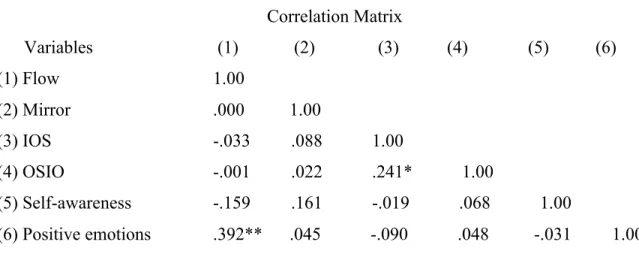
See Table 1 for descriptive statistics and Table 2 for correlations among key variables. Manipulation Check
x 2 (mirror/no mirror) ANOVA. A significant main effect was found for flow condition, F(1, 101) = 13.699, p = .000; there was no significant main effect of mirror or interaction. To determine the effects of the mirror manipulation on participants’ feelings of self-consciousness, scores from the Situational Self-Awareness Scale (Govern & Marsch, 2001) were submitted to a 2x2 ANOVA. A main effect for flow condition was not significant, but the means were in the expected direction, F(1, 101) = 2.684, p = .104. A main effect for mirror condition also was not significant, but the means were in the expected direction, F(1, 101) = 2.684, p = .104; there was no significant interaction effect. To determine if the mirror affected specific aspects of self-consciousness, scores from the subscales of the Situational Self-Awareness Scale were submitted to 2x2 ANOVAs. For the “private” and “surroundings” subscales, no main effects or interactions were significant. For the public subscale, there was a significant effect for mirror condition, F(1, 102) = 9.792, p = .002, such that participants in the mirror condition reported increases in public self-awareness.
Primary Analyses
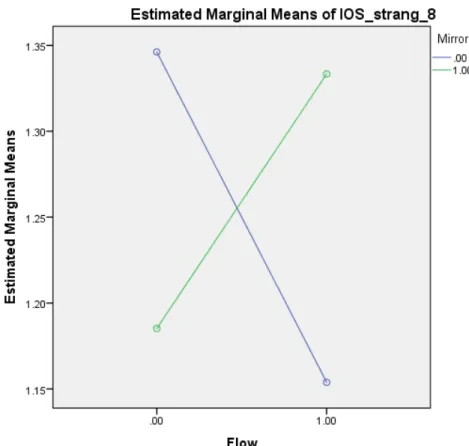
asking participants to rate their closeness with a stranger, F(1, 102) = 3.090, p = .082, such that participants in the flow/mirror and no flow/no mirror conditions reported higher closeness than the flow/no mirror and no flow/mirror conditions (see Figure 4). No other individual IOS items produced significant results.
Data from the Overlap of Self, Ingroup, and Outgroup scale (OSIO; Schubert & Otten, 2002) were submitted to a 2x2 ANOVA to analyze the effects of condition on feelings of
closeness with members of various groups. No main effects or interactions were significant when the aggregated measure was used as the outcome variable. There were, however, significant findings for the individual OSIO measure related to feelings of closeness with members of different gender groups. A significant interaction effect was found for participants’ ratings of closeness with people of a gender outgroup, F(1, 101) = 7.110, p = .009, such that participants in the flow/mirror and no flow/no mirror conditions reported higher closeness than the flow/no mirror and no flow/mirror conditions (see Figure 5). No other individual OSIO items produced significant results.
Data from the Waiting Room Task (Holland et al., 2004) were submitted to a 2x2 ANOVA to analyze the effects on social orientation; no main effects or interactions were significant.
Secondary Analyses
To explore the connections between the flow state and other attention-related
101) = 5.459, p = .021, such that participants in the flow/mirror condition reported higher levels of mindfulness than the other conditions.
Using data from the Modified Differential Emotions Scale (mDES; Fredrickson et al., 2003), the effects of flow on participants’ reported emotional state were submitted to a 2x2 ANOVA. In keeping with the existing literature, there was a significant main effect of flow, F(1, 101) = 18.354, p = .000, such that participants in the flow condition experienced greater positive emotions than the control.
Discussion
The aim of this study was to evaluate the capacity of the flow state to effect changes in social orientation such that individuals would be more willing to interact and connect with others. I anticipated that the flow state would produce increases in ratings of closeness,
specifically due to the positive emotions and loss of self-consciousness produced during flow. I also hypothesized that the addition of a mirror would induce feelings of self-awareness that would interfere with the loss of self-consciousness achieved during flow, thereby interrupting the flow state. The hypotheses of this study were not fully supported by the results; the average scores on measures of feelings of closeness demonstrated no significant effects of flow or the presence of the mirror. Furthermore, the significant effects that emerged on individual items were contrary to the hypotheses, such that ratings of closeness were highest in the flow/mirror and no flow/no mirror conditions.
the flow manipulation check, as well as the significant effect of reading on positive emotions, suggest that this activity should be considered for use as a flow induction in future research.
While the flow manipulation was successful, the mirror manipulation did not
significantly influence the average score on the manipulation check of overall self-awareness, although it did elicit the specific aspect of public self-consciousness. Seeing as the mirror produced a main effect for several measures, its influence in this study may not have been effectively captured by the selected manipulation check as a whole. Interestingly, the significant effect of the mirror on the public self-consciousness subscale of self-awareness suggests that the mirror manipulation may have been successful in shifting a small aspect of self-awareness. The items on this subscale primarily relate to awareness about appearance and thoughts about others’ perceptions of oneself; this suggests that perhaps the mirror manipulation evoked the classic notion of self-consciousness as a general concern about how one is seen in the eyes of others. This has the potential to explain why the mirror manipulation produced higher ratings of
closeness on some items, as the mirror may have been a cue for the presence of others; however, since this effect was not apparent in the average scores, future research should be done to explore whether these findings may have been the result of chance.
the self more salient, as well as the concepts of sociality and people in general, leading to increased ratings of closeness with others because participants conceptualized those others as a part of the self. In other words, the mirror did not interrupt the flow state, but rather broadened the scope of self-awareness such that others were incorporated into the concept of the self. Since this finding was unexpected and only apparent for one IOS item, though, future research should explore the relationship between self-consciousness and connectedness with already-close others to determine whether or not this finding was reliable and meaningful.
Furthermore, participants in the flow and mirror condition reported high ratings of closeness with a stranger and members of a gender outgroup. As hypothesized, the connection between flow and increases in ratings of closeness may be attributed to the boost of positive emotions that participants received during the flow state, creating an effect of broadened
the mirror, may have produced a different cognitive state altogether. This may explain why the effects found in this study are not all in the expected directions.
The possibility that this study is tapping into a different mental state is supported by the finding that participants in the flow and mirror condition reported significantly higher levels of state mindfulness. One explanation for this finding lies in the present-moment focus that is central both to the flow state and the mindful state, and is particularly relevant to the chosen reading manipulation. Self-awareness is also a central aspect of mindfulness, and it was intended to be amplified in the mirror condition. It seems likely that participants adopted the present-moment orientation of the flow state, and potentially also benefited from the self-awareness component of the mirror manipulation, thereby producing heightened state mindfulness.
As addressed earlier, this study has several limitations primarily to do with the chosen manipulations. The flow state consists of a balance of challenges and skills that may be difficult to achieve in the laboratory setting. While the reading intervention was successful in inducing a state of flow that conformed to the chosen manipulation check, it is certainly not representative of the wide range of more immersive and intrinsically motivated flow activities experienced in the field. Future research should continue to explore creative flow inductions that more closely mirror the effects of flow as it occurs naturally during enjoyable activities. Furthermore, the mirror manipulation check may not have tapped into what I originally conceptualized as the construct of self-consciousness. In future studies, it would be helpful to reconsider how this classic manipulation alters consciousness in a way that seems to promote increased other-focus. Furthermore, this study had a limited sample size and may have consequently been
underpowered; a larger sample may have served to clarify some of the unexpected findings or perhaps may have allowed the hypothesized findings to emerge. Consideration of these
limitations would benefit future research, enabling a better understanding of the validity of these findings.
Although the hypotheses were not supported, this study provides groundwork for
References
Aron, A., Aron, E. N., & Smollan, D. (1992). Inclusion of Other in the Self Scale and the structure of interpersonal closeness. Journal of personality and social
psychology, 63(4), 596.
Aron, A., Aron, E. N, Tudor, M., & Nelson, G. (1991). Close relationships as including other in the self. Journal of Personality and Social Psychology, 60, 241-253.
Barbalet, J. M. (1999). Boredom and social meaning. The British Journal of Sociology, 50(4), 631-646.
Beaman, A. L., Klentz, B., Diener, E., & Svanum, S. (1979). Self-awareness and transgression in children: Two field studies. Journal of Personality and Social Psychology, 37(10), 1835.
Brown, K.W. & Ryan, R.M. (2003). The benefits of being present: Mindfulness and its role in psychological well-being. Journal of Personality and Social Psychology, 84, 822-848. Catalino, L. I. & Fredrickson, B. L. (2011). A Tuesday in the life of a flourisher: The role of
positive emotional reactivity in optimal mental health. Emotion, 11(4), 938-950. Clark, M. S. (1983). Reactions to aid in communal and exchange relationships. In J. D. Fisher,
A. Nadler, & B. M. DePaulo (Eds.), New directions in helping (Vol. 1, pp. 281-304). San Diego, CA: Academic Press.
Csikszentmihalyi, M. (1975). Play and intrinsic rewards. Journal of Humanistic Psychology, 15, 41–67.
Csikszentmihalyi, M., & Csikzentmihaly, M. (1991). Flow: The psychology of optimal experience (Vol. 41). New York: HarperPerennial.
Csikszentmihalyi, M., & LeFevre, J. (1989). Optimal experience in work and leisure. Journal of Personality and Social Psychology, 56, 815–822.
Dovidio, J. F., Isen, A. M., Guerra, P., Gaertner, S. L., & Rust, M. (1998). Positive affect, cognition, and the reduction of intergroup bias. In C. Sedikides (Ed.), Intergroup cognition and intergroup behavior (pp. 337–366). Mahwah, NJ: Erlbaum.
Fredrickson, B. L. (2001). The role of positive emotions in positive psychology: The broaden-and-build theory of positive emotions. American Psychologist, 56(3), 218-226.
Fredrickson, B. L., Cohn, M. A., Coffey, K. A., Pek, J., & Finkel, S. M. (2008). Open hearts build lives: Positive emotions, induced through loving-kindness meditation, build consequential personal resources. Journal of Personality and Social Psychology, 95,1045-1062.
Fredrickson, B. L., Tugade, M., Waugh, C. E., & Larkin, G. R. (2003). What good are positive emotions in crises? A prospective study of resilience and emotions following the terrorist attacks on the United States on September 11th, 2001. Journal of Personality and Social Psychology, 84, 365–376.
Govern, J. M., & Marsch, L. A. (2001). Development and validation of the situational self-awareness scale. Consciousness and cognition, 10(3), 366-378.
Holland, R. W., Roeder, U. R., Brandt, A. C., & Hannover, B. (2004). Don't stand so close to me: The effects of self-construal on interpersonal closeness. Psychological
Science, 15(4), 237-242.
Jackson, S. A., & Csikszentmihalyi, M. (1999). Flow in sports. Human Kinetics.
Jackson, S. A. & Marsh, H. W. (1996). Development and validation of a scale to measure optimal experience: The flow state scale. Journal of Sport and Exercise Psychology, 18, 17-35.
Jackson, S. A., Thomas, P. R., Marsh, H. W., & Smethurst, C. J. (2001). Relationships between flow, self-concept, psychological skills, and performance. Journal of Applied Sport Psychology, 13(2), 129-153.
Keyes, C. L. M. (2007). Promoting and protecting mental health as flourishing: A
complementary strategy for improving national mental health. American Psychologist, 62, 95–108.
Kok, B. E., Coffey, K. A., Cohn, M. A., Catalino, L. I., Vacharkulksemsuk, T., Algoe, S. B., Brantley, M., & Fredrickson, B. L. (2013). How positive emotions build physical health: Perceived positive social connections account for the upward spiral between positive emotions and vagal tone. Psychological Science, 24, 1123-1132
Massimini, F., Csikszentmihalyi, M., & Delle Fave, A. (1988). Flow and biocultural evolution. In M. Csikszentmihalyi & I. Csikszentmihalyi (Eds.), Optimal experience:
Mazzocco, P. J., Green, M. C., Sasota, J. A., & Jones, N. W. (2010). This story is not for everyone: Transportability and narrative persuasion. Social Psychological and Personality Science, 1-8.
McQuillan, J. & Conde, G. (1996). The conditions of flow in reading: Two studies of optimal experience. Reading Psychology, 17(2), 109-135.
Moller, A. C., Meier, B. P., Wall, R. D. (2007). Developing an experimental induction of flow: Effortless action in the lab. In B. Bruya (Ed.), Effortless attention: A new perspective in the cognitive science of attention and action (191-204). Cambridge: MIT Press. Nell, V. (1988). Lost in a book: The psychology of reading for pleasure. New Haven, CT: Yale
University Press.
Payne, B. K., Cheng, C. M., Govorun, O., & Stewart, B. D. (2005). An inkblot for attitudes: affect misattribution as implicit measurement. Journal of personality and social psychology, 89(3), 277.
Salzberg, S. (1995). Loving-kindness: The revolutionary art of happiness. Boston: Shambhala.
Schubert, T. W., & Otten, S. (2002). Overlap of self, ingroup, and outgroup: Pictorial measures of self-categorization. Self and identity, 1(4), 353-376.
Sheldon, K. M., Prentice, M., & Halusic, M. (2014). The experiential incompatibility of mindfulness and flow absorption. Social Psychological and Personality Science, 1948550614555028.
Table 1
Descriptive Statistics
N Minimum Maximum Mean Std. Deviation
IOS Average 106 1.00 6.00 3.6758 .85068
IOS Best Friend 102 1.00 7.00 5.2451 1.55707
IOS Stranger 106 1.00 3.00 1.2547 .49879
OSIO Average 106 1.54 6.92 3.9728 .88482
OSIO Gender Outgroup 106 1.00 7.00 3.6132 1.62317
Positive Emotions 105 1.00 3.50 1.8914 .57914
Flow State Scale 105 1.77 4.15 3.1786 .44416
SSAS 105 1.11 5.89 3.6807 1.00968
State MAAS 105 1.00 9.00 4.9067 1.71421
Table 2
Correlation Matrix
Variables (1) (2) (3) (4) (5) (6)
(1) Flow 1.00
(2) Mirror .000 1.00
(3) IOS -.033 .088 1.00
(4) OSIO -.001 .022 .241* 1.00
(5) Self-awareness -.159 .161 -.019 .068 1.00 (6) Positive emotions .392** .045 -.090 .048 -.031 1.00
Figure 1
Inclusion of Other in the Self Scale:
Figure 2
Overlap of Self, Ingroup, and Outgroup Scale:
Figure 3
Figure 5