Running Head: MODELING INTIMACY AND COMMITMENT IN EMERGING ADULTHOOD
Romantic Relationships in Emerging Adulthood: Modeling Intimacy, Commitment, and Factors Influencing their Interaction
Danielle Jameison
University of North Carolina, Chapel Hill Spring 2015
A thesis presented to the faculty of The University of North Carolina at Chapel Hill in partial fulfillment of the requirements for the Bachelor of Arts degree with
Honors in Psychology
Departmental Advisor: Dr. Donald Baucom Reader: Dr. Sara Algoe Reader: Matthew Cohen
Abstract
Intimacy and commitment are constructs essential to a successful romantic relationship, but for emerging adults navigating the world of dating, it is not always clear how these two elements interact. Data from a self-report survey of 162 undergraduate students were used to better
Acknowledgements
I cannot reflect on my experiences in the world of research thus far without also
Romantic Relationships in Emerging Adulthood: Modeling Intimacy, Commitment, and Factors Influencing their Interaction
Intimacy and commitment are both essential aspects of an interpersonal romantic relationship. In the context of marriage, perhaps existing social and legal parameters make expectations of intimacy and commitment relatively clear. In other romantic interactions
spanning in seriousness from first encounters to years-long relationships, expectations regarding intimacy and commitment may be less obviously defined. Some couples might make a point to discuss how they want to define intimacy, the extent to which that intimacy entails commitment, and what that commitment should entail. However, divergences in unspoken definitions and expectations for these constructs in romantic relationships can cause unwanted and potentially unnecessary conflict between partners. In order to assist couples in addressing such central domains within their relationships, a further delineation of these constructs is needed.
Intimacy
Intimacy is a broad construct defined as the ability to give and receive care, to mutually self-disclose, and to trust and feel connected with one’s partner while still maintaining individual autonomy (Kerpelman et al., 2012; Sumter, Valkenburg, & Peter, 2013). Intimate interactions often involve both partners feeling understood and validated by an empathetic and supportive listener (Yoo, Bartle-Haring, Day, & Gangamma, 2013).
Intimacy is thought to be at least partially determined by attachment styles engrained in childhood, but advances substantially between early adolescence and adulthood as young men and women desire to engage in more serious and generally more intimate romantic relationships. Biological developments create desire for physical interaction, and cognitive-emotional
can have on their personal senses of well-being (Reis, 1990). Following that period of growth and transition, self-reported levels of intimacy tend to remain fairly stable (Kerpelman et al., 2012; Sumter, Valkenburg, & Peter, 2013).
Intimacy has long been established as a strong predictor of relationship satisfaction, but it is important to distinguish between the many dimensions that intimacy encompasses. Physical and emotional intimacy have been set apart from other types like social and intellectual intimacy. Not only are physical and emotional intimacy more strongly correlated with relationship
satisfaction, but the two may influence one another (Kerpelman et al., 2012). Empirical findings support the idea that the influence may be bidirectional. Some investigators have found an effect wherein sexual intimacy predicts emotional intimacy, with sexual satisfaction determining the degree of emotional intimacy in a couple (Yoo et al., 2013). Other studies in which self-disclosure and partner self-disclosure strongly predicted sexual intimacy in college students and married couples support alternative ideas that emotional intimacy predicts physical intimacy (Birnie-Porter & Lydon, 2013).
Commitment
increasing levels of commitment in the transition from adolescence to adulthood is the increased level of intimacy in romantic relationships during that period as well (Sumter et al., 2013).
The typical trajectory of a relationship is a function of relational stability, ultimately grounded in commitment. In the context of dating relationships, commitment is generally steady, showing gradual increases over time. Commitment levels fluctuate much more in event-driven relationships (Dailey, Brody, Lefebvre, & Crook, 2013). Both married and non-married couples describe using both direct and indirect mechanisms to communicate and reinforce their
commitment to one another, including working together to solve issues, displaying affection, and remaining faithful. With time and increased interdependence in a relationship, individuals can develop an understanding of their own commitment. That level of commitment is related to expressions of commitment, one’s partner’s perception of those expressions, and one’s partners corresponding level of commitment (Weigel & Ballard-Reisch, 2012). Because of the
interdependent nature of dyadic commitment, when perceptions diverge, expectations for and expressions of commitment can as well.
expectations for commitment and how they relate to intimacy can help to clarify the complex context within which couples function.
Men and Women in Romantic Relationships
The evolutionary perspective. Evolutionary perspectives in sexual strategies posit that men and women have evolved distinctive yet tactical behaviors for short-term and long-term mating. Thought to be a result of both evolutionary differences in mating strategies and social norms about the sexuality of men and women, studies indicate that sexual behavior shows clear gender differences. Men tend to engage in sexual behavior at an earlier age than women and tend to have more sexual partners over the course of a lifetime as well (Fisher, 2013).
For a male, short-term mating strategies offer reproductive benefits such as inseminating and producing progeny with many fertile women, but require solutions to problems such as identifying which women are fertile, minimizing commitment, and identifying an adequate number of partners. Males tend to prefer short-term mates with more sexual experience – as assessed by promiscuity, high sex drive, and lack of prudishness – as such qualities can indicate sexual availability without also entailing the time and resources that courtship demands.
seek sexually loyal partners, since partners more likely to be faithful reduce the risk of paternal uncertainty.
Males balance the differences in strategy and partner preference for short- versus long-term mating patterns by dedicating a larger proportion of their mating efforts, particularly in their younger years, to short-term mating and by prioritizing partner traits that are most likely to alleviate the most threatening mate selection issues (i.e., sexual access to an adequate volume of partners, sole monopoly on a woman’s reproductive faculties) (Buss & Schmitt, 1993; Buss, 1998).
Females employing short-term mating strategies may benefit from gaining access to certain social circles, refining and clarifying one’s mate preferences, immediate resource accrual, protection from non-mated males, and evaluation of a mate’s long-term potential. However, a major selection issue is the fact that short-term strategies do not generally provide a female access to her mate’s resources for an extended period of time. Such a challenge is reflected in the preference for short-term mates who generously share resources early in the relationship.
Long-term mating strategies for females entail two crucial benefits – continuous, long-term access to a mate’s resources and parental investment. However, she has the problems of identifying partners who are not only able, but also willing to provide such resources. As a result, women searching for long-term mates value ambition, income, status, and generosity.
desiring fewer mating partners (Buss & Schmitt, 1993; Buss, 1998). Such hypothesized gender differences in mate selection strategies would seemingly have implications for how women and men address intimacy and commitment in their romantic relationships.
Gendered differences in relationship constructs. Studies on intimacy and commitment as a function of gender have yielded some sex-based differences, but metanalyses of the
literature reveal that any such differences are small (Sumter et al., 2013). When differences have been observed, men tend to report being less intimate and committed than women. Other studies have found that men are more committed but less intimate than women, both in adolescence and adulthood (Vianello, Schnabel, Sriram, & Nosek, 2013).
Studies finding no gender differences in these constructs support the idea that intimacy and commitment differences between genders might reflect that men and women actually are not fundamentally different (Vianello et al., 2013). Alternatively, it has been suggested that gender differences are dependent on the gender climate in a society, since outward expression of a gendered self is fueled by social desirability and tendencies toward conformity. Thus, lessening gender differences in intimacy and commitment would be expected in the changing Western societal climate that has seen a trend towards equalization of gender roles (Fisher, 2013).
However, another explanation could be that although the desire for intimacy and commitment do not differ significantly between men and women per se, the perception and communication of these constructs do differ between the genders.
than men do, while men tend to prioritize sexual activity and physical closeness, both functions of sexual intimacy (Yoo et al., 2013). Similarly, women and men tend to express commitment differently. Women report using more emotional reassurance, tangible reminders, and actively working on the relationship than men do. Such findings are consistent with the theory that women are typically more relationship-oriented, their identities more grounded in their connections with others than men’s identities (Weigel & Ballard-Reisch, 2012).
While literature does not support women and men being more or less intimate or committed than the other gender, findings do indicate that they may define, measure, and perceive intimacy and commitment differently. Men and women, therefore, may differ in how they understand and enact the association between intimacy and commitment as well.
Perceived Social Power
Power is the ability to impose one’s will on others and affect desired outcomes
consistently and intentionally (Bennett, 1988). It is therefore an influential factor on all levels of interaction, from dyadic relationships to normative societal standards to macro structures
(Lennon, Stewart, & Ledermann, 2012). Overall, men desire power and the resources it confers more so than women, whereas women are more focused on status and the respect it garners (Hays, 2013). Women, however, tend to consider power more in their evaluations of potential romantic partners than men do, a finding consistent with evolutionary theories on gendered mating (Eastwick et al., 2013). Men’s greater desire for power also seems to be borne out in reality. In nearly every society, men possess greater power and status financially, politically, and socially than women (Lennon et al., 2013). This consistent imbalance in power can foster
Empirical findings on power in romantic contexts demonstrate the influence it has on the dynamics of a relationship. Overall, higher levels of power are associated with lower levels of commitment, satisfaction, and higher quality of alternative partners (Lennon et al., 2013). Power is also positively associated with infidelity because of increased confidence in the ability to attract partners (Lammers, Stoker, Jordan, Pollmann, & Stapel, 2011). In adolescence, relational power is highly correlated not only with satisfaction, but also with relational aggression and negative psychological symptomology (Bentley, Galliher, & Ferguson, 2007). Individuals with less power may also look to restore the balance in the relationship by increasing the rewards their partners receive in terms of sexual intimacy (Edwards, Barber, & Dziurawiec, 2013). That is, they might use sexual behavior as a resource to exchange in a relationship where they experience less power. While these findings are not gender specific, combining them with existing power dynamics in society suggests that differences in power might differentially influence how men and women address intimacy and commitment in relationships as well.
Emerging Adulthood – The University Setting
Emerging adulthood is a relatively new conception, having only been investigated and characterized in the last two decades. It exists in cultures that foster an extended period of simultaneous independence and identity exploration. Western civilization is one such culture, and recent demographic changes have allowed individuals in their late teens and early twenties to explore a much wider variety of possibilities in love, occupation, and worldviews than
be a function not of demographic changes like marriage or parenthood, but of the ability to make independent decisions and accept responsibility for one’s self (Arnett, 2000).
In the context of romantic relationships, adolescence is a time for companionship, exploration and experimentation, and first experiences, while adulthood is normally
characterized by committed, long-term relationships. Emerging adulthood involves more serious explorations of love than adolescence, at a time when experiences and understanding of
commitment are still involving. More about exploring the potential for sexual and emotional intimacy than the emphasis on transient recreation that characterizes adolescent dating,
relationships in emerging adulthood are likely to last longer (i.e., be more committed), involve sexual intercourse, and center around self-identity and identifying a compatible life partner (Arnett, 2000).
Power in emerging adulthood is distinct from the kind of popularity-based power in adolescence, but it also from occupational power in adulthood (Lammers et al., 2011). The kind of power most relevant in this setting is more social in nature, a function of the extent to which one can achieve desired outcomes in social spheres. As noted earlier, men and women appear to differ in their mating strategies and goals, and social power might aid them in being successful in attaining their relationship goals relative to intimacy and commitment.
The Current Study
The purpose of the current study is to investigate a model that proposes how intimacy and commitment are associated differentially for men and women in the context of emerging
one’s desired goals in intimate relationships. More specifically, the current investigation addressed the following questions –
1. Does intimacy predict commitment in emerging adulthood for both women and men? 2. Is the association between intimacy and commitment moderated by gender, such that
it is stronger for one gender than the other?
3. Are associations between intimacy and commitment for men and women related to the amount of perceived social power that an individual has?
If evolutionary theories of mating are valid despite the prevailing “hook-up culture” on university campuses and among young adults even beyond college, then males should prefer short-term mating, and women should prefer long-term mating, using short-term mating strategies primarily as a progression into a longer-term relationship. Therefore, the degree and ways that intimacy and commitment are associated should differ between genders. In addition, since power is a function of the ability to affect one’s desired outcomes, individuals’ level of self-perceived social power should dictate the extent to which they get their romantic demands met. That is, people in powerful positions should be able to use their power to achieve their goals: in this instance, how to address intimacy and commitment with a partner. Combining strongly supported associations between intimacy and commitment with evolutionary mating perspectives and the benefits that power confers, the following hypotheses were formulated.
Consistent with evolutionary theories on mating, our second hypothesis is that women will more strongly associate intimacy with commitment than men will.
Finally, we hypothesize that perceived social power will be an important factor in understanding differential associations between intimacy and commitment for the two genders. Perceived social power offers people the ability to impose their desires on others and ultimately affect behavioral outcomes. Hence our third hypothesis is as follows: Because women prefer long-term mating, women with higher levels of perceived social power will more strongly
associate intimacy and commitment than women with lower levels of perceived social power. By contrast, because men prefer short-term mating, men with higher levels of perceived social power will demonstrate lower associations between intimacy and commitment than men with lower levels of perceived social power. In summary, women with higher perceived social power will demonstrate higher associations between intimacy and commitment whereas men with higher perceived social power will demonstrate lower associations between intimacy and commitment.
Methods
This study was approved by the University of North Carolina, Chapel Hill Behavioral Institutional Review Board.
Participants
the valid data from 162 participants, 44.4% were men and 55.6% were women. Participants ranged from first-years to seniors with ages between 18 and 23 years old, given the specificity of the investigation to the emerging adult population. No selection criteria for race were included because it was not believed to have a significant impact on the hypotheses, but the sample was primarily Caucasian (77.1%), with 13.6% Asian, 6.2% Black, 2.5% Native American, and 0.6% Pacific Islander. Participants were required to be currently emotionally and physically involved with a significant other according to self-report, although the degree of emotional or physical involvement was unspecified to allow for a breadth of relationship dynamics from those casually “hooking up,” to those who have gone on a few dates and only kissed, to those who have been in a long-term relationship for years.
Measures
The three primary constructs to be assessed in this investigation were intimacy (including both sexual and emotional intimacy), perceived social power, and commitment.
Intimacy. Intimacy was assessed with the Personal Assessment of Intimacy in
Relationships (PAIR) questionnaire (Schaefer, 1981). It measures the expected versus realized degree of intimacy in five areas: emotional intimacy, social intimacy, sexual intimacy,
subscale includes six items, three of which are reverse scored, such as “My partner listens to me when I need someone to talk to” and “I often feel distant from my partner.” The self-report inventory was appropriate for assessing intimacy in the sample because of its breadth of use across all levels of dyadic heterosexual relationships, from friendship to steady dating to
marriage. The emotional intimacy subscale has been shown to be relatively internally consistent (α=0.70-0.73; Walter, Hampton, & Robinson, 2014). The Conventionality scale is used to ensure that participants have realistic views of relationships. It also contains six items, including ones such as “My partner has all the qualities I’ve ever wanted in a mate,” “My partner and I
understand each other completely,” and “I don’t think anyone could possibly be happier than my partner and I when we are with one another.” Ideally, the sample average falls at or below “3,” which suggests that participants neither “Agree” nor “Strongly Agree” with statements that are untrue assuming their perspectives on relationships are truthful. It was used to confirm that the sample’s views of romantic relationships were relatively realistic from the outset of the study. Only the Emotional Intimacy and Conventionality subscales were used in this investigation. Participants indicated the extent to which each of the twelve statements corresponds to their realized perception of intimacy in the context of the relationship in which they are involved.
answering the other items. All questions were asked about sexual touching, oral sex, vaginal sex, and anal sex.
In terms of quantifying sexual intimacy for use in analyses, the frequency of involvement with participants’ single most relevant partner (or only partner) was used. Items measuring frequency of sexual involvement asked about sexual touching, oral sex, vaginal sex, and anal sex and were rated from “Never” to “Everyday” with three markers in between (i.e. “Every Few Months,” “Every Few Weeks,” and “A Few Times Per Week”). Although the scale was ordinal in nature, it was recoded into an interval Likert scale with 1 being “Never” and 5 being
“Everyday” for the purposes of being able to tabulate an average and use a continuous variable in regression analyses and correlations. Anal sex was excluded from the final set of analyses not only because of its limited correlation with the other three kinds of sexual activity (an alpha value of α= 0.837 without anal sex versus α= 0.739 with it), but also because of much lower incidence of this sexual practice than any of the others, a gender difference in the frequency with which men and women engage in it (t(153)= 3.273, p < 0.001), and a sizeable number of
In the context of this study, intimacy was measured as a composite of both emotional and sexual intimacy because the two are so interconnected and heavily influence on another. That is, an average intimacy score was calculated using participants’ responses to each of the six items of the PAIR Emotional Intimacy subscale and three of the frequency of sexual intimacy items noted above. Those nine items yielded a Cronbach’s alpha of α= 0.773, providing empirical support that the two aspects of intimacy can be viewed legitimately as a single construct for this age group.
Commitment. Commitment was assessed using the Investment Model Scale (Rusbult, Martz, & Agnew, 1998). The scale assesses three factors – satisfaction level, quality of
alternatives, and investment size – with three individual subscales followed by a seven-item global scale assessing commitment in general. It has been demonstrated that commitment can be modeled using satisfaction level, alternative quality, and investment size as predictors. However, for the purposes of the current study, participants answered only the seven commitment scale items (two of which are reverse scored), which include statements such as “I would not feel very upset if our relationship were to end in the near future” and “I am committed to maintaining a relationship with my partner” scored on a Likert scale from 1 (Do Not Agree At All) to 8 (Agree Completely). Commitment was calculated as a composite of the seven items, resulting in scores with a possible range from 7 to 63. The commitment scale demonstrates high reliability
(0.91<α<0.95) (Rodrigues & Lopes, 2013).
peers rank the classmates in terms of popularity are not methods applicable to this investigation, in part due to logistical constraints.
When power is measured in adulthood, often researchers ask participants for their level of power in a workplace setting. Again, given the university microcosm in which the participants for this study operate, power could not be evaluated as a function of occupational status or mobility (Lammers, Stokers, Jordan, Pollmann, & Stapel, 2011).
In considering a measure for social status in emerging adulthood, factors that contribute to high social status and power may include general perception and peer recognition, the notoriety of one’s extracurricular organizations, demographic imbalances (e.g., in gender, ethnicity, etc.) in one’s environment, or even financial freedom. Eight items were developed based on three factors attributed to perceived power – being seen or perceived more positively than others, control over self and others, and the potential for obtaining one’s desired
consequences given social standing.
The resulting Perceived Social Power Scale included 8 initial items such as “The world responds to me in a more positive way than it does to those around me,” “I feel in control of myself and others,” and “Because of my social standing, I could probably avoid some or all of the consequences if I broke a rule.” A 5-point Likert scale ranging from Strongly Disagree (1) to Strongly Agree (5) was used. Scale development analyses, discussed further below, were
Procedure
Participants were able to sign up for a variety of studies through the Participant Pool. Once a participant had signed up to complete the current survey, they were provided with a link to the Qualtrics-based online questionnaire and were allowed to complete it in a private setting at any time. Participants were asked for their consent before being allowed to continue. When completing the survey items, they were asked to keep their partners (or the partner with whom they were most involved) in mind. Upon completion of the survey, each participant was granted 0.75 hours of research credit.
Results
Data Analysis
It was predicted that intimacy would predict commitment in the overall sample and for men and women separately. It was also predicted that intimacy would more strongly predict commitment for women than for men. Finally, it was hypothesized that perceived social power would impact the association between intimacy and commitment differentially for men and women. That is, men with high social power would less strongly associate intimacy with commitment than men with low social power, whereas women with high social power would show stronger associations between intimacy and commitment than women with low social power. From an original sample of 189 undergraduate participants, survey data from 162
Exploratory analyses included correlations between constructs pertinent to the
investigation (i.e., different dimensions of intimacy, perceived social power, etc.) for the entire sample and for men and women separately; also, reliability analyses were conducted for scale development purposes.
Sample Characteristics
The sample was comprised of 56% women and 44% men, relatively representative of the University of North Carolina population (58% women, 42% men) and college populations in general (“University of North Carolina – Chapel Hill”). Tables 1 and 2 provide past and current relationship characteristic descriptive information, respectively. Most of the sample had engaged in sexual activity of some kind (88.2%), with only 11.8% having never engaged in sexual
touching, oral sex, vaginal sex, or anal sex. Over the course of a lifetime, participants had engaged in sexual touching with an average of 5.6 partners (SD= 4.0), in oral sex with 4.2 partners (SD= 3.2), and in vaginal sex with 3.7 partners (SD= 3.4). Most had been in an exclusive, committed relationship at some point (90.7%), with an average longest relationship time of 20.3 months (SD= 14.7 months). Substantial variability in relationship time also extended to current relationship duration (M= 16.2 months, SD=16.1 months). Approximately half of the sample was currently in an emotionally committed relationship (48.8%), with a little less in a sexually committed relationship (45.0%).
Table 1
Sample Characteristics: Past Relationship Descriptives
Relationship Characteristic Mean (SD) ta
Lifetime Sexual Partners
Sexual Touching 5.62 (4.05) 1.032
Oral Sex 4.17 (3.19) 0.589
Vaginal Sex 3.73 (3.40) -0.343
Anal Sex 1.58 (2.13) -0.494
Sexual Partners in Last 6 Months
Sexual Touching 2.83 (1.66) 0.691
Oral Sex 2.34 (1.08) -0.049
Vaginal Sex 2.19 (1.55) 0.232
Anal Sex 1.29 (1.25) 1.936
Longest Relationship (Months) 20.3 (14.7) 0.027
Prior Exclusive, Committed Relationship Yes – 90.7%, No – 9.3%
Table 2
Sample Characteristics: Current Relationship Descriptives
Relationship Characteristic Overall Sample ta
Satisfaction 3.90 (0.50) 0.032
Frequency of Sexual Activity with Current Partner
Sexual Touching 3.60 (1.02) 0.606
Oral Sex 2.98 (1.05) 0.211
Vaginal Sex 2.80 (1.34) 0.060
Anal Sex 1.21 (0.59) 3.273***
Current Relationship Status
Casual Emotional – 13.6%
Sexual – 15.6%
Somewhat Serious Emotional – 14.2%
Sexual – 8.1%
Serious Emotional – 13.0%
Sexual – 11.9%
Exclusive Emotional – 10.5%
Sexual – 13.1%
Committed Emotional – 48.8%
Sexual – 45.0%
Relationship Duration (Months) 16.2 (16.1) -1.386
Table 3
Sample Characteristics: Descriptives of Major Constructs and Predictor Variables
Scale Overall Sample ta
Emotional Intimacy 3.96 (0.73) 1.356
Sexual Intimacy 3.13 (0.98) -0.281
Overall Intimacy 3.69 (0.63) 0.554
Perceived Social Power 3.31 (0.65) 0.633
Commitment 6.79 (2.13) -1.182
Overall commitment was relatively high at 6.79 (SD= 2.13) out of 9. There were no significant gender differences in the sample characteristics noted above or average scale scores in Tables 1-3 (with the exception of the frequency of anal sex with participants’ current partners, which was not included in the operationalized Intimacy variable), suggesting relative equivalence between men and women as emerging adults in romantic relationships in the context of this study and more broadly.
Scale Development
Exploratory Analyses
Exploratory Pearson correlations were conducted between participants’ conventionality scores and the predictor variables, including: satisfaction, emotional intimacy, sexual intimacy, and perceived social power. Intimacy as a composite variable was not included because its effect is explored further in the regression analyses. For the purposes of exploration, only emotional and sexual intimacy individually are used.
Exploratory correlations for the entire sample revealed more about the associations among some of the predictors aside from their relationship with the model’s dependent variable (i.e., commitment). A summary is presented here; a detailed presentation of these associations can be found in Tables 4, 5, and 6 in Appendix C. Emotional intimacy moderately and sexual intimacy weakly predicted sexual satisfaction. Better quality alternative partners were
significantly associated with decreased satisfaction, emotional intimacy, and sexual intimacy, and increased social power among men. Among women, quality of alternative partners was associated to a lesser extent with decreased emotional intimacy, but more strongly with increased social power.
Predicting Commitment: A Moderation Model
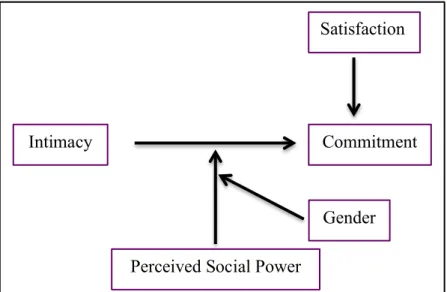
commitment. Rather than including it as a predictor, it was included in the amended model as a covariate, meaning that it was run as a main effect but not in any interaction terms. Each main effect, two-way interaction, and three-way interaction was tested as a predictor of commitment to yield an R2 value of 0.3469 (F(7, 154)= 11.47, p < 0.001) without the covariate and R2 = 0.4225 (F(8, 153)= 15.66, p < 0.001)with the covariate, a significant increase in how much of the variance in commitment is explained by the model (p < 0.001). Sexual satisfaction strongly predicted commitment (β= 5.00, t(153)= 4.32, p < 0.001). Therefore, values from the model in Figure 1 including the covariate are presented (see Table 7). All variables were centered prior to analyses being conducted.
Hypothesis 1. As predicted, intimacy was a strong, significant predictor of commitment as a main effect (β= 10.31, t(153)= 5.73, p < 0.001). Moreover, intimacy predicted commitment for both men and women, as presented in Table 8 (p < 0.001).
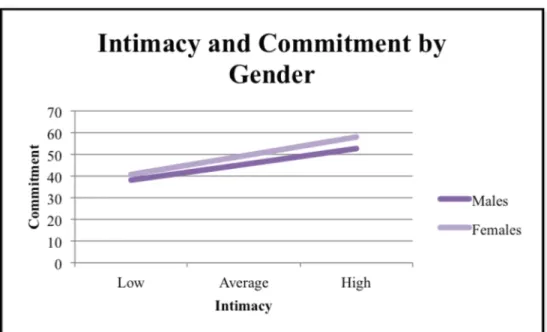
Hypothesis 2. The association between intimacy and commitment was not moderated by gender (β= 3.27, t(153)= 1.00, p = 0.318) when the two-way interaction effect was considered. Figure 2 reflects that intimacy strongly predicts commitment for each gender, and that the effect of intimacy on commitment is the same for men and women. As can be seen in Hypothesis 3 below, the findings on gender are more complex once perceived social power is taken into consideration.
Figure 1Hypothesized Model for the Association between Intimacy and Commitment as a
Function of Perceived Social Power and Gender
Intimacy Commitment
Gender Perceived Social Power
Table 7
Multiple Regression: Standardized Beta Values for Predictors of Commitment
R2= 0.4225 F= 15.66 Sig. 0.000***
Variable Standardized
Beta Coefficient
t Sig.
Intimacy β= 10.31 t= 5.73 0.000***
Perceived Social Power β= -0.34 t= -1.64 0.104
Gender β= 2.51 t= 1.25 0.212
Intimacy * Perceived Social Power β= -0.07 t= -0.18 0.861
Intimacy * Gender β= 3.27 t= 1.00 0.318
Perceived Social Power * Gender β= -0.72 t= -1.68 0.096 Intimacy * Perceived Social Power * Gender β= 1.84 t= 2.12 0.036*
Satisfaction β= 5.00 t= 4.32 0.000***
*p < 0.05, ***p < 0.001.
Table 8
Multiple Regression: Conditional Effect of Intimacy on Commitment by Gender
Gender Effect t Sig.
Men 11.29 4.69 0.000***
Women 13.70 6.64 0.000***
Figure 2Intimacy and Commitment by Gender
It was predicted that social power would moderate the effect of intimacy on commitment differentially for men and women. Specifically, we predicted that women with more social power would more strongly associate intimacy and commitment than women with less social power. By contrast, we expected the opposite for men: that high social power would correspond to weaker associations between intimacy and commitment than low social power. The
conditional effects of intimacy on commitment at each level of gender and perceived social power support these predictions (see Table 9). The labels “Low,” “Average,” and “High” reflect the values for individuals at one standard deviation below the average, at the average, and one standard deviationabove the average, respectively.
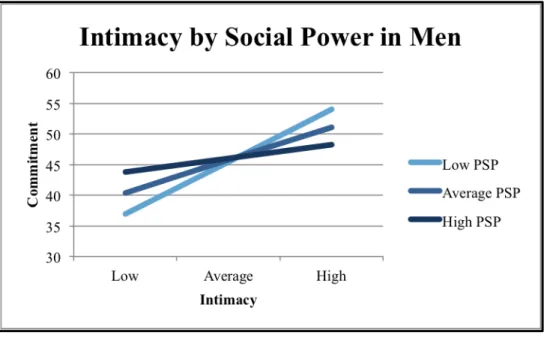
As predicted, for men, the effect of intimacy on commitment diminishes as perceived social power increases, whereas for women the effect of intimacy on commitment increases as their social power increases. Intimacy is only a predictor of commitment for men at low and average levels of perceived social power (p = 0.011, p = 0.003, respectively). Among men with high levels of perceived social power, intimacy and commitment are not correlated (p = 0.351). As seen graphically (Figure 3), commitment noticeably increases as intimacy increases for men at low and average social power.
Table 9
Multiple Regression: Probing the Interaction – Conditional Effect of Intimacy on Commitment at
Perceived Social Power and Gender
Gender Perceived Social Power Effect t Sig.
Men Low 13.45 t= 2.59 0.011*
Average 8.50 t= 3.00 0.003**
High 3.54 t= 0.94 0.351
Women Low 8.37 t= 3.82 0.000***
Average 11.76 t= 5.77 0.000***
High 15.15 t= 4.99 0.000***
Figure 3Intimacy and Commitment by Perceived Social Power in Men
Discussion
The primary goal of the current study was to assess how intimacy, perceived social power, and gender interact in emerging adulthood using a model designed to explain
commitment in romantic relationships. Secondary goals included developing a scale to measure perceived social power in a young adult population and exploring the associations between constructs fundamental to romantic relationships.
The results overall supported the proposed model. Intimacy and sexual satisfaction being strong predictors of commitment as main effects is consistent with current empirical literature. The association between intimacy and commitment was not moderated by gender as anticipated when these variables were considered alone; per the results, the interaction was more
complicated than that because of the role of perceived social power. As predicted, perceived social power moderated the association between intimacy and commitment differentially for men and women. Among men, intimacy most strongly predicted commitment in low social power conditions, less so for men of average social power, and not at all for men with high social power. Among women, the effect was reversed, with intimacy most strongly predicting commitment among high power individuals and less so among women with average and low social power.
Although cause-effect conclusions are not possible based upon this cross sectional data, it is possible that because men prefer short-term mating, they use their power to maximize
seen among women of all social power levels, particularly women of high social power. If these men do not have the power to get their demands met, they may achieve intimacy by being more committed to their female partners (who, in theory, ultimately desire commitment).
The strength of the association between intimacy and commitment increases as power increases among women, suggesting that women with more power may feel comfortable demanding commitment when they are engaging in more intimacy. Intimacy most weakly predicts commitment among women with low social power; that is, women with low social power show the smallest increases in commitment as intimacy increases. One possible explanation is that women with low social power attempt to equalize the power imbalance in their relationships by offering greater intimacy as a reward to partners in an attempt to garner greater commitment since their power alone is not enough to do so.
These findings can be explained by the notion that people use power to achieve their goals, and that ultimately men and women have different goals in a romantic context. It has been argued that when power in a relationship is imbalanced, less powerful individuals will attempt to equalize the imbalance (Eastwick et al., 2013). The weakness of the association between
partners in order to obtain intimacy. Again, such interpretations are only speculative given the cross sectional nature of the data.
Implications. Results are consistent with the theory that men and women, having different romantic relationship goals, may be using their power in a similar way (i.e., to affect their desired goals) but to achieve objectively different outcomes. Often, differences in what individuals, men and women alike, expect in terms of intimacy and commitment can cause conflict and potentially affect adult relationship dynamics long-term. Modeling the associations between intimacy and commitment as they differ between men and women based on perceived social power could provide emerging adults with more realistic expectations in their
relationships. Taking into account that this model is meant to characterize but not explain these interactions, findings do not offer ways to, for example, circumvent power and find other ways to get one’s demands met. Rather, they are descriptive in nature, allowing young adults to make informed decisions when choosing romantic partners and navigating their relationships.
Limitations
One limitation of this study is that results were collected via a self-report questionnaire. Positive impression management, societal normative pressures, and other external factors potentially influenced what kinds of responses participants provided. Given the sensitive and possibly taboo nature of the constructs being measured (i.e. sexual history, interpersonal
romantic relationships, and even social power), it is possible that some responses were inaccurate or untrue.
sense that it governs one’s confidence and how one is perceived by others, it would also be valuable to measure the degree to which one is perceived as powerful by others as well.
In addition, because power was so fundamental to the hypotheses and provided the distinguishing factor between men and women’s associations of intimacy and commitment, it is important to consider existing gender power imbalances. While already mentioned that men generally possess more power than women in society (Lennon et al., 2013), the gender imbalance on this particular undergraduate campus adds an extra layer of discrepancy. Even though there were no significant gender differences in the quality of alternative partners, the fact that men have more choices of romantic partners may have been a contributing factor to the findings. It is possible that on a campus with either an equal ratio of men to women or with a greater male than female population, the effects found in this investigation could be different. Thus, the overall gender difference in social power in a given context as well as a given individual’s social power might be important to consider.
Second, the sample was comprised of undergraduate students. As a result, the sample is on the whole more educated than the general population. Moreover, the majority of the sample was Caucasian. Although there is not evidence suggesting that findings would differ by ethnic identity or education level, lack of variation in the sample means that it is possible that the effects supported by the data are generalizable to a primarily Caucasian, well educated population.
literature; so while the data support a causally informed model, the findings themselves are descriptive rather than explanatory.
Future Directions
This study was conducted among heterosexual dyads in emerging adulthood in an educated, undergraduate setting. Opportunities for related research exist as a function of varying sample characteristics. For example, it would be worthwhile to investigate the validity of the model within a population at a different developmental stage. Since emerging adults straddle adolescence and adulthood, it is possible that the model holds true among a younger and older population. However, emerging adulthood is also a distinct stage. In adolescent dating, perhaps intimacy and commitment have not developed enough in individuals for them to be modeled clearly enough to be generalizable to the group. In addition, social power functions differently in adolescence and is much more a function of status (i.e., respect) than power per se (i.e.,
resources) (Hays, 2013). Adult romantic relationships are characterized by much more serious commitment, marked often by marriage and cohabitation to an extent that emerging adult relationships are not. If commitment in the context of marriage were generally assumed to be monogamy, then the model would necessarily be different because one would expect most respondents to be oriented towards the long-term future of their relationships.
Theoretical bases for the proposed model surround the evolutionary perspective on gendered differences in mating. Those perspectives support the differential effects of social power found for men and women, but it would not provide a sound basis for modeling
pairs would likely need to be conducted before future research on the association between intimacy, commitment, and perceived social power could be meaningfully modeled.
The correlational nature of the current study and support for the model provides a valuable basis for future researchers to explore the mechanisms of these interactions. Some possible explanations for why social power affects men and women’s associations between intimacy and commitment have been proposed and should ultimately be tested.
Finally, the study describes the association between intimacy, commitment, and
perceived social power by gender. It is possible that fundamentally, the model simply describes the way power operates in romantic relationships beyond the constructs of intimacy and
commitment. Furthermore, it could be that the model extends beyond interpersonal relationships, and in fact suggests that people, regardless of gender, use social power to achieve their goals. Because those goals may diverge based on gender in romantic relationships, the model holds true wherein intimacy and commitment are differentially affected by power between men and
women. Further investigations might make use of this model and what it suggests about
achieving goals to research gender differences in other domains. For example, it may be that the pattern holds true in other small-group dynamic such as a family, or larger social structures like a corporate workplace. In any setting – dyadic or macro – if men and women had different goals, the model may operate in a similar manner.
Conclusions
References
Arnett, J. (2000). Emerging Adulthood: A Theory of Development From The Late Teens Through The Twenties. American Psychologist,55(5), 469-480.
Bennett, J. (1988). Power and influence as distinct personality traits: Development and validation of a psychometric measure. Journal of Research in Personality,22, 361-394.
Bentley, C., Galliher, R., & Ferguson, T. (2007). Associations Among Aspects of Interpersonal Power and Relationship Functioning in Adolescent Romantic Couples. Sex Roles,57, 483-495.
Birnie-Porter, C., & Lydon, J. (2013). A prototype approach to understanding sexual intimacy through its relationship to intimacy. Personal Relationships,20, 236-258.
Buss, D., & Schmitt, D. (1993). Sexual Strategies Theory: An Evolutionary Perspective On Human Mating. Psychological Review, 100(2), 204-232.
Buss, D. (1998). Sexual strategies theory: Historical origins and current status. Journal of Sex Research, 35(1), 19-31.
Dailey, R., Brody, N., Lefebvre, L., & Crook, B. (2013). Charting changes in commitment: Trajectories of on-again/off-again relationships. Journal of Social and Personal
Relationships,30(8), 1020-1044.
Eastwick, P., Wilkey, B., Finkel, E., Lambert, N., Fitzsimons, G., Brown, P., & Fincham, F. (2013). Act with authority: Romantic desire at the nexus of power possessed and power perceived. Journal of Experimental Social Psychology,49, 267-271.
Gender Differences in Sexual but Not Non-sexual Behavior. Sex Roles,68, 401-414. Haselton, M., & Buss, D. (2000). Error management theory: A new perspective on biases in cross-sex mind reading. Journal of Personality and Social Psychology,78(1), 81-91. Hays, N. (2013). Fear and loving in social hierarchy: Sex differences in preferences for power
versus status. Journal of Experimental Social Psychology,49, 1130-1136.
Kerpelman, J., Pittman, J., Cadely, H., Tuggle, F., Harrell-Levy, M., & Adler-Baeder, F. (2012). Identity and intimacy during adolescence: Connections among identity styles, romantic attachment and identity commitment. Journal of Adolescence,35(6), 1427-1439. Lammers, J., Stoker, J., Jordan, J., Pollmann, M., & Stapel, D. (2011). Power Increases
Infidelity Among Men And Women. Psychological Science, 1191-1197.
Leeker, O., & Carlozzi, A. (2014). Effects of Sex, Sexual Orientation, Infidelity Expectations, and Love on Distress related to Emotional and Sexual Infidelity. Journal of Marital and
Family Therapy,40(1), 68-91.
Lennon, C., Stewart, A., & Ledermann, T. (2012). The role of power in intimate relationships.
Journal of Social and Personal Relationships,30(1), 95-114.
Reis, H. (1990). The Role of Intimacy in Interpersonal Relations. Journal of Social and Clinical
Psychology,9(1), 15-30.
Rodrigues, D., & Lopes, D. (2013). The Investment Model Scale (IMS): Further Studies on Construct Validation and Development of a Shorter Version (IMS-S). The Journal of
General Psychology, 16-28.
Rusbult, C., Martz, J., & Agnew, C. (1998). The Investment Model Scale: Measuring
Commitment Level, Satisfaction Level, Quality Of Alternatives, And Investment Size.
Schaefer, M., & Olson, D. (1981). Assessing Intimacy: The Pair Inventory. Journal of
Marital and Family Therapy, 47-60.
Sumter, S., Valkenburg, P., & Peter, J. (2013). Perceptions of love across the lifespan:
Differences in passion, intimacy, and commitment. International Journal of Behavioral
Development,37, 417-427.
University of North Carolina--Chapel Hill. (n.d.). Retrieved February 12, 2015, from http://colleges.usnews.rankingsandreviews.com/best-colleges/unc-2974
Vianello, M., Schnabel, K., Sriram, N., & Nosek, B. (2013). Gender differences in implicit and explicit personality traits. Personality and Individual Differences,55, 994-999.
Walker, L., Hampton, A., & Robinson, J. (2014). Assessment of relational intimacy:
Factor analysis of the personal assessment of intimacy in relationships questionnaire.
Psycho-Oncology, 1-4.
Wiederman, M. W. (1997). Extramarital sex: Prevalence and correlates in a national survey.
Journal Of Sex Research, 34(2), 167-174. doi:10.1080/00224499709551881
Weigel, D., & Ballard-Reisch, D. (2012). Constructing Commitment in Intimate Relationships: Mapping Interdependence in the Everyday Expressions of Commitment. Communication
Research,41(3), 311-332.
Yoo, H., Bartle-Haring, S., Day, R., & Gangamma, R. (2013). Couple Communication,
Emotional and Sexual Intimacy, and Relationship Satisfaction. Journal of Sex & Marital
Appendix A
Sexual History Questionnaire
Please keep the following definitions in mind when answering these questions:
Sexual touchingmeans touching another person’s genitals with your hands, or another person touching your genitals with their hands
Oral sex meansputting your mouth on another person’s genitals, or another person putting their mouth on your genitals
Vaginal sex means penis in the vagina
Anal sex means penis in butt or anus
Screener: In your lifetime, have you ever engaged in any sexual activity, including sexual touching, oral sex, vaginal sex, or anal sex?
1. No (skip remaining questionnaire) 2. Yes
1.How old were you when you first engaged in each of the following behaviors? a. Sexual touching 11 or younger 12 13 14 15 16 17 18
19 20 I’ve never done this
b. Oral sex 11 or younger 12 13 14 15 16 17 18 19 20 I’ve never done this
c. Vaginal sex 11 or younger 12 13 14 15 16 17 18 19 20 I’ve never done this
2. In your lifetime, with how many partners have you engaged in the following? a. Sexual touching 0 1 2 3 4 5 6 7 8 9 10 11 12 13
14 15 or more
b. Oral sex 0 1 2 3 4 5 6 7 8 9 10 11 12 13 14 15 or more
c. Vaginal sex 0 1 2 3 4 5 6 7 8 9 10 11 12 13 14 15 or more
d. Anal sex 0 1 2 3 4 5 6 7 8 9 10 11 12 13 14 15 or more
3. With the partner (or a partner) you have been with in the past 6 months, how often have you engaged in these behaviors?
a. Sexual touching Never Every Few Months A Few Times per Month A Few Times per Week Everyday I haven’t done this in past 6 months
b. Oral sex Never Every Few Months A Few Times per Month A Few Times per Week Everyday I haven’t done this in past 6 months
c Vaginal sex Never Every Few Months A Few Times per Month A Few Times per Week Everyday I haven’t done this in past 6 months
d. Anal sex Never Every Few Months A Few Times per Month A Few Times per Week Everyday I haven’t done this in past 6 months
5. In the past 6 months, with how many different partners have you engaged in the following? a. Sexual touching 0 1 2 3 4 5 6 7 8 9 10 11 12 13
14 15 or more
b. Oral sex 0 1 2 3 4 5 6 7 8 9 10 11 12 13 14 15 or more
c. Vaginal sex 0 1 2 3 4 5 6 7 8 9 10 11 12 13 14 15 or more
d. Anal sex 0 1 2 3 4 5 6 7 8 9 10 11 12 13 14 15 or more
6. In the past 6 months, were your partners aware of your involvement with other partners?
Yes Somewhat No I Don’t Know
7. Overall, how emotionally (not physically) satisfied are you with the frequency and level of sexual involvement with your partner(s)?
1 2 3 4 5
Appendix B
Perceived Social Power Scale
1. The world responds differently to me than it does to those around me, in a positive way.
1 2 3 4 5
Strongly disagree Neither Agree Nor Disagree Strongly Agree 2. I feel in control of myself and others.
1 2 3 4 5
Strongly disagree Neither Agree Nor Disagree Strongly Agree 3. I am confident in my ability to get my desires and demands met by someone, for the most
part.
1 2 3 4 5
Strongly disagree Neither Agree Nor Disagree Strongly Agree 4. I feel comfortable making requests of others.
1 2 3 4 5
Strongly disagree Neither Agree Nor Disagree Strongly Agree 5. I do not mind taking risks.
1 2 3 4 5
Strongly disagree Neither Agree Nor Disagree Strongly Agree 6. Because of my standing, I have some leeway in abiding by the same explicit and
unspoken rules as those around me.
1 2 3 4 5
7. Because of my standing, if I were caught breaking a rule, I could probably avoid some of the consequences.
1 2 3 4 5
Appendix C
Exploratory Correlations among Predictor Variables
Table 4
Correlations: Predictor Variables in Overall Sample
1 2 3 4 5
1 Conventionality 1 0.452** 0.692** 0.210** 0.055
2 Satisfaction -- 1 0.460** 0.243** 0.014
3 Emotional Intimacy -- -- 1 0.176* 0.017
4 Sexual Intimacy -- -- -- 1 0.199*
5 Perceived Social Power -- -- -- -- 1
*p < 0.05, **p < 0.01.
Table 5
Correlations: Predictor Variables among Men
1 2 3 4 5
1 Conventionality 1 0.509** 0.752** 0.354** -0.093
2 Satisfaction -- 1 0.564** 0.318** -0.187
3 Emotional Intimacy -- -- 1 0.388** 0.181
4 Sexual Intimacy -- -- -- 1 0.007
5 Perceived Social Power -- -- -- -- 1
Table 6
Correlations: Predictor Variables among Women
1 2 3 4 5
1 Conventionality 1 0.398** 0.672** 0.086 0.109
2 Satisfaction -- 1 0.407** 0.318** 0.142
3 Emotional Intimacy -- -- 1 0.016 0.111
4 Sexual Intimacy -- -- -- 1 0.214*
5 Perceived Social Power -- -- -- -- 1