UNIVERSITY OF NORTH CAROLINA AT CHAPEL HILL CHEMISTRY DEPARTMENT
Protein Stability Under Biomolecular Crowding Conditions
By
Larry “Zijian” Zhou Spring 2015
With
Table of Contents
Abstract Pg 3
Introduction Pg 4
Methods Pg 9
Results and Discussion Pg 12
Conclusion Pg 18
Abstract:
Introduction:
Imagine being in a Jacuzzi, first by yourself and then with others. Initially, you are free to stretch and take up as much space as possible. However, once others are present, your freedom of movement becomes restricted and you are forced to become more compact. Proteins undergo a similar phenomenon. Proteins can either be in a natured (folded) or denatured (unfolded) state. When a protein is in its folded state, it tends to be more compact as expected, while the
denatured state is looser and takes up more space. Thus, when macromolecular crowding reduces the space that a protein can occupy, it becomes more compact and the
natured state is favored. This is the basis of excluded volume in protein crowding. Molecules around the protein occupy space that is restricted to the protein, which compacts and stabilizes it. This repulsive interaction is called hard-core repulsion. Early research using inert synthetic polymers like Ficoll supports the stabilizing effects of hard-core repulsions1.
However, cells are not filled with inert synthetic polymers. There is about 300 g/L of biologically relevant molecules inside cells1. This includes other proteins, metabolites, nucleic acids, respiration byproducts, and etc. In addition to exerting hard-core repulsion forces, these biological molecules can also exert non-specific attractive weak interactions such as Van der Waals, ionic, and etc. interactions. Previous research in the Pielak group has shown that
crowding by other proteins can be destabilizing. Crowding by the protein lysozymedestabilized the enzyme, Chymotrypsin Inhibitor 2 (CI2, 7.4 kDa, pI 6.0)1. Thus, we know that non-specific attractive weak interactions can outcompete stabilizing hard-core repulsion. By learning more
about the destabilizing effects of these attractive interactions, a better understanding of macromolecular crowding can be obtained.
Fluorine Nuclear Magnetic Resonance Spectroscopy (19F NMR) was used to investigate macromolecular crowding. NMR works by detecting changes in the chemical environment of NMR active atoms. NMR active atoms have a non-zero spin that generate a magnetic moment measurable by a NMR spectrometer. This magnetic moment can be altered by changes in the chemical environment. NMR is a powerful technique in that it can detect these changes in the chemical environment in real-time and on a wide range of timescales, from 1 ps to days2. This makes it possible to detect structural changes of a protein in solution.
19F NMR works by measuring the chemical shift of fluorine atoms. Fluorine has 83% of
the sensitivity of protons and chemical shift range of ~400 ppm3, which means that it is very sensitive to a wide range of changes in the chemical environment. But the most useful property of fluorine in protein NMR is that it is rarely found in biologyyet can be incorporated into proteins3. When a 19F NMR spectrum is taken of a fluorinated protein in solution, the only signal comes from it. There is a significant reduction of noise and unwanted signal from other
biological molecules in the solution. This becomes very useful when studying the effects of crowding by other biological molecules, which are at much higher concentrations than the protein of interest.
This means that drkN SH3 will only have a single ∆G°’denaturation corresponding to its
denaturation, which reflects how stable it is in a given environment. In addition, this equilibrium is close to 0, which means both states are sufficiently populated in a sample to be detected by NMR. Crowding agents and temperature changes can push this equilibrium back and forth, altering the relative populations of the folded and unfolded states. By fluorinating the only tryptophan residue in drkN SH3, the two populations of folded and unfolded states can be detected by 19F NMR. From this, the ∆G°’denaturation of drkN SH3 at different temperatures can be
determined under various crowding conditions.
The ratio of the unfolded population to the folded population can be used to calculate the ∆G°’denaturation of drkN SH3 at temperatures from 5-45˚C. These data can then be fitted to the
integrated Gibbs-Helmholtz equation given below. ∆°’𝐺 = ∆𝐻0− 𝑇∆𝑆0+ ∆𝐶
𝑝[𝑇 − 𝑇0− 𝑇 ln 𝑇 𝑇0]
∆G°’ is the free energy of denaturation, ∆H0 is the enthalpy at a reference temperature, ∆S0 is the entropy at ref. temp. and T0is the ref. temp. ∆Cp is the molar heat capacity, which is non-zero
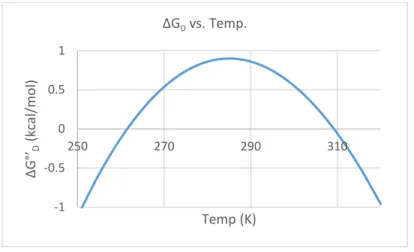
because as proteins unfold, hydrophobic side chains are exposed and solvated. The ordered water molecules in the solvation shell become more difficult to disrupt and in turn, increases the heat capacity of the solution. A general shape of the Gibbs-Helmholtz equation is given below (Figure 3).
∆Gdenaturation
Figure 3 Gibbs-Helmholtz Protein Stability Curve
The curvature is given by -∆Cp/T while the slope of the curve is given by -∆S.5 As such, at the
maximum of this curve, ∆S = 0. This temperature of maximum stability (Tmax) can then be used as
the reference temperature for the integrated form of the Gibbs-Helmholtz equation. The resulting equation is then simplified to
∆𝐺°’ = ∆𝐻𝑚𝑎𝑥+ ∆𝐶𝑝[𝑇 − 𝑇𝑚𝑎𝑥− 𝑇 ln 𝑇 𝑇𝑚𝑎𝑥]
In addition, ∆G°’ = ∆Hmax at the temperature of maximum stability because the ∆Cp term goes to
0. Fitting ∆Gdenaturation vs. temperature to this equation allows the thermodynamic parameters of
temperature of max stability, enthalpy at temperature of max stability, and heat capacity to be extracted. These parameters describe the stability of drkN SH3 under various crowding conditions.
Previous research using the Gibbs-Helmholtz equation to study proteins under various crowding conditions have been done.9 However, they relied on generous extrapolation of data and/or measured the ∆G°’denaturation unreliably. The study of drkN SH3 using 19F NMR has given
us precise and reliable data. For example, Zhou6 extrapolated the Gibbs-Helmholtz equation from
the ∆G°’denaturation with large uncertaintiesat temperatures nearly all below the temperature of max
stability. The large uncertainties in ∆Gdenaturation led to large uncertainties for the thermodynamic -1
-0.5 0 0.5 1
250 270 290 310
ΔG
°’D
(kcal/mol)
parameters. Another example is Sanfelice et al’s study of Ficoll crowding on the protein Yfh1. The study relied on two different techniques, circular dichroism (CD) and 15N-1H HSQC NMR spectra.
The authors found measurement differences between the two different techniques at lower
temperatures, which meant that they could only rely on data at higher temperatures. As a result,
they too were restricted by a lack of data points and large uncertainties.
However, our use of 19F NMR to study drkN SH3 gives us ∆G°’denaturation on both sides of the temperature of max stability and unprecedented precision. We were able to directly measure
the ∆Gdenaturation at various temperatures by determining the relative populations of the folded to
the unfolded states of drkN SH3. Using the equation
∆𝐺°’𝑑𝑒𝑛𝑎𝑡𝑢𝑟𝑎𝑡𝑖𝑜𝑛 = 𝑅𝑇 log 𝐾
where R is the gas constant of 1.987 cal K-1 mol-1, T is temperature, and K is the ratio of the folded
Methods:
Protein Expression and Purification
A plasmid containing the gene encoding for drkN SH3 was transformed into Agilent BL21 DE3
Gold cells by heat-shock method. A single colony was used to inoculate a 5 mL culture of
Luria-Bertani media with 100 µg/mL ampicillin grown for 8 hours at 37˚C. Afterwards, 50 µL of this
culture was used to inoculate 50 mL of supplemented M9 growth media (50 mM Na2HPO4, 20
mM KH2PO4, 9 mM NaCl, pH 7.4 supplemented with 4 mg/mL glucose, 1 mg/mL NH4Cl, 0.1 mM
CaCl2, 2 mM MgSO4, 10 μg/mL thiamine and 10 μg/mL biotin, and 150 μg/mL ampicillin).
The cultures were shaken at 37˚C overnight. Then, they were diluted to 1L with supplemented
M9 media and shaken until until the OD600 reached 0.6-0.8. To the culture, 0.1 mg/mL (final
concentration) of 5-fluoroindole was added and shaken for an additional 30 min. Isopropyl
β-D-1-thiogalactopyranoside (IPTG, 1 mM final concentration) was used to induce expression. After
1 h, the cells were pelleted at 1000g, resuspended in 50 mM Tris (pH 7.5) with protease inhibitors
(Sigma-Aldrich), and frozen.
The cells were lysed by sonication (Fisher Scientific Sonic Dismembrator Model 500, 15%
amplitude, 15 min, 67% duty cycle) on ice. Any cell debris was removed by centrifugation at
16000g and filtration through a 0.22 µm filter.
Purification involved two chromatography separations, first by anion exchange (GE Q column,
by size exclusion chromatography (GE Superdex 75 column eluted with 50 mM K2 HPO4, 150 mM
NaCl, 1mM EDTA, pH 7.2). The purified drkN SH3 was dialyzed against 17 MΩ cm-1 H
2O for 4 hr
at room temperature or overnight at 5˚C. Samples of protein were lyophilized to store them.
Protein Expression for in-cell NMR
The exact same procedure as listed above was used to make 50 mL of overnight cultures. The 50
mL cultures were then diluted to 100 mL with supplemented M9 media, and 5-fluoroindole at a
final concentration of 0.1 mg/mL was added. Then the cultures were shaken for 30 min,
afterwards, IPTG was used to induce protein expression.
After 45 min, the cells were pelled at 1000g and resuspended in M9 media without
5-fluoroindole. IPTG was added again to induce expression. After 45 min, the cells were pelleted at
1000g and washed three times with in-cell NMR buffer (200 mM HEPES, 100 mM bis-tris propane,
50 μg/mL chloramphenicol, 150 μg/mL ampicillin, pH ~7.6). Chloramphenicol was added to halt
protein expression prior to NMR. The cells were ultimately resuspended in 300 µL of in-cell NMR
buffer and loaded into a standard 5 mm NMR tube.
NMR:
For the buffer experiments, the purified 19F-labeled protein was added to NMR buffer (50 mM
acetic acid/sodium acetate, HEPES, bis-tris propane, pH 7.2) along with the crowder agent of
interest. 1-D 19F-spectra were acquired at 4, 10, 15, 20, 25, 30, 35, 40, and 45˚C with a Bruker
Version 3.2 and equipped with a Bruker TCI cryoprobe. Total relaxation delays for these 1D
experiments were 5 s and the sweep width was 70 ppm. However, the number of scans
depended on the crowder agent used and ranged from 64 to 256.
For the in-cell samples, the cell slurry was removed after the experiment and gently pelleted, and
the supernatant was diluted two-fold. The cells were resuspended in 0.4 mL of in-cell NMR buffer
plus protease inhibitors, lysed by sonication and clarified at 16000g. 19F spectra were acquired to
assess protein leakage and confirmed that no leakage was observed.
All 19F-spectra were processed with TopSpin 3.2. The folded and unfolded peaks were integrated
and their respective areas extracted to calculate the ∆GD at each temperature. The fitting of the
∆GD vs. temperature to the integrated Gibbs-Helmholtz equation was done through a MatLab
Results and Discussion:
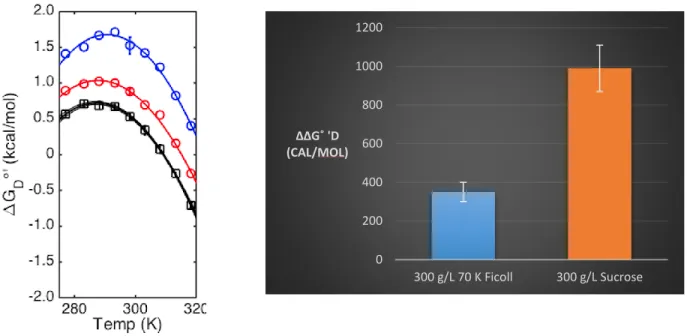
Figure 4 shows the effect of crowding by synthetic inert polymers. As expected, drkN SH3
crowded by synthetic inert polymers are stabilized relative to the dilute solution. This is because
the polymers only exert hard-core repulsive forces on drkN SH3, making it favor the compact
folded state. Stability is quantified by ∆∆G˚’D, which is the ∆G˚’D of different crowders relative to
the dilute solution at a standard temperature of 298K.
Figure 4 300 g/L 70 K Ficoll (red), 300 g/L sucrose (blue), and dilute solution (black) protein stability curve
Figure 5 ∆∆G˚D for inert polymers. Error bars generated by Monte-Carlo noise simulations
It is interesting to note that sucrose at the same g/L as 70 K Ficoll has a far more stabilizing effect (∆∆G˚’D = 990 ± 120 cal/mol vs. 350 ± 50 cal/mol). This is likely due to the
fact that there are far more sucrose molecules that are directly repulsing and surrounding the protein. Ficoll’s length is quite large relative to drkN SH3 so at a certain point, the protein will
0 200 400 600 800 1000 1200
300 g/L 70 K Ficoll 300 g/L Sucrose ∆∆G˚ 'D
not be exposed to the entire Ficoll molecule, i.e. the protein does not care about the rest of the Ficoll molecule.
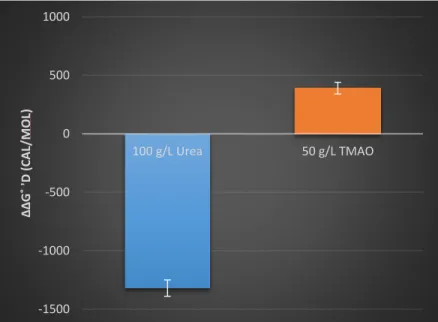
The stabilities of drkN SH3 under 100 g/L of urea (∆∆G˚’D = -1320 ±70 cal/mol) and 50 g/L of trimethylamine N-oxide (TMAO) (∆∆G˚’D = 390 ± 50 cal/mol) are shown by figures 6 and 7.
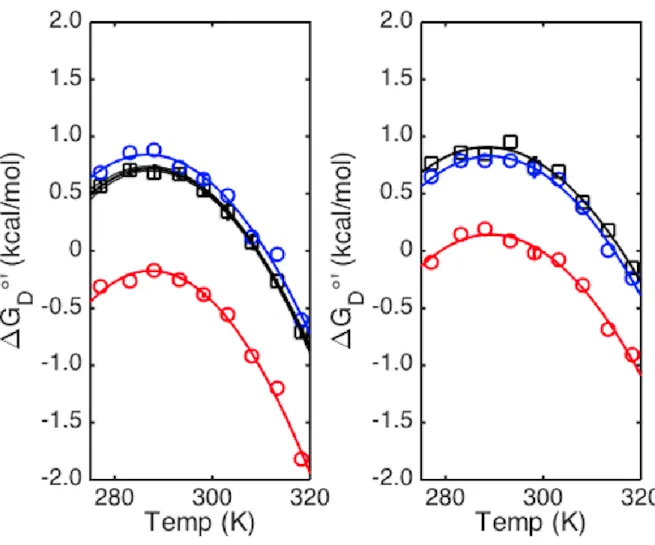
Figure 6 100 g/L Urea (red), 50 g/L TMAO (blue), and dilute solution (black) protein stability curve
Figure 7 ∆∆G˚D for urea and TMAO. Error bars generated by Monte-Carlo noise simulations
-1500 -1000 -500 0 500 1000
100 g/L Urea 50 g/L TMAO
∆
∆
G˚
'D
(
C
A
L/
M
O
Urea is known to destabilize proteins while TMAO stabilizes proteins 7, which our protein
stability curves support. Such experiments show us that drkN SH3 under these conditions follows
what is reported in literature.
The next set of figures demonstrate the effect of crowding by biological molecules,
specifically lysozyme (15 kDa, pI 11.0), bovine serum albumin (BSA, 66 kDa, pI 4.7), and the
cellular environment on drkN SH3 stability.
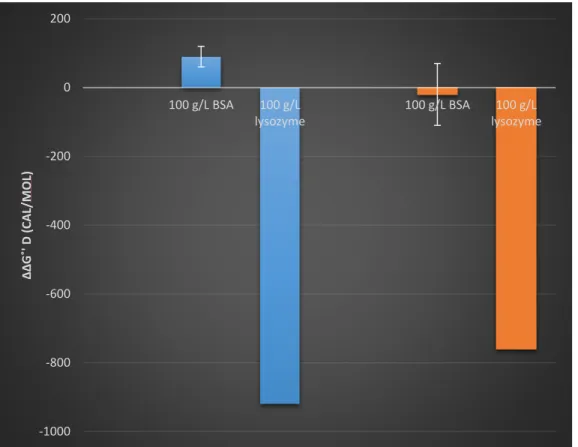
Figure 9 ∆∆G˚D for BSA and Lysozyme. Blue bars at pH 7.2, orange at pH 5.4. Error bars generated by Monte-Carlo noise
simulations
The data shows that lysozyme is destabilizing (-920 ± 30 cal/mol) and BSA is slightly stabilizing (90 ± 60 cal/mol) at pH 7.4 while lysozyme is relatively less destabilizing (-760 ± 90 cal/mol) and BSA is inconclusive at pH 5.4. The next section explains why electrostatic
attraction/repulsion between the crowder and drkN can explain the observed values of ∆∆G˚’D
-1000 -800 -600 -400 -200 0 200
100 g/L BSA 100 g/L lysozyme
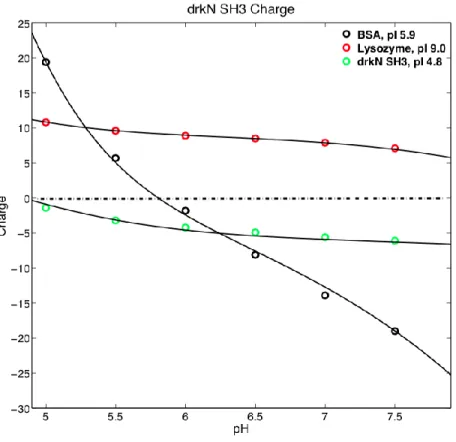
Figure 10 drkN SH3 charge at different pH’s, generated by computational calculations.
Figure 10 shows that at pH 7.2, drkN SH3 is positively charged while lysozyme is negatively charged. Thus, the lysozyme has an electrostatic attraction toward drkN SH3, a non-specific attractive weak interaction that pulls at drkN SH3. This idea is further supported by the decrease in destabilization by lysozyme at the lower pH of 5.4 because the charge difference between drkN SH3 and lysozyme decreases. This would reduce the electrostatic attraction and the magnitude of destabilization.
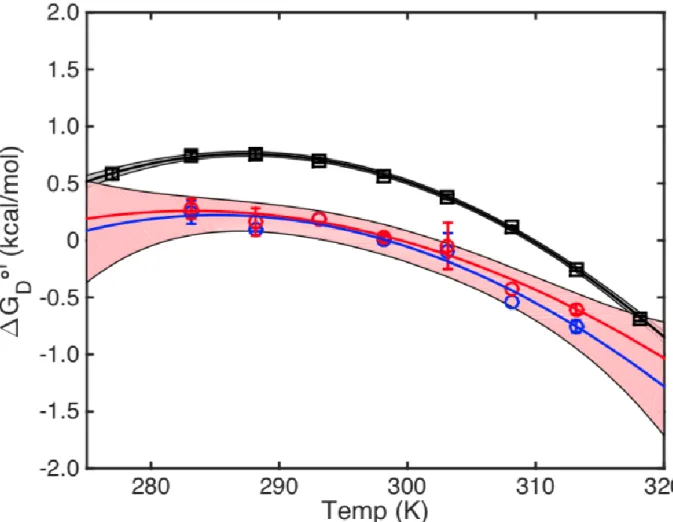
Figure 11 Dilute (black) and in-cell NMR’s (red and blues) protein stability curves. Error of in-cell NMR from fitting of data.
Finally, figure 11 shows the stability of drkN SH3 inside cells. Because we are trying to learn more about biomolecular crowding to better understand how crowding affects proteins inside cells, this data is very revealing.
It shows that the intracellular experiment can destabilize proteins with a ∆∆G˚’D of
Conclusion:
References:
1. Miklos, Andrew C., et al. "Protein crowding tunes protein stability." Journal of the American Chemical Society 133.18 (2011): 7116-7120.
2. "The NMR time scale." Journal of Chemical Education 60, no. 11 (1983): 933.
3. Marsh, E. Neil G., and Yuta Suzuki. "Using 19F NMR to Probe Biological
Interactions of Proteins and Peptides." ACS chemical biology 9.6 (2014): 1242-1250. 4. Kozlowski LP. 2007-2013 Isoelectric Point Calculator. http://isoelectric.ovh.org
5. Tollinger, Martin, et al. "Site-specific contributions to the pH dependence of protein stability." Proceedings of the National Academy of Sciences 100.8 (2003): 4545-4550.
6. Becktel, Wayne J., and John A. Schellman. "Protein stability curves." Biopolymers 26.11 (1987): 1859-1877.
7. Niebuhr, Marc, and Michel HJ Koch. "Effects of urea and trimethylamine-N-oxide (TMAO) on the interactions of lysozyme in solution." Biophysical journal 89.3 (2005): 1978-1983.
8. Zhou, Huan-Xiang. "Polymer crowders and protein crowders act similarly on protein folding stability." FEBS letters 587.5 (2013): 394-397.
9. Sanfelice, Domenico, et al. "The effect of crowding and confinement: a comparison of Yfh1 stability in different environments." Physical biology 10.4 (2013): 045002. 10. Wang, Yaqiang, et al. "Macromolecular crowding and protein stability." Journal of
the American Chemical Society 134.40 (2012): 16614-16618.