Jeffrey Pomerantz
This study used the Delphi method to explore the perceptions and opinions of award-winning librarians on the changing skill set of their profession. 265 (64%) of Library Journal’s 2002-2009 “Movers & Shakers” participated in an online survey in which they answered questions and rated how important particular skills would be to librarians in the future. Of these, 226 (86%) participated in a second survey in which they were shown results from the first survey and asked additional questions. The study’s primary focus was the general librarian skill set, but it also addressed qualities of the Movers & Shakers as a group, specifically related to their skills. Risk-taking and flexibility were ranked as skills participants thought would be much more important to future librarians. The study’s results may inform LIS education, professional development programs, and librarians’ self-education.
Headings
Librarianship as a profession
Surveys -- Librarianship as a profession Librarians -- Qualifications
THE CHANGING LIBRARIAN SKILL SET: A DELPHI STUDY OF “MOVERS & SHAKERS”
by Adam S. Rogers
A Master’s paper submitted to the faculty of the School of Information and Library Science of the University of North Carolina at Chapel Hill
in partial fulfillment of the requirements for the degree of Master of Science in
Library Science
Chapel Hill, North Carolina April 2010
Approved by
The Changing Librarian Skill Set: A Delphi Study of “Movers & Shakers” This research addresses an area of primary concern to library science, and to the profession of librarianship: the skill set of librarians. The subject is a major focus of LIS education, which prepares new librarians to meet workplace challenges, and of library management, which must consider skill sets in a wide range of decisions. In self-evaluation, librarians themselves consider the matter, seeing strengths and weaknesses, indicators of specialization and areas for improvement. The subject finds its most
concrete forms in the job advertisements employers build of qualifications for a librarian, and the resumes candidates craft of their skills and abilities.
In the past few decades, the context in which librarians work has changed
dramatically, and so have those job advertisements and resumes. The amount and variety of work done on computers has rapidly increased. Use of the Internet has grown more and more widespread, with libraries taking on the role of primary access point for many users. Digital collections have grown in size and importance. Meanwhile, the users
librarians serve have developed drastically different relationships with information. These and other changes, and the uncertainty and speculation about the future they arouse, have prompted a long and wide-ranging discussion on the present and future skills of
librarians.
Participants in this ongoing discussion include library schools, academic
seen in library school curricula and accreditation requirements, competency documents produced by professional associations, and the content of library training programs.
The study described in this paper joins a line of research which has supplemented the debate around librarians’ skill sets with empirical observation. A variety of
approaches have been used: some researchers have focused on how library job
advertisements have changed over time, others have done the same with library school curricula. Many studies have asked questions of librarians themselves. The research I conducted joins that latter group, though it differs from them in its focus on award-winning librarians, and in its use of a procedure known as the Delphi method.
At its core, the Delphi method is a tool for forming consensus among a group of experts on a given topic. Rather than bring them together in person or on a committee, their opinions are sought anonymously using a questionnaire. The results of the questionnaire are then shared with each individual, and each is given the chance to change his/her answers. Where their views diverge from the group opinion, they are asked to explain their reasoning.
The group invited to participate in the study were recipients of Library Journal’s “Movers & Shakers” award for the years 2002-2009. Library Journal is a trade
publication which has been covering the library field for over a hundred years. In 2002, the journal initiated “Movers & Shakers,” explaining whom it sought to recognize as:
“[…] individuals who are enhancing the way we provide service, who are making us thing about what we do and how we do it, who are creating new models for others to use. […] We wanted to reach down below the directors, the heads of departments, corporations, or institutions, to identify up-and-comers in all areas of librarianship, whether they work in libraries or not.” (Fialkoff, 2002)
That year and each year since, a group of about fifty have been chosen for the award. Nominations have been sought from the journal’s readers, with the final selections being made by a committee formed by Library Journal. Recipients are individually profiled in Library Journal, but little attention is generally given to the group as a whole. A group of Movers & Shakers have been surveyed once before, by Chrystie Hill and Meredith Farkas (themselves winners of the award), for an article published in the magazine in October 2008. Contributing to an understanding of the Movers & Shakers as a group was a secondary motivation of this study.
This research was intended to gain insight on the skill set of librarians, across positions and types of libraries. The Movers & Shakers, who work in a variety of
contexts, were asked questions about their own skill sets, and about their perceptions and opinions of the skill set of librarians in general.
The primary questions of this research were: • How is the skill set of librarians changing?
• What do Movers & Shakers think about the skill set of librarians and how it is changing?
Literature Review
Many researchers have studied the changing skill set of librarians. They have used a variety of terms, including skill set, work skills, and competencies as well as training, education, and professional development. Some authors have used these interchangeably, while others have used one term exclusively, in discussing the same subject: what librarians do or can do, and how they develop that ability.
Judith J. Field (2008), an LIS educator, provided useful definitions of the above terms an excellent overview of the study of librarians’ skills. While noting the “impl[ied] relationship or perhaps equity in their usage” (Field, 2008, p. 4), she gave the following:
• Skills or a skill set refers to being able to do something competently. It is a developed aptitude which one should be able to effectively demonstrate a mastery of the stated skill or skills. Examples would be showing how to fix a computer or mastery of a particular computer program. It is difficult to
quickly show that you have mastered the skill set necessary to be a leader; this is a more abstract skill.
• Competency refers to having the requisite ability or quality to fulfill a
particular need and to be able to demonstrate it effectively and consistently. It can be seen as an expression of expectations but lacks the authority of either certification or accreditation. (Field, 2008, p. 5)
Along with definitions, Field provided a historical perspective of library education, describing its growth as a response to the growing demand for more technically skilled workers in the early 20th century.
competencies that are needed regardless of any specialization” (Field, 2008, p. 7-10): communication skills, being a good team member, leadership, and lifelong learning.
Soutter (2007) provided another helpful entry point to this topic with a survey of the literature on academic librarian competency. This research involved a thorough search for articles (limited to the years 2001-2005) which dealt specifically with
competency in LIS. Soutter then analyzed these articles to identify trends in their subject domain, authorship, and the presence of non-LIS references.
Each article was classified to a domain based on its research questions, with the majority categorized as either Management or LIS Education. Articles dealing with “education associated with a library school or continuing professional development” (Soutter, 2007, p. 8) were assigned to LIS Education, whereas those on “training, especially in-house training, or oriented towards specific work-related situations and issues” (Soutter, 2007, p. 8) were assigned to the Management domain.
Soutter also showed that “the authors who wrote articles on professional issues are almost equally split between library schools and libraries” (Soutter, 2007, p. 1). The analysis showed that the discussion around librarian skills not only speaks to issues faced by both library educators and working librarians, but that both groups are also
participating in the discussion.
Content Analyses of Job Advertisements
Many researchers have studied librarian skill sets by performing content analysis on samples of job advertisements in the profession. Recent studies of this nature have been concerned with changing requirements for workers in the field, contending that “as technology has changed, so too have the skill sets required of librarians” (Mathews & Pardue, 2009, p. 256).
Mathews and Pardue (2009) approached the problem by looking at specific
information technology (IT) skills called for in a sample of advertisements from 2007 and 2008. They determined the frequency with which specifically defined IT skills appeared in the advertisements, finding that 72% called for at least one IT skill, with 38%
specifically requiring Web development skills in candidates. “As IT continues to pervade how patrons access and utilize library resources,” they concluded, “librarians continue to look more like IT professionals” (Mathews & Pardue, 2009, p. 256-257).
Another study of this type was done by Kinkus (2007), focusing specifically on project management skills. Kinkus provided an overview of management literature as well as LIS literature regarding project management, citing also a previous content analysis which noted increases in the words “electronic” and “digital” in library job ads (Kinkus, 2007, p. 357). The scope of this study was limited to librarian job postings in College and Research Libraries for the years 1993, 2003, and 2004. Kinkus analyzed the content of these, looking for project management skills in each listing. Though her data did not confirm a rising demand for project management skills, it did show their presence in a number of job ads. Combining her results with environmental factors, such as
led Kinkus to conclude that “project management in libraries is here to stay” (Kinkus, 2007, p. 361).
Surveys of New Librarians
Others have approached the changing skill set of librarians by focusing on new librarians. One stated reason for this approach is:
“Often, very different competencies are compiled into a long laundry list of preferred and required qualifications for one position. As new librarians are hired for these positions, they are often asked to juggle responsibilities, quickly get up to speed on the workplace culture, and lead initiatives or keep up with the newest technology.” (Del Bosque & Lampert, 2008, p. 262)
The researchers quoted here surveyed a sample of new librarians (defined as having less than ten years work experience) recruited from the electronic mailing list NEWLIB-L. Respondents were asked about their experiences in library school, the skills required for their positions, the technical nature of their jobs, and their strategies for keeping up with technology.
Overall, a contrast was shown between the expectations and realities of these new librarians’ jobs and their required skills. For example, around 40% of respondents stated they were expected to take on new technical responsibilities not originally listed in their position description. Noting the rapidly changing technical nature of librarianship, Del Bosque and Lampert concluded that “new librarians should cultivate their own intangible skills, such as communication, initiative, flexibility, and ability to work well with others” (p. 284).
libraries to interact with information in more complex and technical ways. These trends, Heinrichs and Lim argued, “require librarians to have new skill sets so they can offer enhanced services” (p. 102). They asked participating LIS students how competent they were—and how competent they desired to be—in a variety of technical skills. Based on the gaps in these two response sets, they concluded that “future librarians perceive the need for improvement and additional training in the areas of database development, Web design, and multimedia skills.” (p.106)
Studies of Types of Librarians
Other studying the librarian skill set have narrowed their scope to a certain type of library professional, and a specialized skill set. Predictably, this has been done for
librarians in highly specialized fields such as law, medicine, and the sciences. Cassner and Adams (2006) focused their research on distance librarians in academic libraries. Their study was framed in terms of professional development, addressing a changing skill set from the working librarian’s point of view. Similar to the work of Del Bosque and Lampert, they surveyed members of an electronic mailing list: OFFCAMP, which caters to distance librarians.
favored instructional design/technology and Web page design; many participants also felt they would need marketing/public relations skills in the future.
Another study focusing on the skill set of a specific type of librarian narrowed its scope to library directors, looking towards their “next generation” (Hernon, Powell, & Young, 2001, 2002). This complex study used multiple methods to attempt to predict the attributes (used here rather than skills or competencies) of university library directors of the near future. To do this, they started with a sample of job ads to form a preliminary list of attributes; these were then discussed in semi-structured interviews with library
directors and their deputies to develop a longer, richer list of possible attributes (Hernon et al., 2001).
In the second part of their research, Hernon, Powell, and Young (2002) ran a Delphi study with twenty Directors of Association of Research Libraries (ARL) libraries; included were the twelve directors who participated in the first part of their research. In this study, they asked the directors to rate each of over a hundred attributes as to their importance over the next ten years. Then the researchers shared the group’s ratings with the participants, asking if they would like to change any of their individual ratings. This work was then repeated with a sample of deputy directors to further inform the results. Their end product was a list of attributes of future library directors, ranked by level of perceived importance.
Summary
literature. I also used Field’s definitions and her writing on competency statements to frame my work. My research was informed by many the studies above, focusing on similar topics and asking similar questions. I followed Del Bosque and Lampert in asking participants to consider their skill sets five years in the future.
Like many of the above studies, I surveyed a group of librarians. Rather than new librarians or a specific type of librarians, though, my sample included librarians with a wide range of experience and from a variety of positions. Using this variety, my work sought to focus on the skill set of librarians in general.
My sample was not chosen to represent the diversity of librarianship, though, and likely did not reflect it. Rather, they were chosen because of their status as award-winners in the profession. This approach, which was based on the Delphi method, was chosen to add a new perspective to the discussion.
Methodology
Participants
The population chosen for this study was the group of librarians and other industry professionals who received Library Journal’s “Movers and Shakers” award for the years 2002-2009. A master list of this group of the 414 individuals, and a profile of each, was available on the website of Library Journal (http://www.libraryjournal.com). Profiles included individuals’ names, associated institutions or workplaces, and degree(s) held, as well as a summary of why they were chosen for the award.
From this population, the sampling frame (the accessible population) was
by email. No one was excluded for any other reason: specifically, non-librarians were not excluded, and individuals who had left the profession were not excluded.
I thoroughly searched the Internet for a publicly listed email address for each Mover & Shaker, starting with the workplaces listed in their profiles. Expanding my searches using search engines such as those of LinkedIn and Google, I found email addresses associated with 403 individuals, or 97.3% of the population. The email addresses were generally from reliable sources—libraries, personal websites or blogs, library associations—but no verification could be made that they were accurate and up-to-date.
This research was intended to draw a large number of participants, so all 403 Movers & Shakers for which email addresses could be found were invited to participate in the study. Thus, the sample was equivalent to the sampling frame. Additional attempts were made to limit barriers to participation: recruiting emails and survey instructions were kept brief, study instruments were designed to require a minimal amount of time (approximately 15 minutes), participants were allowed to save and continue their surveys, and nearly all questions were optional.
No compensation or incentive was offered to participants. The only cost was time, and the only benefit offered was the study’s potential to benefit the library community. There was reason to believe that this would incentive enough, given many Movers & Shakers’ active involvement in the profession.
(Qualtrics), it was not possible to know whether emails had bounced or otherwise been unsuccessfully delivered.
The recruitment email contained a link to a page, documented in Appendix B, with information about the study and participants’ rights, and which required their consent to participate before starting the survey.
The Delphi Method
This research was conducted using the Delphi method, which is described below. Other methods were used within the Delphi process, including qualitative and
quantitative survey questions and content analysis, but these methods are not discussed in detail.
The Delphi method was developed in the 1950s and 60s at the RAND
Corporation as a way to study research problems using a panel of experts. The method is suited to problems which are difficult to study with a precise analytical method, but “can benefit from subjective judgments on a collective basis” (Linstone & Turoff, 1975, p. 4). Rather than grouping experts in a committee to meet and debate in person, Delphi studies involve them in “a carefully designed program of sequential individual [questionnaires] interspersed with information and opinion feedback” (Helmer, 1966, p. 8).
Delphi studies vary greatly, but the method has nearly always includes these essential components:
• a panel of experts
• the ability of participants to revise answers in response to results feedback Some Delphi studies use the first round of surveying for brainstorming or generating ideas, which are then used for questions in a second round. Other studies ask closed questions in the first round which are repeated in the second. However the study is designed, including results feedback from one round with the questions in the next round is an essential part of the Delphi technique. In a traditional Delphi study, participants are asked to compare their own responses with the consensus (often the median response) of the group for each question. They are asked to reconsider their answers and revise them if desired; and asked for justification if they continue to disagree with the consensus. Olaf Helmer, developer of the Delphi method, explained the reasoning behind this:
Placing the onus of justifying relatively extreme responses on the respondents had the effect of causing those without strong convictions to move their estimates closer to the median, while those who felt they had a good argument for a ‘deviationist’ opinion tended to retain their original estimate and defend it. (Helmer, 1966, p. 8)
Some Delphi studies will use the explanations of outlier opinions simply to inform their analysis of the results, while others will provide them as feedback in yet another survey round. This process of feedback and questioning can have many iterations, but generally the method calls for three rounds. Due to time constraints, this study was limited to only two rounds of surveying—explanations of outlier opinions supplement the study’s results, but were not fed back to respondents.
First Round (R1) Survey
The demographic questions addressed participants’ work context (e.g. type of library), the number of years experience they had working in libraries, whether they identified as librarians, and the degrees they held. This information was gathered to show the diversity and backgrounds of participants, as well as to explore correlations between these factors and opinions held.
The second group of questions in the R1 survey asked participants about their own skill sets. Participants were asked to rank the importance of different learning venues in their own development of skills, and to describe their skill set as generalist or
specialist. In addition, they were asked to consider which skills might set them apart from other librarians, where they have developed these skills, and how they go about learning new skills in general. The purpose of these questions was to gather information about the skill set of Movers & Shakers.
The largest section of the R1 survey asked participants for their opinions on the general skill set of librarians. First, they were presented with a long list of librarian skills and a Likert-like scale on which to assess how important each would be for librarians five years in the future. This list of 28 skills was compiled from the American Library
Association’s competency statement (American Library Association, 2009), cross-checked with other associations’ competency statements, and edited for brevity. Participants were also asked to list particular skills they thought were overlooked by library school students or educators, and what they thought were the primary factors driving change in the librarian skill set.
the second gave them a chance to make a “bold or challenging statement about librarians of the future” to be used in the second survey.
Preliminary Data Analysis
If the study had stopped after the R1 survey, it would not have been an application of the Delphi method. The method calls for multiple rounds of surveys, and for the
provision of results feedback to participants between rounds. These components of the method can add nuance and depth to study results, and allow the participant group to indirectly interact with one another. The results of the R1 survey were thus analyzed and used in the composition of the second round (R2) survey. The demographic questions and those about individuals’ skill sets were not suitable for this process, so the analysis
focused on those questions in the R1 survey which dealt with participants’ opinions of the general librarian skill set.
Both quantitative and qualitative methods were used for data analysis. For each of the 28 skills itemized in the R1 survey’s ninth question (Q9), the median and
The above analysis helped shape the questions and feedback given to participants in the R2 survey. The R1 survey results are discussed in more detail later in this paper.
R2 Survey
All of the Movers & Shakers who participated in the R1 survey were sent the R2 survey the week after the R1 survey had closed. This second survey included a brief description of the Delphi method, and was divided into two parts which used the method in different ways. The R2 survey is reproduced in Appendix D of this paper.
The first part of the R2 survey was composed of questions for each of the 28 skills listed in Q9 of the R1 survey (those from the ALA competency statement). This part was customized for each participant: they were not asked questions for every skill, but only for those where their answers in R1 were outside the inter-quartile range, or middle 50%, of responses. For each of these, participants were shown their response to the R1 question alongside the group’s median response. An example is shown in Figure 1.
For librarians five years in the future:
Skill Your Response Median Response
Ethics, values,
and principles Much Less Important Equally Important Figure 1. Presentation of R1 Data in R2 Delphi Questions
Participants were given a chance to change their response after seeing the median response, and then asked to explain their response if it continued to differ from the
The second part of the R2 survey was composed using the content analysis performed on R1 question results. The first survey’s question about skills library school students or educators may overlook (Q10) was posed again, but was altered from its open-ended question form. Instead, participants were given a list of grouped skills and asked which they agreed might be overlooked. Included with the list was the number of participants who had mentioned each skill group in the previous round.
The remainder of the survey was composed of participant-generated content. First, four open-ended questions were posed, each dealing with a theme that had been addressed by numerous questions proposed by participants in Q12 of the R1 survey. I edited these questions for brevity and clarity, sometimes synthesizing multiple proposed questions.
Next, a list of seven “bold or challenging” statements about the future of
librarians were presented, similarly chosen for their representation of themes mentioned repeatedly in the responses to Q13 of the R1 survey. These were presented with a Likert scale to measure participants’ agreement with each.
Results
Participation
Table 1
R1 Survey Participation
Population Sample Participants Completed
Surveya
Count 414 403 265 251
% of Population 100.0 97.3 64.0 60.6
%of Sample 100.0 65.8 62.3
% of Participants 100.0 94.7
a
“Completed Survey” is defined as having proceeded to the survey’s final page.
The R2 survey was made available to participants from March 23 to April 1, 2010. This survey was only sent to individuals who participated in the R1 survey, so for this survey, the sample can be seen as that subset of 265 individuals. Of those, 226
participated in the survey. Table 2 shows the relationships between the survey population, sample, and participants for the R2 survey.
Table 2
R2 Survey Participation
Population Sample Participants Completed Surveya
Count 414 265 226 202
% of Population 100.0 64.0 54.6 48.8
%of Sample 100.0 86.3 76.2
% of Participants 100.0 89.4
a
“Completed Survey” is defined as having proceeded to the survey’s final page.
Demographics of R1 Participants
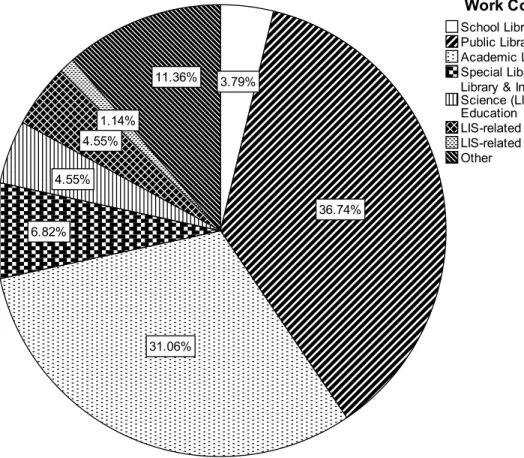
written responses for this subgroup were: library consortium, consultant, state library, publishing, library association, and retired. Some “Other” respondents also used the category to list multiple contexts. “LIS-related Non-Profit” did not prove to be a very useful category. The percentage of respondents who did not work in a library can be estimated by combining LIS Education, Business, and Non-Profit with a portion of the
Figure 2. Q1: What best d Other category: approximately 10-20%.
escribes the context of your work?
The number of years of library experience reported by participants varied widely,
which were multiples of 5 with more frequency, possibly estimating or rounding up or down from their actual years. Figure 3 also includes a normal distribution curve.
Table 3
Descriptive Statistics for Q2: How many years have you worked in the library profession?
N Minimum Maximum Mean Std. Deviation
Years of Experience 264 1 40 15.85 8.593
Valid N (listwise) 264
Figure 3. Q2: How many years have you worked in the library profession?
arians
of the group they are discussing. With 264 participants responding, 87.1% answered Yes they did identify as a librarian. While a large majority of participants identified as librarians, it’s important to note that a substantial number (12.9%) did not.
Q4 asked participants which degree or degrees they held. Due to a fl
,
aw in the to
ory. design of this question—the lack of a “None of the above” category—there is no way differentiate between participants who considered this question but marked none of the options and those who simply skipped it. 87.5% of all R1 participants reported having either an MLS, MIS, or MLIS. 21.5% reported having one of these and an additional degree (either another Master’s or a Ph. D.), while only 1.9% reported having two additional degrees. Table 4 shows the frequency of responses for each degree categ
Table 4
Frequencies for Q4: Please choose the degree(s) you hold
Frequency Percent Valid Percent
Valid Master of Library Science 111 41.9 45.1
Master of Information Science 13 4.9 5.3
Master of Library and Information Science 108 40.8 43.9
Other Master’s degree 60 22.6 24.4
Ph. D. in Library and/or Information Science 6 2.3 2.4
Other Ph. D. degree 16 6.0 6.5
Total 246 92.8 100.0
Missing No Response 19 7.2
Total 265 100.0
R1 Participants On Their Own Skill Sets
The following se skill sets. First, they
ata t of questions dealt with participants’ own
in Table 5 should be read accordingly. The venue with the lowest (most important) median rank was “On-the-job training,” which was ranked in the top 3 by 75% of respondents. “Library school” had the second-lowest median, and was ranked in th by 50% of respondents. Though the range for each venue was high, the dispersion was relatively low. This can be seen in the percentiles shown in Table 5, from which one can derive the inter-quartile range or middle 50% of the responses. The “Other” category was used by 27 of the participants who answered this question; 12 ranked “Other” in their top 3. The most common written responses for “Other” were mentors and colleagues.
e top 3
Table 5
Descriptive Statistics for Q5: Rank of Venues’ Importance to Developing Skillsb Scale: 1=Most Important to 9=Least Important
Median Mode Range
Percentiles
25 75
Library school 3 2 8 2 6
Higher education (non-library school) 6 8 8 3 8
On-the-job training 2 1 8 1 3
Professional development classes or programs 4 4a 7 3 6
Library associations and/or conferences 5 5 8 3 6
Self-directed study on work time 5 6 8 3 6
Self-directed study on personal time 6 7 8 4 7
Training from another discipline or profession 7 8 8 4 8
Other 9 9 8 9 9
a. Multiple modes exist. The smallest value is shown.
b. N for all variables is: Valid=252, Missing=13
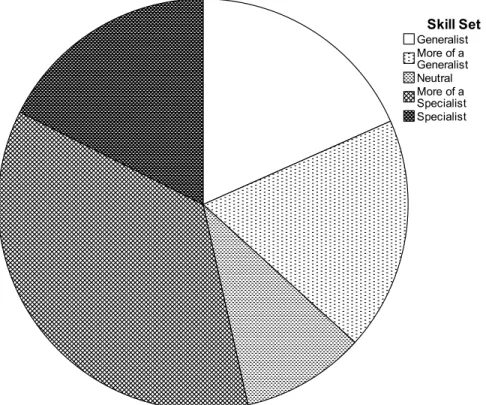
y saw their skill sets as more generalist or ents Q6 asked participants whether the
specialist in nature. Though a neutral option was given, over 90% of the 255 respond chose to describe their skill set as either “Generalist/More Generalist” or
most common (35.9%) choice being the less decisive “More of a Specialist.” Figure 4 shows the distribution of participants’ answers.
Figure 4. Q6: Where would you place your skill set on this spectrum?
The remaining questions about participants’ own skill sets asked them what skills ey fe
R1 Participants’ Opinions of the General Librarian Skill Set
The largest portion of the R1 survey (Q9) was devoted to participants’ opinions of the general librarian skill set, and specifically how important a range of skills would be to librarians five years in the future. For each of 28 skills presented to participants, Table 6 shows the median response of participants, the minimum and maximum responses, and the upper and lower quartiles.
The data reveals some interesting points. First, none of the skills had a median response of “Less Important” or “Much Less Important.” Figure 5 and Table 7 show that the median response for a majority of skills was “More Important,” and for a select few was “Much More Important.” The maximum for all skills was “Much More Important,” while the minimum for a majority of skills was “Much Less Important,” for some was “Less Important,” and for three skills was “Equally Important.” not a single participant thought these skills would be less important).
The percentiles shown in Table 6 can be used to measure the dispersion of
Table 6
Descriptive Statistics for Q9: Importance of Skills to Librarians in Five Years
{1=Much Less Important, 2=Less Important, 3=Equally Important, 4=More Important, 5=Much More Important}
N
Min Max
Percentiles
Valid Missing 25 Median 75
Ethics, values, and principles 251 14 1 5 3 3 4
Copyright and other legal issues 251 14 1 5 3 4 4
Advocacy for libraries 251 14 1 5 4 4 5
Problem-solving 249 16 3 5 3 4 5
Demonstration of library value 251 14 1 5 4 4 5
Effective communication 251 14 3 5 3 4 5
Outreach and marketing of services 251 14 1 5 4 4 5
Lifecycle of information issues 245 20 1 5 3 3 4
Building collections 251 14 1 5 2 3 3
Preservation and conservation 250 15 1 5 3 3 4
Organization of information resources 249 16 1 5 3 3 4
Cataloging and metadata skills 250 15 1 5 2 3 4
Specialized subject knowledge 250 15 1 5 2 3 4
Library technology 250 15 1 5 4 4 5
Emerging technologies 249 16 2 5 4 4 5
Reference services 248 17 1 5 2 3 3
Instruction 245 20 1 5 3 4 4
Information literacy 249 16 1 5 3 4 4
Assessment & evaluation 248 17 1 5 3 4 4
Creation of partnerships 248 17 1 5 4 4 5
Respect for diversity 248 17 1 5 3 3 4
Flexibility 251 14 3 5 4 5 5
Risk-Taking 251 14 2 5 4 5 5
Budgeting 251 14 2 5 3 4 5
Research and evidence-based
decision-making
250 15 1 5 3 4 4
Professional development, life-long
learning
251 14 2 5 3 4 5
Management 248 17 2 5 3 3 4
Leadership Skills 251 14 2 5 3 4 5
would be equally or more/much more important in the future, but it also casts suspicion on the importance of the minimum responses. These responses were generally outlier responses, and should be seen as such: focusing too much on them misses the broader picture of the data.
Table 7
Q9 Skills Grouped by Median Response
Equally Important More Important Much More Important
Ethics, values, and principles Copyright and other legal issues Risk-Taking
Lifecycle of information issues Advocacy for libraries Flexibility
Building collections Problem-solving
Preservation and conservation Demonstration of library value
Organization of information
resources Effective communication
Cataloging and metadata skills Outreach and marketing of services
Specialized subject knowledge Library technology
Reference services Emerging technologies
Respect for diversity Instruction
Management Information literacy
Assessment & evaluation
Creation of partnerships
Budgeting
Research and evidence-based
decision-making
Professional development, life-long
learning
Figure 5. Median Responses to Q9: Importance of Skills 5 Years in the Future
Q10 asked participants to name skills which “library school students or educators may overlook.” Responses to this question ranged from a single word or skill to multiple opinionated paragraphs to nothing at all. I conducted a content analysis of these responses with the purpose of identifying the skills most commonly mentioned. To do this, I used the unit of a single skill (whether it be expressed in a word. phrase, or paragraph) and counted the number of times it was mentioned in responses. Where skills were
Table 8
Frequencies for Q10: Skills Library School Students or Educators May Overlook
Skill Count
Communication: written and oral, interpersonal relationships, public speaking and
presentation
66
Management: operations, personnel, supervision, decision-making and negotiation 45
Budgeting, financial management, cost-benefit and ROI (return on investment)
analysis, fundraising
41
Marketing, public relations and promotion 37
Flexibility, managing and adapting to changes, willingness and ability to question
things
36
Collaboration, partnerships, relationship building, diplomacy and compromise 24
Risk-taking, risk analysis, entrepreneurship, strategy and competition 23
Customer service, hospitality, working with the public, communicating with patrons 23
Teaching, instruction 20
Project management and planning 20
An additional question (Q11) asked participants what they perceived were the primary factors driving change in the skill set. Preliminary analysis showed
Table 9
Frequencies for Q11: What are the primary factors driving change in the
skills required of librarians?a
Content Frequency Percent Valid Percent
Technology 161 60.8 69.1
Economics 67 25.3 28.8
Changing Users 60 22.6 25.8
a. N for all variables is: Valid=233, Missing=32
R1 Participants’ Questions and Statements
The final part of the R1 survey was very different in what it asked of participants. Rather than ask questions or offer statements for them to comment on, this section of the survey asked participants to contribute questions and statements for possible inclusion in a subsequent survey. Interestingly, response rates to these items were much lower than other questions: 148 (55.8% of all participants) provided questions and 153 (57.7%) provided statements.
and the key to your success. Some of these groups were included in R2 survey questions, while others were omitted.
The statements provided by participants in response to Q13 (“bold or challenging statement[s] about librarians of the future”) presented many of the same difficulties as the questions did. Again, I grouped similar responses (here using the broader unit of subject matter) from which to select statements for the R2 survey. Groups of statements dealt with the following subjects: libraries aren’t book warehouses; librarians need to be more connected to users; our core values will remain; there will be fewer librarians; “change or die;” we must change our professional profiles; librarians are the key to the future. Other groups were formed; these were the dominant ones. When choosing from among these, I sought statements which were on topic but not redundant to other parts of either survey.
Like other parts of this study’s dataset, the full set of participating Movers & Shakers’ questions and statements provides an opportunity for further study.
R2 Results: Part A
In Part A of the R2 survey, participants were asked questions about skills ffor which their R1 responses had been outside the inter-quartile range of responses. Table 10 shows how many participants were questioned about each individual skill. Less than 30% of the group was questioned about any given skill, and some skills were not used—for these skills, no R2 participant had answered outside the inter-quartile range in the R1 survey.
given a chance to change their response; the number of participants who changed their response to match the median is reported in the right-hand columns of Table 10.
To analyze this section’s data, R2 participants’ new responses were combined with the R1 dataset for each of the 28 skills, replacing their R1 responses. The set was then analyzed as it had been before (in Table 6). As can be seen from the Table 10 data, only a small portion of participants were given each question, and only a small portion of those changed their response to the median. As such, using the R2 responses in place of the R1 responses had very little effect on the data. The median response for each skill remained the same, as did the upper and lower quartiles (and thus the inter-quartile range). None of the maximums changed, and only four of the minimums changed—but this latter statistic may represent only one participant’s response and should thus be disregarded.
Thus, no change in the group’s consensus could be seen as a result of the R2 survey’s questions in Part A. However, participants were additionally asked to share their reasoning if their responses remained different from the median. Their comments gave insight into dissenters’ thinking, and provided a counterpoint to the descriptive statistics shown for each skill. When read together, these comments also revealed useful
Table 10
Frequencies for Q1a-Q28a: Participants Given Questions, Changing Responses to Median
R2 Participants
Given Question
R2 Participants Changing
Response to Median Response
Frequency % of Na Frequency
% of Given
Question % of Na
Ethics, values, and principles 51 22.6 9 17.6 4.0
Copyright and other legal issues 65 28.8 9 13.8 4.0
Advocacy for libraries 48 21.2 14 29.2 6.2
Problem-solving 0 0 N/A N/A N/A
Demonstration of library value 41 18.1 15 36.6 6.6
Effective communication 0 0 N/A N/A N/A
Outreach and marketing of services 41 18.1 7 17.1 3.1
Lifecycle of information issues 52 23.0 15 28.8 6.6
Building collections 43 19.0 8 18.6 3.5
Preservation and conservation 58 25.7 11 19.0 4.9
Organization of information resources 56 24.8 15 26.8 6.6
Cataloging and metadata skills 27 11.9 3 11.1 1.3
Specialized subject knowledge 23 10.2 4 17.4 1.8
Library technology 48 21.2 10 20.8 4.4
Emerging technologies 50 22.1 7 14.0 3.1
Reference services 55 24.3 10 18.2 4.4
Instruction 60 26.5 6 10.0 2.7
Information literacy 58 25.7 18 31.0 8.0
Assessment and evaluation 55 24.3 9 16.4 4.0
Creation of partnerships 38 16.8 7 18.4 3.1
Respect for diversity 52 23.0 9 17.3 4.0
Flexibility 43 19.0 10 23.3 4.4
Risk-taking 44 19.5 9 20.5 4.0
Budgeting 3 1.3 0 0 0
Research and evidence-based
decision-making 54 23.9 15 27.8 6.6
Professional development, life-long
learning 4 1.8 1 25.0 0.4
Management 45 19.9 6 13.3 2.7
Leadership skills 1 0.4 0 0 0
R2 Results: Part B
Part B of the R2 survey applied the Delphi method in a different manner than Part A. Here, participant responses to the R1 survey’s open-ended questions were
incorporated into new questions. The first of these, Q29, was derived from responses to the first survey’s question about skills library school students or educators may overlook.
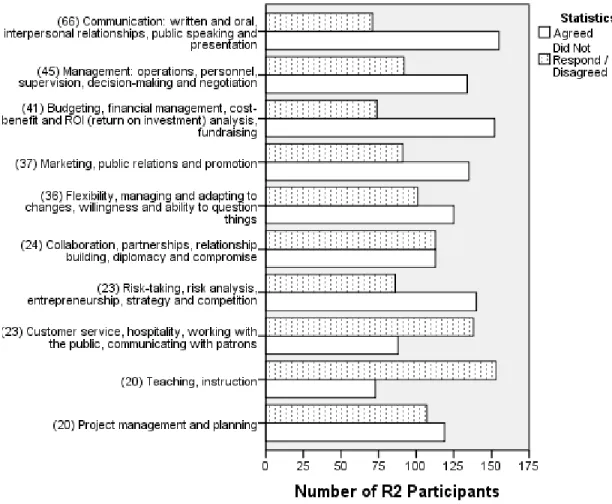
Figure 6. Q10:Skill Groups Library School Students or Educators May Overlook
participants who did not respond and those who disagreed. The level of agreement measured for each skill group is shown in Figure 6.
The next set of questions was composed from R1 participants’ proposed questions for their fellow Movers & Shakers. Four such questions were included in the R2 survey, some of them composites of multiple proposed questions. Of these, two lent themselves to brief qualitative content analysis, while the other two are left to evaluate in future work. The latter two questions asked respondents to discuss barriers they had faced in the profession, and to offer advice to job-seekers. The former two are discussed below.
Q31 asked participants if they planned to stay in the library field, and if they thought they would retire as librarians. Responses were analyzed by how they addressed the first part of the question, being grouped into categories for Yes, No, and
Neutral/Unsure. The “No” category was only used for those who used that word—in other words, those who planned to not stay in the field. Participants who had retired as librarians already were categorized as “Yes” responses. Those who had already left the field were categorized as “No” responses. As can be seen in Table 11, a large majority plan to stay in the field.
Table 11
Frequencies for Q31. Do you plan to stay in the library field?
Content Frequency Percent Valid Percent
Valid Yes 146 64.6 74.5
No 11 4.9 5.6
Neutral/Unsure 39 17.3 19.9
Total 196 86.7 100.0
Missing No Response 30 13.3
The other question from R1 participants which has been analyzed asked whether being named Movers & Shakers had given participants new opportunities or changed their careers. There was a range of responses—almost all positive, but some negative— describing the effects of the award. Many spoke of doors opened, profiles raised, and opportunities for advancement. I chose to analyze these responses based on whether participants felt the award had changed their careers or not. The categories of Yes, No, and Neutral/Mixed were settled on, with all responses classified into one of these (see Table 12). Importantly, more participants chose Yes than No.
Table 12
Frequencies for Q32: Has the Movers & Shakers award changed your career?
Content Frequency Percent Valid Percent
Valid Yes 85 37.6 44.7
No 78 34.5 41.1
Neutral/Mixed 27 11.9 14.2
Total 190 84.1 100.0
Missing No Response 36 15.9
Total 226 100.0
The last section of the R2 survey was a set of statements from R1 participants’ contributed “bold or challenging statements about the future of librarians.” The median responses, given in Table 13, show agreement with all of these statements except one: “There will be far fewer librarians in 10 years than there are now.” The statement for which the median was “Strongly Agree,” about librarians’ need to be adaptable, reflects results seen previously that cited flexibility as skill growing in importance. The
Table 13
Median Responses for Q34: Selected R1 Respondents’ Statements on Librarians of the Futurea
Median Response
Librarians will need to be far more connected to their users and communities. Agree
Librarians' core values will remain the same. Agree
There will be far fewer librarians in 10 years than there are now. Neither Agree nor Disagree
Librarians of the future will be essential to connecting people with information.b Agree
If you cling to the library as a building full of books, you will be left in the dust. Agree
Librarians of the future must be more outgoing and bold. Quiet, shy types need
not apply. Agree
Librarians will have to be more adaptable or they will be out of a job. Strongly Agree
a. N for all items is: Valid=202, Missing=24 except as below
b. N Valid=200, Missing=26
Discussion
Disagreement over the importance of the Movers & Shakers award exists even among the group themselves: one participant considered it “a rare honor” while another said it is “[not a] particularly prestigious award.” How important is it? Answering this question was not a focus of my research, and I leave it to the reader to determine. That said, the Movers & Shakers certainly hold a meaningful place in the profession. Many participants in this study said the award had raised their profile, and 44.7% of those asked said it had changed their careers.
non-librarians. Whether this reflects the diversity of the profession as a whole is difficult to determine.
Celebrating the Movers & Shakers award was not the purpose of this research; rather, I sought to put it to use. The award winners generally appear to be chosen in recognition of some demonstrated skill or “job well done.” For this reason, they seemed suitable to the main topic I chose to study: the skill set of librarians. One assumption I made was that it would be useful to hear not just what they do, but what they think about what librarians in general do.
The Delphi method, which is designed to gather and evaluate group opinions, provided a framework for the study. I used the method somewhat nontraditionally by working with award winners rather than “experts,” using a large sample and low time-commitment, and limiting the study to only two survey rounds.
The study was designed to draw a lot of participants, and succeeded in doing so: 65.8% of the sample (64% of all 2002-2009 Movers & Shakers) participated in the first round survey, with 86.3% of these participating in the second round survey as well. This confirmed the assumption that contributing to an improved understanding of the
profession was incentive enough for these individuals to participate.
rather than generalists, and they ranked on-the-job training as most important in developing skills, followed by library school and professional development.
The largest portion of the study sought participating Movers & Shakers’ perceptions of the general librarian skill set. They were asked to think five years in the future and estimate which skills (of 28 given) would me more or less important then. Interestingly, while some participants thought some skills would be less important, none of the skills had a median response below “Equally Important.” In fact, most skills had a median of “More Important.” It’s difficult to account for this result: perhaps the statement being made is that librarians’ skills as a whole will be more important. A number of participants addressed this sentiment when later asked to make statements about the profession’s future. These revealed two different viewpoints: one which saw librarians’ skills as essential to making sense of an information-overloaded world; while the other saw skills’ importance rising as librarianship grew more competitive and demanding.
Table 7 shows the full list of skills considered, grouped by their median responses. This is an easy place to compare participants’ assessments of each of the skills. A select few skills—flexibility and risk-taking—garnered a median response of “Much More Important.” Participants felt strongly that these were important skills for librarians to have in the future, so librarians might do well to begin focusing on these now.
The study generated a number of skill groups which participants thought library school educators and students might focus more on. Chief among these were
communication skills, budgeting and financial skills, management, and again, risk-taking and strategic skills. Also identified were three major factors causing change in the
librarian skill set: technology, economics, and changing users.
Another part of the study asked participating Movers & Shakers to make
statements about librarians of the future. Seven of these statements were then presented to the group to measure their agreement with each. The most strongly supported statement was “Librarians will have to be more adaptable or they will be out of a job.” Other statements addressed issues of values and approaches to librarianship.
This research was not without its flaws, and in some cases required decisions among competing priorities. Foremost of these, the quite complicated Delphi method was compressed to encouraging higher participation, but this came at a price: insufficient numbers of second-round responses limited the degree to which consensus could be cultivated. Also, explaining the survey’s concepts in very brief terms led to some confusion among participants.
The work presented here provides many avenues for further exploration. The Delphi method was shown to be useful, and some of its limitations were made clear: attempts might be made to strike a better balance between high participation and rich participation. Delphi surveys of other award-winners might prove useful as a way to leverage bright talents as a collective voice for the profession, and to enrich the
camaraderie of participants. Other groups come to mind, such as the American Library Association’s “Emerging Leaders.” Options abound for using the Delphi method more creatively and collaboratively, too; something closer to a wiki, but still systematic and guided.
There is, of course, much more work that can be done with the data produced by this study, as noted in many parts of the Results section above. While I intend to revisit the work myself, I’m also considering publishing the data set for other researchers to use.
Conclusion
This research focused on the changing skill set of librarians, using a group of award-winners in the library industry (Library Journal’s “Movers & Shakers”) to address the topic. A brief demographic profile of participants was constructed, and individuals were asked about their own skills as well as their opinions of the general librarian skill set. Following the Delphi method, a second survey was used to further inform the first survey’s results.
communication skills and budgeting. Participants were asked to contribute questions for the second survey, and to make “bold or challenging statements” about librarians of the future, some of which were offered back to the group to see if they agreed.
References
American Library Association. (2009, January 27). ALA’s core competences of librarianship. Retrieved November 17, 2009, from http://www.ala.org/ala/ educationcareers/careers/corecomp/corecompetences/finalcorecompstat09.pdf Cassner, M., & Adams, K. E. (2006). Assessing the professional development needs of
distance librarians in academic libraries. Journal of Library Administration, 45(1), 81-99. doi:10.1300/J111v45n0105
Del Bosque, D., & Lampert, C. (2009). A chance of storms: New librarians navigating technology tempests. Technical Services Quarterly, 26(4), 261-286.
doi:10.1080/07317130802678878
Field, J. J. (2008). Understanding your competencies to create a successful career. Science & Technology Libraries, 28(1),1-10. doi:10.1080/01942620802096747 Fialkoff, F. (2002, March 15). Change agents. Library Journal. Retrieved November 29,
2009, from http://www.libraryjournal.com/article/CA201132.html Heinrichs, J. H., & Lim, J. (2009). Emerging requirements of computer related
competencies for librarians. Library & Information Science Research, 31(2), 101-106. doi:10.1016/j.lisr.2008.11.001
Helmer, O. (1966). The Delphi method for systematizing judgments about the future. [Los Angeles,: Institute of Government and Public Affairs, UCLA].
Hernon, P., Powell, R. R., & Young, A. P. (2002). University library directors in the Association of Research Libraries: The next generation, part two. College and Research Libraries, 63(1), 73-90.
Kinkus, J. (2007). Project management skills: A literature review and content analysis of librarian position announcements. College & Research Libraries, 68(4), 352-363. Linstone, H. A., & Turoff, M. (1975). The Delphi method: techniques and applications.
Reading, Mass.: Addison-Wesley.
Mathews, J. M., & Pardue, H. (2009). The presence of IT skill sets in librarian position announcements. College & Research Libraries, 70(3), 250-257.
Soutter, J. (2007). Academic librarian competency: A description of trends in the peer-reviewed journal literature of 2001-2005. Partnership: The Canadian Journal Of Library And Information Practice And Research, 2(1). Retrieved from
Author Note
The many Movers & Shakers who decided to participate in this work deserve recognition, even though they are anonymous in the study. They gave generously of their time, which even a conservative estimate counts to be over 80 hours in total. They were inspiring, critical, encouraging, and candid—a truly excellent group to work with!
A number of other people helped bring this project to fruition, whom I would like to acknowledge here. Foremost, I’d like to thank my family and my partner Lindsay, whose support kept me going through a long winter and a busy spring. My faculty advisor Phil Edwards and my mentor Stephanie Willen Brown both listened to early ideas and offered advice, and can be held responsible for whatever success I’ve achieved.
Diane Kelly and Laura Sheble taught me everything I know about research methods, and diligently read through much earlier and less coherent versions of this work, providing extremely helpful commentary. Rebecca Vargha provided insight on the mysterious process of creating competency statements in professional associations. My good friends Elena Feinstein and David Woodbury pre-tested surveys, convincing me this might actually work. And I am most indebted to Jeff Pomerantz, who read many versions of this work as deadlines approached and provided insight, calm, and confidence.
Appendix A: Recruitment Email From: Adam Rogers [mailto:[email protected]]
Sent: Tuesday, March 09, 2010 10:00 AM
Subject: Invitation to Movers & Shakers Survey on the Skill Set of Librarians Dear ${e://Field/Name},
Hello, my name is Adam Rogers, I am a Master's student at UNC-Chapel Hill and I am conducting a research study on the skill set of librarians and how it is changing. I am contacting you because you are a recipient of Library Journal's "Movers & Shakers" award; the purpose of this study is to gather the opinions of Movers & Shakers on the topic, and to learn something about the skill set of the Movers & Shakers as a group. The study will consist of two parts. The first is an online survey which will take approximately 15 minutes of your time. If you choose to participate, the link to the survey is below. If you complete this survey, you will be invited to take another online survey a few weeks later. The second survey will include findings from the first, asking additional questions to clarify and enrich those findings.
Your participation in this study will be kept strictly confidential. Your name and email address will not be kept or associated with the study data after the study ends, nor will they be included in the publication of the study’s results.
The deadline for participation is March 19th.
If you wish to participate, please follow this link to the Survey: ${l://SurveyLink?d=Take the Survey}
Or copy and paste the URL below into your internet browser: ${l://SurveyURL}
Thank you very much for your time! It is my hope that this research will be valuable to the library community.
Sincerely,
Adam Rogers, Principle Investigator, MSLS Candidate 2010 Jeffrey Pomerantz, Faculty Advisor
School of Information and Library Science University of North Carolina at Chapel Hill UNC IRB study #10-0230
Appendix B: Study Information and Consent
Welcome to the Movers & Shakers Survey on the Skill Set of Librarians.
There are a few things you should know before you begin:
• The study involves research, which is intended to provide insight on the skills of librarians.
• Participation is voluntary. You may refuse to join, or may withdraw from the study at any time.
• If you choose to participate, you will be one of approximately 80-200 people in this research study.
• Participation is expected to take about 15 minutes now, and 15 minutes for the second questionnaire in a few weeks’ time.
• You will be asked questions about the context of your work, your personal skill set, and your opinions of the general librarian skill set.
• The study will take place entirely online.
• There are no costs for being in the study. Nor are there any benefits, other than the insight the study will provide to the field of librarianship.
• Your participation in this study is confidential. Your privacy will be protected using encryption and other data security measures, and you won’t be identified with the final study data in any way.
• You have a right to ask, and have answered, any questions you have about this research. If you have questions about the study, you can contact me at
[email protected] or my faculty advisor at [email protected]
• If you have questions about your rights as a research participant, you may contact the Institutional Review Board, which has reviewed this study, at 919-966-3113 or at [email protected] (refer to study #10-0230).
You are encouraged to print this page for your records.
Do you consent to participate in this research study?
Appendix C: First Round (R1) Survey Q1: What best describes the context of your work?
o School Library
o Public Library
o Academic Library
o Special Library
o Library & Information Science (LIS) Education
o LIS-related Business
o LIS-related Non-Profit
o Other __________________
Q2: How many years have you worked in the library profession? _____
Q3: Do you identify as a librarian?
o Yes
o No
Q4: Please choose the degree(s) you hold:
o Master of Library Science
o Master of Information Science
o Master of Library and Information Science
o Other Master’s degree
o Ph. D. in Library and/or Information Science
o Other Ph. D. degree
Q5: Please rank the importance of the following venues in developing the skills which have helped you succeed in libraries. Rank from 1 (most important) to 8 (least
important):
__ Library school
__ Higher education (non-libary school) __ On-the-job training
__ Professional development classes or programs __ Library associations and/or conferences __ Self-directed study on work time __ Self-directed study on personal time
Q6: Where would you place your skill set on this spectrum?
o o o o o
Generalist More of a Generalist
Neutral More of a Specialist
Specialist
Q7: Do you have particular skills which you feel set you apart from most librarians? If so, what are they? Where did you develop these skills?
Q8: If your work requires that you learn a new skill, where do you turn first?
Q9: The following list of librarian skills has been created by analyzing competency statements of numerous professional organizations. Please state whether you think the following skills or competencies will be more important, less important or of equal importance for librarians five years in the future.
Much Less
Important Less Important Equally Important More Important Much More Important Ethics, values, and principles
o o o o o
Copyright and other legal issues
o o o o o
Advocacy for libraries
o o o o o
Problem-solving o o o o o
Demonstration of library value
o o o o o
Effective communication
o o o o o
Outreach and marketing of services
o o o o o
Lifecycle of information issues
o o o o o
Building collections
o o o o o
Preservation and
conservation
Organization of information resources
o o o o o
Cataloging and metadata skills
o o o o o
Specialized subject knowledge
o o o o o
Library technology
o o o o o
Emerging technologies
o o o o o
Reference services
o o o o o
Instruction o o o o o
Information literacy
o o o o o
Assessment & evaluation
o o o o o
Creation of partnerships
o o o o o
Respect for diversity
o o o o o
Flexibility o o o o o
Risk-Taking o o o o o
Budgeting o o o o o
Research and evidence-based decision-making
o o o o o
Professional development, life-long learning
o o o o o
Management o o o o o
Leadership Skills
o o o o o
Q10: What are some essential skills of successful librarians which library school students or educators may overlook?
Note: Your answers to the following questions may be used to form new questions for the second part of this study.
Q12: Are there other questions you would like to see asked of your fellow Movers & Shakers on this topic?
Q13: (Optional) Please make a bold or challenging statement about librarians of the future.
[End of Survey message]
Your answers have been recorded. Thank you for your participation.
Later this month, I will invite you to participate in a second survey. I will share with you some of the responses to this survey, and ask for commentary to enrich my understanding of those responses. I hope you'll decide to participate then, too.
If you have any questions about this research, please feel free to contact me or my advisor.
Adam Rogers, [email protected]
Appendix D: Second Round (R2) Survey
Welcome to Round 2 of the Movers & Shakers Survey on the Changing Skill Set of Librarians
This second survey is meant to inform and refine the understanding gained from the first survey you participated in earlier this month. This survey has two parts:
Part A will revisit the long list of skills from the previous survey, which you were asked to assess in terms of their future importance to librarians.
Part B will be based on the previous survey's open-ended questions. Here you will be asked to answer questions posed by your fellow Movers & Shakers, and to assess some bold statements they have made.
I expect this survey will take most people 15-20 minutes to complete. Feel free to email comments or questions to:
Adam Rogers, [email protected]
Jeffrey Pomerantz, faculty advisor, [email protected] Basic information about this research can be found at: http://adamrogers.info/movers_survey.txt
Part A
This part of the survey uses a research practice called the Delphi method, which is used to establish consensus on a given topic while understanding viewpoints outside that consensus.
In the previous survey, you were asked how important different skills will be for
librarians five years in the future. For each skill, I have calculated the median (middle value) of all participating Movers & Shakers' responses. The median can be used as an estimation of the group's consensus.
For skills where your response differed significantly from the consensus, you are asked to:
• compare your response and the median response, • change your answer if you wish to do so, and
[Note: following question was constructed for each skill from the R1 survey. Participants were only given questions for those which their R1 answers were outside of the inter-quartile range.]
For librarians five years in the future:
Skill Your Response Median Response
[Skill 1-28] [Participant’s Response
for Skill 1-28] Equally Important
Q1a-Q28a. Would you like to change your response for [Skill 1-28] in five years?
o o o o o
Much Less Important
Less Important Equally Important
More Important Much More Important
Q1b-Q28b. If your response remains different from the median, please share your reasoning.
Part B
The first survey asked you to name essential skills of successful librarians which library school students or educators may overlook. The following skill areas were cited by 20 or more survey respondents. The number of people citing each is in parentheses.
Q29. Please select those skills which you agree library school students or educators may overlook.
o (66) Communication: written and oral, interpersonal relationships, public speaking and presentation
o (45) Management: operations, personnel, supervision, decision-making and negotiation
o (41) Budgeting, financial management, cost-benefit and ROI (return on investment) analysis, fundraising
o (37) Marketing, public relations and promotion
o (36) Flexibility, managing and adapting to changes, willingness and ability to question things
o (24) Collaboration, partnerships, relationship building, diplomacy and compromise