degree. May, 2018. 62 pages. Advisor: Melanie Feinberg
This descriptive study returned to the 22 participant institutions of the ASIANetwork / Luce Asian Art Consultancy program (2005–2008) to question the narrative of Japanese woodblock prints through the organization and accessibility of their collections. As this study was concerned with implicit ontologies and not officially articulated meanings, all data was collected through content analysis of the manifest content of digital object records and collection organization
Following the analysis of 22 collections and 30 individual records, this study found that the narrative remains silent for 12 of the 22 institutions – their collections had no digital presence. For the other 10 institutions, existing records were riddled with inconsistent, incorrect, and westocentrically-framed information. Though the scope of this project was narrow, this study can provide a model for questioning constructions of value, cultural exclusion, and the unintended narratives that unfold through the organization and accessibility of art collections.
Headings:
Collection Management (Museums) Museum Collection Catalog
ACCESS TO JAPANESE WOODBLOCK PRINTS AT TWENTY-TWO AMERICAN UNIVERSITY MUSEUMS
by
Madison A Folks
A Master's paper submitted to the faculty of the School of Information and Library Science of the University of North Carolina at Chapel Hill
in partial fulfillment of the requirements for the degree of Master of Science in
Information Science.
Chapel Hill, North Carolina May 2018
Approved by:
Acknowledgements
First, thank you to Melanie Feinberg, for introducing me to the discussion of
Contents
Introduction... 2
ASIANetwork/Luce Asian Art Consultancy Program ... 5
Research Questions ... 6
Literature Review ... 11
Implicit Ontologies in the Museum Space ... 11
Digital Access to the Collection ... 16
Physical Access to Collection ... 19
Constructing Asia in the American Museum ... 21
Methodology ... 26
Findings: Assessing Digital and Physical Access ... 31
Digital Access ... 32
Physical Access ... 40
Discussion ... 42
Conclusion ... 49
Appendix I: Records Consulted (by Institution) ... 51
Introduction
Beyond the carefully curated gallery spaces of the museum, the collection continues, but remains out of sight. Down a hall, up an elevator, or even to an offsite storage facility, museum collections have a larger story to tell than the narrative constructed through curatorial design. Take, for example, the Ackland Art Museum at UNC Chapel Hill. Just beyond the north wall of the study gallery, print storage holds the museum’s vast collection of works on paper. Identical black boxes stacked to the ceiling offer only one hint of their content. Amidst columns of anonymity, a small white label proclaims the contents, a whisper of the worlds hidden within. Yet, if one is to take a box down from the shelf, release its clasps, and fold back the lid, its contents might surprise you. The Ackland is home to the Roberts Collection, a striking collection of Japanese woodblock prints depicting the Sino-Japanese and the Russo-Japanese wars. As the boxes reading “Roberts Collection” fold back, a window opens to Meiji period Japan, to turn-of-the-20th-century reportage, to an enduring artistic medium in transition. From chemists
Exclusion from gallery presentation does not necessarily mean a silencing of stored works. As museums rush to develop their online presence and digital user
experience, stored items gain a digital visibility through high quality images, searchable online records, and digital humanities projects.1 Yet, as gallery spaces present a particular
telling of the history of art, these digital spaces also perpetuate a westocentric canon and value system that characterizes American art museums. These esoteric value judgements find economic reinforcement through auction houses such as Christie’s and Sotheby’s.2
Large institutions seek to present a stunning collection of treasures. Whether this elite status derives from rarity, the perceived genius of the artist, or appraised value, large museums skew to the top of the market and the existing canon. While university-based museums also present treasures, the scale, capital, and diverse functions of these institutions as part of a larger university suggest a unique nature. As New York Times culture critic Holland Cotter explains, university museums function as teaching centers for hands-on art education, but also exploration. The works of “second-and third-tier value at auction” carry a rich cultural history that invites object-based multidisciplinary learning.3 With this distinct set of values, the university museum appears to present a
1 Fiona Cameron and Sarah Mengler, “Complexity, Transdisciplinarity and Museum Collections Documentation: Emergent Metaphors for a Complex World,” Journal of Material Culture 14, no. 2 (June 1, 2009): 189–218.
2 An example of valuation can be found in the starting estimates at Christie’s August 2014 Japanese Print Auction: “Japanese Prints.” Accessed October 27, 2017. https://onlineonly.christies.com/s/japanese-prints/lots/76?PageSize=&Source=&ShowAll=False&SelectedAvailability=&SelectedAttributeValueI ds%5b0%5d=4989&SelectedAttributeValueIds%5b1%5d=&SelectedAttributeValueIds%5b2%5d=&S electedAttributeValueIds%5b3%5d=&SortBy=LotNumber&pid=ecom_category_japanese_box2_bijin &page=2.
prime opportunity to challenge the canonical Western view of art and culture in the art museum context, to lend a voice to silent storage.4
While there are many categories of neglected artworks across university museum collections, Japanese woodblock prints combine collections relevance, theoretical
discourse, and exemplary applications. First, they can be found in the collections of most university art museums.5 Brought to American universities by former missionaries, soldiers formerly stationed in Japan, or, less commonly, foreign students, many prints were bestowed as gifts to an alma mater.6 Second, as printed media, Japanese woodblock prints are devalued, both culturally and monetarily, by their nature as multiples.7 Though scholars continue to dispute this assessment, prints remain largely hidden in storage, inactive, and unknown to the average museumgoer. One must be aware of this bias in order to understand the politics of inclusion and exclusion in the museum setting. Furthermore, as an example exclusion of westocentric museum display, Japanese woodblock prints lend to a larger discussion of non-western objects within western systems of value. Finally, these prints exemplify the diversity of interpretation and
potential for multidisciplinary learning latent in silenced artworks. Together, these factors render the Japanese woodblock print as a critical entry point for the assessment of
collection access in university-based museum.
4Sandy Kita, “Japanese Prints,” in Reading Asian Art and Artifacts : Windows to Asia on American College Campuses, 159-172.Edited by Karil Kucera, Paul Kocot Nietupski, and Joan O’Mara, (Pa.: Lehigh University Press: 2011), 161.
5 In a survey of 22 different American colleges, Japanese prints made up a major category of artwork in the ASIANetwork project; Karil Kucera, Paul Kocot Nietupski, and Joan O’Maram Reading Asian Art and Artifacts : Windows to Asia on American College Campuses, (Pa.: Lehigh University Press:2011), xxv. 6 Ibid, xxiv.
A Japanese woodblock print is an ink image printed on paper (can be one sheet or multiple sheets creating one unified image) from a rectangular, carved woodblock (or wood-based block), designed by one or more Japanese artists. The ink can be natural or aniline, and the image may feature surface effects including embossing, mica, lacquer, metallic accents, color washes, or burnishing.8 The print may be loose leaf, assembled, in an album, or bound as a book (ehon). In the early 17th century, woodblock printing emerged as the artistic medium of Japan’s newly established merchant class. For the first time in the history of Japanese art, printed representation broke from academic and religious themes and embraced the pleasure-driven popular culture of Edo. Publishers kept a finger to the pulse of public interest, capturing notorious courtesans in the latest fashions or scenes from the Kabuki theater in dynamic designs. For the price of lunch, these visions of the “floating world” could be yours.9 As the feudal capital of Edo
evolved into the sprawling Tokyo we know today, the woodblock print followed in suite, adapting to new subjects and styles, as well as a new system of value. Today, Japanese print artists continue to innovate within the medium.
ASIANetwork/Luce Asian Art Consultancy Program
As a consortium of roughly 170 North American liberal arts colleges,
ASIANetwork strives to support and strengthen the teaching of Asia in undergraduate curricula. The consortium promotes active dialogue in the field of Asian studies at large, through its scholarly publication ASIANetwork Exchange, as well as at the institutional
8 Amy Newland, The Hotei Encyclopedia of Japanese Woodblock Prints (Amsterdam: Hotei Publishing, 2005).
level. By providing member institutions with expert resources and educational programs, ASIANetwork encourages students to learn from Asian cultures directly. Object-based inquiry offers one avenue for direct cultural interaction, allowing firsthand experience (if on a small scale) in the classroom or museum space.
The ASIANetwork/ Luce Asian Art Consultancy Project launched in 2005. The project aimed to amplify access to Asian art and artifacts by uncovering silent works within institutional collections. The project operated under the hypothesis that the lack of access to these collections stemmed from a lack of information due to the absence of local subject expertise. Accordingly, the program set out to solve this silence by providing the experts needed to generate information on these collections. The project employed curators and experts in the fields of anthropology and art history to find these objects within museum collections, produce high quality digital images, and complete catalog records for each uncovered object. Each institution in the program received one consultant. The program ran in three rounds, from 2005-2006, 2006-2007, and 2007-2008. Over the course three years, 22 institutions participated in the program, with
DePauw receiving two visits. In 2011, the consortium members and consultants reflected on the project through the book Reading Asian Art and Artifacts: Windows to Asia on American College Campuses, in which various participants explored the significance, discoveries, challenges, and lessons learned during the project.
Research Questions
a key to understanding. ASIANetwork did create their own database, known as IDEAS (Image Database to Enhance Asian Studies), but this database only includes choice objects selected at the discretion of each consultant.10 Ten years after the program ended, this project asks, how was the ASIANetwork generated information used by the
institutions themselves? How successful was this project seven years after the study was published? The ASIANetwork team set out to change the existing ontology of Asian art in American university-based museums, yet such a change depends on the people who access these objects. Has intention turned to reality at the ASIANetwork consultancies? This project returns to the institutions covered in the ASIANetwork program to assess the collections on their digital access and potential for physical access to Japanese
woodblock prints. Considering digital and physical access through content analysis, this project asks: Can a reconstruction of intellectual access (built from combined physical and digital access) change the ontology of Japanese woodblock prints in a university-based art museum collection? The terms of access are as follows:
Digital Access: Online Images and Searchable Information
In Uncertain Images, Dawson considers the struggles of moving from a physical, analog object to an accessible, reproducible digital file.11 As museums are about communication of past and present, near and far, digital information can play an important role to this end.12 While a digital image attempts to bridge the visual
10 “ASIANetwork-Luce Asian Art in the Undergraduate Curriculum Project ASIANetwork IDEAS Project.” Accessed April 8, 2018. http://ideasproject.org/collections/show/12.
11 Kasja Hartig, “Digital Dilemmas: The Impact of Digital Tools on Photograph Collections,” in Uncertain Images : Museums and the Work of Photographs, 223-240. Edited by Elizabeth Edwards and Sigrid Lien, (Farnham, Surrey, England: Ashgate, 2014), 239.
inaccessibility of an object, this representation must be supported with accurate metadata. Together, these attributes make a print discoverable through the museum’s website or for search engines such as ukiyo-e.org, a reverse image search engine dedicated to Japanese woodblock prints.13 In a digitally accessible
form, woodblock prints invite investigation of the woodblock prints through any computer with internet access.
Physical Access: Materiality and Sensory Experience
While digital access improves access to silenced collections, the digital entry point to an image and catalog information lacks the materiality so critical to the investigation of art. This sensory element is nearly unattainable in the large museum setting, but must be discussed in that of the university-based museum. With the majority of the museum’s target audience (i.e. professors, students, resident scholars) close at hand, physical access is viable. Physical access can be assessed remotely through the protocols and practices of the print study room, both as defined for students and teachers. In The Dubious Nature of Touch, Fiona Candlin discusses the incorporation of touch into museum life. While this project does not delve into the politics of touching the art, her discussion of the senses highlights the importance of physical encounters with art. Whether the smell of the materials as they are removed from their cases, or the minute textures of the paper, embossing, or metallic powder visible only when titled towards the light, aspects of a work are lost in their digital format. Candlin urges the reader to
consider how tactile qualities can complicate and enrich one’s understanding of a work.14 Though digitization vastly improves access to objects on one level, materiality should not be forgotten.
Intellectual Access and Meaning Making: Connecting with Objects
Intellectual access concerns the contextualization of woodblock prints across digital and physical concerns. Digital humanities projects can enrich this form of access, such as the extensive Visualizing Cultures project completed at MIT in 2002, or accessible translations of materials otherwise available only to experts.15 At the simplest level, intellectual access refers to the understanding of an object achievable through digital and physical access to that object. Through intellectual access or lack thereof, the questions of who, how, why, when, and in what context
about a print can be discussed. The narrative of the woodblock print begins to emerge.
The question of how to approach East Asian art continues to plague the art historical discipline. In Nora Taylor’s assessment of two recent books on the subject, she concludes that neither “solve the problem of the perpetual ghettoization of Asian art in general art historical discourse.”16 But what about the level of individual objects? This
project considered how the university-based museums of the 2005-2008 ASIANetwork
14 Fiona Candlin, “The Dubious Inheritance of Touch: Art History and Museum Access,” Journal of Visual Culture 5, no. 2 (August 1, 2006): 137–54, 152.
15 “MIT Visualizing Cultures,” accessed October 27, 2017, https://ocw.mit.edu/ans7870/21f/21f.027/home/index.html.
Literature Review
In Uncertain Images, Kajsa Hartig firmly states, “museums are about communication, communicating the past and the present, communicating the collections.”17 While this statement rings true across diverse collections and target
audiences of museums worldwide, the question of what and how these museums communicate is not quite as straightforward. In fact, disparate narratives may thread throughout a single institution, differing between departments, exhibitions, but also between ideas publicly voiced and those embedded in the collections themselves. To consider the implicit ontology of Japanese woodblock prints in the context of the university museum, it is first necessary to situate this study in the discourse of
organizational ontology, digital access, and physical access in the museum setting, as well as within the particular climate of teaching Asian art in the United States.
Implicit Ontologies in the Museum Space
The institution of the museum effuses an aura of fact. Home to objects deemed
valuable, rare, or important, gallery spaces present a true expression of ‘fine art’ curated by experts in the field. At least, this is the impression that Cameron has noted among many museumgoers throughout her many studies on meaning making in museums
over the past 20 years.18 Yet, this approach assumes that concepts of value and meaning are self-evident in artwork, that the interpretation of the expert is the only interpretation, and that museum walls authorize these particular narratives. As Clifford made strikingly clear in Four Northwest Coast Museums: Travel and Reflections, these assumptions are false. Looking at Northwest Coast Native art in four different contexts, he found four distinct ontologies for these objects as defined through their organization and
contextualization. Museum narratives are subjective and discrete, “variants within a unified field of representation.”19 Yet, the myth of empiricism, born of the 19th century
collecting, allows these subjective choices to continue in perpetuity as fact.
Concerning the nature of being, an ontology is defined as “a set of concepts and categories in a subject area or domain that shows their properties and the relations between them.”20 As the museum collects, catalogs, exhibits, and stores works of art,
each action crafts the ontology for an object in that collection. As Sherman and Rogoff describe in Museum Culture: Histories, Discourses, Spectacles, “the museum…while seemingly representing objectively and empirically located contexts for the objects it displays, actually participates in the construction of these categories and in the numerous internal shifts and differentiations they are held to contain.”21 Thus, each choice, from
accession to exhibition (or storage) is an act of construction.
18 Fiona Cameron and Sarah Mengler, “Complexity, Transdisciplinarity and Museum Collections Documentation: Emergent Metaphors for a Complex World,” 189–218.
19 James Clifford, “Four Northwest Coast Museums: Travel Reflections” in Exhibiting Cultures: the Politics and Poetics of Museum Display (Washington, DC: Smithsonian Press, 1991), 215. 20 “Ontology,” Oxford Dictionaries - English, accessed October 15, 2017.
Since the 1980s, scholars and museum professionals have widely rejected this dated empiricism towards objects and singularity of narrative.22 In its place, “information infrastructures can be viewed as organic, evolving with society or the organization they support, defining it as much as they are defined by it.”23 While the plurality of meanings
resounds through conferences on museum studies, visual culture, art history, and more, this conversation has not always translated to museum practice. Cameron acknowledges this disconnect, calling to the now widely held sentiment that ontologies are constructed, knowingly or unknowingly, by the museum.24 She urges for museum documentation to embrace the variable reality of objects to reflect the diverse relationships and multiple meaning each object may possess. The roots of this process seed in collection
development.
Collection Development and Cataloging: Rooting Meaning for Objects
An art object in a museum collection charts a path of acquisition, accession, cataloging, storage, and perhaps, exhibition.25 The museum’s mission statement states the collecting scope, which clearly identifies the goals, objectives, and parameters of
collecting activities as to ensure the internal logic of institution.26 Objects may be
acquired through purchase or donation, but do not officially become part of the collection until accession. At this point, the registrar generates a catalog record for the object.
22 Cameron, 224.
23 Ibid, 224. 24 Ibid, 227.
25 American Association of Museums, Rebecca A. Buck, and Jean Allman Gilmore, The New Museum Registration Methods (Washington, DC: American Association of Museums, 1998).
Currently, best practices for museum cataloging adhere to the Visual Resources Association (VRA) Core schema.27 Created in 1996 and updated as recently as 2007, this data standard for object description applies both to the object itself and to images that depict that object. The VRA Core is an internationally applied metadata standard employed within art and architecture schools, libraries, archives, and museums. It is composed of three main entities: work (the physical object), image (images of the object), and collection (larger category to which the object belongs, i.e. Japanese Art).28 This system invites the creation of relationships between these three entities. While the VRA Core holds as the standard for museum cataloging, museums have tendency to deviate from its standards. Historically, curators favor their own personal descriptive standards rather than adhere to the VRA Core.29 Once created, catalog records are stored in
collections management systems, the key knowledge environment for the museum.30 These systems, such as The Museum System (TMS), CollectiveACCESS, and eMuseum, to name just a few, manage an object and its associated metadata produced during
cataloging and beyond.31
As Cameron points out, catalog records mark an opportunity for museums to express and define the “significance and heritage value of objects” in their collection. 32 She cites the work of scholar Gaynor Kavanagh to identify the importance of the
27 Some institutions use the VRA Core through the intermediary of the Categories of Descript ion of Works of Art (CDWA). Dan Lipcan, “Faith-Based Cataloging: Resource Description and Access and
Libraries, Archives, and Museums,” Art Documentation: Bulletin of the Art Libraries Society of North America 31, no. 2 (Fall 2012): 210–18.
28 Library of Congress. “Introduction,” VRA CORE - a Data Standard for the Description of Works of Visual Culture,” Library of Congress, accessed October 28, 2017.
29 Lipcan, 213. 30 Cameron.
31 Leala Abbot, “Content Technologies: DAM, CMS and Collections Management Systems – What’s the big dif?” Lelaabbott.com, 2010. http://lealaabbott.com/wp/archives/185.
individual records: “the manner in which an object is acquired and documented will, to a large extent, determine how current and future generations understand it.”33 In this sense,
an initial deliberation on meaning and value can become the history of an object, obfuscating the multiple meanings of an object. Take, for example, in 1986, when the Museum of Fine Arts (MFA) Boston discovered more than 500 woodblock prints by the ukiyo-e master Hokusai in storage. As Julia Meech explained, the expansive size of the collection and the relative lack of investigation into Japanese works had led to a situation where treasures could be “discovered” within the collection.34 The MFA prints are not alone. Not only Japanese woodblock prints, but also printed artwork more generally has a heightened tendency to be “scattered in different bequests, subject collections, or
folders,” lost within museum collections due to inadequate documentation.35
The University Museum Space
University museums operate within the larger museum discourse, but also operate within a specific subdiscourse. As New York Times art critic Holland Cotter states in his oft-cited Why University Art Museums Matter,“the august public museum gave us fabulousness…the tucked-away university gallery gave us life: organic, intimate and fresh as news.”36 These institutions provide the opportunity to dive into collection
research, to challenge conventional understandings and approaches to their collections.
33 Ibid, 224.
34 Douglas C. Mcgill, “Finding of Woodblocks Sets Boston to Buzzing,” New York Times, 1986. 35 Antje Theise, “Possibilities for Standardized Cataloging of Prints: The Collection of Engravings at the
Hamburg State and University Library,” Cataloging & Classification Quarterly 54, no. 5–6 (August 17, 2016): 359–76.
Bound to its duty to serve the students and faculty of its parent institution, the university museum not only should, but must think critically about its collections.37
While this research-centric nature is fertile for challenging ontologies, university museums face the burden of limited staff, funds, and often, a collection acquired from many sources.38 As noted in the Reading Asian Art and Artifacts, “more often than not,
the colleges’ collections were acquired not through systematic, planned purchases but rather through less tidy accretion of donations and bequests from generous friends and benefactors.”39 Limited staff mean can spell limited curatorial expertise, leading to
unequal representation of objects in catalog records.40
Digital Access to the Collection
What does it look like? Online Catalogs and Museum Informatics
Turning from the creation of information to its dissemination, this study concerns both digital and physical access to the collection. Looking first to the digital, the primary vehicle is the museum’s website and online catalog.41 Individual catalog records serve as the principle means of access to collection objects. 42 As mentioned earlier, these records result from the cataloging process. Many catalog records include an image of the object, but this is not uniformly true. These collections echo their empiricist roots in the 19th -century museum. As Cameron notes, “collections records favor descriptions,
37 Laura Bradley, Curricular Connections: The College/University Art Museum as Site for Teaching and Learning, College Art Association, 2009.
38 Cotter. 39 Kucera, xxiv. 40 Ibid.
41 While web interfaces certainly affect the usability of the digital records, due to the scope of this project, interfaces will not be discussed at this time.
measurements, and taxonomies…” where the “collation of self-evident data derived from the object as source rather than a subjective form of interpretation on the part of the curator.”43 This limited descriptive approach suggests a single reading of an object.
Why is it Important?
The web presence of collections, whether through online catalog entries or interactive educational devices, allows a collection to transcend its geographic locale, inviting anyone with an internet connection to access the works in the collection. In the 2016 Evaluating Websites of Museums: State of the Art, Katerina Kabassi points to multiple research conclusions that a good digital presence will attract physical attendance to the institution.44 Today, museums are drawing on the power of relationships between objects within and beyond their collection, to contextualize movements, places, objects, and people.45 This shift to contextualization advocates for a plurality of meanings for museum objects.
What is the state of the field?
As early as 2003, most institutions provide “access to collections information and contextualize collections according to themes in the form of essays quantitative data, and digital images.”46 Due to differences in museum staff and budgets, the extent of digital
tool usage varies throughout the field.47 Some museums may only have basic, textual
43 Cameron, 226.
44 Katerina Kabassi. "Evaluating Websites of Museums: State of the Art." Journal of Cultural Heritage 24 (2017): 184-96.
catalog information for an object, while others may have interactive narratives available for object contextualization.
Since the early 2000s, the excitement to incorporate digital tools into museum collections has dominated field literature and conferences. Past and proposed initiatives focus on the contextualization of and interaction with collections. MIT’s Visualizing Cultures project offers an exemplary contextualizing digital humanities project, situating art within thematic categories, complete with essays, timelines, and in depth discussions of each work.48 Excitement for an interactive web 2.0 museum experience resounds through the field. Interaction can take the form of social tagging, as implemented at the Brooklyn Museum. Allowing museum and website visitors to generate tags for collection objects, the museum sought to enhance collection searchability.49 Other forms of
interaction include crowdsourcing information, as done for flower identification in Dutch paintings at the Rijksmuseum in 2014, providing open access to their resources, like the Metropolitan Museum of Art and the Getty Institute, and even providing the code for 3D printouts of objects at the Smithsonian.50 While the trend certainly points to a more complete and interactive digital museum experience, Capriotti et al.’s 2015 study suggested that intentions are currently stronger than actual implementation.51
48 MIT, “Visualizing Cultures,” Massachusetts Institute of Technology, accessed October 27, 2017 49 Carey Strum, “Museum Informatics,” lecture, Queens College/CUNY, online, May 2017.
50 Jasper Oosterman, Alessandro Bozzon, Geert-Jan Houben, Archana Nottamkandath, Chris Dijkshoorn, Lora Aroyo, Mieke H.r. Leyssen, and Myriam C. Traub. "Crowd vs. Experts: Nichesourcing for Knowledge Intensive Tasks in Cultural Heritage." Proceedings of the 23rd International Conference on World Wide Web - WWW 14 Companion, 2014.
Physical Access to Collection
What does it look like? Print Study Rooms
While the digital space opens museum collections in terms of information, the physical institution allows the opportunity to interact the objects themselves, together opening “the store-rooms and making catalog data available so that the public can explore beyond the 1 to 5 percent of the collections curators arbitrarily decide the public should see.”52 Storage cannot simply be opened to museum visitors due to concerns of
security, conservation, and the crowded realities of museum space.53 A print study room
can function as an intermediate space between storage and exhibition, where visitors can request and view objects under the supervision of museum staff. Based on the
“Mentoring in Museums: Diverse Programs Engaging Students on Campus” conference in 2009, ideally, in the university museum setting, an academic coordinator is in charge of this space and facilitates the interactions between the museum and the university.54
Though a print study room creates the opportunity to engage with artwork physically beyond the gallery spaces, running such a space comes with consequences. A print study room can cause a strain on staff and on already limited space within the museum.
Furthermore, these rooms are often small, limiting the number of people who can be in the print study room at one time, and are best suited to works on paper.55
Why is it important?
52 Ames, 105.
53 Buck and Gilmore, The New Museum Registration Methods. 54 Bradley ,2.
The interaction between an image of an object on a computer screen and that with a physical object in person present different information in distinct ways. The digital image restricts the sensory experience to sight, specifically to a vision of the object in the particular light and at the particular angle of the photograph. It is a static image that privileges the view of the photographer. Yet, a physical interaction with an art object is a multi-sensory experience. In the Dubious Inheritance of Touch: Art History and Museum Access, Fiona Candlin stresses what can be learned only through the presence of an object.56 She suggests that “surfaces matter,” focusing on texture, smell, materials, and techniques that can only be seen when held in the correct light.57 She calls for museum professionals to stop thinking of objects as if they were only images, declaring, “the world is not a slide-library.”58 In allowing the visitor to engage with an object in person,
the visitor is not bound to the narrow constraint of a photograph and metadata. Though museum staff mediate the print study room experience for the safety of the artwork, the visitor can explore physically perceived qualities that can spark “an exploration of content and history.”59
What is the State of the Field?
In Hungry Eyes, Julius Bryant expresses concern that the persistent prioritization of digitized collections and virtual access is neglecting the transformative experience of sharing a space with the art object.60 Unfortunately, this devaluation has caused print
56 Candlin, “The Dubious Inheritance of Touch: Art History and Museum Access,” 152. 57 Ibid.
58 Ibid. 59 Ibid, 158.
study rooms to fall victim to austerity measures in major museums. When they do exist, even in large museums, people often do not know of their existence.61 Yet, Bryant suggests that, on the other hand, digitization has instilled a new confidence to visit the print study room. The Victoria & Albert print study room can be seen as an exemplar of the print study room experience: open 5 days a week, 10am-5pm, welcoming visitors with and without appointments, with or without a particular work in mind. The museum offers “Topic Boxes” that allow the visitor to browse works of art and explanatory texts by theme.62 This inviting model encourages visitors to engage their senses through works of art. Harvard University Art Museum’s Project Zero echoes the V&A. This open access study center was wildly successful, but also expensive and intensive for museum staff.63 Project Zero confirmed the importance of the print study room, but took the idea a step further.64 As Bryant states, even if on the gallery wall, a work can “seem tamed, even caged, compared to the energy it can exude when actually held in your own hands.”65 The
print study room allows this intimacy.
Constructing Asia in the American Museum
Within the context of the museum, Asian art often operates on the periphery of the collection. In the ASIANetwork study, they assessed the museum displays of the 22 schools and found that, while some had their most striking Asian artwork on display, many of the schools’ Asian art remained silent and inaccessible in museum storage. Furthermore, at many of the schools, misconceptions about value and meaning pervaded
61 Ibid, 134. 62 Ibid, 135.
63 Harvard University, “Project Zero,” accessed October 28, 2017, http://www.pz.harvard.edu/who-we-are/history.
collection records, while others had no existing records for the objects. Finally, they noted that almost none of the schools had a designated curator of Asian art.66 Without an area specialist as an advocate or accurate collection records, Asian works remained hidden. As this study concerns Japanese woodblock prints, it is pertinent to understand the experience of constructing specifically Japan in the American art museum.
Decentralizing the Specialist: Japanese Art and Information Access
In Reading Asian Art and Artifacts, Sandy Kita introduces two approaches to understanding Japanese woodblock prints.67 In the first, the woodblock printings is divorced from past and future Japanese artistic tradition. This view situates the print in the Western, 19th century cycle of growth (Primitive period: 1660-1765), decadence (Golden age: 1765-1810), and decay (1810-1868).68 Mythicized in works of James
Michener, Harold Stern, and Richard Lane, this view placed a stigma on the 19th century works, those of “decay,” that make up many university print collections. This art
historical placement was reflected in their storage in 2011 ASIANetwork survey of 22 university museum collections, which will soon be discussed. Kita also introduces a second view for understanding Japanese woodblock prints, one that is held widely in Japan and France today, with a growing contingent in the United States. In this view, prints fit into a rich history and continuing narrative. Free from the outdated cycle of artistic development, the prints can be viewed as integral works in a longer history of
66 Kucera, xxiv-xxv.
Japanese art and culture. At the time that Reading Asian Art and Artifacts was published in 2011, the first view described remained dominant in the institutions surveyed.
Since the late 1980s, the field of Japanese art has been subject to internal critical consideration in the United States.69 This introspection into the field questioned existing
systems of value and sought to spread knowledge beyond a handful of experts. This is evident through projects such as that of Narazaki Muneshige, who led the effort to compile an encyclopedia of ukiyo-e, an 11-volume set completed between 1980 and 1982.70 Around this time, scholarly work began to incorporate previously overlooked 19th century prints and art into the discourse of Japanese art history, advocated greater cross-disciplinary collaboration, and offered heightened attention to reprints and forgeries. Yoshiaki Shimizu’s Japan in American Museums: But Whose Japan?, released in 1998, explores how the canon of Japanese art in the West was shaped by politics both in the US and in Japan, pointing to and challenging the clear emphasis on the Nara through Edo periods—and obvious distaste toward late Edo, Meiji, and later periods—in American museums.71
Along with this desire to develop knowledge, there was a push to make this knowledge accessible, linking public awareness to the improvement and expansion of the discipline.72 Meeting in Berkley in 1998, a conference on the state of the field reveals this
69 Taylor, “Asian Art and Its Discontents,” 573–77.
70 Tōkyō Kokuritsu Bunkazai Kenkyūjo and Berkeley Institute of East Asian Studies, International Conference on Japanese Art History: The State of the Field : February 19-20, 1989, Berkeley, California (Berkeley: The Conference, 1989), 14.
71 Yoshiaki Shimizu, “Japan in American Museums: But Which Japan?,” The Art Bulletin 83, no. 1 (2001): 123–34.
goal and evidences concern about digital access to Japanese art from an early stage. Information sharing through new technology was articulated as a priority in the field at the same conference where the shift from pens to word processors was discussed. 73 Yonekura urged a creation of a comprehensive database spanning institutions, curators, and collections, a goal that has yet to be realized in 2018.74 As the Berkley conference closed to the theme of “Computer Applications for Japanese Art and Issues of
Information Exchange,” there is little doubt that the question of access has pervaded Japanese art for nearly 40 years.
Despite this early excitement for information sharing, information about Japanese art remains isolated to specialists in the field. In 2001, Mimi Hall Yiengpruksawan pinpointed the problem in Japanese Art History: The State and Stakes of Research.75 She
acknowledges the secluded nature of Japanese art and art historians and calls for greater integration of Japanese art history into the field at large, to “interrogate the legacies of Japanese art history” in such a way that “contributes to the ongoing critique on the global as well as local scale.”76 In 2009, Nora A. Taylor echoed this stance, supporting
“progress in thinking and rewriting the field and future of Asian art history in North American, out of the margins and into the mainstream.”77
Projects such as the ASIANetwork study do just this, generating information about Asian art and embracing the varied narratives of Asian art objects. The
73 Ibid, 41-42.
74 Ibid.
75 Mimi Hall Yiengpruksawan, “Japanese Art History 2001: The State and Stakes of Research,” The Art Bulletin 83, no. 1 (2001): 105–22.
ASIANetwork program provided the information the participating institutions needed to make their Asian collections available on campus and beyond, to challenge expectations of value, singularity of meaning, and empirical traditions. Armed with curatorial
Methodology
Approach: Defining a Sample
This descriptive study considered the ontology of Japanese woodblock prints crafted through their digital and physical accessibility at the 22 participating institutions in the ASIANetwork / Luce Asian Art Consultancy program conducted between 2005 and 2008. As this study was concerned with implicit ontologies and not officially articulated meanings, all data was collected through content analysis of the manifest content of digital object records. Unobtrusive and nonreactive, content analysis provided the ideal method for this study. Heartened by the efforts of the ASIANetwork project, this study began with the expectation that, over a decade later, the expert-generated
information produced between 2005 and 2008 would have been integrated into the individual institutions’ collection records, at least to a reasonable degree. Yet, as data collection began, the online collections quickly deviated from initial expectations and the study design adapted accordingly. Both the initial and adapted approach are detailed below.
Initial Approach
As detailed in the introduction, the ASIANetwork program matched the 22 participating institutions with an expert curatorial consultant. These consultants created both catalog information and high quality images for significant and under-processed works of Asian art in each institution’s collection.78 This documented availability of curatorial
information made the ASIANetwork consultancies an appropriate starting pool for this study of access, the university museum, and Japanese woodblock prints.
Initially, given time limitation, this study planned to take a twelve-school sample of the 22 ASIANetwork consultancies. These institutions were assessed in terms of enrollment, endowment, museum collection size, Asian art collection size, museum staff, past exhibitions of Asian art, as well as presence of an academic programs director (or equivalent) and print study room to create a representative 12 institution sample of the ASIANetwork program. For each of the 12 chosen institutions, three digital Japanese woodblock print records and all print study room object request protocols and/or print study room behavioral protocols would be analyzed. Yet, as data collection began, it became clear that this initial approach overestimated both the integration of the
ASIANetwork-generated information into the digital records and physical access at the ASIANetwork consultancies.
Adapted Approach
To address and adapt to these surprising preliminary findings, the sample was expanded to include all 22 participants in the ASIANetwork program. The expansion of the original sample allowed this study revisit the ASIANetwork project as a whole, as
well as to consider a larger body of object records. As initially planned, three catalog entries were considered for each institution with an accessible online catalog (only 10 offered online catalogs). If the collection offered temporal diversity, records were
selected to reflect this diversity (i.e. early modern, modern, and contemporary period). As print study room information proved to be notably absent from most institutions, this study adjusted its barometer of physical access to a simple binary: Did they mention or not mention physical access?
Data Collection and Analysis
In the end, content analysis spanned the 22 ASIANetwork consultancies, 10 extant online collection catalogs, a total of 30 digital catalog records of Japanese woodblock prints, and four mentions of physical access. This study did not compare record data and physical access data. The data from the digital records lent information on the digital access to the woodblock print in the collections. Any object processed in permanent museum collection must have a catalog entry. Therefore, digital records offered an appropriate and available element through which to assess digital access across the sample. This study used the data collected from the analysis of physical access
statements (or lack thereof) to question physical access to the woodblock print
collections. While it would have been preferable to visit each school in the sample and go through the act of requesting and viewing a work in the print study room, geographical constraints prohibited this approach to physical access.
access in tandem to inform the ontology of and intellectual access to Japanese woodblock prints among the 22 ASIANetwork consultancies.
Significance and Limitations
Personal experience sparked this project. As an art historian specializing in Japanese woodblock prints, the sight of a near empty catalog entry or lackluster print study room experience is not uncommon for this area of art. As this study began, like the ASIANetwork consortium, I suspected that the void of information and access to East Asian art primarily resulted from the lack of an area specialist. In addition, given the tradition of devaluation of 19th century Japanese woodblock prints in the United States, I originally suspected to see less emphasis on the 19th century prints than on 17th and 18th century works.79 Though neither of these suspicions unfolded as expected, I diminished my bias by developing my codes solely from themes that emerged from the data, rather than presumptive themes developed beforehand. Most significantly, I protected the trustworthiness of this study through my selected sample. By turning to the
ASIANetwork consultancies, the subjects of my study all possessed images and catalog information for their Japanese woodblock print collections, regardless of their
institutional resources.
While this project focused on a highly specific subsection of the collections of a small sample of institutions, the methods used to assess physical, digital, and, through the consideration of the two, intellectual access to Japanese woodblock print collections can be applied beyond this narrow context. Thinking to other university museums and other
Findings: Assessing Digital and Physical Access
While the 2011 ASIANetwork publication Reading Asian Art and Artifacts
heralded the project’s impact for teaching Asia in the selected liberal arts institutions, the project’s efforts were strikingly inaccessible from the digital entry point. Digital catalogs were notably scarce, while the potential for physical access was rarely broached. Not one institution in the sample provided print study room policies or protocols, therefore, institutions were noted for mention or no mention of physical access. The findings of this content analysis of 22 institutions and 30 individual records (of both a catalog record format and a highlight format (see Fig.1 and 2) are divided by digital access and physical access. Within digital access, findings are further organized into three overarching thematic categories: no information, questionable information, and static records.
Digital Access: Absence of Information
This principal finding of this study is the surprising absence of digitally available collection catalog records among participants in ASIANetwork program. Of the 22 institutions included in this study, 12 had no records available for Japanese woodblock prints (54.5% of total sample). While four of the 12 institutions had some records
available digitally, there were no Japanese woodblock prints among them (18.2% of total sample). The remaining eight institutions of the 12 were deemed ineligible for deeper analysis because they had no accessible digital catalog records at all (36.4% of total sample). This left 10 institutions eligible for in-depth analysis (45.5% of total sample).
Figure 3 – Visualizing Record Access for Japanese Woodblock Prints among the 22 ASIANetwork Consultancies
7
3 8
4
Record Access for Japanese Woodblock Prints
among the 22 ASIANetwork Consultancies
Catalog Record Highlight Record
Accessibility
(% of Total Sample)
Institutions
Catalog Record (32%)
Beloit College, Berea College, DePauw University, Dickinson College, Mills College, Ohio Wesleyan University, Willamette University
Highlight Record
(14%)
Connecticut College, Guilford College, Union College
No Digital Records
(36%)
Eckerd College, Wittenberg University, College of Wooster, Fairfield University,80Marietta College, St. Lawrence University, Swarthmore College, Valparaiso University
No Japanese Woodblock Prints
(18%)
Earlham College, Luther College, Washington and Lee University, Lake Forest College
Table 1– Digital Record Accessibility Assessment at the 22 ASIANetwork Institutions
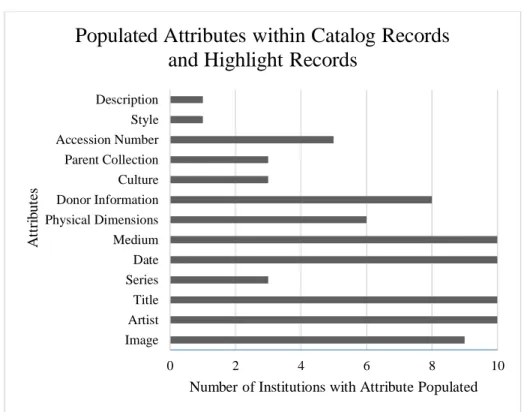
Of the 10 digitally accessible institutions, only seven offered catalog records, defined by stable URL (31.8% of total sample). The remaining three institutions facilitated access to a print’s image and accompanying information through a pop-out window, referred to in this study as a highlight record (13.6%). In this highlight model, the metadata schema applied to the work is not apparent. Instead, the metadata runs together in a stream of information separated by commas or vertical lines beneath the image. Both the catalog records and highlight records, together referred to simply as records, were evaluated for completion based upon the 13 attributes described in the graph below.
Figure 4 – Populated Attributes within Records (Catalog and Highlight Format)
Of the 13 attributes visualized in Fig. 4, image, artist, title, series, date, medium, and physical dimensions make up the key attributes of interest determined before data collection began. The remaining attributes–donor information, culture, parent collection,
accession number, style, and description–emerged in the course of the coding process.
While all 10 institutions populated the fields of artist, title, date, and medium in their records, these attributes proved to be problematic in the quality of their content. This issue will be considered further in the discussion.
Among the 10 institutions with accessible digital records, visual information– defined in this study as a high quality image–was largely available. All but one institution (Guilford College) included images of the object within the record. Of these nine
institutions with images, five provided high-quality images, two with variable quality,
0 2 4 6 8 10
Image Artist Title Series Date Medium Physical Dimensions Donor Information Culture Parent Collection Accession Number Style Description
Number of Institutions with Attribute Populated
A
tt
ri
b
ut
es
and one with consistently low quality. Six of the nine image-bearing records invite image manipulation in the form of zoom, full screen viewing and/or image rotation.
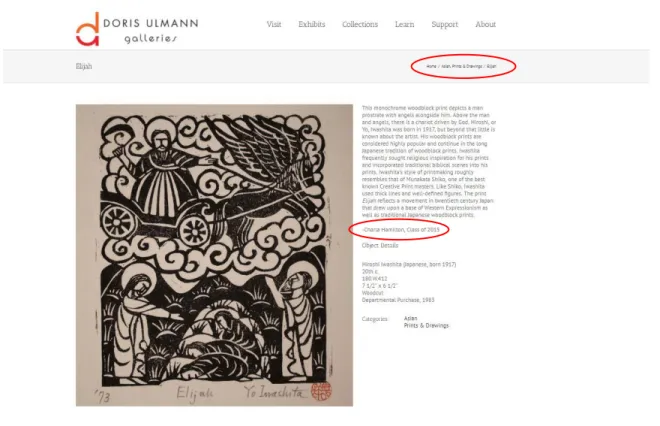
Fields that required a deeper understanding or research into the print at hand, such as series, style, and description were rare. Only one school included a descriptive field, but this was filled with the dimensions of framed print. Berea College was the only institution to provide image descriptions (Fig.5). This information was student produced and varied both in quality and accuracy. While parent collection and culture were stated infrequently within the record sample, parent collections were often implicated through the breadcrumb navigation at the top of a record and culture was frequently implied by a parent category (Fig.5).
Digital Access: Questionable Information
Populated information does not necessarily mean accurate information. Between the 30 records examined (seven catalog records, three highlight records), all attribute categories wavered in the quality of their information. Of the 13 attributes considered in this study, quality problems were particularly prominent in the artist, title, date, and
medium attributes.
Artist
In regards to artists’ lifespans, only three of the ten institutions (Mills College, Berea College, Guilford College) consistently provided both birth and death dates. Two other institutions occasionally included this biographical information (Ohio Wesleyan and Beloit College). Five institutions used inconsistent ordering of Asian names and/or sometimes did not provide the full name (i.e. Hasui, rather than Hasui Kawase). Only Union College provided diacritical marksin the Romanized Japanese names.
Title
Print titles were often vague, untitled, or descriptive. Institutions such as Connecticut College varied wildly in the specificity of their print titles. Only three institutions followed the title of a print that belonged to a larger series with the parent series title. In the case of a reproductions, the qualifier was sometimes added to the title field.
Date
century windows to specific years. Only one institution (Willamette University)
mentioned the Edo period (1603-1868) from the Japanese era system to provide temporal backing to the work at hand.
Medium
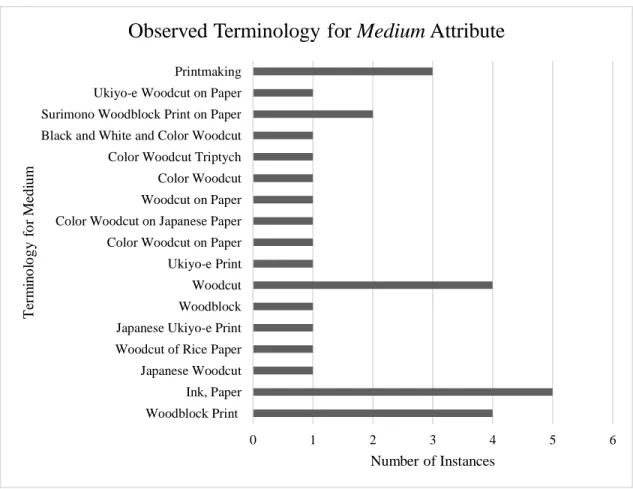
Though in theory, the medium for the woodblock prints should be consistent, this analysis of 30 Japanese woodblock print records resulted in 17 distinct terms for this medium (Fig.6). In two cases, medium was described as technique, and once as a
material. These differences crossed institutional lines, but all 10 institutions also showed disparate terminology use within their own collections as well as sub-collections.
Figure 6 – Observed Terminology for Medium Attribute
0 1 2 3 4 5 6
Woodblock Print Ink, Paper Japanese Woodcut Woodcut of Rice Paper Japanese Ukiyo-e Print Woodblock Woodcut Ukiyo-e Print Color Woodcut on Paper Color Woodcut on Japanese Paper Woodcut on Paper Color Woodcut Color Woodcut Triptych Black and White and Color Woodcut Surimono Woodblock Print on Paper Ukiyo-e Woodcut on Paper Printmaking
Number of Instances
T er m in o lo g y f o r M edi um
Digital Access: Static Records
Inter-Collection Data Linking
Interlinked Records
(% of records)
Institutions
None (50%)
Dickinson College, Guilford College, Mills College, Union College, Connecticut College
One or More Out-Links from Record
(50%)
Ohio Wesleyan University (broken), Willamette University, Beloit College, Berea College, DePauw University
Table 2 – Inter-Collection Linking Among the 10 Record-Bearing Institutions
Five of the 10 analyzable institutions had at least one instance of interlinking a single record to other parts of the larger collection. This took the form of linking single records to artist names, periods, mediums, etc. At the time of this study, Ohio Wesleyan’s links were broken, but the functionality was built into the record. Both Beloit College and DePauw University evidenced the ability to link out equally, as they ran upon the same platform, but neither institution had activated many of these links. Willamette University provided the greatest diversity of out-linking and all of links functioned.
Social Sharing Functionality
Social Sharing Functionality
(% of examined records)
Institution
(From the 10 institutions with accessible records)
None
(70%)
Berea College, Dickinson College, Guilford College, Mills College, Union College, Connecticut College, DePauw University Social Media (10%) Beloit College Email (30%)
Ohio Wesleyan University, Willamette University, Beloit College
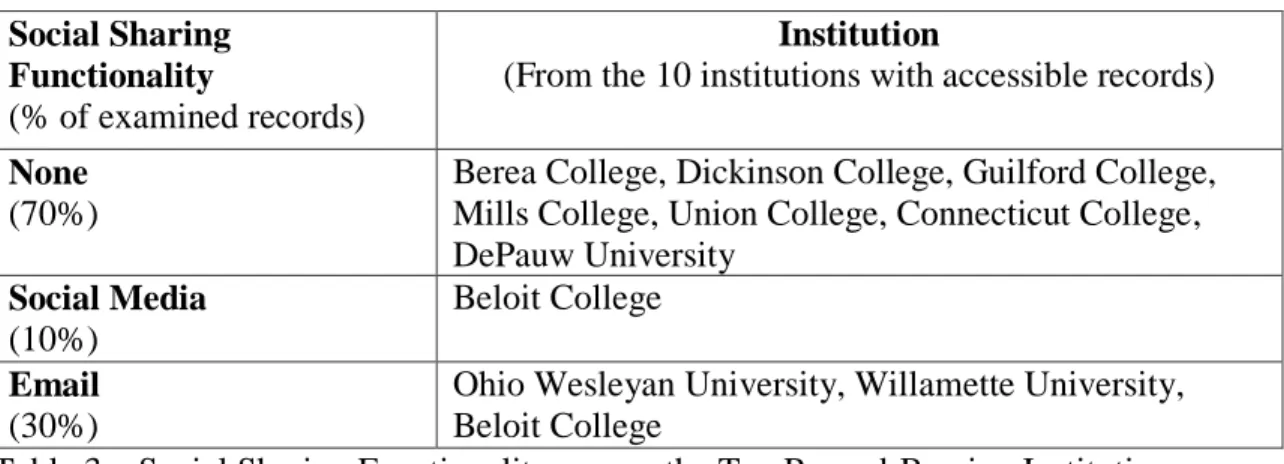
The potential for digital sharing offers another route to dynamic records. This can take the form of social media networks, such as Facebook, Twitter, Instagram, and more, as well as email. Considering the 10 record-bearing institutions, seven out of the 10 did not offer either of these options, while three offered email sharing and one linked out to 192 separate social sharing channels.
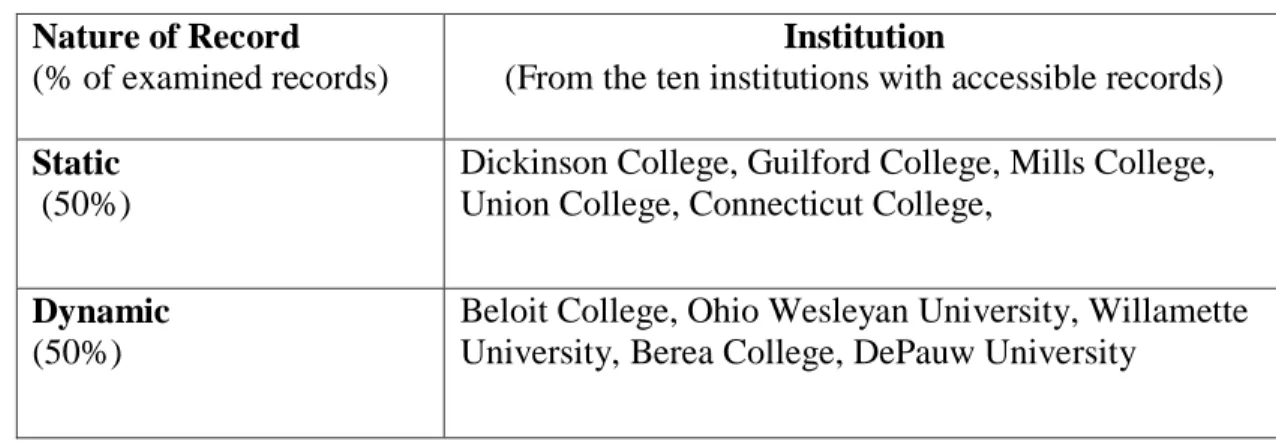
Considering inter-collection record linking and social sharing together, only half of the 10 record-bearing institutions had at least one of these means of user interaction. The remaining half were static, dead ends that required the user to return to the main collection or search page to find another record.
Nature of Record
(% of examined records)
Institution
(From the ten institutions with accessible records)
Static
(50%)
Dickinson College, Guilford College, Mills College, Union College, Connecticut College,
Dynamic
(50%)
Beloit College, Ohio Wesleyan University, Willamette University, Berea College, DePauw University
Physical Access: Alluding to Interaction
Figure 7– Mention vs. No Mention of Physical Access on Collection Website
Four institutions out of the total 22 school sample offered an allusion to physical access to the collection on their website. Though the original research design for this study anticipated the analysis of print study room protocols, none of the ASIANetwork institutions provided digital access to these documents. Thus, the actual policies and protocols remain opaque from digital entry point. The four schools that alluded to physical access on their collection’s institutional websites include Guilford College, Berea College, Union College, and Beloit College.
At Guilford College, the FAQ section answered the question “How can I see works that are not currently on view?,” asserting a case-by-case basis and the
endorsement of exclusively research-focused and scholarly ends. Guilford required the interested party to contact the curator directly by phone to schedule an appointment.
0 2 4 6 8 10 12 14 16 18 20 22
Mention of No Mention of
Number of Institutions
At Union College, physical access to the collection was noted on the permanent collection webpage. This short section provided the name of the coordinator, an email address to initiate contact, and a printable/ downloadable object request form.
At Berea College, physical access was recognized, but not discussed in depth. Beneath the description of the permanent collection, the site describes the “Teaching Collection” as items that are “used on a regular basis for teaching and made available to students and faculty for study in the object study rooms or other controlled
environments,” but the protocol and process to initiate this interaction remained unclear.
Discussion
Crafting Intellectual Access
This study revolved around the question of access, examining both digital and physical access to understand the intersection of the two: intellectual access. Concerned with contextualization and material understanding, intellectual access refers to the ability to consider the who, how, why, when and in what context of the object at hand. For 12 of the 22 institutions in this study, Japanese woodblock prints remained inaccessible digitally, physically, and intellectually. These collections maintained their silence. Though the remaining 10 institutions provided digital access through online object records, the protocol and practice for physical access was notably absent from each collection’s digital platform. Physical access received only fleeting mention at only four of the total 22 institutions. Based on these findings, the narrative of Japanese woodblock prints in the collections of the ASIANetwork consultancies remains silent, vague or confused, and plagued by institutional westocentricism. In addition, the poverty of physical access among the ASIANetwork sample suggests that object-based learning is more of an ideal than a reality at these institutions.
Present, but Muted: Inaccessible Expertise
of Asian art and artifacts resulted from the scarcity of experts to catalog them. By sending consultants to fill curatorial gaps, ASIANetwork sought to lend the objects a newfound voice. By working with the ASIANetwork consultancies as its sample, this content analysis was designed to look beyond the barrier of area knowledge to consider whether expertise was truly the key hurdle to the accessibility of woodblock print collections. With more than half of the collection completely silent and the remainder muffled by vague and questionable records, this study suggests that expertise is only one barrier facing these prints collections.
Dissemination poses a second significant hurdle to access. While the
ASIANetwork generated information provides the most striking example, the ghosts of exhibitions past provide another example of this disconnect between generated
information and its dissemination. For example, Beloit College included Japanese
woodblock prints in exhibitions in 2005, 2006, 2009, and 2014, yet the digitally available catalog records offer no evidence of wall text or any other exhibition content. The same can be said for Mills College in 2014. Finally, Dickinson College produced a publication – in both print and digital formats – of its Asian holdings in 2008. Though a full
descriptive entry, complete with discussion questions, was prepared for the woodblock print Geisha reading, holding a hair pick in her hand, there is no echo of this content in Dickison’s digital catalog record for this object (see Fig. 8). While the scope of this study does not investigate this barrier between information creation and dissemination, the prevalence of disconnect found in this study suggests the importance of further
and antiquated websites, thus inquiry into personnel shortage, technology competency, and prioritization of more critical tasks should be considered as possible barriers.
Fig. 8 – (L) digital catalog record vs. (R) catalog entry from New Lives for Asian Images
(2008) for Geisha reading, holding a hair pick in her hand at Dickinson College.
What is a Woodblock print? Yearning for Disambiguation
Medium
Based on the surprising diversity of definitions for the medium attribute, it’s unclear. While this confusion characterizes the intellectual access to Japanese woodblock prints observed in this study, this imprecision extends level of definition of medium, (alternatively labeled material, or technique). Referring back to Fig. 6, woodblock prints took on 17 different identities in this study, ranging from raw materials (ink, paper) to broad technical category (printmaking) to the incorporation of field-specific terminology (i.e. surimono woodblock print on paper). How is one to know that ukiyo-e print and
Ukiyo-e print / Japanese woodcut / Color woodcut on Japanese paper) define these works? This lack of internal, as well as external consistency for collections among the ASIANetwork consultancies complicates a user’s understanding of the woodblock print medium as a whole. It becomes unclear which prints belong to the same medium. This variety also blurs which aspect of a Japanese woodblock print’s creation defines its medium – technique, raw material, style?
These deviating mediums may not only confuse the unfamiliar audience, but also mislead them with inaccurate information. This can be seen in the frequent use of the term “woodcut (while a valid term for the technique, it is rarely used in the specific case of Japanese woodblock prints),” and again with “woodcut on rice paper (the paper is, in fact, mulberry based).” Inconsistent information such as this floods the artist attribute as well, erecting a barrier against the construction of connections – whether intellectually or functionally – between works in a single collection, as well as those belonging to separate institutions. Confusing and misleading information not only impacts the object at hand, but also distorts its audience’s intellectual understanding of the art form on a larger scale. The implementation of a controlled vocabulary within each collection could ease the confusion that this diverse terminology creates.
Dead End Records
is infrequent among these collections. As with question of information dissemination, the implementation of controlled vocabularies and interlinking of records may require human and technical resources out of reach for these small institutions.
Originals and Copies
When it comes to woodblock prints, all reproductions are not created equal. Popular 18th century prints were reproduced in significant numbers during the Meiji period (1868-1912). In some cases, new blocks were re-carved, but in others, the old blocks were recovered and reprinted. Just as these two types of “copies” differ in their value, so does the value of a Meiji-period reproduction differ from a reproduction made in the past 50 years. Of the four reproductions examined in the ASIANetwork sample, none explicitly designated the nature of their reproduction status (i.e. Meiji, Modern, etc.), while in some cases, the work was not explicitly identified as a reproduction at all. This confusion arose at Connecticut College, where a Hiroshige design from the 1830s bore a 19th century dating. The attributed 19th century window could refer to the original printing, but could also refer to a Meiji period reprint produced for the European export market just before the turn of the 20th century. While temporal ambiguity is common
throughout the collections examined, in certain cases, such ambiguity can hinder
disambiguation between originals and reproduction and plant inaccurate understandings of color, material, and value.
Implicit West, Explicit Other
catalog records implement a stable metadata schema across each collection, parity ends there. Turning fist to the level of collection structure, all but one institution (Mills College) organize their collections into non-Western geographical designations and implicitly Western mediums. Though these mediums present no direct geographic
marker, all works in these collections hail from the Western tradition. This organizational system asserts that Western art is the standard, that the Western tradition is the history of art, and that other artistic traditions are auxiliary, are Other. While the contrast between geographic designation and medium makes this practice of Othering clear, the lumping of all Asian art within a single category further strips the individuality from these diverse artistic traditions to create an homogenous Other. This Othering permeates the records themselves as well. Though culture does not enter into the medium descriptor for Western objects, culture becomes a defining factor for woodblock prints (ie. Japanese Ukiyo-e print/ Japanese woodcut/ Color woodcut on Japanese paper). Perpetuating a westocentric approach to artistic practice and history, this organizational Othering is detrimental not only to Japanese woodblock prints, but to all non-Western collections. Through this structure, non-Western art becomes secondary to the proposed “main” history of art.
Materiality Remains Out of Reach
senior staff at the museum caution the user’s interaction. This underdevelopment of physical access information is unfortunate news for Japanese woodblock prints. As objects rarely displayed in gallery spaces, the absent or qualified invitation to physical access denies or dissuades the audience from collecting critical material information, such as subtle surface effects and overall material understanding. As only six of the 10 record-bearing institutions provided physical dimensions, the sense of the Japanese woodblock print as a physical object remains out of reach.
Looking Forward
This study was concerned with the narrative of Japanese woodblock prints at the ASIANetwork consultancies from a digital entry point. The surprisingly minimal digital impact of the ASIANetwork consultancies stirs a need to reach out to the staff at these institutions to find out what has been done with the information produced during the ASIANetwork project and to ask, what barriers have stood between information creation and dissemination? Is this information in use in ways undetectable through the