Howard S. Carrier. Law Library Digital Reference Services and Interdisciplinary Students. A Master’s Paper for the M.S. in L.S. degree. April, 2009. 61 pages. Advisor: Jeffrey Pomerantz.
This paper evaluates the provision of digital reference services by academic law libraries to interdisciplinary students, who are not affiliated with the law school, but are
researching within a legal area. By using an unobtrusive methodology, which involved presenting carefully developed reference questions to synchronous and asynchronous digital legal reference services, the research aimed to discover how receptive these services are to the information needs of non-lawyer patrons. Particular regard was paid to the types of resources that law librarians direct interdisciplinary patrons toward, and whether these are mainstream university-wide resources, open access resources, or specialist legal databases such as Westlaw and LexisNexis. The research assessed the completeness of reference transactions and applied these findings to the specific needs of interdisciplinary students.
Headings:
Academic Libraries – Reference services – Case studies
Academic libraries – Reference services – United States
LAW LIBRARY DIGITAL REFERENCE SERVICES AND INTERDISCIPLINARY STUDENTS
by
Howard S. Carrier
A Master’s paper submitted to the faculty of the School of Information and Library Science of the University of North Carolina at Chapel Hill
in partial fulfillment of the requirements for the degree of Master of Science in
Library Science.
Chapel Hill, North Carolina April 2009
Approved by
Acknowledgments
I should like to take this opportunity to thank my advisor, Dr Jeffrey Pomerantz, for his help and guidance throughout this research.
I should also like to express my appreciation for the efforts of the law librarians detailed in this paper (especially as those librarians were unaware that their reference work was providing data for an academic study).
Above all, however, I should like to thank my wife, Lennis, and my father, Jeremy, for their unwavering support during my graduate studies.
Table of Contents
1. Introduction...3
2. Literature Review...9
3. Methodology...21
4. Importance of study...37
5. Results...38
6. Discussion...46
7. Conclusions...50
8. References...52
1. Introduction
1.1 Digital reference services
Digital reference has become an intrinsic part of library reference services in the 21st century. Seven years ago digital reference was viewed as an “innovation” (Diamond and Pease, 2001), however by 2006 links to digital reference had grown to be a
commonplace feature of library home pages (Radford & Kearn, 2006). Digital reference services may be typified as reference transactions conducted by e-mail or web-form, or by synchronous “chat,” a method that uses instant-messaging software to enable the reference service (Radford & Kearn, 2006). The rise of asynchronous digital reference services (e-mail and web-forms, which prompt responses to the patron’s e-mail account) has been charted (Carter & James, 2000; Pomerantz et al., 2006); as has synchronous digital (“chat”) reference (Hirko, 2002; Pomerantz et al., 2006). Indeed, with regard to chat, Hirko (2002) goes so far as to observe:
Chat software falls into two categories: software which can be downloaded for free from the internet, and which must be installed on the hard drives of both the reference librarian’s computer and the patron’s computer before the reference
transaction can take place (examples include “Yahoo Messenger” and “Windows Live Messenger”); and software that exists on the library’s computers only, which causes a chat window to open on the patron’s computer, thereby allowing the chat to take place (Francouer, 2001). This ready availability of chat interfaces, and the free accessibility of web-based e-mail accounts (“Hotmail”, “Gmail” etc.), indicates that digital
reference services (when provided), are open to all of the library’s patrons who have access to a computer.
1.2 Academic law libraries and digital reference services
1.3 Academic law library patrons and reference services; interdisciplinary students
It seems reasonable to assume that the patron body of any academic law library will include law students and law faculty members. By extension, it is also foreseeable that legal practitioners may use a law library’s resources when researching legal problems. However, the AALL Competencies envisage another type of law library patron: the non-lawyer. Section 3.4 of the Competencies provides that legal reference librarians must: “Assist non-lawyers in accessing the law,” (AALL, 2001). In the context of an academic law library, which exists within a university-wide library system,
additional questions are raised. Again, UNC Chapel Hill provides a useful example. The Katherine R. Everett Law Library’s homepage indicates that all UNC Chapel Hill affiliated persons enjoy law library borrowing privileges, or may use the law library’s reference services, so clearly the law library does not exist for the sole benefit of lawyers. However, some of the law library’s resources, notably Westlaw and LexisNexis, are reserved for law school affiliates only. An ever-increasing reliance on these particular resources when researching legal issues has been charted (Joergensen, 2002). This raises a question regarding the interaction between the legal reference librarian and the patron, in instances where the patron is not attached to the law school: can the librarian be certain that he/she is directing the patron towards resources that the patron can actually access?
In the context of a large public university, the issue of law library use by students from outside of the law school arises. Such students may be usefully regarded as
disciplines within the academy as a whole. In so doing, he arrived at the following conclusion:
“the notion of a liberal education is specific neither to law nor to university education…a liberal education should always involve giving the student those materials that are necessary to help them reflect upon the values of the culture,” (p.75).
This is not to say that there will not be challenges for interdisciplinary students when approaching legal research. The language of law can be complicated, or in some instances unnecessarily convoluted (Kimble, 2006). Similarly, Mertz (2007) argues that the language of law leads to a socialisation of the law student within the law school, and (subsequently) the legal profession –the linguistic approach adopted by academic lawyers that causes students to literally think “like a lawyer.” Given this prevailing legal culture, one becomes more curious about the experiences of interdisciplinary students when using digital legal reference services. Do legal reference librarians recognise non-lawyer
patrons and tailor reference services accordingly, in order to properly fulfil the information needs of those patrons?
1.4 The need to evaluate legal digital reference services for interdisciplinary students
means (Duggan, 2001). The specific question of how legal digital reference services respond to interdisciplinary students has not been considered to date.
1.5 Research questions and statement of purpose
This research seeks to address three principal questions:
1. To what extent do legal reference librarians assess patrons’ legal experience during the course of a reference transaction?
2. To what extent do legal reference librarians ascertain patron accessibility to subscription-based legal databases when recommending sources, and are alternative resources also suggested to patrons?
3. To what extent do legal reference librarians instruct interdisciplinary student patrons in how to access legal materials during the course of a reference transaction?
2. Literature Review
2.1 Unobtrusive observation of digital reference services
The methodology which will be used by this study is relatively novel, and has proven to be controversial in the past. It will involve the researcher submitting reference inquiries to both synchronous and asynchronous reference services operated by academic law libraries. This combination of novelty and controversy justifies a consideration of appropriate literature.
librarian), it does not bode well for the interdisciplinary student patron of digital legal reference services.
On the contrary, it suggests that librarian will be more focused on the legal information problem itself, rather than actually fulfilling the patron’s information need.
Why is an unobtrusive or covert method preferred? In the case of Shachaf & Horowitz’s research the method was chosen because it was feared that librarians would change their behaviour, if they knew that they were being observed. As the research was trying to determine inequality of treatment based upon race, this approach is easily justified. Contemporary society in the United States rightly abhors racial prejudice, and the knowledge that one was participating in a study addressing this issue might cause an individual to behave differently, in order to ensure that partiality was not shown.
However, the unobtrusive method was used prior to Shachaf & Horowitz’s work, and addressed a different question to that of racial prejudice. Both Shachaf & Horowitz and Sugimoto cite Hernon & McClure, (1986). This article provides a forthright
definition of the unobtrusive method, within its opening paragraph:
“Unobtrusive testing of reference service is the process of asking questions…of library staff members who are unaware that they are being evaluated,” (p.37).
using questions related to government documents, proved that the 55% rule was not substantially wrong. The researchers were able to identify a success rate of 55% - 62% in response to their factual and bibliographic questions, (Hernon & McClure p.41). They argue that this disappointing finding confirms the usefulness of unobtrusive testing, as the 55% rule was initially identified and then subsequently reaffirmed through the use of this method. In a strongly worded final section, the authors suggest that the unobtrusive method has yielded data, which points to a tacit acceptance of the 55% rule, and therefore criticism of librarians’ commitment to meeting patrons’ information needs can be
justified. This conclusion suggests that obtrusive observation would not be a similarly effective means of data collection. There is a likelihood that people will conduct themselves differently when they know that they are being observed. This seems pertinent, given that 30% of the instances of incorrect data were caused by a “don’t know” response, or by the librarian terminating the search prematurely, (p.38-39). This point is supported by Weech & Goldhor, (1982), who noticed that unobtrusive
observation reported an accuracy rate of 70%, as opposed to the 85% observed through an obtrusive methodology, (Sugimoto, 2007, p.8). In a later piece of research examining adherence to Reference & User Services Association (RUSA) guidelines during the course of virtual reference transactions, Shachaf & Horowitz, (2008), state directly:
“This study also applied an unobtrusive method because if librarians know that they are being observed, they may act differently.”
Saxton & Richardson, (2002), Ward selected questions drawn from an archive of previously submitted reference questions. In charting responses, Ward developed a completeness scale, designed to test record the extent to which reference questions were answered. This completeness scale included a codification system, which involved the allocation of a code within a five point scale (beginning with “C” (Complete), and culminating in either “I” (Incomplete) or “R” (referral.).
2.2 Legal reference services and interdisciplinary students’ information needs
Arrigo (2001) stresses the importance of recognising a patron’s attributes:
“Knowing the patron’s…information gathering tendencies are important when conducting a reference interview,” (pp.77-78).
Arrigo considered various types of law library patrons. Specifically, he recognised law students, legal professionals and non-lawyers. However this latter category is
restricted to “public” patrons, seeking information about specific legal problems. It is unfortunate that Arrigo did not simply consider the legal reference needs of law students, and then expand these for interdisciplinary students engaged in legal research. The result of this failing is a rather jumbled paper, which seemingly asserts the need for different sources for different patrons. A law student example (p.93) is focused on Westlaw and legislative databases. The discussion of “public” patrons (pp.81-82), leads to a
recommendation of generic legal reference sources (such as American Jurisprudence
article serves to highlight the absence of relevant literature in this area. When considering the law library’s patron base, a stern distinction between “lawyer” and “non-lawyer” tends to overlook the interdisciplinary researcher all too easily.
The issue of a patron’s ability to access resources is obviously important. Grabarek-Matthews (2008) investigated librarians’ self-assessment of their knowledge about open-access sources, (pp.22-23). Using a five-point scale (1 being “very little” and 5 being “a lot”, she observed a mean response of 3.11. Although Grabarek-Matthews was principally considering open access journals and institutional repositories, this may be of interest to research investigating the type of resources recommended by legal reference librarians to interdisciplinary students. Many legal sources can be found through open access resources, as well as subscription-based legal databases. As interdisciplinary students, in all likelihood, do not have access to Westlaw or LexisNexis, the librarian’s willingness to recommend open access sources is of interest. This matter extends beyond actual physical access to a resource. Newman & Doherty (2008) investigated usability difficulties experienced by non-lawyers when using legal databases. Data was collected by means of an experiment in which lawyers and non-lawyers undertook information-finding tasks whilst using online legal database. The researchers noted:
2.3 The complex nature of legal materials
The necessity of law library instruction for law students is now entrenched in law programmes in both the United States and Europe. Clinch (2008) records the results of a 2006/7 survey of 108 libraries located in the United Kingdom and Republic of Ireland. The libraries were attached to higher education institutions, which offered specialist legal education. Data drawn from an overall response rate of 75% showed that 96% of these libraries reported the provision of legal instruction, beyond basic library tours. During the course of an academic year, Clinch noted that an undergraduate (LL.B) law student received a mean average of 3.7 hours of law library instruction, a taught postgraduate (LL.M.) student received 2.9 hours, and a research postgraduate (Mphil or PhD) student received 1.5 hours. Given the more stringent demands of postgraduate degrees, it seems reasonable to speculate that higher levels of instruction would be expected for
postgraduate students. Conversely, it could be argued that the initial impetus in acquiring legal research skills is of the greatest significance, (in other words, once students are confident in commencing their own research, they achieve levels of competence that reduce their need for a sustained level of instruction – this would explain the disparity between the LL.B student’s 3.7 hours and the PhD student’s 1.5 hours.) Unfortunately, Clinch neither advances nor tests these hypotheses. However, one could submit that the higher number of instructional hours for the most inexperienced student does suggest that the legal novice has the greatest need for law library instruction.
LexisNexis. Their eventual conclusions recognise the paramount importance of
addressing resources of this nature in law library orientation sessions, notwithstanding the challenges of teaching inexperienced researchers how to use these tools. It is important to note that Keene and Gordon were discussing WestLaw and LexisNexis at a time when these resources were relatively new to some lawyers and law schools. It can be argued that the requirement to be proficient in the use of these resources has increased
substantially since 2001. The need for detailed instruction suggests that neither WestLaw nor LexisNexis are immediately intuitive or simple to use – a good working knowledge of legal research is required, if the researcher is to gain the maximum benefit from using either of them. This combination of necessity and difficulty obviously raises problems for the new law library patron. The question of access must also be addressed. As stated earlier, many law schools allow only affiliated law students to access these legal resources. Interdisciplinary students (by definition) do not fall within this group.
In accepting the validity of instruction, questions arise regarding the delivery of this. It is foreseeable that non-lawyer patrons will be at a disadvantage in this regard. As Venie (2008), indicated, law students clearly have the opportunity to attend relevant classes in finding and using legal materials. Non-lawyer patrons are unlikely to take advantage of these training sessions (even if they were permitted to do so). Instead, their use of the law library may take place on an ad hoc basis, as and when information needs arise. As a result of this sporadic use, opportune moments for instruction must be
has the potential to inform the proposed research substantially, as it considers a variety of outcomes for instructional interaction at the time reference inquiries are made.
2.4 Finding legal sources
The research will be informed by an understanding of how legal sources are sought by lawyers. The rationale here lies in a possible comparison between lawyer / non-lawyer searching. Given the disparity (in terms of legal knowledge), this will assist in understanding appropriate levels of instruction provided by legal reference services when assisting non-lawyer patrons.
Kulthau and Tama (2001), investigated information seeking by practising lawyers. It could be argued that this qualitative research study demonstrates some lawyers’ ignorance of contemporary legal research methods (something which is evidenced by their hostility towards online sources, and the erroneous statements which are made about these.) Another suggestion may be that “traditional” methods of research (the use of print sources) have become engrained in experienced lawyers. The research also serves to illustrate the idea of an established legal culture. It is noticeable that some of the informants speak in familiar terms about their methods for conducting research, “…there is no sense in reinventing the wheel. You can get answers from someone who has done exactly the same brief on the same issue,” (p.37). The ignorance of valid research methods by experienced lawyers indicates that a universal strategy may be in order – and perhaps legal reference librarians should offer an equally detailed service to both lawyer and non-lawyer patrons.
The first two items in this short list provide no surprises (this paper has already indicated a heavy reliance on WestLaw and LexisNexis in contemporary legal research). The presence of the third is, perhaps, a little curious (as is the omission of HeinOnline). For the non-legal patron the presence of Google Scholar is unproblematic (as this resource may have been used in interdisciplinary work, or for research in the patron’s own area of academic expertise.) The research serves as a reminder that perhaps instructional legal librarianship ought not to be focused on (strictly) legal sources at the exclusion of all others.
seems likely that different strategies will be applicable to advising about the availability of relevant sources, as opposed to the location of particular materials.
2.5 Types of questions submitted to legal reference services
There is little published work considering actual legal questions presented to legal reference services. Atchison (2008) posed two questions, one of which is a mixture of doctrinal law and legal procedure: “What is the difference between a federal executive agency and a federal independent agency? Does this distinction have any impact on locating the regulations, rules, and adjudications of a particular agency?” Another is a straightforward question concerning the legal profession: “How many states will licence new lawyers without requiring them to pass a bar exam?” These are useful legal
questions, however their appeal to interdisciplinary students is not immediately evident. There is the additional problem that they were published very recently, in a journal that is habitually read by legal reference librarians.
Although the question of law libraries was not specifically addressed, Diamond & Pearce (2001) did consider the types of questions presented to academic reference
3. Methodology
3.1 General description of the method to be used, and the justification for this choice
As has been described, this was an unobtrusive study. The preceding literature review has demonstrated the value of unobtrusive research in evaluating reference
services. Babbie (2007) describes content analysis as one of three methods of unobtrusive research. He notes:
“Content analysis is the study of recorded human communications. Among the forms suitable are books…web-pages…letters…e-mail messages…” (p.320).
With this in mind, the research, effectively, adopted a doubly unobtrusive method: the covert collection of data in the form of transcripts of reference transactions, which were then subjected to content analysis. To realise this, the researcher pretended to be an everyday library patron who had approached the legal reference service with a specific information need. Added to this was the necessary adoption of a persona. The researcher pretended to be an interdisciplinary student –that is a student from another discipline who has encountered a specific legal research need in pursuit of his or her studies. The
The reason for this unobtrusive method is straightforward: it is the best way to gather reliable data. Both Weech & Goldhor (1982), and Allen (2001) noted that an awareness of observation affected the extent to which reference librarians answered patrons’ questions. Specifically, both of these studies recorded a greater willingness to answer queries, or a more dutiful approach to fulfilling information needs, in instances when the participating librarian was aware that his or her actions were being recorded for research purposes.
As a general comment on the selection of this method, it should be noted that this has been significantly informed by Sugimoto’s research from 2007. To a large extent, this research will re-run her research study, although the research will be directed towards law libraries as opposed to music libraries. This fact, in conjunction with the development and use of research questions related to interdisciplinary students, the absence of pre-existing literature in this area, and the necessity of the unobtrusive method, underlines the originality of the research and the legitimacy of the chosen methodology.
3.2 Selecting suitable libraries for the study
As Sugimoto identified (pp.17-18), purposive sampling is a suitable way for populating a study of this type. Babbie regards purposive (or judgmental sampling) as the selection of a sample based upon “knowledge of a population, its elements and the
purpose of this study,” (p.184).
Bar Association (ABA) –in the same way that the American Library Association accredits MSLS programmes. A search of the ABA’s homepage located a list of 199 approved law schools, presented in alphabetical order. This list was extracted from the ABA website. ABA approval is contingent upon the law school maintaining a law library.
Additionally, there is a range of criteria that a law library must meet, in order to satisfy ABA standards for approval. These are laid out in Chapter 6 of the ABA’s publication: 2008-9 Standards for the Approval of Law Schools. Two of these are especially influential to questions regarding the population for this research:
“A law school shall maintain a law library that is an active and responsive force in the educational life of the law school. A law library’s effective support of the school’s teaching, scholarship, research and service programs requires a direct, continuing and informed relationship with the faculty, students and administration of the law school,” (Chapter 6, p.1)
“A law library shall provide the appropriate range and depth of reference,
instructional, bibliographic, and other services to meet the needs of the law school’s teaching, scholarship, research, and service programs,” (Chapter 6, p.2)
At the outset, the law schools were listed in alphabetical order. As a list of four reference questions had been developed (as will be described below), it would have been unsatisfactory for the researcher to simply attach Question 1 to the first law library in the list, and proceed down the list on that basis. Such an approach would defeat the notion of random selection, which Babbie describes as a process by which, “each element has an equal chance of selection independent of any other event in the selection process, (p.191). In order to achieve ensure random selection, each of the law schools in the ABA
approved list were numbered. An online Random Number Generator (“Research Randomizer”) was then used to create a random set of 199 numbers within the range 1-199. Question 1 was then allocated to the first number generated by the Random Number Generator, and the research proceeded on that basis, in accordance with the strategy for the assignment of questions described below.
3.3 Developing appropriate questions for the study
Saxton & Richardson (2002) selected real questions from an archive of previously submitted reference inquiries, (Sugimoto, 2007). Unfortunately, this approach could not be replicated for this study. The law library of the researcher’s home institution was approached, but the researcher was advised that no such archive of reference questions was maintained. Other institutions were also approached, but were not forthcoming.
libraries she used for her research. Diamond & Pease also identified categories of question, and collected frequency data about each question type drawn from an overall data set. From the eleven types of question identified, four categories have been selected for this research: (1)“Questions answered using standard reference sources”; (2)“Starting points for term papers and assignments”; (3)“Specific factual but not ready reference”; and (4)“Information literacy.” These were selected because of their prominence in the frequency table presented by Diamond & Pease, and also owing to their ready
adaptability to legal reference questions. Although the fourth category (information literacy) only achieved a frequency ranking of 8/11 in Diamond & Pease’s analysis, information literacy is clearly important to the question of interdisciplinary students researching legal questions, and the category was selected on that basis.
In developing questions to use in response to these chosen categories, much thought was given to the types of legal questions that could arise in interdisciplinary research. Drawing upon Brecht’s (1985) consideration of interdisciplinary research in law, focus was directed towards the humanities and social sciences. Care was also taken to avoid presenting questions that law librarians cannot answer for professional reasons. “Improper” questions would include any that demanded legal opinion, (Schlater, 1999).
1. (Questions using standard reference sources): What are some of the leading cases
decided under 42 U.S.C. 1983 and where can I access the full-text of these
judgments?
The location of case law provides an excellent example of a question that can be answered using standard legal reference sources. 42 U.S.C. 1983 grants a statutory means for seeking redress following the deprivation of constitutionally protected civil rights.
2. (Starting points for term papers and assignments): I am writing a paper describing
how a human rights culture has been established in Europe following the end of
World War II. I need to find some suitable sources about this topic.
As an example of an international legal question, this allows the librarian scope to provide a detailed response. It also requires a degree of instructional librarianship in locating international treaty resources, if the patron has not used legal sources of that type before.
3. (Specific factual but not ready reference): How are countries able to claim natural
resources (like oil), which are found under the seabed off their shores - and what
governs this?
4. (Information literacy). I am writing a paper about animal rights. I am looking for
US federal regulations about transporting live animals, especially animals to be sold
as pets (such as rabbits). Can you please help me find this information in a suitable
database?
This question is based loosely upon a worksheet assignment for INLS 707 (Government Documents), taught by Michael Van Fossen at UNC Chapel Hill in 2008. The question can be answered using a variety of databases – some of which require a subscription and some of which are open access. Proper searching within databases is required in order to extract this information.
3.4 Assigning questions to the library
This section of the methodology drew directly upon the method described by Sugimoto (2007). As has been established, each of 199 ABA approved law school libraries were assigned a number and a randomised set of numbers developed within the range 1-193.
provided in her published work. Sugimoto regarded some questions as more difficult than others, and reflected this in her assignment of questions to libraries. This has not been replicated, as it is believed that each of the four reference questions chosen for this research share an equal complexity. The primary concerns, therefore, were to ensure the proportionate allocation of questions (allowing each question the potential to contribute up to 25% of the overall data set collected), and to ascertain that a particular library did not receive the same question for both e-mail and chat reference services.
Figure 1: Allocation of questions to libraries
Institution E-mail Chat
17 1 2 112 3 4 43 n/a n/a 7 1 n/a 86 2 3
3.5 Presenting questions within the interdisciplinary student persona
research restrict the use of their digital reference services to persons affiliated with the university in which they are located. In other words, contacting Georgetown University’s law library using a …@email.unc.edu address (for example), would be an immediate giveaway that the inquiry is coming from outside of the Georgetown University system.
Recent work (Shachaf & Horowitz, 2006), considered the effect of a patron’s ethnicity upon the provision of reference services. However, this question was not relevant to the formation of an alias for the purposes of this research. This research did not seek to investigate issues of gender or race, so the creation of an alias which pointed towards a different gender or ethnicity than the researcher’s own did not seem purposeful. A “Gmail” account was therefore created using a generic male Anglo name (“Christopher Marshall”), allowing reference queries to be submitted from that account.
The researcher was also prepared to masquerade as an interdisciplinary student with a legitimate information need. If directly questioned about academic interests or experience during the course of a reference transaction, then the researcher claimed a humanities or social sciences background (such as being a history student for the purposes of Question 1, a political science student for Questions 2 & 4, and a public policy student for Question 3).
3.6 Codification of data and the construction of data collection instruments
was necessary to cut and paste text from a chat window into another application such as Microsoft Wordpad, prior to saving. Data was then codified, thereby allowing content analysis to take place.
Sugimoto used a completeness scale devised by Ward in 2004. This provides four criteria for analysis: “Was an answer provided? ; Was a source provided? ; Was guidance (bibliographic instruction) provided?; and Was the patron probed with questions
(question negotiation?),” (Sugimoto, 2007, p.23).
Ward’s completeness scale is useful to this research, but it must be adapted in response to the research questions posed. Ward’s completeness scale provides five possibilities for a reference answer. These are described in Ward (2004) at p.50, and Sugimoto (2007), at p.23. They are as follows: “Complete” (all criteria satisfied); “Mostly Complete” (a source / answer + either guidance or questions); “Mostly
Incomplete” (one criteria only, or guidance and questions but nothing else); “Incomplete” (zero criteria fulfilled); “Referral” (referred elsewhere with no other criteria fulfilled).
The research added three additional criteria to Ward’s completeness scale. These assessed whether the reference librarian referred the researcher to Westlaw or
The data collection instruments operated on a simple tally basis. The researcher read each transcript, placed a mark in the appropriate field of each table, and created a total for each field at the conclusion of the exercise. Analysis of datathen began.
3.7 Sequential description of study procedures
The study commenced with the allocation of numbers to the alphabetical list of law schools obtained from the ABA website. A Microsoft Excel Worksheet was created which replicated Figure 1 (above). This Excel sheet recorded question allocation data. The first column of the spreadsheet comprised of the random set of numbers within the range 1-199, generated by the Random Number Generator. The Excel sheet therefore took the form of 3 columns, and 199 rows.
The researcher then opened the ABA list and cross-referenced this with the number in the first cell of column 1. By clicking on the hyperlink in the list, the
homepage for the appropriate law school was located, and the researcher then followed links until arriving at the digital reference services’ section of each law library’s website. E-mail reference inquires were made first, as there is a time delay involved with
asynchronous reference. At the time of making the e-mail reference inquiry, the
spreadsheet was finalised. The researcher then returned to row 1, column 3, and began the chat reference element of the data collection.
As each transcript was completed, it was clearly marked with the date, institution number, and question number involved. This was the case for both hard copy printouts and electronically stored transcripts.
It should be noted that a minimum period of at least one week transpired between the submission of the last e-mail reference inquiry, and the completion of the last chat conversation. E-mails inquires which had not drawn any additional response by this point in the research were regarded as finalised. Inquires which received no response, or which a librarian declined to answer were noted. These were not included in the analysis of answer completeness. The refusal to answer a question (because of university affiliation, for
example), differs from an incomplete answer being supplied.
3.8 Ethical issues
Ethical issues are raised when a methodology of this type is used. Specifically, the method used was a covert one. According to Babbie, however, it was also deceptive. Babbie regards deception as unethical, and argues that the use of deception within social research must be “justified by compelling social or administrative concerns, (p.67).
The case for an unobtrusive method has been considered by this paper. Simply put, there is no existing literature that addresses the research questions posed by this study. As Shachaf & Horowitz noted in 2006, no suitable alternative methodology has been identified, which means that unobtrusive research is the only available means for collecting this data. Despite finding fault with the application of unobtrusive methods in 2005, Hubbertz still grudgingly concluded that unobtrusive observation of reference services has a definite place alongside other methods of evaluation.
Secondary to the issue of deception is the question of wasting a library’s time and resources. After all, these questions do not represent actual information needs, yet
librarians will spend part of their working day providing answers. There is no truly satisfactory answer to this complaint. It is to be hoped that that the value of the research provides a justification for the unavoidable consequences of the unobtrusive
methodology.
3.9 Plan for the analysis of data
question. This allowed for cross-referencing with frequency data from the missing data table. The research thus attempted to determine the level of completeness for each
question type and also the omission of elements that resulted in this completeness coding. Comparisons were also possible with regard to resources. Examples could include: a determination that Question 4,"achieved a high completeness level; the researcher was directed towards legal resources; but in most instances those resources were either Westlaw or LexisNexis."
3.10 Advantages and disadvantages of the chosen method
Babbie describes reliability as a “matter of whether a particular technique, applied repeatedly to the same object, yields the same result each time,” (p.143). He adds,
“reliability is a concern every time a single observer is the source of data,” (p.144). There are issues of reliability with regard to this research. Four questions were presented to digital reference services, after which the researcher extracted data from printed transcripts. The reliability question is straightforward: can the researcher treat all four questions identically, or will subjective elements prevent this? This is clearly a potential problem.
to the unobtrusive method. The researcher presented each question from the perspective of the adopted persona – the interdisciplinary student. Data was extracted using standard criteria applied across all questions. This strategy therefore circumvented issues of partiality and ensured reliability.
Similarly, Babbie describes content validity as the extent to which “a measure covers the range of meanings included within a concept,” and argues that construct validity is “based on the logical relationship between variables,” (p.147). The issue of content validity is satisfied as the extraction and codification of data is governed by the fixed rules stipulated in Ward’s completeness scale (se 3.6, above). The manner in which the data is codified also gives rise to construct validity; a response to question 4 (for example) may be coded “MC” because a source, answer, and guidance are provided in response to the inquiry).
The primary advantage to the chosen method is that it allows for the collection of data from the libraries of all ABA approved law schools in the United States. This
ensures that the study’s population includes the leading academic law libraries within that geographic region.
4. Importance of Study
The importance of the study is that it addresses a substantial gap in knowledge at the time of writing. Although there is literature, which considers non-lawyer experiences in using law libraries, this mainly examines law library use by lay-people with a specific legal need. A notable example can be found in Hale-Janeke & Blackburn (2008) –a study that considered interactions between law librarians and self-represented litigants.
Interdisciplinary research within law is now a permanent fixture within academic research and the university as a whole, (Bradney, 1999, Brecht, 1985). Diodato (1990), also points to the use of legal materials by an academic patron base, drawn from a wide range of disciplines.
5. Results
5.1 Reference inquiries submitted by email
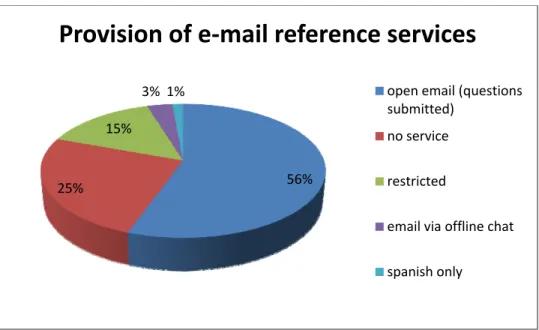
The home pages of all 199 law libraries that comprised the sample for the research were visited. It was ascertained that 52 libraries (26.6%) have no e-mail reference service, 31 libraries (15.6%) restrict the service to their own (law school) affiliates, 7 libraries (3.5%) route e-mail inquiries through chat services, and 3 libraries (1.5%) offer digital reference services in Spanish only. The remaining 117 libraries (58.8%) received questions by e-mail.
Figure 2: Provision of e-mail reference services
56% 25%
15%
3% 1%
Provision
of
e
‐
reference
services
open email (questions
submitted)
no service
restricted
email via offline chat
spanish only
with ABA approved law schools. Of the 95 libraries providing a response, 91 supplied an answer to the question submitted, and 4 stated a definite refusal to provide an answer.
5.2 Reference inquires submitted by chat
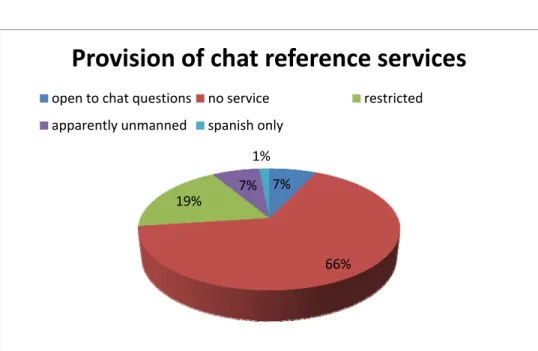
Again, the home pages of all 199 law libraries that comprised the sample for the research were visited. It was ascertained that 131 libraries (65.9%) do not offer a chat reference service, 37 libraries (18.6%) restrict access to their own (law school) affiliates, 14 libraries (7%) do not appear to staff the chat services they claim to provide, 3 libraries (1.5%) offer chat services in Spanish only. The remaining 14 libraries (7%) received reference inquires via chat.
Figure 3: Provision of chat reference services
7%
66% 19%
7% 1%
Provision
of
chat
reference
services
open to chat questions no service restricted
5.3 Questions answered and completeness
Figure 4: Responses received by question
Question
# Medium
Count: asked Count: responses Count: answered Count: declined
1 email 24 23 20 3
2 email 32 22 21 1
3 email 32 24 24 0
4 email 29 26 26 0
1 chat 1 1 1 0
2 chat 4 4 4 0
3 chat 3 3 3 0
4 chat 6 6 6 0
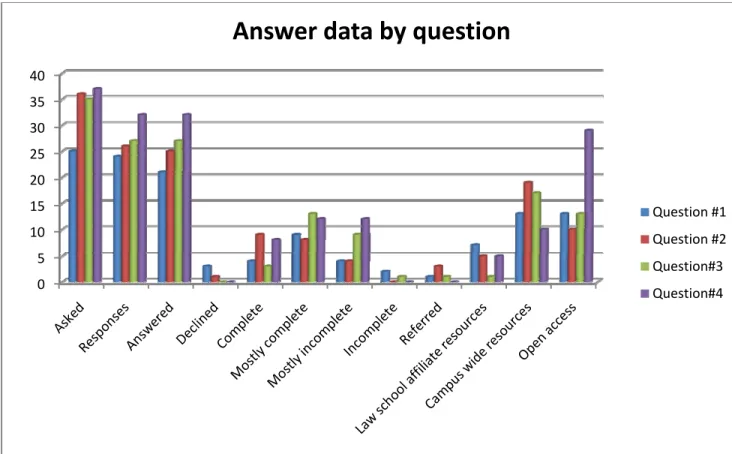
Question 1 received a response on 24 occasions (a response rate of 96%), with an answer rate of 83%. Question 2 received a response on 26 occasions (a response rate of 72%), with an answer rate of 69%. Question 3 received a response on 27 occasions (a response rate of 77%), with an answer rate of 100%. Question 4 received a response on 32 occasions (a response rate of 91%), with an answer rate of 100%.
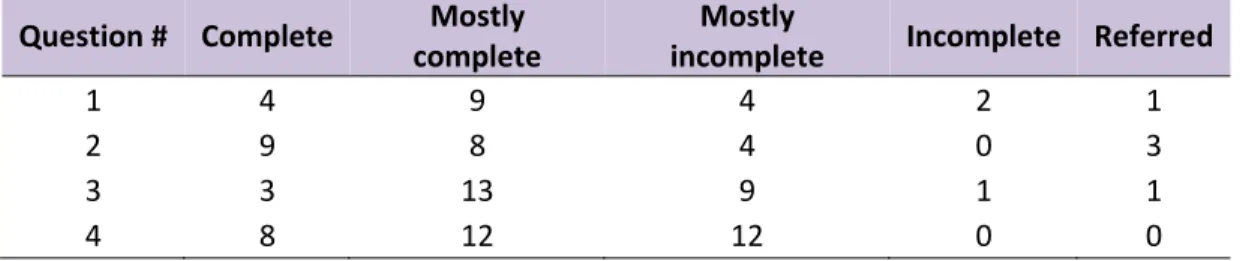
Figure 5a: Answer completeness by question
Question # Complete Mostly
complete
Mostly
incomplete Incomplete Referred
1 4 9 4 2 1
2 9 8 4 0 3
3 3 13 9 1 1
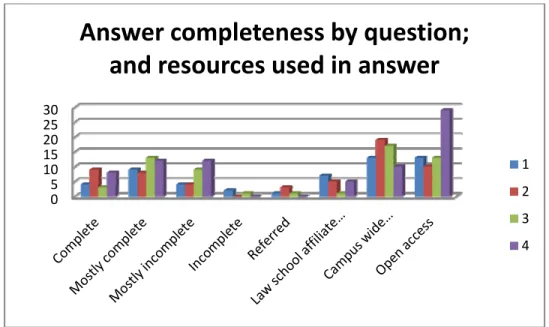
Figure 5b: Resources used in answering questions:
Question Law school affiliate
resources
Campus wide
resources
Open
access
resources
1 7 13 13
2 5 19 10
3 1 17 13
4 5 10 29
Figure 5c: Answer completeness by question; and resources used in answer
0 5 10 15 20 25 30
Answer
completeness
by
question;
and
resources
used
in
answer
1
2
3
Figure 5d: Overview of answer data by question: 0 5 10 15 20 25 30 35 40
Answer
data
by
question
Question #1
Question #2
Question#3
Question#4
5.4 Missing elements that resulted in incomplete answers
Figure 6a: Missing elements by question (email / chat)
Question
# Medium
No answer No source No guidance
No question
negotiation
Restricted
resources only
1 email 11 3 9 6 0
2 email 4 2 5 8 0
3 email 6 5 11 15 0
4 email 16 0 10 16 2
1 chat 1 0 0 1 0
2 chat 0 0 2 1 1
3 chat 2 0 1 3 0
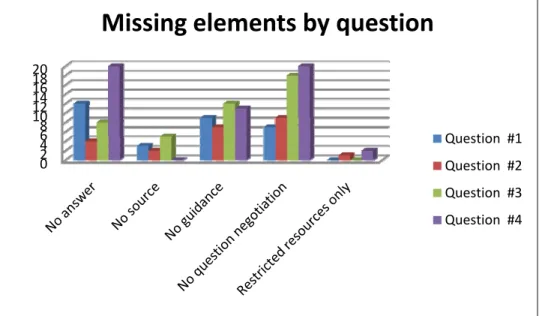
Figure 6b: Missing elements by question (chat and email combined)
0 2 4 6 8 10 12 14 16 18 20
Missing
elements
by
question
Question #1
Question #2
Question #3
Question #4
5.5 Overview by question
Questions 1 & 4 received answers more frequently than Questions 2 & 3, (91% & 96% as opposed to 72% and 77% respectively). When completeness and missing
elements data is also considered, the following patterns emerge:
Question 1 (Questions using standard reference sources): this question generated
“complete” included: “no answer” (50% of responses); and “no guidance” (38% of responses).
Question 2 (Starting points for term papers and assignments): this question
generated the lowest response rate. However, when answered it was answered very well, generating the most “complete” responses of any question, a high number of “mostly complete” responses, and a negligible number of “incomplete” responses. However, Question 2 was also the question most commonly referred to other (non-law) library reference services. The most frequent deficiency in answering this question was an absence of question negotiation. The researcher was commonly directed towards campus-wide resources.
Question 3 (Specific factual but not ready reference): this question generated the
second to lowest response rate. It also generated the lowest number of “complete” responses, the highest number of “mostly complete” responses, and frequent instances of “mostly incomplete” and “incomplete” responses. The question was rarely answered using specific legal resources, and was mostly answered using campus wide resources. The most common omissions from responses were an absence of guidance and an absence of question negotiation.
Question 4 (Information literacy): this question generated the second highest
6. Discussion
At the outset, it is necessary to draw attention to the scarcity of digital reference services in academic law libraries. As has been noted, 26% of these libraries offer no e-mail reference service, and 66% do not offer chat reference services.
From the perspective of the interdisciplinary student, a clear problem is the exclusive nature of digital reference services (when offered). 15% of libraries restrict e-mail to law school affiliates only, while this figure rises to 19% for chat reference. When libraries that do not offer these services at all are excluded from the total list of 199, it becomes evident that 21% of current law library e-mail reference services are restricted to law school affiliates alone –this figure rises to 54% for chat reference services.
for the “declined” figures in Figure 5a (above). On such occasions, the researcher received some responses that stated the reference librarian had checked the researcher’s pseudonym against their law school directory, to confirm that the researcher was not affiliated with their institution.
The research found that these restrictions (and protective login procedures) limit use of the service to law school affiliates alone. The research did not find one instance of a law library using a campus-wide restrictive policy (in other words, limiting reference services to affiliates of the university of which it is a part). Restricted services therefore have this affect: if a history student from University χ attempts to use the digital reference services provided by University χ’s law library, then their request will be declined.
It is curious to note that several law libraries, which have this restrictive policy, state that they are prepared to answer digital reference inquiries from law school alumni and local attorneys. It was not clear how these potential users could overcome the need to log in to the services using a law school affiliated personal identification number (unless, of course, the law library generates numbers for such patrons upon request). This
Turning to individual questions, it may be noted that Question 1 (question using standard reference sources) was the most frequently answered question. This is, perhaps, unsurprising, as it represents the most orthodox legal information inquiry (asking for cases decided under a statute). The absence of question negotiation in many responses to Question 1 seems legitimate, given the direct nature of the question.
The absence of guidance and question negotiation in Question 2 is more startling. As a “starting point for an assignment” question, the question was phrased quite openly, and would seem to lend itself to clarification of the patron’s information need by the reference librarian. When answered incompletely, the researcher tended to be directed towards campus-wide resources, (a common incomplete answer involved a reference librarian conducting a simple catalogue search for “European human rights,” and then forwarding the results to the researcher.) Complete responses tended to utilise open access resources, particularly those provided by the Council of Europe and the European Court of Human Rights.
Question 3 can be answered by reference to the United Nations Convention on the Law of the Sea (1982). Most answers reflected this, a fact which may account for the low number of “no answer” responses, but the high number of “no guidance” and “no
Question 4 was answered well. In most instances, the researcher was referred to open access U.S. Federal Government resources (all of which were freely available online). Curiously, this question also generated the only instances of the patron being referred to restricted sources alone. These instances were rare, but arose when librarians used Westlaw to conduct a search for regulations, as opposed to using the search tools provided by the online version of the Code of Federal Regulations.
Overall, librarians appeared to be very sympathetic to the fact that an
7. Conclusions
This research sought to evaluate the provision of digital reference services to interdisciplinary students by academic law libraries. In so doing, two methods for enabling these reference services were investigated: asynchronous digital reference services (e-mail); and synchronous reference services (chat). The research has shown that all law library patrons have (at best) limited access to these resources, as 26% of law libraries do not offer reference services by e-mail, and 66% of law libraries do not provide a chat based reference service.
Where services are available, these are frequently restricted to law school affiliates only, (21% of existing e-mail services are restricted in this way, as are 54% of
existing chat services). Hence, there is evidence of a clear reticence on the part of law libraries to extend reference services to interdisciplinary patrons, (including patrons affiliated with a
law school’s parent institution, but not the law school itself).
use campus-wide resources, and the welcome use of open access resources (when appropriate).
Although this research has sought to address the reasonable expectations of the interdisciplinary student as a law library digital reference patron, there is clearly a need for additional research. A qualitative study, designed to ascertain law librarians’
perceptions of interdisciplinary students and their needs, would seem to offer a valuable contribution to this presently uncertain area.
8. References
American Association of Law Libraries (2001). Competencies of law librarianship. Retrieved 12th November 2008, from http://www.aallnet.org/prodev/competencies.asp American Bar Association (2008) 2008-9 Standards for the Approval of Law Schools. Retrieved 14th November 2008, from
http://www.abanet.org/legaled/standards/20082009StandardsWebContent/Chapter%206. pdf
Arant, W., & Carpenter, B. (1999). Legal reference service and the unauthorized practice of law – some guides that might help. Reference & User Services Quarterly, 38(3), 235-239.
Arrigo, P. (2001). Taking time for legal research instruction at the reference desk. Legal
Reference Services Quarterly, 19(1/2), 75-98.
Atchison, A. (2008). Questions & Answers. Legal Reference Services Quarterly, 27(1), 89-94.
Babbie, E. (2007). The practice of social research (11th ed.). Belmont, CA: Thomson/Wadsworth.
Bradney, A. (1999). Liberalizing legal education. In F. Cownie (Ed.) The law school:
global issues, local questions, Aldershot, U.K.: Ashgate.
Clinch, P. (2008). SLS / BIALL Academic Law Survey 2006 /2007. Legal Information
Management 8(3), 185.
Chowdhury, G. (2002). Digital libraries and reference services: present and future.
Journal of Documentation, 58(3), 258-283.
Desai, C., & Graves, S. (2008). Cyberface or face to face: The teachable moment and changing reference mediums. Reference and User Services Quarterly 47(3), 242. Diamond W., & Pease, B. Digital reference: a case study of question types in an academic library. Reference Services Review, 29(3), 210-218.
Diodato, V. (1990). Relative use of a law collection in a small academic library. Law
Library Jouurnal, 82, 179-185.
Duggan, J. (2001). The new reference librarian: Using technology to deliver reference services. Legal Reference Services Quarterly, 19(3/4), 195-202.
Farmer, J. (1993). A postructuralist analysis of the legal research process. Law Library
Journal, 85, 391-402.
Francoeur, S. (2001). An analytical study of chat reference services. Reference Services
Review, 29(3), 189-203.
Grabarek-Matthews, M. (2008). Exploring academic reference librarians familiarity with, attitudes toward, and use of open access resources. (Master’s paper, University of North Carolina, Chapel Hill).
Grey, D. (2005). Legal reference services: An annotated bibliography. Law Library
Journal, 97, 537-564.
Hale-Janeke, A., & Blackburn, S. (2008). Law librarians and the self-represented litigant.
Hernon P., & McClure, C. (1986). Unobtrusive reference testing: The 55 percent rule.
Library Journal, April 15, 1986, 37-41.
Hirko, B. (2005). Mainstreaming chat. Library Journal, Fall 2005, 32.
Hubbertz, A. (2005). The design and interpretation of unobtrusive evaluations. Reference
and User Services Quarterly, 44(4), 327-35.
James, N. (2004). Liberal legal education: the gap between rhetoric and reality.
University of New England Law Journal, 8.
Keene, D., and Gordon, H. (2001). Law library tours in an information age: format, effectiveness and function. Legal Reference Services Quarterly 19(1/2), 99.
Kuhlthau, C.C., & Tama, S.L. (2001). Information search processes of lawyers: A call for ‘just for me’ information services. Journal of Documentation, 57, 25.
Makri, S., Blanford, A., and Cox, L. (2008). Investigating the information-seeking behaviour of academic lawyers: From Ellis’s model to design. Information Processing &
Management, 44(2), 613.
Mertz, E.. (2007). The language of law school: learning to think like a lawyer, Oxford: Oxford University Press.
Moeller, S. (2003). Ask-a-librarian: An analysis of an e-mail reference service at a large academic library. Internet Reference Services Quarterly, 8(3), 47.
Newman, D. & Doherty, U. (2008). Making the law accessible to non-lawyers: effects of different kinds of expertise on perceived usability of online legal information services.
Behaviour & Information Technology, 27(5), 423-437.
Saxton, M. L., & Richardson Jr., J. V. (2002). Understanding Reference Transactions: Transforming an Art into a Science. Amsterdam, NY: Academic Press.
Selby, C. (2007). The evolution of the reference interview. Legal Reference Services
Quarterly, 26(1/2), 35-46.
Shachaf, P., & Horowitz, S. (2006). Are virtual reference services color blind? Library &
Information Science Research, 28, 501-520.
Shachaf, P., & Horowitz, S. (2008). Virtual reference service evaluation: Adherence to RUSA guidelines and IFLA digital reference guidelines. Library & Information Science
Research, 30, 122-137.
Shaffer, R. (2002). Thinking like a lawyer: An essay on finding some common ground.
Information Outlook, March 2002, 24-26.
Sugimoto, C. (2007). Evaluating reference transactions in academic music libraries. (Master’s paper, University of North Carolina, Chapel Hill).
Stacy-Bates, K. (2003). E-mail reference responses from academic ARL libraries: An unobtrusive study. Reference & User Services Quarterly, 43(1), 59-70.
Todd, K. (2007). Competencies of law librarianship: Reference, research, and patron services. Legal Reference Services Quarterly, 26(1/2), 7-33.
Venie, T. (2008). Essential research skills for new attorneys: A survey of academic and practitioner law librarians. (Master’s paper, University of North Carolina, Chapel Hill). Ward, D. (2003). Measuring the completeness of reference transactions in online chats.
Reference and User Services Quarterly, 44(1), 46-58.
White, M. (2001). Digital reference services: Framework for analysis and evaluation.
9. Appendices
Appendix A: Data collection instruments
Basic data collection instrument:
Question C MC MI I R W/L OD OA
1 2 3 4
Coding: C= Complete
MC= Mostly Complete MI= Mostly Incomplete I= Incomplete
R= Referral
W/L= Researcher guided to Westlaw/LexisNexis database sources
“Missing data” data collection instrument:
Question NA NS NG NQ W/L O
1 2 3 4
Coding:
NA= No Answer NS= No Source(s) NG= No Guidance
NQ= No Question negotiation
W/L O= Researcher referred to Westlaw / LexisNexis only
Text of questions:
1. What are some of the leading cases decided under 42 U.S.C. 1983 and where can I access the full-text of these judgments?
3. How are countries able to claim natural resources (like oil), which are found under the seabed off their shores - and what governs this?