Introduction
For many years in the United States, individuals who identified as lesbian, gay, bisexual, or transgender (LGBT)1 were forced to hide their sexuality or gender identity, and were unable to live openly as themselves. Because little was known about the LGBT community, these individuals faced both outright and covert discrimination in their personal and professional lives. LGBT Americans were treated as second-class citizens, based on the perceived perversion of their unconventional gender or sexual identity, which discouraged many LGBT people from revealing the truth about their identity in fear of facing repercussions from society.
However, over the course of the last fifty years, public opinion and attitudes toward LGBT Americans has shifted, and citizens have become more accepting towards the LGBT community. According to a 2013 report conducted by Pew Research Center, 92% of LGBT Americans indicated that society has become more accepting of the LGBT community compared to ten years ago, and 70% of those respondents attributed this change to many Americans knowing a family member or close friend who was LGBT. This trend toward acceptance and tolerance has significant implications for LGBT individuals, especially in the realm of politics, an area of civil life where they have historically been shut out. Even as opinion toward the LGBT community becomes more positive, when it comes to serving as a government official, or running for an elected office, LGBT individuals face significant barriers and often have not achieved descriptive representation across all levels of government in the United States.
1 In this paper, I elect to use the term LGB (lesbian, gay and bisexual) when discussing sexual identity in
As of 2015, an LGBT politician has served in some capacity in all 50 states, whether at the local level or higher (Reese 2012). Some states, being more accepting of LGBT politicians, tend to have higher numbers of elected LGBT officials, while less accepting states have had fewer LGBT elected officials, but the national trend shows that LGBT individuals are not being shut out of the political process to the extent that they had been in the past. Even as descriptive representation of the LGBT community improves, there is still room for improvement. There have been no LGBT presidential candidates from either of the major political parties, and there have been no openly LGBT politicians serving in a Cabinet-level position of the federal government (Johnson 2013). The first openly gay member of the U.S. House of Representatives, Gerry Studds, did not come out until 1983, when he was forced to reveal his sexuality in the wake of a congressional investigation of a relationship between Studds and an underage intern (Bendery & Stein 2014). The first openly gay member of the United States Senate, Tammy Baldwin, was not elected until 2012, having previously been the first LGBT female elected to the U.S. House of Representatives (Secter 2012). Even though LGBT politicians have found less success at the national level, more openly LGBT politicians have been elected at the state or local level; at least 41 states have seen an openly gay legislator in their state legislature, or an openly gay mayor or elected city official.
power and its framing effects on local political races. Journalists often influence voters’ decisions, whether intentionally or unintentionally, in their newspaper coverage of an election, especially in local elections where the media can offer cues that aid the voter. Thus, it is important to examine the role of sexuality and its influence on newspaper coverage in local elections. More LGBT candidates are running for political office than ever before, and as public opinion grows to become more tolerant of different
individuals, it becomes essential to understand what elections look like when there is an LGBT candidate, and if it is any different than elections with non-LGBT candidates, specifically in terms of sexual or gender identity.
mayor when David Catania lost his race. These cities represent a small sample of the towns and cities across the United States that have seen LGB mayoral candidates; the list of cities that have elected openly LGB mayors is rapidly growing.
In my research, I seek to explore the role that local news coverage plays in mayoral elections with LGB candidates, specifically when news stories make references to the sexuality of a candidate or to an issue that is considered an LGBT issue. I plan to examine the news media coverage of mayoral elections, both those involving LGB candidates and those not involving LGB candidates. I aim to examine what news coverage of mayoral elections with LGB candidates looks like, including how local media sources may make LGBT references, and determine under what conditions these LGBT references are made. Furthermore, I intend to assess the potential political implications for future LGB candidates in local elections.
Literature Review
The media plays a unique role in elections, as it is often the source that provides voters with the most information about politics (Atkeson & Krebs 2008). However, the way that the media chooses to cover a campaign or its candidates can shape voters’ perceptions of the election (Kahn 1994). Thus, media coverage of a campaign is not insulated from journalistic bias, but the effect of this bias varies from election to election, and from source to source.
Research has been conducted on the impact of media coverage on elections across all levels of government, but many researchers have specifically focused on local
rely on strict partisan cues. Even though partisanship still plays a role in mayoral
elections, and informed voters can often identify candidates’ partisan identifications, for less-informed voters, they cannot rely so easily on partisan cues. Thus, voters must rely on other cues in order to make a decision. Oftentimes, news media provides cues for the voters to utilize when voting in an election (Kaufmann 2005).
Local races tend to be low-information environments for voters, as they pay less attention to substantive information about the issues and the candidates in local elections. Because the voters are less informed, the media provides cues for voters, including some partisan cues. But since local elections tend to be nonpartisan, other cues from the media, like ones pertaining to the sexual or gender identity of the candidates, become important to voters when it comes time to cast their votes for local offices (Elmendorf, et. al 2013).
less-informed voters to act in a way that is consistent with the manner that they would have reacted if they were well-informed. Thus, some cues can provide enough information to a voter, so that even if the voter took the time to learn more about the election, they would still vote in the same way than they would have if they had just relied on the cue (Lupia 1994). It is unclear if a candidate’s sexual or gender identity can provide enough
information to be an effective information shortcut, but in certain elections, these cues can still be important.
Bias plays a role in coverage of all mayoral elections, but it’s likely that biases play a bigger role in media coverage of less traditional candidates. Female candidates, minority candidates, and LGB candidates are subject to more scrutiny from the media, but when candidates criticize the media for covering elections with bias, it can negatively impact the success of the candidate’s campaign (Shaw 2014). In order to begin to
understand the effect of campaign coverage on LGB candidates, it’s important to understand what effect campaign coverage has had on both female and minority candidates.
equitable between male and female candidates, coverage of female candidates is still more likely to include stereotypes (Bystrom, et. al 2004).
However, opposing research suggests that bias has a smaller impact on media coverage than these researchers originally predicted. Instead, the biggest disadvantage that female candidates face is the advantage that incumbent candidates enjoy. And because most incumbents tend to be male, female challengers have to overcome this incumbency advantage in order to win elected office. Whether or not the challenger is male or female, they are more likely to lose to an incumbent. As a result, female
candidates fail to achieve descriptive representation not because of bias but because it is harder for female challengers to beat the predominantly male incumbents in elections (Burrell 1988).
When it comes to personal characteristics, female candidates are associated with more feminine traits and male candidates are associated with more masculine traits; this may lead voters to view men as better suited for politics than women. Thus, female candidates must overcome the stereotypes that are enforced through media coverage. Research shows that any candidate who is a political minority, when compared to the candidates who have traditionally run for office, must overcome these stereotypes, because voters are going to apply stereotypes to all members of a particular community, including the individual running for office (Conover 1981).
role that gender is playing in the entire election. Second, media can make an indirect reference to gender by talking about issues that are considered women’s issues. Gender as a stand-alone characteristic of a candidate can provide cues that voters will use when deciding which candidate to support (McDermott 1998). Additionally, this gender cue also allows voters to gain information about the candidate’s characteristics, even if she does not explicitly display these characteristics (Conover 1981). Research suggests that this can be both a good thing and a bad thing; in some cases, it may work in favor of the candidate, and in other cases, gender may be too significant an obstacle and the candidate cannot overcome it and secure political office. Political scientists have focused on this question, hypothesizing that when candidates are running for an executive office, including mayors, masculine traits are deemed more important than feminine traits, so voters will be more likely to elect a male executive over a female executive (Leeper 1991).
Furthermore, a candidate’s gender may be associated with stereotypical views of the candidate; namely, voters will see a female candidate and may readily access both belief and trait stereotypes. Belief stereotypes are those ideological positions assumed by voters given a candidate’s gender, while trait stereotypes are those personality
characteristics assumed by voters given a candidate’s gender (McDermott 1998).
Regardless of the information presented, voters tend to assume female candidates are more competent in issue areas that are traditionally seen as women’s issues (Leeper 1991). In his experiment, Leeper asked subjects to rate candidates’ competence on certain issues after reading a speech given by the candidate. Even though the speech did not explicitly mention education, the poor, the arts, or maintaining integrity in government, all seen as women’s issue areas, subjects rated the female candidate as more competent than the male candidate. Thus, voters tend to assume that all female candidates care about women’s issues, despite the lack of evidence to back up voters’ claims.
Political scientists have looked extensively at elections involving female
candidates, and the current literature suggests that female candidates are subject to gender bias in the media and that stereotypes impact a voter’s decision to support a female candidate. Conover (1981) asserts that a candidate’s minority status does affect the
campaign, so in order to understand elections with LGB candidates; it is helpful to look at elections with female candidates and racial minority candidates, specifically African-American candidates.
more coverage, in terms of newspaper space. However, the study also showed that white candidates received better placement in the newspapers and that black candidates
received more negative coverage (Chaudhary 1980).
Even if the research shows that there is virtually no systemic bias in media coverage of electoral contests involving black candidates, political scientists have also looked at the impact of individual voters’ biases toward black candidates. In a survey designed to understand voters’ assessments of black candidates’ viability in political elections, respondents were given a list of words that are traditionally used to describe political candidates, such as “strong leader,” “hard worker,” “knowledgeable,” and “trustworthy.” Almost 50% of white respondents stated that these words describe white candidates better than they describe black candidates, and only 5% stated that these words would better describe black candidates. Furthermore, respondents indicated that they trusted a white candidate to solve problems in America more than they trusted a black candidate (Williams 1990).
Research suggests that white voters are less likely to be open to support minority candidates or to vote them into office because white voters stereotype minority
candidates as unsuitable for political office. The “assumed characteristics” hypothesis has been proven to have a significant impact on voters’ perceptions of black candidates. Just as voters assumed that female candidates had traits traditionally associated with
Furthermore, a discrepancy exists between pre-election polling results, and actual election results, when a black candidate is running against a white candidate. The Bradley effect is the phenomenon of white voters to indicate support for the black candidate in pre-election polls out of fear of appearing racist or discriminatory against minority candidates; however, in the privacy of the voter booth, they cast their vote for the white candidate. Black candidates must always be wary of this Bradley effect, which may overestimate their support among their constituency (Payne 2010).
(Guinier 1995). Thus, voters tend to evaluate candidates based on their race without examining their issue stances.
Black political candidates might see it as beneficial to make race an issue in their campaigns, and emphasizing race and racial issues may be a strategy employed by black candidates in certain elections, but under other circumstances, it may not be smart for black candidates to openly discuss issues of race. Issue agendas become extremely
important in mayoral elections, and many voters in local elections care deeply about local issues; thus, the campaign may be an issue-based campaign. Sometimes the most salient issues are racial issues, but talking about racial issues immediately heightens the overall level of conflict in a city’s election. When candidates are attempting to build race-based coalitions, it may be helpful to talk about racial issues, but normally, candidates have very little to gain by making issue agendas racial (Kaufmann 2005).
Research that looks specifically at intentional attempts to make race issues central to the campaign confirm the concept that candidates have little to gain by heavily
mentioning race. In cities with larger black populations, the black candidate is more likely to talk about racial issues, but these strategies do not always pay off (Metz and Tate 2005). It seems that even when candidates identify as part of a minority community, it does not make sense to talk about race during the campaign, because it will hinder the candidate’s ability to win office. Candidates are often assumed to care more about racial issues but they need to make conscious efforts to not discuss race as part of the campaign if they want to have a chance at winning the race (Hero 1992).
candidates in different ways, but overall, there is no reason to think that the media employs prejudice in their coverage (Conyers and Wallace 1976; Chaudhary 1980). But later research shows that there may be some evidence of systemic bias. Even if their coverage is not biased, newspapers will often reduce black candidates to a narrow frame of attributes, something that they do not do to white candidates. These frames of
attributes include an abundance of racial references; in essence, newspapers make candidates “single-issue candidates” by reminding voters that the candidate is from a minority community, and that they only care about racial issues (Gibbons 1993). Other studies find that news media coverage is biased in that they cover races involving black candidates in a way that makes race a salient feature in the election coverage (Terkildsen and Damore 1999; Reeves 1997). The effect of this priming, even if not intended by the news media source, is to give less-informed voters cues that a candidate is of a particular race and that this is an important fact to consider in the election. This racialized news coverage allows voters to focus on some political information, namely racial issues, and not on others, such as non-racial political issues (Domke 2001).
Examining media coverage of female candidates and black candidates can inform research on media coverage of LGB candidates, as all are traditionally considered
political minorities, but it is entirely possible that the challenges faced by female and black candidates will not be faced by LGB candidates. It is important to note that these groups are distinct. The big separation between female and black candidates, and LGB candidates, is that LGB candidates must come out and be open about their sexuality in order to be considered an LGB candidate (Haider-Markel 2010). Sexuality remains a hidden characteristic until the candidates chooses to announce his or her sexuality, at which point they become an openly LGB candidate. Therefore, this additional step affects research on LGB candidates, because individuals self-select into that group, while female and black candidates do not typically face this additional step of coming out. There have been LGB politicians who have served without being open about their sexuality, so this selection bias affects previous research done on this subject. While previous research done on female and black candidates point to the barriers that they face in achieving election to public office, research on LGB candidates may show a different story.
Even when considering that sexuality is a largely hidden characteristic, research into biased media coverage of LGB candidates is sparse. There are fewer elections that involve LGB candidates, which might explain the lack of empirical research on the subject. But one problem seems to exist that all researchers can agree on: the tendency to paint LGB candidates as “single-issue candidates.”
their support of gay issues, but it’s also important to show that they care about a wide range of issues, not just the issues that matter most to their community (Frank 1994). But even if gay candidates focus on more than just gay issues, it is still extremely difficult for them to convince the electorate that they do care about non-gay issues. Political
opponents will accuse them of pushing the “gay agenda” and campaigning on gay issues only (Polman 1998). When running in local elections, neighborhood issues are the most important: very rarely are these gay issues. This makes it difficult for gay candidates to run on gay issues alone and successfully win a campaign in local politics (Freyer 1999).
Even when LGB candidates don’t talk about gay issues, however, their opinions on such issues are assumed. Most voters infer that all LGB candidates unequivocally support gay issues. Because they are assumed to support all gay issues, voters assume their opinions on other non-gay issues as well. For instance, if a gay candidate is assumed to support gay issues, then he or she is assumed to be liberal and a member of the
Democratic party, and is assumed to take the liberal policy stance on all issue opinions. This assumption may be unfounded, though, because according to a 2013 report by the Pew Research Center, 30% of LGBT Americans identify as independents and 8% identify as Republicans; even though it is assumed that a clear majority of the LGBT community is Democratic, it is clear that this is not accurate. Being assumed to be liberal can benefit the candidate in some cases, but most of the time, LGB candidates do not even get the opportunity to elaborate on their specific policy preferences. They receive voter support and endorsements based solely on their sexuality, which is not always the best way to set them up for political success when they get elected to the office they are seeking (Brelis 1998).
Research suggests that the media tends to paint gay candidates as single-issue candidates. Regardless of who initiates the action of portraying gay candidates in a negative light, the media reinforces the sexuality frame and perpetuates the idea that LGB candidates only seek to serve the LGBT community (Golebiowska 2002). Even if the media is perpetuating the idea that LGB candidates do not care about all members of the electorate, it is unclear whether or not citizens use sexuality as a cue when voting.
voters perceive the candidate; voters assume aspects of their personality and other
characteristics given their sexuality, and voters also assume that the candidate cares more about gay issues. Thus, in order to be successful and win an election, an LGB candidate needs to distance him or herself from this stereotype (Golebiowska 2001).
Empirical research backs up the claim that voters perceive gay and lesbian candidates as more concerned with gay issues. Beyond examining gay issues, this study also looked at voters’ perceptions of candidate viability. When asked if an LGB candidate would be considered electable, a majority of respondents indicated that a non-LGB candidate would be more viable than an LGB candidate (Herrick and Thomas 1999). It’s evident that even voters have trouble seeing LGB candidates as worthy of support, because most people don’t think of them as viable candidates. However, a recent survey conducted by Gallup shows that 75% of Americans think that LGBs should be hired to be a member of the President’s Cabinet (“Gay and Lesbian Rights”). While there is a
difference between the two occupations, if Americans are more tolerant of LGB Americans serving in the Cabinet, they may be more likely to view LGBs as viable candidates for political office.
Overall, there is an abundance of research on the role of media coverage in
McIlwain and Caliendo (2011) conducted a detailed study into how newspapers covered campaigns involving candidates of different racial minorities. In their research they sought to explore the frequency to which newspapers invoked racial references, and the degree to which the newspaper reporting framed the coverage or the candidates involved. I intend to assess similar measures as McIlwain and Caliendo (2011), but instead of looking at campaigns with candidates of different racial minorities, I will examine campaign coverage of elections involving LGB candidates.
Theory
The first question I attempt to answer in my research is why LGBT references are made in mayoral elections with LGB candidates? I theorize that LGBT references are made as a way to inform voters of the sexuality of the candidate, but also as a reminder of their platforms on certain issues related to the LGBT community.
Most of the current literature suggests that local mayoral elections are
low-information environments; most voters remain relatively uninformed when voting in local races, compared to state or national races. Local media coverage of elections provides the most information about races, and this information is predominantly related to the
LGBT references can inform voters of the candidate’s sexual or gender identity. Bystrom et. al (2004) found that gender references to candidates are almost always stereotypical in nature, and Chaudhary (1980) found that racial references to candidates are almost always negative in nature. Whether these references lead voters to assume certain character traits or ideological positions about a candidate, almost all references lead voters to develop a stereotypical view of the candidate based on their gender or race. This research does not exist for LGB candidates, though I expect a similar thing to occur in mayoral elections with LGB candidates. LGB Americans are a political minority, just as females and African-Americans are, and when they run for political office, it is a phenomenon that media sources find worthy of mention.
LGBT references can also inform voters of the candidate’s positions on certain issues. Research done on LGB candidates suggest that LGB candidates find it difficult to be elected to political office because the media tends to paint them as “single-issue candidates,” implying that the LGB candidate only cares about LGBT issues and has less competence in other, non-LGBT issue areas. Thus, LGB candidates must work harder to overcome these barriers, and the low level of success they have in attaining political office is evidence of this phenomenon. Unlike previous research, which attempts to test the perception that LGB candidates are painted as single-issue candidates, in my research, I examine the concept itself and attempt to understand just how the media paints LGB candidates as single-issue candidates. Research on female and black candidates show that voters believe that messages in their campaign are dominated by a majority of issues that are perceived to be closest to them: female or black issues. If voters think that the
would tend to cover these issues more than other issues. I extend this theory to LGB candidates, and theorize that if voters think of LGB candidates as “single-issue candidates,” then the media will further portray LGB candidates as “single-issue candidates.”
H1: The number of issue-based LGBT references will be higher in elections with LGB candidates than in elections without LGB candidates.
However, the presence of an LGB candidate may not be the only reason that newspapers make issue-based LGBT references. If the electorate of a city is more liberal, then it is possible that LGBT issues may not be considered controversial, and newspapers may not be interested in discussing candidates’ positions on these issues. Furthermore, newspaper may fear backlash from a liberal electorate if it appears that they are referencing LGBT issues in an unfair way. Therefore, newspaper may make LGBT references less often in cities with liberal electorates, and as a result, issue-based LGBT references may be lower in more liberal cities.
Finally, issue-based LGBT references may increase when factors related to other political minorities appear in the campaign coverage. If the media is making race or gender issues during their coverage, they may feel more comfortable making issue-based LGBT references. Newspapers may feel that covering these types of issues are
controversial, and they may stray about from identity references of any form; however, if they feel comfortable enough to make race-based or gender-based identity references, they may also feel more comfortable making LGBT references.
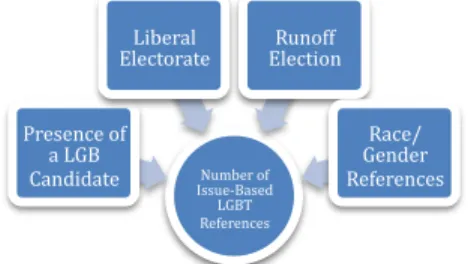
Figure 1: Variables that May Influence the Number of Issue-Based LGBT References
Though LGBs have found increasing accessibility to political office, they still face significant barriers when campaigning, mainly because many Americans still have a negative view of LGBT Americans, as well as LGBT issues. Therefore, I expect that this negative criticism of LGBs will be represented in media coverage during mayoral
elections. However, journalists have a duty to remain as objective and unbiased as possible, so I would not expect that mainstream media coverage would contain negative LGBT references.
H2: Articles that are opinion or editorial pieces will have more negative LGBT references than articles that are not opinion or editorial pieces. Opinion and editorial pieces are not held to the same journalistic standards as objective pieces, and thus, I expect that negative LGBT references will be more common in articles that are not held to the same ethical standards. I theorize that this is a result of more
Number of Issue-‐Based LGBT References
Presence of a LGB Candidate
Liberal
Electorate Election Runoff
hostility toward less traditional candidates and can further add to the stereotypical views of LGB candidates.
As I discussed earlier, LGBT issues have become increasingly partisan, and tolerance towards LGBT Americans largely falls along ideological lines. Cities with more conservative voters will be less tolerant toward the LGBT community and in an effort to reflect the views of its readers, the media may make more negative LGBT references in its coverage, even if it is tasked with being objective.
Furthermore, if an LGB candidate is running in the mayoral election, then there may be more negative LGBT references compared to when there is no LGB candidate. Sexual or gender identity may not be at the forefront of the media’s mind when it is covering mayoral elections, but when an LGB candidate is running, then it may become more prominent, and may feature into campaign coverage.
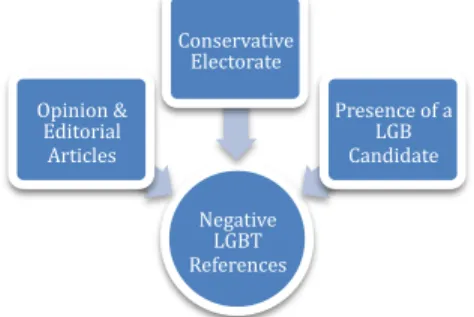
Figure 2: Variables that May Influence the Number of Negative LGBT References
During an election, media coverage will differ according to which point during the election it is appearing. The media has an incentive to cover certain issues during the beginning of a campaign, where it may have less of an effect on actual voting, compared to covering certain issues during the end of a campaign, where its impact on voting may be more substantial.
Negative LGBT References Opinion &
Editorial Articles
Conservative Electorate
H3: LGBT references are more likely to be made in articles as the date of the election approaches.
Mayoral elections are low-information environments, and the media provides most of the information that voters have about elections. As a result, LGBT references are more likely to appear as the date of the election approaches, as media coverage attempts to give more information to voters; I expect that LGBT references will be a part of that
information.
My second research question is what impact LGBT references have on the outcomes of mayoral elections with LGB candidates? I theorize that more LGBT references in an election will be associated with LGB candidates losing their election.
Previous research has been conducted on the electability of LGBT candidates. Namely, Golebiowska (2001) conducted an experiment and found that voters
overwhelmingly perceive LGBT candidates as less viable political candidates than their heterosexual counterparts, which decreases their likelihood of winning office. Other research shows that when LGB candidates are perceived as speaking only to LGB audiences, or speaking only about LGBT issues, they are more likely to lose their elections.
If these phenomena are to occur, and LGB candidates are less likely to win election, then I expect that this would only occur if voters knew the sexuality of the candidates. Thus, the voters would need to know this information, and I would expect they would glean this information from local media coverage of the mayoral elections and the LGBT references in said coverage.
It follows that voters need to be aware of a candidate’s sexuality in order for that to have a negative impact on the voter’s decision, but I wish to determine which types of
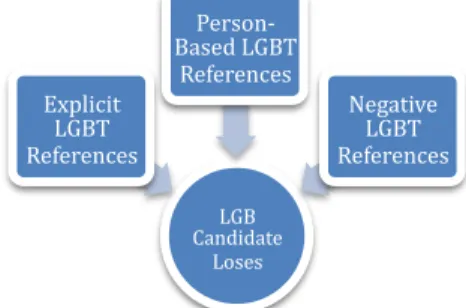
references most affect the voter’s decision. There are three types of references that I think will have the most impact on a voter’s decision, and will ultimately affect whether or not the LGB candidate loses his or her election.
I expect that explicit LGBT references will have more of an impact than implicit LGBT references, merely because they are more obvious to the voter and will be more likely to affect their decision-making process on the date of the election. I adapt Mendelberg’s theory on racial messages and apply them to LGBT references, and also assert that these explicit LGBT references may violate voters’ perceptions of equality and the messages may become less effective (Mendelberg 2001). Therefore, the LGB
candidate is more likely to lose his or her election when there are more explicit LGBT references.
Additionally, if the newspaper coverage makes more person-based LGBT references, then the voter will be less likely to see the LGB candidate as a viable
candidate for political office. These person-based LGBT references include references to the candidate’s sexuality, and not just LGBT issues, so if the media is continually making references to personal characteristics of the candidate, then the voter will make a decision based on the candidate personally, and stereotypes and biases will affect his or her
decision.
she is less likely to vote for that candidate; therefore, negative LGBT references will cause a more negative perception of the candidate.
Figure 3: Variables that May Influence the Electoral Outcome of the LGB Candidate
My research will help to expand the current knowledge on the electability of LGB candidates as I wish to better understand the role of the media in races involving LGB candidates.
Electoral Context
To test my hypotheses, I select seven different cities in the United States that have had an LGB mayoral candidate in recent years. While other cities have had LGB mayoral candidates, and some other cities have even elected LGB mayors, I choose these seven cities for their population. All of these cities are in the top 50 most populous cities in the United States, and with such a large population, I expect that the local media presence will be significantly larger than in cities with smaller populations. In order to provide some context for my method and analysis, and ultimately, my results, I present background information on each of the seven cities, including information about their form of municipal government, their city elections, as well as a brief description of the candidates in each of the elections.
LGB Candidate
Loses
Explicit LGBT References
Person-‐ Based LGBT
References
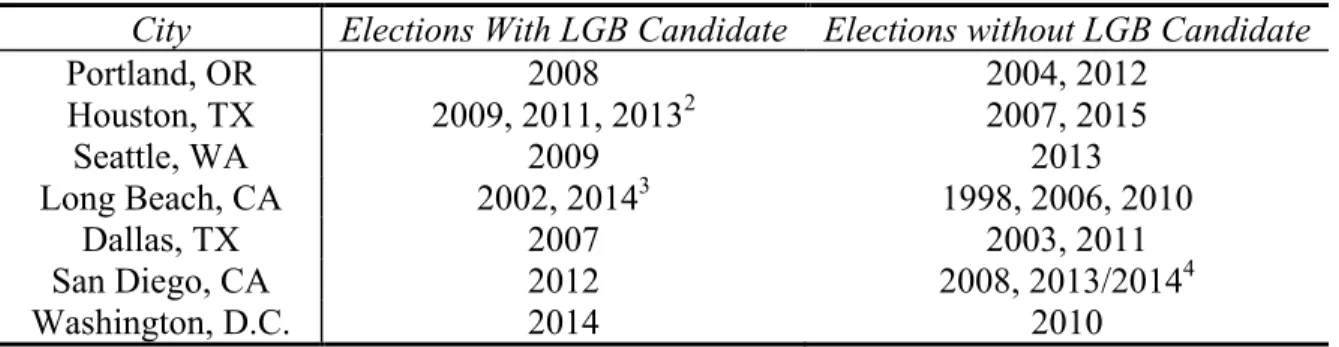
Table 1: List of Cities and Elections Included in Analysis
City Elections With LGB Candidate Elections without LGB Candidate
Portland, OR 2008 2004, 2012
Houston, TX 2009, 2011, 20132 2007, 2015
Seattle, WA 2009 2013
Long Beach, CA 2002, 20143 1998, 2006, 2010
Dallas, TX 2007 2003, 2011
San Diego, CA 2012 2008, 2013/20144
Washington, D.C. 2014 2010
Portland, OR
The city of Portland, Oregon has a city commission government system, where the municipal government of the city is run by a City Council, which includes a mayor and four city commissioners. Each member of the Council is elected to four-year terms, without term limits, and city elections take place in presidential years. All municipal elections in Portland are nonpartisan, and a primary usually takes place in May of the election year, and if no candidate receives more than 50% of the vote, the top two vote-getters move onto the general election in November.
In 2004, Tom Potter was elected mayor of Portland after defeating Jim
Francesconi in the general election. Also in 2004, openly gay Sam Adams won a seat on the City Council. Adams had previously served as Chief of Staff for former mayor Vera Katz, who served from 1993 until 2005. When Potter declined to run for a second term in 2008, Adams announced his candidacy and was elected the first openly gay mayor of Portland on May 20, 2008. He defeated his competitor, Sho Dozono with 58% of the votes, so there was no need for a run-off. In 2012, after scandal reduced his chances of
2
Annise Parker won her first term in 2009, and won re-election in 2011 and 2013.
3 Dan Baker lost his election in 2002, but Robert Garcia won his election in 2014.
4 After Mayor Bob Filner, who was elected in 2012, resigned in 2013, a special election was held in 2013
success, Adams decided against a second term as mayor, and Charlie Hales was elected mayor after defeating his competitor, Jefferson Smith, in the general election.
Houston, TX
Houston, Texas is governed by a strong mayor system of government, and the mayor of Houston has significantly more power than he or she would in a city
commission system. Though members of the City Council are elected, the mayor of Houston is the chief executive of the city. Members of the Council, as well as the mayor, are elected to two-year terms in odd years, but they are limited to three consecutive terms. Like Portland, municipal elections in Houston are nonpartisan. A general election is held in November, and if no candidate receives more than 50% of the votes, the top two vote-getters move on to a run-off election held about six weeks later, usually in mid-December.
2013, Parker won a third and final term, defeating Benjamin Hall with 57% of the vote, avoiding a runoff.
In 2015, facing term limits, Parker was ineligible to run for a fourth term, so the election was open. Sylvester Turner defeated his opponent, Bill King, in the run-off election in December on his third campaign attempt, after previously running in 1991 and 2003. Furthermore, in this election, Houston voters passed a proposition that would allow city officials to run for no more than two four-year terms, meaning the next mayoral elections will take place in Houston in 2019.
Seattle, WA
Seattle, Washington also employs a mayor-council form of government, where a mayor and nine City Council members are elected to four-year terms. Elections take place in odd years, and the most recent mayoral election took place in 2013. City officials are elected in nonpartisan elections, where a primary is usually held in August of an election year. If no candidate receives 50% of the vote, the top two vote-getters move on to a general election in November.
openly gay elected mayor of Seattle. Murray currently serves as mayor, and the next election will take place in 2017.
Long Beach, CA
Long Beach, California is governed by a mayor and a nine-person City Council, who are elected to four-year terms on even years opposite presidential election years. The most recent municipal election was held in 2014. Officials are limited to two terms, but are allowed to run for a third term as a write-in candidate. Elections are nonpartisan, and a primary is typically held in April of the election year. If a candidate does not receive 50% of the votes in the primary, the top two vote-getters move on to the general election, which takes place in June.
In 1998, Beverly O’Neill was elected to her second term as mayor, defeating four little-known challengers without the need for a run-off, capturing over 80% of the vote. However, in 2002, O’Neill was not allowed to appear on the ballot, but she still launched a write-in campaign for an unprecedented third term in office. She faced two challengers, openly gay Vice Mayor Dan Baker and outsider Norm Ryan, and captured a large share of the votes even though her name never appeared on the ballot. Political infighting and court battles ensued, and in the run-off election in June, Baker was the only name to appear on the ballot, even though O’Neill and Ryan still ran write-in campaigns. Making history, O’Neill won a third term with 47% of the vote, while Baker came in second with 36%.
Merino, a young college student and lifelong Long Beach resident. In 2014, Foster
declined to run as a write-in candidate, and Robert Garcia was elected the first openly gay mayor of Long Beach. Furthermore, he was the first person of color elected as mayor, as Garcia is Latino. He defeated Damon Dunn, who is black, in the general election. The next mayoral election will take place in 2018.
Dallas, TX
Municipal government in Dallas, Texas operates under a council-manager system, where the city is governed by a city manager, a popularly elected mayor, and 14 council members who represent the 14 city districts. Mayors serve for four-year terms and are limited to two terms, with nonpartisan elections occurring on odd years in the year immediately preceding a presidential election year. The most recent municipal election occurred in Dallas in 2015. The general election occurs in May, and if no candidate receives more than 50% of the vote, the top two vote-getters move on to a run-off election in June.
year. Mike Rawlings defeated David Kunkle in a run-off election for his first term as mayor of Dallas.
San Diego, CA
San Diego, California employs a strong-mayor system, with a mayor and a nine-seat city council elected to four-year terms with a two-term limit. Elections are
nonpartisan and occur in presidential election years. A general election occurs in June, and if no candidate gets 50% of the vote, then the top two vote-getters move on to the run-off election in November.
In 2008, Mayor Jerry Sanders, who had previously been elected in a 2005 special election, won a full term, defeating his challengers without a need for a run-off election. In 2012, Sanders was unable to run for another term, and Bob Filner, a U.S.
Representative, and Carl DeMaio, an openly gay City Council Member, ran against each other in the November run-off. However, DeMaio was defeated by Filner, who won with 52% of the vote.
Washington, D.C.
The capital of the United States of America, Washington, D.C., has its own elected government under the United States Constitution, and it is run by an elected mayor and a thirteen-seat City Council. Washington, D.C. is unique, because its mayor and council run the city in a similar manner as state governor and legislature would run its state. Elected officials are elected to four-year terms, without term limits, on even years opposite the presidential election year; the most recent election occurred in 2014 and the next election will take place in 2018. Unlike the other cities I analyzed, elections in Washington, D.C. are partisan, with each major political party choosing whether or not to have a primary election, and on which date the primary will take place, in order to determine their nominee for the general election in November of that same year. However, because Washington, D.C. is overwhelmingly Democratic, the Republican party rarely chooses to host a primary, and conservative candidates often run as independents; in essence, the Mayor of Washington, D.C. is chosen during the Democratic party primary, and the November general election is merely a formality.
In 2010, incumbent Mayor Adrian Fenty ran for re-election, but he was defeated in the Democratic primary by challenger Vincent Gray, who went on to win the general election. In 2014, Mayor Vincent Gray was then defeated by challenger Muriel Bowser in the Democratic primary. Bowser faced independent David Catania, an openly gay
Council Member, but defeated Catania in the general election with 55% of the vote, becoming the next mayor of the nation’s capital.
Method
I test my theory by performing a three-fold analysis. The first part of my analysis involves a simple look at descriptive statistics to determine how many LGBT references are made in the elections, and what kind of references they are. In the second part of my analysis, I assess the potential impact that the presence of a LGB candidate has on the number and type of LGBT references in the news coverage. In the third and final part of my analysis, I examine the effect that the LGBT references have on the electoral
outcomes of the contests involving LGB candidates, specifically whether or not they affect the LGB candidate losing his or her election.
I also select these particular cities because of the systems of government and elections decreed by their individual city ordinances. Most of the analyzed cities hold nonpartisan municipal elections, where the party identification of the candidate is not included on the ballot. Only one city, Washington, D.C., holds partisan primaries and lists political parties on municipal ballots. I selected mostly nonpartisan election cities because in the absence of explicit partisan cues, voters must rely on other cues that will help them make a decision on which candidate to vote for, which may include LGBT references. Furthermore, though all of the cities have mayoral systems of government, the political power of the mayor is different in each city. Some cities, like Houston and San Diego, employ a strong mayor form of government, where all the administrative power is vested in the mayor, and the legislative power is shared amongst the mayor and the city council members. Other cities, like Seattle and Portland, give their mayors less power, instead preferring to have the city run by a Council, where the mayor must make
decisions in conjunction with other elected officials on the council. Still, other cities, like Long Beach, have council-manager systems, where the city is run by a city council, on which the mayor sits, but the city manager has executive power, as well. In these
systems, the power is split more evenly among the three entities. I select the cities in my analysis because the power of the mayor varies in comparison to other elected officials, meaning that the selection of a mayor by the people may be a more significant event in cities with a more powerful mayor position.
mayor, or was a candidate in the most recent election, I examine that election, as well as the election immediately preceding it that did not involve an LGB candidate. However, in cities where the term of the LGB candidate has ended, or there have been elections since the election involving an LGB candidate, I examine the election involving the LGB candidate, and the elections immediately preceding it and immediately following it that do not involve LGB candidates. By selecting elections within the same city that did not have an LGB candidate, I compare the number of LGBT references in an election with an LGB candidate to some benchmark. Thus, I am able to partially control for additional factors in a city or its media that may make LGBT references more commonplace.
My data consists of individual newspaper articles drawn from each city where an LGB candidate has run for mayor. The news articles are generated from America’s News,
I also limit the scope by both time and geography. Each city has a variation on a general election-runoff system of elections, where a general election is held with as many eligible candidates as there are, but if none of these candidates receive more than 50% of the votes, then the top two vote-getters move on to a run-off election. Therefore, in some elections, depending on the distribution of votes, a run-off is not necessary. In order to account for elections that feature a runoff, I use articles within 60 days of the general election as well as within 60 days of the run-off election. If a run-off is held at a date that is less than 60 days after the general election, then I include articles within that time period. However, if the run-off is held more than 60 days after the general election, then I only include articles within 60 days of the run-off election. Furthermore, I include articles that come within 10 days after the date of the run-off and general elections. I also limit articles by geography by only examining news sources within the city the election is taking place. Thus, I exclude articles from national publications written about the city elections.
Measurement
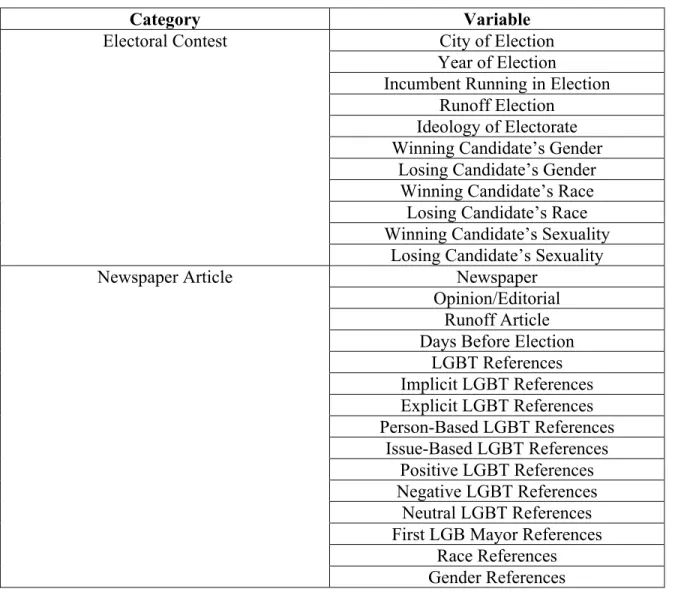
I collect data on two categories of variables: variables related to the electoral contest, and variables related to the newspaper article. Therefore, the variables related to the electoral contest will remain the same for each newspaper article within each electoral contest, but the variables related to the newspaper article will differ according to
Table 2: List of Variables Included in Analysis
Category Variable
City of Election Year of Election
Incumbent Running in Election Runoff Election
Ideology of Electorate Winning Candidate’s Gender
Losing Candidate’s Gender Winning Candidate’s Race Losing Candidate’s Race Winning Candidate’s Sexuality Electoral Contest
Losing Candidate’s Sexuality Newspaper
Opinion/Editorial Runoff Article Days Before Election
LGBT References Implicit LGBT References Explicit LGBT References Person-Based LGBT References
Issue-Based LGBT References Positive LGBT References Negative LGBT References
Neutral LGBT References First LGB Mayor References
Race References Newspaper Article
Gender References
second variable is another dummy variable measuring whether or not there was a runoff. In some elections, when the candidate received more than 50% of the votes in the general election, there was no need for a run-off, but in most elections, a run-off becomes
necessary. It is important to distinguish between these two types of elections, because when no candidate wins more than 50% of the vote, a run-off occurs and the election is extended, which means that the media coverage of the election is extended. A candidate who wins without a run-off could be considered immensely popular, which could potentially change the nature of the news coverage, as well.
I also measure the ideological leanings of the city electorate, because liberal voters are more likely to elect an LGB candidate. In order to quantify the liberalism of the electorate, I use the percentage of the presidential vote that went to the Democratic candidate in the election closest to the date of the mayoral election. However, this is a proxy variable, as election data is available by county, and not by city. Therefore, I measure the presidential vote of the county that most of the city is placed in. Because the cities in my analysis are metropolitan, most city borders are placed squarely within the borders of a particular county, and in turn, most of the county is the city itself. These measurements are not perfect, but they approximate the liberalism of the city electorate through county-level presidential vote. In the table below, I list the counties that I used to measure the liberalism of the cities in my analysis.
Table 3: List of the Counties Used to Measure Presidential Vote in Cities in Analysis
City County
Portland, Oregon Multnomah County
Houston, Texas Harris County
Seattle, Washington King County
Long Beach, California Los Angeles County
San Diego, California San Diego County
Washington, D.C. Washington, D.C.5
Other variables related to the electoral contest include various demographic variables about the candidates themselves, including information on the gender, race and sexuality of the candidates. In most of these elections, many candidates declared
candidacy and were included on the ballot, but for my analysis, I focus only on the top two candidates. In most elections, these will be the two candidates who competed against each other in the run-off election, but in elections without run-offs, these will just be the winner of the election and his or her closest runner-up. For each election, I code six variables; three variables focus on the gender, race and sexuality of the winning candidate and three variables focus on the gender, race and sexuality of the losing candidate. These demographic variables are dummy variables. The gender variable distinguishes between a candidate identifying as female or not, the race variable distinguishes between a
candidate identifying as a person of color or not, and the sexuality variable distinguishes between a candidate identifying as LGB or not. I do not include different variables on the particular LGB identification, particularly because all of the candidates in my analysis identify as gay, and only one of them identifies as a lesbian. Furthermore, I do not include any additional gender distinctions because each candidate in my analysis identifies as either male or female. Finally, I only choose to distinguish between white candidates and candidates of color; while candidates in my analysis identify as various racial minorities, and the lived experiences of these groups vary, my analysis does not hinge upon the particular racial classifications of the candidates. I merely choose to
distinguish between people of color and people who are white, rather than distinguishing between all possible racial identities.
In addition to the variables related to the electoral contest, I include another set of variables related to the individual newspaper article, which is the unit of analysis. Within this category, I collect data on variables related to the article itself, as well as variables related to particular references within the article.
The first variable is a categorical variable for which newspaper the article appeared in. Furthermore, in order to differentiate between journalistic, news pieces and opinion and editorial articles, I include a dummy variable that identifies whether an article is an opinion piece or editorial. The newspaper does not always identify whether an article is an opinion or editorial piece, and each newspaper identifies articles
differently. I consider opinion and editorial articles to be letters to the editor, opinion pieces written both by readers and staff writers, as well as editorial pieces written by editorial board members. Therefore, I would consider any article that does not fall into the above category as a journalistic piece. Because the media is expected to maintain a certain level of integrity, and journalists are held to a high ethical standard, compared to journalists writing opinion pieces and readers sending in their own opinions, who are held to lower standards, I expect that the content of the newspaper articles will differ between these types of articles.
general election will differ from coverage of the runoff election, as there are less candidates and more focus as the decision draws near. Therefore, I expect there to be differences in references between the general election and the runoff election in each election year.
The final variable related to the article itself is an interval variable that identifies how many days prior to the election date the article appears in the newspaper. I identify the date of the general election and the run-off election as two separate election dates, and thus the measurement of the variable is calculated by measuring the difference between the date the article appears and the date of the next election date. An article that appears the same day as the election will be coded as 0 days prior to the election date, and these numbers will increase up to 60 as earlier coverage is examined. Furthermore, I include articles that appear up to 10 days after the date of the election, which will be coded as negative in my analysis. I believe that coverage changes as the election date approaches, and thus, the content of the articles will be different as well. For many readers, local elections may not become relevant until the election date is nearer, so coverage should increase as the date of the election approaches. Furthermore, I anticipate that the content of the articles will change, as more information and additional polling comes out
regarding the election. Thus, the number of LGBT references may change as the date of the election approaches.
the variable is coded as 7. The next three groups of variables further describe the types of LGBT references that I code for in my analysis.
The first distinction is between implicit and explicit references. Explicit
references are those that expressly state any words related to sexual or gender identity, such as “gay,” “lesbian,” “LGBT,” “transgender,” or any other direct statements. Implicit references are more nuanced, as they can take many forms, but it is any sort of indirect LGBT reference. For instance, a reference to Human Rights Campaign is an indirect LGBT reference, because the Human Rights Campaign takes on causes such as LGBT rights, in addition to other related causes, but because its name is not explicitly related to sexual or gender identity, like the Gay and Lesbian Victory Fund, I consider it an implicit reference. Furthermore, another common implicit reference is to a candidate’s partner or spouse. While the name of a partner may be given, which can indicate the gender of the partner and the sexuality of the candidate, unless it specifically mentions any word related to the sexuality of the pair, I consider it an implicit reference. There is a large difference between explicit and implicit references in news coverage; writers and journalists may find that explicit LGBT references are discouraged, but there are many implicit ways to reference sexual or gender identity that still serve to remind readers that these topics are prominent in the campaign coverage.
People-based references include references to the candidate’s sexuality, or a candidate’s performance among a group of people, such as gay or transgender voters. Issue-based references include references to LGBT issues, which include but are not limited to same-sex marriage, equal benefits for same-same-sex couples, protections against same-sexual and gender discrimination in employment, and access to healthcare, among many other issues. Furthermore, issue-based references are also references to institutions and organizations that concern themselves with equality, such as the Human Rights Campaign, the Gay and Lesbian Victory Fund, and other groups devoted to LGBT and other human rights causes. I believe that there is a difference between these two types of references and that the coverage seeks to make a distinction between the two types of references that is important.
fall into either the positive or negative category are neutral LGBT references without any sort of value attached to it.
The number of references between each distinction (people-based vs. issue-based, implicit vs. explicit, positive vs. negative vs. neutral) should add up to the total number of LGBT references in each article. In other words, the groups are mutually exclusive and exhaustive. A reference must be described as something from each distinction, but cannot fall into more than one category within each distinction.
The final variable regarding LGBT references is a dummy variable that measures whether or not the article makes a specific LGBT reference: that the candidate would be the first openly LGB mayor elected in that city, or otherwise refer to the prominence of sexual or gender identity in the election. In all of the cities in my analysis, the LGB candidate would be the first openly LGB mayor elected in that city, and I wish to examine how many articles mention this particular fact, or somehow reference that the election could potentially be a historic election in that city.
In addition to the various descriptions of different LGBT references, I include two dummy variables related to other non-LGBT references that may be made within articles, particularly references to other political minority groups, namely racial and ethnic
Asian-American voters, or female voters. Person-based references can also be more implicit, such as referencing a neighborhood that is heavily populated with a certain racial or ethnic minority. Issue-based references include those issues that may be associated heavily with certain races or genders. For instance, references to crime can sometimes be counted as racial references, because crime is often an implicit way to refer to racial minorities. Furthermore, references to abortion can be counted as references to women’s’ issues, as the right to choose has become an implicit way to reference gender, as well. These variables are merely an indication whether or not any of these references occur or not. LGBs are considered a political minority, alongside racial minorities and females, so references are made in similar ways, and I recognize the importance of allowing a
measure of these references as well.
Analysis
In the first part of my analysis, I examine how many articles in each election include LGBT references, and then how many of each type of reference appears in the media coverage. The following table displays the number of articles within each election in each city that has at least one LGBT reference, no matter the type of reference.
Table 4: Percentage of Articles with LGBT References by City and Year of Election
Year of Election No LGBT References LGBT References Total
2004 151
[82%] [18%] 34 185
2008* 101
[89%]
12 [11%]
113 Portland
2012 134
[93%]
10 [7%]
144
Houston 2007 15
[100%]
0 [0%]
2009* 114 [71%]
46 [29%]
160
2011* 25
[86%]
4 [14%]
29
2013* 39
[83%] [17%] 8 47
2015 84
[66%]
42 [34%]
126
2009 388
[97%] [3%] 11 399 Seattle
2013* 163
[78%]
45 [27%]
208
1998 21
[100%]
0 [0%]
21
2002* 195
[96%] [4%] 8 203
2006 164
[93%]
13 [7%]
177
2010 28
[97% [3%] 1 29
Long Beach
2014* 191
[88%]
26 [12%]
217
2003 76
[93%]
6 [7%]
82
2007* 235
[91%] [9%] 22 257 Dallas
2011 207
[96%]
9 [4%]
216
2008 115
[95%] [5%] 6 121
2012* 298
[93%] 21 [7%] 319 San Diego 2013/201 4 340 [98%] 8 [2%] 348
2010 123
[95%] [5%] 6 129
Washington, D.C.
2014* 75
[83%]
15 [17%]
90
Notes: *- denotes an election with an LGB candidate
It becomes clear that in their coverage of mayoral elections, the media is making LGBT references, even if that number differs among different elections. Only two
gender identity in a majority of the articles in any given election year in any given city. Only three elections had more than 20% of the articles contain LGBT references. Media coverage during the 2015 Houston election referenced sexual or gender identity in 34% of the articles, followed by 29% during the 2009 Houston election and 27% during the 2013 Seattle election. Without even comparing elections with LGB candidates to elections without LGB candidates, the media is not making LGBT references in the majority of articles about mayoral elections in these cities.
I also examine how many articles reference sexuality by mentioning that a
candidate would be the first elected LGB mayor of that particular city, which would only occur during those elections in which there was an LGB candidate for mayor. The table below details the percentage of articles that make this particular reference at least once within the article.
Table 5: Percentage of Articles with First LGB Mayor Reference by City and Year of Election
Year of Election
First LGB Mayor Reference
No First LGB Mayor Reference
Total
Portland 2008 6
[5%] [95%] 107 113
2009 27
[17%]
133
[83%] 160
2011 1
[3%] [97%] 28 29
Houston
2013 5
[11%]
42
[89%] 47
Seattle 2013 9
[4%]
199
[96%] 208
2002 2
[1%] [99%] 201 203
Long Beach
2014 15
[7%]
202
[93%] 217
Dallas 2007 7
[3%]
250
[97%] 257
San Diego 2012 1
[1%]
318
Washington, D.C.
2014 5
[6%]
85
[94%] 90
Media does not seem to make many references to the prominence of electing the first LGB mayor, even though the LGB candidate would be the first LGB mayoral officeholder in each city. The 2009 Houston election featured the most, with 17% of the articles referencing that the candidate would be the first elected LGB candidate, but in the other elections, this number hovers around 10% or less.
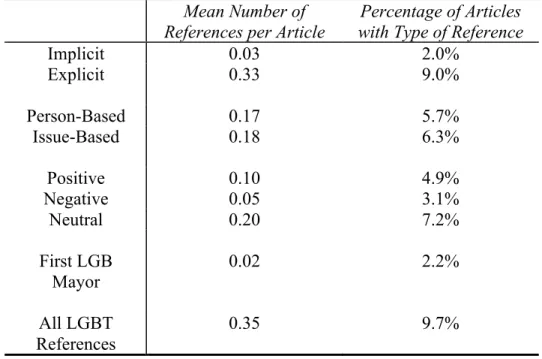
Finally, I examine the types of each reference that are made within the articles. In the following table, I determine the mean number of references of each type that appear in the articles in all of the cities and election years. Furthermore, I record the percentage of articles in the entire analysis that feature at least one of each type of reference.
Table 6: Mean Number of References and Percentage of Articles with References by Type of LGBT Reference
Mean Number of References per Article
Percentage of Articles with Type of Reference
Implicit 0.03 2.0%
Explicit 0.33 9.0%
Person-Based 0.17 5.7%
Issue-Based 0.18 6.3%
Positive 0.10 4.9%
Negative 0.05 3.1%
Neutral 0.20 7.2%
First LGB Mayor
0.02 2.2%
All LGBT References
0.35 9.7%
below one in all of the categories; the percentage of articles that contain LGBT references remains below 10%. Even though the number of LGBT references is low, this does not mean that LGBT references are not influential in media coverage. The simple descriptive statistics merely show the frequencies, but they do not show any sort of relationships between variables.
Previous research on female and minority candidate suggests that gender and racial references tend to be more prominent during coverage of elections involving those types of candidates, but my analysis suggests that this phenomenon may not extend to LGB candidates. Even though it seems that race, gender, sexuality often have no direct impact on a candidate’s ability to hold political office, newspaper seem to make more gender and race references than LGBT references. Perhaps society has reached a point where discrimination against the LGBT community is considered taboo in society, and the media is afraid to cover sexual and gender identity in the same way that they cover race and gender because they are afraid of making readers uncomfortable, or appearing prejudiced. However, to further examine this phenomenon, I conduct further statistical analysis to further test my hypotheses to determine the relationship, if any, between LGBT references and other factors.
In the second part of my analysis, I test the first three hypotheses in order to determine what may possibly impact the number of LGBT references in the elections included in the analysis. My first hypothesis focuses on the factors that influence the number of issue-based LGBT references.
H1: The number of issue-based LGBT references will be higher in elections with LGB candidates than in elections without LGB candidates.
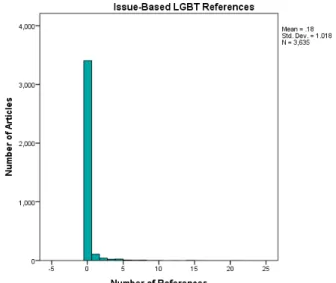
and the distribution of this variable is a Poisson distribution, as demonstrated by the histogram below.
Figure 4: Distribution of Number of Issue-Based LGBT References
Therefore, I estimate a negative binomial regression. However, in estimating this regression, I introduce controls in the model in order to account for differences among the cities, but also differences among the newspapers. For each panel, I estimate two separate negative binomial regressions: a multilevel regression, and a normal regression with controls for the city. The results are displayed in Table 7.
In this first model, I regress the number of issue-based LGBT references on the five variables shown in a multilevel negative binomial regression, while introducing the city of the election as a panel. Gender references are positive and significant; if an article makes a reference to gender, then that article will feature almost one more LGBT
reference than if the article did not reference gender. Though this difference is slight, none of the other variables are statistically significant, including the presence of an LGB candidate.
Table 7: Effects of Presence of an LGB Candidate, Liberal Electorate and Gender References on the Number of Issue-Based LGBT References
Issue-Based LGBT References [Multilevel Model: City
of Election as Panel]
Issue-Based LGBT References [City of Election as Factor-Level Control]
Issue-Based LGBT References [Multilevel Model: Newspaper as Panel]
Issue-Based LGBT References [Newspaper as
Factor-Level Control]
LGB Candidate .223
(.189) .339* (.188) .165 (.192) .303 (.196) Liberal Electorate -5.881
(4.194) -17.865*** (5.082) -2.165 (1.935) -16.546*** (5.170)
Runoff Election .224
(.287) (.281) .270 (.293) .148 (.291) .197
Gender References .869**
(.436) .872** (.432) .874** (.440) .856** (.431)
Race References .329
(.275) .361 (.275) .322 (.276) .340 (.276)
N 3,635 3,635 3,635 3,635
Log-likelihood -1212.534 -1194.534 -1218.302 -1191.028
chi2 9.90 146.85 8.39 153.86
Prob > chi2 .078 .000 .136 .000
Pseudo r2 .058 .061
Notes: ***=P < .01,**=P < .05, *=P <.10
Column 1 uses a multilevel negative binomial regression to estimate the number of issue-based LGBT references, with the city of the election introduced as a panel. Column 2 uses a negative binomial regression to estimate the number of issue-based LGBT references, with controls for the city of election. Column 3 uses a multilevel negative binomial regression to estimate the number of issue-based LGBT references, with newspaper introduced as a panel. Column 4 uses a negative binomial regression to estimate the number of issue-based LGBT references, with controls for newspaper.

![Table 4: Percentage of Articles with LGBT References by City and Year of Election Year of Election No LGBT References LGBT References Total 2004 151 [82%] 34 [18%] 185 2008* 101 [89%] 12 [11%] 113 Portland 2012 134 [93%] 10 [7%] 14](https://thumb-us.123doks.com/thumbv2/123dok_us/8332855.2211087/46.918.242.729.857.1068/percentage-articles-references-election-election-references-references-portland.webp)
![Table 5: Percentage of Articles with First LGB Mayor Reference by City and Year of Election Year of Election First LGB Mayor Reference No First LGB Mayor Reference Total Portland 2008 6 [5%] 107 [95%] 113 2009 27 [17%] 133 [83%] 160 20](https://thumb-us.123doks.com/thumbv2/123dok_us/8332855.2211087/48.918.188.789.647.1070/percentage-articles-reference-election-election-reference-reference-portland.webp)