Sharif University of Technology
Scientia IranicaTransactions A: Civil Engineering http://scientiairanica.sharif.edu
Experimental study of the eect of water to cement
ratio on mechanical properties and durability of
nano-silica concretes with polypropylene bers
K. Rahmani
a, M. Ghaemian
b;, and S.A. Hosseini
aa. Department of Civil Engineering, Science and Research Branch, Islamic Azad University, Tehran, Iran. b. Department of Civil Engineering, Sharif University of Technology, Tehran, Iran.
Received 26 August 2017; received in revised form 20 November 2017; accepted 24 December 2017
KEYWORDS Concrete; Nano-silica;
Polypropylene ber; Mechanical properties of concrete;
ASTM standard.
Abstract. This study investigates the eect of nano-silica on mechanical properties and durability of concrete containing polypropylene bers. Herein, the length and the length-to-diameter ratio of used polypropylene bers were considered xed and equal to 18 mm and 600, respectively, and the cement content was 479 kg/m3. The eects of
bers and nano-silica in four dierent percentages of 0.1, 0.2, 0.3, and 0.4% volume for bers and 3% for nano-silica in concrete with water to cement ratios of 0.33, 0.36, 0.4, 0.44, and 0.5% were compared and evaluated. In total, more than 425 cubic and cylindrical specimens were made according to ASTM standards. Finally, samples of polypropylene ber containing nano-silica were tested under compressive loads, exural strength, indirect tensile strength (Brazilian test), abrasion resistance, permeability, and porosity; in addition, their mechanical properties were evaluated. The test results showed a signicant improvement of mechanical properties and durability of concrete. Compressive strength, tensile strength, exural strength, and abrasion resistance (of concrete) increased by 55%, 25%, 49%, and 45%, respectively. In addition, a considerable reduction in hydraulic conductivity coecient by 50% indicates the high durability of these types of concrete. © 2019 Sharif University of Technology. All rights reserved.
1. Introduction
The use of various additives in concrete and cement products has attracted considerable attention in recent years. So far, many research studies have been carried out on ber concrete; however, very few studies have been devoted to the nano-silica concrete containing polypropylene bers. Particularly, the eect of
nano-*. Corresponding author.
E-mail addresses: [email protected] (K. Rahmani); [email protected] (M. Ghaemian); abbas [email protected] (S.A. Hosseini) doi: 10.24200/sci.2017.5077.1079
silica on ber concrete, especially polypropylene bers, has been scarcely investigated.
To this end, the use of ber concrete, especially polypropylene bers with nano-silica, was considered in this study. High-Strength Fiber Reinforced Concrete (HSFRC) has a wide range of applications in which dierent types of bers are used to increase the tough-ness, exibility, and tensile and exural strength of the concrete in order to increase the strength of structural members under static and dynamic loads and to reduce cracking and crushing [1].
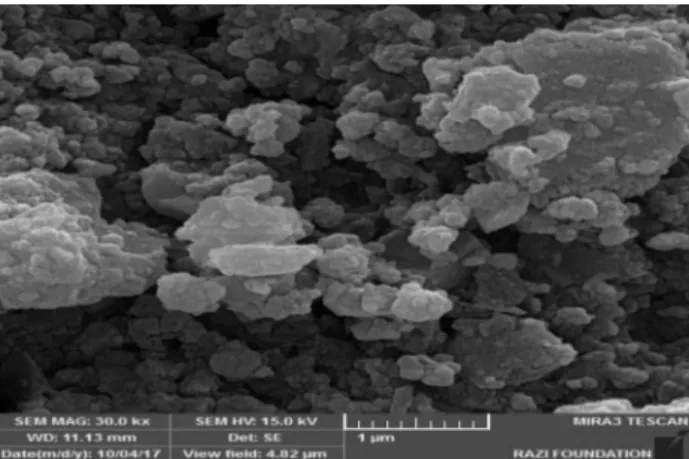
Polypropylene ber was introduced in the mixture to minimize the brittleness of the matrix, thereby re-ducing the susceptibility to cracking of concrete [2]. It was also reported that polypropylene ber was eective
in resisting the development of cracks caused by drying shrinkage [3]. The inclusion of polypropylene ber in concrete showed excellent durability on exposure to freeze-thaw cycling [4].
Studies have indicated that the explosive spalling of regular High-Strength Concrete (HSC) could be noticeably alleviated by embedding an appropriate volume of strong, exile polypropylene bers [5,6]. This improvement is supposedly attributed to the dierence of the thermal expansion capability between polypropylene bers and cement pastes, which can introduce micro-fractures to release the vapor pres-sure[7,8].
Experimental research and analytical study by Olivito and Zuccarello [9] provided reinforced concrete with steel ber with mixing patterns and dierent lengths of dierent bers. They evaluated compressive and tensile strengths, fracture, and ductility. The addi-tion of bers increased the ductility, which is associated with energy absorption during fracture. Samples of longer bers showed higher strain as compared to the samples with shorter bers.
Zhang and Li [10] performed an experimental study to investigate the combined eect of silica fume and polypropylene ber on the workability and drying shrinkage of concrete composite containing y ash. They concluded that the workability of the concrete composite improved, and the drying shrinkage strain decreased gradually with the increase of y ash content. However, polypropylene ber has an inconsiderable adverse eect on the workability of concrete composite. Authors [11-13] showed that the behavior of concrete at high temperatures could be improved by adding polypropylene bers (with a ratio varying from 0.5 kg/m3-3 kg/m3). The melting (160C-170C) and
vaporization (350C) of polypropylene bers generate
not only new pores, but also create microcracks at the tip of bers connecting the already existing pores [14]. Ozawa and Morimoto [15] carried out permeability tests on high strength concretes (72 MPa) including 0.15% of volume of PPF. Results showed that the residual permeability increased 12 times after heating the PPF concrete to 500C, compared to the referenced
concrete. Thus, the improvement of permeability reduces the likelihood of explosive spalling [16].
Consoli et al. [17] showed that the reinforcing eect of polypropylene bers became less eective in high cement contents for a stabilized sandy soil, i.e., the peak strength only increased until 4% of cement content and, after that, the eect of the ber reinforcement had the opposite eect. In fact, when the cement content is high, the stiness of the stabilized soil is fundamentally governed by the high stiness of the cement, and the polypropylene bers are, therefore, un-able to mobilize the tensile strength before peak failure, since the deformations obtained are very low. Thus,
increasing the amount of ber for high cement contents does not have repercussions on the increase of the strength [17]. Thus, polypropylene ber, carbon ber, plastic-glass-based ber, and steel bers started to be used in concrete. It is known that steel, nylon, and mixed bers insignicantly aect mechanical properties (e.g., compressive strength and elasticity module) and highly increase the mechanical properties (bending-tensile strength, ductility, and toughness) [18,19].
It is well understood that silica fume, due to high pozzolanic activity, is a necessary material when pro-ducing high-strength concrete. Silica fume eectively improves the structure of the transition zone, elimi-nates the weakness of the interfacial zone, reduces the number and size of cracks, and enhances the ability of steel ber to resist cracking and restrain damage. Both normal-strength concrete and high-strength concrete are brittle, with a degree of brittleness increasing with increasing strength [20].
Nili and Afroughsabet [21] showed that the silica fume improved the compressive strength of the con-cretes with higher ages by improving the conjunction of aggregates with cement paste. In addition, the simultaneous use of silica soot and ber in concrete mixtures results in an eective increase in the exural strength of concrete.
Pore structure parameters, such as porosity, pore size distribution, etc., are progressively employed to evaluate permeability, frost resistance, carbonation resistance, and physical strength of concrete [22-24].
Tijani et al. [25] added articial carbon ber and microsilica to some concrete mixtures to improve their mechanical properties. Maslennikov et al. [26] analyzed the eect of dierent modiers on the properties of concrete mixtures using microsilicon additive.
Subramanian et al. [27] showed that nano-silica and micro-silica could be successfully used in the preparation of Self-Compacting Concrete (SCC).
Khanzadi et al. [28] measured compressive strength, tensile strength, and water absorption per-centage and chloride penetration depth in concrete containing nano-silica. They showed that the measured mechanical properties and the durability of the con-crete mixed with the nano particles were better than those of a plain concrete were.
In recent years, using dierent additives in con-crete and cement products have attracted considerable attention. Fiber and nano-silica concrete can be considered as the most commonly used additives. In this study, by reviewing the advantages of using nano-silica and polypropylene bers in concrete, 450 sample concretes were prepared using 20 mixture designs with water to cement ratios of 0.33, 0.36, 0.4, 0.44, 0.5, ber volume ratios of 0.1, 0.2, 0.3, 0.4, and 3% volume of nano-silica based on ACI and ASTM standards. The purpose of the present study is
three-fold: to determine the eect of polypropylene and nano-silica bers on behavioral properties of concrete under stress conditions due to exural loads, to study the permeability and porosity of the concrete, and to obtain their optimal percentage. In this research, the length of polypropylene ber is considered 18 mm. Eventually, compressive strength, exural strength, tensile strength, abrasion resistance, permeability, and porosity tests conducted on the samples containing nano-silica and their mechanical properties are investi-gated.
2. Experiments performed on samples
In the present study, the concrete samples with 3% nano-silica and water to cement ratios of 0.33, 0.36, 0.4, 0.44, 0.5 and ber contents of 0, 0.1, 0.2, 0.3 of concrete volume are investigated experimentally:
- The cement used in these experiments is of ordinary Portland cement (ASTM Type I) in accordance with Table 1;
- For all samples, the amount of xed nano-silica and 3% consumption cement are replaced, as shown in Table 2;
- The amount of polypropylene ber varies and is equal to 0, 0.1, 0.2, and 0.3 volumetric percent alternatives of the cement used; The properties of the consumed polypropylene ber are shown in Table 3, and its mixture design with the nano-silica is shown in Table 4;
Table 1. Properties of ordinary Portland cement (ASTM Type I) used in the present tests.
No. Property of cement Value 1 Normal consistency 31% 2 Initial setting time 120 min 3 Final setting time 6 hour
4 Specic gravity 3.11
5 Compressive strength of
cement on the 28th day 55.6 MPa Table 2. Properties of nano-silica [29].
SI. no Dispersed in water Active nano content (%) 40-41.5
Ph (20C) 9-10
Specic gravity 1.4
Particle size 10-40 nm
Table 3. Properties of polypropylene ber [29].
Properties Value
Density (kg/m3) 900
Reaction with water Hydrophobic Tensile strength (MPa) 300-400 Melting point (C) 175
Length (mm) 18
- Compressive strength of the 28-day specimen is 40 MPa;
- The maximum diameter of aggregates is 15 mm. Ta-ble 5 summarizes the properties of required materials for a samples design. Actually, this table shows the concrete mixture design proportions (kg/m3) used in
the present study;
- Super lubricant used in these experiments is super plasticizer 400 according to ASTM-C494 Type 4 standard.
In the production of test specimens, excess water was computed and added to the dry state (S.S.D state) to prevent the free water absorption of the concrete into the empty space of the aggregate;
- A exural strength test was carried out on concrete beams of 101050 cm on the 28th day. All stages of testing were performed according to ASTM-C1018 standard. Eq. (1) can be used in order to calculate the exural strength [30]:
Flexural strength = [(P L=bd2) 1000]: (1)
In the above equation, P , L, b, and d are the applied load at fracture moment, the length of the specimen, the section's width, and the section's height, respectively;
- An indirect tensile strength test or tensile strength of halving is performed on cylindrical specimens of 300 150 mm on the 28th day. To do so, the load needs to be done continuously and without impact. The load speed of 80 kN/min was selected according to the ASTM C496 standard. Eq. (2) illustrates how to determine tensile strength [31]:
Tensile strength = [(2P=dL) 1000]; (2) where P is the applied load at the fracture moment; L and d are the length and diameter of the cylinder, respectively;
- Abrasion strength test on cube samples 150 150 150 mm on the 28th day was performed by the water sand blast method based on ASTM-C778 standard;
- The hydraulic conductivity of the concrete was tested by penetration method according to ASTM-C1920-5 [32]:
Table 4. Nano-silica ber concrete mixture designs. Mixing
scheme number
Polypropylene ber
(%)
Polypropylene ber content
(kg)
Water to cement
ratio
Nano-silica content
(kg)
1 0.1 0.56
0.33 14
2 0.2 1.13
3 0.3 1.7
Table 5. Nano-silica ber concrete mixture designs (kg/m3).
Water-to-cement ratio 0.33 0.36 0.40 0.44 0.5
Nano-silica weight (kg) 14 14 14 14 14
Cement weight (kg) 465 465 465 465 465
Water consumption (lit) 158+20 172+20 191+20 211+20 239+20 Weight of coarse gravel (kg) 470 470 470 470 470
Weight of tiny gravel (kg) 385 385 385 385 385
Sand weight (kg) 821 821 821 821 821
where:
Hp Water penetration depth (m); T Inuence time (sec);
H Pressure height (m); V Concrete porosity.
The following formula can be used to calculate the porosity of the concrete [33]:
Concrete porosity = (w=c) (100 36:15)
=(W + 100=g); (4)
where w=c is the water to cement ratio, is the cement hydration degree, W is the pure water of concrete, kg/m3, and g is the cement specic weight,
gr/cm3;
- Compressive strength tests on cube samples of 150 150 150 mm on the 7th, 28th, and 91th days were done with a pressure test device with a capacity of 2000 kN (Tekno test-Italy) at a speed of 2.5 kN/S in accordance to ACI-C330 standard. The compressive strength value of samples can be evaluated using Eq. (5):
Compressive strength = [(P=A) 1000]; (5) where P is the applied load at fracture, and A is the cross-sectional area of cubic samples.
3. The mixture scheme of ber concrete containing nano-silica
In the mixture scheme of samples, the following points are considered:
- Slump test, according to the ACI, the 544 Commit-tee, is not suitable for ber concrete, and one needs to use the inverted slump test. The inverted slump for samples is achieved in the period of 8-12 seconds;
- The aggregates are broken.
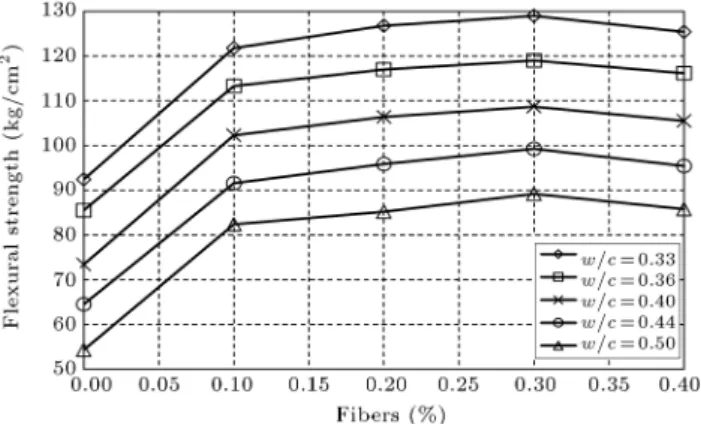
4. Analysis of the exural strength test results According to Figure 1, it is shown that the exural strength increases with the addition of bers. As the graphs show, the addition of bers up to 0.3% and 3% of nano-silica has a signicant eect on exural strength. However, the exural strength decreases in higher ber ratios. It is anticipated that by increasing the ber content to more than 0.3%, the exural strength will be reduced. In this part, inappropriate distribution of bers can also be aected. Non-brous
Figure 1. Flexural strength of the ber-based samples for dierent water to cement ratios.
samples are fractured during failure, where this prob-lem is completely eliminated by the ber. According to Figure 2, by decreasing the water to cement ratio from 0.50 to 0.3 in non-ber samples, the exural strength has improved by 70.17%. In the water to cement ratio of 0.33, by adding 0.1, 0.2, and 0.3% of the bers to the samples, according to Figure 3, the exural strength has improved by 31.81, 37.23, and 39.61%, respectively. 5. Analysis of the tensile strength test results Figure 4 illustrates that indirect tensile strength in-creases with the addition of polypropylene bers. As shown in the diagram, by adding 0.1% ber, there is a signicant eect on tensile strengths. In the ber ratio higher than 0.3%, the tensile strength decreases. In addition, according to Figure 5, one can see that by reducing the water to cement ratio from 0.5 to 0.33 in concrete samples without ber, the tensile strength has improved by 82.4%. By adding 0.1, 0.2, and 0.3% bers for the water to cement ratio of 0.33,
Figure 2. The percentage of improvement in exural strength without ber for water to cement ratio of 0.50.
Figure 3. The percentage of improvement in the exural strength of the bers for dierent ratios of water to cement.
tensile strength has improved by 11.96%, 16.13%, and 17.68%, respectively, compared to non-brous samples (Figure 6).
Figure 4. Tensile strength of the ber-based samples for dierent water to cement ratios.
Figure 5. The percentage of improvement in tensile strength without ber for water to cement ratio of 0.50.
Figure 6. The percentage of improvement in the tensile strength of the bers for dierent ratios of water.
6. Analysis of the abrasion strength test results
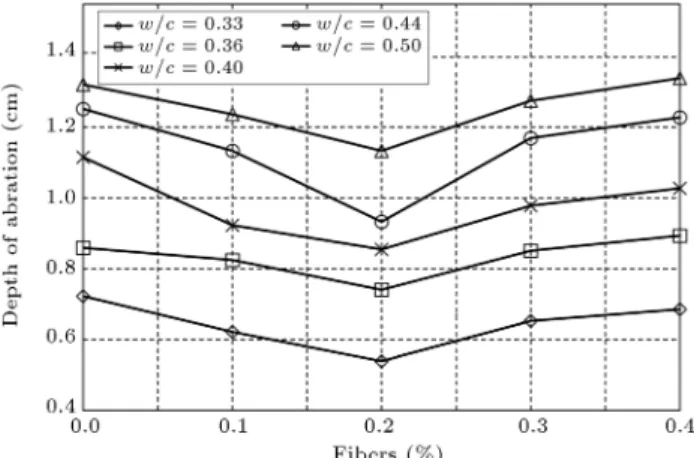
Figures 7 and 8 show the abrasion resistance of re-inforced concrete. One can see the changes in the abrasion resistance of the samples by the ber addition. Increasing the ber content up to 0.2% can increase the abrasion resistance. However, by increasing the ber content to more than 0.2%, the abrasion resistance of the non-brous samples decreases, since the ber will make the samples more porous. Figure 9 illustrates that by reducing the water to cement ratio from 0.5 to 0.33, the abrasion resistance of non-brous concrete samples has improved by 46%. By adding 0.1, 0.2, and 0.3% of the ber to the concrete samples for the water to cement ratio of 0.33%, the abrasion resistance im-proves by 14, 25.45, and 9.68%, respectively, compared to the non-brous samples (Figure 10). As the water to cement ratio increases from 0.33 to 0.50, the slope of the depth of the abrasion curve decreases gradually. This is related to the two-phase nature of concrete in abrasion (phase of mortar and phase of aggregates).
Figure 7. Depth of abrasion variation of ber-based samples for dierent water to cement ratios.
Figure 8. Abrasion strength variation of non-brous samples for dierent water to cement ratios.
Figure 9. The percentage of improvement in abrasion strength of non-brous samples for the water to cement ratio of 0.50.
Figure 10. The percentage of improvement in the abrasion strength of the ber-based samples for dierent ratios of water to cement.
As the ratio of water to cement increases, the abrasion strength of the mortar phase decreases; however, the abrasion strength of the concrete will tend towards the abrasion strength of the aggregates.
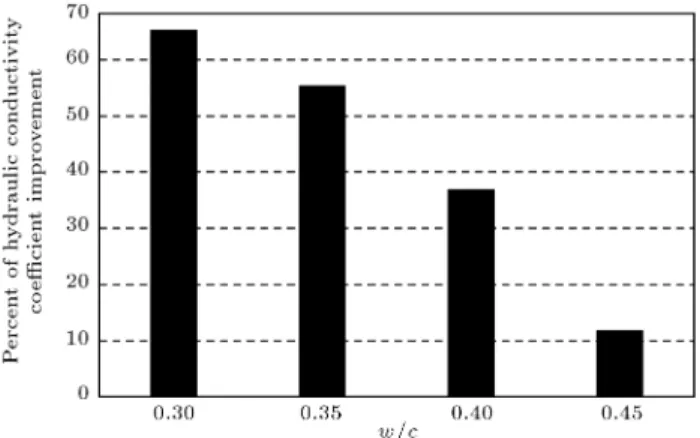
7. Analysis of the hydraulic conductivity coecient and porosity of concrete results The analysis of Figures 11 to 13 shows the hydraulic conductivity coecient, which is changed by the ad-dition of bers. Using bers up to 0.2% reduces the depth of water penetration and hydraulic conductivity. Nevertheless, these values increase by increasing bers to more than 0.2%. The reason for this behavior of most porous samples is due to the addition of more ber content. According to Figure 11, it is obvious that by decreasing the ratio of water to cement from 0.50 to 0.33, the hydraulic conductivity of non-brous concrete samples decreases from 43:03 10 15 m/s
to 6:3 10 15 m/s. In other words, the hydraulic
conductivity coecient of samples has improved by about 85.36%. Figure 13 displays that in the water
to cement ratio of 0.33, the hydraulic conductivity coecient of 0.1, 0.2, and 0.3% of the bers improved by 25.08, 41.43, and 17.9%, respectively. In addition,
Figure 11. Hydraulic conductivity coecient variation of ber-based samples for dierent water to cement ratios.
Figure 12. The percentage of improvement in hydraulic conductivity coecient of non-brous samples for the water to cement ratio of 0.50.
Figure 13. The percentage of improvement in hydraulic conductivity coecient of the ber-based samples for dierent ratios of water to cement.
by reducing the ratio of water to cement from 0.50 to 0.33, the concrete porosity decreases from 14.4 to 13.5% (Figure 14).
8. Analysis of the compressive strength test results
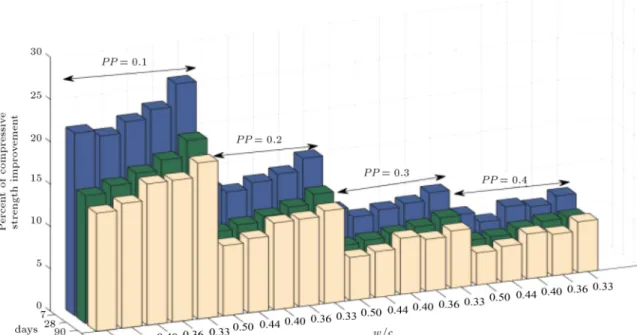
Figures 15 to 17 show the results of compressive strength test and the percentage of improved com-pressive strength of brous samples (0.1, 0.2 and 0.3), compared with non-brous specimens. Investigations of the compressive strength of the ber-reinforced concrete show that the adhesive strength changes with the addition of the bers. Using 0.1% ber with a constant water to cement ratio of 0.33 causes a relative increase in compressive strength on the 7th, 28th, and 90th days. By increasing bers to more than 0.1%, the compressive strength decreases. The reason for this behavior is that when the amount of ber in concrete increases by a certain amount, compressive strength values are reduced due to poor ber dispersion.
According to Figure 16, by reducing the ratio of water to cement from 0.50 to 0.33, the compressive
Figure 14. Percentage of concrete porosity variation for dierent water to cement ratios.
Figure 15. 7-, 28-, and 90-day compressive strength variations of ber-based samples for dierent water to cement ratios and ber percentages.
strength of non-brous concrete samples at the age of 7, 28, and 90 days of concrete has improved by 27.92, 33.04, and 31.88%, respectively. Figure 17 illustrates that by adding ber at 0.1, 0.2, and 0.3%, compared to non-brous samples, the compressive strength of the samples on the 7th, 28th, and 90th days has improved by (21.42, 15.29, and 13.44%), (13.52, 8.47, and 35.8%), and (8.42, 5.9, and 5.71), respectively.
9. Microstructures
Studying the microstructure of cement paste and con-crete by Scanning Electron Microscope (SEM) images has revealed a new horizon in the concrete technology
Figure 16. The percentage of improvement in
compressive strength of non-brous samples for the water to cement ratio of 0.50.
in recent years. Concrete characteristics including specic gravity and all kinds of chemical reactions and hydration created in the initial and nal setting pro-cesses of concrete have a direct and close relationship with the concrete microscopic structure. Therefore, this study investigates the microstructure of concrete in the process of cement hydration and the placement state of concrete besides various admixtures: materials are added to concrete, including various types of bers and pozzolans using Scanning Electron Microscope (SEM), which are very important.
In this investigation, polypropylene bers and nano-silica were added to concrete, and a detailed investigation into their arrangement in the concrete structure was carried out.
Scanning Electron Microscope (SEM) was used for studying three types of cement pastes including a control mix design, a mix design containing 2% (polypropylene) bers, 3% nano-silica, a mix design containing 2% (polypropylene) bers, and 4% nano-silica, whose hydration reaction stopped using acetone at the age of 7 days. The taken images (by scanning electron microscope) are divided into two groups: the fracture surface and the modeled transition zone (re-gion) between the paste and the bers.
The results of tests and microscopic photos and their comparison with the voucher sample (Figure 18) show that the addition of nano-silica to concrete (3% by weight of cement) reduces the volume of cavities and creates a smooth surface with less porosity. In addition, adding polypropylene bers (2% by volume) improved the concrete integrity (Figure 19). The
Figure 17. 7-, 28-, and 90-day compressive strength improvement percentage of ber-based samples for dierent water to cement ratios and ber percentages.
Figure 18. The microscopic photo of referenced concrete specimen.
Figure 19. The microscopic photo of concrete specimen containing (including) the optimum value (amount) of polypropylene bers.
Figure 20. The microscopic photo of conglobation phenomenon of concrete specimen due to unsuitable distribution of bers and using more than the optimum value (amount) of polypropylene bers.
dierence between the density of control sample and ber-containing sample is clear.
According to Figure 20, using more than the optimum value (0.4% by volume) of polypropylene bers results in the conglobation phenomenon due to
Figure 21. The microscopic photo of agglomeration phenomenon of concrete specimen due to unsuitable distribution and the use of more than the optimum amount of nano-silica.
unsuitable distribution of bers. This phenomenon practically causes the bers to be ineective in improv-ing the mechanical properties of concrete.
In addition, according to Figure 21, when the amount of nano-silica addition is more than the op-timum value (4% by weight of cement), the particles of nano-silica stick to each other due to a physical reac-tion, and they become unstable lumps, thus weakening the concrete structure.
10. Conclusion
In this paper, with an overview of the history and ad-vantages of using nano-silica concrete with polypropy-lene bers, the mechanical properties of concrete sam-ples (e.g., compressive, exural, tensile, and abrasion strengths, permeability, and porosity) were evaluated. The main and most important results are drawn, as presented below:
- In the ratio of 0.1% ber and 3% nano-silica, an optimal compressive strength state occurs and con-tinues until the end of the experiments. The reason for this is the inappropriate diusion of bers and the reduction of concrete slump, because the super-lubricant is constant during the test; thus, it is better to increase the nano-silica in order to achieve higher resistance by increasing the ber;
- In the ratio of 0.2% ber and 3% nano-silica, an optimal abrasion strength condition takes place. By increasing the ber content to more than 0.2%, the abrasion strength is reduced due to the porosity of the samples;
- Fibers of 0.3% produced a signicant increase in the tensile strength, which is more obvious by the increase of ber content. The presence of bers in concrete, which is a brittle body, improves the
samples' ductility and improves tensile strength of concrete;
- In the ratio of 0.2% ber and 3% nano-silica, an optimal state occurs at a depth of water penetration and hydraulic conductivity;
- The reason for reducing the permeability in the presence of bers is due to the placement of bers between the porous bonding pathways and their blocking, resulting in the removal of the capillary property and the permeability decreases;
- In the ratio of 0.3% ber and 3% nano-silica, an optimum state of exural strength occurs. By adding bers more than 0.3%, exural strength decreases, compared to non-brous samples. In the presence of samples of more than 0.3% ber, the exural strength decreases due to the lack of suitable bers; the balling phenomenon is evident here;
- It is clear based on the SEM images of the fracture surfaces of hardened paste that the presence of nano-silica and polypropylene bers at optimum levels has improved the density of the cement paste structure, and the paste structure has clearly higher density and uniformity in the presence of these two materials.
References
1. Farnam, Y., Shekarchi, M., and Mirdamadi, A. \Ex-perimental investigation of impact behavior of high strength ber reinforced concrete panels", 2nd Int. Symp. on Ultra High Performance Concrete., Kassel, Germany, pp. 751-758 (2008).
2. Huang, W.H. \Properties of cement-y ash grout admixed with bentonite, silica fume, or organic ber", Cem. Concr. Res., 27(3), pp. 395-406 (1997).
3. Huang, W.H. \Improving the properties of cement-y ash grout using ber and superplasticizer", Cem. Concr. Res., 31(7), pp. 1033-1041 (2001).
4. Morgan, D.R., Mcaskill, N., Carette, G.G., and Malho-tra, V.M. \Evaluation of polypropylene ber reinforced high-volume y ash shotcrete", ACI Mater J., 89(2), pp. 169-177 (1992).
5. Mugume, R.B. and Takashi, H. \Eect of bre type and geometry on maximum pore pressures in bre-reinforced high strength concrete at elevated tempera-tures", Cem. Concr. Res., 42, pp. 459-466 (2012).
6. Bangi, M.R. and Horiguchi, T. \Pore pressure develop-ment in hybrid bre-reinforced high strength concrete at elevated temperatures", Cem. Concr. Res., 41, pp. 1150-1156 (2011).
7. Saka, T. \Spalling potential of re exposed structural concrete", Proc. of the 1st Int. Workshop on Concr. Spalling due to Fire Expos., Leipzig, Germany, pp. 3-5 (2009).
8. Khoury, G.A. \Polypropylene bres in heated concrete, Part 2: Pressure relief mechanisms and modelling criteria", Mag. Concr. Res., 60, pp. 189-204 (2008).
9. Olivito, R.S. and Zuccarello, F.A. \An experimental study on the tensile strength of steel ber reinforced concrete", Composites Part B: Eng., 41(3), pp. 246-255 (2010).
10. Zhang, P. and Li, Q.-F. \Combined eect of silica fume and polypropylene beron drying shrinkage properties of concrete composites containing y ash", Scientia Iranica, 20(5), pp. 1372-1380 (2013).
11. Kalifa, P., Chene, G., and Galle, C. \High-temperature behaviour of HPC with polypropylene bres - from spalling to microstructure", Cem. Concr. Res., 31, pp. 1487-1499 (2001).
12. Noumowe, A. \Mechanical properties and microstruc-ture of high strength concrete containing polypropy-lene bres exposed to temperatures up to 200C", Cem. Concr. Res., 35, pp. 2192-2198 (2005).
13. Zeiml, M., Leithner, D., Lackner, R., and Her-bert, A.M. \How do polypropylene bers improve the spalling behavior of in-situ concrete?", Cem. Concr. Res., 36, pp. 929-942 (2006).
14. Bilodeau, A., Kodur, V.K.R., and Ho, G.C. \Op-timization of the type and amount of polypropylene bers for preventing the spalling of lightweight con-crete subjected to hydrocarbon re", Cem. Concr. Compos., 26, pp. 163-174 (2004).
15. Ozawa, M. and Morimoto, H. \Eects of various bres on high-temperature spalling in high-performance con-crete", Constr. Build. Mater., 71, pp. 83-92 (2014).
16. Kodur, V. \Properties of concrete at elevated temper-atures", ISRN Civ. Eng., 2014, pp. 1-15 (2014).
17. Consoli, N.C., Vendruscolo, M.A., Fonini, A., and Rosa, F.D. \Fiber reinforcement eects on sand consid-ering a wide cementation range", Geotext. Geomemb., 27(3), pp. 196-203 (2009).
18. Unterweger, C., Bruggemann, O., and Furst, C. \Ef-fects of dierent bers on the properties of short-ber-reinforced polypropylene composites", Combust. Sci. Technol., 13, pp. 49-55 (2014a).
19. Unterweger, C., Bruggemann, O., and Furst, C. \Syn-thetic bers and thermoplastic short-ber-reinforced polymers: properties and characterization", Polym. Compos., 35, pp. 227-236 (2014b).
20. Kayali, O., Haque, M.N., and Zho, B. \Some charac-teristics of high strength bre reinforced lightweight aggregate concrete", Cem. Concr. Compos., 25, pp. 207-213 (2003).
21. Nili, M. and Afroughsabet, V. \Combined eect of silica fume and steel bers on the impact resistance and mechanical properties of concrete", Int. J. Impact Eng., 37(8), pp. 879-886 (2010).
22. Gonen, T. and Yazicioglu, S. \The inuence of com-paction pores on sorptivity and carbonation of con-crete", Constr. Build. Mater., 21(5), pp. 1040-1045 (2007).
23. Basheer, L., Basheer, P.A.M., and Long, A.E. \In-uence of meso-macro aggregate on the permeation, durability and the microstructure characteristics of ordinary Portland cement concrete", Constr. Build. Mater., 19(9), pp. 682-690 (2005).
24. Kumara, R. and Bhattacharjee, B. \Porosity, pore size distribution and in situ strength of concrete", Cem. Concr. Res., 33(1), pp. 155-164 (2003).
25. Tijani, A.I., Yang, J., and Dirar, S. \Enhancing the performance of recycled aggregate concrete with microsilica", Int. J. Struct. Civil Eng. Res., 4(4), pp. 347-353 (2015).
26. Maslennikov, S., Dmitrienko, V., Kokunko, I., and Dmitrienko, N. \Investigating the micro silica eect on the concrete strength", Matec Web of Conf., 106, pp. 25-30 (2017).
27. Subramanian, E.S., Arunkumar, P., and Arul, N. \Strength and durability properties of self-compacting concrete with micro silica and nano-silica", Int. Res. J. of Eng. and Tech., 04(01), pp. 146-149 (2017).
28. Khanzadi, M., Tadayon, H., and Sepehri, M. \Inu-ence of nano-silica particles on mechanical properties and permeability of concrete", 2nd Int. Conf. on Sust. Const. Materials and Tech., Ancona, Italy, pp. 28-30 (2010).
29. Yermak, N., Pliya, P., Beaucour, A.-L., Simon, A., and Noumowe, A. \Inuence of steel and/or polypropylene bers on the behavior of concrete at high temperature: Spalling, transfer and mechanical properties", Const. Build. Mat., 132, pp. 240-250 (2017).
30. ASTM C1018 \Standard test method for exural toughness and rst crack strength of ber reinforced concrete (using beam with third point loading)".
31. ASTM C496 \Standard test method for tensile strength of concrete".
32. ASTM C1920-5 \Standard test method for permeabil-ity and hydraulic conductivpermeabil-ity of concrete".
33. ASTM C1084 \Standard test method for portland-cement content of hardened hydraulic-portland-cement concrete.
Biographies
Kamal Rahmani received his BS degree in Civil Engineering from Islamic Azad University and his MS degree in Civil Engineering from Islamic Azad Univer-sity of Mahabad and Science and Research Branches in 1998 and 2002, respectively. He is currently a PhD degree student at Science and Research Branch of Tehran-Islamic Azad University. His research interests include hydraulic structures, concrete technology, and structural engineering. He has presented and published several papers in various national and international conferences and scientic journals.
Mohsen Ghaemian is a Professor at the Civil En-gineering Department of Sharif University of Technol-ogy. His current activity concerns concrete technology, dynamic responses of gravity and arch dams. Dam reservoir interaction eects, seismic response of dams due to non-uniform excitations, and nonlinear behavior of concrete dams have been his research interests in these recent years.
Seyed Abbas Hosseini obtained his BS in Civil Engineering, MS in Hydraulic Structure, and PhD degree in Water Engineering from Sharif University of Technology. He is currently an Assistant Professor of Technical & Engineering Department at Islamic Azad University, Science and Research Branch, Tehran, Iran. His research interests include experimental and numerical modeling of incompressible ow, sediment transport, and scouring in hydraulic structures.
![Table 2. Properties of nano-silica [29].](https://thumb-us.123doks.com/thumbv2/123dok_us/8367030.2222174/3.892.87.393.789.979/table-properties-of-nano-silica.webp)