Sharif University of Technology
Scientia IranicaTransactions A: Civil Engineering http://scientiairanica.sharif.edu
Enhanced vibrating particles system algorithm for
damage identication of truss structures
A. Kaveh
a;, S.R. Hoseini Vaez
b, and P. Hosseini
ba. Centre of Excellence for Fundamental Studies in Structural Engineering, School of Civil Engineering, Iran University of Science and Technology, Tehran-16, Iran.
b. Department of Civil Engineering, Faculty of Engineering, University of Qom, Qom, Iran. Received 17 February 2017; received in revised form 23 July 2017; accepted 14 August 2017
KEYWORDS VPS algorithm; Enhanced VPS algorithm;
Damage detection; Truss structures; Inverse problems; Optimization.
Abstract. Vibrating Particles System (VPS) optimization is a recently developed metaheuristic algorithm for optimization. This algorithm is inspired by the free vibration of freedom systems' single degree with viscous damping. In this method, each answer is modeled as a particle that moves to its equilibrium position; new positions of the vibrating particle system are updated according to a historically best position. Enhanced Vibrating Particles System (EVPS) uses new approaches to improve the performance of the VPS algorithm. In this study, a dynamic method and modal based approach consisting of natural frequencies and mode shapes are used in the objective function formulation. To demonstrate the performance of the VPS and EVPS, dierent truss structures including several multiple elements scenarios with noise and without noise in modal data are considered for detecting damage problems. Additionally, all scenarios are studied with signicant mutations. Results show that the EVPS algorithm has reached better answer than the VPS algorithm for damage detection problems.
© 2019 Sharif University of Technology. All rights reserved.
1. Introduction
Optimization is a highly signicant and prevalent topic in engineering, which leads to the correct use of funds, time, and materials [1-4]. Metaheuristic algorithms are common tools for optimizing problems in suitable time, but they cannot ensure gaining the best answer. New metaheuristic algorithms seek to present methods resulting in more ecient answers for various problems in reasonable computational time. These methods are quite well-known in the structural optimization eld. Some of these methods are listed as follows: genetic algorithms [5], particle swarm optimization [6], *. Corresponding author. Tel.: +98 21 44202710;
Fax: +98 21 77240398
E-mail address: [email protected] (A. Kaveh) doi: 10.24200/sci.2017.4265
charged system search algorithm [7], krill-herd algo-rithm [8], simplied dolphin echolocation algoalgo-rithm [9], colliding bodies optimization [10], enhanced colliding bodies optimization algorithm [11], eagle strategy with dierential evolution [12], ray optimization [13], accel-erated water evaporation [14], and modied dolphin monitoring [15] (this method can be applied to every metaheuristic method to improve their performance). Vibrating Particles System (VPS) algorithm has re-cently been developed by Kaveh and Ilchi Ghazaan [16]. Structural damage detection has been an active topic of increasing interest in structural engineering during the last few decades [17,18]. Monitoring the health of structures and infrastructures exposed to aging or extreme loadings is nowadays recognized as a societal need [17]. Detecting damage includes all the techniques and methods utilized for identifying the damages and their locations and severity. Damage detection methods are divided in two types: static
and dynamic. The dynamic methods are based on evaluating the changes in structural dynamic charac-teristics and the theoretical basis of these methods is that damage causes changes in dynamic characteristics of structures. Also, there are two classes of dynamic methods consisting of signal based and modal based.
In this study, Enhanced Vibrating Particles Sys-tem (EVPS) is introduced and then, VPS and EVPS algorithm are utilized for damage identication of truss structures. Damage identication using meta-heuristic methods in truss structures is utilized for nding the severity of the damage in each element of truss structures according to changes in natural frequencies and mode shapes. Dierent metaheuristic algorithms are applied to damage identication by many researchers [19-23]. These types of problems are considered using nite element models and the error should be equal to zero to obtain the exact answer. It is obvious that the error will never be zero if noise is considered in modal data. Most of the elements are undamaged, while few are damaged. Accordingly, the algorithm can use a signicant mutation to reach the exact answer and it should generate zero value emphatically in this mutation [9]. Hence, the mutation is used for all problems in the study.
This paper is organized as follows: In Section 1, the introduction is presented. A brief explanation of the vibrating particles system algorithm is provided in Section 2. Enhanced vibrating particles system is presented in Section 3. In the fourth section, the for-mulation of the problem is provided. Section 5 includes four benchmark problems. Finally, the concluding remarks are presented in Section 6.
2. Vibrating particles system algorithm
This section contains 2 parts. The rst part provides a brief introduction to the vibrating particles systems, and the second part presents the VPS algorithm. 2.1. Brief concepts of the VPS
Free and forced vibrations are two types of vibration. In the free vibration, the system is set in motion by a maintained force, while in the forced vibration, a periodic force (displacement or velocity) is applied to the system. There is always a damping in these systems, sometimes caused by exterior agents like viscous damping and sometimes by internal agents. The purpose is to free the vibration system of single degree of freedom with viscous damping in Kaveh and Ilchi Ghazaan's study [24]. The equation of the free vibration system can be presented as follows:
M x + C _x + Kx = 0; (1)
where M, C, and K are mass, coecient of viscous damping, and stiness of the system, respectively.
Also, x is distance from the position of the stable equilibrium of the system. Critical damping coecient is provided in Eq. (2):
Cc= 2m!n; !n=
r K
M; (2)
where !n is natural frequency of the
single-degree-of-freedom system. If C < Cc (under damped system),
the solution to Eq. (1) is determined as: x(t) = e !ntsin(!
D+ ');
!D= !n
p
(1 2); = C
Cc; (3)
where and ' are constant and calculated according to the initial condition.
2.2. VPS algorithm
In this method, rst, the initial locations of particles are created by permissible random numbers in n-dimensional search space by:
xji = xmin+ rand:(xmax xmin); (4)
where xji is the jth variable of the ith particle. xminand
xmaxare the starting and ending points of permissible
search space for the jth variable, respectively, and rand is a random number in the range of [0, 1].
In this method, three parameters are dened as HB (the historically best position of the entire popula-tion), GB (a good particle), and BP (a bad particle). These parameters are selected for every particle as: HB is the best candidate until that iteration, GB and BP are selected randomly between partially best and worst answers in each iteration, respectively.
A descending function based on number of itera-tions is dened in Eq. (5). This parameter is introduced due to the eect of the damping level in the vibration.
D =
iter itermax
; (5)
where iter is the number of current iterations, itermax
is the total number of iterations, and has a constant value. Generating the next population in VPS algo-rithm is completed using the following equation:
xji= !1:D:A:rand1+HBj+!2:D:A:rand2+GPj
+ !3:D:A:rand3 + BPj
A =h!1:(HBj xji)
i
+h!2:(GPj xji)
i +h!3:(BPj xji)
i ;
where !1, !2; and !3 are of relative importance to
HB, GB, and BP, respectively, and rand1, rand2, and rand3 are random numbers in the range of [0, 1]. It should be noted that the eects of A and D are equivalent to and e !ntin Eq. (3), respectively, and
sin(!D+ ') is assumed as unity in Eq. (3).
A parameter like p (within 0 to 1) is dened to accelerate the convergence of the VPS algorithm. This parameter is compared with rand and if p < rand, then !3= 0 and !2= 1 !1.
Also, when a particle violates a boundary, it must be changed by the harmony search-based side constraint handling approach [24]. In this method, HMCR (harmony memory considering rate) parameter determines whether the violating component should be replaced by the corresponding value in HB or it must be selected from the permissible search space. Also, if replaced by HB, there is a parameter, PAR (Pitch Adjusting Rate), that determines whether this value should be changed with the neighboring value or not. This process is repeated for itermax times.
3. Enhanced vibrating particles system algorithm
In this section, Enhanced Vibrating Particles System (EVPS) is presented. This improvement results in increasing the convergence speed, augmenting the abil-ity of search, helping the EVPS to escape from local optima, and generally gaining better results. Changes in the VPS algorithm are as follows:
In this method, two new parameters are intro-duced as \Memory" and \OHB". Memory acts as HB with the dierence that it saves NB number of the historically best positions in the entire population, and OHB (one of the historically best positions in the entire population) is one row of Memory that is selected randomly. HB is replaced with Memory in the EVPS algorithm. Another change in the VPS algorithm is that Eq. (6) should be replaced with Eq. (7). In Eq. (7), one of the (a), (b), and (c) equations is applied with the possibility of !1, !2, or !3, respectively.
xji = 8 > > < > > :
D:A:rand1 + OHBj (a)
D:A:rand2 + GPj (b)
D:A:rand3 + BPj (c)
A = 8 > > > > < > > > > :
(1)OHBj xj i
(a) (1)GPj xj
i
(b) (1)BPj xj
i
(c)
!1+ !2+ !3= 1; (7)
where (1) are applied randomly. It should be noted
that OHB, GP, and BP are determined for every particle independently. Other sections of the EVPS are dened exactly same as in the VPS algorithm. 4. Problem formulation
In this section, damage identication is presented briey based on changes in natural frequency and mode shapes. According to the stiness and mass matrices for each element, global matrices can be generated using Eq. (8). It should be noted that the damping matrix is neglected in this study. Damage is considered as a reduction in the damaged structure, so the damage is considered as reduction in element's modulus of elasticity in this study. Therefore, the elasticity modulus of each damaged element is reduced based on each proposed scenario. In other words, damage in each structural element is determined by the amount in the proposed scenarios. Reduction in elasticity modulus has appeared in member stiness matrix and then, in KG stiness matrix.
KG = NE
X
i=1
(1 Bi)ki; MG= NE
X
i=1
mi; (8)
where KG and MG are global stiness and mass
matrices, respectively. NE indicates the number of structural elements. ki and mi present stiness and
mass matrices, correspondingly. Also, it is assumed that no change will happen in the mass of structure before and after the damage. Bi is determined as the
proposed scenario. In fact, damage severity for each element is displayed by Bi. The dynamic parameters of
the damaged structure are calculated by the following eigenvalue equation:
([KG] !jl2[MG]) f'jlg = f0g ; (9)
where !jl and 'jl are the jth natural frequency and
mode shape of the damaged structures, respectively. The objective function of this study is presented in Eq. (10). This equation is based on natural frequencies and mode shapes of damaged and undam-aged structures. In this study, damundam-aged structure is estimated by VPS and EVPS algorithms.
Objective Function =XN
i=1
!iP S !iUS
!US i
+DOFX
j=1
'P S
ji 'USji
'US ji ! ; (10) where N is the number of considered vibration modes and DOF is the considered structure's degree of freedom number; !P S
frequencies of the proposed scenario and undamaged structure, respectively. 'P S
ji and 'USji are the values
of the ith mode shape and jth degree of freedom, respectively.
5. Numerical examples
In this section, the performances of the standard VPS and EVPS algorithms are assessed through four damage detection problems of truss structures. The considered instances consist of four planar and spatial trusses with some single and multiple scenarios. In addition, all problems are investigated in two groups consisting of without-noise and with-noise cases. Prob-lems with noise are considered with small deviations in natural frequencies and experimental mode shapes that are equal to 1% and 3%, respectively.
In damage detection literature, only a few mem-bers are damaged while most are undamaged; thus, a signicant mutation is generated by the algorithm. This mutation leads to replacing 0 with the available numbers in 30% of answers in each iteration. In this study, the scenarios of all the problems are run 30 times and the values of the parameters of the VPS and EVPS algorithms for all problems are as follows.
The total number of iterations, population size, !1, !2, P , HMCR, PAR, , and NB are 2000, 40, 0.3,
0.3, 0.7, 0.5, 0.2, 0.05, and 4, respectively. It should be noted that all the problems and scenarios are derived from [9].
5.1. A 10-bar planar truss
The rst problem is a 10-bar planar truss structure as illustrated in Figure 1. This truss consists of 10 elements and 4 free nodes, and a non-structural mass of 454.0 kg is added to the free nodes. Also, elasticity modulus, density, and cross sectional area for all elements are E = 69; 800 MPa, = 2770 kg/m3, and
A = 0:0025 m2, respectively. Many researchers have
investigated this problem as a well-known benchmark in the eld of damage detection. The rst 8 modes are considered.
Table 1 presents the six scenarios investigated in
Figure 1. Schematic of the 10-bar planar truss.
Table 1. Six scenarios for the 10-bar planar truss. Scenario Damaged
element (s)
Damage severity
1 5 0.15
2 1 0.05
3 1, 10 0.05, 0.10
4 2, 4 0.10, 0.05
5 1, 6, 10 0.05, 0.15, 0.10 6 2, 4, 5 0.10, 0.05, 0.15
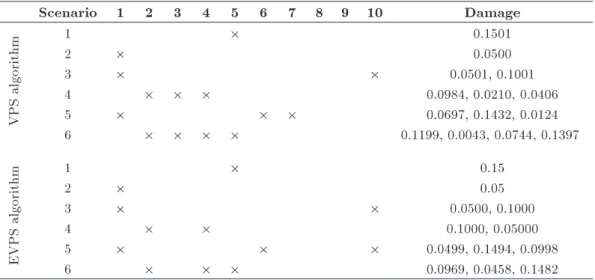
this problem. Table 2 illustrates the achieved average, best, and worst results of 30 independent runs for this problem with VPS and EVPS algorithms. Tables 3 and 4 show the damage locations and the damage severity in all scenarios for the best results of both algorithms without noise and with noise, respectively. Results show that the EVPS accurately nds the loca-tion and severity of damaged elements in comparison with the VPS algorithm. However, these algorithms cannot nd the exact answers for all scenarios.
Figures 2 and 3 present the mean convergence curve for the answers of the sixth scenario without considering noise and evolutionary processes of damage severity to element 5 in the best result for Scenario 1
Figure 2. The mean convergence curve for the answers of the sixth scenario without considering noise for both algorithms for the 10-bar planar truss.
Figure 3. Evolutionary processes of damage severity to element 5 in the best result for scenario 1 without considering noise by both algorithms for the 10-bar truss in the rst 200 iterations.
Table 2. Summary of the objective function values for 6 scenarios without and with noise for VPS and EVPS algorithms for the 10-bar planar truss.
Scenario VPS algorithm EVPS algorithm Objective functionvalue for Average Best Worst Average Best Worst exact answer
Without
noise
1 0.1177 0.007 0.4852 0 0 0 0
2 0.4939 0.0062 1.3 0.198 0 1.233 0
3 0.309 0.043 0.908 0.2827 0 4.25 0
4 3 0.672 5.609 1.543 0.001 4.807 0
5 2.56 1.175 3.516 0.925 0.001 4.52 0
6 3.07 1.806 6.284 2.219 0.129 3.84 0
With
noise
1 1.124 1.081 1.2755 1.082 1.08 1.086 0.47
2 1.164 0.9652 1.8133 1.131 0.9411 2.724 0.505
3 2.279 1.096 3.937 1.617 0.935 3.51 0.5138
4 3.267 1.145 6.196 2.202 0.937 5.32 0.499
5 2.738 1.153 4.038 2 0.86 4.898 0.52
6 3.086 1.788 5.86 2.379 0.919 6.134 0.522
Table 3. Best answers of the VPS and EVPS algorithms without noise for the 10-bar planar truss.
Scenario 1 2 3 4 5 6 7 8 9 10 Damage
VPS
algorithm
1 0.1501
2 0.0500
3 0.0501, 0.1001
4 0.0984, 0.0210, 0.0406
5 0.0697, 0.1432, 0.0124
6 0.1199, 0.0043, 0.0744, 0.1397
EVPS
algorithm
1 0.15
2 0.05
3 0.0500, 0.1000
4 0.1000, 0.05000
5 0.0499, 0.1494, 0.0998
6 0.0969, 0.0458, 0.1482
Table 4. Best answers for VPS and EVPS algorithms with noise for the 10-bar planar truss.
Scenario 1 2 3 4 5 6 7 8 9 10 Damage
VPS
algorithm
1 0.1496, 0.0009, 0.0058
2 0.0479, 0.0009
3 0.0480, 0.1137
4 0.1033, 0.0489
5 0.0461, 0.1533, 0.1148
6 0.0656, 0.0155, 0.1125
EVPS
algorithm
1 0.1509, 0.0041
2 0.0506, 0.0055
3 0.0498, 0.1005
4 0.1009, 0.0493, 0.0021
5 0.0504, 0.1470, 0.1011
without considering noise in the 200 rst iterations by both algorithms for the 10-bar truss, respectively. 5.2. A 15-bar planar truss
The second problem is a 15-bar planar truss structure as shown in Figure 4. This truss consists of 10 elements and 6 free nodes. Also, the elasticity modulus, density, and cross sectional area for all the elements are E = 200 109 N/m2, = 7800 kg/m, and A = 0:001 m2,
respectively. All modes are considered. Also, all vertical and horizontal elements are assumed to be equal to 1.0 m.
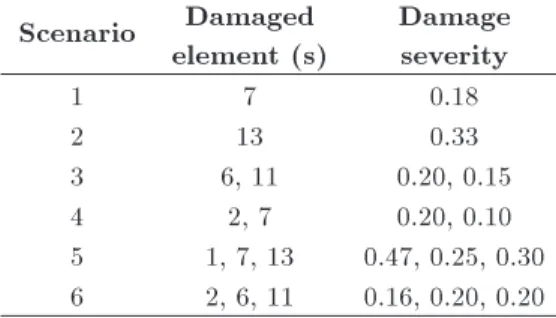
Table 5 shows the six scenarios investigated in
Figure 4. Schematic of the 15-bar planar truss. Table 5. Scenarios for the 15-bar planar truss.
Scenario Damaged element (s)
Damage severity
1 7 0.18
2 13 0.33
3 6, 11 0.20, 0.15
4 2, 7 0.20, 0.10
5 1, 7, 13 0.47, 0.25, 0.30 6 2, 6, 11 0.16, 0.20, 0.20
this problem. Table 6 presents the achieved average, best, and worst results of 30 independent runs in this problem with the VPS and EVPS algorithms. Tables 7 and 8 show the damage locations and damage severity in all scenarios for the best results of both algorithms without noise and with noise, respectively.
5.3. A 25-bar planar truss
The third problem is a 25-bar spatial truss structure as shown in Figure 5. This truss consists of 25 elements and 6 free nodes. Also, the elasticity modulus, density, and cross sectional area for all elements are E = 10 GPa, = 0:1 kg/m3, and A = 0:001 m2,
respectively. The rst 6 modes are considered.
Figure 5. Schematic of the 25-bar spatial truss (all the dimensions are in mm).
Table 6. Summary of the objective function values for 6 scenarios without and with noise for the VPS and EVPS algorithms for the 15-bar planar truss.
Scenario VPS algorithm EVPS algorithm Objective functionvalue for Average Best Worst Average Best Worst exact answer
Without
noise
1 10.92 1.41 23.97 0.89 0 26.91 0
2 20.03 1.76 67.36 2.33 0 24 0
3 35.59 12.49 56.45 11.26 0 33.19 0
4 40.46 17.76 75.50 13.69 0.002 90.48 0
5 22.34 7.62 35.53 7.96 0.083 29.53 0
6 21.90 7.10 34.33 8.16 0.080 19.60 0
With
noise
1 12.49 2.66 31.21 4.19 2.52 30.80 2.54
2 20.42 3.18 43.79 2.49 2.46 2.49 2.50
3 40.91 17.28 63.53 11.42 2.49 30.93 2.50
4 40.99 12.88 75.60 8.21 2.53 23.46 2.54
5 26.33 11.04 44.29 11.35 2.39 26.01 2.70
Table 7. Best answers of the VPS and EVPS algorithms without noise for the 15-bar planar truss.
Scenario 1 2 3 4 5 6 7 8 9 10 11 12 13 14 15 Damage
VPS
algorithm
1 0.1745
2 0.3234
3 0.2170, 0.1343
4 0.2389, 0.0084, 0.0911, 0.0171, 0.0443
5 0.4485, 0.2183, 0.0010, 0.2624
6 0.1768, 0.2194, 0.0133, 0.2429
EVPS
algorithm
1 0.18
2 0.33
3 0.20000, 0.1500
4 0.2000, 0.10000
5 0.4682, 0.2481, 0.3029
6 0.1601, 0.2003, 0.2009
Table 8. Best answers for the VPS and EVPS algorithms with noise for the 15-bar planar truss.
Scenario 1 2 3 4 5 6 7 8 9 10 11 12 13 14 15 Damage
VPS
algorithm
1 0.1790
2 0.0024, 0.3336
3 0.2529, 0.0219, 0.1427
4 0.2124, 0.0189, 0.0668
5 0.4606, 0.0091, 0.2449, 0.0623, 0.3605
6 0.2418, 0.2051, 0.0079, 0.0160, 0.2313
EVPS
algorithm
1 0.0001, 0.1803
2 0.0012, 0.3299
3 0.1998, 0.1500
4 0.1999, 0.1002
5 0.4697, 0.2547, 0.3001
6 0.1600, 0.2006, 0.2007
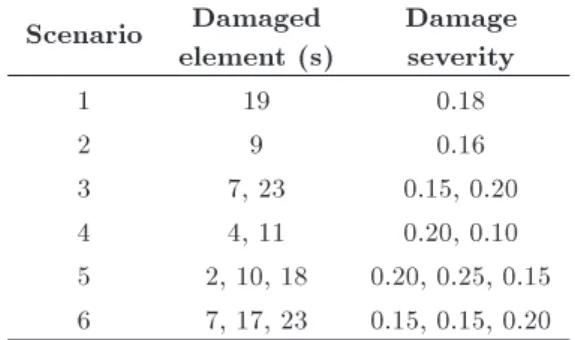
Table 9. Six scenarios for the 25-bar spatial truss. Scenario Damaged
element (s)
Damage severity
1 19 0.18
2 9 0.16
3 7, 23 0.15, 0.20
4 4, 11 0.20, 0.10
5 2, 10, 18 0.20, 0.25, 0.15 6 7, 17, 23 0.15, 0.15, 0.20
Table 9 shows the six scenarios investigated in this problem. Table 10 illustrates the achieved average, best, and worst results of 30 independent runs in this problem with VPS and EVPS algorithms. Ta-bles 11 and 12 show the damage locations and the
damage severity in all scenarios for the best results of both algorithms without noise and with noise, respectively.
5.4. A 72-bar spatial truss
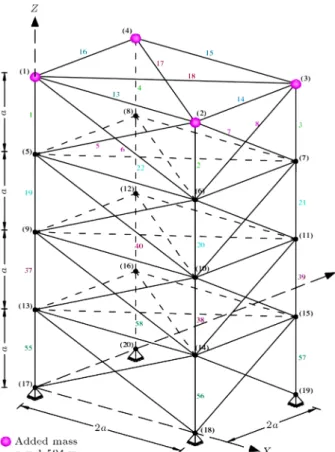
The fourth problem is a 72-bar spatial truss structure as illustrated in Figure 6. This truss consists of 72 elements and 16 free nodes. Elasticity modulus, den-sity, and cross sectional area for all elements are E = 6:98 10 N/m2, = 2770 kg/m3, and A = 0:0025 m2,
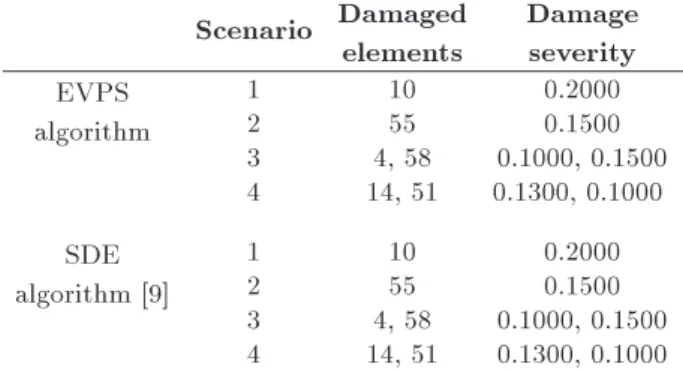
respectively. The rst 16 modes are considered. Table 13 presents the six scenarios investigated in this problem. Table 14 illustrates the achieved average, best, and worst results of 30 independent runs in this problem with VPS and EVPS algorithms. Tables 15 and 16 show the damage locations and damage severity in all scenarios for the best results of both algorithms
Table 10. Summary of the objective function values for 6 scenarios without and with noise for VPS and EVPS algorithms for the 25-bar spatial truss.
Scenario VPS algorithm EVPS algorithm
Objective function value for
Average Best Worst Average Best Worst exact answer
Without
noise
1 489.8604 102.2595 805.4285 6.608262 0 69.36433 0
2 486.107 112.7481 1018.282 7.393969 0 46.36334 0
3 150.1585 55.96212 264.8678 7.363929 0.000739 49.10197 0 4 372.7269 31.76866 823.1844 8.170469 0.000144 33.58254 0 5 116.8389 28.51743 193.6074 11.16476 0.011579 44.48945 0 6 191.9109 78.87526 448.6217 33.23011 0.037428 80.68723 0
With
noise
1 455.9204 100.6871 865.25 26.23318 1.66506 440.6707 1.67 2 445.4167 107.9602 917.9452 8.598463 1.673222 46.53423 1.69 3 141.2858 47.52661 309.7607 7.915229 1.60966 46.10536 1.62 4 378.2894 104.4001 1040.176 7.52212 1.627496 28.81299 1.63 5 109.1755 41.58663 192.6811 8.230128 1.689254 33.91095 1.69 6 184.8772 91.97713 378.5631 36.67907 1.824269 71.48046 1.70 Table 11. Best answers of VPS and EVPS algorithms without noise for the 25-bar spatial truss. Scenario 1 2 3 4 5 6 7 8 9 10 11 12 13 14 15 16 17 18 19 20 21 22 23 24 25 Damage
VPS
algorithm
1 0.0316, 0.2939, 0.3022,
0.2458, 0.0091, 0.1265, 0.556
2 0.1393, 0.2262, 0.909, 0.1480
3 0.3854, 0.1524,
0.5764, 0.4512, 0.2461
4 0.0121, 0.0335, 0.1453, 0.0105
5 0.4956, 0.2051, 0.3725,
0.0405, 0.1361, 0.1270
6 0.0731, 0.1218, 0.1748
EVPS
algorithm
1 0.18
2 0.16
3 0.1500, 0.2000
4 0.2000, 0.1000
5 0.1998, 0.2502, 0.1500
6 0.1500, 0.15003, 0.2001
without noise and with noise, respectively. Results are also compared with the SDE algorithm.
6. Conclusion
Vibrating Particles System algorithm has recently been developed. This algorithm was inspired by one de-gree of freedom systems with viscous damping. In this study, the enhanced vibrating particles system algorithm was introduced as the EVPS algorithm. The improvement included adding new parameters and changes in equations of the VPS algorithm. To
compare the ecacy of the algorithms, 4 problems were studied for damage detection of truss structures considering 30 independent runs. The studied damage detection problems included damage to one and several elements. Additionally, problems with noise and
without noise were studied. In these problems, the objective function was considered using natural frequencies and mode shapes. A signicant mutation was used in all the damage detection problems, which made the algorithm reach an answer faster and more accurately. Results showed that the EVPS algorithm obtained better mean than the VPS algorithm did and
Table 12. Best answers for VPS and EVPS algorithms with noise for the 25-bar spatial truss. Scenario 1 2 3 4 5 6 7 8 9 10 11 12 13 14 15 16 17 18 19 20 21 22 23 24 25 Damage
VPS
algorithm
1 0.01800, 0.36515, 0.0544,0.3966, 0.2391, 0.2214, 0.4156, 0.0385, 0.0491, 0.2476
2 0.2729,0.0787, 0.1816, 0.4899,
0.4327, 0.1029, 0.7218, 0.3736
3 0.1798, 0.4765, 0.2192,
0.5338, 0.3478, 0.0480
4 0.4331, 0.7407, 0.5277, 0.1592,
0.0532, 0.1886, 0.3286 5 0.2423, 0.5242, 0.0526,0.1341, 0.2145, 0.0663,
0.1955, 0.0463, 0.2378, 0.0441
6 0.5377, 0.6092, 0.3271, 0.3279,
0.0830, 0.4709, 0.0227
EVPS
algorithm
1 0.1804, 0.0001
2 0.0024, 0.1600
3 0.1495, 0.2003
4 0.2001, 0.0999
5 0.2007, 0.2494, 0.1498
6 0.1491, 0.1496, 0.2000
Table 13. Four scenarios for the 72-bar spatial truss. Scenario Damaged
element (s)
Damage severity
1 10 0.20
2 55 0.15
3 4, 58 0.10, 0.15
4 14, 51 0.13, 0.10
it gained the best result for all cases. The EVPS algorithm had high capability of escaping from local optima compared with the VPS algorithm. In addition, the EVPS had a higher speed and was more accurate than the VPS algorithm. Comparison of VPS and
Table 15. Best answers of VPS, EVPS, and SDE algorithms without noise for the 72-bar spatial truss.
Scenario Damaged elements
Damage severity EVPS
algorithm
1 10 0.2000
2 55 0.1500
3 4, 58 0.1000, 0.1500 4 14, 51 0.1300, 0.1000 SDE
algorithm [9]
1 10 0.2000
2 55 0.1500
3 4, 58 0.1000, 0.1500 4 14, 51 0.1300, 0.1000
Since the answers of VPS algorithm are inappropriate
for this problem, they are not provided.
Table 14. Summary of the objective function values for 4 scenarios without and with noise for VPS and EVPS algorithms for the 72-bar spatial truss.
Scenario VPS algorithm EVPS algorithm Objective functionvalue for
Average Best Worst Average Best Worst exact answer
Without
noise 12 1235.0841405.002 1039.8241219.066 1361.2381595.558 48.2594454.27792 00 945.8037132.0679 00 3 1724.782 1456.972 1949.947 89.87375 0.0698 148.2069 0 4 1849.881 1646.47 2127.439 76.80913 0.000938 241.9281 0
With
noise
1 1220.854 954.9313 1373.057 68.00602 11.35927 222.2335 11.41 2 1412.465 1212.728 1541.318 35.78667 11.45204 69.85047 11.47 3 1698.849 1254.077 1927.893 95.26347 11.62875 172.9505 11.66 4 1776.609 1519.187 2037.711 53.76691 11.76709 205.5731 11.78
Figure 6. Schematic of the 72-bar spatial truss. Table 16. Best answers for VPS, EVPS, and SDE algorithms with noise for the 72-bar spatial truss.
Scenario Damaged elements
Damage severity EVPS
algorithm
1 10,53 0.2000, 0.0039 2 37, 55 0.0006, 0.1495 3 4, 58, 68 0.1000, 0.1499, 0.0027 4 14, 51 0.1303, 0.0992 SDE
algorithm [9]
1 10, 69 0.2000, 0.0100 4 14, 50, 51 0.1300, 0.0100, 0.0700
Since the answers of VPS algorithm are inappropriate for
this problem, they are not provided.
EVPS for other structural optimization problems is recommended.
References
1. Kaveh, A., Advances in Metaheuristic Algorithms for Optimal Design of Structures, Springer International Publishing, Switzerland (2017).
2. Shara, P., Hadi, M.N., and Teh, L.H. \Heuristic approach for optimum cost and layout design of 3D reinforced concrete frames", Journal of Structural En-gineering, 138(7), pp. 853-863 (2011).
3. Shara, P., Hadi, M.N., and Teh, L.H. \Optimum
column layout design of reinforced concrete frames under wind loading", Topics on the Dynamics of Civil Structures, 1, pp. 327-340 (2012).
4. Shara, P., Hadi, M.N., and Teh, L.H. \Cost optimiza-tion of column layout design of reinforced concrete buildings", Metaheuristic Applications in Structures and Infrastructures, pp. 129-46 (2013).
5. Holland, J.H., Adaptation in Natural and Articial Systems: An Introductory Analysis with Applications to Biology, Control, and Articial Intelligence, Uni-versity of Michigan Press (1975).
6. Eberhart, R. and Kennedy, J. \A new optimizer using particle swarm theory", In: Proceedings of the Sixth International Symposium on Micro Machine and Human Science, 43, IEEE, New York (1995).
7. Kaveh, A. and Talatahari, S. \A novel heuristic opti-mization method: charged system search", Acta Mech., 213(3-4), pp. 267-289 (2010).
8. Gandomi, A.H. and Alavi, A.H. \Krill herd: a new bio-inspired optimization algorithm", Commun. Nonlinear Sci. Numer. Simul, 17(12), pp. 4831-4845 (2012).
9. Kaveh, A., Hoseini Vaez, S.R., Hosseini, P., and Fallah, N. \Detection of damage in truss structures using simplied dolphin echolocation algorithm based on modal data", Smart Struct. Syst., 18(5), pp. 983-1004 (2016).
10. Kaveh, A. and Mahdavi, V.R. \Colliding bodies op-timization: a novel meta-heuristic method", Compu. Struct., 139, pp. 18-27 (2014).
11. Kaveh, A. and Ilchi Ghazaan, M. \Enhanced colliding bodies optimization for design problems with continu-ous and discrete variables", Adv. Eng. Softw., 77, pp. 66-75 (2014).
12. Talatahari, S., Gandomi, A.H., Yang, X.-S., and Deb, S. \Optimum design of frame structures using the eagle strategy with dierential evolution", Eng. Struct., 91, pp. 16-25 (2015).
13. Kaveh, A. and Khayatazad, M. \A new meta-heuristic method: ray optimization", Comput. Struct., 112-113, pp. 283-294 (2012).
14. Kaveh, A. and Bakhshpoori, T. \An accelerated wa-ter evaporation optimization formulation for discrete optimization of skeletal structures", Comput. Struct., 177, pp. 218-228 (2016).
15. Kaveh, A., Hoseini Vaez, S.R., and Hosseini, P. \Modied Dolphin Monitoring for weight optimiza-tion of frame structures", Periodica Polytechnica. Civil Engineering, Online First (2018) paper 12544. https://doi.org/10.3311/PPci.12544
16. Kaveh, A. and Ilchi Ghazaan, M. \Vibrating particles system algorithm for truss optimization with multiple natural frequency constraints", Acta Mech., 228(1), pp. 307-322 (2017).
17. Azam, S.E., Online Damage Detection in Structural Systems: Applications of Proper Orthogonal Decom-position, and Kalman and Particle Filters, Springer Science & Business Media (2014).
18. Chang, F.-K., Structural Health Monitoring: Current Status and Perspectives, CRC Press (1998).
19. Kaveh, A. and Mahdavi, V.R. \Damage identication of truss structures using CBO and ECBO algorithms", Asian J. Civil Eng., 17(1), pp. 75-89 (2016).
20. Kaveh, A. and Maniat, M. \Damage detection based on MCSS and PSO using modal data", Smart Struct. Syst., Techno Press, 15(5), pp. 1253-1270 (2015).
21. Kaveh, A. and Zolghadr, A. \An improved CSS for damage detection of truss structures using changes in natural frequencies and mode shapes", Adv. Eng. Softw., 80, pp. 93-100 (2015).
22. Zamani Mehian, S.H., Razavian Amiri, S.A., Maniat, M., and Nowruzpour, M. \Structural health mon-itoring using optimising algorithms based on exi-bility matrix approach and combination of natural frequencies and mode shapes", International Journal of Structural Engineering, 7(4), pp. 398-411 (2016).
23. Hoseini Vaez, S.R. and Fallah, N. \Damage detection of thin plates using GA-PSO algorithm based on modal data", Arabian J. Sci. Eng., pp. 1-13 (2016).
24. Kaveh, A. and Ilchi Ghazaan, M. \Vibrating particles system algorithm for truss optimization with multiple natural frequency constraints", Acta Mech., Published Online, pp. 1-16 (2016).
Biographies
Ali Kaveh was born in 1948 in Tabriz, Iran. After graduation from the Department of Civil Engineering
at the University of Tabriz in 1969, he continued his studies on Structures at Imperial College of Science and Technology at London University, and received his MSc, DIC, and PhD degrees in 1970 and 1974, respectively. He then joined the Iran University of Science and Technology. Professor Kaveh is the author of 610 papers published in international journals and 145 papers presented at national and international conferences. He has authored 23 books in Persian and 8 books in English published by Wiley, Re-search Studies Press, American Mechanical Society, and Springer.
Seyed Rohollah Hoseini Vaez is currently an Asso-ciate Professor at the University of Qom. He teaches courses on the nite element methods, structural op-timization, advanced reinforced concrete structures, and earthquake engineering. Dr. Hoseini Vaez's re-search interests include system identication, near-fault ground motions, nite element method, and soft computing.
Pedram Hosseini was born in 1989 in Mahallat. He obtained his BSc degree in Civil Engineering from University of Tafresh in 2012, and his MSc degree in Structural Engineering from Iran University of Science and Technology in 2014. At present, he is a PhD candidate at the University of Qom. His main research interests include direct and inverse optimization prob-lems and meta-heuristic algorithms.