The Factors Shaping NC Health Choice and its Relationship with
Community Care of North Carolina
By
Emily Vander Schaaf
A Master's Paper submitted to the faculty of the University of North Carolina at Chapel Hill in partial fulfillment of the requirements for the degree of Master of Public Health in
the Public Health Leadership Program. Chapel Hill
Acknowledgements
Many persons greatly contributed to this study. Much thanks to Sue Tolleson-Rinehart for her guidance throughout this research project. Additional thanks to Dr. Steve Wegner for his expertise on the subject. Thank you all oft hose that spent the time to allow me to interview them; without their help this project would not have been
Table of Contents
Abstract ... ii
Acknowledgements ... iii
Table of Contents ... iv
List of Tables and Figures ... v
lntroduction ... 1
Methods ... 3
Results ... .S Discussion ...
12
Conclusion ... 15
Appendix
1:
Historical Background ...16
Appendix
2:
Literature Review ...24
Appendix 3: Methods Appendix ... .43
Tables and Figures ... .48
List of Tables and Figures
Table A2-1. Critical Appraisal ... 48
Table A3-1. Initial and Secondary lnterviews ... 58
Table A3-2. Codebook of Structured Interview Responses ... 59
Introduction: Expanding Children's Access to Care
American policy governing children's health services changed in 1997 with the passage of
legislation mandating that each state create a government-run health insurance program aimed at
providing health care coverage for children of families earning too much to qualify for Medicaid and not
enough to be able to independently purchase private insurance. (Lam brew 2007) States were afforded
flexibility to develop a program that fit these simple criteria and some federal funding would be
provided to states based on an algorithm using the state's number of uninsured children and average
state income level (Gitterman et al. 2007). Out of a broad constellation of political and contextual
variables, North Carolina developed and implemented NC Health Choice (NCHC) in 1998. This was a
separate block-grant program; the state was not mandated to enroll eligible children if sufficient funding
was not available. It would serve children from birth to age 18 in families earning between 100 and
200% of the federal poverty limit (FPL). It was also to be administered by the State Health Plan (SHP)
and paid by a third-party payer, Blue Cross Blue Shield of North Carolina (BCBSNC). Over the subsequent
decade, NCHC changed in response to internal or external pressures (Gitterman et al. 2007).
Community Care of North Carolina (CCNC) is a care management program first piloted in 1988
and implemented statewide on North Carolina Medicaid patients in 2006. The program is divided into
fourteen networks across the state, each striving to maximize health benefits and reduce costs. These
networks utilize care managers to promote appropriate health behaviors amongst individual higher-risk
or chronic patients. Care managers are intended to ensure that their patients understand treatment
regimens as well as appropriate utilization of specialist and emergency room care. The networks also
fuel population-based efforts to reduce overall spending, such as requiring prior authorization for
prescribing brand name medications over generic ones. In compensation for this added effort, and to
reward providers for creating healthier patients, physicians and networks are given a
Studies have shown CCNC to be highly effective at improving health outcomes while reducing
state cost. CCNC reports a 21% increase in the numbers of asthmatic patients who have been staged
and a 112% increase in asthmatics receiving the flu vaccine. In addition, asthmatics enrolled in CCNC
had an average of 34% fewer hospital admissions and 8% fewer emergency department visits than did
controls. The Mercer Human Resources Counseling Group projected that CCNC's strategies would
produce savings of $60 million dollars in 2003, $124 million in 2004, and $231 in 2005 and 2006.(CCNC
Website) As a result, North Carolina's unique solution to creating Medicaid medical homes has been
widely touted as a success both locally and nationally.
With such an obviously successful structure for managing and improving care in place, would it
not be reasonable to expect that state policymakers would extend CCNC 's portfolio to include NCHC
children as well? In 2007, the General Assembly enacted the necessary enabling legislation to make
CCNC responsible for managing the care of NCHC recipients. Beginning in March of 2007, NCHC was still
administered by SHP and paid for by BCBSNC, but care managers and CCNC networks were to manage
the patients' health. In July of 2009, however, the General Assembly reversed course, removing NCHC
recipients from CCNC management.(Gitterman et al. 2007; Sack 2009, 1)
This study examines the political and circumstantial factors that contributed to the development
ofthe initial NCHC program and shaped its subsequent triumphs and troubles. It also examines the role
of these and other factors in the relationship between NCHC and CCNC, including what may have led to
Methods: Deciphering the Policy Process
I triangulated methods in order to understand the unfolding politics of NCHC. This section
describes the methods I used to conduct a systematic review and critical appraisal of scholarly literature
on the federal politics of CHIP legislation and to conduct in-depth interviews with elites who had
particular knowledge of the North Carolina case.
literature search
To understand the scope of scholarly attention to the problem of understanding the politics of
SCHIP, including pertinent variables and players influencing SCHIP implementation and reauthorization
politics, 1 conducted a limited search of PubMed and JSTOR, databases of biomedical and social science
literature, respectively. The details of the search and a critical appraisal table of the 34 articles included
in the final review are in Appendix 1, Methods. In the pages to follow, I incorporate the remaining
thirty-four relevant articles into a discussion of theoretical perspectives underlying public extensions of
health services like SCHIP. Most articles touched on several categories of SCHIP reauthorization, such as
lobbying and funding in reauthorization debates. They are discussed below according to their most
prominent themes. This literature search strategy did not yield an exhaustive collection of scholarship
on the politics of SCHIP implementation and reauthorization; however these articles provide some
insight into the variables and players contributing to development and passage of this key piece of policy
legislation.
A potential problem with looking to scholarly journals and periodicals for information on health
politics is that the authors of these articles, mostly policy scholars and pediatricians, are more likely to
be either liberal-leaning or oriented toward patient advocacy- or both. Most political scientists and
public policy scholars inherently believe in the potential of government to do good, making it more likely
the appropriateness of a reasonably broad scope of government. Pediatricians are likely to be both
inherently oriented to, and trained for, child health advocacy.(Oberg and Zastrow 2004, 286-308)
Because of the potential perspectives of the authors of most of this literature, then, this systematic
review lends itself to gathering articles written from the perspective of supporting the SCHIP program
and its underlying concepts. Another search may examine articles in more conservative magazines or
newspapers to gain an understanding of an alternate perspective.
I present the results of this literature review and its accompanying critical appraisal table in
Appendix 2: Literature Review.
Recruiting elites
I identified potential respondents using a rolling reputational sampling process (Tansey 2007,
765-772). For my initial set of elites I chose people who were visible, had expertise about the policy, and
could clearly be seen to represent at least one of five different policy domains: advocacy, bureaucracy,
legislative politics, academe; and/or practice. I identified them in conversation with Dr. Steve Wegner
and Dr. Sue Tolleson-Rinehart. These initial contacts, all of whom agreed to be interviewed, then
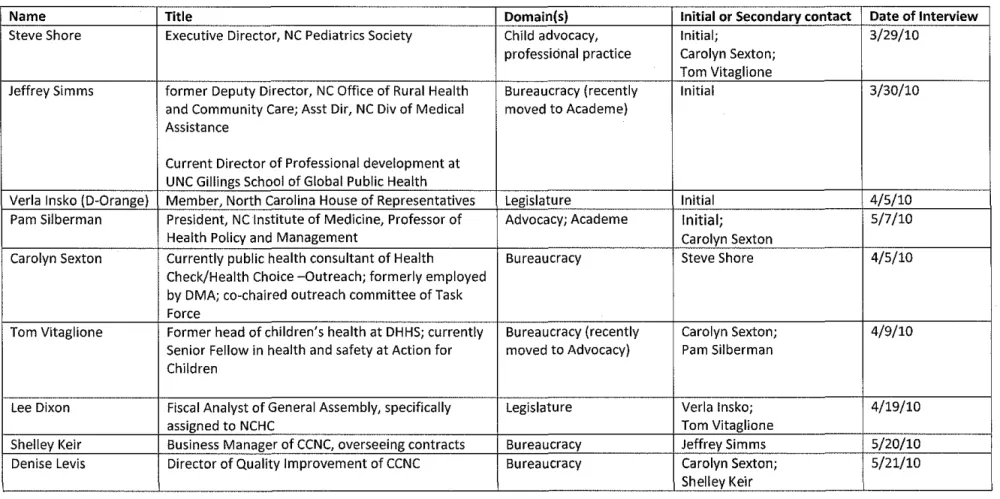
provided me with the names and positions of others I should talk to. The list of elite respondents can be
seen in Table A2-1. I stopped interviewing additional elites when I stopped gaining new information
from the interviews and when interviewees stopped referring me to new contacts. I followed best
practices for in-depth elite interviewing (Hochschild 2008). My open-ended interviews lasted from 30
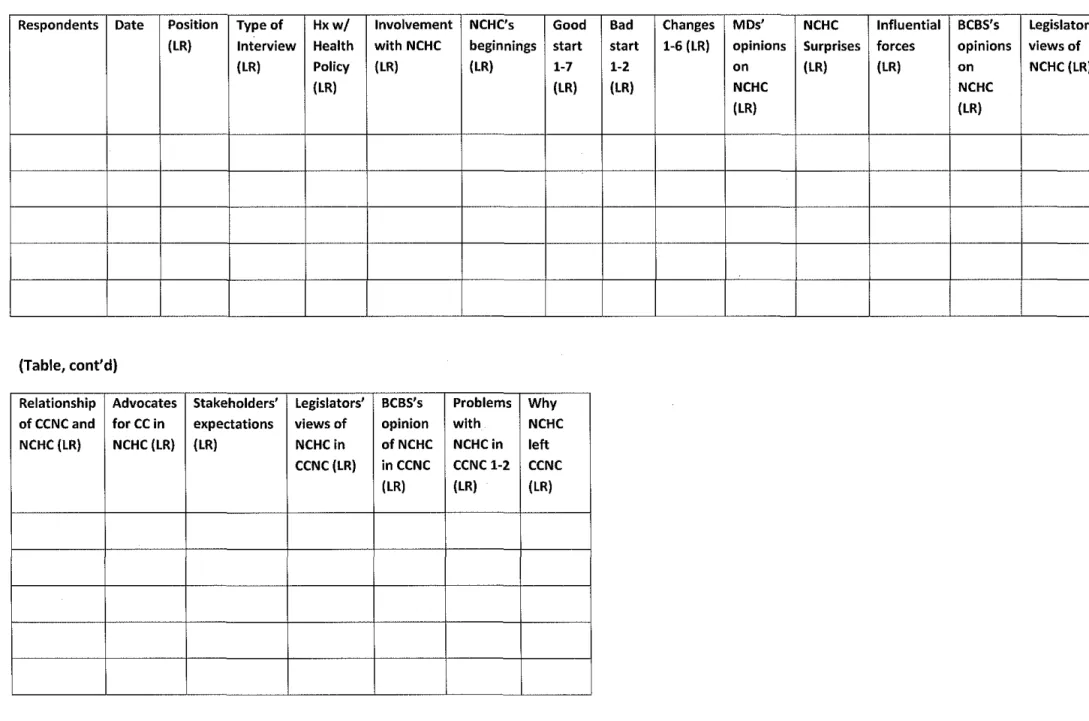
minutes to an hour; I recorded them and transcribed them from the resulting digital files. I alone coded
the interviews, based on the transcripts. Exact interview processes, including my contact messages, a
I also spoke informally to others who, although not interview respondents, helped me
understand SCHIP policy processes. Those individuals' remarks are cited in the following pages as
"personal communications" rather than as interviews.
The analysis below is a synthesis of the scholarly literature, elite perspectives, and my own
careful reading of US and NC primary documents.
Results
Overall, NCHC's disengagement from CCNC was not an isolated decision. In truth, none of the
changes to NCHC were isolated decisions. Instead, they grew from circumstances related to the very
structure of the CHIP program, and that structure itself emerged from the state's political environment
of the state at the time.
NCHC's beginnings
The structure of NCHC in its early years was born of a constellation of interacting variables and
contexts; had one of these been absent, the ultimate design of the program would have been different.
Federal CHIP legislation was passed at a time when North Carolina was already considering means to
creating a safety net health insurance program for children (Vitaglione and Silberman interviews).
BCBSNC already managed a program called Caring for Children, aimed at providing insurance for the
same populations CHIP would later target: those children in families earning too much to qualify for
Medicaid but not enough to afford private insurance (Shore and Silberman interviews). There were
several active and powerful advocacy groups in the state interested in promoting programs to improve
children's access to good health coverage. North Carolina Pediatrics Society was most involved in
advocating for children's health (Shore, Simms, and Vitaglione interviews), but groups such as Action for
North Carolina's Children and were all also influential at the time (Shore, Vitaglione, and Dixon
interviews). Several state legislators, including state Senator Purcell and state Representative Verla
Insko were also strong voices for children's health in the General Assembly (Shore, Simms, Insko,
Vitaglione, Dixon interviews). Meanwhile, Governor Jim Hunt was very "child-oriented" (Vitaglione
interview) and the secretary of DHHS was Dave Bruton, a former pediatrician. Bruton and Hunt had
already begun the process of organizing state policymakers into a task force aimed at developing such a
proposal when federal CHIP legislation passed and focus could be turned to making state policy align
with federal funding (Vitaglione and Silberman interviews). This group's history of cooperation helped
to develop a congenial atmosphere that made the process of setting to work on recommendations
easier and friendlier after CHIP's passage. Tom Vitaglione, then the head of children's health at DHHS,
was charged with helping lead this task force along with Gordon De Friese of the North Carolina Institute
of Medicine. Mr. Vitaglione later recalled the deep feelings of trust in these meetings, attributing this
largely to members' understanding that all valid viewpoints would be considered and multiple final
recommendations would be sent on to the executive branch (Vitaglione interview).
The task force created a set of several possible CHIP structures, sending them on for Secretary
Bruton's and Governor Hunt's consideration. The executive branch ultimately endorsed a proposal to
create CHIP by expanding Medicaid to include children of higher income levels, thus broadening the
entitlement program and ensuring that federal funds would always been available to the program. The
Democrat-run state Senate quickly endorsed this proposal.
Despite all of the favorable influences readying the state to expand children's health insurance
coverage, North Carolina did have one countervailing force: from 1995 to 1999, North Carolina's House
of Representatives was controlled by Republicans, for the first time since at least 1931 (General
Assembly Website 2008, 1). House Republicans opposed a Medicaid expansion, fearing that such an
increased commitment of state funds (Shore and Sexton interviews). Ultimately, the spirit of
compromise cultivated in the development of this legislation prevailed, leading to a separate block-grant
program termed NC Health Choice that would cover children of families earning between 100 and 200%
of the federal poverty limit (FPL) and would only receive a specified level of funding without entitling
eligible children for enrollment. In an effort to reduce the stigma of Medicaid amongst some
middle-income families, the program was to be administered by the State Health Plan (SHP) and to be paid for
by Blue Cross Blue Shield of North Carolina (BCBSNC) (Simms, Insko, Sexton, Vitaglione interviews). The
task force, legislators, and other advocates worked to mold this block-grant legislation into something as
nearly comprehensive and complete as that of Medicaid, simply without the entitlement provision
(Simms and Vitaglione interviews). Ultimately, both sides were satisfied with the program's final
structure. Tom Vitaglione recalled initial worries that a block-grant program would not reach be as
comprehensive and effective as a Medicaid expansion. "The surprise was that they allowed us over six
weeks of negotiation to actually develop a program that was just as good, just a different name. To
some extent, because it was not called Medicaid, the stigma- to the extent there would have been one
-in the middle class community was not there." (Vitaglione interview)
NCHC's Evolution
Inevitably, many of the struggles and resultant changes to NCHC grew from its original structure
and organization. Great state interest in expanding care coverage to uninsured children led to
well-organized, highly effective grassroots outreach (Shore, Sexton, and Vitaglione interviews), so successful
that it created unanticipatedly high enrollment (Shore, Sexton, Insko, and Vitaglione interviews).
Carolyn Sexton co-chaired the Outreach and Enrollment subcommittee of the task force. She recalls
how that committee's understanding of North Carolina's racial, geographical, and cultural diversity lead
tailored to the part of the state that you're working in and that they were hearing the message from
people they trusted" (Carolyn Sexton interview). Initial projections predicted that there were 71,000 ·
uninsured children in North Carolina, and federal budgetary allowances were provided accordingly;
however enrollment had reached 72,000 in the program's first year and nearly 148,000 by 2006
(Gitterman et al. 2007, ). Consistently high annual levels of enrollment ultimately led to on-going
budgetary constraints and crises. In January 2001, North Carolina became the first state to freeze CHIP
enrollment entirely, only opening to eligible children on a wait list in July of that year, and not opening to
all eligible children until October. Program advocates worried that such a freeze would undermine the
program's credibility. Carolyn Sexton spoke passionately of enrollment freezes. She said "2001 was a
very glum year for us ... If you're a family that has a child enrolled in this program and it closes new
enrollment, what does that say to you about the stability of the program? ... That was the worst that it
got right there" (Sexton interview). This low point in NCHC's development stemmed from the
compromise with House Republicans over structure in 1998; had North Carolina created a Medicaid
expansion program, enrollees would have been entitled to federal funding. Likewise, as an entitlement,
enrollment could not be halted for eligible children. Of course, it is uncertain what effect such an
entitlement would have on the state budget and other programs; federal funds are not exhaustive and
the state would be required to find a means to pay for a burgeoning population of children covered
under state government-run insurance.
To try to prevent future, similar freezes, the legislature made cost-saving measures during times of
budgetary stress. In 2005, children up to 6 years of age in families making between 100 and 200% of FPL
were transferred from NCHC to Medicaid, making North Carolina's CHIP a hybrid block-grant and
entitlement program. Those children enrolled in Medicaid were also included in the state's renowned
Community Care of North Carolina (CCNC) care management program, shown to improve patient
CHIP-authorized funds for the remaining 6 to 18 year-olds in NCHC. At this time, both of North Carolina's
houses were controlled by Democrats and the Governor was also Democratic, presumably lessening the
resistance to a shift toward entitlement.
The 2001 enrollment freeze was the only instance in which the program halted all enrollment but
there have been limitations ever since. The General Assembly repeatedly capped increases in the
numbers of new eligible children that could be enrolled in the NCHC program through the first decade of
the 211h century. For example, in the 2008-2009 fiscal year, enrollment was not to exceed 15,000
additional children (Lichstein et al. 2009, 310;Anonymous2008, ). When outreach organizations
anticipated that enrollment might reach this cap, they generally were required to halt enrollment. Such
caps were not infallible at preventing budget overruns. Often when authorities announced that
enrollment would be stopped on a particular date, enrolling agencies would hurry to enroll eligible
patients at a heightened pace, ultimately resulting in higher-than approved enrollment levels (Insko
interview).
Financial struggles influenced the evolution of NCHC in other ways. When the program first began,
participating providers were reimbursed based on the SHP's fee structure, which was comparable to
that of private insurance and higher than that of Medicaid. Legislators felt that these higher payments
to providers would further reduce the stigma of government-run health insurance and increase access
by increasing the number of providers willing to accept NCHC patients. In 2005, the payment structure
was altered to match that of Medicaid (Shore, Simms, and Keir interviews). Some advocates and
legislators feared that this change would impair access and care, but pediatricians and family physicians
remained amenable to the changing fee structure (Shore and Keir interviews). Some specialists,
particularly dentists, resisted these reduced fees and consequently some stopped providing care for
NCHC enrollees. Jeffrey Simms, former assistant director of Medicaid in North Carolina, speculated that
differences in these physicians' underlying motivation; they are a "unique breed," more interested in
patient outcomes than financial bottom lines (Simms interview).
NCHC's inclusion in CCNC
Not surprisingly, the factors contributing to NCHC's inclusion in CCNC mirror those affecting
previous NCHC changes, and also came about from the original structure of the program. The program
was struggling to meet rising demand with limited funds and thus sought to reduce its costs. CCNC has
been shown to improve health outcomes while lowering overall cost in Medicaid recipients, a very
similar patient population to that of NCHC. CCNC thus seemed the perfect fit to help lower overall NCHC
costs and ultimately allow a greater quantity of patients to be included under its care (Insko, Keir, and
Levis interviews). At the same time, CCNC itself was riding considerable momentum from its successful
pilot programs, Carolina Access II and Ill, and its cost-saving first year statewide. Its leaders were very
interested in expanding to improve health outcomes in additional populations, particularly those of the
vulnerable lower income pediatric population (Levis and Insko interviews). CCNC leadership actively
participated in including NCHC under its management.
There was very little opposition by policymakers and providers, who already viewed CCNC as
successful at curbing costs and improving health outcomes in the Medicaid population (Simms and
Dixon interviews). Physicians were largely relieved to be able to utilize care management for their
high-risk or chronic care patients covered under NCHC (Simms, Silberman, and Levis interviews). In addition,
some legislators and advocates perceived that those physicians caring for CCNC patients were
implementing quality improvements and evidence-based protocols for all of their patients, regardless of
insurance status. Providing them with a formalized PMPM legitimizes or formalizes that relationship
(Sexton, Vitaglione, and Shore interviews). BCBSNC may have felt some frustration over needing to
other stakeholders did not find them as oppositional to the union of NCHC and CCNC (Simms and Levis
interviews).
What went wrong
In July 2009, NCHC was removed from CCNC's care management by the General Assembly.
What went wrong? If CCNC is so successful at saving state money on Medicaid patients, a state-run
health insurance program serving primarily children, why would its application to similar NCHC patients
be halted?
Ultimately, NCHC's unrealized potential under CCNC resulted from its original structural
arrangement making BCBSNC the program's third-party payer. Because NCHC payments run through
BCBSNC, that company is responsible for creating and maintaining claims data on its patients. CCNC's
improvements are data-driven; it needs to be able to identify which patients are at highest risk in order
to specifically target their health behaviors. The BCBSNC claims data are primarily for billing purposes,
not for research or improvement, and the data are in many cases less comprehensive and identifiable
than are the DMA-run databases of Medicaid. Despite meetings between BCBSNC and CCNC executives
(Denise Levis interview), the payer (BCBSNC) was never able to give the care management organization
(CCNC) quite the data it needed to manage patients. Without the fine-grained data it needed, CCNC was
unable to manage NCHC patients' care, or achieve improvements in this population as it continued to do
for its Medicaid clients (Simms, Sexton, Dixon, Silberman, and Levis interviews). This proved frustrating
for CCNC and NCHC leadership, and may have for BCBSNC as well; it is uncertain whether the
cumbersomeness of collecting new data outweighed the benefit of having its patient population
managed externally to BCBSNC (Denise Levis interview).
BCBSNC's role as payer for NCHC may have interfered with the program's ability to manage the
managers could encourage NCHC patients to access their primary medical home before seeking
specialty care, and CCNC could encourage NCHC providers to prescribe generic medications before
brand name ones, but it could not mandate these changes; unlike under Medicaid, unadvised visits or
treatments were still reimbursed (Dixon, Silberman, and Keir interviews). This further hampered
CCNC's efforts to curb costs.
In July 2009, the General Assembly recognized that CCNC networks were not able to fulfill their
assigned task of managing the health of the NCHC population, and stopped paying the networks the
PMPM although, interestingly, the legislative revision continued to pay the PMPM to individual
physicians (Lee Dixon interview). This may be because, as mentioned above, there is a perception that
physicians with CCNC patients are implementing quality improvements and evidence-based protocols
for all of their patients, not just those covered under Medicaid. However, in the implementation of
these legislative revisions, both the networks and the physicians stopped receiving PMPMs from DHHS.
1 have not been able to transpire with these payments; it may simply have been an administrative
oversight in interpreting the legislation. It may also be that someone supposed that if CCNC providers
are already implementing quality improvements for all of their patients, an additional PMPM for NCHC
patients would not change health outcomes or reduce costs. Some have also said that as children under
6 years old from families earning between 100 and 200% of FPL receive coverage under Medicaid- and
thus under CCNC care management- these families learn to alter health behaviors for older siblings or
children aging into NCHC (Carolyn Sexton interview); this may have also influenced the perceived value
Discussion: Implications for the future
Policy does not happen in a bubble. Overall, NCHC's disengagement from CCNC was not an
isolated decision. In truth, none of the changes to NCHC were isolated decisions. Instead, they grew
inevitably from the very structure of the CHIP program, and that structure was formed by the prevailing
political dynamics in the state at the time. Seemingly simple federal and state-level compromises of
early years undermined and complicated the program at every step.
Could things have been different?
One could imagine a variety of circumstances that, had they been different, would have altered
NCHC's course. First, had BCBSNC not been willing to participate in a government-run insurance
program, perhaps the state would have selected an alternate payer with more accessible claims data
that might more easily have served CCNC's performance improvement needs. Had the North Carolina
House of Representatives had a Democratic majority when the federal CHIP legislation passed, perhaps
the legislature would have approved an entitlement program such as a Medicaid expansion, avoiding
problems of enrollment caps or incomplete patient data; CHIP children covered under Medicaid would
automatically be enrolled in CCNC, potentially saving the state money and avoiding frustrating confusion
over incorporating these similar populations. Finally, the spirit of collaboration and cooperation that
colored the beginnings of NCHC fostered a sense of goodwill and congeniality; however perhaps it was
this very congeniality that led to the compromise that established CHIP as a separate block-grant
program. Had there been more divisiveness in the legislature and among stakeholders, perhaps no such
compromise would have been reached, and North Carolina's CHIP program would have been forced
through as a Medicaid entitlement program, avoiding many of its subsequent challenges and
It is impossible to know whether any of these alternate situations would have been favorable. A
Medicaid expansion or entitlement program could easily be riddled with its own set of complications
and challenges. It is also difficult to discern precisely what early changes would mean to the future of
the program; the above are simply guesses of how the course may have altered. All we do know is that
North Carolina's CHIP program was born out of a specific, unique set of circumstances and that if these
had been any different, the program itself would have ultimately been different.
What's to come?
Several more recent administrative and legislative changes will affect NCHC and its future. First,
in 2009 the General Assembly wrote to transfer administration of NCHC to Division of Medical
Assistance (DMA); NCHC will remain a block-grant program rather than an entitlement, but BCBS will no
longer administer or pay providers through the program. This transition will occur gradually over the
next twelve months (Gen Assembly 108-70.21; Silberman interview). This will make the process of
utilization management simpler. The DMA and DHHS will have the authority and ability to mandate that
NCHC enrollees utilize their medical home, and that these medical homes utilize more cost-effective,
evidence-based protocols (Dixon interview). This change may also serve to improve CCNC's ability to
perform effective population care management on NCHC recipients through more usable claims data;
several stakeholders anticipate that CCNC and NCHC will reestablish their relationship following this
change in administration (Keir, Sexton interviews).
President Obama signed the Patient Protection and Affordable Care Act (PPACA) into law in
March 2009. PPACA expanded Medicaid eligibility to 133% of FPL and extended the live of the CHIP
program through 2019. Under these new provisions, 6 to 18 year-aids covered under NCHC in families
earning up to 133% of FPL will be moved to Medicaid, while those earning between 133 and 200% of FPL
with CCNC's care management services, but it is possible that by moving more children from NCHC to
Medicaid, a greater proportion of the block-grant funding will be left to enable enrollment of more
NCHC.
Conclusions: What it All Means
An unusual constellation of political and contextual factors contributed to North Carolina's initial
implementation of federal CHIP legislature and to its subsequent evolution. Altering any of these likely
would have changed the course ofthe program, potentially providing improved care to broader
populations. North Carolina had a governor and secretary of Health and Human Services that were
uniquely supportive and sympathetic to children's health issues, along with some consistently
supportive advocacy groups and policymakers. At the same time, there was unique opposition to
full-throttled expansion of care, with Republican majority in the House for the only time in a century. These
unusual circumstances led to what may have been a missed opportunity for expanded entitled care for
the state's children, and a step toward more universal coverage for children. The planned inclusion of
NCHC under DMA administration and the passage of PPACA will likely clear some of the obstacles
resulting from the program's initial structure; transferring of lower income children into Medicaid and
eased utilization management of remaining NCHC enrollees will reduce cost and allow more children to
participate in the program. However, unless NCHC is made a full entitlement program, enrollees will be
subject to budgetary pressures; there will continue to be children eligible for the program that are not
Appendix 1: Historical Background SCHIP's National History
SCHIP was created in 1997 following years of political and national debate about the feasibility
and desirability of comprehensive health reform. President Clinton and Democrats were recovering
from considerable political backlash following their failed attempt to create comprehensive health
reform in the early 1990s. In response, Clinton devoted substantial time in his second term to create a
bill with the newly-Republican Congress that aimed to expand health insurance options for uninsured
children. SCHIP ultimately became a successful example of bipartisan legislature, containing
components endorsed by Democrats and Republicans. Democrats successfully created a
government-run insurance for children of families earning too much to qualify for Medicaid and too little to afford
private insurance and Republicans allowed states flexibility while imposing financial limitations on the
legislation to prevent unlimited, unchecked enrollment in the program.(Lambrew 2007, ) SCHIP was to
be approved for a ten-year course from 1998-2007,.and was mandatory. The federal government
would help states with much of the program's funding, but states would have flexibility in determining
how to best implement their programs. They could expand Medicaid to cover children of families
earning a higher percent of the federal poverty limit (FPL), create independent SCHIP programs, or
initiate some combination of the two.
Funding from the federal government would come in the form of block-grants, rather than as an
entitlement program as is seen in Medicaid and Medicare; as a result not all children financially eligible
for SCHIP would be provided coverage under SCHIP iffunds ran out.(Lambrew 2007,) The federal
government determines each state's grant amount based on a formula including the state's average
wage levels and its quantity of uninsured and low-income children, as determined by the Current
state that had underutilized its funds for one year to use the surplus to cover a more costly year; all
leftover funds after those three years would be returned to the federal government to be redistributed
to consistently overspending states. In response, some consistently under-spending states chose to
increase upper FPL limits, increasing eligibility and coverage but preventing subsequent surpluses from
distribution to other states.(Lambrew 2007 ;Gitterman et al.) One way states have worked to
circumvent this funding barrier is to adopt SCHIP as a component of Medicaid. As Medicaid is an
entitlement program, if block-grant SCHIP funding runs out for a state, the federal government would
still provide lower-rate Medicaid funding for children of SCHIP-qualifying income strata, thus helping to
offset the state's cost of miscalculation (Lam brew 2007).
Over its ten-year course, SCHIP covered millions of children not previously enrolled in any health
insurance programs, considerably improving their health care access and health outcomes, and saving
providers and states money in providing care to previously uninsured (Mann, Rowland, and Garfield
2003, 31-53). When it came time for its renewal in 2007, US Congress passed a bill quickly, but it was
repeatedly vetoed by then-President Bush (Stolberg 2007, 36). Immediately following Barack Obama's
inauguration in January 2009, he signed an SCHIP reauthorization, reallocating federal funds to the state
programs.
North Carolina Health Choice
As the federal government's compromised at SCHIP's creation between its Democratic president
and Republican Congress, North Carolina too was forced to invoke bipartisan compromise to create the
state's SCHIP program. In late 1997, Democratic Governor Hunt proposed that the state expand
Medicaid to cover children of families earning between 100% and 200% of the federal poverty limit
(FPL), requiring them to pay small co-payments for office visits or medications and no enrollment
House formed its own proposal. It recommended that the SCHIP serve as an extension of North
Carolina's Teachers' and State Employees' Comprehensive Major Medical Plan (the "State Health Plan"
(SHP)), covering children offamilies earning up to only 185% ofthe FPL, with higher co-payments for
office visits and medications and sliding-scale premiums for families earning between 133 and 185% of
the FPL. The House also proposed a waiting period between loss of private insurance and enrollment in
SCHIP; this aimed to dissuade families from dropping private insurance to take advantage of the
lower-cost government-sponsored option. Ultimately in April 2008 these groups passed a bill for a
compromise program, North Carolina Health Choice (NCHC). NCHC would be jointly led by the
Department of Health and Human Services (DHHS) and SHP. DHHS would manage budgetary issues,
determine eligibility through its Division of Medical Assistance (DMA), and provide community outreach
and education through its Department of Public Health, while SHP would actually administer benefits
and process claims through Blue Cross Blue Shield of North Carolina (BCBSNC). The plan covered
children of families earning up to 200% of the FPL, with no families paying premiums and only families
earning between 150 and 200% paying modest co-payments on doctor visits and medication costs. The
plan would also not require waiting periods, enabling families to enroll immediately after losing existing
coverage. Physicians were to be reimbursed at BCBSNC rates, rather than at lower Medicaid
rates.(Gitterman et al.)
From NCHC's inception, enrollment in the program exceeded projections and expectations.
Grassroots organizations and advocacy groups were charged with spreading the word of the new
insurance program, efforts which were supported and fueled by grants from organizations such as the
Robert W. Johnson Foundation. In response to such unexpected growth and citing dwindling funds,
DHHS froze SCHIP's enrollment in January of 2001, making North Carolina the first state to do
so.(Mooneyham and Writer 2000, )(Mooneyham and Writer 2000, ) Children were placed on a waiting
the FPL limit or if they had previously been on SCHIP but failed to reenroll within the appropriate time
period. Children that would have qualified for SCHIP for other reasons, such as loss of private insurance,
were not eligible for application at all. After NCHC enrollment decreased to tolerable amounts, children
were allowed to enroll off the wait list beginning in July 2001 and new enrollments were permitted
started October 2001.(Gitterman et al. ;Anonymous)To prevent such future freezes, in 2003 the DHHS
was granted the authority to reallocate funds as necessary. In 2005, the General Assembly lowered
SCHIP reimbursement rates to Medicaid rates rather than those of BCBSNc.(Gitterman et al.)
As NCHC has aged, its eligibility requirements and programs have evolved. In 2005, children
under 5 years of age in families earning between 100 and 200% of the FPL were shifted from NCHC to
Medicaid. This made government-run insurance an entitlement in North Carolina for children aged less
than 5 years in families earning less than 200% of the FPL, effectively transforming its SCHIP program
from a block-grant only strategy to a combination one. Those children enrolled in Medicaid were also
included in the state's renowned case management Medicaid program, Community Care of North
Carolina (CCNC), which has been showed to improve patient outcomes while saving the state millions in
unnecessary medical costs.(CCNC Website ;Chen 2009, 1) Beginning in March 2007, children 6-18 years
old enrolled in NCHC also became eligible to access care with CCNC primary care physicians and case
management, with NCHC paying CCNC's fare of $2.50 per patient per month to cover case management
for these NCHC patients.(Gitterrran et al. ) In 2009, DHHS was given the legislative authority to
discontinue providing CCNC fees for NCHC enrollees if it did not find sufficient evidence of case
management service utilization.(Anonymous2009,) Perhaps as a result, this case management
coverage was discontinued for NCHC patients beginning in July of 2009, with officials citing NCHC
budgetary constraints.(Sack 2009, 1)
In 2007, NCHC faced the same uncertainty as national SCHIP programs, in anticipating and
Carolina Dole and Burr called for a continuation of existing SCHIP coverage at that time, fearing that the
alternative was expanded government-run insurance.(Senate,Eiizabeth Dole, Senator, 2007,
;Senate,Richard Burr, Senator, 2007, ) In 2008, State Congress members debated over allocation of
funds and enrollment allowances, with the state House requesting an addition 10,000 children be
enrolled in the program with $10.4 million in additional resources and the Senate proposing only a 2.4%
increase with $1.7 million allocated for its coverage.(Bonner 2009, 1) Ultimately Session Laws provided
for enrollment growth 6% for the 2008-09 fiscal year, with an increase of up to 8.73% iffederal funds be
reallocated.(Anonymous2008,)
Following a recommendation by the North Carolina Institute of Medicine in 2007, the General
Assembly passed a bill for a new child health insurance initiative termed NC Kids' Care. This program
was to cover children of families between 200 and 250% (or 300%, in some versions) of the FPL,
charging them premium and co-payments to maintain cost-sharing, and providing them with the same
benefits provided under NCHC. Enrollment was not to exceed 15,000 children in the 2008-2009 fiscal
year and was to be conditional upon availability of funds.(Gitterman et al. ;Lichstein et al. 2009,
310;Anonymous2008, )As the program was written for before the onset of the current economic
recession, it has not been put into practice in the state.(Gitterman et al. ) During that same session in
which it created NC Kids Care, the General Assembly continued its tradition of annual NCHC enrollment
caps, fearing limited federal SCHIP support as described above.(Lichstein et al. 2009, 310;
Anonymous2009) While NC Kids' Care could have provided access to 9 to 14% of uninsured children in
North Carolina (depending on a 250 or 300% upper limit of FPL), how did the state legislature think it
feasible and affordable to extend coverage to new groups while limiting coverage to already-eligible
ones? In the same article in which NCIOM promoted Kids Care, the organization also recommended
removing enrollment caps for NCHC, but the legislature did not heed this advice.(Lichstein et al. 2009,
ensuring coverage of lower-income ones? Indeed, ideally North Carolina would aim to ensure that all of
its children had access to sufficient affordable care, but why would the state choose to attempt to
expand before perfecting its existing government-run children's insurance plan? After President
Obama's reauthorization offederal funds for SCHIP, NCHC still placed a cap on enrollment growth for
the 2009-10 fiscal year at 9,098 children.(Anonymous2009,) Presumably the decision to include this cap
was influenced by the economic downtown of those years; however, it is uncertain what budgetary or
economic changes could successfully fund enrollment for all of North Carolina's eligible children into
NCHC.
Community Care of North Carolina
Community Care of North Carolina (CCNC) is the state's- and indeed the nation's- model of a
successful patient-centered medical home. It organizes North Carolina's Medicaid patients into
networks, and coordinates care and quality improvement for patients within that network, ultimately
lowering costs and improving health outcomes. It slowly grew over decades from a small program in
Wilson County in 1988 to a pilot program in nine sites in 1996- Carolina Access II- to entire counties
through Carolina Access Ill. In 2000, shortly after her appointment as secretary of the state's DHHS,
Carmen Hooker Odum renamed Carolina Access as Community Care in North Carolina and in 2006 she
deemed the program a success, recommending its statewide implementation.(CCNC Website ;Steiner et
al. 2008, 361;Willson 2005, 229-233)
As of January 2010, there are more than one million CCNC enrollees from all100 North Carolina
counties distributed between 14 community health networks.(CCNC Website) CCNC has since been
widely deemed a success, saving taxpayers money and Medicaid recipients' health statuses. CCNC
reports a 21% increase in the numbers of asthmatic patients that have been staged and a 112% increase
fewer hospital admissions and 8% fewer emergency department visits than controls.(CCNC Website)
However, it is unclear from CCNC's description who these controls are and why they are not currently
enrolled in CCNC as well. Diabetes patients were more likely to be referred for dilated eye exams of foot
exams than those before initiation of CCNc.(CCNC Website )
CCNC also reports significant cost-savings under its guidance. An external evaluation by the
SHEPS Center estimated that the state saved $3.5 million dollars due to CCNC's asthma plan and $2.1
million from its diabetes management program. The Mercer Human Resources Counseling Group
projected savings of $60 million dollars in 2003, $124 million in 2004, and $231 in 2005 and 2006.(CCNC
Website )(CCNC Website) Of course, these projections are potentially fallible. Mercer compared actual
CCNC costs with projected Medicaid costs based on the years prior its statewide adoption. However,
the economic, political, and medical fields had changed considerably in those years, meaning that actual
Medicaid costs could have been different from projected, even without the adoption of CCNC. With the
statewide application of CCNC there is minimal possibility of a valid control; therefore it is difficult to be
certain of the magnitude and direction of CCNC's cost savings.
These and similar quality measures have lead to wide national recognition of CCNC, touting it as
a step to fixing the country's healthcare, financial and quality woes of the country's healthcare system.
In January 2009, the New York Times published an article on primary care difficulties in which CCNC was
its primary example of medical home success.(Chen 2009, 1) In 2007, the program was awarded the
Annie E. Casey Innovations Award in Children and Family System Reform by Harvard University's School
of Government.(Easley 2007, )(Easley 2007,) In 2008, the program was recognized as a Community in
Action National Exemplary Award Winner by the Environmental Protection Agency for improving the
Appendix 2: Literature Review on Politics of National CHIP Implementation
The State Children's Health Insurance Program (SCHIP) is a federally mandated, state-run health
insurance program that aims to provide coverage to uninsured children in families earning too much to
qualify for Medicaid but not enough to be able to afford private insurance coverage. States are given
the choice of whether to make SCHIP an entitlement program by including it as part of an existing
Medicaid program, make it a block-grant program by creating a separate program, or make it a
combination of the two strategies. As a block-grant program, the federal government gives states a
pre-determined amount of money based on state characteristics; once that money runs out, states are not
required to continue enrolling children until the next funding period. The program began in 1997 under
President Clinton and at the time was lauded as a bipartisan compromise success. It maintained state
flexibility while still improving health coverage and access for uninsured children. Since that time, SCHIP
has received varying levels of support from policymakers and the public.(Oberlander and Lyons 2009,
w399-410) The purpose of this literature review is to gain an understanding of the political issues and
players that have influenced SCHIP's creation and evolution. This will help us gain a contextual
framework into which we can add our understanding of the political issues and controversies
surrounding North Carolina's implementation of SCHIP and its evolution on the state level.
Methods
On March 24-27, 2010, I did a PubMed search using the terms "SCHIP," "CHIP," "State
Children's Health Insurance Program," and "Children's Health Insurance Program" with the MeSH terms
for "politics," which include "politics," "dissent and disputes," "political systems," and "lobbying." I
included limits for English language and Human participants. and excluded all studies published before
1996, as earlier studies would not accurately address the current SCHIP program. The search with these
"SCHIP" and "politics," limiting the search to include only those articles related to Health Policy, yielding
another 17 articles. After reading the abstracts of the articles, I excluded articles ifthey did not directly
address the politics of the SCHIP program.
If an article did not provide an abstract, I assessed its relevance using the Find function for the
terms "children's health insurance program" and a cursory evaluation of the theme of the piece, and
excluded twelve articles using this strategy. Five articles were not easily accessible because the UNC
Libraries do not have subscriptions to the journals. As the remaining articles appear to provide sufficient
insight into the politics offederal CHIP implementation, exclusion of these articles should not interfere
with overall quality of the literature search.
Results
Implementation o/SCHIP. In 2009 following long-awaited reauthorization and expansion of
SCHIP, Jon Oberlander wrote a high-quality review of the history of SCHIP and built upon its lessons to
determine how best to implement subsequent health reform. Oberlander wrote that ultimately
proponents were able successfully to implement SCHIP in 1997 because the program avoided
controversy. It did so by preserving states' rights, building upon existing programs, being led and driven
by Congress, maintaining bipartisan support, keeping a modest scope, being financed incrementally, and
compromising between varied political ideologies. Oberlander described SCHIP's shortfalls under 1997
legislation, including that it left many children uninsured, families remained uncovered, and it led to
increased premium costs. He also wrote of players influential in lobbying for SCHIP's later
reauthorization and expansion. At the time of SCHIP reauthorization and expansion, the program gained
support from the American Medical Association, multiple insurance plans, the Pharmaceutical Research
and Manufacturers of America, hospital groups, and governors. Despite this and widespread
Congress and President Obama reauthorized the use of federal funds for the program. Oberlander
writes that multiple lessons of SCHIP could be applied to subsequent attempts at health reform. The
speediness of 2009 authorization may speak to a different political environment than was seen in2007;
however SCHIP's struggles point to a deep ideological divide in American politics. The author also
pointed out that financing broader coverage would be substantially more expensive. He concluded that
there may be limits to how far incremental change could alter health coverage.(Oberlander and Lyons
2009, w399-410)
In 1998, Sardell and Johnson published a review of the politics of Early and Periodic Screening,
Diagnosis and Treatment (EPSDT) programs, including a brief explanation of their influence on the initial
implementation of SCHIP legislation. They wrote that EPSDT influenced SCHIP implementation by
providing a model of block-grant funding and by determining how best to guarantee coverage. EPSDT
advocates also attempted to change the system and the future SCHIP program in such a way as to best
benefit EPSDT policies.(Sardell and Johnson 1998, 175-205)
Enrollment Successes and Barriers. Halfon, Jnkelas, and Newacheck proposed that the most
successful means of influencing politics and changing health policy is by studying the effects and
successes of current policies. In 1999, the authors measured SCHIP enrollment, as a means of
understanding the program's effects in order to enable effective future changes to that program and
others. Their primary goal was to determine how and to what degree SCHIP reduced the numbers of
uninsured children in each state. Their conceptual approach to monitoring and measuring SCHIP
success involved use of enrollment measures to ascertain the degree of successful recruitment and
retaining of eligible enrollees. The authors explained some of the practical challenges to measuring
SCHIP's effects, including that appropriate measures have not yet been developed, the infrastructure in
collection strategy, no funds are available to support such initiatives, and methods of retaining and
transitioning children between programs has not yet been developed or tested.(Halfon, lnkelas, and
Newacheck 1999, 181-204) Halfon's paper provides a largely theoretical understanding of how one
should approach advancing SCHIP politically. As such, it is of only fair internal validity and applicability.
In 2001 Ullman and Hill utilized a more practical approach to analyze SCHIP enrollment. He and
Hill performed a cross-sectional study to determine what relationship existed between SCHIP income
eligibility criteria and states' characteristics. Ullman and Hill collected information about states' SCHIP
plans and methods through information given by the National Conference of State Legislatures and the
National Governors' Association. They compared this variable to states' percentages of low-income
children based on Current Population Surveys of the US Bureau of the Census. They also compared
these variables to the political party membership of each state's governor, either Democratic or
Republican. The authors found that states with higher percentages of low-income uninsured children
were associated with larger relative changes in eligibility income thresholds. Higher per capita personal
income was associated with bigger increases in threshold levels. Intuitively, higher income thresholds
for Medicaid prior to SCHIP were associated with smaller subsequent increases in income thresholds.
Political affiliations were not statistically related to SCHIP expansions.( Ullman and Hill 2001, 1449-1451)
Ullman's findings were not editorial or anecdotal, but rather the result of methodological study and
peer-review. Their variables of political leaning are oversimplifications; a governor's political affiliation
does not necessarily correlate to the political affiliations ofthe majority of the state's citizens or of its
Congresspersons. As such, this study is of fair to good quality and provides a nice understanding of what
state political factors and characteristics contribute to differences in SCHIP eligibility requirements.
In 2006, Howell and Hughes performed a smaller-scale comparative case study of two California
counties in an attempt to extrapolate the political characteristics influencing SCHIP enrollment and
stakeholders, county administrators, health plan administrators, enrollment assistors, advocates, health
providers, and others. Howell and Hughes named lack of citizenship documentation as an important
barrier to enrollment for children into any government-run insurance option in California. Even children
legally residing in the country may not be enrolled in such programs due to parents' concerns about
their own legal statuses or because of education and language barriers to navigating the system. The
authors describe California's Children's Health Initiatives (CHI) as public insurance programs such as
SCHIP coupled with intensive outreach, meant to cover all uninsured children and potentially provide a
method of coverage for undocumented children. To determine eligibility and outreach efforts, they
reviewed data of key characteristics of two Californian counties, Santa Clara and San Mateo. Santa
Clara, the larger with higher percentages of impoverished children, began CHI implementation 2 years
before San Mateo. They found that the two counties had equal levels of outreach for their CHI
programs, but Santa Clara actively worked to retain their enrollees while San Mateo did not. In both
counties, numbers of uninsured children decreased following implementation of CHis; however Santa
Clara maintained a greater percent decrease than San Mateo. Howell and Hughes conclude that as
Santa Clara was the less wealthy of the two programs, even during economic difficulties communities
can reduce the numbers of uninsured through strong leadership, collaboration, and creative
financing.(Howell and Hughes 2006, 521-554) This case study was small, limiting its generalizability and
making it of fair internal validity; however it provides a clear methodology for evaluating SCHIP
enrollment and gives some understanding of the political factors influencing SCHIP policy.
2007 Reauthorization and Expansion Attempt. A vast majority of articles located by the
systematic review pertained to issues surrounding SCHIP's reauthorization process. Eleven articles dealt
primarily with the anticipation of reauthorization in 2007 and concerns of a veto of the legislation by
policy-making. Two articles, Demske's 2006 and Pulcini's 2007 provide fair, more-objective, peer-reviewed
accounts of events at that time. Demske writes of SCHIP's initial bipartisan compromise and its
subsequent success in providing health insurance and health access to otherwise-uninsured children.
She emphasizes that its initial implementation afforded great flexibility to state governments, which
then served as a foundation for later disputes over the program's reauthorization. Opponents claim
that states are using SCHIP funds to cover children not intended in the original legislation; some states
are using federal funds to cover children of families earning up to 275% of the federal poverty limit
(FPL), while the program was only intended to cover those up to 200% FPL. Demske claims that strain
on the federal budget and misallocation of SCHIP resources would ultimately challenge the passage of
reauthorization legislation.(Demske 2006, 130-132) Pulcini acknowledges SCHIP's successes and
challenges in its reauthorization; yet, her 2007 article goes beyond these to promote expansion of the
program beyond its previous form. She describes Georgetown University's Center of Children and
Families' proposal, which proposed formally increasing SCHIP funding to cover additional children,
strengthening Medicaid coverage, eliminating existing barriers to enrollment in SCHIP, and working
harder to promote healthy development care. She also describes the Children's Defense Fund's
position, that new SCHIP legislation should consolidate SCHIP and Medicaid into one program, include
all children in families earning up to 300% of the FPL, allow children in families earning more to buy into
the program, streamline enrollment processes, permit cost-sharing, and improve provider
reimbursement.(Pulcini 2007, 29-30, 32)
Following Congress's passage of reauthorization and prior to Bush's veto of these bills, Wilensky
published a brief review comparing the House of Representatives' and Senate's bills and explaining
political issues surrounding them. She writes that the Senate bill was the more modest of the two, with
a proposed $35 billion increase in anticipated funding over 5 years and coverage of 4 billion not
drawing funds by reducing payments to providers through Medicare Advantage. She wrote that SCHIP
reauthorization opponents claimed that the program had expanded itself to cover children of higher
income levels than was intended in the original legislation. As a result, they created policies to require
that more than 95% of children in families earning less than 200% FPL must be enrolled in a state's SCHIP plan before it could consider expansion to children in families >250%FPL. Other concerns
included how to extend coverage to the uninsured and how to subsidize coverage for the
insured.(Wilensky 2007, 36-37) This review was peer-reviewed and explained the positions of both sides
of the discussion; however it was of limited scope and is therefore of poor-to-fair internal quality.
The remaining articles addressing SCHIP reauthorization prior to Bush's veto of the legislation
were in the form of magazine journalism and editorials. As such, they are not peer-reviewed and are of
limited academic value; however, they do provide insight into opinions and debates at that time.
Ferman wrote extensively about concerns that SCHIP would be funded through a reduction in Medicare payments to physicians, as part of the proposed Child Health and Medicare Protection Act.( Ferman
2007, 44, 46, 49) Gorin and Moniz wrote an editorial to the Journal of Health and Social Work to explain
that Bush opposed SCHIP expansion because he believed SCHIP should remain a program for
low-income children only. They provided counter-arguments to this claim, explaining that an increase in
funds in proposed SCHIP reauthorization legislation would be primarily to cover children that are eligible
under current guidelines but are not enrolled due to enrollment caps. They also explained that
healthcare was more expensive and that less employer coverage was available in 2007 than when the
program was first established in 1997, fundamentally changing the rules of the game. They maintained
that SCHIP is unlikely to undermine private insurance.( Gorin and Moniz 2007, 243-246)
Feeg wrote a letter from the editor to the Journal of Pediatric Nursing explaining her
interpretation of SCHIP and its reauthorization process in 2007. Here she explained that Bush opposed
taxes on tobacco to fund the program, and he was ideologically opposed to expanding the
"federalization" of health care. She countered that SCHIP was a "good deal" because it extended
coverage to otherwise uninsured populations, provided a means to assess physician and practice
performance, provided state's individual flexibility, potentially reduced smoking through tobacco
taxation, improved children's health care access and subsequent care, and provided a means to improve
quality of care.(Feeg 2007, 299, 312)
Evans reported the results of a Commonwealth Fund survey of health economists and industry
executives that found that a majority considered SCHIP a success and 88% supported expanding
eligibility to children in families up to 300% of the FPL. The same survey found that 80% of respondents
supporting extending coverage to low-income parents and 73% would support including impoverished
childless adults. Evans reiterated others' claims that Bush opposed the legislation because he believed
SCHIP had outgrown its original intent, and sought to limited eligibility to children in families earning less
than 200% of the FPL.(Evans 2007, 22-23)
Dobias wrote to Modern Healthcare in 2007 about anticipation of SCHIP reauthorization and
Bush's threatened veto of the bill. His first, in July of that year, described the financial squabbles
surrounding SCHIP legislation at the time. He outlined the disagreement between the House, which
proposed increasing funding to SCHIP $50 to $100 billion over five years, the Senate, which proposed a
$35 billion expansion over five years, and President Bush, whom opposed and hinted he would veto any
SCHIP bill that he perceived would encourage those covered by private insurance from transferring their
care to SCHIP.(Dobias 2007, 14)
One final highly editorializing article by Sloane about the potential political repercussions of
threatened Bush veto appeared in Modern Healthcare in July 2007. He explained fear and frustration by
GOP leadership at the time, as they anticipated a political backlash of the Republican president revoking
interest in compromising with the administration to create veto-proof proposals; by continuing to back
bills calling for 10 to 12 times the budgetary increase the president said he would be willing to support,
some Democrats may have been working to secure a political victory following Bush's backlash.(Sioane
2007,20)
Overall, these articles show that bodies of Congress and the president all felt that SCHIP
deserved some increase in funds, but they varied in the amount of funds they wished to allocate, with
Congress supporting a much greater expansion than the president. Bush opposed broad expansion on
practical terms, such as a tobacco tax and the original intent of the program, and also on ideological
terms; he did not approve of broad government-run insurance programs and was willing to face
bipartisan opposition to support his own political ideology.
Response to Bush Veto. Several articles were published in response to President Bush's 2007
veto of SCHIP authorization. As with most of the literature published in anticipation to this action, all
responses to Bush's veto were in the form of magazine journalism or letters to the editor. As such they
are not peer-reviewed and are of limited internal validity; however, they can be viewed as one
perspective of ideologies and perspectives at that time. Overall the themes were similar to those
anticipating Bush's veto; the president said he opposed the bill because it did not honor SCHIP's original
intent, but many thought his real opposition was on ideological grounds against the federalization of
health care.
Lubell's 2007 article in Modern Hea/thcare explained the bill and the reasons for Bush's veto of
it. He wrote in October of that year of the healthcare industry's attempts to pressure Congress and the
president into backing legislation that would support SCHIP expansion and reauthorization. They
worked to convince Congress to override President Bush's veto or to work with the president to create a
he claimed that he wanted SCHIP to live up to its original intent of providing health coverage for only the
poorest children. A White House spokesperson reiterated that claim, saying that the president sought
to ensure that eligible children were enrolled in the program before expanding it to higher income
brackets. Lubell quoted Bush as saying he would be willing to accept a bill providing slightly more than
his demanded $5 billion expansion, but only if he knew that money was intended to cover only the
poorest children.(Lubell 2007b, 8-9)
In November of 2007, Iglehart published a letter to the editor in the New England Journal of
Medicine following Bush's veto of SCHIP and Congress's failure to override that veto. Iglehart claimed
that Bush's veto of SCHIP served as a symbol of greater ideology rather than counter of a specific policy.
He wrote that this angered Congresspersons that had worked on the bill, as they felt the president was
unwilling to compromise on the proposals and that he attacked the policy without offering possible
alternatives. Republicans that had worked closely on the bill, such as traditionally-conservative Senator
Grassley, were angry at President Bush for his claims that the bill was socialist. In response to Bush's
claims that the bill might lead to crowd-out, Grassley countered that it discouraged such movement by
reducing federal funds matching to states covering children in homes earning >300% FPL.(Iglehart 2007,
2104-2107)
Perrin's letter to the editor at Ambulatory Pediatrics in November of 2007 told a similar story.
He wrote that the proposed legislation was to draw attention to quality improvement in practice,
increase funding to promote enrollment in the program, and to refocus the program on its
originally-intended audience: poor, uninsured children. He recognized that Bush's opposition to these policies
largely centered on aforementioned concepts, such as increased federalization of care, concerns that
higher-income families would be included in the program, and disagreement of whether a tobacco tax