IJEDR1501081
International Journal of Engineering Development and Research (www.ijedr.org)443
Web Page Classification Using Feature Selection
Techniques
1
Smt. P. G. Modh
2Mr. M. B. Chaudhari
1ME Scholar, 2ProfessorDepartment of Computer Engineering, Government Engineering College, Gandhinagar
________________________________________________________________________________________________________
Abstract - Websites provides a lot of information to the Users. Websites is a collection of Web Pages which contains a bunch of information. In these information to find or retrieve particular page or information is difficult task. So to make this task easy there are different web page classification methods. Using this method we can identify web pages. Based on web page information we have to classify the web page. Web page classification is area of web mining. Web mining is the integration of information gathered by traditional data mining methodologies and techniques with information gathered over the WWW. Web page Classification retrieves WebPages based on different features/parameters of web pages. Web Page Classification can be done in many ways such as using the content of the web page, using the structure of web page, using clustering methods etc. This paper is focuses on the Web Page Classification using the inverse document frequency.
Index Terms - Web Page classification, Classifiers, Features, Naïve Bayes, SVM
________________________________________________________________________________________________________
I. INTRODUCTION
Web page classification, also known as web page categorization, is the process of classifying the web pages into the predefined categories. Classification is one of the traditional data mining tasks. Classification is often posed as a supervised learning problem in which a set of labeled data is used to train a classifier which can be applied to label future examples. According to Qi and Davison [1], the general problem of web page Classification can be divided into multiple sub-problems: Subject Classification concerns about the subject or topic of web page. Functional Classification cares about the role web page plays. Sentimate Classification focuses on opinion presented in the web page. Binary Classification categorizes each instance into one of the two categories. Multi-class Classification deals with more than two classes. multiclass Classification can be further divided into single-label an multi-single-label classification. Flat Classification in that categories are considered parallel, i.e., one category does not supersede another. Hierarchical Classification the categories are organized in a hierarchical tree-like structure, in which each category may have a number of subcategories.
II. WEBPAGECLASSIFICATIONAPPLICATIONS
Applications of Web Page Classification are [1]:
Constructing, maintaining or expanding web directories (web hierarchies) Improving quality of search results
Helping question answering systems
Building efficient focused crawlers or vertical search engines Web content filtering
Assisted web browsing Knowledge base construction
III. WEBPAGECLASSIFICATIONMETHODS
Web Page can be classified into the following broad categories [6]: Manual classification
Clustering approaches
META tags based categorization Text content based categorization Link and content analysis
IV. RELATEDWORK
IJEDR1501081
International Journal of Engineering Development and Research (www.ijedr.org)444
discovery is to be performed. It uses HTML code to represent the processed data by means of an Object Attribute Table (OAT). The OAT contains the columns like Page's text length (TL), External links (EL), Internal links (IL), Image (Im), External Images (EI), Internal Images (II),Multimedia Objects (MO), Word Flash (WF), Word Video(WV), Word Image (WI), Word Blog (WB), Word News (WN). Each row of the OAT describes the characteristics of a web page using these defined attributes. In the following step, an expert assigns classes to each of the rows according with the four categories, Blog, News, Video and Image. In the data mining phase, decision trees converts the data contained in the OAT into useful patterns. In the evaluation phase the consistency of pattern is proven by means of a testing set.A paper [7] used the HTML form elements and their attributes to classify the Web pages with HTML forms into External search forms, No search, site search, Internal database search using the random forest classifier. In order to eliminate sparse matrix problem and to avoid preprocessing of strings, numeric data such as the numbers of input element text type, checkbox type, radio type, select element and textarea element in a form were gathered. In addition, all strings from label elements and name attribute and value attribute of input type text, checkbox and radio, element select and element textarea were scanned for word "search" and its synonyms.
V. CLASSIFICATIONSYSTEM
The methodology presented here uses the Document structure i.e. HTML tags of web page together with the contents within it which is the traditional text categorization approach.
1. Feature Extraction
In the feature extraction stage, candidate features (i.e., the original feature set) are generated from the training set. Among the various HTML tags, <title>, <h1>, <h2>, <h3>,<a>, <strong>, <b>, <em>, <i>, <p>, and <li> tags which denote title, header at level 1, header at level 2, header at level 3, anchor, strong, bold, emphasize, italic, paragraph, and list item, respectively, contains most of the domain specific important terms. So it will be beneficial to consider these tags to generate features that are used in both classifier learning and classification processes. To generate features, all the terms from each of the above mentioned tags are taken then; stopword are removed and Porter's stemming [4] algorithm are applied. Each stemmed term and its corresponding tag form a feature. As an example the word "web" in <title> tag, "web" in <b> tag and "web" in <li> tag are considered as different features.
Algorithm 1: FEATURE EXTRACTION ALGORITHM Input: Collection of Web pages, Stopword list.
Output: Features list
for each Web page p in collection do for each word w in p do
if w is not stopword then if w belongs to <title> tag then title = title U stem(w)
else if w belongs to <h1> or <h2> or <h3> tag then header = header U stem(w)
else if w belongs to <a> tag then anchor = anchor U stem(w)
else if w belongs to <em> or <strong> or <b> or <i>tag then bold = bold U stem(w)
else if w belongs to <li> tag then list_item = list_item U stem(w) else if w belongs to <p> tag then paragraph = paragraph U stem(w) end if
end if end for end for
2. Feature Selection
Feature selection/Feature extraction is an important pre-processing step in pattern recognition or pattern classification, data mining, web mining and machine learning. It also helps to remove noise features in web pages so as to improve search efficiency. The basic idea of feature selection algorithms is searching through all possible combinations of features in the data to find which subset of features works best for prediction and hence in searching. The selection reduces the number of features, keeping the most meaningful ones, and removing the irrelevant or redundant features. Various methods for feature selection are [8]: (1) Term occurrence number (2) Term frequency (TF) (3) Document frequency (DF) (4) Inverse Document Frequency (IDF)
Inverse Document Frequency (IDF)
It is the logarithmically scaled fraction of the documents that contain the word, obtained by dividing the total number of documents by the number of documents containing the term, and then taking the logarithm of that quotient.
IJEDR1501081
International Journal of Engineering Development and Research (www.ijedr.org)445
3. ClassifierThere are various Machine learning algorithms available for classification:
Decision Tree, Naive Bayes, Neural Network, Support Vector Machine, K- nearest neighbour etc. This work used Naïve Bayes and Support Vector Machine for web page classification.
A) Naïve Bayes :
Bayesian learning is a probability-driven algorithm based on Bayes probability theorem as the follow[9]: P (H|X) = P (X|H) P (H) / P(X)
Where X is considered "evidence", which is described by measurements made on a set of n attributes. and H be some hypothesis, i.e. data tuple X belongs to a specified class C.
P(H|X) is the posterior probability of H conditioned on X. That is tuple X belongs to class C, given that we know the attribute description of X, that is we want to determine for classification problems.
P(H) is the prior probability of H.P(X|H) is the posterior probability of X conditioned on H.P(X) is the prior probability of X.
The NB works as follows: Each data sample is represented by an n-dimensional feature vector, X=(x1,x2,…,xn), representing n measurements made on the sample from n attribute, respectively, A1,A2,…,An. Suppose that there are m classes, C1,C2,…,Cm. Given an unknown data sample, X (i.e., having no class label), the classifier will predict that X belongs to the class having the highest posterior probability, conditional on X. That is, the naive Bayesian classifier assigns an unknown sample X to the class Ci if and only if:
P(Ci|X) > P(Cj|X) , where 1 ≤ j ≤ m, and j ≠ i. The class for which P(Ci|X) is called as the maximum posteriori hypothesis.
By the Bayesian theorem : P(Ci|X) = P(X|Ci) P(Ci) / P(X)
As P(X) is constant for all classes, only P(X|Ci)P(Ci) need be maximized. If the class prior probabilities are unknown, then it is commonly assumed that the classes are equally likely, that is: P(C1) = P(C2) = ….. = P(Cm)
Note that the Class prior probabilities may be estimated by P(Ci) = Si / S
where , Si is the number of training samples of class Ci and S is the total number of training samples.
B) Support Vector Machine :
Support Vector Machines are among the most robust and successful classification algorithms. It is a new classification method for both linear and nonlinear Data. Given a set of training examples, each marked as belonging to one of two categories, an SVM training algorithm builds a model that assigns new examples into one category or the other. An SVM model is a representation of the examples as points in space, mapped so that the examples of the separate categories are divided by a clear gap that is as wide as possible.
Fig 1. Support Vector Machine
SVM uses a nonlinear mapping to transform the original training data into a higher dimension. With the new dimension, it searches for the linear optimal separating hyperplane (i.e. decision boundary). With an appropriate nonlinear mapping to a sufficiently high dimension, data from two classes can always be separated by a hyperplane. There are many hyperplanes that might classify the data. One reasonable choice as the best hyperplane is the one that represents the largest separation, or margin, between the two classes. So the best hyperplane is the one that the distance from it to the nearest data point on each side is maximized. If such a hyperplane exists, it is known as the maximum-margin hyperplane as shown in Fig 1.
SVM have several advantages. Because the margin maximization and the regularization term, SVM are known to have high accuracy, good generalization properties, to be insensitive to overtraining and to the curse-of-dimensionality. These advantages are gained at the expense of a low speed of execution.
4. Dataset
IJEDR1501081
International Journal of Engineering Development and Research (www.ijedr.org)446
VI. EXPERIMENTALRESULTS
Data mining tool WEKA is used to perform the classification. The classification is done with 1903 examples and with different values of Inverse Document Frequency. The classifiers' performances has been analysed and compared by the measures Precision, Recall and F-measure, which are obtained from the confusion matrix.
CONFUSION METRIX:
TABLE I CONFUSION MATRIX
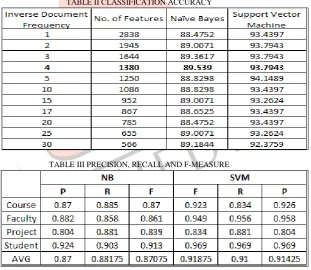
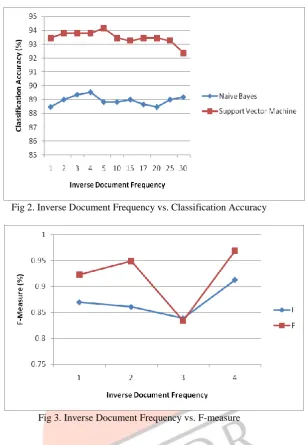
Different Inverse Document Frequency values were experimented. Table II shows the classification accuracy of NB and SVM algorithms with different values of Inverse Document Frequency and corresponding number of attributes. The table shows that the maximum result obtained for both algorithms, is with Inverse Document Frequency 4. The Inverse Document Frequency vs. Classification Accuracy and Inverse Document Frequency vs. F-measure graphs are shown in Fig 2. and Fig 3., respectively. Table III shows Precision, Recall and F-measure values for Inverse Document Frequency value 4.
TABLE II CLASSIFICATION ACCURACY
TABLE III PRECISION, RECALL AND F-MEASURE
Category 1 Category 2 Classified as 1 True Positive False Positive Classified as 2 False Negative True Negative
Precision = True Positive True Positive + False Positive Recall = True Positive
True Positive + False Negative F-measure = 2 * Precision * Recall
IJEDR1501081
International Journal of Engineering Development and Research (www.ijedr.org)447
Fig 2. Inverse Document Frequency vs. Classification Accuracy
Fig 3. Inverse Document Frequency vs. F-measure VII. CONCLUSIONS
Web page classification with html tag and inverse document within each tag - combination as features classifies web pages more accurately. Naive Bayes classifier performs the classification with 89.54 % accuracy, while Support Vector Machine performs classification with 93.79%. Thus it is concluded that Support Vector Machine is good for web page classification with combination of html tag and Inverse Document Frequency as feature. This work classifies web pages of four categories course homepages, faculty homepages, project pages and student homepages. Thus it can be used for developing educational universities' catalogs. This catalogs provides users categorized view of information and is more effective for users to find desired information. So Users of universities can easily find information about course, faculty, project and students, which might be a tedious task otherwise as it requires going through all information. Also building such catalogs manually require lot of human effort.
VIII. FUTUREWORK
In this dissertation work, the web pages are classified into four categories, course, faculty, project and student. Thus it can be used for developing, maintaining Educational Universities' catalogs, which can be expanded by including more categories such as, Department, Event, staff etc. As this work is related to classification of educational web pages, analyzing them specifies the fact that most web pages contains copyrights and various images as noise. These are usually specified using <span> or <font> and <img> tags, respectively. As these tags are not considered for feature extraction, noise is somewhat removed but not completely which can be further improved. A small set of tags is considered for feature generation. META tags, images, scripts etc. are not considered which can be included. The Feature selection method which has been used for this dissertation work is Inverse Document Frequency. Other methods such as Term Occurrence number, Term frequency (TF), Document frequency (DF) can be used.
ACKNOWLEDGEMENT
IJEDR1501081
International Journal of Engineering Development and Research (www.ijedr.org)448
REFERENCES[1] Xiaoguang Qi and Brian D. Davison, “Web Page Classification: Features and Algorithms ", ACM Computing Surveys, Vol. 41, No.2, Article 12, 2009.
[2] Gabriel Fiol-Roig, Margaret Miro-Julia, Eduardo Herraiz,"Data Mining Techniques for Web Page Classification” , 2011. [3] Selma Ayse Ozel,”A Web page Classification System Based on a genetic algorithm using tagged-terms as feature”, In:
Journal On Expert System Applications 38(2011)3407-3415.
[4] Porter, An algorithm for suffix stripping. Program, 14(3), 1980, 130-137.
[5] Jiawei Han, Micheline Kamber and Jian Pei, Third Edition, Data Mining Concepts and Techniques.
[6] Arul Prakash Asirvatham, Kranthi Kumar. Ravi," Web page classification based on document structure", Awarded second prize in National Level Student Paper Contest conducted by IEEE India Council, 2001.
[7] Myungsook Klassen, Chenxiao Wang,"Search Web Page Classification Using Form Structural Characteristics", 24th International Conference on Computers and Their Applications in Industry and Engineering (CAINE), 2011.
[8] Chih-Ming Chen, Hahn-Ming Lee, Yu-Jung Chang, "Two novel feature selection approaches for Web page classification", Expert Systems with Applications 36, 2009, 260-272.
[9] Zakaria Suliman Zubi, "Using Some Web Content Mining Techniques for Arabic Text Classification", Recent Advances on Data Networks, Communications, Computers, ISSN: 1790-5109.
[10]D.Navadiya, M.Parikh, R.Patel,"Constructure Based Web Page Classification”, International Journal of Computer Science and Management Research, Vol 2, Issue 6, June 2013.
[11]Victor Fresno, Raquel Martinez, Soto Montalvo, Arantza Casillas,"Naive Bayes Web Page Classification with HTML Mark-Up Enrichment", In proceeding of: Computing in the Global Information Technology, 0-7695-2629-2/06, 2006 IEEE. [12]M.Indra Devi, Dr.R.Rajaram, K.Selvakuberan, “Automatic Web Page Classification by combining Feature Selection
Techniques and Lazy Learners”, IEEE 2007.
[13]https://www.wiwi.hu-berlin.de/professuren-en/quantitativ/wi/forschung-en/dwm/standardseite-en.
[14]Tamanna Bhatia, “Link Analysis Algorithms For Web Mining", International Journal os Computer Science and Technology, issue-2, June-2011.
[15]http://searchsoa.techtarget.com/definition/stop-word.
[16]Jonathan Elsas, "HTML Tag Based Metrics for use in Web Page Type Classification", 2004.
[17]M. A. Shah, Dr. S. M. Deshpande, "Web Page Classification Based on Document Structure without Negative Examples", International Journal Of Computer Science And Applications Vol. 1, No. 1, June 2008
[18]Zakaria Suliman Zubi, "Using Some Web Content Mining Techniques for Arabic Text Classification", Recent Advances on Data Networks, Communications, Computers, ISSN: 1790-5109.
[19]Deng Cai, Shipeng Yu, Ji-Rong Wen, Wei-Ying Ma, "VIPS: A VIsion based Page Segmentation Algorithm",July-2004. [20]Deng Cai, Shipeng Yu, Ji-Rong Wen, WeiYing Ma,"Improving Pseudo- Relevance Feedback in Web Information Retrieval