i ABSTRACT
The outbreak of Ebola virus disease (EVD) in West Africa from 2013 to 2015 illustrates
the most recent example of the United States' growing need for domestic preparations for
emerging infectious diseases. One case of Ebola presenting in the U.S. exposed weaknesses
in federal and state level hospital preparations, employee protections, and screening,
prevention, and surveillance protocols. In disaster preparedness federal entities such as the
Centers for Disease Control (CDC) and key leaders of health care organizations are expected to
strike a balance between disseminating timely information to train and protect workers and
patients with appropriate resource utilization; a difficult task especially in the current national
health care climate that demands value and cost effectiveness. Around the nation hospitals took
various approaches for Ebola preparedness, often in a non-systematic or un-regulated manner.
Late in the Ebola outbreak, regional tiered response systems called Ebola Treatment Facilities
or Centers (hereafter called ETFs) were introduced as a federal policy for the emergency
response.
This study used interviews with key decision makers or stakeholders from the UNC
Health Care System (Chapel Hill, NC) and the Public Health Department of North Carolina to
identify key themes in system leaders’ thinking about Ebola preparation and also about the
opportunity to pursue ETF status. Stakeholders emphasized that the experience of preparing for
Ebola was expensive but protecting the public and employees was a priority worth the
resources it cost. Ultimately, leaders in North Carolina declined ETF status mostly due to lack of
federal planning around the designation and lack of funding at the time. ETF designation did not
roll out clearly and went relatively untested as the outbreak overseas declined and screening
domestically increased.
A triangulation of careful review of the policy documents, interviews with key
ii
permits me to conclude that capitalizing on national and local Ebola preparations will require
that future federal disease preparedness policy better define the regionalized approach and
strengthen local collaboration; promote ongoing training and adaptable communicable disease
plans; and provide more and more consistently distributed funding for public health
iii ACKNOWLEDGMENTS
I wish to thank my stakeholder interview respondents for their participation, their
enthusiasm, and their advice, all of which has injected me with energy and enthusiasm for my
future career in Medicine and Public Health. I appreciate the interesting opportunities Dr. Jane
Brice put in front of me: she let me help with training, see a CDC site visit, and even play a
suspected patient with Ebola in a surprise drill.
I want to thank Dr. Tolleson-Rinehart for a year of wisdom, expansion, and fun. After an
ominous invitation to her office to discuss my first disastrously written policy paper, I was
surprised to find an ally and an educator who genuinely invests in people’s development. Her
guidance and support early on changed my attitude and desire to improve my skills in the Public
Health program. This year has expanded my curiosity and abilities beyond measure. I
appreciate her encouragement but also refinement as a fellow Socratic thought wanderer.
I want to thank my husband, Dustin, for encouraging me to pursue this degree and
supporting me unwaveringly whether in person or from over 6,000 miles away. I will never forget
the times I felt overwhelmed and unexpectedly received a rousing historical lecture from his
experience as an Army Captain and history major. I will now always associate the trials and
failures of the young officer, Winston Churchill, with my struggles with biostatistics, and I truly
appreciate how quickly history puts my diminutive “trials” in perspective.
iv
TABLE OF CONTENTS
ABSTRACT ... i
ACKNOWLEDGMENTS ... iii
TABLE OF CONTENTS ... iv
INTRODUCTION ... 1
Research Aim and Hypotheses ... 2
BACKGROUND ... 4
Setting the Local U.S. Stage ... 4
Decision Makers Ability to Promote Safety ... 6
Ebola Treatment Facilities: A New Model for Emerging Infectious Disease Care in the U.S.? ... 7
What Sets an ETF Apart ... 8
ETF Hospitals: Volunteering Nobly or With Favors in Mind ... 10
Centralized, Designated Facilities – A New Idea ... 13
New System Thinking for New Disease ... 14
Preparing for Emerging Infectious Diseases: Through the Lens of Ebola ... 16
METHODS ... 17
RESULTS ... 21
Federal or Local Responsibility to Lead Preparations ... 21
Expert Knowledge for Initiating Preparations... 23
Other Disease Comparisons ... 25
Media and Perceived Response to Ebola ... 26
Ebola Treatment Facilities and North Carolina ... 28
The Ebola Treatment Facility Designation Role in Response ... 32
Government Funding ... 33
Overspent, Overconsumed, Overtrained ... 35
Additional Positives of Preparation ... 37
CONCLUDING RECOMMENDATIONS ... 42
Policy Recommendations ... 42
REFERENCES ... 47
APPENDIX A. Systematic Review ... 54
v
APPENDIX B. Stakeholder Interviews ... 59
APPENDIX C. Interview Protocol and HCW Survey ... 60
Qualtrics Web Survey for ED HCWs ... 65
Figure 1. CDC Infographic of Tiered Response for Ebola ... 69
Figure 2. United States Map of 55 ETFs Designated as of Feb. 18, 2015 ... 70
Figure 3. CDC Infographic Public Health Emergency Preparedness Funding ... 71
Figure 4. Hospital Preparedness Program Funding History from Huffington Post ... 72
Figure 5. UNC Hospital System Organizational Chart for Ebola Response ... 73
Table 1. 55 Nationally Designated Ebola Treatment Facilities as of Feb. 18, 2015 ... 74
Table 2. Ebola Funding Streams from ASPR and CDC ... 76
Table 3. Emergency Department HCW Demographics and Ebola Training ... 77
Table 4. Emergency Department HCWs Attitudinal Agreement to UNC Site Ebola Preparations ... 78
Table 5. Emergency Department HCWs Attitudinal Agreement to Broader National and International Ebola Preparation ... 79
Table 6. Rating of Variables in viewpoint change, Training Level, and Index of change scores by occupation ... 80
1
INTRODUCTION
The outbreak of Ebola virus disease (EVD) in West Africa from 2013 to 2015 illustrates
the most recent example of the United States' growing need for domestic preparations for
emerging infectious diseases. One case of Ebola presenting in the U.S. exposed weaknesses
in federal to state level hospital preparations, employee protections, and issues in screening,
prevention, and surveillance (Gostin, Waxman, & Foege, 2014).
As seen in prior infectious disease outbreaks, front line health care workers (HCWs)
occupy key roles and take on special risks associated with those duties in response to infectious
disease control. Many variables contribute to employees' willingness and readiness to respond
to infectious disease outbreaks such as SARS or influenza. Health care and public health
workers’ perceptions of their ability to recognize and treat disease can be affected by the
atmosphere of the employing organization. Well-functioning health care teams are important for
managing disease outbreak successfully. Organizations such as hospitals and federal entities
such as the Centers for Disease Control (CDC) can do their best to disseminate timely
information to train and protect these workers.
Certain stakeholders’ decisions in health care organizations influence the deployment of
preparedness training to employees, which is then translated into care provided to patients.
Major decisions in health care arise out of a complex interplay of social, political, and financial
climates. For disease outbreaks such as Ebola, early information may not be peer-reviewed,
established as best practice, or evidence-based (Love, Arnesen, Phillips, 2014). Common
themes in regional reviews of disaster planning include education, training, and communication
within the health care system as well as practice with “operationalized” training, drills, and
2
very time intensive and costly. System leaders must choose the appropriate level of resources
to devote to preemptive action on specific diseases or other threats.
Ultimately, even when disasters are averted, and preparation for them goes unused or
untested, those preparations can still have considerable value. A difficult balance must be
struck in disaster preparedness especially in the current national health care climate of
demands for value and cost effectiveness. Disaster preparedness lags in moving away from the
reactionary response that our $2.9 trillion health care system still favors and toward a future
goal of prevention and preparation readiness (Koenig and Schultz, 2014; McGill, 2014; Reeve,
Wizemann, Eckert, Altevogt, 2014). Identifying key themes in stakeholder thought processes as
well as probing employee perceptions can inform how reproducible or appropriate these actions
might be for future disaster or outbreak scenarios. Recent Ebola preparations are a test of the
system, and analysis of that test can be parlayed into improved response and safety for
employees and the public the next time we are faced with an emerging infectious disease
outbreak. This study provides such an analysis.
Research Aim and Hypotheses
AIM 1: Evaluate the degree to which HCWs consider training and attention to a specific disease
to be an effective use of the organization's time and resources.
Hypothesis 1: The organizational communication and emphasis on training HCWs on
basic Ebola facts, safety precautions, and hospital plan for suspected Ebola will improve
the HCWs' understanding of the disease and their effectiveness and readiness to
respond.
AIM 2: Interview stakeholders who made key decisions for UNC Hospitals' organizational plan to
respond to Ebola to clarify what influenced the organization's choices in preparing for a potential
3
1. Was there a clear top-down message about preparation strategies from federal to state to the
local site?
2. Was this disease treated any differently than were other emerging infectious diseases in the
past and, if so, why?
3. How does dwindling funding for public health and disaster preparedness affect the
organization's willingness to respond?
4. How much does funding determine the level at which to stop preparations?
5. What benefit does the organization get from engaging in disease specific preparations?
6. Has this preparation had drawbacks for the organization's other priority needs and resource
constraints?
7. Can stakeholders identify why ETF designation did not make sense for their organization in
North Carolina while it made sense for others?
Hypothesis 2: Key stakeholders at the organizational level will identify certain points of
effectiveness and contention in the preparations for Ebola at their site. They will mention
differences in federal recommendations and ability to provide assistance in preparing for
Ebola. Organizations will likely have taken a proactive but site-specific approach in their
preparations because of the high profile nature of the disease. Stakeholders will
emphasize weighing the benefits of preparing for Ebola. For example, we predict that
stakeholders will emphasize that the experience has likely been expensive for the
organization but that protecting the public and employees will be seen as a priority worth
4
BACKGROUND
Setting the Local U.S. Stage
On October 27, 2014, Thomas Duncan presented to a Texas hospital in the United
States, bringing with him the first in-country diagnosed case of Ebola. His arrival, though a
surprise to Dallas Presbyterian Hospital, was not entirely unanticipated, as the United States
(mainly from the CDC) had deployed information about Ebola virus disease since the summer of
2014. However, despite dissemination of information, the hospital and the nation were not ready
to provide the safest and most effective care to both him and the staff who took care of him. The
fallout from Duncan’s hospitalization included his death and the infection of two nurses from his
care team, as well as consequences to the hospital’s reputation and finances.
Misinformation swirled in the national media with contradictory statements about
appropriate safety techniques employed by the hospital, the infectious condition of the nurses,
and whether one of the nurses could travel in the incubatory stage of her disease. The first
nurse infected with Ebola from Duncan’s case, Nina Pham, cited improper safety protocols and
a breach in her privacy while she cared for Duncan and contracted Ebola. She sued Texas
Presbyterian hospital describing her case as “a symbol of corporate neglect - a casualty of a
hospital system’s failure to prepare for a known impending medical crisis,” while officials called
her infection “a breach in protocol” rather than explaining problems with the protocols (Emily,
2015). The second infected nurse, Amber Vinson, called the CDC before she took a commercial
flight and before she exhibited any fever or signs of disease. She had been cleared to fly but
after developing a fever and testing positive for Ebola CDC director Tom Frieden made a
statement that she should not have traveled. The CDC later acknowledged that she had done
nothing wrong, but not before alarming the public that a plane-load of people could have been
5
RoseAnn DeMoro Executive Director of the National Nursing Union, and Kristin
Stevens, a health care emergency management expert, in separate interviews, both felt the
hospital and the CDC reacted first to blame the HCWs rather than own up to deficient protocols
and training (National Nurses United, 2014; Moskowitz, 2014). The fear ratcheted upward, for
both laypeople and HCWs concerned for their safety. The Ebola epidemic demanded that health
systems and hospitals plan for how they would deliver safe and effective care.
HCWs on the front lines closely tuned into the Ebola coverage knowing they might
encounter a suspect or confirmed case in their daily job. The African outbreak dramatically
illustrated the risk of caring for Ebola patients, with more than 50% of infected HCWs (494 of the
853, as of March 25th, 2015) dying from the disease (World Health Organization, 2015). A
survey of 1,058 U.S. clinician visitors to the website Medscape in September and October
reported 49% of the visitors worried about contracting Ebola at work. A majority of clinicians,
63%, felt their clinical site had prepared to treat a patient presenting with Ebola symptoms.
However, 55% felt the nation was not prepared to respond to an outbreak of Ebola. Clinicians
felt more confidence about their site preparations than the nation’s preparations (Goodman,
2014). From September to October, the Registered Nurses Response Network, part of the
National Nurses United union, surveyed nearly 3,000 registered nurses in 1,000 facilities in all
50 states and Washington DC to find 84% said they had not received education about Ebola
including how to interact with and question a suspected case, and 76% had not received any
communication about their hospital’s policy for admitting Ebola patients. Many reported
concerns about safety controls such as personal protective equipment (PPE) availability,
isolation rooms, and disposal of contaminated items (National Nurses United, 2014). Though
major differences exist between the health care systems in Africa and the United States, U.S.
HCWs recognized that their safety was not assured against the virus despite working for
6 Decision Makers’ Ability to Promote Safety
A positive safety climate, for both patients and HCWs, helps health systems provide safe
care. These themes can then be elaborated upon during more advanced epidemic planning.
Gershon et al. established six fundamental dimensions for positive safety climate in the health
care system: (1) supportive senior management for safety programs; (2) absence of barriers in
the workplace to facilitate safe work practices; (3) cleanliness and orderliness of the work
environment; (4) minimal conflict and good communication between staff and team members;
(5) supervisors providing frequent safety-related feedback and training; and (6) access to PPE
and engineering controls such as appropriate isolation spaces (2000). All in all, achievement in
each of these domains showed positive effects on HCWs’ rate of exposure incidents and
improved HCWs’ compliance to blood borne safety protocols (Gershon et al., 2000). These
fundamental dimensions are not new or unusual: they are the basic tenets of typical every day
hospital operations that create a foundation of safety for patients and HCWs.
As seen with Gershon’s safety dimensions, senior hospital officials and health care
leaders play important roles in fostering safety for their workers and their patient clientele. The
risks and costs of preparation for and treatment of Ebola weighed even heavier than usual
safety operations. Capturing local hospital system decision making and then zooming out to the
national level proves an interesting exercise in how these systems work together and what
types of policies work best to promote preparedness. In the case of Ebola, system leaders had
to decide what level of resources to dedicate to training and purchasing of supplies at the
institutional level in collaboration with their surrounding public health departments, and judge the
risk to the populations in their catchment areas. The tradeoff for a deadly, unique viral disease
was between over-preparing which required more money, time, capacity, and staff morale, and
underpreparing, thereby risking the safety of patients and employees, as seen in the Dallas
7
strapped for resources. Ultimately, the decision point was reframed for hospital and state
decision makers by somewhat diffuse federal policy, when the US Department of Health and
Human Services (HHS) charged the Centers for Disease Control and Prevention (CDC) with
creating an ”Ebola Treatment Facilities” designation and invited health systems to seek such a
designation. Health system leaders then had to decide either to pursue the next level of
emergency response for Ebola, or remain where they were, capable of screening or
assessment of Ebola.
Ebola Treatment Facilities: A New Model for Emerging Infectious Disease Care in the
U.S.?
In October 2014, the Department of Homeland Security’s Customs and Border
Protection and the CDC determined that 94% of travelers from Guinea, Sierra Leone, and
Liberia would arrive through the five international airports: New York’s JFK, Washington-Dulles,
Newark, Chicago-O'Hare, and Atlanta, so these locations initiated additional screening
measures for Ebola (CDC, 2014). At the outset, this policy appeared to strengthen the riskiest
entry points at which travelers from Ebola endemic countries might appear first. On December
2, 2014 the HHS declared 35 hospitals had been designated as Ebola Treatment Facilities
(ETFs) to better serve these areas of screening for Ebola (U.S. Department of Health and
Human Services, 2014). To date (July 1, 2015) a total of 55 ETF’s have been designated, not
representing all states, often times overlapping with multiple centers in the same state or city
(CDC, 2015b).
Figure 2 about here
How were these ETFs in such quantity and distribution intended to fill the needs of the
nation in preparing and caring for the Ebola epidemic? As the epidemic has evolved and slowly
8
approaching disease outbreaks, and what will this mean for future outbreak planning? As I
analyze the policy to determine whether it will be the right guide for future preparation, how
facilities received these ETF designations, what motivations spurred the hospitals or various
agencies to pursue such notice, and how this entire process compared to infectious disease
responses of the past must be asked.
What Sets an ETF Apart
A special assessment team from the CDC began visiting hospitals around the country in
the fall of 2014. The team was meant to evaluate and provide recommendations about
hospitals’ Ebola specific operations and plans (U.S. Dept. HHS, 2014). Voluntariness was
central to this process; hospitals and state health officials both had to invite the CDC team and
consequently decide whether they would pursue ETF status following the CDC site visit. The
CDC did not designate ETFs but merely assessed them: even hospitals who had prepared
adequately for Ebola and received positive assessments of their preparations by the CDC, had,
in collaboration with state health officials, to deliberate on whether to become an ETF. How
these joint decisions played out across different states is not widely reported, since it happened
in institutional- and state-level discussions rather than in a systematic national forum. Messages
from federal bodies about where these ETFs “should” occur were not public either because
there was no such plan or because any plan was intended for a specialized audience of hospital
and state decision makers only. For the most part the record contains only press releases when
hospitals and states agreed to declare ETF status. Less is published or discussed about why
institutions would not want to become ETFs, though a myriad of reasons such as limited
resources, uncertainty, risk, and higher priorities are probably at work.
Not having ETF designation does not relieve hospitals from expectations to prepare for
9
encountering a suspect Ebola case and in January it published an interim guide for a “tiered
response” illustrating three tiers. Specialized biocontainment units, Biosafety Level 4 Labs
(BSL-4), consist of the most trained, experienced units and are located in Maryland, Emory,
Nebraska, and Montana. These have been in existence for more than a decade and are
specialized laboratories for defense and military research. Interestingly, the Montana St.
Patrick’s biocontainment unit declined to be included as a transfer facility for Ebola patients.
Their Care and Isolation Unit (CIU) was contracted with the National Institutes of Health to care
for employees who might be exposed to deadly pathogens at the nearby Rocky Mountain Labs.
The St. Patrick’s spokeswoman stated “Nothing in the contract indicates that by having a CIU
St. Pat’s would serve as a component of a national emergency response network” adding that
“we stand ready to take and fully treat a patient from the communities we serve in the event it is
deemed appropriate to do so by all parties involved” (Chaney, 2014). The other biocontainment
units did appear on the CDC ETF list and did receive transferred patients.
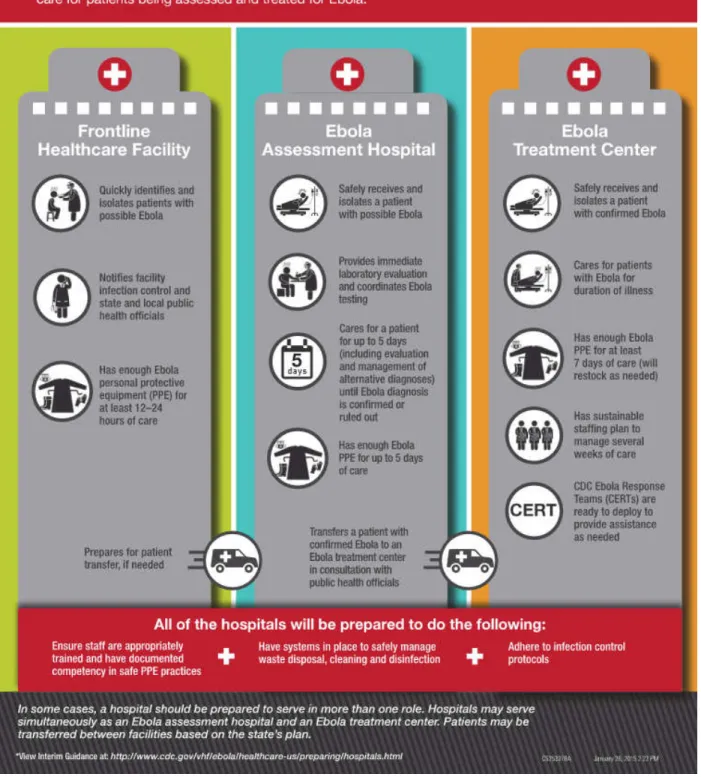
On the CDC’s health care infographic, as seen in Figure 1, ETFs exist at the top of the
tier (though implicitly located below biocontainment units) with capabilities to receive, isolate,
confirm, and care for a patient with Ebola. Additionally, ETFs must have enough personal
protective equipment (PPE) available to provide seven days of full patient care and have staffing
models capable of providing dedicated Ebola care for several weeks. The level below an ETF,
an Ebola Assessment Hospital, provides the same services as an ETF, however, has only five
available days of PPE stocked, and is not expected to provide definitive, intensive care but must
be able to provide care in the several days it takes to diagnose or rule out Ebola. The Frontline
Healthcare Facility represents the lowest tier; essentially these hospitals are expected to
identify, isolate, and notify other facilities of potential cases and manage 12-24 hours of the
10
It should be apparent that Ebola Assessment Hospitals take on significant expectations
to provide care, just short of those of ETFs. While the guidelines suggest transfers be in place
between tiers, the length of time before transfer can be initiated and which facility will take the
transferred patient is not specified and left to local negotiation. “Local” may be relative and the
distribution of higher tier facilities, which will be discussed in a later section, means transferred
patients may be crossing state lines. No jurisdiction exists to keep hospitals from attempting to
“dump” a patient quickly from lower tiers to higher tiers. The stratification of hospitals based on
PPE availability is another interesting change in guidance by the CDC: it likely stemmed from
hospitals’ budgetary and supply chain issues acquiring gear through the fall. Based on this
information, the status of becoming an ETF must be weighed against the extra level of
responsibility, responsibility which is not clearly defined or bounded.
ETF Hospitals: Volunteering Nobly or With Favors in Mind
Scrutinizing the distribution of ETF units raises questions beyond those about the HHS
initial logic of co-locating these facilities near international travel centers (seen in Figure 2 and
listed in Table 1). The 55 ETFs, which include 3 of the 4 biocontainment units, are in 19 states.
Sixteen hospitals are located within 50 miles of the five most likely international airports to
receive travelers from West Africa. Twenty-nine ETFs are co-located in a city with at least one
or more other ETFs. Nine hospitals appear to be specifically pediatric hospitals. Fairly low
volume international travel states like West Virginia, Pennsylvania, and Wisconsin have ETFs,
and the latter two have multiple sites. Dallas, Texas which suffered the only traveler to present
de novo with Ebola to a hospital does not have an ETF; the 2 Texas ETFs are in Houston and
Galveston. However, entire regions such as the South below Virginia and East of Texas, rely on
just one ETF, in this case, Atlanta, home of both CDC headquarters and the Emory
11
Table 1 about here
At least in publicly available and searchable information, I have found no reports that
include an estimated number of cases of Ebola that might be treated in the United States, nor
where hot spots for critical areas might be aside from the 5 international airports, nor why
establishing numerous hospitals for treating children might be expected. Although we can
generate reasonable hypotheses about why particular facilities overall sought and received the
designation, no clear rationale appears for why certain states and hospitals would opt in or out
of getting this special recognition. The outbreak may have been estimated to be large with
significant local transmission within families or immigration of infected youth necessitating
hospitals that could specialize in care for critically ill children. Federal funding and prestigious
standing seem logical motivations for hospitals and state health officials to pursue ETF status
which might be the alternative explanation for the pediatric powerhouses becoming ETFs.
However, if those were clear motivators at the outset of ETF designation, the competition
between states and regions would probably reflect this, and a more even geographical
distribution might be achieved.
Given how much the public feared Ebola, hospitals might also have wished to capitalize
on ETF designation to assure good public image. Following the mishaps of the Dallas
Presbyterian case -- the infection of nurses and the eventual death of the patient – many
hospitals may have wished to assure their communities that they had done their due diligence.
By having ETF status the hospital can claim the CDC had checked them and that they were
seemingly superior in their preparations to other institutions. However, the hospital and state
also must be so brave as to mark itself as a place that could receive Ebola patient transfers
from other less well-prepared hospitals. This move obviously exposes the institutions to
significant risk from the public, since many people in the general population do not like to
12
health needs. The balance between public reward and public risk for a hospital seems a very
delicate one, meaning that another strong variable like potential federal funding must have
helped nudge institutions to take on that risk.
Deciphering the question of grants or funding enticements proves tricky. The time line of
most hospital preparations occurred well in advance of any additional approval of funding and
certainly well before promises and disbursements could be made. However, in a time span of
several months funding valves were turned on, and only now are the results starting to trickle.
Katie Schemm, the Senior Program Analyst of the National Association of County & City Health
Officials Preparedness Division, broke down the various additional funding streams that had
developed for Ebola by December to late January; that breakdown appears in Table 2.
Congress approved the largest amount $5.4 billion dollars, a portion that would go to domestic
federal agencies. Additional funding released by the CDC will help health departments
performing active monitoring, laboratory surveillance, and preparedness activities through
supplemental Hospital Preparedness Programs (HPP) and Public Health Emergency
Preparedness (PHEP) grants. Areas around the international enhanced screening airports and
those health departments implementing tiered system response coordination receive extra
allowances (Schemm, 2015).
Table 2 about here
The HHS confirms that all U.S. states will receive supplemental HPP grants, but those
taking care of actual Ebola patients and those designated as ETFs will receive more (U.S. Dept.
HHS, 2015). Meanwhile, Senators and hospital administrators alike expect that ETF designation
regardless of actual disease deserves higher levels of funding (Almendrala, 2014). Hospitals
13
happen and taken the risks of seeking designation accordingly. Now they must wait to see if the
funding will be realized.
While Congress injected one-time emergency appropriations into the system to help
support Ebola preparations, it hardly touches the budget cuts to baseline sustainment PHEP
and HPP funding. Figure 3 shows how funding has waned for Public Health Emergency
Preparedness Cooperative Agreement over the past decade which weakens the foundation of
our responses in the future (CDC, 2015c). The Hospital Preparedness Program (HPP) grants
have also dwindled to 50% of amounts approved in 2003, as seen in Figure 4, hurt even further
by sequestration events that have kept appropriated funds from flowing to hospitals and states
(Stein, 2014).
Figure 3 about here
Figure 4 about here
Centralized, Designated Facilities – A Different Idea
The approach of designating specific hospitals for Ebola treatment has little precedent in
21st century outbreaks of disease in the U.S. Current literature and news briefs do not explain
the rationale for why it was deemed appropriate to designate special ETFs, but one can
envision several reasons why this made sense to senior leadership at the time. The nation had
expectations about how bad Ebola would be, though not always based on reality, and with such
a strong reaction perhaps policymakers decided to respond strongly with clear signatory titles
for Ebola-capable hospitals. Ebola got special attention from the media, including portrayal in a
major film, Outbreak. As a filovirus and hemorrhagic disease, Ebola differs biologically from
common North American viruses, which are usually spread via the respiratory system, so it has
14
out that in this epidemic massive fluid loss and dehydration from diarrhea and vomiting leading
to organ failure have killed a majority of the victims (Lamontagne et al., 2014). No matter the
mechanisms of harm, the imagery of Ebola proves far more compelling than how most
Americans envision other typical, sometimes deadly, respiratory viruses.
Xenophobia and fear of a virus not endemic to North America and from the remote
forests of Western Africa also played roles in national perception of the disease and perhaps
motivated the desire to designate ETFs. Following public fear, politicians sometimes felt
compelled to action, for example by mandating extra quarantine rules above federal guidelines
such as those in New York and New Jersey (Gostin, 2014). This same logic might have induced
certain state-level politicians to promote or resist local hospitals’ ETF status. A hospital’s ETF
status can display readiness to the public, however, with an actual sick patient it also allows for
the possibility for risk, failure, and “Not In My Backyard” public backlash given the fears about
the African virus. Following the death of their patient and infection of two nurses, the Ebola
scarlet letter affected Dallas Presbyterian’s patient volume and revenues (Asbury Park Press,
2014; Moskowitz, 2014). Again, national funding probably could provide the requisite amount of
incentive to get over the narrow margin between political and public support and opposition, but
how these conversations or potential promises were conveyed to politicians is not clear.
New System Thinking for New Disease
The decision to approach Ebola preparedness by designating treatment in certain
facilities departs from 21st century outbreaks and disaster planning but might resemble 19-20th
century precedents like tuberculosis and polio hospitals. The drama of Ebola and early
projections for the size of the epidemic might have instigated the epidemic and disaster planning
world to make a large leap in response by pursuing this designated, isolation hospital plan.
15
greater preparation of the health care system for treating mass casualties, dealing with surge
capacity, and identifying bioterrorism (Koenig and Schultz, 2014; Weber, Bottei, Cook, and
O’Connor, 2004). Both outbreaks of pandemic respiratory viruses, Severe Acute Respiratory
Syndrome in 2003 and H1N1 in 2009, spurred health care systems to start considering how to
mitigate risk of potentially highly contagious disease in large volumes of patients. For SARS this
entailed the establishment of special units within hospitals with special staff and special
protective gear which was recommended by the CDC for use whenever possible (CDC, 2005).
The establishment of off-site, somewhat isolated centers for providing vaccination and
screening also took hold. This provides some background for the idea of advanced planning to
separate certain epidemic diseases from normal populations in the hospital. However, there was
no formal “designation” of hospitals that created these units, unlike the ETFs for Ebola.
Various system elements may be pushing toward approaches of consolidation and early
identification of key players for response. Budget cuts in recent years to local health
departments, public hospitals reliant on declining state support, and tightened NIH and CDC
funding might make it desirable to broadcast which hospitals have stockpiled the supplies and
trained staff to take care of resource-intensive Ebola. The question remains, however, why it
was believed that biocontainment units would not be enough to treat and support confirmed, ill
patients with Ebola, given their years of experience and specialist training in rare, highly
contagious diseases. Instead of designations of new facilities as ETFs, could greater resources
be spent in creating catchment and shoring up transfer plans to the biocontainment centers?
Experts reported to national news outlets that the biocontainment units could provide care for up
to 11 patients, though it was uncertain whether this number could be cared for concurrently
(ABC News, 2014). Seasoned U.S. biodefence researchers like Dr. Mark Kortepeter suggest
that the biocontainment center’s limited number of beds and staff required to take care of
16
other major medical centers (Kortepeter, Smith, Hewlett, and Cieslak, 2015). He makes a point
of saying these units should be developed as national resources not just for Ebola but for future
outbreaks as well.
Preparing for Emerging Infectious Diseases: Through the Lens of Ebola
Around the nation hospitals took various approaches to deal with potential Ebola, but
they did not do so in a systematic or regulated way. The absence of a systems approach has
harms and benefits: not all hospitals had the same risk, the same resources, or the same
culture of doing things. Biocontainment units and hospitals close to large international airports
likely took their preparedness precautions seriously with training and drills. However, many
hospitals around the rest of the United States may have only disseminated emails or flyers to
alert staff to screening or risk of Ebola, based on their lower perceived risk. The test to the
system in Texas proved a failure and could have presumably happened to many other hospital
systems with the same results. Retrospective analysis of nationwide hospital preparations could
prevent mistakes in the future. In general, we do not know how hospitals prepared nationally but
we can analyze the deployment of federal policy designating ETF hospitals. Key stakeholders
can provide insight into how local decisions were made as well as inform our understanding of
their view of this ETF policy roll out. Information from study of policy and the published
literature, the understanding of key stakeholders, and the perspectives of frontline health care
workers as measured in surveys can help us understand how future epidemic preparedness
17 METHODS
Study Design and Participants:
The present study includes collection of data from two sources:
1. Web survey: Cross sectional, anonymous web-based survey distributed to UNC health
care workers (HCWs) who are members of the Emergency Department staff, including
physicians, nurses, nursing assistants, security personnel, and health unit coordinators
(clerical staff). The web survey was conducted between March 25 and April 23, 2015.
2. Non-random, descriptive interviews conducted in person between April 16 and May 8,
2015 with key stakeholders and decision makers at UNC Health Care, a large, public
academic medical center.
Respondents were two mutually exclusive groups: interview respondents did not complete the
survey, and survey respondents were not interviewed:
1. Web-based survey respondents: Up to 260 HCWs working in the UNC Emergency
Department were invited to participate in the web-based survey, and 151 participants
fully completed the survey, with 159 completing at least part of the survey. See the
Methods Appendix C for the survey questions and Table 3 for a description of survey
respondents.
2. In-depth interviews with stakeholders/policymakers: Six key stakeholders representing
UNC Hospital Systems leadership, UNC Disaster Planning, and the State Public Health
and Disaster Planning sections were invited to participate, with one unable due to
scheduling, and 5 completing in-depth interviews. Interview Protocol and Questions are
in Appendix C.
18
1. Web survey inclusion criteria: Any employee of UNC Health Care System for any
number of hours in one of the health care setting's emergency medicine divisions,
working in any health care field, including support roles, security, and organizational
staff, was eligible to participate. The only exclusion criteria were respondents not
working for UNC Health Care or those unwilling to participate.
2. Key stakeholder in-depth interview inclusion criteria: respondents had to be identified by
the investigators as a person in a system leadership position with organizational or
expert knowledge. The only exclusion criterion was unwillingness to participate. Figure 5
shows UNC incident command operations table of key individuals and those interviewed
for this project during the Ebola response.
Recruitment
1. Web Survey: The investigators distributed a link to the web survey to Emergency
Department staff via work emails with the help of an "honest broker” with access to this
email list so that respondents would remain unknown to the researchers. The email
message explained the nature of the study briefly and noted that participation is
voluntary. The first screen of the survey sought respondents' willingness to continue the
survey. Clicking "I agree to participate" was accepted as consent. One week after the
initial email message about the availability of the web survey, a reminder email was sent
by the "honest broker" using the same email lists. The study was closed 3 weeks after
the initial invitation email. A problem reaching a particular subset of participants required
re-opening the survey and re-contacting the previous lists through another honest broker
to give all participants equal opportunity for participation. The re-opened survey was left
19
2. Stakeholder Interviews: Researchers identified and invited people who represented
UNC and state public health leadership. Participants were emailed and if they agreed,
they participated in a recorded in-person interview. Participants consented to be
recorded and have their names included in any publications, with any use of quotes to
be shared with them prior to submission. The in-depth interview protocol is presented in
the Methods Appendix C.
Data Analysis
Survey Results:
We captured basic occupational demographic information in the survey (but no personal
information), as well as answers to questions about respondents’ perceptions of the amount and
nature of their training. Because we had not had the opportunity to survey staff members before
training began, we used a “post then pre” design to gather HCWs’ attitudes about Ebola and
their competence to care for Ebola patients before and after their training. These attitudinal
questions tapped efficacy, threat, role responsibilities, willingness, organizational preparedness,
respondents’ assessment of contributions, and their general view of preparedness. In this study,
we present collapsed agreement and disagreement summary measures of the attitudes, and we
used Pearson Chi-square to compare respondent groups by occupation, years of experience,
amount of training, and the recentness of training. Likert scale responses were averaged or
summed to create a continuous variable which was then used in t-tests comparing different
groupings of respondents as well as pre- to post- training attitudinal statements. Multinomial
logistic regression analysis was performed to evaluate relationships between categorical
variables and attitudinal responses (data not shown). Investigators used STATA software
20
results from attitudinal statements will be presented in this paper, as they are most relevant to
stakeholder policy opinions.
Stakeholder responses:
We used standard policy analysis methods to evaluate stakeholder responses,
including triangulating themes and interconnections from prior literature, current trends in news
and public commentary, and expert opinion provided by multiple stakeholders representing
different aspects of health care institution decision making. The first author transcribed all
interviews then systematically coded them according to themes of policy decisions, disaster
preparedness, and leadership concepts. Stakeholders’ names, titles, and dates of interviews are
21 RESULTS
Survey Results
Of the Emergency Staff invited to participate, 58% participated and completed surveys
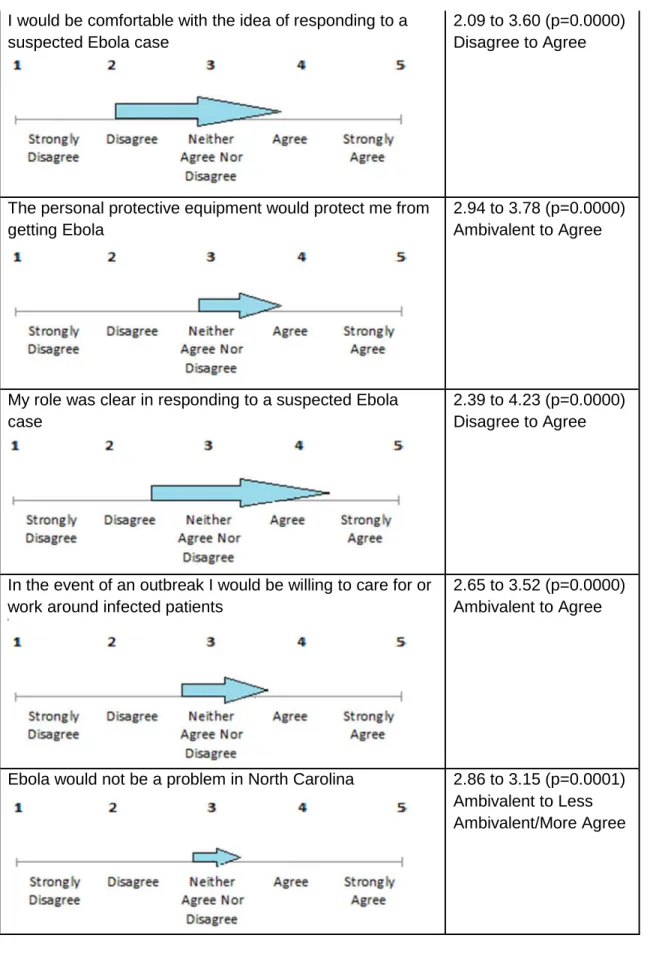
(N=151). Their baseline demographic and Ebola training characteristics are shown in Table 3.
Their perceptions of the Ebola threat and their preparedness for it, as well as their perceptions
of their own attitude changes before and after their training, can be seen in Tables 4 through 7.
Interview Results
The list of invited institutional leaders included Dr. William L. Roper, UNC Health Care
Chief Executive Officer; Dr. David Weber, UNC Medical Director of Hospital Epidemiology; Dr.
Julie Casani, Medical Director of the North Carolina Department of Public Health’s office of
Preparedness and Disaster Planning; Dalton Sawyer, UNC Health Care director of emergency
preparedness and continuity planning; Dr. Jane Brice, UNC Hospital Disaster Committee; and
Dr. William Fischer II, UNC Health Care critical care physician and Ebola researcher. Dr.
William Fischer II was unable to participate during the study period. The responses of all other
five interviewees follow.
Federal or Local Responsibility to Lead Preparations
In summer 2014, hospitals started developing their own protocols and plans to deal with
the threat of Ebola, often in advance of CDC recommendations. Whether this was due to the
vacuum created by lagging federal guidelines or hospitals feeling compelled to create their own
tailored plan for their individual risk and resources was not completely clear. All stakeholders
seemed to support both feelings and believed disaster preparations must happen both at local
22
However, some respondents felt federal authorities had more obligations to assist in the
preparations for Ebola. Dr. Roper firmly stated “I believe it’s the role of national experts to
distribute information in a timely fashion…they were slow to deal with Ebola and slow to offer
any resources…specifically grants to leading institutions” (Roper interview, 2015). The lag in
information was noted as being a major issue leading UNC and other hospitals to prepare in
their own ways. Dr. Brice believed that when hospitals create variable plans to deal with Ebola,
risky, fragmented care and endangered frontline workers could be more likely (Brice interview,
2015). Dr. Weber and Dr. Casani explained that the government can help by creating a
minimum standardization and “connectivity of plans,” the drawback being that it rarely happens
quickly because of the bureaucratic clearance process (Weber interview, 2015; Casani
interview, 2015). Despite some frustration, Dr. Brice did say that the CDC appeared to be more
responsive with disseminating information for Ebola than in previous epidemics like SARS
(Brice interview, 2015).
Other stakeholders argued that public health emergency response to public health
emergencies best originate at the local level. Hospitals feel responsible to their community and
“will prepare on their own before guidance comes out because they know they have to" and
luckily what makes sense to the hospital, logically tends to be close to the scientific guidelines
put forth by federal entities (Casani interview, 2015). Dr. Weber seconded this sentiment: he
said that at UNC "our goal was to always be weeks to months ahead of the CDC
recommendations” (Weber interview, 2015). He added that sometimes top down
recommendations even from the CDC do not make sense since those who create the
recommendations are not actively providing patient care; their recommendations may actually
be dangerous or un-implementable. For this reason experts at UNC reviewed everything rather
than accepting them blindly (Weber interview, 2015). Furthermore, Mr. Sawyer said, federal
23
localized response. They can send resources to us but it's more of an augmentation as opposed
to the whole local response” (Sawyer interview, 2015). Dr. Casani from her vantage point
summed it up this way: federal responses must be strategic while local responses must be
tactical, with hospitals being the most tactical and state public health services occupying the
middle ground (Casani interview, 2015).
Dr. Weber also used UNC’s local negotiations and discussions with the county water
authority to illustrate local vs. federal politics. The CDC said Ebola liquid disposal simply needed
to be disinfected with bleach prior to disposing into public sewer lines, however, the local county
water authority disagreed, therefore, UNC had to comply with local guidelines. “Neither the CDC
nor the federal government nor the state has any legal authority short of the president or the
governor declaring a national emergency to compel [the local water authority] to do anything”
(Weber interview, 2015).
Expert Knowledge for Initiating Preparations
Specifically at UNC, stakeholders felt they had the people and the experience as an
institution to pursue their own path of preparations rather than wait. Most of the UNC
stakeholders mentioned the strength of specific people who could expertly guide the system in
the process. Dr. Roper noted that we had “in-house experts” with national reputations, like Dr.
William Fischer II who had provided direct care for patients with Ebola in West Africa and Dr.
David Weber, expert and author on infection control. These “in house experts” could provide
superior guidance for the UNC preparations, he said (Roper interview, 2015). In emergency
preparedness and planning, Mr. Dalton Sawyer was cited by Dr. Brice as someone who has
been “embraced by hospital administration” for his “thoughtful preparedness efforts.” This
confidence on leadership’s part allowed UNC to follow his lead on responding to Ebola (Brice
24
11th in taking disaster preparedness training seriously – including, importantly, by providing
consistent funding for it (Brice interview, 2015).
From Dr. Weber’s perspective, as a hospital "we like to always be ahead of the game not
behind the game even now as an example, all our people have been trained.” He said that
UNC went beyond CDC guidelines early on and still exceeds them for training staff on basic
personal protective equipment (PPE), protocols for needle sticks or a breach of the PPE, and
how to clean a spill in an Ebola situation (Weber interview, 2015). Additionally at UNC, Dr.
Weber and his team had performed a study of contamination rates of PPE with a harmless
tobacco virus, and he provided this illustration of efficacy of PPE to the CDC a few years prior.
Knowing those results of high rates of contamination around hoods and hands, Dr. Weber
implemented a PPE protocol and 3 step training program at UNC that went beyond guidelines.
It included simulation lab work, educating and training workers on proper donning and doffing
practices, and attending to extra issues like cleaning spills (Weber interview, 2015). These extra
steps and expert knowledge put decision makers at ease that UNC could handle its
preparations for Ebola correctly.
Additionally, the extra attention UNC leadership focused on training was felt beneficial by
the front line health care workers in the Emergency Department who received it. All of these
staff, from doctors to security staff, received at least one Ebola training session headed by Dr.
Jane Brice and Dr. Emily Sickbert-Bennett of Hospital Epidemiology. The training sessions
included Ebola’s epidemiology, the UNC Emergency Department plan, test scenarios, and
practice donning and doffing in PPE gear to groups of 20-30 ED staff at a time.
The trained ED HCWs generally agreed in the web survey with the feeling that UNC was
better prepared than other clinical sites, with a narrow margin agreeing that their site had
25
unqualified agreement because the question included other types of disasters as well as the key
phrase “well-tested,” and some HCWs did note that a real test – a real case -- had not occurred.
Other Disease Comparisons
Ebola required highly specific, unique, and intense preparations, so one method of prior
disease response did not provide a template protocol for responding to this disease. However, 4
of 5 respondents used a diverse set of diseases or situations in prior epidemic disease
response to illustrate aspects of the Ebola response. Dr. Brice pointed to the way the CDC had
been evolving in its management and dissemination of information for diseases, noting that the
response to SARS seemed to not be well coordinated, H1N1 was “OK”, and Ebola was better
(Brice interview, 2015). Dr. Brice also considered UNC’s institutional response to H1N1
successful, with strong laboratory and screening resources (Brice interview, 2015).
The 8th and last U.S. case of SARS which was confirmed at UNC, also came up in
multiple conversations as an example of how disease can travel and providing justification to
always be prepared (Sawyer interview, 2015; Weber interview, 2015). Additionally, Dr. Weber
felt that SARS illustrated how “good public health, isolation, and diagnostic testing” could be the
best approach since SARS was managed and eventually controlled worldwide without disease
specific treatment or vaccines (Weber interview, 2015). Dr. Weber and Dr. Casani mentioned
smallpox preparations that were undertaken nationally in the early 2000’s which involved
extensive campaigns. These preparations were ultimately phased out, since smallpox never
presented as a true problem. The government asked for volunteers to be “smallpox hospitals,”
somewhat similar to current designation of specified destination hospitals for Ebola treatment
(Casani interview, 2015). Dr. Weber mentioned how specific health care workers who
volunteered to respond to potential smallpox cases received extensive team training and
26
HIV/AIDs was mentioned as an example of a disease where a similar “rapid
epidemiologic investigation” was undertaken by federal bodies like the CDC (Roper interview,
2015). However, Dr. Weber also used HIV/AIDS to illustrate how the US’ national response to
the outbreak in the 80’s was too slow, thus giving reason to seize the initiative in preparing for
Ebola (Weber interview, 2015).
Finally, only Mr. Sawyer chose to illustrate just how different Ebola and this national
response have been from other disease outbreaks. "Ebola is a disease that very few people
know anything about, it originates from a land far away. And the only information that people
have about Ebola unfortunately is from a science fiction movie" (Sawyer interview, 2015). Since
nearly all cases of Ebola were tied to infection in Africa, the game is entirely different than
diseases that spread easily in gathering places and airports, he said.
HCWs in the ED agreed that the institution’s response to Ebola was different than it had
been for other diseases, as they received more education, training, and instruction specific to
Ebola. More than half of HCWs had experience with past disease outbreaks to which they could
compare this Ebola response, also seen in Table 4.
Media and Perceived Response to Ebola
None of the stakeholders seemed to feel preparations were driven heavily by media
attention; however, it was not a variable without effect. Interviewers frequently appreciated the
paradox of media wishing to provide information but sometimes sacrificing accuracy or choosing
attention grabbing headlines that could stoke public fears. Overall, the stakeholders had mixed
thoughts as to whether media attention helped or hampered the assessment of overall risk for
Ebola. A slim majority of HCWs in the ED felt negatively towards the media for Ebola seeming
27
Most of these system leaders made the case that the greater responsibility lies on
experts and organizations to produce accurate, clear statements during an epidemic, since the
media markets information to the public’s desires and the public tunes in more for the
sensational. As Mr. Sawyer said, “The one thing in a crisis that you can control is your
message” (Sawyer interview, 2015). Dr. Roper cited errors in public dissemination of knowledge
during the fall when the CDC miscommunicated the Texas Presbyterian case. He felt strongly
that “it is incumbent on experts and more specifically government officials to speak to the public
with clarity with every step” (Roper interview, 2015). Dr. Brice felt that media attention was
frenetic and wondered if the CDC had spent any special time communicating or educating
journalists, which she felt had happened during SARS and H1N1 outbreaks (Brice interview,
2015). Dr. Casani, however, felt she witnessed mostly “responsible” media coverage with
special attention to information from credible experts rather than outlandish, pseudo-experts
seen in prior outbreaks (Casani interview, 2015).
Some reports by the media, however, contributed to a great deal of fear, making it
harder for hospitals and health officials to have a rational “discussion” with the public (Weber
interview, 2015, Sawyer interview, 2015). As Dr. Roper had done, Dr. Weber also mentioned
the mistrials of Texas Presbyterian Hospital as a locus for problematic communication. Dr.
Weber felt the media used this opportunity to prematurely assign blame in this case to the
nurses, and that this had occurred again in the case of the doctor in New York (Weber interview,
2015).
Ebola fear created xenophobia. A few stakeholders expressed concern that fear of
others was the message being conveyed to the American public either in the media or
unofficially in social discourse. A few stakeholders encountered instances or anecdotes of
discrimination toward people of certain ethnicities and toward health care workers who might
28
began to enter debates about immigration and border closings, which Mr. Sawyer felt was not
“an overly helpful national dialogue” since this xenophobia could hinder tracking and controlling
the disease (Sawyer interview, 2015).
Stakeholders tended to the belief that media outlets serve a positive purpose in
delivering news to inform the populace but a few stakeholders went further, with specific points
of appreciation for coverage of Ebola. Dr. Casani expressed her surprise at and approval of the
positive recognition created when TIME magazine named "Ebola fighters people of the year,”
recognizing “heroes of public health” both domestically and internationally (Casani interview,
2015). Dr. Weber made the point that media could have helped capture Congress’ attention to
compel them to earmark funds specifically for Ebola response and research (Weber interview,
2015).
Ebola Treatment Facilities and North Carolina
Given that North Carolina has a thriving science and trade sector in the Raleigh Durham
Triangle area, diverse multi-national residents, multiple universities associated with large
academic hospitals, multiple active military installations, and substantial populations of livestock
(a special factor in avian and swine influenza outbreaks) the state must always be prepared for
infectious disease threats (Weber interview, 2015; Sawyer interview, 2015; Casani interview,
2015). Since public health departments, public health officials, hospitals, hospital systems, and
others pursued exceptional levels of preparedness in order to feel ready should Ebola arrive in
the state of North Carolina, it seems impossible not to ask why an Ebola Treatment Facility
designation was not the next step in planning. Presumably, ETF status might warrant special
funding or designate prestige or future leadership in disease preparedness. However, despite
these presumed benefits, stakeholders readily identified many plausible reasons that UNC
29
The exact group of people who made decisions that resulted in North Carolina hospitals
not pursuing any Ebola Treatment Facility designations was not named by any key
stakeholders, though the interviewer did not ask explicitly, nor did she expect that all
stakeholders would know with certainty. One stakeholder alluded to a political decision that
could have been made beyond the boundaries of any one health care institution (Brice
interview, 2015). Other stakeholders mentioned that UNC, being a public grant institution, would
be unwilling or unable to say no if a state official decided it should be designated to receive
Ebola patients, but as it turned out UNC did not have to make the decision (Weber interview,
2015; Sawyer interview, 2015). Mr. Sawyer conceded "it is noticeable that there are none in
North Carolina" (Sawyer interview, 2015). On some level, collaboration certainly occurred
between the multiple advanced academic institutions and public grant facilities in North Carolina
to arrive at a decision that no one facility would either pursue the designation or be forced into
this role for the State. Stakeholders were able to identify a large collaborative effort with Duke
University and others made some mention of discussions with WakeMed in Raleigh, Wake
Baptist in Winston-Salem, and Carolinas Medical Center in Charlotte (Weber interview, 2015;
Sawyer interview, 2015; Roper interview, 2015). Mr. Sawyer explained "it wasn't just our
experience, it was our collective experience as a state, we wanted these things, we needed
these things before we in good conscience could say yes we will do this” alluding to what kinds
of assurances would be necessary for North Carolina to have selected an ETF (Sawyer
interview, 2015).
Funding stood out as a large question posited by all stakeholders. The timing of
agreements was also a prominent obstacle to the UNC system not going further to seek
designation. Specifically, UNC had to prepare and finalize its plans many months ahead of
when any government support began to even be a remote possibility (Roper interview, 2015).
30
would take it to the level of readiness to take care of any Ebola patient that came to our door but
that we would not go out of our way to be the place where people were transferred from
overseas or other hospitals” as the ETF might necessitate (Roper interview, 2015). Mr. Sawyer
made the same points that designation would entail taking patients from far beyond our
catchment area, which, without assurances, the systems in North Carolina would not be willing
to accept (Sawyer interview, 2015).
How the federal government would deal with reimbursement of patient care was a major
unknown for stakeholders as ETF decisions unfolded. The costs of caring for an Ebola patient
and even conducting a “rule-out” of a suspect case are high and stakeholders like Dr. Weber
and Mr. Sawyer concluded that the hospital would never be able to charge a patient or
insurance and expect to be fully reimbursed, nor could the hospital shift those exorbitant costs
to others (Sawyer interview, 2015; Weber interview, 2015). With patients traveling from Africa,
many without insurance, or insurance simply unable to cover exorbitant costs, how hospitals
would recoup losses was not addressed in the minds of stakeholders. Mr. Sawyer pointed out
that hospitals know how the Refugee Act and NDMS reimbursement will take place (Sawyer
interview, 2015). However, for the care of Ebola, federal entities did not provide a definite plan
for whether ETF hospitals that began receiving transferred patients would receive payment, tax
credits, deductions, or some other versions of reimbursement or would simply be expected to
absorb the cost of care (Weber interview, 2015; Sawyer interview, 2015).
Ultimately, the problem was not simply that payment could not be expected, but that it
would undermine the mission of many hospitals in North Carolina and the needs of the
communities they serve. As Dr. Weber explained, “So while it's a good thing to do, and I
applaud the hospitals that did it, it would cost us another umpteenth hundred thousand dollars of
preparedness, do we then not do artificial hips on 40 patients who are charity patients because
31
example about providing total hip replacement surgery for NC citizens references UNC
Hospitals’ delivery of uncompensated care which directly changes the lives of many North
Carolinians. Intensive Ebola preparations might not be able to achieve the same benefit to the
community but could certainly hinder it by diverting dollars from charity care funds. Mr. Sawyer
also raised the ethical issues behind taking care of Ebola patients at the cost to the institution,
for those who seek care, but also for the staff who work there (Sawyer interview, 2015).
To protect staff, correct personal protective equipment (PPE) must be purchased and
staff must be trained extensively to use it. This became an issue in the fall, mentioned by Mr.
Sawyer and Dr. Weber, as hoods and supplies unique to Ebola exposure were on backorder for
months. Both Mr. Sawyer and Dr. Weber said one qualm about being an ETF was getting the
right supplies: though “earmarked” for UNC by the manufacturer, PPE gear were not located in
house and if the PPE UNC did receive was not exactly the equipment on which staff had
trained, they would have to retrain if they were to be completely safe (Sawyer interview, 2015;
Weber interview, 2015).
Public pressure to become an ETF did not seem to be an important influence to
stakeholders, though they mentioned how the effect of public perception might be both a
negative and positive result of having special designation. Mr. Sawyer and Dr. Weber both
mentioned a potential drop in census, such as patients canceling outpatient or elective
procedures (Sawyer interview, 2015; Weber interview, 2015). “I presume they made a
statement that the ’goodwill’ of being named, and potential for future funding, outweighs the
negative of being called an ’Ebola hospital’” with all that entails of the public nervously choosing
to get their (non-Ebola) care elsewhere (Weber interview, 2015). Dr. Casani said that Duke’s
case of Ebola being ruled out for a patient was handled “incredibly well,” meaning the hospital
suffered no backlash (Casani interview, 2015). Mr. Sawyer also explained that if UNC became
32
conveyed and illustrated to the public without showing everyone a tour of “where Ebola is, and
where it isn’t (Sawyer interview, 2015).
The Ebola Treatment Facility Designation Role in Response
Most stakeholders did not expound on too many specific reasons that Ebola Treatment
Facility status was conferred to other hospitals. They could rationalize general reasons,
however: that the locations of ETFs made sense, such as being on the East coast and located
around major international airports (Casani interview, 2015; Weber interview, 2015; Sawyer
interview, 2015). Additionally, many of the hospitals on the ETF list have prior experience or
special funding for bioterrorism and infectious disease epidemics, noted Mr. Sawyer as he
discussed Urban Area Security Initiative (UASI) jurisdiction and Bellevue hospital as the
destination for treating the New York doctor’s case (Sawyer interview, 2015).
Three stakeholders discussed what they consider to be a similar system of designating
hospitals in tiers, such as that for trauma centers (Casani interview, 2015; Weber interview,
2015; Sawyer interview, 2015). "in the hospital preparedness program out of the assistant
secretary of preparedness and response up at HHS, they, Congress wanted a regional
approach, they did not want 50 Ebola treatment centers because they thought that was just way
too costly, not just in dollars but in people and time, perhaps not a good investment" (Casani
interview, 2015). The current model, with 4 biocontainment units, 50-60 ETFs, and 288
assessment centers, makes sense (Sawyer interview, 2015).
The regionalization policy of designating ETF’s did not seem to roll out in a clearly
defined or fully developed way in the fall when the CDC was making visits to assess
preparedness. "The process of how to get on that list was basically people just raise their
hands, so there was no plan. There was planning within the facilities but there was no plan,”