Solvent Dependence of Relative Hydricity of
Pentamethylcyclopentadienyl Iridium Hydride Complexes
Caleb N. Jadrich, Kelsey R. Brereton, and Alexander J. M. Miller
Abstract
Homogeneous catalytic hydrogenation of carbon dioxide (CO2) could prove an efficient
method to produce many valuable products. There is evidence which suggests a catalyst’s ability to promote this challenging transformation may be predicted by its hydricity, ΔG°H- (hydride
donor ability). However, few studies have sought to discern the solvent dependence of ΔG°H-,
despite the dramatic influence solvent can have on catalysis. Using equilibrium reactions,
relative hydricities were determined between six [Cp*Ir(bpy-X)H]+ (Cp* is 5–
pentamethylcyclopentadienyl; bpy is bipyridine) complexes. From these data, a linear free energy relationship was observed between relative hydricity and the σp- Hammett parameter of
the substituent. This relationship suggested that the effect of substitution on hydricity has approximately the same magnitude in acetonitrile and water.
Introduction
The abundance of carbon dioxide (CO2) as a result of fossil fuel consumption has
motivated significant efforts toward utilizing this compound as a feedstock for more energy-rich and value-added products, including organic chemicals and carbohydrates.1 In particular,
hydrogenation of CO2 could prove to be a cost-effective and atom efficient route to C1 products
such as methanol, and would be a major step toward the creation of a carbon neutral fuel feedstock.2
While heterogeneous systems have had success in producing desirable products from CO2, they are limited by high operating temperatures and low selectivity.3 Homogeneous
optimization.4 Increased understanding of the factors affecting catalyst activity could fuel future optimization of CO2 hydrogenation schemes.
Scheme 1.
Hydricity, ΔG°H-, the free energy associated with hydride donation, is a thermodynamic
parameter which has been utilized to predict activity for homogenous catalysts with respect to these challenging transformations. Previous research has validated hydricity as a valuable tool in catalyst design, contributing to the discovery of a hydrogen evolution catalyst with faster
reaction rates than hydrogenase enzymes.5
Effective hydricity (Scheme 2), ΔG°H-(L), is a parameter which includes coordination of
an incoming ligand subsequent to hydride donation. This parameter is highly dependent upon the identity of the incoming ligand, due to variation in the strength of the M-L bond.
Scheme 2.
𝐾𝑥= (
[𝑀𝐻][𝐻−]
This report details efforts to elucidate the relationship between substituent identity and
relative hydricity of [Cp*Ir(bpy-X)H]+ (Cp* is 5–pentamethylcyclopentadienyl; bpy is bipyridine) complexes in acetonitrile. This family of complexes was selected due to the observed catalytic ability of this family of Cp*Ir(III) complexes for the disproportionation of formic acid to methanol as well as the hydrogenation of carboxylic acids and esters.6-8
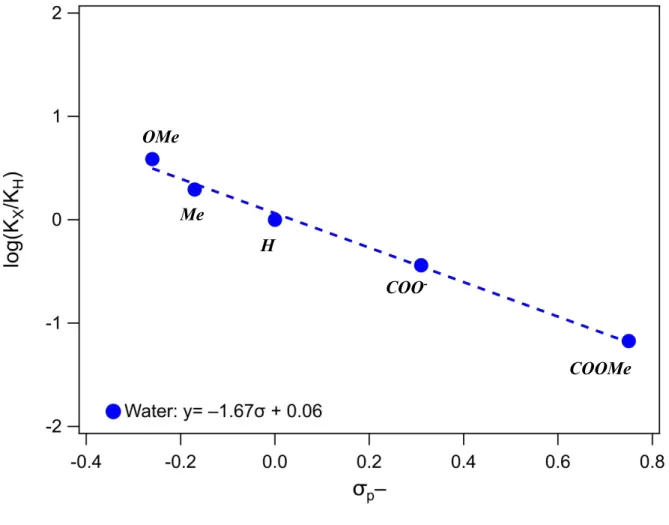
Furthermore, our group has previously demonstrated a linear free energy relationship between aqueous hydricity, ΔGºH-(OH2), of [Cp*Ir(bpy-X)H]+ complexes and the Hammett parameter σp-,
which is indicative of electron withdrawing and donating properties at the para position through induction and resonance stabilization.9,10 However, the effect of ligand substitution had a
Figure 1. Hammett plot for hydricity in water.9
Since water is such a strongly polar solvent (ε = 78),10 it is not surprising that electronic effects of substituents would only weakly influence hydricity; the solvent is very stabilizing due to interactions between the charged complexes and dipole moment of the water molecules. However, one might anticipate that ligand substitution would become a more significant factor in less polar organic solvents. This property was observed for the acidity of benzoic acid in water and ethanol (Table 1, Scheme 3).10
Table 1. Scheme 3.
Solvent ρ
H2O 1.00
EtOH 2.25
OMe
Me
H
COOMe
-Methods
Syntheses
The Ir(III) parent complex, [Cp*Ir(bpy)(Cl)][Cl], and substituted variants (Figure 2) were prepared from literature methods, with final precipitation from MeOH/ether.9,11 [Cp*Ir(bpy-t-Bu)(Cl)][Cl] and [Cp*Ir(bpy-CF3)(Cl)][Cl]
had not been previously synthesized in the Miller Lab; these complexes were
characterized by 1H NMR spectroscopy (Figures 3 & 4).
Figure 3. 1H NMR spectrum (400 MHz) of [Cp*Ir(bpy-t-Bu)Cl][Cl] in CD 3CN.
Figure 2. Cp*Ir(III) chloride salts.
Figure 4. 1HNMR spectrum (600 MHz) of [Cp*Ir(bpy-CF3)(Cl)][Cl] in CD3CN.
Cp*Ir(bpy) and Cp*Ir(bpy-Me) were prepared from the Ir(III) chloride salts through reduction with excess NaBH4 in basic water (1.0M NaOH).9 Cp*Ir(COOMe) was prepared
through reduction in aqueous NaO2CH. The Ir(I) species were then protonated in diethyl ether
by HCl∙etherate (approx. 40 mM). The resulting hydrides precipitated as the chloride salt, and were isolated through filtration and washed with diethyl ether. Purity of synthesized hydride complexes were confirmed by 1H NMR spectroscopy prior to use in equilibration reactions. Hydride Equilibration Reactions
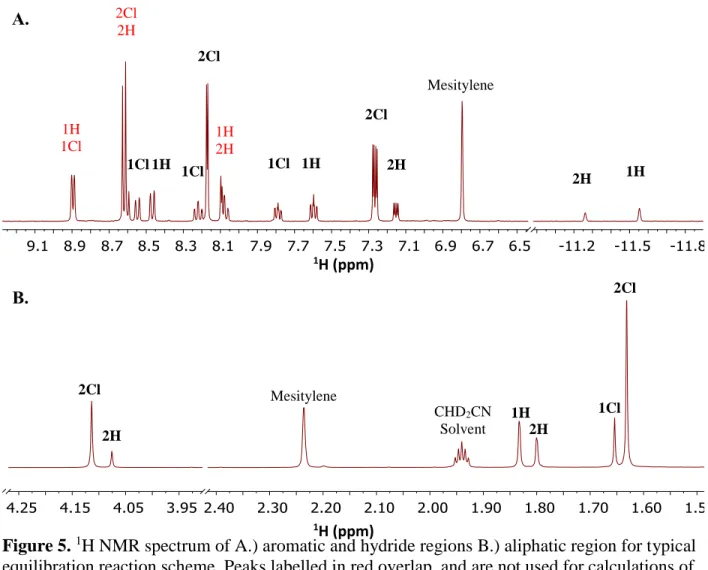
Typical hydride equilibration reactions (Scheme 4, Figure 5) were carried out by dissolving the starting hydride complex in approx. 500 µL CD3CN (approx. 10 mM in hydride
mole ratio). The resulting solution was then transferred to an NMR tube (5 mm diameter); a known quantity of mesitylene was added as an internal standard.
1H NMR spectroscopy (400 MHz or 600 MHz) was used to monitor concentrations of
each Cp*Ir(III) species over a period of 48-72 hrs so that each reaction had adequate time to reach equilibrium. Between spectra, samples were stored under a nitrogen atmosphere to prevent introduction of oxygen, and out of direct light.
Scheme 4.
Figure 5.1HNMR spectrum of A.) aromatic and hydride regions B.) aliphatic region for typical equilibration reaction scheme. Peaks labelled in red overlap, and are not used for calculations of concentration.
Characteristic peaks in the aromatic region were identified for each complex, and
integrated against the mesitylene standard to determine equilibrium concentrations of each Ir(III) species in solution. From the equilibrium constant for the reaction, the relative hydricity
between the two complexes was calculated (Equation 1). Hydricity relative to another complex was determined between two and four times for each complex; the average values were
computed and are reported in kcal∙mol-1.
1H 1Cl 2Cl 2H 2Cl 2H B. Mesitylene 1H
1Cl 1Cl 1H
2H 1H
1Cl 2H
2Cl
1H 2H 1H
1Cl
CHD2CN
Solvent
𝛥𝐺°𝐻−(𝟏𝑯) − 𝛥𝐺°𝐻−(𝟐𝑯) = −𝑅𝑇𝑙𝑛(𝐾𝑒𝑞) = −𝑅𝑇𝑙𝑛 (
𝐾𝑥 𝐾𝐻
) = −𝑅𝑇𝑙𝑛 ([𝟏𝑪𝒍][𝟐𝑯] [𝟐𝑪𝒍][𝟏𝑯])
Equation 1. Calculation of relative hydricity from equilibrium concentrations.
Results and Discussion
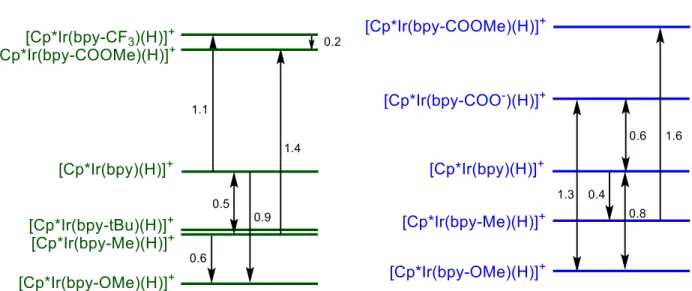
Relative hydricities in acetonitrile between the Cp*Ir(III) hydride complexes were successfully determined through hydride equilibration reactions (Figure 6). Relative hydricities from individual experiments deviated no more than 0.3 kcal∙mol-1 from the reported average. In general, the ordinal relationship between the hydricities of the Ir(III) hydrides could be
qualitively predicted by the σp- values (Table 2), as the largest hydricities (weakest hydride
donation ability) corresponded with the most electron withdrawing substituents. This is
consistent with the expected trend, as electron withdrawing substituents remove electron density from the metal center, making the transfer of a hydride ion less favorable. An exception was observed between [Cp*Ir(bpy-Me)(H)][Cl] and [Cp*Ir(bpy-t-Bu)(H)][Cl], between which no appreciable difference in hydricity could be measured, and [Cp*Ir(bpy-CF3)(H)][Cl] and
Figure 6. Relative hydricity values in acetonitrile and water9 reported in kcal·mol-1 .
Table 2. σp- and ΔΔG°H- values9,12
Substituent σp-
ΔΔG°H- from [Cp*Ir(bpy)H]+
(kcal∙mol-1)
MeCN Literature H2O
-COOCH3 0.75 1.03 ± 0.10 1.60
-CF3 0.65 1.21 ± 0.10 –
-COO– 0.31 – 0.60
-H 0 0.00 0.00
-C(CH3)3 -0.13 -0.45 ± 0.05 –
-CH3 -0.17 -0.50 ± 0.01 -0.40
-OCH3 -0.26 -0.96 ± 0.10 -0.80
large (-0.26 to 0.75) in both studies, there is little evidence of increased sensitivity to substitution in acetonitrile relative to water, each with total range of approximately 2 kcal∙mol-1. This
suggests substitution has approximately the same magnitude of effect on relative hydricity regardless of solvent, which may allow for fine tuning of catalysts across multiple solvents.
Relative hydricities obtained through equilibration reactions were used to calculate ratios between equilibrium constants. The logarithm of the Kx:KH ratios were plotted against the
corresponding Hammett parameter σp- values to generate a Hammett plot (Figure 7). Linear
regression analysis suggests proportionality between log (Kx:KH) and the Hammett parameter of
the substituted complexes. Surprisingly, relative hydricity is somewhat less sensitive to substitution of the bipyridine ligand in acetonitrile (ρ = -1.42) than it is in water (ρ = -1.67).
Figure 7. Hammett plots in acetonitrile and water.9 OMe
Me
t-Bu
H
COOMe
the complexes would be expected to be more greatly influenced by substitution in acetonitrile. This unanticipated result suggests substituent effects on hydricity may be far less variable between solvents than other thermodynamic properties, such as acidity.10 This behavior may be explained by the fact that hydride transfers do not require the solvation of a hydride ion. The thermodynamics of hydricity are largely controlled by the energy of ligand transfer and the coordination of a solvent molecule. In contrast, the ionization of benzoic acid requires two charged species to be solvated compared to a neutral starting material, making solvent environment more influential.
Due to the preferential binding of chloride ion in the equilibration reactions, the relative hydricities measured by this study correspond to ΔGºH−(Cl), hydride donation with subsequent
binding of chloride ion (Scheme 5). Because of the energetic difference between the binding of acetonitrile and chloride ion, absolute ΔGºH−(Cl) values cannot be directly linked to
GºH−(NCCH3) values measured by previous studies. Therefore, absolute ΔGºH−(Cl) values
cannot be determined without an external reference. Previous research indicates incoming ligand has a moderate impact on values of absolute hydricity {for [Cp*Ir(bpy-COO-)H]-, ΔGºH−(OH2) =
32.0 kcal·mol-1, ΔGºH−(Cl) = 27.6 kcal·mol-1}.9
Differences in absolute effective hydricity for these complexes resulting from variation of solvent {for [Cp*Ir(bpy)H]+, ΔGºH−(NCCH
3) = 62 kcal·mol-1} differ far more greatly than
differences resulting from substitution.13 Therefore, the effect of substitution in either solvent will be far less significant than the identity of the solvent itself for predicting hydricity. However, the determination of absolute hydricity for these complexes will provide insight into this question and is part of ongoing research.
Conclusions
Relative hydricities in acetonitrile were determined between six Cp*Ir(III) hydride complexes, utilizing equilibration reactions. A linear free energy relationship was observed between the relative hydricity and the Hammett parameter σp- for substituents on the bipyridine
ligands. While there is little evidence of a difference between substitution sensitivity for hydricity in water and acetonitrile, absolute effective hydricity for a given complex will likely have a strong dependence on solvent. However, the determination of effective absolute
hydricities for the studied Cp*Ir(III) complexes could help elucidate the importance of solvation on hydricity.
Future Work
Future efforts on this project will focus on two primary goals. First, expanding the range of σp- values for which relative hydricities have been determined. By widening this range, the
linearity of the relation between hydricity and σp- can be determined with greater confidence. To
this end, attempts to synthesize [Cp*Ir(bpy-O-)(Cl)][Cl] (σ
p- = -0.82) via deprotonation of
References
(1.) Saeidi, S.; Aishah, N.; Amin, S.; Reza, M. J. CO2 Util. 2014, 5, 66–81.
(2.) Suhas, J. G.; Vaidya, P. D.; Bhanage, B. M.; Joshi, J. B. Chem. Eng. Res. Des. 2014, 92, 2557–2567.
(3.) Joo, F. Activation of Carbon Dioxide. Physical Inorganic Chemistry: Reactions, Processes, and Applications; Wiley-VCH: Weinheim, Germany, 2010; pp 247. (4.) Huff, C. A.; Sanford, M. S. J. Am. Chem. Soc. 2011, 133 (45), 18122–18125. (5.) Helm, M. L.; Stewart, M. P.; Bullock, R. M.; Rakowski DuBois, M.; Dubois, D. L.
Science 2011, 333, 863−866.
(6.) Miller, A. J. M.; Heinekey, D. M.; Mayer, J. M.; Goldberg, K. I. Angew. Chemie - Int. Ed. 2013, 52 (14), 3981–398.
(7.) Brewster, T. P.; Miller, A. J. M.; Heinekey, D. M.; Goldberg, K. I. J. Am. Chem. Soc.
2013, 135 (43), 16022–16025.
(8.) Brewster, T. P.; Rezayee, N. M.; Culakova, Z.; Sanford, M. S.; Goldberg, K. I. ACS Catal. 2016, 6, 3113–3117.
(9.) Pitman, C. L.; Brereton, K. R.; Miller, A. J. M. J. Am. Chem. Soc. 2016, 138, 2252–2260. (10.) Anslyn, E. V.; Dougherty, D. A. Modern physical organic chemistry; Univ. Science
Books: Sausalito, CA, 2008.
(11.) Sasayama, A. F.; Moore, C. E.; Kubiak, C. P. Dalt. Trans. 2016, 45, 2436–2439. (12.) Hansch, C.; Leo, A.; Taft, R. W. Chem. Rev. 1991, 91 (2), 165–195.
![Figure 3. 1 H NMR spectrum (400 MHz) of [Cp*Ir(bpy-t-Bu)Cl][Cl] in CD 3 CN.](https://thumb-us.123doks.com/thumbv2/123dok_us/8332399.2210825/6.918.107.813.229.1043/figure-nmr-spectrum-mhz-cp-ir-bpy-bu.webp)
![Figure 4. 1 H NMR spectrum (600 MHz) of [Cp*Ir(bpy-CF 3 )(Cl)][Cl] in CD 3 CN.](https://thumb-us.123doks.com/thumbv2/123dok_us/8332399.2210825/7.918.112.807.106.648/figure-nmr-spectrum-mhz-cp-ir-bpy-cf.webp)