Relationships among Chronic Pain, Hypervigilance, and Executive Function Chloe Bryen
The University of North Carolina at Chapel Hill Spring 2017
A thesis presented to the faculty of The University of North Carolina at Chapel Hill in partial fulfillment of the requirements for the Bachelor of Arts degree with Honors in Psychology.
Abstract
Acknowledgements
I would like to thank Dr. Mark Hollins who was my advisor throughout this research process. Dr. Hollins has been instrumental in teaching me how to research over the past two years. I have learned more than I could have imagined through conversations, lab meetings and comments on my writing. Thank you to the members of the Somatosensory Lab for listening to my defense and providing feedback to improve my presentation skills.
I would also like to thank my committee members, Dr. Mark Hollins, Dr. Karen Gil and Dr. Peter Ornstein. The time that each of these individuals devoted to discussing my project with me, reading my thesis and listening to my oral defense was crucial to this learning experience. I am also very grateful that Dr. Hollins, Dr. Gil and Dr. Ornstein have each acted as mentors for my career, providing support and wisdom as I move forward in my studies.
I also could not have completed this project without the advice and guidance provided by Dr. Ornstein and Dr. Beth Kurtz-Costes through the honors seminar and individual meetings.
Relationships among Chronic Pain, Hypervigilance, and Executive Function
Researchers in the present study were interested in the relationships among chronic pain, hypervigilance, executive function, pain perception and conditioned pain modulation (CPM). To date no studies have combined all of these factors.
Executive Function
Executive function includes cognitive processes such as planning, attention, cognitive flexibility and decision making. More specifically, executive function is said to include four components: response inhibition, complex executive function, set shifting and updating
(Berryman et al., 2014). In this study, we focus on response inhibition, defined as one’s ability to suppress unnecessary information, and set shifting, defined as the ability to switch between different mental tasks.
Past studies have indicated that chronic pain could affect executive function. For example, a recent systematic review of research found that fibromyalgia patients generally had lower executive function than healthy controls (Berryman et al., 2014). Both fibromyalgia and non-fibromyalgia pain patients had poorer set shifting, the ability to switch between cognitive tasks, than healthy controls. In addition, non-fibromyalgia chronic pain patients were shown to have less response inhibition than controls, while fibromyalgia patients were not statistically different than controls in response inhibition.
Another study used a modified Stroop task with chronic-pain participants. There were four subtasks. In the first subtask, participants were asked to read color names printed in black ink. In the second subtask, participants were shown colored spots, which they were asked to name. The third subtask used a list of color words written in different colored ink, and
participants were instructed to name the color of the ink. The fourth subtask was the same as the third subtask, but if a rectangle was surrounding the word, the participant was instructed to name the color written, instead of naming the ink. In all subtasks, participants with high-pain had significantly longer response times than those with low-pain or healthy controls. There were no significant differences for response times between healthy control participants and low-pain participants. The response times also increased with the difficulty of the tasks (Grisart & Plaghki, 1999). This suggests that those with chronic pain not only have a diminished ability to inhibit information, but that the ability to inhibit information decreases with the difficulty of the task.
We looked to see if a similar effect existed in participants who had experienced chronic pain as compared to participants who had not experienced chronic pain. Based on prior research, we predicted that chronic pain patients would have higher Stroop effect scores and lower
Operation Span (OSPAN) scores than healthy controls as these are both tests of executive function. A result similar to Berryman et al. (2014) was expected because both our study and Berryman et al. (2014) included executive function tasks and individuals with chronic pain. Conditioned Pain Modulation (CPM)
CPM is defined as a reduction in the painfulness of a noxious stimulus when a stronger noxious stimulus is simultaneously presented.
much as healthy control participants (Lewis, Rice, & McNair, 2012). Chronic pain patients could experience less CPM because the ability to suppress pain could become worn out over time.
Diminished CPM in individuals with a history of chronic pain can also be explained by reduced response inhibition as compared healthy controls (Berryman et al., 2014). This is because response inhibition requires suppression of information and CPM requires suppression of a pain. This relates to CPM because both response inhibition and CPM require suppression. Although CPM is not directly an aspect of executive function, chronic pain patients have been shown to have a decreased ability to suppress cognitive responses, raising the possibility that they may have a difficult time with suppression in general (Berryman et al., 2014).
Past Pain and Pain Perception
Another question examined in the present study is how past chronic pain might affect current pain perception. Most research on this topic concerns individuals who experienced pain as infants. Taddio, Katz, Ilersich and Koren (1997) studied the effect of circumcision on
Hermann, Hohmeister, Demirakça, Zohsel and Flor (2006) also studied effects of early pain on pain sensitivity in childhood. This study included three groups. The first two groups were neonatal intensive-care unit (NICU) groups, one with pre-term infants and the other with full-term infants. All infants in the NICU conditions experienced painful procedures. The third group was a healthy control group of full-term infants. Researchers tested these individuals for pain reaction to thermal and mechanical stimulation when they were between the ages of 9 and 14. Children who had been in pain in the NICU as infants showed perceptual sensitization to tonic (continual) heat, while children who had not been in pain habituated to tonic heat. Sensitization is increased sensitivity to a stimulus and habituation is decreased sensitivity to a continuous or repeated stimulus. Participants who had been in the NICU also had a higher threshold for heat pain than those who were not in the NICU. This suggests that infants who experience pain have long-term changes to their pain perception (Hermann et al., 2006).
Researchers found that participants who had received moderate or no burns as infants experienced less pain after the stress condition due to stress related analgesia (lessened pain). This effect was not seen in participants who had experienced severe burns as infants. This suggests that severe past pain could eliminate pain reduction due to stress. The researchers offer several possible reasons for the difference in pain perception between patients with severe burns and patients with mild to moderate burns. One possibility is that people who experience severe burns have more pain over a long period of time but experience less intense pain at the time of the burn due to damaged nerves. In comparison, people who have mild to moderate burns experience intense pain at time of the burn but heal faster than those with severe burns so they experience less long term pain. Also, patients who experience severe burns likely had much more stressful injuries and treatments. Often burn treatments include procedures which increase the pain before improving the pain. Due to this stressful experience during pain, patients may associate pain with stress and therefore experience less of an analgesic effect than people who have had past pain which was not also related to chronic stress (Wollgarten-Hadamek et al., 2011).
Hypervigilance
Hypervigilance, or abnormally high attention to body sensations, may affect pain
participants to count their heartbeats. To test pain threshold and pain tolerance, they used
pressure applied to the thenar. Participants who had high interoceptive sensitivity, or guessed the most heartbeats correctly, had low pain tolerance. This suggests that there is a negative
relationship between interoceptive sensitivity and pain tolerance. Similarly, people who report paying more attention to their pain also report having more intense pain. More research must be done to test if these results can be generalized to all types of pain and not just pressure pain (McCracken, 1997).
The Generalized Hypervigilance Hypothesis (GHH), proposed by McDermid, Rollman and McCain (1996) was developed by measuring pressure and noise tolerance and sensitivity. This hypothesis suggests individuals with chronic pain, specifically fibromyalgia and rheumatoid arthritis, have lower tolerance to noise than healthy control participants. Reduced tolerance level of a stimulus suggests that a hypervigilant person is experiencing perceptual sensitization. They may also have a lower threshold for perceiving the stimulus. However, Hollins et al. (2009) hypothesized that hypervigilance might affect perception of some neutral stimuli as well as painful stimuli.
classified the stimulation as “painful, unpleasant but not painful, or neutral”. Participants also underwent an auditory experiment in which they heard 24 sounds in a random order. Participants were asked to rate the loudness and unpleasantness of each sound from 0-100. Hypervigilance was measured using the Pennebaker Inventory of Limbic Languidness (PILL).
FM participants had the highest scores on the PILL followed by TMD participants. The HC participants had the lowest scores on the PILL. Differences between groups were all statistically significant. FM and TMD participants rated intensity of unpleasant pressure significantly higher than HC participants. FM and TMD participants also rated neutral stimuli (weak pressure) as more intense than HC participants, indicating that the effect of hypervigilance extended to neutral stimuli. Loudness of sound estimates also correlated with hypervigilance as FM and TMD both had higher ratings of sound intensity than the HC participants. In terms of unpleasantness, FM had significantly higher ratings whereas the HC and TMD groups showed no significant difference.
Therefore, Hollins et al. (2009) found that hypervigilant participants experience
perceptual amplification even for neutral stimuli. While this study proposed and found support for the novel attentional gain control model of hypervigilance, further research is needed to corroborate the model. This study only included female participants and only looked at two modalities of stimulation (auditory and pressure pain). In the current experiment, researchers included both males and females and included one different modality of stimulation (temperature pain) to add to previous research (Hollins et al., 2009).
pain. Participants were either placed in an Attention Bias Modification (ABM) group or a
placebo group. During the initial phase, participants were shown a fixation point in the middle of a computer screen. The point disappeared and two words appeared, one above where the fixation point had been and one below where the fixation point had been. One word was related to pain, and the other word was neutral. The word pairs were then randomly replaced with either the letter ‘p’ or ‘q’ (probes). When participants saw the ‘p’ or ‘q’ probes, they were instructed to click the space bar, and their reaction times were recorded. The second part of the experiment was the manipulation. In the ABM group, the probe replaced the neutral word, drawing attention away from the pain words. In the placebo group, the probe letter continued to be placed
randomly.
Three months later, the ABM group reported less pain than the placebo condition. These results suggest a positive relationship between attention and pain such that the more attention one gives to pain, the more pain they will likely experience.
Catastrophizing
Catastrophizing is a combined emotional and cognitive process in which individuals assume the worst of a given situation (Sullivan et al., 2001). Catastrophizing has been shown to correlate with increased sensitivity for somatic-heat and deep soma-muscle pain (Weissman-Fogel, Sprecher, & Pud, 2008). Catastrophizing is also correlated with pain severity ratings, increased pain sensitivity, and functional impairment (Edwards, Bingham, Bathon, & Haythornthwaite, 2006; Keefe, Brown, Wallston, & Caldwell, 1989).
therapy, correlated with lower levels of pain in individuals with chronic low back pain (Smeets, Vlaeyen, Kester, & Knottnerus, 2006).
Pain catastrophizing, as measured by the PCS, has been shown to negatively correlate with diffuse noxious inhibitory controls (DNIC) which is another term for conditioned pain modulation (CPM). This suggests that participants who experience catastrophizing may experience less CPM (Weissman-Fogel et al., 2008). Catastrophizing also correlates with vigilance, although catastrophizing and vigilance have been shown to be different measures (Roelofs, Peters, McCracken, & Vlaeyen, 2003).
Catastrophizing is experienced differently by males and females. Studies have shown that females experience more catastrophizing than males, and the difference in pain sensitivity
between males and females is no longer significant after controlling for catastrophizing. This difference suggests that catastrophizing mediates the relationship between gender and pain (Keefe et al., 2000; Sullivan et al., 2001; Sullivan, Tripp, & Santor, 2000). Research has also shown that catastrophizing about pain could mediate the relationship between chronic pain and vigilance (Crombez, Eccleston, Van den Broeck, Goubert, & Van Houdenhove, 2004).
Hypotheses
Based on previous studies, I was interested in the relationships among CPM,
hypervigilance, executive function, past pain experiences and current pain perception. To study these factors, I used a variety of tests including questionnaires, the Stroop Task, the Operation Span (OSPAN) Task and a cold pressor-weighted rod task.
that healthy participants would experience more CPM than participants with a history of chronic pain. I expected healthy participants to suppress the lesser pain; the weighted rod. I did not expect this same effect in the participants with a history of chronic pain. Third, I expected that the score on the Stroop task would correlate with the amount of CPM, as both CPM and the Stroop task require suppression. Finally, I hypothesized that participants with a history of
chronic pain would have a larger Stroop effect and lower OSPAN score than healthy participants due to a deficit in executive function.
Methods Participants
The participants in this study were introductory psychology students at The University of North Carolina at Chapel Hill. There were 48 participants, 33.3% male (n=16) and 66.7% female (n=32). Participants were recruited using an undergraduate research pool, and were granted credit for participation in the study. Participants were between the ages of 18-23 (M=19.25,
SD=1.23). Materials
This study used questionnaires, the Stroop task, the OSPAN task and a cold pressor-weighted rod task. The Pain History Questionnaire tested for past and chronic pain. The Current Pain Questionnaire measured the pain that participants were experiencing at the time of the experiment. The demographics form asked about age, race and gender.
different aspect of vigilance. The PILL measured overall vigilance. The PVAQ measured vigilance to pain and the BVS measured vigilance to body states.
In the PILL, participants indicated the frequency of each of 54 ailments listed such as “eyes water”, “coughing”, “hot flashes” and “sore throat” (ex: “A: Have never or almost never experienced the symptom”, “B: Less than 3 or 4 times per year”, “C: Every month or so”, “D: Every week or so”, and “E: More than once every week”). The score of the PILL was calculated by counting the number of symptoms that were indicated as experienced every month or so or more (the sum of C, D, and E responses). A high score on the PILL indicated high
hypervigilance (Pennebaker, 1982).
The PVAQ asked participants to consider their behavior over the previous two weeks and rate the frequency of 16 statements about pain (ex: “I am very sensitive to pain”, “I find it easy to ignore pain”) on a scale of 0 (never) to 5 (always). The PVAQ score was calculated by taking the sum of all items; items 8 and 16 were reverse scored. A high score on the PVAQ indicates high vigilance related to pain (Roelofs et al., 2003).
faintness” and “nausea”. The BVS was scored by adding the responses for 1 and 2, the response to question 3 divided by 10 and the average rating for question 4 (taking the sum of all items and dividing by 15). A high score on the BVS indicated high body vigilance.
The Pain Catastrophizing Scale (PCS) was used to measure catastrophizing. The PCS used a 0 (not at all) to 4 (all the time) scale and asked participants to rate 13 statements regarding when they experience pain (ex: “when I’m in pain… I feel I can’t go on”). The PCS was scored by taking the sum of all 13 items (Sullivan, Bishop, & Pivik, 1995). A high score on PCS indicated a large amount of catastrophizing.
The OSPAN task tested executive function, specifically working memory and set shifting, the ability to switch attention between two tasks (Unsworth, Heitz, Schrock, & Engle, 2005). During the OSPAN Task, participants were shown an equation. They were asked to click their mouse when they knew the answer. Then, a number appeared on the screen and the
The Stroop task tested executive function as well, specifically response inhibition. There were two conditions; a control condition and an experimental condition. An online randomizer determined the order of the conditions. In the control condition, participants viewed a list of X’s typed in different colors. They were asked to read down the columns and to say the name of the color of the type as fast as possible, without making any mistakes. They were told to go back and correct any mistakes that they made. In the experimental condition, participants saw the names of colors written in type that did not correspond with the word. The instructions were the same, to say the name of the color of the type as fast as possible without making any mistakes and to correct any mistakes. Researchers timed the participants. The times for each trial as well as the number of incorrect responses were recorded. The score, called the Stroop effect, was calculated by subtracting the time it took a participant to complete the control trial from the time it took participants to complete the experimental trial (experimental time-control time). The Stroop effect shows their ability to suppress or ignore the word written and only pay attention to the color of the type. A higher Stroop effect indicated lower response inhibition (Stroop, 1935). The weighted rod and cold pressor task was used to test pain perception and CPM by inducing both thermal and pressure pain. The weighted rod apparatus consisted of a vertical partition on a table between the researcher and the participant. The partition had an opening at the bottom for the participant’s arm. Above this opening, there was a rod, onto which researchers added weights. Researchers lowered the rod onto the participant’s arm, and a tip on the bottom of the rod made contact with the arm. Multiple scores were included for analyses including pain ratings of the water, pain modulation, and pain ratings of the weighted rod.
First, participants reviewed and signed two consent forms. Participants filled out the Current Pain Questionnaire, the Pain History Questionnaire, the PILL, the BVS, the PVAQ, the PCS, and the demographics form in that order. The researcher explained each form and answered any questions the participant had.
Next, participants completed the OSPAN Task. Researchers explained the task to the participants while instructions appeared on the screen. The participants completed practice trials followed by the experimental trials
The Stroop task, also administered on a computer, was next. In this task, participants completed both the control condition and the experimental condition. The order of the conditions was randomized using an online randomizer. The experimenter timed each condition and
recorded any mistakes.
Participants took a ten-minute break before the weighted rod cold pressor task.
Participants sat at a desk across from the experimenter. They placed their right arm through an apparatus and their left hand up to the crease of their wrist in a cooler of water. The first trial was the control condition with thermally neutral water (32°C). The second trial was the cold-water condition (6°C). For both conditions, the experimenter began the timer and the weighted rod trial when participants placed their left hand in the water. The rod weighed 77 grams and the
or neutral. Lastly, participants were asked to rate the unpleasantness of the sensation from zero to 100, with zero being not at all unpleasant, and 100 being the most unpleasant sensation
imaginable. After each weighted trial the researcher also moved the participant’s arm slightly to avoid stimulation in the same spot. Each condition had 6 weighted rod trials after which the participant dried their hand. When participants removed their hands from the water, they were asked to rate the intensity of the pain of the water from zero to 100 and to rate the unpleasantness of the pain of the water from zero to 100. Participants were given a five-minute break between the neutral and the cold-water trials. The cold-water condition followed the same protocol as the control condition. The amount of time the participant’s hand was in the water was recorded for both conditions as was the starting and ending water temperature measured in degrees
centigrade. Finally, participants were given a debriefing form and told that the purpose of the study was to test perception and memory.
Results Chronic Pain History
Of the participants, 56.3% (n=27) indicated that at some point they had experienced or were currently experiencing chronic pain and 43.8% (n=21) had never experienced chronic pain. Only 29.2% (n=14) of participants reported current chronic pain; 70.8% (n=34) were not
experiencing chronic pain at the time of the study. Questionnaires
There was a moderate positive relationship between the PVAQ and PCS, r=0.458,
also had a moderate positive relationship, r=0.406, p<0.001. These relationships can be seen in Table 1.
Table 1
Means, Standard Deviations and Pearson Correlations Between Questionnaires
**Correlation is significant at the 0.01 level (2-tailed). Pain of Water
Correlational analyses were used to compare hypervigilance/catastrophizing measures, and intensity of the pain of the water and unpleasantness of pain of the water. The means and standard deviations for intensity of pain ratings and unpleasantness of pain ratings in both water conditions can be seen in Table 2. The intensity of the pain of the cold water (M=51.79,
SD=23.405)was higher than the intensity of the pain of the neutral water (M=2.33, SD=7.027). Even though the mean of the intensity ratings of the neutral water was not zero, the median of the intensity ratings of the neutral water was zero. This was also true for the unpleasantness ratings. The unpleasantness of the pain of the cold water (M=61.57, SD=23.554)was higher than the unpleasantness of the pain of the neutral water (M=1.63, SD=5.068). Whereas the mean of the unpleasantness of the neutral water was not zero, the median of the unpleasantness of the neutral water was zero.
M (SD) 1 2 3 4
1. PVAQ 36.67 (15.440) 1 .458** .609** .231
2. PCS
3. BVS
4. PILL
15.90 (10.022)
18.07 (7.204)
17.15 (8.928)
1 .527**
1
.253
406**
Table 2
Means and Standard Deviations of Intensity and Unpleasantness of Pain Ratings in Cold and Neutral Water
Neutral Water Cold Water
Measure M SD M SD
Intensity of Pain 2.33 7.027 51.79 23.405
Unpleasantness of Pain 1.63 5.068 61.57 23.554
There was a small, positive correlation between neutral water pain intensity ratings and PVAQ scores, (r=0.350, p<0.05). Cold water pain intensity had a small positive correlation with PCS scores, (r=0.308, p<0.05). There was a small positive correlation between cold water pain unpleasantness and PVAQ scores, (r=0.334, p<0.05). Cold water pain unpleasantness also correlated positively with PCS scores, (r=0.312, p<0.05).
Researchers also used an independent samples t-test to compare the differences in ratings of the water pain for participants with and without chronic pain. There was no significant
difference for intensity of pain ratings in neutral water for those with chronic pain (M=2.56,
SD=8.450) or without chronic pain, (M=2.05, SD=4.801), t(46)=-0.246, p>0.05. There was no significant difference between intensity of pain ratings in cold water for those with (M=54.70,
SD=22.729) or without chronic pain (M=47.85, SD=24.308), t(45)=-0.992, p>0.05. There was no significant difference found between those with chronic pain (M=0.85, SD=3.870) and without chronic pain (M=2.62, SD=6.249) for unpleasantness of pain ratings for neutral water,
t(46)=1.204, p>0.05. Similarly, no significant difference was found for unpleasantness of pain ratings in the cold water between those with chronic pain (M=66.81, SD=20.738), and those without chronic pain (M=54.50, SD=25.747), t(45)=-1.816, p>0.05.
Ratings for the intensity and unpleasantness of the weights were normalized because there were large individual differences: some participants reported most ratings between zero and 10, and other participants reported values above 80, for the same weights. Normalizing the ratings allowed for more accurate comparisons. First, all zero ratings were replaced with 0.25, which was calculated as half of the lowest reported rating, 0.5. This was done to be able to calculate adjusted values, which required division and thus could not include zero ratings. Each individual’s mean intensity ratings were calculated by taking the average of all intensity ratings including all weights in both the cold water and neutral water conditions. This calculation provided each participant with a mean intensity rating. Then, the grand mean was calculated by taking the mean of the individual intensity means. The norm ratio was then calculated, by dividing the grand mean by the individual’s mean intensity. This norm ratio was used to calculate the adjusted intensity ratings of that subject for each rate. The original weight ratings were multiplied by this norm ratio for each individual weight, calculating the final adjusted rating. These calculations were repeated for the unpleasantness ratings and used for all statistical analyses.
Conditioned Pain Modulation
Researchers tested the effects of pain history and hypervigilance on CPM. CPM was calculated for both intensity and unpleasantness.
more CPM as individuals would be reporting lower ratings when experiencing the painfully cold water. CPM for intensity of the weighted rod is shown in Figure 1.
Figure 1. Intensity ratings for neutral water, cold water and CPM
“Neutral” means average intensity ratings of the rod in the neutral water condition, and “cold” means average
intensity ratings of the rod in the cold water condition. CPM is conditioned pain modulation for intensity caused by
the cold water.
CPM for intensity was compared for subjects with and without chronic pain, as indicated by the pain history questionnaire or the current pain questionnaire, using an independent samples
t-test. The difference was statistically significant for intensity, t(46)=2.150, p<0.05. Those with chronic pain, (M=3.04, SD=6.041), had less CPM with regards to sensation intensity than
participants without chronic pain, (M=7.43, SD=8.120). Figure 2 shows the relationship between intensity CPM and chronic pain. CPM for intensity in individuals with chronic pain is shown to be significantly lower than CPM for intensity in those without chronic pain. Table 3 shows
0 5 10 15 20 25 30 35 40
77 277 477 677 877 1077
means and standard deviations for intensity ratings of the weighted rod in neutral water, cold water, and CPM, for participants with and without chronic pain.
A correlational analysis showed that there was not a significant correlation between age of first chronic pain and intensity CPM (r=0.157, p>0.05). This is shown in Figure 3. Individuals who were experiencing chronic pain at the time of the study are represented with orange markers and individuals who were not experiencing chronic pain at the time of the study are represented with blue markers. There were also no significant relationships between any vigilance or catastrophizing measures and intensity CPM.
Figure 2. Intensity CPM for participants with chronic pain and without chronic pain
CPM is conditioned pain modulation for intensity in the neutral and cold water conditions at each weight.
-4 -2 0 2 4 6 8 10 12 14 16
77 277 477 677 877 1077
In
te
ns
it
y
C
P
M
Weights (g)
Intensity CPM and Chronic Pain
Chronic Pain
Table 3
Means and Standard Deviations of Intensity Ratings of the Weighted Rod in Participants With and Without Chronic Pain
Chronic Pain No Chronic Pain All Participants
Measure M SD M SD M SD
Neutral Water 16.04 3.178 17.76 3.936 16.79 3.596
Cold Water 13.00 2.917 10.34 4.641 11.83 3.957
CPM 3.04 6.041 7.43 8.120 4.96 7.287
Figure 3. Age of first chronic pain and intensity CPM
CPM is conditioned pain modulation for intensity in the neutral and cold water conditions at each weight. Yellow
markers represent individuals who were experiencing chronic pain at the time of the study. Blue markers represent
individuals who were not experiencing chronic pain at the time of the study.
Unpleasantness CPM. The same calculations that were done for intensity CPM ratings, were also done for unpleasantness CPM ratings, (unpleasantness ratings in neutral water-
-10 -5 0 5 10 15 20
0 5 10 15 20 25
In
te
ns
it
y
C
P
M
Age of First Chronic Pain
unpleasantness ratings in cold water), giving each participant an unpleasantness CPM score. Higher numbers indicated more CPM as individuals would report lower ratings when
experiencing a second painful stimulus. Figure 4 shows CPM for unpleasantness of the weighted rod as compared to unpleasantness of the weighted rod in the neutral water and unpleasantness of the weighted rod in the cold water.
Figure 4. Unpleasantness ratings for neutral water, cold water, and CPM
“Neutral” means average unpleasantness ratings of the rod in the neutral water condition and “cold” means average
unpleasantness ratings of the rod in the cold water condition. CPM is conditioned pain modulation for
unpleasantness caused by the cold water.
CPM for unpleasantness was compared to chronic pain, as indicated by participants in the pain history questionnaire or the current pain questionnaire, using an independent samples t-test. The difference was found to be statistically significant, t(46)=2.196, p<0.05. Those with chronic pain, (M=4.05, SD=9.280), had less unpleasantness CPM than participants without chronic pain, (M=9.55, SD=7.636). Figure 5 shows the relationship between unpleasantness CPM and chronic pain. Chronic pain CPM is shown to be significantly lower than no chronic pain CPM. Table 4
0 5 10 15 20 25 30 35 40
77 277 477 677 877 1077
shows means and standard deviations for unpleasantness ratings of the weighted rod in neutral water, cold water and CPM for participants with and without chronic pain.
A correlational analysis showed there was no significant correlation between age of first chronic pain and unpleasantness CPM, (r=-0.223, p>0.05). This is shown in Figure 6. Individuals who were experiencing chronic pain at the time of the study are represented with orange markers and individuals who were not experiencing chronic pain at the time of the study are represented with blue markers.
Figure 5. Unpleasantness CPM for participants with chronic pain and without chronic pain
CPM is conditioned pain modulation for unpleasantness in the neutral and cold water conditions at each weight.
-5 0 5 10 15 20 25
77 277 477 677 877 1077
U
np
le
as
an
tn
es
s
C
P
M
Weights (g)
Unpleasantness CPM and Chronic Pain
Chronic Pain
Table 4
Means and Standard Deviations of Unpleasantness Ratings of the Weighted Rod in Participants With and Without Chronic Pain
Chronic Pain No Chronic Pain All Participants
Measure M SD M SD M SD
Neutral Water 13.78 5.215 15.19 6.081 14.40 5.593
Cold Water 9.73 4.368 5.64 3.665 7.94 4.525
CPM 4.05 9.280 9.55 7.636 6.46 8.947
Figure 6. Age of first chronic pain and unpleasantness CPM
CPM is conditioned pain modulation for unpleasantness in the neutral and cold water conditions at each weight.
Yellow markers represent individuals who were experiencing chronic pain at the time of the study. Blue markers
represent individuals who were not experiencing chronic pain at the time of the study.
-30 -20 -10 0 10 20 30
0 5 10 15 20 25
U
np
le
as
an
tn
es
s
C
P
M
Age of First Chronic Pain
There was a weak positive correlation between unpleasantness CPM and PVAQ scores,
r=0.313, p<0.05. There was also a weak positive correlation between unpleasantness CPM and BVS scores, r=0.386, p<0.01. There was a moderate positive correlation between unpleasantness CPM and intensity CPM, r=0.484, p<0.01.
Executive Function
Stroop effect. Means of the Stroop effect scores were compared for chronic pain participants and healthy control participants. An independent samples t-test indicated that there was not a significant difference in Stroop effect scores for individuals with past chronic pain (M=12.48, SD=5.970) and those without past chronic pain (M=13.04, SD=6.343), t(46)=0.310,
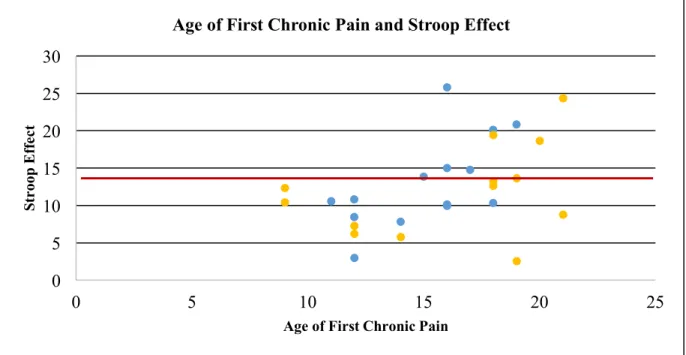
p>0.05. However, there was a moderate positive relationship between Stroop scores and age of first chronic pain, r=0.450, p<0.05. This relationship can be seen in Figure 7, with a line representing the average Stroop effect for participants without chronic pain. Blue markers indicate participants who were not experiencing chronic pain at the time of the study and orange markers indicate participants who were experiencing chronic pain at the time of the study. There were no significant relationships between the Stroop effect and any of the questionnaire
Figure 7. Correlation between age of first chronic pain and Stroop effect.
Line represents mean Stroop effect for participants with no chronic pain (M=13.04). Yellow markers represent
individuals who were experiencing chronic pain at the time of the study. Blue markers represent individuals who
were not experiencing chronic pain at the time of the study.
OSPAN scores. There was not a significant difference in OSPAN scores for individuals with past chronic pain (M=45.41, SD=15.943) and those without past chronic pain (M=46.48,
SD=12.568), t(46)=0.252, p>0.05. Unlike the Stroop, there was not a significant relationship between OSPAN scores and age of first chronic pain, r=-0.043, p>0.05. There were no
significant relationships between OSPAN scores and any of the questionnaire measures. There were also no significant relationships between OSPAN scores and intensity CPM or
unpleasantness CPM.
Discussion Hypervigilance and Pain Ratings
The first hypothesis was that hypervigilance would correlate with higher sensation ratings, and this hypothesis was supported. The ratings of perceived pain of the water for both
0 5 10 15 20 25 30
0 5 10 15 20 25
St
roop
E
ff
ec
t
Age of First Chronic Pain
intensity and unpleasantness, were correlated with vigilance measures. These correlations were observed in both the neutral water and cold water conditions. Given that this relationship was seen in the neutral water as well as the cold water, it is likely that hypervigilance affects all incoming stimuli, even those that are not painful. Other than individuals high in vigilance, most participants gave the neutral water a zero pain rating for both intensity and unpleasantness, resulting in a positively skewed distribution. However, the median was zero, so the neutral water was generally perceived as neutral, and not painful. The finding that even neutral water ratings were correlated with hypervigilance measures supports the attentional gain control model of hypervigilance, which suggests that even neutral stimuli are amplified in hypervigilant individuals (Hollins et al., 2009).
There were also correlations among vigilance measures. There were significant
relationships between the PVAQ and PCS, the PVAQ and the BVS, the PCS and the BVS, and the PILL and the BVS. The PVAQ, BVS, and PILL all measure vigilance, so this correlation is to be expected. This suggests that vigilance to pain correlates with catastrophizing and body vigilance. Similarly, body vigilance correlates with hypervigilance and catastrophizing. The PCS is a measure of catastrophizing, so its relationship with the BVS is more novel.
Chronic Pain and Pain Ratings
This study did not support prior research that suggests that those who experience chronic pain become more sensitive to painful stimuli in the future (Hermann et al., 2006; Taddio, Katz, Ilersich, & Koren, 1997; Wollgarten-Hadamek et al., 2011). There were no significant
carefully considering the painfulness of the sensation. Future studies should use multiple stimuli to ensure participants experience a variety of types and levels of pain. This would make a relationship between chronic pain and pain sensation easier to find, as there would be multiple measures to compare to chronic pain.
Conditioned Pain Modulation
Chronic pain was not related to individual sensation ratings, but there was a significant difference between participants with chronic pain and those without chronic pain for intensity CPM and unpleasantness CPM, such that those with chronic pain used less CPM. This supports the second hypothesis that individuals with chronic pain use less CPM.
Prior research has supported the idea that CPM occurs when an individual experiences suppression of the lesser pain, when presented with two painful stimuli (Berryman et al., 2014; Lewis, Heales, Rice, Rome, & McNair, 2012; Munakata, Herd, & Chatham, 2011). However, our finding is novel because only one stimulus, the cold water, was consistently rated by participants as painful. Most participants did not indicate that they felt any pain from the weighted rods and used “unpleasant, but not painful” to categorize many weights. Few
participants described weights as painful. It is possible that this unpleasantness acted as a mild pain, or preliminary pain, and that unpleasantness was enough for participants to experience CPM. This study found a significant relationship between chronic pain and CPM, even though the weighted rod was not frequently classified as painful. Therefore, future studies should focus on the experience of CPM with unpleasant but not painful stimuli to further understand this relationship.
The analyses partially supported the fourth hypothesis that chronic pain affects future executive function. We expected to find a significant relationship between chronic pain and executive function. We did not find significant differences in scores for those with chronic pain or those without chronic pain in either the Stroop task or the OSPAN task.
However, there was a significant positive relationship between age of first chronic pain and Stroop effect: as age of first chronic pain experience increased, Stroop effect increased as well. This was expected as the Stroop task has been shown to be affected by pain (Abeare et al., 2010). The Stroop effect was calculated by subtracting the control time from the experimental time, with a higher effect indicating that an individual performed more slowly in the
experimental condition with colored words than in the control condition with colored X’s. Therefore, a higher Stroop effect indicates lessened ability to suppress the salient information in the experimental condition. Age of first chronic pain correlated with Stroop effect score which indicates type of deficit in executive function in those who first experience chronic pain at a later age. This effect was not seen for the OSPAN, although it is possible that the relationship between chronic pain and OSPAN score would be evident with a larger sample (Berryman et al., 2013). On the other hand, the OSPAN specifically tests working memory, so it is also possible that, unlike response inhibition, working memory is not impacted by age of first chronic pain.
18-23 years old, there was not enough variation in age to consider the proximity of time of first chronic pain as a factor. Future studies should use a larger age range to explore the relationship between age of first chronic pain and response inhibition.
Another possibility is that the memory of the pain influenced the executive function. Pain experienced early in childhood might not be remembered to the same degree or in the same way as pain later in life (Ornstein, Manning, & Pelphrey, 1999). Ornstein et al. (1999) used vignettes to illustrate how children create and recall memories for pain. One main theme of the literature review is that children may not remember everything about each painful experience that they have had. Similarly, what a child does remember likely varies in strength and this can be affected by many factors. The memory of the pain can also change over time as individuals add new experiences and build on their knowledge. Finally, retrieval of memories about pain is not perfect. These factors are important to consider with the significant finding that age of first chronic pain positively correlates with Stroop effect. This literature review supports the idea that for the current research, it is less important to consider how recently the pain occurred, and more important to consider that children may not be able to recall or remember pain accurately later in life.
Whereas individuals with more recent age of first chronic pain showed a deficit in ability to suppress salient information in the Stroop task, this does not mean that they are deficient in all areas of executive function. Berryman et al. (2014) report that both fibromyalgia and
The Stroop task specifically measures inhibition of one item (the written word) while verbally reporting another (the color of the type of word). Glass et al. (2011) found that
individuals with fibromyalgia pain showed less activation in brain structures responsible for two types of inhibition, i.e., response selection and motor preparation. Researchers hypothesized that this lower activation was due to an overlapping of the brain structures that are involved in the professing of both pain perception and response inhibition. Therefore, individuals with chronic pain may not be able to dedicate as much response inhibition to executive function tasks as those without chronic pain. Their resources may already be focused on pain perception. People with chronic pain, especially recent chronic pain, and those who are still experiencing pain, might have used all their inhibition resources and thus have experienced a deficit in response inhibition. (Glass et al., 2011). This could explain why there was a significant difference in Stroop effect based on age of first chronic pain, but no such difference in OSPAN scores.
Abeare et al. (2010) studied individuals with rheumatoid arthritis and found that positive affect was a moderator of the relationship between pain and executive function. For patients with high positive affect, there was a significant negative relationship between pain and executive function. This same relationship was not seen in individuals with negative affect. We did not ask about affect in our study, but this could influence the executive function of individuals with chronic pain, and even those without chronic pain.
Conditioned Pain Modulation and Executive Function
Stroop scores were not correlated with CPM, and therefore the third hypothesis was not supported. However, the significant relationships between chronic pain and both pressure and verbal suppression support a link between CPM and executive function, specifically inhibition. Like the Stroop task, CPM tests one’s ability to suppress a salient item. In the Stroop task, participants are asked to ignore visual stimuli and inhibit a verbal response. However, in the weighted rod-cold pressor task, participants suppress sensations caused by pressure stimuli. Although this is not considered to be an executive function task, the significance of both measures and the lack of significance for the OSPAN scores, suggests that those with chronic pain may not struggle with general executive function. Instead, individuals with chronic pain may struggle specifically with types of inhibition. CPM might be a perceptual analogue of executive function, as participants use the same abilities to suppress a physical stimulus as they might a cognitive stimulus (Yarnitsky, 2015). This idea is supported by Munakata et al. (2012), who present inhibition as a competitive factor in the prefrontal cortex. This inhibition ability is not separated based on type of stimuli, supporting an idea of a general inhibition deficit in those who have experienced chronic pain.
This study supports the hypothesis, that chronic pain affects both response inhibition and CPM. These findings support a connection between chronic pain and inhibitory control for both visual and pressure stimuli. Researchers also found that recalled age of first chronic pain impacts inhibitory control as measured in the Stroop task. Based on the significant finding that
individuals who experience chronic pain for the first time later in life are more likely to experience executive function deficits, health psychologists should work with people
experiencing first chronic pain later in life, to improve cognitive function and prevent deficits. Future studies should explore this relationship in a larger sample size including a more
References
Abeare, C. A., Cohen, J. L., Axelrod, B. N., Leisen, J. C. C., Mosley-Williams, A., & Lumley, M. A. (2010). Pain, executive functioning, and affect in patients with rheumatoid arthritis.
The Clinical Journal of Pain, 26(8), 683–9. https://doi.org/10.1097/AJP.0b013e3181ed1762 Berryman, C., Stanton, T. R., Bowering, K. J., Tabor, A., McFarlane, A., & Moseley, G. L.
(2014). Do people with chronic pain have impaired executive function? A meta-analytical review. Clinical Psychology Review, 34(7), 563–579.
https://doi.org/10.1016/j.cpr.2014.08.003
Berryman, C., Stanton, T. R., Jane Bowering, K., Tabor, A., McFarlane, A., & Lorimer Moseley, G. (2013). Evidence for working memory deficits in chronic pain: A systematic review and meta-analysis. Pain, 154(8), 1181–1196. https://doi.org/10.1016/j.pain.2013.03.002
Crombez, G., Eccleston, C., Van den Broeck, A., Goubert, L., & Van Houdenhove, B. (2004). Hypervigilance to Pain in Fibromyalgia. The Clinical Journal of Pain, 20(2), 98–102. https://doi.org/10.1097/00002508-200403000-00006
Edwards, R. R., Bingham, C. O., Bathon, J., & Haythornthwaite, J. A. (2006). Catastrophizing and pain in arthritis, fibromyalgia, and other rheumatic diseases. Arthritis Care and Research, 55(2), 325–332. https://doi.org/10.1002/art.21865
Fillingim, R. B., King, C. D., Ribeiro-Dasilva, M. C., Rahim-Williams, B., & Riley 3rd, J. L. (2009). Sex, gender, and pain: a review of recent clinical and experimental findings. The Journal of Pain, 10(5), 447–85. doi: 10.1016/j.jpain.2008.12.001.
https://doi.org/10.1016/j.jpain.2008.12.001
controls: different cortical activation during response inhibition in fibromyalgia. The Journal of Pain : Official Journal of the American Pain Society, 12(12), 1219–29. https://doi.org/10.1016/j.jpain.2011.06.007
Grisart, J. M., & Plaghki, L. H. (1999). Impaired selective attention in chronic pain patients.
European Journal of Pain, 3(4), 325–333. https://doi.org/10.1016/S1090-3801(99)90014-9 Hermann, C., Hohmeister, J., Demirakça, S., Zohsel, K., & Flor, H. (2006). Long-term alteration
of pain sensitivity in school-aged children with early pain experiences. Pain, 125(3), 278– 285. https://doi.org/10.1016/j.pain.2006.08.026
Hollins, M., Harper, D., Gallagher, S., Owings, E. W., Lim, P. F., Miller, V., … Maixner, W. (2009). Perceived intensity and unpleasantness of cutaneous and auditory stimuli: An evaluation of the generalized hypervigilance hypothesis. Pain, 141(3), 215–221. https://doi.org/10.1016/j.pain.2008.10.003
Keefe, F. J., Brown, G. K., Wallston, K. A., & Caldwell, D. S. (1989). Coping with rheumatoid arthritis pain: catastrophizing as a maladaptive strategy. Pain, 37(1), 51–56.
https://doi.org/10.1016/0304-3959(89)90152-8
Keefe, F. J., Lefebvre, J. C., Egert, J. R., Affleck, G., Sullivan, M. J., & Caldwell, D. S. (2000). The relationship of gender to pain, pain behavior, and disability in osteoarthritis patients: the role of catastrophizing. Pain, 87(3), 325–334. https://doi.org/S0304395900002967 [pii] Lewis, G. N., Heales, L., Rice, D. A., Rome, K., & McNair, P. J. (2012). Reliability of the
conditioned pain modulation paradigm to assess endogenous inhibitory pain pathways. Pain Research and Management, 17(2), 98–102. https://doi.org/10.1155/2012/610561
936–944. https://doi.org/10.1016/j.jpain.2012.07.005
Logan, D. E., & Rose, J. B. (2004). Gender differences in post-operative pain and patient controlled analgesia use among adolescent surgical patients. Pain, 109(3), 481–487. https://doi.org/10.1016/j.pain.2004.02.026
McCracken, L. M. (1997). “Attention” to pain in persons with chronic pain: A behavioral approach. Behavior Therapy, 28(2), 271–284.
https://doi.org/10.1016/S0005-7894(97)80047-0
McDermid, A. J., Rollman, G. B., & McCain, G. A. (1996). Generalized hypervigilance in fibromyalgia: Evidence of perceptual amplification. Pain, 66(2–3), 133–144.
https://doi.org/10.1016/0304-3959(96)03059-X
Munakata, Y., Herd, S. A., Chatham, C. H., Depue, B. E., Banich, M. T., & O’Reilly, R. C. (2011). A unified framework for inhibitory control. Trends in Cognitive Sciences, 15(10), 453–459. https://doi.org/10.1016/j.tics.2011.07.011
Munakata, Y., Herd, S., & Chatham, C. (2011). A unified framework for inhibitory control.
Trends in Cognitive …, 15(10), 453–459. https://doi.org/10.1016/j.tics.2011.07.011.A Ornstein, P. A., Manning, E. L., & Pelphrey, K. A. (1999). Children’s memory for pain. J Dev
Behav Pediatr, 20(4), 262–277. Retrieved from http://www.ncbi.nlm.nih.gov/pubmed/10475601
Pennebaker, J. W. (1982). The psychology of physical symptoms. The Psychology of Physical Symptoms. https://doi.org/10.1007/978-1-4613-8196-9
Roelofs, J., Peters, M. L., McCracken, L., & Vlaeyen, J. W. S. (2003). The pain vigilance and awareness questionnaire (PVAQ): Further psychometric evaluation in fibromyalgia and other chronic pain syndromes. Pain, 101(3), 299–306. https://doi.org/10.1016/S0304-3959(02)00338-X
Schmidt, N. B., Lerew, D. R., & Trakowski, J. H. (1997). Body vigilance in panic disorder: Evaluating attention to bodily perturbations. Journal of Consulting and Clinical Psychology, 65(2), 214–220. https://doi.org/10.1037/0022-006X.65.2.214
Sharpe, L., Ianiello, M., Dear, B. F., Nicholson Perry, K., Refshauge, K., & Nicholas, M. K. (2012). Is there a potential role for attention bias modification in pain patients? Results of 2 randomised, controlled trials. Pain, 153(3), 722–731.
https://doi.org/10.1016/j.pain.2011.12.014
Smeets, R. J. E. M., Vlaeyen, J. W. S., Kester, A. D. M., & Knottnerus, J. A. (2006). Reduction of Pain Catastrophizing Mediates the Outcome of Both Physical and Cognitive-Behavioral Treatment in Chronic Low Back Pain. Journal of Pain, 7(4), 261–271.
https://doi.org/10.1016/j.jpain.2005.10.011
Solberg Nes, L., Roach, A. R., & Segerstrom, S. C. (2009). Executive functions, self-regulation, and chronic pain: A review. Annals of Behavioral Medicine, 37(2), 173–183.
https://doi.org/10.1007/s12160-009-9096-5
Stroop, J. R. (1935). Studies of interference in serial verbal reactions. Journal of Experimental Psychology, 18(6), 643–662. https://doi.org/10.1037/h0054651
Sullivan, M. J. L., Bishop, S. R., & Pivik, J. (1995). The Pain Catastrophizing Scale: Development and validation. Psychological Assessment, 7(4), 524–532.
Sullivan, M. J. L., Tripp, D. A., & Santor, D. (2000). Gender differences in pain and pain behavior: The role of catastrophizing. Cognitive Therapy and Research, 24(1), 121–134. https://doi.org/10.1023/A:1005459110063
Sullivan, M. J., Thorn, B., Haythornthwaite, J. A., Keefe, F., Martin, M., Bradley, L. A., & Lefebvre, J. C. (2001). Theoretical perspectives on the relation between catastrophizing and pain. The Clinical Journal of Pain, 17(1), 52–64.
https://doi.org/10.1097/00002508-200103000-00008
Taddio, A., Katz, J., Ilersich, A. L., & Koren, G. (1997). Effect of neonatal circumcision on pain response during subsequent routine vaccination. Lancet, 349(9052), 599–603.
https://doi.org/10.1016/S0140-6736(96)10316-0
Unsworth, N., Heitz, R. P., Schrock, J. C., & Engle, R. W. (2005). An automated version of the operation span task. Behavior Research Methods, 37(3), 498–505.
https://doi.org/10.3758/BF03192720
Weissman-Fogel, I., Sprecher, E., & Pud, D. (2008). Effects of catastrophizing on pain perception and pain modulation. Experimental Brain Research, 186(1), 79–85. https://doi.org/10.1007/s00221-007-1206-7
Wollgarten-Hadamek, I., Hohmeister, J., Zohsel, K., Flor, H., & Hermann, C. (2011). Do school-aged children with burn injuries during infancy show stress-induced activation of pain inhibitory mechanisms? European Journal of Pain, 15(4).
https://doi.org/10.1016/j.ejpain.2010.09.001
Yarnitsky, D. (2015). Role of endogenous pain modulation in chronic pain mechanisms and treatment. Pain, 156 Suppl(2), S24-31.