1i
#
KIMBERLEY DENE CIZERLE. Analysis of Design Standards for Latin
American Water Systems (Under the Direction of DR. DONALD LAURIA)
Design standards for rural water supply systems in Latin
America were analyzed to determine their ability to select
component capacities and design flows sufficient to meet actual
demands. Water use data were collected from sixteen communities in
Guatemala, Honduras, and Ecuador. The data were analyzed to determine actual values for design parameters, including average use rates, peaking factors and storage volumes. Regressive equations were developed for each parameter as a function of community characteristics.
For towns of 300 to 1200 persons, results indicate average use
rates on the order of 13 to 32 gallons per capita per day in Guatemala and 52 to 56 gallons per capita per day in Honduras and Ecuador. These demands are 150% to 300% higher than the design standards used by AID and local ministries of health; actual
peaking factors and storage volumes are also underestimated.
Hence, it appears that water systems in Guatemala, Honduras, and Ecuador will not have sufficient capacities to meet actual demands at the end of design periods as planned; rather, excess capacities will be exhausted prematurely.
The underlying cause of this seems to be due largely to
existing tariff structures, which are incompatible with design standards, and a lack of community awareness about water use and
conservation in rural piped water systems. Various approaches for
<•
TABLE OF CONTENTS
Page
#
I. INTRODUCTION...1
A. MOTIVATION FOR THE STUDY...2
B. THE PROBLEM...3
II. GOAL AND OBJECTIVES A. ACTUAL WATER USE...4
B. REQUIRED CAPACITIES...4
C. DESIGN STANDARDS...5
III. LITERATURE REVIEW A. CONSUMPTION DATA...6
B. WATER SUPPLY ECONOMICS...7
C. DESIGN STANDARDS...8
IV. METHODOLOGY A. ACTUAL WATER USE...10
1. Data Collection...10
2. Data Analysis...13
a. Long Term Average Demand...13
b. Nighttime Use Rates...13
c. Maximum Daily Peaking Factor...14
d. Maximum Hourly Peaking Factor...15
e. Required Volume of Storage Tank...15
B. REQUIRED CAPACITIES...16
C. DESIGN STANDARDS...17
V. RESULTS A. ACTUAL WATER USE
1. Long Term Average Demand...18
2. Maximum Daily Peaking Factor...18
3. Maximum Hourly Peaking Factor...21
4 . Required Volume of Storage Tank...21
B. REQUIRED CAPACITIES 1. System Capacity a. Predictive Models...23
b. Nighttime Use Rates...29
2. Source Works a. Predictive Models...31
b. Maximum Daily Demands...34
3. Network a. Predictive Models...34
b. Maximum Hourly Demands...35
4. Storage Tank a. Predictive Models...36
1. Guatemala...39
2. Honduras...41
3. Ecuador...43
VI. CONCLUSIONS...46
VII. DISCUSSION AND RECOMMENDATIONS A. THE PROBLEM...49
B. EXISTING SYSTEMS...50
C. NEW SYSTEMS...52
D. FUTURE WORK...54
VIII. REFERENCES..._______.___...56
IX. APPENDICES
•
LIST OF TABLES
Page
1. Communities in Which Meters Were Installed...11
2. Long Term Average Demand Values...19
3. Maximum Daily and Hourly Peaking Factor Values...20
4. Storage Volume and Detention Time Values...22
5. Nighttime Use Rate Values...30
6. Study-Predicted Parameters and Component Capacities...33
7. Component Capacity Comparisons: Study-Predicted
vs. Design Standard Values for Guatemala...388. Component Capacity Comparisons: Study-Predicted vs. Design Standard Values for Honduras...42
9. Component Capacity Comparisons: Study-Predicted vs. Design Standard Values for Ecuador...45
#
Page
1. LTAD as a Function of Population...24
2. LTAD as a Function of Population for Guatemala...27
3. LTAD as a Function of Population for Honduras/Ecuador....28
4. MDPF as a Function of LTAD...32
5. MHPF as a Function of LTAD... .35
ACKNOWLEDGEMENTS
I thank Dr. Lauria for his constant guidance and friendship. I am very grateful for everything he has done to help me learn and grow as an engineer and person. I also thank Dr. Whittington and Dr. Christakos for being on my committee and providing suggestions afid advise to help improve this report.
This study was conducted under a contract with the Water and Sanitation for Health Project. I thank Rick Mattson and Ellis Turner of the CDM-WASH office for their support of this project.
I am grateful to my parents, grandparents, and brother for their love and encouragement. I am very lucky to have such a wonderful support system.
I thank my friends in the WRE program and the IPHP office for the many fun times and laughs we shared. I am grateful to Swarna
for his help with the literature review and to Bill for his input
on the data analysis. I thank Christa for being a special friend
and confidant.
My deepest appreciation goes to Jim, for his unconditional
love and support.
Kimberley Dene Cizerle
I. INTRODUCTION
Rural water supply coverage in the developing world is
severely lacking. Throughout the world's developing countries, the
World Health Organization estimates that only 29% of the rural
population had piped drinking water supplies as of 1980 (WHO,
1981). Hence, the years 1981-1990 were designated the International
Drinking Water Supply and Sanitation Decade in which safe drinking
water and sanitation services were to be provided for all.
Unfortunately, this goal was not met. For example, only 30% of
Guatemala's and 56% of Honduras' rural population had received water supply systems as of 1989 (WASH, 1990).
In Latin America, the realization that water supply and
sanitation services could not be constructed in all rural
communities by 1990 prompted the local governments and the U.S.
Agency for International Development (AID) to set more realistic
coverage targets. For instance, targets were set for 44% rural
water supply coverage in Guatemala and 66% coverage in Honduras by
1995 (WASH, 1990). Various bilateral agencies such as AID and the
international banks have attempted to address this problem and
provide funds to meet the needs. AID is spending about $50 million
over five years to construct rural water systems in Guatemala,
Honduras and Ecuador.
•
2
A. MOTIVATION FOR THE STUDY
This report is concerned with the rural water systems that are
planned and constructed by the Agency for International Development
in conjunction with the local Ministry of Health (MOH) in various
Latin American countries. The planning process employed by these
organizations is similar in each country. The MOH and AID
(MOH/AID) first select rural communities in which to install water supply systems. Each selected community then forms a water
committee which is responsible for providing a portion of the labor
and transportation required to construct the system. The MOH/AID
then design the system, which is typically gravity fed, with
individual yard tap connections. The MOH/AID set the water rates
(usually flat monthly fees) and present the system to the water
committee, which is then responsible for operating and maintaining
the system and collecting the monthly fees.
The MOH/AID in each country adopt design standards which are
used to select the capacities of each of the water supply system
components. One such standard is the average water use rate, which
is usually on the order of 20 gallons per capita per day (GPCD).
Each system is designed to meet the use rate of the population that
is predicted to exist about twenty years in the future. This
estimated population is based on an assumed growth rate which may
or may not be derived from historical data. The source works,
storage tank, and distribution network are designed to meet peak
•
B. THE PROBLEM
The design standards used for these systems generally involve
a great deal of judgement regarding expected rates and patterns of
water use in each community. In most cases, rural water systems in
Latin America have non-metered house connections and lackmacrometers as well. Without meters, engineers and planners have
not been able to measure the actual volvimes of water used, and
consequently have not been able to check the standards employed for
design.
Given that large sums of money are expended on constructing
rural water systems and that the design standards are based largely
on assumptions and judgments, high potential exists to
"misallocate" MOH/AID's scarce resources. For purposes herein,
"appropriate" allocation implies "accurate prediction," whereby
actual demands are equivalent to the design standards, and system
components have sufficient capacity to meet demands. In this
sense, a misallocation of resources means too little or too much
excess capacity is provided in the system. This situation results
if the design standards are much lower or much higher than the
actual demands.
It should be noted that the problems of optimal design and
maximum economic efficiency are not in question here, as these
issues involve the examination of demand functions and consumer
m
m
II. GOAL MUD OBJECTIVES
The goal of this project is to improve the MOH/AID rural water supply program in Latin America. Three major objectives are associated with this goal:
A. Determine actual water use rates and patterns in typical MOH/AID rural water systems.
B. Determine the required capacities of the major
system components based on actual demands for water. C. Evaluate the standards used to design water systems
in various countries, with a view toward detecting
the possible misallocation of scarce resources;
i.e. determine the ability of existing design standards
to produce systems that meet actual demands.
A. ACTUAL WATER USE
The first objective involves collecting water use data to
measure and determine use rates, peaking factors, and storage
requirements in typical rural water systems throughout Latin
America. A typical MOH/AID system serves between 200 and 2000
persons and includes: source works (without water treatment),
storage tank, transmission main, and distribution network. To
develop a broad data base, communities with different
characteristics were studied in three different countries.
B. REQUIRED CAPACITIES
The second objective is to determine system capacities
required to meet actual demands. This involves analyzing the use
are needed for all design parameters, so each can be estimated for a variety of communities of different characteristics. Once the models are used to make predictions about the parameters, the required capacities of the water supply system components are then
determined. These are the capacities required to meet the "actual"
demands (as predicted from actual data).
C. DESIGN STANDARDS
The final objective of this project is to evaluate the
effectiveness of the MOH/AID design standards in terms of their
ability to predict system capacities that are sufficient to meet
the actual demands. This involves comparing the predicted required
capacities with the design standard-generated capacities.
The accomplishment of these three objectives will help to
improve MOH/AID rural water supply planning in Latin America. The
information provided by this study regarding rural water use rates
and patterns will either affirm the current design standards, or it
will assist MOH/AID planners and engineers in the selection of more
•
III. LITERATURE REVIEW
A. CONSUMPTION DATA
There is a vast body of literature regarding typical water use
rates in various parts of the world. In United States cities and
towns, use rates have been found in the range of 47 to 437 GPCD
(Howe and Linaweaver, 1967). Various studies found daily demands
of 16 to 50 GPCD in Latin America. A 1970 World Health Organization survey found rural water use in Latin America on the
order of 18 to 50 GPCD. A 1956 study of thirteen rural water
systems in Venezuela found the average water use rate to be about
50 GPCD from consumption at house connections (Wagner and Lanoix,
1959). Other surveys have found average use rates of 16 GPCD in
rural Guatemalan communities and 26 to 33 GPCD throughout rural
Latin American communities (White, et al., 1972).
Several factors are known to influence water use, including
population, climate, and culture. Use rates generally increase
with higher populations and warmer climates; they have been found to vary from one culture to another due to different customs and
religions (White, et al, 1972). Other factors affecting water use
rates are leakage, carelessness and waste, meterage, and price.
It is recognized that most distribution systems leak (Fair, et
al., 1971). Leakage frequently contributes to a large portion of
the water used in a system. A leakage rate of less than ten
•
leakage is a problem is to examine the nighttime flows. If the
late night and pre-dawn flows are high, it is likely the system has
leaks (Fair, et al., 1971).
Carelessness and waste are also common factors contributing to
high use rates, especially in developing countries. "The amount of
water lost through carelessness of customers sometimes reaches
staggering proportions; it is not uncommon to find towns wasting as
much as 75% of the water supplied" (Wagner and Lanoix, 1959).
Metering and charging customers for the amount of water used
has a substantial impact on use rates because consumers are given
information about their use and the financial incentive to
conserve. In a study in Boulder, Colorado, the introduction of
meters and incremental water charges decreased use by 36%; it has
lowered use rates by 20 to 50% in other areas. These effects vary
greatly depending on the types of use. Consumers who use water for
gardening are more likely to respond than those who use it for
drinking and cooking alone (Clark and Goddard, 1974).
B. WATER SUPPLY ECONOMICS
In 1967, Howe and Linaweaver published a well known study
concerning the effect of price on residential water use in the
United States. They found that the price of water significantly
impacts the average and peak demands. This impact is measured as
the price elasticity of demand, which is the percentage change in
•
8
Howe and Linaweaver found a price elasticity of about -0.23,
indicating that a 10% increase in price brings about a 2.3%
decrease in water use.
Similar studies have been conducted in other parts of the world. For residential customers in Malaysia, price elasticities of -0.1 to -0.2 were found (Katzman, 1977). Other studies report values of -0.60 for households with piped connections and -0.78 for
squatter settlements in an urban area of Sudan (Khadam, 1988).
These studies show that water utilities can use price as a tool to
ration water.
C. DESIGN STANDARDS
Several design standards for rural water systems are published
in the literature. For piped water supplies in developing
countries, Okun and Ernst (1987) recommend use rates of:
5-11 GPCD in humid climates
16-21 GPCD in dry climates
11-16 GPCD average
with a maximum-daily to average ratio of 1.5 and maximum-hourly to
average ratio of 2.0. They also recommend a design period of 7 to
8 years as optimal, based on average economy of scale factors and interest rates in developing countries.
Another set of standards (Unakel, 1971) for rural water
systems in developing countries is:
13 - 21 GPCD average use rate
1.5 maximum daily to average ratio
4.0 maximum hourly to average ratio
10 - 15 years design period
m
(Glennie, 1987) for an African village water supply, with anaverage use rate of 6 GPCD and a storage tank detention time of 8
hours.
Relationships between design standards and several different
variables have been reported in the literature. For example, the
average use rate is often expressed as a function of community
population, number of persons per household, or climate (White, et
al., 1972). Peaking factors are commonly represented as log
functions of the average design flow, decreasing logarithmically as
the average flow increases. For example, at 0.1 MGD, the maximum
daily and hourly peaking factors are estimated as 3.0 and 5.5
respectively, and at 1 MGD they are estimated as 2.2 and 3.6. (Walker, 1978)
Design standards are generally based on studies and surveys in
various parts of the developed and developing world. They are
meant to give engineers and planners guidance for designing water
systems in the absence of historical data. However, water use
rates and patterns are very different from one area to another. To
accurately determine appropriate design standards for systems in a
given area, studies of actual water use must be conducted in that
IV. METHODOLOGY
A. ACTUAL WATER USE
To determine actual water use in rural Latin American
communities, trips were made to Guatemala and Honduras in September, 1989 and to Ecuador in May, 1990. In each country, the
project was explained to key MOH/AID personnel and the study
communities were selected. The criteria used for community
selection were:
a. The water system was recently constructed by MOH/AID.
b. The system was functioning properly, preferably with excess capacity, and providing water 24 hours a day.
c. The communities were in various geographic and climatic regions, including the mountains,
subtropical regions, and the coast; their climate was categorized as either "cold," "temperate,"
or "hot."
d. The water from the system was designated for domestic consumption only. In all the
communities studied, use of water for irrigation or animals was prohibited.
A complete list of the communities studied and the characteristics
of each, is given in Table 1 and Appendix A.
To measure water use on a community-wide basis, several
macrometers were taken to each country; they were Hersey volumetric
meters with maximum 160-gallon per minute capacity and calibration
in units of gallons. Specifications for this meter are in Appendix
B. In the three countries of the study, ten macrometers were
COMMUNITIES IN WHICH METERS WERE INSTALLED
TOWN
GUATEMALA
POPULATION_______CLIMATE TOWN NAME CODE
Calera Tenerias 348 cold CAL
Chuicotom 372 cold CHU
Xetacabaj 432 cold XET
Nueva Esperanza 804 temperate NUE
La Cienaga 840 cold LACI
TOWN
HONDDRAS
POPULATION_______CLIMATE TOWN NAME CODE
La Bella Vista
La Curva Coloraditos
Brisas del Carmen
Quebrada de Yoro
Ruth Garcia Colonia Martinez 140 260 350 408 819 850 960 hot hot hot hot hot hot hot BEL LACU COL BRI QUE RUT MAR ECUADOR
TOWN POPULATION CLIMATE TOWN NAME CODE^
Unachi-Pucara 245 cold UNA
Panzaleo 252 cold PAN
San Vicente 820 temperate SAN
de Guayllabamba
Tandapi 1243 temperate TAN
12
In each system, the macrometer was installed in the
transmission main from the storage tank. Due to budgetary
constraints, it was not possible to purchase automatic meter recorders nor to pay workers to read the meters twenty-four hours a day. Hence, two people in each community were employed to read
the meter and record the readings on data forms. Samples of data
forms left with the meter readers are shown in Appendix C.
It was indicated from conversations with water committee
members that most of the water consumption occurred in these rural
communities during the daylight hours, from just before sunrise
until after sunset. Hence, the hours from 4:00 a.m. to 8:00 p.m.
were selected as the meter reading time period during which two
meter readers each worked eight hours, making meter recordings
every fifteen minutes. The first worker recorded meter data from 4:00 a.m. until 11:45 a.m. and the second worker from 12:00 p.m. until 8:00 p.m. At the onset of the study, the meters were read
every day for two weeks. After this initial period, they were read
every other week for seven days straight, sixteen hours per day.
In some cases, the meters were moved to new communities after the initial meter reading term ended. As of June, 1991,
water use data were collected in 16 different rural communities in
Guatemala, Honduras, and Ecuador. Details, such as the times and
dates of data collection and the number of days of meter readings
are given in Appendix A.
are the source works, storage tank, and distribution network.
Thus, the water use data were analyzed to determine the parameters
that affect the capacities of these components, including the
average use rate, ratio of peak day to average use rate, ratio of
peak hour to average use rate, and required storage volume.
Other important parameters for design purposes are the design
period and population growth rate, which were not studied in this
project. For the rural water systems of Guatemala, Honduras, and
Ecuador, MOH/AID typically use a 20-year design period and a
population growth rate of two to three percent per year.
The average use rate, also called the long term average demand
(LTAD), is the average amount of water used by the community. It
is expressed in units of gallons per hour (GPH), gallons per day
(GPD), or gallons per capita per day (GPCD). The water use rates
employed by the MOH/AID design standards are in the range of 15 to
30 GPCD. In this study, the LTAD was calculated as the average
demand for water over the longest time period for which data were
available. It is the last meter reading less the first meter
reading (gallons), divided by the time interval (hours or days).
A sample calculation for this parameter is given in Appendix D;
this calculation was repeated for each community studied.
The nighttime use rate was also examined to obtain information
regarding possible system leaks or consumer waste. This rate
^ , 14
between 8:00 p.m. and 4:00 a.m. (when the meters were not being read), and is equal to the 4:00 a.m. meter reading less the 8:00
p.m. reading from the previous night (gallons), divided by eight
hours. Based on daily living patterns described by community
officials, it was assumed that water use in this time period
primarily represents leakage, wastage, and consvimption for non¬
essential purposes. A sample calculation for the nighttime use
rate is given in Appendix E.
The ratio of peak daily demand to average demand is called the
maximum daily peaking factor (MDPF); it is typically combined with
the LTAD to select the capacity of the source works. For MOH/AID's designs in Guatemala, Honduras, and Ecuador, a MDPF of about 1.2 is
customarily employed. This means that source works are typically
designed for a flow equal to 1.2 times the average design flow.
For each day of meter readings in a community, a maximum daily
peaking factor was calculated by dividing the total water use for that day by the community's long term average flow (LTAD). This results in a different maximum daily peaking factor for each day of meter readings. A representative calculation for the MDPF
parameter is given in Appendix F.
To select the single MDPF parameter, a frequency distribution
analysis of the data was performed. A typical MDPF frequency
distribution is given in Appendix G, which shows, for example, that
80 percent of the MDPF's for this community are less than or equal
•
MDPF was less than or equal to 1.2. The one-hundredth percentile value of the MDPF (i.e. the maximum MDPF) is 2.2. It is a matter of judgement as to which frequency should be selected for the MDPF parameter; for the purpose of this study, the eightieth percentile was used. This process was repeated for each community studied.
The ratio of peak hourly demand to long term average demand is
called the maximum hourly peaking factor (MHPF) and is used with
the LTAD to design the capacity of the distribution network.
Typically, MOH/AID use a MHPF of 2.0-3.0 for rural water systems;
networks are designed for a flow equal to 2.0-3.0 times the average
design flow.
For each day of meter readings, a maximum hourly peaking factor was calculated by dividing the peak hourly demand for that
day by the community's LTAD. A sample MHPF calculation is given in
Appendix H. This calculation was repeated for each community
studied. With a different MHPF for each day of record, the design parameter was selected from the frequency distribution at the
eightieth percentile. A typical MHPF distribution is shown in
Appendix I.
A storage tank is necessary in order to meet peak hourly
demands. The tank fills when the use rate is less than the rate of
purposes, MOH/AID generally assume the RVST is the volume needed to
provide 7 to 9 hours detention time at the average design flow.
For each day of meter readings in each community, a RVST was
determined for the demands of that day at three different assumed
inflow rates, viz. the LTAD, 1.2 times LTAD, and 1.4 times LTAD.
A sample calculation of the RVST for a given day of record is shown
in Appendix J. This calculation is based on a mass diagram analysis
(i.e. Rippl method), which is commonly used for reservoir design
(Fair, Geyer and Okun, 1971).
A RVST was obtained for each day of record corresponding to
each assumed rate of inflow to the tank. With three different
inflow rates, the analysis produced three different required
volumes for each day of record in each community. The storage
volume parameter was selected in essentially the same way the
peaking factor parameters were selected. A frequency analysis was
made of RVST values, and the volume at the ninetieth percentile was
selected as the design requirement. A typical RVST frequency
distribution is shown in Appendix K; this estimation was repeated
for each community studied.
B. REQUIRED CAPACITIES
The data analysis from this study produced a LTAD, MDPF, MHPF,
and RVST for each town. Each of these values is needed to predict
required component capacities for communities which will likely
receive MOH/AID water systems in the future. This implies the need
community characteristics (i.e. explanatory variables) such as
population, climate, and country. These models are obtained
through ordinary least squares analysis and are presented in the
next chapter.
C. DESIGN STANDARDS
The final objective of this study is to evaluate the effectiveness of MOH/AID design standards in terms of their ability
to predict system component capacities sufficient to meet actual
demands. To do this, communities with different design populations
(viz. 300, 600, 900, and 1200 persons) were assumed and the
"required" component capacities were determined based on the
metered data from this study. The "required" capacities were then
compared with the "predicted" capacities based on the MOH/AID
design standards. This analysis was conducted for each system component, for each of the four selected design populations, in
•
V. RESULTS
A. ACTUAL WATER USE
The LTAD values for the 16 communities in this study are reported in Table 2. In these towns, the use rate (column 6)
varies from 10 to 78 GPCD. The average for Guatemala is 24 GPCD;
for Honduras, 56 GPCD; and for Ecuador, 51 GPCD.
It is expected that the LTAD increases with increasing
population; a town with 1000 persons will use more water than one
with 100. Although this is a general trend in the data, it is not
always the case. The data presented in Table 2 are arranged by
country in order of increasing population. The values in column 4
indicate that the LTAD generally increases as the population
increases, but there are exceptions. The LTAD values in column 6 show that the per capita use rates are much lower in Guatemala than
in Honduras and Ecuador.
The fact that the LTAD does not always increase with population and that per capita use rates are significantly
different in Guatemala than in Honduras and Ecuador raises
questions regarding the factors that might explain the demand (e.g.
population and climate) and the origin of the demand (e.g.
consumption, waste, or leakage). Each of these will be discussed
in the second section of this chapter.
The MDPF values for the 16 communities are reported in Column
4 of Table 3. These values are fairly consistent from one
LONG TERM AVERAGE DEMAND VALUES
GUATEMALA
(1) (2) (3) (4) (5) (6)
POPULATION CLIMATE
LTAD
TOWN GPH GPD GPCD
CAL 348 cold 297 7100 21
CHU 372 cold 425 10200 27
XET 432 cold 174 4200 10
NUE 804 temperate 1179 28300 35
LACI 840 cold 913 21900 26
HONDURAS
POPULATION CLIMATE
LTAD
TOWN GPH GPD GPCD
BEL 140 hot 454 10900 78
LACU 260 hot 401 9600 37
COL 350 hot 651 15600 45
BRI 408 hot 932 22400 55
QUE 819 hot 2434 58400 71
RUT 850 hot 2157 51800 61
MAR 960 hot 1913 45900 48
ECUADOR
TOWN POPULATION CLIMATE GPH
TABLE 3
MAXIMUM DAILY AND HOURLY PEAKING FACTOR VALUES
GUATEMALA
(1) (2) (3) (4) (5)
TOWN POPULATION LTAD MDPF» MHPF^
CAL 348 297 1.1 3.1
CHU 372 425 1.5 2.8
XET 432 174 1.6 4.5
HUE 804 1179 1.1 2.7
LACI 840 913 1.1 3.5
HONDURAS
TOWN POPULATION LTAD MDPF MHPF
BEL 140 454 1.1 2.8
LACU 260 401 1.1 4.7
COL 350 651 1.2 3.3
BRI 408 932 2.2 2.7
QUE 819 2434 1.5 2.1
RUT 850 2157 1.1 1.9
MAR 960 1913 1.1 2.6
TOWN UNA PAN SAN TAN ECUADOR POPULATION LTAD 245 493 252 446 820 2031 1243 2804 MDPF 1.3 1.2 1.1 1.1 MHPF 2.4 2.5 1.5 1.9
•
*MDPF ^MHPFMaximum Daily Peaking Factor
•
appear to depend on either population or country. The MDPF values
range from 1.1 to 2.2; the average value in both Guatemala and Honduras is 1.3; in Ecuador it is 1.2.
The MHPF values for the 16 communities are reported in Column 5 of Table 2; they range from 1.5 to 4.7. The average MHPF value is 3.3 for Guatemala, 2.8 for Honduras, and 2.1 for Ecuador. Note that the MHPF tends to be higher when the LTAD is low and lower when the LTAD is high. The reason for this seems to be that with
more people using water, use is spread throughout the day rather
than concentrated in one or a few short periods, dampening the
peaks and smoothing the data trace for the entire community.
RVST values for the 16 communities are reported in Column 4 of
Table 4. These values represent the storage volumes needed when
the inflow rate is 1.2 times the long term average demand. The
RVST values range from 2100 to 18,500 gallons; the required
detention times (based on the average design flow) range from 1 to
15 hours. The average detention values are 9 hours for Guatemala, 7 hours for Honduras, and 3 hours for Ecuador.
As indicated by the data in Table 4, the RVST values generally
increase with increasing LTAD, and seem to be related to the
maximum hourly peaking factor. At larger MHPF values, more
detention time is required, whereas at smaller MHPF values, much
less detention time is required. This is because large MHPF values
TABLE 4
STORAGE VOLUME AND DETENTION TIME VALUES
GUATEMALA
(1) (2) (3) (4)
TANK
(5) (6) (7)
DETENTION
TOWN POP LTAD INFLOW* MHPF RVST TIME
348 GPH 297 GPH GAL 3200 hours
CAL 360 3.1 9
CHU 372 425 510 2.8 3600 7
XET 432 174 210 4.5 3200 15
NUE 804 1179 1420 2.7 7000 5
LACI 840 913 1100 3.5 9500 9
HONDURAS
TANK DETENTION
TOWN POP LTAD INFLOW* MHPF RVST TIME
140 GPH 454 GPH GAL 4300 hours
BEL 550 2.8 8
LACU 260 401 480 4.7 4500 9
COL 350 651 780 3.3 8000 10
BRI 408 932 1120 2.7 9500 8
QUE 819 2434 2920 2.1 18500 6
RUT 850 2157 2590 1.9 7500 3
MAR 960 1913 2300 2.6 14900 6
ECUADOR
TANK DETENTION
TOWN POP LTAD INFLOW* MHPF RVST TIME
245 GPH 493 GPH GAL 2300 hours
UNA 590 2.4 4
PAN 252 446 540 2.5 2100 4
SAN 820 2031 2440 1.5 3600 1
TAN 1243 2804 3370 1.9 9500 3
meet demand. Small MHPF values mean that the hourly data trace is smoother; therefore, the rate of tank drawdown is smaller, and less
volume is needed. The outflow rate exceeds the inflow rate to a
greater extent when the MHPF is high than when the MHPF is low,
thereby resulting in larger detention times at high MHPF values and
smaller detention times at low MHPF values.
B. REQUIRED CAPACITIES
The principal determinant of system capacity is long term
average demand. To determine required system capacities for towns
with populations in the range of those studied herein, the LTAD
data were pooled and regressed against population based on the
apparent association in Table 2. The resulting equation, in which
LTAD has units GPH, is:
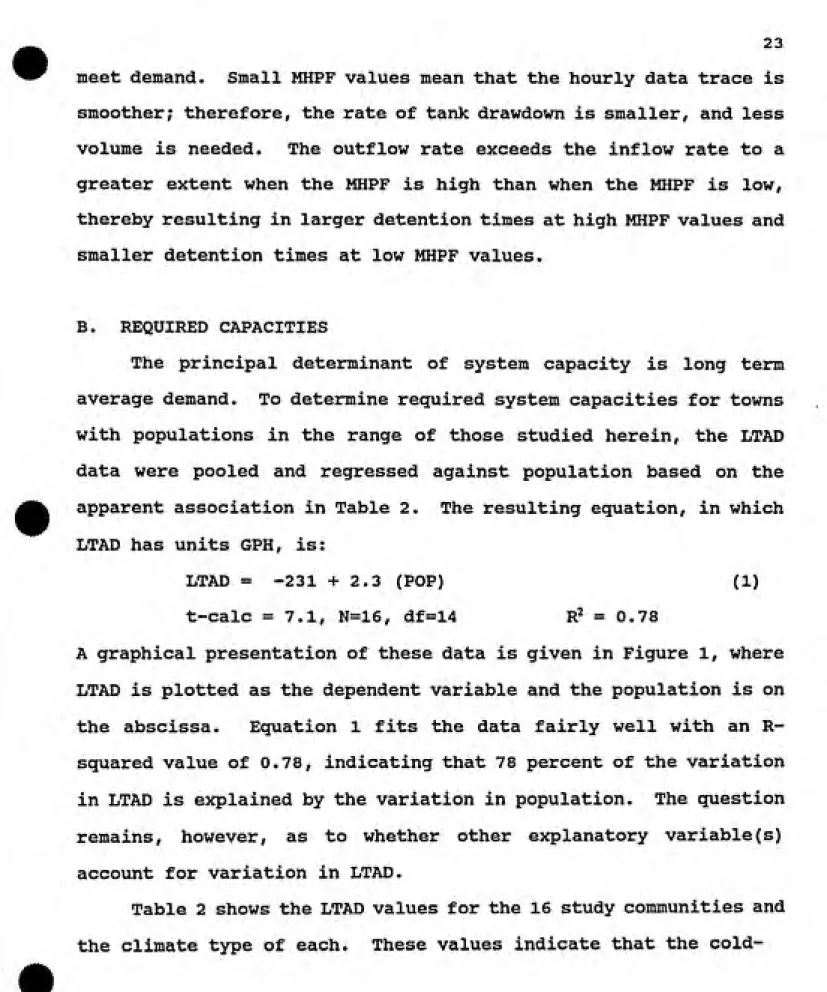
LTAD = -231 +2.3 (POP) (1)
t-calc =7.1, N=16, df=14 r2 = 0.78
A graphical presentation of these data is given in Figure 1, where
LTAD is plotted as the dependent variable and the population is on
the abscissa. Equation 1 fits the data fairly well with an
R-sguared value of 0.78, indicating that 78 percent of the variation
in LTAD is explained by the variation in population. The question
remains, however, as to whether other explanatory variable(s)
account for variation in LTAD.
Table 2 shows the LTAD values for the 16 study communities and
cold-FIGURE 1
- i ^ͣ
_--1 ͣ ! 1 • (
\ • t s
JiJJ^
LTAD = -231+2.3 (POP)
•
climate communities generally have lower use rates than the temperate- and hot-climate communities. For this reason, a
regression was performed with both population and climate as the explanatory variables. Climate is represented as a 0/1 dummy variable, where CLIM=1 indicates a cold climate and CLIM=0
indicates a temperate or hot climate. The resulting regression
equation and statistics for this data show that the addition of the climate variable improves the R-squared value:
LTAD = 144 +2.0 (POP) - 529 (CLIM) (2)
t-calc = 6.8, 2.7, N=16, df=13 R^ = 0.86
Further examination of the data in Table 2 indicates that the
use rates in Guatemala are much lower than the use rates in
Honduras and Ecuador. In Guatemala, the average LTAD is 24 GPCD, but it is 56 GPCD in Honduras, and 51 GPCD in Ecuador. Therefore, a regression was performed with population and country as the explanatory variables. The country designation is a 0/1 dummy
variable, where C0UN=1 represents Guatemalan towns, and COUN=0
represents non-Guatemalan towns. The resulting regression equation
and statistics are:LTAD = 3 + 2.3 (POP) - 699 (COUN) (3)
t-calc = 11.9, 5.3, N=16, df=13 r2=0.93
Both population and country coefficients are statistically
significant. However, nothing is gained by adding climate to the
model, as shown below:
LTAD = 63 + 2.2 (POP) - 120 (CLIM) - 626 (COUN) (4)
26
With this analysis, it is determined that the variations in
LTAD are sufficiently explained due to variations in population and
country and not to climate. A regression analysis was performed
with just the Honduras and Ecuador data, showing that use rates are
not significantly different in these two countries. Thus, for
predicting the values for communities with different populations,
two equations are used.
Guatemala; LTAD = - 318 + 1.6(POP) (5)
t-calc = 4.1, N=5 df=3 r2= 0.85
•
Honduras and Ecuador: LTAD = - 66 + 2.4 (POP) (6)
t-calc = 11.7, N=ll, df=9 r2= 0.94
A graphical presentation of this data is given in Figures 2 and 3.
In the Guatemala LTAD equation, the population coefficient is
1.6, implying a predicted average daily use rate of 1.6 GPH per
capita, or 38 GPCD. For Honduras and Ecuador, the population
coefficient is 2.4 GPH/capita, indicating average daily demand of
58 GPCD.
LTAD values can be predicted with the above equations, but
these equations do little to explain demand. Whether average
demands are due to leaking systems, water wasting, or actual use is
not known.
Many distribution systems have high leakage rates, and
2. >ͣ__••ͣ_ J. i »__' _
. %—' i. > i. 'ͣ^—- J. i' \_« '*—
FIGURE 3
I " t ^ ͣ ! l_ L_' ! .!
1^ } i r ! 1
A J. X -I—' _ » J_ ͣ_' J. ; \. J. k - J. -i
contributes to higher demands in the Honduran and Ecuadorian
communities. To investigate this possibility, the nighttime use
rates (between 8:00 p.m. and 4:00 a.m.) were calculated and
examined. A summary of the nighttime use rates in each of the
communities is presented in Table 5. If the minimum nighttime use
rate (in gallons per minute) ever gets near zero, then can be
concluded that leakage is not a major determinant of demand.
The flow rate from an open tap is generally between 3 and 5
GPM. In the many cases where the minimum nighttime use rate is
small and the maximum nighttime use rate is large (i.e. where the
standard deviation or coefficient of variation is large), it is
concluded that the nighttime use is due to consumers consciously or
wastefully using water overnight; that is, it appears that users
are turning the valves to use water.
In the case of Guatemala, the minimum nighttime use rates are
small, as are the maximum nighttime use rates. In these
communities, consumers are probably not wasting water, using it
improperly overnight, or losing it through system leaks. In this
way, the Guatemalan water demands are very different than those of
Honduras and Ecuador.In both Honduras and Ecuador, the majority of the communities
have small minimum nighttime use rates and large maximum nighttime
use rates. This implies that the communities do not lose water
through system leakage. Instead, the consumers probably leave
their taps open overnight — either by neglecting to turn them off
TABLE 5
NIGHTTIME USE RATES
GUATEMALA
(1) (2) (3) (4) (5)
TOWN AVERAGE STANDARD MINIMUM MAXIMUM
GPM DEVIATION
0.6
GPM GPM
CAL 0.4 0.0 2.8
CHU 3.6 0.5 3.2 6.0
XET 0.2 0.8 0.0 4.6
NUE 9.3 --- ---
---LACI 2.5 1.2 0.9 4.7
HONDURAS
TOWN AVERAGE STANDARD MINIMUM MAXIMUM
GPM DEVIATION
2.6
GPM GPM
BEL 2.0 0.0 15.0
LACU 0.3 0.1 0.2 0.4
COL 1.7 0.8 0.8 3.9
BRI 10.9 2.6 7.1 14.4
QUE 36.0 11.4 0.1 56.9
RUT 24.0 2.6 18.4 27.6
MAR 11.5 4.6 1.1 25.3
ECUADOR
TOWN AVERAGE STANDARD MINIMUM MAXIMUM
GPM DEVIATION
2.2
GPM
1.6
GPM
UNA 6.2 11.9
PAN 3.6 2.8 0.0 9.4
SAN 25.2 5.7 1.3 40.4
the water during the nighttime hours (perhaps irrigate). Therefore,
the LTAD measurement adequately reflects the real consumer use
rates, and is used as the predictive parameter for the system
capacity. ,
The LTAD values, expressed in GPD, represent required system capacity to meet demands; various predicted LTAD values based on
equations 5 and 6 are given in row 1 of Table 6. For a community
of 900 persons in Guatemala, the predicted average use rate is 30
GPCD, or 27,000 GPD, or 1100 GPH. A community with a design
population of 900 persons in Guatemala needs a capacity of 27,000
GPD in order to meet average demands. For a community with a
design population of 900 persons in Honduras or Ecuador, the predicted LTAD is 56 GPCD, or 50,000 GPD, or 2100 GPH.
Required source works capacity is based on maximum daily
demands, which are equal to the MDPF times the LTAD. It would be
expected that the MDPF decreases as LTAD increases, from relationships observed in other studies. In the communities of this study, however, this was not the case. As shown in Table 3,
the MDPF does not vary with LTAD. A regression of MDPF on LTAD
shows that there is no relationship between the two parameters:
MDPF = 1.23 (LTAD) -^"^
t-calc = 4.3, N=16 df=14 R^ = 0.02
The plot Of MDPF as a function of LTAD depicted in Figure 4 shows
FIGURE 4
m:
\T U L%K. I ii 1 i i "^!M
i; 'I
STUDY-PREDICTED PARAMETERS AND CAPACITIES
GUATEMALA
(1) (2) (3) (4) (5)
POPULATION: 300 600 900 1200
(l)LTAD (GPH) 160 640 1100 1600
(2)LTAD (GPD) 3900 15000 27000 38000
(3)LTAD (GPCD) 13 26 30 32
(4)MDPF 1.2 1.2 1.2 1.2
(5)MDD (GPD) 4700 19000 32000 46000
(6)MHPF 4.2 2.9 2.5 2.3
(7)MHD (GPD) 16000 45000 68000 88000
(8)RVST 2500 5000 6500 7800
HONDURAS AND ECUADOR
POPULATION: 300 600 900 1200
(l)LTAD (GPH) 650 1400 2100 2800
(2)LTAD (GPD) 16000 33000 50000 68000
(3)LTAD (GPCD) 52 55 56 56
(4)MDPF 1.2 1.2 1.2 1.2
(5)MOD (GPD) 19000 40000 60000 81000
(6)MHPF 2.9 2.4 2.1 2.0
(7)MHD (GPD) 46000 78000 110000 130000
•
34
at a value of about 1.2. Hence, a value of 1.2 is recommended for the MDPF design standard, in either of the three countries, regardless of the LTAD (within the domain of 0 to 3000 GPH).
The source works capacity is based on the maximum daily demand (MDD), which is equal to the MDPF times the LTAD. Various MDD
values were calculated for populations of 300, 600, 900, and 1200 persons in Guatemala, Honduras, and Ecuador. These values represent the source capacities required to meet maximum daily demands. As shown in column 4 of Table 6, a town with a design population of 900 persons in Guatemala, has an expected MDD of 32,000 GPD; in Honduras or Ecuador, it is 60,000 GPD.
Required pipe network capacity is based on maximum hourly
demands (MHD), which are equal to the MHPF times LTAD. A predictive equation for MHPF was developed so it could be estimated for communities with different populations.
The data in Table 3 indicate that MHPF might be associated
with LTAD; the MHPF generally decreases as LTAD increases. The regression model that fits the data shows that MHPF is a log-log
function of LTAD:
MHPF = 16.7 (LTAD) -°" (7)
t-calc = 4.3, N=16, df=14 r2 = 0.57
This relationship is depicted graphically in Figure 5; LTAD
I !ͣ I ^- y-_ — ^
i ^._- ' s .'
i 1 .* \ n I
MHPF =16.7 (LTAD) -0.27
- <t«s«i??^3'»sS?i?wTrt=^?"' .3W«EB^SW!!!'S35?SHli5 .-'rH*W(W7S!-'SC'?^-^^'";^?PWi»iffiFK
TABLE 7
COMPONENT CAPACITY COMPARISONS
STUDY-PREDICTED VS. DESIGN STANDARD VALUES
GUATEMALA (1) POPULATION; (2) (3) STUDY MOH/AID 300 300 160 250 3900 6000 13 20 1.2 1.2 4700 7200 4.2 1.8 16000 11000 2500 1800 16 7 (4) (5) STUDY MOH/AID 600 600 640 500 15000 12000 26 20 1.2 1.2 18000 14000 2.9 1.8 45000 22000 4900 3500 8 7
LTAD (GPH) LTAD (GPD) LTAD (GPCD)
MDPF
MDD (GPD)
MHPF
MHD (GPD)
RVST HRS DET
GUATEMALA
STUDY MOH/AID
POPULATION: 900 900
LTAD (GPH) 1100 750
LTAD (GPD) 27000 18000
LTAD (GPCD) 30 20
MDPF 1.2 1.2
MDD (GPD) 32000 22000
MHPF 2.5 1.8
MHD (GPD) 68000 32000
RVST 6500 5300
HRS DET 6 7
inversely related, as indicated by the negative exponent for LTAD
in the regression equation. Predicted MHPF values are given in row
6 of Table 6.
MHD values were estimated for communities with 300, 600, 900, and 1200 persons in Guatemala, Honduras, and Ecuador. These
values, reported in row 7 of Table 6, represent network capacity required to meet maximum hourly demands. For a town with a design
population of 900 persons in Guatemala, the MHD is 68,000 GPD; in
Honduras or Ecuador, it is 110,000 GPD.
Storage tank volume is dependent on the outflow from and the
inflow to the tank. For purposes of predicting the RVST, a
regression analysis was performed of the data, where RVST (gallons)
is a function of the maximum outflow rate (MHD) and the inflow
rate. The resulting regression equation is:
RVST =0.37 (OUT) "^ (inf) • ^o (8)
t-calc = 8.2, 5.6, N=48, df=45 R^ = 0.70
Note that both OUT and the INF variables are statistically
significant.
The predicted RVST values are shown in row 8 of Table 6.
Inflow to the tank is from the source of supply, and source works
are designed for the MDD. Thus, for the RVST predictions herein,
the inflow rate is estimated as the MDD, and the outflow rate is
estimated as the MHD.The values in row 8 show that RVST (GAL) increases with
37
in larger communities. Also, relatively more volume is required in Honduras and Ecuador than in Guatemala because of higher LTAD values in the former countries. For a community of 900 persons in Guatemala, the required storage volume is 6500 gallons, providing 6 hours detention time at average flow (LTAD) of 1100 GPH. For a similar community in Honduras and Ecuador, a storage volume of 8900
gallons is required, providing 4 hours detention time at an average
flow of 2100 GPH.
In summary, to determine required design flows and capacities,
the design population and the country in which the water supply
system will be installed are first selected. The appropriate LTAD
predictive equation is used to determine the expected average use rate, which indicates required system capacity for the community. A factor of 1.2 is used for the MDPF, but LTAD must be used to
predict the MHPF. MDD values determine the source work capacity,
and MHD values determine the distribution network capacity. The
MDD and the MHD values are then used to predict the RVST for the system. These are the required capacities of the system
components, needed to meet the predicted demands for water.
It is important to note that a general predictive equation for
LTAD was not developed in this study due to the significant
differences in demand from one country to another. This implies
that there exists no single equation which can be uSed to predict
•
predict a LTAD of 30 GPCD, whereas MOH/AID would design a water
supply system with a capacity of 20 GPCD for such a community.
MOH/AID would appropriately estimate the MDPF as 1.2, but
underestimate the MHPF as 1.8 instead of the required 2.5. Hence,
the required source works capacity of 32,300 GPD would not be
reached with the MOH/AID design standards; based on their
standards, a capacity of only 22,000 GPD would be provided.
The MOH/AID distribution network capacity would also be
insufficient. The required capacity, based on the predicted MHD,
would need to deliver 68,000 GPD, but the MOH/AID-designed system
would design network capacity for only 32,000 GPD. The Guatemala
MOH/AID would provide 7 hours detention time for storage in this
system, which would result in a tank of 5300 gallons at the
selected average and maximum flows. The models from this study
suggest that a volume of 6500 gallons is required, providing a
detention time of 6 hours at an average flow of 1100 GPH.
None of the components in these systems would be sufficient to
meet the actual demands, due to the underestimation of the use rate
and max hourly peaking factor in the design standards. Thus, in
general, the design standards employed by MOH/AID in Guatemala are
not sufficient because they do not design systems that will
adequately meet the actual demands.
In each of the cases mentioned here, it is important to note
that the populations and flows are the design populations and
flows. These water supply systems have a design period of twenty
•
41
into the future. However, this study indicates the systems will
run out of excess capacity before the end of the design period.
When the design population is reached, the systems will not be
sufficient to meet the demands.
Table 8 shows the predicted component capacities and MOH/AID
design standards for the Honduran communities of 300, 600, 900, and
1200 persons. The values in the first column show the design
parameters and required capacities as indicated by this study. The
values reported in the right column are those that would be used by
the Honduran MOH/AID. In most cases, these standards produce designs that are not sufficient to meet the actual demands.
For example, in a Honduran community of 900 persons, this
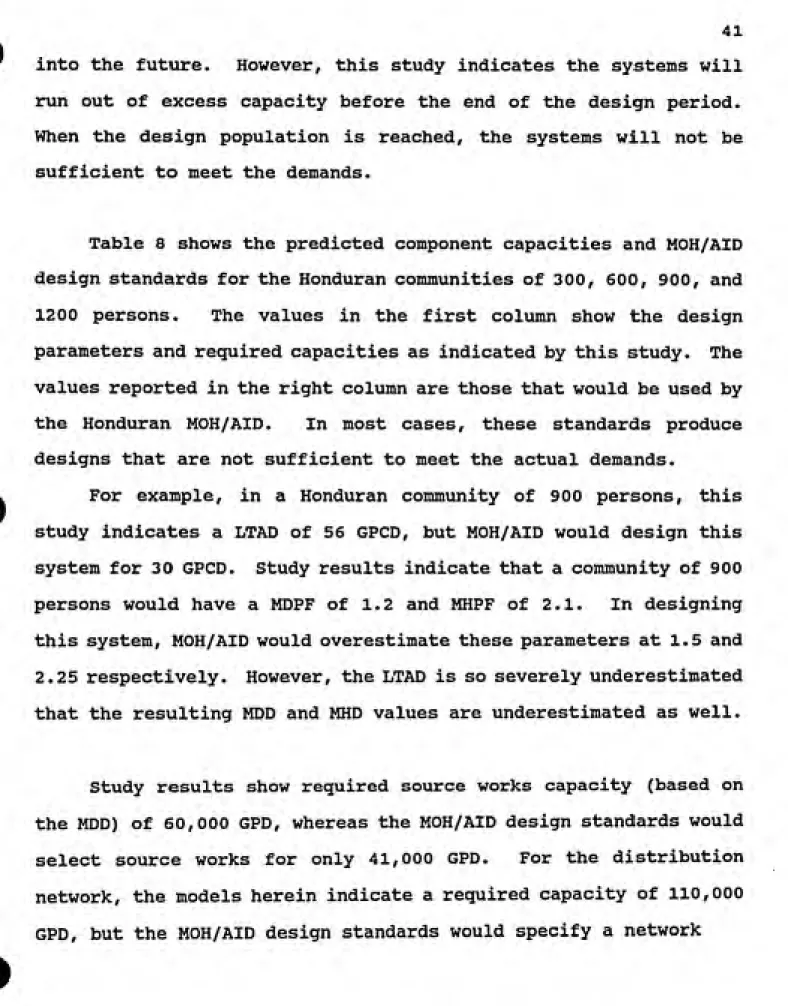
study indicates a LTAD of 56 GPCD, but MOH/AID would design this system for 30 GPCD. Study results indicate that a community of 900
persons would have a MDPF of 1.2 and MHPF of 2.1. In designing
this system, MOH/AID would overestimate these parameters at 1.5 and
2.25 respectively. However, the LTAD is so severely underestimated
that the resulting MDD and MHD values are underestimated as well.
Study results show required source works capacity (based on
the MDD) of 60,000 GPD, whereas the MOH/AID design standards would
select source works for only 41,000 GPD. For the distribution
network, the models herein indicate a required capacity of 110,000
COMPONENT CAPACITY COMPARISONS
STUDY-PREDICTED VS. DESIGN STANDARD VALUES
HONDURAS (1) POPULATION: (2) (3) STUDY MOH/AID 300 300 650 310 16000 8000 52 25 1.2 1.5 19000 11000
2.9 2 . 3
43
capacity of only 61,000 GPD. Hence, the source works and network
capacity for this system would not be sufficient to meet the actual
demands.
For a community of 900 persons, the predicted data show a
required storage detention time of 4 hours. For this situation,
the Honduras MOH/AID would design a storage tank to provide 8 hours
of detention time at average flow. Because the detention time is
overestimated by 200 percent in this case, sufficient storage
volume is provided, even though the MDD and MHD values are
underestimated. This detention time overestimation only applies to
communities of 900 and 1200 persons. All the other parameters are
underestimated as discussed above.
•
The design standards and component capacities for design
populations of 300, 600, 900, and 1200 persons in Ecuador are shown
in Table 9. The values in the left column show the design
standards and required capacities as predicted by the regression
equations obtained through this study. The values in the right
column are those that would be employed by the Ecuadorian MOH/AID.
In the case of Ecuador, the design standards employed always result
in component capacities that are not sufficient to meet the
expected demands for water.
For example, in a community of 900 persons in Ecuador, study
results indicate LTAD of 56 GPCD, but MOH/AID would design for 17
GPCD for this community. The data show that a community of 900
Of 2.1. MOH/AID appropriately estimates the peaking factors at 1.3
and 2.0 respectively, but the LTAD standard is so severely
underestimated that the resulting MDD and MHD values are much too
small.
The required MDD for this system is 60,000 GPD, but MOH/AID
would estimate the MDD as 20,000 GPD. The MHD based on this study
is 110,000 GPD for a 900-person community; MOH/AID would design for
31,000 GPD. The source works and network capacities determined by
the Ecuador MOH/AID design standards would not be sufficient to
meet actual demands.
The study results show that 4 hours detention time at average
flow is required to fill the storage tank in this system, whereas
the MOH/AID standards estimate a detention time of 9 hours. The
predicted data estimate that this tank should have a capacity of
8900 gallons, whereas the MOH/AID design standards would provide a
tank of only 5700 gallons. The resulting MOH/AID storage tank is
too small because the average, max daily, and max hourly flows are
TABLE 9
COMPONENT CAPACITY COMPARISONS
STUDY-PREDICTED VS. DESIGN STANDARD VALUES
ECUADOR (1) POPULATION: (2) (3) STUDY MOH/AID 300 300 650 160 16000 4000 52 13 1.2 1.3 19000 5100 2.9 3.0 46000 12000 5000 1500 8 9 (4) (5) STUDY MOH/AID 600 600 1400 380 33000 9000 55 15 1.2 1.3 40000 12000 2.4 3.0 78000 27000 7200 3400 5 9 LTAD (GPH) LTAD (GPD) LTAD (GPCD) MDPF HDD (GPD) MHPF MHD (GPD) RVST HRS DET ECUADOR
STUDY MOH/AID STUDY MOH/AID
POPULATION: 900 900 1200 1200
LTAD (GPH) 2100 640 2800 950
LTAD (GPD) 50000 15000 68000 23000
LTAD (GPCD) 56 17 56 19
MDPF 1.2 1.3 1.2 1.3
MDD (GPD) 60000 20000 81000 30000
MHPF 2.1 2.0 2.0 2.0
MHD (GPD) 110000 31000 130000 46000
RVST 8900 5700 10000 8600
•
In Guatemala, Honduras, and Ecuador, the design standards employed by MOH/AID result in component capacities that are not
sufficient to meet actual demands. Based on these standards,
MOH/AID provide too little excess capacity in their water system
components. The information presented in this report regarding
actual water use rates and patterns can be used to improve rural
water supply planning in Latin America.
The actual water use data collected in this study are used to
develop predictive models for various design parameters, including
average use rate, daily and hourly peaking factors, and storage
volumes. These models estimate use rates on the order of 13-32 GPCD in Guatemala and 52-56 GPCD in Honduras and Ecuador. The
predicted MDPF is about 1.2 for all communities; the MHPF is
estimated from 2.3 to 4.2 for Guatemalan towns, and 2.0 to 2.9 for
Honduran and Ecuadorian towns. Predicted storage tank detention
times range from 5 to 16 hours in Guatemala, and from 4 to 8 hours
in Honduras and Ecuador.
Based on these predicted values, actual average demands are
150% to 300% higher than MOH/AID design standard values. Maximum
daily and hourly demands are 140% to 380% higher, and required
storage volumes are 110% to 330% higher than design standard
estimates. This implies that the design standards are
inappropriate because they select source works, network, and
47
meet demands; systems will run out of excess capacity much sooner
than expected. If action is not taken to augment the supply or
reduce the demands, consximers will experience low flows,
intermittent supplies, and negative or low pressures in the pipes.
The principal cause of the capacity underestimation is the low
average use rate value estimated by the design standards, as the
other parameters are estimated fairly closely to the required
values. One reason the actual use rates are likely to be so high
is because consumers in the MOH/AID water systems pay a low, flat,
monthly fee, irrespective of the quantities they consume. There is
no reason for them to make economic decisions about how much waterto use and no financial incentive to conserve. This study shows
that the differences in demands between Guatemala and
Honduras/Ecuador are the high nighttime uses (not attributable to
leakage) in the latter countries, implying illegal or careless
water use. Charging flat fees, or inappropriately setting
consumption blocks on incremental fees, is likely to encourage
wasteful behavior and result in average use rates that are much
higher than expected.
It is not known exactly why rural consumers in Guatemala use
about half as much water as those in Honduras and Ecuador. It is
possible that the water committees work better in Guatemala and
properly enforce water use restrictions. It is also likely that
several socioeconomic characteristics explain water use patterns in
macro-level study conducted here.
To explain the demands beyond the population and country
variations described in this report, micrometers must be installed
at each connection and water use studied on a household level.
This will illuminate other explanatory variables for water use
rates and provide the opportunity to develop a single predictive
equation for water demand in rural Latin American water systems.
VII. DISCUSSION AND RECOMMENDATIONS
A. THE PROBLEM
The results of this study show that actual demands in
MOH/AID-designed water systems are much higher than the design standards.
Hence, these systems will run out of excess capacity before the end
of the twenty-year design period if present rates of water use
persist and communities grow as anticipated. For the most part,
the systems are currently functioning properly. Because they are
relatively new (most are less than five years old) and have excess
capacity, they have not experienced problems delivering water
twenty-four hours per day.
If system capacities are exceeded, it could result in periodic
interruptions in service and negative pressures in the pipe
networks, possibly causing infiltration of groundwater and
contamination of water quality. In Guatemala, MOH/AID acknowledges
that the storage tanks have already exhibited some problems of
insufficient capacity. New water systems constructed in the future
might also develop similar problems, assuming current design
standards are employed and demands in new areas are similar to
those observed in this study.
There are several ways MOH/AID might choose to address these
issues. Possible strategies for existing and new systems are
B. EXISTING SYSTEMS
One option is to let communities handle the problems of
insufficient capacity (viz. low or negative pressures, low flows,
intermittent supply) on their own. This implies that the problems
would not be addressed until excess capacity is exhausted, at which
time the communities would voluntarily reduce their demands or pay
to augment system capacities. This may not be a good option
because allowing systems to function improperly could cause public
health problems, which the systems were constructed to overcome.
Furthermore, it is unlikely that communities could increase system
capacity without professional assistance, which is in short supply
and would be difficult to obtain.A second option is for MOH/AID to increase the capacities of
existing systems to handle the higher-than-expected demands. This
would be difficult because it appears that MOH/AID does not have
the designers, contractors and resources available to return to old
systems for expansion when there are so many communities without
systems to date. Consequently, it is unlikely that expansions
could be made before excess capacity is exhausted, which would
result in the intermittent service, negative pressures and public
health risk described above.
Other options involve attempts to decrease the demands in
existing systems. In principle, this can be achieved with
51
education campaigns. In fact, mechanical restrictors are usually
ineffective because they need high pressures to work properly and
they often clog. Another drawback is that people often remove or
tamper with them.
The option of charging prices to reduce water use is a
substitute for the flat monthly fees that most consumers currently
pay. An effective pricing scheme based on the volume of water
consumed would encourage people to be more conservative and at the
same time provide funds to increase system capacity to meet
demands.
In recent years, AID has begun to investigate the possibility
of cost recovery from its water supply systems, the capital costs
of which are currently provided by AID funds. The monies collected
from monthly fees stay in the communities to pay for operation and
maintenance expenses. An effective pricing scheme would charge
consumers for the water they use, thereby encouraging conservation
and providing funds for capital cost recovery. In addition, a
system of water prices would enable the community to send a clear
signal when it is ready to pay for system expansion.
The implementation of this option is a matter for further
study because it would involve installing meters and selecting
water tariffs. Cost-benefit analyses would be needed to determine
the value of metering, and willingness to pay studies would
probably be needed to help select appropriate water tariffs and
#
52
The nighttime use rate analysis presented in this report shows
that a significant portion of the water use (not due to leakage) in
these communities occurs overnight, presximably from proscribed or
careless use. In fact, the principal difference in the demands
between Guatemala and those of Honduras and Ecuador is the high
nighttime use rate in the latter countries. The pricing option
would in principle decrease the nighttime demands by charging
consumers for the water used.
Establishing water prices in communities where systems are
already in place may be controversial and difficult to implement.
A different approach to decreasing demands could involve working
with village water committees to encourage water use restrictions.
This would involve ensuring that consumers turn off their taps when
not in use and enforcing restrictions on water use for irrigation
or animals. A proper community education and conservation program
would enable consumers to understand the importance of reducing
nonessential consumption without eliminating or decreasing
necessary uses such as bathing. A possible way to implement such
a program would be through use of PVO (private voluntary
organization) community workers. A pilot program would be needed
to determine if education is a practical way to reduce water use in
these communities.
C. NEW SYSTEMS
"1?^^
53
possible for MOH/AID to leave their design standards unchanged.
However, assuming that new communities behave like the ones studied
here, this might not be desirable since it is known that current
standards do not select capacities sufficient to meet demands.
One option is to change the design standards to accommodate
higher use rates and provide required capacities. This would
provide a higher level of service, but given AID'S fixed budget,
fewer communities would be served. For example, if the design
standards were doubled (from, say, 25 to 50 GPCD), system costs
would increase by about 60%, assviming a cost function of the form
K * capacity , where'<=0.7 as in Guatemala.
The average capital cost of systems in Guatemala is about
$40,000. If the design standards are increased to raise costs by
60%, capital costs would increase to about $64,000. For a budget
of, say $50 million, which is the approximate amount AID is
spending in Guatemala, Honduras and Ecuador, 1250 water systems can
be constructed with the old standards. However, only 780 systems
could be constructed with revised standards, which is a reduction
of about 40%.
MOH/AID should consider revising its design period from 20
years to something less, possible between 7 and 10 years. Economic
theory suggests that a shorter period would be more nearly optimal,
especially in light of the high opportunity cost of capital in
Latin America.
54
Another option for MOH/AID is to adopt pricing schemes for new water systems, with a view towards cost recovery, conservation, and appropriate signals for expansion. In this way, consumers would pay for the water they use, thereby making economic decisions about how much to consume. The flat monthly fee currently charged does not encourage such behavior. This option should be studied further
because it could allow MOH/AID to recover at least part of the
costs of the systems they design and construct, providing consumers
with the level of water service they want and are willing to pay to
receive.
D. FUTURE WORK
It is recommended that pilot conservation and education campaigns be conducted in various communities. Consumers should be told how to decrease their water use rates, and they should be
educated in the importance of doing so. Such pilot programs would
require careful evaluation to determine their effectiveness prior
to full-scale adoption.
A second recommendation is to conduct a study of water use on a household level by collecting data from micrometers at each
connection. This type of study could provide a better
understanding of household water use and the various socioeconomic
factors that explain it.
-ͣͣ 55,
MOH/AID water systems and the implications of design standard and price changes studied in detail. This would involve collecting data on the costs of providing water systems in rural Latin American communities and performing sensitivity analyses to determine the effects of changing the various determinants of the costs. This information would be important for cost-benefit
analyses and for designing pricing schemes. Analyses should be
made to determine optimal design periods based on economies of scale, interest rates, growth rates in demand, and other pertinent
variables.
A final recommendation is to conduct a pilot study to
determine the effects of price changes on water use. This would
involve determining actual price elasticities of demand. Such a
study might be conducted by actually changing prices from one