Multi-Channel
Marketing
Making “Bricks and Clicks” Stick
McKinsey
Marketing
Practice
Overview
The complexities of multi-channel marketing can be daunting and can seem to exponentially increase the variables a marketer must manage. The stakes are high, but for many companies, innovatively delivering benefits through integrated multi-channel solutions is the key to significant profit growth. McKinsey research shows that four key steps will help you win in this arena.
Choose between a multiple channel strategy and a multi-channel strategy that provides cross-multi-channel benefits
■ There are substantial differences between these strategies – the core reason to choose multi-channel is the increasing importance of high-value multi-channel buyer segments.
Define a customer-based, multi-channel network architecture ■ Explicitly defining the core role each channel plays in the customer’s
experience is key to profitability, and will help avoid the “3E Trap” – overinvesting to provide “Everything to Everyone Everywhere.”
Manage customer experience and brand promise delivery on a cross-channel basis
■ The most important levers to successful implementation of a seamless experience are a realigned resource allocation and
budgeting process, coordination of certain focused marketing activi-ties, balanced customer and channel performance metrics, and customer-focused P&Ls.
Build capabilities needed to market a multi-channel enterprise ■ Tightly align your brand promise and multi-channel proposition.
■ Make sure your CRM capabilities enable multi-channel management.
■ Aggressively “test and learn” with cross-channel offerings, manage-ment processes, and technologies.
The ability to master multi-channel marketing is becoming
increasingly vital for companies determined to be leading
players in the New Economy. In both B2C and B2B sectors,
McKinsey research indicates that within 2 to 3 years, over
50 percent of customers – and typically the highest value
cus-tomers – will be using multiple channels for shopping and
purchasing. These channels include store, telephone,
ATM/kiosk, catalog, and online. Aware of this trend,
incum-bents and attackers in countless industries are moving to
“bricks and clicks” distribution strategies to attract, grow, and
retain these emerging multi-channel customers.
While still early in their evolution, multi-channel “value propositions” – innovatively delivering new benefits through integrated multi-chan-nel solutions – show signs of being significant growth and profit drivers for companies that are able to effectively develop them. While a hand-ful of players have been quite successhand-ful at this task, many others are finding it a complex and expensive road with a still uncertain payoff. Indeed, the stakes can be extremely high for companies developing multi-channel solutions. Companies as diverse as Allstate, Gateway, and E*Trade are investing hundreds of millions of dollars to build and integrate field, phone, and Internet sales and service.
Clearly, the key to successful multi-channel investments will be pro-viding distinctive value propositions to high-value customer segments while avoiding the “3E Trap” – unprofitably investing while trying to provide “Everything to Everyone Everywhere.”
There is little doubt that the need among companies for an effective multi-channel strategy will only intensify. What lessons, then, can be learned from the early winners? McKinsey research underscores four imperatives (see Table 1) addressed by the emerging class of successful multi-channel marketers:
■ Choose between a multiple channel strategy (i.e., simply making multiple channels available) and a multi-channel strategy that provides unique cross-channel benefits, such as the ability to check item availability via the Internet prior to visiting the store.
■ Define a unified multi-channel network architecture that clarifies channel roles and investment priorities from a customer-value-based perspective.
■ Manage the customer experience seamlessly on a cross-channel basis and faithfully deliver on the brand promise.
■ Build capabilities needed to market a multi-channel enterprise.
Developing a Multi-Channel Action Plan
Table 1 High-value segment conve-nience and information benefits Technology-enabled “realm of the feasible” Brand promise linkage
Core channel roles and linkages Customer revenue/ cost across channels Set role, siting, scale of physical assets –“wrap the old around the new” and recondition/exit Clear accountabili-ties/metrics, requisite skills Customer recognition, brand promise delivery, consistent treatment foundational Experiment with “tactical accelerators” Accountability for cross-channel customer experience – senior management committed
Modify marketing resource/budget and performance man-agement processes – single/shadow P&L vs. transfer pricing? Track metrics balancing customer segment measures with channel-specific measures
Decide on multi-channel vs. multiple channel strategy and design multi-channel value proposition Develop a multi-channel network architecture Retool your ability to deliver target customer experience
Build the requisite organiza-tion, marketing, and IT skills Value creation opportunities of multi-channel strategy vs. multiple channel portfolio Key criteria: – Segments – Customer mix – Competition – Brand – Capabilities – Economics
Choose between a
multiple channel
and a
multi-channel
strategy
There are substantial differences between strategies that simply pro-vide multiple channels for shoppers and those that propro-vide
cross-channel benefits based on tight linkages among multiple chan-nels. The critical decision facing marketers is the degree to which they will adopt a dynamic value proposition embracing important new benefits sought by high-value multi-channel customers. This decision should be driven by two factors.
First is the size and profit potential of emerging multi-channel seg-ments in your customer base. Proprietary McKinsey research in retailing and financial services indicates that multi-channel shoppers represent increasingly substantial proportions of the attractive buying population (e.g., more than 50 percent in apparel retailing and retail banking). On an individual basis, retail customers using multiple channels for purchasing have more than two to four times the spend than those using one channel. Similarly, in retail banks, multi-chan-nel customers are 25 to 50 percent more profitable than single channel users.
If your high-value customers are interested only in access to new channels – essentially new delivery of today’s benefits – then a multi-ple channel strategy will probably suffice. But if they are receptive to competitors who offer creative new cross-channel benefits, then the development of a multi-channel value proposition is essential.
Our research indicates that two core benefits will drive most successful multi-channel value propositions. They are:
Greater convenience: For some people, greater convenience means faster access to information, for others it means the ability to purchase from home without having to deal with salespeople. For still others, it means a richer and more personalized in-store service experience.
More targeted and actionable information:Access to information seamlessly combined with advisory tools and “personalized” sugges-tions will increasingly drive consumer choice. This hybrid of
information and advice (both online and “on call”) will become even more important as the multi-channel shopper pool includes more
advice-oriented individuals who want to feel they’ve made the right decisions.
Charles Schwab, for instance, provides customers with not just the convenience of trading online, by phone or in person, but actionable information and advice through online Learning Center investment courses and Portfolio Consultation using offline and online tools and interactions. Similar benefits are offered by Office Depot, which enables small businesses to shop online and choose between same-day in-store pick up or next-day delivery.
The second factor affecting the pursuit of these benefits is the degree to which an industry requires multi-channel integration. As shown in Table 2, financial services firms, by virtue of their information-rich offerings, face a very high degree of channel substitutability (there is lit-tle a customer can do in one channel that cannot be done in others). At the same time, there is an unmistakable trend – at once desirable and costly for marketers – toward more frequent and direct customer interactions leveraging new channels. In these situations, multi-chan-nel value propositions are rapidly becoming strategic necessities. While retailing channels are not yet this interchangeable, high-value cus-tomers increasingly expect key multi-channel benefits to be in place – and wise competitors should be building capabilities now.
Define a customer-based, multi-channel network architecture
Many of today’s multi-channel distribution networks are the result of organic growth and incremental channel expansion. This has often led to a layering of roles, capabilities, and costs resulting in higher dis-tribution expense and fragmented customer experience. Explicitly defining a multi-channel architecture – namely, the core role(s) of each channel along with their functionality, formats, physical density, and how they will interact – is critical to profitability.
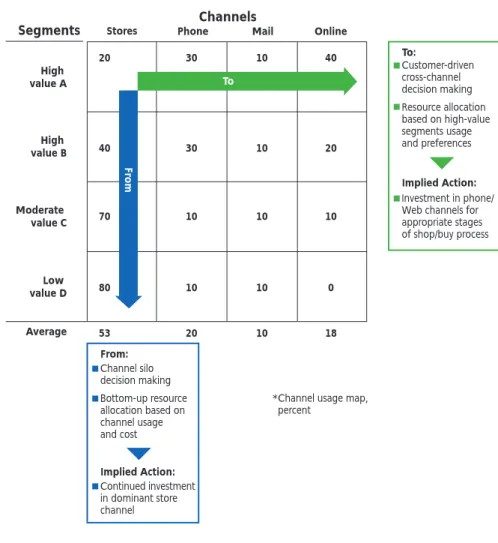
A deliberate multi-channel architecture is critical to avoid the 3E Trap. The key to this process is carefully mapping high-value customer channel usage and preferences against the existing network and cost base. This usually requires a sharp change from managing these
chan-nels as silos to managing them as a linked, interdependent system. This, in turn, means transitioning from a bottom-up, capacity- and cost-driven process to a customer-focused, cross-channel process (see Table 3). Findings related to gaps and overinvestments can be used to develop key migration steps toward a customer-driven, true multi-channel architecture.
Gateway has proven adept at defining distinct channel roles and tailor-ing them to the needs of targeted customer segments. It discovered that 30 percent of its market was uncomfortable buying a computer online, so the company created the Gateway Country Store in which novice
The Need for a Multi-Channel Strategy Will Intensify
Table 2
Frequency of customer interactions
Increasing need for multi-channel
strategy
Channel substitutability
High
Strategic choice
Strategic opportunity
Strategic necessity
Retail banking
Retailing
P&C insurance PCs
Airlines Autos
customers can test, configure, and order equipment for subsequent home delivery, and obtain training. The stores carry no inventory, and over time customers begin to use the Web site for subsequent interac-tions. The majority of Gateway’s new sales are now through these stores, and a large proportion of buyers sign up for computer training, a business with gross margins far in excess of hardware.
Finally, reconditioning the branch/store network creates a major eco-nomic opportunity for redeploying physical assets. First, in our experience, savings of at least 15 to 20 percent of the expense base
Manage Your Channels as a Network*
Table 3
Customer-driven cross-channel decision making Resource allocation based on high-value segments usage and preferences Segments High value A High value B Moderate value C Low value D Average To:
Investment in phone/ Web channels for appropriate stages of shop/buy process
*Channel usage map, percent Implied Action: 20 40 70 80 30 30 10 10 10 10 10 10 40
Stores Phone Mail Online
20
10
0
53 20 10 18
To Fr om Channel silo decision making Bottom-up resource allocation based on channel usage and cost From:
Continued investment in dominant store channel Implied Action:
are possible. Second, divesting or closing stores is often part of the multi-channel solution; research on department store customers reveals that a 6 percent shift to online sales among high-value shop-pers decreases the profitability of the bottom third of stores in the chain by 40 percent. Disciplined management of this process can mitigate the attrition of high-value customers.
Manage customer experience and brand promise
delivery on a cross-channel basis
To this end, multi-channel marketers must tightly align brand prom-ise, value proposition, and customer management to provide a seamless experience. While these strategic marketing issues are chal-lenging, the critical ingredient of multi-channel experience
management is execution. The following levers are key:
Organizational commitment:In many companies, organizational accountability for the “customer,” and therefore the customer experience, often resides only with the CEO/COO. A key element of success is assigning accountability for managing customers across channels. A mix of dedicated (at the center) and matrix (in the channels) roles is the most common solution.
Resource allocation/budgeting:Cross-channel commitments must be communicated across the organization through the resource alloca-tion/budget and performance management processes. A “horizontal” process driven by high-value customer usage is therefore essential.
Marketing practices:Virtually any multi-channel value proposition will require alignment of basic customer identification strategies, seg-mented treatment plans, and brand promise delivery across the organization. While a centralized marketing unit is not necessarily required, a well defined set of “rules of the road” and coordinated activities are critical.
Metrics:Marketers need to bridge the gap between channel-indiffer-ent customer-value-based performance metrics and traditional channel-specific measures. Through a set of enterprise-wide customer metrics, winners create a common cross-channel vocabulary where segment-level customer value, share of wallet, retention/migration, channel usage, cost-to-serve, and service quality are basic. These must be linked to measures that channel managers control so that trade-offs in delivering the target experience are clear. Handle times and CSR compensation, for instance, may need to differ dramatically for high-value customers.
P&Ls:Most importantly, the move to unified or shadow customer P&Ls will accelerate progress toward sole reliance on channel P&Ls, or complex transfer pricing mechanisms. As one senior manager observed, “My life became much easier when we moved to a single customer P&L from channel P&Ls.”
Build capabilities needed to market a multi-channel enterprise
Multi-channel marketing can add exponentially to the variables a marketer must manage. Therefore, we recommend that marketers focus on three “touchstones”:
■ Tightly align your brand promise and multi-channel value proposi-tion. Winners in multi-channel marketing will be those who can design and deliver value propositions that offer unique convenience and information benefits. Contrast how Schwab has naturally evolved its core brand promise (providing self-directed individual investors the tools they need to build wealth) with the transition that traditional full-service brokers are currently attempting as they reposition themselves as multi-channel providers with a less broker-centric emphasis.
■ Make sure your CRM/customer information capabilities enable multi-channel management. It is essential that multi-channel mar-keters focus on identifying high-value customers as quickly as possible, even using incentives to encourage customers to identify themselves. Providing Web-enabled tools to accelerate the ability
of all channels to collect and provide high-impact data to frontline employees and customers can pay off handsomely and build the required platform for multi-channel experience management. Employ a phased approach, however, that avoids the trap of “big bang” solutions.
■ Use a “test and learn” approach. Most of today’s multi-channel win-ners have been aggressively experimenting with cross-channel offerings, management processes, and technologies for several years. Clearly, multi-channel marketers should be creating a portfolio of cross-channel programs based on their insights into the emerging convenience and information benefits sought by high-value cus-tomers. For instance, explore the use of “tactical accelerators” to encourage trial of new cross-channel offerings. These should include such “carrots” as information, education, promotional pric-ing, product design and rewards, as well as such “sticks” as penalty pricing and store closures. Continuing to define ways to provide greater convenience and information will yield powerful clues for future action.
– Corey Yulinsky is a Principal in McKinsey’s Marketing Practice
For additional information or copies, please call (203) 977-6800 or e-mail