Cloud
Computing
Checkpoint
First signs of more general mainstream
acceptance?
Dale Vile - Freeform Dynamics Ltd
June 2011
We’ve heard the promises, we’ve listened to the hype, but where exactly are we in terms of tangible activity and commitment when it comes to cloud computing?
Key Points
Views of cloud computing are wide, varied and often contradictory
When 318 IT and business professionals were asked to sum up their view of cloud computing in a recent online study, a whole spectrum of opinions came back, from positive revolution at one end of the scale to extreme scepticism at the other. At the moment, ambiguous and wildly differing marketing messages are driving attention, but they are also perpetuating confusion and uncertainty.
But a core of acceptance suggests a growing acknowledgement of mainstream readiness
Despite the communication gap between buyers and sellers, indications are that we might be entering a new phase of market evolution, in which cloud options are starting to be viewed as ‘normal’ by those who make it through the marketing noise. With familiar incumbents extending their offerings into the cloud arena, cloud services are now being worked into the plans and activities of conservative as well as progressive organisations.
Experienced adopters see cloud services as complementary to traditional options
Those with early experience have largely concluded that cloud services complement rather than replace traditional hosting options. On-demand/elastic IaaS and PaaS have an important role to play to support transient needs, bursty applications, and other
workloads with fluctuating demands, but traditional co-location remains more suitable for
the majority of applications with more predictable resource requirements. A continued role for traditional managed services and application hosting options is also perceived.
‘Utility SaaS’ has the broadest appeal of all cloud service options
SaaS services relating to general purpose horizontal applications such as email, content
management, and collaboration figure more prominently in plans and activities than
more complex application services such as ERP, full scope CRM and line of business solutions. Furthermore, while ‘Complex SaaS’ and traditional application services
appeal more to larger enterprises, the value of ‘Utility SaaS’ is recognised by all sizes of organisation. For those starting out with cloud services, email and other horizontal solutions that are used largely ‘as is’ are worth exploring.
The role of ‘Private cloud’ is acknowledged to help with ongoing infrastructure optimisation
Even in our cloud-savvy research sample, the majority are clear that optimisation of on-premise systems has to be at least part of the equation. With this in mind, clear
opportunities exist to drive better responsiveness and more efficient resource utilisation
through the adoption of private cloud. The ‘service-centric’ mind-set that underpins cloud computing in general also means that private cloud adoption frequently goes hand in hand with the use of hosted cloud services. The ‘hybrid cloud’ architectures that result from this sit very well with the inclusive nature of real world IT.
The study upon which this report is based was independently designed, interpreted and reported by Freeform Dynamics and executed in
collaboration with The Register news site. Feedback was gathered via an online survey of 318 IT and business professionals from the UK, USA, and other geographies. The study was sponsored by Microsoft.
Introduction
The noise surrounding cloud computing still far exceeds the meaningful signal. In addition
to the hype and unqualified advocacy at one end of the spectrum, and the deep
scepticism at the other, when commentators use the word ‘cloud’ it is often unclear what, exactly, they are referring to[1]. The end result is that when 318 IT and business professionals
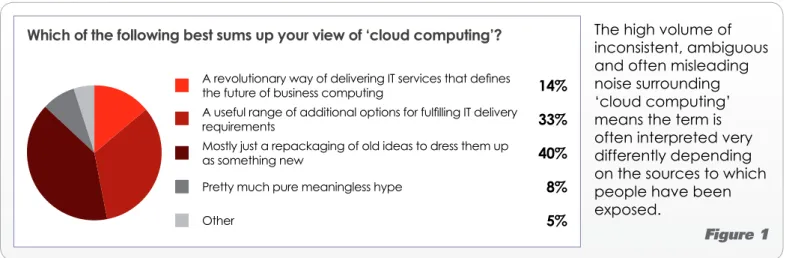
were asked to sum up their opinion on the topic in a recent study (see Appendix A for more details), a wide and contradictory range of different views emerged (Figure 1).
The aim of this report is to bring a sense of proper perspective to the whole cloud discussion. It is based on the aforementioned study that was designed to investigate
where specific cloud offerings are likely to fit into the overall computing landscape.
As with all good research, we took a hypothesis-testing approach to the investigation.
In this case, the specific high level hypothesis at the centre of the work was that various
forms of cloud computing will mostly extend, rather than replace, existing IT delivery options as time goes on. The study was designed to challenge this notion rather than prove it, i.e. we provided every opportunity for the opposite, more revolutionary, view to emerge.
As we talk through our findings, we’ll start with the hosted cloud services that have
received most attention in the market, and then move on to discuss the so-called ‘private cloud’ on-premise option.
The context for hosted cloud
Hosted cloud services (we’ll define these more precisely in a minute) are essentially about outsourcing. In order to understand where they fit, it is therefore useful to start by looking
at attitudes associated with outsourcing and the use of external IT services in general (Figure 2).
The high volume of inconsistent, ambiguous and often misleading noise surrounding ‘cloud computing’ means the term is often interpreted very differently depending on the sources to which people have been exposed.
Figure 1
Which of the following best sums up your view of ‘cloud computing’?
A revolutionary way of delivering IT services that defines
the future of business computing 14%
A useful range of additional options for fulfilling IT delivery
requirements 33%
Mostly just a repackaging of old ideas to dress them up
as something new 40%
Pretty much pure meaningless hype 8%
We should at this point highlight that the online survey methodology used to capture data in our study almost certainly led to a skew in the sample due to the principle of ‘self-selection’. Put simply, this means that those with more of an interest in or knowledge of cloud computing are more likely to have participated. Conversely, those who know less or care less about cloud are likely to be underrepresented. The upshot is that it is not possible to make statements regarding absolute levels of market penetration and activity. Fortunately, however, it does not stop us generating insights into the way activity is evolving in relative terms.
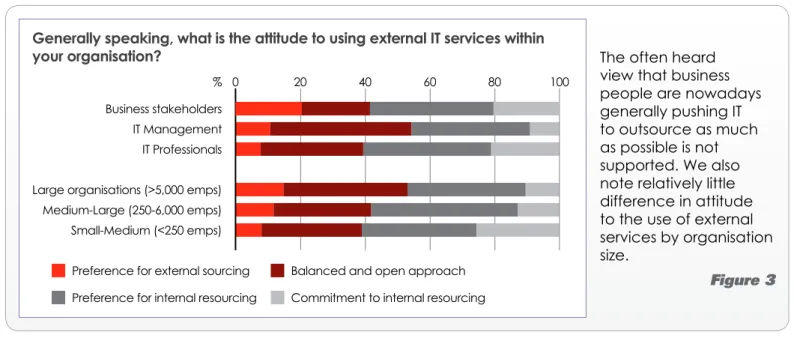
For example, when we break out the propensity or preference to use external services by type of respondent, we see some differences, but the often heard view that business people are nowadays generally pushing IT to outsource as much as possible is not
supported (Figure 3).
We can also see from this chart how policy and preference varies by organisation size. A slight gradient is evident, with larger organisations tending to lean more towards external services than smaller ones. But the correlation isn’t particularly strong - SMB’s are almost as likely to be looking outside for resources and expertise as large enterprises.
Those who know the IT services market in which we have traditionally seen activity
significantly skewed towards larger organisations may find this surprising. Remember,
though, that we’re looking here at preference rather than activity. This apparent anomaly can be resolved if we look at the actual use of external services.
The often heard view that business people are nowadays generally pushing IT to outsource as much as possible is not supported. We also note relatively little difference in attitude to the use of external services by organisation size.
Figure 3
Generally speaking, what is the attitude to using external IT services within your organisation?
Preference for external sourcing Preference for internal resourcing
Balanced and open approach Commitment to internal resourcing
% 20 40 60 80
Business stakeholders IT Management IT Professionals Large organisations (>5,000 emps) Medium-Large (250-6,000 emps) Small-Medium (<250 emps)
0 100
While only a relative
minority (one in five)
have a strong aversion to the use of external services, the centre of gravity within the survey sample was towards
the internal fulfilment
end of the scale.
Figure 2
Generally speaking, what is the attitude to using external IT services within your organisation?
1% All of our IT is outsourced
We use external services to fulfil our IT requirements as
much as we possibly can 10% We take a balanced view, do a lot in-house, but use
external services whenever it makes sense 32% We prefer to do things in-house, but use external services selectively where there is a compelling reason 39% We have an aversion to using external services, and do
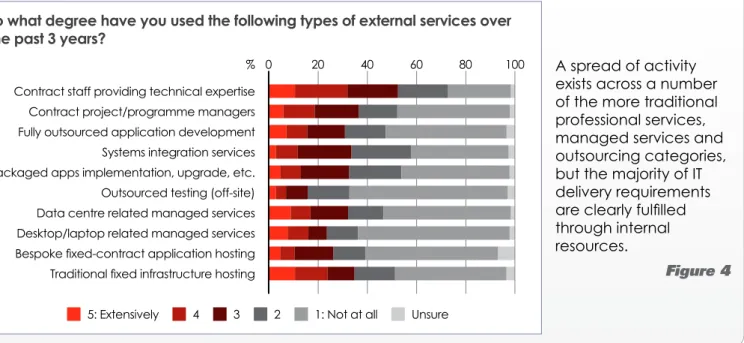
During the study, we inquired about the degree to which various forms of more traditional services had been taken advantage of in recent history, and this revealed a spread of activity across a number of the more traditional professional services, managed services and outsourcing categories as follows (Figure 4).
Not much of a surprise here, just a confirmation that while various forms of external services are used significantly, the majority of IT delivery is based on the use of internal
resources and assets.
Bringing organisation size back into the equation, when we group respondents by their average overall use of external services (see appendix B for analysis), we see a much
more pronounced correlation, with larger organisations exhibiting a significantly stronger
service history (Figure 5).
The picture we get from these last few charts is consistent with IT professional services,
managed services and outsourcing firms historically focusing on the more lucrative higher
end of the market, leaving smaller organisations underserved. In reality, it is likely that the
A spread of activity exists across a number of the more traditional professional services, managed services and outsourcing categories, but the majority of IT delivery requirements
are clearly fulfilled
through internal resources.
Figure 4
To what degree have you used the following types of external services over the past 3 years?
5: Extensively 4 3 2 1: Not at all Unsure
% 20 40 60 80
Contract staff providing technical expertise
Packaged apps implementation, upgrade, etc. Fully outsourced application development
Data centre related managed services
Bespoke fixed-contract application hosting
Contract project/programme managers
Outsourced testing (off-site) Systems integration services
Desktop/laptop related managed services
Traditional fixed infrastructure hosting
100 0
We see a much more pronounced correlation between organisation size and the actual use of external
services, with larger organisations exhibiting a significantly stronger service history than smaller ones.
Figure 5
Categorisation based on aggregate index of external service use (see Appendix B)
Overall use of external services Overall
Strong Service
History Medium Service History Weak Service History % 20 40 60 80 Large organisations (>5,000 emps) Medium-Large (250-5,000 emps) Small-Medium (<250 emps) 0 100 29% Strong Service History Medium Service History 42% Weak Service History 29%
latent need amongst resource-constrained SMBs is actually higher than in their larger cousins, but that demand is suppressed because fewer services companies sell to them, so they are less aware of what’s available. The principle here is that people generally don’t ask for things they don’t know are on offer, or which they regard to be inaccessible to them.
In theory, some of the developments taking place in the area of cloud computing have the potential to close this services availability gap. The economics of cloud hosting,
exploiting economies of scale together with standardisation to allow more to be delivered for less, has the potential to shift many of the traditional lines. From the supply side of the equation, it can become more cost-effective to address the broader mainstream market of small and mid-sized customers. From the buyer side of the equation, it is likely to mean
more accessible services at cheaper prices over time. This, of course, can benefit larger
as well as smaller organisations.
With this in mind, let’s now focus on hosted cloud, and look at how participants in our
study perceive services in this space fitting into the overall outsourcing landscape.
Perceived relevance of hosted cloud
Firstly, we must avoid falling into the trap of using cloud related terminology in an
ill-defined and ambiguous manner.
When asking questions of respondents during our study, we took care to define a number
of categories of hosted cloud services as explicitly and precisely as could be achieved in
the context of an online questionnaire. Here are the definitions we used, exactly as they
were presented in the survey:
Infrastructure as a Service (IaaS)
In which server cycles and other resources (storage and networking) are consumed and paid for ‘on demand’ (the model initially made famous by Amazon with AWS).
Platform as a Service (PaaS)
Hosted environments providing everything needed for building and
executing bespoke applications in the cloud (app server, DBMS, web server, security, development tools, monitoring and management, etc).
Utility style Software as a Service (Utility SaaS)
Hosted applications that are horizontal in nature, e.g. email, content management and other productivity and communication tools that tend to be used as they come by each customer with minimal functional
configuration and integration work.
Complex Software as a Service (Complex SaaS)
Hosted services around ERP, full scope CRM* and other business applications
that generally require significant functional configuration and/or integration work to get up and running in a specific customer environment.
* Note that limited scope CRM such as basic sales automation may be considered ‘Utility SaaS’
that we have broken out the last of these into two subcategories. This is because
much of the analysis we at Freeform Dynamics have done over the past year or so has
consistently highlighted some significant differences in the economics and practicalities
of different types of hosted application. All too often, we were encountering situations in which the differences between, for example, hosted ERP and hosted email or content management, were not being acknowledged.
Despite our unfamiliar refinement to cloud service categorisation, respondents in the
study seemed to tune in very naturally to breaking out the two types of SaaS, and ‘get’ the importance of the distinction. Here is how respondents declared their personal level of experience and knowledge of the different forms of hosted cloud, for example, which shows a clear difference between Utility SaaS and Complex SaaS (Figure 6).
And when looking at how cloud options are anticipated to fit into overall plans and
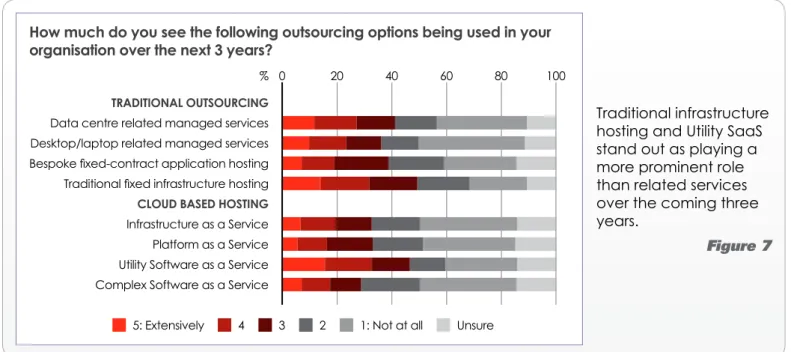
activities, we see an even bigger difference between the SaaS sub-categories (Figure 7).
We’ll get on to exploring what’s behind this difference shortly. In the meantime, the more general observation we can make from this last chart is that hosted cloud options are seen as sitting alongside more traditional services, not totally replacing them.
The evidence so far therefore seems to support our central hypothesis. However, we need to address the question of whether the general level of familiarity with cloud computing
Actual experience is limited across all cloud service categories, even in this self-selecting sample, though if we look across categories, most declared they had a good understanding in at least one type of hosted cloud.
Figure 6
How familiar are you with the following so called ‘cloud’ offerings?
Very clued up from direct practical experience
Familiar with the concept, but not the detail Good level of understanding from my investigations Little or no familiarity with the concept % 20 40 60 80 Infrastructure as a Service Utility Software as a Service Platform as a Service Complex Software as a Service
100 0
Traditional infrastructure hosting and Utility SaaS stand out as playing a more prominent role than related services over the coming three years.
Figure 7
How much do you see the following outsourcing options being used in your organisation over the next 3 years?
5: Extensively 4 3 2 1: Not at all Unsure
% 20 40 60 80
Data centre related managed services
TRADITIONAL OUTSOURCING
CLOUD BASED HOSTING
Infrastructure as a Service
Bespoke fixed-contract application hosting
Utility Software as a Service Desktop/laptop related managed services
Platform as a Service
Traditional fixed infrastructure hosting
Complex Software as a Service
100 0
within our sample meant respondents didn’t know enough to make a judgement on the likely role and impact of emerging options. It could be, for example, that the current view is not an accurate representation of things to come, and that as IT and business professionals become more educated and experienced, they will realise that cloud options can deal with their needs across the board.
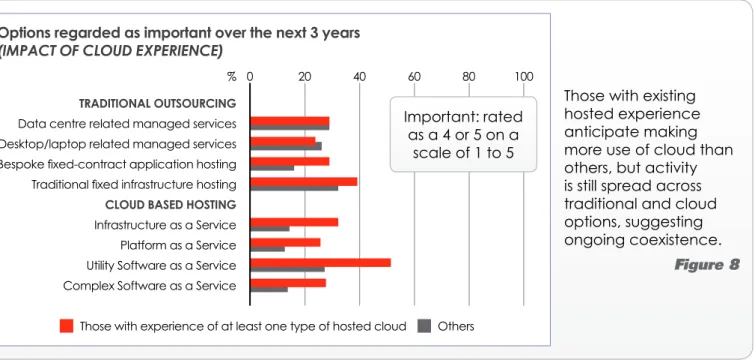
That’s not, however, what the findings suggest. If we take the subset of participants
who claim real experience (based on the responses shown in Figure 6), they certainly anticipate making more use of cloud than others, but activity is still spread across traditional and cloud options (Figure 8).
Looking more closely at this chart, we can also make some other important observations. Activity around traditional infrastructure hosting (e.g. co-location services) seems pretty
robust in general, despite the emergence of the more flexible IaaS and PaaS models. We then see Utility SaaS standing out significantly over and above all other cloud service
categories.
These observations are worth exploring in more detail.
Traditional versus cloud-based infrastructure/platform services
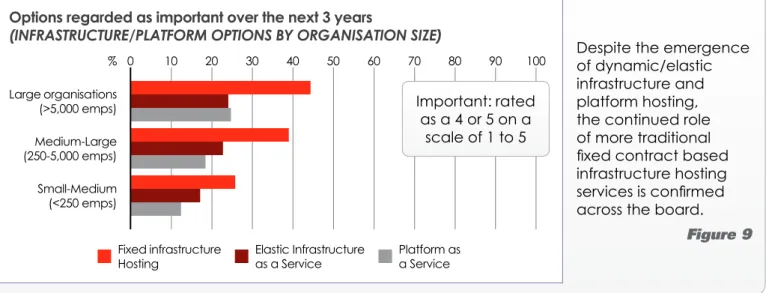
Breaking out the results for infrastructure/platform options by organisation size confirms the continued role of fixed contract based infrastructure hosting services across the board
(Figure 9).
Those with existing hosted experience anticipate making more use of cloud than others, but activity is still spread across traditional and cloud options, suggesting ongoing coexistence.
Figure 8
Options regarded as important over the next 3 years
(IMPACT OF CLOUD EXPERIENCE)
Those with experience of at least one type of hosted cloud Others
% 20 40 60 80
Data centre related managed services
TRADITIONAL OUTSOURCING
CLOUD BASED HOSTING
Infrastructure as a Service
Bespoke fixed-contract application hosting
Utility Software as a Service Desktop/laptop related managed services
Platform as a Service
Traditional fixed infrastructure hosting
Complex Software as a Service
100 0
Important: rated as a 4 or 5 on a
Despite the emergence of dynamic/elastic infrastructure and platform hosting, the continued role of more traditional
fixed contract based
infrastructure hosting
services is confirmed
across the board.
Figure 9
Options regarded as important over the next 3 years
(INFRASTRUCTURE/PLATFORM OPTIONS BY ORGANISATION SIZE)
Fixed infrastructure
Hosting Elastic Infrastructure as a Service Platform as a Service % 10 20 30 40 50 60 70 80 Large organisations (>5,000 emps) Medium-Large (250-5,000 emps) Small-Medium (<250 emps) 0 90 100 Important: rated as a 4 or 5 on a scale of 1 to 5
What this picture reflects is the ‘horses for courses’ principle. For bursty or highly fluctuating
workloads, and arguably for transient applications with a short life span, the elastic nature of IaaS and PaaS potentially represents a very good match. The need to over-provision capacity to handle peaks in demand is minimised, and there is less worry
about service failure or degradation because an application has unexpectedly ‘maxed
out’ the resources available to it (a significant consideration for customer facing Web
applications, for example).
But as flexibility typically comes at a premium, the traditional fixed hosting approach (e.g. based on a fee per fixed spec physical or virtual server per month) can be more cost
effective for the majority of applications and workloads that have relatively predictable
ongoing resource requirements. Furthermore, fixed hosting arrangements also often
go hand in hand with the need or desire for more critical or compliance-sensitive applications to be hosted on dedicated equipment with suppliers that can provide effective account management and ‘expert level’ professional services and support. It’s
for these reasons that traditional fixed hosting will remain a big part of the mix. Another important point is that the resource management and flexible provisioning
technology and techniques that underpin many elastic cloud services can also be used
by service providers to reduce the cost of their fixed capacity services. Put simply, cloud
architectures allow service providers to take cost out of their own operations, regardless of how capacity is consumed by the customer and billed by the provider. We therefore
anticipate an indirect benefit for customers over time in the form of decreased hosting fees across the board, broadening the reach and appeal of traditional fixed hosting even
further.
Traditional versus cloud-based application services
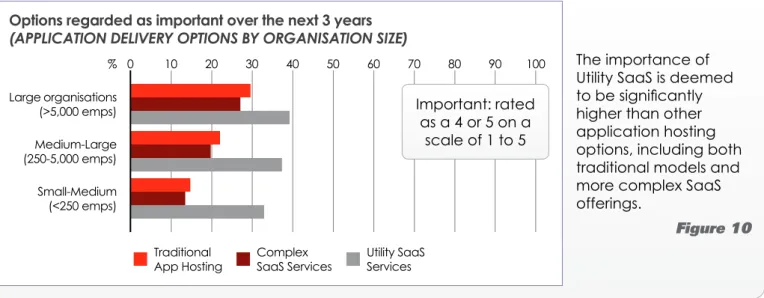
Turning to hosted application services, one of the most striking findings from the study is
the broad appeal of Utility SaaS. A third or more of respondents in every size group rate the forward-looking importance of these kinds of services as 4 or 5 on a scale of 1 to 5 (Figure 10).
The importance of Utility SaaS is deemed
to be significantly
higher than other application hosting options, including both traditional models and more complex SaaS offerings.
Figure 10
Options regarded as important over the next 3 years
(APPLICATION DELIVERY OPTIONS BY ORGANISATION SIZE)
Traditional
App Hosting Complex SaaS Services Utility SaaS Services % 10 20 30 40 50 60 70 80 Large organisations (>5,000 emps) Medium-Large (250-5,000 emps) Small-Medium (<250 emps) 0 90 100 Important: rated as a 4 or 5 on a scale of 1 to 5
As a reminder, Utility SaaS is about horizontal applications that are essentially used as they
come with little or no functional configuration or customisation to meet specific customer
needs. Email, communications, collaboration and content management are the most obvious examples, which are now widely available from a number of service providers as hosted cloud offerings. You still need to go through a migration process and overlay your policies for security, identity and information management on top of such services, but there is little or no tailoring of the applications themselves.
Contrast this with the other two forms of hosting we have shown here, which are generally concerned with more complex applications such as ERP, full scope CRM (as opposed
to basic sales automation) and industry specific solutions. Not only is the implementation more involved to take care of needs analysis, functional configuration, customisation and
integration with other systems, but support and maintenance activity thereafter is also more complex.
The point is that the whole cost and ROI equation is totally different. With horizontal
applications, the cost and overhead of installing and operating the physical environment for an on-premise solution is a big factor in the cost model. Shift this into the cloud with
Utility SaaS economies of scale, and the benefits are potentially significant, not to mention
the rapid time to value. Where more complex and tailored functionality is concerned, the infrastructure and platform piece is often dwarfed by application level implementation, support and maintenance costs. And with a more complex initial project, time to value is longer, risks are higher, and more involvement from key people within the business is required. Neither the SaaS nor traditional hosting models change this that much, hence these propositions are not as immediately compelling as Utility SaaS.
Considering different size segments, for larger organisations, Utility SaaS represents an opportunity for IT departments to pass overhead and burden onto a service
provider, simultaneously reducing costs and freeing up IT resource to do more valuable and interesting things than running an email infrastructure, for example. For smaller organisations, Utility SaaS often represents an opportunity to take advantage of
capability that would never be implemented in-house because the platform and physical operational requirements would be prohibitive in a limited resource/skills environment.
So, it is understandable why Utility SaaS as we have defined it has the strongest and
broadest appeal of all the cloud options, but could we go so far as to say that cloud has now ‘gone mainstream’?
Mainstream, or still a bit special?
Much of the early work conducted by Freeform Dynamics into hosted services suggested that more progressive organisations[2], typically also the faster growing ones, were more
likely to be using SaaS and other cloud based offerings than less progressive ones. This made sense in the very early days of cloud as three of the common traits of progressive organisations are willingness to embrace (or even drive) change, a focus on time to value, and a comfort with taking risks.
The service provider community has moved on quite a bit in recent times, however. In particular, the last year has seen trusted incumbents extend their portfolios to include IaaS and Utility SaaS offerings in a credible manner. We still, of course, hear the odd horror story of outages and premature launches, but on the whole, cloud providers with more established offerings can often deliver a better quality of service with more robust security than in-house IT departments[3]. This is particularly true when we consider the
Small-Medium and Small-Medium-Large business segments.
So, in a world where household names are now delivering low cost services to the broader business community, often based on a familiar software foundation, and trusted ISPs and
traditional hosting firms are offering Amazon-like flexibility, could cloud now be considered
mainstream?
The evidence suggests that things are certainly moving convincingly in that direction. During the study, we inquired about the general environment respondents were working in to get a feel for how progressive or otherwise their organisations were. Here are the questions we asked (Figure 11).
During data analysis, we ran through each of these expecting to see correlations
between many of them and a propensity to adopt different forms of hosted cloud (which
we have seen in previous studies), but on this occasion, we didn’t find any – at least not in
a consistent way.
To double-check the lack of a clear correlation, we aggregated the scores across all responses to the questions shown in Figure 11 and divided respondents into two equal
groups. The first was made up of respondents with an above average score (‘More Organisations vary in terms of the business and IT environment. Some are very
progressive, while others are very conservative, with a spectrum in between.
Figure 11
How much would you say the following apply to your organisation?
5 (Fully applies) 4 3 2 1 (Doesn’t apply at all)
% 20 40 60 80
The company/organisation is generally doing very well
The IT department is very well managed Senior management has a very
progressive attitude
IT is viewed very positively by the business We have a very progressive
approach to the use of IT
Funding is generally available to support new initiatives The IT department is very well
funded
100 0
progressive organisations’) and the second contained those with a score below the overall average for the group (‘Less progressive organisations’). Comparing these two, it is clear that the differences between them are minimal when it comes to the declared importance of cloud and other outsourcing options (Figure 12).
Of course we need to caveat this observation by reminding ourselves of the inherent sample skew towards those with more of an interest in or knowledge of cloud. For every respondent that took part in our survey, there will be a number of others who simply don’t see cloud as relevant to them at the moment. In many cases this will be because it’s simply too hard to distinguish the signal from all of the noisy rhetoric. In others it might be because erroneous assumptions or misunderstandings have led to cloud being written off for the wrong reasons. Then, of course there are those that simply have a preference for doing things in-house as we have seen.
Nevertheless, the absence of a strong correlation between the two groups we have been looking at is consistent with cloud based options now being seen as ‘ready’ for the more conservative mainstream, as well as more progressive and ‘adventurous’ organisations. This doesn’t make hosted cloud mainstream quite yet, but it is an important step in that direction.
But before we get too carried away, hosted cloud does not represent some kind of magic bullet to solve all IT delivery problems. Indeed, taken on board carelessly, hosted cloud services can actually elevate costs and risks rather than reducing them[4]. With this in mind,
it is useful to consider what we learned from the study about the practicalities of hosted cloud adoption.
Hosted cloud adoption practicalities
One of the most important considerations when looking at cloud options is one of fit. The
most robust and professionally delivered service in the world is of no use if it is applied
to solve the wrong problem. We have already discussed the interplay between fixed
and elastic hosting, and different forms of SaaS. We also need to consider requirements imposed by external parties such as customers and regulatory bodies around the security, privacy and sometimes even physical location of data. There is a limit in this report to how
much we can cover the topic of needs analysis and service fit, but this is explored further Indications are
that cloud based options are now seen as ‘ready’ for the more conservative mainstream, as well as more progressive and ‘adventurous’ organisations. Figure 12
Options regarded as important over the next 3 years
(IMPACT OF BUSINESS ENVIRONMENT)
More positive/progressive organisations Less positive/progressive organisations
% 20 40 60 80
Data centre related managed services
TRADITIONAL OUTSOURCING
CLOUD BASED HOSTING
Infrastructure as a Service
Bespoke fixed-contract application hosting
Utility Software as a Service Desktop/laptop related managed services
Platform as a Service
Traditional fixed infrastructure hosting
Complex Software as a Service
100 0
Important: rated as a 4 or 5 on a
In addition to matching requirements to solutions, we also need to consider the nature of the services on offer, including the scope of what’s being provided, the terms and conditions of the service contract (service levels, support, data protection, etc) and the provider’s heritage. On this last point, we will, for example, undoubtedly see more telecoms companies offering full blown hosted CRM solutions. In such cases, we have to be realistic about how well they can operate higher up the value stack than they are used to with regard to providing pre-contract advice and post-contract support, either directly or via partners. Conversely, common sense says we should probably also think twice about relying on a business application specialist to provide hard-core telephony services.
It’s not to say that such scenarios are always going to be a problem, but we need to be aware that the provider landscape currently includes players that are working well outside of their comfort zones, so due diligence is critical.
In this respect, we can learn from those with direct experience of cloud services (Figure 13).
Some of the items on this list highlight an important principle with cloud services, in that you cannot simply pass responsibility for everything over to the provider. It is incumbent on the customer to make sure that use of the service is properly managed, with clear
definition of responsibility and accountability for different parts of the equation. In
reality, most of the burden will fall onto the in-house IT department, as IT professionals are probably best placed to understand the practical dependencies, evaluate delivery capabilities of providers and attributes of services, and take care of policy and process that must exist internally to make sure everything hangs together.
It is worth remembering that in all but the smallest of organisations, the chances are that hosted cloud will be used in conjunction with on-premise IT systems, and as the use of hosted services escalates, multiple providers are likely to be required to meet different needs. This can actually complicate some aspects of IT such as security management, information management, user support and other key areas of policy and process that end up having to operate across organisational boundaries. Again, for more insight into this, see the aforementioned paper[4].
In the meantime, mentioning on-premise systems leads us onto our final topic of Private
Cloud.
The ‘subscribe and go’ rhetoric often heard in relation to cloud is misguided. Those with experience highlight many areas that are critical to consider for success to be achieved.
Figure 13
How important are the following to ensure that service levels to the business can be properly maintained? (THOSE WITH CLOUD EXPERIENCE)
5: Critical 4 3 2 1: Not important
% 20 40 60 80
Clear and appropriate SLAs with providers Coordination between in-house & provider support Pre-contract due diligence on provider capability Clear accountability for points of integration Clear in-house ownership of provider relationship Control of service upgrade timing/rollout IT dept management visibility/control mechanisms APIs/standards for automated monitoring/mgmt Self-service mechanisms for end users
The ‘Private Cloud’ on-premise option
For context, the majority of participants in our study were clear that despite increasing use of hosted services, continued optimisation of internal systems remains important (Figure 14).
The concept of private cloud, which is essentially about creating highly flexible and
dynamic pools of resource within the on-premise infrastructure, was understood to one level or another by almost two thirds of the participants in our study (Figure 15).
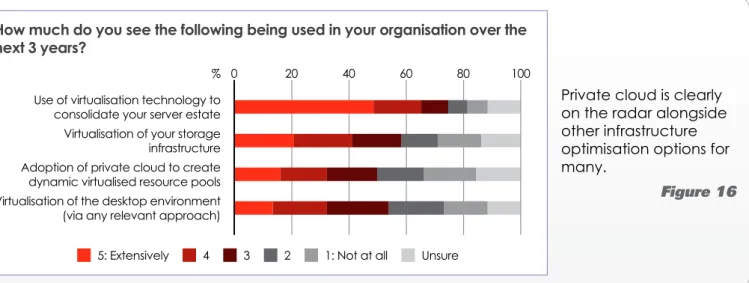
Even bearing in mind the sample skew, this tells us that creating clouds in-house is now a logical part of the cloud computing discussion. And zooming out to the bigger picture, it is clearly on the radar alongside other infrastructure optimisation options for many (Figure 16), especially among larger organisations (Figure 17).
Despite increasing use of hosted services, continued optimisation of internal systems remains important.
Figure 14
When it comes to IT service delivery, which of the following will you primarily look to over the coming 3 years to drive improvements or cost savings?
40% Continued optimisation of on-premise systems
Increasing adoption of hosted services 21%
Both 39%
Private cloud is clearly on the radar alongside other infrastructure optimisation options for many.
Figure 16
How much do you see the following being used in your organisation over the next 3 years?
5: Extensively 4 3 2 1: Not at all Unsure
% 20 40 60 80
Use of virtualisation technology to consolidate your server estate
Virtualisation of the desktop environment (via any relevant approach)
Virtualisation of your storage infrastructure Adoption of private cloud to create
dynamic virtualised resource pools
100 0
Familiarity with the concept of private cloud is in line with most hosted cloud options.
Figure 15
How familiar are you with the concept of ‘Private Cloud’, i.e. use of resource
pooling and dynamic provisioning technologies to create a highly flexible
workload execution and management environment in your own data centre or computer room?
26% Very clued up from direct practical experience
Good level of understanding from my investigations 37% Familiar with the concept, but not the detail 27% Little or no familiarity with the concept 10%
The strength of
commitment to private cloud is higher in large organisations that arguably have more to gain. We also see a notable relationship between the use of hosted and on-premise cloud options.
Figure 17
How much do you see [Private Cloud] being used in your organisation over the next 3 years?
5: Extensively 4 3 2 1: Not at all Unsure
% 20 40 60 80
Large organisations (>5,000 emps)
BY ORGANISATION SIZE
BY HOSTED CLOUD EXPERIENCE
Those with experience of hosted cloud Small-Medium (<250 emps) Medium-Large (250-5,000 emps)
Others
100 0
What’s also interesting, as we can see from this last chart, is the relationship between
hosted cloud and private cloud – those with experience of the former are more likely have the latter as a firm part of their plans. This is partly because cloud in general tends to
encourage a ‘service-centric’ view of the world, i.e. a focus on what is delivered to the business rather than how. In the context of on-premise systems, this simply translates to challenging the traditional tightly coupled manner in which hardware and software has historically been implemented. It’s the service delivered to the business or the user that is important, not the origin or the nature of the resources driving it, and this notion underpins
the use of flexible resource pools as much as it does hosted cloud.
There is also a very practical aspect to the link between hosted and private cloud.
Workloads and applications that have been virtualised to operate effectively in a private cloud environment can typically be comfortably run via IaaS, and, of course, vice
versa. Whether organisations start with private cloud or hosted infrastructure services, it is therefore natural to extend activity from one to the other.
Discussion
Following a confusing couple of years dominated by aggressive marketing, evangelism, and sensationalist press coverage, this study suggests that we are beginning to enter a more considered phase of the cloud computing story. Experience is gathering across the IT professional community, and we appear to have turned a corner in terms of perceived
mainstream readiness and accessibility. The finding that cloud computing is now being
worked into the plans of conservative as well as progressive organisations is particularly
noteworthy, and a likely reflection of familiar incumbents extending their offerings into this
space.
To be clear, however, while the hosted cloud market may be moving into the next phase of development in which offerings from credible sources are accepted as ‘ready’ by those who look at them objectively, we are still very much at the beginning of that phase. As we saw right at the start of this report, views of cloud computing still vary widely from the extreme positive to the extreme negative, and we know from other research that many are still not taking that much notice, either put off by the often contradictory and confusing hype, or getting the impression that cloud is too new for them to consider. The truth is that a disconnect still exists between the seller and buyer communities,
ironically with the level of marketing and revolutionary talk actually hampering progress. With this in mind, there is a clear call to action for the supplier community to adopt a
business professionals know intuitively, i.e. that cloud computing complements rather than replaces the current ways in which IT capability is delivered to the business, including traditional hosting and other outsourcing options. Aggressive marketing around a ‘shift to the cloud’, implying that all established approaches are now outmoded, creates an unhelpful barrier to communication.
For IT and business professionals assessing where cloud fits into their own plans, a key
piece of advice is to always seek precision in terms of the type of cloud computing being considered or discussed. The rationale for adoption and the criteria for service selection
are significantly different for each category of cloud, and what’s important will also
depend on your situation and requirements. Some services will alleviate the IT burden, while others might deliver business value but actually make the life of IT more complex when it comes to areas such as integration, systems monitoring and management, security, and information management.
Working through all this, it is not surprising to see an emerging consensus of Utility SaaS representing one of the best IT/business win/wins in the short term. Before embarking on that next big email migration project, for example, it might be worth taking a look at the hosted service alternatives and the value they might bring.
One of the biggest lessons from our research, however, and something worth reiterating, is the need to think of cloud computing as building on rather than replacing existing IT delivery options. The continued prominence of traditional infrastructure hosting, for example, particularly underlines the ongoing value of traditional services. At a higher level, we have also seen that a very small minority are putting all their eggs in the hosting basket when they look to drive improvements and cost savings around IT service delivery. Even in our cloud-savvy research sample, the majority are clear that optimisation of on-premise systems has to be at least part of the equation.
With this in mind, clear opportunities exist to drive better responsiveness and more efficient
resource utilisation through the adoption of private cloud. While not necessarily a natural follow on from consolidation focused virtualisation initiatives, the latter certainly lay the groundwork which puts many companies in a good position to explore the resource pooling, dynamic usage option. The relationship between hosted and private cloud underlines the importance of taking an inclusive view. This in turn supports the notion of hybrid architectures which allow internal and external resources to be exploited together
to achieve high levels of choice and flexibility.
In conclusion, cloud computing potentially has something to offer to organisations of all sizes, and you don’t need to be working in a progressive leading/bleeding edge environment to take advantage of what’s on offer. You do, however, need to ignore all of the ‘subscribe and go’ rhetoric, and take an objective, considered and practical approach to investigation and adoption.
References and Further Reading
1. But is that really cloud computing
The problem of ill-defined terminology
http://www.freeformdynamics.com/fullarticle.asp?aid=1068
2. IT on the front foot
Sourcing, architecture and the progressive IT organisation http://www.freeformdynamics.com/fullarticle.asp?aid=318
3. Trust and security in the cloud
The myths and realities of hosted applications
http://www.freeformdynamics.com/fullarticle.asp?aid=1307
4. Applied cloud computing
A practical guide to identifying the potential in your environment http://www.freeformdynamics.com/fullarticle.asp?aid=1229
Appendix A: Study Sample
The study upon which this report is based was independently designed, interpreted and reported by Freeform Dynamics, with execution carried out in collaboration with The Register news site. Feedback was gathered via an online survey of 318 IT and business professionals from the UK, USA, and other geographies. The sample distribution was as follows:
A note on methodology
The online survey methodology used to capture data in this study almost certainly led to a skew in the sample due to the principle of ‘self-selection’. Put simply, this means that those with more of an interest in or knowledge of cloud computing are more likely to have participated. Conversely, those who know less or care less about cloud are likely to be underrepresented. It is therefore not possible to make statements regarding absolute levels of market penetration and activity from the data.
However, the insights presented in this report, which are all based on relative observations, are not affected by this limitation.
Which of these best describes your role in relation to IT services?
20
10 15 25
5 %
Management level IT professional Multi-disciplined IT practitioner IT architect Management level user or stakeholder IT administrator Professional business user Software developer Non-IT professional with IT responsibilities IT support specialist (external users) IT support specialist (internal users) Network/comms specialist Desktop specialist Server specialist Storage specialist Other 0 30
Sample by organisation size Sample by geography 24% Large organisations (>5,000 employees) Medium-Large organisations (250-5,000 employees) 32% Small-Medium organisations (<250 employees) 44% 45% UK 15% Rest of Europe 17% USA 23% Rest of World
Appendix B: Service History Index
During the study, respondents were asked about their use of external services across a range of different professional service, managed service and hosted service categories. A 1-5 scale was used to gather feedback and the raw results (by rating) along with the average response for each category (usage index) were as follows:
This averaging approach was then used to segment the sample. An overall usage index was calculated for each respondent based on the average rating they gave across all service categories. Respondents were then grouped according to their usage index as follows.
Note that the groupings used are not meaningful in absolute terms. Convenient
breakpoints were identified that allowed the sample to be divided into three reasonably
sized groups. The aim was simply to facilitate analysis based on relative levels of historical service use.
3 4 2
To what degree have you used the following types of external services over the past 3 years? (Scale of 1-5)
5: Extensively 4 3 2 1: Not at all Unsure Usage index 80
40 60 20
% Contract staff providing technical expertise Contract project/programme managers Fully outsourced application development Systems integration services Packaged apps implementation, upgrade, etc Outsourced testing (off-site) Data centre related managed service Desktop/laptop related managed services
Bespoke fixed-contract application hosting Traditional fixed infrastructure hosting
100
0 1 5
Overall average:
2.11
Service History Analysis
29% Strong Services History (Service use index 2.5 or higher)
Medium Services History (Service use index 1.5 to 2.5) 42% Weak Services History (Service use index less than 1.5) 29%
The Register started life as a daily news operation on the
web in May 1998. On the first day, 300 readers visited; in
November 2009, 5.4 million unique readers visit the site every month, according to an independent audit by ABCe.
The Register’s blend of breaking news, strong personalities, and its accessible online execution, has made it one of the most popular authorities on the IT industry.
With an international team of journalists and columnists, The Register reports on the
IT industry from the inside out – covering everything from enterprise software to chip
developments.
About
Freeform Dynamics is a research and analysis firm. We track and
report on the business impact of developments in the IT and communications sectors.
As part of this, we use an innovative research methodology to gather feedback directly from those involved in ITC strategy, planning, procurement and implementation.
Our output is therefore grounded in real-world practicality for use by mainstream IT professionals.
For further information or to subscribe to the Freeform Dynamics free research service, please visit www.freeformdynamics.com or contact us via [email protected].
Founded in 1975, Microsoft (Nasdaq “MSFT”) is the worldwide leader in software, services and solutions that help people and businesses realise their full potential.
Terms of Use
This document is Copyright 2011 Freeform Dynamics Ltd. It may be freely duplicated and distributed in its entirety on an individual one
to one basis, either electronically or in hard copy form. It may not, however, be disassembled or modified in any way as part of the
duplication process.
The contents of the front page of this document may be reproduced and published on any website as a management summary, so long as it is attributed to Freeform Dynamics Ltd, and is accompanied by a link to the relevant request page on www.
freeformdynamics.com. Hosting of the entire report for download and/or mass distribution of the report by any means is prohibited unless express permission is obtained from Freeform Dynamics Ltd.