- 81 - A unification of electrostatic and gravitational forces
7.
A UNIFICATION OF ELECTROSTATIC AND
GRAVITATIONAL FORCES
Abstract
The gravitational force of attraction FG between two bodies, distance Z apart, one of mass M1 containing N1 positive and
negative electric charges (±Qi) and the other of mass M2 containing
N2 electric charges (±Ki), is derived as:
1 2 1 2 2 2 1 1 N N G o o i i o o i i i i G G M M Q V K P Z Z µ ε = µ ε = = − = −
∑
∑
F û ûwhere G is the gravitational constant, µo the permeability and εo the
permittivity of a vacuum, Vi and Pi are the total potentials at the
respectivelocations of the charges Qi and Ki andû is a unit vector.
This explains Newton’s universal law of gravitation, as an electrical effect, outside Einstein’s theory of general relativity. Gravitation is attributed to deflection of electric fields by charges such that forces of repulsion are decreased and forces of attraction increased.
Keywords: Electric charge, force, gravity, mass, relativity.
7.1 Introduction
The force of attraction between two bodies is given by the universal law of gravitation discovered by Sir Isaac Newton around 1687 [1]. The force of attraction or repulsion between two stationary electric charges is expressed by the law of electrostatics enunciated by Charles Coulomb in 1784. It is natural that physicists would think that there should be a connection between gravitational and electrostatic forces. So, for several decades now, physicists have been searching for a theory that would combine gravitational forces between masses and electrostatic forces between charges. In 1915, Einstein [2] came out with the general relativity theory. This, it was believed, explained gravitation in the context of curvature or warping of four-dimensional space-time.
The idea of four-dimensional space-time continuum, where the three spatial coordinates and the one time dimension pinpoint an event in space,
- 82 - A unification of electrostatic and gravitational forces
was first suggested by the German physicist Herman Minkowski, in 1908. Minkowski’s idea was subsequently adopted by Albert Einstein in
formulating the theory of general relativity.
According to the general relativity theory, gravity is not a force like other forces, but the result of curvature or warping of four-dimensional space-time due to the presence of matter; not some effect emanating from matter itself. Bodies, like the earth, follow the path of least resistance, a straight line in curved space-time, which, in reality, is an elliptic orbit in three-dimensional space. In other words, curved space pushes (accelerates) objects to follow a particular path in the universe. Where the space-time curvature is infinite, there is what is called “singularity”, resulting in a “black hole” - matter so dense and massive that not even light can escape from its vicinity, boundary or event horizon. The idea of warping of space-time, referred to as “ripples of space” (due to time effect), in the presence of matter, giving rise to gravitation, was a revolutionary, brilliant and most appealing theory.
The general relativity theory or Einstein’s theory of gravitation, describes the large-scale structure of the universe and the force of gravity or acceleration between bodies, like the sun, planets and moons. Quantum mechanics based on the works of Planck, Bohr, De Broglie and others [3, 4, 5], on the other hand, treats extremely small-scale phenomena down to the atomic particles. Unfortunately, the quantum and relativity theories, the dominant theories of modern physics, being incompatible with one another at high speeds, cannot both be correct, but do coexist peacefully. This inconsistency has informed the search for a unified theory to incorporate general relativity and quantum mechanics – a quantum theory of gravity or quantum field theory. Einstein spent many years searching for a link between general relativity and quantum theory, up to the end of his life, without success. Many physicists are now engaged in the search for a unified field theory or Grand Unified Theory (GUT).
Just as Einstein introduced time making a fourth (non spatial) dimension in general relativity, to explain gravitation, in 1919 the Polish mathematician, Kaluza, proposed that a fourth spatial dimension was needed to incorporate electrical forces. This proposal was subsequently refined in 1926 by Swedish physicist, Klein. Kaluza and Klein suggested that electromagnetism was due to “ripples” in four spatial dimensions and one time dimension. The idea of space having more than three dimensions (the usual three extended dimensions and several “curled up” dimensions
- 83 - A unification of electrostatic and gravitational forces
too small to be observed) was a brilliant and very attractive theory. Thistheory has stretched physicists’ dimensions of imagination too far, but so far, it has not been demonstrated by any experiment.
In the early 1980s the search for a unified field theory assumed extra dimensions with the introduction of the superstring theories as described by Hawking [6], Greene [7] and Barbour [8]. According to the union of five types of superstring theories, called the M-theory (‘M’ for mysterious), the fundamental constituents of the physical world are not point particles but infinitesimal one-dimensional open strings (lines) or closed strings (loops). All the forces and energies in the universe arise from the strings’ vibrations at different frequencies in ten spatial dimensions and one time dimension; an elementary particle, like the electron, being a string vibrating at a resonant frequency. The advocates of the M-theory take it as the Grand Unified Theory (GUT) of everything.
Some other physicists have been engaged in the pursuit for a unified field theory but not along the lines of reconciling general relativity and quantum mechanics. It may as well be that either the general relativity theory or quantum mechanics is incorrect or that both theories are wrong. It is not so much like looking for the proverbial “needle in the haystack” but searching for something that was not a “needle” or never in “the haystack”. What is needed is to go back to the first principles and conduct the search on the basis of the well-known Newton’s universal law of gravitation and Coulomb’s law of electrostatics.
7.2 Newton's universal law of gravitation
The law of force of attraction between masses in space was discovered by the great English physicist and mathematician, Sir Isaac Newton around 1687 [1]. Newton’s law of gravitation states:
“Every object in the universe attracts every other object with a force that is proportional to the product of their masses and inversely proportional to the square of the separation between the two objects”.
Mathematically, the gravitational force of attraction FGbetween two objects of masses M1 and M2 in space separated by a distance Z, between
- 84 - A unification of electrostatic and gravitational forces 1 2 2 G M M G Z = − F û (7.1)
where û is a unit vector pointing in the direction of the force of repulsion, opposite to the force FG and G is the gravitational constant.
7.3
Coulomb’s law of electrostatics
The American politician, scientist and inventor, Benjamin Franklin (1706 – 1790) had established that there were two kinds of electricity, positive charges and negative charges. He demonstrated that electric charges always existed in equal and opposite amounts. Franklin’s discovery was of great significance in physics. Thus, for neutral bodies the forces of repulsion and attraction, due to the equal number of positive and negative charges, cancel out exactly. There is no electrostatic force of repulsion or attraction between two neutral bodies, but the gravitational force of attraction remains and persists.
Forces between stationary electric charges are expressed in the law enunciated by the French physicist, Charles Coulomb, in 1785. Coulomb’s law of electrostatics, a significant law in physics, states:
“The force of repulsion or attraction between two electric charges is proportional to the product of the magnitude of the charges and inversely proportional to the square of the distance between them”. An addition to Coulomb’s law is to the effect that
“Like charges repel and unlike charges attract”,
This is in contrast to gravitation where the forces are always attractive. The electrostatic force fE, of repulsion or attraction, between two
stationary electric charges of magnitudes Q and K distance Z apart, in space, is expressed as a vector:
2 4 E o QK Z πε = ± f û (7.2)
where the force between two electric charges is positive (repulsive) for like charges and negative (attractive) for unlike charges, εo is the
permittivity of a vacuum and the unit vector û points in the direction of the force of repulsion.
- 85 - A unification of electrostatic and gravitational forces
7.4 Electrostatic and gravitational forces between
two isolated charges
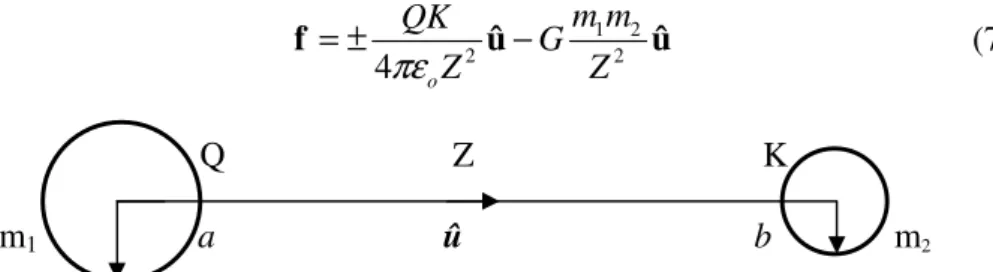
Figure 7.1 shows two isolated electric charges of magnitudes Q and K respectively in the form of spherical shells of radii aand b. The masses m1and m2 are separated by a distance Z in space. Z is very much larger than the radius aor b. The force f between the stationary charges, which is a combination of electrostatic force of repulsion or attraction and gravitational force of attraction, is expressed as:
1 2 2 2 4 o m m QK G Z Z πε = ± − f û û (7.3) Q Z K m1 a û b m2
Figure 7.1. Electrostatic and gravitational forces between two charges Q and K. where ûis a unit vector in the direction of force of repulsion and G is the gravitational constant. The first term on the right-hand side of equation (7.3) is the electrostatic force of repulsion or attraction between isolated electric charges of magnitudes Q and K and the second term is the gravitational force of attractionfG, between masses m1 and m2, as given by Newton’s universal law of gravitation. Equation (7.3) gives the gravitational force, equation (7.1), as:
G G2 m m1 2 Z
= −
f û (7.4)
The author [9] showed that the mass m of an isolated electric charge (positive or negative) of magnitude Q, in the form of a spherical shell of radius a in free space of permeability µo, is given by the equation:
2 4 oQ m a µ π = (7.5)
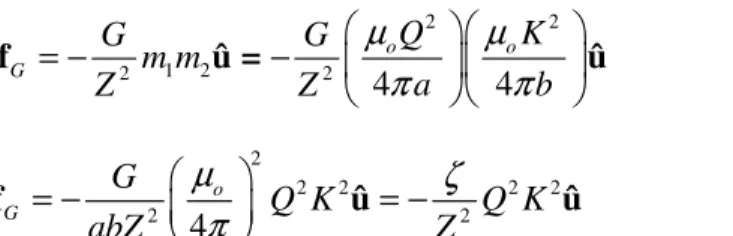
Substituting for the mass m1 (of electric charge Q) and mass m2 (of another electric charge K) from equation (7.5) into (7.4), gives the gravitational force of attraction. The gravitational force of attraction between two isolated electric charges, where the separation Z is much larger than the radius aor b, is given by the vector equation:
- 86 - A unification of electrostatic and gravitational forces 2 2 1 2 2 2 4 4 o o G Q K G G m m a b Z Z µ µ π π = − − f û = û (7.6) 2 2 2 2 2 2 2 4 o G G Q K Q K abZ Z µ ζ π = − = − f û û (7.7)
where ζ (zeta) is a constant. Thus fG, the force of attraction due to gravity, is proportional to the product of square of the charges or proportional to the square of product of the charges. This force is always negative (attractive) because the square of an electric charge (positive or negative) is always positive.
A unification of electrostatic and gravitational forces gives the force between two electric charges Q and K separated by distance Z in space (equation 7.3) as: 2 2 2 2 4 o QK Q K Z Z ζ πε = ± − f û û (7.8)
For a neutral body containing equal numbers or equal amounts of positive and negative electric charges the forces of repulsion and attraction cancel out exactly but the gravitational forces of attraction add up.
7.5 Electrostatic force of repulsion and attraction
between two neutral bodies
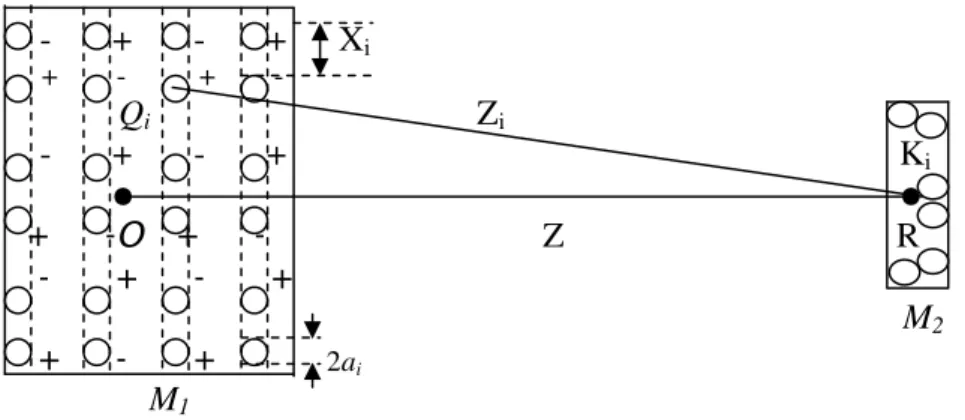
Figure 7.2 shows a neutral body of mass M1 containing N1/2 positive
electric charges and N1/2 negative electric charges, N1 being an even
number and a very large number indeed. Each charge is of quantity ±Qi =
(–1)iQi, in the form of a spherical shell of radius ai (i = 1, 2, 3, 4....N). The
potential pi at a point R, due to a charge Qi distance Zi from R, is:
( )
1 4 i i i o i Q p Z πε − =The electrostatic potential P, at a point R, due to all the N1/2 positive
electric charges and N1/2 negative electric charges in a neutral body of
mass M1, is the sum:
( )
( )
1 1 1 1 1 1 1 1 4 4 N N i i i i i i o i o Q P Q Z Z πε = πε = =∑
− =∑
− (7.9)- 87 - A unification of electrostatic and gravitational forces - + - + Xi + - + - Qi Zi - + - + Ki + -O + - Z R - + - + M2 + - + 2ai M1
Figure 7.2. A body of mass M1 containing N1 positive and negative charges each of
magnitude Qi at a distance Zi from a point R with mass M2 in space. Two constituent
charges, each of radius ai, making a pair of particles, are separated by a distance Xi,
much lager than ai. The distance Ziis much larger than Xi.
where Z is the distance of the centre of charge O from the point R in space. Since a neutral body is composed of equal numbers or equal
amounts of positive and negative electric charges, the potential at R, is:
( )
( ) 1 1 1 2 2 2 2 1 1 1 1 1 1 1 0 4 4 N N N i i i i i i i o o P Q Q Q Z Z πε πε − = = = = − = − = ∑
∑
∑
(7.10) N1/2 N1/2where
ΣQ
2i is the total amount of positive charges, equal toΣQ
(2i -1) i = 1 i = 1the total negative charges in a neutral body. Equation (7.10), making the potential at any point, due to a neutral body, zero, is stating the obvious. This is quite obvious for electric charges equal in magnitude. A second neutral body of mass M2 placed at R (Fig. 7.2) experiences a constant (0)
potential and no electrostatic force, as the forces of repulsion and attraction cancel out exactly, leaving the gravitational forces.
7.6 Gravitational force between two bodies
The author [9] showed that the mass M of a distribution of N positive and negative electric charges (±Qi) constituting a neutral body, as in Figure 7.2, is given by the sum of products, thus:
- 88 - A unification of electrostatic and gravitational forces 1 N o o i i i M µ ε Q V = =
∑
(7.11)where Vi is the total potential at the point of location of charge Qi.
The gravitational force of attraction FG between the body of mass M1
and another body at R (Figure 7.2), of mass M2 containing N2 charges
(±Ki), is obtained as the product of two sums, thus: 1 2 1 2 2 2 1 1 N N G o o i i o o i i i j G G M M Q V K P Z Z µ ε = µ ε = = − = −
∑
∑
F û û (7.12)where Z is the separation between the bodies, G is the gravitational constant and Vi and Pi are the total potentials at the respective points of
locations of the charges Qi and Ki.
In Figure 7.2, pairs of opposite charges Qi, of radius ai, separated by
distance Xi, the total potential Vi at the location of charge Qi, is:
1 1 4 i i o i i Q V a X πε = −
Other potentials at the position of Qi cancel out. Equation (7.11) gives 2 1 1 1 4 N o i i i i M Q a X µ π = = −
∑
(7.13)Where the constituent electric charges are of the same magnitude Q, same radius a and same separation X, equation (7.13) becomes:
2 2 1 1 1 1 1 4 4 N o o i i i i NQ M Q a X a X µ µ π = π = − = −
∑
(7.14)Let us find the force of attraction FG between the body of mass M1
and another of mass M2 at R (Figure 7.2). The mass M2 contains N2/2
pairs of opposite charges, each of magnitude Kin the form of a spherical shell of radius b, distance Y apart. Force FG is the product:
1 2 2 G GM M Z = − F û 2 2 1 2 2 1 1 1 1 4 4 oN Q N K G a X b Y Z µ µ π π − − − o û (7.15)
In equation (7.15), if the charges are in two bodies where 1/X and 1/Y can be neglected compared with 1/a and 1/a, FG, is obtained as:
- 89 - A unification of electrostatic and gravitational forces 2 2 2 2 2 1 2 1 2 1 2 2 2 2 4 o G M M N N Q K N N Q K G G Z abZ Z µ ζ π = − = − = − F û û û (7.16)
Equation (7.7) and (7.16), giving the gravitational force of attraction as proportional to the product of squares of the charges, are what this paper set out to derive. The ‘electro-gravity’ constant ζ, incorporating the gravitational constat G, is given by:
2 4 o G ab µ ζ π = (7.17)
7.7 Deflection of electric fields by an electric charge
The attributes of space, of zero electric field (constant potential), inside a spherical electric charge, is different from the attributes of space outside the sphere where the field decreases inversely with square of the distance from the charge. The spherical surface is visualized as a source of energy, a ‘boundary’ which is tantamount to ‘distortion’ of a region of space. It creates an electric charge and produces an electric field emanating from the charge and.extending into space to vanish at infinity.
The electrid field due to an electric charge is supposed to be deflected or bent when it encounters another electric charge at a point in spsce. The interaction produces a a small ‘deformation’ of the electric field such that the force of repulsion is slightly decreased and the force of attraction similarly increased. The consequent small decrease in electrostatic energy of electric fields from electric charges composing bodies may account for the gravitational (potential) energy of masses. The effect of ‘deformation’ of electric fields from charges is gravitational force of attraction between masses in a manner akin to ‘distortion’ or ‘warping’ of space, as envisaged by Einstein, but without the “time dimension”.
The space, outside matter in space, is not empty but crisscrossed by electric fields emanating from equal numbers or equal amounts of electric charges composing bodies. The fields are ever present, with the electrostatic forces of repulsion and attraction cancelling out exactly at a point in space, but leaving the gravitational forces of attraction. A gravitational field is present everywhere in space between electric charges composing masses, producing a ‘pull’ independent of relative velocities between the charges of the bodies.
- 90 - A unification of electrostatic and gravitational forces
7.8 Conclusion
The import of equations (7.7) and (7.16) is that gravitational force of attraction between masses is electrical in nature, supposed to be the result of deflections of electric fields by electric charges in a body. This explains the force of gravity between masses without recourse to four-dimensional space-time continuum of Einstein’s theory of general relativity. It should put to test the idea of four-dimentional space-time and ‘warping’ of space-time continuum, in the presence of matter, to create gravitation and put to rest the present quest, by physicists [10], for the Grand Unified Theory (GUT) of everything.
We, following the greats, Galileo Galelei and Isaac Newton, contend that space and time are absolute quantities, independent of the position or motion of the observer and that space is of one dimension, Length, a vector quantity with three orthogonal components.
7.9 References
[1] I Newton, (1687); Mathematical Principles of Natural Philosophy (Translated by CAJORI, F., University of California Press, Berkeley (1964).
[2] A. Einstein & H.A. Lorentz; The Principle of Relativity Matheun, London (1923).
[3] M. Planck; Ann. Phys, 4 (1901), 533. [4] N. Bohr; Phil. Mag. 26 (1913), 476. [5] L. De Broglie; Ann. Phys. (1925), 3, 22.
[6] S. Hawking; A Brief History of Time, Bantam Books, London (1999), chap. 10.
[7] B. Greene; The Elegant Universe, Vintage, London (1999), chap. 8. [8] J. Barbour; The End of Time, Phoenix, Orion Books Ltd., London
(2000), Parts II & IV.
[9] M.D. Abdullahi; “On the Energy and Mass of Electric Charges in a Body”, This Book (2006), Paper 6.
[10] G. A. Oyibo; “A Grand Unified Theorem Representing the Unified Field Theory of Everything”, Int. J. Maths., 9 (1999). See author’s website: http://www.geocities.com/igala1/new_page_6.htm (2006).