19 SUSTAINABLE ENERGY: THE KEY TO
EVERYTHING
19.1 THE ENERGY PROBLEM
It is a rather bold claim that sustainable energy is “the key to everything.” But a convincing argument can be made that most problems in the physical environment can be solved to at least a large degree if enough energy is available, if it is inexpensive enough, and if it can be used without doing irreparable environmental harm. Consider the following environmental and sustainability problems that can be solved at least in part with sufficient sustainable energy:
• Water: With enough energy, wastewater can be reclaimed to drinking water standards by reverse osmosis and other energy-consuming technologies and sea water can be desalinated.
• Food: With enough energy, marginal land can be reclaimed by measures such as leveling, terracing, and rock removal and irrigation water can be pumped from long distances or desalinated to grow food. Greenhouses can be heated even during winter months to grow high-value specialty foods.
• Wastes: The disposal of hazardous organic wastes in landfills, though widely practiced, is not a good idea. With sufficient energy such wastes can be converted to forms that cannot do harm.
• Transportation: With sufficient sustainable energy, transportation problems can be solved by technologies such as electrified railways.
• Fuels: Biomass sources of fixed carbon can be converted to hydrocarbon fuels for applications for which there are no viable alternatives (such as aircraft) without adding any net amounts of greenhouse-gas carbon dioxide to the atmosphere.
which its economic systems have become based. This is especially true of petroleum. Peak U.S. petroleum production was passed several years ago, and it is likely that peak world production will be reached within a few years of 2010. Exorbitantly high petroleum prices in the first part of 2008 followed by a precipitous fall in price as world economies collapsed at the end of the year emphasized the economic uncertainties of reliance upon petroleum as an energy source, especially by nations that do not have domestic sources. There are still abundant resources of coal, but their utilization to provide for energy with current technology almost certainly will cause unacceptable global warming. Therefore, the great challenge facing humankind during the next several decades is to develop sources of energy that will meet energy needs and that will not ruin Earth and its climate.
There are energy alternatives to fossil fuels that can be developed, that are environmentally safe (or can be made so), and that, taken in total, can be adequate to supply energy needs. These include wind, solar, biomass, geothermal, and nuclear energy sources. Some other miscellaneous sources, such as tidal energy, may contribute as well. Fossil fuels will continue to be used and may contribute sustainably for decades with sequestration of greenhouse gas carbon dioxide. And, of course, energy conservation and greatly enhanced efficiency of energy use will make substantial contributions. This chapter discusses the energy alternatives listed above with emphasis upon energy sustainability.
19.2 NATURE OF
ENERGY
Energy is the capacity to do work (basically, to move matter around) or heat in the form of the movement of atoms and molecules. Kinetic energy is contained in moving objects. One such is the energy contained in a rapidly spinning flywheel, a device of potentially great importance for energy storage to even out the energy flow from intermittent solar and wind sources. Potential energy is stored energy, such as in an elevated reservoir of water used as a means of storing hydroelectric energy for later use that can be run through a hydroelectric turbine to generate electricity as needed.
A very important form of potential energy is chemical energy stored in the bonds of molecules and released, usually as heat, when chemical reactions occur. For example, in the case of methane, CH4, in natural gas, when the methane burns,
CH4 + 2O2 → CO2 + 2H2O (19.2.1)
the difference between the bond energies in the CO2 and H2O products and the CH4 and O2 reactants is released, primarily in the form of heat. If the heat is released by combustion of methane in a gas turbine, part of the heat energy can be converted to mechanical energy in the form of the rapidly spinning turbine and an electrical generator to which it is attached. The generator, in turn, converts the mechanical energy to electrical energy.
used in describing chemical processes. The “calorie” commonly used to express the energy value of food (and its potential to produce fat) is actually a kilocalorie, kcal, equal to 1000 cal.
Power refers to energy generated, transmitted, or used per unit time. The unit of power is the watt equal to an energy flux of 1 joule per second (J s-1). A compact fluorescent light bulb adequate to illuminate a desk area might have a rating of 21 watts. A large powerplant may put out electricity at a power level of 1000 megawatts (mw, where one mw is equal to 1 million watts). Power on a national or global scale is often expressed in gigawatts, each one of which is equal to a billion watts or even terawatts, where a terawatt is equal to a trillion watts.
The science that deals with energy in its various forms and with work is thermodynamics. There are some important laws of thermodynamics. The first law of thermodynamics states that energy is neither created nor destroyed. This law is also known as the law of conservation of energy. The first law of thermodynamics must always be kept in mind in the practice of green technology, the best practice of which requires the most efficient use of energy. Thermodynamics enables calculation of the amount of usable energy. As described by the laws of thermodynamics, only a relatively small amount of the potential energy in fuel can be converted to mechanical energy or electrical energy with the remaining energy from the combustion of the fuel dissipated as heat. With the application of green technology, much of this heat is salvaged for applications such as district heating of homes.
Although energy is neither created nor destroyed, the amount of useful energy that can be obtained from a system can be dissipated. Useful mechanical energy can be produced for example in a heat engine by harnessing part of the energy flow from a hot to a cooler part of the system (Section 19.4 and Equation 19.4.1). The amount of this useful energy is called exergy and it can go to zero in a system that has reached equilibrium.
19.3 SOURCES OF ENERGY USED IN THE
ANTHROSPHERE
Before the 1800s, most of the energy used in the anthrosphere came from biomass produced during plant photosynthesis. Houses were heated with wood. Soil was cultivated and goods and people moved by the power of animals or by humans themselves, obtaining their energy from food biomass. Wind drove sailing ships and windmills and falling water moved waterwheels. These sources were renewable and sustainable, with solar energy captured by photosynthesis to generate biomass, wind produced by temperature and pressure differences in solar-heated masses of atmospheric air, and flowing water moved as part of the solar-driven hydrologic cycle.
providing a large fraction of energy used in the anthrosphere and still is. By around 1975, nuclear energy was supplying significant amounts of electricity and has maintained an appreciable share worldwide until the present. Miscellaneous renewable sources including geothermal and, more recently, solar and wind energy are making increasing contributions to total energy supply. Biomass still contributes significantly to the total of the sources of energy used.
Figure 19.1 shows U.S. and world energy sources used annually as of the year 2000. The predominance of fossil fuel petroleum, natural gas, and coal are obvious. Estimates of the amounts of fossil fuels available differ. Those of the quantities of recoverable fossil fuels in the world before 1800 as estimated around 1970 are given in Figure 19.2. By far the greatest recoverable fossil fuel is in the form of coal and lignite.
Figure 19.1. U.S. (left) and world (right) sources of energy. Percentages of total rounded to the nearest 1%.
Although world coal resources are enormous and potentially can fill energy needs for a century or two, their utilization would become intolerable to Earth’s environment because of environmental disruption from mining and emissions of carbon dioxide long before coal resources were exhausted. Assuming only uranium-235 as a fission fuel source, total recoverable reserves of nuclear fuel are roughly about the same as fossil fuel reserves. These are several orders of magnitude higher if the use of breeder reactors that convert normally unfissionable uranium-238 to fissionable plutonium-239 is assumed. Extraction of only 2% of the deuterium present in the earth’s oceans would yield about a billion times as much energy by controlled nuclear fusion as was originally present in fossil fuels! This prospect is tempered by the lack of success in developing a controlled nuclear fusion reactor. Geothermal power, currently utilized in northern California, Italy, Iceland, and New Zealand, has the potential for providing a significant percentage of energy worldwide. The same limited potential is characteristic of several renewable energy resources, including hydroelectric energy, tidal energy, and especially wind power. All of these will continue to contribute significant amounts of energy. Renewable, nonpolluting solar energy comes close to being an ideal energy source and it almost certainly has a bright future.
<1% 4% 8%
26%
21%
41%
4% 7% 6%
25% 22%
37%
Petroleum
Natural gas
Coal
Nuclear
Hydro
Other
Petroleum
Natural gas
Coal
Nuclear
Hydro
Figure 19.2. Original amounts of the world’s recoverable fossil fuels (quantities in thermal kilowatt hours of energy based upon data taken from M. K. Hubbert, “The Energy Resources of the Earth,” in Energy and Power, W. H. Freeman and Co., San Francisco, 1971).
The contributions of different fossil fuels to greenhouse gas carbon dioxide emissions vary with the chemical nature of the fuel with greater contributions from those that have relatively less hydrogen. For example, the chemical reaction for the combustion of methane, CH4,
CH4 + 2O2 → CO2 + 2H2O + energy (19.3.1)
shows that 2 molecules of H2O are produced for each molecule of CO2. Since the conversion of chemically bound hydrogen to H2O produces a large amount of heat, a relatively smaller amount of CO2 is released per unit of heat generated. Petroleum hydrocarbons, such as those in gasoline or diesel fuel contain essentially only 2 atoms of H per atom of C. The combustion of such a molecule showing the conversion of 1 atom of C to CO2 is represented as
CH2 + 3/2O2 → CO2 + H2O + energy (19.3.2)
demonstrating that only half as much hydrocarbon-bound H is burned per molecule of CO2 produced, so significantly less energy is produced per C atom than in the combustion of natural gas. Coal is even worse. Coal is a black hydrocarbon with an
containing 3.25 x 10¹⁵
7.6 x 10¹² metric tons of coal and lignite, containing 55.9 x 10¹⁵ kw-hr of energy
0.19 x 10¹² barrels 1.0 x 10¹⁶ cubic feet
of natural gas con-taining 2.94 x 10¹⁵ kw-hr energy
2.0 x 10¹² barrels of liquid petroleum
kw-hr energy taining 0.32 x 10of shale oil con- 15
kw-hr energy
approximate simple formula of CH0.8, so the combustion of an atom of carbon in coal can
be represented as the following:
CH0.8+ 1.2 O2 → CO2 + 0.4H2O + energy (19.3.3)
Much less hydrocarbon-bound hydrogen is available to burn per atom of C in coal compared to petroleum or, especially, natural gas, so the amount of carbon dioxide emitted to the atmosphere per unit energy produced from coal is higher than with petroleum and much higher than with natural gas.
The problem that industrialized societies have become dependent upon unsustainable fossil energy is clear, the solution less so. Alternatives must be developed and the transition to them will not be easy. The alternatives are discussed later in this chapter.
19.4 ENERGY DEVICES AND CONVERSIONS
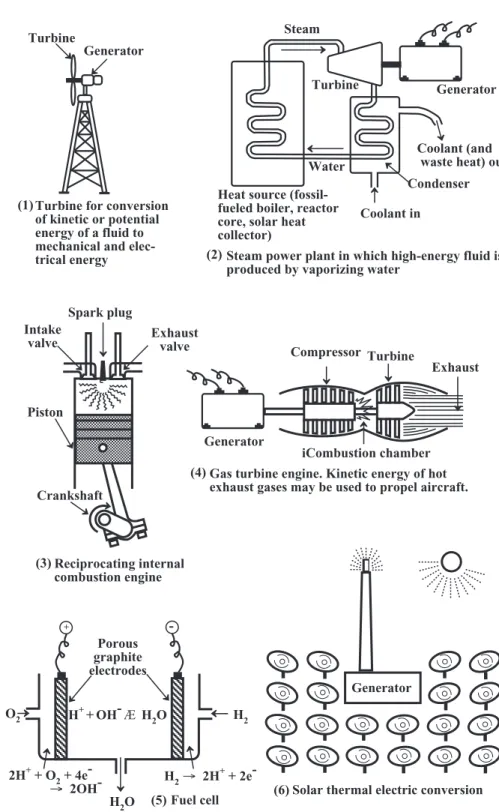
Energy occurs in many forms and its utilization requires conversion to other forms. Many devices exist for the utilization of energy and its conversion to other forms. The most common of these are shown in Figure 19.3. The types of energy available, the forms in which it is utilized, and the processes by which it is converted to other forms have a number of implications for green technology and sustainability. For example, the wind turbine shown in Figure 19.3(1), once in place, continues to pump electricity into the power grid with virtually no harm to the environment (though some people regard them as unsightly while others think they are picturesque), whereas the steam power plant shown in Figure 19.3(2) requires mining depletable coal, combustion of the fossil fuel with its potential for air pollution, control of air pollutants, and means for cooling the steam exiting the turbine, with its potential for thermal pollution of waterways.
An important aspect of energy utilization is its conversion to usable forms. For example, gasoline burned in automobile engines comes originally from petroleum pumped from underground, the petroleum constituents are separated, molecules with properties suitable for engine fuel are produced chemically, the gasoline product is burned in an internal combustion engine converting chemical to mechanical energy, and the mechanical energy is transmitted to the wheels of the automobile in the form of kinetic energy that moves the automobile. Significantly less than half of the energy in the gasoline is actually converted to mechanical energy of the automobile’s motion; the rest is dissipated as waste heat through the engine’s cooling system.
energy to light can save large amounts of energy and will be mandated in the U.S by legislation passed in 2007.
Figure 19.3. Examples of many devices for the collection of energy and its conversion to other forms. Turbine
Generator
Steam
Turbine Generator
Water Heat source (fossil-fueled boiler, reactor core, solar heat collector)
Coolant in Condenser
Coolant (and waste heat) out
Turbine Spark plug
Exhaust valve Intake
valve
Piston
Crankshaft
Generator
Exhaust Compressor
H++OH-Æ H2O +
H2 O2
H2O
H2! 2H+ + 2e-2H+ + O
2 + !
2OH -Porous graphite electrodes Turbine for conversion of kinetic or potential energy of a fluid to mechanical and elec-trical energy (1)
Steam power plant in which high-energy fluid is produced by vaporizing water
(2)
Reciprocating internal combustion engine (3)
Gas turbine engine. Kinetic energy of hot exhaust gases may be used to propel aircraft. (4)
Generator
Solar thermal electric conversion (6)
Fuel cell (5)
Figure 19.4. Major types of energy and conversions between them showing conversion efficiencies.
A particularly important energy conversion carried out in the anthrosphere is that of heat, such as from chemical combustion of fuel, to mechanical energy used to propel a vehicle or run an electrical generator. This occurs, for example, when gasoline in a gasoline engine burns, generating hot gases that move pistons in the engine connected to a crankshaft that converts the up-and-down movement of the piston to rotary motion that drives a vehicle’s wheels. It also occurs when hot steam generated at high pressure in a boiler flows through a turbine connected directly to an electrical generator. A device, such as a steam turbine, in which heat energy is converted to mechanical energy is called a heat engine. Unfortunately, the laws of thermodynamics dictate that the conversion of heat to mechanical energy is always much less than 100% efficient. The efficiency of this conversion is given by the Carnot equation,
(19.4.1)
in which T1 is the inlet temperature (for example, of steam into a steam turbine), and T2, is the outlet temperature, both expressed in Kelvin (˚C + 273). Consider a steam turbine as shown in Figure 19.5. Substitution into the Carnot equation of 875 K for T1 and 335 K for T2 gives a maximum theoretical efficiency of 62%. However, it is not possible to introduce all the steam at the highest temperature and friction losses occur so that the
Radiant (light) Kinetic Mechanical Electrical Thermal Chemical Chem iluminces cence Photosyn thesis <0.5% H om e fu rnac e(g as) 85% 88% Stea mbo ile r In cand esce nt lam p 4%
Solar cell 15%
Steam turbine 46% Hot water hea
ter almost
100% Ther
mocouple
7% Electric motor
60-90%
Electri
c generat
or
98%
Electric motor-generator systemwith flywheel storage
Aircraft jet engine35%
Percent efficiency = T1T - T2 x 100
energy conversion efficiency of most modern steam turbines is just below 50%. About 80% of the chemical energy released by combustion of fossil fuel in a boiler is actually transferred to water to produce steam so that the net efficiency for conversion of chemical energy in fossil fuels to mechanical energy to produce electricity is about 40%. The overall conversion of chemical energy to electricity is essentially the same because an electrical generator converts virtually all of the energy of a rotating turbine to electricity. Because nuclear reactor peak temperatures are limited for safety reasons, their conversion of nuclear energy to electricity is only about 30%.
Figure 19.5. In a steam turbine, superheated steam impinges on vanes attached to a shaft to produce mechanical energy. For generation of electricity, the shaft is coupled to an electrical generator.
A particularly important machine for converting chemical to mechanical energy is the internal combustion piston engine shown in Figure 19.6. Most internal combustion engines operate on a cycle of four strokes. In the first of these, the piston moves downward drawing air or an air/fuel mixture into the cylinder. Next, with both valves closed, the air or air/fuel mixture is compressed as the piston moves upward. With the piston near the top of the cylinder (a point at which fuel may be injected if only air is
Figure 19.6. An internal combustion piston engine in which a very rapidly burning mixture of air and fuel drives a piston downward during the power stroke and this motion is converted to rotary mechanical motion by the crankshaft.
Superheated steam in, T1
Cooler steam out, T2 Turbine vanes
Rotating shaft connected to electrical generator
Spark plug Exhaust
valve Intakevalve
Piston
compressed) ignition occurs and the burning fuel creates a mass of highly pressurized combustion gas in the cylinder, which drives the piston down in the third stroke. The exhaust valve then opens and the exhaust gas is expelled during the exhaust stroke.
The efficiency of the internal combustion engine increases with the peak temperature reached by the burning fuel, which increases with the degree of compression during the compression stroke (around 20:1 for a modern diesel engine). This temperature is highest for the diesel engine in which the compression is so high that fuel injected into the combustion chamber ignites without a spark plug ignition source. Whereas a standard gasoline engine is typically about 25% efficient in converting chemical energy in fuel to mechanical energy, a diesel engine is typically 37% efficient, with some reaching higher values.
Although highly superior from the standpoint of efficiency, diesel engines do have some disadvantages with respect to emissions. The first of these is that the combustion zone is not homogeneous because the fuel is injected into the highly compressed air at the top of the compression stroke resulting in incomplete combustion and production of carbon particles; improperly adjusted diesel engines are a major source of particle air pollution in urban areas. In addition, because of their very high combustion temperatures and high ignition pressures, diesel engines tend to produce elevated levels of air pollutant nitrogen oxides. Recent advances in diesel engine design, computerized control, and exhaust pollutant control devices have greatly reduced diesel engine emissions
Fuel Cells
Fuel cells, are devices that convert the energy released by electrochemical reactions directly to electricity without going through a combustion process and electricity generator. Fuel cells are the primary means for utilizing hydrogen fuel and are becoming more common as electrical generators. A fuel cell has an anode at which elemental hydrogen is oxidized, releasing electrons to an external circuit, and a cathode at which elemental oxygen is reduced by electrons introduced from the external circuit, as shown by the half-reactions in Figure 19.7. The H+ ions generated at the anode migrate to the cathode through a solid membrane permeable to protons. The net reaction is
2H2 + O2 → 2H2O + electrical energy (19.4.2)
and the only product of the fuel cell reactions is water.
Figure 19.7. Cross-sectional diagram of a fuel cell in which elemental hydrogen can be reacted with elemental oxygen to produce electricity directly with water as the only chemical product.
19.5 GREEN TECHNOLOGY AND ENERGY CONVERSION
EFFICIENCY
One of the best ways to conserve fuel resources is through increasing the efficiency of energy conversion including that of chemical to mechanical energy with the intermediate step of production of heat energy. Many advances have been made in this area since the late 1800s. Part of the increase in conversion of fuel energy to electricity going from around 4% conversion in 1900 to more than 40% at present resulted from increasing the input temperature (T1 in the Carnot equation) in the heat engines driving electrical generators. Energy use efficiency increased by more than four-fold when picturesque steam engines were replaced by diesel/electric locomotives during the 1940s and 1950s. Substitution of diesel engines for gasoline engines in trucks and farm and construction equipment have resulted in gains in energy efficiency.
Much of the increased efficiency in fuel utilization has come from improved materials that allow higher operating temperatures. In addition to high-temperature-tolerant metals in engines, a contribution has been made by lubricating oils that do not break down at high temperatures. Much of the progress has been achieved with better engineering, now greatly aided by computerized design, evaluation, and manufacturing of
H2 O2
Anode, reaction
2H2 ! 4H+ +
4e-Cathode, reaction
O2 + 4H+ + 4e- ! 2H2O
Movement of H+ from anode to cathode
through cation-permeable membrane
Net reaction 2H2 + O2 ! 2H2O
Electrical current that can be used for motors, lighting, other purposes
e-engines. Engineers of a century ago had never heard of green technology, and probably would not have cared had they known about it. But they did understand costs of fuel (which on the basis of constant value currency were often higher then than they are now) and they welcomed the greater efficiencies they achieved on the basis of costs.
A key aspect of the most efficient conversion of chemical to mechanical energy in engines is the precise control of operational aspects such as ignition timing, valve timing, and fuel injection. In modern engines, key operation parameters are controlled by computer leading to optimum efficiency in engine operation.
As an inevitable consequence of the thermodynamics described by the Carnot equation, engines that convert heat to mechanical energy cannot utilize much of the heat, which is carried away by an engine cooling system. Typically, a small portion of this heat is used in automotive heaters on cold days. On a broader scale, such as municipal electrical systems, this heat can be used for heating buildings. Such efficiencies are discussed under “Combined Power Cycles” in Section 19.17.
19.6 ENERGY CONSERVATION AND RENEWABLE ENERGY
SOURCES
Any consideration of energy needs and production must take energy conservation into consideration. This does not have to mean cold classrooms with thermostats set at 60˚F in mid-winter, nor swelteringly hot homes with no air-conditioning, nor total reliance on the bicycle for transportation, although these and even more severe conditions are routine in many countries. The fact remains that the United States and several other industrialized nations have wasted energy at a deplorable rate. For example, U.S. energy consumption is higher per capita than that of some other countries that have equal, or significantly better, living standards. Obviously, a great deal of potential exists for energy conservation that will ease the energy problem.
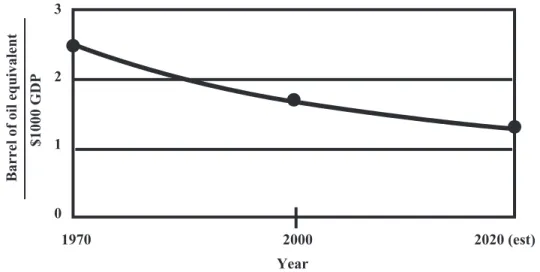
Efficient use of energy can in fact correlate positively with higher economic standards. Figure 19.8 shows a plot of the ratio of energy use per unit of gross domestic product in developed industrialized nations and illustrates a steady and favorable
Figure 19.8. Plot of barrel of oil equivalent required per $1000 gross domestic product (GDP) as a function of year in industrialized nations.
1970 2000 2020 (est) Year
0 1 2 3
decrease of energy required relative to economic output. Whereas in 2000, 1.7 barrels of oil equivalents were required per $1000 gross domestic product in developed nations, the corresponding figure for developing nations, which tend to lack advanced means of using energy efficiently, was 5.2 barrels, or 3 times as much. These figures indicate the substantial potential for decreased energy consumption by energy conscious development of the less industrially advanced nations as well as the additional conservation that can be achieved if citizens of industrialized nations can be persuaded to forego wasteful energy practices such as excessively large and inefficient vehicles and overly large dwellings.
Transportation is the economic sector with the greatest potential for increased efficiencies. The private auto and airplane are only about one-third as efficient as buses or trains for transportation. Transportation of freight by truck requires about 3800 Btu/ton-mile, compared to only 670 Btu/ton-mile for a train. Truck transport is terribly inefficient compared to rail transport (as well as dangerous, labor-intensive, and environmentally disruptive). Major shifts in current modes of transportation in the U.S. will not come without anguish, but energy conservation dictates that they be made.
Figure 19.9 shows the trend in U.S. automobile fuel economy during recent decades. The gains through about 1990 were very impressive, then dropped off as less fuel efficient vehicles became more popular. If the same trends from this period would have been maintained, the U.S. automobile fleet would by now average close to 40 miles per gallon (MPG). Such a figure is readily achievable without seriously compromising safety or comfort and, as is obvious from the figure, with much lower emissions from pollutants compared to 1970. In 2007 the U.S. Congress passed legislation mandating higher fuel economy standards for vehicles sold in the U.S.
Figure 19.9. U.S. auto fleet fuel economy and emissions over 3 decades. Fuel economy has improved markedly while emissions have been greatly reduced.
Household and commercial uses of energy are relatively efficient. Here again, appreciable savings can be made. The all-electric home requires much more energy (considering the percentage wasted in generating electricity) than a home heated with fossil fuels. The sprawling ranch-house style home uses much more energy per person than does an apartment unit, row house, or even a home of comparable floor area built in a compact format (more like a square box). Improved insulation, sealing around the windows, and other measures can conserve a great deal of energy. Electric generating
40 30 20 10 0
100
75
50
25
0
1970 1980 1990 2000
MPG
Pollutant emissions
Hydrocarbon/NOx/CO emissions
relative to 100 (1970)
plants centrally located in cities can provide waste heat for commercial and residential heating and cooling and, with proper pollution control, can use municipal refuse for part of their fuel, thus reducing quantities of solid wastes requiring disposal.
One of the greatest contributions to energy conservation and energy use efficiency in very recent years has been the hybrid vehicle that uses an internal combustion engine to produce electricity that is stored for propulsion of the vehicle in a nickel-metal-hydride battery (Figure 19.10). Although not greatly more efficient for prolonged driving at highway speeds, these vehicles have achieved improvements up to 50% in stop-and-go driving in traffic. For routine operation, the internal combustion engine supplies all the power needed plus additional power, if required, to run the generator to recharge a battery (larger than the battery in a conventional automobile but significantly smaller than the battery in an all-electric vehicle). When a surge of power is required, electricity from the storage battery drives the electric motor to produce the additional power. The braking system also generates electricity that is stored in the battery. When the vehicle is stopped, the internal combustion engine does not run, which also saves fuel.
Vastly reduced fuel consumption can be achieved by hybrid vehicles now under development that have batteries that can be charged by an external electrical source as well as the onboard engine. Such vehicles could give around 40-50 km driving range from an overnight charge, alone, sufficient for the majority of routine driving. As the battery ran down, the internal combustion engine would recharge it as is the case with current hybrids. As of 2008, batteries were under development that could be recharged efficiently by both an external source of electricity and by an internal combustion engine coupled to a generator.
Although gasoline engines are now employed in hybrid vehicles, the ultimate in fuel economy could be achieved with an inherently more efficient diesel engine as the internal combustion engine component. By allowing the diesel engine to run at a generally steady
Figure 19.10. Major components of a hybrid automobile in which an internal combustion engine drives a generator to produce electricity to drive a vehicle. Electrical energy is stored in a battery. Electrical energy is also salvaged for storage from braking the vehicle.
Battery
Generator
Transmission Internal combustion engine
rate, the output of exhaust pollutants, which are produced at higher levels by diesel engines as the engine speed is changed, could be greatly reduced. Furthermore, diesel engines idle with remarkably little fuel consumption, so that the diesel engine would not need to be turned off when the vehicle is stopped, thus staying hot and further reducing emissions when it is brought up to speed.
As scientists and engineers undertake the crucial task of developing alternative energy sources to replace dwindling petroleum and natural gas supplies, energy conservation must receive proper emphasis. In fact, zero energy-use growth, at least on a per capita basis, is a worthwhile and achievable goal. Such a policy would go a long way toward solving many environmental problems. With ingenuity, planning, and proper management, it could be achieved while increasing the standard of living and quality of life.
Closely related to energy conservation is the concept of renewable energy from sources that do not run out. Essentially all of these depend upon energy from the sun including direct solar energy, wind driven by the solar heating of air masses, falling water from the solar-powered hydrologic cycle, and biomass formed from photosynthesis. For most of its lifetime on Earth, humankind has depended entirely upon renewable sources of energy, and most countries are again emphasizing these sources.
Enlightened sustainable energy policies are being implemented in some developing countries. China implemented a new law on renewable energy at the beginning of 2006. This policy encourages renewable energy alternatives including wind power, biomass energy, and biomethane generation. Long known for its utilization of wastes (including even use of human wastes as fertilizer for growing vegetables), China has constructed many waste-to-methane generators in rural areas with 17 million families served by such facilities by 2006. Experimental biopower projects burning crop biomass byproducts have been undertaken. As of 2006, China had 80 million square meters of solar collectors to heat water, equivalent to the energy from 10 million tons per year of coal. The total renewable energy capacity of China in 2006 was 7% of China’s energy use, equivalent to 160 million tons of coal per year.
19.7 PETROLEUM AND NATURAL GAS
alone. A recovery efficiency of 60% through secondary or tertiary techniques could double the amount of available petroleum. Much of this would come from fields which have already been abandoned or essentially exhausted using primary recovery techniques. The year 2008 was a very interesting one for world oil production and consumption. In July of that year prices reached record levels of more than $150/barrel and many experts forecast that prices would continue to increase with gasoline going well over the $5.00/gallon reached in parts of the U.S. With the world economic collapse that took place in the fall of 2008, petroleum prices fell precipitously, reaching levels of around $40/barrel. The year also saw the first drop in world oil consumption since 1983 down to 85.8 million barrels per day and U.S. consumption dropped 6.3% to 19.4 million barrels per day.
Shale oil is a possible substitute for liquid petroleum. Shale oil is a pyrolysis product of oil shale, a rock containing organic carbon in a complex structure of biological origin from eons past called kerogen. Oil shale is believed to contain approximately 1.8. trillion barrels of shale oil that could be recovered from deposits in Colorado, Wyoming, and Utah. In the Colorado Piceance Creek basin alone, more than 100 billion barrels of oil could be recovered from prime shale deposits. However, the environmental implications of recovering shale oil by heating oil shale include production of vast amounts of greenhouse gas carbon dioxide. Furthermore, potential water pollution problems from water-soluble salt residues left over from the pyrolysis of oil shale make it unlikely that this resource will ever be developed on a large scale.
Natural gas, consisting almost entirely of methane, is a very attractive fuel that produces few pollutants and less carbon dioxide per unit energy than any other fossil fuel. In addition to its use as a fuel, natural gas can be converted to many other hydrocarbon materials. It can be used as a raw material for the Fischer-Tropsch synthesis of gasoline. As of the early 2000s, increased demand for natural gas had led to tight supplies in the U.S. Production of natural gas from coal seams in Wyoming has required pumping saline, alkaline water from the seams, which has caused water pollution problems. By 2009 exploitation of natural gas in “tight” shale formations opened by fracturing with water had resulted in increased supply of natural gas in the U.S. and some other countries.
19.8 COAL
From Civil War times until World War II, coal was the dominant energy source behind industrial expansion in most nations. However, after World War II, the greater convenience of lower-cost petroleum resulted in a decrease in the use of coal for energy in the U.S. and in a number of other countries. Annual coal production in the U.S. fell by about one third, reaching a low of approximately 400 million tons in 1958, but since then coal production for electricity generation has reached about 1 billion tons per year in the U.S. About one-third of the world’s energy and around 50% of electrical energy is provided by coal.
organic coal molecule and mixed with coal as mineral pyrite, FeS2, presents major environmental problems because of production of air pollutant sulfur dioxide during combustion. Much of the FeS2 can be removed physically from coal prior to combustion and sulfur dioxide can be removed from stack gas by various scrubbing processes.
Coal Conversion
As shown in Figure 19.11, coal can be converted to gaseous, liquid, or low-sulfur, low-ash solid fuels such as coal char (coke) or solvent-refined coal (SRC). Coal conversion is an old idea; a house belonging to William Murdock at Redruth, Cornwall, England, was illuminated with coal gas in 1792. The first municipal coal-gas system was employed to light Pall Mall in London in 1807. The coal-gas industry began in the U.S. in 1816. The early coal-gas plants used coal pyrolysis (heating in the absence of air) to produce a hydrocarbon-rich product particularly useful for illumination. Later in the 1800s the water-gas process was developed, in which steam was impinged upon hot coal coke to produce a mixture consisting primarily of H2 and CO. It was necessary to add volatile hydrocarbons to this “carbureted” water-gas to bring its illuminating power up to that of gas prepared by coal pyrolysis. The U.S. had 11,000 coal gasifiers operating in the
Figure 19.11. Routes to coal conversion. BTU refers to British thermal units, a measure of the heat energy that can be obtained from a fuel. Methanation means synthesis of CH4 gas. Hydrogenation and
hydrotreating refer to reaction with elemental H2 gas.
Air gasification Cleanup Low BTU gas
O2 gasification Cleanup Medium BTU gas
Methanation SNG
Fischer-Tropsch Liquids
Pyrolysis Hydrotreating
Gas
Char
Dissolution and
hydrogenation Ash and solventremoval Hydrotreating
Clean solid fuel, solvent-refined
coal
Liquids
1920s. At the peak of its use in 1947, the water-gas method accounted for 57% of U.S.-manufactured gas. The gas was made in low-pressure, low-capacity gasifiers that by today’s standards would be inefficient and environmentally unacceptable (many sites of these old plants have been designated as hazardous waste sites because of residues of coal tar and other wastes). This was definitely not a green technology because of the high toxicity of carbon monoxide in the gas product, and many people were killed by release of CO in their houses. During World War II, Germany developed a major synthetic petroleum industry based on coal, which reached a peak capacity of 100,000 barrels per day in 1944. A synthetic petroleum plant operating in Sasol, South Africa, reached a capacity of several tens of thousands of tons of coal per day in the 1970s and currently produces hydrocarbons and feedstocks equivalent to about 150,000 barrels of petroleum per day.
A number of environmental implications are involved in the widespread use of coal conversion. These include strip mining, water consumption in arid regions, lower overall energy conversion compared to direct coal combustion, and increased output of atmospheric carbon dioxide. These plus economic factors have prevented coal conversion from being practiced on a very large scale. However, coal conversion does enable relatively facile carbon sequestration (see Section 19.9), which could enable much more sustainable coal utilization.
19.9 CARBON SEQUESTRATION FOR FOSSIL FUEL
UTILIZATION
Carbon sequestration, which prevents carbon dioxide generated by fossil fuels from entering the atmosphere, holds the promise of enabling utilization of fossil fuels without contributing to greenhouse warming. Basically, the various schemes that have been proposed entail capturing carbon dioxide from a product or waste stream and sequestering it in a place where it cannot enter the atmosphere. Several approaches have been suggested or tried for capturing carbon dioxide and there are several possibilities for sequestration. The term carbon sequestration is also used in a more general sense to apply to removal of carbon dioxide from the atmosphere, especially by photosynthesis.
There are several possible sinks in which carbon dioxide can be sequestered. The largest of these, a natural sink for the gas, is the ocean. Earth’s oceans have an almost inexhaustible capacity for carbon dioxide. However, lowering the average pH of the oceans by as little as 0.1 pH unit from acidic carbon dioxide could have a serious adverse effect upon ocean life and productivity; there is some evidence to suggest that shells of some small sea creatures have become thinner because of higher levels of dissolved carbon dioxide in ocean water. Deep saline formations also have a very high capacity for carbon dioxide sequestration. Depleted oil and gas reservoirs and un-mineable coal seams have much lower, but still significant, carbon dioxide capacities.
injected into sedimentary formations rises and is confined by poorly permeable cap-rock. Breaches in cap rock, such as those from abandoned oil wells can result in carbon dioxide release. Eventually, the carbon dioxide dissolves in the generally saline pore waters in the sedimentary formation into which it is injected. Chemical reactions in the water and with the surrounding geological strata can result in long-term stability of the carbon dioxide. It is much more effective and less expensive to force carbon dioxide into unsaturated saline groundwater where it is dissolved than to compress the gas into a pressurized gas form underground.1
The first commercial application of carbon dioxide sequestration has operated since 1996 in the North Sea about 240 km from the Norwegian coast in a region known as the Sleipner oil and gas field. The natural gas product from this field is about 9% carbon dioxide, a value that must be reduced to 2.5% for commercial distribution of the gas. Whereas all other gas-producing operations simply discharge the carbon dioxide removed to the atmosphere, at Sleipner it is pumped under pressure into a 200-m thick layer of sandstone, the Utsira formation, that is about 1000 m below the seabed. A mixture of carbon dioxide and hydrogen sulfide removed from sour natural gas that is abundant in Alberta, Canada, is now being sequestered underground.2
The easiest sources of carbon dioxide to capture are those from industrial processes that generate the gas in high concentrations. An example of such a process is the fermentation of carbohydrates to produce ethanol for fuel or other uses. This source provides much of the carbon dioxide that is used commercially at present. The largest anthropogenic source of carbon dioxide discharged to the atmosphere is generated in power plants fueled with fossil fuels. These sources present a substantial challenge for carbon dioxide removal because they are so dilute. A power plant fueled with carbon-rich coal produces an exhaust stream that is 13–15% carbon dioxide, whereas one burning hydrogen-rich methane produces only 3–5% carbon dioxide. A third possibility is to capture carbon dioxide released from the gasification of fossil fuels, particularly coal (see Section 19.8). Normally, gasification is performed using oxygen as an oxidant, and the initial product consists of carbon dioxide and combustible H2 and CO gases. Carbon monoxide in the synthesis gas product can be reacted with steam,
CO + H2O → H2 + CO2 (19.9.1)
to produce nonnpolluting elemental hydrogen fuel and carbon dioxide.
combination results in very efficient electrical power generation. The production of intermediate hydrogen adds options for powering fuel cells or for using hydrogen in chemical synthesis or manufacture of synthetic hydrocarbon fuels. Byproduct hydrogen sulfide must be removed from the hydrogen product and can be used for making sulfuric acid, an important industrial chemical, or can be sequestered with the carbon dioxide. The carbon dioxide byproduct is sequestered in mineral formations at depths up to around 2000 m. For powerplants located near petroleum bearing formations, carbon dioxide can be pumped into oil-bearing mineral formations for tertiary petroleum recovery.
Figure 19.12. A coal-based carbon sequestration operation. Electricity is generated at generators connected both to the gas turbine and steam turbine. Reclaimed hydrogen sulfide is used to synthesize sulfuric acid. Hydrogen product can be employed for fuel cells and industrial hydrogenation as well as to power the gas turbine. Sequestered carbon dioxide can be used for petroleum recovery or simply disposed underground. Waste heat is reclaimed for district heating and industrial heating applications.
19.10 INDUSTRIAL ECOLOGY FOR ENERGY AND CHEMICALS
An excellent example of a system of industrial ecology for sustainable utilization of fossil fuels is provided by the Great Plains Synfuel plant located near Beulah, North Dakota. This complex is designed to take advantage of abundant deposits of lignite, a relatively low-heating-value, high-water-content form of coal that occurs in abundance in North Dakota. A schematic diagram of the system is shown in Figure 19.13. The heart of the plant consists of 14 Lurgi-type gasifiers that are 13 meters high and 4 m in diameter
Gasifier
Slag Coal
O2 H2O
Water gas shift, CO + H2O ! CO2 + H2
H2O
H2 CO2 Coal
Coal Coal
Cleanup
H2S to H2SO4 synthesis
H2 CO2
CO2 separation
Underground sequestration of CO2,
tertiary petroleum recovery
H2
Gas turbine Fuel cell
Industrial hydrogenation
Generator
Hot Exhaust
Steam turbine
Generator
Steam boiler Steam
processing 16,000 metric tons of lignite per day at temperatures up to 1200˚C to produce a synthesis gas mixture of combustible H2 and CO along with byproduct CO2, water, and smaller quantities of tars, oils, phenolic compounds, ammonia, and H2S. Useful fuel hydrocarbons, phenol, cresols, ammonia, and sulfur compounds are extracted from the water, which is used for cooling water. The gas mixture is subjected to a shift reaction that increases the ratio of H2 to CO and this mixture is reacted to produce methane (CH4) that is fed into a natural gas pipeline. Part of the synthesis gas stream is diverted to an ammonia synthesis plant to make this valuable fertilizer product. A key feature of the plant is the extraction of CO2 from the synthesis gas. The carbon dioxide is compressed and sent through a pipeline to Canada where it is pumped underground to depleted petroleum-bearing strata for secondary recovery of crude oil.
Figure 19.13. Schematic of the Great Plains lignite coal gasification complex.
The Great Plains Synfuels plant provides an excellent example of a diversified industrial ecology complex. It utilizes an abundant resource (lignite coal) in a way that significantly reduces the greenhouse gas emissions and other potential environmental impacts from this resource. Rather than having to transport large quantities of lignite by rail to distant powerplants, the energy content of the lignite is converted to methane, the most environmentally friendly fossil fuel, which is moved with minimum environmental disruption through pipelines. An even higher value product, fertilizer ammonia, is synthesized at the site using elemental hydrogen made from gasifying the lignite and elemental nitrogen isolated from air in the air liquefaction operation required to prepare elemental oxygen required for gasification. The carbon dioxide byproduct is not released to the atmosphere where it could aggravate the global warming problem but is pumped to oilfields where it is pumped underground to increase crude oil recovery. Commercially
Oxygen plant Krypton Xenon Liquid nitrogen Oxygen Raw gas Coal lock Coal in Boiler
steam Gasifier Condenser
Gas cooling
Condensed process water
Tar oil to boiler fuel Raw gas liquor Byproduct purification Ash Purified water to cooling tower Phenol Cresylic acid Ammonia to flue gas scrubber Separator
Boiler flue gas desulfurization Boiler stack
gas
Ammonium sulfate Shift conversion
CO + H2O ! CO2 + H2
Acid gas and
CO2 removal
Synthesis gas
CO/H2 mixture
Methanation
CO + 3H2! CH4 + H2O
CH4 product
to pipeline
Synthesis gas Ammonia synthesis
N2 + 3H2! 2NH3
Ammonia product
CO2 to compressor
and pipeline for petroleum recovery Gas flow
N2 from oxygen plant
valuable ammonium sulfate byproduct, a useful source of nitrogen and sulfur soil nutrients, is recovered from the water released during lignite gasification. In an area where water shortages can occur, the relatively large amount of water released by lignite gasification is used for cooling and as boiler feedwater.
19.11 NUCLEAR ENERGY
The awesome power of the atom nucleus revealed at the end of World War II held out enormous promise for the production of abundant, cheap energy. This promise has never really come to full fruition, although nuclear energy currently provides a significant percentage of electric energy in many countries, and it may be the only source of electrical power that can meet world demand without unacceptable environmental degradation, particularly through the generation of greenhouse gases.
Nuclear fission for power production is carried out in nuclear power reactors in which the fission (splitting) of uranium-235 or plutonium nuclei occurs. Each such event generates two radioactive fission product atoms of roughly half the mass of the nucleus fissioned, an average of 2.5 neutrons, plus an enormous amount of energy compared to normal chemical reactions. The neutrons, initially released as fast-moving, highly energetic particles, are slowed to thermal energies in a moderator medium. For a reactor operating at a steady state, exactly one of the neutron products from each fission is used to induce another fission reaction in a chain reaction (Figure 19.14):
Figure 19.14. Fission of a uranium-235 nucleus.
The energy from these nuclear reactions is used to heat water in the reactor core and produce steam to drive a steam turbine, as shown in Figure 19.15. As noted in Section 19.4, temperature limitations make nuclear power less efficient in converting heat to mechanical energy and, therefore, to electricity, than fossil energy conversion processes.
A limitation of fission reactors is the fact that only 0.71% of natural uranium is fissionable uranium-235. This situation could be improved by the development of
•
U-235•
Neutron
Neutrons +
•
•
Fissionbreeder reactors, which convert uranium-238 (natural abundance 99.28%) to fissionable plutonium-239.
A major consideration in the widespread use of nuclear fission power is the production of large quantities of highly radioactive waste products. These remain lethal for thousands of years. They must either be stored in a safe place or disposed of permanently in a safe manner. At the present time, spent fuel elements are being stored under water at the reactor sites. Under current regulations in most countries, the wastes from this fuel will eventually have to be buried. An alternative favored by many investigators is to process the material in the spent fuel elements to remove radioactive products from uranium fuel, isolate the relatively short-lived fission products that decay spontaneously within several hundred years, and bombard the longer-lived nuclear wastes with neutrons in nuclear reactors. The absorption of neutrons by the nuclei of the nuclear waste elements causes transmutation in which the elements are converted to other elements or fission products with shorter half lives resulting in relatively rapid production of stable isotopes. Radioactive waste elements for which transmutation is feasible include plutonium, americium, neptunium, curium, technetium-99, and iodine-129. Plutonium, americium, neptunium, and curium are heavy actinide elements that are fissionable and add fuel value in a nuclear reactor.
Figure 19.15. A typical nuclear fission power plant.
Another problem to be faced with nuclear fission reactors is their eventual decommissioning. There are three possible solutions. One is dismantling soon after shutdown, in which the fuel elements are removed, various components are flushed with cleaning fluids, and the reactor is cut up by remote control and buried. “Safe storage” involves letting the reactor stand 30-100 years to allow for radioactive decay, followed by dismantling. The third alternative is entombment, encasing the reactor in a concrete structure.
The course of nuclear power development was altered drastically by two accidents. The first of these occurred on March 28, 1979, with a partial loss of coolant water from the Metropolitan Edison Company’s nuclear reactor located on Three Mile Island in the
Steam Control rods to
absorb excess neutrons and regulate chain reaction
Fuel rods containing uranium
Superheated water
Steam turbine
Electrical generator
Waste heat exchanger Heat sink Heat exchanger
(steam generator) Pressure vessel,
Susquehanna River, 28 miles outside of Harrisburg, Pennsylvania. The result was a loss of control, overheating, and partial disintegration of the reactor core. Some radioactive xenon and krypton gases were released and some radioactive water was dumped into the Susquehanna River. Eventually the reactor building was sealed. A much worse accident occurred at Chernobyl in the Soviet Union in April of 1986 when a reactor blew up and burned spreading radioactive debris over a wide area and killing a number of people (officially 31, but certainly many more). Thousands of people were evacuated and the entire reactor structure had to be entombed in concrete and steel plate. Food was seriously contaminated as far away as northern Scandinavia.
As of 2006, 28 years had passed since a new nuclear electric power plant had been ordered in the U.S., in large part because of the projected high costs of new nuclear plants. Although this tends to indicate hard times for the nuclear industry, pronouncements of its demise may be premature and by 2008 several U.S. utilities had begun the process of ordering new nuclear power plants and a significant number of such plants were under construction around the world. Properly designed nuclear fission reactors can generate large quantities of electricity reliably and safely and have done so for decades in U.S. naval submarines and carrier ships and in France, which gets about 80% of its electricity from nuclear sources. The single most important factor that may lead to renaissance of nuclear energy is the threat to the atmosphere from greenhouse gases produced in large quantities by fossil fuels. It can be argued that nuclear energy is the only proven alternative that can provide the amounts of energy required within acceptable limits of cost, reliability, and environmental effects.
New designs for nuclear power plants can enable power reactors that are much safer and environmentally acceptable than those built with older technologies. The proposed new designs incorporate built-in passive safety features that work automatically in the event of problems that could lead to incidents such as TMI or Chernobyl with older reactors. These devices — which depend upon passive phenomena such as gravity feeding of coolant, evaporation of water, or convection flow of fluids — give the reactor the desirable characteristics of passive stability. They have also enabled significant simplification of hardware, with only about half as many pumps, pipes, and heat exchangers as are contained in older power reactors.
Nuclear Fusion
The fusion of a deuterium nucleus and a tritium nucleus releases a lot of energy as shown below, where Mev stands for million electron volts, a unit of energy:
(19.11.1)
This reaction is responsible for the enormous explosive power of the “hydrogen bomb.” So far it has eluded efforts at containment for a practical continuous source of energy. And since physicists have been trying to make it work on a practical basis for the last approximately 50 years, it will probably never be done. (Within about 15 years after the discovery of the phenomenon of nuclear fission, it was being used in a power reactor to power a nuclear submarine.) However, the tantalizing possibility of using the essentially
1H + 1H 2He + 0n
+ 17.6 Mev (energy released per fusion) 2 3 4 1
limitless supply of deuterium, an isotope of hydrogen, from Earth’s oceans for nuclear fusion still give some investigators hope of a practical nuclear fusion reactor and some research continues toward that end.
Nuclear fusion was the subject of one of the greatest scientific embarrassments of modern times that occurred in 1989. This incident came about when investigators at the University of Utah announced that they had accomplished so-called cold fusion of deuterium during the electrolysis of deuterium oxide (heavy water). This resulted in an astonishing flurry of activity as scientists throughout the world sought to repeat the results, whereas others ridiculed the idea. Unfortunately, for the dream of a cheap and abundant source of energy, the skeptics were right, and the whole story of cold fusion stands as a lesson in the (temporary) triumph of wishful technological thinking over scientific good sense.
19.12 GEOTHERMAL ENERGY
Underground heat in the form of steam, hot water, or hot rock used to produce steam has been employed as an energy resource for about a century and can be regarded as largely renewable. This energy was first harnessed for the generation of electricity at Larderello, Italy, in 1904, and has since been developed in Japan, Russia, New Zealand, the Phillipines, and at the Geysers in northern California.
Underground dry steam is relatively rare, but is the most desirable from the standpoint of power generation. More commonly, energy reaches the surface as superheated water and steam. In some cases, the water is so pure that it can be used for irrigation and livestock; in other cases, it is loaded with corrosive, scale-forming salts. Utilization of the heat from contaminated geothermal water generally requires that the water be reinjected into the hot formation after heat removal to prevent contamination of surface water.
The utilization of hot rocks for energy requires fracturing of the hot formation, followed by injection of water and withdrawal of steam. This technology is still in the experimental state, but promises approximately ten times as much energy production as steam and hot-water sources.
Land subsidence and seismic effects, such as the mini-earthquakes that occur when water is pumped under extreme pressure into hot rock formations that fracture as a consequence, are environmental factors that may hinder the development of geothermal power. However, this energy source holds considerable promise, and its development continues.
19.13 THE SUN: AN IDEAL, RENEWABLE ENERGY SOURCE
of land for solar energy collection. Certainly, many residents of Arizona would not be pleased at having so much of the state covered by solar collectors, and some environmental groups would protest the resultant shading of rattlesnake habitat.)
There are vast land areas available in the U.S. and throughout the world that receive exceptional levels of solar energy suitable for power generation. Factors involved in evaluating areas for solar energy generation include proximity to the Equator, relatively high altitude, and consistent absence of cloud cover. The terrestrial area that has optimum conditions is in the Sahara Desert of southeast Niger in Africa, which receives an average of 6.78 kWh per square meter each day, which is close to the amount of energy required to heat water for a typical U.S. household.
Solar power cells (photovoltaic cells) for the direct conversion of sunlight to electricity have been developed and are widely used for energy in space vehicles. With present technology, however, they are relatively expensive in most places for large-scale generation of electricity, although the economic gap is narrowing. Most schemes for the utilization of solar power depend upon the collection of thermal energy followed by conversion to electrical energy. The simplest such approach involves focusing sunlight on a steam-generating boiler (see Illustration 6 in Figure 19.3). Parabolic reflectors can be used to focus sunlight on pipes containing heat-transporting fluids. Selective coatings on these pipes ensure that most of the incident energy is absorbed.
The most efficient and reliable type of solar-powered heat engine to generate electricity is the Stirling engine, which has achieved close to 30% overall efficiency in the conversion of solar energy to electricity. The Stirling engine uses hydrogen gas as a working fluid in a sealed system in which pistons connected by rods in cylinders pump the gas back and forth in the system. The gas is heated at a heater head kept at a relatively high temperature by sunlight focused from an array of reflective mirrors that concentrate sunlight on the heater head. The resultant pressure forces one of the pistons down in a power stroke. The gas is then transferred to a piston on the cooled side of the engine through a regenerator consisting of a material that captures some of the heat to be used in the next cycle, thereby greatly increasing efficiency. For a system planned for installation in California’s Mojave desert,3 each Stirling unit is rated at 25 kilowatts power, running at 1800 rpm and generating electricity at 480 volts and 60 Hz. A major advantage of this system is its modular character that enables scaling from a single unit to a very large number generating hundreds of MW of energy in a single location. As of 2008, it appeared that the Stirling system would become a leading contender for the utilization of solar power in areas such as California’s Mojave Desert and Africa’s Sahara that receive intense, consistent sunlight.
shows that substitution of an arsenic atom with its 5 valence electrons for a silicon atom with its 4 valence electrons in the donor layer gives a site with an excess of 1 electron whereas substitution of a boron atom with only 3 electrons for a silicon atom in the acceptor layer gives a site “hole” that is deficient in one electron. The surface of a donor layer in contact with an acceptor layer contains electrons that are attracted to the acceptor layer. When light shines on this area, the energy of the photons of light can push these electrons back onto the donor layer, from which they can go through an external circuit back to the acceptor layer as shown in Figure 19.16. This flow of electrons constitutes an electrical current that can be used for energy.
Solar voltaic cells based on crystalline silicon have operated with a 30% efficiency for experimental cells and 15-20% for commercial units available in 2008, at a cost of around 20-25 cents per kilowatt-hour (kWh), compared to 4-7 cents per kWh for fossil fuel fired powerplants and 6-9 cents for those fired by biomass. Part of the high cost results from the fact that the silicon used in the cells must be cut as small wafers from silicon crystals for mounting on the cell surfaces. Significant advances in costs and
Figure 19.16. The operation of a photovoltaic cell.
technology are being made with thin-film photovoltaics, which use an amorphous silicon alloy. These cells are only about half as efficient as those made with crystalline silicon, but cost only about 25% as much. A newer approach to the design and construction of amorphous silicon film photovoltaic devices uses three layers of amorphous silicon to absorb, successively, short wavelength (“blue”), intermediate wavelength (“green”), and
Si As B
Donor layer Acceptor layer
Si Si Si Si B Si Si Si Si
Si
Si Si Si Si As Si Si Si Si
Si
Positive hole from boron atom
Extra electron from arsenic
e-Sun