Investigating Digital Apps: Gaming Elements and Learning Context
Aylar Fallah Vazirabad*, Farahman Farrokhi
Department of English Language and Literature, Faculty of Persian and Foreign Languages, University of Tabriz, Tabriz, Iran Corresponding Author: Aylar Fallah Vazirabad, E-mail: [email protected]
ABSTRACT
The present study investigated four methods implemented to improve phrasal verb knowledge by two digital apps among Iranian learner-players. A total of 174 students of intermediate level took part in this mixed-method, quasi-experimental research. The first group was blended learning, in the second group the apps acted as the main tutor, the third group played autonomously, outside of the class and the fourth group was gamified as well as non-digital, investigating digital apps, through gaming elements and various learning context. One-Way ANOVA and Tukey HSD was used to analyse the quantitative data and ANCOVA was used for adjusting both quantitative data and pre and post-test covariation. Qualitative data analysis was based on game diary and questionnaire results by means of descriptive statistics. The results revealed that all groups improved their knowledge. Although students in game as blended learning in both digital game types outperformed other groups. Game as tool did not improve as high as game as tutor. Students in Phrasal Nerds outperformed Kahoot. Play time in game as tutor was the highest. Game as tool had the least improvement. Majority of participants prefer a classroom coach. Comparing Nerds and Kahoot, participants prefer Nerds app as it includes a story line. However, among game features, the degree of learning and playing leaded to a focus on reading and repeating game stages for new phrasal verbs to make new sentences to use in daily life rather than using them to discuss how to rescue grandfather or implicit learning by playing informally.
Key words: Blended Learning, Digital Game-Based Language Learning, Game-Informed, Kahoot, Phrasal Nerds, Phrasal Verb, Tutor and Tool
INTRODUCTION
Digital gaming is a powerful means for helping students to acquire foreign language skills, to teach speaking, writing (Kovalik & Kovalik, 2002; Salies, 2002; Spelman, 2002; Marcedonia, 2005), and enhance cross-cultural understand-ing (Jung and Levitin, 2002) and communicative compe-tence (Garcia-Carbonell et al. 2001). However, the current research studies the impact of digital game on phrasal verb knowledge and therefore focuses on pedagogical and game play outcomes and experiences.
Playing a good mobile game requires practicing and im-proving skills, relevant knowledge to set and achieve the goals by playing. In order to fulfil the gameplay goals, you need to fully engage in the game play and focus on the game at the social, emotional and mental levels at the same time. As you progress in the game and achieve the game goals you feel highly motivated to learn whatever the game has to offer to succeed e.g. language, story line, game rules and regula-tions to keep playing and learning (Reinhardt, 2019), you also learn by doing (Prensky, 2001) or through story and fan-tasy elements (Gunter, Kenny, Robert, Vick, & Erick, 2008).
Digital game-based language learning is popular in inter-national era with a growing focus on between learning and
Published by Australian International Academic Centre PTY.LTD.
Copyright (c) the author(s). This is an open access article under CC BY license (https://creativecommons.org/licenses/by/4.0/) http://dx.doi.org/10.7575/aiac.ijalel.v.9n.3p.25
playing (Cornillie, Thorne, & Desmet, 2012). The literature tends to focus on learner-players playing digital games and learning from them and practicing a language, whether in class or in leisure time. Game-based language teaching role, characteristics and how to implement them however is less prominently studied in the literature, making it hard to find relevant research or advice for teachers or even students (Dehaan, 2019). Meantime, there is a lack of research on the role of teacher instruction as well as game-based context in literature (Reynolds, 2019).
More studies on why students fail to achieve digital language courses fully might also be relevant. Students in Strake’s study reported major concerns in the areas of sup-port and course structure, factors which to a large extent are related to the cultures as education is entirely teach-er-centred. Students may well have difficulty breaking the increased amount of passivity (Strake, 2007). The difficul-ty based on the study and findings is due to the loss of ability to cope with an increased learner autonomy that can be unsettling. Thus there is an obvious tension between learning and playing in the context due to the cultural in-fluence. On the other hand, the influence of what students bring from their background which is in line with Prensky ARTICLE INFO
Article history
Received: February 08, 2020 Accepted: April 21, 2020 Published: May 31, 2020 Volume: 9 Issue: 3 Advance access: May 2020
(2007) arguing that schools should be ‘fun’ is not appre-ciated worldwide, too.
Moreover, the theoretical framework of DGBLL consid-ers various context for game play e.g. in experimental or lab context (e.g. Sylven & Sundqvist, 2012; Peterson, 2012), learning in the wild context or pedagogy in the classroom, or played in everyday settings (Thorne, 2008; Piirainen-Marsh & Tainio, 2009). Although there are several researches out there, but none of the outcomes compared different contexts and settings in one study, neither they implemented it in an Iranian context.
Allen (1983), states that if we discuss the purpose of a game to adults they will not see it as childish and they might even enjoy the game as much as kids do. However other re-searchers believe that instruction actually kills the game and games should not be implemented as a serious blended learn-ing. It is therefore about having, knowing and investigating the right balance between learning and playing involved in the implementation and to find out whether/to what extent implementing it purely for fun and entertainment or only for language learning improves their knowledge (Whitton, 2010). Reinhardt (2015) argues that there is not enough research on how a game can be integrated into learning context. How does the nature of integration influence the learning out-comes and what role does game or teacher instruction play? According to Reinhardt and Lange (2014) college-level ad-vanced second language learners of literacies in classroom as text and practice, expressed mixed feedback. While some of the learners reacted stating that the game was an enjoyable and efficient way of learning and playing, the others believed and felt that there was a clash between expectations about language learning and play which was against the classroom norms. So the purpose is to synthesize findings and identify trends in research, rather than to compare game-mediated with non-game-mediated L2TL. The study outcomes might also vary as playing as in gamified, game-informed and game-enhanced settings varies as the game play might func-tion differently as the context changes from main or second-ary instruction or if it is mandatory or optional (Reinhardt, Warner & Lange, 2014). Thus there is still no agreement if game elements and game settings together might impact gaming outcomes that is why the present study focuses on both game types and four game play settings and therefore has a novel and original approach.
Godwin-Jones (2014) in his article argues the benefits and drawbacks of digital game based language learning and includes findings from the meta-analysis of Thorne and Fischer (2012) on significant affect and role of social and communicative aspects and accomplishments which come as an additional game play benefit. The article represents learning data both from gaming inside the classroom and ex-tramural learning. It details the significance of context of use which is useful in resolving the current question of learning benefits as in ‘what use of games’. Meantime, Godwin-Jones (2014) meta-analysis of the COTS games, opportunities and challenges, emphasizes that if games are perceived as as-signment, the ‘game flow’ might get blocked and disunit-ed (Bellotti, Kapralos, Lee, Moreno-Ger, & Berta, 2013).
Meantime, game-based language teaching features are less prominently researched in the literature (Dehaan, 2019).
According to Godwin-Jones (2005) gaming elements such as avatars or fiction designed for the game or during game play course, cooperative learning or mentoring the learner-players with game strategies to foster language acqui-sition or learning would lead more effective outcomes with-out distractive worrying and anxiety in the virtual digital era. In addition, it is suggested that language learning poten-tials of digital games are not sufficient, thus scaffolding guid-ance of a teacher through blended, non-game based teaching might be required inside the classroom through game as blended learning (Newcombe & Brick, 2017). On the oth-er hand, thoth-ere is increasing intoth-erest in out-of-class digital game based L2 learning research and it has yet to show how games foster language learning as the focus is on autonomy and shows that there is no requirement for blended learning as game can act as tutor itself through game as tutor (Chik, 2014; DeHaan, 2005; Miller & Hegelheimer, 2006). More frequently, education is seen as ‘hard work’ and games are therefore inappropriate (Chik, 2014). In the case of EFL, the fear of playful approaches might be stronger than other influ-ences; Thomas (2012) theorizes that opposition specifically to DGBLL may come from EFL academics, who fear that language learning already suffers from an unserious image and therefore disagree with the notion of game in universi-ty setting and supports non-game-based learning. However, Ketamo, Killi, Arnab & Dunwell (2013) studies on teacher-ship approaches in pedagogical game-enhanced context and curriculum development suggested a crucial role of novel use of gaming features in game-based learning events.
Gaming Environment Associated with Task-based Language Teaching
Tutor-tool Distinction
Conventionally used categories as a form of tutorial CALL, popularized the term tutor-tool distinction as a term created by Levy (1997) with explicit instruction aims built into an application and differentiates tutor from what relies only on a computer as a medium for learning, communication and a means for processing information. Tutorial CALL games implement computer games which include identifiable lin-guistic elements and teaching presence specifically for im-proving some language proficiency (Hubbard & Bradin Siskin, 2004), which is evident in designed learning objec-tives and assessment strategies and objecobjec-tives. In this regard, commercial off-the-shelf (COTS) games are considered as functional environments that unintentionally are supporting some language-specific learning outcomes, but based on pedagogical expectations for language learning are not ex-plicitly tutorial by nature.
Defining Gamified Education
To understand the phenomenon, we first need to explain what the term ‘gamification’ means. Gamification is defined as the implementation of game elements and game design techniques in non-game or non-digital learning contexts (Werbach, 2015). In order to adopt non digital and gamified classroom to the present study, Zarzycka-Piskorz (2016), identifies the impact of motivation through gamification and game-informed elements. According to the author and the relevant research, game elements could be used in non-dig-ital game settings and in order to reinforce the process of effective player outcomes as well as to win/learn. The find-ings through students’ survey result and perceptions shows that gamification can actually motivate people to undertake practices that they would not normally do. Cekaite and Aronosson (2005) studied the role of playing games in sec-ond language acquisition and emphasized the need to incor-porate language play into learning. According to Crookall and Oxford (1990), gaming techniques are very powerful ways to help people in acquiring language skills. Previous research on the use of simulations and gaming in language classrooms has revealed the influence of their crucial role in learning speaking (Macedonia, 2005), writing (Kovalik & Kovalik, 2002; Salies, 2002; Spelman, 2002), and commu-nicative competence (Garcia-Carbonell, Rising, Mortero & Watts, 2001).
Adapting Blended Learning
Thus, the term ‘blended’ is used to mean combining vari-ous learning environments in an integrated way and the emphasize is on learning, not teaching. In other words, it is about implementing the right blend either learning in the classroom with teacher or peer support or on how learning online could happen more independently and autonomously. As Marsh (2012) explains, blended learning could refer to combined methods of learning in different learning contexts or styles. Meantime, the correct implementation of blended learning is fundamentally about making the most out of the
learning opportunities and tools available in achieving the most desirable learning goals.
Serious vs. Conventional Digital-Games
Opposite to conventional games which is purely made for en-tertainment purposes, serious games offer specific teaching content (Calvo-Ferrer, 2018). However, this does not give the impression that serious games should not have principles of conventional gaming to provide ludic entertaining effect (Oliviera, Correira, Merrelho, Marques, Pereira, & Cardoso, 2009; Gonzalez-Gonzalez & Blanco-Izquierdo, 2011). Serious games are designed for teaching aims purposefully (Bellotti et al, 2013; Escribano, 2012). In other words, seri-ous games in contrary to primary purpose of conventional games are designed so that teaching specific content is facil-itated and the ludic aspect of play remains secondary.
Comparison Between Two Language Learning Apps Godwin-Jones (2014) focuses on opportunities and chal-lenges of digital games and includes the meta-analysis of Thorne and Fischer (2012) that emphasizes the significant role of social and communicative aspects and benefits that comes from beyond game play activities. The article rep-resents learning data both from inside and outside of the classroom e.g. extramural learning context. It details the sig-nificance of context of play which could be beneficial in re-solving the current question of learning opportunities which is ‘What kind of games’ and ‘what use of games’. Meantime, Reinhardt (2015) develops a research plan and focuses on re-cent findings and perspectives of research frameworks. The article argues that there is no agreement on what a ‘game’ is.
Comparison of two mobile game apps Busuu vs. Dualingo by RETAIN model and collected teachers’ percep-tions reveals that although these apps offer some language learning opportunities, they do not present scenario- based quality or gameplay, among other elements. However, there is clearly a need for more language learning mobile applica-tions and educational games that specially includes role-play and story-telling (Gunter, Radolph, & Gary, 2015).
Phrasal Nerds is a story-based digital app and includes avatars (moles) against Cunningham, has a scenario-based setting and you can build a ‘rocketship’ to master phrasal verbs. It has limited numbers of phrasal verbs so as a teacher we cannot add or remove phrasal verbs depending on our lesson plan. However, Kahoot is an open accessed platform for teachers to include unlimited multiple-choice questions for their classes but does not include any story-line or avatar. Both of the apps give positive or negative feedback when the right or wrong item is selected and highlight the correct response in case the selected answer is not accurate.
to the questionnaire. That is what these two mobile apps are and the core purpose that we are going to compare them.
Meantime, researchers need to be cautious of two things: although gaming elements approach such as problem solving, timing, scoring and competition make an activity a fun game, but there is more to a ludic approach than that. The elements of tests are also a crucial aspect, so that makes the other el-ements lead a cooperative, motivating and engaging educa-tional gaming (Hubbard, 1991). Thus design of a game and investigating gaming elements requires a focused and detailed understanding of gaming elements as well as that of the test-ing approach (e.g. Bjork, & Holopainen, 2005). Investigattest-ing DGBLL and defining it also requires a complementary focus on learner-player experience, a view that was introduced and endorsed by Hubbard. The good rule of thumb for determining the degree to which an activity is ludic and playful in a game is the degree to which learner-players want to invest their time and effort and basically want to play it for the pleasure it brings rather than for some external forces. What a teacher or courseware designer considers or even calls a game is not important at all, it is how students perceive it and believe it to be true that determines it as one (Hubbard, 1991).
Kahoot! Classroom Engagement and Motivation
Semi-structured interview results with students to learn about the extent to which Kahoot! enhance learning expe-rience in view of promoting engagement and motivation was implemented and the findings revealed that the im-plementation of Kahoot! has positive impact on the quali-ty of student’s learning in the classroom, with the highest impact reported on classroom dynamics, engagement, mo-tivation and improvement of their learning experience. The use of games in the classroom highly improve the quality of teaching and learning beyond what is provided in ordi-nary classrooms (Licorish, George, Owen, & Daniel, 2017) A different study based on a Kahoot systematic question-naire, shows four things: fun, learning effectiveness, learn-ing recommendations, and types of feellearn-ings accompanylearn-ing the game. The first significant finding from this study on immediate grammar learning, which is graded very high (90%), shows that even though the content may be difficult, the learner-players are showing enthusiasm to learn through the online game (Zarzycka-Piskorz, 2016).
PROBLEM ANALYSIS AND RATIONALE
Considering four methods in this study, the previous re-searchers did not attempt or consider the variety of learn-ing context. In other words, although they compared inside classroom versus outside classroom learning but none of them considered game as blended learning, tutor, tool and game-informed at the same time. According to Reinhardt (2015) there is no agreement through meta -analysis on how the game should be integrated into learning context and how the integration impact learning. How does context of gameplay impact player-learners’ motivation or learning outcomes or which SLA theories or methods should be used and what is the teachers’ role. There is also no agreement
whether it must be mandatory or optional, implemented in class or played in everyday context.
Objective, Research Questions and Methodology
The research goal and objectives as discussed earlier are to investigate the effective implementation of digital games as blended, tutor, tool and game-informed and effective imple-mentation of two types of digital apps, namely Phrasal Nerds Game and Kahoot, students’ perceptions on teachers’ role, learning context and the relevant ludic elements.
Therefore, we developed four research questions: 1) Does the degree of learning and playing the game as
blended learning, tutor, tool and game-informed, digital gamified vs. game-informed have any difference in de-veloping the phrasal verb knowledge of learners? 2) Does learning and playing through Phrasal Nerds vs.
Kahoot have any difference in improving phrasal verb knowledge?
3) What are Iranian university students’ perceptions about autonomous learning and teacher’s role into integration of digital games?
4) What are the learners’ perceptions of the drawbacks and potentials of implementing the two digital apps and methods, preferences of gaming elements, supplemen-tary material, average play time, alone vs. pair and stu-dents’ perception of the games?
Participants
The present research was conducted among adult learn-er-players as the results will be implemented between uni-versity or pre-uniuni-versity level students. 41.5% are bachelor students, 43.6% are pre-university students or hold a diplo-ma, 12% have master degree and only 2.8% are PhD holders. Average age of students is 21 years old.
Students’ Questionnaire and Interview Framework The main digital game questionnaire, adapted and modified from Peterson (2012) and inside the classroom versus out-side the class questionnaire context modified from Houston (2016) and Bush (2016), captures the participant’s feelings concerning the entirety of the gameplay experience focusing on the general technical difficulties encountered while play-ing and interactplay-ing in the game. Fun, motivation and purpose related questionnaire was based on Zarycka-Piskorz (2016). Other Questionnaires related to language learning theories and digital game frameworks were also assessed and the rel-evant questions were added to the questionnaire based on the requirements of this study. The responses provided by par-ticipants were largely reflecting their individual gameplay experiences. The standard questionnaire offers consistent responses (reliability) and exactly measures what they are intended to measure (validity). However minor changes (e.g. new vocabulary changing to new phrasal verbs) as well as modifications and few item omissions were required.
structure, semi-structured interview was used as it gives more flexibility in the coverage of the interview and also gives interviewees a chance to provide more information from their own voice (Gilmore, 2007). A semi structured in-terview was therefore conducted at the end of the study and for each class.
Game Diary
Students are supposed to keep a diary and write down the length of their own game play interval, length and duration per session and per first, second, third, fourth and fifth ses-sion and the number of times that they repeated each game level. When and how long they played it alone versus as a team. The game diary was taken at the end of the semester.
Diaries are influential tools in language research (Nunan, 1992). However, collecting diary data from learners can be far from easy (Gilmore, 2007). Some potential difficulties in diary study as summarized by Gilmore (2007) were that learner’s diaries were often poor quality, being short and were not coming with fixed results or structures. Therefore, in this study the diary is as structured as possible to collect fixed responses.
Teaching Procedure
Teachers in game-informed group will implement some fea-tures such as visualized images from the digital game and the same phrasal verbs from the game. The experimental groups will not learn with traditional teaching as the avoidance of phrasal verbs indicates that traditional teaching is not pro-moting their phrasal verb knowledge. The teaching mate-rials are developed by the educational game company and therefore will be in harmony with the experimental groups’ activity. All groups’ lesson plans contain similar teaching materials and homework assignments. It is the nature of the activity itself that differs among the experimental groups, as the nature of promotion of language competence includes different learning methods and game-informed group lacks fundamental features of digital game experience, that is the only difference to make the results more reliable and val-id. There will be evidence of gamified teaching techniques and strategies such as noticing, guessing, giving students synonyms in an attempt to help them select the appropriate phrasal verb, postpone and come up with the right phrasal verb, explaining the meaning of consistent categories or the degree of metaphorical meanings, or writing up new item based constructions on the board or repeat the appropriate construction in the new context so that students notice the structure and the appropriate usage. The game elements therefore are adopted to gamify the classroom.
In the current study the first group was blended learning and included both supplementary guessing game materials and digital game play in the classroom. The second group was game as tutor, digital game play in the classroom acted as the main tutor and no supplementary guessing game material was played, the third group played the game more autono-mously, had no classroom teaching and they were informed that the post-test result was for research purposes only and
was not affecting their grades. The fourth group was game-in-formed, gamified and non-digital within the classroom.
Diffusion of Treatment
Diffusion of treatment can be threat to internal validity when members of the groups may learn from one another easily and about the other groups’ treatment and create a threat to internal validity. This was not a concern in this study as the classes have different timetable (morning class and evening class) and each group is divided and conducted in various other branches of the institute.
FINDINGS AND DISCUSSION
This section will present and discuss the results of data anal-ysis in relation to the four research objectives stated earlier. Does the degree of learning and playing the game as blended learning, tutor, tool and game-informed, digi-tal gamified vs. game-informed and game type have any difference in developing the phrasal verb knowledge of learners?
This section sought to explore the first two research objec-tives all within the initial table which is the impact of four treatment groups in developing phrasal verb knowledge. The data based on which the first two research questions were an-swered are the students’ pre and post-test scores. The mean scores from the four groups and the two apps are analysed and described as below:
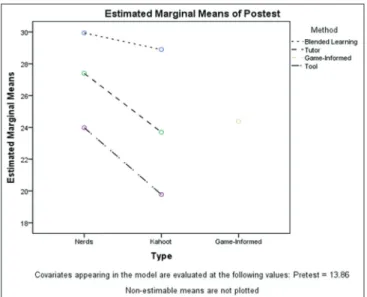
According to Figure 1 and Table 1, ANCOVA test was applied to compare the mean scores of two types of games. The results of inferential statistics between groups there-fore reveals that there is significant difference between the post-test means of different treatment groups, Phrasal Nerds and Kahoot app. Although based on questionnaire findings learning is taking place in the two groups, but Phrasal Nerds has higher mean score compared to Kahoot based on post-test mean score. In other words, Phrasal Nerds vs. Kahoot mean score difference is 3.01. However, only in game as
blended learning context, the mean score of Phrasal Nerds and Kahoot are higher. Comparison of the mean score of Nerd’s post-test results as Blended, Tutor and Tool are 29.9, 27.4 and 24 respectively. The mean score for Kahoot’s post-test results are 28.9, 23.7 and 19.8 respectively. P-value for effect of method and mean on post-test is significant <0.001. The results of this study in terms of the four learning contexts through participants pre and post-test and ques-tionnaires’ findings however ran against or in odds with the findings of Binzak, Anderson, Kumar, Jordan-Douglass, and Berland (2016) and Chik (2014) who studied students’ inside and outside the classroom game play experience.
Findings of the comparison between two mobile game apps Busuu vs. Dualingo (Gunter, Campbell, Bragar, & Racilan, 2016), although offered some language learning opportunities, they did not present scenario-based quality, role-play or game-play or story-line, among other elements. Thus this study was in line with the requirements and the gap in research literature on two game apps, one that include story line and another which is workshop based and the comparison results significantly varies among the two apps, Phrasal Nerds and Kahoot. The results of
questionnaires also reveal that students’ favour playing Kahoot mostly when teacher is the main instructor in the classroom. What are Iranian university students’ perceptions about autonomous learning and teacher’s role into integration of digital games?
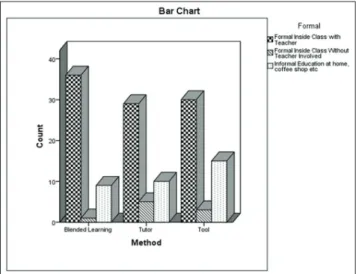
With regard to the third research question, perceptions of learner-players toward teachers’ role are compared among blended, tutor and tool. The role of the contribution was elic-ited and the results of the questionnaire are as follows:
According to Figure 2, the mean score for inside class with teacher for method is 36, tutor is 29 and tool is 30 per-cent. However, for inside classroom without teacher it is 1, 5 and 3 respectively. The outside the class education is also 9, 10 and 15 respectively. It clearly illustrates that even in game as tool, they insist on the positive impact of inside the class education. In line with this results, questions 2 and 3 from the second questionnaire reveals students’ agreement on learning through game significantly higher inside class-room than in/from outside of an educational setting.
The role of teacher instruction as well as game-based in-struction are undervalued in literature (Reynolds, 2019). Results indicate that pedagogical practices that provide fo-cused grammatical instruction, the just in time feedback pro-vided during game play afforded learners with opportunities to engage in awareness-raising language related episodes. This is in line with this research where game-based instruction through gamifying classroom and supplementary material resulted in significantly higher phrasal verb knowledge improvement than when students were expected to learn the instruction and implemented with higher levels of autonomy and as in tool. Therefore, pedagogical practices afforded higher levels of im-provement. However, in this study students also did not want teachers’ interruption during their main game play practice and they wanted it before or after the game play itself.
A mixed reactions study findings 1) embraced the game as new, effective and pleasurable 2) resistance cause of a clash between expectations about language learning, play and the constraints of the classroom. The research is also in line with this study and relevant to various methods and game play
Table 1. Comparison of the means of groups as Nerds, Kahoot and gamified multiple comparisons Tukey HSD
Dependent variable (I) Type (J) Type 95% Confidence Interval for Mean
Mean Difference (I-J) Std. Error Sig. Lower bound Upper bound
Posttest Nerds Kahoot
Gamified 3.013 3.139 1.255.841 .001 .035 1.02 .17 5.00 6.11 Kahoot Nerds
Gamified -3.013 .126 1.255.841 .001 .994 -5.00 -2.84 -1.02 3.09 Gamified Nerds
Kahoot -3.139 -126 1.25 1.25 .035 .994 -3.09-6.11 0.17 2.84
Pretest Nerds Kahoot
Gamified .026 .766 .709 1.05 .999 .750 -1.70 -1.73 1.65 3.27 Kahoot Nerds
Gamified .026 .792 1.05.70 .999 .735 -1.65 -1.71 1.70 3.29 Gamified Nerds
Kahoot -.766 -.792 1.05 1.05 .750 .735 -3.27 -3.29 1.73 1.71 *. The mean difference is significant at the 0.05 level.,* Gamified implies the non-digital, formal group
experiences (Reinhardt & Lange, 2014). Although all par-ticipants embraced the game as an enjoyable tool that im-proved their knowledge of phrasal verbs, learning and skills but resistance and a clash of expectations occurred mostly in game as tool and participants were not capable to manage their own mediated and self-directed learning. At the end of the experiment participants resisted the change and expected a teacher’s role and further engagement with extra classes in a classroom setting. But, the game as blended learning and tutor had stable outcomes in this regard.
What are the learners’ perceptions of the drawbacks and potentials of implementing the two digital apps and method, preferences of gaming elements, supplementary material, average play time, alone vs. pair and students’ perception of the games?
With regard to the fourth research question, Tables 2-7 explain the frequency of gaming elements and preferences between Nerds and Kahoot, play time between methods, alone vs. pair game play preferences and DGBLL Framework questionnaire for Fun, Motivation and Purpose Questionnaire and as follows:
Table 2. Frequency of the gaming elements’ preferences between Nerds and Kahoot Preferences for Gaming Elements
Repeating Reading Feedback Story
Line Avatar Scoring Competition Communication Graphics Sound
F(P) F(P) F(P) F(P) F(P) F(P) F(P) F(P) F(P) F(P)
Nerds 52 (68%) 40 (52%) 20 (26%) 13 (17%) 3 (4%) 16 (21%) 9 (12%) 9 (12%) 12 (15%) 8 (10%) Kahoot 45 (59%) 37 (48%) 9 (11%) 20 (26%) 5 (6%) 18 (23%) 10 (13%) 8 (10%) 14 (18%) 12 (15%)
Table 3. Preference for supplementary books and play between blended learning, tutor and tool
N 95% Confidence interval for mean
Mean St. Deviation Std. Error Lower bound Upper bound I prefer supplementary books and
materials Blended Tutor
Tool 51 51 50 3.65 3.33 4.42 1.42 1.21 .90 .20 .17 .12 3.25 2.99 4.16 4.05 3.67 4.68 I prefer working from the book and
worksheet Blended Tutor
Tool 51 51 50 1.88 2.24 2.38 .95 1.03 1.10 .13 .14 .15 1.61 1.95 2.07 2.15 2.53 2.69 We should play once a week Blended
Tutor Tool 51 51 50 4.04 3.84 4.46 1.14 1.40 .81 .16 .19 .11 3.72 3.45 4.23 4.36 4.24 4.69 We should play more than once a week Blended
Tutor Tool 48 51 45 2.31 2.10 2.13 1.32 1.36 1.42 .19 .19 .21 1.93 1.72 1.71 2.70 2.48 2.56 We should not play at all Blended
Tutor Tool 46 48 47 1.26 1.27 1.15 .88 .76 .51 .13 .11 .07 1.00 1.05 1.00 1.52 1.49 1.30
Table 4. Play time between blended learning, tutor and tool
Average play time N 95% Confidence interval for mean
Mean Std. Deviation Std. Error Lower bound Upper bound Week 1 Blended
Tutor Tool 44 47 47 56.36 77.77 62.13 32.46 65.46 41.43 4.89 9.54 6.04 46.49 58.54 49.96 66.23 96.99 74.29 Week 2 Blended
Tutor Tool 44 47 47 42.05 73.19 67.02 36.17 77.93 66.72 5.45 11.36 9.73 31.05 50.31 47.43 53.04 96.08 86.61 Week 3 Blended
Tutor Tool 44 47 47 32.27 67.55 69.15 37.19 61.86 78.65 5.60 9.02 11.47 20.97 49.39 46.06 43.58 85.72 92.24 Week 4 Blended
Tutor Tool 44 47 47 27.73 79.04 44.04 33.20 75.79 45.75 5.00 11.05 6.67 17.63 56.79 30.61 37.82 101.30 57.48 Week 5 Blended
Table 5. Alone vs. pair game play between the groups
N 95% Confidence interval for mean
Mean Std. Deviation Std. Error Lower bound Upper Bound Alone vs. Pair Blended
Tutor Tool Total
41 43 42 126
1.37 1.40 1.17 1.31
.488 .075 .377 .464
.076 .075 .058 .041
1.21 1.24 1.05 1.23
1.52 1.55 1.28 1.39
Table 6. DGBLL Framework questionnaire
N 95% Confidence interval for mean
Mean Std. Deviation Std. Error Lower bound Upper bound The game was easy to play. Nerds
Kahoot 76 76 3.87 3.92 .83317 .83946 .09557 .09629 3.6846 3.7358 4.0654 4.1195 I actively comprehend the new
constructions in the game. Nerds Kahoot 76 76 3.96 3.68 1.183 1.288 .136 .148 3.69 3.39 4.23 3.98 I experienced technical problems in the
game. Nerds Kahoot 76 76 1.33 1.68 1.157.839 .096 .133 1.14 1.42 1.52 1.95 There was no much feedback from the
game. Nerds Kahoot 76 76 1.76 2.00 1.142 1.166 .131 .134 1.50 1.73 2.02 2.27 I could make mistakes more freely than
in a regular class. Nerds Kahoot 76 74 4.00 3.81 1.306 1.362 .150 .158 3.70 3.50 4.30 4.13 Having my own avatar made me feel
more involved in the game. Nerds Kahoot 76 76 4.03 3.74 1.286 1.226 .147 .141 3.73 3.46 4.32 4.02 Most of the visualized teaching was not
useful. Nerds Kahoot 76 75 1.45 1.71 1.010.944 .108 .117 1.23 1.47 1.66 1.94 The game made me construct new
sentences with phrasal verbs than in a regular class.
Nerds
Kahoot 76 76 4.1974 3.9408 .66372 .88682 .07613 .10173 4.0457 3.7381 4.3490 4.1434
I would like to play the game in the
future. Nerds Kahoot 76 76 4.7314 4.1991 .37103 .96261 .04256 .11042 4.6467 3.9791 4.8162 4.4190 The game competition and rules,
although difficult but were manageable. Nerds Kahoot 76 76 4.24 3.80 1.276.950 .109 .146 4.02 3.51 4.45 4.09 Chatting while playing the game was a
good way to improve my phrasal verbs and language.
Nerds
Kahoot 75 75 4.05 4.07 1.126 1.319 .130 .152 3.79 3.76 4.31 4.37
Most of the discussions and classmates
are not useful. Nerds Kahoot 76 75 2.9816 3.5477 .89067 .87793 .10217 .10137 2.7781 3.3457 3.1851 3.7497
Table 7. Fun, Motivation and purpose questionnaire
N 95% Confidence interval for mean
Mean Std. Deviation Std. Error Lower bound Upper bound
Was it fun? Nerds
Kahoot 75 75 1.00 .91 .000 .293 .000 .034 1.00 .84 1.00 .97 Did you learn something? Nerds
Kahoot 75 73 1.00 1.00 .000 .000 .000 .000 1.00 1.00 1.00 1.00 Feedback about feelings Nerds
Kahoot 76 76 1.07 1.08 .250 .271 .029 .031 1.01 1.02 1.12 1.14 It motivates me very much because I
can… Nerds Kahoot 75 68 2.04 2.15 .743 .697 .086 .084 1.87 1.98 2.21 2.32
How would you like to play this/
similar game(s) in the future? Nerds Kahoot 70 68 1.33 1.79 .737 .923 .088 .112 1.15 1.57 1.50 2.02 Does it motivate you to learn phrasal
As you can see in Table 2, the frequency percentage for repeating is the highest (M= Nerds 68%, Kahoot 59%), fol-lowed by reading (M= Nerds 52%, Kahoot 48%). The scor-ing frequency percentage is (M= Nerds 21%, Kahoot 23%) respectively. Students in Kahoot treatment group were intro-duced to Phrasal Nerds App after their post-test exams was over and the results of story line element in Table 2, illus-trates the perception of the Phrasal Nerds app for Kahoot participants, exceptionally. The objectives of the game were to rescue grandfather. Although this element is important but it seems that learner-players focused mostly on the language learning element and using the new phrasal verbs to talk about their daily life rather than discussing the game goal and through the use of phrasal verbs and it was considered as their secondary favourite preference.
The participants were instructed to score each items on questionnaire using a six-point likert scale (1= Strongly dis-agree, 5= Strongly Agree and 6= Not Applicable).
As shown in Table 3, significant mean difference ex-ists between the preference for working from the book and worksheet in Blended Learning vs. Tutor and Tool (M=1.88, confidence interval= 1.61, P <0.05). Learner-players prefer supplementary materials significantly higher in game as tool (M= 4.42, SD = .90). It can be observed that the over-whelming majority of learner-players’ prefer game play once a week. The results of statistics reveal that learners prefer to have books, complementary material worksheets beside the game play. Students’ preference to play the game was significantly high and they preferred game play to learning from textbooks.
Table 4 shows that on average learner-players’ play time in game as blended learning and Tutor were significantly lower and higher respectively.
If we emphasize on time spent on playing the game as well as the improvement of scores, then maybe game as tu-tor is significant and more practical. The scores in game as tutor were lower than in game as blended learning but if the emphasize is on improvement of the scores and therefore the phrasal verbs, then the time spent on the game to build self-autonomy and authenticity did not play a role.
As Table 5 shows, for alone vs. pair game play, the learner-players in the tutor and blended played the digital game were in favour of pair work a bit higher (M=1.37, SD= .488) than the pair work preference in game as tool (M= 1.17, SD= .377). In other words, overall they played the game alone but whenever they had the opportunity they also played it together (M= 1.31, SD= .464).
The results indicated that 8% of students encountered technical difficulties. The technical difficulty was due to the fact that they were unable to sign in to Kahoot on their mobile phones and link it to their email addresses on time. This might be the only reason that they mentioned feeling stressed out during the first days of the learning procedure. Overall learner-players like to play the game in the future (M= 4.4653, SD= .77455). Majority of students also thought that the feedback from the game was significantly useful. In this study majority of students felt that they could make mistakes during their interaction with peers both through
questionnaire and classroom observation while in other classes this was impossible.
Reinhardt (2014) findings from gamified and game in-formed teaching ran against the findings of this study and for the two game types. The research claimed that in an attempt to have willingness to communicate there was reluctance to interact in the classroom and notably anxiety around speak-ing. However, in this study majority of students felt that they could make mistakes during their interaction.
The results indicated that in general students consider the game play as a fun activity and they can learn something from it (M= .95, SD= .212). The students found the game useful firstly and mostly because it improved and mastered their knowledge of phrasal verbs. Winning, doing it with others or knowing the purpose was the second important cri-teria for them. The results of ‘Master my knowledge’ was significantly higher than the other items. 70.6% was in fa-vour of ‘master my knowledge’,14% ‘win’, 7.7% to do it with others and a second 7.7% ‘Achieving Game’s Goal’ which was to rescue grandfather. It implies that either the gamified elements are not the focus of their attention and not motivating or that learning to enjoy achieving games’ goals should be implemented into the procedure of the fu-ture plans and through these game platforms. It could also be that the outcomes and perceptions are in line with Task-based Language Learning outcomes and requirements. Thus, positive or negative, there is no balance between playing and learning elements and learning phrasal verbs dominates their game play experience.
Reinhardt meta-analysis (2019) argues a balance be-tween learning and playing and questions ‘how does context of gameplay impact player-learners’ motivation or learning outcomes? When does gameplay become ‘game work’ in the mind of the player-learners? The results of current study explored students’ focus of attention and the results drasti-cally were in favour of learning phrasal verbs through stu-dents’ questionnaire responses. Thus majority of students responded positively to ‘master my knowledge’. There is tension between learning and playing in the context due to the cultural influence which is in line with the statement arguing that schools should be ‘fun’ is not universally ac-cepted (Prensky, 2007).
CONCLUSION
This section provides a summary of the findings, data anal-ysis of pre and post-test results and students’ questionnaire and interviews. The implications, novelty and originality of the study for language pedagogy are also explained.
four treatment groups while previous studies were conducted only on two experimental groups.
Comparing two mobile apps and distinguishing the im-pact and perceptions of the most vital game features while meeting a linguistic goal also makes the current study an original work and a novel approach to find out a balance be-tween pedagogical, fun, play in the wild or blended learning of various types of integration which was not explored pre-viously thus makes this study vital and differentiate it from the previous studies not only in Iran but can be implemented to other countries and languages. It is therefore investigating digital game apps through gaming elements, ludical manners and learning context at the same time that makes the out-come of the study a unique approach.
There is not enough research on how a game can be in-tegrated into learning context. How does the nature of inte-gration influence the learning outcomes and what role does game or teacher instruction play? Meantime, implementing electronic games into instructed language learning curric-ulum requires practical and pedagogical research on game type selection, affective features and creation, gamifying, integrating as well as implementing gamefulness to second language learning and their relevant tasks into the teach-ing instruction and course plannteach-ing (Godwin-Jones, 2014). Evaluating and selecting the right game to the relevant ap-proach in order to promote phrasal verb knowledge with re-spect to Iranian learner-players also differentiates this study from previous research.
Current study therefore in brief, investigated 1) What are the gaming elements (e.g. story-line, scenario-based, prob-lem-based) in an educational gaming context and 2) whether we should implement it in the classroom versus outside of the classroom as blended learning, tutor, tool or game-in-formed (degree of learning and playing, mandatory or op-tional as in leisure time) among Iranian university learner players. That is how the ‘what is a game’ question and ‘what game use’, focuses on both game types and four game play treatment settings implemented at the same time in the cur-rent study through questionnaire on teachers’ role, the degree of autonomous learning and gaming elements preferences, between Phrasal Nerds and Kahoot to improve phrasal verb knowledge, to also see patterns of play time between meth-ods, alone versus pair role play functionality and DGBLL Framework questionnaire for the core purpose of eliciting fun and motivation and to see if these all align with other aspects of the research.
Implementing games as blended learning, tutor, tool and gamified in current research found out the most appropriate features and the significance of the role. In other words, game as blended learning, tutor and gamified instruction improve their phrasal verb knowledge significantly higher than the tool group where students (learner-players) are given higher levels of autonomy and relevant skills and suggestions to ex-plore the games outside of the classroom. However, overall the findings illustrate positive improvement and majority of participants enjoyed the game play. In other words, although game-informed group expressed engagement and motivation and their post-test scores are better than game as tool, the
game as blended learning and tutor mean scores are still the highest compared to game-informed.
REFERENCES
Allen, V.F. (1983). Techniques in teaching vocabulary. New York: Oxford University Press.
Baltra, A. (1990). Language learning through computer ad-venture games. Simulations and Gaming Journal, 21, 445- 452.
Bellotti, F., Kapralos, B., Lee, K., Moreno-Ger, P., & Berta, R. (2013a). Assessment in and of serious games: an overview. Hindawi Advances in Human- Computer Interaction. doi:101155/2013/136864
Binzak, V. J. Anderson, C.G. Kumar, Jordan-Douglass. A., & Berland, M. (2016). Comparing gameplay across formal and informal contexts. Proceedings of the 1st DiGRA and
FDG. pp. 1-2.
Bjorks, S., & Holopainen, J. (2005a). Games and design patterns. In Salen, K. and Zimmerman, E., editors, The Game Design Reader: A Rule of Play Anthology. MIT Press.
Bjork, S., & Holopainen, J. (2005b). Patterns in Game Design. Game development series. Charles River Media, Hingham (Mass).
Calvo-Ferrer, J. R. (2018). Juegos, videojuegos series: Analisis de los factorcs que favorecen la diversion del jugador. Migvelhernandez Communication Journal. 9 (1), 191- 226.
Campbell, L., Braga, J., & Souza, V. (2016). Language learn-ing apps or games: an investigation utilizlearn-ing the RETAIN model. Revista Brasileira de Linguistica Aplicada, 16(2), 209-235. doi:10.1590/1984-639820168543 Cekaite, A., & Aronosson, K. (2005). Language play, a
col-laborative resource in children’s L2 learning. Applied Linguistics, 26 (2), 2169- 2191.
Chik, A. (2014). Digital gaming and language learning: Autonomy and community. Language, Learning and Technology, 18(2), 85- 100.
Cornillie, F., Clarebout, G., & Desmet, P. (2012). Between learning and playing? Exploring learners’ perceptions of corrective feedback in an immersive game for English pragmatics. ReCALL, 24(3), 257-278.
Cornillie, F., Thorne, S.L. & Desmet, P. (eds.) (2012). Digital games for language learning: challenges and opportu-nities. ReCALL Journal, 24(3), 243-256. doi:10.1017/ S0958344012000134
Crookall, D., & Oxford, R. (1990). Linking language learn-ing and simulation games. In D. Crookall and R. L. Oxford (Eds.), simulation, gaming and language learn-ing (pp. 3-25). New York: Newbury House.
Dagut, M., & Laufer, B. (1985). Avoidance of phrasal verbs: A case of Contrastive Analysis. Studies in Second Language Acquisition., 7(1), 73- 79.
Ellis, R. (2003). Task-based language learning and teach-ing. Oxford: Oxford University Press.
Escribano, F. (2012). 10 Gamification as the Post-Modern Phalanstee: The video game industry: Formulation, present state, and future. In P. Zackariasson and T.L. Wilson (eds.), The video game industry: formation, present state and future, pp. 198-219. New York and London: Routledge.
Garcia- Carbonell, A., Rising, B., Mortero, B., & Watts, F. (2001). Simulation/gaming and the acquisition of com-municative competence in another language. Simulation and Games, 32 (4), 481- 491.
Gaudart, H. (1999). Games as teaching tools for teaching English to Speakers of Other Languages. Simulation and Gaming. 30 (3), 283- 291.
Ghabanchi, Z., & Goudarzi, E. (2012). Avoidance of Phrasal Verbs in Learner English: A study of Iranian Students. World Journal of English Language. Sciedu Press. 2 (2), 43-54.doi:10.5430/wjel. v2n2p43
Gilmore, A. (2007). Getting real in the language classroom: Developing Japanese students’ communicative compe-tence with authentic materials. PhD thesis, Nottingham University, UK. Retrieved from http://etheses.nottin-ham.ac.uk/1928/1/478936.pdf
Godwin-Jones, R. (2014). Emerging Technologies: games in language learning: opportunities and challenges. Language Learning and Technology. 18 (2), 9-19. Godwin-Jones, R. (2005). Messaging, gaming, peer- to-
peer sharing: Language learning strategies and tools for the millennial generation. Language Learning and Technology, 9 (1), 17- 22.
Gonzalez-Gonzalez, C., & Blanco-Izquierdo, F. (2011). Designing social videogames for educational uses. Computers & Education. 58 (1), 250-262. doi:10.1016/j. compedu.2011.08.014
Gunter, A, G., Kenny, Robert, F. Vick, & Erik H. (2008). Taking educational games seriously: using the RETAIN model to design endogenous fantasy into standalone ed-ucational games. Education Tech Research Dev, vol. 56, n. 5-6, 511- 537.
Gunter, A. G, Campbell L. O. Bragar, J., & Racilan, M. (2016). Language Learning apps or games: an investigation uti-lizing the RETAIN model. Researchgate Publication. Retrieved from: https://www.researchgate.net/publica-tion/299589882_Language_learning_apps_or_games_ an_investigation_utilizing_the_RETAIN_model. Gunter, G. A, Randolph, E. G, & Gary, B. S. (2015). Teachers
Discovering Computers: Integrating Technology in a Changing World. 8 ed. Boston, MA: Cengage Learning. Houston, S. & Nugent, G. (2016). WearTec Students’
Preferences and Perceptions of Formal vs. Informal Education. University of Nebraska-Lincoln. UCARE Research Products.
Huang, Y., Wu. B., & Fu Chang, D. (2017). Mobile game-based learning with a mobile app: motivational ef-fects and learning performance. Journal of Advanced Computational Intelligence and Intelligent Informatics. 21(6), 963-970. doi:10.20965/jacii.p. 8963
Hubbard, P., & Bradin Siskin, C. (2004). Another look at tutorial CALL. RECALL., 16 (2), 448-461.
Hubbard, P. (1991). Evaluating computer games for language learning. Simulation and Gaming Journal, 22, 220-223. Ketamo, H., Kiili, K., Arnab, S. & Dunwell, I. (2013).
Integrating games into the classroom: towards new teachership. In S. de Freitas, M. Ott, M. M. popescu and I. stanescu (Eds). New Pedagogical Approaches in Game Enhances Learning: Curriculum Integration (pp. 534- 539).
Kovalik, D. L., & Kovalik, L. M. (2002). Language Learning Simulations: A Piagetian perspective. Simulation and Games, 33(3), 345- 352.
Levy, M. (1997). Computer-Assisted Language Learning: Context and Conceptualization, Oxford: Clarendon Press. Mawer, K. and Stanely, G. (2011) Digital Play: Computer Games and Language Aims, Peaslake: Delta Publishing.
Liao, Y. D. & Fukuya, Y. J. (2004). Avoidance of phrasal verbs: the case of Chinese learners of English. Language Learning. 54(2), 193-226.
Licorish, S., George, J., Owen, H. & Daniel, B. (2017). Go Kahoot! Enriching Classroom Engagement, Motivation and Learning Experience with Games. Chen, W. et al. (Eds.). Proceedings of the 25th International Conference
on Computers in Education. New Zealand: Asia-Pacific Society for Computers in Education.
Marcendonia, M. (2005). Games and foreign language teaching. Supporting for learning, 20 (3), 135- 140. Marsh, D. (2012). Blended Learning Creating Learning
Opportunities for Language Learners. New York: Cambridge University Press.
Miller, M. & Hegelheimer, V. (2006). The SIMS meet ESL: Incorporating authentic computer simulation games into the language classroom. Interactive Technology & Smart Education. 3(4), 311-328.
Newcombe, J. & Brick, B. (2017). Blending Video Games into Language Learning. International Journal of Computer-Assisted Language learning and Teaching. doi:104018/IJALLT.2017100106
Nunan, D. (1992). Research methods in language learning. Cambridge: Cambridge University Press.
Oliviera, L. R., Correia, A. C., Merrelho, A., Marques, A., Pereira, D. J., & Cardoso, V. (2009). Digital games: possibilities and limitations – The Spore game case. In T. Bastiaens.
Peterson, M. (2012). Learner Interaction in a massively mul-tiplayer online role playing game (MMORPG): A socio-cultural discourse analysis. ReCALL, 24(3), 361-380. Peterson, M. (2012). EFL learner collaborative interaction in
Second Life. ReCALL, 24(1), 20- 39.
Piranen- Marsh, A., & Tainino, L. (2009). Other- repeti-tion as a resource for participarepeti-tion in the activity of playing a video game. Modern Language Journal, 93 (2), 153- 169.
Prensky, M. (2007). Changing Paradigms: From ‘being taught’ to ‘learning on your own with guidance’.
Prensky, M. (2001). Digital natives, digital immigrants Part 1. On the horizon, 9 (5), 1-6.
Purushotma, R., Thorne, S. L., & Wheatley, J. (2009). 10 Key Principles for Designing Video Games for Foreign Language Learning. World Languages and Literatures. Portland State University, PDXScholar.
Reinhardt, J. (2015). Developing a research agenda for dig-ital game-based L2 learning. University of Arizona. Retrieved from: https://slideplayer.com/slide/3345033/ Reinhardt, J., Warner, C., & Lange, K. (2014). Digital
games as practices and texts: New literacies and genres in an L2 German classroom. In J. Pettes-Guikema & L. Williams, (Eds.), Digital Literacies in Foreign and Second Language Education, San Marcos, TX: CALICO. Chapter 7, 159-177.
Reynolds, B. L, & Kao, C. (2019). The effects of digital game-based instruction, teacher instruction, and direct focused written corrective feedback on the grammat-ical accuracy of English articles. Computer Assisted Language Learning.
Spelman, M. D. (2002). GLOBECROP: Simulation versus tradition. Simulation and Games, 33(3), 376-394. Sylven, L., & Sundqvist, P. (2012). Gaming as extramural
English L2 learning and L2 proficiency among young learners. ReCALL, 24(3), 302-321.
Stracke, E. (2007). A road to understanding: A qualita-tive study into why learners drop out of a blended language learning (BLL) environment. ReCALL, 19(1), 57-78.
Sabandar., G. N. C., & Suryana. (2018). Bring the fun into the classroom! Indonesian Journal of Informatics edu-cation. Volume 2(2). 127-134.
Salies, T. G. (2002). Simulation/gaming in the EAP writing class: Benefits and drawbacks. Simulation and Gaming, 33(3), 316-329.
Spelman, M. D. (2002). GLOBECORP: Simulation ver-sus tradition. Simulation and Games, 33(3), 376-394. doi:10.1177/104687810203300312
Sabandar, G., Supit, N. & Suryana, E. (2018). Bring the fun into the classroom! Indonesian Journal of Informatics education. Volume 2(2). 127-134.
Thomas, M. (ed.) (2011). Digital games and second language in Asia. Digital Culture and Education, 3(1).
Thorne, S. (2008). Transcultural communication in open in-ternet environments and massively multiplayer online games. In Magnan, S. (ed.) Mediating Discourse Online (pp. 305-327). Amsterdam: John Benjamins.
Thorne, S. L., Fischer, L., & Lu, X. (2012). The semiotic ecology and linguistic complexity of an online game world. ReCALL Journal, 24 (3), 279- 301.
Vandercuysse,s., Vandewaetere, M., & Clarebout, G. (2012). Game-based learning: A review on the effectiveness of ed-ucational games. In M.M. Cruz-Cunha (Ed.), Handbook of Research on Serious Games as Educational Business, and Research Tools (PP. 628-647). Hershey, PA: IGI Global. Werbach, K. (2015). Gamification, Coursera Platform:
University of Pennsylvania. Retrieved from: https:// www.coursera.org/learn/gamification/
Whitton, N. (2010). Learning with digital games: A practi-cal guide to engaging students in higher education. New York, NY: Routledge.