The Role of Lag Time in Simultaneous Interpreting Quality
Mehdi Eftekhari*
Faculty of Foreign Languages & Literature of Tehran University, Iran
Corresponding Author: Mehdi Eftekhari, E-mail: [email protected]
ABSTRACT
Interpreting either simultaneous or consecutive, as a translational activity, has the feature of immediacy which distincts simultaneous, consecutive and sight translation modes from the other common translation crafts. Immediacy as an important element in interpreting task of simultaneous mode, implicitly promotes verbal involvement and demands interpreter’s active role playing to prevent the flow of communication from being disrupted. Immediateness, as an integral part of simultaneous interpreting, consecutive and sight modes, itself is an element which keeps interpreting activity dynamic, while in the absence of synchrony and shared knowledge it can be a cause of cognitive limitation and mental load on the mind of interpreter. Perfect verbal involvement and a quality interpreting output, therefore, reveal the presence of a perfect synchrony, standard lag time, appropriate shared knowledge and moderate cognitive load. The aim of this study is to illustrate how the lack of such parameters as shared and encyclopaedic knowledge, liguistic and cultural affinities between Source Language (SL) and Target Language (TL) could entail increased amount of mental load and waiting time, and interpreter’s errors and miscues and accordingly low quality interpreting product with semantic inaccuracy.
Key words: Cognitive Load, Input, Immediacy, Lag Time, Simultaneous Interpreting, Synchrony, Output, working Memory
INTRODUCTION
Controlling the flow of communication and preventing it from successive interruptions in the proceedings, are the problem-atic areas and interpreting albatross that nearly the majority of interpreters almost always face with. The shortage of time (immediacy), unballanced input and output interval, unperfect lag time, heavy cognitive load on interpreter’s mind, the lack of opportunity for repetition and clarification and the fast-paced original speech are referred to as impedimental factors in simultaneous interpreting, which make the task more chal-lenging as well as revealing the existance of a chain relation-ship among the factors. However, the cognitive shortcoming among them is of paramount importance. The absence or pres-ence of any of the above elements affects the quality of output. It can be inferred from above that the existence of the prob-lematic areas makes decoding and encoding almost difficult or at least inaccurate. The lack of quality in any translational material originates largely in deficient linguistic and cultural knowledge of S and T language resulting unbalanced interval between input and output (increased amount of waiting time), and heavy cognitive load on interpreter’s mind. Having a mas-tery of interpriting strategies and behaviours, is contributive but not a panacea for dealing with the problems associated with cognitive and communicative processing. Inadequate linguistic knowledge of Source (S) and Target (T) language
Published by Australian International Academic Centre PTY.LTD.
Copyright (c) the author(s). This is an open access article under CC BY license (https://creativecommons.org/licenses/by/4.0/)
http://dx.doi.org/10.7575/aiac.ijalel.v.8n.1p.139
and encyclopedic knowledge about the particular subject have retarding effect on the process of reproduction of output in the receptor language. The retardation clearly involves a concatenation of such negative feedbacks as lack of concen-tration as the result of phobic reactions, unbalanced lag time, heavy mental load, interpreter’s passivity, loss of confidence, increased number of errors and miscues, semantic deviation of the original message, etc. The very objective of this study is, therefore, to regulate the impact that the negative factors might have on the quality of interpreting work.
Indisputabaly, immediateness in simultaneous interpret-ing is a hindrance to a straightforward and accurate inter-preting product, albeit its dynamic quality. Immediacy as a psychological hindrance for interpreters, can be a potential cause of interpretation phobia. The fear of not being able to keep pace with the original speaker’s words and to grasp sufficient portion of the original message, successive failures and the fear of failure begin to undermine interpreter’s confi -dence and hence the interpretation phobia lurks in the after-math of the lack of success. Let’s reitrate that there is a direct relationship between interpreter’s linguistic-level deficits and the fear of failure. Furthermore, reduced shared-knowl-edge, lack of adequate linguistic and cultural knowledge of S and T language and unfamiliarity with such interpreting tacticts as note-taking, skipping (avoidance), anticipation, approximation, filtering, substitution, and incomplete sen -ARTICLE INFO
Article history
Received: September 30, 2018 Accepted: December 22, 2018 Published: January 31, 2019 Volume: 8 Issue: 1
Advance access: December 2018
tences exacerbate the hardship of simultaneous interpreta-tion task, and conversely.
Cognitive factor, a ubiquitous and interdisciplinary element, has a close relationship with language. Another im-portant issue relevant to the relationship between cognition and language which ought to be studied is the language ac-quisition device or the Universal Grammar supported by lin-guist Noam Chomsky. Generally speaking, language is not independent of cognition. As a matter of fact, language as a mental talent, cannot be separate from cognition and hence it is logical to study language in parallel with cognition be-cause undubitably the cognitive factors enable languageto emerge and come to existence. For language, cognition is a source ofenergy and it is the cognition that makes language productive, otherwise language by itself would just be an ar-ray of words, string of clauses, sentences and discourses. In other words, cognition is as if a soul that makes language generative. The element that makes language and combina-tion of words meaningful and productive, is the power that has its origin in cognition. It is not irrelevant to say that cog-nition, language, and environment well mesh. There are a number of theories surrounding the role of genes and envi-ronmental factoros including the Epigenetic Systems Theory which emphasizes the genetic origins of behavior but also stresses that genes, over time, are directly and systemati-cally affected by many environmental factors. This theory thus well illustrates that language as a behavioural and bi-ological entity requires an environmental space to burgeon. Language has myriad functions and that is the fulfillment of the function which makes it meaningful and helps it to evolve. Language as a functional, biological and behaviural phenomenon is inseparable from psychic phenomenon. Neu -rolinguistics, the study of the functions the brain performs in language learning and language use, as well as hemiplegics (lasions) impairing language acquisition and performance, clearly suggest that language is a mental ability and trans-lation of any modes is no exception. There are plenty more hints that language as a mental entity is supervised by the brain and that the right hemisphere can take over
many of the language functions that would normally re-side in the left hemisphere. Hemiplegics or leisions in one side of the brain and hemispherectomy, sergical removal of a hemisphere of the brain, which cause greater deficiancy in language acquisition and performance with impairments in the ability to form words and sentences are further examples of the mental quality of language in general and translation in particular. Hemispherectomy and the contralateral brain function provide us with a new window on the duality char-acteristic of the brain cells and neurons in taking over the functions of the missing one either in the left or in the right hemisphere. Actually, contralateral possibility is a gift to prevent human from being deprived of language acquisition and usage. It seems that language is neither pure mental nor pure environmental. Now, let’s discuss in brief the anatomy of the brain and the cerebral lesions and their impacts on language acquisition and performance.
Localization, put forward by Franz Joseph Gall, propses that different human cognitive abilities and behaviors are
lo-calized in specific parts of the brain (modularity notion) and afterwards, the theories of Broca and Wernicke revealed that the linguistic abilities are domained in the left hemisphere as further evidence to the reality of localization theory. Lan -guage Savants and special lan-guage impairment (SLI) also show the modularity of language and localization of mental talents in that if brain were not modular, the savants would be deficient in all cognitive abilities, while we see that the sevants’ linguistic ability is independent of general cognitive ability since numerous cases have shown that intelectually handicapped individuals, despite their disabilities in certain spheres, show remarkable talents in others such as language acquisition and production. Studies of genetic disorders also reveal that one cognitive domain can develop normally along with abnormal development in other domain demonstrating that languagae abilities are localized in the left hemisphere and hence children with damaged left hemisphere show greater deficiency in language acquisition and performance with the greatest impairments in their ability to form words and sentences. In extreme cases of brain lesion the aphasic person has to undergo a procedure known as hemispherecto-my. When this happens, the remaining hemisphere attemps to take over the function of the removed or lost one (plastici -ty or flexibi-ty of right hemisphere). In view of all these facts, now this question comes to mind that if the left hemisphere is superior for linguistic processing, so how the remaining hemisphere (right one) after hemispherectomy attempts to take over the function of the missing one? The valuable the-ories of Broca and Wernicke open up a new possibility that human is endowed with two brains, left and right. If we ac-cept the notion that Broca and Wernike are placed in the left hemisphere and this half controls linguistic functions and if we accept that following to the left hemisphere lesion, the right one attempts to take over the function of the missing part, thus it can be deduced that a mechanism and anatomy exactly same as the left hemisphere, namely Broca, Wernike and Arcuate fasciculus do exist there in the right hemisphere, but this should be reminded that congenitally the left hemi-sphere is defined as a default lalf for controlling lingusitic functions, but this does not mean that the other half is not talented for taking over the linguistic functions handled by the left side, i.e. plasticity/flexibility. Cotralateral brain func -tion also explicitly illustrates the compatibility and adapt-ability of the two halves in taking over mutual functions. As the left hemisphere is switched on as default controlling motor for language abilities, the right side (named the right brain) requires time and practice for activation. The right he -meisphere actually mirrors the left one through the fibrous network. In other words, the right hemisphere is a backup system and a substitute brain. Moreover, ipsilateral (the no -tion that both hemispheres receive signals from both ears) can be regarded as additional evidence for adaptability and duality feature of the left and right hemispheres in that they backup each other.
during their formative years to achive native-like grammati-cal competence illustrates that to some extent apparantly lan-guage is imitative and analogic as imitation and analogy are seemingly a source of linguistic input. Generally speaking, language and translation are two integral events. The term ‘event’ is deliberately applied here since it is supposed that language same as other occurances needs a space (context) to obtain a real and tangible form, thus space or environ-ment is the requisite for the manifestation of language as a mental and biological event. The schematic representation of the relationship between cognition, environment (space) and language would look like this:
Transtion, a work of art, as well as language is not inde-pendent of cognition and some impairments in interpreting root in both linguistic knowledge and cognitive defician -cies. Full counterpart in target language rarely happens and in nearly most cases never happens to have full equiva-lence between S and T language. So, the reproduction of an appropriate meaning of the original message overrides the interpretation of the entire words of the original speak-er. The lack of sufficient time for repetition and correction of the original message, makes the control of the flow of communication difficult and sometimes disrupts it. Studies elsewehere corroborate that waiting time influences satis -faction (Ad Pruyn, 1998). The acceptable waiting time ev-idently appears to be a determining element in interpreting craft since surpassing the normal waiting time provokes strong negative response and leads to a low quality trans-lational product and entails interpreter’s passivity. Short -ening the waiting time (normalized waiting time) increases the quality quite strongly (the amount of waiting time vs. satisfaction). In simultaneous interpreting craft, everything happens very fast and if anything is missed, there is actual-ly no possibility for repetition, clarification, amendment or correction and hence the interpreter is recommended com-petently to keep pace with the original speaker and grasp as much portion as possible of the words of the speaker and that to be prepared to anticipate and guess the speaker’s concepts from context. A major concern in simultaneous interpreting is to counteract the negative effects of wait-ing since the parameter of waitwait-ing time plays an important role both in disruption or continuity of the flow of com -munication. A successful interpreting task happens through
a steady flow of communication and normal waiting time because inordinate waiting time entails insufficiency of sat -isfaction, increased cognitive load on the mind of interpret-er and consequently intinterpret-erpretinterpret-er’s passivity and semantic deviation.
LITERATURE REVIEW
A perfect temporal synchrony with the source message is of paramount importance and is closely relevant to the ef-fect that lag time could have on the quality of interpreting. As already stated, the lack of perfect synchrony results in inaccurate interpretation and increased number of errors or miscues. The number of miscues in interpreter performance has been compared with the amount of lag time (i.e. the time between delivery of the original message and delivery of the interpreted message). The more the amount of waiting time is, the less the satisfaction is. Clearly the accuracy of inter-pretation or restating the original message in the receptor counter is directly related to the interpreter’s degree of com-prehension. Now this question comes to mind that ‘under what conditions an accurate comprehension takes place?’ It is possible to posit a number of conditions (e.g. “familiarity with the subject matter, (Dennis Cokely, 2014)” and inter -preter’s adequate linguistic and cultural knowledge of both S and T language etc. Dennis Cokely implicitly notifies that the existance of shared and encyclopedic knowledge are con-tributive to fully comprehend the pragmatic of the original message in stressful condition of simultaneous interpreting.
The keywords ‘immediacy’ and ‘here and now’ as dis-tinguishing features of simultaneous interpreing are attached to simultaneous interpreting mode by Franz Pochhaker who holds that interprting is a task which is performed across linguistic and cultural differences that exist between S and T language: “Within the conceptual structure of translation, interpreting can be distinguished from other types of trans-lational activities most succinctly by its special feature of immediacy: in principle, interpreting is performed ‘here and now’ for the benefit of people who want to engage in communication across the barriers of language and culture (Franz Pochhaker, 2003). The barriers of language and cul -ture which this scholar refers to could be the lack of cultural and linguistic counterpart and commonalities between S and T language. The phrase ‘here and now’ suggests the short-age of time and stressful condition under which simultane-ous interpreting work is carried out. Minhua Liu, Diane L. Schallert and Patrick J. Carroll in their work titled Working memory and expertise in simultaneous interpreting (2004) applying the sentence, “moment-by-moment operations in the process of simultaneous interpreting involve expressing in the target language the meaning of the original message”, develop the concept of concurrent speaking and listening which clearly points out that simultaneous interpreting could be a stressful experience.
in any language activity, it is an artistically creative act of community and we draw unconsciously on vast cognitive resources and mappings (mental models) call up innumer -able models and frames, set up multiple connections, coor-dinate large arrays of information, and engage in creative mappings, transfers and elaborations (David Morley, 2012)”. John Benjamins in his book Describing Cognitive Processes in Translation: Acts and Events addresses translation as an act and event and has its main focus on the cognitive and mental processes of interpreting (translation) as well as in -cluding the social situation (context) in the exploration of interpreing or translating process and at the same time the paper by Andrew Brook/Pete Mandik titled The Philosoply and Neuroscience Movement (2007) embodies elaborations on such concepts as linguistic deficits of aphasic patients, localization, cognition and the brain as quite relevant terms to language and interpreting activity.
Gile’s Effort Models for Interpreting (2014) typically ex -emplifies the cognitive property of interpreting and the ne -cessity of memory effort in any translational activity: “The key concepts of the Effort Models are the Processing Capac-ity and ‘the fact that some mental operations in interpreting require’ a significant amount of it (Gile, 1992: 191). Since each interpreting phase implies an effort, the interpreter should therefore be able to find a balance among them in terms of energy.
Kade in the following saying along with Pochhaker pos-tulates stressful condition and the shortage of time in simul-taneous interpreting: “Interpretation is defined as a form of translation in which the source-language text is presented only once and thus cannot be reviewed or replayed, and the target-language text is produced under time pressure, with little chance for correction and revision (Kade, 1968)”.
This saying by Jean Piaget also illustrates the importance of environment in maturation of cognitive data: ‘’It is greatly worthy of mentioning that the cognitive development is a progressive reorganization of mental processes which result from biological maturation and environmental experience (Jean Piaget, 1896-1980); the notion also argues that chil -dren construct an understanding of the world around them, experience discrepancies between what they already know and what they discover in their environment and then adjust their ideas accordingly’’.
This also deserves consideration that regardless of some minor differences John Benjamins, Jean Piaget along with Chernov/Gerer, David Morley, Gile, Andrew Brook/Pete Mandik, Warren Burggren supports cognitive involvement in language and translation (interpreting) activities. Near -ly all these scholars admit that language as well as any translational activity is the result of the involvement of cognitive and environmental factors. Warren Burggren, meanwhile, in the the following notion asserts epigenetic envolvement and its contributing role in language evolve-ment. It is notable as well that Jean Piaget and Noam Chomsky hold a mentalistic view on language. Warren Burggren’s notion also deserves consideration: “Epigene -tic inheritance likely contributes to evolution both directly and indirectly (Warren Burggren, 2016), hence there is a
necessity to illuminate the terrestrial environmental role in language evolvement”. Warren Burggren implicitly takes into account the biological aspect of language and that lan-guage evolvement is influenced by the surrunding environ -ment. Nearly all the notions put forward by these scholars, illuminate the cognitive and environmental charecteristic of language in general and interpreting activity in particu-lar. Simultaneous interpreting, therefore, is referred to as truly a work of art that realizes in stressful condition by an interpreter who has a high sence of imagination and with adequate liguistic and cultural knowledge of S and T language as well as being well skilled in improvisation and extemporization. In view of these facts language, there-fore, is strongly tied with cognition, context (space), and neural underpinnings. In this work the focus of argument has been shifted from interpreting activity to language and its features largely due to the fact that translation or in-terpreting is regarded as a subpart of language and hence after language is well clarified and its cognitive aspects are clearly demystified, then the nature of translation could be described.
METHODOLOGY
RESEARCH QUESTION
This research mostly attempts to answer the following questions and to find ways to moderate the effects of Lag Time on interpreter’s errors and miscues and to decrease the cognitive load most often interpreters face with during inter-preting specially of simultaneous mode.
1) How the harmful effect of inappropriate Lag Time (in -creased amount of waiting time) can be controlled or moderated?
2) How the cognitive load on the mind of interpreter can be decreased?
3) How the sense of security in interpreting craft can be increased and what are the positive feedbacks?
The following six Tables (1-6) illustrate the questions of the questionnaire and the answers given by the respondents to the quotations.
The above data elucidate that enjoying shared-knowledge in both S and T language is a helping factor to ensure a stan -dard output in the receptor language, while the lack of shared and encyclopedic knowledge, linguistic knowledge (knowl -edge of vocabulary), loss of proper synchrony, and failure of concentration and inability to grasp sufficient portion of the original speaker’s words all are referred to as negative, preventive and distracting elements that impair the interpret-ing activity. Any of these impairments, can be the cause for another distracting element. For example, the lack of shared and vocabulary knowledge can be the cause for disruption of synchrony which entails loss of concentration and failure of interpreter’s grasp of sufficient portion of the original speak -er’s words. Each negative or positive factor, thus, can be the
cause for other element either positive or negative. Such a positive element as vocabulary knowledge, for instance, can be a cause for experiencing a sense of security and handling interpreting work under the condition of proper synchrony with normal amount of waiting time.
CONCLUSION
Such basic principles of simultaneous interpreting as adjust -ment, anticipation, reformulation, simplification, faithful -ness and shadowing exercises and the other strategies as well as enjoying a perfect cognitive status all can be contributive to moderate the impact of wating time (lag time) on the qual -ity of interpreting output, but an obvious implication is that certain instances of misunderstanding, miscues and seman-tic deviations, interpreter’s passivity and the fear of failure or the phobia of interpreting craft and consequently the loss of confidence could be due not merely to cognitive limita -tions but rather to the lack of sufficient linquistic and cultural knowledge of S and T language. Inadequate familiarity of intepreter with the topic and subject of discussion is obvi-ously salient in interpreter’s failure and lack of confidence and increase in the number of errors and miscues. Studies have shown that there is a direct relationship between com-prehension and background knowledge. Thereore, topic familarity, interpreter’s expertise, background knowledge and content relevancy play an important role to achieve a perfect apprehension of source language message and that to encode perfectly the same in the target counter. The gist of this argument is that linguistic and cultural knowledge of S
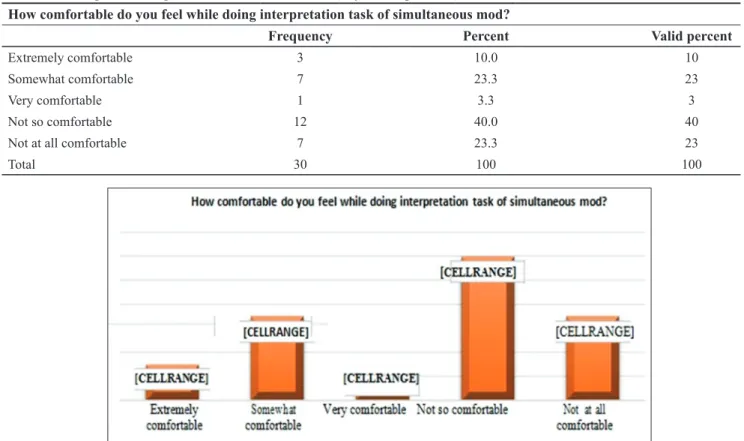
Table 1. Multiple choice question No. 1 and its answers by the respondents
How comfortable do you feel while doing interpretation task of simultaneous mod?
Frequency Percent Valid percent
Extremely comfortable 3 10.0 10
Somewhat comfortable 7 23.3 23
Very comfortable 1 3.3 3
Not so comfortable 12 40.0 40
Not at all comfortable 7 23.3 23
Total 30 100 100
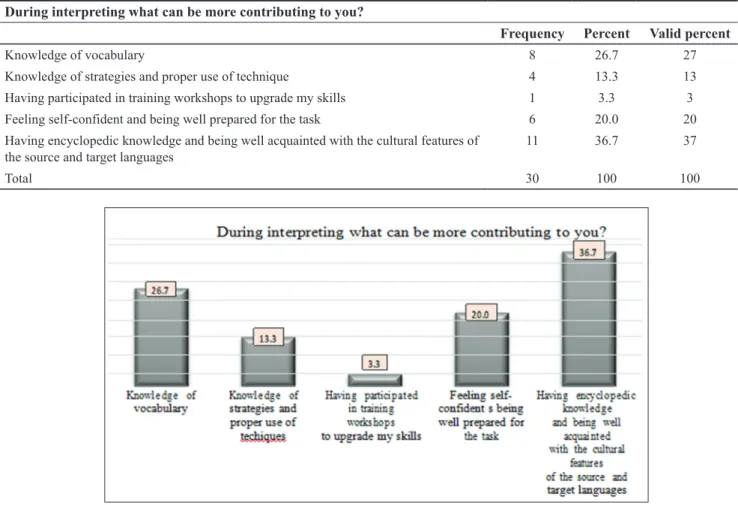
Table 2. Multiple choice question No. 2 and its answers by the respondents During interpreting what can be more contributing to you?
Frequency Percent Valid percent
Knowledge of vocabulary 8 26.7 27
Knowledge of strategies and proper use of technique 4 13.3 13
Having participated in training workshops to upgrade my skills 1 3.3 3
Feeling self-confident and being well prepared for the task 6 20.0 20
Having encyclopedic knowledge and being well acquainted with the cultural features of
the source and target languages 11 36.7 37
Total 30 100 100
Figure 2. Frequency Diagram of multiple choice question No.2 and its answers by the respondents
Table 3. Multiple choice question No. 3 and its answers by the respondents what are your weaknesses?
Frequency Percent Valid
percent
Feeling insecure in my role 5 16.7 17.2
My loss of concentration and inability to grasp sufficient portion of the speaker’s sentences 13 40.7 46.3 Lack of vocabulary to keep the flow of communication uninterrupted 14 46.7 48.3 Use of body gestures to convey meaning when under stress or memory laps 2 6.7 6.9 I cannot manage a well synchrony between the original speaker’s input and target language
output 13 40.7 47
Unanswered 1 3.0
-Total 30 100 100
Table 4. Multiple choice question No. 4 and its answers by the respondents What increases your sense of security while on the job?
Frequency Percent Valid
percent
Having shared knowledge of the source and target languages 11 36.7 36.7
Attending training seminars regularly 1 3.3 3.3
Keeping up-to-date with information relevant to the fields in which interpreting takes place 10 33.3 33.3 Reading the source and target language to keep up my vocabulary to decrease passivity and
successive pauses during interpretation 5 16.7 16.7
Knowinghowwellmanaging the attention dividing 3 10.0 10.0
Total 30 100 100
Figure 4. Frequency diagram of multiple choice question No.4 and its answers by the respondents
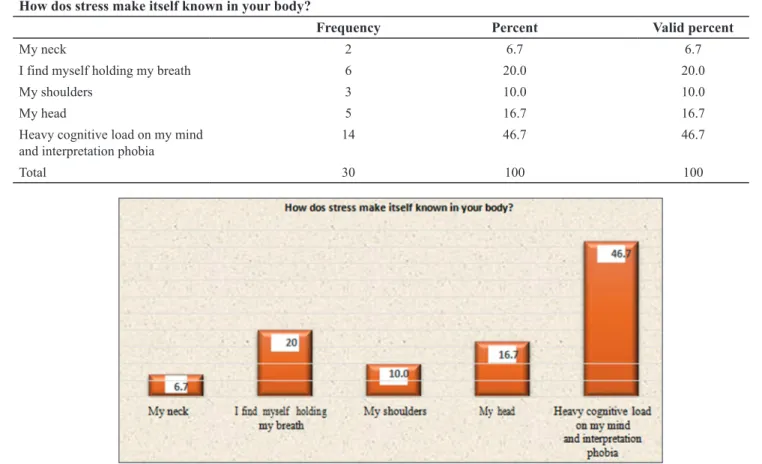
Table 5. Multiple choice question No. 5 and its answers by the respondents How dos stress make itself known in your body?
Frequency Percent Valid percent
My neck 2 6.7 6.7
I find myself holding my breath 6 20.0 20.0
My shoulders 3 10.0 10.0
My head 5 16.7 16.7
Heavy cognitive load on my mind
and interpretation phobia 14 46.7 46.7
Total 30 100 100
and T language as well as interpreter’s expertise and back-ground knowledge of the subject of discussion are determin-ing factors in the quality of interpretdetermin-ing product; conversely, the absence of these factors could lead to mental load and cognitive deficiency.
ACKNOWLEDGEMENT
Building an academic discipline requires the committed ef -forts of many researchers, and it is only on the strength of the collective achievements of scholars past and present that this work has come to exist. I actually owe a great debt of grati-tude to the entire community of scholars who have contrib-uted to this field. My sincere thanks also go to Dr. Abdollah Karimzadeh and Dr. Ahmad Basir Vafai, Mr M. Jafari Mogh -adam and Mr M. Babazadeh Bedoostani whose effective co -operation has been valuable. I am also extremely grateful to the esteemed reviewers for their useful guidelines and the invaluable time they spent on reviewing the current work.
REFERENCES
Ad, P. (1998). Effects of Waiting on the Satisfaction with the service: Beyond objective time measures. Article in In -ternational Journal of Research in Marketing.
Andrew, B. & Pete, M. (2007). The Philosophy and Neuro-science Movement (paper). Cambridge University Press.
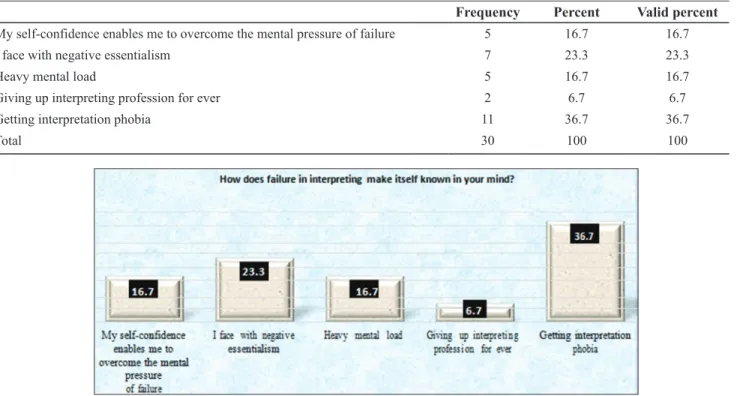
Table 6. Multiple choice question No. 6 and its answers by the respondents How does failure in interpreting make itself known in your mind?
Frequency Percent Valid percent
My self-confidence enables me to overcome the mental pressure of failure 5 16.7 16.7
I face with negative essentialism 7 23.3 23.3
Heavy mental load 5 16.7 16.7
Giving up interpreting profession for ever 2 6.7 6.7
Getting interpretation phobia 11 36.7 36.7
Total 30 100 100
Figure 6. Frequency diagram of multiple choice question No.6 and its answers by the respondents
Daniel, G. (1995). Basic Concepts and Models for Interpret-er and Translator Training. John Benjamins Publishing Company.
David, M. (2012). The Cambridge Introduction to Creative Writing. Cambridge University Press.
Dennis, C. (2014). The Effect of Lag Time on Interpreter Errors. National Consortium of Interpreter Education Centers, Gallaudet University Press.
Franz, P. (2003). Introducing Interpreting Studies.Routledge Publication.
Gary, B. (2004). The Birth of the Mind: How a Tiny Number of Genes Creates the Complexities of Human Thought. Publisher: Basic Books.
John, B. (2013). Describing Cognitive Process in Transla-tion: Acts and Events. John Benjamins Publishing Com -pany.
Minhua, L., Diane, L. Schallert and Patrick J. C. (2004), Working Memory and Expertise in Simultaneous Inter-preting, The University of Texas at Austin, John Benja -min’s Publishing Co.
Sylvie, L., & Barbara, M. (1994). Bridging the Gap: Empir-ical research on simultaneous interpreting published by John Benjamins Publishing Co.
Warren, B. (2016). Epigenetic Inheritance and Its Role in Evolutionary Biology: