ISSN: 2147-611X
www.ijemst.com
A Video-Based Measure of Preservice
Teachers’ Abilities to Predict Elementary
Students’ Scientific Reasoning
Valarie L. Akerson1, Ingrid S. Carter2, Meredith A. Park Rogers1, Khemmawadee Pongsanon3
1Indiana University
2Metropolitan State University of Denver 3
Institution for the Promotion of Teaching Science and Technology
To cite this article:
Akerson V.L., Carter I.S., Park Rogers, M.A. & Pongsanon, K. (2018). A video-based
measure of preservice teachers’ abilities to predict elementary students’ scientific reasoning.
International Journal of Education in Mathematics, Science and Technology (IJEMST),
6(1), 79-92. DOI:10.18404/ijemst.328335
This article may be used for research, teaching, and private study purposes.
Any substantial or systematic reproduction, redistribution, reselling, loan, sub-licensing,
systematic supply, or distribution in any form to anyone is expressly forbidden.
Authors alone are responsible for the contents of their articles. The journal owns the
copyright of the articles.
Volume 6, Number 1, 2018
DOI:10.18404/ijemst.328335
A Video-Based Measure of Preservice Teachers’ Abilities to Predict
Elementary Students’ Scientific Reasoning
Valarie L. Akerson, Ingrid S. Carter, Meredith A. Park Rogers, Khemmawadee Pongsanon
Article Info
Abstract
Article History
Received: 28 December 2016
In this mixed methods study, the researchers developed a video-based measure called a ―Prediction Assessment‖ to determine preservice elementary teachers’ abilities to predict students’ scientific reasoning. The instrument is based on teachers’ need to develop pedagogical content knowledge for teaching science. Developing a knowledge base for aiding teachers in their abilities to predict students’ scientific reasoning promotes student learning because it enables teachers to understand students’ current conceptions and to be able to build lessons to improve upon those ideas. To determine whether preservice teachers are improving in their abilities to predict scientific reasoning it is necessary to have an instrument that can measure their current abilities and then to measure whether those abilities improve through instruction. In the second part of this study the authors used the prediction assessment to determine whether the traditional or new (Iterative Model Building, or IMB) field experience improved preservice elementary teachers’ abilities to make reasonable predictions of student scientific reasoning. It was found that though preservice teachers in both the traditional and IMB field experience approaches improved their abilities to make predictions, there was a greater number in the IMB group who made reasonable predictions and based those predictions on student reasoning.
Accepted: 19 June 2017
Keywords
Scientific reasoning Science education Preservice teachers Elementary science
Introduction
In her review of research related to science teacher knowledge, Abell (2007) explained, ―overall, teachers’ lack knowledge of student science conceptions, but that this knowledge increases with teaching experience‖ (p. 1128). This notion of experience improving teachers’ abilities to promote better science conceptions supports Pinnegar’s (1989) findings that teacher knowledge of how students learn a particular discipline comes mainly from classroom practice and consistent interactions with students. Shulman (1986) referred to this specialized form of knowledge for teaching a specific discipline as pedagogical content knowledge (PCK). Magnusson, Krajcik, and Borko (1999) refined this notion of PCK further for science teaching indicating that there are various forms of knowledge that comprise PCK, one of which is knowledge of student learning. We know that understanding how students learn a specific discipline is a critical component of quality instructional decision-making (Donovan & Bransford, 2005; Duschl, Schweingruber, & Shouse, 2006).
Pedagogical content knowledge (PCK) is ―science teaching ideas (strategies, representations, demonstrations) [that can] be used to help students learn various science concepts‖ (Abell, 2008, p. 1405). PCK includes knowledge of students as science learners, knowledge of science curriculum, knowledge of science instructional strategies, and knowledge of science assessment. More specifically, PCK includes seeing topics as embedded in rich networks of interrelated concepts, deciding on tasks, selecting useful representations of the ideas involved, teaching science as an integrated body of knowledge and practice, and seeing what makes the learning of specific topics easy or difficult for students (Shulman, 1986; van Driel, Verloop, & de Vos, 1998).
community rather than passive receivers of information (Anderson, 2007). Therefore, one could also conclude that inquiry must be ―central to inquiry teaching‖ (Anderson, 2007, p. 810).
This view of inquiry teaching aligns with a constructivist approach to teaching and learning (Anderson, 2007; Krajcik & Czerniak, 2007). However, like constructivist teaching, there is no one single way to conduct inquiry teaching. Inquiry teaching has multiple manifestations and forms (Anderson, 2007). Much of the research has focused on what strategies teachers use in their classrooms that promotes an inquiry approach to learning and engages students in learning science. Some of these approaches include: organizing units of instruction in such as way that students are part of the decision making process of what to learn and that learning is driven by purposeful question (Krajcik & Czerniak, 2007); using technologies to support learners with actively constructing knowledge (Linn, 1997); and supporting knowledge development in such a way that it is developed socially as part of the ―product of the activity, context, and culture in which it is developed and used‖ (Brown, Collins, & Duguid, 1989, p. 32).
However, for these approaches to be successful, teachers need to understand how students construct knowledge from participating in each of these various teaching approaches. They then need to decide what instructional strategies to use that will best support their students’ learning based on their current level of understanding. In other words, teachers need to utilize the aspect of their PCK that is related to knowledge of science learners (Abell, 2007). Knowledge of science learners focuses on ―requirements for learning certain concepts, areas that students find difficult, approaches to learning science, and common alternative conceptions‖ (Abell, 2007, pp. 1126-1127). Developing this knowledge base requires teachers to think about how students connect ideas to make sense of particular concepts and how they then apply these connections to other contexts to further elaborate on their schemas. This knowledge base can begin with experience of attending to student thinking. One way to develop teachers’ understanding of students’ scientific thinking is to have them talk with students (Gagnon & Abell, 2007; Reddy, Jacobs, McCrohon, Rupert, & Herrenkohl, 1998), but in what ways should they talk with them, how do they use this information to piece together student thinking, and is this knowledge transferable between science concepts? Building a model of students’ thinking is an approach that researchers have used in mathematics education (von Glaserfield & Steffe, 1991). A model seeks to represent the way students are thinking about a concept, and ―stimulates the mental actions students perform as they solve [mathematical and science] problems‖ (Norton, McCloskey, & Hudson, 2011, p. 315). As the model represents how the student is thinking, it should include an element of predicting students’ actions and thought processes with the concept. Here we discuss the development of an instrument to measure the ability to model students’ thinking, as an indication of growth in one’s PCK. The prediction assessment (PA) instrument allows preservice and inservice teachers to view a child’s thinking process, develop a model of the student’s thinking, and predict further actions based on the model. We then describe the preservice teachers’ abilities to predict student scientific thinking.
Context of the Study
The prediction assessments (PAs) we developed are in conjunction with a nationally funded research project titled ―Iterative Model Building‖ (IMB). The goal of the IMB project is to improve teacher education programs for future elementary school mathematics and science teachers and thus improve student learning in mathematics and science. Our innovations include a central focus on children’s reasoning by creating models of students’ knowledge through teaching experiments (Steffe & Thompson, 2000), building models of students’ thinking (von Glaserfield & Steffe, 1991), and purposeful reflection on practice through lesson study groups (Lewis, 2000). Materials and assessment tools were developed for preservice teachers and their instructors to support the implementation of these two innovations. The PAs are an example of one assessment tool and its objective is to determine the preservice teachers’ abilities to construct models of elementary students’ mathematical and scientific thinking of a particular topic, and then apply the models to predict elementary students’ responses to mathematical or scientific problems.
student’s actions in various problem solving situations, this not only indicates more useful models of students’ reasoning, but it also provides the preservice teacher with a means of providing better, student-centered teaching.
The PAs we used are video-based and engaged the preservice teachers with analyzing a child’s manner of problem solving of a task related to how shadows are formed. First, the preservice teachers watched a short clip to provide context and the materials used; in this case, the focus was on the nature of science. Next, they watched a longer clip of about 5-7 minutes on which they take notes and begin building a model of the child’s understanding, similar to how they have practiced in their field experience each week. The clip showed the interviewer talking with one student about his views of the nature of science. Finally, the preservice teachers watched a clip where a question is posed to the child and the preservice teachers were to use their ―model‖ of this child’s process of thinking as evidence to support a reasonable prediction of what they think the child’s response would be to the question. The preservice teachers’ written responses were collected before they were able to view the final clip, which showed the students’ actual response. The scoring rubric we used to assess the preservice teachers’ prediction abilities focused on their use of evidence of the student’s thinking and the reasonableness of their prediction of the child’s response with respect to this evidence.
Our work is related to the challenge of how to support beginning teachers’ PCK development for teaching science as it focuses specifically on their knowledge of student learning. This knowledge in turn affects other aspects of their PCK development, such as their decision-making about what instructional strategies to employ, how to modify curriculum, and appropriate methods for assessment
Method
The overall research design for this study was mixed methods (Cresswell, 2003). We selected a mixed methods design to enable us to use quantitative statistics to explore the prediction assessment and model building. We used the qualitative portion to delve more deeply into the data to enable us to better describe the kinds of responses provided by the preservice teachers.
Instrument Development
The topic for the two PAs (pre and post) was the nature of science (NOS). We selected this topic rather than a content specific topic because we wanted all preservice teachers to draw from their field teaching and methods course experiences to help them with their predictions. Also, we felt that a predication assessment related to NOS may be more appropriate than a specific science topic for eliciting young children’s scientific reasoning. With this goal in mind, we took the interview instrument Young Children’s Views of Science (Lederman, 2006) and modified its format to fit with our purpose and design of the PAs. The first three authors developed the interview protocol based on a component of NOS that elementary students have been shown to understand (Akerson & Donnelly, 2010): observation versus inference. The first four authors included two professors of science education (first and third authors) and two science education doctoral students (second and fourth authors). The inquiry set the framework to engage Jeffrey in a discussion about the different between observation and inference. Jeffrey was a typical fourth grader who was selected to be interviewed and videotaped for the use of the PAs developed within the project. The interview protocol was distributed among the four researchers for revision. We all agreed that the protocol was appropriate for an elementary student and that it would elicit a child’s understandings of observation and inference.
The PAs themselves included two components. Part one asked the preservice teachers to answer the same problem as the one posed to the child in the video to assess the preservice teachers’ understandings of the NOS content (see Appendix A). The second component of the assessment involved the model building and prediction of a child’s response to the same content question (see Appendix B). We have currently developed four PAs on various NOS concepts that can be used interchangeably for pre- or post-tests.
up the video to make it accessible for instructors to use with several sections of the science methods course. This same format was used for both the pre and post assessments, and for both the control and experimental groups of one spring cohort of elementary education majors. To see a sample of PA videos please go to http://www.youtube.com/watch?v=qel_dwwiQZ0, http://www.youtube.com/watch?v=1ZOE1t57n2I, http://www.youtube.com/watch?v=5HMR0tWveeg, http://www.youtube.com/watch?v=fAUFpTaCfIQ
Implementation of Prediction Assessment
While concurrently enrolled in their science methods course in one semester, our preservice elementary teacher participants were involved in a school-based teaching experience that required them to consider each of these questions. In the field, the preservice teachers worked in pairs to conduct formative interviews with a pair of elementary students. These interviews included questions that probed at elementary students’ explanations and application of particular science concepts. The methods class supported the preservice teachers in their development of these weekly interviews. From these interviews the preservice teachers were required to develop and continuously refine models of students’ thinking which they then shared with their peers each week. We believed that by providing preservice teachers with both of these experiences (the interviews and the model building) they would become better able to predict student thinking for other science concepts. We tested this idea with a tool we have developed called Prediction Assessments (PAs). These are given at the beginning and end of the semester. The purposes of the PAs are to test (a) the quality of the learning experience we are giving our preservice teachers; and (b) the transferability of the preservice teachers’ abilities to formulate models of student thinking.
Each assessment took approximately 25-30 minutes of class time to complete. The first prediction assessment (pre) was given during the first week of classes before the preservice teachers were introduced to much about Nature of Science (NOS in their methods course. The preservice teachers started their field experience by the third week of classes, but for the first six weeks the focus was on teaching elementary mathematics as the field experience was shared between the math and science methods courses. Thus, they did not begin their science teaching in the field until mid-semester. The second assessment (post) was conducted during the second last week of semester when most (if not all) instruction in the methods course was completed and the preservice teachers were near the end of their science teaching in the field.
The implementation of the PAs occurred in the science methods course for both the pre and posttest and we used the following protocol for both our control and experimental sections.
1. The facilitator for the prediction assessment explained the context of the assessment task (e.g., the video you will watch is asking the student to think about how scientists go about developing scientific knowledge).
2. The facilitator then distributed Appendix A (with spaces provided to respond to the question), which asked the preservice teachers to respond to the same key questions that the Jeffrey in the video was being asked. These questions came directly from the Young Children’s Views of Science (Lederman, 2006). If Jeffrey was asked to construct something, or a demonstration/model was provided for him to think about, then the same resources were provided to the preservice teachers during this first phase of the prediction assessment to support them as they were completing the NOS content questions.
a. The facilitator collected all of the preservice teachers’ responses to the questions and distributed
Appendix B, which included the same questions (see Part A in the appendix) that they had just responded to but this time they would watch Jeffrey respond to these questions and write this information down as evidence to justify their prediction in Part B.
3. The video they watched was divided into four chapters: (a) An introduction to Jeffrey and context (1-2 minutes); (b) the discussion with Jeffrey about the content/scenario described in Part A (see Appendix B) (5-7 minutes); (c) the posing of the question the preservice teachers were to make a prediction about with regards to Jeffrey’s thinking (30seconds-1minute); and (d) Jeffrey’s response to the question (1-2 minutes). The sheet (Appendix B) was collected from the preservice teachers between chapters three and four so they could not make changes to their responses.
For the purpose of confidential analysis of the assessment, an outside member of our research team coded with a numerical identifier and scanned all of the assessment forms. These were then loaded to a secure server for all research members to access. Researchers were blinded as to which treatment group each preservice teacher came from.
Data Collection and Analysis
In this mixed methods study, we first described the development of the instrument using quantitative methods. Secondly, we describe the trends and themes of scientific reasoning that we identified that our preservice teachers were able to engage in through qualitative methods. We were able to compare the abilities of each group to model students’ reasoning since both the IMB (experimental group) and the control group of preservice teachers completed PAs. Initially, a rubric was developed to evaluate the mathematics PA (see Norton, McCloskey, & Hudson, 2011). Again, we evaluated content knowledge, model, and prediction. On our scoring rubric, content knowledge was assessed on a scale of 0-1, for an incorrect or correct answer respectively. The preservice teachers were assessed on a scale of 0-2 for their model of the child’s thinking and 0-4 for their prediction, including the evidence they used from their model to support their prediction.
The original math rubric used by Norton et al. (2011) evaluated the accuracy of mathematical predictions, while, in science, the accuracy of the predication was not an appropriate factor in understanding student reasoning, as there are often several appropriate responses to some questions in science (McComas, 2008). There was some discussion about revising the science PA rubric evaluate the reasonableness of predictions about students’ scientific reasoning, reasonableness would be rated according to the evidence provided to support the model. However, after authors three and four reviewed preservice teachers’ pre/post responses, the research team decided that a measure of accuracy held for the nature of science predication assessment.
The following example illustrates how we used this scaling system to assess our preservice teachers’ knowledge of student thinking and their ability to use this knowledge to predict a child’s response to a problem.
If a preservice teacher incorrectly answers the problem posed for the content component of the assessment s/he receives zero points for this scale. However, when watching the video of how the child worked through the nature of science activities posed to him, if the preservice teacher wrote statements and created a model of the child’s thinking based directly on observations of what the child was saying and doing, and not just inferences, then s/he receives two points. Finally, when asked to make a prediction about what the child will say in response to the problem/question posed to him, if the preservice teacher provides an accurate answer supported with specific evidence from his/her model then they receive 4 points. The key to receiving full points for this final scale is the preservice teacher’s use of evidence to support an accurate prediction.
To demonstrate differences on this final scale consider the following response, which received only two out of the four points for the prediction scale, ―Jeffrey would say his friend would have to have a lot of proof and evidence. Jeffrey stated that it might have been a meteor, whether his friend agreed with this or not he would need proof to say when this could have happened, how it happened, and why.‖ The prediction was not accurate (nor reasonable) so the preservice teacher received only one point. Also, the preservice teacher provided no evidence as to why they thought this would be Jeffrey’s response. In other words, they have not shown us that they can apply their model of the child’s scientific thinking. On the other hand, a response that would receive the full four points would be, ―He said [that scientists need evidence] because earlier he emphasized the fact that scientists have their own opinions and different evidence.‖ This response discusses the model of Jeffrey’s thinking about NOS. To continue, the preservice teacher wrote, ―He also said that his friend needed bones as proof because he said that bones are the reason scientists know there were dinosaurs.‖ This response uses Jeffery’s idea that scientists use evidence to form opinions and applies it to the situation presented regarding theories about why dinosaurs disappeared.
Forty-seven subjects took part in the current study. However, due to missing data for two participants, the results were based on the responses of forty-five preservice teachers. All the preservice teachers in the study were elementary or special education majors and were concurrently enrolled in a science methods course, a math methods course, and a field experience course. Twenty-two of the preservice teachers were enrolled in the field experience following the IMB method, and twenty-three of the preservice teachers were in a traditional field experience course.
patterns in the data for the kinds of predictions of scientific reasoning they described, and whether or not the predictions were reasonable. These analyses were then compared between the two courses to help us determine which approach of field experience likely leads to better abilities to predict scientific reasoning. The first two authors independently searched for patterns in the preservice teachers’ responses to the PA, and then compared responses. Any discrepancies, which were few, were resolved through discussion and further consultation of the data.
Results and Discussion
In this section we will first describe the development of the PA instrument. In the second section we will share findings in terms of the kinds of scientific reasoning that our preservice teachers predicted for the elementary student, and determine which field experience seemed to enable preservice teachers to develop better predictions.
Development of the Prediction Assessment (PA)
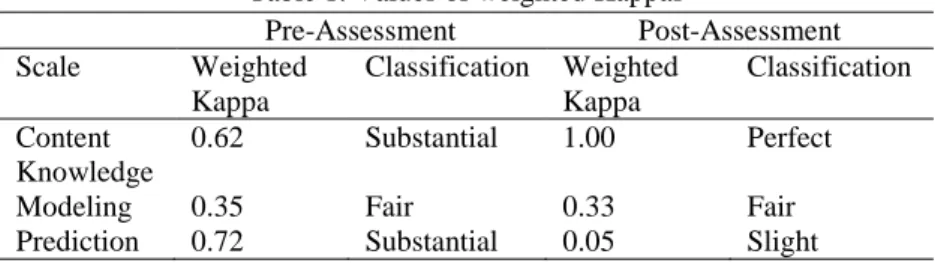
Each preservice teacher’s response was independently scored by two science educators. The most common measure of inter-rater reliability is Cohen’s Kappa. However, Cohen’s Kappa measures the agreement between scorers for categorical data, and must be weighted to account for data that is ordinal. Thus, weighted Kappas were calculated for each of the three scales (content, modeling, and prediction) for both the pre- and post-assessments. As the results show (in Table 1), the weighted Kappas varied from 0.05 to 1.00. Using Landis and Koch’s (1977) classification for inter-rater reliability using Kappas, one scale resulted in slight reliability, two scales resulted in fair reliability, two scales resulted in substantial reliability, and one scale resulted in perfect reliability.
Table 1. Values of weighted Kappas
In cases in which the two scores did not match, the two scores were averaged to arrive at a single score for each subject and scale. These scores were used in the analyses described below. The means and standard deviations for these scores are shown in Table 2.
Table 2. Means and standard deviations of scores for IMB (n=22) and control (n=23) groups
Note:Standard deviations are given in parentheses
To provide evidence of the construct validity of the instrument, we analyzed whether differences existed between the two groups of preservice teachers. The preservice teachers using the IMB approach participated in workshops about the process of model building and practiced their model building via conducting formative assessment interviews over the course of their twelve-week field experience. Thus, by showing that differences existed between the two groups on the post-assessment (but not the pre-assessment), we can argue that the instrument is measuring the scales that we intended. We measured these differences using Chi-Square Contingency tables. The results of these analyses are shown in Table 3. Although there were no significant differences between the two groups on the pre-assessment, there was a significant difference on the modeling score between the two groups. Given that the mean of the IMB group was higher than the mean for the control group, we conjecture that this instrument provides a legitimate way of measuring the types of processes we intend.
Pre-Assessment Post-Assessment
Scale Weighted
Kappa
Classification Weighted Kappa
Classification Content
Knowledge
0.62 Substantial 1.00 Perfect
Modeling 0.35 Fair 0.33 Fair
Prediction 0.72 Substantial 0.05 Slight
Pre-Assessment Post-Assessment
Scale IMB Control IMB Control
Table 3. Results of chi-squared comparisons of IMB (n=22) and control (n=23) groups
*: IMB group was significantly different at p < 0.05
By examining the scale associations, we can determine whether the scales correlate as we would expect. Research has found that teachers’ knowledge of scientific content directly impacts teachers’ instructional decisions (Carlson, as cited in Abell, 2007), their ability to ask higher level questions and detect student misconceptions (Hashweh, as cited in Abell, 2007), and influences how they teach science (Gess-Newsome & Lederman, as cited in Abell, 2007). We also hypothesized that a preservice teachers’ ability to construct a model of the student’s scientific thinking and their ability to form a reasonable prediction of the student’s response would be correlated. We used two common measures of association for ordinal variables: Somer’s d and Gamma. We hypothesized that the interaction between content knowledge and the other two scales would be asymmetrical (directional), so we measured the association using the Somer’s d statistic to measure these associations. The Gamma statistic was used to measure the association between modeling and prediction. The results of these analyses are shown in Table 4. Content knowledge and modeling were slightly correlated (although negatively) on the pre- assessment. Positive correlations were shown between modeling and prediction on both the pre- and post-assessments. This suggests that a students’ ability to form models of students’ thinking and their ability to predict students’ future responses are related. Although the other three interactions did not produce significant associations, it is important to point out that there was very little variation in the scores for content knowledge, especially on the post-assessment in which only one preservice teacher responded to the question incorrectly.
Table 4. Scale interactions
*Significance at p < 0.10 ** Significance at p < 0.05
Preservice Teachers’ Prediction of Scientific Reasoning
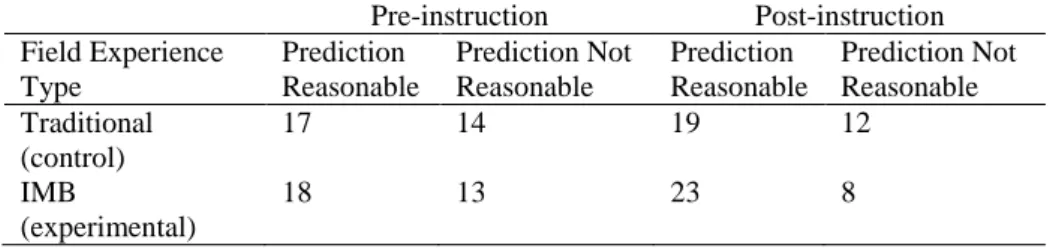
In this section we present the kinds of predictions of scientific reasoning that the preservice teachers made. We report results pre- and post- instruction, as well as by field experience type (traditional and IMB approach). We used the PAs in Appendix A to explore the preservice teachers’ predictions of scientific reasoning. We initially tabulated the number of reasonable predictions prior to and following instruction (see Table 5) and then identified themes of types of predictions of scientific reasoning reported in the sections below.
Table 5. Preservice teachers with reasonable predictions pre/post instruction
Preservice Teachers’ Predictions of Scientific Reasoning Prior to Instruction
Both the traditional and IMB field experience groups had similar predictions about Jeffrey’s reasoning prior to instruction in the science methods course. Of the preservice teachers who held reasonable predictions, about half (ten from IMB and 11 from the traditional field experience course) believed that Jeffrey would think that the scientist (―bird lady‖) would make more observations and collect more data to determine the relationship
Scale Pre-Assessment Post-Assessment
Content Knowledge 4.223 (p = 0.121) 1.069 (p = 0.301) Modeling 7.767 (p = 0.100) 11.958* (p = 0.003) Prediction 7.951 (p = 0.159) 3.208 (p = 0.361)
Scale Pre-Assessment Post-Assessment
Content Knowledge – Modeling (Somer’s d) -0.372** 0.636 Content Knowledge – Prediction (Somer’s d) -0.032 0.273
Modeling- Prediction (Gamma) 0.488** 0.400*
Pre-instruction Post-instruction Field Experience
Type
Prediction Reasonable
Prediction Not Reasonable
Prediction Reasonable
Prediction Not Reasonable Traditional
(control)
17 14 19 12
IMB
(experimental)
between bird beak and the type of food the birds would eat. For example, one student from the traditional field experience class stated:
Watch the birds to see what they eat because [Jeffrey] kept making connections with food sizes and shapes and their relationship to beak size (pre instruction, traditional).
It is clear from the statement that the preservice teacher not only had a reasonable prediction of Jeffrey’s scientific knowledge, but also based it on listening to Jeffrey discussing how scientists make claims. Similarly, a preservice teacher from the IMB field experience group stated:
I think Jeffrey will say something about her ―collecting data‖ to try and figure it out because he said before that scientists use resources and data to help them (pre instruction, IMB).
Again, the preservice teacher makes a reasonable prediction and is also able to substantiate it through her interpretation and focus on Jeffrey’s discussion about scientists. In both examples, the preservice teachers showed their understandings and abilities to predict Jeffrey’s scientific reasoning based on listening to him discuss his views about scientists.
In both field experience groups there were several preservice teachers who were unable to make reasonable predictions based on Jeffrey’s scientific reasoning. Though Jeffrey never mentioned experimentation in his discussion of how scientists make claims, three preservice teachers in each course predicted that Jeffrey would say that scientists would design an experiment as the examples below illustrate:
She should compile her questions, design an experiment, get data and evidence and make an educated guess or conclusion on which birds each which seeds (pre instruction, traditional).
She should experiment with the seeds and see why the birds only go to that seed. Put the two seeds out and experiment what bird goes to what seed (pre instruction, IMB).
It seems from the previous two predictions that the preservice teachers were not basing their predictions upon the discussions that Jeffery was sharing about his views of scientists, but perhaps were actually sharing their own ideas about what the ―bird lady‖ should do. Neither example discussed their predictions in light of Jeffrey’s reasoning, as evidenced because they did not reference any of Jeffrey’s statements as evidence of his thinking. Similar responses were provided by other preservice teachers who did not provide reasonable predictions of Jeffrey’s scientific thinking. These preservice teachers were able to make a statement of what they thought would be a reasonable way that the ―bird lady‖ could determine the answer to her question, but they did not base the statement on Jeffrey’s scientific reasoning, nor did they reference any statements that Jeffrey made.
Preservice Teachers’ Predictions of Scientific Reasoning after Instruction
The prediction assessment that was used to determine preservice teachers’ abilities to make predictions of scientific reasoning can be found in Appendix B. As seen in Table 5, after instruction 19 from the traditional field experience group and 23 from the IMB field experience group made reasonable predictions, while twelve from the traditional and eight from the IMB field experience groups made unreasonable predictions. Of those who made reasonable predictions, thirteen from the traditional group and nineteen from the IMB group stated that Jeffrey would attribute scientists changing their minds about scientific knowledge to the collection of additional evidence. The following representative statements illustrate the preservice teachers’ predictions that Jeffrey would state that scientists would change their interpretations with new evidence:
I think Jeffrey would respond by saying that scientists find evidence that might change their thinking. Example is: Scientists could find bones of an animal, that think is one animal and they have to change their mind. Jeffrey realizes that scientists rely on evidence (post instruction, traditional).
While both preservice teachers indicate a reliance on what Jeffrey thinks, the one from the IMB group provides specific examples, and also mentions that Jeffrey realizes scientists interpret evidence differently and can influence one another. Three other preservice teachers from the IMB group also made the prediction that in addition to obtaining new evidence Jeffrey would believe scientists would think creatively about the evidence and may then change their interpretation. See the statement below as an example of such a response:
I think he will say they change their minds because they share their ideas with each other, they hear someone else’s idea about the evidence, and then maybe agree with that interpretation, and change their mind. That is part of scientific creativity—to think about the evidence and interpret it. They may also collect additional evidence. He did say that scientists could look at the same clouds and think about the clouds differently, and share their ideas with others. That is one reason I think he may believe that others will change their minds about the data after they share ideas (post instruction, IMB group).
None of the preservice teachers in the traditional group predicted Jeffrey would include a reference to scientific creativity in his explanation. However, four of the preservice teachers did predict that Jeffrey would state that scientists change their claims because of technology. For example, on preservice teacher in traditional field experience group simply stated, ―Technology tells them otherwise.‖ Not only does the statement allude to scientists depending on technology for answers, it also does not refer to any of Jeffrey’s discussions about why scientists change their claims. The preservice teacher was again not referencing Jeffrey’s reasoning in her prediction, but simply stating a reason she believed scientists may change their claims.
Of the preservice teachers in both classes who made unreasonable predictions, three from the traditional group and five from the IMB group stated that scientists would change their claims if they were confused or wrong. For example:
He might say that scientists change their mind because they might think it is one thing and then research it and find out they were wrong. Because they get confused when they are looking at an object and make a wrong prediction (post instruction, traditional).
He might say that they looked at something wrong the first time, so then they would have to change it when they have the right information. I think this because in the second question, he shows that he knows, or at least assumes, that something such as clouds, can be seen differently. So I think he will use that same idea to say why scientists change their minds. (post instruction, IMB).
These statements illustrate that though preservice teachers from both groups indicated that scientists would change their minds if they found out they were wrong, the preservice teacher in the IMB group still based her prediction on statements made by Jeffrey. This indicates that the preservice teacher from the IMB group was attending to Jeffrey’s scientific reasoning to make her prediction, despite the fact that her prediction was inaccurate.
Conclusion
While the validity and reliability of the mathematics prediction assessment instrument was established by Norton et al. (2011), here we established the validity and reliability of the science instrument. We believe that we received similar results for both math and science because the notion of the PAs remained the same.
In applying the PAs in the settings (the traditional and IMB field experience sections), we have found in this study there is a slightly better rate of reasonable predictions by those in the IMB section. In addition, those in the IMB group--whether or not their predictions were accurate—still based their predictions on Jeffrey’s scientific reasoning. This result is interesting and important because it indicates that the IMB approach helps preservice teachers both attend to students’ scientific reasoning as well as base their interpretations of student understandings on those reasonings. It is important for teachers of science of any grade level to be able to not only recognize their students’ scientific reasoning, but to base future lessons on that reasoning. In this way students will be better able to conceptualize content as lessons will be based on what they need in order to improve their understandings.
should also explore the elements of IMB that are supportive of developing preservice teachers’ abilities to recognize and use their students’ reasoning. Would this approach for field experience be as effective if any of the elements were removed (e.g. the lesson study section, for example)? Or would using lesson study on its own be equally effective? What is the role of the formative assessment interview, as that interview focuses directly on student ideas and reasoning? Future research can explore these elements.
Recommendations
We suggest a method for evaluating teachers’ understanding of students’ science reasoning and their ability to predict further reasoning. Understanding students’ current conceptions and misconceptions about a topic is essential to foster effective learning (Strauss, 1993). These preconceptions influence how a student continues to learn and should inform teachers about the direction in which to take their instruction (Driver, Guesne, & Tiberghien, 2000). Driver et al. (2000) discuss scientific ―schemes‖ that students create from their previous learning and personal experiences. Teachers must understand these schemes, regardless of their correctness, so that they can best plan the learning experiences of their students. Influenced by this knowledge-in-practice perspective (Cochran-Smith & Lytle, 1999), we believe that to encourage student learning, it is necessary that a teacher learns to identify their students’ conceptual schemes and establish connections between these schemes and new content to be learned.
Acknowledgements
A special thank you to Dr. Rick Hudson and Dr. Anderson Norton for their work on the statistical analyses and to Dr. Enrique Galindo for his support of this project. Support for this project was funded by the National Science Foundation #0732143, Iterative Model Building.
References
Abell, S. K. (2007). Research on science teacher knowledge. In S. K. Abell & N. G. Lederman (Eds.),
Handbook of research on science education (pp. 1105-1150). Mahwah, New Jersey: Lawrence Erlbaum
Associates, Inc., Publishers.
Abell, S. (2008). Twenty years later: Does pedagogical content knowledge remain a useful idea? International Journal of Science Education, 30(10), 1405- 1416.
Anderson, R. D. (2007). Inquiry as on organizing theme for science curricula. In S. K. Abell & N. G. Lederman (Eds.), Handbook of research on science education (pp. 807-830). Oxford, UK: Taylor & Francis. Akerson, V. L., & Donnelly, L. A. (2010). Teaching Nature of Science to K-2 Students: What understandings
can they attain? International Journal of Science Education, 32. 97-124.
Brown, J. S., Collins, A., & Duguid, P. (1989). Situated cognition of learning. Educational Researcher, 18, 32-42.
Cochran-Smith, M., & Lytle, S. (1999). The teacher research movement: A decade later. Educational Researcher, 28(7), 15-25.
Cresswell, J.W. (2003). Research design: Qualitative, quantitative, and mixed methods approaches, second edition. Thousand Oaks, London: Sage.
Donovan, M. S., & Bransford, J. D. (Eds.). (2005). Introduction. In National Research Council, How students learn: Science in the classroom. Washington, DC: National Academies Press, pp. 1-26.
Driver, R., Guesne, E., & Tiberghien, A. (2000). Children’s ideas and the learning of science. In R. Driver, E. Guesne, & A. Tiberghien (Eds.), Children’s idea in science (pp. 1-9). Philadelphia, PA: Open University Press. (Original work published, 1985).
Duschl, R. A., Schweingruber, H. A., & Shouse, A. W. (Eds.). (2006). Taking science to school: Learning and
teaching science in grades K–8. Committee on Science Learning,Kindergarten Through Eight Grade. Board on
Science Education, Center for Education, Division of Behavioral and Social Sciences and Education. Washington, DC: The National Academies Press.
Gagnon, M., & Abell, S. (2007). Perspectives: Making time for science talk. Science and Children, 44(8), 66- 67.
Glasersfeld, E. von, & Steffe, L. (1991). Conceptual models in educational research and practice. Journal of Educational Thought, 25, 91-103.
Landis, J. R., & Koch, G. G. (1977). The measurement of observer agreement for categorical data. Biometrics, 33, 159-174.
Lederman, J. S. (2006). Young children’s views of science. Unpublished manuscript, Illinois Institute of Technology, Chicago, IL.
Lewis, C. C. (2000, April). Lesson study: The core of Japanese professional development. Invited presentation to the Special Interest Group on Research in Mathematics Education at the annual meeting of the American Educational Research Association, New Orleans, LA.
Linn, M. C. (1997). Learning and instruction in science education: Taking advantage of technology. In D. Tobin & B. J. Fraser (Eds.), International handbook of science education (pp. 265-294). Dordrecht, The
Netherlands: Kluwer.
Magnusson, S., Krajcik, J., & Borko, H. (1999). Nature, sources and development of pedagogical content knowledge for science teaching. In J. Gess-Newsome & N.G. Lederman (Eds.), Examining pedagogical content
knowledge: The construct and its implication for science education (pp. 95-132). Boston: Kluwer. McComas, W. (2008). The principal elements of the nature of science: dispelling the myths. Retreived July 13,
2009 from
http://earthweb.ess.washington.edu/roe/Knowability_590/Week2/Myths%20of%20Science.pdf. National Research Council. (2005). How students learn: Science in the classroom. Committee on How
People Learn, A Targeted Report for Teachers, M. S. Donovan and J.D. Bransford, Editors. Division of Behavioral and Social Science and Education. Washington, DC: The National Academies Press.
NGSS Lead States. 2013. Next Generation Science Standards: For States, By States. Washington, DC: The National Academies Press.
Norton, A., McCloskey, A., & Hudson, R. (2011). Prediction Assessments: Using video-based predictions to assess preservice teachers’ knowledge of students’ mathematical reasoning. Journal of Mathematics Teacher Education, 14, 305-325.
Pinnegar, S.E. (1989). Teachers’ knowledge of students and classrooms. Dissertation Abstracts International, 51(01), 0142A (UMI no. 9014676)
Reddy, M., Jacobs, P., McCrohon, C., & Rupert Herrenkohl, L. (1998). Creating scientific communities in the
elementary classroom. Portsmouth, NH: Heinemann.
Shulman, L.S. (1986). Those who understand: Knowledge growth in teaching. Educational Researcher, 15(2), 4-14.
Steffe, L., & Thompson, P.W. (2000). Teaching experiment methodology: Underlying principles and essential elements. In R. Lesh & A.E. Kelly (Eds.), Research design in mathematics and science education (pp. 267-307). Hilllsdale, NJ:Erlbaum.
Strauss, S. (1993). Teacher’s pedagogical content knowledge about children’s minds and learning: Implications for teacher education. Educational Psychologist, 28(3), 279-290.
Van Driel, J., Verloop, N., & DeVos, W. (1998). Developing science teachers’ pedagogical content knowledge.
Journal of Research in Science Teaching, 35, 673-695.
Author Information
Valarie L. Akerson
Indiana University 201 North Rose Avenue Bloomington, IN 47460 USA
Contact e-mail: [email protected]
Ingrid S. Carter
Metropolitan State University of Denver Campus Box 21, P.O. Box 173362 Denver, CO 80217 USA
Meredith A. Park Rogers
Indiana University 201 North Rose Avenue Bloomington, IN 47460 USA
Khemmawadee Pongsanon
Institution for the Promotion of Teaching Science and Technology
Appendix A – Prediction Assessment 1 (pre)
Bird Lady – Thinking about the Design of Scientific Investigations
Part A: Developing an explanation for Jeffrey’s scientific thinking.
In the first chapter of the video Jeffrey is thinking about how scientists develop scientific knowledge in the context of a scientist who explores bird beaks.
As you watch the second chapter consider the following questions and take notes to explain Jeffrey’s reasoning about how this particular scientist investigated the relationship between the bird’s beak and the food they eat.
Please answer the following questions:
1. What does Jeffrey understand is necessary to make an investigation scientific? 2. Does Jeffrey believe all scientific knowledge is developed through experiments? 3. How does he see the role of evidence in the development of scientific knowledge? Part B: Predicting Jeffrey’s scientific thinking
Appendix B - Prediction Assessment 1 (post)
Scientists’ Thinking
Part A: Developing an explanation for Jeffrey’s scientific thinking
In chapter one Jeffrey is thinking about his own ideas about science, and reasoning about whether science may be subjective, tentative, and therefore, can change in the future.
As you watch the second chapter, consider the following questions and take notes to explain Jeffrey’s reasoning about the subjective and tentative nature of science.
How does Jeffrey think people on TV use science to predict the weather?
What does Jeffrey think about why weather reporters disagree about what weather to predict? Does Jeffrey think scientists are creative when they do their work? And what example does he give to
support his opinion?
What does Jeffrey think scientists do or use to help them make their decisions in whatever they are investigating in science?
Part B: Predicting Jeffrey’s Scientific thinking
Appendix C - Prediction Assessment Rubric
Content Knowledge
0: Incorrectly solved the problem 1: Correctly solved the problem
Model
0: Does not use evidence (descriptions of student actions or statements) to describe what or how the student is thinking
1: Uses evidence to support an explanation of what the student knows or thinks, but not how the student is thinking
2: Uses evidence to support an explanation for how the student is thinking
Prediction (Accuracy and Detail)
In case the preservice teacher listed multiple predictions, consider the most accurate prediction.
0: Makes no prediction relevant to the situation
1: Makes an inaccurate prediction with some detail relevant to the situation, but not enough to unambiguously envision what the student might have done or said in response to the task/question
2(a): Makes an inaccurate prediction, but with enough relevant detail to envision what the student might have done or said in response to the task/question
2(b): Makes a prediction that might be correct, but remains too vague to determine
3: Makes an accurate prediction with some detail relevant to the situation, but not enough to unambiguously envision what the student would do or say in response to the task/question
4: Makes an accurate prediction with sufficient detail to envision what the student would do or say in response to the task/question
Use of Model
0: There is no evidence (or there is counter-evidence) that the preservice teacher used an explanation of the students’ thinking (model) to form any of the predictions