R E S E A R C H
Open Access
Quantification of the internalization patterns of
superparamagnetic iron oxide nanoparticles
with opposite charge
Christoph Schweiger
1†, Raimo Hartmann
2†, Feng Zhang
2, Wolfgang J Parak
2, Thomas H Kissel
1and Pilar Rivera_Gil
2*Abstract
Time-resolved quantitative colocalization analysis is a method based on confocal fluorescence microscopy allowing for a sophisticated characterization of nanomaterials with respect to their intracellular trafficking. This technique was applied to relate the internalization patterns of nanoparticlesi.e. superparamagnetic iron oxide nanoparticles with distinct physicochemical characteristics with their uptake mechanism, rate and intracellular fate.
The physicochemical characterization of the nanoparticles showed particles of approximately the same size and shape as well as similar magnetic properties, only differing in charge due to different surface coatings. Incubation of the cells with both nanoparticles resulted in strong differences in the internalization rate and in the intracellular localization depending on the charge. Quantitative and qualitative analysis of nanoparticles-organelle colocalization experiments revealed that positively charged particles were found to enter the cells faster using different
endocytotic pathways than their negative counterparts. Nevertheless, both nanoparticles species were finally enriched inside lysosomal structures and their efficiency in agarose phantom relaxometry experiments was very similar.
This quantitative analysis demonstrates that charge is a key factor influencing the nanoparticle-cell interactions, specially their intracellular accumulation. Despite differences in their physicochemical properties and intracellular distribution, the efficiencies of both nanoparticles as MRI agents were not significantly different.
Keywords:Superparamagnetic iron oxide nanoparticles (SPIONs), Intracellular distribution, Charge, Coating, Size, Quantitative correlation analysis, Colocalization
Background
The interaction of nanomaterials with cells and tissues is a key factor when considering their translation into clin-ical applications. Especially an effective accumulation of nanoparticles (NPs) inside certain tissues is beneficial for a great number of applications, such as hyperthermia, contrast enhancement in magnetic resonance imaging, cell tracking or theranostics [1-7]. Apart from colloidal stability, which is essential to ensure reproducibility as well as to influence the amount of cellular loading and toxicity, the surface chemistry/properties of the NPs
control their cellular interactions [8]. Predominantly size, shape and surface charge of NPs influence their cellular internalization and distribution and thus their effective performance.
The overall uptake rate of nanoparticulate objects and their respective pathway of internalization can be manipulated by surface charge [9-11]. In general, cationic NPs have been found to display excellent prop-erties for tracking applications as they enter cells with higher effectiveness [12] due to the interaction with the negatively charged glycocalix [13]. However, a higher de-gree of toxicity is often associated with these systems [14-17]. Nevertheless, also negatively charged NPs are massively incorporated by cells. In this respect it has to be mentioned that charged NPs strongly interact with serum proteins to form a protein corona [18-21], whose * Correspondence:[email protected]
†Equal contributors
2Biophotonics Group and WZMW, Institute of Physics, Philipps University of
Marburg, Renthof 7, Marburg D 35037, Germany
Full list of author information is available at the end of the article
formation also depends on the NP charge. The rate of NP uptake is important, as insufficient cellular accumu-lation of NPs e.g. magnetic NPs can lead to deficient usage for example as imaging probes [22].
Thus a precise knowledge of their internalization mechanisms, endosomal sorting and resulting intracellular pathways are crucial aspects governing their fate, efficiency or toxicity. So far most of the techniques employed to study NP-cells interactions are based on qualitative ana-lysis; thus being prone to subjectivity or to errors in the in-terpretation of results.
Typically intracellular trafficking is studied using fluores-cence microscopy. By comparing the fluorescent pattern of labeled and internalized NPs with the distribution of cellu-lar organelles possible intracellucellu-lar pathways can be derived for the material. Following endocytic uptake, NPs are gen-erally trapped in vesicular compartments. The detection and imaging of typical proteins associated to those enclosed structures allows their identification and allocation in for example endosomes or lysosomes. If such image material is super-imposed with signal gained for example from labeled NPs, structures associated with NP uptake, transport and processing can be identified. To analyze the uptake and en-richment of NPs inside a certain organelle fluorescent label-ing of both, the nanomaterial and the organelle is typically performed. The uptake study is based on the correlation of the emission of the labeled nanomaterial with fluorescence signal of the organelle. If both structures are colocalizing within the detection volume the overlay of the correspond-ing two fluorescence image channels (for example red and green) would result in a new color value (yellow). In a qualitative manner the degree of colocalization can be esti-mated by looking at the super-imposed image. As a matter of fact, any processing having impact on the image’s histo-gram is influencing the“amount of yellow” in the overlay and altering the subjective impression of the degree of colo-calization. For a sophisticated correlation of the image material of both structures, several approaches to perform a quantitative colocalization analysis exist. In intensity-based methods voxel or pixel intensities in both fluores-cence channels are correlated by calculating for example Pearson’s or Manders’colocalization coefficients [23,24]. In Li’s approach the correlation between the variations of the intensity-distributions within both channels are analyzed [25]. In object-based approaches the imaged structures are transformed into binary objects and the overlap is quanti-fied [24]. In live-cell imaging also methods for trajectory correlation of those binary objects have been introduced [26]. Nevertheless, as long as single nanoparticle detection and tracking is hard to realize by conventional confocal mi-croscopy the relevance of trajectory correlation is quite low, although the results seem to bear good prospects due to the discrimination of false colocalization caused by low axial resolution.
In order to validate our analysis methodology as well as to correlate differences in the physicochemistry of the NPs to different cellular behavior, the NPs were synthe-sized according to different protocols to produce NPs with different physicochemical properties. Especially sur-face chemistry and thus an opposite charge was selected on purpose, to influence the internalization rates of the NPs and thus proof our methodology. Due to the differ-ent synthetic protocols used, the colloidal stability and the size distribution of both NPs were also altered. According to their great potential in biomedical applica-tions [6,7,27,28], superparamagnetic iron oxide NPs (SPIONs) were selected as systems to investigate NP internalization patterns; firstly qualitativelyviaflow cyto-metry (Fluorescence-Activated Cell Sorting, FACS) and Confocal Laser Scanning Microscopy (CLSM) and then by quantitative correlation analysis. Additionally, possible alterations in the relaxation times in A549 lung carcin-oma cells were quantitatively evaluated.
Results
Water-soluble SPIONs were synthesized eitherviaaqueous coprecipitation [29] or via thermal decomposition of or-ganometallic precursor molecules with subsequent phase transfer to aqueous solution [30-32]. Both methods lead to hydrophilic NPs suitable for biomedical applications.
The different synthesis strategies for formation ofγ-Fe2O3
NPs clearly had an impact on the resulting NP morphology. Inorganic cores generated by aqueous co-precipitation fol-lowing Massart’s protocol [29] were found to be inhomogen-ously spherically-shaped. Those coming from thermal decomposition of organometallic precursor molecules in or-ganic solvent had homogenous, almost spherical shape and better size distribution. Analysis of the Fe2O3core diameters
(i.e. the inorganic Fe2O3 part without the organic surface
coating) on transmission electron microscopy (TEM) micro-graphs revealed mean diameters of 10.4 ± 2.4 nm and 10.8 ± 0.12 nm for the synthesis performed in aqueous and organic solution, respectively (see Additional file 1: Figure SI-1.c in the SI). Adsorptive attachment of poly(ethylene imine) (PEI) to stabilize the NPs in solution completed the synthesis of positively charged γ-Fe2O3-PEI NPs. In contrast,
hydro-phobic interaction via intercalation of polymer (poly(iso-butylene-alt-maleic anhydride), PMA) strands between surfactant alkyl chains formed the final step in producing hydrophilic negatively chargedγ-Fe2O3-PMA NPs [33]. It is
important to point out that coupling PEI to theγ-Fe2O3NPs
turned out to be essential to stabilize the NPs generated by aqueous co-precipitation in solution. The absence of PEI led
to strong agglomeration, making some kind of
characterization procedure of the NPs (cf. Additional file 1: Figure SI-1.f) difficult. Hydrodynamic diameters for the two polymer-modified formulations, γ-Fe2O3-PEI and γ-Fe2O3
ultrapure water amounted to 16 ± 5 nm and 22 ± 7 nm, re-spectively (cf. Table 1). Both types of NP suspensions exhib-ited unimodal size distributions and zeta potentials of comparable absolute value, in numbers +53 ± 11 mV forγ -Fe2O3-PEI and−38 ± 6 mV forγ-Fe2O3-PMA (cf. Table 1).
The impact of the preparation technology on magnetic features of the samples was investigated by monitoring the field-dependent magnetization with a SQUID (Supercon-ducting QUantum Interference Device) system (cf. Table 1 and Additional file 1: Figure SI-2). All recorded curves showed lack of remanence and typical sigmoidal character-istics. The reader is referred to the SI (Additional file 1:} SI-1 and}SI-2) for a detailed description of the synthesis and physicochemical characterization of both NP formulations.
When incubating the lung carcinoma cell line A549 with fluorophore-bearingγ-Fe2O3NPs, different uptake patterns
were qualitatively observed for the two species. First of all it has to be remarked that due to a significant inferior col-loidal stability of γ-Fe2O3-PEI-FITC NPs in growth
medium (10 % serum-containing media) compared toγ-Fe
2O3-PMA-Dy636 NPs it turned essential to establish a
suit-able exposure NP dose as well as the composition of the cell media, in which both NP systems had sufficient col-loidal stability. An iron ([Fe]) concentration of 1μg/ml in a 5 % serum-containing media turned out to be a good com-promise between agglomeration, cell survival, and optical detection. Higher concentrations gave a better fluores-cence signal (due to the fluorophores in the NP shell) but, in the case ofγ-Fe2O3-PEI-FITC NPs suffered from strong
agglomeration problems. NPs at lower concentrations were difficult to detect optically (cf. Additional file 1: Figure SI-6.a.i). It has to be pointed out that the concentra-tions are not absolutely comparable in terms of NPs per volume, as the mass comprises besides the inorganic Fe2O3cores also the organic coating around their surface,
which is different for both types of preparations. The quantity of serum proteins had to be lowered from 10 % (corresponding to the normal A549 growth media) to 5 % (cf. Additional file 1: Figure SI-6.a.ii and SI-6.a.iii). After having established the cell culture and NP incubation con-ditions the uptake of both formulations was studied with FACS and with CLSM. Positively γ-Fe2O3-PEI-FITC and
negatively γ-Fe2O3-PMA-Dy636 charged NPs were
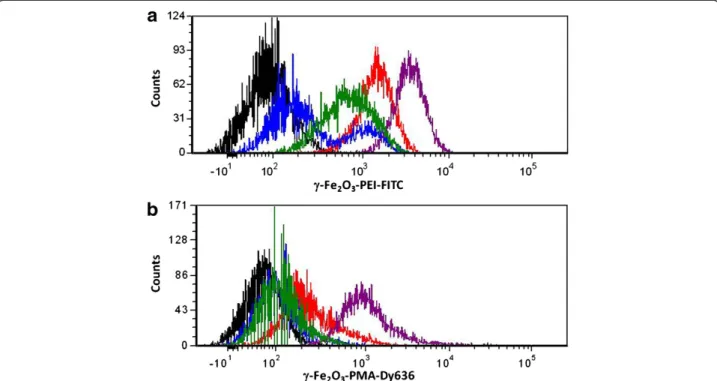
inter-nalized in a steady manner over the examined period of 24 hours. Nevertheless, the uptake ofγ-Fe2O3-PEI-FITC NPs
was taking place to an extent of about 40% within the first 4 h after incubation (cf. Figure 1). In contrast to that,γ-Fe
2O3-PMA-Dy636 NPs were found to accumulate in cells
only to a small extent within the first hours. The major fraction of these NPs was incorporated between time points 4 and 24 hours (cf. Figure 1), mostly after 8 h (cf. Additional file 1: Figure SI-6.b). Single-peaked mean fluor-escence intensity signals indicated that there were no cell population subsets with lower degrees of NP incorpor-ation. Incubation of the cells under the same circum-stances as for FACS measurements and characterization by CLSM confirmed these results (cf. Additional file 1: Figure SI-6.b.i). Interestingly, negatively charged γ-Fe2O3
-PMA-Dy636 NPs were faster incorporated by the cells in the presence of positively chargedγ-Fe2O3-PEI-FITC NPs
(cf. Additional file 1: Figure SI-6.b.i and SI-6.b.vi). These results suggest that upon concomitant incubation, com-plexes from positively and negatively charged NP were formed due to electrostatic interaction, finally leading to an increase in the uptake rate of the negatively charged NPs.
The impact of different charge and surface coating of both NP carriers on their intracellular pathways was ana-lyzed by CLSM. For this purpose A549 cells, which were exposed to both NPs for different periods of time (indi-vidually or concomitantly) were stained for different organelles i.e. early endosomes, lysosomes, actin cyto-skeleton and the plasma membrane (cf. Additional file 1: SI-6.b). Figure 2 shows the results of the intracellular localization of the NP complexes, whereby positively and negatively NPs were added simultaneously to the cells. In addition, the colocalization of each NP carrier with the different organelles upon time can be seen in Additional file 1: Figure SI-6.b. After 30 min the first fluorescent signal ofγ-Fe2O3-PEI-FITC NPs was
detect-able. However theγ-Fe2O3-PMA-Dy636 NPs were firstly
visualized after 60 min. Interestingly, at this early time points negatively charged γ-Fe2O3-PMA-Dy636 NPs
clearly colocalized spatially with early endosomes near to the plasma membrane, whereas the positively charged counterparts,γ-Fe2O3-PEI-FITC NPs, were not found
in-side the endosomes. The endosomes migrate towards lysosomal structures wherein the first NPs were detect-able after approximately 4–8 hours. After 24 h most of the NPs γ-Fe2O3-PEI-FITC as well as γ-Fe2O3
-PMA-Dy636 were found inside the lysosomes. One can specu-late that the absence of γ-Fe2O3-PEI-FITC NPs in the
endosomes is due to the presence of PEI, which might manage to transfer the NPs out of the endosomes due to the proton-sponge effect [34]. In this case the NPs
Table 1 Physicochemical parameters of SPIONs as used in this work
hydrodynamic diameter [nm] polydispersity index zeta potential [mV] saturation magnetization [emu g-1]
γ-Fe2O3-PEI 16.2 ± 5.4 0.144 ± 0.019 +53.2 ± 11.0 23.7
should be found free in the cytosol of the cell. To con-firm this assumption, the actin cytoskeleton was stained and the possible colocalization of the free NPs was stud-ied. As can be seen in Figure 2 (see also Additional file 1: Figure SI-6.b.vii),γ-Fe2O3-PEI-FITC NPs were not found
at detectable level in the cytosol of the cells. As expected
γ-Fe2O3-PMA-Dy636 NPs were also not found there but
rather inside vesicular structures as their counterparts,
γ-Fe2O3-PEI-FITC NPs did.
Colocalization studiesvia CLSM images without further data treatment are merely qualitative in nature so that dif-ferent labeling efficiencies of the two NP systems as well as the different optical properties of the fluorophores conju-gated to the NPs can induce erroneous interpretations. In order to get absolute comparability between the intracellular localization ofγ-Fe2O3-PEI-FITC andγ-Fe2O3-PMA-Dy636
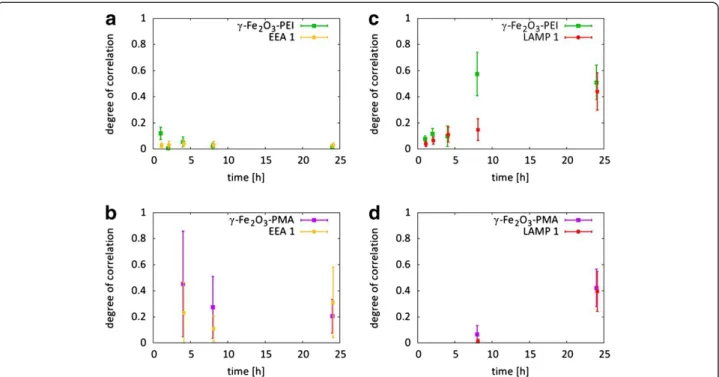
NPs a quantitative colocalization analysis of both NPs with the different organelles was performed upon time (cf. Meth-ods and Supporting Information) [35]. As can be seen in Figure 3, the results confirmed the qualitative analysis by looking at the overlay of the different fluorescence channels (cf. Figure 2). Immediately after addition of the NPs to the cells, γ-Fe2O3-PEI-FITC NPs did not colocalize with the
endosomes (cf. Figure 3.a) though in contrast γ-Fe2O3
-PMA-Dy636 NPs did to some extend (cf. Figure 3.b). Ap-proximately 45 % of allγ-Fe2O3-PMA-Dy636 NP signal was
overlapping with the endosomes but only 22 % of endosome
signal was overlapping with the NPs at 4 h incubation time. At later points of time both NP types were found in the lysosomes (cf. Figure 3.c and 3.d). A significant fraction of
γ-Fe2O3-PEI-FITC NPs colocalized with lysosomal
struc-tures after 8 h incubation time, but quite few lysosomes contained NPs. Interestingly, the analysis suggests that at early incubation times some γ-Fe2O3-PEI-FITC NPs were
already in the lysosomes. After 24 h incubation time, a large fraction of γ-Fe2O3-PEI-FITC and γ-Fe2O3-PMA-Dy636
NPs colocalized with the lysosomes and a large fraction of lysosomes were containing NPs of both nature.
Finally, the impact of different charge and surface coat-ings of both NP carriers on their magnetic properties was studied. Relaxation parameters were gathered for agarose phantoms containing either freely dispersed NPs (γ-Fe2O3
-PEI-FITC or γ-Fe2O3-PMA-Dy636) or cells loaded with
certain amounts of SPIONs following incubation. Para-meters of manufactured phantoms containing doped cells were dependent on the effective amounts of iron per cell. As expected, A549 incubation with high iron molarities caused non-proportional enhancement of intracellular ac-cumulation. For γ-Fe2O3-PEI-FITC NPs, maximum
incu-bation with a total of 100μg [Fe] (as determined with ICP-OES) for instance led to intracellular iron levels of 6.9 pg per cell and subsequent relaxation rates R2* of 23.0 s-1,
where R2* is indicative of absolute proton relaxation and
signal darkening level. An identical application scheme of
γ-Fe2O3-PMA-Dy636 NPs resulted in values of 1.4 pg per
cell and R2* of 8.2 s-1. In comparison to that, relaxation
rates R2* reached 140 s-1and 134 s-1for freely dispersed
PEI-FITC and PMA-Dy636 NPs at equal “incubation” levels (data not shown). Despite the discrepancy in abso-lute R2* numbers, the efficiency of both SPION set-ups
in reducing transverse relaxation times, often denoted as relaxivity r2*, turned out to be almost equivalent as
derived from comparison of the slopes of the best-fit lines: 1.70μM-1s-1and 1.72μM-1s-1for freely dispersed PEI-FITC and PMA-Dy636 NPs (data not shown), 1.61μM-1s-1and 1.58 μM-1s-1for cell containing PEI-FITC and PMA-Dy636 NPs, respectively (cf. Figure 4).
Discussion
Several models are reported concerning the internalization of differently charged SPIONs [36]. However, only little
efforts have been made so far to directly compare NP sys-tems of equal dimensions and opposite charge with re-spect to their cellular uptake rate and intracellular fate. Especially a profound quantification of the colocalization of the NPs with different cellular structures is missing. Consequently, our approach consisted in eliminating size and shape as a key factor for NP uptake by keeping the dimensions of the two formulations constant. We hypothesized that, under these circumstances, the invasion into cells was predominantly dependent on the surface properties provided by the polymer coating,i.e. surface po-tential and the colloidal stability of incubated carriers.
Firstly, the synthesis strategy seems to affect the mag-netic properties of the fabricated SPIONs. It is well-known that magnetization of inorganic colloids is determined pri-marily by their crystal diameter [37]. The results from TEM statistical analysis display a number-weighted and
Figure 2Intracellular localization of SPIONs.Cells were incubated concomitantly with both SPIONs (γ-Fe2O3-PEI-FITC andγ-Fe2O3-PMA-Dy636)
therefore one-dimensional quantity (cf. the TEM data in Additional file 1: Figure SI-1.c). As the magnetic moment of nanoparticles depends on their volume, the relative con-tribution of particles with larger size to the overall magnetization is higher. A mathematical approximation of
a volume-weighted mean for both samples gave values of 11.5 nm each. Since mean diameters are virtually equal, we speculate that microstructural features of the magnetic cores are responsible for the different saturation magnetizations. On the one hand, the crystalline domains in the γ-Fe2O3
-PMA NPs might be smaller than those in theγ-Fe2O3-PEI
NPs. Another explanation for the differing Msatvalues might
be the existence of a magnetically dead layer on the maghe-mite surface which does not contribute to the collective magnetic moment ofγ-Fe2O3NPs. The general reduction in
magnetization with respect to bulk maghemite can be attrib-uted to several mechanisms such as spin canting or spin-glass-like behavior of the surface spins, both of them being effects which become more and more important with de-creasing particle size [38,39]. Polymer shielding of the naked Fe2O3cores induced further lowering of gram-standardized
saturation magnetizations, which becomes logical as the or-ganic material does not add to the magnetic properties of the respective particle systems. As already pointed out, direct mass-correlated comparison of both types of NPs is compli-cated due to the fact that they have different surface coatings and thus mass contributions of organic material. Moreover, organic ligands used to stabilize SPIONs might lead to quenching of surface magnetic moments [40]. The sigmoidal curves displayed in the SI (Additional file 1:}2) are indicative for superparamagnetism of both γ-Fe2O3-PEI andγ-Fe2O3
-PMA NPs. This feature is not only beneficial due to the availability of giant magnetic moments, but also due to the
Figure 3Quantification of colocalization.Manders’coefficients M1and M2represent the correlation between the intracellular locations of
γ-Fe2O3-PEI (green) andγ-Fe2O3-PMA (pink) with early endosomes (yellow) and lysosomes (red), respectively.
Figure 4Relaxation rates R2* of agarose phantoms containing
105cells doped with SPIONs.Data points represent intracellular iron levels after incubation with increasing amounts ofγ-Fe2O3-PEI
reduction in agglomeration tendency which is attributable to complete paramagnet-like loss of magnetization at zero ex-ternal fields.
Secondly, differences in the charge of the NPs clearly affected their intracellular internalization route, rate and distribution. This statement was achieved by combin-ation of the results obtained FACS and with CLSM followed by a time resolved quantitative analysis of the internalization patterns of both NP types. The conclu-sions drawn by eye-based interpretation of superim-posed, fluorescent images presenting the distribution of NPs and certain cellular structures are strongly biased by any acquisition parameters and image processing. For a first impression or a proof of principle this method may be sufficient but the generalization of any observation has to be not taken literally. The averaging over colocali-zation data of several individual experiments and the im-aging of various cells for each data point is needed. For quantification, the described procedure of time-resolved colocalization analysis is a well suited tool that certainly helps to retrace NP internalization in a reproducible manner.
The saturable, steady, but non-linear uptake pattern of positively chargedγ-Fe2O3-PEI NPs strongly suggests
ad-sorptive endocytosis as the main mechanism of cell up-take. This is supported by the fact that electrostatic interaction between the positively charged NPs and the negatively charged glycocalix certainly favors fast attach-ment to the cell membrane and subsequent ingestion of cationic species. It also goes along with the fact that the colloidal stability of theγ-Fe2O3-PEI NPs is limited.
Fur-thermore, it has to be noted that positively charged NPs have been reported to interact differently with serum proteins at physiological pH than negatively charged NPs [21]. Different protein coronas are likely to influence cellular uptake. Finally, from the CLSM images of the cells incubated with positiveγ-Fe2O3-PEI NPs over time and over different
concentrations (cf. Additional file 1: Figure SI-6) it can be observed that accumulation of the positively charged NPs in the extracellular side of the cell membrane plays a key role, not only on the adsorption to the cell membrane (as com-mented before) but also on the fast rate of internalization. It appears that uptake of the positively charged NPs occurred only after membrane accumulation of the NPs, thus directly related to a specific NP concentration. These results sug-gested that there might be a concentration threshold respon-sible for the fast internalization as it happens for zwitterionic NPs [41]. Above the threshold NPs are rapidly internalized, however below this threshold NPs should be less efficiently internalized. Thus special attention should be paid to this insight. On the other hand, negatively charged γ-Fe2O3
-PMA NPs seem to follow common endocytic internalization processes and even receptor-mediated endocytosis cannot be excluded. The uptake was steady and constant over time
and more important, it was independent from membrane accumulation, thus excluding unnecessary thresholds. Fur-thermore, the negatively charged NPs strongly interact with serum proteins leading to the formation of a protein corona around the surface of the NPs [19-21]. Many of these proteins have specific ways of cellular entry. For ex-ample transferrin, which has been demonstrated to adsorb to the surface of negatively charged PMA-coated NPs [42] is well known to internalize via receptor-mediated endo-cytosis [43]. In this way, the uptake of these NPs may be controlled by the protein corona.
Sufficient and fast loading of certain cell types with SPIONs is for example desired for tracking purposes via magnetic resonance imaging [44]. The reason for this is the concentration-dependent enhancement of transverse pro-ton relaxation in the vicinity of areas containing magnetic iron oxide NPs, thus leading to quick fading of MR signals and gain of contrast in T2-weighted images [45]. Based on
the quantification of the intracellular iron concentrationvia ICP-OES (cf. Additional file 1: Figure SI-5), γ-Fe2O3-PEI
NPs accumulate to a higher degree inside the cells com-pared to the negative γ-Fe2O3-PMA NPs. Thus γ-Fe2O3
-PEI NPs should perform better than their anionic counter-part when being used for cell tracking tasks. However, it has to be pointed out that despite an optimization of the cell culture media and NP dose (i.e. reduced serum quantity as well as adequate NP dose) to increase the stability of the
γ-Fe2O3-PEI-FITC NPs, agglomeration was still observed
for this formulation and the agglomerates were strongly attached to the cell membrane (cf. Additional file 1: Figure SI-6.a.ii and SI-6.a.iii). Trypsinization of the cells did not re-move the agglomerates ofγ-Fe2O3-PEI-FITC NPs attached
to the cell membrane and thus signal could also result from
γ-Fe2O3-PEI-FITC NPs only adherent to the outer cell
membrane.
Finally, as an alternative way for probing the efficiency of both types of NPs as contrast agents for MRI, agarose phantoms containing NP-labeled cancer cells were subjected to MR measurement sequences. Phantom matrices act as versatile human tissue equivalents, as alteration of their basic composition allows for the imita-tion of specific intracorporal regions and appendant relaxation properties [46]. Most effective signal darken-ing in T2-weighted MRI maps, denoted as high absolute
relaxation rate values R2*, was observed for freely
dispersed NPs and, to a lower extent, cell dispersions carrying large amounts of γ-Fe2O3-PEI NPs. As a more
reliant measure of proton relaxation yield/efficiency, transversal relaxivity r2* values were calculated by
normalization of the results to the iron concentration. The differences in relaxivity r2* between freely dispersed
cells or cell organelles. Thus, besides concentration of magnetic materials as the main factor for signal improve-ment, intracellular confinement plays a second, yet sub-ordinate role in this context and has an impact on the detected proton relaxation times [47]. Coming back to the magnetization properties of the tested NP formula-tions, we predicted higher molar relaxivities for the sys-tem γ-Fe2O3-PEI due to enhanced magnetic interactions
with surrounding proton spins. Surprisingly, the efficien-cies of both tested NP formulations were found to be in the same range.
Conclusions
The physicochemical properties of the generated NPs (mainly charge and colloidal stability) were found to be a key factor governing the internalization into cells. The internalization patterns (i.e. uptake rates and intra-cellular localization) of SPIONs synthesized either dir-ectly in water or in organic solutions and with opposite charged, were completely different. The use of qualitative techniques like FACS and CLSM give inter-esting initial information in this regard however, a quantitative analysis is crucial to make statistically rele-vant conclusions. By real time quantitative correlation analysis the kinetic of NP internalization could be elu-cidated. Negatively charged SPIONs were found firstly in endosomes and lately in lysosomes whereas posi-tively charged SPIONs were found exclusively inside lysosomes. Interestingly, not all the involved vesicles were found to be colocalizing with the NPs all over the time. Thus, elucidating dynamics in NPs trafficking inside the cells depending on their charge.
Methods
For a detailed description of the experimental procedure as well as for other additional experiments, the reader is referred to the supporting information (Additional file 1).
Nanoparticle synthesis
γ-Fe2O3 NPs were prepared following standard protocols
since the acquirement of exact information about the crystalline structures of these kind of NPs is very contro-versial [48]. γ-Fe2O3 NPs were synthesized either via
aqueous coprecipitation, according to the Massart proto-col [29] or viathermal decomposition of organometallic precursor molecules following a published protocol by Hyeon and co-workers [30].
Physicochemical characterization
Hydrodynamic diameters andζ-potentials of hydrophilic NPs after polymer functionalization were assessed by dynamic light scattering (DLS). For magnetization studies, the lyophilized NP materials were placed into a
Magnetic Property Measurement System MPMSW
equipped with a 5 T magnet (Quantum Design, San Diego, CA) using superconducting quantum interfer-ence device (SQUID) technology.
Cell culture and uptake studies
The human lung adenocarcinoma cell line A549 was maintained in Dulbecco’s Modified Eagle Medium (DMEM) supplemented with 10 % serum. The uptake kinetics was analyzed with (1) flow cytometry and (2) CLSM. For (1), some cells were incubated with either
γ-Fe2O3-PEI-FITC or with γ-Fe2O3-PMA-Dy636 NPs at
Quantitative analysis of colocalization studies
The intracellular distributions of both nanoparticle species were correlated with the locations of early endo-somes and lysoendo-somes over time to study the intracellular trafficking of both systems (see Additional file 1: SI, }7). Therefore, A549 adenocarcinoma cells were incubated with either γ-Fe2O3-PEI-FITC or with γ-Fe2O3
-PMA-Dy636 NPs at fixed iron concentrations (1μg/ml) for dif-ferent periods of time followed by an immunostaining of either early endosomes or lysosomes, performed as described above. For each of the combinations given in Additional file 1: SI, }7, Table 1 at least 20 cells were imaged using a highly corrected CLSM. The degree of colocalization of fluorescence signal originating from nanoparticles and labeled endosomes (EEA1) or lysosomes (LAMP1) was quantified by calculating Manders’ distinct colocalization coefficients M1 and M2 for the confocal
image material: M1¼∑R∑iRi;coloc∈½0;1andM2¼∑G∑iGi;coloc∈½0;1
Riand Giare the pixel intensities of pixel i in channel R
(nanoparticles) and G (endosomes or lysosomes).“coloc” are pixels in which colocalization was observed. In our calculations M1 represents the degree of colocalization
of fluorescence signal from one nanoparticle species with signal coming either from stained endosomes or lyso-somes while M2 covers the situation with regard to the
organelles. An image providing a high value of M1 but a
low value for M2 can be interpreted as follows: Most of
the detected particles are present in the particular cellu-lar compartments but the cellu-largest fraction of these orga-nelles is not including nanoparticles anyhow.
Agarose phantom relaxometry
A549 cells were plated at a density of 100,000 cells per well and were incubated with suspensions of SPIONs of differ-ent typesγ-Fe2O3-PEI andγ-Fe2O3-PMA) and
concentra-tions (1, 10, 30 and 50 μg/ml) for 24 hours. After PBS washing and trypsinization, cell numbers were counted using a Neubauer chamber. Quantification of cell-internalized iron was realized by ICP-OES after cell lysis in concentrated nitric acid (600μl) for 4 hours. Phantoms for MR relaxometry were produced by dispersing 105 SPION-doped A549 cells in agarose (1 % w/v). Magnetic resonance (MR) imaging studies concerning the T2 and T2*
relax-ation times of the respective phantoms were carried out on a 7 T Bruker ClinScan 70/30 USR (Bruker BioSpin, Rheinstetten, Germany). For measurements of transverse T2 relaxation times, spin-echo multicontrast sequences
were run at TRvalues of 2000 ms, varying spin echo times
TE(10–120 ms with an increment of 10 ms), field of view
75x75 mm, matrix 128x128 and slice thickness 0.6 mm. Data quantification was achieved by evaluating such cre-ated DICOM images. Relaxation times T2could be derived
by analyzing regions of interest (ROI) within T2 maps
generated by the overlay of successive spin-echo images, using a monoexponential fitting of the signal intensity (I) decay curve: I(t) = I0exp(−t/T2), where I0is the signal
mag-nitude at equilibrium and t the particular echo time. Effective transverse relaxation times (T2*) were calculated
from T2*-weighted images taken with the following
set-tings: gradient-echo multicontrast with TR= 350 ms,
mul-tiple spin echo times TE (3–32 ms), field of view 89x89
mm, matrix 128x128, slice thickness 0.5 mm. T2* values
were obtained correspondingly by fitting the MRI signal intensities of the acquired maps versus echo times TE.
Additional file
Additional file 1:Supporting Information.
Competing interests
We (the authors) wish to confirm that there are no known conflicts of interest associated with this publication and there has been no significant financial support for this work that could have influenced its outcome.
Authors’contributions
The concept was designed by WJP, THK, and PRG. Experiments and data analysis were performed by CS, RH, FZ, and PRG. All authors read and approved the final manuscript.
Authors’information
Dr. C. Schweiger studied Pharmacy and obtained his PhD under the supervision of Prof. Dr. T. H. Kissel in the Department of Pharmaceutical technology in the Philipps University of Marburg.
R. Hartmann studied Physics at the University of Marburg and is currently doing his PhD under the supervision of Dr. P. Rivera Gil and Prof. Dr. W. J. Parak.
Dr. F. Zhang received his bachelor degree in 2000 from Biology School of Inner Mongolia University and his Ph. D degree in 2006 from Shanghai Institute of Applied Physics, Chinese Academy of Sciences. After a postdoctoral stay in the group of Prof. Dr. W. J. Parak in the University of Marburg, Dr Zhang moved as a senior research fellow to Washington University (Bioengineering Dep.). He is currently employed as a professor and a Ph.D advisor in Biology School in Inner Mongolia Agricultural University. Prof. Dr. W. J. Parak obtained his PhD in biophysics at the Ludwig Maximilians Universität München, Germany in 1999 in the group of Prof. Dr. Hermann Gaub. After a postdoctoral stay at the University of California, Berkeley, CA, USA in the group of Prof. Dr. Paul Alivisatos he returned 2002 to Munich as Assistant Professor. Since 2007 he is Full Professor at the Physics Department of the Philipps Universität Marburg, Germany.
Prof. Dr. T. H. Kissel is currently retired. Until August 2012, he was Professor of Pharmaceutics & Biopharmacy and Department Head at Philipps-Universität Marburg, Germany, where he has been since 1991. He received his B.S. (Pharmacy) from Freiburg University (1971), his M. S. (Chemistry, 1974) and his Ph.D. (Medicinal Chemistry, 1976) from Marburg University.
Dr. P. Rivera Gil studied Pharmacy in Spain and obtained her PhD in Pharmacology at the Free University Berlin. She is currently a senior researcher in the group of Prof. Dr. W. J. Parak.
Acknowledgment
The authors thank Eva Mohr, Department of Pharmaceutics and Biopharmacy, Marburg, Germany for assistance in the cell culture lab and Clemens Pietzonka for helpful discussions concerning magnetic phenomena. The authors are grateful to Dr. Azhar Z. Abassi for the synthesis and TEM images of theγ-Fe2O3-PMA NPs. This work was supported by the German
Author details
1
Pharmaceutics and Biopharmacy, Faculty of Pharmacy, Philipps University of Marburg, Ketzerbach 63, Marburg D 35037, Germany.2Biophotonics Group
and WZMW, Institute of Physics, Philipps University of Marburg, Renthof 7, Marburg D 35037, Germany.
Received: 2 April 2012 Accepted: 28 May 2012 Published: 10 July 2012
References
1. Jordan A, Scholz R, Wust P, Fahling H, Felix R:Magnetic fluid hyperthermia (MFH): cancer treatment with AC magnetic field induced excitation of biocompatible superparamagnetic nanoparticles.J Magn Magn Mater
1999,201:413–419.
2. Gonzales M, Krishnan KM:Synthesis of magnetoliposomes with monodisperse iron oxide nanocrystal cores for hyperthermia.Journal of Magnetism and Magnetic Materials2005,293:265.
3. Nasongkla N, Bey E, Ren JM, Ai H, Khemtong C, Guthi JS, Chin SF, Sherry AD, Boothman DA, Gao JM:Multifunctional polymeric micelles as cancer-targeted, MRI-ultrasensitive drug delivery systems.Nano Letters2006,6:2427–2430. 4. Huh YM, Jun YW, Song HT, Kim S, Choi JS, Lee JH, Yoon S, Kim KS, Shin JS,
Suh JS, Cheon J:In vivo magnetic resonance detection of cancer by using multifunctional magnetic nanocrystals.Journal Of The American Chemical Society2005,127:12387–12391.
5. Rivera_Gil P, Yang F, Thomas H, Li L, Terfort A, Parak WJ:Development of an assay based on cell counting with quantum dot labels for comparing cell adhesion within cocultures.Nano Today2011,6:20–27.
6. Jenkins SI, Pickard MR, Granger N, Chari DM:Magnetic nanoparticle-mediated gene transfer to oligodendrocyte precursor cell transplant populations is enhanced by magnetofection strategies.ACS Nano2011,5:6527–6538. 7. Cho HS, Dong Z, Pauletti GM, Zhang J, Xu H, Gu H, Wang L, Ewing RC, Huth
C, Wang F, Shi D:Fluorescent, superparamagnetic nanospheres for drug storage, targeting, and imaging: a multifunctional nanocarrier system for cancer diagnosis and treatment.ACS Nano2010,4:5398–5404.
8. Mailander V, Landfester K:Interaction of Nanoparticles with Cells.
Biomacromolecules2009,10:2379–2400.
9. Harush-Frenkel O, Rozentur E, Benita S, Altschuler Y:Surface charge of nanoparticles determines their endocytic and transcytotic pathway in polarized MDCK cells.Biomacromolecules2008,9:435–443.
10. Chung YI, Kim JC, Kim YH, Tae G, Lee SY, Kim K, Kwon IC:The effect of surface functionalization of PLGA nanoparticles by heparin- or chitosan-conjugated Pluronic on tumor targeting.Journal Of Controlled Release,143:374–382. 11. Ge YQ, Zhang Y, Xia JG, Ma M, He SY, Nie F, Gu N:Effect of surface charge
and agglomerate degree of magnetic iron oxide nanoparticles on KB cellular uptake in vitro.Colloids And Surfaces B-Biointerfaces2009,73:294–301. 12. Villanueva A, Canete M, Roca AG, Calero M, Veintemillas-Verdaguer S, Serna CJ, Morales MD, Miranda R:The influence of surface functionalization on the enhanced internalization of magnetic nanoparticles in cancer cells.
Nanotechnology2009,20.
13. Martin AL, Bernas LM, Rutt BK, Foster PJ, Gillies ER:Enhanced Cell Uptake of Superparamagnetic Iron Oxide Nanoparticles Functionalized with Dendritic Guanidines.Bioconjugate Chemistry2008,19:2375–2384. 14. Luo JT, Xiao K, Li YP, Lee JS, Xiao WW, Gonik AM, Agarwal RG, Lam KS:The
effect of surface charge on in vivo biodistribution of PEG-oligocholic acid based micellar nanoparticles.Biomaterials2011,32:3435–3446.
15. Xia T, Kovochich M, Liong M, Zink JI, Nel AE:Cationic polystyrene nanosphere toxicity depends on cell-specific endocytic and mitochondrial injury pathways.ACS Nano2008,2:85–96.
16. Breunig M, Lungwitz U, Klar J, Kurtz A, Blunk T, Goepferich A:Polyplexes of polyethylenimine and per-N-methylated polyethylenimine-cytotoxicity and transfection efficiency.Journal Of Nanoscience And Nanotechnology
2004,4:512–520.
17. Petersen H, Fechner PM, Martin AL, Kunath K, Stolnik S, Roberts CJ, Fischer D, Davies MC, Kissel T:Polyethylenimine-graft-poly(ethylene glycol) copolymers: Influence of copolymer block structure on DNA complexation and biological activities as gene delivery system.
Bioconjugate Chemistry2002,13:845–854.
18. Walczyk D, Bombelli FB, Monopoli MP, Lynch I, Dawson KA:What the Cell "Sees" in Bionanoscience.Journal of the American Chemical Society2010,
132:5761–5768.
19. Röcker C, Pötzl M, Zhang F, Parak WJ, Nienhaus GU:A Quantitative Fluorescence Study of Protein Monolayer Formation on Colloidal Nanoparticles.Nature Nanotechnology2009,4:577–580.
20. Cedervall T, Lynch I, Lindman S, Berggård T, Thulin E, Nilsson H, Dawson KA, Linse S:Understanding the nanoparticle–protein corona using methods to quantify exchange rates and affinities of proteins for nanoparticles.
Proceedings of the National Academy of Sciences of the United States of America2007,104:2050–2055.
21. Lundqvist M, Stigler J, Elia G, Lynch I, Cedervall T, Dawson KA:Nanoparticle size and surface properties determine the protein corona with possible implications for biological impacts.Proceedings of the National Academy of Sciences of the United States of America2008,105:14265–14270.
22. Huang HC, Chang PY, Chang K, Chen CY, Lin CW, Chen JH, Mou CY, Chang ZF, Chang FH:Formulation of novel lipid-coated magnetic nanoparticles as the probe for in vivo imaging.Journal Of Biomedical Science2009,16:86.
23. Gonzalez RC, Woods RE:Digital Image Processing. 3rd edition. Upper Saddle River, NJ: Prentice-Hall; 2008.
24. Manders EMM, Verbeek FJ, Aten JA:Measurement Of Colocalization Of Objects In Dual-Color Confocal Images.Journal Of Microscopy-Oxford1993,169:375–382. 25. Li Q, Lau A, Morris TJ, Guo L, Fordyce CB, Stanley EF:A Syntaxin 1, Galpha
(o), and N-Type Calcium Channel Complex at a Presynaptic Nerve Terminal: Analysis by Quantitative Immunocolocalization.The Journal of Neuroscience2004,24:4070–4081.
26. Vercauteren D, Deschout H, Remaut K, Engbersen JFJ, Jones AT, Demeester J, De Smedt SC, Braeckmans K:Dynamic Colocalization Microscopy To Characterize Intracellular Trafficking of Nanomedicines.Acs Nano2011,5:7874–7884. 27. Pankhurst QA, Connolly J, Jones SK, Dobson J:Applications of magnetic
nanoparticles in biomedicine.Journal Of Physics D-Applied Physics2003,36:
R167–R181.
28. Rivera_Gil P, Hühn D, del Mercato LL, Sasse D, Parak WJ:Nanopharmacy: Inorganic nanoscale devices as vectors and active compounds.
Pharmacological Research2010,62:115–125.
29. Bee A, Massart R, Neveu S:Synthesis of Very Fine Maghemite Particles.Journal of Magnetism and Magnetic Materials1995,149:6–9. 30. Hyeon T:Chemical synthesis of magnetic nanoparticles.Chem Commun
2003,8:927–934.
31. Casula MF, Jun YW, Zaziski DJ, Chan EM, Corrias A, Alivisatos AP:The Concept of Delayed Nucleation in Nanocrystal Growth Demonstrated for the Case of Iron Oxide Nanodisks.Journal of the American Chemical Society
2006,128:1675–1682.
32. Casula MF, Floris P, Innocenti C, Lascialfari A, Marinone M, Corti M, Sperling RA, Parak WJ, Sangregorio C:Magnetic Resonance Imaging Contrast Agents Based on Iron Oxide Superparamagnetic Ferrofluids.Chemistry Of Materials2010,22:1739–1748.
33. Lin C-AJ, Sperling RA, Li JK, Yang T-Y, Li P-Y, Zanella M, Chang WH, Parak WJ:
Design of an amphiphilic polymer for nanoparticle coating and functionalization.Small2008,4:334–341.
34. Akinc A, Thomas M, Klibanov AM, Langer R:Exploring polyethylenimine-mediated DNA transfection and the proton sponge hypothesis.Journal of Gene Medicine2005,7:657–663.
35. Zinchuk V, Zinchuk O, Okada T:Quantitative Colocalization Analysis of Multicolor Confocal Immunofluorescence Microscopy Images: Pushing Pixels to Explore Biological Phenomena.Acta Histochemica et Cytochemica2007,40:101.
36. He C, Hu Y, Yin L, Tang C, Yin C:Effects of particle size and surface charge on cellular uptake and biodistribution of polymeric nanoparticles.
Biomaterials,31:3657–3666.
37. Kneller EF, Luborsky FE:Particle Size Dependence of Coercivity and Remanence of Single-Domain Particles.Journal of Applied Physics1963,34:656. 38. Lu AH, Salabas EL, Schuth F:Magnetic nanoparticles: Synthesis, protection,
functionalization, and application.Angewandte Chemie-International Edition
2007,46:1222–1244.
39. Fiorani D, Testa AM, Lucari F, D'Orazio F, Romero H:Magnetic properties of maghemite nanoparticle systems: surface anisotropy and interparticle interaction effects.Physica B-Condensed Matter2002,320:122–126. 40. Paulus PM, Bonnemann H, van der Kraan AM, Luis F, Sinzig J, de Jongh LJ:
Magnetic properties of nanosized transition metal colloids: the influence of noble metal coating.European Physical Journal D1999,9:501–504. 41. Jiang X, Röcker C, Hafner M, Nienhaus GU:Endo- and Exocytosis of Zwitterionic
42. Jiang X, Weise S, Hafner M, Röcker C, Zhang F, Parak WJ, Nienhaus GU:
Quantitative Analysis of the Protein Corona on FePt Nanoparticles formed by Transferrin Binding.J R Soc Interface2010,7:S5–S13. 43. Karin M, Mintz B:Receptor-Mediated Endocytosis of Transferrin in
Developmentally Totipotent Mouse Teratocarcinoma Stem-Cells.Journal of Biological Chemistry1981,256:3245–3252.
44. Himmelreich U, Dresselaers T:Cell labeling and tracking for experimental models using Magnetic Resonance Imaging.Methods2009,48:112–124. 45. Laurent S, Boutry S, Mahieu I, Vander Elst L, Muller RN:Iron Oxide Based MR
Contrast Agents: from Chemistry to Cell Labeling.Current Medicinal Chemistry2009,16:4712–4727.
46. Park SM, Nyenhuis JA, Smith CD, Lim EJ, Foster KS, Baker KB, Hrdlicka G, Rezai AR, Ruggieri P, Sharan A, et al:Gelled versus nongelled phantom material for measurement of MRI-induced temperature increases with bioimplants. Ieee Transactions on Magnetics2003,39:3367–3371. 47. Tanimoto A, Oshio K, Suematsu M, Pouliquen D, Stark DD:Relaxation effects
of clustered particles.Journal of Magnetic Resonance Imaging2001,14:72–77. 48. Corrias A, Mountjoy G, Loche D, Puntes V, Falqui A, Zanella M, Parak
WJ, Casula MF: Identifying Spinel Phases in Nearly Monodisperse Iron Oxide Colloidal Nanocrystal. J Phys Chem C2009,113:18667–18675.
doi:10.1186/1477-3155-10-28
Cite this article as:Schweigeret al.:Quantification of the internalization patterns of superparamagnetic iron oxide nanoparticles
with opposite charge.Journal of Nanobiotechnology201210:28.
Submit your next manuscript to BioMed Central and take full advantage of:
• Convenient online submission
• Thorough peer review
• No space constraints or color figure charges
• Immediate publication on acceptance
• Inclusion in PubMed, CAS, Scopus and Google Scholar
• Research which is freely available for redistribution