e
Service Oriented
Architecture (SOA)
in the Real World
Table of Contents
Chapter 1: Service Oriented Architecture (SOA) ... 7
Reader ROI ... 7
Acknowledgements ... 7
Introduction to SOA ... 8
The SOA Elephant ... 8
A simple definition for SOA ... 9
SOA Myths and Facts ... 11
The Evolution of SOA ... 12
Why should I care about SOA? ... 14
Understanding Services ... 16
The Tenets of Service Design ... 18
Tenet 1: Boundaries are Explicit ... 18
Tenet 2: Services Are Autonomous ... 20
Tenet 3: Services share schema and contract, not class ... 21
Tenet 4: Service compatibility Is based upon policy ... 23
An Abstract SOA Reference Model ... 24
Expose ... 25
Compose ... 25
Consume ... 26
Recurring Architectural Capabilities ... 27
Messaging and Services ... 27
Workflow and Process ... 28
Data ... 28
User Experience ... 28
Identity and Access ... 28
Management... 29
Supporting the Common Architectural Capabilities ... 29
Common Architectural Capabilities and the Abstract SOA Model ... 30
Expose ... 30
Compose ... 33
Consume ... 34
Summary ... 36
References: ... 38
Chapter 2: Messaging and Services ... 39
Acknowledgements ... 40
Understanding Services ... 41
A SOA Maturity Model (another one??) ... 41
A Service Taxonomy ... 45
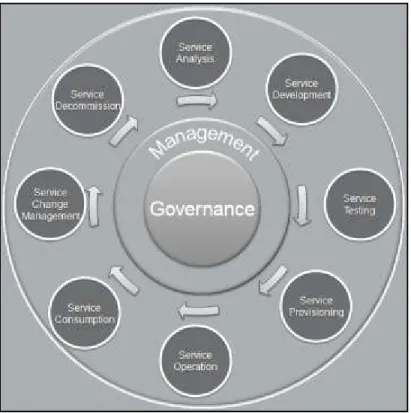
A Services Lifecycle ... 55
Service Analysis ... 55
Service Development ... 56
Service Testing ... 56
Service Provisioning ... 56
Service Operation ... 56
Service Consumption ... 57
Service Change Management ... 57
Service Decommission ... 57
SOA Scenarios... 58
Information Integration ... 58
Legacy Integration ... 58
Process Governance ... 58
Consistent Access ... 59
Resource Virtualization ... 59
Process Externalization ... 59
Other Scenarios ... 59
SOA and the End User ... 60
What are Composite Applications? ... 62
What does a Composite Application look like? ... 65
Expected Benefits of Composition, and How to Achieve Them ... 67
Conclusion ... 67
SOA Case Study: Commonwealth Bank of Australia ... 69
References: ... 71
Chapter 3: Workflow and Process ... 72
Reader ROI ... 72
Acknowledgements ... 73
Understanding Workflow ... 74
What is Workflow? ... 74
Workflow Terminology ... 74
Why Workflow? ... 75
A Workflow Model ... 76
Problem-Resolution Collaboration ... 78
Scripted Operations ... 80
Rule and Policy ... 81
Workflow Platform Value ... 83
More Semantic Exploitation ... 85
Platform Characteristics ... 86
A Common Workflow Runtime ... 87
Attacking the Problems ... 88
A Workflow Manifesto ... 89
Agility ... 89
Abstraction... 90
Workflow is Everywhere ... 90
Workflow is Expressive ... 95
Workflow is Fluid ... 96
Workflow is Inclusive ... 97
Workflow is Transparent ... 97
Understanding the Relationship between BizTalk Server and WF ... 98
Conclusion ... 100
SOA Case Study: Dollar Thrifty Automotive Group ... 101
References: ... 102
Chapter 4: Data ... 103
Reader ROI ... 103
Acknowledgements ... 103
Data Challenges Facing SOA ... 104
Overview ... 104
Data Integration Issues ... 104
Database Scalability ... 107
Master Data Management (MDM) ... 109
What is MDM? ... 110
Customer Data Integration (CDI) ... 111
Product Information Management (PIM) ... 111
Master Data Management (MDM) Hub Architecture ... 111
Hub Architecture Styles ... 112
Architectural Issues ... 116
Versions and Hierarchies ... 117
Population and Synchronization ... 122
Data Integrity and Reliability... 130
Metadata ... 130
Stewardship and Governance ... 131
Data Profiling ... 132
Export ... 132
Reporting ... 132
Workflow and Business Rules ... 132
Tools ... 133
Conclusion ... 133
SOA Case Study: London Stock Exchange ... 134
References: ... 135
Chapter 5: User Interaction ... 136
Reader ROI ... 136
Acknowledgements ... 136
What is Architecture? ... 137
Introducing a Framework for UX ... 138
Interface ... 139
Interaction ... 146
Infrastructure ... 151
SOA Case Study: Zurich Airport ... 162
References: ... 163
Chapter 6: Identity and Access ... 164
Reader ROI ... 164
Acknowledgements ... 165
Identity and Access ... 166
Overview ... 166
Trusted Subsystem Design ... 168
Current Practices ... 169
Trusted Subsystem Design ... 175
Trusted subsystem process extensions ... 177
Trusted Subsystem Policies ... 178
Flowing an Original Caller‘s Identity Claims ... 179
Identity/credential mapping ... 182
Benefits of the Design ... 182
An Identity Metasystem ... 183
What is the Identity Metasystem? ... 184
The Laws of Identity ... 186
Roles within the Identity Metasystem ... 186
Components of the Identity Metasystem ... 187
Benefits of the Identity Metasystem ... 189
An Architecture for the Identity Metasystem: WS-* Web Services... 190
Implementing the Identity Metasystem ... 191
Conclusion ... 194
SOA Case Study: OTTO ... 195
Chapter 1: Service Oriented Architecture (SOA)
“SOAs are like snowflakes – no two are alike.”
- David Linthicum Consultant
Reader ROI
Readers of this chapter will learn about some of the general concepts generally associated with Service Oriented Architectures (SOA). The chapter provides several analogies for
understanding service oriented concepts and some high level recommendations for designing services. This chapter provides an abstract model for describing SOA and introduces a set of architectural capabilities that will be explored in subsequent chapters of this book.
Acknowledgements
The vast majority of this book consists of content from a wide variety of people. Some of this content is new while other content may have appeared in other formats. Each chapter in this book will begin with an ―Acknowledgements‖ section to thank the authors of the content that comprises each chapter.
Introduction to SOA
The SOA Elephant
SOA has become a well-known and somewhat divisive acronym. If one asks two people to define SOA one is likely to receive two very different, possibly conflicting, answers. Some describe SOA as an IT infrastructure for business enablement while others look to SOA for increasing the efficiency of IT. In many ways SOA is a bit like John Godfrey Saxe‘s poem about the blind men and the elephant. Six blind men from Indostan encounter an elephant – each of the men then describes the elephant a bit differently because they are influenced by their individual experiences:
The man touching the trunk believes it to be a snake The man touching the tusk believes it to be a spear The man touching the ear believes it to be a fan
The man touching the elephant‘s side believes it to be a wall The man touching the tail believes it to be a rope
The man touching the legs believes they are trees.
Figure 1: Saxe's Elephant
The blind men then engage in a series of debates about what they believe are facing them:
Though each was partly in the right, And all were in the wrong!”
In many ways Mr. Saxe‘s poem has become a prophecy for SOA. Industry analysts, pundits, bloggers and reporters engage each other in an ongoing, never-ending debate about what is or isn‘t SOA. Like Mr. Saxe‘s blind men, people have correctly identified many of the capabilities of SOA but largely fail to communicate the concept as a whole. The challenge of defining SOA has become so important that various vendor consortia and standards organizations have launched initiatives to try and answer the question ―What is SOA?‖
A simple definition for SOA
For the purposes of this book, we will define SOA as:
A loosely-coupled architecture designed to meet the business needs of the organization.
At first glance this definition seems far too simplistic – where is SOAP, web services, WSDL, WS-* and other related standards? A SOA does not necessarily require the use of Web Services – Web Services are, for most organizations, the simplest approach for implementing a loosely coupled architecture. In the past, loosely coupled architectures have relied upon other technologies like CORBA and DCOM or document-based approaches like EDI for B2B integration. Many of these technologies are still in widespread use and are being augmented, replaced or extended with Web Services. Our definition works for us not because the focus here is not on the technology of SOA but upon meeting the needs of the organization. In simpler terms, one organization‘s SOA may look like nothing more than a bunch of Web Services (or other technologies) to another. There may be some common infrastructure capabilities such as logging and authentication, but for the most part a SOA for one organization will be quite different from the SOA used by another.
Many analysts and industry pundits have confused the concept of Service Oriented Architecture with Service Oriented Implementations. This has only added to the confusion associated with SOA and its related concepts. This can lead to disastrous results.
until the heiress passed away, 38 years later. The result of their efforts is a classic example of implementation without architecture:
The mansion contains 160 rooms, 40 bedrooms, 6 kitchens, 2 basements and 950 doors
Of there 950 doors, 65 of them open to blank walls, 13 staircases were built and abandoned and 24 skylights were installed into various floors.
No architectural blueprint for the mansion was ever created.
Figure 2: The Winchester Mystery House
Confusing architecture with implementation generates chaotic and unpredictable results – much like the Winchester Mystery House. Articles that try to explain SOA and jump into a tutorial for building Web Services are providing guidance for coding, not architecture. This is one of the many reasons that SOA is so misunderstood today – the rush to promote loosely coupled architectures focuses on the trees instead of the forest.
The architectural concepts associated with SOA are not new – many have evolved from ideas originally introduced by CORBA, DCOM, DCE and others. Unlike these previous initiatives, the key promise of SOA is to enable agile business processes via open, standards-based interoperability. While these standards are important we must remember that standards are not architecture and architectures are not implementations. At the end of the day it is the
implementation of a well-designed architecture that will generate business benefits, not the architecture itself.
technologies. Many of the concepts associated with SOA such as services, discovery and late binding were associated with CORBA and DCOM. Similarly, many service design principles have much in common with earlier OOA/OOD techniques based upon encapsulation, abstraction and clearly defined interfaces.
Does the buzz around SOA and services mean that IT wasn’t service-oriented in the past? No - IT (outsourced or not) exists solely to enable the business. Without IT businesses will have tremendous difficulty in both execution and competition. However, if IT cannot respond to business needs and opportunities fast enough then IT is perceived as a constrainer to the business instead of an enabler.
SOA promises to help IT respond to market conditions in a much timelier manner. SOA, however, is an architectural philosophy and is not necessarily an implementable concept. Many analysts and trade magazines have confused architecture with implementation – this leads one to believe that an implementation is, in fact, an architecture which can lead to disastrous results. Organizations have different requirements and expectations for SOA because of vastly different business needs and objectives. This simple fact is one of the reasons that describing SOA can be such a challenge. SOA, like any initiative, must provide some level of value to the organization – otherwise there would be no use in ever considering it. The best way to ensure that SOA investments will provide a return to the organization is to align SOA with the organization‘s business drivers. Despite this obvious fact there is still a lot of confusion about SOA.
SOA Myths and Facts
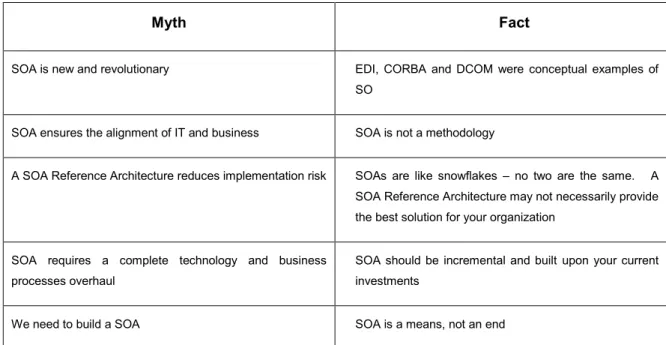
There are several myths associated with SOA which are very important to understand before digging deeper into it. The table below describes some of the top myths surrounding SOA and the facts to help debunk them.
Myth Fact
SOA is a technology SOA is a design philosophy independent of any vendor, product, technology or industry trend. No vendor will ever offer a ―complete‖ SOA ―stack‖ because SOA needs vary from one organization to another. Purchasing your SOA infrastructure from a single vendor defeats the purpose of investing in SOA.
Myth Fact
SOA is new and revolutionary EDI, CORBA and DCOM were conceptual examples of SO
SOA ensures the alignment of IT and business SOA is not a methodology
A SOA Reference Architecture reduces implementation risk SOAs are like snowflakes – no two are the same. A SOA Reference Architecture may not necessarily provide the best solution for your organization
SOA requires a complete technology and business processes overhaul
SOA should be incremental and built upon your current investments
We need to build a SOA SOA is a means, not an end
Focus on delivering a solution, not an SOA. SOA is a means to delivering your solution and should not be your end goal.
The Evolution of SOA
Service Orientation (SO) is the natural evolution of current development models. The, 80s saw object-oriented models; then came the component-based development model in the 90s; and now we have service orientation (SO). Service orientation retains the benefits of component-based development (self-description, encapsulation, dynamic discovery and loading), but there is a shift in paradigm from remotely invoking methods on objects, to one of passing messages between services. Schemas describe not only the structure of messages, but also behavioral contracts to define acceptable message exchange patterns and policies to define service semantics. This promotes interoperability, and thus provides adaptability benefits, as messages can be sent from one service to another without consideration of how the service handling those messages has been implemented.
Service orientation provides an evolutionary approach to building distributed software that facilitates loosely coupled integration and resilience to change. With the advent of the WS-* Web Services, architecture has made service-oriented software development feasible by virtue of mainstream development tools support and broad industry interoperability. Although most frequently implemented using industry standard Web services, service orientation is independent of technology and its architectural patterns and can be used to connect with legacy systems as well.
Unfortunately, the benefits offered by service orientation and SOA have been obscured by the hype and confusion that increasingly surround the terms. As awareness and excitement around SOA have swelled, the clear lines that once defined service orientation have been blurred. However SO does offer some specific benefits when utilized for the right purpose. There are three important observations about SO:
1. It’s evolutionary: The principles of service-oriented development build on decades of experience in building real world distributed applications. SO incorporates concepts such as self-describing applications, explicit encapsulation, and dynamic loading of functionality at runtime – principles first introduced in the 1980s and 1990s through object-oriented and component-based development. What changes with SO is the metaphor with which developers achieve these benefits. Instead of using method invocation on an object reference, service orientation shifts the conversation to that of message passing – a proven metaphor for scalable distributed software integration.
2. It’s not a product or technology: It is a set of architectural principles expressed independently of any product. Just as development concepts such as polymorphism and encapsulation are independent of technology, so is service orientation. And while Web services have in recent years facilitated the development of service-oriented applications, they are not required to do so.
3. It’s incremental: Finally, service orientation can and should be an incremental process – one that can often be done in-house. Customers should not be required to dramatically re-engineer their businesses to attain the benefits of service orientation. Rather, they should be able to leverage existing IT assets in doing so. Service-oriented development can often be achieved using the skills and technologies customers already have today.
result in loosely-coupled business processes, since the business processes are no longer constrained by the limitations of the underlying infrastructure. Services and their associated interfaces must remain stable, enabling them to be re-configured or re-aggregated to meet the ever-changing needs of business. Services remain stable by relying upon standards-based interfaces and well-defined messages— for example using SOAP and XML schemas for message definition. Services designed to perform simple, granular functions with limited knowledge of how messages are passed to or retrieved from it are much more likely to be reused within a larger SOA infrastructure.
Service Orientation does not necessarily require rewriting functionality from the ground up. Following the four tenets (see below) enables reuse of existing IT assets by wrapping them into modular services that can be plugged into any business process that you design. The goals for doing this should be:
Connect into what is already there - Layer business process management, collaborative workflows, and reporting on top of existing IT assets.
Extract more value from what is already there - Enable existing applications to be re-used in new ways.
Extend and evolve what we already have - Create IT support for new cross-functional business processes that extend beyond the boundaries of what the existing applications were designed to do.
One of the key benefits of service orientation is loose coupling. No discussion of Web services seems complete without some reference to the advantages of looser coupling of endpoints (applications) facilitated by the use of Web service protocols. The principle is that of using a resource only through its published service and not by directly addressing the implementation behind it. This way, changes to the implementation by the service provider should not affect the service consumer. By maintaining a consistent interface, the service consumer could choose an alternative instance of the same service type (for example change service provider) without modifying their requesting application, apart from the address of the new instance. The service consumer and provider do not have to have the same technologies for the implementation, interface, or integration when Web services are used (though both are bound to use the same Web service protocols).
Why should I care about SOA?
Service Orientated Architecture is important to several stakeholders:
context of a specific business process, and to gracefully incorporate new capability providers over time.
To the IT manager, service orientation is a means for effectively integrating the diverse systems typical of modern enterprise data centers. By providing a model for aggregating the information and business logic of multiple systems into a single interface, service orientation allows diverse and redundant systems to be addressed through a common, coherent set of interfaces.
To the CIO, service orientation is a means for protecting existing IT investments without inhibiting the deployment of new capabilities. By encapsulating a business application behind capability-based interfaces, the service model allows controlled access to mission-critical applications, and creates the opportunity for continuous improvement of the implementation behind that interface. Service orientation protects investments from the swirl of change.
To the business analyst, service orientation is a means of bringing information technology investments more in line with business strategy. By mapping employees, external capability providers and automation systems into a single model, the analyst can better understand the cost tradeoffs associated with investments in people, systems and sourcing.
To Microsoft, service orientation is a crucial prerequisite to creating applications that leverage the network to link the actors and systems that drive business processes. This application model transcends any single device, crossing boundaries respectfully, and rejecting the restrictions of synchronicity. SOA-enabled solutions pull together a constellation of services and devices to more effectively meet your business challenges than the disconnected applications of the past.
The architectural concepts associated with SOA enable loose coupling. Loose coupling is the fundamental principle behind SOA, enabling us to summarize up the benefit of SOA in a single word: agility.
With a Service Oriented Architecture the application‘s functionality is exposed through a collection of services. These services are independent and encapsulate both the business logic and its associated data. The services are interconnected via messages with a schema defining their format; a contract defining their interchanges and a policy defining how they should be exchanged.
Service
Policy Schema
and Contact
Messages
Figure 4: Anatomy of a Web Service
An application‘s services are designed to last with the expectation that we cannot control where and who consumes them. This is one of the key differences between SOA and traditional application architectures. Traditionally applications are designed to interact with humans, and the application vendor would provide the user-interface, the underlying business components and data stores. While good engineering disciplines separated the business components from the user interface, the only consumers of this business logic were the user interfaces delivered as part of the application. These UI and business components were traditionally deployed and versioned as a single entity. With service orientation, the business functionality exposed through the service can be used by any consumer outside of the control of the application. These consumers can be other services (incorporating the encapsulated business process) or alternatives to the user interfaces provided by the application itself. Therefore, contracts for these services, once published, must remain constant as we have no idea who is consuming them, nor when. In addition to offering services and exploiting its own services, an application itself should have the flexibility to adapt to new services offered after deployment. The availability and stability of these services therefore becomes a critical factor.
Understanding Services
the Service Lifecycle). The Service Lifecycle explains the necessary steps an organization must go through to define, develop, deploy and operate a service.
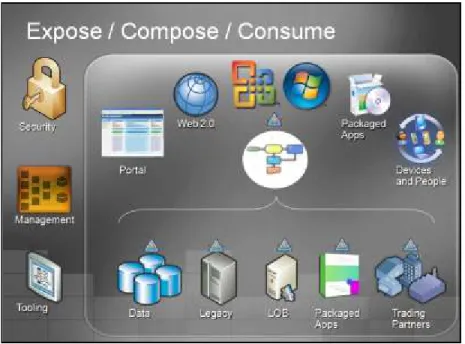
Services are commonly used to expose IT investments such as legacy platforms and Line of Business applications. Services can be assembled (or ―composed‖) into business processes, and be made available for consumption by users, systems or other services. The process is an iterative one of creating (―exposing‖) new services, aggregating (―composing‖) these services into larger composite applications, and making the outputs available for consumption by the business user.
Figure 5: An incremental, business-driven approach to SOA
Fundamental to the service model is the separation between the interface and the implementation. The invoker of a service need only (and should only) understand the interface; the implementation can evolve over time without disturbing the clients of the service. Several key benefits of service orientation derive from this abstraction of the capability from how the capability is delivered. This means that, the same interface can be offered by many implementations, or conversely, that implementations can change without affecting the aggregate application. At its most abstract, service orientation views everything — from the mainframe application to the printer to the shipping dock clerk to the overnight delivery company — as a service provider. The service model is ―fractal:‖ the newly formed process is a service itself, exposing a new, aggregated capability.
The Tenets of Service Design
The acronym SOA prompts an obvious question – what, exactly, is a service? Simply put, a service is a program that can be interacted with via well-defined message exchanges. Services must be designed for both availability and stability. Services are built to last while service configurations and aggregations are built for change. Agility is often promoted as one of the biggest benefits of SOA – an organization with business processes implemented on a loosely-coupled infrastructure is much more open to change than an organization constrained underlying monolithic applications that require weeks to implement the smallest change. Loosely-coupled systems result in loosely-coupled business processes, since the business processes are no longer constrained by the limitations of the underlying infrastructure. Services and their associated interfaces must remain stable, enabling them to be re-configured or re-aggregated to meet the ever-changing needs of business. Services remain stable by relying upon standards-based interfaces and well-defined messages – in other words, SOAP and XML schemas for message definition. Services designed to perform simple, granular functions with limited knowledge of how messages are passed to or retrieved from it are much more likely to be reused within a larger SOA infrastructure. As stated earlier, recalling basic OO design principles regarding encapsulation and interface design will serve us well as we design and build reusable Web Services. We can extend these OO principles into the world of Web Services by further understanding the frequently cited ―four tenets‖ of Service Orientation:
Tenet 1: Boundaries are Explicit
Services interact through explicit message-passing over well-defined boundaries. Crossing service boundaries may be costly, depending upon geographic, trust or execution factors. A boundary represents the border between a service‘s public interface and its internal, private implementation. A service‘s boundary is published via WSDL and may include assertions dictating the expectations of a given service. Crossing boundaries is assumed to be an expensive task for several reasons, some of which are listed below:
The physical location of the targeted service may be an unknown factor. Security and trust models are likely to change with each boundary crossing.
While services are built to last, service configurations are built to change. This fact implies that a reliable service may suddenly experience performance degradations due to network reconfigurations or migration to another physical location.
Service consumers are generally unaware of how private, internal processes have been implemented. The consumer of a given service has limited control over the performance of the service being consumed.
The Service Oriented Integration Pattern tells us that ―service invocations are subject to network latency, network failure, and distributed system failures, but a local implementation is not. A significant amount of error detection and correction logic must be written to anticipate the impacts of using remote object interfaces.‖ While we should assume that crossing boundaries is an expensive process, we must also exercise caution in the deployment of local methods designed to minimize such boundary crossings. A system that implements monolithic local methods and objects may gain performance but duplicate functionality of a previously defined service (this technique was referred to as ―cut and paste‖ in OOP and shares the same risks regarding versioning of the service).
There are several principles to keep in mind regarding the first Tenet of SO:
Know your boundaries. Services provide a contract to define the public interfaces it provides. All interaction with the service occurs through the public interface. The interface consists of public processes and public data representations. The public process is the entry point into the service while the public data representation represents the messages used by the process. If we use WSDL to represent a simple contract, the < message> represents the public data while the <portType> represents the public process(es). Services should be easy to consume. When designing a service, developers should
make it easy for other developers to consume it. The service‘s interface (contract) should also be designed to enable evolving the service without breaking contracts with existing consumers. (This topic will be addressed in greater detail in future papers in this Series.) Avoid RPC interfaces. Explicit message passing should be favored over an RPC-like
model. This approach insulates the consumer from the internals of the service implementation, freeing service developers to evolve their services while minimizing the impact on service consumers (encapsulation via public messages instead of publicly available methods).
accept a well-defined input message and respond with an equally well-defined output message. Once these interfaces have been designed they should remain static. These interfaces provide the ―constant‖ design requirement that services must support, serving as the public face to the service‘s private, internal implementation.
Internal (private) implementation details should not be leaked outside of a service boundary. Leaking implementation details into the service boundary will most likely result in a tighter coupling between the service and the service‘s consumers. Service consumers should not be privy to the internals of a service‘s implementation because it constrains options for versioning or upgrading the service.
Tenet 2: Services Are Autonomous
Services are entities that are independently deployed, versioned, and managed. Developers should avoid making assumptions regarding the space between service boundaries since this space is much more likely to change than the boundaries themselves. For example, service boundaries should be static to minimize the impact of versioning to the consumer. While boundaries of a service are fairly stable, the service‘s deployment options regarding policy, physical location or network topology is likely to change.
Services are dynamically addressable via URIs, enabling their underlying locations and deployment topologies to change or evolve over time with little impact upon the service itself (this is also true of a service‘s communication channels). While these changes may have little impact upon the service, they can have a devastating impact upon applications consuming the service. What if a service you were using today moved to a network in New Zealand tomorrow? The change in response time may have unplanned or unexpected impacts upon the service‘s consumers. Service designers should adopt a pessimistic view of how their services will be consumed – services will fail and their associated behaviors (service levels) are subject to change. Appropriate levels of exception handling and compensation logic must be associated with any service invocation. Additionally, service consumers may need to modify their policies to declare minimum response times from services to be consumed. For example, consumers of a service may require varying levels of service regarding security, performance, transactions, and many other factors. A configurable policy enables a single service to support multiple SLAs regarding service invocation (additional policies may focus on versioning, localization and other issues). Communicating performance expectations at the service level preserves autonomy since services need not be familiar with the internal implementations of one another.
service itself. Service providers also cannot trust consumers to ―do the right thing‖. For example, consumers may attempt to communicate using malformed/malicious messages or attempt to violate other policies necessary for successful service interaction. Service internals must attempt to compensate for such inappropriate usage, regardless of user intent.
While services are designed to be autonomous, no service is an island. A SOA-based solution is fractal, consisting of a number of services configured for a specific solution. Thinking autonomously, one soon realizes there is no presiding authority within a service-oriented environment - the concept of an orchestration ―conductor‖ is a faulty one (further implying that the concept of ―roll-backs‖ across services is faulty– but this is a topic best left for another paper). The keys to realizing autonomous services are isolation and decoupling. Services are designed and deployed independently of one another and may only communicate using contract-driven messages and policies.
As with other service design principles, we can learn from our past experiences with OO design. Peter Herzum and Oliver Sims‘ work on Business Component Factories provides some interesting insights on the nature of autonomous components. While most of their work is best suited for large-grained, component-based solutions, the basic design principles are still applicable for service design,
Given these considerations, here are some simple design principles to help ensure compliance with the second principle of SO:
Services should be deployed and versioned independent of the system in which they are deployed and consumed
Contracts should be designed with the assumption that once published, they cannot be modified. This approach forces developers to build flexibility into their schema designs. Isolate services from failure by adopting a pessimistic outlook. From a consumer
perspective, plan for unreliable levels of service availability and performance. From a provider perspective, expect misuse of your service (deliberate or otherwise),expect your service consumers to fail – perhaps without notifying your service.
Tenet 3: Services share schema and contract, not class
Most developers define classes to represent the various entities within a given problem space (e.g. Customer, Order and Product). Classes combine behavior and data (messages) into a single programming-language or platform-specific construct. Services break this model apart to maximize flexibility and interoperability. Services communicating using XML schema-based messages are agnostic to both programming languages and platforms, ensuring broader levels of interoperability. Schema defines the structure and content of the messages, while the service‘s contract defines the behavior of the service itself.
In summary, a service‘s contract consists of the following elements: Message interchange formats defined using XML Schema Message Exchange Patterns (MEPs) defined using WSDL Capabilities and requirements defined using WS-Policy
BPEL may be used as a business-process level contract for aggregating multiple services.
Service consumers will rely upon a service‘s contract to invoke and interact with a service. Given this reliance, a service‘s contract must remain stable over time. Contracts should be designed as explicitly as possible while taking advantage of the extensible nature of XML schema (xsd:any) and the SOAP processing model (optional headers).
The biggest challenge of the Third Tenet is its permanence. Once a service contract has been published it becomes extremely difficult to modify it while minimizing the impact upon existing service consumers. The line between internal and external data representations is critical to the successful deployment and reuse of a given service. Public data (data passed between services) should be based upon organizational or vertical standards, ensuring broad acceptance across disparate services. Private data (data within a service) is encapsulated within a service. In some ways services are like smaller representations of an organization conducting e-business transactions. Just as an organization must map an external Purchase Order to its internal PO format, a service must also map a contractually agreed-upon data representation into its internal format. Once again our experiences with OO data encapsulation can be reused to illustrate a similar concept – a service‘s internal data representation can only be manipulated through the service‘s contract.
Ensure a service‘s contract remains stable to minimize impact upon service consumers. The contract in this sense refers to the public data representation (data), message exchange pattern (WSDL) and configurable capabilities and service levels (policy). Contracts should be designed to be as explicit as possible to minimize misinterpretation.
Additionally, contracts should be designed to accommodate future versioning of the service via the extensibility of both the XML syntax and the SOAP processing model. Avoid blurring the line between public and private data representations. A service‘s
internal data format should be hidden from consumers while its public data schema should be immutable (preferably based upon an organizational, defacto or industry standard).
Version services when changes to the service‘s contract are unavoidable. This approach minimizes breakage of existing consumer implementations.
Tenet 4: Service compatibility Is based upon policy
While this is often considered the least understood design tenet, it is perhaps one of the most powerful in terms of implementing flexible web services. It is not possible to communicate some requirements for service interaction in WSDL alone. Policy expressions can be used to separate structural compatibility (what is communicated) from semantic compatibility (how or to whom a message is communicated).
separate, domain-specific specifications for a variety of vertical industries (establishing the WS-Policy ―framework‖ concept).
While policy-driven services are still evolving, developers should ensure their policy assertions are as explicit as possible regarding service expectations and service semantic compatibilities. The four tenets are primarily designed to assist you in designing and developing your services.
An Abstract SOA Reference Model
While a well planned and executed SOA undertaking can help organizations realize greater responsiveness in a changing marketplace, not all service-oriented efforts have been successful. SOA projects may experience limited success when they are driven from the bottom up by developers unfamiliar with the strategic needs of the organization. Building SOA for the sake of SOA without reference to the business context is a project without organizing principles and guidance. The result is a chaotic implementation that has no business relevance. On the other hand, taking a top-down mega-approach to SOA requires such enormous time investments that by the time the project is complete, the solution no longer maps to business needs. (This of course is one of the problems SOA is supposed to solve!)
By contrast, Microsoft advocates a ―middle out‖ approach which combines both top-down and bottom-up methodologies. In this approach, SOA efforts are driven by strategic vision and business need, and are met through incremental, iterative SOA projects that are designed to deliver on business goals one business need at a time. Microsoft has been using this technique to assist customers with their SOA initiatives since the .NET framework was first released in 1999.
The concept of SOA can be viewed from several possible perspectives. While no single perspective or set of perspectives represents a definitive view of a SOA, from a holistic view these perspectives assist in understanding the underlying architectural requirements. Microsoft believes that there are three abstract capability layers exposed within a SOA:
Figure 6: An Abstract Reference Model for SOA
Expose
Expose focuses on how existing IT investments are exposed as a set of broad, standards-based services, enabling these investments to be available to a broader set of consumers. Existing investments are likely to be based upon a set of heterogeneous platforms and vendors. If these applications are unable to natively support Web services a set of application or protocol-specific set of adapters may be required. Service creation can be fine grained (a single service that maps on to a single business process), or coarse grained (multiple services come together to perform a related set of business functions). Expose is also concerned with how the services are implemented. The functionality of underlying IT resources can be made available natively if they already speak Web services, or can be made available as Web services though use of an adapter. A Service Implementation Architecturedescribeshow services are developed, deployed and managed.
Compose
Architecture describes a set of capabilities for composing services and other components into larger constructs such as business processes. Composing services requires some sort of workflow or orchestration mechanism. Microsoft provides these capabilities via BizTalk Server 2006 (BTS) or Windows Workflow Foundation (WF). While BTS and WF may appear to serve similar needs, they are actually quite different. WF and BTS are complementary technologies designed to serve two very different needs:
BTS is a licensed product designed to implement workflow (―orchestrations‖) across disparate applications and platforms.
WF is a developer framework designed to expose workflow capabilities within your application. There are no fees or licensing restrictions associated with using or deploying WF.
We will examine workflow, orchestration and the use of BizTalk/WF in Chapter Three (Workflow and Business Processes).
Consume
When a new application or business process has been created that functionality must be made available for access (consumption) by IT systems, other services or by end-users. Consumption focuses on delivering new applications that enable increased productivity and enhanced insight into business performance. Users may consume ―composed‖ services through a broad number of outlets including web portals, rich clients, Office business applications (OBA), and mobile devices. ―Composed‖ services can be used to rapidly roll out applications that result in new business capabilities or improved productivity. These application roll-outs can be used to measure the return on investment (ROI) in an SOA. A Service Oriented Application Architecture
describes how ―composed services‖ are made available for consumption through as business processes, new services or new end-user applications. This concept is sometimes referred to as
Composite Applications since it implies service consumption by end-user applications. Microsoft‘s Office Business Applications (OBAs) support the Composite Application notion of transactional systems while expanding the scope of user interaction via the familiar Office environment.
We will examine consumption in greater detail in Chapter Five (User Experience).
Recurring Architectural Capabilities
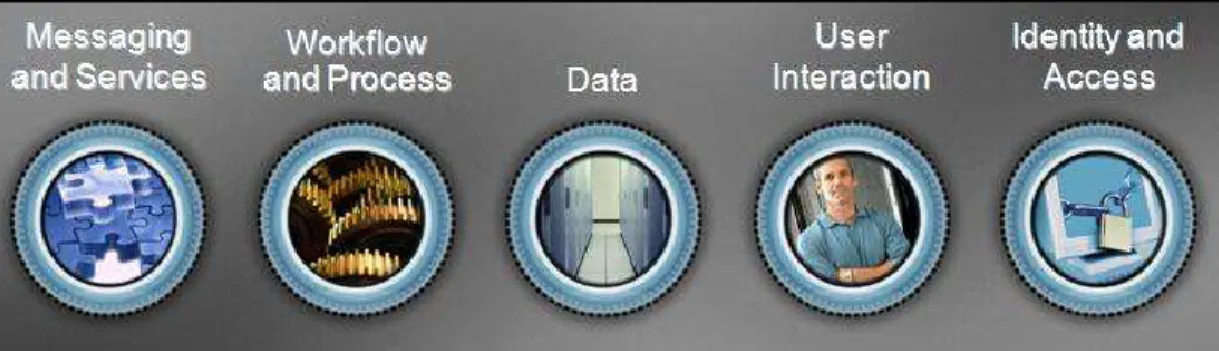
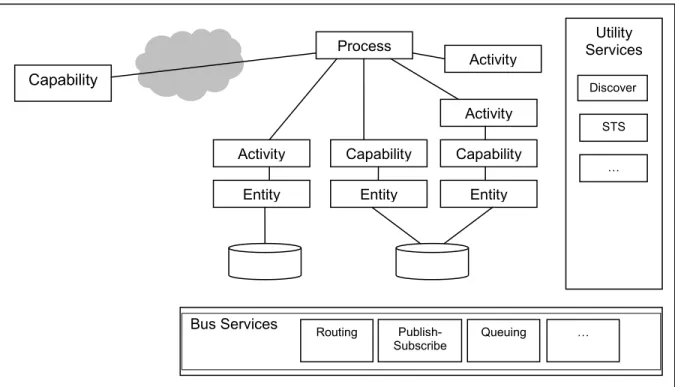
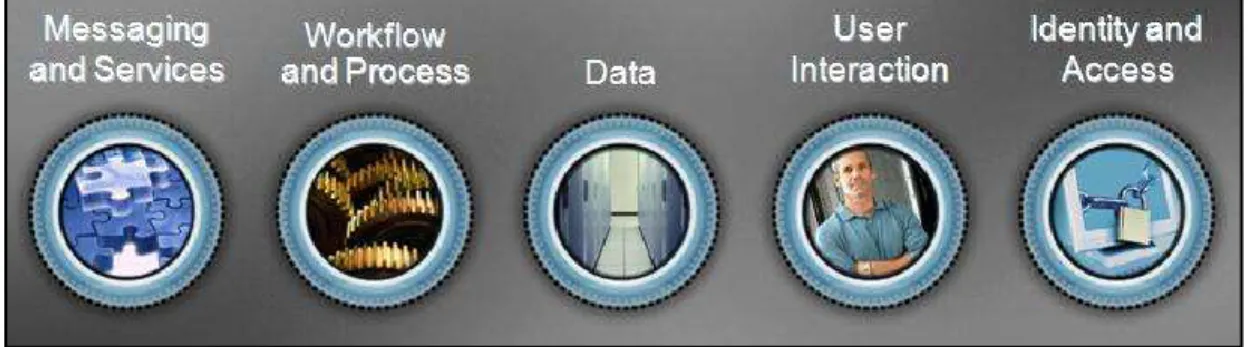
As we saw earlier, the SOA architectural model is fractal. This means that a service can be used to Expose IT assets (such as a Line of Business system), be Composed into workflows or Business Processes (each of which may also be exposed as a service) and be Consumed by end users, systems or other services. SOA is a fractal, not layered model. While the Abstract SOA Reference Model provides a holistic view of several important SOA concepts, the Expose / Compose / Consume portions of the model should not be interpreted as layers (despite their apparent appearance in the model). Designing a SOA as a set of well-defined tiers (or layers) will constrain the value and flexibility of your services, resulting in dependencies across unrelated components. This is why the Expose / Compose / Consume portions of the model can be thought of as independent architectural initiatives referred to as a Service Implementation Architecture (Expose), a Service Integration Architecture (Compose) and an Application Architecture (Consume). While each of these architectures are designed to be independent of one another, they share a set of five common capabilities
Figure 7: Recurring Architectural Capabilities
Messaging and Services
service is generally implemented as a coarse-grained, discoverable software entity that exists as a single instance and interacts with applications and other services through a loosely coupled (often asynchronous), message-based communication model. Messages tend to be based upon an agreed-upon set of semantics (such as an industry-standard Purchase Order) and serialized using an interoperable, extensible syntax (usually XML, although alternate approaches like JSON, RNC and ASN1 are sometimes used).
Workflow and Process
Workflow and Process are pervasive across multiple layers of an integration architecture – from formal orchestration of processes to flexible ad hoc systems and collaborative workflow across teams. Since business processes are dynamic and evolve with the organization, the workflow that models these processes must be equally adaptable. In addition, effective workflow involves not only process modeling, but also monitoring and analytics in order to respond to exceptions and optimize the workflow system over time.
Data
The lynchpin to success in many integration architectures is the ability to provide Data
management. The need to deliver a shared view across disparate, often duplicate sources of data is more important than ever, as businesses strive to achieve a 360-degree view of
organizational information. Entity aggregation, master data management, and the ability to make data useful via analytics and mining are crucial elements of integration architecture.
User Experience
Successful integration architectures depend upon both service delivery and the ability to consume services in a rich and meaningful way. Service consumption needs to be contextual, mapping to the natural workflow of employees, customers, and partners. To that end, an integrated User Experience spanning smart clients, rich clients, lightweight Web applications, and mobile devices enables service consumption by the broadest possible audience.
Identity and Access
Management
During the lifetime of a service, the service most probably changes in different perspectives as listed below. As a result, one service will probably have to be available in several versions.
Difference in interface (e.g. extended interface, but same business object) Difference in semantics with same interface (business objects changed)
Difference in QoS, e.g. slower but cheaper or high-available but more expensive
Service management encompasses many capabilities, some of which are listed below: A comprehensive solution for change and configuration management, enabling
organizations to provide relevant software and service updates to users quickly and cost-effectively.
Reducing the complexity associated with managing the IT infrastructure environment with a focus on lowering the cost of operations.
Centralized backup services capturing changed files to disk. Centralized backup should enable rapid, reliable recovery from disk while providing end-user recovery without IT intervention.
Pre-deployment capacity planning coupled with best-practice guidance and hardware-specific knowledge to help information technology professional make low-risk
architectural decisions.
Data warehouse and reporting to help IT better support corporate decision making, improve the quality of service provided, and better administer resources through
improved reporting capabilities and management data integration from a broad variety of resources.
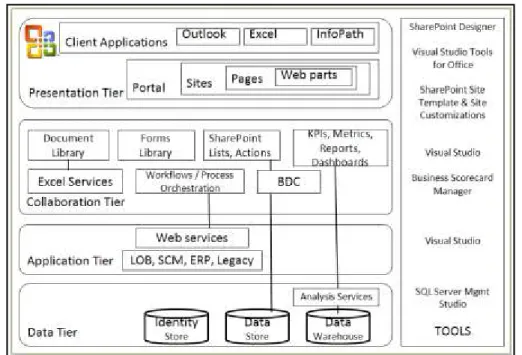
Supporting the Common Architectural Capabilities
Figure 8: SOA Capabilities on the Microsoft Platform
Common Architectural Capabilities and the Abstract SOA Model
We can also think of these five common architectural capabilities as set of perspectives for viewing and understanding the Abstract SOA Model. The five architectural capabilities serves as a set of lenses to help us view and better understand the challenges associated with Exposing
existing IT investments as services, Composing the services into business processes and
Consumingthese processes across the organization.
Expose
Service Enablement
Expose focuses on how we design and expose our services. We will most likely start out by enabling our IT investments to be exposed as web services.
As our organization matures we will start adding new services, most likely as proxies for other resources within the organization.
One of the hardest parts of service implementation is deciding where to begin. The are a variety of choices here and there is no single recommendation that will work for everyone. Motion is a methodology that provides some guidance for identifying business capabilities that could be exposes as services.
What are some best practices that one should follow when exposing IT investments as services? • Think big– but start small
• Be pragmatic
• Vertical-slice – not build it and they will come • Risk-mitigation
• Demonstrate value in rapid iterations – not waterfall • New approaches to development
• Successful customers ‗snowball‘
The recurring architectural capabilities provide us with a set of considerations when exposing IT investments as services. Let‘s take a quick look at some of the considerations associated with each capability for service exposure (this is by no means a complete list):
Messaging and Services
Determining what to expose and how - Avoid falling into the granularity trap – focus on meeting your business requirements
Service Operation Contracts Message and Data Contracts Configuration, behaviors and control SLAs
Governance Versioning
Workflow and Process
Coordinator services for distributed, long-running processes
Tracking services capable of logging specific events within a workflow Compensation services
Data
Entity services
Entity Aggregation services: acts as a single point to access information that may exist in multiple systems. An Entity Aggregation service has the following responsibilities:
Acts as a unified source of entities. Provides a holistic view of an entity.
Provides a holistic view of the entity model—entities and their relationships with other entities
Enforces business rules that determine the segments of entities retrieved in a given context.
Determines the system of record for each data element constituting an entity. Enriches the combined data model across systems—the whole being better than
the sum of its parts. Entity factoring
MDM focuses on exposing data across corporate or departmental boundaries. We‘ll discuss MDM in greater detail in Chapter Four.
User Experience
Specialized services for supporting user interfaces (caching resources, communications between UI and services, etc). Service wrappers provide coarse-grained interfaces for user app consumption, lightweight mash-ups, etc.
Identity and Access Identity Management
Impersonation and Delegation services
Trusted Subsystem - A trusted subsystem model implies that services are trusted to perform specific tasks, such as processing customer orders.
Authentication (Kerberos, SSL) Role-based access control (RBAC) Create/revoke trust relationships
Services need to make authorization decisions, such as approving an order submission before performing the business transaction.
The service must know the identity of the end user submitting the order.
Need to flow the identity of the end user is an inherent property of the delegation model, it is not so for the trusted subsystem model and special efforts must be made to include this feature.
To support the notion of trust as defined by the model, the services must at least be able to:
1. Authenticate / verify identity of upstream / downstream services
2. Decide if the service is a trusted subsystem for specific functions (including propagating identity claims)
Besides application data, application plumbing data, such as the identity claims of the original user, must also be protected so that no man-in-the-middle can modify the identity information that is in transit.
Compose
Service Composition
Compose focuses on how we can combine or aggregate granular services into more complex processes. We will most likely start by using services that expose our existing IT investments. Service composition results in a new service instance that the rest of the organization can make use of. The composition provides capabilities such as correlated asynchronous service
invocation, long running processes and other capabilities for orchestrating autonomous services.
The recurring architectural capabilities provide us with a set of considerations when composing granular services into complex processes. Let‘s take a quick look at some of the considerations associated with each capability for service composition (this is by no means a complete list):
Messaging and Services Service interaction patterns
Exposing orchestrations as services Asynchronous service invocation patterns
Workflow and Process Transactions
High frequency of change Business Rules
Service Orchestration
Service Interaction Patterns (SIPs) Process Externalization
Long Running Processes Auditing and analytics
Data
Tracking the state of a given workflow instance Data transformation (ETL)
Synchronization
Metadata repository and Management Instance reconciliation
Schema reconciliation Document Replication Syndication/Aggregation
User Experience
Composite applications (OBAs) Human workflows (MOSS)
Orchestrations initiate human workflows via SharePoint adapter Pageflows
Identity and Access
Impersonation and Delegation Provisioning
Identity Repository synchronization Approval workflows
Consume
User Experience
Consume focuses on how services and orchestrated processes (which may be exposed as services) are consumed by other services, applications and end-users. Any resource capable of interacting with services can be referred to as a ―consumer‖. Consumers may appear across the organization in several possible forms:
Lightweight, browser-based applications
Rich internet applications (RIA) are browser-based applications that can address and cache local and remote resources
Configurable, portal-based user experiences
Applications that are installed on the local machine (such as a custom Windows application)
Corporate business applications with solution-specific extensions (such as Microsoft Office with context-aware activity panes)
Applications designed for mobile devices
Recall that the SOA model is fractal – services may be consumed by other services and service compositions may be exposed as new services. In the last couple of years a ―new breed‖ of consumers has emerged, enabling consumers to be aggregated and consumed by additional consumers. This ―new breed‖ of consumers is usually referred to as a ―mashup‖. A mashup is a set of services, websites or applications that combine content from multiple resources into a new integrated user experience. Content used by mashups is typically sourced from a third party (such as a service or website) via a public interface or API. Alternative methods of sourcing content for mashups include newsfeeds and JavaScript constructs (JSON).
The recurring architectural capabilities provide us with a set of considerations for User Experience. Let‘s take a quick look at some of the considerations associated with each capability for User Experience (this is by no means a complete list):
Messaging and Services
Forms-based service consumption Web parts
Service Registry – check in / check out / search AJAX, REST
Workflow and Process Human workflows (MOSS) Event brokering (CAB) Page flows
Data
Entities (OBA Business Data Catalog) Single view of the customer problem JSON
User Experience
Composite applications (OBAs) Personalization, user profiles Portals
Business Intelligence Reporting
Identity and Access
Single Sign-On (password synchronization) User identification
Role-based access (RBAC) Directory Services
Password management Privacy (firewalls, encryption) Compliance
Summary
In this chapter we provided some useful analogies for understanding the fractal nature of SOA. Services are the fundamental building blocks of SOA, although services do not necessarily need to be web services. Ideally these services should follow the four service design tenets which describe a set of best practices for service scopes, dependencies, communications and policy-based configuration. While these tenets focus upon service design, it is important to realize that services alone are not necessarily solution architecture – Microsoft uses an abstract reference model to describe the various aspects of SOA. The abstract SOA reference model provides three fundamental concepts to help most organizations understand the role that services can play within their solution architectures:
Expose focuses on how existing IT investments are exposed as a set of broad,
standards-based services, enabling these investments to be available to a broader set of consumers. A Service Implementation Architecturedescribeshow services are
developed, deployed and managed.
Compose focuses oncombining services into applications or cross-functional business processes. A Service Integration Architecture describesa set of capabilities for
composing services and other components into larger constructs such as business processes.
Consume focuses on delivering new applications that enable increased productivity and enhanced insight into business performance. A Service Oriented Application Architecture
describes how ―composed services‖ are made available for consumption through as business processes, new services or new end-user applications.
set of views to better understand the challenges associated with Exposing existing IT investments as services, Composing the services into business processes and Consumingthese processes across the organization.
References:
1. ―Enabling ―Real World‖ SOA through the Microsoft Platform‖, A Microsoft White Paper, December 2006. Available at
http://www.microsoft.com/biztalk/solutions/soa/whitepaper.mspx
2. Service Oriented Integration Pattern:
http://msdn2.microsoft.com/en-us/library/ms978594.aspx
Chapter 2: Messaging and Services
“SOA is not something you buy, it's something you do.” – Jason Bloomberg
Analyst
Reader ROI
Readers of this chapter will build upon the concepts introduced in Chapter One, specifically focusing on the Messaging and Services architectural capability.
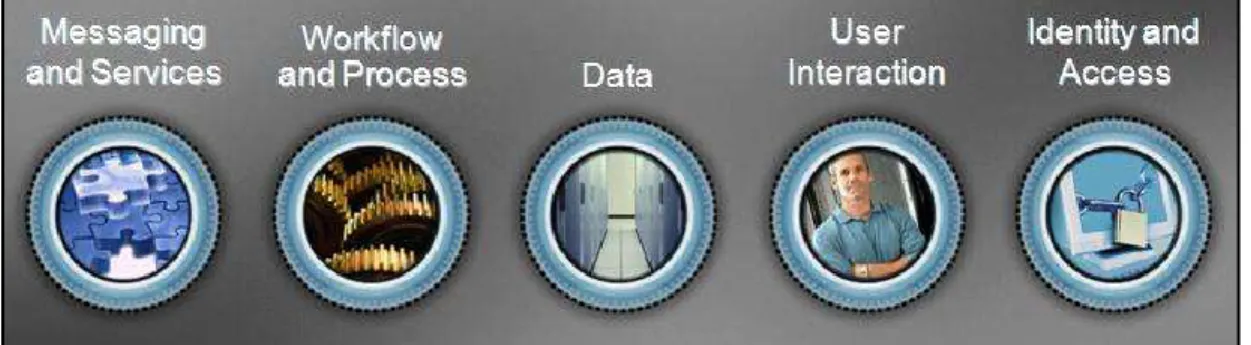
Figure 1: Recurring Architectural Capabilities
The Messaging and Services architectural capability focuses on the concept of service orientation and how different types of services are used to implement SOA. This chapter also touches upon the role of the user – specifically how a user will interact with services within a SOA.
Topics discussed in this chapter include: A maturity model for SOA A services lifecycle Sample SOA scenarios
The role of the user within a SOA
agrees upon. Readers should review several of these efforts and draw from them the aspects that best fit your organizational needs.
Acknowledgements
Understanding Services
A SOA Maturity Model (
another
one??)
There is an abundance of SOA Maturity Models available from vendors, consulting firms, analysts and book authors. Most of these Maturity Models are either based upon or inspired by the Software Engineering Institute‘s (now retired) Capability Maturity Model (CMM). A recent search on the terms ―SOA Maturity Model‖ returned almost 10,000 relevant hits (including articles on what to look for in a Maturity Model). Given the intense interest and variety of maturity models available why introduce another? Unlike other Maturity Models, the one discussed here doesn‘t attempt to simply apply service orientation to the CMM. ESOMM (Enterprise Service Orientation Maturity Model) borrows CMM‘s notion of capability-driven maturity models and applies these principles to service-orientation paradigms, essentially building a road map from scratch. Unlike CMMI, the ESOMM Maturity Model doesn‘t focus on processes because the focus is on IT capabilities, not organizational readiness or adoption. While there are some conceptual
similarities with CMM, ESOMM is a decidedly different application of the maturity model concept. The layers, perspectives, and capabilities defined in the ESOMM are designed as a road map to support services—not any specific service with any specific use, implementation, or application, but any service, or more specifically, any set of services.
Developing an enterprise-wide SOA strategy is not a trivial undertaking and should not be treated as a short-term or one-time effort. SOA is an attempt to enable a higher level of agility for the entire organization to facilitate an expedient response to the needs of the business and
customers. There are many aspects of SOA that will be much more critical in the near- instead of long-term, so it is important to align your group‘s efforts accordingly. To do so successfully, the development of a prioritized roadmap should be a high priority to plan for success.
An ESOMM can provide a capability-based, technology-agnostic model to help identify an organization‘s current level of maturity, the short- and long-term objectives, and the opportunity areas for improvement.
Figure 2: An Enterprise Service Orientation Maturity Model (ESOMM)
Most organizations will not naturally completely implement all of one layer‘s capabilities before moving up the model, but jumping too far ahead can be risky. This becomes very apparent as you recognize that some poor decisions concerning key building block capabilities can severely impact your ability to mature at higher layers.
Capabilities are categorized into one of three perspectives: Implementation, Consumption, and Administration. Implementation capabilities target the development and deployment of Web services from the provider‘s perspective. Consumption capabilities are those that cater to the consumers of your services, making them easier to implement and therefore more widely and successfully adopted. Administration capabilities include those that facilitate the operational and governance aspects of Web services across the organization. While an organization can choose to focus on a single perspective, the overall maturity, and hence value, of your SOA depends on the appropriate level of attention to all three.
ESOMM is a tool that can be used to:
o simplify the complexity of a massively complex and distributed solution. o Identify and discuss an organization‘s adoption of service orientation.
o understand the natural evolution of service adoption (such as skipping certain capabilities at lower levels comes with certain risk).
o align an organization‘s activities and priorities with a distinct level of value providing specific benefits through specific capabilities,
In a SOA assessment, each capability is assessed independently as a level of strength,
adequacy, or weakness. A level of strength demonstrates that the organization is well positioned to safely grow their use of Web services without fearing pitfalls in this area down the road. A level of adequacy signals that an organization has sufficient capabilities to meet today‘s needs, but is vulnerable to a growth in Web services that could cause problems in that area. A weakness
represents a deficiency that is a problem for today‘s use of Web services and could be a serious detriment in the future. Any capabilities that are obviously not part of the organization‘s
objectives and appear to have minimal impact in the near term for the organization are classified as not applicable. These areas may quickly become weaknesses if business or technical objectives were to change or accelerate.
As in the CMM, individual capability levels drive an overall layer grade ranging from 1 to 5. A grade is assessed based on the average of the capability maturities within the layer. A rating of 5 represents a mastery of that level with little or no room for improvement. A 4 represents a solid foundation within an area that can be successfully built upon. A 3 is assigned when good efforts are established in that layer, but extending efforts to the next layer carries some risks. 2 means that only initial efforts have been made in the area and much more work is needed to extend to the next layer. A grade of 1 represents no effort to address the capabilities at that layer.
Now that we've had a chance to briefly review the components of ESOMM, you are hopefully already thinking about how it can be applied to your organization. To be clear, applying this model should not be looked at as a one-time activity or short-term process. Instead, the model is best leveraged as a working plan that can be modified over time as the usage of services and your experience grows.