TEKS
REVIEW TEKS_TXT R E a d in E S Sdifferentiate between physical and chemical changes and properties.
R E a d in E S S
4A
Physical and Chemical Changes
and Properties
TEKS 4A
What is a physical property?
Properties of substances can be classified as either physical or chemical. A physical property is a quality or a condition of a substance that can be observed or measured without changing the substance’s composition. Examples of physical properties include shape, length, mass, volume, melting point, boiling point, state of matter, color, hardness, density, and solubility. Physical properties can be used to identify a substance. Figure 1 shows some physical properties of several substances.
What is a chemical property?
A chemical property describes the ability of one substance to change into a different substance. A chemical property differs from a physical property in that we can observe it only by changing (or attempting to change) the composition of a substance. Examples of chemical properties include reactivity, flammability, heat of combustion, electronegativity, and the ability to oxidize. Chemical properties can also be used to identify a
substance. But chemical properties can be observed only when a substance undergoes a chemical change.
Figure 1 Vocabulary physical property chemical property physical change chemical change Neon Oxygen Chlorine Ethanol Mercury Bromine Water Sulfur Aluminum Sodium chloride Gold Copper −249 −218 −101 −117 −39 −7 0 115 660 801 1064 1084 −246 −183 −34 78 357 59 100 445 2519 1413 2856 2562
Physical Properties of Some Substances
Substance Gas Gas Gas Liquid Liquid Liquid Liquid Solid Solid Solid Solid Solid State Colorless Colorless Greenish-yellow Colorless Silvery-white Reddish-brown Colorless Yellow Silver White Yellow Reddish-yellow
Color Melting Point (°C) Boiling Point (°C)
TEKS 4A • Copyright © Pearson Education, Inc., or its affiliates. All Rights Reserved. 55
Study Tip
You may have heard the term chemical reaction in other science classes. The term chemical reaction has the same meaning as the term chemical
change.
What is a physical change?
A physical change is a change that does not alter the chemical identity of a substance. The substance that exists before the change still exists after the change. For example, when an aluminum can is cut, crushed, or broken into smaller pieces, its chemical identity—aluminum—does not change. It is still aluminum. Cutting, crushing, and breaking into smaller pieces are all physical changes. Similarly, when aluminum melts, changing state from a solid to liquid, it is still aluminum. Changes of state, such as melting, freezing, and condensation, are physical changes. Dissolving is another example of a physical change. When salt dissolves in water, it is still salt. We can separate the salt from the water by evaporating the water.
Although one or more physical properties of a substance might change during a physical change, its chemical properties stay the same.
What is a chemical change?
A chemical change occurs when one or more substances change into one or more different substances. A substance present before the change
occurred is called a reactant; a substance produced as a result of the change is called a product. In a chemical change, the products have chemical and physical properties that are different from those of the reactants.
For example, when iron is exposed to moist air, the iron reacts with oxygen molecules; the oxygen and iron combine to form new substances, including iron oxide (Fe2O3)—“rust.” This reaction is shown below.
4Fe + 3O2 ➝ 2Fe 2O3
Iron Oxygen Iron(III) oxide
The physical and chemical properties of iron oxide are different from those of the iron and the water. Oxidation, therefore, is an example of a chemical change. Combustion, or burning, is another example of a chemical change. When wood burns in the presence of oxygen, two new substances—carbon dioxide and water—are formed. All chemical changes involve a transfer of energy. For example, in the burning of wood, energy is given off in the form of heat and light.
How can you recognize a chemical change?
When chemical changes occur, they often exhibit telltale signs. Some of these signs are the formation of a gas, a change in color or odor, a change in temperature, the release of light or sound, and the formation of a precipitate. A precipitate is a solid that forms from a chemical change, not from a change of state. For example, if you mix two clear liquids and a yellow solid forms, it is likely that a chemical change has occurred. If a piece of metal changes color over time, it is likely that a chemical change has occurred. Although these signs can indicate that a change might have occurred, the only way to be certain of a chemical change is to test the chemical properties of the reactants and products. If the properties are different, then a chemical change has occurred.TEKS 4A • Copyright © Pearson Education, Inc., or its affiliates. All Rights Reserved. 56
End-of-Course Assessment Review
1. Identify Which of the following observations likely describes a physical change?
A A solid was added to water and the mixture was stirred until the solid was no longer visible.
B A piece of metal was added to a liquid and bubbles formed on the surface of the metal.
C A white solid was exposed to ultraviolet light and turned brown.
D Two clear liquids were mixed together and a yellow solid formed.
2. Draw Conclusions A student places a beaker of liquid water on a
hot plate. After a few minutes, bubbles form in the water. The student tests the bubbles and determines that they contain gaseous water. Is the formation of bubbles by the heating of water a physical change or a chemical change?
A The change is chemical because a new substance was formed.
B The change is chemical because formation of a gas indicates a chemical change.
C The change is physical because no new substances were formed.
D The change is physical because the physical properties of the substance changed.
3. Explain The equations below describe two changes. The first equation
describes a change that occurs when sodium chloride is added to water. NaCl + H2O ➝ Na++ Cl–+ H
2O
The equation below describes the change that occurs when the mixture of sodium chloride and water is left out for several days.
Na++ Cl–+ H
2O ➝ NaCl + H2O
Explain what is happening to the atoms in each equation. Identify each change as either physical or chemical and explain your reasoning.
4. Differentiate List two ways in which chemical changes differ from
physical changes.
TEKS
TEKS 4A • Copyright © Pearson Education, Inc., or its affiliates. All Rights Reserved. 57
TEKS
REVIEW
What is an intensive property?
One way to classify physical and chemical properties of matter is as intensive or extensive. An intensive property is a property that is not dependent on the amount of a substance. Different amounts of a substance will have the same intensive properties if all other conditions are equal. For example, density is an intensive property. Density is the ratio of mass to volume of a substance. A large volume of liquid water will have the same density as a small volume of liquid water. Similarly, a large volume of water will boil at the same temperature as a smaller volume of water. Boiling point is an intensive property. Reactivity is another example of an intensive property. Other examples of intensive properties include melting point, hardness, solubility, the ability to oxidize, and specific heat.
Knowing how a substance reacts with other substances can help you identify it. An intensive property depends on the identity of a substance. Different substances have different intensive properties. Several intensive properties of seven substances are shown in Figure 1. The more intensive properties that are known for a given substance, the easier it is to identify the substance.
Intensive and Extensive Properties
4B
TEKS 4B
Identify extensive and intensive properties.
Vocabulary
intensive property extensive property
Study Tip
As you learn about chemical and physical properties of substances, practice classifying these properties as extensive or intensive.
Figure 1
Iron Water Aluminum Gold Silver Mercury Platinum
2862 100 2519 2856 2162
356.73 3825
Intensive Properties of Selected Substances
Substance1538 0 660.45 1064.43 961.78 −38.83 1768.3
Melting Point (°C) Boiling Point (°C)
7.86 1 2.702 19.31 10.49 13.534 21.45 Density (g/cm3)
TEKS 4B • Copyright © Pearson Education, Inc., or its affiliates. All Rights Reserved. 58
What is an extensive property?
An extensive property is one that changes with the amount or size of a substance. For example, mass is an extensive property. A larger amount of water has a greater mass than a smaller amount of water. Length, volume, and energy are other examples of extensive properties.
An extensive property is not dependent on the identity of a substance. This is because different substances can have the same extensive property. For example, knowing that a sample of matter has a mass of 5 g does not help identify it. Samples of iron, water, aluminum, and gold all can have a mass of 5 g. Because extensive properties depend on the size of a sample and not on the identity of a sample, a single extensive property, such as mass or volume, is not helpful in determining the identity of a substance.
However, sometimes knowing two or more extensive properties can help you identify a substance. For example, knowing both the mass and the volume of a substance can yield information that is dependent on the identity of the substance.
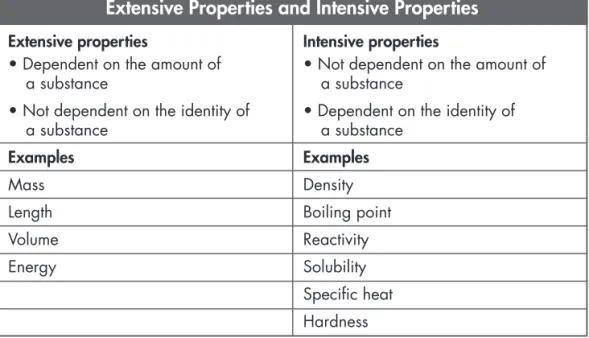
Some of the differences between extensive and intensive properties are listed in the table below.
Figure 2
Extensive Properties and Intensive Properties
Extensive properties
• Dependent on the amount of a substance
• Not dependent on the identity of a substance
Examples
Mass Length Volume Energy
Intensive properties
• Not dependent on the amount of a substance
• Dependent on the identity of a substance
Examples
Density Boiling point Reactivity Solubility Specific heat Hardness
TEKS 4B • Copyright © Pearson Education, Inc., or its affiliates. All Rights Reserved. 59
End-of-Course Assessment Review
1. Identify Which of the following is an example of an intensive property?
A mass
B thermal energy
C length
D density
2. Conclude A student measures the volume of a substance to be
3.25 mL. Can the student determine the identity of the substance from this measurement?
A No, because volume is an intensive property.
B No, because volume is an extensive property.
C Yes, because volume is an intensive property.
D Yes, because volume is an extensive property.
3. Apply Concepts You have measured the length and density of a
pure metal object in your chemistry lab. You will be able to identify the metal the object is made of because
A length is an intensive property.
B length is an extensive property.
C density is an intensive property.
D density is an extensive property.
4. Evaluate In a classroom discussion, one of your classmates argues
that mass and volume are intensive properties, not extensive proper-ties, because they give you information that helps determine the iden-tity of a substance. Is your classmate correct? Explain your answer.
5. Infer Iron oxidizes faster than gold. Is oxidation an example of an extensive property or an intensive property? Explain.
6. Analyze Data A student is given Substance X to analyze. He
measures the volume of the substance to be 3.25 mL, and the mass to be 2.55 g. The student also measures the boiling point to be 82.5 °C. Which of the following substances in the table below is the identity of Substance X? Explain two ways you can confirm the substance’s identity.
TEKS
Methanol
Isopropyl alcohol Water
Chloroform
64.7 82.5 100.0 61.2 Substance
2.55 5.11 3.25 4.60
Mass (g) Boiling Point (°C)
3.22 6.50 3.25 3.10 Volume (cm3)
TEKS 4B • Copyright © Pearson Education, Inc., or its affiliates. All Rights Reserved. 60
TEKS
REVIEW
TEKS_TXT
Compare solids, liquids, and gases in terms of compressibility, structure, shape, and volume.
4C
States of Matter
TEKS 4C
What are states of matter?
The three states of matter found commonly on Earth are solids, liquids, and gases. All of these states have different properties and characteristics. All matter is made of particles—atoms, molecules, or ions. The three states differ in how the particles they consist of are arranged and how these particles move in relation to one another. These differences are responsible for the unique characteristics of each state.
What is a solid?
A solid is a state of matter that has a definite shape and volume. The particles in a solid are held closely together, usually in a regular
arrangement, or pattern. Figure 1 shows what a solid might look like if you could zoom in to see the particles that make up the solid. You can see that the particles are packed closely together in a rigid arrangement.
Vocabulary
solid liquid gas
Figure 1 A Solid
All particles in matter are in constant motion, even the particles in a solid. But because the particles in a solid are held very close together, they are able only to vibrate in place. The particles cannot move around much relative to one another, and therefore solids do not flow. The shape of a solid does not change to fit the shape of a container it is in. For example, the shape of a rock does not change when it is moved from inside a small beaker to a large beaker.
Also, because the particles of a solid are held closely together, the volume of solids is nearly fixed. The particles that make up a solid can move only very slightly. As a result, solids are almost incompressible; that is, it is difficult to squeeze a solid into a smaller volume. In addition, solids expand only slightly when heated.
TEKS 4C • Copyright © Pearson Education, Inc., or its affiliates. All Rights Reserved. 61
What is a liquid?
A liquid is a state of matter that has an indefinite shape, flows, yet has a fixed volume. The particles in a liquid are held closely together. However, in a liquid, particles have enough energy to slide past one another. Figure 2 shows what a liquid might look like if you could zoom in to see the
particles that make up the liquid.
Figure 2 A Liquid
The ability of particles in a liquid to move around relative to one another leads to two characteristics that are different from those of a solid. First, liquids are able to flow. You can see this when you pour a liquid from one container to another or when water in a river flows downstream. Second, liquids are able to take the shape of the container they are in. If you pour a liquid from one container to another, the shape of the liquid changes to match the shape of the new container.
Because the particles in a liquid are only slightly farther apart than they are in a solid, the volume of liquids is nearly fixed. Liquids are only slightly more compressible than solids. They tend to expand slightly when heated.
What is a gas?
Similar to liquids, gases take on the shape of their container. But, unlike liquids or solids, gases can expand to fill the container that they are in. A gas is a state of matter that takes both the shape and volume of its
container. The large amount of space between gas particles allows a gas to be compressed. For example, if you add more air to a full bicycle tire, the air in the tire compresses—the particles that make up the air in the tire move closer together. When you let some of the air out of the tire, the particles move farther apart and the gas expands.
Figure 3 shows what a gas might look like if you could zoom in to see the particles that make up the gas. Notice that the particles in a gas are far apart and can move more quickly then in a solid or a liquid.
Study Tip
Make flash cards to study solids, liquids, and gases. On one side of each card, write a characteristic, such as “only slightly compressible.” Then write the appropriate state or states, such as “solids and liquids” on the other side.
Figure 3 A Gas
TEKS 4C • Copyright © Pearson Education, Inc., or its affiliates. All Rights Reserved. 62
End-of-Course Assessment Review
1. Compare Which of the following correctly describes the particles in a solid compared to the particles in a liquid?
A Particles in a solid are farther apart than particles in a liquid.
B Particles in a liquid are much farther apart than particles in a solid.
C Particles in a solid do not move at all, and particles in a liquid slide past one another.
D Particles in a solid vibrate in place and particles in a liquid slide past one another.
2. Identify Which observations were likely made of a gas?
A This substance completely filled only the bottom half of a container.
B The volume of this substance did not change when pressure was applied.
C When this substance was transferred from a smaller container to a larger container, its volume increased.
D When this substance was moved from one container to another, its shape stayed the same.
3. Analyze Which of the following correctly describes what happens
when an inflated balloon is compressed?
A When the gas is compressed, its particles get smaller.
B When the gas is compressed, its particles get closer together.
C When the gas is compressed, its particles get larger.
D When the gas is compressed, its particles get farther apart.
4. Apply Explain how inflatable packing materials and foam packaging
peanuts both rely on the properties of gases to keep objects safe during shipping.
TEKS
TEKS 4C • Copyright © Pearson Education, Inc., or its affiliates. All Rights Reserved. 63
TEKS
REVIEW
TEKS_TXT
R
E
a
d
in
E
S
S
Classify matter as pure substances or mixtures through investigation of their properties.
R
E
a
d
in
E
S
S
4D
Classifying Matter
TEKS 4D
How is matter classified?
One way matter can be classified is by the type and arrangement of the particles that it consists of. Using this method, matter can be classified into one of two broad groups—pure substances or mixtures. Each of these groups can be classified into subgroups.
What is a pure substance?
A pure substance is matter that has a definite composition. This means that the composition of a pure substance is always the same wherever it is found. Water is an example of a pure substance. Water is always made of molecules composed of one oxygen atom bonded to two hydrogen atoms. Another example of a pure substance is aluminum. Aluminum is always composed of only aluminum atoms.
Vocabulary
pure substance element compound mixture solution
Element
Pure substance
Definite composition (homogeneous)
Can be separated physically
Can be separated chemically
Compound
Homogeneous mixture
Uniform; also called a solution
Heterogeneous mixture
Nonuniform; distinct phases
Mixture of substances
Variable composition
Matter
TEKS 4D • Copyright © Pearson Education, Inc., or its affiliates. All Rights Reserved. 64
What are elements and compounds?
Pure substances can be classified as elements or compounds. An element is matter that is made up of only one type of atom. All elements are pure substances. Aluminum is an element. Other familiar elements are gold, helium, copper, iron, and oxygen.
A compound is matter that is made up of two or more different atoms chemically combined in a fixed proportion. All compounds are pure substances. Water is a compound. Other familiar compounds are carbon dioxide, sodium chloride (table salt), and glucose.
You cannot classify a sample of matter as an element or compound simply by looking at it. Both will have a uniform texture and color. The only way to identify whether the sample is an element or compound is to test its chemical properties. If the sample can be broken down by chemical changes into two or more different elements, it is a compound.
How do mixtures differ from a pure
substance?
A mixture is a physical blend of two or more substances that are not chemically combined. Nearly all of the matter that you come into contact with every day is a mixture. Wood, fabric, food, beverages, plastics, plants, and air are all examples of mixtures. Unlike a pure substance, the
components of a mixture can be separated using physical processes such as boiling and filtering.
The composition of a mixture can vary. For example, air is a mixture of nitrogen, oxygen, hydrogen, carbon dioxide, and other pure substances. The percentage of each of these gases can vary in different mixtures. For example, the percentage of oxygen in room air is about 21 percent, while the percentage of oxygen in air within an underwater dive tank can be below 20 percent.
To classify a sample of matter as a pure substance or a mixture, you must study its physical and chemical properties. If the texture and color of the matter vary, then you know that it is a mixture because all pure substances are uniform. However, if the substance has uniform texture and color, then you must determine whether physical means can separate the components. If so, the sample is a mixture because pure substances cannot be separated into different components by physical means.
What are homogeneous and heterogeneous
mixtures?
Mixtures can be either homogeneous or heterogeneous. A homogeneous
mixture is evenly mixed at the atomic level. Another name for a
homogeneous mixture is solution. Solutions have a uniform texture and color throughout. Variations in texture and color cannot be seen with the unaided eye or even with traditional microscopes. Solutions can be liquids, solids, or gases. Vinegar and fruit drinks made with a drink mix are
examples of liquid solutions. Alloys such as brass or steel are examples of solid solutions. Air is an example of a gaseous solution.
Study Tip
As you read about the different types of matter, use a graphic organizer, such as a spider map, to keep track of definitions, examples, and sketches of what each type of matter might look like at the atomic level.
TEKS 4D • Copyright © Pearson Education, Inc., or its affiliates. All Rights Reserved. 65
A heterogeneous mixture is one that is unevenly mixed. Different parts of a heterogeneous mixture have different compositions. You can see these differences with the unaided eye or with a traditional microscope. For example, a mixture of cereal, fruit, and milk is heterogeneous.
End-of-Course Assessment Review
1. Infer A student is given a sample of matter to classify. The sample is uniform in color and texture. Based on this information, the student can determine which of the following?
A The sample is an element.
B The sample can be an element or a compound.
C The sample is a homogeneous mixture.
D The sample can be a homogeneous mixture or a pure substance.
2. Classify A new material was produced in a laboratory by bonding
atoms of different elements together in a unique arrangement. Other laboratories were able to reproduce these results, producing the same material with the same elements in the same arrangement. What type of matter was produced?
A element
B compound
C homogeneous mixture
D heterogeneous mixture
3. Infer Vinegar is classified as a mixture. What does this tell you about vinegar?
A Vinegar is made of atoms of one type of element.
B Vinegar is made of atoms of different elements chemically bonded together.
C Vinegar has a composition that is the same wherever it is found.
D Vinegar contains two or more pure substances mixed together.
4. Classify When you look at blood with your unaided eyes, it has a
uniform texture and color. However, when you look at a blood sample under a microscope, you can see it contains platelets, red blood cells, and other particles suspended in a liquid. Is blood an element, com-pound, homogeneous mixture, or heterogeneous mixture? Explain your reasoning.
5. Conclude A student does a series of experiments on a sample of
unknown material. The student determines that physical processes are not able to break the sample into simpler substances. However, a chemical reaction produces carbon, hydrogen, and oxygen. What type of matter is the sample? Explain your reasoning.
TEKS
TEKS 4D • Copyright © Pearson Education, Inc., or its affiliates. All Rights Reserved. 66