Part III
Exchange Rate Risk Management
Information on existing and anticipated
economic conditions of various countries and on historical exchange
rate movements
Information on existing and anticipated
cash flows in each currency at each subsidiary
Forecasting Exchange Rates
Forecasting Exchange Rates
9
9
ChapterChapter
South-Western/Thomson Learning © 2003
Chapter Objectives
• To explain how firms can benefit from
forecasting exchange rates;
• To describe the common techniques used
for forecasting; and
• To explain how forecasting performance
Why Firms Forecast
Exchange Rates
• MNCs need exchange rate forecasts for their:
– hedging decisions,
– short-term financing decisions, – short-term investment decisions, – capital budgeting decisions,
Forecasting Techniques
• The numerous methods available for
forecasting exchange rates can be categorized into four general groups:
technical,
fundamental,
Technical Forecasting
• Technical forecasting involves the use of
historical data to predict future values. It includes statistical analysis and time series models.
• Speculators may find the models useful for
predicting day-to-day movements.
• However, since they typically focus on the
Fundamental Forecasting
• Fundamental forecasting is based on the
fundamental relationships between economic variables and exchange rates.
• A forecast may arise simply from a subjective
assessment of the factors that affect exchange rates.
• A forecast may be based on quantitative
Fundamental Forecasting
• Known relationships like the PPP can be used
for the regression models. However, problems may arise. In the case of PPP:
– the timing of the impact of inflation on trade
behavior is not known for sure,
– prices may be measured inaccurately,
– trade barriers may disrupt the trade patterns that
should emerge, and
Fundamental Forecasting
• In general, fundamental forecasting is limited
by :
– the uncertain timing of the impact of the factors, – the need for forecasts for factors with
instantaneous impact,
– the possibility that other relevant factors may be
omitted from the model, and
– changes in the sensitivity of currency movements
Market-Based
Forecasting
• Market-based forecasting involves developing
forecasts from market indicators.
• Usually, either the spot rate or the forward
rate is used, since speculation should push the rates to the level that reflect the market
Market-Based
Forecasting
• Since forward contracts have low trading
volumes and are not widely quoted, the
interest rates on risk-free instruments can be used to determine what the forward rates
Mixed Forecasting
• Mixed forecasting refers to the use of a
combination of forecasting techniques.
• The actual forecast is a weighted average of
Forecasting Services
• The corporate need to forecast currency
values has prompted some consulting firms and investment banks to offer forecasting services.
• Advice on hedging and international cash
management, and assessment of the firm’s exposure to exchange rate risk, may be
Forecasting Services
• One way to determine whether a forecasting
Evaluation of Forecast Performance
• An MNC that forecasts exchange rates should
monitor its performance over time to
determine whether its forecasting procedure is satisfactory.
• The MNC may also want to compare the
Evaluation of Forecast Performance
• One measure of forecast performance is the
absolute forecast error as a percentage of the realized value:
| forecasted value – realized value | realized value
• Over time, MNCs are likely to have more
Evaluation of Forecast Performance
• The ability to forecast currency values may
vary with the currency of concern.
• In particular, the value of a less volatile
Forecast Bias
• If the forecast errors are consistently positive
Forecast Bias
• The following regression model can be used to
test for forecast bias:
realized = a0 + a1 forecast +
• If a predictor is found to be biased, the
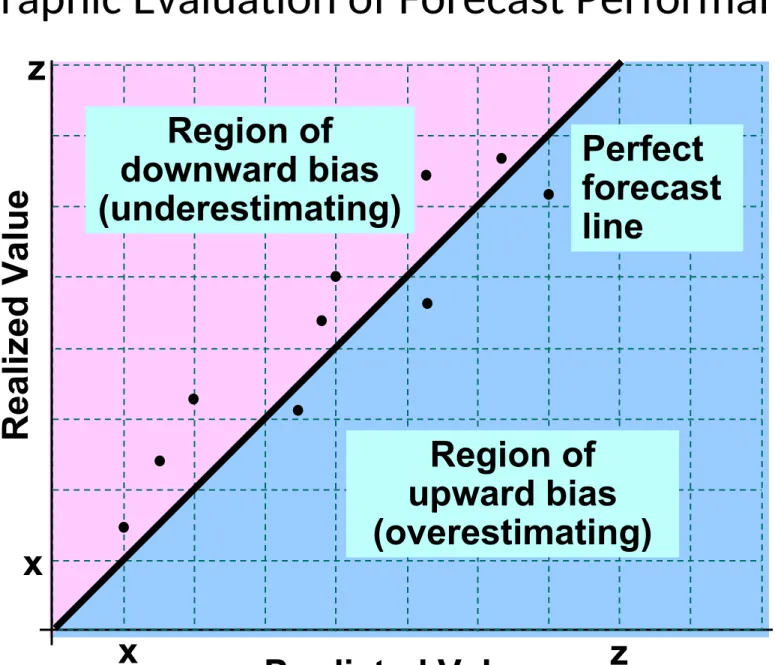
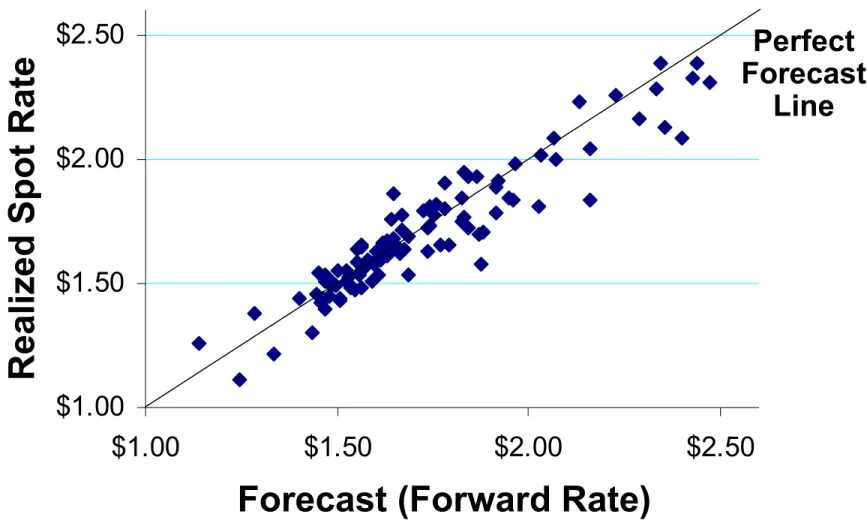
Graphic Evaluation of Forecast Performance
Using the Forward Rate as a Forecast for the British Pound
R ea li ze d S p o t R at e $1.00 $1.50 $2.00 $2.50
$1.00 $1.50 $2.00 $2.50
Forecast (Forward Rate)
Perfect Forecast
Graphic Evaluation
of Forecast Performance
• If the points appear to be scattered evenly on
both sides of the perfect forecast line, then the forecasts are said to be unbiased.
• Note that a more thorough assessment can be
Comparison of
Forecasting Techniques
• The different forecasting techniques can be
evaluated
– graphically - by comparing the distances from the
perfect forecast line, or
– statistically - by computing the mean of the
Forecasting Under Market Efficiency
• If the foreign exchange market is weak-form
efficient, then the current exchange rates already reflect historical information. So, technical analysis would not be useful.
• If the market is semistrong-form efficient, then
Forecasting Under Market Efficiency
• If the market is strong-form efficient, then all
the relevant public and private information is already reflected in the current exchange
rates.
• Foreign exchange markets are generally found
Forecasting Under Market Efficiency
• Nevertheless, MNCs may still find forecasting
worthwhile, since their goal is not to earn speculative profits but to use exchange rate forecasts to implement policies.
• In particular, MNCs may need to determine
Exchange Rate Volatility
• MNCs also forecast exchange rate volatility.
This enables them to specify a range
(confidence interval) and develop best-case and worst-case scenarios along with their point estimate forecasts.
• Popular methods for forecasting volatility
include:
Exchange Rate Volatility
the use of a historical time series of volatilities
(there may be a pattern in how the exchange rate volatility changes over time), and
Application of Exchange Rate Forecasting to the Asian Crisis
• Before the crisis, the spot rate served as a
reasonable predictor, because the central banks were maintaining a somewhat stable value for their respective currencies.
• But even after the crisis began, it is unlikely
that the degree of depreciation could have been accurately predicted by the usual
Application of Exchange Rate Forecasting to the Asian Crisis
• The large amount of foreign investment and
the fear of a massive selloff of the currencies played key roles in the sharp decline of the Asian currency values.
• However, these two factors cannot be easily
incorporated into a fundamental forecasting model in a manner that will precisely identify the timing and magnitude of currency
Chapter Review
• Why Firms Forecast Exchange Rates
• Forecasting Techniques
– Technical Forecasting
– Fundamental Forecasting – Market-Based Forecasting – Mixed Forecasting
• Forecasting Services
Chapter Review
• Evaluation of Forecast Performance
– Forecast Accuracy Over Time
– Forecast Accuracy Among Currencies – Search for Forecast Bias
– Statistical Test of Forecast Bias
Chapter Review
• Forecasting Under Market Efficiency • Exchange Rate Volatility
• Application of Exchange Rate Forecasting to
the Asian Crisis
• How Exchange Rate Forecasting Affects an