Examination of Balance Using Laboratory-Based and Clinical Measures in Female Survivors of Breast Cancer
Charlotte Shatten
A thesis submitted to the faculty of the University of North Carolina at Chapel Hill in partial fulfillment of the requirements for the degree of Masters of Arts in the Department of
Exercise and Sport Science (Exercise Physiology).
Chapel Hill 2012
Approved By:
Claudio Battaglini PhD Anthony C. Hackney PhD DcS Troy Blackburn PhD, ATC
ii
Abstract
CHARLOTTE SHATTEN: Examination of Balance Using Laboratory-Based and Clinical Measures in Female Survivors of Breast Cancer
(Under the direction of Dr. Claudio Battaglini)
This study compared laboratory-based and clinical measures of balance between 10 breast cancer survivors (BCS) and 10 healthy, age, weight, and physical activity level
matched controls (CNT). The single leg stance (SLS) and force plate parameters (sway speed
(SS) and sway path (SP)) were the main outcome variables. No statistically significant differences were found on the clinical SLS with either eyes open or closed between the BCS
and CNT groups (p=0.38, p=0.37; respectively). Additionally, no significant differences between groups were found on the laboratory-based measures SS or SP during any test condition (p≥0.05). In conclusion, no significant differences in balance using either clinical
or laboratory-based tests between BCS and CNT were observed in this study. It appears that the age differences in BCS enrolled in this study compared to other studies and the amount of
ii
Table of Contents
Chapters
I. Introduction...1
Statement of Purpose...5
Research Questions...5
Hypotheses...6
Definition of Terms ...6
Limitations ...9
Delimitations ...9
Significance of Study ...9
II. Review of Literature ...11
Breast Cancer Treatment and its Side Effects ...11
Anti-Cancer Treatment Side Effects Potentially Associated With Decreased Balance in Beast Cancer Survivors ...18
Sensory Input for Balance Control ...19
Laboratory Based and Clinical Measures of Balance...21
Laboratory Based Measures ...21
Clinical Measures ...23
Implications of Decreased Balance Control on Quality of Life in Breast Cancer Survivors ...24
Conclusion ...27
ii
Subjects ...28
General Procedures ...29
Instrumentation ...29
Clinical and Laboratory Based Balance Assessments ...29
Data Reduction ...31
Statistical Analyses ...31
IV. Results ...34
Hypothesis 1 ...36
Hypothesis 2 ...36
Hypothesis 3 ...36
Hypothesis 4 ...37
Hypothesis 5 ...37
Hypothesis 6 ...37
V.Discussion, Conclusion, and Recommendations ...38
Clinical Tests For the Assessment of Balance in Breast Cancer Survivors ...39
Laboratory Based Measures of Balance in Breast Cancer Survivors ...44
Conclusion ...48
Recommendations for Future Study ...48
iii
List of Tables
1. Common Chemotherapeutics for the Treatment of
Breast Cancer and Their Side Effects………...……15
2. Breast Cancer Survivor Group Treatment Characteristics...35 3. Descriptive Statistics For All Participants……….…. 35 4. Differences Between the Current Study and a
Similar Study Assessing Balance Using the SLS
Measured in Seconds………...………...………….41 5. SOT Results Between CNT and BCS ………...………..42
Chapter I Introduction
After skin cancer, breast cancer is the most frequently diagnosed cancer in women. In 2011, it was estimated that 288,130 women were diagnosed with breast cancer; of those
approximately 248,810 women were expected to survive (American Cancer Society: Breast Cancer Facts and Figures 2011-2012., 2011). Breast cancer is the second leading cause of cancer death in women; nonetheless the mortality rates for women with breast cancer have
been steadily declining since 1990 (American Cancer Society: Breast Cancer Facts and Figures 2011-2012., 2011). Advances in diagnosing technology and improved treatment have rendered most types of breast cancer successfully treatable, with survival rates as high as 90% (American Cancer Society: Breast Cancer Facts and Figures 2011-2012., 2011). The high survival rates for breast cancer leave a large population of women coping with
psychological and physiological side effects from the diagnosis of the disease and the harsh nature of its treatment. Chemotherapy is often used in conjunction with radiation and
potentially surgery to eradicate breast cancer cells. Commonly observed side effects of treatment include: reduced cardiorespiratory fitness, reduced muscle strength, increased fatigue (Courneya & Friedenreich, 1999), depression, peripheral neuropathy, vestibular
damage, and vision changes (Hile, Fitzgerald, & Studenski, 2010; Scaioli et al., 2006; Verstappen et al., 2005; Zhang, Liu, Ding, & Salvi, 2003). Some side effects reported in the
2
medical community due to their impact on the overall functionality, health, and quality of life
of survivors; one such side effect is a decreased ability to balance. Survivors anecdotally report that they are finding themselves using walls and railings during ambulation to help
maintain their balance and that tripping more frequently has become a regular occurrence while attempting to perform their regular activities of daily living.
The mechanism for balance decline in breast cancer survivors is understudied;
however, it is known that chemotherapeutic agents can be taxing to physiological systems that are important for the maintenance of balance (Griffin & Garnick, 1981; Sergi, Ferraresi,
Troiani, Paludetti, & Fetoni, 2003; Wampler et al., 2007). Balance requires integrated input from the somatosensory, visual, and vestibular systems; loss of one system’s input increases reliance on the input from another system. These systems provide redundant feedback in
order to allow for corrective torque from the muscles to stabilize posture (Peterka & Loughlin, 2004). Healthy, young populations correct for small perturbations in balance by
swaying about the ankles; muscles activate from the ankles toward the core, an ankle
strategy. In older populations, perturbations in balance cause posterior hip displacement and anterior chest or torso displacement, a hip strategy (Manchester, Woollacott,
Zederbauer-Hylton, & Marin, 1989). The hip strategy is seen mostly in populations that have deficit in their ankle strategy; those with injury or neuropathy often employ hip strategy in response to
displacements that healthy populations would employ ankle strategy (Horak, Nashner, & Diener, 1990a; Winters-Stone et al., 2011). In breast cancer survivors, due to the nature of anti-cancer treatment, physiological systems involved during maintenance of balance can be
3
Neuropathic pain occurs as a side effect of treatment by taxane in more than 50% of
women (Jung, Herrmann, Griggs, Oaklander, & Dworkin, 2005). The duration and extent of chemotherapy induced peripheral neuropathy (CIPN) is unclear, but is believed to impact
balance and other physical abilities that can negatively impact the quality of life of cancer survivors. Damage to the nerves in the feet and ankles commonly associated with taxane therapy can cause decreased proprioceptive sense. Proprioception allows the brain to
determine where the body is in relation to a surface and in relation to other parts of the body through the somatosensory system (van Deursen & Simoneau, 1999). Proprioception is
important not only for balance, but also as a protective mechanism upon painful sensory stimulation. Women who experience changes in proprioceptive input could be more likely to have decreased ability to maintain balance. CIPN can inhibit proprioceptive information in
ways similar to diabetic peripheral neuropathy. In people with diabetic peripheral
neuropathy, significant balance instability is a common occurrence, as well as an abnormal
shift from ankle to hip strategy to maintain proper balance (Horak, Nashner, & Diener, 1990b; Simmons, Richardson, & Pozos, 1997b). Decreased input from proprioception causes increased reliance on the vestibular and visual systems for the maintenance of
balance.
The vestibular system provides information on body orientation and movement.
Recent data have shown that vestibular deficit is present in breast cancer survivors, and that this is a positive predictor of a fall in this population (Winters-Stone et al., 2011). Age related degeneration of the vestibular and visual systems is common, (Rauch,
4
Speculations regarding negative changes in body composition associated with loss of
muscular mass with concurrent gain in fat mass (a condition called sarcopenic obesity) is a possible cause of decreased balance in cancer survivors. The musculoskeletal system is the
system responsible for locomotion, and is directly associated with the ability of humans to balance. However, one previous study that examined decreases in strength as a cause of decreased balance failed to confirm this possibility (Tysinger, 2010). No significant
differences when balance was measured through clinical variables (SLS, four square step test, and 360° turn) were observed between a group of breast cancer survivors and a control
group matched on age and fitness level. The authors suggested that breast cancer survivors, who had completed their major treatments within 6 months, were functional enough to be able to perform physical tasks similarly to their counterparts of similar fitness level, and that
the non-significant balance differences could be attributed to the lack of sensitivity of the clinical measures used for the assessment of balance (single leg stance, 360 degree turn, and
the four square step test for the assessment of static and dynamic balance) (Tysinger, 2010).
Only two studies have examined balance issues in breast cancer survivors using laboratory-based measurements, and both confirmed that balance is compromised (Wampler
et al., 2007; Winters-Stone et al., 2011). One unpublished study found no difference between breast cancer survivors and apparently healthy controls (Tysinger, 2010). Therefore, the use
5
Statement of the Purpose
The purpose of this study was to compare clinical and laboratory-based measures of balance between early stage breast cancer survivors and apparently healthy, sedentary
age-matched controls. Exploratory analyses evaluating balance using the NeuroCom Sensory Organization Test in both breast cancer survivors and controls were performed as an attempt to identify potential explanations of balance disruption.
Research Questions (R)
R1. Is there a difference in number of seconds that breast cancer survivors (BCS) and
apparently healthy, age and weight matched controls (CNT) can perform a clinical single leg stance (SLS) with the eyes open?
R2. Is there a difference in the number of seconds that BCS and CNT can perform a clinical
SLS with the eyes closed?
R3. Is there a difference in the sway speed (centimeters/second) between BCS and CNT
during a SLS on a force plate with the eyes open?
R4. Is there a difference in the sway speed between BCS and CNT during a SLS on a force plate with the eyes closed?
R5. Is there a difference in the sway path (cm) between BCS and CNT during a SLS on a force plate with the eyes open?
6
Hypotheses (H)
H1. There will be no significant difference in the number of seconds that the clinical single leg stance is performed between BCS and CNT with eyes open.
H2. There will be no significant difference in the number of seconds that the clinical single leg stance is performed between BCS and CNT with eyes closed.
H3. The CNT group will have a slower sway speed when compared to the BCS group with
eyes open during the single leg stance when sway speed is measured in centimeters/second (cm/s) through the force plate.
H4. The CNT group will have a slower sway speed when compared to the BCS group with eyes closed during the single leg stance when sway speed is measured in centimeters/second (cm/s) through the force plate.
H5. The CNT group will have a smaller sway path when compared to the BCS group during the single leg stance with eyes open when the center of pressure is measured in centimeters
through the force plate.
H6. The CNT group will have a smaller sway path when compared to the BCS group during the single leg stance with eyes closed when the center of pressure is measured in centimeters
through the force plate.
Definition of Terms
7
recreational therapy 3 times per week for 5 months. Eligible participants have completed
their planned anti-cancer therapy (including chemotherapy, radiation therapy, and surgery) within the prior six months and may currently be receiving adjuvant therapy (“Get REAL and
Heel: An After Care Breast Cancer Program,” 2009).
Breast Cancer Survivors: A group women treated for breast cancer who have completed their major therapy (chemotherapy, radiation therapy, or combination of these treatments) within 6
months and could be undergoing adjuvant therapy at the time of data collection.
Clinical Measures of Balance: Measures that are easily used in clinics, require few materials,
and little specific training. They can be easily conducted in a short amount of time and can provide basic information on balance performance. Performance information is usually assessed by how long the subject can complete the task, or by how long it takes the subject to
complete the task. Included in these measures is the timed single leg stance.
Laboratory-Based Measures of Balance: Measures that are likely to be used in laboratories,
require specific training for use, and are typically costly. Often, these measures provide specialized information on balance and sensory input; included in these measures are force plate assessments.
Center of Pressure: the point of application of force between the feet and the force platform (van Schie, 2008).
8
Sway Speed: a kinematic term often estimated from center-of-pressure measures derived from force plate data; the speed of center of pressure displacement is related to increased
instability (Peterka & Loughlin, 2004; Winter, Patla, Prince, Ishac, & Gielo-Perczak, 1998).
Static Balance: The ability to control the body while in a stationary position (Thibodeau & Patton, 1996).
Peripheral Neuropathy: Decreased sensation and proprioception, particularly on the plantar
surface of the feet, ankles, and lower legs. Peripheral neuropathy can cause feelings of instability, increased falls, and increased risk of foot injury (van Deursen & Simoneau,
1999).
Vestibular System: A compilation of organs in the inner ear. Receptors called maculae, which contain hair cells, are located in the saccule and utricle in the inner ear and are critical
for regulation of static balance. During dynamic balance tasks, crista ampullaris within the semicircular ducts respond to angular or rotary movement. The vestibular system initiates
responses that fix the eyes on objects and activate muscles to maintain balance in response to acceleration and direction changes (Marieb & Hoehn, 2007).
NeuroCom Sensory Organization Test: A static balance assessment with 6 conditions.
During the six conditions sensory information is altered or inhibited through sway referenced movement of the force platform or visual surround to provide a quantitative analysis of
9
Limitations
1. Anti-cancer treatment differences (based on cancer stage, treatment type, and duration of treatment) within the BCS group could cause differences within the measurement of
variables in this study.
2. All subjects in the BCS group will completed their major treatments within 6 months, but those who have completed treatment more recently may be experiencing more severe
treatment related side-effects.
3. The minimum sampling time for the force plate is about 10 seconds; many breast cancer
survivors may not reach this.
Delimitations 1. All subjects in the BCS group were participants in the Get REAL and HEEL Breast
Cancer Program and were recruited via hospitals and clinics around the triangle and through the Great REAL and HEEL web page.
2. All subjects in the BCS group were diagnosed with stage I, II, or III breast cancer and had completed their major therapy within the preceding six months.
3. All patients in the BCS group had undergone chemotherapy and/or radiation as part of
their major treatment plan. Significance of the Study
Balance deficits in breast cancer survivors appear to be a quality of life and safety issue. Studies examining this issue are scarce; currently, only three studies have examined the issue of balance deficits in breast cancer survivors (Tysinger, 2010; Wampler et al., 2007;
10
Winters-Stone et al., 2011). The only study using clinical measures showed no difference in
balance between BCS and CNT (Tysinger, 2010). Sensitivity issues associated with the clinical measurements used may have been the cause of non-significant difference in balance
between BCS and CNT. The latter study indicates the importance of evaluating the
sensitivity of clinical measurements so clinicians can used them confidently when diagnosing balance deficits in breast cancer survivors. Balance changes in breast cancer survivors after
completion of major therapy appears to be an important issue that has been understudied. This study will add to the current knowledge regarding this potential issue. This will allow
Chapter II Review of Literature Introduction
The American Cancer Society estimated, that about 248,810 women became
survivors of breast cancer in 2011 (American Cancer Society: Breast Cancer Facts and Figures 2011-2012., 2011). Many of these survivors have undergone various types of treatments and are coping with the associated side effects. In the following review of
literature: a brief description of side effects related to anti-cancer treatment, treatment related decreases in balance, laboratory-based and clinical measures of balance, and the implications
that decreased balance may have on the quality of life of breast cancer survivors will be provided.
Breast Cancer Treatment And Its Side Effects
Cancer treatment is typically a combination of surgery, radiation, chemotherapy, and adjuvant therapy. Adjuvant therapy occurs after surgery and consists of long-term,
preventative drugs, and/or chemotherapy, and/or hormonal therapy when no detected cancer is left in the body. Each treatment option has different risks and benefits depending on adjuvant therapy type, duration, and patient response
13
Surgery can range from removal of only the tumor (lumpectomy) to removal of the entire
breast, all surrounding lymphnodes, and part of the muscles of the chest wall below the breast (radical mastectomy). This is dependent on the tumor size and extent of lymphnode
involvement. Often following surgery, chemotherapy and/or radiation therapy are given to ensure that all tumor cells are eradicated (“Breast Cancer Treatment Physician Data Query,” 2011).
Radiation therapy involves treatment with high-energy ray or some other radioactive substance to eradicate cancer cells in a localized region. Radiation can be through an
external beam, or through brachytherapy. External beam radiation often involves x-rays aimed externally at the area around the tumor or tumor site. Brachytherapy involves small pellets of radioactive material placed directly into the breast tissue near the tumor. Radiation
treatment, duration, and intensity are dependent on the tumor stage and the extent of
lymphnode involvement. Radiation therapy is often given after breast conserving surgery to
ensure that cancer cells are eliminated (“Breast Cancer Treatment Physician Data Query,” 2011).
In addition to radiation therapy, hormone therapy is an alternate type of adjuvant
therapy. Hormone therapy is available to women with hormone sensitive tumors as some tumors rely on estrogen to grow. Hormone therapy stops hormone production or blocks
hormone action to stop tumor growth. Treatment with the drug tamoxifen blocks the action of estrogen on the breast tissue in pre-menopausal women. Instead of blocking estrogen’s action, aromatase inhibitors decrease the body’s estrogen production and therefore prevent
the growth of estrogen dependent tumors. Aromatase inhibitors are given to
14
estrogen production is by ovarian ablation, which stops the ovaries from functioning.
Ovarian ablation can cause a women to go through menopause prematurely and can allow for other hormonal therapies to be more effective (“Breast Cancer Treatment Physician Data
Query,” 2011).
Chemotherapy is available in many different forms and with various different dosing protocols. Chemotherapy can be given as either adjuvant therapy, after surgery, or
neo-adjuvant therapy to shrink the tumor before surgery. Unlike radiation therapy, chemotherapy is a systemic treatment and is given either through a pill, intravenously, or through the
cerebrospinal fluid. Chemotherapy protocols and treatment plans are based on the tumor type, tumor location, and lymphnode involvement (“Breast Cancer Treatment Physician Data Query,” 2011). Chemotherapy has evolved over the past 40 years; achievements in
technology and the ability to assess biomarkers in cancer has improved breast cancer outcomes by 15-20% (Swain, 2011). Physicians now have the ability to assess patient
tumors and design chemotherapy regimens based on tumor receptors. The ability to provide targeted chemotherapy based on tumor receptor type and menopausal status has helped to increase efficacy of cancer treatment (Nurgalieva et al., 2010).
Chemotherapy is given based on the type of cancer, the genetics of the patient, other chronic illness, and concurrent medication use (“Breast Cancer Treatment Physician Data
Query,” 2011). For many women who need to receive chemotherapy, anthracyclines are the typical “first line” for the treatment of breast cancer. Anthracyclines are often given in combination with cyclophosphamide (AC). A few of side effects of AC therapy are as
15
that are given for adjuvant treatment are combination, cyclophosphamide, methotrexate,
flouracil or cyclophosphamide and doxorubicin, and taxane/cyclophosphamide (Muss et al., 2009). Each regimen has its own battery of side effects as well as potential benefits that
surpass the scope of this study. However, common chemotherapeutics for the treatment of breast cancer are outlined in Table 1.
Table 1. Common Chemotherapeutics for the Treatment of Breast Cancer and Associated Side Effects: Some of These Could Negatively Affect Balance.
Chemotherapeutic Side Effects Potential Effect on Balance
Anthracyclines Cardiotoxicity n/a
Taxanes Peripheral neuropathy
(Argyriou et al., 2005; Hile et al., 2010; Nurgalieva et al., 2010)
Decreased
somatosensory feedback
5-Flouroucil, corticosteroids, tamoxifen,
cyclophosphamide, taxane
Vision changes (Griffin & Garnick, 1981)
Decreased visual information Cisplatin Vestibular damage (Sergi
et al., 2003)
Decreased vestibular reference information Aromatase inhibitors Bone loss (Mincey et al.,
2006)
n/a
The drug class, taxane, comes in two active forms, docetaxel and paclitaxel. Paclitaxel comes from the bark of the Pacific yew tree and has a higher risk of neuropathy
when compared to its counterpart docetaxel, which is semi-synthetic (Hagiwara & Sunada, 2004; Wickham, 2007). According to Swain (2011), the addition of taxane therapy is beneficial to most women who have been diagnosed with breast cancer. The addition of
docetaxel to routine adjuvant chemotherapy treatment has improved outcome and quality of life for many women, in addition to limiting other adverse effects of combination therapy
16
75% for the TAC group compared to 68% in the FAC group. Additionally, TAC reduced the
risk of recurrence by 39% and 17% in women with either three or four positive lymphnodes respectively. Toxicity was higher in the TAC group, with the most common toxic side being
neutropenia (Martin et al., 2005). Although it appears that the risks of toxic side effects are increased, the addition of docetaxel seems to increase the rates of event free survival in women with lymphnode positive breast cancer.
Peripheral neuropathy is a common side effect that is caused by taxane therapy can be attributed to microtubule aggregation in the distal nerves of the feet and hands. Microtubules
allow for intracellular transport, cell division, and structural support; aggregation inhibits these vital functions and causes demyelination and slowed nerve conduction. As smaller distal nerves demyelinate and loose their nutrient supply, numbness, paresthesias, and
burning occur often starting at the toes and plantar surface of the feet (Hagiwara & Sunada, 2004).
A well-documented side effect of taxane therapy is peripheral neuropathy. In a study by Argyriou et al. (2005) 21 adults being treated with paclitaxel 66.6% presented with signs and symptoms of neuropathy after treatment of 175 mg/m2 per dose. The neuropathy started
in the lower limbs and progressed to the upper limbs (Argyriou et al., 2005). This is consistent with other studies which found that patients treated with a platinum-taxane
combination therapy were twice as likely to develop peripheral neuropathy (Nurgalieva et al., 2010). A case report by Hile et al. (2010) outlined the disability implications of paclitaxel induced peripheral neuropathy. During the adjuvant treatment of breast cancer, an elderly
17
after cessation of therapy; the patient reported falls, cane use, and mobility- related disability
(Hile et al., 2010).
In addition to taxane induced peripheral neuropathy, chemotherapeutics can also
damage other systems that are directly related to the maintenance of balance (Table 1). Vision changes associated with chemotherapy can cause postural control disturbances. No studies were found on the relationship between breast cancer, vision and chemotherapy
treatment. A review by Griffin and Garnick (1981) outlines many chemotherapeutics and the changes to the visual system that occur as side effects. This review includes common
chemotherapeutics used during the treatment of breast cancer including: 5-flourouracil, corticosteroids, tamoxifen, and cyclophosphamide, and their effects on vision during and after infusion (Griffin & Garnick, 1981). In a study of paclitaxel treated patients (n=32), 15
patients showed visual electrophysiological changes during paclitaxel treatment. Fourteen patients displayed positive clinical/electrophysiological correlations; although there were no
positive correlations between positive spontaneous visual symptoms and the chemotherapy treatment (due to occurrence in both groups). This study suggests that the visual changes induced by paclitaxel could be due to optic nerve changes or vasculature changes to the
retina (Scaioli et al., 2006). Tan and Walsh (1998) also documented paclitaxel ocular toxicity in a brief report. Two male patients were treated with paclitaxel for squamous cell
lung cancer complained of blurred vision, light flashes, and numbness during infusion. Symptoms in both patients resolved within an hour after infusion; this was attributed to vasospasticity (Tan & Walsh, 1998). In children (n=5) being treated with cyclophosphamide,
18
patients undergoing chemotherapy seem to be fleeting; however, poor visual acuity is
associated with diminished postural control. Occlusion of the peripheral visual field
increased postural sway in older adults (n=16) (Manchester et al., 1989). Decreased foveal
visual feedback alone resulted in diminished postural stability (Manchester et al., 1989).
Vestibular damage caused by cisplatin therapy has been documented in animal studies. Eight guinea pigs were injected with cisplatin for 6 days; a significant decrease in
the vestibular-ocular reflex was found at the end of treatment along with a decrease in hair cells in both the cristae and utricular maculae (P > 0.625 & P > 0.907 respectively) (Sergi et
al., 2003). In relation to breast cancer survivors, Winters-Stone et. al. (2011) found that women had decreased vestibular input during the Neurocom SOT. This finding could suggest changes to the vestibular system caused by cancer treatment (Winters-Stone et al.,
2011).
Anti-Cancer Treatment Side Effects Potentially Associated with Decreased Balance in Breast Cancer Survivors
Balance changes in female breast cancer survivors were first explored by Wampler et al. (2007). Upon examination of 20 breast cancer patients treated with taxane therapy, the breast cancer group had decreased balance outcomes as assessed by the NeuroCom SOT
when compared to healthy, matched controls (Wampler et al., 2007). The women who had been treated with taxane therapy performed more poorly on both measures when compared
with healthy controls (Wampler et al., 2007).
Recently, Winters-Stone et al. (2011) found that a group of post-menopausal breast cancer survivors had decreased vestibular input during balance testing with the NeuroCom
19
breast cancer; 76% of their study population experienced a fall from a year prior to study
enrollment to 6 months thereafter (Winters-Stone et al., 2011). In addition to measuring balance with the SOT, they assessed: gait speed, maximal lower limb strength, functional
lower body strength, muscular power testing, muscle mass, visual acuity, spatial contrast sensitivity and self reported fall history. Subjects who took longer to read letters on the contrast sensitivity chart were more likely to have a history of falls. Interestingly, the
vestibular portion of the SOT was the only mediator of the relationship between treatment and falls. All past- fallers had lower scores on condition 5 of the SOT, which attributed to
lower vestibular scores, but having a low vestibular score could not predict future falls. Furthermore, the chemotherapy only group was more likely to have experienced a fall than the chemotherapy plus endocrine therapy group, or the endocrine therapy only group. This
study suggests that changes to the vestibular system could be caused by cancer treatment (Winters-Stone et al., 2011). Effective maintenance of balance requires sensory input from
the visual, vestibular, and somatosensory systems. Altered or inhibited input from any of these systems could have a negative impact on balance.
Sensory Input for Balance Control
In diabetic populations, the presence of neuropathy (DPN) is regarded as the key factor in loss of independence and as having a major impact on quality of life (van Schie,
2008). Peripheral neuropathy also impacts postural control in diabetics (Lafond, Duarte, & Prince, 2004; van Deursen & Simoneau, 1999; van Schie, 2008). In a study of 11 elderly patients with type 2 diabetes mellitus and 20 healthy elderly individuals, patients with
20
This indicates that patients with DPN had poorer standing postural control than their healthy
elderly counterparts. One limitation to most studies assessing peripheral neuropathy is the difficulty in quantifying the severity of the neuropathy. Severity of DPN depends on the
degree of neuropathy and the size fibers that are affected; the smaller the afferent fiber affected, the more severe the balance deficit (Nardone, Galante, Pareyson, & Schieppati, 2007). In a study of sensory neuron disease (SND) (n=11), it was found that patients with
SND had greater sway areas; and were limited similarly in sensation, but had fewer motor deficits than those with DPN (n=14) (Nardone et al., 2007).
Horak et al. (1990) preformed a within subjects experimental study to obtain information pertaining to neuropathy and decreased postural control caused by ischemia. They found that during the ischemic trail, muscle activation pattern changed favoring the use
of a hip strategy to maintain upright balance during the SOT. The muscles used to maintain balance changed based on the amount of hip displacement used to illicit a postural change
response; all 6 subjects showed increased use of the hip strategy during the somatosensory loss trial (Horak, Nashner, & Diener, 1990a). After extensive PubMed search, no studies were found indicating the use of a hip strategy or an ankle strategy in any cancer population.
Nashner et al. (1982) found that the vestibular system has two important roles in postural control inputs: first, when combined with inputs from the visual and somatosensory
system the vestibular system helps to maintain equilibrium control. Second, the vestibular system provides orientation reference which conflicts the information given by the visual and somatosensory system. Patients with vestibular deficit were unable to suppress the influence
21
visual and proprioceptive stimuli which elicited postural stability disturbances (n=12)
(Nashner, Black, & Wall, 1982).
Laboratory-based and Clinical Measures of Balance
No studies were found that validate the use of any clinical or laboratory measures of postural control in any cancer population. Additionally, no studies were found that use the single legged stance to measure postural control, a force plate was used to measure postural
control in one study with a cancer population (Wampler et al., 2007). Two studies were found that used the NeuroCom SOT in the breast cancer population (Wampler et al., 2007;
Winters-Stone et al., 2011).
Laboratory-based Measures of Balance.
The NeuroCom Sensory Organization Test (SOT) is used regularly in the assessment
of balance in concussed athletes and other populations. The NeuroCom Balance Master is an apparatus that consists of a moveable visual surround and a moveable force platform; the
force platform and visual surround move in a sway-referenced fashion (“Sensory
Organization Test,” 2011). In cancer populations (specifically breast cancer), there have been a few studies using the SOT to assess balance. Two studies used the SOT to assess
balance in women with breast cancer; one assessed women that were treated with taxane therapy (Wampler et al., 2007) and the other to assess fracture risk in post-menopausal
breast cancer survivors (Winters-Stone et al., 2011). In Wampler et al. (2007), twenty women treated with taxane chemotherapy for breast cancer with no central nervous system metastases were recruited; postural control was measured with a force plate and the SOT.
22
conditions except for quiet standing; women who were treated with taxane therapy showed
poorer static and dynamic postural control. Recently, Winters-Stone et al. (2011), assessed breast cancer survivors’ postural control with the SOT. This study’s purpose was to evaluate
fracture risk in breast cancer survivors (n=59). The SOT was used to evaluate postural control; this study found that breast cancer survivors have decreased vestibular input, and those treated with chemotherapy only were 1.96 times more likely to have a fall
(Winters-Stone et al., 2011). In addition to the SOT, force plates have been used to detect balance changes in clinical populations.
The use of a force plate to measure sway path and sway speed has been conducted in only one study to my knowledge (Wampler et al., 2007). Wampler et al. (2007), found that women who were treated with taxane therapy had increased center of pressure velocities
when compared to controls. Force plates have also been used in populations with vestibular loss and peripheral neuropathy to identify balance deficits. In a study of 12 patients with
vestibular lesions and 2 without, it was found that under stable conditions, there was little difference between disordered patients and healthy ones. When deprived of a stable support surface and visual input, patients with severe vestibular lesions performed more poorly on
feet together balance tasks. The authors concluded that vestibular input provides the orientation reference when conflicting visual and proprioceptive information are provided,
and that when vestibular information is inhibited, decreases in balance occur (Nashner et al., 1982). In an other study, patients with vestibular loss swayed excessively or lost balance under conditions of inaccurate somatosensory information, accurate vestibular information,
23
In patients with diabetic peripheral neuropathy, ample information is available
regarding postural sway. In a study of 50 patients with either diabetes (n=27) or bilateral cutaneous sensory deficit (n=23), patients with cutaneous deficit displayed increased postural
instability when compared to the diabetes group. These results indicated significant balance loss associated with cutaneous deficit (Simmons, Richardson, & Deutsch, 1997a). In another study assessing static balance in patients with diabetic sensory neuropathy, 11 elderly
patients with diabetic sensory neuropathy were age matched to healthy elderly controls; COP displacement was assessed with a force plate in the medial-lateral and anterior-posterior
directions. The COP displacement was significantly greater for diabetic peripheral neuropathy group in both the anterior-posterior and medial-lateral directions, indicating increased postural sway and increased instability in this population (Lafond et al., 2004).
Clinical Measures.
Most clinical measurements are based on visual judgment of steadiness. Haupstein &
Goldie (2000) validated the use of the single legged stance test (SLS) to determine postural stability. A videotape of 20 five-second SLS balance performances were shown to 14 experienced physiotherapists; intraclass correlations (ICC) were used to assess the reliability
of the observers as well as the reliability of the test. The intra-observer reliability was high (ICCaverage= 0.88) as well as inter-observer reliability (ICCtest1= 0.81, ICCtest2= 0.82). Each
physiotherapist watched the balance performances twice in order to determine inter-rater performance. The errors of visual judgment were consistent across all groups, additionally the correlations between the visual judgments and steadiness measured by the force platform
24
found between the non-fallers, the single-fallers, and the multi-fallers using the clinical SLS
test. However, the SOT produced statistically significant differences between the groups (Buatois, Gueguen, Gauchard, Benetos, & Perrin, 2006). This finding supports the need for
clinical use of sensitive measures of balance in clinical populations in which falls can be devastating.
Implications of Decreased Balance Control on Quality of Life in Breast Cancer Survivors
Poor balance is one of the major risk factors for falling (Choy, Brauer, & Nitz, 2003).
In an elderly population, it is estimated that 1 in 3 people older than 65 years old will fall in a 12-month period (Cho & Kamen, 1998; Lord, Clark, & Webster, 1991). However, Winters-Stone et al. (2011) found that a group of post-menopausal breast cancer survivors had higher
rates of falling than the average fall rate for elderly community dwelling adults. It has been shown that prevention of falls is easily obtained through interventions and training
(Madureira et al., 2007). Ensuring that a clinical assessment of balance is sensitive enough to detect disordered balance in a population is essential for developing interventions and
preventing falls.
Women who have been treated with chemotherapy, are on adjuvant endocrine therapy or are postmenopausal could have lower bone density. Adjuvant hormonal therapy is used to
block estrogen production in women with estrogen positive tumors, which can cause
accelerated bone loss, which can lead to an increased risk of fracture. Increased risk of falls and lower bone density can increase the risk of fracture among cancer survivors; this can
25
A study by Chen et al. (2005) compared bone density and the rate of change in bone
mineral density (BMD) between 209 breast cancer survivors and 5759 non-cancer subjects. Using dual- energy x-ray absorptiometry (DEXA) scans on posterior-anterior spine, total hip,
total body it was found that breast cancer survivors had a significantly higher prevalence rate of osteoporosis at the hip and total body, but not at the spine (Chen et al., 2005). There was no difference in bone mineral density between the groups, but some subjects did not return
for follow up measurements, which Chen admitted could have caused the discrepancy. Unlike Chen et al, Kanis et al. (1999) found that women with non-metastatic breast cancer
had an increased risk of vertebral fracture. Kanis’s study compared two groups of breast cancer patients (one group was first time diagnosis; the other was a second time diagnosis with soft tissue metastasis) with controls (n=1210). They found that women with first time
diagnosis were not significantly different in the prevalence of fractures when compared with the controls. Conversely, women with soft tissue relapse were 6 times more likely to have a
vertebral fracture (Kanis et al., 1999). Women who had a diagnosis of breast cancer of any type also had a higher incidence of vertebral fracture than controls when followed after diagnosis, regardless of age. Fractures were also more likely to occur in women with
metastasis (Kanis et al., 1999).
Women with endocrine sensitive tumors are often treated with endocrine therapy to
suppress estrogen production. Decreased estrogen can lead to amenorrhea and decreased bone density. Winters-Stone et al. (2009) found that women with breast cancer had lower spine bone mineral density (BMD) than controls, as well as increased fall rate, decreased
26
chemotherapy. Bone mineral density of the greater trochanter, femoral neck, total hip and
lumbar spine were assessed via DEXA. Falls and fracture rates were collected via self-report; there was no difference between the groups (control group n=28) in regards to BMD.
Women who were taking adjuvant endocrine therapy had significantly lower BMD when compared to controls, and a higher percentage of women with breast cancer had a lower BMD when compared with controls (Winters-Stone, Nail, Bennett, & Schwartz, 2009).
Adjuvant hormonal therapy is an important component of maintenance therapy for women with estrogen sensitive tumors. Aromatase inhibitors (AI) block estrogen production
and can cause bone loss (Mincey et al., 2006). Mincey et al. (2006) studied 12,368 breast cancer patients with no bone metastases via an insurance billing claim database; of these patients 1,354 received AI therapy. Using prevalence and incidence analysis, this study
found that treatment with AI was associated with an increased risk for bone loss and bone fracture (incident rate of bone loss for treatment group and control groups =5.99 and 4.66
respectively) (Mincey et al., 2006). The AI group was also associated with a 1.35 fold increase in fracture risk (Mincey et al., 2006). In another study involving AI therapy, Edwards et al. (2011) found an increased number of hip fractures among middle-aged
women. This study of 226 cases of fractures reveled that in women < 64 years there were 78 hip fractures and 15 femur fractures associated with the use of AI (n=149) (Edwards et al.,
2011). According to Winters-Stone et al. (2011), patients with cancer may have an increased risk of falling due to an accumulation of risk factors that they share with geriatric
populations. One study has been performed assessing fall incidence and fracture risk in
27
Using clinical tests that have been correlated with fall risk, Overcash and Rivera
(2008) assessed fall risk in patients with cancer. Twenty participants (age 68-83 years) with breast cancer, leukemia, lymphoma, blood disorders, and adenocarcinoma were assessed with
the Timed Up and Go Test, fall questionnaires, and the Simmons Physical Test Performance Battery. Thirteen subjects reported a fall within one year (n=13), within the past three months (n=15) and some subjects recalled falls since cancer diagnosis (n=12); only falls
within one year correlated with the Timed Up & Go Test (Overcash & Rivera, 2008).
These data indicate the need for fall risk assessment in cancer patients. Balance
assessment can help researchers and clinicians assess fall risk, decrease fracture risk, and allow for the patient to receive proper rehabilitative therapy.
Conclusion
Current literature is inconclusive about the issue of balance in the BCS population and points to the need to further examination of balance in the group. Assessment of balance
Chapter III Methodology Subjects
This cross-sectional, descriptive study assessed balance in women who had been
diagnosed with stages I-III (non-metastatic) breast cancer, undergone anti-cancer treatment (chemotherapy, surgery, radiation, or combination), and are currently taking maintenance hormonal therapy or chemotherapy. Ten breast cancer survivors (BCS) who had been treated
with chemotherapy and 10 age, weight, and pre-treatment physical activity level matched controls (CNT) enrolled to participate in this study. In order to be eligible for this study,
women with breast cancer must have been treated with chemotherapy during their major therapy and have completed their major therapy ≤ 6 months prior to recruitment. Breast cancer survivors were recruited from The University of North Carolina at Chapel Hill
(UNC-CH), Get REAL and HEEL After Care Breast Cancer Research Program. Controls were recruited via word of mouth. To be included in this study, subjects may not have had chronic
bone, joint or muscular abnormalities that compromised their ability to stand for a prolonged period of time. Additionally for the BCS group, renal function with creatinine <1.5 mg/dL, immune deficiency that would compromise the patient’s health, absolute neutrophil count
<1.5 uL of blood, platelet count test <90,000 per uL of blood, blood hematocrit <30%, or a diagnosis of metastatic disease would exclude participation from Get REAL and HEEL and
28
provided by an oncologist. To be included as a control, subjects must have been: apparently
healthy, sedentary women, with no history of chronic disease, between the ages of 25-75 years, have no orthopedic problems that would limit the ability to stand unassisted, have no
know vestibular problems, taking no medication that would cause balance disturbances, and must have been classified as “low risk” per American College of Sports Medicine guidelines (Thompson, Gordon, & Pescatello, 2010).
This study employed the use of clinical and laboratory-based measures of balance. The clinical measure, the single legged stance (SLS), was based on time performance as
determined by an observer and measured with a stopwatch in seconds to the nearest hundredth. The laboratory-based measures included the measurement of sway speed and sway path during the SLS using the force plate.
General Procedures
Breast cancer survivors performed a series of fitness assessments as part of their
initial evaluation in the Get REAL & HEEL Breast Cancer Research Program. This initial series of fitness assessment included: body composition assessment, clinical assessment of balance, cardiovascular submaximal testing, upper and lower body muscular strength testing,
and upper and lower body muscular endurance testing. For this study, only the measurements of balance were used for analyses. Strength and cardiovascular testing
29
Instrumentation
Prior to testing, all subjects underwent height and weight measurements on the Health-o-Meter 402KL (Rye, NY) stadiometer and physicians scale. Advanced body
composition analysis was performed by dual x-ray absorpometry (DEXA) for the BCS group. For the timing of the clinical SLS, a stopwatch (Accusplit Survivor III, Model Magnum XL, Livermore CA) was used.
A force plate (Bertec Model 40 60, Columbus, OH) was used to obtain ground reaction forces (Motion Monitor version 5, Chiacago, IL) during the SLS. Custom LabView
software (National Instruments 2011, San Antonio, TX) was used to evaluate sway path and sway speed. The force plate sampled at 1000 Hz, each trial lasted 30 seconds. A custom made electronic event trigger was used to mark each fall during the trials. A fall was
considered one of the following scenarios: if the knee touched the standing leg, if the non-standing foot touched the ground, or if the eyes opened during an eyes-closed trial.
Clinical and Laboratory-Based Balance Assessments
Prior to balance testing, the BCS group underwent body composition analysis via the DEXA located in the Integrative Oncology Laboratory at UNC-Chapel Hill. Balance testing
was performed in the Neuromuscular Research Laboratory at UNC-Chapel Hill. Prior to balance testing subjects were asked to determine leg dominance by stepping onto a raised
platform 5 times; the leg that she stepped onto 3 out of 5 times was considered dominate. Balance testing was performed in ready position; ready position was described as: standing bare footed on a single leg on the force plate, with arms crossed across the chest, with head
30
performed balance testing on their dominant leg. The researcher asked the subject to indicate
their readiness with the phrase “Ok, Go”.
The single leg stance was performed on the right leg, under two conditions (eyes open
and eyes closed), with three trials per condition, totaling six 30-second tests. Between trails there was a short recovery, lasting no more than 30 seconds. The clinical portion of the test was terminated at the loss of balance or a fall in any direction. The clinical test was timed
and measured to the nearest hundredth of a second. Timing of the clinical portion started as soon as the subject indicated readiness; timing ended at a loss of balance or at 30 seconds.
During the eyes closed trials, timing began once the subject closed her eyes and then indicated readiness. If a subject was unable to achieve the SLS, the time was recorded as 0.00 seconds. The visual judgment assessment of the one-legged stance was validated by
Haupstien and Goldie (2000). There were three trials with eyes open and eyes closed; the mean times were recorded as the test times and used for analysis.
The timing of the clinical SLS occurred simultaneously with the sampling of the sway path and sway speed data from the force plate. When the subject indicated readiness, the electronic trigger was used to begin data collection with the force plate. The electronic
trigger was also used to mark any falls during the 30-second sampling time. The trigger enables the researcher to remove data in which a fall has occurred and the subject was
regaining her balance. After a fall was recorded, the subject was able to regain the ready position and the laboratory-based test continued. The laboratory-based test ended after the 30 seconds; whereas, the clinical test ended after the first fall. For the clinical and the
31
the first fall, the laboratory based test continued for 30 seconds, and the trigger was used to
mark all falls during that time.
Data Reduction
Analog data from the force plate were sampled at 1000 Hz, during each 30-second trial. Custom LabView software (National Instruments 2011, San Antonio, TX) was created to analyze the ground reaction forces. Ground reaction forces were filtered through a fourth
order, low pass, Butterworth filter with a cutoff frequency of 10 Hz. Ground reaction forces were used to calculate center of pressure coordinates, which were then used to determine
sway speed (cm/sec) and sway path (cm). Sway speed were calculated using the average distance the subject swayed over the three trials, divided by the average number of seconds the single leg stance was performed over the three trials. Similarly, sway path was calculated
using the average distance the subject travel during the SLS.
Statistical Analyses
All data analysis were performed on SPSS Version 19 (Armonk, New York).
Descriptive statistics were presented in form of means and standard deviations. A Bonferroni adjustment was performed to minimize the possibility of Type I error occurrence, since
multiple dependent t-tests were performed on the same data set. The p-values for the analyses were set a-priori at < 0.05. Dependent t-tests were chosen due to the homogeneity
32
Hypotheses
H1. There will be no significant difference in the number of seconds that the clinical SLS is performed between BCS and CNT with eyes open. A dependent t-test will be used to
compare the differences in the number of seconds the BCS and CNT groups can perform the SLS with eyes open
H2. There will be no significant difference in the number of seconds that the clinical SLS is
performed between BCS and CNT with eyes closed. A dependent t-test will be used to compare the differences in the number of seconds the BCS and CNT can perform the SLS
with eyes closed.
H3. The BCS group will have a faster sway speed (cm/s) when measured using the force plate compared to the CNT group when SLS is performed with eyes open. A dependent t-test
will be used to compare the differences sway speed between the BCS and CNT groups during the SLS with eyes open.
H4. The BCS group will have a faster sway speed (cm/s) when measured using the force plate compared to the CNT group when SLS is performed with eyes closed. A dependent t-test will be used to compare the differences sway speed between the BCS and CNT groups
during the SLS with eyes closed.
H5. The CNT group will have a smaller sway path when compared to the BCS group during
33
H6. The CNT group will have a smaller sway path when compared to the BCS group during
the single leg stance with eyes closed when the sway path is measured in centimeters through the force plate. A dependent t-test will be used to compare the differences sway path
Chapter IV Results
The purpose of this study was to compare clinical and laboratory-based measures of
balance between early stage breast cancer survivors and apparently healthy, sedentary, and age-matched controls. All data were analyzed using SPSS version 19 (Armonk, NY); a p value of 0.05 was set a priori and was used for all statistical procedures. Descriptive
statistics were presented in the form of means and standard deviations. Subjects
Twenty female subjects, 10 BCS who have recently completed treatment within 6 months, and 10 age, weight, and physical activity level matched CNT, were recruited and tested at UNC-CH in the Neuromuscular Research Laboratory. The treatment characteristics
35
Table 2. Breast Cancer Group Treatment Characteristics
Cancer
Stage Chemotherapeutic
Radiation
(yes/no) Adjuvant Therapy
Finished Treatment
BCS 01 II
Cytoxan, Adriamycin,
Taxotere, yes Tamoxifen 12/2011
BCS 02 III AC*/Taxol yes Herceptin, Femara 6/2011
BCS 03 III Cytotoxan/Taxol yes
Herceptin, Xeloda,
Tykerb, Tamoxifen 8/2011
BCS 04 III AC/Taxol yes Tamoxifen 1/2012
BCS 05 II AC/Taxol no Tamoxifen 2/2012
BCS 06 I AC/Taxol yes Tamoxifen 2/2012
BCS 07 II AC/Taxol yes Tamoxifen 12/2011
BCS 08 I Taxotere yes n/a 9/2011
BCS 09 III Taxol/AC yes Herceptin/ Femra 9/2011
BCS 10 III Taxol/Herceptin yes
Herceptin/Zometa/
Arimidex 9/2011 Twenty percent of the BCS group was treated for stage I breast cancer, 30% was treated for stage II, and 50% was treated for stage III. All members of the BCS group received Taxol or a Taxane derivate and all but one subject received radiation as part of their major treatment.
Sixty percent of the BCS group was taking Tamoxifen as part of their adjuvant therapy, during the study 40% were taking Herceptin, and one was not undergoing an adjuvant
therapy. Sixty percent of all subjects were at least 6 months post completion of their major cancer treatments while the other 40% were within 3 months, the average time off therapy was 4.2 months. Subject characteristics are presented below in Table 3.
Table 3. Descriptive Statistics presented as mean ± standard deviations (SD) for all study participants (n= 20)
BCS (Mean ± SD) CNT (Mean ± SD)
Age (Years) 51.9 ± 7.7 51.2 ± 10.6
Height (cm) 153.4 ± 11. 6 154 .0 ± 11.8
Mass (kg) 77.7 ± 14. 5 69.4 ± 11. 3
36
H1. There will be no significant difference in the number of seconds that the clinical single
leg stance is performed between BCS and CNT with eyes open. A dependent sample t-test was used to analyze average number of seconds that the single leg stance was performed with
eyes open between the BCS and CNT groups. No significant difference was observed (26.15 ± 2.87 sec, 22.09 ± 2.83 sec, respectively; p= 0.19). The Cohen’s D for effect size for the paired samples t-test was small (ES=0.2).
H2. There will be no significant difference in the number of seconds that the clinical single leg stance is performed between BCS and CNT with eyes closed. A dependent sample t-test
was used to analyze average number of seconds that the single leg stance was performed with eyes open between the BCS and CNT groups. No significant difference between groups was observed (5.58 ± 3.95 sec, 3.90 ± 3.07 sec, respectively; p= 0.18). The Cohen’s D for effect
size for the paired samples t-test was small (ES=0.3).
H3. The CNT group will have a slower sway speed when compared to the BCS group with
eyes open during the single leg stance when sway speed is measured in centimeters/second (cm/s) through the force plate. A dependent sample t-test was used to analyze average sway speed with eyes open between the BCS and CNT groups. No significant difference between
groups was observed (4.50 ± 1.44 cm/sec, 4.24 ± 1.28 cm/sec, respectively; p= 0.35). The Cohen’s D for effect size for the paired samples t-test was small (ES=0.1).
H4. The CNT group will have a slower sway speed when compared to the BCS group with eyes closed during the single leg stance when sway speed is measured in centimeters/second (cm/s) through the force plate. A dependent sample t-test was used to analyze the average
37
between groups was observed (11.72 ± 4.59 cm/sec, 10.74 ± 3.18 cm/sec, respectively; p=
0.27). The Cohen’s D for effect size for the paired samples t-test was small (ES=0.2).
H5. The CNT group will have a smaller sway path when compared to the BCS group during
the single leg stance with eyes open when the sway path is measured in centimeters through the force plate. A dependent sample t-test was used to analyze the average sway path between the BCS and CNT groups. No significant difference between groups was observed
(127.91 ± 35.86 cm, 111.24 ± 27.91 cm, respectively; p= 0.17). The Cohen’s D for effect size for the paired samples t-test was small (ES=0.3).
H6. The CNT group will have a smaller sway path when compared to the BCS group during the single leg stance with eyes closed when the center of pressure is measured in centimeters through the force plate. A dependent sample t-test was used to analyze the average sway
path between the BCS and CNT groups. No significant difference between groups was observed (228.04 ± 69.80 cm, 218.93 ± 55.78 cm, respectively; p= 0.37). The Cohen’s D for
Chapter V
Discussion, Conclusion and Recommendations
To date, there are 12.5 million cancer survivors in the United States, 2.5 million of those are breast cancer survivors ("What is breast cancer?", 2012). Survivors of breast
cancer are often left dealing with a wide array of side effects from their treatment. Many of these are well studied; however some, such as balance, are understudied and information regarding this potentially long term issue is still developing. Two studies have been
published regarding breast cancer and balance (Wampler et al., 2007; Winters-Stone et al., 2011). These studies indicate that decreased balance in breast cancer survivors is an
important issue and can put breast cancer survivors at increased fall risk. One unpublished thesis out of The Department of Exercise and Sport Science at UNC-CH indicated that there was no difference between breast cancer survivors and healthy controls in regards to balance
(Tysinger, 2010). The field of balance for cancer survivors is still developing and these are important findings that require further study and consideration.
Balance decline in healthy populations is well established as a normal process that occurs with aging (Choy et al., 2003; Toledo & Barela, 2010). The sensory systems that are required for balance often undergo age related denegation (Nardone et al., 2007; Rauch et al.,
2001). However, the published research shows that balance decline is occurring in nonelderly breast cancer survivors (Wampler et al., 2007; Winters-Stone et al., 2011).
39
that peripheral neuropathy, has been related to balance decline in other populations in
addition to the breast cancer population (Simmons et al., 1997b; van Deursen & Simoneau, 1999; Wampler et al., 2007). Additionally, damage to the vestibular organ has been known
to cause balance changes in those treated with chemotherapeutics and those with external damage (Gabriele, Orecchia, Magnano, Albera, & Sannazzari, 1992; Sergi et al., 2003).
Balance changes in the breast cancer population are of great concern due to reports of
low bone density, fall risk, and quality of life issues (Holley, 2002; Stone, Lawlor, & Kenny, 2011; Winters-Stone et al., 2009). Therefore, the purpose of the present study was to
compare clinical and laboratory-based measures of balance between early stage breast cancer survivors and apparently healthy, sedentary age-matched controls.
Clinical Test for the Assessment of Balance in Breast Cancer Survivors
The single leg stance (SLS) was used to measure static measure balance in breast cancer survivors (BCS) and healthy, age, weight, and physical activity level matched controls
(CNT). No significant difference was found between the two groups when SLS was measured in seconds during the eyes open trials (p=0.19). The BCS group was able to maintain their SLS for an average of 26.15 ± 2.87 seconds as compared to the CNT group,
which was able to maintain their SLS for 22.09 ± 2.83 seconds. The eyes open trials for the BCS and CNT groups were both below reported normative values (30.0 ± 0.0 seconds)
(Vereeck, Wuyts, Truijen, & Van de Heyning, 2008). The current study also found no significant difference between groups during the SLS with eyes closed. The mean values of 5.58 ± 3.95 seconds and 3.90 ± 3.07 seconds for the BCS group and CNT group are also both
40
based on healthy adults; the fact that the BCS and CNT groups both performed below the
normative values during this study indicate that the both groups may have had compromised balance. This could be part of the reason for the finding that there was no significant
difference between the CNT and BCS groups in the present study.
Even though no statistically significant difference between groups was found, it was somewhat unanticipated that the BCS group would be able to maintain the SLS, in both, eyes
open and eyes closed trials for slightly longer duration than the CNT group. The non-significant difference between groups for the SLS is in agreement with the only previous
study conducted to date that compared static balance using the SLS measured in seconds (Tysinger, 2010). Interestingly, the BCS group in the current study was able to maintain the SLS longer than the BCS group from Tysinger (2010) (5.58 ± 3.95; 4.81 ± 3.28 sec
respectively). Some potential explanations for the improved performance of the current BCS group’s could be related to the number of subjects in the current study, which are also
indicated by the effect size calculations. Tysinger (2010) had 40 BCS who were slightly older than the current study’s BCS group (53.48 ± 9.73; 51.9 ± 7.75 yrs, respectively). This
larger sample size and increased age of the cancer survivors sampled could have decreased
the average number of seconds that the BCS was able to perform the SLS in Tysinger (2010).
A potential reason for the differences between studies may be attributed to the fact
that in the current study, data were reported for only one leg during the SLS. In Tysinger (2010), the SLS was performed on the subject’s self selected leg; differences between legs were not reported. In the current study, ground reaction force values for the right leg and the
41
data were used from the right leg in the current study. However, several studies have
reported no difference in the evaluation of SLS between limbs (Dietz, Horstmann, & Berger, 1989; Geurts, Nienhuis, & Mulder, 1993; Goldie, Bach, & Evans, 1989). The current study
recorded time (sec) data for the clinical SLS on both legs. The results are presented in comparison to Tysinger (2010) below in Table 4.
Table 4. Differences Between the Current Study and a Similar Study Assessing Balance Using the SLS Measured in Seconds.
Trial/Study Mean Time ± Standard Deviation Current Study- Eyes Closed Right Leg 5.58 ± 3.96
Current Study- Eyes Closed Left Leg 6.33± 4.87
Tsyinger et al. (2010) 4.81± 3.28
On average, subjects in the current study were able to perform the SLS longer than subjects in previously conducted studies
As previously mentioned, the results of the current study are in agreement with
Tysinger (2010). In the aforementioned study, 40 BCS and 25 CNT, matched on weight, height and age showed no statistically significant difference when the SLS was measured in seconds. However when dynamic balance was assessed using the foursquare step test, the
BCS and CNT groups did differ significantly (p=0.08); the BCS group performed better than the CNT group (Tysinger, 2010). This was attributed to increased concentration of the BCS
group during the dynamic tests according to the authors (Tysinger, 2010).
In Tysinger (2010), all of the subjects received some form of treatment, not all
received the same type of treatment, and in fact not all subjects had chemotherapy. The BCS
that had chemotherapy were treated with a wide variety of types (Tysinger, 2010). The sample in the current study, even though smaller, was much more homogenous regarding
42
average time off therapy or the current adjuvant therapy for their sample, the improved
performance of the current study’s BCS group could be related to the time off therapy or to the adjuvant therapy type. It is possible that for the current study, the time off therapy has
been long enough to cause adaptation or diminish the effect of treatment; however, further research is needed to confirm this.
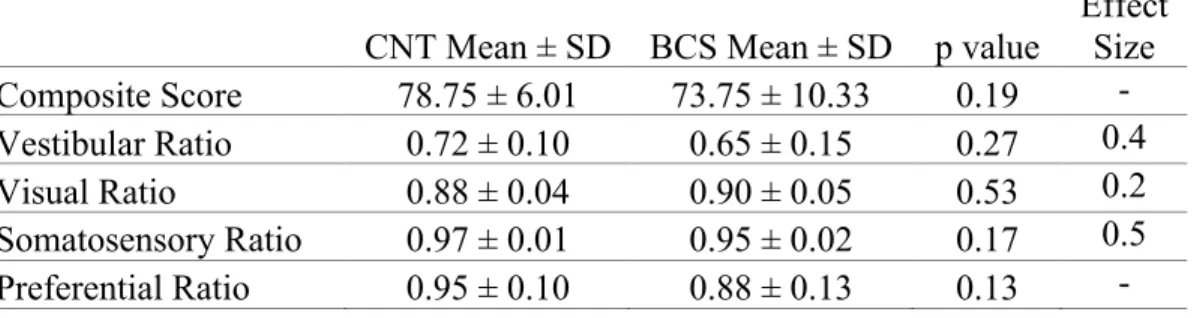
As an attempt to explain the non-significant difference between BCS and CNT for the
SLS, exploratory analysis using the Sensory Organization Test (SOT) was examined. The results of the SOT analyses are presented below in Table 5.
Table 5. SOT Results Between CNT and BCS
CNT Mean ± SD BCS Mean ± SD p value
Effect Size Composite Score 78.75 ± 6.01 73.75 ± 10.33 0.19 - Vestibular Ratio 0.72 ± 0.10 0.65 ± 0.15 0.27 0.4 Visual Ratio 0.88 ± 0.04 0.90 ± 0.05 0.53 0.2 Somatosensory Ratio 0.97 ± 0.01 0.95 ± 0.02 0.17 0.5 Preferential Ratio 0.95 ± 0.10 0.88 ± 0.13 0.13 -
Dependent sample t-tests were used for the analyses. No significant difference between groups was observed for any component of the SOT test. The effect sizes indicate that more subjects are needed.
These results are unlike those of Wampler et al. (2007) and Winters-Stone et al. (2011) who found that breast cancer survivors had deficits during the SOT that were reflected
in their vestibular ratios when compared to matched controls; meaning a vestibular
integration problem in breast cancer survivors may exist. The lack of a statically significant difference between the BCS and CNT groups in this study could be an issue of being