Improved treatment of blocking effect at finite temperature
N. Quang Hung,1,*N. Dinh Dang,2,3,†and L. T. Quynh Huong1,4,5
1Institute of Research and Development, Duy Tan University, K7/25 Quang Trung, Danang City, Vietnam
2Quantum Hadron Physics Laboratory, RIKEN Nishina Center for Accelerator-Based Science, 2-1 Hirosawa,
Wako City, 351-0198 Saitama, Japan
3Institute for Nuclear Science and Technique, Hanoi, Vietnam
4Department of Natural Science and Technology, University of Khanh Hoa, Nha Trang City, Khanh Hoa Province, Vietnam
5Faculty of Physics and Engineering Physics, Ho Chi Minh University of Science, Ho Chi Minh City, Vietnam
(Received 4 July 2016; published 30 August 2016)
The blocking effect caused by the odd particle on the pairing properties of systems with an odd number of fermions at finite temperature interacting via the monopole pairing force is studied within several approximations. The results are compared with the predictions obtained by using the exact solutions of the pairing Hamiltonian. The comparison favors the approximation with the odd particle occupying the top level, which is the closest to the Fermi surface and whose occupation number decreases with increasing temperature.
DOI:10.1103/PhysRevC.94.024341
I. INTRODUCTION
The BCS theory is a most popular approximation for treat-ing pairtreat-ing interaction between fermions such as nucleons in atomic nuclei. In the systems with an odd number of particles at zero temperature (T =0), which are referred to hereafter as odd systems, the Pauli principle prevents the levelk, which is occupied by the odd particle, from the pair scattering process due to pairing correlations. This level k remains unpaired with the occupation number equal to 1 and, consequently, is excluded from the BCS equation for the pairing gap, whereas the equation for the particle number is solved only for the even core. This approximation is traditionally referred to as the “blocked BCS” [1,2]. Although the odd particle can occupy any levelkabove the Fermi surface, atT =0 the lowest level
k0, which is located just above the Fermi surface, corresponds to the ground state of the odd system. Any physical observable such as the ground state energy, pairing gap, etc., is obtained by minimizing the pairing Hamiltonian, which is averaged over the ground state.
At finite temperature (T =0), the average over the ground state is replaced by that over a statistical ensemble such as the grand canonical ensemble (GCE), where the energy and particle number of the system fluctuate in contact with the heat bath, or canonical ensemble (CE), where the system with a fixed number of particle exchanges its energy with the heat bath. Several approximations were proposed to describe the properties of odd systems at finite temperature.
The first type of approximation takes into account the blocking effect only at zero temperature (T =0). As this reduces the pairing gap atT =0, the approximation is simply equivalent to a shift in the excitation energy. The second type of approximation is the so-called fixed quasiparticle-number approach, which was proposed by Ignatyuk and Sokolov [3] to describe the odd system by considering only states consisting
of an odd number of quasiparticles. Because this approach is constructed on the basis of the BCS level density calculations with a fixed number of quasiparticles [4,5], it does not deal explicitly with the odd BCS equations at finiteT, and hence, it will not be discussed in the present paper.
The third type of approximation, proposed by Maino
et al. [6], is a direct extension of the blocked BCS to finite temperature T. This approach assumes that, at T =0, the odd particle occupies the level k with the unity occupation number (qk=1) as atT =0, butkcan be any level above the Fermi surface, not onlyk=k0. The grand partition function is calculated with the trace taken over all possible positions of the blocked levelk. The approach then takes the average of any observable as the sum of all its average values taken for each blocked levelkwith the statistical weight as the ratio of the grand partition function for the blocked level kto the total grand partition function. For simplicity, we refer to this approach as “Maino’s” hereafter.
The assumption of the unity occupation probability of the odd level in the Maino’s approach means that temperatures have no effect on it, whereas the occupation numbers of all the levels in the pairing core are obtained by averaging over the GCE, and, they are therefore temperature-dependent. An obvious inconsistency of such assumption is that it fails to reproduce the zero-pairing limit of the equation for the particle number at finite temperature, where all the single-particle occupation numbers should follow the Fermi-Dirac distribution of noninteracting fermions.
zero-temperature limit (to be explained in the paper). More-over, by comparing with the exact solutions of the pairing problem, we will demonstrate that the qk0-blocked BCS with k=k0 is the most appropriate approximation for the description of the pairing properties of odd systems at finite temperature. An extension of the qk0-blocked BCS, which takes into account the quasiparticle number fluctuation (QNF), is also carried out. This extension is based on the approach called FTBCS1 [7] for even systems, where the QNF smoothes out the sharp phase transition between the superfluid phase to the normal one at the critical temperatureTc0.57(0) with (0) being the pairing gap atT =0.
The paper is organized as follows. The qk-blocked BCS and average-blocked BCS are presented in Sec. II, where the Maino’s approximation and exact solutions of the pairing problem, which are extended toT =0, are also summarized. The results of numerical calculations are analyzed in Sec.III. The paper is summarized in the last section, where conclusions are drawn.
II. FORMALISM
A. Pairing Hamiltonian and the finite-temperature BCS equations for even nuclei
We employ the standard pairing Hamiltonian of a system, which consists of N particles interacting via a monopole pairing force with the constant parameterG, namely,
ˆ
H =
k
k(a+†ka+k+a†−ka−k)−G
kk
a†ka−†ka−kak (1)
witha±†k(a±k) being the creation (annihilation) operators of a particle (neutron or proton) with angular momentum k, projection ±mk, and energy k. This means this level k is doubly degenerate, that is, it can be occupied at most by two particles in the states|k,mkand|k,−mkwith the same energy k. The particle-number operator ˆN is given as
ˆ
N =
k
(a+†ka+k+a†−ka−k). (2)
After the Bogoliubov transformation from the particle opera-tors,a†kandak, to the quasiparticle ones,α†kandαk,
a†k=ukαk†+vkα−k, a−k=ukα−k−vkαk†, (3)
the Hamiltonian (1) is transformed into the quasiparticle one
H, whose explicit form is given, e.g., in Ref. [7].
By applying the Bogoliubov transformation and the average in the GCE to the operator (2), one obtains the average particle numberNin the even system as
N≡ Nˆ =2
k
nku2k+(1−nk)vk2
, (4)
whereOˆdenotes the GCE average
Oˆ = Tr[ ˆOe−β( ˆH−λ ˆ
N)]
Tr[e−β( ˆH−λN)ˆ ] , β = 1
T, (5)
N is an even number, and nk is the quasiparticle occupation number
nk= 1
eβEk+1 (6)
with the chemical potentialλand the quasiparticle energy
Ek=
(k−λ)2+2, (7)
where the self-energy correction term−Gv2
k is neglected in k−λfor simplicity, because it has only a small effect at very low temperature in the present model (see Figs. 2 in Refs. [8,9] and discussions therein). This does not affect the temperature dependence of all thermodynamic quantities considered in the present paper. In the realistic calculations, the single-particle energies deduced from the experimental data are often used, including this self-energy correction term.
The pairing gapis found by minimizing the average value Hˆ −λNˆ, resulting in the BCS gap equation
=G
k
(1−2nk)ukvk. (8)
The coefficients uk and vk are expressed in terms of the chemical potential, the pairing gap, and the single-particle energykas
uk=
1 2
1+k−λ
Ek
, vk =
1 2
1−k−λ
Ek
. (9)
The set of two equations (4) and (8) forms the so-called finite-temperature BCS (FT-BCS) equations to determine the chemical potentialλand the pairing gapfor a system with even particle numberN interacting via the pairing force with parameterGat a given temperatureT.
The thermodynamic quantities such as the total energy
E, the heat capacity C, and the quasiparticle entropyS are calculated in the standard way as
E(T)≡ Hˆ =
k k
u2knk+(1−nk)v2k
, C= dE
dT, (10)
S = −2
k
[nklnnk+(1−nk) ln(1−nk)]. (11)
The excitation energyE∗ is given as the difference between
E(T) and its ground state valueE(0), namely,
E∗(T)=E(T)−E(0). (12)
B. Maino’s approach
Maino’s approach as
(k) =G
k=k
(1−2nk)ukvk, (13)
N(k) =1+2
k=k
nku2k+(1−nk)v2k
, (14)
where the total particle number N of the system is an odd number. The superscript (k) denotes the levelkthat is occupied by the odd particle and excluded from the pairing even core.
To calculate the thermodynamic quantities, it is further assumed thatkcan be any level above the chemical potential
λ, and the grand partition functionZ(β,λ) is constructed as a sum of all partition functionsZ(k) of the systems with the blocked levelk, namely,
Z(β,λ)=Tr e−β[ ˆH(k)−λNˆ(k)]= k
Z(k)(β,λ). (15)
In Eq. (15) ˆH(k)is the Hamiltonian of the odd-particle-number system, where the levelkis occupied by the odd particle:
ˆ
H(k) =k(a+†ka+k+a†−ka−k)+Hˆ, ˆ
H=
k=k
k(a+†ka+k+a−†ka−k)
−G
k,k=k
ak†a−†ka−kak. (16)
The average valueOˆ(k)of an operator ˆO(k)over all possible configurations of the system is given by
Oˆ(k) = k
R(k)O(k), R(k)= Z (k)
Z . (17)
The total energy, heat capacity, and quasiparticle entropy are then calculated as
EMaino =
k
R(k)(k+ Hˆ), CMaino=dEMaino
dT , (18)
SMaino =
k
R(k)S(k),
S(k) = −2
k=k
[nklnnk+(1−nk) ln(1−nk)]. (19)
To restore the zero-temperature limit where k=k0, which is the first level above the ground-state chemical potential
λ(T =0), the following requirement is imposed within the Maino’s approach:
lim
β→∞R
(k)=δ
kk0. (20)
C. qk-blocked BCS and average-blocked BCS
An obvious shortcoming of the assumptionqk=1 in the blocked-BCS Eq. (14) is that it fails to reproduce the zero-pairing limit atT =0, that is,
N =
k
(2−δkk)fk, (21)
wherefkis the single-particle occupation number
fk= 1
eβ(k−λ)+1. (22)
Instead of this, the zero-pairing limit of Eq. (14) isN =1+ 2k=kfk.
The second shortcoming of the Maino’s approach is that the imposed requirement (20) for the zero-temperature limit causes a jump between the average pairing gap as well as the total energy, obtained atT =0, and their corresponding values at finiteT because atT =0 the average gap (total energy) is equal to that, obtained from Eq. (13) for k=k0, whereas at T =0 it is defined as the weighted sum over all the gaps (total energies), obtained from the same equation but with different
k. There is no smooth transition between the two average gaps (total energies).
To remove these shortcomings, we propose to derive the equation for the odd particle number as follows. From Eq. (4) for the even particle number, it is clear that the equation for the odd particle number with the odd particle occupying the levelkcan be written as
N(k)=
k
(2−δkk)
nku2k+(1−nk)vk2
=qk+2
k=k
nku2k+(1−nk)vk2
, (23)
where
qk=nku2k+(1−nk)vk2=1−nk, nk= 1
eβ|k−λ|+1, (24)
because, for the unpaired particle on levelk, one hasuk=0, vk=1, and nk=nk as the pairing gap=0. In the zero-pairing limit,qk=fk and the sum at the right-hand side of Eq. (23) reduces to 2k=kfk. Hence one recovers Eq. (21) for N noninteracting single particles. By neglectingnk, one obtainsqk =1, and recovers from Eq. (23) the particle-number equation (14) in the Maino’s approach. We refer to Eqs. (13) and (23) as the “qk-blocked BCS”.
Assumingk=k0in Eq. (23), it follows that any other level k=k0in the system has the probability 1−qk0to be occupied by the odd particle. The average of any observable ˆO(k0)is then calculated as
Oˆ(k0) = 1
N ⎡
⎣qk0O(k0)+1−q k0
k=k0
O(k)
⎤ ⎦,
N =qk0+(−1)
1−qk0 (25)
with being the total number of levels in the system. In the zero-temperature limit, qk0=1 and the average (25) smoothly reduces to its ground-state value without imposing any special requirement atT =0. We refer to this approach, which calculates all the thermodynamic quantities by using the average (25) based on theqk-blocked-BCS Eqs. (13) and (23), as the “average-blocked BCS”.
transition from the superfluid phase to the normal one [10–12]. It has been demonstrated in Refs. [7,11], by taking into account the effect owing to the QNF, which is neglected in the standard FTBCS, that the pairing gap does not collapse atTc, but monotonically decreases with increasingT. In the present paper, we also include the effect of the QNF within the FTBCS1 [7], whose result is the gap equation
(k)k
=G ⎡
⎣
k=k
(1−2nk)ukvk+2(1−δkk)nk
(1−nk)
1−2nk uk
vk
⎤ ⎦,
(26)
from which one obtains the level-independent gap ¯(k)for the odd system with the odd particle occupying the levelk. This level-independent gap is obtained by averaging the gaps (26) over all the levelsk=k, namely,
¯
(k) = 1
−1
k=k
(k)k . (27)
The last term on the right-hand side of Eq. (26) contains the QNFδNk2 ≡nk(1−nk). We refer to this approximation based on Eq. (23) and (27) as theqk-blocked BCS1.
D. Finite-temperature extension of exact solutions for odd systems
The exact solutions of the pairing Hamiltonian (1) were first obtained by Richardson in 1963 by solving the Richard-son’s nonlinear equation for each total seniority quantum numberS, which is the number of unpaired particles in the system [13]. Fifteen years ago, a method based on SU(2) algebra of the angular momentum, which diagonalizes directly the Hamiltonian (1) instead of solving the Richardson’s equations, was proposed in Ref. [14]. This method allows us to find simultaneously all the exact eigenvalues ES(ex) and exact occupation numbers fS
k with the total seniority S=0,2, . . . ,for even systems. For the odd systems, since the odd particle does not participate in the pairing correlation, it is separated from the off-diagonal matrix elements of the pairing Hamiltonian, which describe the pair transfer (see Eq. (9) of Ref. [14], for example). This separation is called the blocking effect caused by the odd particle in the exact pairing method. As the result, the exact ground state of the odd system corresponds toS=1, whereas the excited states correspond toS=3,5, . . . ,. The exact ground-state energy is obtained when the odd particle occupies the highest level, which is located just above the Fermi surface, that is the levelk=k0. The extension of the exact solutions to finite-temperature is often carried out by using the CE, whose partition function is constructed based on the exact eigenvalues ES(ex) in the form [15]
Z(ex)=
S dSe−E
(ex)
S /T, (28)
where dS=2S is the degeneracy. Knowing the partition function, one can easily obtain all the exact thermodynamic quantities of the system such as the total energyE(ex), entropy
S(ex), and heat capacityC(ex), namely,
E(ex)= T
2
Z(ex)
∂lnZ(ex)
∂T , S
(ex)=
βE(ex)+lnZ(ex),
C(ex)= ∂E
(ex)
∂T . (29)
The exact temperature-dependent occupation numbers fk(ex) are obtained by averaging the exact state-dependent occupa-tion numbersfk(S)over the CE, namely,
fk(ex)= 1
Z(ex)
S
dSfk(S)e−E (ex)
S /T. (30)
Based on the exact total energyE(ex)and occupation numbers
fk(ex), one can compute the exact pairing gap from the relation of the mean-field (BCS) gap as [15]
(ex)=
−G
E(ex)−2
k
kfk(ex)+G
k
fk(ex)2
.
(31)
III. ANALYSIS OF NUMERICAL RESULTS
For the clarity of comparison between the Maino’s and our approaches, we employed the schematic model, which consists ofN particles (N is odd) occupyingdoubly folded levels (N ) and interacting via a pairing force with the strength parameterG. Various values of N,, andG are tested by using equidistant and nonequidistant levels. In the discussion below we will analyze the most representative cases, namely with N =9, G=0.6 MeV, =10, 14, and 20, with the level distant equal to 1 MeV, that is, with the single-particle
0.5 1.0 1.5 2.0
0.5 1.0 1.5 2.0
Occupation numbers
Occupation numbers
0 1 2 3 4 5 T (MeV)
0 1 2 3 4 T (MeV)
Ω= 10 (a) Ω= 10 (b)
Ω= 14 (c) Ω= 20 (d)
FIG. 1. Exact occupation numbers of the levels as functions of
4.2 4.4 4.6 4.8 5.0 5.2 5.4
λ
(MeV)
0 1 2 3 4
T (MeV)
FIG. 2. Chemical potentials as functions ofT forN=9. The solid, dotted, and dashed lines are results obtained within the equidis-tant model with=10, 14, and 20, respectively. The dot-dashed line stands for the prediction obtained within the nonequidistant model with=10. The thin lines correspond to the predictions by the blocked BCS, whereas the thick lines are those obtained within the
qk-blocked BCS.
energies (in MeV) k=k (k=1,2, . . . ,). An example is also shown for the nonequidistant case with=10 by using the following values ofk:1=1,2=2,3=2.5,4=4, 5=5.5,6=6.2,7=6.8,8=7,9=7.2,10=7.5.
Shown in Fig. 1are the exact occupation numbers of the levels as functions of temperatureT for=10, 14, and 20. It is seen from this figure that, at T =0, pairing decreases (increases) the occupation numbers of the levels below (above) the Fermi surface from 2 (0), which is their values in the absence of pairing. With increasingT, the occupation numbers of the levels below (above) the Fermi surface smoothly decrease (increase). The results shown in this figure reveal two important features. First, despite the odd particle is allowed to occupy any level in diagonalizing the pairing Hamiltonian, in average, it always occupies the fifth level, which is the highest occupied level (k0=5 forN =9) in the ground state (T =0), because this is the only level with the occupation number equal to 1 (fk0=1) atT =0. This feature rules out the assumption that one has to averagefkover all the levels above the chemical potential as in the Maino’s approach. In fact, the odd particle occupies only the levelk0. Second, the occupation number of the odd levelfk0does not remain equal to 1, but decreases with increasingT in the equidistant model for all values of the level number under consideration [Figs. 1(a), 1(c), and 1(d)]. In the nonequidistant model, fk0 decreases significantly as T increases from 0 to 1 MeV, then increases slightly as T
increases further, but still remaining smaller than 1 up toT =
5 MeV. This feature is a clear evidence that the assumption
qk0=1 as in the blocked-BCS Eq. (14) might not be correct.
0.4 0.8 1.2 1.6
0 1 2 3
T (MeV)
Δ
(MeV)
2 4 6 8 10 12 14
E*
(MeV)
2 4 6 8 10
S
2 4 6 8 10
C
0.5 1.0 1.5 2.0
5 10 15 20
2 4 6 8 10 12
2 4 6 8 10 12 14
Δ
(MeV)
E*
(MeV)
S
C
0.5 1.0 1.5 2.0 2.5
5 10 15 20 25
2 4 6 8 10 12
0 4 8 12 16
Δ
(MeV)
E*
(MeV)
S
C
0 1 2 3
T (MeV)
0 1 2 3
T (MeV)
Ω= 10 Ω= 14 Ω= 20
(a1)
(b1)
(c1)
(d1)
(a2)
(b2)
(c2)
(d2)
(a3)
(b3)
(c3)
(d3)
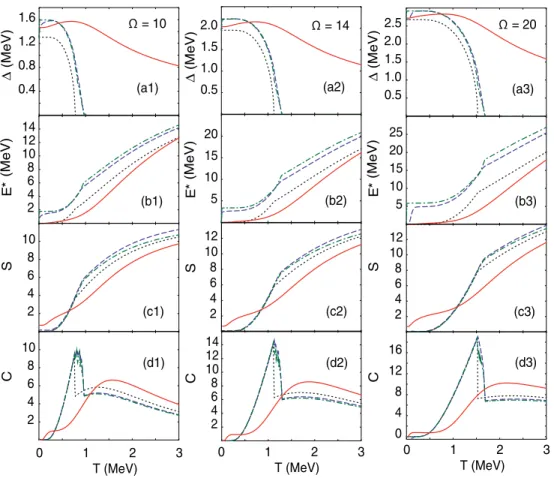
FIG. 3. Pairing gap[(a1)–(a3)], excitation energyE∗[(b1)–(b3)], entropyS[(c1)–(c3)], and heat capacityC[(d1)–(d3)] as functions of
The chemical potentials obtained within the qk-blocked BCS (with k=k0), and blocked BCS, that is withqk0=1, are shown in Fig.2as functions ofT for=10, 14, and 20. The chemical potentials increase withT up toT =Tc, where, because of the collapse of the pairing gap, their temperature dependence abruptly changes to decreasing as T increases further. The figure is a clear demonstration of the large difference between the two approximations. Indeed, whileqk within the qk-blocked BCS varies with T as in Eq. (24), it remains always 1 independently ofT within the blocked BCS. As the result the chemical potentialsλobtained as the solutions of Eqs. (14) and (23) coincide only atT =0, whereqk0=1 in both approximations. Consequently, the chemical potential can become even larger than the energyk0(5 MeV) of the blocked level k0 within theqk-blocked BCS (thick lines), whereas it remains always below the blocked level within the blocked BCS (thin lines).
The pairing gap, excitation energy, entropy, and heat capacity, which are predicted by theqk-blocked BCS, average-blocked BCS, Maino’s approach, and exact solutions are shown in Fig. 3as functions ofT for the equidistant model with=10, 14, and 20. The figure shows that the pairing gap and the heat capacity obtained within the average-blocked BCS reproduce remarkably well the predictions by the Maino’s approach. The excitation energy and entropy predicted by the average-blocked BCS are slightly lower than those obtained within the Maino’s approach, and therefore, closer to the blocked-BCS results. The latter are closest to the results obtained by using exact solutions.
The same thermodynamic quantities obtained within the
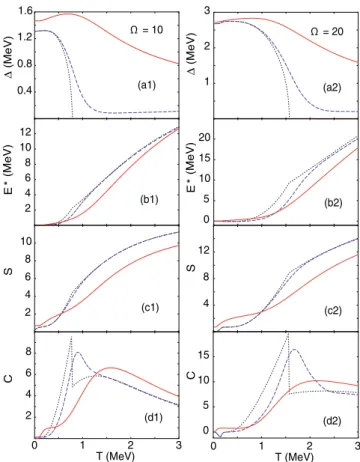
qk-blocked BCS are compared with the predictions by the qk-blocked BCS1 and the exact solutions for=10 and 20 in Fig.4. The sharp superfluid-normal phase transition in theqk -blocked BCS (dotted lines) is smoothed out in theqk-blocked BCS1 by taking the QNF into account. As compared to the blocked BCS, whereqk=1, the pairing gap obtained within theqk-blocked BCS slightly increases withT atT <0.5 MeV because of the blocking effect becomes weaker, whereasT is not sufficiently high to break the first pair. The similar trend is seen in the exact pairing gap, where it keeps increasing up to
T ∼0.7–0.8 MeV. This increase in the pairing gap leads to a slight decrease in the excitation energy at lowT for=20. Consequently, the heat capacity turns negative at a very low
T 0.15 MeV [Fig.4(d2)]. This negative heat capacity is due to the equidistant levels under consideration. A test by using the modified spectrum with5 =4.3,6 =5.8, and7=7.5 MeV shows no negative value of the heat capacity.
Because the exact single-particle occupations numbers
fk(ex)=k0 are neither 0 nor 1 (Fig. 1), the exact entropies are finite whereas the quasiparticle entropies are zero at T =
0. Since the qk-blocked BCS1 is just a correction of the qk-blocked BCS by including the effect of QNF, neglected within the standard BCS, it cannot improve much the BCS except for the smoothing out of the superfluid-normal phase transition. Moreover, particle number projection has yet to be done. Therefore there is still a large discrepancy between the predictions by theqk-blocked BCS1 and those obtained from the exact solutions. But at least, on the qualitative level, it shows the right trend towards the exact results.
0.4 0.8 1.2
0 1 2 3
T (MeV) 1.6
2 4 6 8 10 12
2 4 6 8 10
2 4 6 8
Δ
(MeV)
E*
(MeV)
S
C
1 2 3
0 5 10 15 20
4 8 12
0 5 10 15
0 1 2 3
T (MeV)
Δ
(MeV)
E*
(MeV)
S
C
Ω= 10 Ω = 20
(a1)
(b1)
(c1)
(d1)
(a2)
(b2)
(c2)
(d2)
FIG. 4. Same thermodynamic quantities as in Fig. 3 for the equidistant model withN=9,=10 and 20. The dotted, dashed, and solid lines denote the predictions obtained by using theqk-blocked BCS,qk-blocked BCS1, and exact solutions, respectively.
IV. CONCLUSIONS
In the present work we propose an improved treatment of the blocking effect in the systems with odd numbers of fermions interacting via the constant pairing force. By using the exact solutions of the pairing Hamiltonian, we show that the conventional assumption of the unity occupation number for the blocked level occupied by the odd particle is not valid at T =0. Instead, we introduce the temperature-dependent occupation numberqkfor the blocked level, which is directly derived from the standard equation for the particle number within the standard FTBCS. We also construct the average
qk-blocked BCS, which reproduces quite well the predictions by the Maino’s approach. However, again by using the exact solutions of the pairing Hamiltonian, we demonstrate that the average procedure over all the levels above the Fermi surface as proposed in the Maino’s approach does not correspond to the real situation observed in the exact solutions, where the odd particle actually always remains on the top levelk=k0, which is located above the Fermi surface atT =0.
ACKNOWLEDGMENTS
The numerical calculations were carried out using the
FORTRANIMSL Library by Visual Numerics on the RIKEN
supercomputer HOKUSAI-GreatWave System. N.Q.H. ac-knowledges the support by the National Foundation for Sci-ence and Technology Development (NAFOSTED) of Vietnam through Grant No. 103.04-2013.08.
[1] S. Walborn,Nucl. Phys.37,554(1962).
[2] P. Ring and P. Schuck, The Nuclear Many-Body Problem
(Springer, Berlin, 1980).
[3] A. V. Ignatyuk and Yu. V. Solokolov, Sov. J. Nucl. Phys.19, 628 (1974).
[4] A. V. Ignatyuk and Yu. V. Solokolov, Sov. J. Nucl. Phys.17, 376 (1973).
[5] L. G. Moretto,Nucl. Phys. A243,77(1975).
[6] G. Maino, E. Menapace, and A. Ventura,Il Nuovo Cimento A
57,427(1980); V. Benzi, G. Maino, and E. Menapace,ibid.66, 1(1981).
[7] N. Dinh Dang and N. Quang Hung,Phys. Rev. C77,064315 (2008).
[8] N. D. Dang,Phys. Rev. C76,064320(2007).
[9] N. Dinh Dang and N. Quang Hung,Phys. Rev. C81,034301 (2010).
[10] L. G. Moretto, Phys. Lett. B40, 1 (1972); A. L. Goodman, Phys. Rev. C29,1887(1984).
[11] N. Dinh Dang and V. Zelevinsky, Phys. Rev. C 64, 064319 (2001); N. Dinh Dang and A. Arima,ibid.67,014304(2003);
68, 014318 (2003); N. D. Dang, Nucl. Phys. A 784, 147 (2007).
[12] V. Zelevinsky, B. A. Brown, N. Fazier, and M. Horoi,Phys. Rep.
276,85(1996).
[13] R. W. Richardson,Phys. Lett.3,277(1963);14,325(1965). [14] A. Volya, B. A. Brown, and V. Zelevinsky,Phys. Lett. B509,
37(2001).