Political Corruption and Partisan Engagement: Evidence from Brazil1
Rebecca Weitz-Shapiro Brown University Matthew S. Winters
University of Illinois at Urbana-Champaign
Forthcoming Journal of Politics in Latin America
In long-standing democracies, the partisan attachments of most citizens are stable and not responsive to short-term political events. Recent studies from younger democracies, however, suggest that partisanship may be more malleable in these contexts. In this paper, we develop hypotheses about how political corruption might affect voter attachment to the party of corrupt officials or to the party system as a whole. Using data from an original survey experiment in Brazil, we show that, for highly educated respondents, prompts about political corruption shift patterns of partisan attachment. For the highly educated, corruption associated with one political party reduces nonpartisanship and significantly increases identification with other political parties. For less-educated respondents, information on corruption has no consistent measureable effect on partisanship. We conclude by discussing the implications of malleable partisanship for democratic accountability.
1
1 Can individual political events change partisan attachment? The dominant view of
partisanship as an “unmoved mover” suggests not: in most of the literature, partisanship is seen as a stable personal attribute rather than a pliable attitude that varies over time. This scholarly understanding has been shaped predominantly by the study of American politics and public opinion. What is true of citizens in the United States, however, may not be true of citizens elsewhere – especially those in countries with shorter democratic histories. The political parties in these countries, as compared to those of longstanding democracies, are likely to be younger, less institutionalized, and less deeply familiar to citizens. Individual attachment to these parties, consequently, may be shallower and more malleable.
Building on a nascent literature that examines partisan identity as an outcome variable in younger democracies (Brader and Tucker 2008; Baker et al. 2010; Chong et al. forthcoming; Lupu 2013; Klăsnja and Tucker 2013), we examine whether citizens’ partisan identities are responsive to priming about political corruption. Corruption is a highly salient issue for voters in many young democracies. Whereas observers once treated corruption as innocuous or even beneficial (Huntington 1968), it is now well-established that corruption is linked to lower
economic growth, decreased investment, and greater income inequality (see Lambsdorff 2006). It is common for these pernicious effects to be highlighted by national media outlets and
international organizations like Transparency International, and public opinion surveys reveal widespread citizen discontent with corruption (e.g., Transparency International 2013).
Existing work on how voters respond to corruption falls into two main categories. The first is a mostly case-driven literature that explores how citizen disgust with systemic corruption serves as a catalyst for major political upheaval, from the impeachment or resignation of
2 Della Porta and Vannucci 2007; Chang, Golden and Hill 2010). The second literature uses
survey data to examine how corruption prompts changes in individual attitudes like system support (Anderson and Tverdova 2003; Seligson 2006) and individual behavior like protest participation (Gingerich 2009) or vote choice (Chong et al. forthcoming). In that group, recent experimental and quasi-experimental work provides strong evidence that voters punish
individual politicians involved in malfeasance (Ferraz and Finan 2008; Pereira, Melo, and Figuereido 2008; Chong et al. forthcoming).2
We build on both approaches to examine whether information about corruption can affect citizens’ partisan attachments, an important individual-level change that can have system-level consequences.3 Using original survey experimental evidence from Brazil, we show that priming respondents to associate major political parties with corruption leads to greater engagement with the political system among the most highly educated. As compared to those who have not been primed with information about corruption, these highly-educated respondents are less likely to describe themselves as nonpartisan and more likely to declare a partisan attachment to smaller political parties. Existing findings about the effects of corruption on voting behavior would not predict these results. Thus, our findings point to the importance of treating partisanship as an outcome distinct from voting behavior and suggest a heretofore unidentified pathway through which negative political information may increase political engagement for at least some voters. At the same time, the effect of the priming is limited to one group; we find less evidence that patterns of partisanship change among less well-educated respondents.
2
Some recent work also explores factors that may mitigate dissatisfaction with corruption (e.g., Anduiza et al. 2013; Winters and Weitz-Shapiro 2013).
3 1. The Presumptive Stability of Partisan Attachment
Partisanship is commonly understood as a stable individual characteristic.Originating in the Michigan School of the 1960s and based largely on studies of American politics, the
dominant view of partisanship depicts it as an “unmoved mover” formed in adolescence that goes on to affect a wide range of individual attitudes and behaviors (Campbell et. al 1960). 4 While not all scholars would go so far as to place partisanship in the same category as “kinship and ethnic ties” (Gerber, Huber, and Washington 2010), even revisionist scholars who treat partisanship as a “running tally” (Fiorina 1981) concur that partisan identity is slow moving.5 In longstanding democracies with entrenched parties, identification persists to a great extent even when a party performs poorly in office (e.g. in terms of managing the economy) (Green, Palmquist and Schickler 2002).6 The limited experimental work on this topic is broadly
consistent with this view. Attempts by Cowden and McDermott (2000) to manipulate students’ partisan attachments through short-term role-playing, for example, produce null results.7
4
Despite the large empirical literature that examines partisanship outside of the United States, most of the theoretical discussion is driven and dominated by the study of the United States. 5
See Fiorina (2002) and Johnston (2006) for summaries of the debate. 6
In fact, rather than updating their beliefs, there is ample evidence in the United States that partisans are likely to seek out information from news sources that tend to confirm their preexisting party evaluations (e.g., Iyengar and Hahn 2009), to evaluate the same policies or economic conditions differently if they are endorsed by or associated with their preferred party (Bartels 2002; Druckman and Bolsen 2011; Lavine et al. 2012), and even to act in accordance with incorrect, partisan-induced views (Prior, Sood and Khanna 2013).
7
4 Given strong findings about the stability of partisan identity, the vast majority of
literature studying partisanship has examined the effects of partisanship on other outcomes. Building on the large body of empirical work from the long-standing democracies of the United States and Western Europe, recent studies outside of these countries have found evidence that strong partisan identities can be formed and that partisanship can predict political behaviors in other contexts, too. Authors studying Brazil (Samuels 2006; Baker et. al 2010) and Mexico (McCann and Lawson 2003) find relatively high levels of partisan attachment and a fair degree of stability in partisan identification. Using survey experiments, Brader and Tucker (2012) and Samuels and Zucco (2014) provide evidence that voter partisanship in developing democracies has meaningful effects on outcomes like policy preferences.
At the same time, many newer democracies have characteristics that should undermine the strength of party attachment. Where parties are young or democratic elections a recent phenomenon, the creation of long-standing attachments from childhood is impossible for many citizens.8 Party proliferation and turnover—either over time or at any given moment—may weaken citizens’ incentives to learn about and develop psychological attachments to particular parties. Similarly, legislative weakness in some new democracies undermines the importance of parties and party labels (Fish 2006; Carey and Reynolds 2007).
In a context where some or all of these characteristics are present, we should be cautious in applying the U.S. model of partisan stability. Where partisan attachments are more malleable, experiment in the U.S. state of Connecticut, they find that latent partisans in the treatment
condition were more likely to identify with the party to which they were closest. 8
5 the likelihood that an individual will declare herself a partisan of a given party is more likely to be affected by recent political events. In Brazil, Baker et al. (2010) find that declared
partisanship within a six-wave panel study experiences short-term shifts in response to the performance of national and, to some extent, subnational officials. In a field experiment in Mexico, Chong et al. (forthcoming) show that distributing information about high levels of municipal corruption decreases identification with the party of the incumbent politician. Relatedly, studies from Eastern Europe and Latin America have shown that rates of expressing partisan identification increase among survey respondents who receive more information about parties’ policy positions (Brader and Tucker 2008; Lupu 2013). Taken together, these studies suggest that changes in the information environment can alter individual partisanship in new democracies in the short and medium term.
2. Possible Patterns of Partisan Change
How might an individual’s declared partisanship change after she is exposed to negative political information? In this section, we review likely ways in which an individual might change her expressed partisan identity after being primed to think about corruption in
conjunction with a particular party.9 We then describe how individual shifts in partisanship might be reflected in the aggregate.
9
6 The possible pathways of partisan change depend on how the individual would have expressed her partisan leanings in the absence of priming. Before hearing about a corrupt politician, a given individual might be (a) a sympathizer with the party of that politician, (b) a sympathizer of another party or (c) nonpartisan. Table 1 summarizes the range of reactions for these three types of individuals confronted with information linking a partisan politician to corruption. For the purposes of fully enumerating an individual’s choice set, we include in the table some outcomes that we do not think are particularly likely.
[Table 1 Here]
From these reactions, we highlight three likely outcomes of interest. Although it is not impossible, we think it is unlikely that revealed corruption would drive citizens into affiliation with the corrupt party, and so we do not speculate further on that possibility.
-Persistent Partisanship/Nonpartisanship. It may be the case that the partisanship of a sympathetic voter in situation (a) is sufficiently strong that negative information does not alter her partisan identity. This is what we would expect in settings like the United States where partisanship is a social identity. Persistent partisanship is even more likely in situation (b), where a sympathizer of some other party hears negative information linked to a party with which she does not identify. Negative information about this other party is highly unlikely to prompt someone to identify with the corrupt party, although it is possible that hearing corrupt
7 exposed to negative information about some party.
-Switch to Nonpartisanship. In either situation (a) or (b), information about corruption may drive individuals to embrace a new nonpartisan identity. This shift is most likely among people who otherwise would consider themselves copartisans with the party of the corrupt politician (a) but who begin to feel a new distaste for that party. It is also possible that supporters of other parties may respond to information about corruption by minimizing their engagement with the political system as a whole, even if previously, they would have identified with a party (b); distaste with the party system as a whole drives these citizens into
nonpartisanship.
-Identification with Other Parties. A link between corruption and one political party may inspire copartisan or nonpartisan individuals to identify with a new political party toward which they now feel relatively greater sympathy.10 In situation (a), negative information decreases the voter’s support for her previously most-preferred political party to the extent that she identifies with a new party. In situation (c), negative information is enough to inspire a former nonpartisan to newly identify with a party not linked to corruption.11
At a systemic level, these individual-level pathways map to a set of possible outcomes for the overall distribution of partisanship in the population at large.12 In our empirical analysis
10
Both Turner (1999) and Lupu (2013) argue for the importance of comparative fit. Though they focus on ideology, valence issues like corruption might also contribute to comparative fit.
11
Gingerich (2009) finds increasing political engagement in the form of protest activity is a common response to exposure to corruption in Bolivia. Similarly, using 2008
AmericasBarometer data from Brazil, we find that personal experience with corruption is positively associated with a variety of measures of political engagement (results not reported). 12
8 below, we examine shifts in aggregate partisanship in response to a prime about corruption; therefore, we specify three alternative (but not mutually exclusive) hypotheses at the macro-level:
H1: Decreased Copartisanship: Defining copartisanship as sympathy with the party associated with corruption, we expect that the proportion of people identifying with that party will decrease when they are exposed to information linking that party to corruption. The most robust result from various survey and field experiments on corruption is that politicians lose electoral support (or intended support) when corrupt behavior is revealed (Ferraz and Finan 2008; Chong et al. forthcoming; De Figueiredo, Hidalgo and Kasahara 2013; Kălsjna and Tucker 2013). To the extent that declarations of partisanship and vote choice result from similar cognitive processes, we expect similar results.
H2: Increased Other Partisanship: After hearing about corruption associated with party X, citizens may feel relatively greater sympathy with other parties, increasing the overall rate of affiliation with those parties. This movement could come from individuals who formerly
9 sympathized with the party linked to corruption or from individuals who formerly identified as nonpartisans and are sufficiently disenchanted by one party’s links to corruption that they now feel greater affinity with a competing political party.
H3: Increased Party Alienation: After hearing party X linked to corruption, some individuals who would otherwise be copartisans might feel newly alienated from the implicated party but not sufficiently sympathetic with any other party to identify themselves as a partisan. Separately, other individuals who might have identified with a political party not linked to corruption may be turned off from partisan politics in general. Both individual-level processes reflect a form of political disengagement and should result in an increase in the share of the population that describes itself as nonpartisan. This hypothesis receives support from studies of vote choice in the wake of corruption. Both Chong et al. (forthcoming) (in Mexico) and de Figuereido, Hidalgo and Kasahara (2013) (in Brazil) find higher levels of abstention—another form of political disengagement— among voters randomly exposed to information about actual corruption by a mayor and/or mayoral candidates.
2.1 Who Updates Partisan Identification in Response to Information about Corruption?
10 asked to express their partisan identity.13 Highly educated individuals are the most likely to maintain access to such associations and to connect particular information about corruption with their attitudes toward the political system writ large. As Druckman and Nelson (2003) observe in the literature on framing effects, experts are the respondents who most often “possess the
knowledge and ability to connect the considerations suggested by the frame to their opinions” (731).
Our expectation is consistent with other results that examine partisan identity or political attitudes more broadly. Gerber, Huber and Washington (2010, fn. 24), for instance, find that their field experimental treatment of informing people about the value of registering with a party leads to larger positive shifts in partisanship among the most educated respondents (although the difference from the overall effect is not statistically significant). Results in the literature on framing and political attitudes find stronger framing effects among more knowledgeable people after controlling for prior attitudes. 14 Chong and Druckman (2007) argue that this is because knowledge “increases the likelihood that the considerations emphasized in a frame will be
13With regard to recall, in a separate survey from Brazil using a similar vignette, we find that rates of correct recall of information contained in the prompt are highly correlated with educational attainment. Among those with the lowest levels of education, only 50% of respondents could correctly answer a question about the prompt, whereas the rate rose to 74% among those with the highest level of education.
14
11 available or comprehensible to the individual” (see also Zaller 1992; Druckman 2004).15
Our empirical framework parallels the real world delay between hearing some piece of information at a specific point in time and then thinking about one’s partisan identity in the medium or longer term. In our survey, we describe a hypothetical local politician as either corrupt or not. We give this politician a partisan identity, but we do not describe the overall performance of the political party in the local arena, nor do we describe the performance of a party leader or national figure associated with the political party. We thus prime the respondent to think about corruption in conjunction with a particular party. In the context of our survey, highly educated people should be more likely to recall the partisan affiliation of the politician in the prompt, to recall the association with corruption, and to have these factors in mind when reflecting on their partisan identity later in the survey.16
15
Both Brader and Tucker (2008) and Lupu (2013) find that more sophisticated respondents are somewhat less likely to change their partisan attachment after being exposed to information about parties in a survey environment. In those studies, however, the authors provide respondents with publicly available information about party platforms and/or alliances. Knowledgeable voters are more likely to already be aware of macro-level party behavior and therefore less likely to update their preferences in response to this information. In our study, we describe a hypothetical local politician about whom the respondents have no prior information. Our results here, which demonstrate more responsiveness among more educated respondents, are consistent with other work that shows greater responsiveness among more educated voters to new information on valence issues like corruption (Weitz-Shapiro and Winters 2014) and economic growth (Alt et al. 2014).
16
12 3. Understanding and Operationalizing Partisanship in Brazil
Brazil is a particularly compelling site in which to examine the link between local political corruption and partisan attachment. Although strictly speaking a federal country since the 1891 constitution, subnational governments gained substantial power in the years
immediately following the country’s most recent transition to democracy in 1985.17 Municipal governments are responsible for the provision of a variety of basic services, including in core areas like health, and they spend an increasingly large portion of total government revenue (Falleti 2010).Holding municipal political office can be an important stepping stone in a political career.
Although it experienced a long dictatorship in the second half of the 20th century (1965-1985), the Brazilian Congress remained open during that period and the military allowed controlled competition between one pro-regime and one anti-regime party. After
democratization, these parties lost influence and two new parties came to dominate national politics – the Partido dos Trabalhadores (PT), a leftist worker’s party that first emerged in 1980 led by Luiz Inácio Lula da Silva, and the Partido do Social Democracia do Brasil (PSDB), a centrist party that held the presidency from 1995 to 2002. The dominant narrative about
Brazilian politics for much of the current democratic period has depicted parties as quite weak, both legislatively and in terms of their ability to engender individual loyalty among citizens (Weyland 1996; Ames 2002; although see Figueiredo and Limongi 2000 and Desposato 2006, among others, for evidence on the relative strength of parties in the legislative arena).
The recent literature on Brazil questions that portrayal. Baker et al. (2010) show that
17
13 partisan identity is relatively stable over time, especially for the PT. Similarly, Samuels (2006) and Samuels and Zucco (2014) show the strength of PT partisanship as a social identity and demonstrate that PT (and to some extent PSDB) partisans react to party cues, shifting their opinions in order to conform with those of their party. This new wave of scholarship, however, still acknowledges that partisan attachment and identity in Brazil do not have the strength they enjoy in longstanding democracies. Partisan identification, for example, is far more limited in Brazil than in the United States: two-stage party identification questions from recent surveys suggest rates of partisan identification of less than 35 percent; in the United States, 60 percent of citizens identify with a political party.18
In 2010, we carried out a nationally representative, in-person survey with 2,000 respondents in Brazil. The survey presented respondents with a vignette describing a
hypothetical incumbent mayor running for reelection.19 We employed random assignment to vary across vignettes the hypothetical mayor’s party affiliation along with certain aspects of his past performance in office.20 Some respondents learn that it is well known that the mayor takes
18
These numbers are based on AmericasBarometer data (Brazil) and the ANES (US). 19
In doing so, we follow a long tradition of survey experimental work that asks respondents to evaluate hypothetical politicians (e.g., Terkildsen 1993; Tomz 2007; Pepinsky, Liddle and Mujani 2012). As Tomz and Weeks (2013) note, having respondents abstract from actual politicians allows for better testing of general hypotheses.
20
14 bribes while others learn that it is well known that the mayor does not take bribes.21 We analyze how the survey prime linking major political parties and corruption affects respondents’ declared partisan attachments.
The vignette reads as follows:
Imagine a person named Gabriel {or Gabriela}, who is a person like you, living in a neighborhood like yours, but in a different city in Brazil. The mayor of Gabriel’s city is running for reelection in October. He is a member of the PT {or, PSDB}. In Gabriel’s city, it is well known that the mayor never takes bribes {or frequently takes bribes} when giving out government contracts. The mayor has completed few {or many; or omit the entire sentence} public works projects during his term in office. In this city, the election for mayor is expected to be very close.
The experimental vignette was followed immediately by a question that asked the respondent the likelihood (on a four-point scale) that Gabriel(a) would vote for the named mayor.22 We then
21
In providing their responses, it is possible that those surveyed react to either the positive or the negative information. In emphasizing the effects of negative information, we follow the
convention in the corruption literature (Klăsjna and Tucker 2013; Muñoz et al. 2013). In the online appendix, we use data from another survey experiment to show that respondents tend to behave as if a politician is not corrupt unless they are exposed to explicit information about corruption.
22
The results of this analysis, discussed elsewhere [citation omitted], are reproduced in the online appendix. We use a third person vignette in order to attenuate social desirability bias among respondents exposed to a prompt that mentions corruption. In a separate survey
15 asked a series of additional questions about mayoral performance and eventually a question about partisan attachment. The time elapsed within the survey between the vignette and the question on partisan identification should attenuate any effect of the information about corruption on respondents’ self-reported partisan identification and therefore bias against a significant finding.
Partisanship. Respondents were shown a list of 27 parties and asked to select the party to which they felt closest.23 This one-stage question results in a relatively higher rate of
partisanship as compared to that elicited by a two-stage question. About 44 percent of respondents did not express a preference for any party; results from other surveys place this percentage of nonpartisans in the population at between 50 and 60 percent (Samuels 2006) or in the range of 65 to 70 percent (BNES; LAPOP). Of the total sample, about 32 percent claim sympathy with the PT, about 7 percent each support the PMDB and PSDB, and about 16 percent say that they support another party.
Education. At the individual level, we expect the effect of the treatment to be strongest among highly educated respondents. We therefore subset out analyses to compare respondents with some tertiary education to those with a completed secondary school education or less. About 15 percent of our sample has some tertiary education or more.
4. Partisanship Changes in Response to Corruption Prompts for the Highly Educated
third-person language with second-person language. We did not find any significant differences in response patterns between the two versions.
23
16 In order to understand how linking corruption information to a political party affects declarations of partisanship, we examine differences in the distribution of expressed partisan identities across the corrupt and not-corrupt conditions in our experiment.24 The randomized design allows us to attribute changes in this distribution to the corruption prime in the treatment vignettes; the other characteristics of respondents are orthogonal to this information.25 As described above, we expect to see stronger effects among highly educated respondents and therefore subset our analyses accordingly.
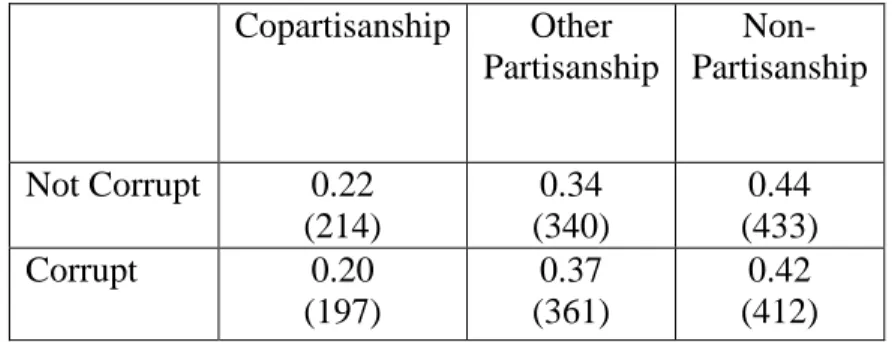
Table 2 presents results for our three theoretical outcomes of interest: copartisanship, other partisanship, and nonpartisanship. For each panel of the table, we use a χ2 test to examine whether the distribution of outcomes in the corrupt condition is statistically distinguishable from the distribution of outcomes in the not-corrupt condition. In the overall data and among the subset of less educated respondents, we see little evidence of any difference between the two conditions. Among the less educated respondents, in particular, the distribution of declared partisanship is nearly identical in the corrupt and not-corrupt conditions.26 This suggests that the majority of our respondents do not update their partisan identification after being primed to think
24
In this discussion, we use the language “partisan attachment” interchangeably with “declared partisan attachment.” A survey allows us to observe the latter, although the former is the phenomenon of theoretical interest. We return to this issue in the discussion of our results. 25
In an online appendix, we demonstrate balance on observable characteristics across the corrupt and not-corrupt treatment groups.
26
For this group, the corrupt treatment has a statistically significant effect on the share of
17 about corruption in conjunction with a particular party. Among the highly educated group,
however, the corruption treatment has a number of interesting effects on declared partisanship. [Table 2 Here]
Panel C focuses on the most educated respondents in the sample. For this group, it shows a decrease in copartisanship (consistent with hypothesis 1), as well as an increase in other
partisanship (consistent with hypothesis 2). Specifically, the table reveals that the share of highly educated respondents sympathizing with the party named in the vignette drops from 25 percent in the not-corrupt condition to 20 percent in the corrupt condition, while the share of respondents declaring a partisan identity with a party other than the one named in the vignette rises by 15 percentage points (from 32 to 47 percent). In contrast to hypothesis 3, which anticipates that corruption information increases party alienation, for this group, our results instead document increased party engagement. When compared with the control condition, in the corruption condition, nonpartisanship drops from 43 percent to 33 percent. Highly educated respondents who might otherwise be copartisans or nonpartisans in the clean condition appear to instead say they identify with parties not named in the vignette in the corrupt condition.
Figure 1 presents our results for the most educated respondents only. It illustrates the substantial increase in other partisanship and the marked decrease in nonpartisanship that result from exposure to the corruption prime. The comparatively limited change in the number of copartisans suggests that the bulk of the increased rate of other partisanship is a result of
18 other parties in the system.27 As a result, the association of a particular political party with
corruption seems to drive new partisan identification and to increase engagement with the partisan political system among highly-educated respondents in Brazil.28
[Figure 1 Here]
In the online appendix, we show the robustness of these results to several additional tests of the data. First, we run a multinomial probit model in which we use a corruption treatment indicator and an interaction between that indicator and a variable indicating whether or not the respondent belongs to the high education group to predict whether or not a respondent expressed copartisanship with the politician in the vignette, other partisanship, or nonpartisanship (the omitted category). Using the parametric model allows us to include basic socio-demographic controls. The results show the same overall pattern as presented above: among highly-educated respondents, the corrupt information treatment increases the share of other-party identifiers relative to nonpartisans. The multinomial probit model allows us to run an explicit test on the difference in the treatment effect between the two groups, and we show that there is a
statistically significant difference (p < 0.03). Second, we run the multinomial probit model only among the respondents who heard about a PT mayor and then again only among the respondents who heard about a PSDB mayor. We find that the differences in treatment effects persist across
27
Lupu (2013) finds that partisanship increases when voters have an increased capacity to differentiate among political parties. To the extent that our respondents are prompted to think about corruption in conjunction with one party, that might assist them in differentiating that party from other parties.
19 the two types of vignettes, although the difference is significant only for the PSDB vignettes.
Third, we present the cross-tabulated results using a more exhaustive set of categories that underlie our coding of the outcome variable, disaggregating the larger parties that compose the “other party” category. The patterns for our high education respondents are again consistent with the patterns shown here: the respondents in this group who hear about a corrupt politician from either of the two parties used in the treatment are less likely to describe themselves as nonpartisan and more likely to express support for a third party. For the PT vignettes, apart from leading to gains in identification with other parties, the corruption treatment leads the PT to lose support from highly educated respondents. Gains to other parties outweigh losses to the PT, which explains the net positive effect on partisan engagement. Among the PSDB vignettes, corruption information does not change identification with this party among the highly educated, but other parties still gain identifiers. Among our low education respondents, when we
disaggregate results by party, the results are somewhat more ambiguous than those presented in Table 2. In the PT treatment, among less educated respondents, we see the same pattern as in the overall data—information about corruption does not shift reported party identification. Within the PSDB vignettes, corruption information does shift the distribution of partisanship, as our respondents move away from both the PT and the PSDB and toward the third largest party in the country, the PMDB. In terms of rates of partisan identification, however, these shifts mostly cancel out. That is, in contrast to the most educated respondents, the corruption prompt does not appear to increase overall partisan engagement among the least educated. We discuss these patterns in greater detail in the online appendix.
20 As argued above, we believe that the existence of a treatment effect conditional on
having at least some tertiary education reflects the cognitive demands of linking a prompt about a corrupt partisan politician to one’s broader views about political parties. Here, we address two alternative explanations for why the treatment effect might be limited to this group. First, it might be the case that highly educated citizens simply are more likely to condemn corruption than the population at large. Second, highly educated citizens may be more susceptible to social desirability bias and therefore more likely to give the “right” answer to survey questions on sensitive topics like corruption, regardless of their true opinions. We find a number of patterns in the data that are inconsistent with these two alternatives.
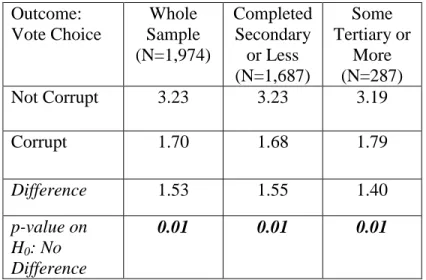
21 vs. 1.40), which is the opposite of what an explanation focused on different preferences implies. This strongly suggests that the differences in partisan change we observe in our survey are not the result of different attitudes towards political corruption. It also speaks to the importance of thinking about changing partisan affiliation as a response to political corruption that is
analytically distinct from electoral punishment of the corrupt actor. [Table 3 Here]
The second alternative explanation is that, in the context of a survey, highly educated people have a stronger desire to communicate their disapproval of corruption than less educated respondents, regardless of any underlying difference in views between these two groups. That is, the highly educated might be particularly susceptible to social desirability bias on the sensitive issue of corruption. The results reviewed in the previous paragraph speak against this possibility. If social desirability bias were to explain the different patterns of partisan change across
education groups, we would expect the highly educated to be particularly likely to claim that they would not vote for a corrupt politician. As the results displayed in Table 3 illustrate, this is not the case.
In addition, responses to the question on partisanship itself do not offer support for this alternative explanation. If the responses of the highly educated mostly reflected a desire to give socially conforming answers in the context of a survey, we would expect these respondents to be reluctant, in particular, to reveal sympathy with a party of a mayor identified as corrupt.
22 Although we can dismiss these alternative explanations, the question remains as to the extent to which changes in declared partisan attachment in a survey are likely to reflect changes in genuine party attachment in response to real world information. As always, we should exercise caution in extrapolating from the relatively controlled context of a survey experiment to the views and behavior of citizens in the real world (Barabas and Jerrit 2010). The limited
information a survey can provide about an electoral contest, and the relatively close proximity between receiving the information and being asked about partisan leaning suggest that our survey experiment might best replicate cases in which information about political corruption gains the public’s attention and receives ongoing attention in the press (e.g. Chang, Golden and Hill 2010).29 In Brazil, the expansion of federal audits aimed at discovering corruption and the practice of publicizing the names of candidates accused of corruption both mean that these high information settings are increasingly common.
The external validity of our survey is also buttressed by the fact that our results are consistent with other previously identified characteristics of partisanship and partisan change in Brazil. Baker et al. (2010) use a six-wave panel study in two medium-sized Brazilian cities to document changes in partisanship over time. Their findings emphasize the fluidity of the “nonpartisan” category: across the six waves of their study, the level of nonpartisanship ranges between 50 and 62 percent in one city and between 46 and 64 percent in the other. Comparing between two waves of the survey, they show that some 20 percent of declared nonpartisans in
29
23 one wave of the survey profess a party affiliation at another time; they document far less
movement between parties. Our results provide further evidence, on a nationally representative sample, of the importance of shifts in and out of the nonpartisan category (what Baker et al. call “bounded partisanship”) and the limited shifts between partisan groupings. In addition, our use of a survey experiment allows us to identify a probable cause of such shifts: priming respondents to associate a particular political party with corruption.30
5. Changing Partisanship in Brazil and the Implications for Accountability
The notion that partisanship is an ingrained social identity that is relatively unresponsive to short-term political events is well-established in the literature on voters in the United States. Recent work presents mixed evidence on the applicability of this view for other countries. Our paper advances our understanding of partisanship in younger democracies by providing
experimental evidence from Brazil that priming subjects with short-term political information can cause changes in citizens’ declared partisan identity. In particular, a prompt about corruption tied to a politician from a particular political party can decrease the likelihood that a respondent will describe herself as nonpartisan and increase the likelihood that she will declare herself a sympathizer of another party. This effect is found only among the highly educated – those people most likely to recall and be able to access the association in the prompt when considering their own partisan sympathies at some later time. Importantly, this does not reflect different
preferences over corruption across respondents with different levels of education.
Our finding that some citizens’ declared partisan identities are responsive to short-term
30
Our work also builds on Samuels’ (2006) finding that attitudes towards a party’s most
24 political performance contributes to an emerging consensus that the declaration of partisan identity is malleable in less-established democracies (Brader and Tucker 2008; Baker et al. 2010; Chong et al. forthcoming; Klăsnja and Tucker 2013; Lupu 2013; Winters and Weitz-Shapiro 2014).31 Nonetheless, these studies do exhibit variation in the details of who changes their partisanship and in what way. In the survey examined here, we find that changes are
concentrated among the highly educated, whereas some other studies find widespread movement in partisan identification or even that changes in expressed partisan identification are
concentrated among the less educated. Whereas we find that negative performance information brings nonpartisans into new engagement with the party system, other studies find that negative performance information causes people to shift into nonpartisanship. Thus, while the variety of results emerging in the literature demonstrate the malleability of partisanship in younger democracies, they also give us reason to continue to work to understand precisely for which groups and under what conditions partisan sentiment will shift in these democracies.
What are the implications of our results for our understanding of political accountability in Brazil today? There are two broad schools of thought on the relationship between strong party identity and democratic accountability.32 On the one hand, strong, responsible parties have been traditionally portrayed as a democratic asset that can organize and channel societal demands, and in this light, strong partisan identity is valuable because it both originates in and contributes to
31
Baker et al. (2010) explicitly compare their results to those found in Britain and Germany in Zuckerman, Dasović, and Fitzgerald (2007) and note that partisan identities are less stable in Brazil.
32
25 strong parties.33 Scholars studying relatively young democracies in Latin America (Mainwaring and Scully 1995; Mainwaring 1998; McCann and Lawson 2003) and the post-Soviet space (Klingemann and Wattenberg 1992; Smyth 2006)have lamented weak partisanship as a deterrent to democratic consolidation and accountability. As McCann and Lawson (2003, 60) argue, “when citizens lack firm, enduring dispositions … it is difficult for them to hold leaders accountable.”
Against this view that strong parties and strong partisanship enhance accountability, other scholars have portrayed strong party identification as a blind loyalty that distorts citizens’ ability to objectively evaluate relevant political information. To the extent that strong partisans “have already decided who is right and who is wrong” (Mutz 2006, 128), strong partisanship could actually decrease accountability. In the United States, researchers have shown that partisanship colors voter perceptions of politician and government performance across a range of areas (Wilcox and Wlezien 1996; Bartels 2002; Johnston et al. 2004; Lavine et al. 2012) and have called attention to the risks of partisan motivated reasoning (Bolsen, Druckman, and Cook 2012). The cross-national literature that highlights the differences between partisan “winners” and “losers” offers evidence of the more forgiving nature of copartisans outside of the United States, as well.34
33In the U.S. context, this vision was articulated by the 1950 APSA Committee on Political Parties, and it has since appeared elsewhere in the literature (e.g., Burnham 1970, ch. 5; Broder 1971).
34
26 Where does Brazil fall in this spectrum? This study and several other recent studies (Baker et al. 2010; Winters and Weitz-Shapiro 2014) provide evidence that short-term
performance information can change partisan attachment for at least some groups of Brazilian citizens. At the same time, it is clear that for some Brazilians, partisan attachments help organize and order their understanding of politics (Samuels and Zucco 2014). Together, these results suggest that mass partisanship in Brazil today may occupy a middle ground—parties are strong enough to serve as meaningful cues to citizens, but parties can also expect their fortunes to rise and fall with their accomplishments. Public opinion polling in advance of the October 2014 presidential election perhaps reflects this dynamic, as Brazil’s President and incumbent PT candidate Dilma Rousseff has struggled in light of growing corruption scandals and a slowdown in economic growth.
Finally, our results are particularly encouraging with respect to the spate of new information provision reforms enacted in Brazil in recent years. Federal audits of municipal accounts, the publication of the names of political candidates accused by wrongdoing in the judiciary, and a new right to information law means that credible information about political performance is more available now than ever before. Our findings suggest that the revelation of malfeasance through such venues may serve the double purpose of facilitating punishment of poor-performing politicians while, at least for some citizens, increasing engagement with Brazil’s political system.
27 Works Cited
Anduiza, Eva, Aina Gallego, and Jordi Muñoz (2013), Turning a Blind Eye: Experimental Evidence of Partisan Bias in Attitudes towards Corruption, in: Comparative Political Studies,
46, 12, 1664-92.
Ames, Barry (2002), Party Discipline in the Chamber of Deputies, in Scott Morgenstern and Benito Nacif(eds.), Legislative Politics in Latin America, Cambridge, UK: Cambridge University Press, pp. 185-221.
Anderson, Christopher J, and Yuliya V. Tverdova (2003), Corruption, Political Allegiances, and Attitudes Toward Government in Contemporary Democracies, in: American Journal of Political Science, 47, 1, 91-109.
Baker, Andy, Barry Ames, Lucio R. Renno, and Anand Sokhey (2010), The Sources and Dynamics of Mass Partisanship in a New Democracy, paper presented at the American Political Science Association Annual Meeting, Washington.
Barabas, Jason, and Jennifer Jerit (2010), Are Survey Experiments Externally Valid?, in:
American Political Science Review, 104, 2, 226-242.
Bartels, Larry M. (2002), Beyond the Running Tally: Partisan Bias in Political Perceptions, in:
Political Behavior, 24, 2, 117-150.
Brader, Ted, and Joshua A. Tucker (2008), Reflective and Unreflective Partisans? Experimental Evidence on the Links between Information, Opinion, and Party Identification in Russia, Poland, and Hungary, Department of Political Science, New York University.
28 Bolsen, Toby, and James N. Druckman, and Fay Lomax Cook (2012), When and How Partisan
Identification Works, paper prepared for presentation at the American Political Science Association Annual Meeting, New Orleans (cancelled).
Broder, David S. (1971), The Party's Over: The Failure of Politics in America, New York: Harper and Row.
Burnham, Walter Dean (1970), Critical Elections and the Mainsprings of American Politics,
New York: Norton.
Calvo, Ernesto, and M. Victoria Murillo (2012), When Parties Meet Voters: Assessing Political Linkages through Partisan Networks and Distributive Expectations in Argentina and Chile, in: Comparative Political Studies, 46, 7, 851-82.
Campbell, Angus, Philip E. Converse, Warren E. Miller, and Donald E. Stokes (1960), The American Voter, New York: Wiley.
Carey, John M., and Andrew S. Reynolds (2007), The Role of Political Parties in the Governance of New Democracies, in: Party Politics, 13, 2, 255-74.
Chang, Eric, Miriam Golden, and Seth J. Hill (2010), Legislative Malfeasance and Political Accountability, World Politics, 62, 2, 177-220.
Chong, Alberto, Ana De La O, Dean Karlan, and Leonard Wantchekon (forthcoming), Does Corruption Information Inspire the Fight or Quash the Hope? A Field Experiment in Mexico on Voter Turnout, Choice and Party Identification, in: Journal of Politics.
Chong, Dennis, and James N. Druckman (2007), Framing Theory, in: Annual Review of Political Science, 10, 103-126.
Cowden, Jonathan, and Rose McDermott (2000), Short Term Forces and Partisanship, in:
29 de Figueiredo, Miguel F. P., F. Daniel Hidalgo, and Yuri Kasahara (2013), When Do Voters
Punish Corrupt Politicians? Experimental Evidence from Brazil, Department of Political Science, University of California, Berkeley.
Della Porta, Donatella, and Alberto Vannucci (2007), Corruption and Anti-corruption: The Political Defeat of ‘Clean Hands’ in Italy, in: West European Politics, 30, 4, 830-853. Desposato, Scott (2006), The Impact of Electoral Rules on Legislative Parties: Lessons from the
Brazilian Senate and Chamber of Deputies, in: Journal of Politics, 68, 4, 1018-1030.
Druckman, James N. (2004), Political Preference Formation: Competition, Deliberation, and the (Ir)relevance of Framing Effects, in: American Political Science Review, 98, 671-686. Druckman, James N., and Toby Bolsen (2011), Framing, Motivated Reasoning, and Opinions
about Emergent Technologies, in: Journal of Communication, 61, 4, 659-88.
Druckman, James N., and Kjersten R. Nelson (2003), Framing and Deliberation, in: American Journal of Political Science, 47, 728–44.
Falleti, Tulia G. (2010), Decentralization and Subnational Politics in Latin America, New York: Cambridge University Press.
Ferraz, Claudio, and Frederico Finan (2008), Exposing Corrupt Politicians: The Effects of Brazil's Publicly Released Audits on Electoral Outcomes, in: Quarterly Journal of Economics, 123, 2, 703-45.
Figueiredo, Argelina C, and Fernando Limongi (2000), Presidential Power, Legislative Organization, and Party Behavior in Brazil, in: Comparative Politics, 32, 2, 151-170. Fiorina, Morris P. (1981), Some Problems in Studying the Effects of Resource Allocation in
30
Behavior, 24, 2, 93-115.
Fish, M. Steven (2006), Creative Constitutions: How Do Parliamentary Powers Shape the Electoral Arena?, in Andreas Schedler (ed.), Electoral Authoritarianism: The Dynamics of Unfree Competition, Boulder, CO: Lynne Rienner, pp. 181-97.
Gaines, Brian J., James H. Kuklinski, and Paul J. Quirk (2007), Rethinking the Survey Experiment, in: Political Analysis, 15: 1-21.
Gerber, Alan S., Gregory A. Huber, and Ebonya Washington (2010), Party Affiliation, Partisanship, and Political Beliefs: A Field Experiment, in: American Political Science Review, 104, 4, 720-44.
Gingerich, Daniel (2009), Corruption and Political Decay: Evidence from Bolivia, in: Quarterly Journal of Political Science, 4, 1, 1-34.
Green, Donald P., Bradley Palmquist, and Eric Schickler (2002), Partisan Hearts and Minds: Political Parties and the Social Identities of Voters, New Haven, CT: Yale University Press. Huntington, Samuel P. (1968), Political Order in Changing Societies, New Haven: Yale
University Press.
Iyengar, Shanto, and Kyu S. Hahn (2009), Red Media, Blue Media: Evidence of Ideological Selectivity in Media Use, in: Journal of Communication, 59, 1, 19-39.
Johnston, Richard (2006), Party Identification: Unmoved Mover or Sum of Preferences, in:
Annual Review of Political Science, 9, 329-51.
Johnston, Richard, Michael G. Hagen, and Kathleen Hall (2004), The 2000 Presidential Election and the Foundations of Party Politics, New York: Cambridge University Press.
31
Journal of Political Science, 22, 2, 131-49.
Klăsnja, Marco, and Joshua Tucker (2013), The Economy, Corruption, and the Vote: Evidence from Experiments in Sweden and Moldova, in: Electoral Studies, 32, 3, 536-43.
Lambsdorff, Johann Graf (2006), Causes and Consequences of Corruption: What Do We Know from a Cross-Section of Countries?, in: Susan Rose-Ackerman (ed.), International Handbook on the Economics of Corruption, Northampton, MA: Edward Elgar.
Lavine, Howard, Christopher Johnston, and Marco Steenbergen (2012), The Ambivalent Partisan: How Critical Loyalty Promotes Democracy, New York: Oxford University Press. Lupu, Noam (2013), Party Brands and Partisanship: Theory with Evidence from a Survey
Experiment in Argentina, in: American Journal of Political Science, 57, 1, 49-64.
Lupu, Noam and Susan C. Stokes (2009), The Social Bases of Political Parties in Argentina, 1912-2003, in: Latin American Research Review, 44, 1, 58-87.
Mainwaring, Scott (1998), Party Systems in the Third Wave, in: Journal of Democracy, 9, 3, 67-81.
Mainwaring, Scott, and Timothy R. Scully (1995), Building Democratic Institutions: Party Systems in Latin America, Stanford, CA: Stanford University Press.
McCann, James A., and Chappell Lawson (2003), An Electorate Adrift? Public Opinion and the Quality of Democracy in Mexico, in: Latin American Research Review, 38, 3, 60-81.
Muñoz, Jordi, Eva Anduiza, and Aina Gallego (2013), Why Do Voters Forgive Corrupt Politicians? Implicit Exchange, Noise, and Cynicism, Universitat Autònoma de Barcelona. Mutz, Diana C. (2006), Hearing the Other Side: Deliberative Versus Participatory Democracy,
New York: Cambridge University Press.
32 Advantage: Evidence from Indonesia, in: American Journal of Political Science, 56, 3, 584-600.
Pereira, Carlos, Marcus André Melo, and Carlos Mauricio Figueiredo (2008), The Corruption-Enhancing Role of Re-Election Incentives? Counterintuitive Evidence from Brazil's Audit Reports, in: Political Research Quarterly, 62, 4, 731-44
Pérez-Liñan, Anibal (2007), Presidential Impeachment and the New Political Instability in Latin America, New York: Cambridge University Press.
Pharr, Susan J. (2000), Officials' Misconduct and Public Distrust: Japan and the Trilateral Democracies, in: Susan J. Pharr, and Robert D. Putnam (eds.), Disaffected Democracies: What's Troubling the Trilateral Democracies?, Princeton, NJ: Princeton University Press Prior, Markus, Gaurav Sood, and Kabir Khanna (2013), You Cannot Be Serious: Do Partisans
Believe What They Say?, Department of Politics, Princeton University.
Samuels, David (2006), Sources of Mass Partisanship in Brazil, in: Latin American Politics and Society, 48, 2, 1-27.
Samuels, David, and Cesar Zucco (2014), The Power of Partisanship in Brazil: Evidence from Survey Experiments, in: American Journal of Political Science, 58, 1, 212-25.
Seligson, Mitchell A. (2006), The Measurement and Impact of Corruption Victimization: Survey Evidence from Latin America, in: World Development, 34, 2, 381-404.
Smyth, Regina (2006), Candidate Strategies and Electoral Competition in the Russian
Federation: Democracy Without Foundation, Cambridge, UK: Cambridge University Press. Taber, Charles S., and Milton Lodge (2006), Motivated Skepticism in the Evaluation of Political
Beliefs, in: American Journal of Political Science, 56, 3, 568-83.
33 Implications of Candidate Skin Color, Prejudice, and Self-Monitoring, in: American Journal of Political Science, 37, 4, 1032-53.
Tilley, James, and Sara B. Hobolt (2011), Is the Government to Blame? An Experimental Test of How Partisanship Shapes Perceptions of Performance and Responsibility, in: Journal of Politics, 73, 2, 316-30.
Tomz, Michael (2007), Domestic Audience Costs in International Relations: An Experimental Approach, in: International Organization, 61, 4, 821-40.
Transparency International (2013), Global Corruption Barometer 2013, available at
http://www.transparency.org/gcb2013/report (accessed 12 September 2014). Turner, John C. (1999), Some Current Issues in Research on Social Identity and
Self-Categorization Theories, in Naomi Ellemers, Russell Spears, and Bertjan Doosje (eds.),
Social Identity: Context, Commitment, Content, Malden, MA: Blackwell.
Weyland, Kurt G. (1996), Democracy without Equity: Failures of Reform in Brazil, Pittsburgh, PA: University of Pittsburgh Press.
Wilcox, Nathaniel, and Christopher Wlezien (1993), The Contamination of Responses to Survey Items: Economic Perceptions and Political Judgments, in: Political Analysis, 5, 1, 181-213. Winters, Matthew S., and Rebecca Weitz-Shapiro (2013), Lacking Information or Condoning
Corruption When Do Voters Support Corrupt Politicians?, in: Comparative Politics, 45, 4, 418-36.
35
Partisanship Before Receiving Information Possible Responses to Information about a Corrupt Politician from Party X
(a)
Partisan of Party X
Remain a partisan of Party X
Abandon Party X and become a partisan of a new party
Abandon Party X and become nonpartisan
(b)
Partisan of Party Y
Remain a partisan of Party Y
Abandon Party Y and become nonpartisan
Abandon Party Y and become a partisan of Party X
Abandon Party Y and become a partisan of a new party
(c)
Nonpartisan
Remain nonpartisan
Become a partisan of Party X
Become a partisan of a new party
36
Copartisanship Other
Partisanship
Non-Partisanship
Not Corrupt 0.22 (214)
0.34 (340)
0.44 (433)
Corrupt 0.20
(197)
0.37 (361)
0.42 (412) Panel A: All Respondents
N = 1,957; proportion of respondents with number in parentheses χ2
statistic for independence of rows and columns: 1.71 (p < 0.43)
Copartisanship Other
Partisanship
Non-Partisanship
Not Corrupt 0.21 (176)
0.35 (292)
0.44 (367)
Corrupt 0.20
(170)
0.36 (299)
0.44 (369)
Panel B: Respondents with Completed Secondary Education or Less N = 1,673; proportion of respondents with number in parentheses χ2
statistic for independence of rows and columns: 0.19 (p < 0.92)
Copartisanship Other
Partisanship
Non-Partisanship
Not Corrupt 0.25 (38)
0.32 (48)
0.43 (66)
Corrupt 0.20
(27)
0.47 (62)
0.33 (43) Panel C: Respondents with Some Tertiary Education or More N = 284; proportion of respondents with number in parentheses χ2
statistic for independence of rows and columns: 7.13 (p < 0.03)
37 Outcome:
Vote Choice
Whole Sample (N=1,974)
Completed Secondary
or Less (N=1,687)
Some Tertiary or
More (N=287)
Not Corrupt 3.23 3.23 3.19
Corrupt 1.70 1.68 1.79
Difference 1.53 1.55 1.40
p-value on H0: No Difference
0.01 0.01 0.01
1 Online Appendix for
“Political Corruption and Partisan Engagement: Evidence from Brazil”
Contents
Portuguese Version of the Vignette... 2
Partisanship Question ... 3
Balance Check ... 4
Results from Corruption Experiment ... 5
Assumptions about Corruption under No Information ... 6
Multinomial Probit Analysis ... 7
2
Portuguese Version of the Vignette
Bolded brackets indicate the randomized components of the vignette.
Imagine que existe uma pessoa chamada Gabriel/Gabriela (leia conforme o sexo do
entrevistado), que é uma pessoa como você, que vive num bairro como o seu, mas numa cidade diferente do Brasil. O Prefeito da cidade onde Gabriel/Gabriela mora está concorrendo à
3
Partisanship Question
13) (MOSTRAR DISCO DE PARTIDOS) De qual partido político você se sente mais próximo? (ESTIMULADA) (RU)
RU
DEM 1
PROSSIGA
PCB 2
PCO 3
PC do B 4
PDT 5
PHS 6
PMDB 7
PMN 8
PP 9
PPS 10
PR 11
PRB 12
PRP 13
PRTB 14
PSB 15
PSC 16
PSDB 17
PSDC 18
PSOL 19
PSL 20
PSTU 21
PT 22
PTB 23
PTC 24
PT do B 25
PTN 26
PV 27
Nenhum deles (Não estimular) 97
Não sabe (Não estimular) 98
4
Balance Check
To check that the randomization of the vignettes produced balance across treatment groups on pre-treatment covariates, we ran two multinomial logit models where the 12 categories of treatment assignment defined the outcome variable. We compared a null model with no predictors to a model with predictors for gender, age, education, social class, indicators for employment status, an indicator for being Catholic, an indicator for being religious, an indicator for being nonwhite, indicators for being a likely PSDB or PT voter and indicators for being a PSDB or PT partisan. If the specified model fits the data better than the null model, this would indicate a lack of balance on pre-treatment characteristics.
A likelihood ratio test fails to reject the null hypothesis that the two models are indistinguishable (p < 0.93), meaning that no meaningful correlations are detected across the treatment conditions and respondent characteristics. This shows that the randomization produced balance on pre-treatment characteristics across pre-treatment groups.
5
Results from Corruption Experiment
In our previous work, we examine how the treatments affect respondents’ willingness to say that Gabriel(a) will vote for the politicians described in the vignettes. We reproduce below the main table from that study.
The table shows that corruption information reduces the proportion of respondents who say that Gabriel(a) will vote to reelect the mayor. This happens regardless of the information about public goods provision.
(1) All Vignettes (2) Competent Vignettes (3) Incompetent Vignettes (4) Vignettes without Competence Information Not Corrupt 0.78
(0.01) N=989 0.88 (0.02) N=329 0.62 (0.03) N=331 0.83 (0.02) N=329
Corrupt 0.19
(0.01) N=985 0.28 (0.02) N=328 0.13 (0.02) N=328 0.16 (0.02) N=329 Difference 0.58
(0.02) 0.59 (0.03) 0.49 (0.03) 0.66 (0.03) p-value on
H0: No Difference
0.00 0.00 0.00 0.00
6
Assumptions about Corruption under No Information
In a survey run in May 2013, we replicated our experiment with a version of the vignette that includes no information about corruption.
That “pure control” condition reads as follows:
Imagine that you live in a neighborhood similar to your own but in a different city in Brazil. Let’s call the mayor of that hypothetical city in which you live Carlos. Imagine that Mayor Carlos is running for reelection. During the four years that he has been mayor, the municipality has experienced a number of improvements, including good economic growth and better health services and transportation.
We can compare that to an otherwise similar vignette in which the following sentence is added: Also, it is well known in the city that Mayor Carlos has not taken any bribes when awarding city contracts.
And to an otherwise similar vignette in which the following sentence about corruption is added: Also, it is well known in the city that Mayor Carlos has taken bribes when awarding city contracts
Comparing responses across these three conditions to a follow-up question about the likelihood of voting for the mayor will provide some insight as to whether respondents assume (in the absence of any information about corruption) that mayors are corrupt – in which case the explicit mention of cleanliness will provide a boost to the levels of support for the mayor – or not.
The table below shows that respondents view mayors in the pure control and not corrupt conditions in the same way. The estimated levels of support for these two mayors is almost exactly the same and statistically indistinguishable. On the other hand, the estimated level of support for a corrupt mayor is a full point less and statistically significantly different from both the pure control and not corrupt conditions (p < 0.00). This suggests that – at least in the presence of positive performance information – the voters in our sample generally assume that mayors are not corrupt unless they are explicitly told that they are.
Pure Control Not Corrupt Corrupt
3.38 (0.06) N=280
3.39 (0.06) N=280
7
Multinomial Probit Analysis
To increase the efficiency of the estimation of our treatment effects, we run multinomial probit models (which unlike multinomial logit models do not require the independence of irrelevant alternatives option) with an indicator variable for respondents in the corrupt condition and an interaction between that indicator variable and an indicator for whether or not respondents are in our high education category. We control for age, gender, and social class, variables that might predict respondents’ likelihood of declaring certain political party allegiances and look at selection into the three outcome categories.
The model below shows the results for three analyses: for the overall data, for the PT vignettes only, and for the PSDB vignettes over. In each case, the omitted category is nonpartisan, such that the tables show the effect of each variable on the probability of being either a copartisan or a partisan of another party relative to the probability of being nonpartisan.
When the PT and PSDB vignettes are combined (as in Table 2 in the text), we see that high education respondents receiving the corrupt treatment are significantly more likely to declare other partisanship relative to nonpartisanship. The coefficient for the treatment among less-educated respondents has a relatively small point estimate for both the copartisan and other partisan outcomes, reinforcing the idea that we see relatively little movement in this group in response to the treatment. There is a positively estimated treatment effect for highly educated group in terms of their likelihood of expressing copartisanship in the treatment condition, which is surprising, but the effect is estimated with significant uncertainty.
8
All PT Vignettes PSDB Vignettes
Copartisan Other Party Copartisan Other Party Copartisan Other Party
Corrupt Vignette -0.04 0.00 0.05 0.07 -0.28 -0.06
(0.10) (0.09) (0.13) (0.14) (0.18) (0.12)
Corrupt Vignette * High
Education 0.20 0.63*** -0.02 0.51 0.77* 0.75**
(0.26) (0.24) (0.34) (0.35) (0.44) (0.34)
Age -0.01*** -0.00 -0.01*** -0.00 -0.01* -0.01*
(0.00) (0.00) (0.00) (0.00) (0.01) (0.00)
Male 0.24** 0.35*** 0.13 0.21 0.42** 0.47***
(0.09) (0.08) (0.12) (0.13) (0.17) (0.12)
Social Class 0.17*** 0.19*** 0.08 0.32*** 0.44*** 0.13
(0.07) (0.06) (0.09) (0.09) (0.12) (0.08)
High Education -0.10 -0.29 -0.04 -0.10 -0.32 -0.44*
(0.18) (0.18) (0.24) (0.25) (0.32) (0.25)
Constant -0.56*** -0.54*** 0.04 -1.20*** -1.83*** -0.13
(0.20) (0.18) (0.26) (0.28) (0.35) (0.24)
p-value for χ2 test on H0:
No Difference High Education and Low Education Treatment for
Other Party Outcome 0.03 0.31 0.05
Observations 1,957 1,957 976 976 981 981
9
Distribution of Partisan Declarations under Different Experimental
Conditions and across Different Subgroups by Partisan Condition and
with a Fuller Partisan Choice Set
In Table 2 in the text, we combine data from both the PT and PSDB treatments and look at copartisanship as a choice variable (which means the selection of PT in the PT treatments and the selection of PSDB in the PSDB treatments). In addition, we combine together all other parties (including the PT in the PSDB treatments and the PSDB in the PT treatments) into the category of “other partisanship.”
Here we get closer to the raw data, displaying the partisanship distributions for the PT vignettes and for the PSDB vignettes and showing the specific numbers for the PT, PSDB, PMDB, and PV in each case. Because the chi-squared test becomes less reliable when cells have an expected value of less than 5, we group together the many other minor parties that respondents could have selected into an “other” category.
In both the PT and PSDB vignettes, we see the behavior among the highly educated respondents that is summarized in Table 2: nonpartisanship decreases (by 14.5 percentage points in the PSDB vignettes and by 8 percentage points in the PT vignettes), and other partisanship increases
(particularly for the PV, which gains by 10 percentage points in the PSDB vignettes and 8.5 percentage points in the PT vignettes). With the data separated between the PT and PSDB vignettes, the chi-squared statistics decrease in size and are not significant at conventional levels for the highly educated. Nonetheless, these results are consistent with those presented in the text and offer further support for the claim that information about corruption actually increases partisan engagement among the most educated.
For the remainder of the sample, the patterns in the data are somewhat more complex than the overall results in Table 2 suggest. In the PT conditions, information about corruption leads to basically no change in the distribution of partisanship, consistent with the overall results reported in the text. In contrast, in the PSDB condition among the less educated respondents, the
proportion of respondents declaring themselves to be PSDB partisans drops by 2.5 percentage points (or 30 percent), while the proportion of respondents declaring PT partisanship drops by 7.5 percentage points (or 20 percent). The PMDB is the winner for low-education respondents in the PSDB conditions; the proportion of respondents declaring PMDB partisanship doubles for this group. The differences in these distributions are statistically significant.