Pairing within the self-consistent quasiparticle random-phase approximation at finite temperature
N. Dinh Dang1,2,*and N. Quang Hung1,†
1Heavy-Ion Nuclear Physics Laboratory, RIKEN Nishina Center for Accelerator-Based Science, 2-1 Hirosawa, Wako City, 351-0198 Saitama, Japan
2Institute for Nuclear Science and Technique, Hanoi, Vietnam
(Received 6 March 2008; revised manuscript received 25 April 2008; published 19 June 2008)
An approach to pairing in finite nuclei at nonzero temperature is proposed, which incorporates the effects due to the quasiparticle-number fluctuation (QNF) around Bardeen-Cooper-Schrieffer (BCS) mean field and dynamic coupling to quasiparticle-pair vibrations within the self-consistent quasiparticle random-phase approximation (SCQRPA). The numerical calculations of pairing gap, total energy, and heat capacity were carried out within a doubly folded multilevel model as well as realistic nuclei56Fe and120Sn. The results obtained show that, under the
effect of QNF, in the region of moderate and strong couplings, the sharp transition between the superconducting and normal phases is smoothed out, resulting in a thermal pairing gap, which does not collapse at the BCS critical temperature, but has a tail, which extends to high temperature. The dynamic coupling of quasiparticles to SCQRPA vibrations significantly improves the agreement with the results of exact calculations and those obtained within the finite-temperature quantal Monte Carlo method for the total energy and heat capacity. It also causes a deviation of the quasiparticle occupation numbers from the Fermi-Dirac distributions for free fermions.
DOI:10.1103/PhysRevC.77.064315 PACS number(s): 21.60.Jz, 21.30.Fe, 24.10.Pa, 24.60.−k
I. INTRODUCTION
Pairing phenomenon is a common feature in strongly interacting many-body systems ranging from tiny ones such as atomic nuclei to very large ones such as neutron stars. Because of its simplicity, the Bardeen-Cooper-Schrieffer (BCS) theory [1], which explains the conventional superconductivity, has been widely employed as the first step in nuclear structure calculations that include pairing forces. In infinite systems such as low-temperature superconductors, the BCS theory offers a correct description of the pairing gap as functions of temperatureT and pairing-interaction strengthG. Here, asT
increases, the BCS gap decreases from its value(0) atT =0 until it collapses at a critical temperatureTc=0.568(0), at which the phase transition between the superconducting phase and normal one (SN-phase transition) occurs [2,3]. However, the application of the BCS theory to small systems such as atomic nuclei needs to be carried out with a certain care since quantal and thermal fluctuations are not negligible in finite systems, especially when the number of particles is small.
The effects of thermal fluctuations on the pairing properties of nuclei have been the subject of numerous theoretical studies in the last three decades. In the seventies, by applying the macroscopic Landau theory of phase transitions to a uniform model, Moretto has shown that thermal fluctuations smooth out the sharp SN phase transition in finite systems [4]. In the eighties, this approach was incorporated by Goodman into the Hartree-Fock-Bogoliubov (HFB) theory at finite temperature [5] to account for the effect of thermal fluctuations [6]. Theoretical studies within the static-path approximation (SPA) carried out in the nineties also came to
†On leave of absence from the Institute of Physics and Electronics,
Hanoi, Vietnam; [email protected]
the non-vanishing pairing correlations at finite temperature [7], which are qualitatively similar to the predictions by Landau theory of phase transitions. The shell-model and Monte Carlo shell-model calculations [8,9] also show that pairing does not abruptly vanish atTc, but still survives atT > Tc. For rotating systems, Frauendorf and collaborators have recently shown a phenomenon of pairing induced by temperature [10], which reflects strong fluctuations of the order parameter in very small systems with a fixed number of particles. The recent microscopic approach to thermal pairing, called modified-HFB (Mmodified-HFB) theory [11], includes the quasiparticle-number fluctuation (QNF) in the modified single-particle density matrix and particle-pairing tensor. Its limit of constant pairing interaction Gis the modified BCS (MBCS) theory [12–15]. The MBCS theory predicts a pairing gap, which does not collapse atTc, but monotonously decreases with increasingT, in qualitative agreement with the predictions by the Landau theory of phase transitions and SPA. This feature also agrees with the results obtained by averaging the exact eigenvalues of the pairing problem over the canonical ensemble with a temperature-dependent partition function [14]. The recent extraction of pairing gap from the experimental level densities [16] confirms that the pairing gap does not vanish at Tcbut decreases asT increases, in line with the predictions by these approaches.
RPA (SCQRPA) at finite temperature, which is workable with any value of pairing interaction parameterG.
Recently, we have developed in Ref. [18] a SCQRPA for the multilevel pairing Hamiltonian and applied it to the Richardson model [19] at zero temperature. The derivation of the SCQRPA is based on a set of renormalized BCS equations, which include the corrections due to the QNF and the SCQRPA. The latter arise from the expectation values
A†jA
†
jandA
†
jAjin the correlated ground state. HereA†j is the product of two time-reversal conjugated quasiparticle operators,αj†andα−†j, corresponding to thejth orbital. Within the particle-particle (pp) SCRPA [20], these expectation values overshadow the attractive pairing interaction, turning it into repulsion in agreement with the trend of the exact solutions of the Richardson model. For this reason, the expectation valuesA†jA†jandA†jAjare called the screening factors. The goal of the present study is to extend the SCQRPA in Ref. [18] to nonzero temperature to explore the effects due to QNF as well as coupling to QRPA vibrations on the pairing properties of finite systems in a self-consistent way.
The article is organized as follows. The derivation of the equations for quasiparticle propagation, which include the effects of QNF and SCQRPA corrections as well as coupling of quasiparticles to pair vibrations at finite temperature is presented Sec. II. Two approximation schemes will be considered, which are based on the thermal quasiparticle representation without and including dynamic coupling to SCQRPA quasiparticle-pair vibrations. In Sec.III, the devel-oped approach undergoes a thorough numerical test within the Richardson model as well as in realistic nuclei56Fe and120Sn. The last section summarizes the article, where conclusions are drawn.
II. FORMALISM
A. Quasiparticle Hamiltonian
The pairing Hamiltonian
H=
j m
jaj m† aj m−G
jj
mm>0
a†j ma†jm˜ajm˜ajm, (1)
describes a set of N particles with single-particle energies
j, which are generated by particle creation operators aj m† onjth orbitals with shell degeneracies 2j (j =j+1/2), and interacting via a monopole-pairing force with a constant parameterG. The symbol ˜ denotes the time-reversal operator, namelyajm˜ =(−)j−maj−m. In general, for a two-component system withZ protons andN neutrons, the sums in Eq. (1) run over alljτmτ, jτmτ, andGτwithτ =(Z, N). This general notation is omitted here as the calculations in the present article are carried out only for one type of particles.
By using the Bogoliubov’s transformation from the particle operators,aj m† andaj m, to the quasiparticle ones,α†j mandαj m,
a†j m=ujαj m† +vjαjm˜, ajm˜ =ujαjm˜ −vjα†j m, (2)
the pairing Hamiltonian (1) is transformed into the quasiparti-cle Hamiltonian as follows [13,14]:
H =a+
j
bjNj +
j
cj(A†j+Aj)+
jj
djjA†jAj
+
jj
gj(j)(A†jNj +NjAj)
+
jj
hjj(A†jAj†+AjAj)+
jj
qjjNjNj, (3)
where Nj is the quasiparticle-number operator, whereasA†j andAj are the creation and destruction operators of a pair of time-reversal conjugated quasiparticles:
Nj = j
m=−j
αj m† αj m= j
m=1
(α†j mαj m+αj†−mαj−m), (4)
A†j = 1
√
2[α
†
j ⊗α
†
j] 0 0=
1
j
j
m=1
α†j mα†jm˜, Aj =(A†j)†. (5) They obey the following commutation relations:
[Aj,A†j]=δjjDj, where Dj =1− Nj
j
, (6)
[Nj,A†j]=2δjjA†j, [Nj,Aj]= −2δjjAj. (7) The functionalsa, bj, cj, djj, gj(j), hjj, qjj in Eq. (3) are given in terms of the coefficientsuj, vj of the Bogoliubov’s transformation, and the single particle energiesj as (see Eqs. (7)–(13) of Ref. [13], for example)
a=2
j
jjvj2−G
j
jujvj
2
−G
j
jvj4,
(8)
bj =j
u2j−v2j+2Gujvj
j
jujvj+Gv4j, (9)
cj =2
jjujvj −G
j
u2j−vj2
j
jujvj
−2Gjujvj3, (10)
djj = −G
jj
u2ju2j+vj2v2j
=djj, (11)
gj(j)=Gujvj
j
u2j−vj2
, (12)
hjj =
G
2
jj
u2jvj2+v2ju2j
=hjj, (13)
qjj = −Gujvjujvj=qjj. (14)
By setting j =1 in Eqs. (8)–(14), one recovers the exp-ressions for the case with doubly-folded levels of the Richardson model (see, e.g., Eqs. (12)–(18) of Ref. [18]).
B. Gap and number equations
presented briefly in Ref. [18] for the Richardson model. For the clarity of the extension to finite temperatureT, we give below the detailed derivation of the gap equation, which is applied to the more general quasiparticle Hamiltonian (3) and valid forT =0.
The coefficients uj and vj of the Bogoliubov’s transfor-mation (2) are determined by using the variational procedure, which minimizes the expectation value of the Hamiltonian
H=H−λNˆ in the grand canonical ensemble. This leads to the variational equations [21]
∂H ∂uj
+∂H
∂vj
∂vj
∂uj
≡ [H,A†j] =0, (15)
whereOˆdenotes the ensemble average of the operator ˆO,
Oˆ ≡ Tr[ ˆOe− βH
]
Tre−βH , β =T
−1. (16)
The commutation relation [H,A†j] is found by using Eqs. (6) and (7) as
[H,A†j]=2bjA†j + cj +
j
[djjA†j+gj(j)Nj
+hjjAj]
Dj+2
j
gj(j)[A†jA†j +A†jAj]
+qjj[A†jNj+NjA†j]
+
j
hjjDjAj. (17)
The ensemble average of the commutation relation (17) is then given as
[H,A†j] =cjDj +
j
2gj(j)[A†jA†j + A†jAj]
+gj(j)NjDj
, (18)
where the functionalsbj andcj are
bj =bj −λ
u2j −vj2, cj =cj−2λ
jujvj, (19) i.e., they have the same form as that ofbj in Eq. (9), andcj in Eq. (10), but withj −λreplacingj at the right-hand sides. Inserting the explicit expressions for the functionalscj from Eq. (19) as well asgj(j) andgj(j) from Eq. (12) into the right-hand side of Eq. (18), and equalizing the obtained result to zero as required by the variational procedure (15), we come to the following equation, which is formally identical to the BCS one:
2j−Gv2j−λujvj−j
u2j −vj2=0, (20) where, however, the single-particle energiesj are renormal-ized as
j =j +
G
jDj
j
j
u2j−vj2
×(A†jA†j=j + A†jAj). (21)
The pairing gap is found as the solution of the following equation:
j =
G Dj
j
jDjDjujvj, (22)
which is level dependent. The coefficients uj andvj of the Bogoliubov’s transformation (2) are derived in a standard way from Eq. (20) and the unitarity constraintu2
j +vj2=1. They read
u2j = 1
2
1+
j −Gvj2−λ
Ej
,
(23)
v2j = 1
2
1−
j −Gvj2−λ
Ej
,
whereEj are the quasiparticle energies
Ej =
j −Gv2 j −λ
2
+2
j. (24)
The particle-number equation is obtained by transforming the particle-number operator ˆN ≡j maj m† aj minto the quasipar-ticle presentation using the Bogoliubov’s transformation (2) and taking the ensemble average. The result is
N =2
j
j
v2jDj + 1 2
1− Dj
. (25)
The pairing gap j and chemical potential λ, which is the Lagrangian multiplier in the variational equations (15), are determined as solutions of Eqs. (22) and (25).
The right-hand side of Eq. (22) contains the expectation values DjDj, whose exact treatment is not possible as it involves an infinite boson expansion series [22]. In the present article, following the treatment on Ref. [18], we use the exact relation
DjDj = DjDj +
δNjj
jj
, with
(26)
δNjj = NjNj − NjNj,
and the mean-field contraction for the termδNjj
δNjj 2jδNj2δjj, δNj2≡nj(1−nj), (27) with the quasiparticle occupation numbernj
nj =
Nj 2j =
1
2(1− Dj), (28) to rewrite the gap equation (22) as a sum of a level-independent part,, and a level-dependent part,δj, namely,
j =+δj, (29)
where
=G
j
jDjujvj,
(30)
δj =2G
δN2 j
Dj
The quantity δN2
j in Eqs. (27) and (30) is nothing but the standard expression for the QNF corresponding to the jth orbital [6,11].1Using Eqs. (23) and (30), after simple algebras, we rewrite the gap (29) in the following form:
j = ˜
Gj 2
j
jDj
j
Ej
, where
(31) ˜
Gj =G
1−G δN
2 j
DjEj
−1
.
C. Finite-temperature BCS with quasiparticle number fluctuations
1. Without particle-number projection (FTBCS1)
The gap equation (31) is remarkable as it shows that the QNFδNj2renormalizes the pairing interactionGto ˜Gj. The conventional finite-temperature BCS (FTBCS) gap equation
j = is recovered from Eq. (31) when the following assumptions simultaneously hold:
(i) Independent quasiparticles:nj =nFDj , wherenFDj is the
Fermi-Dirac distribution of noninteracting fermions
nFDj = 1
eβEj +1, (32)
(ii) No quasiparticle number fluctuation:δNj2=0,
(iii) No screening factors: A†jA†j = A†jAj = 0 in Eq. (21).
These three assumptions guaranty a thermal quasiparticle mean field, in which quasiparticles are moving independently without any perturbation caused by the QNF and/or coupling to multiple quasiparticle configurations beyond the quasiparticle mean field. Among these configurations, the simplest ones are the small-amplitude vibrations (QRPA corrections). From these assumptions, one can infer that releasing assumption ii) allows us to include the effect of QNF, provided the quantal effect of coupling to QRPA vibrations is negligible, i.e., assumption (iii) still holds. In the present article, this approximation scheme, for which (i) and (iii) hold, whereas
δNj2=0, is referred to as the FTBCS1.
2. With Lipkin-Nogami particle-number projection (FTLN1)
The problem of particle-number violation within the BCS theory is usually resolved in the simplest way by means of an approximated particle-number projection (PNP) before variation called the Lipkin-Nogami (LN) method [23]. In Ref. [18] this method has been applied to the BCS1 and the resulting approach is called the LN1. For the case withj =1 and level-dependent gapj (29) atT =0, the corresponding
1The definition (27) for the QNF δN2
j is different from that in Eq. (32) of Ref. [18] by a factor 2 as this factor is now put in front of
jto have the complete shell degeneracy 2j.
finite-temperature LN1 equations have the form ˜
j =G
j
jτ˜jj, N =2
j
jρ˜j,
(33) ˜
j =j +(4λ2−G) ˜vj2, λ=λ1+2λ2(N+1), where
˜
τjj =τj+ 2 j
δNj2 Dj
δjju˜jv˜j,
τj = Dju˜jv˜j, (34)
˜
ρj =v˜2jDj + 1
2(1− Dj), ˜
u2j = 1
2
1+˜j −λ ˜
Ej
,
˜
vj2= 1
2
1−˜j −λ ˜
Ej
, (35)
˜
Ej =
( ˜j −λ)2+˜2j. The coefficientλ2is given as [18]
λ2= G
4
×
jj(1−ρ˜j)τj
jjρ˜jτj−
jj(1−ρ˜j)2ρ˜j2 jjρ˜j(1−ρ˜j)
2−
jj(1−ρ˜j)2ρ˜2j
.
(36) This FTBCS1 including the approximated PNP within the LN method is referred to as FTLN1 in the present article. It is worth pointing out that, being an approximated projection that corrects for the quantal fluctuations of particle number within the BCS theory, the LN method in the present formulation is not sufficient to account for the thermal fluctuations (QNF) around the phase transition pointT ∼Tc as well as at high
T. Another well-known defect of the LN method is that it produces a large pairing gap (pairing correlation energy) even in closed-shell nuclei. The source of this pathological behavior is assigned to the fast change ofλ2at the shell closure, which invalidates the truncation of the expansion at second order [24]. In Ref. [15], it has been demonstrated within the MBCS theory that the projection-after-variation (PAV) method offers much better results, which are closer to the exact solutions. The PAV atT =0, however, is much more complicated than the LN method. Therefore, we prefer to devote a separate study to its application to the BCS1.
D. Finite-temperature BCS with quasiparticle-number fluctuation and dynamic coupling to SCQRPA vibrations
(FTBCS1+SCQRPA and FTLN1+SCQRPA)
tantamount to artificially breaking the pair correlators (5) (see Appendix A). Therefore, to account for the correlations beyond the quasiparticle mean field, these screening factors should be estimated, at least, within the SCQRPA, where they can be expressed below in terms of the forward- and backward going amplitudes,XjµandYjµ, of the SCQRPA operators (phonons) as [18]2
Q† µ= j Xµ j Dj
A†j− Yµ j Dj Aj
, Qµ=[Q†µ]†. (37)
The renormalization factor Dj is introduced in Eq. (37) to ensure that the SCQRPA operators Q†µ and Qµ remain bosons within the thermal average (16), preserving the exact commutation relation (6). This leads to the orthogonality relation for the Xjµ andY
µ
j amplitudes in the conventional form as j Xµ j X µ j −Y
µ j Y
µ j
=δµµ, (38)
which can be easily verified by calculating[Qµ,Q†µ] and
requiring that the result to be equal to δµµ. The inverse transformation of Eq. (37) reads
A†j =
Dj µ Xµ j Q†µ+Y
µ jQµ
, (39)
provided the following conventional closure relations hold:
µ Xµ j X µ j−Y
µ jY
µ j
=δjj,
µ Xµ j Y µ j−Y
µ jX
µ j
=0.
(40)
1. Screening factors
Using the inverse transformation (39), we obtain the expectation valuesA†jA†jandA†jAjatT =0 in the form
xjj ≡
A†jAj
DjDj = µ Yµ jY µ j + µµ
UjjµµQ†µQµ +Z µµ jj Q†µQ
†
µ
, (41)
yjj ≡ A
†
jA
†
j
DjDj
= µ Yµ jX µ j + µµ
UjjµµQ†µQ†µ +Z µµ
jj Q†µQµ
, (42)
2In general, operatorQ†
µ(J M) atT =0 also contains the terms ∼B†jj(J M)≡[αj†⊗αj]JM and Bjj(J M) apart from those with
A†
jj(J M) and Ajj(J M) because of the relation [Bjj(J M), Bj†
1j1(JM)] =δJ JδMMδjj1δjj1(nj−nj)=0 forj=j
[25,26].
In the present article, where J =M= 0, and hence j=j, this relation vanishes.
where the following shorthand notations are used:
Ujjµµ =XjµX µ
j +YjµYµ
j , Z µµ
jj =XjµY µ j +Yµ
j X µ j,
(43) taking into account the symmetry property Q†µQ†µ =
QµQµ. Using now the definition (37), we express the
expectation values Q†µQµ and Q†µQ
†
µ in terms of xjj (i.e.,A†jAj),yjj(i.e.A†jA†j), and amplitudesXjµandY
µ j as
Q†
µQµ =
j Yµ jY µ j + jj
Ujjµµxjj−Wµµ
jj yjj
, (44)
Q†
µQ†µ = −
j Yµ jX µ j + jj
Ujjµµyjj−Wµµ
jj xjj
,(45)
where
Wjjµµ=XjµY µ j +Y
µ jX
µ
j . (46)
Inserting Eqs. (44) and (45) into the right-hand sides of Eqs. (41) and (42), after some simple algebras, we obtain the following set of exact equations for the screening factors (41) and (42):
j1j1
δjj1δjj1−
µµ
UjjµµUµµ
j1j1 −Z µµ jj W
µµ j1j1
xj1j1
+
j1j1µµ
UjjµµWµµ
j1j1 −Z µµ jj U
µµ j1j1
yj1j1
=
µ Yµ
j Y µ j+
jµµ Yµ
j
UjjµµYjµ−ZjjµµX µ j
, (47)
j1j1µµ
UjjµµWµµ
j1j1 −Z µµ jj U
µµ j1j1
xj1j1
+
j1j1
δjj1δjj1−
µµ
UjjµµUµµ
j1j1 −
ZjjµµWµµ
j1j1
yj1j1
=
µ Yµ
j X µ j +
jµµ Yµ
j
ZµµjjYµ
j−U µµ jj X
µ j
. (48)
The derivation of the SCQRPA equations at finite tempera-ture is proceeded in the same way as has been done atT =0, and is formally identical to Eqs. (46), (56), and (57) of Ref. [18] so we do not repeat them here. Notice that the expectation valuesDjDjin the submatrices A and B in Eqs. (56) and (57) of Ref. [18] are now calculated by using Eqs. (26) and (27). The approach that solves the number and gap equations (25), (27)–(29), as well as equations for the screening factors (47) and (48) self-consistently with the SCQRPA ones atT =0, where all the assumptions (i)–(iii) cease to hold, is called the FTBCS1+SCQRPA in the present article. The corresponding approach that includes also PNP within the LN method is called as FTLN1+SCQRPA.
2. Quasiparticle occupation number
To complete the set of FTBCS1+SCQRPA equations we still need an equation for the quasiparticle occupation number
of the FTBCS1+SCQRPA compared to the zero-temperature SCQRPA sincenj should be calculated self-consistently from the SCQRPA taking into account dynamic coupling between quasiparticles and SCQRPA phonons atT =0 in an infinite hierarchy of algebraic equations. The quasiparticle propagator found as the formal solution of this hierarchy of equations is different from that for free quasiparticles by the mass operator, which reflects the effects of coupling to complex configura-tions. Since the latter cannot be treated exactly, approximations have to be made to close the hierarchy. Following the same line as in Ref. [17], we derive in this section a set of equations for the quasiparticle propagator and quasiparticle occupation number nj at T =0 by using the method of double-time Green’s functions [27,28]. To close the hierarchy of equations, we lower the order of double-time Green’s functions by applying the standard decoupling approximation introduced by Bogoliubov and Tyablikov [27,28].
By noticing that the only term in the quasiparticle Hamil-tonian (3) that cannot be taken into account within either the BCS theory or the SCQRPA is the sum containing
gj(j) functionals, we effectively rewrite Hamiltonian Hin Eq. (15) as
Heff =
j
(bj +
j
qjjNj)Nj +
µ
ωµQ†µQµ
+
j µ
VjµNj(Q†µ+Qµ). (49)
The first sum at the right-hand side of this representation describes the part of the quasiparticle Hamiltonian (3), which cannot be expressed in terms of phonon operators (37). Within the BCS theory, where the part containing qjj does not contribute whereas the term∼Gv4
jand the QNF are neglected, one obtains bj =Ej. In this case, this sum corresponds to the quasiparticle mean field. The second sum describes the SCQRPA Hamiltonian after solving the SCQRPA equations, which give the amplitudesXjµ,Y
µ
j , and the SCQRPA energies
ωµ. The last sum represents the coupling between the quasi-particle and phonon fields, which is left out from the BCS (FTBCS1) and the QRPA (SCQRPA). This sum is rewritten here in terms of Nj and SCQRPA operators by using the inverse transformation (39). The vertexVjµobtained after this transformation has the form
Vjµ=
j
gj(j)
DjXjµ +Yjµ
. (50)
Given that Nj commutes with Q†µ within the SCQRPA, such effective representation of the quasiparticle Hamiltonian causes no double counting between the first two sums at the right-hand side of Eq. (49), but becomes convenient for the derivation of the quasiparticle Green’s function, which includes the coupling to SCQRPA modes, because the first sum is activated only in the quasiparticle space, whereas the second sum functions only in the phonon space.
Following closely the procedure described in Section 8.1 of Ref. [28], we introduce the double-time retarded Green’s functions, which describe
(i) The quasiparticle propagation:
Gj(t−t)= αj(t);αj†(t), (51)
(ii) Quasiparticle-phonon coupling:
j µ−(t−t)= αj(t)Qµ(t);αj†(t),
(52)
j µ+(t−t)= αj(t)Q†µ(t);α
†
j(t).
The magnetic quantum numberminα†j mandαj mis omitted hereafter for simplicity as the results below do not depend on m. The definitions (51) and (52) use the standard nota-tion Gr(t−t)= A(t);B(t) ≡ −iθ(t−t)[A(t), B(t)] for the double-time retarded Green’s functionGr(t−t) built from operatorsA(t) at timetandB(t) at timet. The advantage of using the double-time retarded Green’s function is that this type of Green’s function can be analytically continued into the complex energy plane. The imaginary part of the mass operator in this analytic continuation corresponds to the quasiparticle damping caused by the quasiparticle-phonon coupling. This method is free from any constraints of perturbation theory.
Applying the standard method of deriving the equation of motion for the double-time Green’s function, namely,
i∂Gr(t−t
)
∂t =δ(t−t
)[A(t), B(t)] ±
+ [A(t), H(t)];B(t), (53) to the Green’s functions (51) and (52) with the effective Hamiltonian (49), we find for them a set of three exact equations
i∂Gj(t−t
)
∂t =δ(t−t
)+E˜jGj(t−t)
+
µ
Vjµ[j µ−(t−t)++j µ(t−t)],
(54)
i∂
−
j µ(t−t)
∂t =( ˜Ej +ωµ)
−
j µ(t−t)+
µ
Vjµ
× αj(t)
Q†µ(t)+Qµ(t)
Qµ(t);α†j(t)
+
j
Vjµαj(t)Nj(t);α†(t), (55)
i∂
+
j µ(t−t)
∂t =( ˜Ej −ωµ)
+
j µ(t−t)+
µ
Vjµαj(t)
×Q†µ(t)+Qµ(t)Q†µ(t);αj†(t)
−
j
Vjµαj(t)Nj(t);α†(t), (56)
where
˜
Ej =bj+qjj. (57)
by pairing off operators referring to the same time, namely,
αj(t)[Q†µ(t)+Qµ(t)]Qµ(t);α†j(t) δµµνµGj(t−t),
αj(t)[Q†µ(t)+Qµ(t)]Q†µ(t);α†j(t) δµµ(1+νµ)
×Gj(t−t),
αj(t)Nj(t);α†(t) δjj(1−nj)
×Gj(t−t). (58) As the result of this decoupling, Eqs. (55) and (56) become
i∂
−
j µ(t−t)
∂t =( ˜Ej +ωµ)
−
j µ(t−t)
+Vjµ(1−nj +νµ)Gj(t−t), (59)
i∂
+
j µ(t−t)
∂t =( ˜Ej −ωµ)
+
j µ(t−t)
+Vjµ(nj+νµ)Gj(t−t). (60) Taking the the Fourier transforms of Eqs. (54), (59), and (60) into the (complex) energy variable E, one obtains three equations for three Green’s functions Gj(E), j µ−(E), and
+j µ(E). Eliminating two functionsj µ±(E) by expressing them in terms of Gj(E) and inserting the results obtained into the equation for Gj(E), we find the final equation for the quasiparticle Green’s functionGj(E) in the form
Gj(E)= 1 2π
1
E−E˜j−Mj(E)
, (61)
where the mass operatorMj(E) is given as
Mj(E)=
µ
Vjµ2
1−nj +νµ
E−E˜j −ωµ
+ nj +νµ
E−E˜j +ωµ
.
(62) In the complex energy planeE=ω±iε (ωreal), the mass operator (62) can be written as
Mj(ω±iε)=Mj(ω)∓iγj(ω), (63) where
Mj(ω)=
µ
Vjµ2
(1−nj +νµ)(ω−E˜j −ωµ) (ω−E˜j −ωµ)2+ε2
+(nj +νµ)(ω−E˜j+ωµ) (ω−E˜j +ωµ)2+ε2
, (64)
γj(ω)=ε
µ
Vjµ2
1−nj+νµ (ω−E˜j −ωµ)2+ε2
+ nj+νµ
(ω−E˜j +ωµ)2+ε2
. (65)
The spectral intensityJj(ω) of quasiparticles is found from the relation
Gj(ω+iε)−Gj(ω−iε)= −iJj(ω)(eβω+1), (66) and has the final form as [27,28]
Jj(ω)= 1
π
γj(ω)(eβω+1)−1 [ω−E˜j −Mj(ω)]2+γj2(ω)
. (67)
Using Eq. (67), we find the quasiparticle occupation number
nj as the limitt =tof the correlation function
α†j(t)αj(t) =
∞
−∞
Jj(ω)e−iω(t−t
)
dt. (68)
The final result reads
nj = 1
π
∞
−∞
γj(ω)(eβω+1)−1 [ω−E˜j−Mj(ω)]2+γj2(ω)
dω. (69)
In the limit of small quasiparticle damping γj(ω)→ 0, the spectral intensityJj(ω) becomes aδ-function, andnj can be approximated with the Fermi-Dirac distribution [exp(βEj)+ 1]−1atγ
j(Ej)→0 , whereEj is the solution of the equation for the pole of the quasiparticle Green’s function Gj(ω), namely Ej −E˜j −Mj(Ej)=0, whereas the quasiparticle damping at ω=Ej due to quasiparticle-phonon coupling is given byγj(Ej).
We have derived a closed set of Eqs. (64), (65), and (69) for the energy shiftMj, dampingγj, and occupation numbernj of quasiparticles. They should be solved self-consistently with the SCQRPA equations atT =0 where the screening factors are calculated from Eqs. (47) and (48). The quasiparticle occupation number nj obtained in this way is used to determine the pairing gap from Eq. (29). These equations form the complete set of the FTBCS1+SCQRPA equations for the pairing Hamiltonian (1), where the dynamic effect of quasiparticle-phonon coupling is self-consistently taken into account in the calculation of quasiparticle occupation numbers.
III. ANALYSIS OF NUMERICAL RESULTS
A. Ingredients of calculations
We test the developed approach by carrying out numerical calculations within a schematic model as well as realistic single-particle spectra. For the schematic model, we employ the Richardson model having doubly-folded equidistant levels with the numberof levels equal to that of particles,N. This particle-hole symmetric case is called the half-filled one as in the absence of the pairing interaction (G=0), all the low-est/2 levels are occupied byNparticles with 2 particles on each level. The level distance is taken to be 1 MeV to have the single particle energiesj =j MeV withj =1, . . . , . The results of calculations carried out within the FTBCS1, FTLN1, FTBCS1+SCQRPA, and FTLN1+SCQRPA at variousNand
Gwill be analyzed. As this model can be solved exactly [29], for the sake of an illustrative example, we will compare the predictions by these approximations with the exact results obtained for N =10 andG=0.4 MeV after extending the latter to finite temperature. Such extension is carried out by averaging the exact eigenvalues over the canonical ensemble ofNparticles [14].
For the test in realistic nuclei,56Fe and120Sn, the neutron single-particle spectra for the bound states are obtained within the Woods-Saxon potentials at T =0, and kept unchanged as T varies. The parameters of the Woods-Saxon potential for 120Sn take the following values:V = −42.5 MeV,V
The full neutron spectrum for120Sn spans an energy interval from around−37 to 7.5 MeV for120Sn. From this spectrum the calculations use all 22 bound orbitals with the top bound orbital, 1i13/2, at energy of−0.478 MeV. For56Fe, as we would like to compare the results of our approach with the predictions by the finite-temperature quantum Monte Carlo (FTQMC) method reported in Ref. [30], the same single-particle energies from Table I of Ref. [30] for56Fe and the same values for G therein are used in calculations. Given the large number of results reported in Ref. [30], we choose to show here only one illustrative example for thepf shell.
The main quantities under study in the numerical analysis are the level-weighted gap
¯
=
jjj
j
, (70)
total energy E= H, and heat capacity C=∂E/∂T. By using PNP within the LN method, the total energy has an additional term due to particle-number fluctuationsN2[23], namely,
ELN1= H −λ
2N2, N2= Nˆ2 −N2. (71) Within the FTLN1, the particle-number fluctuations N2 consist of the quantal fluctuation,N2
QF, and statistical one,
N2
SF, which are calculated following Eqs. (16) and (17) in Ref. [31], respectively. Within the FTLN1+SCQRPA, a term
δNSCdue to the screening factors should be added, so that
N2 =NQF2 +NSF2 +δNSC,
(72)
δNSC =8
jj
jjujvjujvj[Aj†A†j=J + A†jAj].
The integration in Eq. (69) is carried out within the energy interval −ωLωωL with ωL= 100 MeV and a mesh pointω0.02 MeV. Since the integration limit is finite, the integral (69) is normalized byωL
−ωLJj(ω)[exp(βω) +1]dω.
The results obtained within the FTBCS1+SCQRPA
(FTLN1+SCQRPA) by using a smearing parameter ε
0.2 MeV [in calculating the mass operator (64) and quasi-particle damping (65)] are analyzed. They remain practically the same with varyingεup to around 0.5 MeV.
B. Results within Richardson model
1. Effect of quasiparticle-number fluctuation
It is well known that, below a critical value Gc of the pairing interaction parameter, the conventional BCS theory has only a trivial solution (=0). AtG > Gc, the FTBCS gap decreases with increasingT up to a critical value ofT =Tc, where it collapses, and the system undergoes a sharp SN-phase transition. The behavior of the pairing gap within the FTBCS1 theory can be inferred from Eq. (31). As a matter of fact, the increase of the QNFδN2
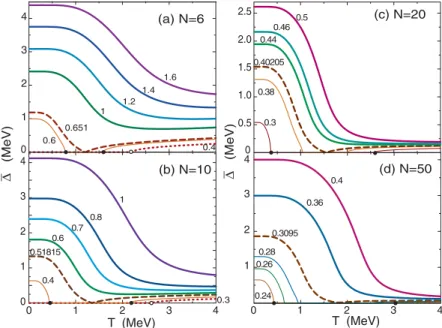
j withT leads to an increase of ˜Gj, whose consequences are qualitatively different depending on the magnitude ofG and particle number N. These features can be seen in Fig.1, where the level-weighted pairing gaps
¯
obtained within the FTBCS1 theory at various values of the pairing interaction parameterGfor several particle numbers are displayed as functions of temperature T. They can be classified in three regions below.
In the region of strong coupling,GGc, where the BCS equations have nontrivial solutions at T =0, and δN2
j is sufficiently large so that ˜Gj G, the gap j in Eq. (31) never collapses since wheneverT reaches the valueTcwhere the BCS gap obtained with parameter G collapses, the gap
j is always positive given ˜Gj G with a renormalized critical temperature ˜TcTc. In this way, the sharp SN-phase transition never occurs asj remains always finite at
TcT T˜cwith ˜Tccontinuously becoming larger withT. If
Gis sufficiently large the QNF may become so large at highT
that the level-dependent partδj in Eqs. (29) and (30) starts to dominate and the total gapj will even increase withT. This effect is stronger when the particle number is smaller. As
0 1 2 3 4
T (MeV) 1
2 3
4 (a) N=6
0.4 0.6
0.651 1
1.2 1.4
1.6
0 1 2 3 4
(b) N=10
0.3 0.4
0.51815 0.6
0.7 0.8
1
0 0
0.5 1.0 1.5 2.0
2.5 (c) N=20
0.3 0.38 0.40205
0.44 0.46
0.5
1 2 3 4
(d) N=50
0.24 0.26 0.28
0.3095 0.36
0.4
0 1 2 3 4
T (MeV)
_ _
FIG. 1. (Color online) Level-weighted pair-ing gaps ¯ obtained within the FTBCS1 as functions of temperature T at various values of pairing interaction parameter G (in MeV) indicated by the figures near the lines for several values of particle numberN. Open circles on the axes of abscissas in panels (a) and (b) mark the values T1 of temperature, where the FTBCS1
gap turns finite at low G. Full circles denote temperature ˜Tc, where the gap vanishes, andT2,
seen in Fig.1, in contrast to the FTBCS gap, which collapses at Tc, the FTBCS1 gaps shown as the thick solid lines are always finite. ForN6, the gaps decrease monotonously asT
increases up toT =4 MeV. This feature qualitatively agrees with the findings within alternative approaches to thermal fluctuations mentioned in the Introduction.
In the region of weak coupling,GGc, where the pairing gap is zero at T =0, the increase of ˜Gj with T makes it becomes significantly greater than Gc at a certain T =T1, allowing a nontrivial solution of the gap equation. This feature is demonstrated by the dotted lines in Figs. 1(a) and 1(b), whereT1 (>2 MeV) is marked by an open circle. Since the difference between the FTBCS1 gapj and the conventional FTBCS one,, is the gapδj in Eqs. (29) and (30), which arises because of the QNFδN2
j, it is obvious that the finite gap atTT1is assisted by the QNF.
In the transitional region, whereGis slightly larger than
Gc, it may happens that, althoughδNj2increases withT, it is still too small so that ˜Gj is only slightly larger thanG, and so is ˜Tccompared toTc. As a result, the gap collapses atT =T˜c which is slightly larger than Tc. AsT increases further, the mechanism of the weak-coupling region is in effect, which leads to the reappearance of the gap atT =T2>T˜c. In Fig.1, these values ˜Tc and T2 are denoted by full circles on the axes of absiccas forN =6,10,20,50 withG=0.6,0.4,0.3, and 0.24 MeV, respectively. With increasing G, it is seen that ˜Tc increases whereas T2 decreases so that at a certain
G these two temperatures coalesce. The value GM where ˜
Tc=T2 =TM is found to be 0.651, 0.51815, 0.40205, and 0.3095 MeV for N= 6, 10, 20, and 50, respectively, i.e., decreases with increasingN. The gap obtained withG=GM is seen decreasing with increasing T from 0 to TM, where it becomes zero. Starting from TM the gap increases again withT. The valueTM is found increasing withT fromTM 1.2 MeV forN =6 toTM 1.7 MeV forN=50. AtG > GM
the gap remains finite at any value ofT. For smallN, the strong QNF even leads to an increase of the gap withT at highT as seen in the cases withN =6, andGM< G1.2 MeV. With increasingNthe high-T tail of the gap gets depleted, showing how the QNF weakens at largeN.
The curious behavior of the level-weighted gap at weak coupling, where it appears at a certain T =T1, and in the transitional region, where it collapses at ˜Tc and reappears at
T2, may have been caused by the well-known inadequacy of the BCS approximation (and BCS-based approaches) for weak pairing [32]. Even atT =0, Ref. [29] has shown that, whereas the exact solution predicts a condensation energy of almost 2 MeV in the doubly-closed shell48Ca, the BCS gives a normal Fermi-gas solution with zero pairing energy. It is expected that a proper PNP such as the number-projected HFB approach in Ref. [33], if it can be practically extended to T = 0, will eventually smooth out the transition points T1 as well as ˜Tc andT2in Fig.1.
To have an insight into the source that causes the high-T tail of the FTBCS1 gap we plot in Fig.2the examples for the level-weighted gaps ¯ (70) along with the level-dependent gaps
j (29), which are obtained forN=20 andG=0.44 MeV. It is seen from this figure that the level-independent part (quantal component)of the gap [dashed lines in Fig.2(b)] also has a high-T tail although it is much depleted compared to the total gapj, which includes the level-dependent part
δj. This figure also reveals that the QNF has the strongest effect on the levels closest to the Fermi surface, which are the 10th and 11th levels. In this figure, the results for the 11th level are not showed as they coincide with those for the 10th one due to the particle-hole symmetry, which is well preserved within the FTBCS1. For the rest of levels, the effect of QNF is much weaker. With increasing the particle numberN, the number of levels away from the Fermi surface becomes larger, whose contribution in the gap ¯outweighs that of the levels closest to the Fermi surface. This explains why the high-T tail of the level-weighted gap ¯is depleted at largeN. WhenN
becomes very large, this tail practically vanishes as the total effect of QNF becomes negligible. In this limit, the temperature dependence of the pairing gap approaches that predicted by the standard BCS theory, which is well valid for infinite systems.
2. Corrections due to particle-number projection and SCQRPA
Shown in Fig. 3 are the level-weighted pairing gaps ¯
, total energies E, and heat capacities C, obtained within the FTBCS, FTBCS1, FTLN1, FTBCS1+SCQRPA, and FTLN1+SCQRPA for the systems with N=10(G=
0.4 MeV) andN =50(G=0.3 MeV). As we want to see the effect of QNF for the case with small(T =0) without any phase transition points at ˜Tc andT2, we choose to neglect,
(MeV)
(a)
0 0.5
1 1.5
0 1 2 3 4
T (MeV)
1 2 3 4 5
T (MeV) 10
9 8
10
9
8 (b) N = 20
G = 0.44 MeV
N = 20 G = 0.44 MeV 2
FIG. 2. (Color online) Level-dependent pairing gapj (29) and level-weighted pairing gap ¯ (70) obtained within the FTBCS1 as functions of temperature T for N= 20 and
_
T (MeV)
0.2 0.4 0.6 0.8 1.0 1.2
0
-28 -24 -20 -16 -12
(MeV)
2 4 6 8
C
1 2 3 4
0
_
0 0.5 1.0 1.5 2.0
-640 -630 -620 -610 -600 -590
(MeV)
5 10 15 20
C
0 1 2 3 4
T (MeV)
(f) (e) N=50 G=0.3 MeV
(d)
(c) (b) N=10 G=0.4 MeV
(a)
FIG. 3. (Color online) Level-weighted pairing gaps (a), (d), total energies (b), (e), and heat capacities (c), (f) as functions of temperature T, obtained for N=10 [(a)–(c)], and N= 50 [(d)–(f)]. The dotted, thin solid, and thick solid lines show the FTBCS, FTBCS1, and FTBCS1+SCQRPA results, respectively. The predictions by the FTLN1 and FTLN1+SCQRPA are presented by the thin and thick dashed lines, respectively. The dash-dotted lines in (a)–(c) denote the exact results. The calculations of the mass operator and quasiparticle damping within the SCQRPA were performed using
ε=0.05 MeV.
for this particular test, the self-energy term −Gv2j in the single-particle energy. ForN =10, e.g., this increases the gap at T = 0 by around 14%, to around 0.8 MeV, but the change in the total energy is found to be negligible. Different from the common practice, which usually neglects the terms
∼−Gjjv4j in calculating the total energyE, the latter is calculated in the present article by averaging the complete pairing Hamiltonian (3). For N =10 and G=0.4 MeV, e.g., this causes a shift of total energy down by around 2 MeV (∼8%) and 1 MeV (∼10.4%) atT =0 and 4 MeV, respectively.
As has been discussed in Sec. II C2, Fig.3 demonstrates that, although the LN method significantly improves the agreement between the predictions by the FTBCS1 theory with the exact results for the pairing gap and total energy at lowT, it fails to do so atTTc, where all approximated results for the pairing gap coalesce and clearly differ from the exact result (forN =10). The reason is partly due to the fact that, strictly speaking, there is no pairing gap in the exact solution [14]. The dash-dotted line, representing the exact result in Fig.3(a) is the effective gap (canonical gap) extracted from the pairing energy. The latter is the difference between the exact total energy and that of the single-particle mean field (Hartre-Fock) energies. The canonical gap includes correlations caused by the fluctuations of the order parameter, only a part of which
is taken into account within the FTBCS1 in terms of QNF. It reduces to the BCS pairing gap only within the mean field approximation and the grand canonical ensemble.
The corrections caused by the SCQRPA are found to be significant for smallN (N =10), in particular for the pairing gap in the regionTc< T <1.5 MeV [Fig.3(a)]. AtT < Tc, the predictions by the FTLN1+SCQRPA are closer to the exact results than those by the FTBCS1+SCQRPA. AtT > Tcboth approximations offer nearly the same results. They produce the total energies and heat capacities, which are much closer to the exact values as compared to the FTBCS1 and FTLN1 results, as shown in Figs.3(b)and3(c). What remarkable here is that the SCQRPA correction indeed smears out all the trace of the SN phase transition in the pairing gap as well as energy and heat capacity.
For largeN(N =50), the effect of SCQRPA corrections is much smaller, although still visible. It depletes the spike, which is the signature of the SN phase transition aroundTcin the heat capacity, leaving only a broad bump between 0< T <
C. Results by using realistic single-particle spectra
The level-weighted gaps, total energies, and heat capac-ities, obtained for neutrons in 56Fe and 120Sn within the same approximations are displayed as functions of T in Fig. 4. The results of calculations for ten neutrons in the 1f7/22p3/22p1/21f5/2shell usingG=25/26 MeV are plotted in Figs.4(a)–4(c)as functions ofT within the same temper-ature interval as that in Ref. [30]. They clearly show that the SCQRPA corrections bring the FTBCS1 (FTLN1)+SCQRPA results closer to the predictions by the FTQMC method for the total energy and heat capacity (no results for the pairing gap are available within the FTQMC method in Ref. [30]). In heavy nuclei, such as120Sn, the effects caused by the SCQRPA corrections are rather small on the pairing gap and total energy. In both nuclei, the pairing gaps do not collapse atT =Tc, but monotonously decrease with increasingT, and the signature of the sharp SN-phase transition seen as a spike at T =Tc in the heat capacities is strongly smoothed out within the FTBCS1(FTLN1)+SCQRPA.
D. Self-consistent and statistical treatments of quasiparticle occupation numbers
The quasiparticle occupation numbersnj as predicted by the FTBCS1 and FTBCS1+SCQRPA for all quasiparticle
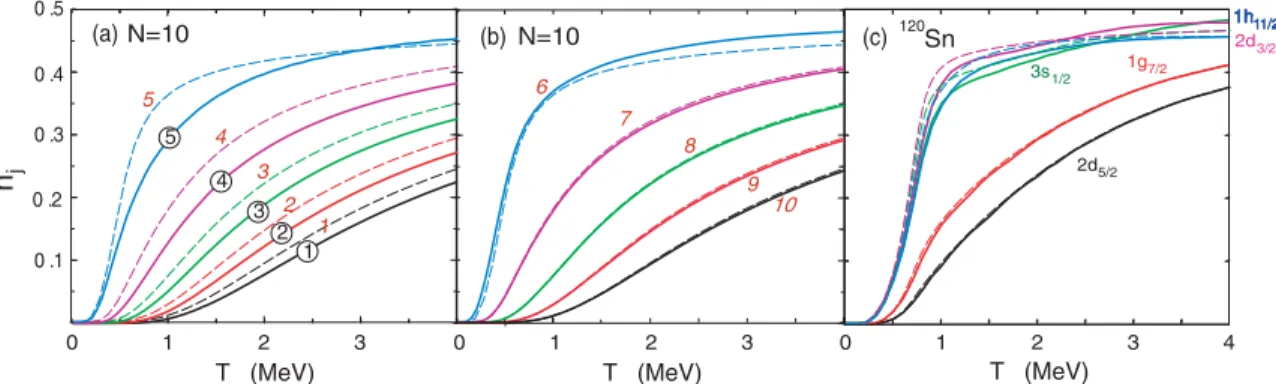
levels in the system withN=10, G=0.4 MeV, and for the orbitals within the (50–82) shell in120Sn (G=0.137 MeV) are shown in Fig.5as functions ofT. While thephsymmetry is preserved within the FTBCS1 (nj =nFDj ) in the sense that the values fornFDj are identical for the single-particle levels located symmetrically from the Fermi level [compare the dashed lines in Figs. 5(a)and 5(b)], it is no longer the case after taking into account dynamic coupling to SCQRPA vibrations. This is particularly clear in light systems [see the solid lines in Figs.5(a)and5(b)]. This deviation ofnjfrom the Fermi-Dirac distribution of free quasiparticles, however, turns out to be quite small in realistic heavy nuclei, such as120Sn, as shown in Fig.5(c).
E. Comparison between FTBCS1 and MBCS
In Refs. [12–15] the MBCS theory has been developed, which also produces a nonvanishing pairing gap at high T. Therefore, it is worthwhile to draw a comparison between the MBCS theory and the present one. Both approaches include the same QNF (27) as the microscopic source, which smoothes out the sharp SN-phase transition and leads to the high-Ttail of the pairing gap. This high-T tail has been shown to be sensitive to the size of the configuration space in either approach. However,
-106 -104 -102 -100 -98 -96 -94 -92 0.5 1.0 1.5 2.0
0 4 8 12 16 20
0.5 1.0 1.5 2.0
0
T (MeV)
(MeV)
C
(MeV)
_
56Fe
G = 25/56
(a)
(b)
(c) MeV
-1300 -1280 -1260 -1240 -1220 0.0 0.2 0.4 0.6 0.8 1.0 1.2 1.4
10 20 30
0 1 2 3 4
T (MeV)
(f) (e)
120
Sn
G = 0.137 MeV
(d)
(MeV)
C
(MeV)
_
FIG. 4. (Color online) Level-weighted pairing gaps, total energies, and heat capacities for ten neutrons in the 1f7/22p3/22p1/21f5/2 shell of 56Fe and all neutron bound states of 120Sn as functions ofT(ε=0.1 MeV).
(a) (b) (c)
T (MeV)
T (MeV) T (MeV)
N=10 N=10 120Sn
2d5/2
1g7/2 3s1/2
2d3/2
1h11/2
0 1 2 3 4
0 .1 0 .2 0 .3 0 .4 0 .5
nj
0 1 2 3 0 1 2 3
1 2 3 4 5
FIG. 5. (Color online) Quasiparticle occupation numbers forN=10 withG=0.4 MeV (a), (b) and120Sn withG=0.137 MeV (c) as
functions ofT. In (a) and (b) the solid lines are predictions within FTBCS1+SCQRPA for the levels numerated by the numbers in the circles starting from the lowest ones. The dashed lines, numerated by the italic numbers, show the corresponding results obtained within the FTBCS1. In (c) predictions for the neutron orbitals of the (50–82) shell in120Sn, obtained within the FTBCS1 and FTBCS1+SCQRPA, are shown as the
dashed and solid lines, respectively.
due to different assumptions in these two approaches, the functional dependences ofδj on the QNFδNj2are different. As a result, the FTBCS1 gap is level dependent, whereas the MBCS one is not. The most important advantage of the FTBCS1 over the MBCS theory is that the solution of the FTBCS1 gap equation (29) is never negative. Moreover, at moderate and strong couplings, where the FTBCS1 gap is finite, its behavior as a function of temperature bears no singularities in any configuration spaces for any value ofN2. The MBCS gap, on the other hand, is free from singularities only up to a certain temperatureTM, which is around 1.75 – 2.3 MeV within the Richardson model with=N =10 and increases almost linearly withN to reachTM24 MeV for
=N =100 [14] (For detail discussions see Refs. [14,15] and references therein). However, the mean-field contraction used to factorize the QNF within the FTBCS1 to the form (27) may have left out some higher-order fluctuations, which can enhance the total effect of the QNF. It might also be the reason that causes the phase transition temperaturesT1,T˜cand
T2 at weak coupling and in the transitional region, discussed in Sec. III B1. Meanwhile, the MBCS theory is based on the strict requirement of restoring the unitarity relation for the generalized single-particle density matrix [11], which brings in the QNF δN2
j (27) without the need of using a mean-field contraction. As a result, the effect of QNF within the MBCS theory is stronger than that predicted within the FTBCS1 and/or FTBCS1+SCQRPA, which can be clearly seen by comparing, e.g., Fig.4(d)above and Fig. 4 of Ref. [11]. Whether this means that the secondary Bogoliubov’s transformation properly includes or exaggerates the effect of coupling to configurations beyond the quasiparticle mean field within the MBCS theory remains to be investigated. Another question is also open on whether the MBCS theory can be improved by coupling the modified quasiparticles to the modified QRPA vibrations. The answer to these issues may be a subject for future study.
IV. CONCLUSIONS
The present work extends the BCS1+SCQRPA theory, derived in Ref. [18] for a multilevel pairing model, to
finite temperature. The resulting FTBCS1+SCQRPA theory includes the effect of QNF as well as dynamic coupling of quasiparticles to pairing vibrations. This theory also incorporates the corrections caused by the particle-number projection within the LN method.
We have carried out a thorough test of the developed approach within the Richardson model as well as two realistic nuclei,56Fe and120Sn. The analysis of the obtained pairing gaps, total energies, and heat capacities leads to the following conclusions:
(i) The FTBCS1 (with or without SCQRPA corrections) microscopically confirms that, in the region of mod-erate and strong couplings, the quasiparticle-number fluctuation smoothes out the sharp SN phase transition, predicted by the FTBCS theory. As a result, the gap does not collapse atT =Tc, but has a tail, which extends to high temperatureT.
(ii) The correction due to the particle-number projection within the LN method to the pairing gap is significant atT Tc, which leads to a steeper temperature depen-dence of the pairing gap in the region around Tc. At the same time, the SCQRPA correction smears out the signature of a sharp SN phase transition even in heavy realistic nuclei such as120Sn.
(iii) The dynamic coupling to SCQRPA vibrations causes the deviation of the quasiparticle occupation number from the Fermi-Dirac distribution for noninteracting fermions. However, for a realistic heavy nucleus such as120Sn, this deviation is negligible. Consequently, in these nuclei, the FTBCS1 and FTBCS1+SCQRPA predict similar results for the pairing gap and total energy. At the same time, for light systems, this deviation is stronger, therefore, the FTBCS1+SCQRPA offers a better approximation than the FTBCS1 in the study of thermal pairing properties of these nuclei.
can be applied in further study of thermal properties of finite systems such as nuclei, where pairing plays an important role. Compared to existing methods, the merit of the present approach lies in its fully microscopic derivation and simplicity when it is applied to heavy nuclei with strong pairing, where the effect of coupling to SCQRPA is negligible so that the solution of the SCQRPA can be avoided. In this case, thermal pairing can be determined solely by solving the FTBCS1 gap equation, which is technically as simple as the FTBCS one, whereas the exact diagonalization is impracticable (atT =0). As the next step in improving the developed approach, we will include the effect of angular momentum in this approach. This study is now underway and the results will be reported in a forthcoming article [34].
ACKNOWLEDGMENTS
The authors thank Vuong Kim Au of Texas A&M Univer-sity for valuable assistance. NQH is a RIKEN Asian Program Associate. The numerical calculations were carried out using
theFORTRAN IMSLLibrary by Visual Numerics on the RIKEN
Super Combined Cluster (RSCC) system.
APPENDIX: FACTORIZATION OFA†jAj
The factorization of the screening factor A†jAj is not unique as it can be carried out in at least two ways, which lead to different results. In the first way, one can perform the mean-field contraction by using the Wick’s theorem (WT) to obtain
A†jAjWTδjjn2j. (A1)
In the second way, one uses the Holstein-Primakoff’s (HP) boson representation [35]
A†j =b†j
1−bj†bj
j
,
(A2)
Aj =
1−b†jbj
j
bj, Nj =2bj†bj,
with boson operatorsbj†andbj to obtain
A†jAjHPδjjjnj(1−2nj). (A3)
The lowest order of the HP boson representation implies that operatorsA†j andAj are ideal bosonsbj†andbj, respectively, i.e., settingDj = 1 in Eq. (6). It is in fact the well-known quasiboson approximation (QBA), which is widely used in the
derivation of the QRPA equations. The QBA leads to
A†jAjQBA12δjjNj =δjjjnj. (A4) As for the screening factor A†jA†j, it vanishes in these
approximations.
Using these results, we obtain the same form of Eq. (29) for the pairing gap, except that now j =j, and the level-dependent partδj from Eq. (30) becomes
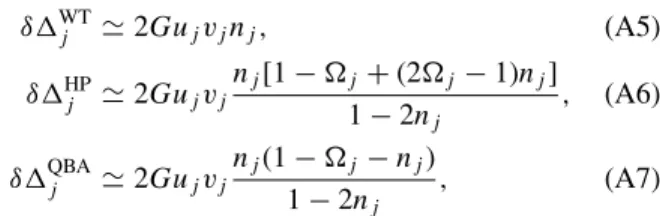
δWTj 2Gujvjnj, (A5)
δHPj 2Gujvj
nj[1−j +(2j −1)nj] 1−2nj
, (A6)
δQBAj 2Gujvj
nj(1−j −nj) 1−2nj
, (A7)
which correspond to the approximations using the Wick’s theorem, HP representation, and the QBA, respectively.
The level-weighted gaps ¯ obtained for N =10 and
G=0.4 MeV within these approximations are compared with the FTBCS, FTBCS1 and FTBCS1+SCQRPA results in Fig.6. AtT <1 MeV, all three approximations, WT, HP, and QBA, predict the gaps close to the FTBCS one, but collapse at different Tc, namely TcQBA< TcFTBCS< TcHP< TcWT. At
T 1.2 MeV the HP gap reappears and increases with
T to reach the values comparable with those predicted by the FTBCS1 and FTBCS1+SCQRPA at T >2 MeV. From this comparison, one can see that the mean-field contraction (A1) for A†jAj includes only a tiny fraction of the QNF because it produces a finite gap at T > TFTBCS
c 0.5 MeV, but this gap collapses again at TWT
c 0.6 MeV. The HP boson representation, on the other hand, is able to take into account the effect of QNF at hight T leading to a finite gap at T >1.38 MeV, but fails to account for this effect at intermediate temperatures 0.55T1.38 MeV. The QBA produces essentially the same result as that of the conventional FTBCS at low T with a slightly lower critical temperature
TcQBA0.43 MeV. However, it causes a negative ¯atT >
1.9 MeV.
_
-0.2 0 0.2 0.4 0.6 0.8 1
0 1 2 3 4 5
T (MeV)
N=10
G=0.4 MeV
FIG. 6. (Color online) Level-weighted gaps forN=10 withG=
![FIG. 3. (Color online) Level- Level-weighted pairing gaps (a), (d), total energies (b), (e), and heat capacities (c), (f) as functions of temperature T , obtained for N = 10 [(a)–(c)], and N = 50 [(d)–(f)]](https://thumb-us.123doks.com/thumbv2/123dok_us/8200350.2174190/10.891.79.591.99.642/color-weighted-pairing-energies-capacities-functions-temperature-obtained.webp)