Monograph of
Coccinia
(Cucurbitaceae)
Norbert Holstein1
1 Nees-Institute for Biodiversity of Plants, Meckenheimer Allee 170, 53115 Bonn, Germany
Corresponding author:Norbert Holstein ([email protected])
Academic editor:Sandra Knapp | Received 25 April 2012 | Accepted 23 September 2014 | Published 3 August 2015
Citation: Holstein N (2015) Monograph of Coccinia (Cucurbitaceae). PhytoKeys 54: 1–166. doi: 10.3897/ phytokeys.54.3285
Abstract
This monograph deals with all 95 names described in the Cucurbitaceae genus Coccinia and recognizes 25 species. Taxonomic novelties are Coccinia adoensis var. aurantiaca (C.Jeffrey) Holstein, stat. nov.,
C. sessilifolia var. variifolia (A.Meeuse) Holstein, stat. nov., and C. adoensis var. jeffreyana Holstein,
var. nov. For the 25 species 3157 collections were examined, of which 2024 were georeferenced to produce distribution maps. All species are distributed in sub-Saharan Africa with one species, C. grandis, extending from Senegal in West Africa east to Indonesia and being naturalized on Pacific Islands, in Australia, the Caribbean, and South America. Coccinia species are dioecious creepers or climbers with simple or bifid tendrils that occupy a range of habitats from arid scrubland, woodlands to lowland rainforest and mist forest. The corolla of Coccinia species is sympetalous, usually pale yellow to orange, and 1 to 4.5 cm long. Pollination is by bees foraging for pollen or nectar. After pollination, the developing ovary often exhibits longitudinal mottling, which usually disappears during maturation. All species produce berries with a pericarp in reddish colors (orange-red through to scarlet red), hence the generic name. The globose to cylindrical fruits contain numerous grayish-beige flat to lenticular seeds. Chromosome numbers are 2n = 20, 24, and 22 + XX/XY. Many Coccinia species are used for food, either as roasted tubers, greens as spinach, or the fruits as vegetables. Medicinal value is established in C. grandis, of which leaves and sap are used against diabetes.
Keywords
Cucurbitaceae, Coccinia, molecular phylogeny, biogeography, taxonomy, morphology, sex expression, useful plants
www.phytokeys.com
Copyright Norbert Holstein. This is an open access article distributed under the terms of the Creative Commons Attribution License (CC BY 4.0), which permits unrestricted use, distribution, and reproduction in any medium, provided the original author and source are credited.
Table of contents
Introduction ... 4
Materials and methods ... 4
General morphology ... 4
Phylogenies ... 5
Distribution maps ... 5
Morphology and anatomy ... 6
Habit ... 6
Roots ... 6
Hypocotyl and shoots ... 7
Cotyledons ... 9
Leaves ... 9
Probracts and bracts ... 13
Extranuptial glands ... 13
Peduncles and pedicels ... 14
Perianth ... 15
Androecium ... 17
Pollen ... 18
Gynoecium ... 19
Female gametophyte development and embryology... 19
Fruits ... 19
Seeds ... 21
Germination ... 23
Genome, chromosomes, and hybridization ... 23
Chromosomes and sex determination ... 23
Genome of C. grandis ... 26
Hybridization and crossing experiments ... 26
Plant – biotic environment interactions ... 29
Pollination ... 29
Seed dispersal ... 30
Interaction with ants ... 31
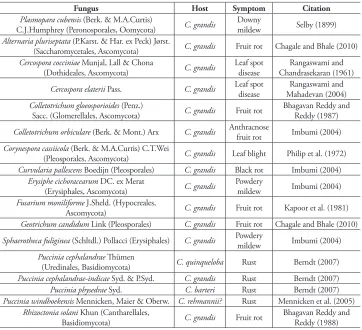
Diseases and parasites ... 31
Use, economic potential, and phytochemistry ... 34
Evolution and phylogeny ... 36
Identification of Coccinia species ... 41
Possible confusion with other genera ... 41
Characters for species discrimination ... 41
Key to Coccinia species ... 41
Taxonomic treatment ... 54
1. Coccinia abyssinica (Lam.) Cogn. ... 56
2a. Coccinia adoensis (Hochst. ex A.Rich.) Cogn. var. adoensis ... 59
2c. Coccinia adoensis var. jeffreyana Holstein ... 70
3. Coccinia barteri (Hook.f.) Keay ... 72
4. Coccinia grandiflora Cogn. ... 75
5. Coccinia grandis (L.) Voigt ... 78
6. Coccinia heterophylla (Hook.f.) Holstein ... 89
7. Coccinia hirtella Cogn. ... 92
8. Coccinia intermedia Holstein ... 94
9. Coccinia keayana R.Fern. ... 95
10. Coccinia longicarpa Jongkind ... 97
11. Coccinia mackenii Naudin ex C.Huber ... 99
12. Coccinia megarrhiza C.Jeffrey ... 102
13. Coccinia microphylla Gilg ... 104
14. Coccinia mildbraedii Gilg ... 107
15. Coccinia ogadensis Thulin ... 109
16. Coccinia pwaniensis Holstein ... 111
17. Coccinia quinqueloba (Thunb.) Cogn. ... 113
18. Coccinia racemiflora Keraudren ... 114
19. Coccinia rehmannii Cogn. ... 115
20. Coccinia samburuensis Holstein ... 122
21. Coccinia schliebenii Harms ... 123
22. Coccinia senensis (Klotzsch) Cogn. ... 124
23a. Coccinia sessilifolia (Sond.) Cogn. var. sessilifolia ... 129
23b. Coccinia sessilifolia var. variifolia (A.Meeuse) Holstein... 132
24. Coccinia subsessiliflora Cogn. ... 133
25. Coccinia trilobata (Cogn.) C.Jeffrey ... 135
Insufficiently known taxa ... 137
Dubious names ... 138
Invalid names ... 140
Exluded taxa ... 145
Acknowledgements ... 150
References ... 151
Supplementary material 1 ... 165
Introduction
Coccinia Wight & Arn. comprises 25 species and is the 11th largest of the 97 genera
of the Cucurbitaceae (Schaefer and Renner 2011a). Especially in the 19th century, it
drew gardeners’ attention probably because of its striking fruits (André 1900; Edwards 1815; Huber 1864; 1865; Koch 1865; Sims 1816). All species are dioecious, and one species, C. grandis (L.) Voigt, has heteromorphic sex chromosomes and therefore has been studied cytologically (Agarwal and Roy 1975; 1983; 1984; Bhaduri and Bose 1947; Chakravorti 1948; Datta 1988; Kumar and Deodikar 1940; Kumar and Vish-veshwaraiah 1952; Roy 1974; Roy and Roy 1971b). The last complete taxonomic treatment of Coccinia is by Cogniaux (1881), more than 130 years ago. Since then, 16 new species have been described, and the genus has only been revised regionally (Hutchinson et al. 1954; Jeffrey 1967; 1978; 1995; Jeffrey and Fernandes 1986; Ké-raudren-Aymonin 1975a; Kéraudren 1967; Meeuse 1962). The position of Coccinia in the Benincaseae has been confirmed by molecular data (Kocyan et al. 2007; Schaefer and Renner 2011b), and the monophyly has been tested with almost complete species sampling by Holstein and Renner (2011b).
The delimitation of Coccinia from other genera is difficult. The scarlet-red fruits to which the genus name – Coccinia from Latin coccineus – refers are also found in other African genera, such as Eureiandra Hook.f. Therefore, it is not surprising that early botanists described several species now considered to belong to Coccinia in other genera (Cephalandra Schrad. ex Eckl. & Zeyh., Physedra Hook.f., and Staphylosyce Hook.f.), or species described in Coccinia now belong to different genera. In all, 113 names at various ranks have been proposed for what are here considered 25 species. The species concepts in the present revision are based on 3157 herbarium collections and fieldwork in Tanzania, geo-referencing of 2024 collections and cultivation of 10 species in the greenhouse. In combination, plastid and nuclear data obtained for multiple accessions representing most species and ecological information coming from the mapping effort provide a modern understanding of the evolution and species relationships in Coccinia.
Materials and methods
General morphology
New collections were added if the photograph allowed identification or if misidentifica-tion appeared to be unlikely (esp. C. grandis collections from the Pacific area), while du-plicates were added without visual inspection of the specimen photo. Online availability of specimen images is mentioned in the list of exsiccatae (Suppl. material 1). Ten species were cultivated in greenhouses of Munich Botanical Garden: C. abyssinica (Lam.) Cogn. (1 origin, 4 individuals), C. adoensis var. jeffreyana (1 origin, 4 individuals), C. grandiflora
Cogn. (1 origin, 1 individual), C. grandis (3 origins with 2, 61, 3 individuals, respec-tively), C. hirtella Cogn. (1 origin, 12 individuals), C. megarrhiza C.Jeffrey (1 origin, 8 individuals), C. microphylla Gilg (2 origins, 2 and 1 individual, respectively), C. rehman-nii Cogn. with two varieties (2 origins, each 3 individuals), C. sessilifolia (Sond.) Cogn. var. sessilifolia (1 origin, 8 individuals), and C. trilobata (Cogn.) C.Jeffrey (2 origins, each 3 individuals). The present author performed crossing experiments among eight of these species. Morphological features were documented photographically and in the form of vouchers, with 47 collections deposited in M. Field data were obtained on a trip to NE Tanzania in 2009 resulting in 28 Coccinia collections.
Phylogenies
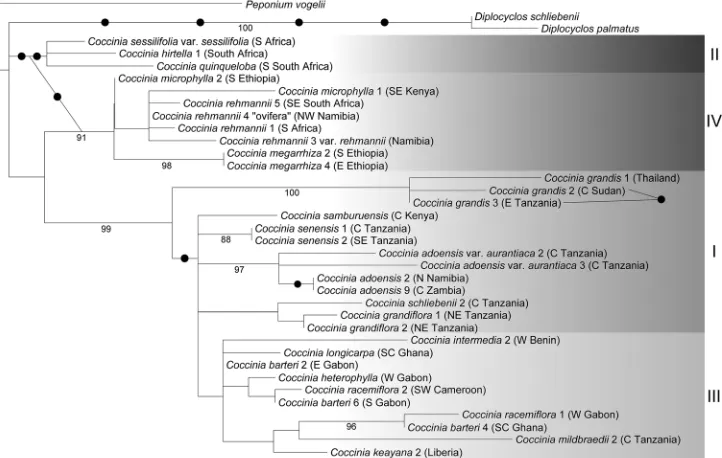
For this monograph the phylogenetic data of Holstein and Renner (2011a; 2011b) were augmented with 20 new sequences from 8 accessions (GenBank accession numbers are given in Suppl. material 2), and new phylogenies were calculated using RAxML v. 7.2.6 (Stamatakis 2006) and MrBayes v. 3.2 (Ronquist et al. 2012). The substitution model was GTR+Γ as used before, and 1000 ML replicates were used to infer statistical support for the nodes via bootstrapping. For Bayesian analysis, four chains were run with 2,000,000 generations, with a sampling frequency of 1000. The first 25% of the trees were discarded as burn-in, and the rest were plotted as a 50% majority rule consensus tree using FigTree 1.3.1 (http://tree.bio.ed.ac.uk/software/figtree/). Gaps in the plastid matrix occurring in more than one accession were coded as “0”, “1”, or “?”, with “?” when data were missing or when shorter gaps were coded in the same place, but in different accessions.
Distribution maps
useful to ignore in the distribution maps despite the large uncertainty of the position (radius > 5 km) or if the collecting site was only given as “nearby” a distinct locality, then geo-referenced coordinates are given in brackets. Political administrative borders were taken from GADM v.1 (Jan 2009) or v.2 (Jan 2012) (http://www.gadm.org/) and elevation data (1 km resolution) from CGIAR Consortium for Spatial Information (Jarvis et al. 2008). The geodetic datum for the maps is WGS84; the projection in each case is equirectangular. Coordinates are given in decimal degrees in Suppl. material 1 with WGS84 as geodetic datum.
Morphology and anatomy
Habit
Coccinia species are perennial climbers or creepers. The lignification of the mature shoots differs among the species from unlignified to completely lignified. Climbing is enabled by tendrils, which are either simple or bifid. Tendril development in young plants is delayed and emerges in C. abyssinica after the 6th node (Getahun 1974a). The
tendril arms are only rarely equally sized, as one is usually much smaller; true dichot-omy of tendrils is unknown from Coccinia. Whether a species has simple or bifid ten-drils is often not fixed, but there is a strong predominance of one kind. Bifid tenten-drils regularly occur or are predominant in C. grandiflora Cogn., C. heterophylla (Hook.f.) Holstein, C. hirtella Cogn., C. intermedia Holstein, C. mackenii Naudin ex C.Huber,
C. mildbraedii Gilg, C. racemiflora Keraudren, C. schliebenii Harms, and in some forms of C. barteri (Holstein and Renner 2011b). Strikingly, Coccinia species with bifid ten-drils occur in rather humid habitats. This suggests an adaptive advantage, because more tendril arms increase stability, as the leaves of rainforest species are larger, coriaceous, and thus heavier than leaves of species from drier habitats. Some species are regularly described as having simple tendrils in floristic treatments, but they may bare bifid tendrils such as C. sessilifolia (N. Holstein 13) and C. senensis (H.J.E. Schlieben 5745
in B, K, and MO). Coccinia adoensis has bifid tendrils even in some type specimens (e.g., G.H.W. Schimper 166 in BR8886781 and on the sheet with a drawing in K) and is still listed as simple-tendrilled. All three species with this polymorphism, however, have predominantly simple tendrils. Interestingly, these species are also closely related to species with predominantly bifid tendrils: C. sessilifolia with C. hirtella and C. mac-kenii, and C. adoensis with C. grandiflora and C. schliebenii.
Roots
and C. schliebenii), however, produce globular subterranean root tubers, much like potatoes, but smaller in size (Holstein and Renner 2011b; Zimmermann 1922b; pers. observ.). Root tubers in Coccinia adoensis are likely to be an adaptation to fire, as this species predominantly occurs in woodlands. In contrast to rather mild fires in semi-arid savannas with less inflammable biomass, woodland fires produce temperature rises of 60 °C in 0–3 cm depth (Bradstock and Auld 1995; Gignoux et al. 1997), so vegeta-tive buds near the ground (hemicryptophytes) might be damaged, whereas root tubers (geophytes) have a higher chance of survival.
Coccinia grandis and C. barteri produce adventitious roots if stems touch the soil (Fig. 1b). Coccinia hirtella, C. sessilifolia and their F1 hybrids with C. grandis appear to lack this ability (pers. observ.). Adventitious roots also occur along the hypocotyl of C. abyssinica seedlings (Getahun 1974a). There is barely any research on root anat-omy, solely Getahun (1974a) reports tetrarch vascular bundles in the primary roots of
C. abyssinica seedlings and di- to triarch bundles in secondary roots.
Hypocotyl and shoots
Many species, such as C. abyssinica, C. grandis, C. hirtella, C. megarrhiza, C. micro-phylla, C. rehmannii, C. sessilifolia, and C. trilobata, produce a lignified tuber that is derived from the hypocotyl (Zimmermann 1922b; pers. observ., Fig. 1a). The tuber, at least of some species, contains starch as a storage nutrient (Getahun 1974b). It de-velops during the first season, and lignification may begin as soon as the appearance of the first tendrils, such as in C. abyssinica (N. Holstein 132). Some species, such as
C. adoensis and C. grandiflora (and most likely also C. senensis and C. schliebenii) do not produce hypocotyl tubers but root tubers. In C. adoensis var. jeffreyana the hypocotyl is
Figure 1.a Young plant of C. grandis. The hypocotyl is already thickened and lignifies later-on to a tuber. The cotyledons are glabrous, have an entire margin and an obtuse apex b Adventitious root on
minute (N. Holstein 130), which prevents the development of a tuber. Whether West and Central African forest species produce tubers is unknown.
Each plant produces one to several shoots, which can persist or die back completely during the dry season or due to fire or grazing. Coccinia microphylla shoots can lignify completely and produce short green branches with flowers and small leaves during the dry season (Fig. 2a), whereas shoots of C. sessilifolia do not lignify at all (pers. observ. from greenhouse cultivation over 4 years). The shoots of C. grandis can become slightly succu-lent. The length of the shoots varies from 70 cm in C. microphylla to 20 m in C. grandiflora
and C. mildbraedii. Zimmermann (1922a) reports a stem of C. grandiflora being 6 cm in diameter. Usually, the bark of the hypocotyl tuber and the shoots is grayish in color. Fresh shoots and twigs are usually deep green to brownish green, sometimes speckled with pale to whitish pustules. In C. abyssinica and C. megarrhiza the shoots and tendrils can turn purple during maturity. Coccinia sessilifolia produces glaucous shoots that bear a waxy bloom (Fig. 2b). The indumentum of Coccinia species, if present, is composed of simple, oligo- to multicellular eglandular trichomes up to 2 mm in length. The long trichomes consist of oblong cells that may appear articulate when dried (Fig. 3a). Shorter trichomes can be lineal to conical (Fig. 3b). Sometimes, trichomes have a thickened base that appear warty when the trichomes break off. The density of the trichomes is often increased on the nodes. Trichome type and length on shoots are like those of the abaxial surface of the peti-oles, but usually less dense. Young shoots often exhibit short (< 0.5 mm), weak trichomes, even in species that are later glabrous, e.g., in C. grandis or C. sessilifolia. Glandular tri-chomes are rare, few-celled, not visible with the naked eye and have been found, e.g., in C. grandiflora and C. grandis (pers. observ.; Thanki 1989; Fig. 3c). Glandular trichomes are also observed in young stems of C. abyssinica (Getahun 1974a), which are usually covered with long multicellular eglandular trichomes.
Cotyledons
Zimmermann (1922b) reports epigeous cotyledons for C. grandiflora and C. grandis, of which the latter is confirmed by personal observations (Fig. 1a). Epigeous cotyledons also occur in C. abyssinica, C. adoensis var. jeffreyana, C. microphylla, C. rehmannii
aff. var. littoralis, and C. sessilifolia. The hypocotyl and cotyledons of all observed taxa are glabrous. The cotyledons are elliptical to obovate and have an entire margin. The cotyledons are slightly fleshy and green, which is also observed in those of C. abyssinica
(Getahun 1974a), and the cotyledonous apex has a pale marking and is obtuse to retuse. Getahun reports that the prominent veins and the margins on the lower cotyledon surface in C. abyssinica are covered with multicellular trichomes. However, prominent veins in C. abyssinica cotyledons cannot be confirmed, and if multicellular trichomes occur, then they are not visible to the naked eye. The first normal leaf in this species, however, emerges in the axilla of the cotyledons (N. Holstein 132, Fig. 4a), and thus might have been confused.
Leaves
The leaves of Coccinia species are simple, alternate, and paired with a tendril on each node, except for the first nodes (Figs 1a, 4a, b). Leaves of all species are petiolate, except for C. sessilifolia var. sessilifolia, which only develops petioles when young (N. Holstein 131, Fig. 4b) or rarely subsessile leaves when older; full petioles in this species are only realized in C. sessilifolia var. variifolia (A.Meeuse) Holstein. Subsessile leaves are common in C. quinqueloba and C. senensis, while the other species’ leaves are usually distinctly petiolate. The petioles’ surface can be glabrous, at maturity speckled with hyaline to white cell clusters (C. grandis, C. heterophylla, C. intermedia, C. quinqueloba,
C. rehmannii, C. samburuensis, C. senensis, C. subsessiliflora), or have an indumentum. The petiole contains several vascular bundles arranged in a U-shape (Fig. 5a). However,
Figure 3. Trichomes on Coccinia species. a Node of C. adoensis var. jeffreyana (J.C. Lovett 1197). The black bar equals 1 mm. b Part of a leaf C. adoensis var. jeffreyana (A.F. Stolz 504). The white bar equals 1 mm.
Hussain et al. (2011) report a ring of vascular bundles in C. grandis. The adaxial side of the petiole often bears two ridges above the “lateral” vascular bundles (Fig. 5a). These ridges merge into the leaf margin and usually bear trichomes (Figs 3b, 5b, c). The abaxial side of the petiole shares its indumentum with the lower leaf lamina, at least at the base of the veins (Fig. 5c).
The venation in C. grandis is reticulate, and the mid rib is reported to contain three bicollateral vascular bundles with xylem and phloem arranged in a ring (Hussain et al. 2011). Reticulate venation can be confirmed for all Coccinia species except C. ogaden-sis, in which only the central vein in each lobe is visible.
Figure 4.a Young plant of C. abyssinica (N. Holstein 132). The first node is in the axilla where the glabrous cotyledons split off. Thefirst nodes lack probracts and tendrils b Young plant of C. sessilifolia
(N. Holstein 131). The first leaves in this species are petiolate, sessile leaves are produced later-on. The glabrous cotyledons are already dried (plant had the same age as the one in Fig. 4a).
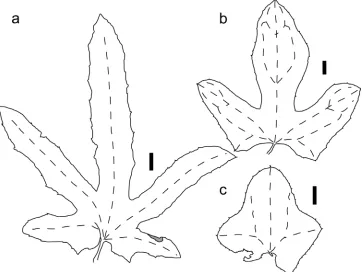
Young leaf buds often bear a dense indumentum, even in species that are glabrous at maturity, e.g., in C. grandis. The leaf lobes are linear, elliptic, (ob-)ovate to triangular. The incision depth of the lobes can be consistent (C. ogadensis, C. subsessiliflora) or highly variable (C. adoensis, C. grandis, C. senensis (Fig. 6)), even within a single individual. In taxa with a variable degree of lobation, young leaves tend to be not or shallowly lobed (e.g., C. grandis, C. megarrhiza, C. rehmannii aff. var. littoralis,
C. sessilifolia), a differentiation according to light exposure might also be possible. The leaf margin usually is beset conspicuously with small teeth and often bears trichomes (Figs 3b, 5b, c), even in otherwise glabrous species (e.g., C. grandis, C. sessilifolia). The teeth are at the apex of lobes, lobules and smaller orders of serration or situated along the entire margin. The term “dentate” (toothed) is therefore ambiguous in literature describing Coccinia, as it might also refer to the margin morphology (Stearn 2004). The teeth are often pale, but can also be colored, esp. when dry, such as in C. abyssinica,
C. grandis, C. intermedia, C. longicarpa, C. megarrhiza, and C. samburuensis (Fig. 7a). The coloration of teeth is inconspicuous in young plants and develops during maturation (as observed in C. abyssinica, C. grandis, and C. megarrhiza). The teeth are interpreted as hydathodes by Zimmermann (1922a), because he observed water drops in C. grandis and C. trilobata on the teeth of the 2nd order (except those of the tip of
the lobes) in the morning. A white deposit at the teeth on the upper side of the leaf of a C. adoensis plant (P. Quarré 75; PR) seems to support Zimmermann’s interpretation.
The upper leaf lamina is often covered with transparent to white pustules, that con-tain cystoliths (Avetta 1894; Solereder 1899; Zimmermann 1922a; pers. observ.). The pustules consist of up to 25 cells in C. mackenii (Avetta 1894) but are larger and denser in glabrous species from dry habitats (esp. C. ogadensis). As they develop over time (they are smaller and less well visible in forest species), it can be assumed that the pustules are an adaptation towards protection against high solar radiation. When acetic acid is applied to microscopic sections of the leaves, heavy gas development suggests that the cystoliths consist of CaCO3 (pers. observ.). This can be observed in C. grandis, C. hir-tella, and C. sessilifolia, hence also when the pustules are not conspicuous as in the latter two species. The pustules may form the base of small trichomes, such as in C. adoen-sis var. jeffreyana (Fig. 3b) or C. microphylla. In some species, the upper surface is usually covered with an indumentum (C. hirtella, C. schliebenii, C. senensis, and C. trilobata), but it may also be reduced, and other species rarely exhibit a trichome-bearing upper surface, e.g., C. adoensis. In each case, the trichomes are simple, < 1 mm, and whitish. The veins on the upper surface are either glabrous to the naked eye or are covered with small < 0.5 mm long simple trichomes. Zimmermann (1922a) observed in C. grandis
that the glabrous surface of the lamina is only slightly wettable, whereas a drop of eosine disperses along the veins rapidly. Zimmermann argues that these “capillary drainage lines” might serve to transport water to the hydathodes during the dry season.
The lower leaf lamina is paler than the upper side (Fig. 3b) and can be glabrous or bear an indumentum. The highest density of the indumentum can be found on the
prominent veins (Fig. 5c). The indumentum on the lower leaf surface and the abaxial surface of the petiole can consist of eglandular oligo- to multicellular trichomes. The trichomes are appressed or upright (Fig. 5c), usually filiform, sometimes also narrowly conical (e.g., C. abyssinica). Filiform trichomes are straight, curved, or sinuate. Long filiform trichomes often appear articulate when dry due to sunken lateral cell walls (Fig. 3a). Dry trichomes are hyaline, whitish, beige, or yellowish. The lower lamina often displays deeply colored to dark green to blackish extranuptial glands (Fig. 7b). The glands usually occur at the base of the leaf between the veins, sometimes also between secondary ramifications (C. grandis) or along the main veins (C. grandiflora). The epidermis of the lower leaf lamina in C. grandis consists of cells with undulating anticlinal cell walls and anomocytic stomata (pers. observ.).
Probracts and bracts
In addition to the foliose leaves, most Coccinia species have bracteose prophylls on ster-ile nodes, which are called “probracts” (Zimmermann 1922b). The probracts can be up to 5 mm long, but also rather small (< 1 mm) or caducous. The first nodes of the seed-ling lack probracts, and they are developed on later nodes. The shape of the probracts is ovate and entire with a round to acute apex. They are often spoon-like presenting the lower surface (e.g., C. adoensis, C. barteri, C. grandis, C. megarrhiza, C. sessilifolia; Figs 3a, 8b), or they are folded in the middle with a prominent keel (C. grandiflora; Fig. 8a). Probracts can be glabrous or bear short (< 1 mm) trichomes, and bear ex-tranuptial glands on the lower surface (Fig. 8a; Okoli and Onofeghara 1984).
Bracts (leaves subtending inflorescences or flowers), if present, look like the pro-bracts. Bracts below inflorescences are as large as probracts, while bracts below flowers tend to be smaller. Bracts can be present or absent, the latter being an indicative char-acter for some species.
In rare cases, probracts and bracts can be leaf-like (e.g., N. Holstein 126, Fig. 2b;
P.C.M. Jansen 2065; H. Wanntorp & H.E. Wanntorp 1159) indicating that the (pro-) bracts are likely derived from usual leaves.
Extranuptial glands
Schrödter (1926), however, finds that young sheaths in Luffa aegyptiaca are lignified but become suberinized with age, so the difference might be explained by different stages. Chakravarty (1948) interprets the sheath as filter tissue that is surrounded by an “external osmotic tissue”. Also Muhammad Ilyas (1992) interprets these radially elongated cells as secretory and notes that they have a connection to the vascular strand. However, Okoli and Onofeghara (1984) find that the glands in C. barteri
are too distant to be interpreted as vascularized. Zimmermann (1922b) observes intermediate forms between few-celled, stalked glandular hairs and the Benincasa-type glands in C. microphylla and C. trilobata, including the sheath that forms the base of the protruding glandular tissue. The glands secrete a clear, rarely slightly colored, sweet-tasting exudate (pers. observ. in C. grandiflora and C. grandis). In C. grandis the exudates contain sucrose, glucose, fructose, alanine, tryptophane, threonine, and an unidentified amino acid (Muhammad Ilyas 1992).
Peduncles and pedicels
Male flowers mostly occur in racemes that are usually accompanied by 1–2 solitary flowers on the same node (Fig. 2b). The first flowers in male plants of C. hirtella,
C. reh mannii, and C. sessilifolia are solitary. Racemes appear later in the course of the flowering season, although racemes are generally rare in the first species (pers. observ.). If solitary flowers and racemes are produced on the same node, then the solitary flower(s) precede(s) those of the racemes in time of maturity (Fig. 2b). The trigger to produce racemes instead of or additionally to solitary flowers is not known. The racemes bear up to 35 flowers (e.g., in C. pwaniensis, C. racemiflora). Within the racemes, flowering starts at the basalmost branches. If the peduncle is reduced, flowers
Figure 8.a The probract of C. grandiflora is fleshy and has a keel. The abaxial side bears many extranuptial nectaries. The structure pointing to the lower left of the picture is the tendril b The probract of C. trilobata
appear clustered on the node. In C. grandis, which usually produces single flowers only, flower clusters (short-peduncled racemes) rarely occur. This can be seen in plants from Ethiopia, Saudi Arabia but also from India and Sri Lanka. The pedicels of solitary male flowers of C. hirtella, C. megarrhiza, and C. rehmannii exhibit a negative gravitropism. In creeping plants, pedicels that grow downwards in the beginning make a sharp bent upwards to present the flower upright.
Female flowers are mostly solitary. Only in some species, female flowers are usually in racemes, such as in C. heterophylla, C. keayana, and C. racemiflora. Few-flowered female racemes or clustered flowers might also occur in C. grandiflora, C. intermedia, and C. subsessiliflora. In C. barteri, female flowers can be solitary or in few- or many-flowered racemes. Two female flowers per node have also been observed in C. micro-phylla. The pedicels of solitary female flowers are negatively gravitropic during flower development. After pollination, the pedicels of solitary female flowers of C. grandis,
C. hirtella, C. megarrhiza, C. microphylla, C. rehmannii, and C. sessilifolia exhibit posi-tive gravitropism. The downturn is not due to slackness caused by the weight of the developing fruit but an active process, as the pedicels thicken and remain firm. How-ever, only fertilized flowers turn downwards completely, as aborted flowers from mis-pollination never reach this state (pers. observ. in cultivated plants).
Perianth
The perianth of all Coccinia species is synsepalous and sympetalous. At the base, calyx tube and corolla tube are connected with each other and form a perianth tube or fun-nel. Depending on the exsertion point of the staminodes in female flowers, parts of the tube form a hypanthium (e.g., C. grandiflora).
The calyx differentiates as a bulge (Fig. 7a, b) with usually five lobes, or only the lobes emerge from the perianth tube (Fig. 9). If the calyx emerges as a bulge, then it and the perianth tube are rather conspicuously differentiated from the corolla in terms of color. If only the calyx lobes emerge, then the color of perianth tube fades to green color towards the receptacle, with the veins of the corolla remaining more intensely colored. Whether calyx and corolla are non-differentiated (congenital fusion) or postgenital-ly fused, is not known for Coccinia, but in the distantly related Echinopepon wrightii
(A.Gray) S.Watson the perianth tube is non-differentiated (Leins and Galle 1971). The outside of the perianth tube can bear long trichomes of the type on as the lower leaf surface or the petioles (Fig. 10a). The calyx lobes are acute triangular to subulate or linear, rarely slightly lanceolate. The orientation of the calyx lobes is erect, spreading, or reflexed, although they can be curved inwards (e.g., C. rehmannii aff. var. littoralis (Fig. 10a) or outwards (e.g., C. intermedia). The color of the calyx lobes can be more intense (green) than the perianth tube or the pedicel (Fig. 7b). In C. grandis, the tip of the calyx lobes is brownish to reddish just as the teeth on the leaves and the corolla (Fig. 7a).
observ. in C. megarrhiza, C. rehmannii var. rehmannii, and C. sessilifolia). Perianth tube and corolla tube are often campanulate, rarely funnel-shaped or tubular. The peri-anth tube can be urceolate in C. longicarpa, C. racemiflora and sometimes in C. barteri. The tips of the (4–)5(–7) corolla lobes are rounded to acute with an apical tooth. The
Figure 9. Leaky dioecy in a plant of C. megarrhiza. The plant was flowering male (the bud on the left) through the season, but a single female flower developed (the second flower on this node was male). The flower was receptive and produced a normal-sized fruit and normal-shaped seeds. The probracts (left node) are spoon-shaped, the tendrils are purplish.
Figure 10.a Male plant of C. rehmannii [aff. var. littoralis] (N. Holstein 126). The plant was raised from seeds of a female plant with ovoid fruits (B. Jarret – pers. comm.) b Male flower of C. adoensis var.
apical tooth can be inconspicuous or colored claret red or brown, such as in C. adoensis
var. aurantica or C. grandis. Outside, the perianth tube and the corolla is glabrous or covered with short (< 10 globose cells in C. grandis) trichomes. Inside, the corolla is covered with long trichomes (up to 20 cells in C. grandis), sometimes with a glandular apical cell (Fig. 10b). The trichomes become shorter towards the receptacle. The in-ner side of the hypanthium of female flowers is glabrous and smooth, which suggests nectary tissue, in C. grandiflora, C. grandis, and C. hirtella (Fig. 11a). The size of the corolla does not differ conspicuously between staminate and pistillate flowers; pistillate flowers might be a bit smaller.
Androecium
In staminate flowers, the three stamens originate from the base of the perianth tube, and the filaments are fused to a central column (Fig. 10a). The fusion point sometimes leaves a small gap to the hollow receptacle center. This gap, however, can be filled with long multi-cellular trichomes (e.g., in C. abyssinica and C. megarrhiza). Rarely, the fila-ments can also be separate. The filafila-ments are glabrous and white, greenish, yellowish, or orange. The number of vascular bundles in the stamens is disputed. Chakravarty (1954) reports five vascular bundles in C. grandis: two stamens have two bundles each, and the third stamen has a single bundle. Later research shows three vascular bundles for the same species with one per stamen (Bhuskute et al. 1986; Deshpande et al. 1986). In C. hirtella each stamen contains a single vascular bundle (pers. observ.).
The anthers together form a globose head (Fig. 10b). Each anther is bithecate; sometimes one can be monothecate (Bhuskute et al. 1986; Chakravarty 1954). Each theca is sinuate. Deshpande et al. (1986) report a bi-layered fibrous endothecium and a secretory tapetum, which they found differs from distantly related Momordica charantia L.
Figure 11.a Longitudinal section of a female C. hirtella flower (size of the small squares is 1 mm²). Peri-anth and style were detached. The pollen sacs on the staminodes are highly reduced. The introrse side of the staminodes bears long trichomes that in intact flowers touched the style b Female flower of C. rehmannii var.
In pistillate flowers, the three, now free, stamens are reduced to staminodes that originate from the interior perianth wall, forming a hypanthium. Introrsely, the stami-nodes of C. grandiflora, C. grandis and C. hirtella bear long, multicellular trichomes, except for the apex, extrorsely the staminodes are glabrous (Fig. 11a). The anthers of the staminodes are strongly reduced to a slightly yellowish spot at the apex in C. gran-dis and C. hirtella. The staminodes of C. megarrhiza bear long multicellular trichomes introrsely and laterally but are glabrous extrorsely.
Pollen
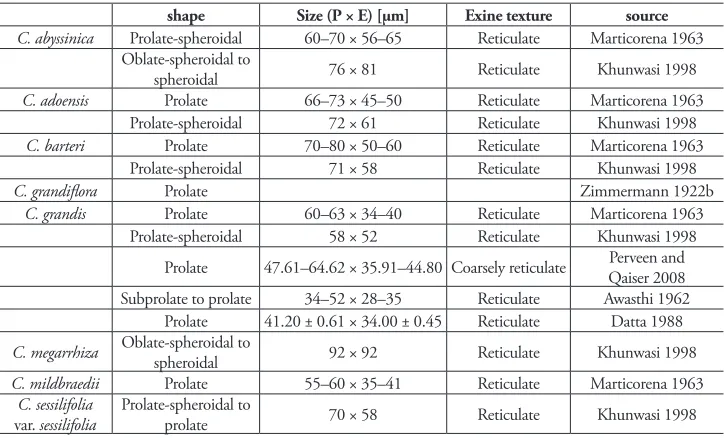
Pollen in Coccinia species shows little diversity. The pollen is oblate-spheroidal to pro-late with a reticupro-late exine (Table 1). Additionally, the pollen of C. pwaniensis (Holstein and Renner 2010), C. hirtella, and C. trilobata is prolate, the exine texture is unknown. The sampling of the examined species covers all clades and suggests uniformity in shape and exine texture, which negates systematic value of pollen in Coccinia. The color is yel-low in C. abyssinica, C. grandiflora (Zimmermann 1922b; and pers. observ.), C. grandis,
C. hirtella, C. megarrhiza, C. microphylla, C. rehmannii, C. sessilifolia, and C. trilobata, and orange in C. adoensis var. aurantiaca. Zimmermann (1922b) reports that pollenkitt of C. grandiflora contains a yellow colorant that is soluble in peanut oil, but not in water and only slightly in heated chloral hydrate solution. It changes its color in concentrated sulfuric acid to blue, in Lugol’s iodine (I2KI) to green, and in osmic acid to brown. As
in several other cucurbit species, in vitro germination of C. grandis pollen increases from pH = 7 towards alkalinity and is maximal at pH = 8.5 (Zaman 2009).
Table 1. Pollen characters in Coccinia species.
shape Size (P × E) [µm] Exine texture source
C. abyssinica Prolate-spheroidal 60–70 × 56–65 Reticulate Marticorena 1963 Oblate-spheroidal to
spheroidal 76 × 81 Reticulate Khunwasi 1998
C. adoensis Prolate 66–73 × 45–50 Reticulate Marticorena 1963
Prolate-spheroidal 72 × 61 Reticulate Khunwasi 1998
C. barteri Prolate 70–80 × 50–60 Reticulate Marticorena 1963
Prolate-spheroidal 71 × 58 Reticulate Khunwasi 1998
C. grandiflora Prolate Zimmermann 1922b
C. grandis Prolate 60–63 × 34–40 Reticulate Marticorena 1963
Prolate-spheroidal 58 × 52 Reticulate Khunwasi 1998
Prolate 47.61–64.62 × 35.91–44.80 Coarsely reticulate Qaiser 2008Perveen and Subprolate to prolate 34–52 × 28–35 Reticulate Awasthi 1962 Prolate 41.20 ± 0.61 × 34.00 ± 0.45 Reticulate Datta 1988
C. megarrhiza Oblate-spheroidal to spheroidal 92 × 92 Reticulate Khunwasi 1998
C. mildbraedii Prolate 55–60 × 35–41 Reticulate Marticorena 1963
C. sessilifolia
Gynoecium
Pistillate flowers are epigynous and have three (rarely two or four) carpels. The ovary is narrowly spindle-shaped, oblong to globose. The surface is smooth or warty; it is glabrous or has the indumentum of the pedicel. The style is often greenish-white or pale-yellowish; the stigmas are frequently in yellowish colors and covered with long trichomes (Fig. 11c). Each stigma in C. grandiflora, C. grandis, C. hirtella, C. megar-rhiza, C. rehmannii, and C. sessilifolia is U-shaped with the ends of the lower sides of the arms touching each other. The stigmatic branches can be long and free, such as in
C. grandiflora, C. grandis and C. rehmannii var. rehmannii (Fig. 11b), or short and bul-bous, such as in C. hirtella, C. megarrhiza (Fig. 11c), C. microphylla, and C. sessilifolia. The placentation of the ovules in Coccinia is involute, which is also discussed for other Cucurbitaceae by Leins and Galle (1971). The funicle appears to be attached to the outer wall, but actually attaches to a septum coming from the axis (Fig. 11a, b, c), which itself is connected to the outer wall. The axis-wall septum, however, might be reduced during ripening, but this needs further study.
The anatomy of the ovules is barely surveyed in Coccinia. In C. abyssinica and
C. grandis, the ovules are reported to be anatropous, bitegmic, and crassinucellate (Ge-tahun 1973; Zahur 1962). Anatropus ovules also occur in C. hirtella (Fig. 12a). The position of the ovules is horizontal in C. grandis (Kirkwood 1904), C. hirtella (Fig. 12a), and C. megarrhiza (Fig. 12b) with the micropyle facing outwards. Horizontal ovules are regularly reported in the Benincaseae and the Cucurbiteae (Schaefer and Renner 2011a).
In staminate flowers, a pistil is not developed because the stamens fuse to a central column. The pedicel is narrow and reaches the perianth, and there is no indication of even a thin (sterile) inferior ovary in the flower.
Female gametophyte development and embryology
The development of the embryo has only been investigated in C. grandis. Chakravorti (1947) and Zahur (1962) report that the female gametophyte development is accord-ing to the Polygonum-type. Both observe that the synergides possess hooks instead of the filiform apparatus. Chakravorti (1947) describes the developing endosperm as a nuclear type, which is confirmed by Chopra (1955). By formation of a large central vacuole, the nuclei become displaced to the periphery. After the endosperm becomes cellular, the often lateral chalazal haustorium remains coenocytic. Then, the hausto-rium becomes cellular with multinuclear cells except for the apex (Chopra 1955).
Fruits
C. rehmannii var. rehmannii and C. microphylla with globose berries as small as 1 cm in diameter at maturity. However, in both species larger globose fruits (up to 2.5 cm in diam.) and in C. rehmannii ovoid fruits may occur additionally, in the latter case especially in more humid habitats. The largest fruits occur in C. samburuensis and the rainforest species
C. grandiflora, C. longicarpa, C. mildbraedii, and C. schliebenii, which have long elliptical to cylindrical (sausage-shaped) fruits up to 20 cm long and up to 5 cm in diameter.
Immature fruits often have a white or pale-green (C. hirtella, C. sessilifolia) or dark green (C. adoensis) longitudinal mottling or lines, even when the ovary and the ripe fruit is single-colored (Figs 2a, 13a, b, c). In the C. rehmannii clade, the white spots or lines become surrounded by a dark green halo during ripening (Fig. 13c). Rarely, if no white mottling develops, e.g., in some C. microphylla, dark green spots develop nevertheless. In any case, the mature fruit in species of the C. rehmannii clade is usually uniformly colored red (Zimmermann 1922b; and pers. observ.). Ripening usually
oc-Figure 12.a Cross-section through an ovary of C. hirtella. The ovules are anatropous with the micropyle facing outwards b Cross- and longitudinal section of a C. megarrhiza fruit. The seeds are enclosed in a hyaline hull (aril) and seemingly attached to the periphery c Cross-section through a fruit of C. sessilifolia. Note that the vascular bundles in the lower left of the picture bend in the periphery, so the placentation is not parietal but involute.
Figure 13.a Ripening fruit of C. hirtella. Note the typical lobulate leaves of this species in the lower right b Ripening fruit of C. sessilifolia. The fruit, like the plant, bears a waxy bloom c Ripening fruits of
curs from green with or without mottling via yellow to orange to the final coloration. The color changes from the apex of the fruit downwards (Fig. 13a, b, c), independent of the position (hanging vs. horizontal) in C. sessilifolia. In C. megarrhiza, pendulous fruits ripen from the apex to the base, which sometimes remains green even when the apex already turns soft. In lying fruits from creeping C. megarrhiza plants, ripening does not proceed from the apex, but starts from point that is closest to the source of either warmth or light (pers. observ. from greenhouse cultivation). The degree of the yellow to orange ripening zone varies. In C. sessilifolia, fruits directly turn red, whereas in C. grandis the color change includes a well visible yellow zone. Unripe fruits col-lected of C. grandis tend to turn yellow outside and pink to red inside (Imbumi 2004). Mature fruits are in deep red colors (hence the genus name) or orange-red. Rarely, a white longitudinal mottling is described in ripe fruits (e.g., C. mackenii).
Immature fruits are glabrous or have the same indumentum as the ovary. By ripen-ing, the indumentum is usually reduced. The exocarp of Coccinia fruits is papery thin and has a waxy bloom when ripe. The endo- and mesocarp are red, fleshy and soft (Fig. 12b, c). The pulp is nerved with a dense network of tubular tissue. Shah et al. (1983) report that such a network consists of sieve tubes in C. grandis. The sieve tubes are not connected to the main vascular strands and are filled with a proteinaceous ma-terial. The authors suggest that the sieve tube network aids nutrient transport during the rapid growth of the fruit.
Seeds
The seeds (Fig. 14) in Coccinia species are beige to grayish with a small margin, which often has a darker coloration. The shape is more (esp. in the C. rehmannii clade) or less asymmetrically ovate (especially C. adoensis, C. pwaniensis, and C. senensis). The sur-face is flat, esp. in the C. rehmannii clade, to lenticular (esp. C. adoensis, C. pwaniensis, and C. senensis). The size varies from 4.5–7 × 3–5 × 1–2 mm (L/W/H). Seed numbers per fruit vary drastically from about 10 (C. microphylla) to c. 100 (+ c. 20 infertile) in
C. sessilifolia (N. Holstein 119). Species with larger fruits might contain more seeds. Detailed observations of the seed anatomy have been made by Getahun (1973) for
Getahun contrasts his observations with those of Chakravorti (1947) in C. grandis, but the seeds are in fact similar, just incompletely described by Chakravorti. Chakra-vorti draws a four-layered testa, but does not name the innermost layer that has the same hatching as the third layer, which he describes as “cells with thickened walls”. This is what Getahun calls parenchyma. Chakravorti’s outermost layer, the epidermis, consists of radially elongated cells with thin walls. These cells have likely just not yet disintegrated as observed by Getahun. The only difference between both observations is the second layer, which consists of macrosclereids in C. abyssinica and of radially slightly elongated cells with thin walls in C. grandis. These different observations are explainable by two possibilities: 1) different developmental stages of the seeds, since Chakravorti surveys the seed development, so the layers are immature, while Getahun surveys mature seeds and germination, or 2) different staining. Chakravorti uses matoxylin alone, which does not stain lignified cell walls, whereas Getahun uses hae-matoxylin with safranin as counter stain, which makes lignin, and thus sclerenchyma, well visible (von Aufseß 1973).
The seeds in Coccinia, at least in C. abyssinica (Hora 1995), C. grandis, C. hirtella,
C. megarrhiza, C. microphylla, C. mildbraedii, C. sessilifolia, and C. subsessiliflora (pers.
Figure 14. Seeds of Coccinia. The lack of fibers in e and f are preparation artifacts due to mechanical removal of the hyaline aril. Maceration (coarse crushing of the fruit and soaking of the mass in water for 2–3 weeks; R. Brüggemann – pers. comm.) retains the surface fibers. Length of white bars equals 1 mm.
a Seeds of C. adoensis var. jeffreyana (plant derived from seed of the same fruit: N. Holstein 130). Note the lenticular face and symmetrical shape of the seed b seeds of C. abyssinica (plant derived from seed of the same fruit: N. Holstein 120 and 132) c Seeds of C. trilobatad Seeds of C. sessilifolia (harvested by macera-tion) e Seeds of C. sessilifolia (harvested by mechanical extraction; taken from N. Holstein 119) f Seeds of
observ.) are surrounded by a hyaline red juicy envelope (Fig. 12b). As the ovule is bitegmic (see above), one might assume the hyaline envelope is the testa. Chakravorti (1947), however, observes that the juicy envelope is derived from carpellary tissue. However, Getahun (1973) does not recognize the hyaline hull in C. abyssinica, which is surprising as it also occurs in the closely related species C. megarrhiza and C. micro-phylla. Similar structures to the hyaline hull are also found in other Cucurbitaceae, esp. in Momordica. Van der Pijl (1982) interprets these as “endocarp-pulpa” taking over the function of an aril for seed dispersal as the fruits of Momordica species dehisce at maturity. However, Coccinia fruits disintegrate and do not dehisce, e.g., into valves.
Germination
The seeds of C. abyssinica maintain a high germination rate (100%) after four years of storage at room temperature (Getahun 1973). However, time from watering until ger-minating increases from 4 days (after one year of storage) to 16 days (after four years of storage). Seeds of C. grandis are also able to germinate after four years of storage, while seeds of C. ogadensis Thulin (3 seeds tested) did not germinate after five years (pers. ob-serv.). Getahun (1973) reports that C. abyssinica seeds do not germinate below 10 °C and above 35 °C. In the latter case, he observes thermal damage to hypocotyls and primary roots. The optimum for germination in C. abyssinica is between 20 and 30 °C and that of
C. grandis is 35 °C, whereas temperatures < 23.5 °C and > 40 °C inhibit germination (Li et al. 2001). The germination rate of C. abyssinica seeds in the light is decreased by 35% compared to germination in darkness (Getahun 1973). In C. sessilifolia, seed viability de-clines after 9 months, and germination is at a maximum after 10–20 min smoke exposure or red:far red light treatment, followed by burying and a long-day cycle (Weiersbye and Witkowski 2003). Rotting of a crushed ripe fruit in water (for seed extraction) resulted in germination of two seeds in an artificial hybrid (C. megarrhiza ♀× C. rehmannii aff. var.
littoralis♂) after 3 weeks of soaking (pers. observ.). Coccinia grandis seeds do not exhibit dormancy (Motooka et al. 2003); for the other species there is no information available.
Genome, chromosomes, and hybridization
Chromosomes and sex determination
to 3–4 times longer (Guha et al. 2004) than the other chromosomes. Some years be-fore Kumar and Deodikar, Sutaria (1936) reported n = 12 from pollen mother cells of
C. grandis, without finding the large Y chromosome. Although scientists from India conducted some research for C. grandis, chromosome work in other Coccinia species is almost none-existent. McKay (1930) reports n = 12 for C. hirtella, without mention-ing whether he studied a male or a female individual. The author’s own chromosome counts (Table 2; Fig. 15b) support McKay’s report and reject the existence of hetero-morphic sex chromosome in C. hirtella males. This is also the case for C. sessilifolia
(Fig. 15c). Two counts in the C. rehmannii clade reveal a reduction of chromosome number and the non-existence of a heteromorphic Y chromosome there.
Due to the sex chromosomes, sex expression in C. grandis plants is pre-determined and sex ratios in the offspring basically follow Mendelian inheritance of a single allele.
However, Agarwal and Roy (1983) report that of 500 planted seeds only 181 (36.2%) were male, and their interpretation is that there might be a genetic mechanism to reduce the number of male plants. As they do not report XY females, their finding might be explained rather by an increased lethality of XY embryos due to deleterious mutations on the single X or on the Y in Y-containing pollen. The Y chromosome in C. grandis is dominant, as the presence of a single Y results in male phenotypes, regardless of the number of X chromosomes (Agarwal and Roy 1975; Kumar and
Figure 15. Chromosome preparations fixed in 3:1 EtOH – acetic acid and stained with orcein, objective lens: 100×. a Mitotic plate of a male C. grandis (2n = 22 + XY) b Mitotic plate of a male plant of C. hirtella
(2n = 24) c Phase contrast image of a mitotic plate of a male plant of C. sessilifolia (2n = 24).
Table 2. Chromosome numbers of Coccinia species and sexes of surveyed individuals.
Species Sex of individual Chromosomes (2n) Voucher
C. grandiflora female 24 N. Holstein 114 (EA, M)
C. grandis male 22 + XY (Fig. 15a) N. Holstein 32 (M)
C. grandis female 22 + XX N. Holstein 25 (M)
C. hirtella male 24 (Fig. 15b) N. Holstein 29 (M)
C. rehmannii aff.
var. littoralis male 20 N. Holstein 126 (M)
C. sessilifolia male 24 (Fig. 15c) N. Holstein 13 (M), N. Holstein 109 (M (3))
C. sessilifolia female 24 N. Holstein 119 (B, M)
Vishveshwaraiah 1952; Roy and Roy 1971b). Triploids of C. grandis with a 3n = XYY constitution are also male but bear flowers in clusters instead of the usually solitary ones and exhibit leaf deformations (Roy and Roy 1971b).
Evidence for Mendelian inheritance of sex in C. hirtella is not so clear, as the same plant can produce flowers of the opposite sex in succeeding seasons. Two plants marked as female and one as male from observation of flowers produced flowers of the opposite sex in the following year (pers. observ.), making C. hirtella functionally dioecious, but geneti-cally hermaphroditic. On the other hand, there are several observations of flowers of the opposite sex in otherwise unisexual plants. Kumar and Vishveshwaraiah (1952) report a gynodioecious form of C. grandis that has homomorphic chromosomes (XX). Although bisexual flowers are reported to develop, pollen grain development is arrested, and the male function remains suppressed. Roy and Saran (1990), however, report fully fertile hermaph-roditic flowers in an otherwise female individual. Holstein and Renner (2011a) report a collection of C. intermedia that bears male floral buds and female flowers and young fruits on the same nodes. This observation can be interpreted as ‘leaky dioecy’ (Baker and Cox 1984). Among the author’s own cultivated plants, a male individual of C. megarrhiza pro-duced a single female flower towards the end of the season (Fig. 9). Although two male flowers on the same individual were open at the same time when the female flower was ma-ture, the pollen sacs did not open. It is not known whether this was a coincidence or func-tionally significant, e.g., to prevent selfing. Selfing is often discussed as being advantageous in small population sizes, e.g., when new islands are colonized. Prevention of simultaneous flowering of both sexes on the same plant implies that leaky dioecy would not immediately aid the establishment of new distant populations per se. It might require the establishment of several plants or clonal separation. In any case, the single female flower was receptive and was fertilized by another male C. megarrhiza plant derived from the same fruit as the “female” plant. The resulting fruit and seeds developed normally.
The production of hermaphroditic flowers in X-radiation studies (Agarwal and Roy 1983; Roy 1974) shows that dicliny in Coccinia is kept up actively. Agarwal and Roy found hermaphroditic flowers on two plants with otherwise female flowers and an XX configuration. They also report the development of a normal fruit without mentioning the fertility of pollen from hermaphroditic flowers, but interpret their finding as cleis-togamy. However, fruit development without previous pollination (parthenogenesis) or from pseudogamy with pollen from different genera as fructification stimulus is described by Lal (1973). True selfing from own pollen (in irradiated XX individuals) would mean that the Y chromosome is not important for fertile pollen development. Furthermore, this means that it only carries at least one gene for suppression of the development of the female organs, and the occurrence of a second X suppresses pollen development in “normal” plants. Agarwal and Roy (1983) also report that X-ray dos-ages of 5 to 50 R [1.29 × 10⁻³ to 12.9 × 10⁻³ C/kg] result in a drastic reduction of the
Genome of C. grandis
Aside from research on the sex chromosomes, a few studies on the genome of C. grandis
have been undertaken. Guha et al. (2004) report the 4C nuclear DNA content of female
C. grandis as 8.37 ± 0.14 pg, whereas that of male C. grandis is 10.17 ± 0.24 pg. This means that the difference between X and Y chromosome adds about 20% to the complete DNA content. Patankar et al. (1985) report a DNA content of 1C = 2.75 pg for C. grandis, how-ever, they do not report the sex of the analyzed individual. Interphase nuclear structure in
C. grandis is chromocentric with 14 ± 0.25 chromocenters (Patankar et al. 1985).
Surveys on the reassociation kinetics in Cucurbitaceae suggest that C. grandis has the lowest amount of repetitive DNA among the six species studied in the Cucurbita-ceae (Bhave et al. 1984). Fragments of 550 bp length have 25% of repetitive elements (Bhave et al. 1984), whereas 7400 bp long fragments consist of 49% repetitive DNA (Bhave et al. 1986). However, Pasha and Sen (1995) report different results as they find 400–600 bp long fragments to comprise 38% highly repetitive DNA (52% total repetitive DNA), which appears to be average in the Cucurbitaceae. Pasha and Sen do not discuss this difference, which cannot be explained by difference in sex, as the large amounts of plant material used (1 kg seeds or 100 seeds respectively) suggest that it must have comprised elements of both sexes. A sex discriminating study of C. grandis
reassociation kinetics has not been undertaken yet.
Hybridization and crossing experiments
Charles Naudin’s famous work on the effects of hybridization included crosses between
Coccinia plants. He reports successful crosses between Asian C. indica (nom. illeg. for
C. grandis) and the NE African C. schimperi (P06809214, P06809215, P06809216; Naudin 1862), which is now seen as a synonym of C. grandis. Naudin’s Coccinia schim-peri, however, has buff petals, whereas the Asian C. grandis has snow-white petals. Both supposed species hybridized without problems. During the following two years, Nau-din could not intercross within the F1 generation because plants of different sexes did not flower at the same time, so he crossed F1 individuals with a female C. grandis from Asia, which again produced offspring. As Naudin erroneously supposed that he dealt with two species, he deduced that hybrids between species could be fully fertile, have a reduced fertility or be sterile, and that there was no clear boundary between species and varieties. However, he proved rather that the buff-petaled, African C. schimperi
and the white-petaled Asian C. grandis are a single species obeying the biological spe-cies concept.
C. quinque-loba and C. mackenii were not distinguishable using more than 3500 bp of plastid sequences, and hence might share the same plastid haplotype (Holstein and Renner 2011b). There are collections that share characters of C. mackenii and C. quinqueloba, butthese are not intermediates. In these collections, long petioles (typical for C. mack-enii) are coupled with simple tendrils (typical for C. quinqueloba), and thus cannot be unambiguously allocated to either species. However, if both typical forms are indeed reproductively isolated, then they are species sensu Mayr (1942), and the crossing behavior of these species needs to be tested reciprocally to define the morphological scope of the two species.
Naudin also crossed male C. diversifolia (C. abyssinica) with a female C. mackenii, which are rather distantly related and do not co-occur in nature. However, the cross resulted in onset of mediocre fruits with only few, but well-developed and viable seeds (Naudin 1866). Naudin did not report further results for this cross either.
As reproductive isolation between species is often assumed but rarely tested, cross-ing experiments among species that are cultivated in Munich Botanical Garden have been performed. Positive results are given in Table 3.
Interspecific fertilization succeeded or failed without correlation of relatedness or co-occurrence (Table 4). Female flowers of C. sessilifolia could not be fertilized with pollen of C. megarrhiza (4 trials), C. trilobata (4 trials), C. rehmannii (2 trials), C. hirtella
(3 trials) or Diplocyclos palmatus (2 trials). Pollinated female flowers were discarded like non-fertilized flowers. Hence, hybridization seems to be prevented prezygotically in female C. sessilifolia with members of the C. rehmannii clade and C. hirtella as pollen donor. As C. sessilifolia and C. rehmannii co-occur widely in their range and share flowering time and floral syndrome, the production of hybrids would reduce fitness drastically. Coccinia sessilifolia and C. hirtella do not co-occur, but belong to the same clade (see chapter Evolution and phylogeny). Although a female C. sessilifolia could not be fertilized by pollen from C. hirtella, pollination of a female C. hirtella with pollen from C. sessilifolia resulted in fruit onset.
Table 3. Description of the F1 from crosses and a natural hybrid between Coccinia species. Species used for the artificial crosses are not sympatric.
Parent species Offspring Occurrence
C. grandis♀ ×
C. hirtella♂
F1 vegetatively morphologically intermediate; flowers are either aborted or sterile (pollen sacs remain closed);
pollen globose; corolla is smaller than in each parent species (Fig. 16a)
Artificially in Munich Botanical Garden; voucher: N. Holstein 108 (M)
C. hirtella♀ ×
C. grandis♂ F1 vegetatively morphologically intermediate; flowers smaller (Fig. 16b), sterile Artificially in Munich Botanical Garden; voucher: N. Holstein 116 (M)
C. grandis♀ ×
C. pwaniensis♂ F1 morphologically intermediate; flowers sterile (pollen sacs remain closed) (Fig. 16c)
Naturally in Pugu Hills, Dar es Salaam, Tanzania; vouchers: N. Holstein et al. 102 (DSM, M), 103 (M), 104 (M), 105
(DSM, M)
C. grandis♀ ×
C. sessilifolia♂
F1 vegetatively morphologically intermediate; flowers are either aborted or sterile (pollen sacs remain closed); corolla is smaller than in each parent species (Fig. 16d)
Artificially in Munich Botanical Garden; voucher: N. Holstein 113 (B, M);
N. Holstein 115 (M)
C. hirtella♀ ×
C. trilobata♂
F1 morphologically intermediate; males flowering vigorously with intermediate flowers, pollen sacs open,
but pollen is sterile
Artificially in Munich Botanical Garden;
N. Holstein 121 (M)
Table 4. Observations on fruit development of crosses between Coccinia species (except for crosses men-tioned in Table 3). Viability and morphology of the F1 is not known so far. a = sympatrically distributed species, b = close relatives/sister species, c = species occur in the same area but in different habitats.
Parent species crossability
C. grandis♀ × C. abyssinica♂ Onset of fruit (1 trial) c C. grandis♀ × C. megarrhiza♂ Onset of fruit (1 trial) a
C. grandis♀ × C. rehmannii aff. var. littoralis♂ Abortion of flower (1 trial)
C. grandis♀ × C. trilobata♂ Abortion of flower (2 trials) c C. hirtella♀ × C. rehmannii aff. var. littoralis♂ Onset of fruit (1 trial) c C. hirtella♀ × C. sessilifolia♂ Onset of fruit (1 trial)
C. megarrhiza♀ × C. abyssinica♂ Onset of fruit (1 trial) b & c C. megarrhiza♀ × C. hirtella♂ Abortion of flower (1 trial)
C. megarrhiza♀ × C. rehmannii aff. var. littoralis♂ Onset of fruit (1 trial)
C. megarrhiza♀ × C. sessilifolia♂ Abortion of flower (2 trials)
C. megarrhiza♀ × C. trilobata♂ Onset of fruit (Fig. 13c; 1 trial)
C. microphylla♀ × C. megarrhiza♂ Abortion of flower (1 trial) a
C. microphylla♀ × C. trilobata♂ Onset of fruit (1 trial) b & c C. rehmannii var. rehmannii♀ × C. rehmannii aff. var. littoralis♂ Onset of fruit (1 trial) b C. rehmannii var. rehmannii♀ × C. trilobata♂ Abortion of flower (2 trials) b
Roy and Roy (1971a) report an intergeneric cross between a female C. grandis
C. grandis but not with D. palmatus. To the author’s knowledge, there are no reports of the F2 generation. However, if the parental sexes were the other way around (male
C. grandis × female D. palmatus), fertilization was not possible.
Plant – biotic environment interactions
Pollination
Although bee pollination is observed for only a few species, most Coccinia species ex-hibit characters that support a general attraction to bees. The petal color is commonly pale yellow but can also range to white, pale pink or bright orange, with green, yellow, orange to purple venation. Anthesis is during the day in C. abyssinica, C. adoensis var.
aurantiaca, C. grandiflora, C. grandis, C. hirtella, C. megarrhiza, C. microphylla, C. re-hmannii, C. sessilifolia, and C. trilobata (pers. observ.) but often only for a few hours (in, e.g., C. megarrhiza, C. rehmannii). Zimmermann (1922b) reports pollen release in C. grandiflora at 6.30 a.m. before blooming of the flower, opening of the flower
Figure 16. Hybrids of Coccinia species. aCoccinia grandis ♀ × C. hirtella ♂bCoccinia hirtella ♀ ×
C. grandis♂cCoccinia grandis ♀ × C. pwaniensis ♂; note that the pollen sacs are not open although the flower is in full bloom indicating sterilityd Left flower: male C. sessilifolia, right flower: male flower of
between 7 and 8 a.m. and wilting after noon. Ash (J.W. Ash 898) reports flower open-ing a.m. in C. schliebenii. Anthesis time in the other Coccinia species is not reported, but also likely to happen during the day. The scent is rather weak and dull sweetish, resembling that of honey melon, in C. abyssinica, C. grandiflora, C. hirtella, C. rehman-nii, C. sessilifolia, and C. trilobata, weak but fresh in C. grandis, and intense, sweet, and fruit-like (like honey melon) in C. adoensis var. aurantiaca and C. megarrhiza. The only evidence of an alternative to bee pollination is C. ogadensis, which is reported to smell of rotten meat (P. Ellis 163 and 383). However, it is unclear whether the flowers emit a fetid scent or whether the smell comes from crushed vegetative parts, as it is known from Momordica foetida or Kedrostis foetidissima (Jacq.) Cogn. (Jeffrey 1967).
Bee pollination is confirmed for C. rehmannii (C.J. Ward 12250), C. adoensis var.
aurantiaca (Fig. 10b), C. grandiflora, and C. grandis. Observed pollinators of C. grandis
are Trigona apicalis Smith, 1857 and Trigona collina Smith, 1857 in Thailand (Jongjitvi-mol and Wattanachaiyingcharoen 2006), and Megachile sp. in Cambodia (H. Schaefer, pers. comm.). The present author observed a halictid bee (Fig. 10b; identification by H. Schaefer, pers. comm.) in a male C. adoensis var. aurantiaca walking on the globose anther head and collecting pollen in the corbicula. Stigmas in Coccinia are lobed (Fig. 11b) or bulging (Fig. 11c), and nectaries are located presumably in the hypanthium, so one can assume stripping of the pollen from the venter when crawling into the flower. Zimmermann (1922b) also observed the circling around the anther head in the large-flowered C. grandiflora. He identified the visiting small bee as Trigona sp. He also noted that a bee just having visited a Momordica flower walked on the inner side of the corolla loading dorsally located pollen on the anthers of a male C. grandiflora flower.
Seed dispersal
There are no observations of actual seed dispersal but mammals and birds appear to be attracted by the fruits and likely act as seed dispersers. Fruit bats such as Cynopterus sphinx (Vahl, 1797) feed on C. grandis fruits in Thailand (Elangovan et al. 2001; Ruby et al. 2000). Fruits of C. grandis are also taken up by birds (Bhatt and Kumar 2001) and eaten by humans (Voigt 1845). Elephants also feed on C. grandis (Mubalama 2000) and are possibly also seed dispersers. From its introduction to Pacific Islands, dispersal of C. grandis by humans is well-known (Muniappan et al. 2009). Human dispersal, in many cases likely to be intentional (Starr et al. 2010), also explains the occurrence of this species in the Neotropics and even in Missouri, USA. Some occurrences in Aus-tralia can also be explained by escape from gardens. Zimmermann reports feeding on
C. grandiflora fruits by birds, small mammals but also snails and beetles (Zimmermann 1922a), the latter two unlikely being seed dispersers. The forest weaver Ploceus bicolor
![Figure 10. a Male plant of C. rehmannii [aff. var. littoralis] (N. Holstein 126). The plant was raised from seeds of a female plant with ovoid fruits (B](https://thumb-us.123doks.com/thumbv2/123dok_us/1080314.2082287/16.468.51.418.60.278/figure-plant-rehmannii-littoralis-holstein-raised-female-fruits.webp)