Fall 2009
Volume 22 Number 2
The O
HIO
Journal
of
T
eacher
Edu
cati
The Ohio Journal of Teacher Education
Fall, 2009
Volume 22, Number 2
Published by the Ohio Association of Teacher Educators
Sarah Cecire, Ph.D.
Virginia McCormack, Ed.D.
Gayle Trollinger, Ph.D.
Savilla Banister, Ph.D.
Bowling Green State University
Michele Beery, Ph.D.
Wilmington College
Cynthia Bertelsen, Ph.D.
Bowling Green State University
Linda C. Burkey, Ph.D.
Mount Union College
Polly Collins, Ph.D.
Muskingum College
Joy R. Cowdery, Ph.D.
Muskingum College
Charlotte M. Harris, Ed. D.
Wright State University
Deborah J. Hess, Ph.D., R.N.
Wright State University
Doris Johnson, Ed. D. Wright State University
Lynn Kline, Ph.D. University of Akron
Kaye Martin, Ph.D.
Ohio University-Lancaster
Terry Miller
Wilmington College
Megan Wereley, Ed. D.
Wooster College
Deborah Wooldridge
Bowling Green State University
Editorial Board
Sarah McCorkle Technical Editor
Contents
Message from the Editors ... 4
Building a Virtual Learning Community to Promote Reflective Practice and
Cultural Effectiveness ... 5
Charlotte Harris, Ed. D.
Catherine Keener, Ph.D.
Deborah J. Hess, Ph.D., R.N.
Doris G. Johnson, Ed. D.
What Role Does Culturally Responsive Teaching Play in Minority
Literacy Education? ... 12
Kerry C. Coovert, Ed. D.
Meeting Ohio TESOL Endorsement Program Standard 6.2:
One Strategy ... 23
Tim Micek, D.A.
Answering the Mandate and Then Some: Lessons Learned from Embedding
Value-Added Outcomes in the Teacher Education Curriculum ... 32
Rachel M.B. Collopy, Ph.D.
Mary Kay Kelly, Ph.D.
Investigating the Effectiveness of Graduates of a Teacher Education
Program Using Qualitative Data from Graduates and their Principals ... 41
Nimisha Patel, Ph.D.
Suzanne Franco Ed. D .
Brian Boyd, Ph.D.
Karen Wonders, Ph.D.
Ohio Association of Teacher Education Membership Invitation ... 54
A Message from the Editors…
The Fall 2009 issue of The Ohio Journal of Teacher Education has an open theme. The articles cover a range of topics of interest to teacher educators such as using practitioner inquiry, embedding value-added outcomes into teacher education courses, expanding teaching strategies to response to the needs of diverse learners, summarizing and discussing current research and application to meet Ohio TESOL Endorsement Program Standard 6.2 and identifying professionalism and emotional intelligenc-es as qualitiintelligenc-es in effective teachers.
The first article byHarris, Keener, Hess, and Johnson discusses practitioner inquiry by examining the effectiveness of an online practicum seminar for pre-service teacher candidates. The evidence suggests that the virtual learning community successfully facilitated reflective practice and developing cultural effectiveness. The authors continue to engage in practitioner inquiry, accessing and assessing the de-velopment of teacher candidates’ reflective thinking and cultural competence to inform practice and guide program improvement.
The next article by Coovert explores the role of culturally responsive teaching in minority liter-acy Education. Culturally responsive teaching uses the students’ culture as a resource to scaffold learn-ing for culturally and llearn-inguistically diverse students. The author suggests steps toward expandlearn-ing teach-ing strategies and makteach-ing instruction more meanteach-ingful to all students.
The third article by Micek investigates the Ohio TESOL Endorsement Program (TEP) Standard 6.2 that calls for candidates to employ current research to develop strategies to advance age/grade-appropriate social and academic English learning. In the study, the students were assigned a two page-report in which they were to summarize one piece of current research and discuss how they would ap-ply it to their teaching. The evidence from the study shows that this assignment allows students to see what research is available, choose what is relevant, and apply it to their teaching.
The fourth article by Collopy and Kelly analyzes the development of curriculum materials cre-ated to answer the mandate that all teacher education programs incorporate outcomes relcre-ated to value-added measures into their curricula. Several designs were implemented including an expansion of Bernhardt’s four categories of data, creating materials that allowed flexibility and consistency in the content conveyed the four themes from the University of Dayton’s School of Education and Allied Pro-fessions’ mission and by providing clear examples, step-by-step explanations and glossaries of poten-tially unfamiliar terms. The data from the pilot of the curriculum in the fall of 2007 and lessons learned is shared.
In the final article by Patel, France, Boyd, and Wonders describes a three-phase study on ex-plores the effectiveness of a teacher education program with input from a K-12 principal focus group, a principals’ reports of teachers who are recent program graduates, and graduates’ reports of their pro-gram experiences. The framework consists of six interweaving strands that articulate the shared vision and alignment with state, learned society, professional, and the NCATE 2000 standards for preparing teacher candidates and candidates for professional school roles. The analyses revealed that principals hiring program graduates feel professionalism and emotional intelligence best align with their student achievement missions.
We hope you enjoy this issue of the journal, and we hope you find these articles to be informa-tive and helpful in your various roles preparing teacher educators.
Sarah Cecire
Virginia McCormack Gayle Trollinger Fall, 2009
Building a Virtual Learning Community to Promote Reflective Practice
and Cultural Effectiveness
Charlotte Harris, Ed. D. Deborah J. Hess, Ph.D., R.N. Catherine Keener, Ph. D. Doris G. Johnson, Ed. D.
Introduction
Providing coursework and experiences that prepare teachers to meet the needs of diverse students and communities is a goal for many teacher education programs. Our college of education, for example, articulates the desire to provide curricular and field experiences that “enhance the awareness and cul-tural competence” of teachers, and foster the devel-opment of the knowledge, skills, and dispositions necessary to help all students learn.
To operationalize this vision, the college requires pre-service teacher candidates to have practicum experiences in both urban and suburban partner school sites. However, we, teacher educa-tors, contend that simply spending time in diverse school communities is insufficient for developing what Storti (2001) referred to as cultural effective-ness. Storti suggested that culturally effective indi-viduals interact from the perspective of the other person’s view of what their culture considers ap-propriate and inapap-propriate behavior. Furthermore, culturally effective people are aware of the impact their behavior has on others and the behaviors of others have on them. We recognized that, rather than developing cultural effectiveness by experienc-ing a diverse urban placement, for example, teach-er candidates who entteach-ered urban schools with neg-ative assumptions often emerged with their nega-tive assumptions confirmed. We proposed that structured opportunities that stimulate reflection and inquiry, and enable teacher candidates to mas-sage, challenge, and expand the attitudes, behav-iors, and dispositions they take into the classroom, would facilitate the development of their cultural
effectiveness.
To address this concern, we designed a practicum seminar as a virtual learning community that enabled teacher candidates, through guided electronic discussions, to identify and connect, share experiences, and support each other’s profes-sional growth. The purpose of this seminar was to (a) provide structured opportunities for teacher candidates to process their experiences with di-verse student populations, (b) promote reflective practice, and (c) foster cultural effectiveness. This article reports the findings of our practitioner in-quiry to examine the success of the seminar in ac-complishing these objectives.
Learning Communities for In-Group Reflection Teacher education literature supports the development of reflective practice and the use of learning communities as effective strategies to en-hance teacher learning.
Value of Reflection
and Liston (1996) believed that “reflective teaching, when used as a teaching tool, entails a recognition, examination, and rumination over the implications of one’s beliefs, experiences, attitudes, knowledge, and values as well as the opportunities and constraints pro-vided by the social conditions in which the teacher works” (p. 20). Similarly, Loughran (1996) stated that, “The value of reflection . . . is that it gives (teachers) the confidence to test their hypotheses about their teaching and their students’ learning. They are able to think about what they are doing and why, and reason through their problems” (p, 50).
Several strategies have been recommended to encourage teacher candidates’ reflections. Journal writing has been a frequent means of gathering reflec-tions of teacher practice (Cole, Raffier, Rogan, & Schleicher, 1998; Johnson, 1994; Loughran & Corri-gan, 1995; Maloney & Campbell-Evans, 2002). Addi-tionally, arranging a group into a cohort provides a structure to assist in-group reflection within a learning community (Peterson, 1992; Tom, 1997). Teachers learning through reflection, collaboration, and sharing what they learn “requires settings that support teacher inquiry and collaboration and strategies grounded in teachers’ questions and concerns” (Darling-Hammond & McLauglin,1995, p. 597).
Power of Learning Communities
Learning communities, organized around rela-tionships and ideas, can offer opportunities to “create as well as receive knowledge” (Lieberman, 2000, p. 226), and facilitate “the social, interactive, and con-nective construction of knowledge” (Stone, 1994, p. 226). Noddings (1994) discusses the characteristics and power of a “caring” learning community: model-ing to “encourage responsible self-affirmation”; open dialogue to engender “the search for enlightenment, or responsible choice, or perspective, or means to prob-lem solution”; practice that encourages candidates “to support each other,” provides “opportunities for peer interaction,” and values “the quality of that interac-tion”; and confirmation to enable the candidates’ self-actualization (pp.174-178). The power of the caring learning community is in the sharing of knowledge.
Many teacher education programs use internet technology to facilitate reflective practice and to ex-tend learning communities beyond the face-to-face classroom. Ferdig, Roehler, and Pearson (2002) found that the use of an electronic discussion forum with preservice teachers afforded them “numerous
opportunities for posting, reflection, and the internali-zation of key ideas associated with a deeper under-standing of teaching and learning” (p. 94). A virtual learning community can provide a place for teacher candidates to freely express their beliefs and feelings. Our goal was to create a virtual learning community for our teacher candidates to engage in guided in-group reflection that would facilitate the development of their cultural effectiveness.
Method
Beginning in the fall of 2004, teacher candi-dates enrolled in the Adolescence to Young Adult and Multi-Age graduate initial licensure programs were required to participate in an online seminar. The semi-nar engaged them in electronic dialogue journaling via WebCT in conjunction with their fall and winter quar-ter practicum experiences. The teacher candidates were divided into eight discussion groups with 7 or 8 members in each group. Each quarter, the groups par-ticipated in four dialogue journal conversations. Dur-ing the practicum orientation, the teacher candidates were introduced to the web-based practicum seminar dialogue journaling process, as well as invited to be participants in our practitioner inquiry. Sixteen of the 60interns (26%) in the 2004-05 cohort agreed to par-ticipate and composed two of the eight groups.
Each virtual conversation consisted of two steps. First, the teacher candidates reflected upon and responded to a dialogue journal prompt, each with a designated topic (e.g., urban students, expectations, school regularities). To guide the reflective process, we used a guided reflection protocol (Hole &
McEntee, 1999). In accordance with this protocol, for each prompt, they told the story of a relevant
“ordinary event” from their experiences in the field, responding to the following questions: (a) What hap-pened? (b) Why did it happen? (c) What might it mean? and (d) What are the implications for your practice? Then, they read and responded to the posted stories of fellow group mates. They were encouraged to raise questions and engage in conversation about the event and any new insights that might emerge. Three of the four prompts each quarter included a re-quired reading, which provided further direction to the conversation. We monitored these conversations but did not participate in them.
ex-tent to which the virtual learning community facilitat-ed this process. The discussion that follows reflects the findings from the data provided by the conversa-tions of the two groups of consenting participants.
Findings Reflective Practice
A careful review of the data clearly indicated that, in telling their stories, the participants engaged in reflec-tive practice. In responding to each other’s stories, they also reflected on their own experiences. Through peer interaction, they supported and learned from each other, as reflected in the story, “Easier To Do It Myself,” and the resulting response:
Participant #22: The students were busily working on keyboarding and electronic calculators, and one student raised a hand for help. I walked over and she asked a question about the keyboarding software, a question that had already been gone over numerous times in class, both visually and verbally. I attempted to verbally walk her through the steps she needed to take. A look of confusion remained on her face and no physical response was taken. Before I knew it, my hand was on the mouse and I was clicking through the steps for her. This incident obviously occurred because I allowed myself to be impatient with a stu-dent…. I robbed a student of a learning opportuni-ty…. As a result of my actions, the student might as-sume that every time she asks for my help, I will simply do the task in question for her.
Participant #7: Isn’t it amazing what you realize when you reflect on your situation. I have read your entry and didn’t respond immediately because I want-ed to see if I was doing that to any of my students. And surprise, I caught myself…. It really made me stop and look at my own actions as a teacher. During their electronic conversations about their ex-periences, the participants engaged in, not only flective, but also collaborative practice. Their re-sponses often built on each other. This collaborative, in-group reflection led to further reflection and im-proved understanding of teaching and learning. As illustrated in the following excerpts, in responding to each other, the participants asked probing and chal-lenging questions, shared strategies, and recommend-ed solutions.
Participant #22: What does this incident say about our growing responsibility as teachers? About the
changing school environment? About new precautions that must be taken as a result of the rise of violence in schools?
Participant #11: I agree that teachers should not waste valuable learning time on minor student infractions. I also would like to believe that students at the high school level know the rules. However, some students will try to get away with as much as they can…. My suggestion would be to monitor students who commit minor infractions. If the infractions occur rarely, then I think that may be a battle that you might not want to take up….
Participant #22: To what extent do you think com-municating high expectations and a positive caring atti-tude to satti-tudents from day one impacts their academic performance?... How can we, as teachers, avoid favorit-ism? How can we teach students to respect one another in the classroom, regardless of which clique they be-long to, what background they come from, etc.?
Caring Learning Community
Conversing with each other in this virtual environment resulted in community building. Through dialogue journaling, the participants supported, affirmed, com-miserated with, and learned from each other. Responses were substantive and caring, as illustrated in the con-versations about the concept of nurturing pedagogy (Mantle-Bromley, 2004):
Participant #6: I am working with a questionnaire in order for me to learn more about their interests, strengths, and weaknesses. This has helped me during different topics we have covered because I know going into the lesson that I have a student who will need some extra attention….
Participant #22: I think your questionnaire is a terrific idea… I would like to see your questionnaire. Would you mind posting it on WebCT? Maybe the rest of us could use it as a template for future classes.
Participant #19: I was wondering if any of the students resisted your attempts to be nurturing and helpful?... If you have experienced this, how did you handle it?
Developing Cultural Effectiveness
Several participants reported having had little interac-tion with other cultures growing up, but responses clearly reflected their developing cultural effective-ness:
Participant #3: When I came into this program I thought myself a culturally open person. I thought that I knew all I needed to. I was wrong…. Through all of this it has taught me that, as an educator, I need to be more aware of my students’ as well as my own bias. I don’t need to think that I have it all figured out be-cause I don’t. I am still learning. I may teach my stu-dents, but they teach me as well.
Participant #2: The one thing that…I hadn’t thought of when I posted my first response on WebCT was that just because my students…all have a similar cul-tural heritage, it does not mean that they are all the same…. By reflecting back on my teaching attitudes, beliefs, and personality this quarter, I have been able to think about the different ways that I approach stu-dents.
The prompts encouraged this development. In one prompt, the teacher candidates were encouraged to reflect on their experiences with urban students in comparison with their experiences with suburban stu-dents in relation to the reading “Who Are Our Urban Students and What Makes Them So ‘Different’?” in which Goldstein (2004) challenged the reader to con-front his/her current assumptions of who urban stu-dents are, and “look beyond what you know to what you think you know” (p. 51). The prompt requested that they describe one ordinary event that they be-lieved addressed this topic and relate that response to the article. An example from the resulting conversa-tion “Book Conferences” illustrates the developing cultural effectiveness:
Participant #11: Upon reflecting, I realize that my own assumptions about students in an urban school formed my suspicion that the student in the urban school was abused and the student in the suburban school was not…. I learned that in the future just as you cannot judge a book by its cover, I cannot judge students by the books they choose to read.
Participant #2: The one thing that I found myself do-ing when I first got to my [urban] placement was
play-ing “let’s spot the cheater.” My challenge now, after realizing
what happened, is to overcome those thoughts in my head…. I am hoping that as I realize and wonder about more and more of these differences, I will be able to overcome these silly opinions and reactions.
Participant #12: I have also found myself making those same types of assumptions…. When I find my-self leaping to conclusions now at my urban place-ment, I always try to ask myself if, given the same sit-uation, I would have made the same assumptions at my [suburban] placement. The answer is often “no.” …we have all grown up hearing the same misconcep-tions about inner city schools.
This dialogue journal topic about urban stu-dents posed a direct challenge to the participants in their field placements. Discussion responses indicated that they found that stereotypes might have labeled the students in urban settings with an undeserved negative image.
Participant #8: I truly believe that many students are misinformed about people of other races because they have not had contact with those groups on a regular basis. Many times, students from both the urban place-ment and suburban placeplace-ment will give stereotypes of the different races that they normally do not have con-tact with on a regular basis.
Additionally, the participants believed that there were ways in which the students labeled them-selves with a negative image. They expressed con-cerns that these perceptions presented an additional burden for the urban communities.
(much) more positive energy to overcome one nega-tive comment.
The data indicated that the participants consid-ered their own dealings with the issue of diversity within their own personal experiences, as the follow-ing excerpt illustrates:
Participant #9: Part of having an effective, active learning environment is to create a safe place for stu-dents to interact so that no one feels alienated or threatened because of their race or gender. I, too, look for the best out of everyone. I’d like to think that I judge very little. Obviously, we all carry with us cer-tain prejudices and I am no exception. I hope that as I become aware of my prejudices I will work quickly to correct them…. I cannot control how other teachers behave nor will I be able to change the attitudes of those who think differently than I. But what I can do is work very hard to give every student, regardless of race, socio-economic status, or academic aptitude, my best effort and attention and encourage all my students to strive for excellence.
Additionally, responses suggested that partici-pants in both the urban and suburban placements con-sidered what materials their cooperating teacher used. They openly discussed how they would address the same choice of materials:
Participant #5: All of my students treat each other with respect regardless of race, and my cooperating teacher doesn’t have lower standards for any of her minority students. I have noticed, however, that in the month I have been at my placement, the students have read very little culturally diverse material. Although they choose independent reading novels, most of the material read in class is written by and about Cauca-sians. As a teacher, I plan to introduce my students to racially and culturally diverse materials regardless of the number of minority students in my classroom. Reading novels, stories, poems, and plays from around the world will enrich my students’ educations in a way that is vital to be successful members of our increas-ingly global society.
Within this virtual learning community, we discovered that the participants questioned their own perceptions as well as their teaching to understand the messages they themselves were sending students in their urban and suburban placements.
Participant #2: I plan to look at my next videotaped lesson for my interactions with my students. I would like to study my interactions to see if I make any sub-conscious decisions…. This experience has taught me to become more aware and more critical of how I react during teaching situations. I plan to videotape myself and look at whom I call on for the majority of an-swers. Is there a pattern?
Discussion
Can this virtual learning community be judged as effective in promoting reflective practice and fos-tering cultural effectiveness? In this structured virtual environment, in which participation, reflection, and collaboration were encouraged, the teacher candidates developed a caring learning community where they engaged in collaborative reflection and openly dis-cussed their experiences with diverse student popula-tions.
Consistent with Schon’s conclusions (1983), the initial reflections resulted in issues for further reflection— additional questions and improved understanding. Par-ticipation in this virtual learning community promoted community building. Reflective practice was modeled, as some participants were obviously more reflective than others. The use of prompts, a reflection protocol, and readings primed the reflection, guiding it, giving it focus and direction. Participants sought and gave ad-vice; shared strategies that worked. They related to and applied what they had learned in their coursework, which bridged theory and practice. The resulting car-ing learncar-ing community, with the sharcar-ing of
knowledge flowing from teacher candidate to teacher candidate, possessed the power and characteristics— modeling, dialogue, practice, and confirmation—that Noddings (1994) described. Furthermore, it was trans-formative in its “social, interactive, and connective construction of knowledge” (Stone, 1994, p, 226). Additionally, the data revealed the participants were beginning to develop cultural awareness, if not fully meeting Storti’s (2001) concept of cultural effective-ness. The prompts and readings did provide a structure that encouraged them to massage, challenge, and ex-pand their professional attitudes, behaviors, and dispo-sitions, facilitated the construction of their profession-al and pedagogicprofession-al knowledge, and enabled their self-actualization.
teacher candidates’ reflective practice and cultural ef-fectiveness, in order to inform our practice and guide program improvement.
Charlotte M. Harris, Ed.D.is an Associate Dean in the College of Education and Human Services and Associate Professor in the Department of Teacher Ed-ucation at Wright State University. Her research in-terests include black feminist thought, education femi-nism, narrative research, teacher education, diversity issues in education, and practitioner inquiry.
Catherine D. Keener, Ph.D. is an Assistant Professor in the Department of Teacher Education at Wright State University, and teaches undergraduate and graduate special education courses. Her area of inter-est is intervention specialist teaching with an empha-sis on the group process and efforts to include those with learning differences.
Deborah J. Hess, Ph.D., RN is an Assistant Professor in the Department of Teacher Education at Wright State University, and teaches undergraduate and graduate special education classes. She is the advisor for the early childhood intervention specialist licen-sure and the pre-kindergarten special needs endorse-ment programs. Her research interests include multi-cultural education, developing multi-cultural effectiveness, and facilitating the learning of young students with disabilities.
Doris G. Johnson, Ed. D. is an Associate Professor in the Department of Teacher Education at Wright State University, and teaches undergraduate and graduate educational foundations and classroom management courses. She is the Undergraduate Middle Childhood Faculty Advisor and Pre-Professional Education Pro-gram Coordinator. Her research foci are educational law, instructional technology, classroom management, and educational foundations.
References
Cochran-Smith, M. (2000). Blind vision: Unlearning racism in teacher education. Harvard Educat ion Review, 70(2), 157-190.
Cole, R., Raffier, L. M., Rogan, P., & Schleicher, L. (1998). Interactive group journals: Learning as a dialogue among learners. TESOL Quarterly, 32, 556-568.
Darling-Hammond, L., & McLaughlin, M. W. (1995). Policies that support professional development In an era of reform. Phi Delta Kappan, 76(8), 597-604.
Ferdig, R. E., Roehler, L. R., & Pearson, P. D. (2002). Building electronic discussion forums to scaf fold pre-service teacher learning: Online con versations in the reading classroom explorer.
Journal of Computing in Teacher Education, 18(3), 87-94.
Goldstein, R. A. (2004). Who are our urban students and what makes them so “different”? In S. R. Steinberg & J. L. Kincheloe (Eds.), 19 urban questions: Teaching in the city (pp. 41-51). New York: Peter Lang.
Hole, S., & McEntee, G. H. (1999). Reflection is at the heart of practice. Educational Leadership,
56(8), 34-37.
Johnson, K. E. (1994). The emerging beliefs and in structional practices of preservice English as a second language teachers. Teaching and Teacher Education, 10(4), 439-452.
Lieberman, A. (2000). Networks as learning communities. Journal of Teacher Education, 51(3), 221-227.
Loughran, J. J. (1996). Developing reflective practice: Learning about teaching and learning through modeling. Australia: RoutledgeFalmer.
Loughran, J. J., & Corrigan, D. (1995). Teaching port folios: A strategy for developing learning and outstanding preservice education. Teaching and Teacher Education, 11(6), 565-577.
Maloney, C., & Campbell-Evans, G. (2002). Using interactive journal writing as a strategy for professional growth. Asia-Pacific Journal of Teacher Education, 30(1), 39-50.
Mantle-Bromley, C. (2004). Jazz at the improv. Kappa Delta Pi Record, 41(1), 21-25.
L. Stone (Ed.), The education feminism reader
(pp. 171-183). New York: Routledge.
Peterson, R. (1992). Life in a crowded place: Making a learning community. Richmond Hill, Ontario: Scholastic.
Richards, J. C. (1998). Beyond training. Cambridge: Cambridge University Press.
Schon, D. A. (1983). The reflective practitioner: How professionals think in action. New York: Basic Books, Inc.
Schon, D. A. (1987). Educating the reflective practitioner. New York: Basic Books.
Stone, L. (1994). Toward a transformational theory of teaching. In L. Stone (Ed.), The education feminism reader (pp. 221-228). New York: Routledge.
Storti, C. (2001). The art of crossing cultures. Yarmouth, ME: Intercultural Press.
Tom, A. (1997). Redesigning teacher education.
Albany: SUNY Press.
Valli, L. (1993). Reflective teacher education programs: An analysis of case studies. In J. Calderhead & P. Gates (Eds.), Conceptualizing reflection in teacher development (pp. 11-21).
London: Falmer.
What Role Does Culturally Responsive Teaching Play in Minority
Literacy Education?
Kerry C. Coovert, Ed. D.
How does culture play a part in learning?
Culture is a part of every student that walks through a school building and walks into our class-room. No matter if the student is Black, White, Hispanic, Asian, or another ethnicity, the culture that they bring with them provides them with a re-source to interpret and view the academic world in which they learn. We use our behavior, language, values and beliefs as a foundation to learn new content and react to situations in the world around us. As members of different cultures, we bring with us different ways to interpret learning experiences and social interactions. Our experiences and inter-actions are interpreted through a) our social or cul-tural group memberships; b) a particular social lan-guage or mixture of them; and c) a particular con-text, that is, set of other people, objects, and loca-tions” (Gee, 1996, p. 69). These characteristics of experiences and interactions will also have an im-pact on how students relate and learn in a school or academic environment.
Looking at statistics and the dramatic de-mographic changes over the past decade, we need to become more aware of the role culture plays in learning. According to the National Education As-sociation (2003), 90% of teachers are White and 97% of teachers are monolingual (Darling-Hammond & Scalan, 1996). Nineteen percent of U.S. schoolchildren speak a language other than English, and 28% of these students are limited in English proficiency (Herrera, Perez, & Escamilla, 2009). It is estimated by Spellings (2005) that one out of every four students in U.S. schools will be
an English Language Learner by the year 2025. “Surveys consistently find that although a large proportion of White pre-service students an-ticipate working with children of another cultural background, as a whole they bring very little cross-cultural background, knowledge, and experienc-es” (Sleeter, Torres, & Laughlin, 2004, p. 81). In addition, only 26% of teachers across the United States feel well prepared to meet the needs of cul-turally and linguistically diverse students (Herrera, Perez, & Escamilla, 2009). Only a small number of teachers have been trained at any point to support culturally and linguistically diverse students. And an even smaller number have been trained to teach those children in literacy acquisition. With culture being such a large part of experience, identity, and how we interpret interactions, teachers need to be able to make connections to a students’ culture in order to make learning a success in any classroom. What is literacy and how is it affected by culture?
There are several different ways of defining literacy that takes into consideration culture and the way in which students interpret and learn skills of literacy. Academic literacy as seen by Gipe (2006) is the instructional literacy children have been exposed to through personal experiences with books and other forms of spoken or written lan-guage. A student’s exposure to language, oral tra-dition, and their “nature of organizing, and under-standing our experiences” (Gipe, p.5) plays a cru-cial part in how they become literate.
Vacca, 2008) as well as have the “ability to do so in a culturally appropriate manner” (Perez, 2004, p. 5). Therefore, we can say that literacy is interpreted and learned through the experiences and interactions that a student brings with them to academics.
As teachers initiate skills in literacy, five re-search-based components are used as a basis for in-struction. These components are phonemic awareness, phonics, vocabulary, comprehension, and fluency (National Reading Panel, 2000). Teachers consistently move back and forth between these components of reading to make literacy instruction possible. To be successful with the literacy skills taught, the student must be able to follow the transition from one compo-nent to another and become proficient in the individu-al skills that make up the components. As the teacher initiates and conducts literacy instruction, the student uses their own personal experiences and background knowledge to interpret the skills being taught.
However, the literacy instruction taking place is most likely being taught using an academic dis-course which does not necessarily take into considera-tion varying cultures and ethnicities. The instrucconsidera-tion taking place is also most likely being taught using Standard English and also not taking into considera-tion the linguistic differences in language and dialect. For students to follow and learn successfully, the teacher should provide instruction that considers the students’ culture and be able to use it as a resource for academic success. The experiences that take place in the cultural element of a person play a role in how they make meaning of interactions. The struggle to make meaning of a text or literacy instruction on one’s own terms, which may or may not be the ‘official’ in-terpretation, is imperative to becoming active in litera-cy (Perez, 2004).
Examining Examples of Minority Cultural Differences in Literacy
When we speak of cultural and linguistic dif-ferences in literacy we are speaking of aspects of a culture that are different than the “norm” taught and expected in academics. One specific culture other than the dominant European-American student that we see commonly in classrooms is the African-American stu-dent. Within the African-American culture, we can see general differences in how a student may interpret lit-eracy based on their own personal experiences as well as differences in language or dialect. For this study, I
examined general aspects of African-American cul-ture.
Looking at a general history of African-Americans one can see strong characteristics of cul-ture and language dialect that differ from the “typical” academic discourse. The forms of oral tradition, com-munication, and storytelling are embedded in the his-tory of African-American culture. Communication, narrative sequencing, and language content and style differences should be better understood to support suc-cess in literacy acquisition.
Communication in Literacy
A few communication styles used in African-American discourse are signification, tonal semantics, which includes rhythm and repetition, and call-and-response. These communication styles are seen in in-formal oral conversations, community events such as church or group gatherings, communicating non-verbally, and literary works such as poetry and music. These communication styles often carry deeper mean-ing and make connections to community discourse.
An emphasis is put on oral communication that may rely on implicit language, multiple meanings, and ambiguity. Within these types of oral communication, it is considered repetitive to explicitly state infor-mation that should already be understood. To com-municate this way insults the listener and lacks pur-pose (Delpit, 1995). However, in the academic dis-course, details, sequence, and relaying even a shared knowledge of information is deemed important and is required for success. This relaying of information not only must be used in listening and spoken communi-cation but in written communicommuni-cation and interpretation of text as well.
Narratives in Literacy
Narratives are stories that follow a linear pat-tern (Labov, 2001). They “consist of an abstract, ori-entation, complicating action, evaluation, resolution, and coda” (Champion, 1998, p. 252). They also in-clude characters, details, thoughts, and feelings. Nar-ratives have a basic expectation to infer information, understand cause-and-effect relationships, and project possible outcomes. Not only are students expected to be able to read narratives but developmentally should be able to compose a narrative using the preceding characteristics.
some-times begin and end a narrative with a theme but im-provise the events in between (McCabe, 1992). McCa-be also found that African-American student narra-tives have characteristics of figurative language, teas-ing, and a blending of facts and fantasy. “African-American children usually plot numerous sequences of events within the context of the individual experi-ences” (p. 29). This differs from traditional academic expectations. Another dynamic that differs from aca-demic expectations was found by Michaels (1981) and Westby (1994). They found that some
African-American children use “topic-associating” styles with implicit themes, which differs from what is the ex-pected use of a “topic-centered” style, depicting linear events.
The use of narratives is important in academics as they lay a foundation for interpreting and inferring information from communication and text. “Narrative development is considered one of the major precursors to reading and writing and is fundamental to a child’s ability to interact with the various other discourse gen-res he or she encounters in school” (Polloway, Miller, & Smith, 2004, p. 11). Although there may be cultural variation, all narratives contain characteristics of nar-rative accuracy. Becoming familiar with the character-istics and the strengths of narratives specific to a cul-ture can become a resource in supporting successful literacy acquisition. Using those strengths as a guide in teaching minority students can in turn lay a founda-tion for academic success.
Language and Dialect in Literacy
Language abilities begin to progress as early as infancy and continue to develop through school-age. These skills and abilities come in the form of phonolo-gy, semantics, syntax, and pragmatics. These struc-tures, styles, and contexts are well developed and are based on an individual’s own personal experiences and influences of family and community. Reading and writing skills are language-based and directly affect our learning and interpretation of literacy skills. Lin-guistic differences are observed in African-American English in the forms of phonological differences, lexi-cal differences, syntactic differences, and/or stylistic differences (Fogel & Ehri, 2006). Although students who use African-American English (AAE) are not considered to be bilingual, the technical differences in form, content and use make AAE differences im-portant to know and understand.
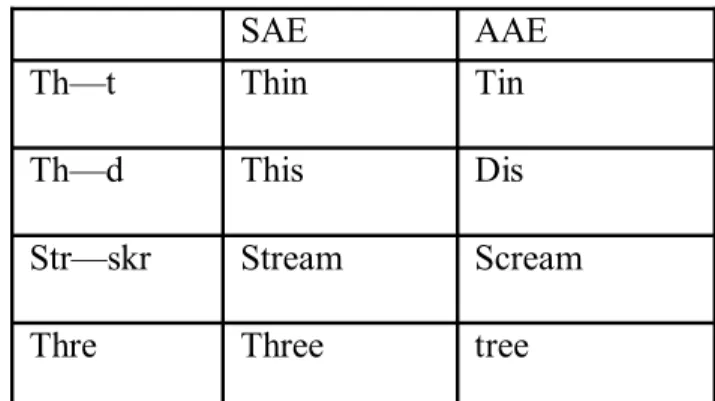
Labov (1995) identified difficulties that may obstruct successful reading for some minority students that use AAE. He suggested that an abstract difference be-tween sound and spelling exists, making it difficult for African-American English speakers to learn to read, which may ultimately influence success in literacy (Labov, 1995). Examples of these phonological differ-ences can be seen in initial sounds, final consonant sounds, and switching the short “I” sound as seen in Figure 1 and Figure 1.1.
Figure 1: Initial Sounds
Figure 1.1: Simplifying final consonants and switch-ing the short I sound
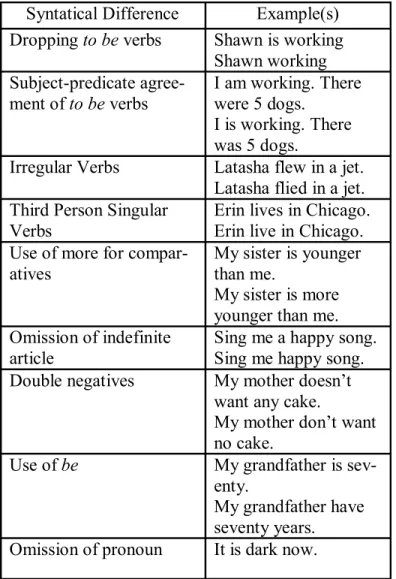
Syntactical differences in how sentences are produced may also be seen in AAE. These differences affect how sentences are made up and formed gram-matically. Examples of some of these syntactical dif-ferences are shown in Figure 2.
SAE AAE
Th—t Thin Tin
Th—d This Dis
Str—skr Stream Scream
Thre Three tree
SAE AAE
Talked Talk
Looks Look
Best Bess
Figure 2: Syntactical Differences
When a teacher is aware of and is able to iden-tify the specific differences in African-American Eng-lish, he/she will be able to identify miscues with accu-racy in reading and writing. In identifying the specific miscues of each student, the teacher can then begin to implement instruction to support the transfer of Afri-can-American English to Standard English and pro-vide a more individualized instruction. This transfer would help support making critical connections and expand a minority students’ knowledge base of the sounds and rules of language development which in turn would increase success in literacy acquisition.
Using Culturally Responsive Teaching to Support Literacy Instruction
One way to become effective in the support of minority students is to use culturally responsive teach-ing. Culturally responsive teaching uses the students’ culture as a resource to scaffold learning for culturally and linguistically diverse students. Many teachers
be-lieve that culturally responsive teaching is simply in-corporating literature with culturally and linguistically diverse characters or settings or designating months to specific ethnicities.
Culturally responsive teaching goes beyond the basic inclusion of heritage into curriculum. To truly incorporate culturally responsive teaching, four areas must be specifically addressed within the classroom, and must be part of the teachers’ awareness; 1) Teach-ers must be culturally sensitive; 2) able to reshape their classroom curriculum to incorporate culturally relevant teaching; 3) build a community of learners through the foundation of relationships (Powell, 1997); and 4) believe that all children can succeed (Ladson-Billings, 1994).
Achieving academic success can be done through culturally responsive teaching. Using cultural-ly responsive teaching engages students and builds personal connections with the content being taught. Bringing in all characteristics of culturally responsive teaching would enhance a teachers’ classroom and build a stronger academic foundation for student achievement. Using culture as a resource and tool can enhance interpretations and experiences to make liter-acy success more attainable for those students having a hard time making connections to academic dis-course.
The Study: Working with Minority Students Not being able to make connections has creat-ed an obvious gap in the academic success of African-American students and their White counterparts. This gap has fluctuated but not closed in looking at reading scores published by the National Center of Education-al Statistics (Vanneman, A., Hamilton, L., BEducation-aldwin Anderson, J., and Rahman, T, 2009). Therefore, mi-nority students are still at a disadvantage in academic success. As previously stated, one possible solution to making more meaningful connections in academics for minority students is to use culture as a resource in teaching.
Study Description
The concept of using culture as a resource in the classroom initiated a qualitative study on what knowledge White teachers brought with them to the literacy education of their African-American students and how this knowledge was implemented in the classroom through culturally responsive teaching. The research questions that guided this study were focused Syntatical Difference Example(s)
Dropping to be verbs
Shawn is working Shawn working Subject-predicate
agree-ment of to be verbs
I am working. There were 5 dogs.
I is working. There was 5 dogs.
Irregular Verbs
Latasha flew in a jet. Latasha flied in a jet. Third Person Singular
Verbs
Erin lives in Chicago. Erin live in Chicago. Use of more for
compar-atives
My sister is younger than me.
My sister is more younger than me. Omission of indefinite
article
Sing me a happy song. Sing me happy song. Double negatives My mother doesn’t
want any cake.
My mother don’t want no cake.
Use of be My grandfather is sev-enty.
on these concepts. They are as follows: 1) What knowledge of African-American culture and language do four European-American teachers bring to the liter-acy education of African-American students? and 2) How do these four teachers verbally report implement-ing this knowledge in their classroom practices?
Method
Setting and Participants of Study
This study was conducted in an urban school district in the Midwest. The study included four Euro-pean-American teachers with varying amounts of teaching and personal experience. Approximately 60 letters were randomly sent out to four various schools in this urban district. The teachers that were invited to participate could have any number of years experi-ence, however, they had to be White and had to be teaching reading and/or language arts. Teachers were asked to return a letter of consent if they had an inter-est in the study and interinter-est in participating. Four teachers responded and were willing to participate. Interviews were set up and were conducted in a setting of their choice to illicit comfort in their responses.
Interviews
The teachers were interviewed and given scenarios to respond to in a way that they felt comfort-able. The interview questions specifically focused on American communication styles, African-American characteristics of narratives, and dialectal differences found in African-American English. The interview questions also integrated scenarios that in-cluded characteristics of culturally responsive teach-ing. The questions and scenarios were gathered based on the research collected for the study as well as the cultural characteristics of the African-American com-munity. A summary of the questions and the infor-mation gathered from the scenarios are summarized in Table 1. A full text of the scenarios can be found in Appendix A.
Table 1:
Table of Scenarios and Information Gathered
Summarization of Scenario
Data Gathered
Scenario that incorporates Black HistoryMonth and specific activities to cel-ebratethe month of Feb-ruary
Knowledge of Culturally Relevant Teaching
Misreading of text selection that has use of African-American Eng-lish
Knowledge of African-American English
Selection written by third grade student that uses African-American English
Knowledge of African-American English
Narrative as told by 7 year old girl that uses African-American Eng-lish
Knowledge of Narrative Sequencing
Grammar assignment of six sentences by
sixth grade student with use of
African-American English
Knowledge of African-American English
Formal text selection that incorporates signification
Knowledge of Signification
Informal conversation that incorporates signification
Knowledge of Signification
Classroom scenario that makes use of call-and response and tonal se-mantics
Results
Findings from Study
Overall, the findings of this study indicate that the participants acknowledged the cultural differences of their African-American students. They were famil-iar with some of the communication styles of their Af-rican-American students, but identified very few com-munication styles to use in the classroom as a resource for literacy acquisition. They also conveyed an
acknowledgement of culture which gave insight into each participant’s cultural sensitivity and belief in Af-rican-American students learning and their acquisition of literacy. The following provides further detail of the findings in the teachers’ understandings of AA com-munication styles, narrative styles, language and dia-lect, and culturally responsive teaching.
Findings of Understanding Communication Styles
Being able to identify and use the different AA communication styles in the classroom would bring a strong foundation and connection to literacy skills. Not only would there be connections made to commu-nity life, but the teacher would make learning more accessible as they focus the importance of certain lit-eracy aspects of the lessons or activities. In the study conducted, the teachers were able to identify with the communication style of signification in formal litera-ture and felt that using it in the classroom would build skills in inferencing, figurative language, interpreta-tion, and vocabulary building. They also felt that the students would be able to make connections to the text which in turn would provide foundation for making text-to-self and text-to-world connections in terms of comprehension skills. However, the other styles of communication, tonal semantics and rhythm and repe-tition, were seen more as classroom management tech-niques and not styles that would be used in the class-room as a tool to teach literacy skills. Their under-standing took into consideration their cultural aware-ness of the differing discourse of their students’, how-ever, they used only one style as a resource to make personal connections to academics. While there was a definite awareness to the specific characteristics of AA culture, the understanding of how to use each of the characteristics as a strategy in teaching to promote academic success and to make personal connections was not shown. Using the styles signification, tonal
semantics, and rhythm and repetition for literacy ac-quisition would further communication between the student and teacher and further build subject recall and motivation. Making connections to community using these styles would also build a foundation for making interpretations to content and text.
Findings of Understanding of Narrative Styles
When given scenarios that included narratives, the teachers in the study focused more on the grammar and sentence structure. The differences in AA English and Standard English were points of conversation for each teacher. The participants were able to identify the miscues but did not identify the piece as a narrative. A lot of emphasis was placed on how to correct the grammatical errors. Strategies included revising pa-pers and making edits to give to the students, however, the strategies did not include a way for the students to be able to identify the differences and be able to code-switch from one discourse to another.
With the characteristics of narratives not being identified, the participants did not identify that the piece had sequencing, stayed on topic, included feel-ings and thoughts, and included a beginning, middle, and end. Focusing on the dialectal differences of the language caused the teachers to miss the strengths of the narrative, therefore missing the opportunity to build on what the student would bring as an asset to writing or telling narratives. Becoming more familiar with the characteristics that may be seen in narratives written by African-American students would put the focus back on the skills of narratives in literacy acqui-sition and not on differences in dialect.
Findings of Understanding of Language & Dialect
acquire a pertinent foundation of Standard English to acquire literacy skills. To be able to establish this type of strategy, the teacher must become familiar with specific differences in language and dialect that would be represented on a day-to-day basis in the classroom and in student work that all of their students could succeed given the right tools through education. They believed in their students and showed many times in comments that they cared for them deeply. They com-municated with families and tried to build relation-ships in and out of the classroom. They also believed that culture should not be implemented only at holi-days but throughout the year.
The one characteristic of culturally responsive teaching that was not present was that they did not tru-ly incorporate culture into the curriculum and use it as tool or resource to build literacy skills and therefore create a strong foundation for acquisition. They were familiar with different communications styles but could only see one as a resource for the classroom. Dialectal differences were identified as well as the knowledge of formal and informal language but tech-niques and strategies for transferring from one dis-course to another were not conveyed. Using the strengths of the discourse and making connections would provide for a more opportune academic suc-cess.
Implications for the Future
In looking toward the future, there is a need to embed culturally responsive teaching into undergradu-ate and graduundergradu-ate programs as well as professional de-velopment sessions. The need to build awareness of cultural characteristics and learning styles is impera-tive to minority student success. Undergraduate and graduate programs or professional development train-ings should incorporate curriculum that integrates cul-ture as an embedded piece to academic success. Ex-plicitly introducing cultural characteristics and learn-ing styles would be an asset to developlearn-ing curriculum connected to culture. This curriculum should be seen in all areas of content and incorporate the premise of using culture throughout the academic year and not just at specific times that may be celebrated according to a specific scope and sequence. These programs or professional development sessions might also inte-grate the teaching of specific cultural differences such as communication styles and techniques (signification, call-and-response, tonal semantics, and narrative se-quencing) to support an embedded curriculum. This
curriculum should provide the affects that these differ-ences may have on academics both in a positive man-ner if used as a resource and a negative manman-ner if seen as a hindrance. Finally, these programs and sessions should teach the proper, in depth use of culturally re-sponsive teaching and require the successful applica-tion of its characteristics in a classroom setting.
While these are only suggestions, the need for further research in the area of White teachers and their knowledge of minority students is critical in educa-tion. As stated before, the teaching force is predomi-nantly White, middle-class women. The student popu-lation is becoming much more diverse as seen in the statistics previously given. This suggests that discon-nect is inevitable between the culture and language of the teacher and the students unless measures are taken to improve and widen the cultural knowledge base of teachers. We need to begin to build our own aware-ness of culture in academic content. We also need to begin to take steps toward expanding our teaching strategies making instruction more meaningful to all students. Including culture in curriculum and the use of culturally responsive teaching in literacy acquisi-tion is one way in which we can attain academic suc-cess.
References
Bohin, A. P., (2003). Familiar voices: using Ebonics communication techniques in the classroom.
Urban Education, 38, (6), 688-707.
Champion, T. (1998). Tell me s omethin’ good: A de-scription of narrative structures among African American children. Linguistics and Education, 9 251-286.
Darling-Hammond, L., & Scalan, E. M. (1996). Who teaches and why: Dilemas of building
Profession for 21st century schools. In J. Sikula, T.
J. Buttery, & E. Guyton (Eds.), Handbook of re-search on teacher education (2nd ed., pp. 67-101).
New York: Macmillan.
Delpit, L. (1995). Other people’s children: cultural conflict in the classroom. New York: New Press.
Fogel, H. & Ehri, L., (2006). Teaching African-American English forms to standard African-American English-speaking teachers: effects on acquisition, attitudes, and responses to student use. Journal of Teacher Education, 57 (5), 464-480.
Gee, J. P. (1992). The Social Mind: Language, Ideolo-gy, and Social Practice. New York:
Bergin and Garvey.
Gee, J. P. (1996). Social linguistics and literacies: Ideology in Discourses. London: Routledge Falmer.
Gipe, J. P. (2006). Multiple paths to literacy: Assess-ment and differentiated instruction for
diverse learners. Boston: Allyn & Bacon.
Heath, S. B., (1983). Ways with words: Language, life, and work in communities and lassrooms. Cam-bridge: Cambridge University Press.
Herrera, S., Perez, D., & Escamilla, K. (2009). Teach-ing readTeach-ing to English language lea ers: Differentiated Literacies. Boston: Allyn & Bacon.
Labov, W. (1995). Can reading failure be reversed? A linguistic approach to the question. In V. Gadsen & D. Wagner (Eds.), Literacy Among
African-American Youth.
Creskill, New Jersey: Hampton Press.
Labov, W. (2001, February). Uncovering the event structure narrative. Paper presented at Georgetown University Round Table, Washington DC.
Ladson-Billings, G. (1994). The dreamkeepers: suc-cessful teachers of African-American children, San Francisco, CA, Jossey-Bass.
McCabe, Allysa. (1992, December). All kinds of good stories. Paper presented at the meeting of the Na-tional Reading Conference, San Antonio, TX.
Michaels, S. (1981). Sharing time: children’s narrative styles and differential access to literacy. Language and Society, 10, 423-442.
National Education Association (NEA). (2003). Status of the American public school teacher
2000-2001.Washington, DC: Author.
National Reading Panel (NRP). (2000). Report of the National Reading Panel: Teaching children to read. Reports of the subgroups (NIH Publication no. 00-4754). Washington DC: U.S.
Perez, B. (2004). Literacy, Diversity, and Program-matic Response. In (Eds). Bertha 101 Perez.
Sociocultural contexts o language and literacy (3-20). Mahwah, New Jersey: Lawrence Erlbaum.
Polloway, E., Miller, L., & Smith, T. Language in-struction for students with disabilities.
Denver: Love Publishing Company.
Powell, R. (1997). Then the beauty emerges: a longitudinal case study of culturallyrelevant teach-ing. Teaching and Teacher Education, 13 (5), 467-484.
Sleeter, C., Torres, M. N. & Laughlin, P. (2004). Scaf-folding conscientization through
inquiry in teacher education. Teacher Education Quarterly, 31(1), 81-96.
Sollon, R. & Scollon, S.W. (1981). Narrative, literacy, and face in interethnic communication. New Jer-sey: Ablex.
Spellings, M. (2005). Academic gains of English lan-guage learners prove high standards
accountability paying off. Presentation at the fourth annual Celebrate Our Rising
Stars Summit: From Essential Elements of Effec-tive Practice, Washington, DC.
Vacca, R. & Vacca J. (2008). Content area reading: Literacy and learning across the curriculum. New York: Pearson.
Vanneman, A., Hamilton, L., Baldwin Anderson, J., and Rahman, T. (2009). Achievement Gaps: How Black and White Students in Public Schools
Perform in Mathematics and Reading
on the National Assessment of Educational Pro-gress, (NCES 2009-455). National Center for Education Statistics, Institute of Education
Sciences, U.S. Department of Education. Washington, DC.
Walker, A. (1982). The Color Purple. New York: Pocket Books.
Appendix A
Interview Protocol
As a reminder, your rights as a participant are in effect. You may opt not to answer any question that makes you feel at risk or uncomfortable. You also may leave the study at any time. If any discomfort or feelings of risk arise, please advise me. No questions will be asked of your decision.
1) Please tell me a little bit about yourself.
2) Could you describe experiences that you have had with African American students before your current teaching position?
3) How has this affected your teaching?
4) Please identify and describe any classes, professional development sessions, or workshops that you have attended that included issues of diversity.
5) Describe your students and your teaching environment. 6) What do you feel is your role as a literacy educator? 7) Define literacy and what it means to be literate.
8) How do you provide literacy support in your classroom?
9) A teacher incorporates Black History month into his/her yearly lesson plans. The lessons include looking at famous African-Americans from the past to the present, learning about slavery in American History, learning about Dr. Martin Luther King, Jr. and The Civil Rights movement, having successful African-Americans from the community come in and speak, and having African- American families from the classroom bring in ethnic foods for the students to sample.
• Do you feel that is a sufficient display of culturally relevant teaching? Why or why not?
10) “Imagine that you are a second grade teacher listening to one of your students read orally. The student speaks African-American English. You observe the student misread a portion of the text because he/she has translated the Standard English print to its corresponding African- American English form.” (Fogel & Ehri, 2006, p. 478)
• How do you respond to this reading?
11) The following was written by a third grade African-American English speaking student. She was asked to describe her family.
• “My name Vanessa. I have a big family. I have two brother and three sister. My older brother name
Bruce. He sixteen year old. My younger brother name Tommy. He only four year old.” (Fogel & Ehri, 2006, p.478)
• As her teacher, how would you respond?
12) The following is a narrative as told by a 7 year old girl. The interviewer has asked the child to tell them about a time that she was sick.
“I went to the doctors
an my mom, she had to see if I had asthma
An’ I had to go to the um store to get my medicine An’ um they didn’t have it
An’ I had to for ‘em them to make it
An’ um my mom she wen’ back an’ back an’ finally it was done making it An’ I xx, when I got in the car an’ she got it
I had to drink some, I’s nasty” (Champion, 1998, p. 258)
13) You receive the following sentences for a grammar assignment from an African-American sixth grade student:
• Michaela friend she be working as a actress in a off broadway production of Rent.
• She be workin hard for her money.
• My brother he sit in the front row so he can hear everything Michaela say. • He use to want to be in three play but last year he changes his minds. • He now want to be in fours!
• As this student’s teacher, how do you respond?
14) In a high school literature classroom, a group of African-American students are reading the novel, The Color Purple, by Alice Walker. The teacher chooses the following passage:
• “You lowdown dog is what’s wrong, I say. It’s time to leave you and enter
into Creation. And your dead body just the welcome mat I need (Walker, p. 207)
• How would you use this passage in a literature lesson? (signifyin’)
15) Several African-American high school students are walking down the hallway outside of
your room at the end of the school day. You are standing in the doorway of the classroom. The stu-dents are using African-American English.
The conversation goes as follows: “Sherry: I sho am hongy. Dog!
Reginald: That’s’ all you think bout, eating all the time. John (Sherry’s brother): Man, that’s why she so big. Sherry: Aw, y’all shut up!
John: Come on Sherry, we got to go. We’ll catch you later man.
Reginald: (to John): Goodnight. Sleep tight. Don’t let Sherry eat you up tonight. (Everyone laughs- including Sherry- and gives skin.) (Smitherman, 1977, p. 119)
• How do you respond?
• How could you bring this type of conversation into the classroom for use with learning?
(figurative language and signifyin’) 16) Listen to the following scenario:
The teacher walks around the room as students help to pass out booklets for a writing lesson. The teacher announces, “Class, this morning we are going to practice some sentences, and when we do that I want you to listen. Can you say that?” The class replied loudly in unison, “Listen!” She said, “Do what?” and they shouted, “Listen!” The teacher repeated the word with them a few times: “Listen…listen…” and then began to clap her hands in between each utterance of the word, “Listen…[clap]…listen…[clap]…listen…[clap].” All of the children joined in with her, clapping and saying listen alternately. (Bohin, 2003, p. 691)
• How would you respond to this situation in your classroom? (rhythm, repetition, call and
re-sponse)
Meeting Ohio TESOL Endorsement Program Standard 6.2: One Strategy…
Tim Micek, D.A.The Ohio TESOL Endorsement Program (TEP) Standard 6.2 calls for candidates to “apply current research to develop a repertoire of strate-gies to promote age/grade-appropriate social and academic English learning.” Teacher educators may feel challenged to meet this standard for sev-eral reasons. First, they may not be sure how to structure this application: should candidates apply research once or many times? Should candidates apply research directly, in the field, or indirectly, through assignments such as papers, for example? The former may be problematic as not all ESL teacher candidates have ready access to English language learners (ELLs), the latter as it is an indi-rect measure. Second, teacher educators may not be sure what research candidates should apply— canonical research in second language acquisition (SLA) of the teacher educator’s choosing, for ex-ample, or any relevant research of the candidate’s choice. Arguments may be made for both posi-tions. Finally, teacher educators may be uncertain as to how to assess this application: how many strategies, and which ones, should they require candidates to develop? How can teacher educators make candidates aware of current TESOL research and have them apply it to their teaching? One an-swer may lie in learner autonomy, a principle that has received significant attention in language edu-cation but relatively little in teacher eduedu-cation.
Benson (2003) offers an explanation, a his-tory, and principles of learner autonomy. In a defi-nition that has ‘stood the test of time,’ he reports, ‘Holec (1981, p. 3) defines autonomy as “the abil-ity to take charge of one’s own learning.” Differing slightly with Holec, Benson (2001, p. 47) defines
autonomy as “the capacity to control one’s learn-ing.” Autonomy is best described as a capacity, Benson explains, because different abilities are in-volved in controlling learning. Researchers gener-ally agree that the most important abilities are those that allow learners to “plan their own learn-ing activities, monitor their progress, and evaluate their outcomes.” In his own research, Benson sug-gests that different abilities may be needed for “the day-to-day management of learning, control over the mental processes of second language learning and control over the content of learning” (Benson, 2001, p. 50).
According to Benson (2003), the notion of autonomy first came into language teaching in the late 1960s through the adult education movement in Europe and North America and for many years was associated with adult learners who had left for-mal education. Many early studies were conducted by the Council of Europe’s Modern Languages Project in the 1970s. Holec played an important role in this project as director of the Centre de Re-cherches et d’Applications en Langue (CRAPEL),” which is still “a focal point for research and prac-tice on autonomy” (p. 291).