Checkpointing in CosMiC: a User-level Process Migration Environment
P. Emerald Chung, Yennun Huang and Shalini Yajnik
Bell Labs, Lucent Technologies
600 Mountain Avenue
Murray Hill, NJ 07974
f
emerald,yen,shalini
g@bell-labs.com
Glenn Fowler, Kiem-Phong Vo and Yi-Min Wang
AT&T Labs, Research
180 Park Avenue
Florham Park, NJ 07932
f
gsf,kpv,ymwang
g@research.att.com
Abstract
TheCosMiCsystem is a user-level process migration en-vironment. Process migration is defined as the mechanism to checkpoint the state of an unfinished process, transfer the state from one machine to another, and resume process execution on the new machine. The main purposes of pro-cess migration are (1) to utilize the CPU power and balance load on all machines in an environment; (2) to provide fault-tolerance by migrating a process from a failed machine to another machine.
CosMiC provides an extensible architecture to allow an application to choose its own checkpointing mecha-nism. It is equipped with four checkpoint libraries, namely, libckp,libfcp,libftandlibst. They provide dif-ferent strategies for state saving and restoring. Libckpis a transparent checkpoint library, it checkpoints the entire process state. It requires minimum user involvement and no modifications to the source code. Libfcpis a file check-point library that saves and restores file contents. Libft is a critical data checkpoint library. Users select critical data to be checkpointed using a set of application program-ming interfaces (APIs). Libst is a strong-type check-point library. It saves and restores architecture-independent checkpoints in a heterogeneous environment. In this paper, we describe our experience in incorporating these different checkpointing mechanisms into theCosMiCsystem.
2pm 6pm 10pm 2pm
91
36 workstations
No. of idle
total 131 hosts sampling rate: 5/hr
32
2am 6am 10am 0
128
96
64
Figure 1. Numbers of idle machines in a day
1. Introduction
In the scientific computing community, many tasks re-quire a large amount of computation time. Examples in-clude model parameter estimations from a large set of data and solving a large-dimensional linear equation.
These jobs used to be carried out on centralized super-computers. With the trend of desktop computing, many modern laboratory computing environments are now pop-ulated with workstations sitting on individuals’ desks and sharing network file systems. There is a need to run the computation-intensive jobs effectively in this type of dis-tributed environments.
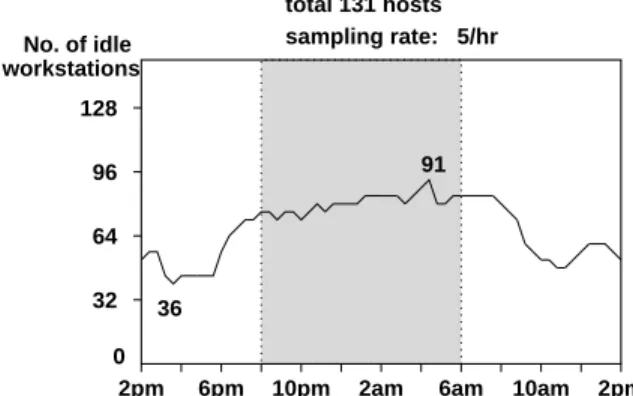
them were idle during the nights and weekends. Figure 1 shows a typical day. The situation was disturbing because many users were asking for more computing power while a significant percentage of machines were idling.
To take advantage of these under-utilized computer cy-cles, many systems have been developed to distribute jobs automatically and to balance the load on all the machines. A typical setting includes a centralized or distributed job queue, and a resource monitor running on each machine. Resource monitors periodically collect status information such as load, idle time, or number of users. The job queue dispatches a task to a certain machine based on some load-balancing algorithm.
An important feature in these systems is process migra-tion [13], i.e., the capability to transfer the state of an unfin-ished process from one node to another node, and to resume process execution. With process migration, a system is able to move jobs from an overloaded node to an under-loaded one, to move jobs away from a node being interactively used by users, or to recover jobs which fail to finish due to a node failure.
The techniques for process migration can be categorized into OS-built-in process migration and user-level process migration. OS-built-in process migration has been imple-mented in several operating systems. Examples include MOSIX [3], V [5], Accent [16], Sprite [14], Mach [2] and OSF/1 AD [22]. The user-level process migration is typ-ically implemented as checkpoint-restart systems running on UNIX or NT operating systems. Examples include Con-dor [12] and Load Sharing Facility (LSF) [23]. Although the OS-built-in migration systems are often more efficient, they have not been widely used due to the slowness in accepting new operating systems in the user community.
There are also parallel systems that utilize the com-putation power from a network of workstations, such as Linda-Piranha [9] and PVM [7]. Also, the CMU Dome project [17] implements high-level architecture checkpoint to support heterogeneous process migration in PVM. Unlike the previous migration mechanisms which are applied to general UNIX processes, these systems mainly provide ser-vices to parallel programs written in specific programming paradigms.
We developed a user-level process migration system, calledCosMiC, to address the needs from a signal process-ing research group. In this paper, we focus our discussions on the checkpoint-restart mechanisms supported in the Cos-MiCsystem, and our experience in building and deploying the system.
2. CosMiC System Architecture
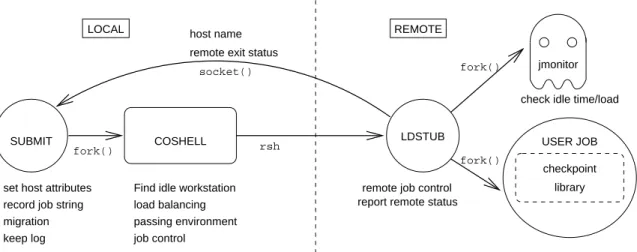
CosMiC stands for Coshell [6], Migration and Checkpointing. The overall architecture of CosMiC is
shown in Fig. 2. We briefly describe the Coshell service and the migration mechanism in this section. The checkpoint-restart techniques are described in more details in the next section.
2.1. Coshell Service
Coshellis a general purpose service that automatically executes jobs on lightly loaded machines in a local net-work. There is no centralized job queue; each user is served by a separateCoshelldaemon with its own job queue. A Coshelldaemon usesrshto establish a shell process on a remote machine, without requiring any special privilege. To minimize the overhead of establishing network shell connec-tions, aCoshelldaemon may reuse a previous connection.
Coshelldaemons are responsible for accepting user re-quests for job submissions and status inquiries, and for send-ing jobs to idle machines in the network. Each Coshell daemon maintains and schedules its own job queue. The se-lection of a target machine is based on a ranking function that combines both static machine attributes and dynamic status information, to be described shortly. The target machine is selected randomly from a number of top-ranked machines to reduce the chance of multipleCoshelldaemons scheduling jobs on the same idle machine.
Static machine attributes are maintained in a central host description file as shown in Fig. 3. The type attribute differentiates different processor types; ratingspecifies the relative mips rating; idle is the minimum idle time of any interactive users before jobs can be scheduled on the machine (the default is 15 minutes);memdescribes the size (in Mbytes) of the main memory; puserdefines the primary user(s) of the machine. Typically, if a machine is physically located in a person’s office, thepuserattribute would include that person. In addition to these standard attributes, users can also add their own attributes for machine selections.
Dynamic status information is collected by a per-machine status daemon. Each status daemon periodically posts status to a per-machine status file visible to all machines in the local network. Status update frequency is configurable and the default value is 40 seconds plus a random fraction of 10 seconds in our installation. The random component tends to evenly distribute the update times of all status daemons.
remote exit status
fork() rsh
socket()
host name
keep log
Find idle workstation
load balancing
passing environment
job control
fork()
USER JOB jmonitor
library checkpoint LDSTUB
LOCAL
remote job control report remote status
fork()
check idle time/load REMOTE
migration
SUBMIT COSHELL
set host attributes
record job string
Figure 2. CosMiC architecture
banana type=sgi.mips rating=60 idle=15m mem=64m puser=emerald orange type=sun4 rating=9 idle=15m mem=32m puser=ruby grape type=sun4 rating=18 idle=15m mem=32m puser=gem strawberry type=sol.sun4 rating=4 idle=15m mem=64m puser=stone kiwi type=hp.pa rating=40 idle=15m mem=64m puser=amber pear type=sun4 rating=21 idle=15m mem=96m puser=diamond apple type=att.i386 rating=5 idle=15m mem=96m puser=sapphire
Figure 3. An example host description file
consecutive polling, we consider that process as a nontrivial job.
2.2. Migration mechanism
Three programs, submit, ldstub and jmonitor, together handle job migration.
Submit is an interface between users and Coshell. User jobs can be commands, application programs, or shell scripts. Each job is specified by a shell command string.
Submitpasses the job string toCoshell, which then se-lects an idle machine and starts anldstubon that machine to execute the job, as shown in Fig. 2.
On the selected machine,ldstubforks both the user job and ajmonitor.Jmonitoris a fine-grain polling device for detecting changes in machine status. It does the polling every 10 seconds. Migration is triggered by an occurrence of any of the following events: (1) an activity on an input device by a primary user, either directly or through remote login; (2) a nontrivial job being run by a primary user; (3) a one-minute load average being greater than or equal to a particular threshold, typically 3.5. Upon detecting any such event,jmonitorexits. Sincejmonitoris a child process ofldstub, aSIGCHLDsignal is sent toldstub.
Being interrupted by the signal,ldstubkills the user job, sends a job migration request tosubmit, and then exits.
Submitsimply resends the request to theCoshelldaemon to restart the job on another machine. If the job is not linked with a checkpoint library, it is re-executed from the initial state.
If a job finishes withoutjmonitor exiting,ldstub
sends its exit status back to submitand submitexits with the same status. The job will not be further submitted. Occasionally, the selected machine crashes, and the job is lost. Submitdetects such a failure when the commu-nication channel, a UNIX socket, between submit and
ldstubis closed. In such case,submitresends the job toCoshellto run on another machine. This mechanism provides fault tolerance to remote machine failures.
3. Checkpointing and Restart Techniques
check-point library distinguishes a recovery from a fresh start by detecting the existence of an appropriate checkpoint file. That is, if the checkpoint file exists, then it is a recovery; otherwise, it is a fresh start. This design philosophy is dif-ferent from Condor and LSF, which typically require extra command-line arguments when a migrated process is recov-ered from a checkpoint. Any application must be linked with a standard checkpoint library so that these extra arguments can be properly interpreted. In contrast, CosMiC recog-nizes the fact that different applications may need different kinds of checkpointing and restart techniques. Therefore, it provides an extensible architecture to allow each appli-cation to choose its own checkpointing mechanism. In this section, we describe four different types of checkpoints that are currently available for use with theCosMiCsystem.
3.1. User-transparent checkpoint library: libckp
Libckpis a user-transparent checkpoint library for Unix applications [20]. It can be linked with a user program to periodically save the program state on stable storage with-out requiring any modifications to the source code. The checkpointed program state includes (1) program counter, (2) program stack and stack pointer, (3) open file descrip-tors, (4) global and static variables of the user program, the statically linked libraries, and the dynamically linked libraries, (5) dynamically allocated memory, and (6) the
mmap regions. Libckptakes over the mainroutine of the user program in order to perform necessary initializati on and to detect a recovery mode. Insidemain,libckpuses a probing technique to identify the data areas of dynamically linked libraries, that need to be included in the checkpoint. If there exists an appropriate checkpoint file,libckp en-ters the recovery mode by restoring all checkpointed state, and the program eventually jumps to where the checkpoint was taken; otherwise,libckpinvokes the originalmain
routine supplied by the user program to do a fresh start. The main advantage of usinglibckpis that it does not require any modifications to the user program source code. The main disadvantage is that, since the entire process state is checkpointed, the checkpoint file size can be large and the run-time overhead can be high. We have tested libckp
on a dozen of signal processing, simulation and CAD appli-cations, and measured the run-time overhead to range from zero to seven percent with a default 30-minute interval be-tween checkpoints. If an application cannot tolerate this level of overhead,libckpcan be modified to use a stan-dard copy-on-write technique [15]: instead of blocking the process execution when taking a checkpoint, a child process is spawned to perform the actual checkpoint task while the parent process continues normal execution. It is noted, how-ever, that the copy-on-write technique may not be effective if the memory usage of the user program approaches the
limit of the available physical memory.
In addition to the default totally transparent mode, we have observed that the following two semi-transparent modes of libckp are also useful in practice. First,
libckpprovides ackpcheckpoint()function call that can be inserted into a user program to snapshot the entire process state at a user-controlled program location. This can be useful for debugging purpose, or to avoid losing all useful work when a program abnormally exits due to tempo-rary resource unavailability or glitch [20]. Second,libckp
allows users to hook in an application-specific recovery rou-tine after data restoration but before the final program jump. This is useful for reestablishing whatever execution envi-ronment that is difficult to checkpoint, and for correcting state variables that should not have been checkpointed and restored in the first place. For example, if the program uses a variable to hold the current host name, the restored value upon a migration will be the old host name, which may cause subsequent execution to be incorrect. In this case, the user program can obtain the new host name and overwrite the re-stored value inside the application-specific routine to ensure correct recovery. As another example, whether a timing-related variable should be checkpointed or not is usually application-dependent. Variables holding “remaining time to timeout” information often need to be recalculated upon a recovery, instead of being restored to the checkpointed values.
3.2. File checkpoint library: libfcp
In addition to volatile memory state, a user program typically also modifies files during execution. To ensure consistency, all file updates since the previous checkpoint should also be rolled back when the memory state is rolled back. This functionality was first provided as part of the
libckpimplementation. Since checkpointing files is es-sentially orthogonal to checkpointing volatile memory and because of its practical importance, this file-rollback func-tionality is now taken out oflibckp and provided by a separate checkpoint librarylibfcp[19]. This allows the flexibility of usinglibfcpwith any other volatile mem-ory checkpoint library. Libfcpcan also be used alone in the following two application scenarios. First, if an appli-cation’s critical data always all reside in files at checkpoint time, volatile memory would never need to be checkpointed. Second, if an application is not long-running and so volatile memory checkpoints are not necessary, the application may still need to uselibfcpto ensure file consistency at restart time.
When a file is opened for modifications, its size is recorded and an undo log of file truncation is generated. When the portion of the file that existed at the previous checkpoint time is about to be modified, an undo log of restoring the pre-modification data is generated. When a rollback occurs, these undo logs are applied in a reversed order to restore the original files. It is noted that, when libfcpis used with an volatile memory checkpoint library, a simple linear two-phase commit protocol should be applied; otherwise, it is possible that a failure occurring during checkpoint time can cause inconsistency between the memory checkpoint and the file checkpoint.
3.3. Critical data checkpoint library: libft
Many long-running applications have the following pro-gram structure: they start with some initialization proce-dures and then enter a program loop executing a large num-ber of iterations. Within each iteration, the stack may grow due to subroutine calls, and dynamic memory may be allo-cated to hold intermediate results. But at the end of each iteration, the stack often shrinks back to containing only the main stack frame, and most intermediate dynamic mem-ory has been deallocated. Critical data that are needed for later iterations usually concentrate in a small number of well-defined regions or data structures such as arrays and matrices. Althoughlibckpcan still be used in this type of applications, saving the entire process state at arbi-trary program locations often generates unnecessarily large checkpoint files. A more efficient approach is to use non-transparent checkpointing: checkpoint routine is always in-voked at the loop boundary, and only user-specified critical data are saved.
Libft [10] provides a set of functions that users in-sert into their programs to specify, checkpoint, and restore critical volatile data. The critical data may include vari-ables and dynamically allocated memory, but not data on the stack. In contrast withlibckp-style recovery which does a
longjmp()to a checkpointed program location to skip all executions before that,libft-style recovery runs through all original initialization procedures, and then invokes the
recover()function to restore checkpointed data before entering the loop. An advantage is that variables that hold environment-dependent information such as host names can be excluded from the critical data. They are reinitialized to the correct current values in the restarted program, and are not overwritten by therecover()function.
Sometimes it may not be an easy task to correctly identify all critical data. For example, if a program imports software libraries written by others, it is often safer to consider all data used by these libraries as critical. To uselibftto check-point such applications, theall critical()function is first invoked to declare all global variables and dynamically
allocated memory as critical. (Note that stack variables are not included.) Then, theuncritical()function is in-voked to exclude from the checkpoint all data regions of the program, that are known to be uncritical.
Libftalso provides a file checkpoint mechanism. It is different fromlibfcpin the following two aspects. First, it provides a set of APIs and so is not user-transparent. Second, it adopts a deferred update approach, as opposed to in-place update: if a file is opened with theftfopen()
call, all file updates are buffered in a log file, and are applied and committed only atftfclose()orftcommit(). A call toftabort()or a migration rollback simply causes the log file to be removed and all updates to be aborted.
3.4. Strong-type checkpoint libary:libst
Coshell supports execution on a heterogeneous envi-ronment by defining a HOSTTYPE environment variable. A user’s environment variable which contains any occurrence of /hosttype/ in it is changed to/$HOSTTYPE/ in the remote job context. For instance, let the local host type be sun4 and
PATH=/home/emerald/arch/sun4/bin:/bin, if the re-mote $HOSTTYPE issgi.mips then the remote shell would use PATH=/home/emerald/arch/sgi.mips/bin:/bin
to find the proper executable.
However, bothlibckp andlibftcheckpoint and restore data in terms of memory addresses. Since machines of different architectures use different representation formats for various data types, checkpoints saved by these two libraries in general cannot be used to recover the same process on another machine of a different architecture.
To make CosMiCprocess migration in a heterogeneous en-vironment possible, we developed another checkpoint library
libst [21] to take checkpoints in a machine-independent for-mat. A user oflibstfirst specifies the critical data structures of the program in a specification file. A protocol compiler,stgen, then parses the specification file to generate specific checkpoint routines for the program. When a checkpoint is needed, the pro-gram callslibstcheckpoint functions which in turn invoke the generated checkpoint routines. The checkpoint routines traverse the critical data structures and marshal the data in theXDRformat. The marshaled data can then be saved into a file or to another process. Because the XDR format is machine independent, the checkpointed data can be used on another machine of a different architecture. During the recovery, the checkpointed data is read from the file and unmarshaled into relevant data structures.
length of idle interval count
....
600 660 720 780840900960 minutes 540
180 120 60
0 240300360420480 15000
20000 25000 30000
10000
5000
Figure 4. Histogram of idle intervals for 131 machines over a period of four months
3.5. Other checkpoint-related issues
In all of the above checkpoint libraries, the checkpoints are often stored as files, identified by UNIX filenames. In our environment, all the machines share a network file system and so any checkpoint file can be accessed from all the machines by a uniform name. We do not consider migration environments where files may not be accessible from a remote machine. The Condor system solves this problem by remote system calls, which always open a file from the home machine and send the file content to the selected machine.
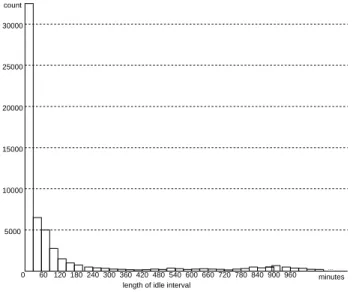
We have collected the status information from the 131 machines for a period of four months, including a total of 64,082 idle inter-vals. The distribution of these intervals is shown in Fig. 4. If we model the distribution as an exponential distribution, the esti-mated expected idle time, which is the average length of all idle intervals, is about 70 minutes. (Note that in our calculation, we did not include intervals longer than 8 hours. They occurred in evenings, weekends or holidays.) This information can be useful for calculating optimal checkpoint intervals. If the expected exe-cution time for a job is known in advance and the checkpoint size can be estimated, several algorithms have been proposed to cal-culate the optimal checkpoint interval to minimize the execution time [8, 11, 18].
4. Summary and Future Work
We have presented the architecture of theCosMiCsystem, and described four different checkpoint-restart techniques that can be used with CosMiC. So far, most usage of CosMiCis for com-puting model parameters in speech or pattern recognition appli-cations. Such applications are typically self-contained, single-process C or C++ programs. Future work includes checkpointing script applications, transparently migrating inter-process commu-nications for message-passing applications, and integrating the
mi-gration techniques with emerging distributed object standards such as DCOM [4] and CORBA [1].
References
[1] The Common Object Request Broker: Architecture
and Specification. July 1995.
http://www.omg.org/corba/corbiiop.htm.
[2] M. Accetta, R. Baron, W. Bolosky, D. Golub, R. Rashid, A. Tevanian, and M. Young. Mach: A new kernel foun-dation for unix development. In the 1986 summer USENIX Conference, 1986.
[3] A. Barak and A. Litman. Mos: a multicomputer distributed operating system. Software-Practice and Experience, 15(8), 1985.
[4] N. Brown
and C. Kindel. Distributed component object model protocol – dcom/1.0. http://www.microsoft.com/oledev/olecom/draft-brown-dcom-v1-spec-01.txt, Nov 1996.
[5] D. Cheriton. The V distributed system. Communications of the ACM, 31(3), 1988.
[6] G. S. Fowler. The shell as a service. In Cincinnati USENIX Conference Proceedings, June 1993.
[7] A. Geist, A. Beguelin, J. Dongarra, W. Jiang, R. Manchek, and V. Sunderam. PVM: Parallel Virtual Machine, A Users’ Guide and Tutorial for Networked Parallel Computing. MIT Press, Dec. 1994.
[8] E. Gelenbe. On the optimal checkpoint interval. JACM, 26(2):259–270, April 1979.
[9] D. Gelernter, M. Jourdenais, and D. Kaminsky. Piranha scheduling: Strategies and their implementation. Technical Report 983, Department of Computer Science, Yale Univer-sity, Sept. 1993.
[10] Y. Huang and C. Kintala. A software fault tolerance plat-form. In B. Krishnamurthy, editor, Practical Reusable UNIX Software. John Wiley & Sons, 1995.
[11] C. M. Krishna, K. G. Shin, and Y. H. Lee. Optimization criteria for checkpoint placement. CACM, 27:1008–1012, 1984.
[12] M. J. Litzkow, M. Livny, and M. W. Mutka. Condor - a hunter of idle workstations. In Proceedings of International Conference on Distributed Computing Systems, pages 104– 111, 1988.
[13] D. S. Milojicic, F. Douglis, Y. Paindaveine, R. Wheeler, and S. Zhou. Process migration. http://www.osf.org/ de-jan/papers/m8.6.fr.ps.Z, submitted for publication, 1996. [14] J. Ousterhout, A. Cherenson, F. Douglis, M. Nelson, and
B. Welch. The sprite network operating system. IEEE Trans-actions on Computers, Feb. 1988.
[15] J. S. Plank, M. Beck, G. Kingsley, and K. Li. Libckpt: Transparent checkpointing under unix. In the 1995 Usenix Technical Conference, pages 213–224, Jan. 1995.
[16] R. Rashid and G. Robertson. Accent: a communication oriented network operating system kernel. In the 8th Symp.on Operating System Principles, pages 64–75, 1981.
[17] E. Seligman and A. Beguelin. High-level fault tolerance in distributed programs. Technical Report 983, Department of Computer Science, Carnegie Mellon University, Dec. 1994. [18] K. G. Shin, T. Lin, and Y. Lee. Optimal checkpointing of
[19] Y.-M. Wang, P. E. Chung, Y. Huang, and M. Elnozahy. In-tegrating checkpointing with transaction processing. In Pro-ceeding of 27rd Fault-Tolerant Symposium, Seattle, Wash-ington, June 1997.
[20] Y.-M. Wang, Y. Huang, K.-P. Vo, P.-Y. Chung, and C. Kintala. Checkpointing and its applications. In the 25th Intl. Symp.on Fault-Tolerant Computing, pages 22–31, June 1995. [21] S. Yajnik and Y. Huang. STL: A toolkit for on-line software
update and rejuvenation. submitted for publication, 1996. [22] R. Zajcew, P. Roy, D. Black, C. Peak, P. Guedes, B. Kemp,
J. LoVerso, M. Leibensperger, M. Barnett, F. Rabii, and D. Netterwala. An osf/1 unix for massively parallel muti-computers. In the 1993 winter USENIX Conference, 1993. [23] S. Zhou, J. Wang, X. Zheng, and P. Delisle. Utopia: A load