THE MILLENNIUM CITY:
OIL POLITICS AND URBANIZATION IN THE NORTHERN ECUADORIAN AMAZON
Angus Lyall
A dissertation submitted to the faculty at the University of North Carolina at Chapel Hill in partial fulfillment of the requirements for the degree of Doctor of Philosophy in the Department
of Geography.
Chapel Hill 2020
Approved by: Gabriela Valdivia Elizabeth Havice Christian Lentz
© 2020 Angus Lyall
ABSTRACT
Angus Lyall: The Millennium City:
Oil Politics and Urbanization in the Northern Ecuadorian Amazon
(Under the direction of Gabriela Valdivia)
Oil production in the northern Ecuadorian Amazon has facilitated the urbanization of some of the world’s most biodiverse rainforests. New highways into the jungle, snaking
pipelines, and population centers have followed in the wake of oil explorations and drilling over the last fifty years. Oil companies and the state have also sought indigenous consent to oil production in their territories in exchange for infrastructures, such as roads, electrification, and, in a few cases, urban-like settlements. Researchers, environmentalists, and engaged citizens have denounced urban development in indigenous territories as an unsustainable imposition of
Western culture on otherwise isolated, unwilling or unwitting communities. However, such narratives overlook the social legacies of prior waves of colonial capitalism in the northern Amazon. Histories of racism and racial capitalism are often erased by ahistorical representations of the Amazon as a timeless, uniform space of pre-Hispanic cultures, effectively obscuring the violence that produced modern Amazonía.
driving these families to pursue integration into market relations, Western education, and urban spaces, as strategies to mitigate the physical and symbolic violence of dominant, white society.
ACKNOWLEDGEMENTS
I am deeply grateful to the residents of Playas del Cuyabeno for sharing their stories with me. In particular, I am indebted to Marco Noteno, Olimpo Casanova, Anderson Tapuy, Bercelino Noteno, Rocío Chávez, Edwin Noteno, Rommel Chávez, Andrea Jipa, Roney Noteno, Edgar Noteno, Yessica Noteno, Rosa Noteno, Líder Jaramillo, ‘Don Plúas,’ Carlos Plúas, Jesús Grefa, Humberto Yumbo, and Karen Chávez. I am grateful for all that they have taught me, as well as their hospitality, kindness, and friendship. Similarly, I am indebted to Felipe and Randi Borman of the Zábalo community for their enriching conversations and support. I thank the communities of San Pedro, Taikwa, Zancudococha, Zábalo, Puerto Bolívar, Pañacocha, and Tablada de Sánchez for participating in this research. The institutional support of the National Archives of Ecuador; the Tena Governorship; the Ecuadorian Ministry of the Environment; the Aurelio Espinosa Pólit Library; and the vicariates of Aguarico and Sucumbíos was crucial for carrying out the archival portion of this research. I am particularly grateful to María Eugenia Tamaríz and Teodoro Bustamente for sharing their vast knowledge of the historical archives of the northern
Amazon and to Álvaro Gundín of the Museo Arqueológico y Centro Cultural de Orellana [Archaeological Museum and Cultural Center of Orellana] for his guidance and his personal commitment to organizing and sustaining the Capuchin archives.
Valdivia. Gaby’s generosity and enthusiasm for teaching and advising are unmatched. Likewise, I am grateful to Rudi Colloredo-Mansfeld, Elizabeth Havice, Christian Lentz, Alvaro Reyes, Altha Cravey, and Florence Babb for mentoring me beyond the classroom through conversations, shared writing and research projects, and independent studies. Coursework with John Pickles, Banu Gökariksel, and Scott Kirsch were also very formative for how I think and write as a geographer. Coursework and conversations with Ara Wilson at Duke University shaped how I approach social theory. I am grateful to Beatriz Muniz, Shelley Clarke, and Joanna Shuett at the Institute for the Study of the Americas for their support. A host of journal editors and workshop organizers helped to move my analysis along for this dissertation, particularly James McCarthy, Sarah Radcliffe, Andrea Nightingale, Pablo Bose, Mattias Borg Rasmussen, Kenneth Bo
Nielsen, Rune Bolding Bennike, Christian Lund, Kristen Drybread, and Donna Goldstein. I could not have seen what I saw in the field or conducted the type of ethnographic-historical research that informs this dissertation without the teachings of my friends and mentors at FLACSO-Ecuador, particularly Cristina Cielo, Ivette Vallejo, Lisset Coba, Gioconda Herrera, Fernando García, Andrés Guerrero, Blanca Muratorio, Carmen Martínez, Valeria Coronel, Eduardo Kingman, Luciano Martínez, and Carlos de la Torre. At Columbia, I am grateful to Carl Wennerlind for teaching me how to do historical research and for mentoring me to this day. I am forever indebted to Chad Gifford, Sam Connell, Ana Lucía González, and the rest of the
Pambamarca Archaeology Program crew for sparking an enduring interest in Andean anthropology and history.
Poema Carrión; Misha Gómez and the Gómez family; Mike Cepek, Matt Ford, and Jeremy Rayner; Mike Bento and Nancy Burneo; and members of the Colectivo de geografía crítica del Ecuador [Critical Geography Collective of Ecuador], including Sofia Zaragocin, Manu Bayón, Melissa Moreno, Karo van Teijlingen, Nadia Romero, and Gabi Ruales. At UNC, Benjamin Rubin, Rachael Cotterman, Chris Neubert, Maia Call, Cory Keeler, Fredy Grefa, Francisco Laso, Mike Hawkins, Helena Cárdenas, K.D. Brown, Tim Stallman, Jim Kuras, Pavithra Vasudevan, Sertanya Reddy, Eloisa Berman-Arévalo, Dayuma Alban, Willie Wright, Adam Bledsoe, Mike Dimpfl, Molly Green, and Eric Thomas all shaped both my experience and my thinking. Thank you to Barbara Taylor, Nell Phillips, and Dan Warfield in the geography office for all of your help through crises big and small. And thank you, Javier Rodríguez, for your help and your patience.
PREFACE: A WORLD DIVIDED IN TWO
In 2009, I was in a town meeting in a rural Andean parish when several indigenous men stood up to denounce me as an “imperialist.” I was working for North American archaeologists at the time, as their logistics guy. And I had requested the meeting to offer work to locals in exchange for access to new dig sites on their farms. At the opening of the meeting, I was rebuked for not deferring to local leadership to call the meeting to order; by the end of the night, I had been accused of stealing Incan gold on behalf of the U.S. government.
I was successful at negotiating access to new sites, but our staff was later chased off of several sites by farmers waving axes and shovels at them. It seemed that I had struck deals that were no longer tolerable once white people began digging up their lands. Worse still, the
archaeologists had been storing artifacts in the estate of a local elite family that had once owned the parish and held the indigenous population in indebted servitude until the 1970s. That history lingers.
It was an exciting time for the country as well. A bright young socialist economist named Rafael Correa was running for president against the billionaire banana tycoon, Alvaro Noboa. Correa promised to defend socioeconomic justice, rebuild institutions, and end the ‘long neoliberal night’ – ten turbulent years in which the country cycled through seven presidents. Correa pledged to oversee the construction of a new and progressive national constitution. On the night of Correa’s upset victory, I joined masses dancing salsa in the streets. Ecuador seemed like a place of tremendous possibility.
I enrolled in a master’s program in cultural anthropology in Quito. For my thesis, I wrote an ethnography centered on how memories of peasant struggles for land in the 1960s influence contemporary peasant politics, as modern agroindustry manages to re-concentrate that land. In that research, I enjoyed privileged access to plantation owners and workers by leveraging my cultural capital as a foreigner – as my professors had suggested, I spoke English with the owners.
I later landed a series of jobs writing rural development proposals. Although I was writing in Spanish, one boss after another commented that they were excited to have someone who could “write like a gringo”: concise, clear, convincing. My Spanish did not match such high expectations (to this day, I confuse the words for soap and Japan!), but they tasked me,
dropped into scenic communities to evaluate irrigation projects, labor relations, tuberculosis, rural housing access...
I was slow to fully-recognize that there was a veiled logic to why I – a man from
suburban USA – could move through such spaces so seamlessly, even recognized as an ‘expert’ in rural development. In 2014, I began a 3-year respite, as a graduate student in North Carolina. There, professor Alvaro Reyes introduced me to the writings of Frantz Fanon and challenged me to reflect more intensively on the connection between my experiences of freedom and my
identity as a white man. In The Wretched of the Earth, Fanon (2004[1963]) writes, “…it is clear that what divides this world is first and foremost what species, what race one belongs to” (5). Of course, Fanon did not believe that race was biological; rather, he wrote of the experience of a world as if it were divided in two. In Latin America, the fact of mestizaje or hybrid identity does not displace from everyday experience a set of binary racial stereotypes – white and non-white. This schema is inscribed in language, economics, habits, and landscapes.
What do I stand to gain from a world in which whiteness and indigeneity are inherited as meaningful categories, and what do I lose?
The summer after I started reading Fanon, I was in the back of a taxi in Quito and the driver commented, “Your mother-in-law must be very happy to have extranjero in the family.” Extranjero means ‘foreigner,’ but the term is used to refer to white North Americans and
Europeans. If I had been a Venezuelan refugee or a Cuban doctor, he likely would have referred to me as an ‘immigrant.’ Being an extranjero implied that one was wealthy, educated, and ‘cultured’ (i.e., efficient, punctual, cosmopolitan, English-speaking). I understood the driver’s intention, but feigned naivete. “It’s a [source of] pride,” he continued, “to have an extranjero in the family.” We both recognized this as a widely-shared social fact, despite what our own evaluations or criticisms of that fact might have been.
This social fact of whiteness had enabled my ease of movement through work and
everyday life in Ecuador. If you are white, money comes faster and your savings, your looks, and your university degree go further. They carry an inflated value. Even your weaknesses are re-interpreted as strengths – e.g., whether you speak Spanish or dance salsa poorly, you are apt to receive recognition for speaking and dancing well (for a gringo). My body in this space was marked and elevated long before I had become fully aware of how or why. Back in 2009, I had represented this social fact to the farmers who angrily reacted by labeling me an “imperialist,” later accepting and rejecting our presence on their lands. However, I only began to grasp the weight of this social fact during my doctoral research.
extraction, as environmentalists hoped, they requested urban development as compensation. The state subsequently built an urban resettlement in the rainforest that included modern houses, roads, electrification, plumbing, Wifi, and a host of urban services. I traveled to this place expecting to find a dystopia with disillusioned inhabitants. Over the following months and subsequent visits, I found that isolated urban space in the ‘jungle,’ in fact, did not make any practical sense. Residents were struggling to access food, infrastructural maintenance, and money. But I also discovered a remarkable determination among residents to occupy this place, rather than abandon it for their farms. I began to study the history of the community and the region. This place at the confluence of the Aguarico and the Cuyabeno rivers had witnessed numerous attempts to colonize and control indigenous groups, from the arrival of Franciscan missionaries in the 18th century to the spread of indebted servitude and indigenous enslavement
in the 19th and early 20th centuries and more recent attempts by missionaries, merchants, and
state actors. It was a history that stunned me – in part due to the levels of violence it disclosed and in part because I had never heard any mention of it, either in popular culture or academic spaces. For people on the outside, it seemed, the northern Amazon was timeless; Amazonian peoples had no history. Over the following years of archival and ethnographic research, I came to appreciate that the residents of this urban resettlement and their ancestors had endured exploitation and violence at the hands of the “blancos” or white people for generations. This urban space, which resembled the spaces of white society, was experienced as a form of redemption and a strategy to mitigate the ethnic subordination of future generations.
legacy of a colonized world. This dissertation is not a judgement of choices made by the residents of Playas, but rather a reflection of a world divided in two – and its materialization in the Amazon.
TABLE OF CONTENTS
LIST OF FIGURES ... XVI LIST OF ABREVIATIONS ...XVII
CHAPTER 1. MANICHEAN SPACE: OIL AND URBANIZATION IN THE AMAZON ... 1
Introduction ... 1
Urbanization in the Northern Ecuadorian Amazon... 5
Urbanization as Dispossession ... 14
Urbanization as a Function of Desire ... 20
Manichean Space ... 25
A Method to Study the Non-Contemporaneous Present ... 34
CHAPTER 2. THE MILLENNIUM CITY: EXPERIENCES AND STRUGGLES ... 39
Introduction ... 39
Entering the City: Diverse Experiences of Urban Life ... 40
Ruins and Persistence: Shared Struggles to Sustain Urban Life ... 50
Thinking Beyond Resistance and Ambivalence ... 56
CHAPTER 3. THE RUBBER BOOM: VIOLENCE AND DECEIT IN THE AMAZON ... 60
Introduction ... 60
The Renewal of Ethnic Hierarchies During the Rubber Boom ... 61
Playas’ Ancestors Under Debt Peonage ... 68
An Indigenous Oil Company: Anticipating White Violence ... 78
CHAPTER 4. EDUCATION: RENEWING GEOGRAPHIC AND ETHNIC DISTANCES ... 89
Introduction ... 89
The Capuchin Schools of Aguarico County ... 92
The Founding of Boca Cuyabeno ... 95
Education and Persistence in The Millennium City ... 104
CHAPTER 5. MIGRATIONS: MARKET VOLATILITY AND URBAN ASPIRATIONS ... 111
Introduction ... 111
Territorial Integration Under Neoliberalism ... 113
Precarious Market Integration in Playas ... 117
De-Valuing Agrarian and Jungle Spaces ... 122
Memories of Urban Outmigration ... 125
Urban Aspirations in Playas ... 126
Tourism Development: Organizing for Non-Agrarian Futures in the City ... 131
CHAPTER 6. RAGE AND CATHARSIS: THE UPRISING REVISITED ... 135
Introduction ... 135
Oil and Deceit ... 136
The Uprising ... 139
Unsettling the Social Order: ‘God is Machista!’ ... 142
Order Returns to Cuyabeno ... 146
CONCLUSIONS: PRODUCTIONS OF URBAN SPACE IN CUYABENO ... 148
Manichean Structures of Urban Aspiration ... 148
On Representing Resource Politics in the Amazon ... 153
Postscript: A Note on Stretching Marxism ... 159
LIST OF FIGURES
Figure 1. Playas del Cuyabeno, 2013... 11
Figure 2. Frontpage Article Featuring Playas in State-Owned Newspaper, October 2013 ... 12
Figure 3. Secretary of Hydrocarbons Map of Oil Blocks in the Ecuadorian Amazon, 2012 ... 13
Figure 4. Playas del Cuyabeno, 2015... 44
Figure 5. Playas del Cuyabeno During Annual Floods, 2017 ... 51
LIST OF ABREVIATIONS
CEPE Corporación Estatal Petrolera Ecuatoriana [Ecuadorian State Oil Corporation]
CGC Compañía General de Combustibles [General Fuel Company] CONAIE Confederación de Nacionalidades Indígenas del Ecuador
[Confederation of Indigenous Nationalities of Ecuador]
CONFENIAE Confederación de Nacionalidades Indígenas de la Amazonía Ecuatoriana [Confederation of Indigenous Nationalities of the Ecuadorian Amazon] FARC Fuerzas Armadas Revolucionarias de Colombia [Revolutionary Armed
Forces of Colombia]
FCUNAE Federación de Comunas Unión de Nativos de la Amazonia Ecuatoriana [Federation of Communities – Union of Natives of the Ecuadorian Amazon]
FENOCIN Confederación Nacional de Organizaciones Campesinas Indigenas y Negras [National Federation of Peasant, Indigenous, and Black Organizations]
FONAKISE Federación de Organizaciones de la Nacionalidad Kichwa de
Sucumbíos [Federation of Organizations of the Kichwa Nationality of Sucumbíos]
IERAC Instituto ecuatoriana de reforma agrarian y colonización [Ecuadorian Institute of Agrarian Reform and Colonization]
INCRAE Instituto nacional de colonización de la región amazónica ecuatoriana [National Institute of Colonization of the Ecuadorian Amazonian Region] SENPLADES Secretaria Nacional de Planificación y Desarrollo [National Secretary of
Planning and Development]
UCODEP Unity and Cooperation for the Development of Peoples (Italian NGO) UNAE Unión de nativos de la Amazonía ecuatoriana [Union of Natives of the
Ecuadorian Amazon]
CHAPTER 1. MANICHEAN SPACE: OIL AND URBANIZATION IN THE AMAZON
“When you examine at close quarters the colonial context, it is evident that what parcels out the world is to begin with the fact of belonging to or not belonging to a given race... This is why Marxist analysis should always be slightly stretched every time we have to do with the colonial problem… It is neither the act of owning factories, nor estates, nor a bank balance which distinguishes the governing classes. The governing race is first and foremost those who come from elsewhere…” – social theorist and militant Frantz Fanon, The Wretched of the Earth (2004[1963], 40)
Introduction
which became a region of resource exploitation and rapid cultural change long before the arrival of oil companies.
Beginning in the 16th century, non-indigenous actors from ‘the outside,’ including
missionaries, merchants, and military officers, have used violence, monopolies on Western goods, and subtler expressions of power to establish a dominant – albeit contested – social and spatial hierarchy in the northern Amazon. Over five hundred years, rankings of personhood, such as ‘civilized,’ ‘semi-civilized,’ and ‘savage,’ have been incorporated into everyday discourse, social relations, norms of respect and recognition, as well as parental aspirations for their children. In the 20th century, ‘civilized’ status became closely associated with educational
credentials, formal work, and urban migration. In fact, for decades, indigenous peoples in this region – particularly men – have migrated to urban spaces (Holt, Bilsborrow, and Oña, 2004; Lu and Bilsborrow, 2011; McSweeney and Jokisch, 2007), often leaving behind material sufficiency in exchange for urban hunger and hardship (Davis et al. 2017). Today, negotiations over oil production between indigenous communities, on the one hand, and the state and oil companies, on the other hand, unfold on this symbolic terrain. And, while emerging aspirations for urban development deep in the Amazon may make little material sense, they can change physical, social, and political landscapes nonetheless.1
Rarely do there exist consensuses in communities over how or whether to negotiate with the state and companies (e.g., Cepek 2018; Valdivia and Lyall 2018; Vallejo 2014). Some communities do reject oil production and compensation packages outright, particularly in the
1 Anthropologist Gina Crivello (2015) observes that “‘aspirations’ are about much more than abstract ‘futures’; they
central and southern Amazon.2 My claim is that the northern Amazon’s regional history of
colonial capitalism transformed cultural perceptions, practices, and aspirations in some communities, in effect enabling state institutions to secure oil flows through the promise of infrastructural development. The violent history of ethnic domination in this region is often erased by the narratives of environmentalists and development institutions alike. It has yet to be confronted by a nation that insists on representing the Amazon as a uniform space of
pre-Hispanic cultures, negating injustices that helped to produce modern Ecuador and dehumanizing its inhabitants.
In the following chapters, I trace the histories of half a dozen indigenous Kichwa families of subsistence farmers, fisher-people, and hunters, from their entrance into rubber extraction work in the late 19th century through their formation of a community and school in the 1960s and
to their recent negotiations with the state oil company to achieve relocation into an urban-like settlement in the Amazon. In Chapter 2, I describe the variety of positive and quite negative experiences of residents, but I highlight that residents, nonetheless, struggle collectively to maintain and expand this urban space at the far margins of market society. The importance of urban space for these residents is socially- and historically-situated in relation to distinct experiences of ethnic subordination. In subsequent chapters, I examine the historical accumulation of events and relationships with white, urban society that structured urban aspirations in this unlikely place.
2 Colonial terms of personhood have never been hegemonic in the Americas. Felipe Guamán Poma de Ayala’s 16th
My objective in this case study is to sketch what geographer Doreen Massey (2009) referred to as the politics of place “beyond” (413) place – i.e., examining the broader or regional webs of political economic relations that made possible the production of this particular place. And perhaps I also aim to understand the politics of place before place. In Cuyabeno, historical relations of ethnic domination linger in contemporary modes of perceiving and negotiating with white market actors. Historical modes of thought and emotion “fold back on themselves,” as anthropologist Ann Laura Stoler (2016) writes, “and, in that refolding, reveal new surfaces” (26) – and new places.
In this first chapter, I sketch the modern history of oil production and urbanization in the northern Amazon. There exists an extensive literature on the history of oil in this region, but only recently have authors begun to focus their analyses on the relationship between oil and urban expansion. I examine influential, Marxist and Foucauldian theorizations of the forces driving this urbanization. Finally, I discuss my own approach to studying urban development in areas of oil production. I enter into dialogue with theories on the enduring effects of colonization, in particular, the writings of militant and theorist Frantz Fanon. Fanon described social contexts that forced colonized peoples to seek out the literal and figurative place of the colonizer in the metropoli. While he was hopeful in the 1950s and 1960s that waves of decolonization would produce formal independence, new societies, and new subjectivities, unburdened by fixed
notions of dignified spaces and subjects, Fanon also worried about the durability of commitments to urban- and euro-centric notions of personhood. I discuss contemporary Latin American
peripheries of urban centers. The pursuit of urban futures is commonly experienced as a self-conscious strategy to evade symbolic subordination and an affective obligation to future generations. I close this first chapter by providing an overview of the narrative structure of the dissertation and my methodology for working with historical archives, oral histories, and contemporary ethnography.
Urbanization in the Northern Ecuadorian Amazon
In this first section, I detail two major mechanisms driving urbanization in the northern Ecuadorian Amazon since the mid-20th century. First, oil companies drove the extension of
highways, secondary roads, and pipelines. In turn, population centers appeared along these roads that built or demanded electrification, telecommunications, and other material, networked
infrastructures. Second, the state has provided urban development in contested areas of oil extraction in order to secure local consent. I focus on this second mechanism in this dissertation, although they are interrelated.
Following the Spanish conquest, colonial forces conceived of the Ecuadorian Amazon or the Oriente as a frontier region whose populations were best left administered by Catholic missions (Esvertit 2008; Muratorio 1991). This perception persisted after the founding of an independent republic in 1830. By the early 20th century, correspondences from governors of the
state divided the Oriente into two provinces to improve administration. However, the central government in Quito continued to resist investing in infrastructure in a region sparsely populated and marginal to state affairs.
Between 1937 and 1944, U.S.-based Shell Oil conducted extensive explorations along the border with Colombia and, by 1959, Shell, Standard Oil, California Oil, Tennessee, and Western Geophysical Co. had obtained concessions to explore more than 5 million hectares of the
northern Amazon (García 1999; Muratorio 1991). Expeditions used dynamite to measure the movement of shock waves underground and cleared forest for encampments, but they did not require road networks or permanent settlements. That is, these explorations did not generate major changes in the landscape.
A concerted effort to introduce networks of modern infrastructure into the northern Amazon began in the 1970s, but it was not spearheaded by the state. Rather, in 1964, the North American firm Texaco-Gulf received a 40-year concession of 1.4 million hectares (Gordillo 2003) and, within three years, the company had discovered a series of large reserves at sites in the rainforest called Shushufindi, Sacha, and Lago Agrio. Largely due to investments made by private and public oil firms, each of these sites would become urban centers by the end of the century, with populations today ranging from 16,000 in Shushufindi to 92,000 in Lago Agrio.
droughts (Iriarte de Aspurz 1980). In this time, Texaco completed a major road between Coca and Lago Agrio, as well as a pipeline from Lago Agrio to the coastal town of Esmeraldas.3
Under a modernizing, military government, CEPE-Texaco financed new transportation and electrical and communications grids, facilitating flows of workers and equipment into the Amazon (González and Ortiz de Villalba 1977).
National land reforms in the 1970s accelerated the growth of farmer cooperatives and population centers (Mena et al 2006; Wasserstrom and Southgate 2013). The Ecuadorian Institute of Agrarian Reform and Colonization (IERAC) facilitated land titles to Andean
migrants (Iriarte de Aspurz 1980), also spurring the growth of other industries, like African Palm production and illegal logging. Into the 1980s, CEPE-Texaco continued to build capillary road networks to new oil blocks and production sites (Martz 1987, 364), driving the creation of new town and urban centers, such as Tarapoa, that would become municipal or parish centers by the turn of the century.
Much of the urbanization witnessed in the northern Amazon since the major 1964 Texaco-Gulf concession has been directly related to oil exploration and extraction activities. Towards the end of the century, a distinct oil-related mechanism of urban expansion emerged. The state began to develop urbanization budgets and projects as forms of social compensation in oil-producing territories to subdue social protest.
In the northern Amazon, indigenous leaders and communities began to organize in the 1970s in response to new territorial pressures, as communities on the Aguarico River allied with Capuchin missionaries to pursue land rights. Young leaders from thirty Kichwa communities
3 While Coca had been founded by missionaries in 1958 as a small agrarian estate (see Cabodevilla 1996), by 1982 it
formed the Kichwa federation Jatun Comuna Aguarico (JCA). Settlers continued leveraging institutional biases in IERAC to claim lands, while occasional indigenous conflicts with settlers and oil workers gained little national attention. Yet, by the 1990s, indigenous and
environmentalist protests over the socio-environmental impacts of oil production and a perceived lack of local redistribution of revenues began to force reactions from the state, leading to the creation of targeted forms of compensation.
In the late 1970s, a conservationist movement formed in Quito (Lewis 2016; Lyall 2017a). Indigenous and environmentalist organizing converged in the wake of the government’s 1983 decision to expand the oil frontier into important national parks. CEPE signed contracts with private firms Occidental Petroleum Corporation (Oxy) and Conoco to explore parts of the Cuyabeno Wildlife Reserve and the Yasuní National Park (both parks were founded in 1979). Environmentalists and human rights advocates launched a campaign that, by 1989, included the U.S.-based Natural Resource Defense Council (NRDC) and Rainforest Action Network, drawing international attention to potential impacts on flora, fauna, and indigenous peoples (Reider and Wasserstrom 2018, 186-187). NRDC-sponsored lawyers and scientists inspected CEPE-Texaco oil fields, finding that millions of gallons of toxic residues were being dumped into the
environment (Kimerling and Henriksen 1991, 31). NGOs such as Acción Ecológica [Ecological Action] (founded in 1989) and the Foundation Pachamama (founded in 1997), as well as
contamination and helped 30,000 colonists, Cofán, Siona, and Secoya file a class-action lawsuit against Texaco for failing to remediate contamination and compensate communities (Valdivia 2007). By the close of the century, national and international media were paying attention to oil-related conflicts in indigenous territories of the Amazon. Moreover, as growing numbers of foreign oil companies entered the Amazon in the 1990s, environmentalists, indigenous organizations, and oil worker unions rejected industry liberalization as an affront to national sovereignty (Valdivia 2008).4
With growing scrutiny of human rights and environmental impacts, as well as industry liberalization, local and regional protests slowed or even halted production at some sites. In response, legislators inaugurated a new era of social compensation designed to secure oil flows. In 1991, the government created the Fund for Regional Amazonian Eco-development, financed with 6 cents from the sale of every barrel of oil. It distributed funds to local governments and the newly-formed Institute for Eco-development of the Ecuadorian Amazon Region (ECORAE), which invested in plumbing, roads, and bridges, as well as economic development initiatives. The so-called “Trolleybus Law” of 2000 directed 35% of oil profits to road construction in the Amazon (this was increased to 40% in 2005).
In addition to rent redistribution, the Ecuadorian government ceded to demands from the indigenous movement regarding consultation, signing onto the International Labour
Organization’s (ILO) Convention 169 in 1998. The convention was the first international treaty to recognize ancestral land rights, including the right to be consulted about extractive activities and receive compensation. This so-called “territorial turn” (Bryan 2012; Erazo 2013; Offen 2003) in indigenous governance across the Americas offered a new legal framework for
communities and organizations to engage the state. But some organizations pushed for additional rights, particularly as oil prices spiked upwards in the 2000s (Valdivia 2008). For example, the so-called “Bi-provincial Assembly” of local governments and indigenous organizations formed in the Sucumbíos and Orellana provinces of the northern Amazon and spearheaded protests to demand more local benefits, especially infrastructure, such as highways. In 2005, a neoliberal regime responded by increasing contributions to ECORAE to 50 cents per barrel.
planning ministry, Correa’s objective was to quickly disarm local resistance and conspicuously demonstrate to the national electorate the benefits of a progressive form of resource governance (Lyall and Valdivia 2019b).
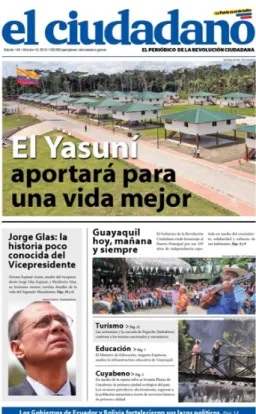
Soon thereafter, Correa constituted a public institution called Ecuador Estratégico or “Strategic Ecuador” to channel private and public oil profits (among other revenues) into spectacular infrastructure projects in contested areas of resource extraction. In 2012, Strategic Ecuador’s investment budget was $115 million. This budget doubled the following year, as its activities eclipsed those of ECORAE. Government propaganda featured Strategic Ecuador’s projects on billboards, television, and state newspapers, as evidence of how oil could expand citizenship rights. By its third year, Strategic Ecuador had planned or completed 1,214
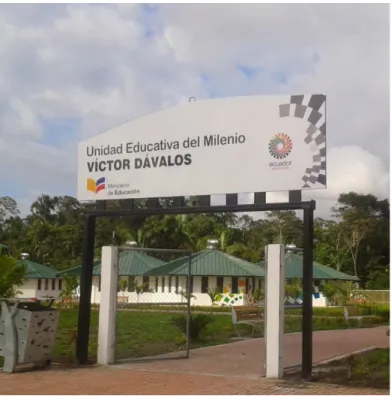
infrastructure projects, concentrated in the northern Amazon, including electrification, internet connections, plumbing, schools, health clinics, and urban-like resettlements called “Millennium Cities” or “Millennium Communities” (Ministerio coordinador de sectores estratégicos 2016).
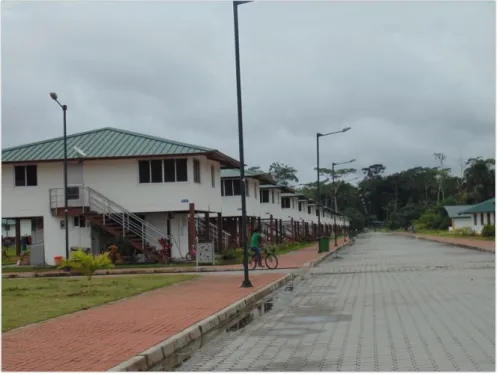
Figure 1. Playas del Cuyabeno, 2013
Correa frequently appeared on television inaugurating or touting infrastructural projects in what he referred to as “the new Amazon.” He promised to transform the Amazon with the construction of 200 Millennium Cities.
Figure 2. Frontpage Article Featuring Playas in State-Owned Newspaper, October 2013 Source: https://issuu.com/elciudadano_ec/docs/ec_143b
The so-called “Amazonian Law” passed in 2018, augmenting distributions of oil rents (as well as mining and hydroelectric rents) to local governments, largely for public services, roads, and telecommunications, and creating a planning entity and two development funds. Under Correa, local governments in the Amazon had demanded a greater share of oil rents for their own infrastructure projects, but Correa had responded that municipal and provincial governments had to express support for extractive industries before he would approve any increase. Yet, in 2017, Correa ceded amid fiscal crisis in order to stir hopes and expectations. As one Petroamazonas executive explained to me, falling oil prices and public spending in strategic territories brought back the specter of “social risk” or unrest. Since 2019, the Amazonian Law has channeled $1 per barrel (set to double in 2020) and 4% of the value of every barrel into local and regional
investment budgets, in effect combining the models of ECORAE and Strategic Ecuador by drawing funds both from a fixed sum per oil barrel and a percentage of oil rents.
Figure 3. Secretary of Hydrocarbons Map of Oil Blocks in the Ecuadorian Amazon, 2012 (Orange Blocks at Auction)
Thus, from 1972 to the present day, the expansion of the oil industry has facilitated the expansion of the urban fabric in the northern Amazon, both as a function of activities related to oil exploration and extraction and as a form of social compensation in indigenous territories. In the next two sections, I discuss influential interpretations of these forms of urban expansion. The first set of interpretations understands urbanization as an imposition of capital flows and a development state on unwilling communities. This narrative, I argue, tells us little of the
experiences and aspirations of those indigenous families and communities that actively leverage territorial rights in order to secure urban development.
Urbanization as Dispossession
In recent years, political ecologists, resource geographers, and other critical researchers have put a spotlight on how the oil industry generates multiple forms of dispossession – i.e., cultural, material, environmental, and territorial – in indigenous territories of the northern Ecuadorian Amazon (e.g., Fiske 2017; Silveira et al. 2017; Vallejo 2014). Many have described urbanization as one of these processes, as it displaces indigenous peoples from hunting territories and traditional habitations (e.g., Kimerling 1990, 882; Rogge 1997, 32; Sawyer 2004, 13). According to this interpretation, ecologically-diverse rainforests are being “expropriated” (Lu and Bilsborrow 2011, 148) by expanding nuclear settlements and roads, in addition to the concurrent expansion of logging, monocrop agriculture, and other market-oriented and
extractivist livelihoods (e.g., Bozigar and Gray 2016; Fadiman 2009; Gray et al. 2008; Murphy 2001).
have labeled oil-funded infrastructures in the Amazon as manifestations of a violent process of “planetary urbanization” (Wilson et al. 2015; Wilson and Bayón 2016). While conventional urban theorists have defined cities in terms of population density (e.g., Orum 2007, 5159), Andy Merrifield (2011; 2013) and Neil Brenner (Brenner et al 2011) encourage researchers to develop urban theory “without an outside,” re-framing urbanization as a process of geographically-expanding frontiers of capital accumulation. “Extended urbanization,” argue Neil Brenner and Christian Schmid (2015, 167), refers to the incorporation of non-urban sites within circuits of capital accumulation at urban centers, as peripheries of capital become “subsumed within and operationalized” (Brenner 2013, 16).
In a sense, Brenner and other planetary urban theorists seem to be re-inventing discussions in urban geography and sociology since the 1970s, regarding urban expansion beyond the metropolis (e.g., Friedmann and Wolff 1982; Scott ed. 2001; Smith 2010[1984]). “[E]very place on earth,” wrote urban geographer Edward Soja (2005), “from the Amazon to Antarctica, is being both globalized and urbanized.”5 In fact, concerns about the “urbanization of
the world” (Wirth 1938, 1) motivated the formation of urban studies in North America and Europe in the early 20th century. “Will the city disappear or will the whole planet turn into a vast
urban hive?” asked Lewis Mumford (1989 [1961], 3). Perhaps the hallmark of planetary
urbanization literature today is its consistent references to sociologist Henri Lefebvre, especially his 1970 book The Urban Revolution, in which Lefebvre associated urbanization directly with the incorporation of new spatial frontiers into circuits of capitalist production and consumption (and only indirectly with population growth and infrastructure). “In this sense,” Lefebvre
5 Similarly, Ash Amin and Nigel Thrift (2002) asserted that the traditional division between the urban and the rural
(2003[1970]) elaborated, “a vacation home, a highway, a supermarket in the countryside are all part of the urban fabric” (3-4).6 Contributors to conversations on planetary urbanization today
argue that state and market actors are no longer merely attempting to overcome geographic constraints to capital accumulation, as Lefebvre hypothesized; rather, they are being remarkably successful at breaking down such barriers.
Researchers across the Amazon have adopted this idiom to characterize urbanization in “remote, isolated hinterland communities” (Kanai 2014, 1082), highlighting investments in intercontinental market connectivity – i.e., “the annihilation of space with time” (Marx 1973)7, as
well as new infrastructures for oil and mining (e.g., Árboleda 2016; Castriota and Tonucci 2018; Kani 2014; Kanai and da Silva Oliveira 2014; Kanai and Schindler 2018). “Capital as subject” (Árboleda and Banoub 2018, 11) is urbanizing the globe, writes Brenner (2013), including “erstwhile ‘wilderness’ landscapes, from the Arctic, the European Alps and the Amazon…” (174).
Many of these researchers have further characterized ‘planetary’ urbanization as a particularly violent expression of what David Harvey (2004) coined “accumulation by dispossession” (e.g., Aulestia et al. 2016; Encalada-Falconí 2016; Kroger 2012; Pieck 2011; Rivero and Cooney 2010; Thaler 2017). Reformulating the thesis that capitalism relies not only
6 Similarly, Manuel Castells (1977) famously critiqued urban sociology itself as an ideology that mystified the
reproduction of capitalist relations of production that defined urban processes.
7 “Capital by its nature drives beyond every spatial barrier. Thus the creation of the physical conditions of
on formal labor relations, but also on violence and theft (also, see Luxemburg 1913; Lenin 1999[1916]; Amir and Pearce 1974), Harvey (2004) emphasizes that capital requires8 geographic
“expansion and spatial reorganization” (63), often materializing as a violent expansion of the urban fabric. As capital continues to seek out frontiers of investment, there is a violent
“equalization” (Smith 1982, 143) or “homogenization” (Brenner and Elden 2009, 368) of space, particularly urban space, on a global scale.9
Such theories of spatial homogenization driven by the requirements of capital
accumulation have enjoyed remarkable degrees of academic and popular acceptance in diverse contexts. By the same token, feminist, critical race, queer, and postcolonial scholarship has questioned these theories for too readily reducing mechanisms of spatial transformation to
economistic laws of capitalist crisis and expansion. Critics have argued that Harvey erases within a “capital-centric” (e.g., Parker 2016; Reddy 2018; Werner et al. 2018) or “masculinist” (Rose 1993) gaze diverse social formations and histories that shape capitalism, the urban fabric, and the broader social landscape. In his book Seventeen Contradictions and the End of Capitalism
(2014), Harvey responds to his critics by likening capitalism to an “economic engine” and a “closed system” that can be studied in isolation from “everything else that is going on” (8) (in this passage, “everything else” refers specifically to racism and gender domination). Elsewhere, Harvey (1996) seems to bracket ‘everything else’ as mere context: “Where does context begin or end?” (239), he asks, rhetorically. It is this bracketing-off of relations that he has deemed
independent from (or the bi-products of) an impersonal capitalist machine, rather than
8 This requirement is due to capital’s tendency towards falling rates of profit. See chapter 13 of Capital volume 3
(1993[1894]) for Marx’s elaboration of a theory of the rate of profit to fall. In Grundrisse (2005[1857]), he would refer to it as the most significant law in political economy, although there are many debates about the validity and mechanisms of Marx’ observation among Marxists today (e.g, Roberts 2016; Shaikh 2016).
9 Urbanist Melvin Webber (1963) referred to the emergence of homogenous urban space on a global scale as the
constitutive components of historical capitalism that has incited frustration among many critical geographers. In 1996, feminist geographer Cindi Katz wrote, ‘‘despite years of feminist,
postcolonial, queer, and antiracist critique, and the rich, different productions of knowledge offered from these quarters, much social theory remains largely impervious to this work’’ (488, cited in Oswin 2018, 3). These critiques have been renewed in relation to the planetary
urbanization thesis (e.g., Derickson 2015, 2018; McLean 2018; Oswin 2018), reinvigorating what geographer Julie Cupples (2019) refers to as a “tense intellectual struggle… between those who engage with feminist and decolonial perspectives and those who are more firmly grounded within Marxist and political economy approaches” (217).
There is no doubt that such a polarization exists in academia today, though such a characterization of two camps obscures the diversity of Marxist traditions. In fact, one might readily derive critiques of planetary urbanization literature from that paradigm’s chosen
godfather, Henri Lefebvre. In many of Lefebvre’s writings from the 1950s through the 1980s, he distinguished between abstract strategies of capital accumulation and the actual, historical production of space. In many of his works, Lefebvre explicitly denied that abstract “spaces of capital” are hegemonic, insisting instead that space is also shaped by cultural perceptions, experiences, and longer social histories, within webs of dialectical relationships (2003[1970], 3; 1991[1974], 4; 1991[1977]; 2004; also, see Goonewardena et al. 2008; Loftus 2018). Taken in its full scope, Lefebvre’s cultural Marxism stands rather apart from the law-like theories of
historical-geographic materialism.10
10 David Harvey (2004) writes that the production of space is “the organization of wholly new territorial divisions of
There is a tendency among researchers to apply theories such as “planetary urbanization” or “accumulation by dispossession” in diverse contexts, without accounting for how distinct social-historical contexts challenge or transform theory. Edward Said (1983, 2001) explored this tendency in terms of Georg Lukacs’ theory of commodification, illustrating how theory itself becomes commodified. He demonstrated that, as theories ‘travel’ from their points of origin to other social contexts, social analysts too often reify them or awkwardly ‘apply’ them to disparate contexts. Literary critic Barbara Christian (1988) gestures towards incentives within academia that have shaped these trends in terms of a “race for theory,” or the tendency to write about theory in ways that are detached from textual analysis (for similar critiques, see Cusset 2008; Gordon 2014; Graeber 2001, 30)11. Likewise, theories of historical-geographic materialism
rooted in the experiences of the industrialized world often fail to ‘stretch’ Marxism to the colonial context, as Frantz Fanon (2007[1963], 40) insisted, accounting for how and why social relations of production and spatial transformations have articulated in particular ways in
(formerly) colonized countries.
In this dissertation, I explore the struggles of subsistence indigenous peoples to bring urban space into the Amazon, at the far margins of market society. How might we account for demands for urbanization where it is not imposed by capital or a capitalist state; where
urbanization does not facilitate the production and accumulation of capital – that is, where it makes little or no strategic sense from the point of view of Capital? The planetary urbanization thesis does not offer us guideposts in such places.
11 “Critics are no longer concerned with literature,” Christian writes, “but with other critics’ texts, for the critic
In the next section, I address influential research that has sought to account for urban aspirations in these peripheries in terms of the power of development discourse to “interpellate” (Althusser 2014[1970]) or create new subjects and new desires. These discussions are largely rooted in French post-structural and posthuman theorizations of the subject, as a placeholder or effect of power, readily transformed by discourse (Althusser 2014[1970]; Deleuze and Guattari 1988; Derrida 2001; Foucault 1982). In so doing, they place little import on history, the legacies of colonial capitalism, and the longue durée of aspirations for ethnic inclusion in this region.
Urbanization as a Function of Desire
A handful of studies acknowledge that indigenous communities in the northern Amazon have demanded urban development in exchange for their consent to oil extraction. They have explained that the post-neoliberal state produced these demands, transforming indigenous subjects and their desires. On the one hand, researchers inspired in the psychoanalytic Marxism of Jaques Lacan, Louis Althusser, and Slavoj Žižek have described these desires as a function of capitalist ideologies. On the other hand, Foucauldian researchers have accounted for them as effects of development discourse. By explaining urban aspirations as an effect of contemporary representations, both approaches implicitly dismiss the weight of history in the formation of human perceptions, norms, practices, and aspirations (i.e., subjectivities).
Marxists have explored and fleshed out Marx’ and Engels’ sparse writings on “ideology”12 to
account for contradictions among workers’ material interests and their lack of revolutionary practice. Engels (1893) characterized ideology as the root of “false consciousness” or a mode of thought in which the historical development of the economy and that of the state, law, and other institutions erroneously seem independent. Most importantly, he argued, ideology mystifies class relations, such that the working class misrecognizes the origins of class inequalities. While skeptics have questioned as reductive Engel’s argument that social relations of production determine modes of thought, countless Marxists have re-fashioned the concept (e.g., Adorno 2005[1946]; Marcuse 1966[1955]; Eagleton 2014). For his part, philosopher Luis Althusser (2006[1970]) attempted to universalize ideology within the human psyche, describing it in broad terms as the “imaginary relationship of individuals to their real conditions of existence” (181) – indeed, as an integral part of subject formation (also, see Žižek 1994). All subjects, he argued, are interpellated or “hailed” into existence by ideology. Sociologist Stuart Hall (1996) offered to de-link ideology from economic determinism by identifying it within complex, shifting cultural formations. Amid such conceptual diversity, ideology has, nonetheless, continually referred to mental frameworks – i.e., languages, representations, modes of thought – that individuals use to make either erroneous or incomplete sense of economic inequalities, alienation, and exploitation.
In the northern Amazon, several researchers have attempted to account for the pursuit of urban futures among subsistence hunters and farmers in terms of their presumed lack of
awareness of their true interests and collective political potential. In the most widely-read account, geographers Japhy Wilson and Manuel Bayón (2018a; 2018b) of CENEDET
12 In A Critique of the German Ideology (1970[1932]), Marx and Engels argued that the class that holds the means of
characterized the Millennium Cities as representations of what Žižek calls a “fantasy of origins,” illusions that help people to repress and cope with the violence of capitalist development. Wilson and Bayón suggest that indigenous peoples pursuing urban futures suffer from a “conservative fantasy of idyllic small town USA” (2018a, 239). Similarly, cultural analyst Alejandra Espinosa Andrade (2017) argues that indigenous peoples who accept urban resettlement have been “interpellated into participation… through a discourse of progress that they find hard to refuse” (320) – that is, she writes, the very “desire for progress [was] imposed from the outside” (322).
Escobar, Cielo et al. (2016) argue that discourses on urban development have “seduced” indigenous communities, producing new “forms of subjectivity” (284).
These Marxist and Foucauldian researchers often conflate the circulation of (ideological) discourses by powerful actors (e.g., the state) with subjective commitments to those discourses (see Lyall et all 2018). As theorist Lawrence Grossberg (2010) writes, much Foucauldian research erroneously equates “dreams of power and regulation with the realities of power, intention with effect” (320, endnote 17).13 Researchers in the northern Amazon too lightly hop
from the fact of a discourse to the presumption of interpellation. In doing so, they evade questions related to the regional-historical construction and durability of subjectivities.14 The
weight of individual and shared history becomes inscribed in enduring perceptions, practices, and norms – what anthropologists have long defined simply as “culture” (Kroeber & Kluckholn 1952, 357).15 As geographer Matthew Hannah (2018) rightly argues, subjectivities have a
“weight and durability” – i.e., a culture – that cannot be “interpellated with every passing encounter or hailing” (4).
13 Likewise, Henri Lefebvre once protested that Foucault himself “never… bridges the gap between the theoretical
(epistemological) realm and the practical one, between mental and social, between the space of the philosophers and the space of people who deal with material things” (1974[1991], 4). O’Malley et al. (1997, 504) point out that Foucault’s “lack of attention to social relations occurs by epistemological design, not by accident.” While Foucault never actually claimed to write social histories or ethnographies, but rather accounts of modes of thought (Agnew 2014; for critiques of critical realist appropriations of Foucault, see Rabinow and Rose 2003; Rose 1999; Rose et al 2006; Lemke 2002), researchers working on urbanization in the Amazon do assert that state development discourses produce subjectivities. Grossberg (2010) writes, “I often have serious problems with much of this post-Foucauldian work on governmentality, not only because it tends to find it everywhere it looks, but even more because it
constructs a seamless web between capitalism… politics, and subjectivity. It ignores the historical specificity of such practices” (320, endnote 17).
14 Marxist historian E.P. Thompson (1978) famously decried the displacement of empirical-historical research on
social experience by interest in discursive formations in his 200+ page diatribe against Althusser.
15 “Culture,” stated Kroeber and Kluckholn (1952), “consists of patterns, explicit and implicit, of and for behavior
In this dissertation, I develop an understanding of urban aspiration as something akin to what French philosopher and anthropologist Pierre Bourdieu16 referred to as a structured
practice, i.e., socially-inherited habits of perception and practice that are “durably embedded in things and in bodies,” as opposed to “simple mental representation, a fantasy (‘ideas in people’s heads’), an ideology” (41).17 The people I interviewed for this dissertation were born into a
social world in which the ability to access urban worlds already had manifold implications in terms of social- and self-respect. The recent circulation of urban ideology or development discourse was not needed to cultivate perceptions of urban spaces as centers and non-urban spaces (and subjects) as peripheries. Yet, in this dissertation, I also diverge from Bourdieu. Some Playas residents express a critical awareness of these urban-centric norms. They do not pursue urban futures out of blind habit, but as a self-aware strategy to mitigate ethnic subordination for them and their children.
Whereas descriptions of the interpellation of subjectivities by urban development
discourses fail to address whether or not history holds any relevance in the formation of subjects and their aspirations, the case study in this dissertation demonstrates that, in fact, they do. In the next section, I discuss relevant theories regarding the enduring history of colonialization on subjectivities and spatial aspirations.
16 Despite his critics (e.g., Burawoy 2012), Bourdieu did not dismiss the human capacity to develop critical
awareness or even change their practices; yet, his objective was to explain why people tended to reproduce social norms in practice, even – in some cases – in spite of their critical awareness or desire to act otherwise.
17 Anthropologist Marcel Mauss (1979[1935]) qualified the human capacity for pre-conscious learning as habitus, a
Manichean Space
Throughout the 20th century, Marxists in Latin America explored the persistent social
production of territories of ethnic difference,18 as the basis of extractivist forms of capitalism in
the region. In the 1960s and 1970s, anthropologists and sociologists inspired in Dependency Theory19 closely documented the social production of indigenous and black regions as racially-
and culturally-inferior for the purpose of labor exploitation and resource extraction (e.g., Cotler 1967; González Casanova 1965; Haven and Flinn 1970; Stavenhagen, 1965). According to this literature on “internal colonialism,” urban centers became sites of material and symbolic accumulation in relation to the material and symbolic production of peripheries. Moreover, ethnographers in this tradition documented how intersectional or “combined exploitation” (González Casanova 2006[1969], 194) shaped self-perceptions and aspirations among exploited
18 In the 16th century, Europeans characterized Latin American conquest not as an encounter of civilizations (with
distinct languages, religions, and histories), but as Civilization’s discovery of a new, savage world. Invaders responded to the challenge that the Americas represented to the European conception of self (at the center of the universe) by characterizing peoples of the Americas as objects of discovery, external to civilization. Conquest involved a mixing of European males with native populations, generating perceptions of what philosopher Nelson Maldonado-Torres (2016) calls “subontological difference” or difference in “degrees of being human” (69). A semi-fluid caste system emerged in which individuals who could claim greater European descent could sustain social, political, and economic advantages. In the early 19th century, processes of formal political independence were led by criollo or white-mestizo elites (with the exception of Haitian independence), who sustained colonial-like social, political, and economic structures, along with a material and symbolic division between European-descendent elites, on the one hand, and black and indigenous populations, on the other hand. “That is the question,” wrote the
Argentinian intellectual Domingo Faustino Sarmiento (2003[1845]) following Argentina’s independence, “to be savages or not” (35). Personhood continued to be tied to a racial and cultural proximity to Europe and, increasingly, to the politically- and economically-ascendant figure of the United States (Martí 1986[1891]). In Peru, for example, José Mariátegui (1928) famously rejected the commonplace notion that the Peruvian economy was semi-feudal, instead arguing that the exploitation of indigenous land and labor had long fed capitalist markets in industrial centers.
19 Economist André Gunder Frank (1969) and other ‘dependency theorists’ (Cockcroft et al. 1972; Cueva 1974)
described the uneven development of the “metropolis” and its “satellites,” both at the scale of international trade and
populations. For example, anthropologist Pablo González Casanova (1965) showed how indigenous peoples in Mexico sought to mitigate their subordination through strategies of education, behavioral change, migration, and cultural expressions – a host of imitations or performances that sociologist Bolívar Echeveria (2010) would later coin blanquitud or
“whiteness.” This literature on the aspirations of marginalized subjects drew from writings on the subjective impacts of colonialism – i.e., “the colonization of souls” (Mirés 1987) – by Aimé Césaire (1972[1950]), Albert Memmi (1990[1946]), and Frantz Fanon (1952; 1959; 1963; 1967). In this section, I discuss the particular relevance of Fanon’s writings on the symbolic power of the metropoli.
In the 1950s and 1960s, social theorist, militant, and psychiatrist Frantz Fanon wrote of the dehumanizing effects of colonization on colonizer and colonized, and of the processes and perils of institutional, social, and subjective decolonization. Fanon offered a stark vision of the paralyzing impacts of colonialism on colonizers and colonized, who find themselves trapped within fixed identities that become inherited through language, segregation, violence, and subtle gestures. Fanon famously described the colonialized world as “a world divided into
compartments… [into] native quarters and European quarters, of schools for natives and schools for Europeans…” (2004[1963], 37). He elaborated the symbolic effects of these divisions in the following passage of The Wretched of the Earth:
Theorists Stefan Kipfer (2007, 2018) and Ato Sekyi-Otu (1996) have highlighted these spatial dimensions of Fanon’s writings, but few Fanon scholars have failed to observe the explicitly spatial nature of his analysis. Fanon famously described colonialism was a process of spatial and symbolic compartmentalization.
Fanon also examined the role of segregation in shaping the fraught aspirations of the colonized for social recognition (I say ‘fraught’ because, in a colonial society, Fanon argued, authentic recognition is not possible). He argued that “[t]he look that the native turns on the settler’s town is a look of lust… And this the settler knows very well; when their glances meet he ascertains bitterly, always on the defensive. ‘They want to take our place’” (2004[1963], 39). The native, he wrote, was born into a world in which the colonized had to aspire to assume the position of the colonizer.20 Writing of dominant social aspirations in his native Martinique,
Fanon (2008[1952]) observed, “All colonized people… position themselves in relation to the… metropolitan culture. The more the colonized has assimilated the cultural values of the
metropolis, the more he will have escaped the bush” (2). Colonized peoples sought to mitigate their subordination by seeking out a place in urban centers. Such aspirations, Fanon emphasized, did not reflect a pathology or psychosis – i.e., an internally-derived inferiority complex, but rather they were imposed by the force of violence and social stigmatization. In other words, the colonized were “made to feel inferior” (2008[1952], emphasis mine) by disparate lines of force, from segregation to material inequalities, language, gestures, and brute violence.
In his foreword to The Wretched of the Earth, postcolonial literary critic Homi Bhabha (1994) critiqued Fanon for producing Manichean or starkly binary characterizations of racial
20 Similarly, in his lectures on the state, Bourdieu (2014) argued that modern state formation involves the production
identities in a postcolonial world better characterized by hybrid identities and spaces, with their own, shifting uniqueness that necessarily overcomes the histories that produced them (also, see Edward Soja’s (2008) theorization of “thirdspace”). Fanon scholars have responded that Fanon also believed in – and celebrated – the innate plasticity of human identity and transforming, which was precisely why he was so concerned with the colonial institutions and mechanisms that attempted to trap social experience within fixed, binary identities (Gibson 1999; 2007; Gordon 2015; Reyes 2012). That is, Fanon’s critique was centered on “the colonized economy, thinking, and institutions” (2004[1963], 120) that shaped the experience of social identities and spaces as if they were fixed and hierarchical, restricted within rigid compartments.21
This dissertation is very much about the social life of an abstract binary – its creation, renewal, changing signifiers, and effects on human aspirations. White/non-white,
civilized/uncivilized, educated/uneducated, and urban/non-urban are social inventions in the northern Amazon – abstract categories or reifications that do not reflect the tremendous social diversity of the region. Nonetheless, they shape shared notions of dignity and social status. The people whose perspectives I explore in this dissertation do not always see through a binary lens. For example, in one moment, an informant in Cuyabeno might refer to merchants, missionaries, tourists, or state officials ‘from the outside’ as distinct social groups or they might describe them as mestizo (an identity that merges white and indigenous ancestries into what Bhabha (1997) refers to as a hybrid or “liminal” position between colonizer and colonized); yet, in other moments of conflict, in which power is at play and symbolic status is in question, people might refer to all of these diverse actors as ‘white people’ or simply ‘whites.’ By the same token, these
21 I am very grateful to Dr. Alvaro Reyes. Out of his seminar “Frantz Fanon: Racialized Spaces and Proper Places”
binaries tend to mediate social hierarchies within communities. As we will see, a Kichwa man in Cuyabeno might refer to himself and his wife as indigenous people of distinct ethno-linguistic lineages in some instances, but in moments of conflict claim white ancestry and refer to his wife as a ‘jívaro’ or savage. As we will see in many instances throughout this dissertation, racialized, binary modes of perception generally become triggered and expressed when people are either claiming superiority or questioning it. The social and historical diversity of the northern Amazon is remarkable, but I am concerned with the situations in which people experience a world divided in two and with how social binaries of civilized and savage become renewed in distinct forms (i.e., educated/uneducated; urban/non-urban).
The people whose perspectives I explore in this dissertation are often critical of this Manicheanism, but recognize it as a shared, social fact to which they must respond in order to mitigate social subordination. In Playas, I have heard criticisms of people in the community that claim ancestry from Quito: “They think they’re white… They want to appear as if they were more from the outside.” Such comments reflect both a critique and a recognition of Manichean perceptions of urban space – ‘on the outside’ – as both ‘white’ and status-granting.22 Similarly,
residents of neighboring communities often critique Playas residents for their resettlement by saying, “they think they’re white” – though each of these neighboring communities have plans to lobby the state for similar settlements. In this context, Manicheanism reflects a ‘domination without hegemony’ (Guha 1977; Beasley-Murray 2010) that I will trace back to indigenous relations with rubber merchants in the 19th century.
That is, as I detail in Chapter 3, Spanish colonization in this region violently imposed Manichean experiences and, in turn, perceptions of a social space divided between civilized and
22 As Fanonian scholar Alvaro Reyes (2012) writes, there is a “certain circularity… between the classificatory
savage. Subsequently, white actors have periodically modified the trappings of civilization (e.g., Western goods, education, urbanism), in the very process renewing white authority. During the rubber boom, the social world was divided between those indigenous families that accessed Western goods from white merchants and ‘savages’ who did not. With the appearance of missionary schools, the social world was divided between those who could access educational credentials and those who could not. With partial territorial and market integration over
subsequent decades, the social world was divided between those who accessed urban spaces and labor markets and those who did not. In each moment, market, religious, and state authorities transformed and renewed experiences of a social space divided in two.
In Playas, a teenager named Marco Noteno laments that his extended family and peers grew up with “broken thoughts, that the indigenous were lesser than the mestizos, than the whites – that we speak our language, that we are ugly.” Despite his critical analysis of ethnic
subordination, nonetheless today Marco is pursuing education as a pathway off of the farm and into the formal, urban labor market ‘on the outside.’ For many like Marco in this region, the symbolic significance of urban space is a social fact, despite their own critiques of how or why that came to be. Urban life attracts social recognition or respect and urban space is a medium for accessing institutions that consecrate status (i.e., modern schools and labor markets). Over the course of this dissertation, I describe the experience of a Manichean, hierarchical division of social space across distinct historical conjunctures. The legacies of ethnic domination have shaped spatial aspirations in Playas, as residents attempt to mitigate subordination either by migrating into cities or bringing urban space into the Amazon.
global South has witnessed the consolidation of national elites, as well as the rise of political parties and multicultural governance budgets, programs, and institutions that claim to respond to aspirations for inclusion among marginalized populations. Politicians express interest in the frustrations of subaltern people who seek inclusion, for example, into urban spaces, and offer promises and partial solutions. In turn, frustrations become channeled into the realm of electoral politics or domesticated in everyday, often individual, family, or community pursuits for
education and development projects. Yet, in the 1960s, Fanon did anticipate that during and, potentially, following decolonization, domestic elites would try to reaffirm the economic, institutional, and cultural structures of colonialism, including spatial segregation, and
re-consolidate the spaces of elites as centers of personhood, national belonging, and prestige. If they were successful, he worried, then colonized subjects would continue to experience a world “divided in two” (Fanon 2004[1963], 3). Spaces would continue to be racialized through segregation, language, and pre-conscious learning (e.g., everyday gestures, glances, body language)23 that “walled in” (1986[1967], 89) colonizers and colonized.
In this section, I have briefly discussed Fanon’s ideas on the enduring effects of colonialism on the spatial aspirations of peripheralized subjects. In the 1960s and 1970s, the writings of Frantz Fanon were highly-influential across Latin America and were taken up in North American by anti-colonial Marxists, such as the Black Panthers (e.g., Carmichael and Hamilton 1967), and among radical academics to explain the exploitation of Black (e.g., Blauner 1969) and Chicano (e.g., Barrera et al. 1972) communities. Today, Fanon has inspired many contemporary political and intellectual traditions, from black radicalism24 (Moten 200; Sexton
23 “[I]t is precisely this absence of will—this offhand manner; this casualness; and the ease with which they classify