ESSAYS ON THE POLICY RESPONSES TO LABOR MARKET RISKS BORNE BY WORKERS
Dillan Bono-Lunn
A dissertation submitted to the faculty at the University of North Carolina at Chapel Hill in partial fulfillment of the requirements for the degree of Doctor of Philosophy in the Department of Public Policy.
Chapel Hill 2020
ABSTRACT
Dillan Bono-Lunn: Essays on the Policy Responses to Labor Market Risks Borne by Workers (Under the direction of Jeremy G. Moulton)
This dissertation explores the extent to which policy alleviates or exacerbates labor market risks borne by workers looking at three different policies: Right-to-Work (RTW) laws, disability insurance, and state-level minimum wages.
My first chapter examines impact of state RTW laws using Current Population Survey (CPS) data. Employing a state fixed effects model and a Synthetic Control design focusing on Wisconsin’s RTW legislation, I find that RTW laws are associated with sizeable increases in public sector free riding by union covered workers and considerable decreases in private sector union membership and coverage. RTW laws also substantially decrease private sector employer health insurance contributions and
marginally reduce private sector wages. Given the role that union decline has had increasing worker precarity, it appears that RTW laws exacerbate labor market risks for workers.
My second chapter examines the impacts of changes to disability insurance eligibility in the United Kingdom using an individual fixed effects model and data from the United Kingdom Household Longitudinal Study (UKHLS) and the Department of Work and Pensions (DWP). Increased reassessment using more stringent eligibility criteria at the local level is associated with a higher probability of
ACKNOWLEDGEMENTS
This dissertation represents several years of hard work that would not have been possible without the continued support of others in both my professional and personal life. I am indebted to the steadfast support and mentoring from my advisor, Jeremy Moulton. I would remiss if I did not acknowledge Daniel Gitterman for his advice and mentorship and for his advocating for various teaching and research opportunities for me.
I also want to thank my other dissertation committee members Christine Durrance, Arne Kalleberg, and Carolyn Heinnrich. Each have graciously given me their time and expertise in order to strengthen this dissertation and ensure my continued professional success after my doctoral degree. I am thankful to many other staff and faculty at UNC who have assisted me in the past seven years.
My achievements would not have been possible without my family and friends. Thank you to my husband, Peter Lunn, who encouraged me to pursue a PhD and moved to the United States so that I could begin my studies; who undertook the majority of the household chores and care for our daughter, Audrey, while also working full-time himself; and who, with Audrey, our soon-to-be-born son, and our dog, Pippa, enriches my life immeasurably. Thank you to my parents, Scott and Laura Bono, my sister, Ashley Bono, and my brother, Jackson Bono, who instilled in me the value of education and the belief that a society should protect and improve the lives of its least well-off.
I am thankful for the friendships made during my time at UNC and wish to specifically mention Emily Nwakpuda, Adria Molotsky, Nicole Ross, Mary Edwards, Paige Clayton, Paul Treacy, Aspacia Stafford, Averi Chakrabarti, and Yuna Kim. Thanks also to Bobby Newell and Paul Sobin for helping me navigate these years while maintaining a sense of presence and gratitude.
• Chapter 1: I would like to thank UNC faculty and graduate students, participants at SEA and CREED, staff at the W.E. Upjohn Institute, and faculty at Elon University for their comments on an earlier version of this paper.
• Chapter 2: I would like to thank participants at APPAM, SEA, AEA, and UNC Public Policy’s Social Policy Research Group for their feedback on an earlier version of this paper. I also wish to acknowledge the University of Essex and the UK Data Service for its maintenance and provision of Special License Access of its Understanding Society dataset.
TABLE OF CONTENTS
LIST OF TABLES ... ix
LIST OF FIGURES ... xii
LIST OF ABBREVIATIONS ... xiv
INTRODUCTION ... 1
CHAPTER 1: THE RIGHT-TO-WORK OR THE RIGHT-TO-FREE RIDE? THE IMPACTS OF U.S. RIGHT-TO-WORK LAWS ON WAGES, FREE RIDING, AND UNIONIZATION... 4
The Theorized Impacts of Right-to-Work Legislation ... 15
Data ... 17
Methods ... 20
Fixed Effects Results ... 27
Synthetic Control Results: Wisconsin ... 34
Discussion ... 42
REFERENCES ... 45
CHAPTER 2: THE LABOR MARKET IMPACT OF STRICTER DISABILITY INSURANCE ELIGIBILITY: EVIDENCE FROM THE UK WORK CAPABILITY ASSESSMENT ... 67
Literature Review ... 68
Incapacity Benefit (IB), the Work Capability Assessment (WCA), and Employment and Support Allowance (ESA) ... 76
Data ... 83
Methods ... 87
Results ... 88
Discussion ... 92
CHAPTER 3: STATE MINIMUM WAGE INCREASES AND
SELF-EMPLOYMENT: ANALYSIS OF HETEROGENEOUS TREATMENT
EFFECTS ACROSS OCCUPATIONS ... 107
Literature Review ... 108
Hypotheses ... 113
Methods ... 115
Data ... 118
Results ... 119
Discussion ... 123
REFERENCES ... 125
APPENDIX 1.1: SUPPLEMENTAL TABLES FOR FIXED EFFECTS MODELS ... 138
APPENDIX 1.2: SUPPELEMENTAL FIGURES FOR SYNTHETIC CONTROL METHOD ... 141
APPENDIX 1.3: DIFFERENCE-IN-DIFFERENCE ROBUSTNESS CHECKS ... 159
APPENDIX 2.1: SUPPLEMENTAL TABLES ... 161
APPENDIX 3.1: OCCUPATIONS, SCHEDULING FLEXIBILITY, AND WAGE QUARTILE ... 164
APPENDIX 3.2: DIFFERENCE-IN-DIFFERENCE MODELS WITH LOGGED MINIMUM WAGE LAGGED ONE YEAR ... 172
LIST OF TABLES
Table 1.1: Unweighted Descriptive Statistics ... 51
Table 1.2: Weighted Descriptive Statistics ... 52
Table 1.3: Rate of Union Coverage and Union Membership in Non-RTW States and RTW States ... 53
Table 1.4: Estimated Impact of RTW Laws on Logged Wages ... 54
Table 1.5: Estimated Impact of RTW Laws on Logged Employer Health Insurance Contributions ... 55
Table 1.6: Estimated Impact of RTW Laws on Logged Aggregate Union Outcomes ... 56
Table 1.7: Predictor Means for Wisconsin's Union Membership and Coverage (Public Sector)... 57
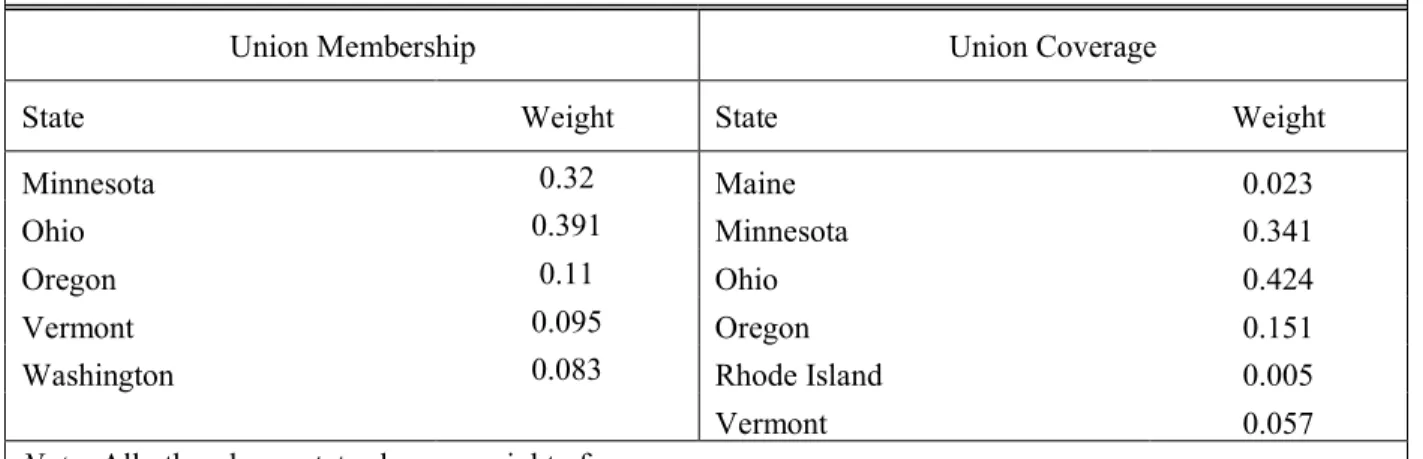
Table 1.8: State Weights for Synthetic Wisconsin: Union Membership & Union Coverage (Public Sector) ... 58
Table 1.9: Predictor Means for Wisconsin's Union Membership and Coverage (Private Sector) ... 62
Table 1.10: State Weights for Synthetic Wisconsin: Union Membership & Union Coverage (Private Sector) ... 63
Table 2.1: Weekly Benefit Rates, 2010/11 for single claimants aged 25 and over ... 98
Table 2.2: Expected versus Actual Outcomes of IB Reassessment... 99
Table 2.3: National Rates of IB Reassessment and ESA Outcomes ... 100
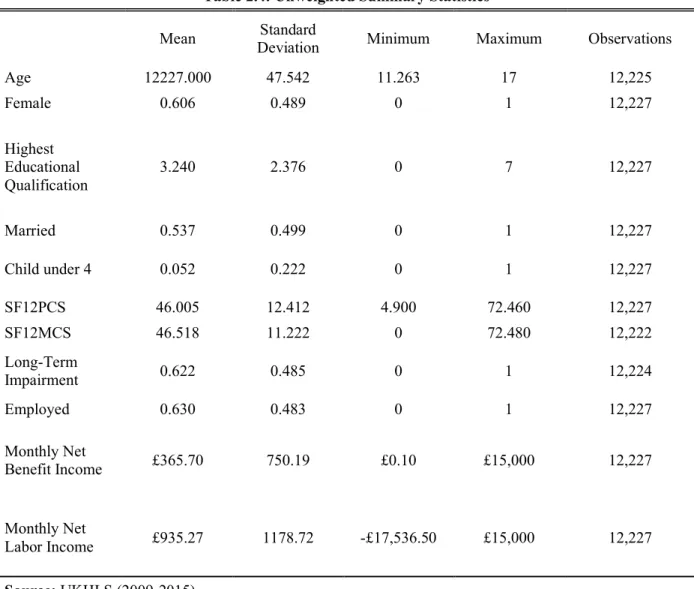
Table 2.4: Unweighted Summary Statistics ... 101
Table 2.5: Weighted Summary Statistics ... 102
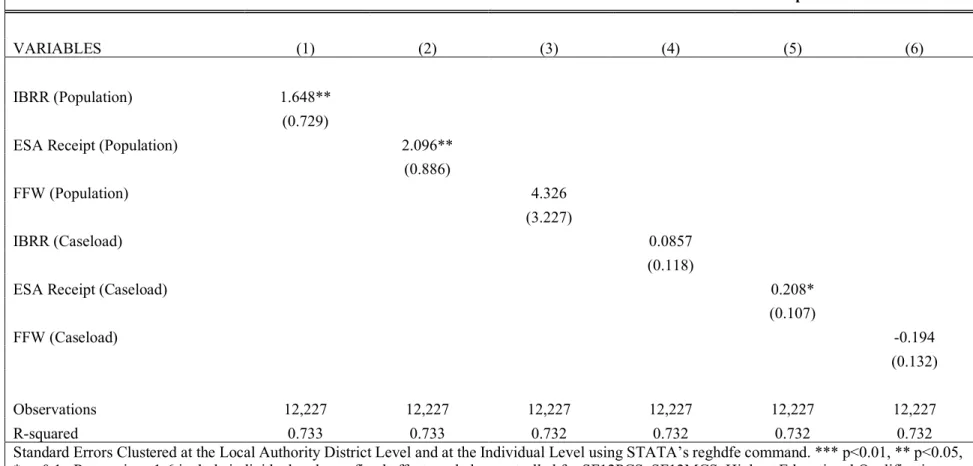
Table 2.6: The Effects of LAD-Level IB Reassessment Rates on Individual ESA Rate of Receipt ... 103
Table 2.7: The Effects of LAD-Level IB Reassessment Rates on Logged Net Monthly Benefit Income ... 104
Table 2.8: Effect of Work-Related Activity Group and Support Group Assignment on Benefit Outcomes ... 105
Table 2.9: Effect of Lagged Work-Related Activity Group and Support Group Assignment on Benefit Outcomes ... 106
Table 3.1: Summary Statistics... 130
Table 3.2: P(Self-Employed) Difference in Difference (DD) Stratified by Wage Quartile and Flexible Occupations... 131
Table 3.3: P(Self-Employed) Triple Difference (DDD) Stratified by Wage ... 132
Table 3.5: P(Self-Employed) Quadruple Difference (DDDD) ... 134
Table 3.6: P(Self-Employed) Quadruple Difference (DDD) Stratified by Gender ... 135
Table 3.7: P(Self-Employed) Quadruple Difference (DDD) Stratified by Age ... 136
Table 3.8: P(Self-Employed) Quadruple Difference (DDD) Stratified by Education ... 137
Table A-1.1: Estimated Impact of RTW Laws on Logged Wages, All Covariates ... 138
Table A-1.2: Estimated Impact of Lagged RTW Laws on Logged Aggregate Outcomes ... 139
Table A-1.3: Estimated Impact of RTW Laws on Individuals' Probability to Free Ride, Be a Union Member, and be Covered by a Union Contract ... 140
Table A-1.4: Difference-in-Difference for Wisconsin's Public Sector ... 159
Table A-1.5: Difference-in-Difference for Wisconsin's Private Sector ... 160
Table A-2.1: The Effects of LAD-Level IB Reassessment Rates on Individual ESA Rate of Receipt (Table 7 with Covariates) ... 161
Table A-2.2:The Effects of LAD-Level IB Reassessment Rates on the Individual Likelihood of Employment ... 162
Table A-2.3: The Effects of LAD-Level IB Reassessment Rates on Individual Likelihood of Non-Participation in the Labor Force... 163
Table A-3.1: Schema of Occupations by Scheduling Flexibility and Wage Quartile (Counts in Parentheses) ... 164
Table A-3.2: P(Self-Employed) Difference in Difference (DD) Stratified by Wage Quartile and Flexible Occupations Using Logged Minimum Wage Lagged One Year ... 172
Table A-3.3: P(Self-Employed) Triple Difference (DDD) Stratified by Wage Using Logged Minimum Wage Lagged One Year ... 173
Table A-3.4: P(Self-Employed) Triple Difference (DDD) Stratified by Flexible Occupations Using Logged Minimum Wage Lagged One Year ... 174
Table A-3.5: P(Self-Employed) Quadruple Difference (DDDD) Using Logged Minimum Wage Lagged One Year ... 175
Table A-3.6: P(Self-Employed) Quadruple Difference (DDD) Stratified by Gender Using Logged Minimum Wage Lagged One Year ... 176
Table A-3.7: P(Self-Employed) Quadruple Difference (DDD) Stratified by Age Using Logged Minimum Wage Lagged One Year ... 177
Using Logged Real Minimum Wage ... 179 Table A-3.10: P(Self-Employed) Triple Difference (DDD) Stratified by Flexible
Occupations Using Logged Real Minimum Wage ... 180 Table A-3.11: P(Self-Employed) Quadruple Difference (DDD) Stratified by
Gender Using Logged Real Minimum Wage ... 181 Table A-3.12: P(Self-Employed) Quadruple Difference (DDD) Stratified by
Gender Using Logged Real Minimum Wage ... 182 Table A-3.13: P(Self-Employed) Quadruple Difference (DDD) Stratified by Age
Using Logged Real Minimum Wage ... 183 Table A-3.14: P(Self-Employed) Quadruple Difference (DDD) Stratified by
LIST OF FIGURES
Figure 1.1: U.S. Right-to-Work States, with Enactment Years ... 49
Figure 1.2: Schema of Union Coverage vs. Union Membership ... 50
Figure 1.3: Synthetic Control Results for Wisconsin’s Public Sector Unionization Rate ... 58
Figure 1.4: Synthetic Control Results for Wisconsin’s Public Sector Union Coverage Rate ... 59
Figure 1.5: Placebo Testing (Wisconsin’s Public Sector Unionization Rate) ... 60
Figure 1.6 Placebo Testing (Wisconsin’s Public Sector Union Coverage Rate)... 61
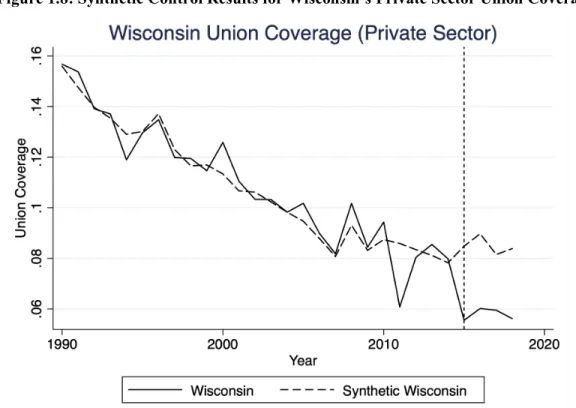
Figure 1.7: Synthetic Control Results for Wisconsin’s Private Sector Unionization Rate ... 63
Figure 1.8: Synthetic Control Results for Wisconsin’s Private Sector Union Coverage Rate ... 64
Figure 1.9: Placebo Testing (Wisconsin’s Private Sector Unionization Rate) ... 65
Figure 1.10: Placebo Testing (Wisconsin’s Private Sector Union Coverage Rate)... 66
Figure 2.1: Transition from Old Benefits to Employment and Support Allowance (ESA). ... 98
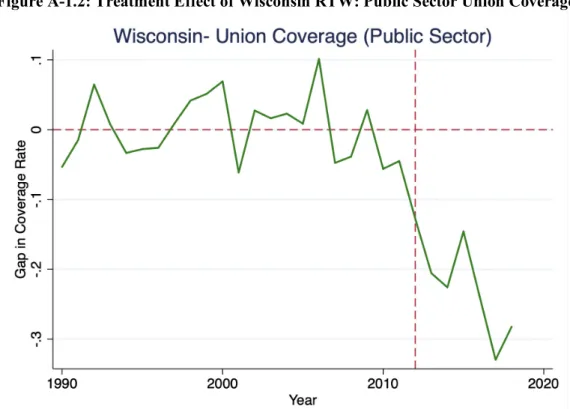
Figure A-1.1: Treatment Effect of Wisconsin RTW: Public Sector Unionization ... 141
Figure A-1.2: Treatment Effect of Wisconsin RTW: Public Sector Union Coverage ... 142
Figure A-1.3: Comparison of Trends in Public Sector Unionization: Wisconsin vs. Ohio ... 143
Figure A-1.4: Comparison of Trends in Public Sector Union Coverage: Wisconsin vs. Ohio ... 144
Figure A-1.5: Treatment Effect of Wisconsin RTW: Private Sector Unionization ... 145
Figure A-1.6: Treatment Effect of Wisconsin RTW: Private Sector Union Coverage... 146
Figure A-1.7: Placebo Testing (Wisconsin’s Public Sector Unionization Rate): RMSPE ... 147
Figure A-1.8: Placebo Testing (Wisconsin’s Public Sector Union Coverage Rate): RMSPE ... 148
Figure A-1.9: Placebo Testing (Wisconsin’s Private Sector Unionization Rate): RMSPE ... 149
Figure A-1.10: Placebo Testing (Wisconsin’s Private Sector Union Coverage Rate)... 150
Figure A-1.11: In-Time Placebo Testing (Wisconsin’s Public Sector Unionization Rate) ... 151
Figure A-1.12: In-Time Placebo Testing (Wisconsin’s Public Sector Union Coverage Rate) ... 152
Figure A-1.13: In-Time Placebo Testing (Wisconsin’s Private Sector Unionization Rate) ... 153
Figure A-14: In-Time Placebo Testing (Wisconsin’s Private Sector Union Coverage Rate) ... 154
LIST OF ABBREVIATIONS
ACS American Community Survey
ASEC Annual Social and Economic Supplement, or March CPS
CPI Consumer Price Index
CPS Current Population Survey
CQFW Credit and Qualifications Framework for Wales
CWS Contingent Worker Survey
DD Difference-in-Difference
DDD Triple Difference
DDDD Quadruple Difference
DWP Department of Work and Pensions
ESA Employment and Support Allowance
FFW Fit For Work
GCSE General Certificate of Secondary Education
GOR Government Office Region
GVA Gross Value Added
IB Incapacity Benefit
IBRR Incapacity Benefit Reassessment Rate IPUMS Integrated Public Use Microdata Series
IS Income Support
JSA Job Seeker’s Allowance
LAD Local Authority District
NI National Insurance
RMSPE Root Mean Squared Prediction Error RQF Regulated Qualifications Framework
RTW Right-to-Work
SCQF Scottish Credit and Qualifications Framework
SDA Severe Disablement Allowance
SF12MCS SF12 Mental Component Survey SF12PCS SF12 Physical Component Survey
UK United Kingdom
UKHLS U.K. Household Longitudinal Study (Understanding Society)
US United States
WCA Work Capability Assessment
INTRODUCTION
This dissertation explores the extent to which policy alleviates or exacerbates labor market risks
borne by workers looking at three very different policies in different contexts: Right-to-Work laws,
disability insurance (specifically tightening disability insurance eligibility in the United Kingdom as part
of a broader active labor market policy mix), and state-level minimum wages.
Chapter 1 uses recent policy variation to identify the impact of state RTW laws on wages,
benefits, free riding, union membership and union coverage among private and public sector workers,
using Current Population Survey (CPS) data. Using CPS Annual Social and Economic Supplement
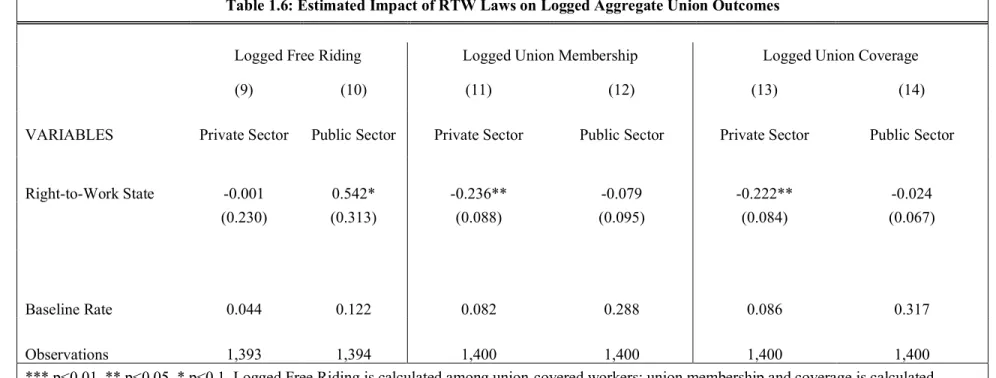
(ASEC) data, I find that RTW laws are associated with a 54.2% increase in public sector free riding and a
23.6% reduction in private sector union membership. RTW passage is associated with a 22.2% decrease
in private sector union coverage, which suggests that RTW laws influence the decisions of not only
individual workers but also union leaders. Whereas RTW laws have no impact on the union wage
premium (additional earnings associated with union membership), there is a ‘benefit premium’ (measured
by employer health insurance contributions): employer contributions for union members remain the same
following the passage of a RTW law, whereas covered workers’ contributions decrease. I further study
Wisconsin’s experience with RTW using a Synthetic Control design and CPS Outgoing Rotation Groups
(ORGS) data. Wisconsin enacted RTW for public sector workers in 2011 and for private sector workers
in 2015, though its 2011 legislation contained other provisions that were likely to negatively affect unions
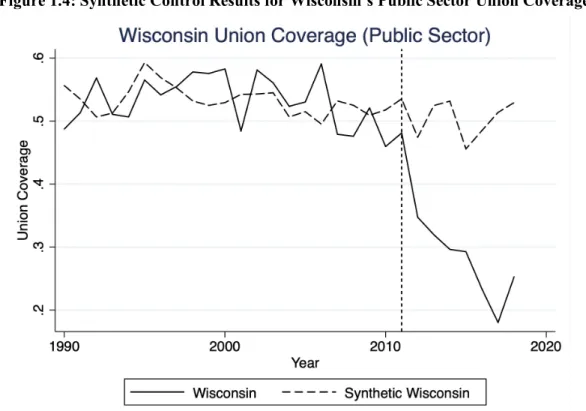
in general. I find the 2011 legislation reduced Wisconsin’s public sector union membership by 28.4% and
union coverage by approximately 28.7% over the 2011-2017 period. The 2015 RTW law is associated
with a reduction in Wisconsin’s private sector union membership of approximately 38% and union
increasing inequality and stagnating wages, it appears that RTW laws serve to exacerbate labor market
risks for workers.
Chapter 2 examines the impacts of changes to disability insurance eligibility using the UK’s
recent experience with the Work Capability Assessment (WCA), a more stringent metric for assessing
disability eligibility than its predecessor. Using an individual fixed effects model and Special License
data from the United Kingdom Household Longitudinal Study (UKHLS) as well as Department of Work
and Pensions (DWP), this paper identifies the effects of tightened disability insurance eligibility on labor
market and benefit enrollment outcomes among people with long-term disabilities. Contrary to the
Government’s stated policy goals as well as widespread media reporting of people losing their benefits, I
find that increased reassessment using more stringent eligibility criteria at the local level is associated
with a higher probability of individual disability receipt and no change in labor force participation.
However, my findings are suggestive of policy spillover effects, wherein individuals assigned to benefits
with work conditions seek out other benefits. Thus while these reforms did not push an entire population
of vulnerable people into the labor market, they created a great deal of uncertainty for people around their
livelihoods and induced those assigned work-conditioned benefits to search out other sources of support.
Chapter 3 considers the effects of state minimum wage increases on labor supply: specifically
self-employment within occupations. Previous empirical work on the minimum wage has examined its
potential impacts on unemployment, however there may be other consequences for workers that cannot be
observed in unemployment insurance rolls. What is the impact of a minimum wage increase on the share
of self-employment? This chapter employs the American Community Survey (ACS) data from 2000-2017
and a Quadruple Difference (DDDD) model to examine the compositional effects of state minimum wage
increases, specifically on the rates of unincorporated and incorporated self-employment within
occupations. The results indicate that a state minimum wage increase is associated with a decrease in
self-employment, particularly unincorporated self-employment within low-wage occupations with flexible
workers consider both the earnings from self-employment and hired employment as well as the relative
risk of each type of work. Workers previously classified as self-employed are induced into hired
employment when the wage they can expect to earn from hired employment matches or exceeds expected
earnings in self-employment. Therefore the minimum wage, in allowing for workers to select into work
arrangements that are inherently less risky, may present another policy lever for reducing the labor market
CHAPTER 1: THE RIGHT-TO-WORK OR THE RIGHT-TO-FREE RIDE? THE IMPACTS OF U.S. RIGHT-TO-WORK LAWS ON WAGES, FREE RIDING, AND UNIONIZATION
Economists have suggested for several decades that labor unions, in offering public goods to their
members and nonmembers who enjoy union coverage, suffer from a free rider problem. The National
Labor Relations Act of 1935, also known as the Wagner Act, gave employees the right to join a labor
union, the right to collectively bargain, and the right to go on strike. This legislation required that
union-covered members and non-members must receive equal application of contract terms, however it also
allowed for union security agreements, such that workers covered by union arrangements either join their
union or contribute to the costs of collective bargaining by paying some portion of union dues.
The Labor-Management Relations Act of 1947, more commonly known as the Taft-Hartley Act,
allowed state legislatures to prohibit union security agreements but maintained the requirement for equal
application of contract terms between union members and nonmembers. This type of legislation is
commonly called Right-to-Work (RTW) legislation. Consequently, employees in union-covered sectors in
RTW states are not required to become members of labor unions or pay dues to a union in order to receive
the benefits a union provides.
Because union members and covered nonmembers alike receive union negotiated contracts,
contract agreements made between firms and unions are public goods: the benefits of these arrangements
cannot be withheld from nonmembers or non-contributors, and the benefits enjoyed by one worker do not
preclude another worker from enjoying those same benefits.
Insofar as a union-set wage is a public good that is applied to a union-covered sector or firm
regardless of an employee’s union status, free riding may occur in the absence of arrangements requiring
joining a union against the likelihood that there are no additional economic benefits to being a member,
may opt to not join a union.
This paper focuses on whether RTW laws create (or exacerbate) free rider problems for unions.
While other authors have attempted to identify a free rider problem in unions, this paper focuses more
directly on the extent to which RTW laws induce free riding in unions and consequentially result in a
decline of union membership. This paper takes advantage of recent variation in RTW laws and a state
fixed effects model to address issues of time-invariant omitted variable bias. It also looks at both private
and public sectors, whereas the vast majority of the literature has only focused on the private sector.
After a summary of the literature on RTW laws, free riding, and union wages, I discuss research
questions and hypotheses and lay out the data and methods used. I then discuss the results of various
industry-level and state-level fixed effects models and a synthetic control design. The results suggest that
RTW laws result in reduced worker benefits, union membership and union coverage, but the effect of
RTW laws on free riding remains ambiguous and sector-dependent. I find that RTW laws are associated
with approximately a 23% decline in private sector union membership and a 22% decline in private sector
coverage, as well as an increase in free riding among public sector workers by 54%. While RTW laws
have no discernable impact on the union wage premium, RTW laws differentially impact union members
versus covered workers with respect to employer health insurance contributions. Finally, using a
Synthetic Control design, I estimate that Wisconsin’s RTW provisions are associated with reductions in
public sector union membership and coverage of approximately 28% and reductions in private sector
union membership and coverage of approximately 40%; these results suggest that declining unionization
Literature Review and Conceptual Framework
As can be seen in Figure 1.1, there are 27 RTW states,1 largely in the Southeast and the West, the
majority of which became RTW in the 1940s and 1950s, although some states passed RTW legislation
following renewed interest in RTW laws in the 1970s and 1990s (NCSL, n.d.). Indiana expanded its RTW
provisions from just public school employees to all employees in the state in 2012, and Michigan and
Wisconsin became RTW states in 2013 and 2015,2 respectively (ibid). In early 2017, Kentucky and
Missouri became the most recent states to pass RTW legislation, however Missouri’s RTW legislation
was overturned by a state referendum in November 2017.3 RTW legislation was passed in West Virginia
in February 2016 and was effective in July 2016, followed by an injunction in August 2016. After a
prolonged court challenge by unions, the law went into effect in October, 2017 following a decision by
the West Virginia Supreme Court. Most recently, in late April 2019, the Supreme Court stayed a February
2019 judgment by a Kanawha County circuit judge, who had struck down portions of the legislation.4
RTW laws indicate that a state has declared its authority to determine whether workers can be
required to join a labor union to get or keep a job. In most cases, this means that all employees in the state
are not obliged to join a union, however in the case of Indiana before 2012, this was only true for public
sector teachers. RTW bills were introduced in sixteen states in 2014, five states in 2015, and fourteen
states in 2016; and in February 2017, Representative Steve King (R-IA-4) introduced H.R. 785 - National
Right-to-Work Act, which would establish a RTW law at the national level (he has introduced the same
legislation in previous years). And in June 2018, the U.S. Supreme Court ruled in Janus v. AFSCME that
1 The 27 states are: Alabama, Arizona, Arkansas, Florida, Georgia, Idaho, Indiana, Iowa, Kansas, Kentucky, Louisiana, Michigan, Mississippi, Nebraska, Nevada, North Carolina, North Dakota, Oklahoma, South Carolina, South Dakota, Tennessee, Texas, Utah, Virginia, West Virginia, Wisconsin, and Wyoming.
2 Wisconsin had prohibited union security agreements for public sector workers in 2011. Its 2015 legislation expanded the prohibition to private sector workers.
public sector unions cannot charge fees to employees who decline to join a union but are covered by its
collective bargaining agreement (agency fees), a blow to public sector unions in the United States. The
Janus ruling particularly underscores some of the implications of this paper, as this analysis focuses on
both private and public sector union members and covered workers.
There have been counter-efforts by unions and Democrats to preempt RTW legislation. In May
2018, Senator Bernie Sanders introduced S. 2810, the “Workplace Democracy Act,” which would
nationally repeal RTW laws. Although the bill had little chance for success in the Republican-controlled
Senate, 18 fellow Democrats co-sponsored the bill. Finally, the Protecting the Right to Organize Act (or
PRO Act), introduced in 2019, would abolish state RTW laws, requiring the payment of agency fees in
addition to other provisions expanding worker bargaining.
RTW Laws and Unions
RTW proponents argue that RTW policies result in increased employment and economic growth,
however opponents argue that RTW policies reduce unionization rates and the bargaining power of
unions, thereby reducing wages, the rate of pension provision, and workplace safety. Reed (2003)
concludes that RTW states have higher wages, on average, than non-RTW states. However, Shierholz and
Gould find that in RTW states versus non-RTW states, wages are 3.2% lower, and the rate of
employer-sponsored pensions is 4.8 percentage points lower (2011)5. Eren and Ozbeklik (2015) observe no effects
of Oklahoma’s passage of a RTW law on employment or average private sector wages using a Synthetic
Control design. Using an industry and year fixed effects model, Roberts and Habans find that RTW laws
reduce private sector hourly wages by 1%, however they note that this effect is correlated with state
development and regulation (2015: 20). They also note differential impact of RTW laws on wages. RTW
laws: exacerbate gender wage gaps; reduce the wage gap between white and Hispanic workers;
marginally expand the wage gap between African American and white workers; reduce the difference
between workers with degrees and workers with high school diplomas; and reduce the wage premium
between union members and nonmembers (2015: 19-20).
RTW laws are associated with a lower level of union membership (Moore and Newman, 1985;
Eren and Ozbeklik, 2015), however the reason for this association is unclear. RTW laws may create
opportunities for free riding, making organization and maintenance of unions costlier, leading to an
undersupply of union services. Conversely, with increased free riding, RTW laws may lower unions’
bargaining power, reducing demand for union services. Both of these explanations identify free riders as
the mechanism through which RTW laws reduce unionization rates.
While authors like Hirsch (1980) and Freeman and Medoff (1984) suggest RTW laws create free
riding problems for unions, Davis and Huston find that once controlling for other factors that may
determine whether someone free rides, the impact of RTW laws on the incidence of free riding—while
still statistically significant—is smaller in magnitude (1993: 53).6 It may be the case that RTW laws have
no independent effect on the supply or demand of union services. Rather workers in RTW states have
tastes and preferences against high unionization (Lumsden and Peterson, 1975; Moore and Newman,
1985; Sobel, 1995).
Olson (1965) suggests that, without coercion, unions may offer excludable goods or services to
their members to encourage employees to join. A good or service is excludable if it is possible to prevent
people who have not paid for that good or service from having access to it. Much of the literature around
free riders in labor unions focuses on whether there is a wage premium associated with union membership
above the wage for a union-covered nonmember. According to the existing literature, a positive wage
premium would suggest that there is some excludability associated with union-negotiated contracts; in
other words, the union-negotiated wage cannot be enjoyed without becoming a member and, therefore,
the free rider problem does not exist. Implied in this is that the contract is somehow no longer a public
good.
Finding a Wage Premium
Using national survey data, Jones (1982), Blakemore, Hunt, and Kiker (1986), Sobel (1995),
Schumacher (1999), Budd and Na (2000), and Eren (2009) find positive wage premiums and conclude
there are substantial, excludable economic gains to union membership. However, Booth (2004) argues
that these findings may be driven by a spurious correlation between membership and wages. She and
Bryan ask, why do non-members in covered sectors refrain from joining a union when the economic gains
(the wage premium) are so large? (2004: 405). Using UK7 employer-employee linked data, Booth and
Bryan exploit within-workplace variation in membership and wages of covered nonmembers and find no
evidence of a wage premium. Non-members in covered sectors refrain from joining unions, because they
can realize the same wage regardless of membership status.
Union members and nonmembers may differ systematically in unobservable characteristics that
also influence wage, particularly in analyses relying on national survey data, where differences between
bargaining units and variation of workers within bargaining units cannot be discerned. For example, Budd
and Na suggest that workers who unionize are more motivated or are more likely to stay with the firm and
invest in firm-specific human capital (2000: 787). Younger, more temporary workers, consequentially, are
less likely to join a union, either due to their own preferences or because unions may not target them in
the same way as other workers. Probationary periods, during which individuals are not required to join a
union, may result in covered nonmembers appearing to have shorter tenures and lower wages than
average union members (Jones, 1982).
Members may be systematically found in higher paid firms for a few reasons. First, workers may
be more likely to join where other bargaining structures like multiple union bargaining help unions
achieve higher wages. Second, unions may also concentrate their activities in higher-wage firms (Booth
and Bryan, 2004: 404). Third, Chaison and Dhavale (1982) found that lower paid workers are more likely
to free ride, either because they are less able to afford the cost of union dues or find they benefit less from
membership (360). Without more detailed data collected at the bargaining level, we cannot be sure that a
wage premium exists between union members and covered nonmembers within a covered firm.
The literature around unions and inequality may prompt us to ask among which groups a wage
premium should exist. Freeman and Medoff (1980) found that unions in fact compress wages within
unionized sectors, particularly in manufacturing, and this effect more than offset any dis-equalizing
effects found between union and non-union workers. Subsequent research such as that by Card, Lemieux,
and Riddell (2004) attributes falls in unionization with increasing wage inequality, which lends further
credence to the notion that unions serve to reduce wage premiums rather than create them.
Finally, there may be measurement issues associated with union status.8 Jones (1982) suggests
that there may be greater measurement error associated with union coverage than union membership,
which would bias the estimated effect of free riding on coverage to zero. Mis-measured union
membership status would also bias the penalty of free riding towards zero (Schumacher, 1999: 504).
Does a Positive Wage Premium Indicate an Absence of Free Riding?
Theoretically, a wage premium of zero is indicative of free riding, because it suggests that the
benefits of union coverage—or the union-negotiated wage—are non-excludable. However, there should
be no observable wage premium, because of federal law requiring equal pay between union members and
nonmembers in a bargaining unit. Setting issues of measurement and omitted variable bias aside,
Blakemore et al. (1986) suggest that a wage premium may result from discriminatory behavior by a
union, a firm, or both. Chaison and Dhavale (1992) argue that unions may provide preferential treatment
to union members, or may convey the impression that they do (360). Budd and Na (2000) note that
businesses have the incentive to treat members and nonmembers differently, arguing that firms may
exploit worker ignorance of bargained contracts by undercutting nonmembers so as to reduce labor costs
(787). Granted, Booth and Bryan (2004) argue that unions are unlikely to want nonmembers’ wages to be
undercut, because the firm would then be more likely to substitute cheaper nonmembers for more
expensive members, eventually reducing union bargaining power (405).
Economic theory would suggest that RTW laws damage unions by inducing free riding among
covered workers. It follows that, if the wage premium is indicative of free riding, RTW laws will reduce
any wage premium that exists between union members and covered non-members. Robert and Habans
(2015) find that RTW legislation reduces the wage premium between union members and non-members.
However, there may be differential gains between union members and non-members for other,
unobservable reasons. Farber (1984) posits that, if free riding is the mechanism by which RTW laws
result in union decline, RTW laws increase the price of unionization, driving down the supply of union
contracts relative to their demand. Consequentially, workers who are unionized in the absence of a RTW
law (and who remain unionized in the presence of a RTW law) gain more from unionization than those
who are not (i.e. the wage premium will be higher in non-RTW states; the analysis in this paper does not
corroborate this theory).
One must also consider that unions may behave differently depending on whether a state is RTW.
Bennett and Johnson (1980) note that, since workers are required to pay union dues in non-RTW states,
union leaders may have less of an incentive to provide higher benefits in those states rather than RTW
states. Unfortunately, this hypothesis was not tested in their study. More generally, there is some evidence
of a trade-off between wages and premiums, but the literature supports the notion that union strength also
matters in health insurance contributions. In their study of teachers unions, Clemons and Cutler (2014)
find that school district employees bear a smaller share of the cost of higher health insurance premiums
when the union is stronger, with unions negotiating higher contributions as well as compensation.
Focusing on teachers unions in Illinois, Lubotsky and Olson (2015) acknowledge that a unionized setting
If unions or firms were successful in rewarding members or punishing free riders through
differential wages, a higher wage for members would be observed despite the incidence of free riding or
RTW legislation. It is empirically challenging if not impossible to observe pure free riding9 in non-RTW
states; therefore, there is no counterfactual in assessing the ‘true’ impacts of RTW laws on free riding.
This may be why the wage premium has played such a prominent role in the literature (and in this paper).
However, the union wage premium, while useful to observe in its own right, may not be the most
appropriate test of whether covered workers free ride. The wage premium may be a response to the
phenomenon of free riding (and RTW laws that exacerbate free riding), rather than an indication that free
riding is or is not occurring. Still, a wage premium remains empirically useful as an indication of whether
or not there are incentives for covered workers to free ride.
It is important to note that unions provide other (excludable) benefits to their members, which
workers may consider in their decision about membership. Unions can also offer excludable benefits such
as scholarships, life insurance options, legal assistance, training programs, grievance procedures, pension
advice, unemployment insurance, strike compensation, housing assistance, and rental car discounts that
may induce potential free riders into joining a union (Bennett and Johnson, 1979; Budd and Na, 2000;
Booth and Bryan, 2004). Unions can also alter workers’ access to workers’ compensation, as this does not
stem from the collective bargaining agreement (ibid). The rate of turnover in a firm may influence the
relative mix of private goods offered by unions: for example, if grievance procedures are only provided to
members, workers may be more likely to join in the face of high employee turnover (Booth and Bryan,
2004: 404).
Bounded Rationality of Actors: Other Considerations
The literature discussed thus far largely assumes that a prospective union member rationally
weighs out the tangible benefits of membership versus the costs in member dues (Sobel, 1995). However,
workers do not exist in isolation; their behavior is influenced, at least in part, by the actions of others
(Naylor, 1989).
Using CPS data, Chaison and Dhavale (1992) identify characteristics of workers that distinguish
free riders from union members, including knowledge of available options, preferential treatment of union
members, the value of reputation, and union consciousness. Regarding information asymmetries, Singer
(1987, p. 323) claims that “the average resident of right-to-work state is either uninformed or
misinformed concerning his/her rights,” and as a result, workers may be unaware of the available options
regarding union membership.10 Chaison and Dhavale (1992) qualify Singer’s point by adding that it
relates only to residents of right-to-work states, and that workers in unionized establishments or workers
in general may have greater awareness of the free rider option (359). Awareness and appreciation of
union achievements may also play a role, as free riders tend to be younger and have lower organizational
tenure (Chaison and Dhavale, 1982; Jermier et al., 1988). Bennett and Johnson (1979) note that many
accomplishments once made by unions—such as improved working conditions—are protected by the
government and therefore may not factor into present-day decisions by workers to unionize.
Some authors have also noted the importance of norms of union membership and threat of
reputational damage of non-membership in union membership decisions, because reputation-conscious
individuals see utility in the social custom of belonging to a union (Booth, 1985; Naylor, 1989).
Importantly, proxies for the value of reputation and union consciousness are likely more accurate at the
bargaining unit level rather than national surveys (Chaison and Dhavale, 1982: 365). However, as
unionization rates decline, these factors may be less relevant: Chaison and Dhavale posit that generally,
employees in occupations with lower union density should be less concerned about reputational effects of
not belonging to a union (1982: 363).
Schumacher (1999) makes a related point, finding that sectors with relatively low rates of covered
nonmembers (free riders) are associated with higher wage premiums than sectors with relatively high
rates of covered nonmembers. There are two possible explanations for this finding. First, workers respond
to the relative benefits provided by a union in the form of higher wages or better workplace rights and
laws, joining when relative benefits are high. Second, free riders weaken the bargaining position of unions
through decreased membership and payment of dues, so bargaining power of unions (for both members
and covered nonmembers) diminishes as free ridership increases. Schumacher concludes that the ability
of a union to ‘punish’ free riders decreases with the number of free riders (1999: 501). He also observes
that there has been a decline in the union wage premium in RTW states since the 1980s (1999: 499-500).
What Type of Free Rider?
This paper and others identify free riders as workers, who are covered by a union contract but
who are not members of that union (see Figure 1.2). However, there is some notable heterogeneity
among free riders. Sobel (1995) makes a theoretical distinction between true free riders—those who
would join a union if threatened with exclusion—and induced free riders—those who would opt out of
union membership by finding a nonunion job (348). True free riders value the benefits of union coverage
more than the cost of becoming a member, whereas induced free riders value union coverage less than the
cost of membership.
The distinction is important regarding RTW laws: if RTW laws were repealed, thereby requiring
union membership or payment of partial union dues, only the true free riders would become (and remain)
union members. Therefore, “the extent to which union membership suffers because of RTW laws is
measured solely by the number of true free riders. The induced riders do not contribute to the undersupply
of union services. The undersupply of union services is a result of the lost union revenues (and bargaining
power) from those workers who would join if threatened with exclusion, the true free riders,” (Sobel,
1995: 348). Thus, the greater the proportion of induced free riders, the less union membership is affected
by RTW laws. However, any meaningful methodological distinction between induced and true is difficult
to make.
cheap riders, which is more relevant in non-RTW settings. When agency fees make up a very high
percentage of member dues, there may be fewer stigmas associated with being a nonmember and less to
be gained in reputation by being a member but employees may have lower financial incentive to remain
nonmembers and may opt to join a union (Chaison and Dhavale, 1982: 366). This is corroborated by the
observation that there are relatively few covered nonmembers in non-RTW states (Schumacher, 1999).
Chaison and Dhavale (1982) add that free riders may not be all that bad for unions after all. Free
riders represent internal organizing opportunities for unions, because their recruitment elicits less
employer opposition (as the bargaining unit is already unionized) and are relatively easy to reach (355).
Much of the literature on why workers join unions deals exclusively with decisions made in initial
campaigns at nonunion facilities, but Chaison and Dhavale (1982) posit that the motives behind voting for
a union and joining a union in an already organized unit are fundamentally different (356). This analysis
attempts to deal with this distinction by looking at both union coverage and union membership.
The Theorized Impacts of Right-to-Work Legislation
According to existing literature, a substantial wage premium would not be expected for a couple
reasons. First, the illegality of wage premium; and second, higher rates of free riding are correlated with
reduced bargaining power of unions (Schumacher, 1999), which would suggest a more limited ability of
unions to reward members or penalize nonmembers.
While several papers have found positive wage premiums, the possibility for spurious
correlations from omitted variables and the likelihood of measurement error suggest that previous
findings have been biased. Due to a lack of firm-level data, this paper cannot address all methodological
issues that hamper previous attempts in quantifying the union wage premium, though I do control for
relevant confounding variables and include state, year and industry fixed effects. The aforementioned data
limitations suggest that a wage premium is expected.
As for the effect of RTW legislation on the wage premium, existing literature would predict that
between members and non-members may be zero, positive or negative, the predicted direction of this
effect is ambiguous. Predicted attenuation may also be incorrect;
reconsidering discussions by Bennet and Johnson (1980), Blakemore et al. (1986), Chaison and Dhavale
(1992), and Schumacher (1999), there may be (legal) union responses to increased free riding. In a policy
environment that creates free riding opportunities, unions may be induced to provide exclusive benefits
(such as additional training or advancement opportunities that result in higher wages) in order to
incentivize membership, even when union members and covered non-members alike must receive the
same contract.
Hypothesis 1: While there is a wage premium between union members and free riders as well as between covered workers and non-covered workers, RTW laws have no discernable impact on these wage differentials. However, RTW laws differentially affect workers’ employer health insurance contributions.
The ambiguity in predictions outlined above belies the soundness of a wage premium as a reliable
measure of free riding.I attempt to identify the impact of RTW laws on free riding more directly by
examining the proportion of free riders among covered workers in a state (i.e. the proportion of workers
covered by union contracts who are not union members, among all workers covered by a union contract).
Notably, much of the existing literature has not quantified free riding in this manner at all. Only
Schumacher (1999) has considered the rate of free riding with respect to RTW laws, though he does not
attempt to identify a causal impact of RTW laws on free riding.
Hypothesis 2: RTW laws result in higher rates of free riding among union covered members, as workers are no longer required to join a union upon entering a unionized bargaining unit.
There is clear evidence in existing literature to support the argument that the decline of unions is due in
part to RTW laws. The below hypothesis seeks to corroborate existing research.
Hypothesis 3: RTW laws result in decreased state union membership (unionization) rates.
There are two potential sources for declines in state-level union membership: (1) increased free riding by
covered workers, or (2) a decline in the number of covered workers within a state. The former represents
corresponding tradeoff between organization efforts and likelihood of success. RTW laws may reduce
union coverage, as unions facing declining membership are no longer viable and are forced to leave a
bargaining unit. In addition, there may be a secondary effect of RTW laws on union coverage through the
preemption of new bargaining contracts between firms and employees. Due to increased maintenance
costs associated with free riding, union leaders are likely to consider bargaining units in non-RTW states
more favorably than those in RTW states when selecting bargaining units for prospective union
arrangements. Conversely, one could argue that RTW legislation inspires renewed or emboldened labor
efforts in a particular state; for example, labor organizations spent more than $15 million in a successful
effort to overturn Missouri’s RTW legislation by voter referendum in 2017 (Neuman, 2018).
Hypothesis 4: RTW laws result in decreased union coverage.
It is likely that unions make decisions regarding where to expand their operations based upon either
demand for union services or the cost to provide such services, both of which are likely to be affected by
RTW legislation. Ellwood and Fine (1987) find strong short-run reductions in union organizing following
passage of a RTW law that decays over time (ten or more years out). All but one of the treated states in
this sample have passed RTW legislation in 2011 or later, and most recently RTW states have historically
had higher rates of unionization. I therefore expect to see large effects of RTW legislation on union
coverage.
Data
This paper uses data from the March Annual Social and Economic (ASEC) supplement to the
Current Population Survey (CPS) from 1990 to 2018 for the fixed effects regressions and data from the
CPS Outgoing Rotation Groups questions (ORGS), or earner study, from 1990 to 2018 for Synthetic
Control.
The CPS is a monthly U.S. household survey conducted by the U.S. Census Bureau and the
Bureau of Labor Statistics. Households in the CPS are interviewed for four months, excluded for 8
for the March CPS are asked a wider array of questions, and supplemental inquiries of certain topics have
been completed for certain time periods.
Data were extracted from the Minnesota Population Center’s Integrated Public Use Microdata
Series (IPUMS), a harmonized compilation of over 50 surveys of the American population.11
The sample consists of private and public sector wage or salary earners; the sample spans all 50
states and Washington D.C. Self-employed individuals, unemployed individuals, and those not in the
labor force are excluded. Those under the age of 16 or above the age of 65 are also excluded, as well as
individuals whose union status was imputed12 by the Census Bureau.
The sample is broken down into further subsamples, such as workers covered by a union versus
all workers, or private sector workers versus public sector workers.
The ASEC sample: the individual wage models are comprised of 55,634 (covered workers) and
363,072 (all workers) observations.13 The sample sizes for the state-level free rider, union membership,
and union coverage models are 1,400.14
Used for Synthetic Control, the ORGS sample includes only non-RTW states and Wisconsin. The
ORGS sample contains 1,712,277 individual observations, collapsed to the state-year level (and stratified
by public and private sector). Once collapsed to the state-year level, there are 667 state-year observations.
The CPS variable, union, indicates whether, for their current job, a respondent is: (a) a member of
a labor union or employee association similar to a union; (b) not a union member but covered by a union
or employee association contract; or (c) neither a union member nor covered by a union contract. Union
11 For more information, see IPUMS: https://www.ipums.org
12 Approximately 21,000 observations for the ASEC sample; approximately 169,000 observations in the ORGS sample.
13 The sample sizes for employer health insurance contributions models are 34,024 (covered workers) and 168,090 (all workers); the sample sizes are smaller than those of the wage models, because employer contribution is calculated only for workers who have employment-based insurance.
members are likely to be markedly different from covered nonmembers (free riders) and non-covered
workers.
As can be seen in Tables 1.1 and 1.2 (Un-Weighted and Weighted Summary Statistics,
respectively, using CPS ASEC data), union members are disproportionately male and employed in a
‘highly unionized industry’15 compared to covered nonmembers or non-covered workers. The higher
proportion employed in a highly unionized industry underscores the importance of reputation in union
membership decisions, specifically that reputational damage of free riding is of less concern in work
places with lower union density (Chaison and Dhavale, 1982). There are more women who are free riders
than non-covered workers, while the proportion of women who are non-covered workers is seven
percentage points higher than the proportion of women who are union members (Table 1.2). Union
members are also slightly older than covered nonmembers and non-covered workers, on average. Racial
composition does not appear to vary greatly across union status, though non-covered workers have a
marginally higher proportion of white workers in comparison to union members and free riders. Though
union members are slightly more educated than non-covered workers, covered nonmembers appear to
have more education than union members, on average. Union members and covered workers also have
more experience in their industry than non-covered workers, and the rate of part-time work is noticeably
lower among union members and covered non-members than non-covered workers. Perhaps
unsurprisingly, those who are covered by a union contract are paid more than those who are not. Union
members also earn more than covered non-members; this may be because of a wage premium for being a
union member or may be due to a range of individual- and firm-level characteristics, as discussed above.
Union members and covered non-members are substantially more likely to receive insurance from their
employer than non-covered workers, and union members are approximately nine percentage points more
likely to receive employment-based insurance than covered non-members (Table 1.2).
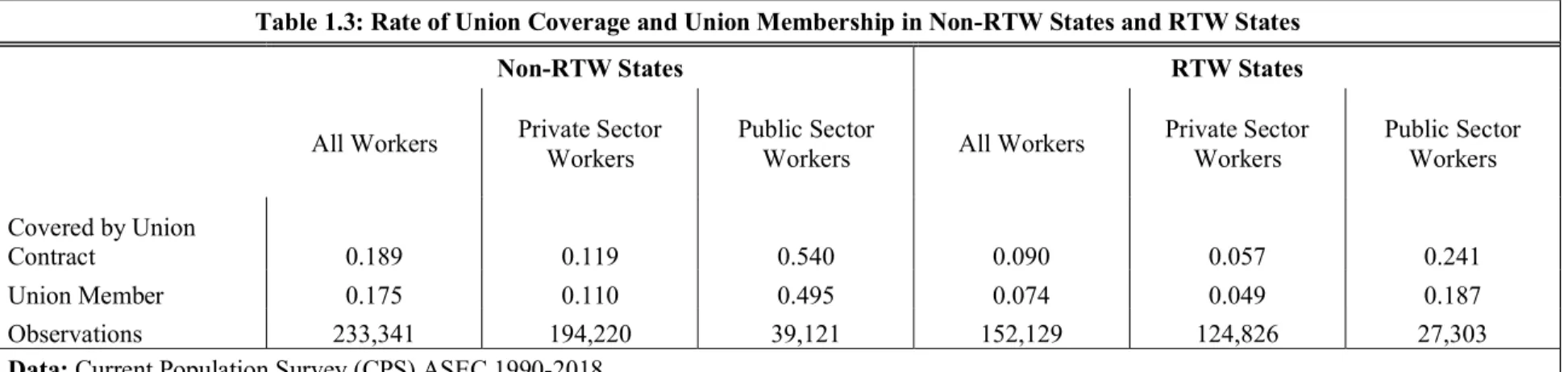
Table 1.3 displays rates of union coverage and union membership in RTW states versus
Non-RTW states, decomposing the analysis further by private and public sector workers. As one might expect,
union coverage and union membership is higher for both the private and the public sector in non-RTW
states compared to RTW states, though the difference between non-RTW and RTW states is largest in the
public sector (approximately 30 percentage points).
Methods
Primary Analysis
I examine the impact of RTW laws on five outcomes:16 the natural log of wage and salary
income, !"#, and the natural log of employer health insurance contributions (conditioned on being the policy holder of employment-based insurance),17 $
"# (to test Hypotheses 1a); the natural log of the rate of free riders among covered workers in a state, %&# (to test Hypothesis 2); the natural log of the rate of union membership among all workers in a state, '&# (to test Hypothesis 3); and the natural log of the rate of union coverage among all workers in a state, (&# (to test Hypothesis 4).
The independent variables of interest are )*!&# (dummy variable equaling 1 if the state is a RTW state),18 +,-.,/
" (a dummy variable equaling 1 if the worker is a union member), and (01,/,2"
16 Additional three outcomes are explored and presented in the Appendix: the probability a union-covered individual free rides, Pr(%/,,/62,/), the probability an individual is a union member, Pr(+,-.,/), and the probability an individual is covered by a union, Pr((01,/,2). These are used in individual-level regressions (linear probability models) in order to check the robustness of the state-level findings, using industry fixed effects in addition to state and year fixed effects.
17 Employer health contributions (CPS variable EMCONTRB) are conditioned on GROUPOWN, whether the respondent was the policy holder for group health insurance related to their employment. The interviewer asked whether, at any time during the previous calendar year, anyone in the household was covered by a health plan provided through a current or former employer or union, with follow-up questions identifying the policyholder(s). It is important to narrow this analysis to only policy holders, as I am interested in the relationship between an
employee’s insurance coverage and their union status.
(a dummy variable equaling 1 if the worker is covered by a union contract). An interaction between
)*!&# and +,-.,/" (in Equations 1-4) and between are )*!&# and (01,/,2" (in Equations 2 and 4) are also included (to capture the impact of RTW laws on any wage premium of being a union member and
any wage premium of being covered by a union contract, respectively).
The wage models (Equations 1 and 2) are at the individual level; Equation 1 pertains only to
covered workers, while Equation 2 includes all workers. I use the same design of Equations 1 and 2 to
study employer health insurance contributions. The free riding, unionization, and union coverage rate
models (represented by Equation 3) are aggregated at the state-by-year level. The free riding model
includes covered workers only, whereas the unionization and union coverage rate models include all
workers.
All models include a state fixed effect (9&) and year fixed effect (:#). The wage and health insurance contributions models include a industry fixed effect (;<). Subscripts are as follows: i for individual, I for industry, s for state, and t for time.
(1) ln(!"&#) = BC)*!&#+ EC+,-.,/"&#+ FC)*!&#∗ +,-.,/"&#+ HCI"&#+ JCK&#+ ;C"< + 9C&+ :C#+ L"&#
(2) ln(!"&#) = BN)*!&#+ EN+,-.,/"&#+ FN)*!&#∗ +,-.,/"&#+ :C(01,/,2"&#+ OC)*!&# ∗ (01,/,2"&#+ HNI"&#+ JNK&#+ 9N&+ ;N"<+ :N#+ L"&#
(3) ln(%&#) = BQ)*!&#+ HQI&#+ JQK&#+ 9Q&+ :Q#+ L&#
Each regression is further stratified by sector (public versus private) in order to understand the varied
impacts of RTW legislation.19 I
"# is a vector of individual characteristics of the employee, including: age, gender, race, educational attainment by years of schooling, occupation, job experience (whether the
industry and occupation in which the individual is currently employed was their industry of employment
and occupation the previous year), and whether an employee is part time (works less than 35 hours a
week).
The free riding rate, unionization rate and union coverage models (Equation 3) use data
aggregated to the state-by-year level. K&# is a vector of state characteristics, which appears in all models, and is comprised of the natural log of the state annual average unemployment rate.
The wage model should identify the impact of RTW laws on a wage premium (if one exists). By
looking at different subsamples such as only covered workers or all workers, I can examine whether
union members earn a wage premium compared to covered nonmembers (free riders) as well as
non-covered workers (workers who do not have a union-negotiated contract). The health insurance models
should identify the effect of RTW laws on employer contributions to health insurance for union members,
covered non-members, and non-covered workers. The state-level models should identify the impact of
RTW laws on state-level free riding, union membership, and union coverage rates.
The few authors who have examined the impact of state RTW laws on instances of free riding
(e.g. Schumacher, 1999) have typically relied on pooled ordinary least squares regressions. These
estimates may be biased by omitted state-level variables. I attempt to address omitted variable bias from
time-invariant unobservable state characteristics by including a state-fixed effect in all of the models. I
also include a year fixed effect. However, it is important to note that these estimates may be sensitive to
unobservable factors that vary within states over time like attitudes towards unions or the strength of state
economies not captured by unemployment rate. The wage and health insurance contribution models
(Equations 1-2) include industry fixed effects (;C"<- ;N"<) to address omitted variable bias resulting from unobserved time-invariant heterogeneity in union activity and wages across industry; however, these
estimates are sensitive to time-varying unobservable characteristics such as wages and union status
changing differentially across industries.
The existing literature has also typically focused on private sector union-covered workers, which
private sector workers, as well as covered and non-covered workers, allowing me to differentiate the
impacts of RTW legislation on a greater variety of workers.
National survey data like the March CPS are not ideal for this analysis: differences between
bargaining units (firms) and variation of workers within bargaining units cannot be discerned using the
March CPS. Firm-level data, like the data employed by Booth and Bryan (2004), would allow for the use
of within-firm and within-industry variation to discern differences in wages between members and
covered nonmembers and (possibly) the differences in information about the benefits and costs of union
membership between members and covered nonmembers. However, as treatment (RTW legislation)
occurs at the state level, there would ideally be data at the firm-level with firms that cross state borders in
order to identify what can be considered a true impact of RTW laws on the union wage premium.
Secondary Analysis
I explore the dynamics of how RTW laws affect union membership and union coverage in
Synthetic Control designs for Wisconsin, a historically pro-labor state that enacted high-profile RTW
laws in 2011 and 2015. Wisconsin’s experience with RTW is somewhat unique, in that its public sector
workers experienced treatment nearly four years prior to its private sector workers. Wisconsin’s
enactment of RTW for public sector workers in 2011 was the first move towards RTW in a decade and
was followed by a wave of RTW legislation in the Midwest.
In March 2011, Governor Scott Walker signed the 2011 Wisconsin Act 10 (“Budget Repair
Bill”), 20 which limited collective bargaining and established RTW for its 175,000 public sector workers,
though law enforcement and firefighters were exempt.21 The bill was introduced in the state legislature
by Governor Walker on February 14, 2011, with Governor Walker and others arguing that the state was
‘broke’ and that changes in collective bargaining were needed in order to reign in government spending
20 The Act’s limitations on collective bargaining and unions went into effect in late March, 2011. The Act’s budget cuts went into effect at the end of the state’s budget year, June 30th (“Wis. governor officially cuts collective bargaining, 2011).
(Associated Press, 2011). After a proposed compromise by Wisconsin Democrats and union leaders to
preserve bargaining rights but concede benefits failed (Walker, 2011), all 14 Democratic state senators
fled the state to prevent a quorum. The legislation received worldwide attention as the state’s Capitol
building was swarmed with as many as 80,000 protestors (“Wis. governor officially cuts collective
bargaining,” 2011).
Though there was extensive media coverage, the timeline for the legislation was short, giving
opponents little time to countermobilize (Associated Press, 2011). Most Wisconsin union leaders
expressed astonishment that Governor Walker’s plan comprised such sharp limits on union power,
positing that Walker was not forthcoming during his campaign. Walker has said “[a]nybody who says
they are shocked on this has been asleep for the past two years.” Although Governor Walker stressed the
need for flexibility in budget decisions for local officials, his gubernatorial campaign did not
communicate plans to curb unions (Umhoefer, 2011). For a researcher, this means that Wisconsin’s
public sector should display no anticipation effects associated with Wisconsin Act 10. However, Act 10
also contained other anti-union provisions, which introduces the possibility that this analysis is not
measuring the effect of RTW in isolation.
In addition to its RTW provision and to significant changes in state employee pension and health
insurance policies, Act 10 required that collective bargaining units take annual votes to maintain
certification as a union, limited union contracts to one-year terms, and prohibited unions from collecting
dues via paycheck. The legislation also limited collective bargaining to only wage and salary negotiations
and mandated that total increases could not exceed a cap based upon the Consumer Price Index (CPI)
unless approved by a referendum. These provisions very likely would erode both demand for and supply
of unions in Wisconsin even if unions had still been permitted to collect agency fees from covered
workers. In the year immediately following the Act’s passage, the median salary of a Wisconsin teacher
fell by 2.6 percent, with their median benefits falling 18.6 percent (Madland & Rowell, 2017).
RTW bill from arriving on his desk, because he valued his partnerships with private sector unions in
economic development (Marley, 2012; Calamur, 2015). As late as December 2014, Walker called RTW
“a distraction” but declined to say whether he would veto a piece of legislation that established RTW for
the private sector (Spicuzza, 2014). However, in February 2015, Governor Walker publicly stated he
would sign RTW legislation for private sector workers (Logan, 2015).
There was little time between the introduction of the bill and enactment: the bill was introduced
in the Senate February 23rd, 2015 and passed two days later, then introduced in the House February 26th,
2015 and passed March 5th, 2015. Though thousands of protesters once again descended upon the state
capital, the legislation’s passage was viewed as inevitable, due in part to the beleaguered state of local
labor after Act 10 (Resnikoff, 2015). Governor Scott Walker signed it into law (2015 Wisconsin Act 1)
March 9th, 2015, with immediate effect.
Because of the public statements by Walker against private sector RTW legislation and the speed
at which legislation was passed, there is unlikely to be anticipation effects. But the effects of this
legislation may require some consideration: most recent RTW legislation has been applied to both private
and public sector workers, whereas public sector unions in Wisconsin had already experienced significant
losses in membership following Act 10. To the extent that the public sector remains a crucial stronghold
for an already struggling labor movement, the effect of RTW legislation on private sector workers
estimated from Wisconsin may have limited external validity for other states.
Synthetic Control Design
Synthetic Control is a data-driven procedure to examine the effects of a policy intervention that
occurs in one or few treatment units (often states), whereby a control group is constructed from a
weighted combination of non-treated units based upon observed pre-treatment characteristics.22 If the