Suppress tRNA’s Intrinsic Ability to Activate the Innate
Immune Sensor PKR
Subba Rao Nallagatla1¤a, Christie N. Jones2¤b, Saikat Kumar B. Ghosh1, Suresh D. Sharma3, Craig E. Cameron3, Linda L. Spremulli2, Philip C. Bevilacqua1*
1Department of Chemistry and Center for RNA Molecular Biology, The Pennsylvania State University, University Park, Pennsylvania, United States of America,
2Department of Chemistry, University of North Carolina, Chapel Hill, North Carolina, United States of America,3Department of Biochemistry and Molecular Biology, The Pennsylvania State University, University Park, Pennsylvania, United States of America
Abstract
Interferon inducible protein kinase PKR is an essential component of innate immunity. It is activated by long stretches of dsRNA and provides the first line of host defense against pathogens by inhibiting translation initiation in the infected cell. Many cellular and viral transcripts contain nucleoside modifications and/or tertiary structure that could affect PKR activation. We have previously demonstrated that a 59-end triphosphate–a signature of certain viral and bacterial transcripts–confers the ability of relatively unstructured model RNA transcripts to activate PKR to inhibit translation, and that this activation is abrogated by certain modifications present in cellular RNAs. In order to understand the biological implications of native RNA tertiary structure and nucleoside modifications on PKR activation, we study here the heavily modified cellular tRNAs and the unmodified or the lightly modified mitochondrial tRNAs (mt-tRNA). We find that both a T7 transcript of yeast tRNAPheand natively extracted total bovine liver mt-tRNA activate PKRin vitro, whereas nativeE. coli, bovine liver, yeast, and wheat tRNAPhedo not, nor do a variety of base- or sugar-modified T7 transcripts. These results are further supported by activation of PKR by a natively folded T7 transcript of tRNAPhein vivosupporting the importance of tRNA modification in suppressing PKR activation in cells. We also examine PKR activation by a T7 transcript of the A14G pathogenic mutant of mt-tRNALeu,
which is known to dimerize, and find that the misfolded dimeric form activates PKRin vitrowhile the monomeric form does not. Overall, thein vitroand in vivofindings herein indicate that tRNAs have an intrinsic ability to activate PKR and that nucleoside modifications and native RNA tertiary folding may function, at least in part, to suppress such activation, thus serving to distinguish self and non-self tRNA in innate immunity.
Citation:Nallagatla SR, Jones CN, Ghosh SKB, Sharma SD, Cameron CE, et al. (2013) Native Tertiary Structure and Nucleoside Modifications Suppress tRNA’s Intrinsic Ability to Activate the Innate Immune Sensor PKR. PLoS ONE 8(3): e57905. doi:10.1371/journal.pone.0057905
Editor:Thomas Preiss, The John Curtin School of Medical Research, Australia
ReceivedOctober 25, 2012;AcceptedJanuary 28, 2013;PublishedMarch 4, 2013
Copyright:ß2013 Nallagatla et al. This is an open-access article distributed under the terms of the Creative Commons Attribution License, which permits unrestricted use, distribution, and reproduction in any medium, provided the original author and source are credited.
Funding:Funding provided by NIH GM58709 to PCB and NIH GM 32734 to LLS (https://commonfund.nih.gov). The funders had no role in study design, data collection and analysis, decision to publish, or preparation of the manuscript.
Competing Interests:The authors have declared that no competing interests exist. * E-mail: [email protected]
¤a Current address: AuraSense Therapeutics, Skokie, Illinois, United States of America
¤b Current address: Department of Chemistry, Trinity University, San Antonio, Texas, United States of America
Introduction
Interferon-inducible PKR is a vital component of innate immunity, which provides the first line of defense against pathogens [1,2]. PKR consists of two functional domains: an N-terminal double stranded RNA (dsRNA) binding domain (dsRBD) comprised of two dsRNA binding motifs (dsRBMs) and a C-terminal kinase domain. These domains are separated by a flexible 20 amino acid linker [3,4]. The dsRBM recognizes dsRNA with no sequence specificity via minor groove interactions [5,6], while the kinase domain helps mediate dimerization of PKR as well as possessing the kinase catalytic activity [7–9].
Activation of PKR is well known to be promoted by long stretches of dsRNA (.33 base pairs), which may arise as intermediates during viral replication. RNA species of this length are long enough to accommodate a PKR dimer [10–12]. Two models of RNA-mediated activation of PKR have been offered: 1) a model in which PKR has intrinsically disordered regions that
become ordered upon RNA binding, and 2) an autoinhibition model in which the latent protein is locked into a closed conformation that is relieved upon binding to dsRNA of sufficient length [3,13]. Activated PKR then phosphorylates translation initiation factor eIF2a, inhibiting translation initiation [14]. This overall process provides essential antiviral and antiproliferative functions for the infected host cell [15].
In addition to the above functions, PKR has been shown to modulate cell-signaling pathways, which alter numerous cellular responses [16]. For instance, PKR regulation has been linked to several diseases, including Huntington’s, Parkinson’s and Alzhei-mer’s disease [17–21]. Furthermore, recent studies indicate that PKR regulates insulin action and metabolism in response to nutrient signals and endoplasmic reticulum stress [22].
pseudoknots, and single stranded tails can activate PKR [24–26]. In addition, largely single-stranded RNA can activate PKR in a 59 -triphosphate dependent manner, which may help distinguish self and non-self RNAs [27–29], and this activation can be abrogated by incorporating nucleoside modifications into the transcripts [30,31]. Several examples of non-canonical RNA activators of PKR include: HIV TAR and HDV RNA dimers [10,11], domain II and domain III–IV of the internal ribosome entry site (IRES) of HCV [32,33], the 39-untranslated regions (UTRs) of several highly structured cytoskeletal mRNAs [34,35], the 59-UTR of IFN-c
mRNA [24,25], and mutant transcripts of the Huntington’s and myotonic dystrophy protein kinase (DMPK) genes [18,36,37]. These non-canonical RNA activators provide an activating length of 33 bp by either dimerization of the RNA [10,11], which roughly doubles the length of a given RNA species, or by non-Watson-Crick interactions in the loops of the RNA [1,25]. In addition, siRNA containing just 19–21 bp can activate PKR, possibly by forming extended RNA species [1,38,39].
Another important biological RNA that has so far not been studied with respect to PKR regulation is transfer RNA (tRNA). The folding of tRNAs conforms to a cloverleaf secondary structure and requires magnesium [40] and post-transcriptional modifica-tions [41–43] in order to achieve high tertiary structure stability. Studies have shown that an unmodified tRNA transcript of yeast tRNAPhe can be aminoacylated and has a similar lead cleavage pattern, indicating that the tertiary structure of this unmodified T7 tRNA transcript is similar to that of native tRNA [41,42]. Likewise, the crystal structure of an unmodifiedE. coli tRNAPhe
has an overall fold that is nearly identical to that of the native tRNA [44].
Several studies suggest that tRNAs have a tendency to dimerize and that such dimers are separable by analytical techniques. Examples of dimerizing tRNAs include tRNATyr [45] and tRNAGlu[46] fromE.coli; tRNAAlafrom yeast [47]; and a mutant form of mitochondrial tRNALeu[48,49]. Given that modifications in tRNA strengthen tertiary structure [41–43], one function of modifications might be to favor native RNA tertiary structure and thereby minimize tRNA dimerization. This observation could be related to innate immunity given previous data indicating that RNA dimerization drives PKR activation [10,11]. In addition, previous studies suggest that unmodified tRNAs are capable of inducing an innate immune response via tumor necrosis factor-alpha (TNF-a) in dendritic cells through Toll-like receptors (TLRs), whereas this induction is abrogated by modified tRNA [50]. The effect of nucleoside modifications and the function of dimers in tRNA have not been probed for regulation of PKR.
We recently reported that naturally occurring nucleoside modifications modulate PKR activation in an RNA structure-specific manner [30]. Introduction of most RNA modifications into a largely single-stranded RNA 47mer, ‘‘ssRNA-47’’ that activates PKR in a 59-triphosphate-dependent manner [27] were found to abrogate activation, whereas just a few of these modifications abrogated PKR activation by perfectly dsRNA. In the present study, we evaluate PKR activation by incorporating nucleoside modifications into biologically relevant tRNA tran-scripts, as well as endogenous tRNAs from various organisms. In the cytoplasm of the cell, tRNAs are the most heavily modified RNAs, with approximately 20% of its nucleosides being modified [51]. Since PKR is mostly present in the cytoplasm [52] and based on our previous studies on modified short RNAs and mRNAs [30,31], we reasoned that modifications in tRNAs may have a significant role in suppressing activation of PKR.
Overall, we find that unmodified tRNAs activate PKR and that this activation is abrogated by incorporating numerous
modifica-tions into tRNAs. Moreover, we demonstrate that in some cases, tRNA dimers activate PKR, whereas monomers do not. General implications of RNA lacking nucleoside modifications and native tertiary structure for the innate immune response to pathogens are discussed.
Results and Discussion
Most Nucleoside Modifications Abrogate Activation of PKR by tRNA
In order to assess the effect of nucleoside modifications on PKR activation by tRNA, we chose to examine the commer-cially available phenylalanine-specific tRNA from yeast (tRNAPhe) as an RNA substrate (Fig. 1A). At first we compared activation (i.e. phosphorylation) of PKR by the T7 transcript of tRNAPhe and the natively isolated tRNAPhe (Fig. 1B, row 1, compare the two lane sets). (In an innate immune response, PKR autophosphorylates, which allows it to phosphorylate eIF2a which inhibits translation initiation.) The T7 transcript contains a 59-triphosphate and unmodified bases, whereas the native tRNA has a 59-monophosphate and modified bases. The T7 transcript activated PKR to almost the same levels as the perfectly double stranded, dsRNA-79, whereas native tRNAPhe did not activate PKR above background at any of the RNA concentrations tested (Fig. 1B). The abrogation of PKR activation by native tRNAPhe may be due to the internal modifications or to lack of a 59-triphosphate, given that some RNAs require a 59-triphosphate to activate PKR [27]. To test the role of the 59-triphosphate, we tested PKR activation by calf intestinal phosphatase (CIP)-treated T7-tRNAPhe. Activation of PKR was completely retained by CIP-treated T7-tRNAPhe (Fig. 1B, row 2, compare ‘59-ppp’ and ‘59-OH’ lanes), indicating that the 59-triphosphate is not a factor for PKR activation by T7-tRNAPhe. The unimportance of a 59-triphosphate for tRNA-PKR function is similar to that found for dsRNA and tRNA-PKR [27]. Overall, these findings suggest that nucleoside modifica-tions may play a key role in abrogating PKR activation by native tRNAPhe.
In order to better understand the role of nucleoside modifications in native tRNA-PKR interactions, we tested PKR activation by a series of modified T7-tRNAPhe transcripts. We fully substituted uridines in tRNAPhe with either 2-thiouridine (s2U) or pseudouridine (y); cytidine with either 5-methylcytidine (m5C), 29-O-methylcytidine (Cm), or 29 -fluorocy-tidine (29-FC); and adenosine with N1-methyladenosine (m1A) (Fig. 1B). These modified nucleosides are commercially available as triphosphates, which are amenable for use in in vitro
transcription. Transfer RNAs containing the majority of these modifications (s2U,y, m5C, Cm, and m1A) revealed significant reduction in PKR activation, the exception being 29-FC, which showed anenhancement in PKR activation. These results indicate that modifications generally abrogate activation of PKR by tRNA, just as observed previously in model RNAs [30]. Moreover, retention of PKR activation by tRNAs containing 29-FC, which can accept a hydrogen bond, supports the importance of minor groove hydrogen bonding between the dsRBD and tRNA, as previously reported in unmodified dsRNAs [5,6]. In considering these data, it is important to keep in mind that full substitution of a natural base with a modified one will affect the folding of the tRNA; as such, changes in PKR activation will be due to a combination of direct effects of the modification and indirect effects of the RNA folding. Overall, these findings suggest that tRNA has the
potential to activate PKR and thus lead to an innate immune response.
Mitochondrial tRNAs Activate PKR, Other Native tRNAs do not
The level of modification in tRNA varies depending on the origin of the tRNA. For example, cytoplasmic tRNAs are heavily modified (,14 sites/tRNA), whereas mitochondrial tRNAs generally contain relatively few modifications (,3 sites/tRNA) and have less variety in the modifications observed [53]. In particular, tRNAs from E. coli, bovine liver, yeast, and wheat contain many modifications as compared to mitochondrial bovine liver tRNAs [54]. To further test our observation that nucleoside modifications in tRNA influence PKR activation, we tested PKR activation by total tRNAs from different organisms, includingE. coli, bovine liver, yeast, wheat and bovine liver mitochondria. All of these tRNAs are available commercially except for mitochon-drial tRNA, which was isolated using published procedures [55]. As shown in Figure 2A, total mitochondrial bovine liver tRNA significantly activated PKR, while total tRNAs from other organisms did not. For example, at a 1.25mM concentration, tRNAs fromE. coli, bovine liver, yeast and wheat showed lower activation of PKR by,22-, 7-,.25- and 7-fold, respectively, as compared to mitochondrial tRNA. These observations strongly suggest that nucleoside modifications in these tRNAs play a major role in the abrogation of PKR activation, either directly or through their effects on tRNA structure.
We next compared PKR activation by a natively isolated methionine-specific mitochondrial tRNA (mt-tRNAMet) to activa-tion by anin vitrotranscribed version (T7-mt-tRNAMet). Remark-ably, both of these tRNAs potently activated PKR, having activation profiles similar to each other and to the total mt bovine liver preparation, although there was somewhat less activation by the native mt-tRNA, perhaps reflecting a slight suppression of activation by its few modifications (Fig. 2B). Because in vitro
transcribed T7-mt-tRNAMethas no modifications and native mt-tRNAMethas very few, we believe that the ability of these tRNAs to activate PKR resides in the little or no modification present in them. This interpretation supports the notion that modifications in cytoplasmic tRNA play a significant role in minimizing PKR activation either directly or through effects on tRNA structure. Lastly, these results further support our earlier conclusion that PKR activation by tRNA is not 59-triphosphate-dependent in that neither of these tRNAs has a 59-triphosphate yet they are both potent activators: the unmodified T7-mt-tRNAMethas a hammer-head ribozyme-generated 59-hydroxyl while the natively isolated mt-tRNAMethas a 59-monophosphate.
Activation of PKR by a mt-tRNA Dimer
Previous reports indicated that tRNAs are intrinsically capable of forming dimers [45–49]. This tendency may be due to their simple secondary structure, which is always at least partially self-complementary. We, therefore, tested our various tRNAs for dimer formation. When we performed native gel analysis on
unmodified radiolabeled T7 yeast tRNAPhe we detected a few percent dimer, which, while more than detected in naturally modified yeast tRNAphe, was not enough to purify (Fig. S1 in File S1). We then turned to a human mitochondrial tRNA.
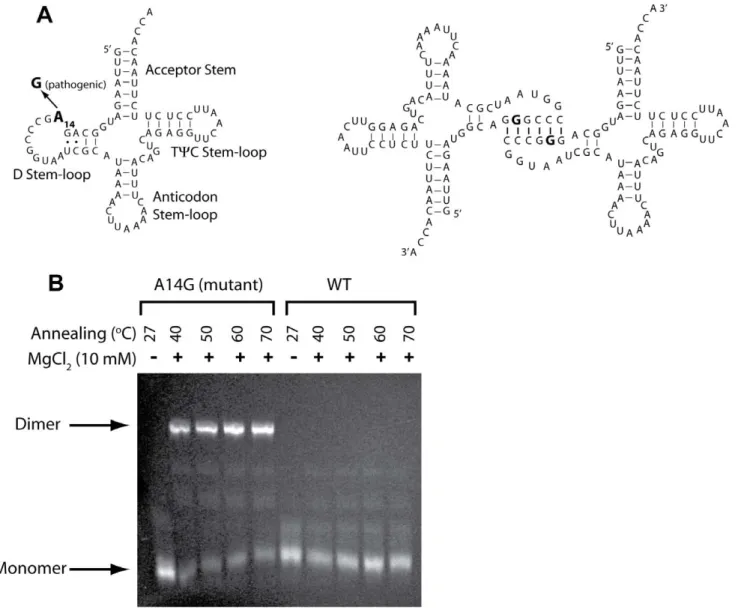
Human mitochondrial tRNALeuhas been reported to form a stable dimer when the pathogenic A14G mutation occurs [48]. This dimer can be separated from the monomer using native PAGE purification, and its secondary structure has been previously probed and shown to involve six GC base pairs in the D stem-loop (Fig. 3A) [49]. We first confirmed dimerization of mt-tRNALeu (A14G) using native gel electrophoresis under slightly modified conditions. As shown in Figure 3B, the dimer band is only observed in the A14G lanes, with more than 50% of the tRNA forming a dimer under all temperature renaturation conditions. (The identity of this species as a dimer has been confirmed previously by native gel markers [48].).
Next, we investigated activation of PKR by dimers and monomers of mitochondrial tRNALeu. The dimer was annealed and purified as described in the Materials and Methods. Purified dimer was stable when stored at 220uC, as checked by 32 P-radiolabeling analysis (e.g. Fig. 4B, 4C). In addition, we isolated the mt-tRNALeu (WT) monomer on a native gel in order to eliminate any dimeric form.
Upon testing the activation of PKR by dimers and monomers of mt-tRNALeu, the tRNA dimer activated PKR, whereas the tRNA monomer did not (Fig. 4A). In fact, no appreciable activation of PKR by tRNA monomer was observed even at concentrations up to 5mM. In addition, the dimer tRNA (A14G) activated PKR to the same levels as perfect dsRNA-79 (Fig. 4A). This result clearly shows that the dimeric form of this tRNA is an activator of PKR.
It has been shown that 16 bp of dsRNA is required for binding to PKR and that 30 bp is required for activation [5,12,56,57]. Moreover, the dsRBD can tolerate non-Watson-Crick base pairs, and noncontiguous helical stems can help PKR dimerize for activation [1,58]. In the dimeric form of mt-tRNALeu, 6 extra base pairs form (Fig. 3A) [49]. Thus, while only ,20 base pairs are present in monomeric mt-tRNALeu,,40 base pairs are present in dimeric mt-tRNALeu, which may be sufficient for PKR binding and activation.
Next, we analyzed binding of PKR to both the monomeric and dimeric forms of mt-tRNALeu. Native mobility-shift experiments were carried out as previously described, using P20, the dsRBD of PKR [5]. Appreciable binding was observed for dimer (Kd,1mM) compared to monomer (Kd,5mM) in the presence of 0.1 mg/mL herring sperm DNA (Fig. 4B). More-over, the binding ability of the monomer was completely abolished (Kd .20mM) when 0.1 mg/mL native yeast tRNAPhe
was used as a competitor, while the binding ability of the dimer was reduced just 2.4-fold (Kd,3mM) (Fig. 4C). These results
strongly suggest that the dimer is capable of binding PKR with high affinity as compared to the monomer. Overall, the approximate doubling of the number of base pairs present in the tRNA dimer helps promote tight binding and activation of PKR, as observed for other RNAs [10,11].
Figure 1. Effect of tRNA modifications on PKR activation.(A) Secondary structure of tRNAPhein the cloverleaf representation. Positions of modifications are depicted in bold font, where m2G =N2-methylguanosine, D = dihydrouridine, m22G =N2,N2-dimethylguanosine, Cm = 29-O -methylcytidine, Gm = 29-O-methylguanosine,y= pseudouridine, m7G = 7-methylguanosine, m5C = 5-methylcytidine, and m1A = 1-methyladenosine, Y = wybutosine. (B) Activation assays for modified tRNAs (10% SDS-PAGE). RNA concentrations are 0.31, 0.63, 1.25, 2.5, 5, and 10mM. A no RNA control and a positive control of 0.1mM dsRNA-79 are included. Positions of modifications are depicted, where 59-ppp = triphosphate at 59-terminus (present on all transcripts, unless otherwise noted), 59-OH = hydroxyl at 59-terminus, s2U = 2-thiouridine, m5C = 5-methylcytidine, 29-FC = 29-fluorocytidine, and, m1A, and Cm are as defined in panel A. Phosphorylation activities are provided below each gel lane. Phosphorylation activities were normalized to dsRNA-79 and rounded to the nearest integer.
doi:10.1371/journal.pone.0057905.g001
Activation of PKR by tRNAin vivo
We wanted to test whether PKR is activated by unmodified tRNA in cells. The Huh-7 cell line was chosen because it can produce interferon (IFN)-a/band has the capacity to signal from the IFN-a/b receptor [27]. These cells can thus lead to PKR phosphorylation without the addition of IFN. Transfection with the positive control of dsRNA-79 induced activation of PKR (Fig. 5, lane 2), while the mock transfection with RNA omitted did not (Fig. 5, lane 1). Transfections of Huh-7 cells with a T7 transcript of yeast tRNAphe or natively isolated yeast tRNAphe were also conducted. The T7 transcript induced activation of PKR to the same level as the same amount of dsRNA-79 (Fig. 5, compare lanes 4 and 2, respectively), while native tRNAphedid not activate PKR above the background found in the mock lane (Fig. 5, compare lanes 3 and 1, respectively). These results parallel those found in vitro (Fig. 1B) and indicate that tRNAs have an intrinsic ability to activate PKR both in vitro and in vivo. It is important to note that unmodified and native yeast tRNApheare thought to have the same tertiary structure, [41,42,44] suggesting that tRNA modifications may play a direct role in suppressing PKR activation in cells, at least in this case.
Lastly, we note that eIF2awas phosphorylated to a similar level in all four of the conditions tested: mock, dsRNA-79, tRNAphe (Sigma), and tRNAphe (T7) (Fig. 5). Similar eIF2a behavior has been noticed in several prior studies [27,59–61] and may reflect the active signaling to the IFN-a/b receptor present in Huh-7 cells. Nonetheless, it is clear that only unmodified tRNApheinduces activation of PKR, which, in turn, should lead to phosphorylation of eIF2a.
Conclusion
PKR was originally described as the double-stranded RNA-activated protein kinase [62]. While this moniker still holds, it has become clear that PKR is activated by much more than dsRNA.
RNAs with complex secondary and tertiary structures activate PKR [1,58]. Moreover, dimerization of RNA drives PKR activation, primarily because it approximately doubles the number of base pairs that PKR can interact with and because RNA dimers tend to have extensive helical regions and less tertiary structure [10,11]. In addition, most nucleoside modifications abrogate PKR activation [30,31].
It then becomes of interest to ask not only which RNAs activate PKR, but which RNAsdo notand why? For instance, have cellular RNAs been selected so that they do not spuriously activate PKR? We showed in this study that unmodified or lightly modified tRNAs, such as mt-tRNA, have an intrinsic ability to activate PKR
in vitro, but that tRNAs that are heavily modified suppress this ability. Moreover, the dimer form of an unmodified tRNALeu transcript can activate PKRin vitro. Dimerization of tRNA has been long known [45–49], however functional significance of such dimers has remained obscure. Given that nucleoside modifications strengthen native tRNA tertiary structure [41–43], which would resist dimerization, it is possible that RNA modifications serve, at least in part, to help distinguish self from non-self tRNAs by resisting RNA misfolding.
We do note that it is unclear at present whether native PKR-activating mt-tRNAs–such as mitochondrial bovine liver total tRNAs and mt-tRNAMet–activate PKR as dimers or monomers. Observation that the T7 transcript of tRNALeumonomer did not activate PKR in vitro might seem to indicate that tRNA dimerization is critical for PKR activation; however it has been shown elsewhere that this non-activating transcript does not fold unless its synthetase is present [63]. Moreover, we were unable to detect any dimers of the PKR-activating mt-tRNAMetor other mt-tRNAs in vitro (Fig. S2 in File S1). On a related note, an unmodified T7 human mt-tRNAMettranscript, which is very close in sequence to the PKR-activating bovine version, adopts a cloverleaf structure [64]. This observation strengthens the
Figure 2. Activation of PKR by tRNAs from various sources.(A) Activation assays for total tRNAs isolated fromE. coli, bovine liver, yeast, wheat, and mitochondrial bovine liver. RNA concentrations are 0.63, 1.25, 2.5, and 5mM. (B) PKR activation for T7 transcript and natively isolated mitochondrial tRNAs specific for methionine. RNA concentrations are 0.31, 0.63, 1.25, 2.5, and 5mM. For each panel, a control of no RNA and a positive control of 0.1mM dsRNA-79 are included. Phosphorylation activities are provided below each gel lane. Phosphorylation activities were normalized to dsRNA-79 and rounded to the nearest integer.
importance of having native secondary structure in monomeric tRNA in order to activate PKR. This then suggests that RNA modifications playdualroles in suppressing activation of PKR by tRNA: 1.) They may help to abrogate activation when tRNA is a monomer with native secondary structure, which is supported by
in vivo activation by natively folded yeast T7 tRNAPhe, and 2.) They may stabilize native tertiary structure to prevent the tRNA from dimerizing, which potentially activate PKR. Indeed, a role for RNA modifications in suppressing PKR activation has been reported previously for a non-dsRNA both in vitro and in vivo
[30,31].
That tRNAs capable of activating PKR exist in the human cell but reside where PKR does not (i.e. in the mitochondria) is consistent with the absence of selective pressure on such tRNAs to avoid activating the innate immune system, although other functions of the modifications such as influencing native folding
and the binding of proteins are almost certainly important. This possibility supports the notion that modification in cellular tRNAs function, at least in part, to suppress intrinsic activation of innate immune responses. It will be of interest to test whether there is a connection between tRNA from pathogens and PKR activation, as related to the innate immune system. In addition, it will be of interest to test whether other classes of cellular RNAs have an intrinsic ability to activate PKR or other innate immune sensors, and if certain cellular factors–for example, RNA modifications, tertiary structure, or protein binding function, at least in part, to suppress an innate immune response. The existence of the ability to activate the innate immune system intrinsic to the sequence and structure of a cellular RNA suggests the potential for rich regulation of innate immunity in response to stress, disease, or other exogenous signals that could function to unmask these suppressed RNA signatures.
Figure 3. Analysis of hs mt-tRNALeuA14G mutant dimer formation.(A) Secondary structure of hs mt-tRNALeuin the cloverleaf representation with the four stem-(loops) named (left-hand panel). In wild-type, the 14thposition (bold font) is ‘A’, and in the pathogenic tRNA it is ‘G’. Schematic representation of the previously reported dimeric complex formed by the pathogenic A14G hs mt-tRNALeu(UUR)mutant (right-hand panel), adopted from ref. [49]. (B) Dimerization assay for WT and A14G pathogenic hs mt-tRNALeu. 2mM tRNA samples in 1XTE were annealed for 5 min at the indicated renaturation temperature, MgCl2was added to 10 mM, and then cooled on ice. Samples were subjected to native gel electrophoresis with running buffer 0.5X TB (45 mM Tris base and 45 mM boric acid) and stained with ethidium bromide. Positions of the previously characterized [48] dimeric species (present only for the mutant) and the monomeric species are indicated.
doi:10.1371/journal.pone.0057905.g003
Materials and Methods
Protein Expression and Purification
Full length PKR containing an N-terminal (His)6, which does
not interfere with binding or activation [5,57], was cloned into
pET-28a (Novagen, Inc.) and transformed intoE. coliBL21 (DE3) Rosetta cells (Novagen, Inc.) as described [5,27,57]. Briefly, cells were sonicated and the protein was purified by a Ni2+-agarose column (Qiagen, Inc.). PKR was dialyzed into storage buffer of 10 mM Tris-HCl (pH 7.6), 50 mM KCl, 2 mM Mg(OAc)2, 10% Figure 4. PKR is activated by and binds tightly to A14G mt-tRNALeudimers.(A) Activation assays for native gel purified WT monomer and A14G dimer of mt-tRNALeu. RNA concentrations are 0.04, 0.08, 0.16, 0.32, 0.63, 1.25, 2.5, and 5mM. A no RNA control and a positive control of 0.1mM dsRNA-79 are included. Phosphorylation activities are provided below each gel lane. Phosphorylation activities were normalized to dsRNA-79 and rounded to the nearest integer. (B, C) Binding assays for dsRBD of PKR (P20) and WT and A14G mt-tRNALeu. Trace amount of 59-32P-labeled tRNA was used in the binding experiments. Protein concentrations are 0, 0.04, 0.08, 0.16, 0.32, 0.63, 1.25, 2.5, 5, 10 and 20mM and are present in Lanes 1 to 11, respectively. For one set of binding experiments (B) herring sperm DNA competitor was used (0.1 mg/mL) and for the other (C) tRNA competitor was used (0.1 mg/mL). Binding constants for A14G (#) and WT (
N
) in DNA competitor were 1.3 and 5.1mM with Hill coefficients of 3.7 and 2.9 respectively, and in the presence of tRNA competitor they were 3.1 and.20mM with Hill coefficients of 3.1 and undetermined, respectively. Higher Hill coefficients correlate with multiple bands of lower mobility on native gels, especially in Panel C (14G); this may relate to the dimer having enough binding registers to accommodate multiple copies of P20 at one time.glycerol, and 7 mM b-mercaptoethanol (bME). Prior to PKR activation assays, isolated protein was treated with l-protein phosphatase (l-PPase) (NEB) as described below.
RNA Preparation and Purification
Unmodified and s2U-, m5C-, y-, m1A-, and Cm-modified tRNAs were prepared for in vitro and in vivo experiments and purified as reported [30]. Briefly, a T7 transcription was conducted (Ambion) in which the corresponding modified nucleoside triphosphate was completely substituted in the transcription reaction. The RNAs were purified by denaturing polyacrylamide gel electrophoresis (PAGE), identified by UV shadowing, excised, eluted overnight, ethanol precipitated, dissolved in TE [10 mM Tris-HCl (pH 7.5), 1 mM EDTA], and frozen at220uC. RNA concentrations were determined spectro-photometrically. 29-FU-containing tRNA was prepared by an Epicentre T7 transcription (Durascribe) kit, as previously reported [30], and the transcript was purified as described above.
E. coli, bovine liver, yeast and wheat total and tRNAPhe-specific tRNAs were purchased from Sigma. Total bovine liver mitochon-drial tRNAs and methionine-specific mitochonmitochon-drial tRNA (mt-tRNAMet) were isolated as previously described using an oligonu-cleotide with the sequence 59 TAGTACGGGAAGGATA-TAAACCAACATTTTCGGG-biotin [65].
Sequences of T7-transcripts of tRNAs are as follows:
T7-tRNAPhe : GCGGAUUUAGCUCAGUUGGGA-GAGCGCCAGACUGAAGAUCUGGA
GGUCCUGUGUUCGAUCCACAGAAUUCGCACCA T7-Mt-tRNALeu(WT): UUAAGAUGGCAGAGCCCG-GUAAUCGCAUAAAACUUAAAACU
UUACAGUCAGAGGUUCAAUUCCUCUUCUUAA-CACCA
T7-mt-tRNALeu(A14G): GUUAAGAUGGCAGGGCCCG-GUAAUCGCAUAAAACUUAAAACU
UUACAGUCAGAGGUUCAAUUCCUCUUCUUAA-CACCA
T7-mt-tRNAMet (bovine) AGUAAGGUCAGCUAAUUAAG-CUAUCGGGCCCAUACCCCGAAAAUGUU
GGUUUAUAUCCUUCCCGUACUACCA
(Note that this transcript was prepared from a hammerhead construct to allow efficient transcription of the gene carrying a 59A residue, and so has a 59-OH start) [66].
T7 transcripts were labeled at their 59-ends as needed by first treating with calf intestinal phosphatase (CIP), followed by polynucleotide kinase (PNK) in the presence of [c-32P]ATP. Native tRNAs from Sigma and native mt-tRNAMetwere labeled at their 39-ends using T4 RNA ligase (NEB) and [32P]-pCp.
tRNA Dimerization Assay
Native gels contained 10% of 29:1 (acrylamide: bis) crosslinking polyacrylamide and were used to analyze the mobility differences between monomer and dimers of tRNAs. The buffer in both the gel and running electrophoresis was 0.56TB [50 mM Tris base, 40 mM boric acid]. Samples were fractionated between 4 and 12 h at 300 V and 16uC. Briefly, 2mM tRNA samples in TE were renaturated at 40, 50, 60 or 70uC for 5 min; MgCl2 was
immediately added to a final concentration of 10 mM; and RNA was cooled on ice. Next, samples were subjected to native gel electrophoresis with 0.56TB running buffer and stained with ethidium bromide for visualization. (We note that employing 0.56TBE showed reduced formation of the dimer on native gels, which may be due to sequestration of magnesium ions by EDTA during the native gel run.).
Preparative native gel electrophoresis of tRNA dimers for PKR activation assays followed a similar protocol. The dimer was prepared by annealing 10mM mt-tRNALeu (A14G) at 70uC followed by fractionation on a 0.56TB native gel and a crush and soak procedure similar to previously described [10].
Native Gel Mobility Shift Assay
Binding of dsRBD (P20) to tRNA monomer and dimer was carried out by native gel mobility shift assays as described [5]. Briefly, a trace amount of 59-end labeled RNA was incubated with various concentrations of P20 at room temperature for 10 min in binding buffer [BB: 25 mM Hepes-KOH (pH 7.5), 10 mM NaCl, 5% glycerol, 5 mM dithiothreitol, 0.1 mM EDTA and 0.1 mg/ mL tRNAPhe (Sigma) or 0.1 mg/mL herring sperm DNA(Pro-mega)]. Binding reactions were loaded onto a running 10% (29:1 acrylamide/bis) native gel. The gel and the running buffer contained 0.56TB, and electrophoresis was performed at 300 V at 16uC for 2 h. Gels were exposed to a storage screen and analyzed on a PhosphorImager (Molecular Dynamics).
PKR Activation Assaysin vitro
Modified and unmodified tRNAs, total tRNAs, and monomer and dimers of tRNAs were tested for their ability to activate PKR autophosphorylation. Prior to use in activation assays, T7 and Sigma tRNAPhe were heated at 90uC for 3 min and cooled at
room temperature. All other tRNAs were used without any renaturation prior to an activation assay, including native gel-isolated monomer and dimer of pathogenic tRNAs, total tRNAs, and native and T7 transcripts of mt-tRNAMet. Activation assays were carried out largely as previously described [27,57]. Briefly, purified PKR was dephosphorylated with l-PPase (NEB), quenched by the addition of freshly prepared sodium orthovana-date, and incubated with [c-32P] ATP for 10 min at 30uC. The time of 10 min was chosen because this is in the plateau region of phosphorylation versus time plots [27]. Reactions were quenched by SDS loading buffer. Samples were heated at 95uC for 5 min and loaded onto a 10% SDS PAGE gel (Pierce). Gels were exposed to a storage PhosphorImager screen, and bands were quantified on a PhosphorImager (Molecular Dynamics). In all experiments, data were normalized to the counts in a 0.1mM of
Figure 5. Activation of PKR by yeast tRNA in vivo.Cells were plated 8 h before transfection. Cells were transfected for 16 h with 2mg of either 79 bp dsRNA (lane 2), native tRNAPhe (Sigma) (lane 3), or unmodified yeast tRNAPhe(T7) (lane 4), except in the ‘mock’ lane (lane 1) which had no RNA. The tRNA and dsRNA-79 were prepared as per
in vitroactivation experiments. The ‘mock’ and ‘dsRNA-799lanes serve as negative and positive controls, respectively, for PKR phosphorylation. Proteins were denatured in SDS buffer and resolved in 10% SDS-PAGE. Phosphorylated PKR (PKR-p), phosphorylated eIF2a (eIF2a-p), and GAPDH (loading control) were identified by Western blotting. doi:10.1371/journal.pone.0057905.g005
dsRNA-79 lane. Note that all activation assays in the same figure were conducted on the same day and exposed to the same PhosphorImager screen for the same length of time and so can be referenced to the same dsRNA-79 reference lane.
PKR Activation Assaysin vivo
Huh-7 cells were maintained as described [27]. The transfection procedure was similar to previously described, [27] with the following exceptions. Lysates were prepared from 16106 Huh-7 cells that were transfected for 16 h with 2 mg of the respective RNA, prepared and renatured as described above, using DOTAP (N-[1-(2, 3-dioleoyloxy)propyl]-N, N, N-trimethylammonium methylsulfate) as the transfection reagent (Sigma), which has been used recently for similar transfections [67]. The RNA was omitted from the ‘mock’ transfection control. Cells were lysed using lysis buffer containing 50 mM Tris-HCl pH 7.4, 100 mM NaCl, 0.5% sodium deoxycholate, 1% NP-40, 0.1% SDS and 1/100 Protease inhibitor cocktail (Calbiochem). The lysates were further treated with RQ1 DNase (Promega) at 37uC for 5 min and clarified by centrifugation at 16,000 g for 10 min. A total of 25mL of samples were loaded for PKR-p (PKR phosphorylated at T446) and eIF2a-p (eIF2a phosphorylated at S51) immunostaining, while 5mL of sample was loaded for glyceraldehyde-3-phosphate dehydrogensase (GAPDH) immunostaining. Western blotting was performed on samples using rabbit monoclonal antibody against PKR-pT446 (Epitomics) and eIF2a-pS51 (Epitomics) at 1:1000 dilution, and mouse monoclonal antibody GAPDH (Fitzgerald) at 1:10,000 dilution for loading control.
Supporting Information
File S1 Supplemental material. Figure S1. Dimerization assay of unmodified yeast tRNAPhe(T7) and native yeast tRNAPhe (Sigma). tRNA samples (2mM) plus trace radiolabeled tRNA in 1X TE were annealed for 3 min at 90uC, MgCl2was added to
5 mM, and then cooled to room temperature. Samples were subjected to native gel electrophoresis with running buffer 16
THEN100M5(33 mM Tris (base form), 66 mM Hepes (acid form)
(pH 7.5), 0.1 mM EDTA, 100 mM NaCl, and 5 mM MgCl2).
The percent dimerization is indicated in each lane below the gel. Very little dimer forms for either tRNA, although there is somewhat more dimer in the T7 transcript. Figure S2. Dimerization assay of unmodified mt-tRNAMet(T7) and native mt-tRNAMet. Either 0.625mM (Lanes 1, 3, 5) or 5mM (Lanes 2, 4, 6–8) tRNA samples plus trace radiolabeled RNA in 1X TE were renatured in lanes 1–6, as follows: samples were annealed for 5 min at 70uC, MgCl2was added to 10 mM, and then cooled on
ice. Lanes 7 and 8 were not renatured. Samples were subjected to native gel electrophoresis with a running buffer of 0.56TB. tRNAs were loaded as follows: Lanes 1, 2, and 7, native mt-RNAMet; Lanes 3, 4, and 8, unmodified mt-tRNAMet; Lanes 5 and 6, native yeast tRNAPhe(as per Fig. S1 in File S1). No significant dimer formed for any of these tRNAs under any of the conditions tested. The small amount of a slower migrating band in lanes 3, 4, and 8 is likely a minor amount of tRNA with uncleaved hammerhead.
(PDF)
Acknowledgments
We thank Laurie Heinicke, Chelsea Hull, and Rebecca Toroney for comments on the manuscript.
Author Contributions
Conceived and designed the experiments: SN CNJ SKBG SDS CEC LLS PCB. Performed the experiments: SN CNJ SKBG SDS. Analyzed the data: SN CNJ SKBG SDS CEC LLS PCB. Contributed reagents/materials/ analysis tools: CEC LLS PCB. Wrote the paper: SN CNJ SKBG SDS CEC LLS PCB.
References
1. Nallagatla SR, Toroney R, Bevilacqua PC (2011) Regulation of innate immunity through RNA structure and the protein kinase PKR. Curr Opin Struct Biol 21: 119–127.
2. Yoneyama M, Fujita T (2009) Recognition of viral nucleic acids in innate immunity. Rev Med Virol 20: 4–22.
3. Cole JL (2007) Activation of PKR: an open and shut case? Trends Biochem Sci 32: 57–62.
4. Sadler AJ (2010) Orchestration of the activation of protein kinase R by the RNA-binding motif. J Interferon Cytokine Res 30: 195–204.
5. Bevilacqua PC, Cech TR (1996) Minor-groove recognition of double-stranded RNA by the double-stranded RNA-binding domain from the RNA-activated protein kinase PKR. Biochemistry 35: 9983–9994.
6. Ryter JM, Schultz SC (1998) Molecular basis of double-stranded RNA-protein interactions: structure of a dsRNA-binding domain complexed with dsRNA. EMBO J 17: 7505–7513.
7. Dar AC, Dever TE, Sicheri F (2005) Higher-order substrate recognition of eIF2alpha by the RNA-dependent protein kinase PKR. Cell 122: 887–900. 8. Dey M, Cao C, Dar AC, Tamura T, Ozato K, et al. (2005) Mechanistic link
between PKR dimerization, autophosphorylation, and eIF2alpha substrate recognition. Cell 122: 901–913.
9. Lemaire PA, Lary J, Cole JL (2005) Mechanism of PKR activation: dimerization and kinase activation in the absence of double-stranded RNA. J Mol Biol 345: 81–90.
10. Heinicke LA, Wong CJ, Lary J, Nallagatla SR, Diegelman-Parente A, et al. (2009) RNA dimerization promotes PKR dimerization and activation. J Mol Biol 390: 319–338.
11. Heinicke L, Bevilacqua PC (2012) Activation of PKR by RNA misfolding: The HDV ribozyme dimerizes to activate PKR. RNA 18: 2157–2165.
12. Lemaire PA, Anderson E, Lary J, Cole JL (2008) Mechanism of PKR activation by dsRNA. J Mol Biol 381: 351–360.
13. VanOudenhove J, Anderson E, Krueger S, Cole JL (2009) Analysis of PKR structure by small-angle scattering. J Mol Biol 387: 910–920.
14. Pindel A, Sadler A (2010) The role of protein kinase R in the interferon response. J Interferon Cytokine Res. 31, 59–70.
15. Garcia MA, Gil J, Ventoso I, Guerra S, Domingo E, et al. (2006) Impact of protein kinase PKR in cell biology: from antiviral to antiproliferative action. Microbiol Mol Biol Rev 70: 1032–1060.
16. Garcia MA, Meurs EF, Esteban M (2007) The dsRNA protein kinase PKR: Virus and cell control. Biochimie 89: 799–811.
17. Sadler AJ, Williams BR (2007) Structure and function of the protein kinase R. Curr Top Microbiol Immunol 316: 253–292.
18. Peel AL, Rao RV, Cottrell BA, Hayden MR, Ellerby LM, et al. (2001) Double-stranded RNA-dependent protein kinase, PKR, binds preferentially to Huntington’s disease (HD) transcripts and is activated in HD tissue. Hum Mol Genet 10: 1531–1538.
19. Bullido MJ, Martinez-Garcia A, Tenorio R, Sastre I, Munoz DG, et al. (2007) Double stranded RNA activated EIF2 alpha kinase (EIF2AK2; PKR) is associated with Alzheimer’s disease. Neurobiol Aging 8: 1160–1166. 20. Morel M, Couturier J, Lafay-Chebassier C, Paccalin M, Page G (2009) PKR,
the double stranded RNA-dependent protein kinase as a critical target in Alzheimer’s disease. J Cell Mol Med. 8A: 1476–1488.
21. Mouton-Liger F, Paquet C, Dumurgier J, Bouras C, Pradier L, et al. (2012) Oxidative stress increases BACE1 protein levels through activation of the PKR-eIF2alpha pathway. Biochim Biophys Acta. 6: 885–896.
22. Nakamura T, Furuhashi M, Li P, Cao H, Tuncman G, et al. (2010) Double-stranded RNA-dependent protein kinase links pathogen sensing with stress and metabolic homeostasis. Cell 140: 338–348.
23. Nallagatla SR, Toroney R, Bevilacqua PC (2008) A brilliant disguise for self RNA: 5’-end and internal modifications of primary transcripts suppress elements of innate immunity. RNA Biol 5: 25–29.
24. Ben-Asouli Y, Banai Y, Pel-Or Y, Shir A, Kaempfer R (2002) Human interferon-gamma mRNA autoregulates its translation through a pseudoknot that activates the interferon-inducible protein kinase PKR. Cell 108: 221–232. 25. Cohen-Chalamish S, Hasson A, Weinberg D, Namer LS, Banai Y, et al. (2009)
Dynamic refolding of IFN-gamma mRNA enables it to function as PKR activator and translation template. Nat Chem Biol 5: 896–903.
27. Nallagatla SR, Hwang J, Toroney R, Zheng X, Cameron CE, et al. (2007) 59 -triphosphate-dependent activation of PKR by RNAs with short stem-loops. Science 318: 1455–1458.
28. Toroney R, Hull CM, Sokoloski J, Bevilacqua PC (2012) Mechanistic characterization of the 59-triphosphate-dependent activation of PKR: Lack of 59-end nucleobase specificity, evidence for a distinct triphosphate binding site, and a critical role for the dsRBD. RNA 18: 1862–1874.
29. Dauber B, Martinez-Sobrido L, Schneider J, Hai R, Waibler Z, et al. (2009) Influenza B virus ribonucleoprotein is a potent activator of the antiviral kinase PKR. PLoS Pathog 5: e1000473.
30. Nallagatla SR, Bevilacqua PC (2008) Nucleoside modifications modulate activation of the protein kinase PKR in an RNA structure-specific manner. RNA 14: 1201–1213.
31. Anderson BR, Muramatsu H, Nallagatla SR, Bevilacqua PC, Sansing LH, et al. (2010) Incorporation of pseudouridine into mRNA enhances translation by diminishing PKR activation. Nucleic Acids Res 38: 5884–5892.
32. Shimoike T, McKenna SA, Lindhout DA, Puglisi JD (2009) Translational insensitivity to potent activation of PKR by HCV IRES RNA. Antiviral Res 83: 228–237.
33. Toroney R, Nallagatla SR, Boyer JA, Cameron CE, Bevilacqua PC (2010) Regulation of PKR by HCV IRES RNA: importance of domain II and NS5A. J Mol Biol 400: 393–412.
34. Davis S, Watson JC (1996) In vitro activation of the interferon-induced, double-stranded RNA-dependent protein kinase PKR by RNA from the 39untranslated regions of human alpha-tropomyosin. Proc Natl Acad Sci U S A 93: 508–513. 35. Nussbaum JM, Gunnery S, Mathews MB (2002) The 3’-untranslated regions of cytoskeletal muscle mRNAs inhibit translation by activating the double-stranded RNA-dependent protein kinase PKR. Nucleic Acids Res 30: 1205–1212. 36. Huichalaf C, Sakai K, Jin B, Jones K, Wang GL, et al. (2010) Expansion of
CUG RNA repeats causes stress and inhibition of translation in myotonic dystrophy 1 (DM1) cells. Faseb J 24: 3706–3719.
37. Tian B, White RJ, Xia T, Welle S, Turner DH, et al. (2000) Expanded CUG repeat RNAs form hairpins that activate the double-stranded RNA-dependent protein kinase PKR. RNA 6: 79–87.
38. Sledz CA, Holko M, de Veer MJ, Silverman RH, Williams BR (2003) Activation of the interferon system by short-interfering RNAs. Nat Cell Biol 5: 834–839. 39. Puthenveetil S, Whitby L, Ren J, Kelnar K, Krebs JF, et al. (2006) Controlling
activation of the RNA-dependent protein kinase by siRNAs using site-specific chemical modification. Nucleic Acids Res 34: 4900–4911.
40. Stein A, Crothers DM (1976) Conformational changes of transfer RNA. The role of magnesium(II). Biochemistry 15: 160–168.
41. Sampson JR, Uhlenbeck OC (1988) Biochemical and physical characterization of an unmodified yeast phenylalanine transfer RNA transcribed in vitro. Proc Natl Acad Sci U S A 85: 1033–1037.
42. Nobles KN, Yarian CS, Liu G, Guenther RH, Agris PF (2002) Highly conserved modified nucleosides influence Mg2+-dependent tRNA folding. Nucleic Acids Res 30: 4751–4760.
43. Jones CI, Spencer AC, Hsu JL, Spremulli LL, Martinis SA, et al. (2006) A counterintuitive Mg2+
-dependent and modification-assisted functional folding of mitochondrial tRNAs. J Mol Biol 362: 771–786.
44. Byrne RT, Konevega AL, Rodnina MV, Antson AA (2010) The crystal structure of unmodified tRNAPhe from Escherichia coli. Nucleic Acids Res 38: 4154– 4162.
45. Yang SK, Soll DG, Crothers DM (1972) Properties of a dimer of tRNA I Tyr 1 (Escherichia coli). Biochemistry 11: 2311–2320.
46. Madore E, Florentz C, Giege R, Lapointe J (1999) Magnesium-dependent alternative foldings of active and inactive Escherichia coli tRNA(Glu) revealed by chemical probing. Nucleic Acids Res 27: 3583–3588.
47. Loehr JS, Keller EB (1968) Dimers of alanine transfer RNA with acceptor activity. Proc Natl Acad Sci U S A 61: 1115–1122.
48. Wittenhagen LM, Kelley SO (2002) Dimerization of a pathogenic human mitochondrial tRNA. Nat Struct Biol 9: 586–590.
49. Roy MD, Wittenhagen LM, Kelley SO (2005) Structural probing of a pathogenic tRNA dimer. RNA 11: 254–260.
50. Kariko K, Buckstein M, Ni H, Weissman D (2005) Suppression of RNA recognition by Toll-like receptors: the impact of nucleoside modification and the evolutionary origin of RNA. Immunity 23: 165–175.
51. Bjo¨rk G (1995) Biosynthesis and Function of Modified Nucleosides. In: So¨ll D, RajBhandary UL, editors. tRNA: Structure, Biosynthesis and Function. Washington, D.C.: American Society for Microbiology Press. 165–205. 52. Jeffrey IW, Kadereit S, Meurs EF, Metzger T, Bachmann M, et al. (1995)
Nuclear localization of the interferon-inducible protein kinase PKR in human cells and transfected mouse cells. Exp Cell Res 218: 17–27.
53. Florentz C, Sohm B, Tryoen-Toth P, Putz J, Sissler M (2003) Human mitochondrial tRNAs in health and disease. Cell Mol Life Sci 60: 1356–1375. 54. Bjo¨rk GR, Ericson JU, Gustafsson CE, Hagervall TG, Jonsson YH, et al. (1987)
Transfer RNA modification. Annu Rev Biochem 56: 263–287.
55. Hunter SE, Spremulli LL (2004) Effects of mutagenesis of residue 221 on the properties of bacterial and mitochondrial elongation factor EF-Tu. Biochim Biophys Acta 1699: 173–182.
56. Manche L, Green SR, Schmedt C, Mathews MB (1992) Interactions between double-stranded RNA regulators and the protein kinase DAI. Mol Cell Biol 12: 5238–5248.
57. Zheng X, Bevilacqua PC (2004) Activation of the protein kinase PKR by short double-stranded RNAs with single-stranded tails. RNA 10: 1934–1945. 58. Nallagatla SR, Toroney R, Bevilacqua PC (2008) A brilliant disguise for self
RNA: 5’-end and internal modifications of primary transcripts suppress elements of innate immunity. RNA Biol 5: 140–144.
59. Graham RL, Sims AC, Brockway SM, Baric RS, Denison MR (2005) The nsp2 replicase proteins of murine hepatitis virus and severe acute respiratory syndrome coronavirus are dispensable for viral replication. J Virol 79: 13399– 13411.
60. Nie Y, Hammond GL, Yang JH (2007) Double-stranded RNA deaminase ADAR1 increases host susceptibility to virus infection. J Virol 81: 917–923. 61. Wang X, Liao Y, Yap PL, Png KJ, Tam JP, et al. (2009) Inhibition of protein
kinase R activation and upregulation of GADD34 expression play a synergistic role in facilitating coronavirus replication by maintaining de novo protein synthesis in virus-infected cells. J Virol 83: 12462–12472.
62. Hovanessian AG (1993) Interferon-induced dsRNA-activated Protein Kinase (PKR): Antiproliferative, Antiviral and Antitumoral Functions. Semin Virol 4: 237–245.
63. Sohm B, Sissler M, Park H, King MP, Florentz C (2004) Recognition of human mitochondrial tRNALeu(UUR) by its cognate leucyl-tRNA synthetase. J Mol Biol 339: 17–29.
64. Jones CN, Jones CI, Graham WD, Agris PF, Spremulli LL (2008) A disease-causing point mutation in human mitochondrial tRNAMet rsults in tRNA misfolding leading to defects in translational initiation and elongation. J Biol Chem 283: 34445–34456.
65. Wakita K, Watanabe Y, Yokogawa T, Kumazawa Y, Nakamura S, et al. (1994) Higher-order structure of bovine mitochondrial tRNA(Phe) lacking the ‘conserved’ GG and T psi CG sequences as inferred by enzymatic and chemical probing. Nucleic Acids Res 22: 347–353.
66. Spencer AC, Heck A, Takeuchi N, Watanabe K, Spremulli LL (2004) Characterization of the human mitochondrial methionyl-tRNA synthetase. Biochemistry 43: 9743–9754.
67. Gehrig S, Eberle ME, Botschen F, Rimbach K, Eberle F, et al. (2012) Identification of modifications in microbial, native tRNA that suppress immunostimulatory activity. J Exp Med 209: 225–233.