REVISITING THE FIRST YEAR INVENTORY WITH A DIMENSIONAL APPROACH TO ASSESS THE PREDICTIVE VALUE OF INFANT ATTENTION BEHAVIORS
Rebecca Louise Stephens
A thesis submitted to the faculty at the University of North Carolina at Chapel Hill in partial fulfillment of the requirements for the degree of Master of Arts in the Department of Psychology.
Chapel Hill 2014
Approved by:
J. Steven Reznick
Peter A. Ornstein
© 2014
ABSTRACT
Rebecca Louise Stephens: Revisiting the First Year Inventory with a Dimensional Approach to Assess the Predictive Value of Infant Attention Behaviors
(Under the direction of J. Steven Reznick)
Research supports a strong relationship between early attention behaviors and
neurological attention networks and later cognitive and social capabilities, including impairments
associated with autism spectrum disorder (ASD). The First Year Inventory (FYI) was designed
to flag 12-month-olds at risk for a diagnosis of ASD. The goal of the current study was to
develop new constructs from FYI items that reflect aspects of attention, through a comprehensive
literature review of behavioral and neurological correlates of infant attention, feedback from
other researchers, statistical analyses and associations between the new constructs and clinical
outcome data. We operationalized three new constructs of attention: responding to attention
coordination (RAC), initiating attention coordination (IAC) and sensory and attentional
engagement (SAE). Cronbach’s alpha analyses indicated good internal consistency, and
regression analyses showed a significant relationship between scores on these new constructs at
ACKNOWLEDGEMENTS
To my advisor: I can’t imagine a better graduate school experience. I am fortunate to
have the opportunity to learn from you and am extremely grateful for your guidance and support.
Here’s to another two years.
To my program director: Thank you for your unwavering support through times of
challenge and times of success. You have helped make this program my home.
To my committee: I couldn’t have asked for a better group of faculty members. Thank
you for the advice, for the compassion and for challenging me to be a stronger graduate student
TABLE OF CONTENTS
LIST OF TABLES ... vii
LIST OF FIGURES ... viii
Chapter 1. Introduction ... 1
Early Development of Attention ... 3
Attention and Cognitive Development ... 5
Joint Attention ... 6
Neurobiological Bases of Attention ... 9
The Current Study ... 13
Chapter 2. Methods ... 15
Participants ... 15
Construct Development ... 16
Predictive Value of New Constructs ... 22
Chapter 3. Results/Discussion ... 23
Construct Development ... 23
Constructs as Predictors of Social Responsiveness ... 29
Chapter 4. General Discussion... 31
Limitations and Future Directions ... 32
APPENDIX ... 35
LIST OF TABLES
Table 1. Evolution of construct definitions... 20
Table 2. Final clustering of FYI items in new constructs. ... 24
Table 3. Pearson correlation coefficients between the three new constructs
LIST OF FIGURES
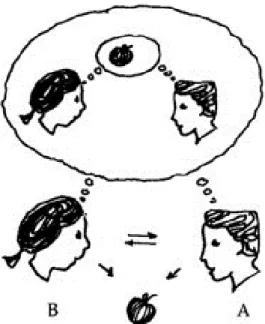
Figure 1. From Mundy & Jarrold (2010): "An illustration of integrated triadic
information processing during joint attention" ... 8
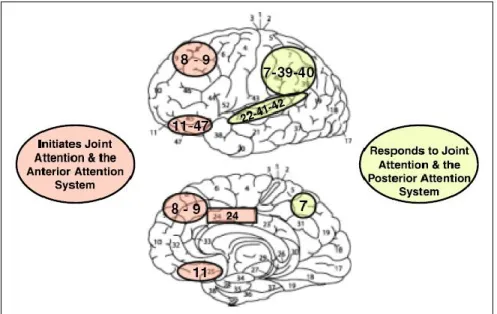
Figure 2. From Mundy & Newell (2007): Illustration of the attention networks in relation to the development of JA skills ... 13
Figure 3. Screenshot from online survey, with sample items and possible responses... 18
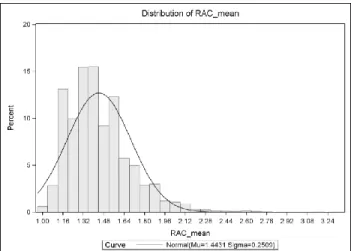
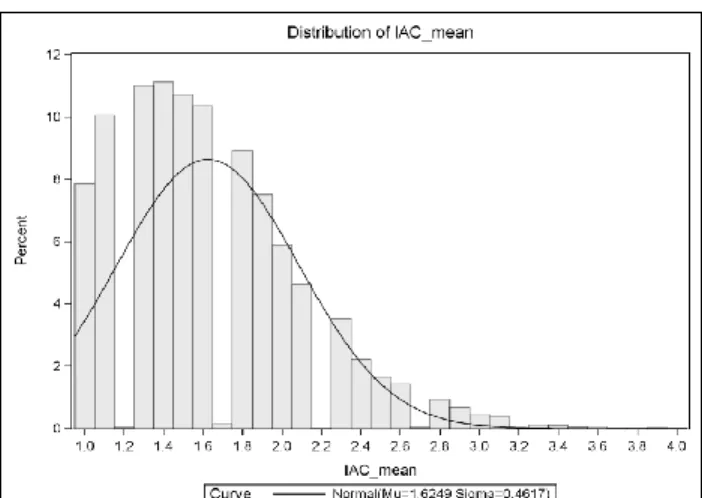
Figure 4. Distribution of mean RAC scores using the new scoring algorithm ... 27
Figure 5. Distribution of mean IAC scores using the new scoring algorithm ... 28
LIST OF ABBREVIATIONS
ASD autism spectrum disorder
EDP Early Development Project
EEG electroencephalography
EF executive function
ERP event related potential
FYI First Year Inventory
IAC initiating attention coordination
IBR initiating behavior requests
IJA initiating joint attention
RAC responding to attention coordination
RBR responding to behavior requests
RJA responding to joint attention
SAE sensory and attentional engagement
Chapter 1. Introduction
Current research in infant and toddler development is often based on identifying
behaviors that differentiate typical and atypical trajectories of development. In recent decades,
developmental psychology has begun to embrace the benefits of neuroimaging and more
physiologically-based technologies and research methods with the goal of linking infant behavior
to underlying biological factors. Although this type of multidisciplinary research remains
relatively scarce, especially in young infants, the surge in interest stemming from researchers,
funding agencies and the media in the causes and symptoms of neurodevelopmental disorders
has resulted in increased emphasis on the identification of behaviors during infancy that are
predictive of later cognitive development.
The First Year Inventory (FYI) (Baranek, Watson, Crais, & Reznick, 2003) was
originally developed with the goal of identifying 12-month old-infants at-risk for an eventual
diagnosis of autism spectrum disorder (ASD) (Reznick, Baranek, Reavis, Watson, & Crais,
2007). The FYI was created by combing through videotapes of birthday parties of infants who
later received ASD diagnoses, as well as by examining the literature on potential early atypical
behaviors that may be linked to risk for ASD. Using these various sources, the team was able to
identify a set of ‘unusual’ behaviors that may be indicative of early signs of risk.
Since its development, the FYI has undergone numerous adaptations, mostly in regards to
its scoring. In its first use, the FYI was scored in terms of cumulative risk percentile, balanced
percentile of risk were flagged as “at risk.” A subset of the initial cohort was re-contacted at age
three (Turner-Brown, Baranek, Reznick, Watson, & Crais, 2013), and researchers soon
determined that scoring could be improved by using specific criteria for the two primary domains
of risk: social-communicative and sensory-regulatory functions. In order to be flagged as “at
risk”, infants needed to score above the cut-points for both domains (Reznick et al., 2007).
Although this method of scoring has more accurately identified infants who do eventually
receive a diagnosis of ASD, it remains to be seen how the measure may be used to identify
various dimensions of behaviors for both typically and atypically-developing infants.
With a push by the NIH for more dimensionally based research (RDoC) (NIMH research
domain criteria (RDoC)), it is important to establish measures and scoring algorithms that allow for quantitative analyses of symptomatology, in addition to, or instead of, diagnostic categorical
analyses. This goal has been presented numerous times in the ASD literature, from the idea of
the Autistic Continuum (Baron-Cohen, Wheelwright, Skinner, Martin, & Clubley, 2001) to the
Broad Autism Phenotype (Piven, 2001). Both of these considerations, among others, view
autistic symptomatology as expressed along a continuum, with those individuals who are the
furthest along the continuum, that is, having the most severe symptoms, being the ones who are
diagnosed with ASD. To some degree, however, the point on this continuum that determines
whether an individual has symptoms severe enough to warrant a diagnosis remains arbitrary.
Those individuals who fall close to this point may still have severe deficits in many areas of
functioning, but do not receive any type of assistance because they have not been diagnosed with
a clinical disorder that warrants intervention.
The FYI remains a valuable tool for assessing infant behaviors, especially those
project was not to discount the work currently being done based on the original scoring of the
FYI in terms of assessing risk for an eventual diagnosis, but rather to expand the application of
the measure by developing a scoring paradigm that provides an informative profile. The first step
in this expansion was to take the items in the FYI and combine them in new constructs that
would be more appropriately applied to the entire range of typical and atypical development.
These new ways of scoring the FYI would also focus less on a risk cut-off and more on
dimensions of behaviors. After substantial review of the research of behavioral and neurological
correlates of infant behaviors, and considering the interests of those involved, it was determined
that creating constructs based on different patterns of infant attention was a valuable direction to
take. Much is known in the current infant and child development literature about attention,
allowing for the creation and refinement of three constructs of attention derived from the FYI.
My thesis will provide a background on the development of attention and the importance of
infant attention in the study of typical and atypical cognitive development, describe the process
of creating the definitions of the new constructs, and present initial findings based on previously
collected longitudinal data.
Early Development of Attention
In early infancy, measures of looking time are some of the most commonly-used
techniques for studying a variety of cognitive, sensory and perceptual constructs. Paradigms such
as habituation and familiarization allow researchers to make inferences about infants’ cognitive
processing in terms of how much attention is paid to a particular stimulus. Preferential looking
paradigms have been used in infants as young as a few days old (see, for example, Batki,
Baron-Cohen, Wheelwright, Connellan, & Ahluwalia, 2000; Farroni, Csibra, Simion, & Johnson, 2002).
increasingly complex. Neonates are unable to visually process anything much more complicated
than simple geometric shapes or faces, but as they mature, infants become able to process stimuli
that include different colors, shapes, movement and even multimodal components.
Infant looking behaviors display drastic changes over the first year of life. Although there
are individual differences in how infants perceive and process particular stimuli, research has
established a consistent trajectory of duration of looking time during the first year. Between birth
and about 3 ½ months, infants show increased looking time to stimuli as a result of the
continuing maturation of the visual system and the increasing ability of infants to obtain and
process greater loads of information. After this period, there is a steady decline in look duration
until about six months of age, which is attributed to increased efficiency of the perceptual
system, as infants do not require as much time to scan and process the stimuli (Colombo &
Mitchell, 1990; Colombo, 2001; Colombo, 2002).
Beyond six months looking time varies based on the complexity of the stimulus, with
more salient, dynamic and patterned stimuli eliciting longer looking times than static, geometric
shapes. By this point the visual system is considered to be close to functionally mature, so
increased looking time to more complex stimuli is thought to reflect an infant’s ability to obtain
and process greater amounts of information (Colombo et al., 2004; Courage, Reynolds, &
Richards, 2006; Richards, 2010).
In addition to looking time, research has also focused on infants’ increasing abilities to
disengage from stimuli or to shift attention. In the 1960s and 1970s, researchers explored a
behavior they called “obligatory looking,” that is, when an infant is unable to disengage from a
stimulus, which occurred in infants between birth and around two months of age (Stechler &
has been studied extensively over the past few decades (Colombo, Richman, Shaddy, Follmer
Greenhoot, & Maikranz, 2001; Hopkins & van Wulfften Palthe, 1985; Hunnius & Geuze, 2004).
With further development of attention networks of the brain (to be described later), infants lose
the propensity to become “stuck” looking at a particular stimulus and become better able to shift
attention more reliably and with shorter latencies (Hood & Atkinson, 1993; Johnson, Posner, &
Rothbart, 1991).
Deficits in disengagement and/or attention shifting are commonly associated with ASD,
with many studies indicating a delayed or decreased ability to disengage. These impairments are
related to perseverative and repetitive behaviors present in ASD, as it is hypothesized that
overfocusing may lead to sensory overstimulation and that repetitive behaviors serve as
self-regulatory mechanisms (Liss, Saulnier, Fein, & Kinsbourne, 2006).
Attention and Cognitive Development
As previously described, the most widely used paradigms for studying infant behavior
include looking time (i.e., habituation and familiarization). For infants who have developed
voluntary control of attention, it is generally accepted that looking time to a particular stimulus
reflects attention paid to it. For example, in habituation paradigms we assume that an infant will
look at, or pay attention to, a stimulus until it is no longer salient or novel. Taken a step further,
information-processing perspectives propose that infants who habituate more quickly to new
stimuli are capable of faster processing, which is reflected in a variety of different cognitive
skills later in life.
Colombo & Mitchell (1988, 1990) characterized infants as “short lookers” or “long
lookers” based on individual differences in measures of fixation duration. Such classifications
These relations support the information-processing notion that faster processing during infancy,
which can be detected through simple looking time paradigms, is highly predictive of a variety of
aspects of learning (Colombo, Mitchell, Coldren, & Freeseman, 1991), intelligence (Fagan,
Holland, & Wheeler, 2007; McCall, 1994; Sigman, Cohen, & Beckwith, 1997) and memory
(Courage & Howe, 2001; Rose, Feldman, & Jankowski, 2003).
Joint Attention
“Joint attention may be conceived of as a self-organizing system that facilitates
information processing in terms of social learning” (Mundy et al., 2009). The broad construct of
joint attention, defined as “the ability to coordinate visual attention with others regarding objects
and events” (Mundy & Gomes, 1998) has received significant focus as an early predictor of a
number of cognitive skills. The relation between joint attention and cognitive abilities is
especially strong in the ASD literature, where early deficits in aspects of joint attention are
strong predictors of later social and cognitive impairments. The majority of research on joint
attention emphasizes two primary constructs: responding to joint attention (RJA) and initiating
joint attention (IJA). Secondary constructs that are often evaluated in addition to RJA and IJA
are responding to behavior requests (RBR) and initiating behaviora requests (IBR) (Mundy et al.,
2007; Vaughan Van Hecke et al., 2007). Although all four of these constructs will be discussed,
more emphasis is placed on IJA and RJA and the roles of these constructs in individual
differences in the trajectories of cognitive and social development.
Gaze following, which involves an infant turning his/her eyes in the same direction as the
eyes of another person, is considered to be a precursor to responding to joint attention (Bedford
et al., 2012). This ability is often considered more perceptual than attentional, with there being a
necessarily include a shift in focus towards a particular stimulus. Those who consider gaze
following distinct from joint attention point this out as the main difference. Joint attention must
be triadic – there must be intent to communicate that the other individual should look at a
particular stimulus (see Figure 1). Gaze following, on the other hand, can be dyadic. Researchers
argue that gaze following indicates that young infants are able to follow another’s gaze but do
not necessarily understand the purpose (Bedford et al., 2012).
Responding to joint attention (RJA) refers to a person’s ability to follow the direction of
the gaze and/or gestures of others in order to share a common point of reference (Mundy &
Newell, 2007). RJA can be measured in infants as young as three months of age, although there
is a significant increase in correct responses up to 18 months (Mundy et al., 2007). Responding
to behavior requests (RBR) can be thought of as a sub-construct of RJA. With the primary
inclusion criteria that an act of RJA includes one person making a bid, another person
responding, and a specific target, the requested behavior is considered the target. The attention is
being directed to the desired behavior, maintaining the triadic nature of RJA.
Initiating joint attention (IJA) refers to a person’s use of eye contact, gestures and/or
words to direct others’ attention to objects, events or him/herself (Mundy & Newell, 2007). IJA
does not begin to function reliably in infants until closer to one year of age. IJA requires the
child to indicate to another individual that he/she should look at something, most commonly
through the use of gestures or words. In these behaviors, the infant has intentional control over
his/her own bids for joint attention. It is thought that this increasing control allows the infant to
explore and learn at a level that is not available through the more reflexive or passive nature of
RJA (Mundy et al., 2007). Similar to the RJA/RBR consideration above, IJA and IBR are often
Like the broad construct of attention, aspects of joint attention have been established as
strong predictors of later cognitive and social abilities. In fact, joint attention is considered by
many to be the first indicator of social cognition (Frischen, Bayliss, & Tipper, 2007; Mundy &
Newell, 2007). Both RJA and IJA are predictive of language skills in early childhood (Delgado
et al., 2002; Mundy, Sigman, & Kasari, 1990; Mundy et al., 2007), as well as social competence
(Vaughan Van Hecke et al., 2007) and self- and emotion-regulatory behaviors (Morales, Mundy,
Crowson, Neal, & Delgado, 2005; Vaughan Van Hecke et al., 2012). Further, IJA specifically
has been linked to aspects of executive function, such as working memory and response
inhibition (Bell & Fox, 1992; McEvoy, Rogers, & Pennington, 1993; Mundy, Card, & Fox,
2000; Stuss, Shallice, Alexander, & Picton, 1995).
Joint attention has historically been measured in laboratories using standardized
procedures that prompt RJA and IJA behaviors. The most commonly used measure is the Early
Social Communication Scales (ESCS) (Mundy et al., 2003), a structured 20-minute interaction
between an experimenter and an infant that can be used with children aged 6-30 months. The
ESCS utilizes a variety of presses in a standardized sequence in order to elicit either responses or
bids for joint attention from the child. Other paradigms have been utilized with frameworks
similar to that of the ESCS (e.g., MacDonald et al., 2006). Joint attention can also be coded
during other laboratory assessments or naturalistic observations. More recently, eye tracking
(Chawarska, Macari, & Shic, 2012; Fletcher-Watson, Leekam, Benson, Frank, & Findlay, 2009;
Navab, Gillespie-Lynch, Johnson, Sigman, & Hutman, 2012), EEG/ERP (Henderson, Yoder,
Yale, & McDuffie, 2002; Mundy et al., 2000; Striano, Reid, & Hoehl, 2006) and neuroimaging
(Grossmann & Johnson, 2010; Mosconi et al., 2009) measures have been added to the literature,
providing physiological and neurobiological support to behavioral claims. Further, numerous
studies have documented the strong relationship between joint attention deficits in young infants
and a variety of cognitive and social impairments in individuals diagnosed with ASD (Dawson et
al., 2004; Leekam, López, & Moore, 2000; Mundy et al., 1990; Mundy & Crowson, 1997;
Mundy, Sullivan, & Mastergeorge, 2009).
Neurobiological Bases of Attention
The constructs discussed above can be substantiated and modified based on our current
understanding of the underlying neurological bases of attention. Posner and Peterson (1989) first
described the attention networks of the brain. Today, there has been little change to the model,
with added support from newer neuroimaging technology (Petersen & Posner, 2012; Posner &
Rothbart, 2007). In this section, unless otherwise noted, information about the structures and
systems involved in attentional behaviors is a summary based on a select group of relevant
publications (Atkinson & Braddick, 2012; Keehn, Müller, & Townsend, 2013; Mundy, Fox, &
The first system to develop is the alerting network, which is responsible for voluntary
alertness and the system of internal attentional mechanisms responsible for information
processing. It also controls phasic alertness or involuntary or reflexive physiological reactions to
changes in the environment and is primed for novelty detection.
The brain regions involved in this network include the more primitive structures of the
brain, as well as the neurotransmitter norepinephrine (NE), which is primarily involved in
sleep/arousal mechanisms. The involvement of such areas and NE suggests that the attention
behaviors controlled by this particular network are less voluntary.
The alerting network has also been found to control early sustained attention, a
characteristic that supports the functionality of the habituation and familiarization paradigms
used in early infancy. At this age, shorter looking times are considered “better”, or indicative of
faster information processing. Toward the latter half of the first year, sustained attention is taken
over by the executive attention network and is considered more effortful. At this time, longer
looking times are associated with higher levels of information processing.
The second network to develop, the orienting network, is responsible for selective attention that allows the brain to filter information, respond to certain stimuli and ignore others.
This network controls both voluntary and involuntary attentional disengagement and shifting,
overlapping in many areas with the alerting network. The orienting network has been described
as “functionally mature between 3 and 6 months of age” (Cuevas & Bell, 2013). The
development of this network has also been associated with the loss of “obligatory looking.” The
orienting network allows for more voluntary control of attention, and is thought to continue to
Brain regions responsible for activity in this network include more posterior areas, as
well as those known for their involvement in visual processing. The cerebellum also plays a role
in both overt and covert orienting of attention. Research suggests that this network accounts for
both reflexive and voluntary orienting, which is further supported by the role of acetylcholine
(Ach), the primary neurotransmitter in this network. Ach has been shown to be responsible for
more rapid attention shifting.
The orienting network is also related to the onset of joint attention capabilities, beginning
with gaze following. Gaze following is considered to be the earliest form of social cognition and
can be detected behaviorally as early as three or four months (D'Entremont, Hains, & Muir,
1997; Farroni, Johnson, Brockbank, & Simion, 2000; Hood, Willen, & Driver, 1998) and
neurologically by four to six months (Farroni, Johnson, & Csibra, 2004; Reid, Striano, Kaufman,
& Johnson, 2004). The ability of an infant to detect and follow the gaze of another individual
reflects the development of the ability to disengage and shift attention. Gaze following is
considered to be a precursor to responding to joint attention (RJA), which differs from gaze
following in that it is considered to include an understanding of intent. The orienting network has
been further implicated in the development of imitation or other behaviors associated with the
perception of the eye and head orientation of others.
The last network to develop, the executive attention network, begins to emerge later in the first year with continued development throughout toddlerhood. This network is commonly
associated with the higher-order cognitive skills of attentional control and executive function. As
mentioned previously, this network takes over the role of sustained attention. Toddlers are able
to more intentionally select and maintain focused attention on a particular stimulus. At this point
associated with more mature cognitive processing such as executive function (EF), which
includes a variety of associated higher-order cognitive processes. In early childhood, three
separate but related components of EF have been identified: cognitive flexibility or set shifting,
response inhibition and working memory.
Neurologically, the regions associated with this network are more anterior to the alerting
and orienting networks, again supporting protracted development. The executive attention
network includes areas of the prefrontal cortex, medial frontal regions such as the anterior
cingulate cortex, the basal ganglia and the cerebellum. These areas interact to allow individuals
to respond more effectively to increasingly complex situations.
The executive attention network has been strongly linked to the development of active
emotional regulatory strategies (Graziano, Calkins, & Keane, 2011), as well as the ability to
initiate joint attention (IJA). Because IJA requires more volitional control of attention, the
protracted development of the frontal areas previously described supports behavioral research
suggesting that IJA behaviors cannot be reliably measured until close to 10 months or later.
The development and differentiation of these three attention networks suggests that
attentional behaviors during infancy can not only be observed behaviorally, but also that the
individual differences in these behaviors that may be indicative of typical or atypical
development may emerge long before age one. Consideration of the neurological underpinnings
of attention in addition to the extensive behavioral research on attention and joint attention
The Current Study
My primary goal in this project was to establish a new technique for scoring the FYI,
with the intent of creating domains that will allow for the dimensional evaluation of individual
differences in patterns of behaviors at age one. The broad construct of attention was chosen as
the focus of the new criteria for multiple reasons: its strong link to a variety of cognitive and
social outcomes, its salience in the literature of both typical and atypical infant and toddler
development and the research interests of the individuals involved. Constructs were established
through multiple steps of validation, the first being the information gleaned from the literature on
trajectories of the development of attention, with considerations of both behavioral and
neurological systems, as described above. The second step was to survey other individuals
knowledgeable about infant behavior. We provided operational definitions of new constructs and
asked that they group FYI items based on these definitions in order to assess the “top-down”
validity of constructs. The third step was to test for statistical validity. This involved first
for a more dimensional profile of typical and atypical patterns and trajectories of cognitive
development. Constructs were then evaluated for internal consistency and correlated with
original FYI risk domains. The fourth step was to assess the relation of the new constructs to
clinical outcomes, using existing FYI follow-up data from the Social Responsiveness Scale –
Preschool version (Pine, Luby, Abbacchi, & Constantino, 2006) as a dimensional measure of
Chapter 2. Methods
Participants
The development of the three new constructs involved multiple samples of participants.
For analyses of statistical validity, participants included all infants for whom parents had filled
out the FYI both in the original FYI cohort (N = 1305) and as part of the Early Development
Project (EDP) (N = 7823), for a total sample size of 9571. The original FYI cohort was recruited
via an invitation mailed to parents of infants within 2 weeks of the infant’s first birthday.
Mailings were sent to families whose birth record indicated that they lived in the 6 counties
closest to Chapel Hill. Longitudinal follow-up has been conducted with various subsets of this
cohort at 2 years, 3 years, 5 years and 8 years. The EDP is an ongoing study in the Department of
Allied Health at the University of North Carolina – Chapel Hill (UNC-CH). Using birth records,
EDP sends FYIs to all parents of infants approaching their first birthdays and who reside within a
nine-county radius of UNC-CH. This project utilizes the previously-described risk domains to
identify infants at risk for an eventual diagnosis of ASD. If flagged as “at risk,” parents are
notified and invited to participate in an intervention study.
Data for predictive analyses using the Social Responsiveness Scale – Preschool version
(SRS-P) (Pine et al., 2006) came from a subset of the original FYI cohort who was contacted
again at age three to participate in a variety of follow-up measures, including the SRS-P and the
ADOS (Lord et al., 2000) and the Vineyard Adaptive Behavior Scales – Second Edition
(VABS-2) (Sparrow, Cicchetti, & Balla, 2005) were obtained for a subset of children (N=38)
(Turner-Brown et al., 2013). Of the families re-contacted, 735 completed the SRS-P, allowing for an
initial test of the predictive value of the new constructs.
In addition to FYI participants, and as one assessment of theoretical validity, a number
of colleagues (N = 22) were surveyed to assess the clarity of definitions and the grouping of
items. The survey was first sent to other developmental researchers (N=15) who each left a
number of comments that influenced the changes we made in our construct definitions and item
groupings. The survey was later sent to undergraduate research assistants working in our
research group (N=7). These students also provided feedback in the survey as well as during
group discussions, resulting in final adjustments.
Construct Development
There were many steps taken and multiple iterations of the item groupings in order to
maximize both theoretical and statistical validity. All questions from the FYI were initially
considered individually, with a focus on ties to specific aspects of attention as defined above.
Given the predictive strength of RJA and IJA in both the typical and atypical developmental
literature, we wanted to represent these constructs in our new configuration of items. Although
these constructs are strictly defined in the majority of the joint attention literature (MacDonald et
al., 2006; Mundy et al., 2003; Mundy et al., 2007), we were interested in including RBR and IBR
in our operational definitions of joint attention behaviors. Further, strict qualifications of RJA
and IJA require a triadic interaction between child, adult, and a third object or person, including
the self. Our constructs were further expanded to include any bid to coordinate attention, whether
clear about whether the bid comes from the adult or the child, in order to establish whether the
child is the initiator (Initiating Attention Coordination – IAC) or the responder (Responding to
Attention Coordination – RAC).
Based on early behavioral and neurological theoretical support as well as the nature of
skills as represented in both the typical and atypical developmental literature, we established the
third construct to cover sustained attention and attention shifting. In addition to these processes,
this third construct includes attention to self (including repetitive movements) and perseverative
attention to objects or self. In addition, given the recent focus in ASD research on sensory
abnormalities, we were interested in how certain sensory items in the FYI would fit into this
domain. Previous research describes the relation of sensory characteristics with “overfocusing
behaviors” (Liss et al., 2006), supporting the combination of these items into a construct called
Sensory and Attentional Engagement (SAE).
After establishing our three constructs, we wrote operational definitions of each, with the
intent that others would group items the same way according to these definitions. Once all items
in the FYI were classified into one of the three new constructs or omitted, we adjusted the
scoring patterns for each FYI item to reflect our interest in a more dimensional approach to the
scoring of attention. Instead of assigning risk points, we used a categorical, Likert-type scoring
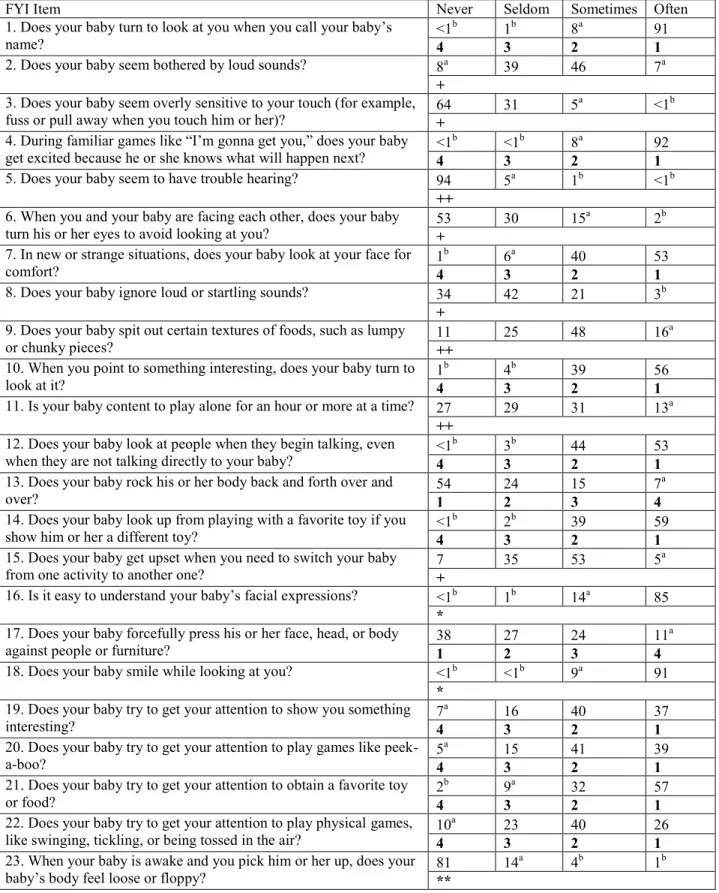
(1 through 4). Original FYI scoring and the new dimensional scoring are displayed in the
Appendix. Infants’ scores on each construct were calculated as the average of the scores on all
items included in that construct. Using SAS 9.3 (SAS Institute, Cary, NC), we calculated
Cronbach’s alphas and intercorrelations among the items in each construct, using a full database
and scores on risk criteria from the original scoring algorithm to explore any overlap or
uniqueness. These analyses resulted in closer examination of items with low intercorrelations.
Adjustments were made to the groupings if existing research confirmed the exclusion of such
items, and operational definitions were clarified to reflect these changes.
The next step was to survey fellow researchers who had at least a moderate understanding
of infant behavior (N=15, described above). An online survey was created that included the
current operational definitions on each page and a list of all items on the FYI (even those we had
omitted from our groupings). Respondents were instructed to classify each FYI item into one of
four groups (our three constructs and “none of the above”) based on the definitions provided.
They were also encouraged to provide comments about any lack of clarity, items they thought
could belong in more than one construct or any other concerns or confusion about specific items
(see Figure 3). Feedback from comments as well as agreement on the sorting of items provided
valuable assistance in further refinement of not only the operational definitions, but also the
items in each construct.
Figure 3. Screenshot from online survey, with sample items and possible responses
surveyed a second group of researchers. This group included all of the undergraduate research
assistants in our research group (N=7). For this group and with the revised definitions, agreement
was generally high (90% for the items in the three constructs), but additional feedback allowed
us to continue to refine operational definitions, this time with inclusion and exclusion criteria,
and make additional decisions about item grouping. Analyses were again conducted to ascertain
the strength of intercorrelations and internal consistency across each construct, as well as to
compare new constructs to the original FYI risk domains. Although some items remained
questionable, continued discussion and consideration of previous research and statistical validity
confirmed their inclusion. Table 1 shows the evolution of construct definitions and indicates the
different names of constructs assigned throughout the development process. Although the names
of the constructs changed throughout, the main focus of each remained consistent. The bottom
Table 1. Evolution of construct definitions
Date Construct 1: Construct 2: Construct 3:
Early October, 2013
Social-affective responsiveness involves dyadic interactions with a social partner. It includes motivation to engage in social interactions, showing interest in and/or taking pleasure in interactions with others, expressing agreeableness and positive affect with social partners, communicating feelings with a social partner, and integrating behaviors of self with others during social interactions.
Initiating joint attention involves the use of gaze, gestures, and/or vocalizations to direct the attention of others to a specific person or object, or to engage in a desired activity
Attentional flexibility involves the ability to transfer attentional focus between one or more
objects/activities/persons in a social or non-social setting. This flexibility can include responding to bids for joint attention; disengaging from one stimulus to follow the gaze or gesture of another person. Flexibility also includes the ability to respond appropriately to a new or changing situation, and to explore new and different methods of exploratory or play behaviors with minimal prompting or enforcement by a parent, caregiver or peer. By contrast, deficits in attentional flexibility involve such perseverative actions as repetitive behaviors or the inability to disengage from a particular activity or stimulus.
Mid-October, 2013
Social-affective engagement refers to the degree to which a child shares and expresses positive affect toward and interest in a social partner (adult or other child), as well as the degree to which the child responds to, joins in and enjoys socially-directed games initiated by an adult social partner, such as imitation. This construct also includes anticipatory behaviors or affect in response to a bid for social engagement. In addition, we include the broadly defined construct of sociability – seeking and taking pleasure in interactions with others. This construct DOES NOT include passive orienting (turning to or looking) in response to an adult-initiated bid for a child’s attention or engagement or a child’s initial bid for attention from a social partner. Rather, it requires the child’s reciprocal affect sharing or engagement in an activity (i.e. social game or affective communication) that has been initiated by an adult or peer.
Initiating joint attention is defined as a child’s use of gaze, gestures, and/or vocalizations to begin a social interaction and/or to make a bid for a social partner’s attention to himself or herself, to an object, toy or other desired item, or to engage in a desired activity. Initiating joint attention goes beyond social reciprocity and requires that the child more actively work to engage the attention of a social partner. This behavior requires higher-order cognitive skills, as controlled by more anterior areas of the brain (i.e. the executive attention network; Posner & Peterson, 1991; Mundy, Card & Fox, 2000). IJA has been strongly linked to later aspects of executive function, and early deficits of IJA have been noted as early markers for children at risk for a diagnosis of ASD. An example of IJA would be an infant directing an adult’s attention towards a particular toy in order to indicate to the adult that the child desired to play with the object.
Attentional flexibilityis defined as the child’s ability to disengage from a current point of attentional focus and move his or her attentional focus (via head turn or gaze shift) toward another object, event, person, or location. When an exogenous social and/or nonsocial stimulus is presented, attentional flexibility requires that the child turn or look away from what he or she was doing, and orient to the new stimulus. This construct only includes acts of orienting to a new stimulus, disregarding any further engagement. This orienting behavior develops early and involves the posterior attention network, as defined by Posner and Peterson (1991). Impairments in attentional flexibility can be seen if the child fails to move his or her focus of attention in response to a stimulus presented either by a social partner or elicited from a nonsocial object, or when the child requires several prompts or greater stimulus input to move his or her attention away from the current point of focus and toward the new stimulus. Additionally, this construct refers to the breadth and diversity (or lack thereof) of the child’s exploration during engagement with toys, objects, or activities. Deficits in attentional flexibility in this respect would thus involve a child’s perseverative looking and/or limited repertoire of actions on a stimulus or object for a prolonged period of time. Thus, repetitive behaviors that only involve the body/motor
Mid-November, 2013
Responding to Attention Coordination (RAC) involves a child’s behavioral response to an adult’s initiation of a bid for attention and/or social interaction. The adult’s bids can include the use of vocalizations, gestures, bodily actions, or offering, showing, or acting on a toy or object. The child’s response may involve orienting to (turning to or looking at) or reciprocating with an action in response to one or more of those adult-initiated bids for attention or engagement.
Initiating Attention Coordination (IAC) involves a child’s active bid for a social partner’s attention for a variety of purposes, including drawing attention to him- or herself, acquiring a desired object, toy or other item, or engaging in a desired activity. To elicit an adult’s attention, the child can use behaviors such as gaze, gestures, and/or vocalizations. Based on Mundy and colleagues’ work, initiating joint attention and initiating behavioral requests can be considered related constructs involving slightly different levels of skill and underlying motivation. Our definition collapses across these two distinctions and broadens the scope beyond the strict definitions associated with joint attention.
Overfocused Selective Attention (OSA) refers to the degree to which a child focuses on, acts on and/or engages with objects, sensory stimuli, and/or body parts (must include a visual focus). Examples of behaviors that may represent overfocused selective attention include limited exploration, perseverative action repertoires, visual focus on objects, sensory stimuli or body parts, and/or failure to overtly orient to nonsocial salient environmental stimuli. This construct excludes items that refer to repetitive, stereotyped bodily movements that do not involve a visual focus of attention (e.g., body rocking, feet kicking, pressing body, getting body stuck in a position).
FINAL Responding to Attention Coordination (RAC)
involves an adult’s initiation of a bid for attention and/or interaction with a child and the child’s subsequent response (or lack of response or delayed response). The key to inclusion of an item in this construct is that the adult is initiating some act or communication in an attempt to elicit the attention and/or engagement of the child. The adult must clearly be initiating an interaction with the child or bidding for attention (for a variety of purposes) from the child through a behavioral, emotional or communicative act. The adult’s bids can include vocalizations, gestures, bodily actions and/or offering, showing or acting on a toy or object directed toward the child. The child’s response may involve orienting (turning to or looking at),
emotionally reacting or reciprocating with an action in response to an adult-initiated bid for attention or engagement. If the wording of the item is such that the direction of the
interaction is not clear (i.e., who is the initiator and who is the responder) or the child is the initiator of the interaction or bid for attention, then the item is not included.
Initiating Attention Coordination (IAC) involves a child’s active bid for a social partner’s attention for a variety of purposes, including drawing attention to him- or herself, acquiring a desired object, toy or other item or engaging in a desired activity. To elicit an adult’s attention, the child may use communicative behaviors including gaze, gestures and/or vocalizations. The child must clearly be initiating an interaction with an adult or bidding for attention (for a variety of purposes) from an adult through a behavioral, emotional or communicative act. Based on previous research, initiating joint attention and initiating behavioral requests can be considered related constructs involving slightly different levels of skill and underlying motivation. IAC collapses across these two distinctions, building on, but also broadening the scope beyond, the strict definitions associated with initiating joint attention. If the wording of the item is such that the direction of the interaction is not clear (i.e., who is the initiator and who is the responder) or the adult is the initiator of the interaction or bid for attention, the item is not included.
Sensory and Attentional Engagement (SAE) refers to the degree to and manner in which a child attends to and/or acts on objects, sensory features of objects, or his/her own body. Behaviors can include visually examining, acting on or exploring objects, body parts or sensory features. Examples that may represent SAE include visual focus on objects, sensory stimuli or body parts, focused or limited exploration or perseverative action repertoires. Items that involve automatic, reflexive orienting to sensory stimuli are not included.
Predictive Value of New Constructs
The Social Responsiveness Scale (SRS) (Constantino & Gruber, 2005) is an instrument
designed to quantitatively measure the severity of ASD symptomatology in children older than
age four. This scale focuses on social impairment, assessing social awareness, social information
processing, social anxiety/avoidance, capacity for reciprocal social interaction and other traits
relevant to ASD, and can be completed by a parent or teacher. In contrast to other
commonly-used measures assessing symptoms of ASD, the SRS does not provide a categorical outcome in
regards to the presence/absence of the disorder. Instead, this measure provides a quantitative
overall score, as well as scores on multiple subscales covering a large range of symptom
severity. These features are consistent with recent research that characterizes autism as a
spectrum or continuum (as described previously), as opposed to a present-or-absent diagnostic
outcome.
The Social Responsiveness Scale – Preschool Version (SRS-P) was developed for use
with children between ages three and four, with items based on the original version of the SRS.
This preschool version has shown high test-retest reliability (Pine et al., 2006) and has been
validated by strong agreement with the social impairment scale of the Autism Diagnostic
Interview – Revised (ADI-R) (Rutter, Le Couteur, & Lord, 2003). The SRS-P was used in this
study to establish predictive validity of new constructs. As discussed previously, the initial FYI
cohort was re-contacted when children were three years old, and the SRS-P was one of many
questionnaires sent to parents. Of the original sample of 1305, 735 parents responded, allowing
Chapter 3. Results/Discussion
Construct Development
In the final iteration of the development process, the following constructs were
established: Responding to Attention Coordination (RAC), Initiating Attention Coordination
(IAC) and Sensory and Attentional Engagement (SAE). Table 2 lists the items included in each
construct. Not all items from the FYI were suitable for these three constructs. Some of these
omitted items ask about specific developmental milestones or regulatory patterns, while others
were removed based on feedback from investigators involved in the original FYI study. For more
details concerning these omitted items, see the Appendix. The original FYI risk scoring also had
Table 2. Final clustering of FYI items in new constructs.
New FYI Constructs Responding to Attentional
Coordination (RAC)
Initiating Attentional Coordination (IAC)
Sensory and Attentional Engagement (SAE)
1. Looks when name is called 7. Looks at your face for comfort 13. Rocks body back and forth
3. Overly sensitive to your touch 19. Tries to get your attention to
show things 17. Presses against things
4. Excited when knows what will happen next
20. Tries to get your attention for interactive games
30. Repeats simple activity over and over
10. Turns to look at pointed out
object 21. Tries to get your attention to obtain a toy 33. Enjoys staring at bright lights
12. Looks at people when they talk 22. Tries to get your attention for
physical games 37. Gets stuck on playing with a part of a toy
14. Looks up from play when shown
new toy 29. Tries to get attention by sound and gaze 42. Enjoys rubbing or scratching objects
15. Upset when switching activities 34. Uses communicative gestures 44. Enjoys making objects spin over and over
24. Imitates mouth sounds 38. Uses finger to point at things 45. Enjoys kicking feet over and over
25. Imitates body movements 46. Stares at fingers while wiggling
them
26. Imitates activities with objects 47. Your baby’s typical play with a
favorite toy
35. Responds to “Where’s ____?” 48. Your baby’s interest in toys on a
typical day
49. When you introduce your baby
to a new game, how he/she responds 59. Does baby keep a toy or object in his/her mouth
50. What you have to do to get your baby to look up from playing with a favorite toy
52. What you have to do to get your baby to turn towards you
53. What you have to do to get your baby to smile or laugh at you
After the rounds of revisions described previously, including rescoring of the questions,
items for each construct were pooled for a variety of analyses in SAS 9.3, including correlations
with initial FYI risk domains, Cronbach’s alphas and univariate analyses in order to examine score distribution. The following results include data from all completed FYIs to date (n= 9128).
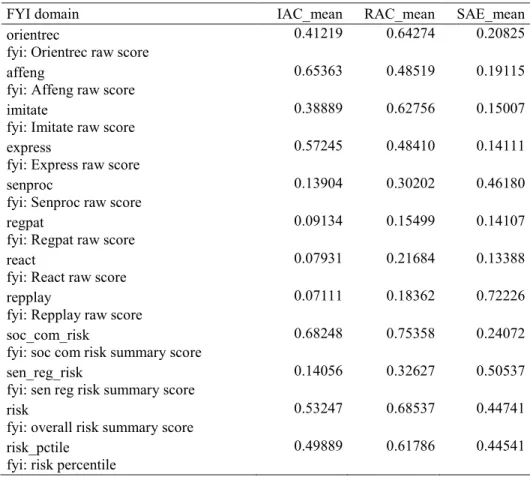
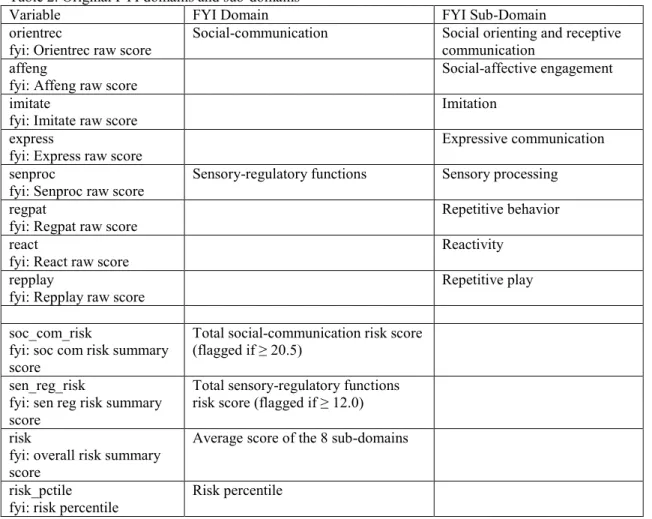
All three of the new constructs were significantly correlated with all of the original FYI domains
(p < .0001 for all correlations), as well as the original risk criteria (see Table 3 for correlations).
These data suggest that the new constructs are indeed related to the original FYI risk domains;
however, correlations are primarily in the low to moderate range, suggesting that the new
constructs offer some unique insight into infant behavior that was not previously obtained (see
Appendix for full descriptions of the original FYI variables).
Table 3. Pearson correlation coefficients between the three new constructs (IAC, RAC & SAE) with the previous FYI domains and risk scores.
FYI domain IAC_mean RAC_mean SAE_mean
orientrec
fyi: Orientrec raw score
0.41219 0.64274 0.20825
affeng
fyi: Affeng raw score
0.65363 0.48519 0.19115
imitate
fyi: Imitate raw score
0.38889 0.62756 0.15007
express
fyi: Express raw score
0.57245 0.48410 0.14111
senproc
fyi: Senproc raw score
0.13904 0.30202 0.46180
regpat
fyi: Regpat raw score
0.09134 0.15499 0.14107
react
fyi: React raw score
0.07931 0.21684 0.13388
repplay
fyi: Repplay raw score
0.07111 0.18362 0.72226
soc_com_risk
fyi: soc com risk summary score
0.68248 0.75358 0.24072
sen_reg_risk
fyi: sen reg risk summary score
0.14056 0.32627 0.50537
risk
fyi: overall risk summary score
0.53247 0.68537 0.44741
risk_pctile fyi: risk percentile
Responding to Attentional Coordination
Definition:
RAC involves an adult’s initiation of a bid for attention and/or interaction with a child
and the child’s subsequent response (or lack of response or delayed response). The key to
inclusion of an item in this construct is that the adult is initiating some act or communication in
an attempt to elicit the attention and/or engagement of the child. The adult must clearly be
initiating an interaction with the child or bidding for attention (for a variety of purposes) from the
child through a behavioral, emotional or communicative act. The adult’s bids can include
vocalizations, gestures, bodily actions and/or offering, showing or acting on a toy or object
directed toward the child. The child’s response may involve orienting (turning to or looking at),
emotionally reacting or reciprocating with an action in response to an adult-initiated bid for
attention or engagement. If the wording of the item is such that the direction of the interaction is
not clear (i.e., who is the initiator and who is the responder) or the child is the initiator of the
interaction or bid for attention, then the item is not included.
The RAC construct consists of 16 items and shows good internal consistency (α = .716).
The range of RAC scores for the entire sample is from 1.0 to 3.34 (M = 1.44; SD = 0.25), with
lower mean scores indicating better parent-reported RAC behaviors. See Figure 3 for a graphical
Initiating Attentional Coordination
IAC involves a child’s active bid for a social partner’s attention for a variety of purposes,
including drawing attention to him- or herself, acquiring a desired object, toy or other item or
engaging in a desired activity. To elicit an adult’s attention, the child may use communicative
behaviors including gaze, gestures and/or vocalizations. The child must clearly be initiating an
interaction with an adult or bidding for attention (for a variety of purposes) from an adult through
a behavioral, emotional or communicative act. Based on previous research, initiating joint
attention and initiating behavioral requests can be considered related constructs involving
slightly different levels of skill and underlying motivation. IAC collapses across these two
distinctions, building on, but also broadening the scope beyond, the strict definitions associated
with initiating joint attention. If the wording of the item is such that the direction of the
interaction is not clear (i.e., who is the initiator and who is the responder) or the adult is the
initiator of the interaction or bid for attention, the item is not included.
The IAC construct consists of 8 items and shows good internal consistency (α = .746).
The range of IAC scores for the entire sample is from 1.0 to 4.0 (M = 1.62; SD = 0.46), with lower mean scores indicating better parent-reported IAC behaviors. See Figure 4 for a graphical
representation of the distribution of mean IAC scores.
Sensory and Attentional Engagement
SAE refers to the degree to and manner in which a child attends to and/or acts on objects,
sensory features of objects, or his/her own body. Behaviors can include visually examining,
acting on or exploring objects, body parts or sensory features. Examples that may represent SAE
include visual focus on objects, sensory stimuli or body parts, focused or limited exploration or
perseverative action repertoires. Items that involve automatic, reflexive orienting to sensory
stimuli are not included.
The SAE construct consists of 12 items and shows good internal consistency (α = .787).
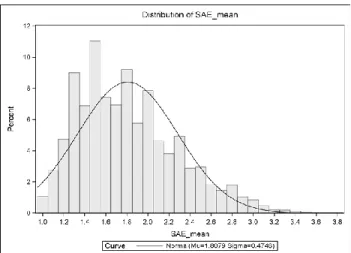
The range of SAE scores for the entire sample is from 1.0 to 3.83 (M = 1.81; SD = 0.47), with
lower mean scores indicating better parent-reported SAE behaviors. See Figure 5 for a graphical
representation of the distribution of mean SAE scores.
Constructs as Predictors of Social Responsiveness
The first FYI cohort was re-contacted at age three, and a subset of this group (N=735)
completed the Social Responsiveness Scale – Preschool version (SRS-P; Pine et al., 2006). The
SRS-P produces a total score, with higher scores indicating increased severity of ASD
symptomatology. All three constructs (RAC, IAC and SAE) at age one were significantly
correlated with SRS-P scores at age three: r = 0.35 (p < .001), r = 0.26 (p < .001) and r = 0.24 (p
< .001) for RAC, IAC and SAE, respectively.
Using SAS 9.3, stepwise multiple regression analysis was conducted to evaluate whether
all three new attention constructs (RAC, IAC & SAE) were predictive of age-three SRS-P scores.
Step one of the analysis entered RAC into the regression equation and this was significantly
related to SRS-P score, F(1,733)=101.94, p <.0001). The squared multiple correlation coefficient
(R2) indicated that 12.2% of the variance in SRS-P score at age three can be accounted for by
RAC score at age one. SAE was entered into the equation at step two and was, in addition to
RAC, significantly related to SRS-P score, F(2,732)=65.77, p <.0001. There was a significant
increment in R2, with 15.2% of the variance in SRS-P score accounted for by both RAC and
SAE. Step three added IAC into the equation, and all three variables remained significantly
related to SRS-P score, F(3,731)=48.28, p <.0001. There was another significant increment in R2, with 16.5% of the variance in SRS-P score accounted for by all three constructs: RAC, SAE
and IAC. Further, simultaneous regression analyses indicate that each construct has a unique
contribution to the variance in SRS-P scores.
For comparison, original FYI risk variables were also entered into a multiple linear
regression model. Although both the sensory-regulatory and social-communicative risk
constructs significantly predicted SRS-P scores at age three, F(2,732) = 54.14, p < .001, these
Chapter 4. General Discussion
Table 1 describes the various iterations of the new construct definitions. Modifications
were driven by both theoretical and statistical tests of validity, and this cyclical feedback allowed
us to establish operational definitions that most clearly differentiate between the constructs and
delineate which items are included in each. Once the items in each construct were finalized,
analyses were conducted to explore both internal consistency within constructs and relations to
previous risk domains. All three constructs showed good internal consistency. When compared
to the original risk domains, there were, as expected, high correlations between the new
constructs and certain previous domains. However, correlations were not so high as to raise
concern that the new constructs were not offering any unique information. This distinction is also
reflected in the relation to SRS-P scores, discussed next.
Regression analyses revealed that the three new constructs are predictive of social
responsiveness scores at age three. The goal of this fourth step of validity was not to make
theoretical claims about the relation of new constructs to the SRS-P as a clinical tool for
diagnostic outcomes, but this analysis was explored in order to establish whether or not the new
constructs could do as well as, or better than, the original risk domains at predicting ASD
symptomatology. Although the percentage of variance explained by the new constructs was
fairly small (R2 = .165), all three (RAC, IAC and SAE) provided significant and unique
contributions. Compared to the original FYI domains, the three attention constructs explain a
difference is not large, it supports the decision to explore different avenues of scoring the FYI.
Further, the new attention constructs represent a quantitative approach to the data and which fall
in line with new initiatives by the NIH to study psychopathology through dimensional, as
opposed to categorical, approaches.
Based on the vast body of research on the links between infant attention and a variety of
later cognitive and social skills, it is important to establish measures that can accurately represent
attentional behaviors effectively by age one. Much can be debated concerning the validity of
parent-report measures, but they remain the most cost-effective and efficient means of obtaining
data about infant behaviors. In considering the value of early identification of risk for ASD, this
need is even more salient.
Limitations and Future Directions
The primary limitation of the development of these constructs from the FYI is that it is a
measure designed to detect risk for ASD, so some of the FYI items may not be appropriate for a
measure attempting to assess attention behaviors across the range of typical and atypical
development. In addition, although significant, the percentage of variance in SRS-P score
explained by the three new constructs is relatively low. Additional longitudinal data will need to
be collected to support the predictive value of the constructs, and there is a need for validation
against well-established attentional measures.
In contrast, by altering the scoring of the FYI items and aiming for a more quantitative
assessment of infant behaviors, it is possible that the new constructs are only appropriate for
looking across typically developing attention skills and may not have any implications for
predictive value in terms of clinical outcomes, but further research needs to be conducted to
delineate such relations.
Another limitation is the relatively low, although significant, R2 value associated with the
three constructs in predicting SRS-P scores. The SRS-P primarily measures social aspects of
behavior, with a sub-category for repetitive behaviors. With constructs that were developed with
an emphasis on attention, it may be more beneficial to use a quantitative assessment that takes
into account more cognitive skills and features that may be impaired in clinical populations. The
SRS-P data were all that was available for the analysis of predictive validity, and although
informative, further research should be conducted to explore more cognitive outcomes.
Planned future directions include using the established constructs to create profiles of
attentional behaviors and to use these profiles to predict a variety of attentional, regulatory and
executive control behaviors at 30 months. Different patterns of attentional behaviors as
determined by the FYI will allow for the prediction of typical and atypical developmental
trajectories of multiple different social and cognitive constructs measured by parent-report
surveys and laboratory assessments. The relation of these profiles of attention as well as
individual construct scores to later behaviors will be another step toward validating new
constructs.
Conclusions
This study defined three new constructs from the items of the FYI, based on the
well-established value of measuring attention in infancy. These constructs were refined and validated
through 1) an extensive literature review on behavioral and neurological correlates of infant
attention, 2) theoretical validity as further determined by the input of other individuals
validity determined by internal consistency and relation to the original FYI risk domains and 4)
an analysis of the new constructs as predictors of clinical outcomes (SRS-P scores). The final
constructs are responding to attention coordination (RAC), initiating attention coordination
(IAC) and sensory and attentional engagement (SAE). Each of these constructs has strong
internal consistency, with Cronbach’s alphas greater than .70, and each construct significantly and uniquely predicted ASD symptomatology at age three. Results support the reconsideration of
APPENDIX
Table 1. FYI scoring – old (top row) & new (bottom row)
FYI Item Never Seldom Sometimes Often
1. Does your baby turn to look at you when you call your baby’s
name? <1
b 1b 8a 91
4 3 2 1
2. Does your baby seem bothered by loud sounds? 8a 39 46 7a
+
3. Does your baby seem overly sensitive to your touch (for example,
fuss or pull away when you touch him or her)? 64 31 5
a <1b
+
4. During familiar games like “I’m gonna get you,” does your baby get excited because he or she knows what will happen next? <1
b <1b 8a 92
4 3 2 1
5. Does your baby seem to have trouble hearing? 94 5a 1b <1b
++
6. When you and your baby are facing each other, does your baby
turn his or her eyes to avoid looking at you? 53 30 15
a 2b
+
7. In new or strange situations, does your baby look at your face for
comfort? 1
b 6a 40 53
4 3 2 1
8. Does your baby ignore loud or startling sounds? 34 42 21 3b
+
9. Does your baby spit out certain textures of foods, such as lumpy
or chunky pieces? 11 25 48 16
a
++
10. When you point to something interesting, does your baby turn to
look at it? 1
b 4b 39 56
4 3 2 1
11. Is your baby content to play alone for an hour or more at a time? 27 29 31 13a
++
12. Does your baby look at people when they begin talking, even
when they are not talking directly to your baby? <1
b 3b 44 53
4 3 2 1
13. Does your baby rock his or her body back and forth over and
over? 54 24 15 7
a
1 2 3 4
14. Does your baby look up from playing with a favorite toy if you
show him or her a different toy? <1
b 2b 39 59
4 3 2 1
15. Does your baby get upset when you need to switch your baby
from one activity to another one? 7 35 53 5
a
+
16. Is it easy to understand your baby’s facial expressions? <1b 1b 14a 85
*
17. Does your baby forcefully press his or her face, head, or body
against people or furniture? 38 27 24 11
a
1 2 3 4
18. Does your baby smile while looking at you? <1b <1b 9a 91
*
19. Does your baby try to get your attention to show you something
interesting? 7
a 16 40 37
4 3 2 1
20. Does your baby try to get your attention to play games like
peek-a-boo? 5
a 15 41 39
4 3 2 1
21. Does your baby try to get your attention to obtain a favorite toy
or food? 2
b 9a 32 57
4 3 2 1
22. Does your baby try to get your attention to play physical games,
like swinging, tickling, or being tossed in the air? 10
a 23 40 26