Decomposition
Bowen Liu and Qiang Tang
Luxembourg Institute of Science and Technology (LIST), 5, Avenue des Hauts-Fourneaux, L-4362, Esch-sur-Alzette, Luxembourg
{bowen.liu, qiang.tang}@list.lu
Abstract. With the proliferation of data and emerging data-driven ap-plications, how to perform data analytical operations while respecting privacy concerns has become a very interesting research topic. With the advancement of communication and computing technologies, e.g. the FoG computing concept and its associated Edge computing technologies, it is now appealing to deploy decentralized data-driven applications. Fol-lowing this trend, in this paper, we investigate privacy-preserving singu-lar value decomposition (SVD) solutions tailored for these new comput-ing environments. We first analyse a privacy-preservcomput-ing SVD solution by Chen et al., which is based on the Paillier encryption scheme and some heuristic randomization method. We show that (1) their solution leaks statistical information to an individual player in the system; (2) their so-lution leaks much more information when more than one players collude. Based on the analysis, we present a new solution, which distributes the SVD results into two different players in a privacy-preserving manner. In comparison, our solution minimizes the information leakage to both individual player and colluded ones, via randomization and threshold homomorphic encryption techniques.
Keywords: Internet of Things · Fog Computing · Edge Computing · Singular Value Decomposition· Paillier Encryption · Threshold Cryp-tosystem
1
Introduction
Internet of Things (IoT) is increasingly appearing in our lives, which promises to connect everyone with everything from everywhere. In practice, IoT generates a large amount of data that is closely related to the human users (or, owners) of the devices. On the positive side, such data can be used for many useful purposes such as building smart services. However, on the other side, it brings huge privacy risks [13]. In most applications, the root of the privacy issue lies in the fact that data needs to be aggregated to a must-to-be trusted service provider before any service can be provided.
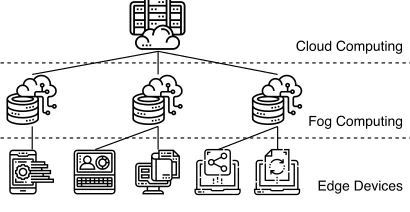
advocating privacy-preserving distributed protocols for decades. Unfortunately, these protocols do not appeal to the real-world applications, which are often designed for the cloud computing paradigm that essentially requires data ag-gregation to a central third-party server. Recently, with the advancement of communication infrastructure (e.g. 5G) and computing technologies such as the FoG computing concept and its associated Edge computing technologies, it has become a trend to design and deploy decentralised applications, which push com-putations to the edge so that it avoids data aggregation to some extent. Coined by Numhauser in 2011 [1], there are many (similar) definitions for FoG comput-ing. For example, Cisco [4] defines FoG computing as a paradigm that extends cloud computing [8] and services to the edge of the network, shown in Figure 1. In reality, FoG Computing can process its services at different nodes in the network as opposed to a central server. It significantly decreases the data move-ment across the network, so as to reduce the congestion, cost, and latency, and it also provides a decentralised infrastructure that naturally facilitates privacy protection. While many FoG-based applications are emerging, it is becoming an interesting research topic to design privacy-preserving solutions for the data exploitation tasks in these applications.
Fog Computing Cloud Computing
Edge Devices
Fig. 1.FoG Computing
1.1 Related Work and Problem Statement
In this paper, we are interested in how to perform Singular Value Decomposi-tion (SVD) based on data from decentralized IoT devices. In machine learning and data mining, SVD is a powerful and fundamental matrix factorization tech-nique. It provides a means to decompose a matrix into a product of three simpler matrices, so that one may discover useful and interesting properties of the orig-inal matrix [6]. It finds many applications in reality. One prominent example is recommender systems [9] which are the cornerstone for many personalization services.
SVD in partitioned dataset, where two players collaborate with each other to perform SVD based on their joint dataset. Their solution is based on a number of cryptographic primitives, and the authors concluded that it is a challenge to reduce the complexity when their solution is used for large dataset. For privacy-preserving matrix factorization (MF) in general, Nikolaenko et al. [10] proposed a garbled circuit-based protocol and Kim et al. [7] proposed a protocol based on homomorphic encryption. In both solutions, the factorization operation is decentralized to two non-colluding servers, one of them controls key materials while the other carries out the factorization operation. When the two servers are compromised at the same time, then everything is leaked. Some further examples include Zhuo et al. [15] utilized full homomorphic encryption to achieve privacy-preserving data statistics on crowd-sourcing data and Zhou et al. [14] utilized one-way trapdoor permutation to realize time series data aggregation for wireless wearable communications.
Despite the literature work, it remains an open problem to design an effi-cient privacy-preserving SVD (or MF in general) protocol that provides rigorous security even when several players are compromised simultaneously.
1.2 Contribution and Organization
In this paper, we aim at rigorous privacy-preserving SVD solutions in the FoG computing paradigm. Firstly, we review the solution by [3] in Section 3 and demonstrate several privacy risks in Section 4. Our analysis covers a number of scenarios, including individual player/attacker and more colluded players/at-tackers. Moreover, we also briefly analyse the recommender use case. Based on the analysis, we simplify the FoG architecture from [3] and present a stronger security model, which captures scenarios where several players may collude. We then propose a new solution based on threshold homomorphic encryption and push some of the heavy computation workloads to the edge. We further analyse the security properties and the asymptotic complexities, as well as benchmark-ing results on a PC. These results appear in Section 5. In addition, we present some preliminary in Section 2 and draw some conclusions in Section 6.
2
Preliminary on Singular Value Decomposition
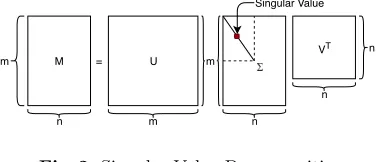
m
n
M =
m m
n
n n Singular Value
U V
T
Fig. 2.Singular Value Decomposition
m×n singular matrix of M, V is a n×n right-singular matrix of M, and T means conjugate transpose. In addition, there are also two relations:
M·MT =UΣVT·VΣTUT =UΣΣTUT; MT·M=VΣTUT·UΣVT =VΣTΣVT
The columns ofU(left-singular vectors) and V (right-singular vectors) are, respectively, eigenvectors of M·MT and
MT ·M. The non-zero elements of Σ
are the square roots of the non-zero eigenvalues ofM·MT and
MT ·M.
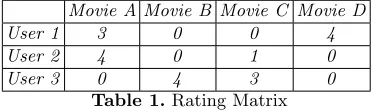
A prominent application of SVD is recommender systems. Using the users’ rating data, a service provider can recommend other films that they might like. As a toy example, suppose we have 3 users’ score records for 4 movies (0 for the case not rated), see Table 1.
Movie A Movie B Movie C Movie D
User 1 3 0 0 4
User 2 4 0 1 0
User 3 0 4 3 0
Table 1.Rating Matrix
For this toy example, after applying SVD to the rating matrix, we can obtain three singular matrices denoted asU, ΣandVT.
U=
−0.784 0.243 0.571 −0.588 0.000−0.809 −0.196−0.970 0.143
Σ=
5.831 0.000 0.000 0.000 0.000 5.000 0.000 0.000 0.000 0.000 2.828 0.000
VT=
−0.807−0.135−0.202−0.538 0.146−0.776−0.582 0.194 −0.538 0.202−0.135 0.807 0.000 0.137−0.158 0.727
In practice, a dimensionnality reduction procedure can be applied to generate small-rank feature matrices. Note that the eigenvalue 2.828 is smaller than the other two values, so that we can choose to suppress it and have a truncated variant ofΣ, namely
Σ∗=
5.831 0.000 0.000 5.000
Accordingly, we generate a variant of Uby removing its last column and a
variant ofVT by removing its last two rows. Let the variants be denoted asU∗
and V∗T respectively. By computing U∗Σ∗
1
2 and Σ∗ 1
2V∗T, we obtain the user
and item feature matrices shown in Table 2 and 3. User 1 -1.893 0.543
User 2 -1.420 0.000 User 3 -0.473 -2.169 Table 2.User Feature Matrix
Movie A Movie B Movie C Movie D -1.949 -0.326 -0.488 -1.299
0.326 -1.735 -1.301 0.434 Table 3.Movie/Item Feature Matrix Based on these feature matrices, a recommender service provider can serve users with predictions on the movies they have not rated.
3
Overview of Chen et al.’s Solution
Second-Layer FoG Device (SDu) (Decomposing ATA)
Second-Layer FoG Device (SDv) (Decomposing AAT) (3) Sending Decrypted Result
(3) Sending Decrypted Result (2) Sending Randomized Data
Randomizing Collected Data
First-Layer FoG Device (FD)
(1) Uploading Encrypted Data
Edge Device ( ED1 )
( EDi )
( EDN )
...
...
Second-Layer FoG Device (SDd)
Fig. 3.Fog Computing Architecture
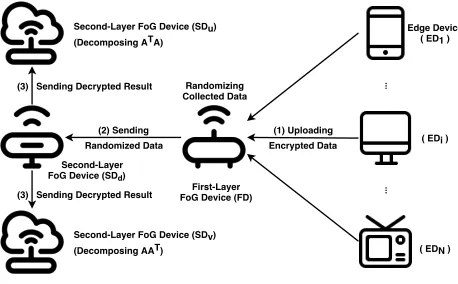
By assuming a FoG architecture, shown in Figure 3, Chen et al. [3] designed a privacy-preserving SVD solution based on some heuristic randomization tech-niques and the Paillier scheme, described in Appendix A. This FoG computing architecture consists of the following types of entities:
– Server: The initialization of the whole system is generated and operated by the server, it is considered as fully trusted node in the FoG architecture. Once, the initialisation is done, the server will not get involved anymore. So, we omit it in Figure 3.
– Edge Devices ED: Each edge device is the original collector of the data and represents the human user behind it.
– First-layer FoG DeviceF D: The FoG device is responsible for collecting the data from edge devices and coordinating the SVD operations.
– Second-layer FoG Devices SDs: There are three different devices in this category.SDddecrypts the received information and obtains the randomized
data matrix, and prepares data for SDu and SDv, who will perform the
decomposition.
3.1 Description of the Solution
Parameter Propose
N Number of Edge Devices (ED)
l Dimension of data vector
x Range of value in data vector: [0,x]
k1 For generatingt= 2k1
W RandomizedW > max(N, l)·x2
S RandomizedS > max(N, l)·(x2+ 2tW x+t2W2)
k2 Bit length ofW
k3 Bit length ofS
~a For transforming vector into number
(λ, µ) Private key of Paillier cryptosystem Table 4: Initialization Parameters
Initialisation. The trusted server will setup the parameters for the system, shown in Table 4. In terms of Paillier cryptosystem [11], the server generates the public key (n=pq, g), and the private key (λ, µ). In the meanwhile, the server generates two random coprime numbers W and S respectively. Additionally, a super-increasing vector ~a = (a1 = 1, a2, ..., al)T is generated, and each value
needs to conform to the following conditions:Pi−1
j=1aj·(x+tW+tS)< ai, i∈
[2, l] andPl
j=1aj·(x+tW+tS)< n. The Paillier private key (λ, µ) is assigned
to SDd, and the private randomization parameters W and S are assigned to
F D,SDu,SDv. All other parameters are public.
Privacy-preserving Protocol. Illustrated in Figure 3, the privacy-preserving protocol runs in four steps.
1. EDi’s data is expressed in vector formd~i= (d1i, d2i, ..., dli)T. Note that the
data fromEDs forms a matrixAas follows.
A=
d11d12. . . d1N
d21d22. . . d2N .
.
. ... . .. ...
dl1 dl2 . . . dlN
(1)
By using the public vector~a, EDi first converts its vector into an integer.
mi =d~i T
·~a=a1d1i+a2d2i+...+aldli
It then encrypts this integer with Paillier public key to obtainci. At the end
of this step,EDi, for every 1≤i≤N, sendsci toF D.
2. After receiving every ci, F Dchooses two vectors z~i= (z1i, z2i, ..., zli)T and
~
ri = (r1i, r2i, ..., rli)T, where each element is randomly chosen from [1, t]. It
then computes the randomization parameterRi=Plk=1ak·(zki·W+rki·S),
and sets the randomized ciphertextc0i as
c0i=ci·gRi mod n2 = (gmi·rn
i)·g
Ri mod n2
= (g
Pl
k=1ak·dki·rn
i)·g Pl
k=1ak·(zki·W+rki·S) mod n2
=gPlk=1ak·(dki+zki·W+rki·S)·rn
i mod n
2
At the end of this step,F Dsends c0i (1≤i≤N) toSDd.
3. After receiving every c0i,SDd decrypts it to obtain
m0i= l X
k=1
ak·(dki+zki·W+rki·S)mod n
Algorithm 1Recover Vector from Integer Input: m0iand~a= (a1, a2, ..., al)T
Output: randomized non-encrypted datad~0i
1: lettmp= (ta1, ta2, ..., tal)
T within empty value inside 2: Xl←m0i=
Pl
j=1ak·(dji+zji·W+rji·S)mod n
3: fork=l to2do 4: Xk−1←Xkmod ak 5: tak←
Xk−Xk−1
ak =dki+zki·W+rki·S
6: end for
7: ta1 ←X1=d1i+z1i·W+r1i·S
8: return d~0i= (ta1, ta2, ..., tal)
T
Now, SDd has the matrix A0 made up by N different randomized
non-encrypted vectorsd~0i = (d01i, d02i, ..., d0li)T.
A0=
h
~ d0
1d~02 . . . ~d0N
i
=
d011d012. . . d01N
d021d
0
22. . . d
0
2N .
.
. ... . .. ...
d0l1 d
0
l2 . . . d
0
lN
(2)
At last,SDd sendsresu =A0·A0T and resv =A0T ·A0 to SDu andSDv
respectively.
4. Withresu,SDuderandomizes every entrye0ij as follows.
e0ijmod S mod W
=(dij+zij·W+rij·S)mod S mod W =(dij+zij·W)mod W
=dij
The resulting matrix isA·AT. Then,SDuperforms eigenvalue decomposition
to obtainUandΣofA·AT, referring to Section 2. Similarly,SDvcan obtain V and Σ of AT ·A. At the end, SDu and SDv will store UΣ
1
2 and VΣ 1 2
respectively. Note that they might apply the dimension reduction procedure, as mentioned in Section 2 , to store smaller feature matrices.
3.2 Recommender Use Case
Referring to the recommender use case described in Section 2, Chen et al. [3] presented a procedure to extend the privacy-preserving SVD protocol to compute predictions of unrated items for the user of any edge deviceED. Assuming this use case, the information thatSDuobtains at the end of privacy-preserving SVD
protocol, namelyUΣ12, can be regarded as the user feature matrix, where the
i-th row is i-the feature vector of i-the user ofEDi. Correspondingly, the information
thatSDv obtains at the end of privacy-preserving SVD protocol, namelyVΣ
1 2,
If the user of EDi wants to retrieve the prediction on the j-th item, the
procedure is detailed below.
1. SDu andSDv randomize Inf oU iandInf oIj withW andS, respectively,
and send the randomized data toSDd. Here, as described above, Inf oU i
stands for the user feature vector ofEDi, whileInf oIj stands for the item
feature vector of item j. As an example, the randomization of Inf oU i is shown in Algorithm 2.
Algorithm 2Randomize data withW andS
Input: Inf oU i,W,S and range of random number [1, t] Output: randomized vectorInf oU i0
1: forevery elementhziofInf oU iwhere 1≤z≤ldo 2: Generate random integerx,yfrom [1, t]
3: h0z1←=hz1+x·W+y·S
4: end for
5: return Inf oU i0= (h01i, h02i, ..., h0li)
2. After receiving the randomized feature vectors Inf oU i0 and Inf oIj0, SDd
computes a randomized scoreScore0 =Inf oU i0{Inf oIj0}T, and sends it to
F D.
3. After receivingScore0,F Dcan derandomize it withW andS to obtain the plaintext prediction forEDi:
Score=Score0mod S mod W =Inf oU i·Inf oIjT
4
Analysis of Chen et al.’s Solution
In [3], Chen et al. analysed all devices of the system, and claimed that none of them has the ability to learn private data under normal operations. However, we show that their solution has a number of vulnerabilities, it leaks information not only to an individual device but also colluded devices (more seriously).
4.1 Information Leakage to Individual Device
At the end of the privacy-preserving protocol,SDvobtainsAT·Awith following
notation.
AT·A=
v11 v12 . . . v1N
v21 v22 . . . v2N .
.
. ... . .. ...
vN1vN2. . . vN N
(3)
Leakage 1. We note that the values vii, for i ∈ [1, N], are in the following
v11=d211+d 2
21+...+d 2
l1
. . .
vN N =d21N+d
2
2N+...+d
2
lN
According to Cauchy-Schwarz inequality [12], based onvii,SDv can deduce
the upper bound about the average of the elements in d~i for each deviceEDi,
namely
Pl j=1dji
l ≤(
vii l )
1 2.
Leakage 2. Taking the elements related toED1as an example,SDvpossesses
the following values.
v11=d211+d 2
21+...+d 2
l1
. . .
vN1=d1Nd11+d2Nd21+...+dlNdl1
Adding all of them,SDv can obtainP N
j=1vj1=P N
j=1d1j·d11+P N j=1d2j·
d21+· · ·+P N
j=1dlj·dl1. Based on the fact that everydji∈[0, x], according to
the law of large numbers [2], the above equality can be approximately written as
PN j=1vj1
N =
1 +x 2 ·d11+
1 +x
2 ·d21+...+ 1 +x
2 ·dl1
Based on this,SDv can obtain the approximate average of the elements in
~
d1for deviceED1, namely 2PN
j=1vj1
N·(1+x)·l. Clearly, the same analysis applies toEDi
(2≤i≤N).
4.2 When two Devices Collude
IfSDuandSDvcollude, they possessU,ΣandVwhich are the singular matrices
of A. It means they can restore all private data as U·Σ·VT =
A. If SDd and
F D collude, they will possess W, S, and the Paillier private key (µ, λ). With this information, they can recover the private data of all EDs. Clearly, ifSDu
orSDv colludes withSDd, they can also recover everything in the same way.
Next, we investigate the case thatSDv and oneEDcollude. Generally, let’s
assume if SDv and EDi collude. They possess d~i and AT · A as defined in
Equation (3).
~
di= (d1i, d2i, ..., dli)T
v1i=d11d1i+d21d2i+...+dl1dli .
. .
v(i−1)i=d1(i−1)d1i+d2(i−1)d2i+...+dl(i−1)dli .
. .
v(i+1)i=d1(i+1)d1i+d2(i+1)d2i+...+dl(i+1)dli .
. .
vN i=d1Nd1i+d2Nd2i+...+dlNdli Below, we describe two simple active attacks.
Attack 1. Being an active attacker,EDican set its vector to bed~i= (1,1, ...,1).
As a result, from the value vji where j ∈[1, N] and j 6=i, SDv andEDi can
learn the average of the elements in the vector ofEDj.
vji
l =
d1j+d2j+...+dlj
l
Attack 2. Similarly,EDi can set its vector to be d~i = (0, ...,1, ...,0) where
they-th element is 1 and all others are 0. In this case, from the valuevji,SDv
andEDi can learn the the elementdyj in the vector ofEDj.
vji=d1jd1i+d2jd2i+...+dyjdyi+...+dljdli=dyj
4.3 When more Participants Collude
Attack 1. Suppose thatSDvandl (or more)EDs collude. If this case, they will
possess AT ·
Adefined by Equations (3) and for example the followingl ~ds. ~
di= (d1i, d2i, ..., dli)T .
. .
~
d(i+l−1)= (d1(i+l−1), d2(i+l−1), ..., dl(i+l−1))T
With the information,SDv may recover the data of anyEDj, forj /∈[i, i+
l−1]. Note that thei-th toi+l−1-th elements from thej-th column ofAT·Aare
defined as follows. The attack is simply to solve the system of l-variable linear equations.
vij=d1id1j+d2id2j+...+dlidlj .
. .
vN(i+l−1)=d1(i+l−1)d1j+d2(i+l−1)d2j+...+dl(i+l−1)dlj
By solving the system of equation, the attacker can obtain all the value of daj wherea∈[1, l].
Attack 2. SupposeSDd andh EDs collude, where his an integer, they will
processA
0
~
di= (d1i, d2i, ..., dli)T .
. .
~
d(i+h−1)= (d1(i+h−1), d2(i+h−1), ..., dl(i+h−1))T
ForEDj, wherej∈[i, i+h−1], the relevant elements inA
0
lie in thej-th column which can be expressed as:
d01j=d1j+zj1·W+rj1·S
. . .
d0lj=dlj+zjl·W+rjl·S
These equations can be transformed into the following form shown in Equa-tions (4), wherezs,rs, andW,S are the unknowns.
d01j−d1j=zj1·W+rj1·S
. . .
d0lj−dlj=zjl·W+rjl·S
(4)
Sincers andzs are random integers chosen from [1, t], according to the law of large numbers [2], we can get an approximated form of the following equation.
1 l ·
l X
i=1
(d0ij−dij) =
1 +t 2 ·W +
1 +t 2 ·S
Since the computation is based on data from EDj, we let Pj denote the
approximated estimation forW+S.
Pj=W+S=
2 (1 +t)·l·
l X
i=1
(d0ij−dij)
Based onPj for allj ∈[i, i+h−1],SDd can try to recoverW andS by a
brute-force attack, shown in Algorithm 3.
OnceW andSare found, the whole matrixAcan be recovered. We emphasize that a brute-force attack has been analyzed in [3], where the attacker tries each possible value of S. The complexity of their attack is O(2k3). In contrast, our
attack enumerates the parameter W which is much smaller than S (as shown in Table 4, S > max(N, l)·(x2+ 2tW x+t2W2)). The complexity of current
Algorithm 3Brute-force the value ofW andS Input: P, Range ofW
Output: Value ofW andS
1: LetLC denote the set of all results ofd0ij−dijwherei∈[1, l] andj∈[1, N] (i.e. Equation (4) forEDj)
2: for eachf in range ofW do 3: SBF ←P−f
4: for eachLCkinLCdo 5: M odSk←LCk moduloSBF 6: end for
7: LetM odS denote the set of allM odSk
8: if GCD(M odS)>1 andcoprime(GCD(M odS), SBF)then 9: return W =GCD(M odS),S=SBF
10: end if 11: end for
4.4 Analysis of the Recommender Use Case
Regarding the recommender use case from Section 3.2, we observe that it has two privacy vulnerabilities. One is thatF Dobtains the prediction score for the edge devices. The score indicates the interest of the human user behind the device, so that it may be considered as private information. Disclosing such information may be considered undesirable by many. The other is that SDd obtains the
randomized feature vectors for all prediction queries. Considering the attack from Section 4.3, SDd may recover W and S, and then recover the plaintext
data from all the devices.
5
New Privacy-Preserving SVD Solution
In this section, we first simplify the FoG architecture shown in Figure 3 and propose a stronger security model. Then, we present a new solution and provide detailed security and performance analysis.
5.1 Security Model
Our new FoG architecture is shown in Figure 4. In comparison to that in Figure 3, we get rid of the involvement of the second-layerSDd device. With this new
architecture, the second-layer devicesSDu andSDv will store the decomposed
matrices, while the first-layer device F Dis responsible for interacting with the edge devices and coordinating the SVD operations.
The purpose of our solution is to perform SVD based on the private data from all edge devices EDi (1 ≤ i ≤ N), where EDi’s input is a data vector
~
di. Note that we assume every data vector is in a column form and all these
data vectors form a data matrix A, as defined in Equation (1). As the output, SDuandSDvshould learn (U, Σ) and (V, Σ) respectively. Any other disclosure
considered as an information leakage. Referring to the description of SVD in Section 2, the legitimate information disclosure is equivalent to disclosingA·AT
andAT ·
AtoSDuandSDv respectively. Second-Layer FoG Device (SDu)
Second-Layer FoG Device (SDv) (3.2) Decomposing
(2.b) Sending
(2.a) Randomly Permuting Data
First-Layer FoG Device (FD)
(1) Uploading Encrypted Data
Edge Device ( ED1 )
( EDi )
( EDN )
...
...
(2.b) Sending (3.1)
Decrypting in collaboration with FD and SDv
(3.1) Decrypting in collaboration with FD and SDu
(3.2) Decomposing
Fig. 4.Simplified FoG Architecture
Comparing with [3] and other distributed machine learning solutions, we will not make a general semi-honest assumption to ask all participants to follow the protocol specification and not to collude with each other. As we have put in our analysis, such an assumption is not realistic in practice, particularly some edge devices can be compromised or forged easily. Instead, we assume some players may collude and try to figure out information that they are not supposed to learn. Next, we enumerate all the attack scenarios and our privacy expectations. 1. When a group of edge devices is regarded as the attacker, it should learn nothing about the private data of other edge devices. This implies that the attacker learns nothing about (U, Σ) and (V, Σ) more than what it can infer
from its own data.
2. WhenSDu is regarded as the attacker, it only learns (U, Σ). WhenSDv is
regarded as the attacker, it only learns (V, Σ). WhenF Dis regarded as the attacker, it learns nothing.
3. WhenSDuand F Dare regarded as the attacker (i.e. they collude), it only
learns (U, Σ). When SDv and F D are regarded as the attacker (i.e. they
collude), it only learns (V, Σ). When SDu and SDv are regarded as the
attacker (i.e. they collude), it learns a randomly permuted data matrixA†,
which is obtained by randomly permuting the rows and columns ofA. This means the attacker cannot trivially link a data vector to an edge device and cannot trivially recover the order of the elements in a data vector.
4. WhenF Dand a group of edge devices are regarded as the attacker, it should learn nothing about the private data of other edge devices. This implies that the attacker learns nothing about (U, Σ) and (V, Σ) more than that it can
infer from its own data.
5. When SDu and a group of edge devices are regarded as the attacker, it
data vectors of these edge devices. WhenSDv and a group of edge devices
are regarded as the attacker, it should learn nothing more than what can be inferred fromA†T ·A† and the data vectors of these edge devices. Recall
thatA† is defined in bullet 3.
Note that we do not consider the scenarios, where all edge devices collude or all FoG devices (SDu,SDvandF D) collude, because in both cases the attacker
will know everything by default in our setting.
In our construction, we will use threshold homomorphic encryption as the main building block, which guarantees that only the legitimate information will be decrypted and delivered to the corresponding parties. As such, when we say the solution does not leak any information about some private dataα, it meant that if another piece data β will generate the same output as α then the at-tacker cannot determine whether αor β has been used as the input. It has the same flavor as the semantic security of the underlying homomorphic encryption scheme.
5.2 Description of the New Solution
Our main tool is a homomorphic encryption scheme, which supports partial homomorphic multiplication (between plaintext and ciphertext) and a polyno-mial number of homomorphic additions. In addition, we also require the scheme to allow us to support threshold decryption. To this end, the threshold Pail-lier scheme [5], described in Appendix B, satisfies our needs. This leads to the following initialisation for our new solution.
In the initialization stage,SDu,SDv andF D jointly set up the parameters
of the threshold homomorphic encryption scheme. We assume the public key is pk, while the private key shares for the FoG devices are denoted assku,skv and
skf respectively. We require a (3, 3) threshold decryption setting, namely all
three FoG devices need to collaborate in order to recover a plaintext message. For the privacy-preserving SVD protocol, we will keep every data vector in encrypted form after leaving the edge devices, and threshold decryption is only carried out to recover the legitimate matrices for SDu and SDv respectively.
Depicted in Figure 4, the protocol consists of four phases.
1. Edge ComputingPhase:EDi(1≤i≤N) uses the public keypkto encrypt
its vectord~i= (d1i, d2i, ..., dli)T into a ciphertext vectorc~i = (c1i, c2i, ..., cli)T
wherec1i=Enc(d1i, pk) and so on. Then,EDisendsc~i, an encrypted inner
productEnc(d~i T
·d~i, pk), and l(l+1)
2 encrypted scalar valuesEnc(dxidyi, pk)
(1≤x≤l, x≤y≤l) toF D. Note that these encryption operations can be done offline.
After receivingc~i(1≤i≤N),F Dwill possess a ciphertext matrixC, which
C=
c11c12. . . c1N
c21c22. . . c2N .
.
. ... . .. ...
cl1 cl2 . . . clN
Next,F Dcomputes the encrypted forms ofAAT andATA, generally denoted
asC⊗CT andCT⊗Crespectively. For the sake of notation simplicity, if two
ciphertexts encrypt the same plaintext, then we consider them the same.
– We note that, for 1≤x, y≤l, the element onx-th row andy-th column of C⊗CT is in the form PNi=1cxi⊗cyi, which can be computed by
F Dbased on the encrypted scalar values from all edge devices. For each such element,F Dneeds to performN−1 homomorphic additions based on the received encrypted scalar values, and it also needs to perform a ciphertext rerandomization for security reasons.
– F D obtains CT ⊗
C by pushing the computing task back to the edge
devices as follows. For 1≤x, y≤N, the element on x-th row andy-th column ofCT⊗
Cis in the form of an encrypted inner productsc~x T
⊗c~y.
Note that, if the edge deviceEDxis givenc~y, then it can computec~xT⊗c~y
more efficiently by replacingc~xT with the plaintext, namelyd~x T
, and the complexity islpartial homomorphic multiplications,l−1 homomorphic additions and a ciphertext rerandomization (to prevent the leakage of the plaintext data). As the values on the diagonal have been sent by the edge devices, there are only (N−1)(2N−2) encrypted inner products to be computed, every edge device needs to compute (N−1)(2NN−2) on average. 2. RandomizationPhase:F Dchooses two random permutations.PUrandomly
permutes the edge device indexes: for any 1≤i≤N,PU(i)∈ {1,2,· · ·, N}.
PIpermutes the index of elements in data vectors: for any 1≤i≤l,PU(i)∈ {1,2,· · · , l}. In this phase, based onC⊗CT andCT⊗C,F Dgenerates their
variants corresponding to the following permuted plaintext data matrix.
A†=
dPU(1)PI(1)dPU(1)PI(2). . . dPU(1)PI(N)
dPU(2)PI(1)dPU(2)PI(2). . . dPU(2)PI(N)
. .
. ... . .. ...
dPU(l)PI(1) dPU(l)PI(2) . . . dPU(l)PI(N)
Let C† denote a ciphertext of A†. Then, F D can generate C†⊗C†T and C†T⊗C† as follows.
(a) Clearly, PI does not affectC†⊗C†T, which can be generated based on
PUby rearranging the elements inC⊗CT.
(b) Clearly,PUdoes not affectC†T⊗C†, which can be generated based on
PIby rearranging the elements inCT ⊗ C.
At the end,F D sendsC†⊗C†T to SDu, and sendsC†T ⊗C† toSDv.
3. Ephemeral SVD Phase: After receivingC†⊗C†T,SDu can request the help
fromSDv andF Dto decrypt all the elements to obtainA†A† T
. It can then perform decomposition and obtainU†andΣ†. Similarly,SDvcan obtainV†
4. Secure Storage Phase (optional): Based on some predefined rule, SDu and
SDv can truncateӆ in a certain way (see Section 2), and then store an
en-crypted product instead of the plaintext matrices. For example, if they do not truncateΣ† at all, they store Enc(U†(Σ†)12, pk) and Enc((Σ†)12(V†)T, pk)
respectively.
The permutations, namely PU and PI, only affects the location of device indexes and data elements in the data matrix, so that they do not affect the functionality of SVD in any manner. Referring to the recommender use case, F D can easily determine the feature vectors for a specific user and item in
U†(Σ†)
1
2 and (Σ†) 1
2(V†)T. If the optionalSecure Storage Phase is adopted, then
when an outsider attacker compromises any two of the FoG devices (i.e. SDu,
SDv andF D) at the end of the solution, it learns nothing due to the threshold
decryption requirement.
5.3 Security and Performance Analysis
Security Analysis. We show that the solution satisfies our privacy expectations defined in Section 5.1.
1. When a group of edge devices are regarded as the attacker, it does not learn anything about the private data of other edge devices because it only receives encrypted data and has no access to the decryption oracle.
2. WhenSDu(orSDv) is regarded as the attacker, it only learns (U†, Σ†) (or,
(V†, Σ†)) because that is the only information disclosed in the Ephemeral SVDPhase. WhenF Dis regarded as the attacker, it clearly learns nothing because of the threshold decryption constraint.
3. WhenSDu andF Dare regarded as the attacker, it possesses (U†, Σ†) and
the permutations. As a result, it only learns (U, Σ) because of the threshold
decryption constraint. Similarly, when SDv and F D are regarded as the
attacker, it only learns (V, Σ). When SDu and SDv are regarded as the
attacker, it learns a randomly permuted data matrixA†, which is equivalent
to (U†, Σ†) and (V†, Σ†).
4. WhenF Dand a group of edge devices are regarded as the attacker, it does not learn anything about the private data of other edge devices because it only receives encrypted data and does not receive any decryption output. 5. Due to the threshold decryption constraint, whenSDu and a group of edge
devices are regarded as the attacker, it only learns A†·A†T and the data
vectors of these edge devices. Similarly, when SDv and a group of edge
devices are regarded as the attacker, it only learns A†T ·
A† and the data
vectors of these edge devices.
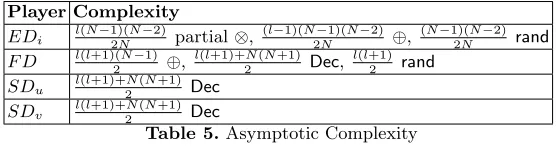
ciphertext rerandomization respectively. Regarding the threshold Paillier scheme described in Appendix B, referring to the cryptographic operations, we make the following note: a partial⊗is an exponentiation, a⊕is a modulo multiplication, and arandis a modulo multiplication.
Player Complexity
EDi l(N−1)(2NN−2) partial⊗, (l−1)(N2−N1)(N−2) ⊕, (N−1)(2NN−2) rand
F D l(l+1)(2N−1) ⊕, l(l+1)+N2(N+1) Dec, l(l+1)2 rand
SDu l(l+1)+2N(N+1) Dec
SDv l(l+1)+2N(N+1) Dec
Table 5.Asymptotic Complexity
Optimised Benchmarking. In order to learn the actual running time of differ-ent parties, we implemdiffer-ent our solution based on the threshold Paillier scheme. For the benchmarking, we choose a 2048-bit n, set s = 2, and split the key into three shares and require the decryption to involve all three key shares. We assume there are 1000 devices and every data vector has 100 elements. In addi-tion, as in the recommender use case, every element of the data vector is a small number from 0 to 5.
To reduce the number of threshold decryption operations, we propose to pack multiple ciphertexts into one and decrypt all of them at once. We have the following:
– Every ciphertext in the matrixC†⊗
C†T encrypts a number in the range
[0,215). Since the message space for threshold Paillier is (0, n2), we can pack
around 270 ciphertextsCi(1≤i≤270) into one asC1·(C2)2 15
· · ·(C270)2 15×269
. Note that operations are modulo n2+1. The packing incurs 269 + 15 + 30 +· · · + 15×269 = 544944 ciphertext multiplications. Recovering in-dividual plaintext is trivial based on modulo operations with respect to 215×269,215×268,· · ·,215 sequentially.
– Every ciphertext in the matrixC†T ⊗C† encrypts a number in the range
[0,212). Similar to the above case, we can pack around 340 ciphertexts Ci
(1≤ i≤ 340) into one asC1·(C2)2 12
· · ·(C340)2 12×339
. The packing incurs 339 + 12 + 24 +· · ·+ 12×339 = 691899 ciphertext multiplications.
Player Complexity Time
EDi 49850 partial⊗, 49850mul 3s
F D 5050000mul, 1491Dec 189s
SDu C†⊗C†T: 19Dec(comb), 10353936mul;C†T⊗C†: 1472Dec 267s
SDv C†⊗C†T: 19Dec;C†T⊗C†: 1472Dec(comb), 1018475328mul15061s Table 6.Optimised Complexity (N= 1000, l= 100)
After the optimisation, based on Table 5, we derive the new asymptotic complexity in Table 6. Note thatmul is a modulo multiplication, Decand Dec
in Appendix B. Based on our implementation on a PC with 3.40 GHz CPU and 16 GB memory, we obtain the actual running time in the last column.
In order to further reduce the running time forSDv, there are two more ways
to further optimise the computations. The first one is to check the density of the dataset and pack more ciphertexts into one, and the other is to outsource the computations to the edge devices. We leave the investigation of them as future work.
6
Conclusion
In this paper, we analysed the privacy-preserving SVD solution by Chen et al. [3], and demonstrated several privacy vulnerabilities. Based on our analysis, we presented an enhanced solution and provided analysis on both security and efficiency. As an immediate future work, we would like to further optimize its efficiency by exploiting fine-grained packing and computation outsourcing. It is also an interesting work to study the performances with larger datasets and improve the efficiency a step further.
References
1. Bar-Magen Numhauser, J.: Fog computing introduction to a new cloud evolution. University of Alcal´a (2012)
2. Barbour, A.D., Luczak, M.J.: A law of large numbers approximation for Markov population processes with countably many types. Probability Theory and Related Fields153(3), 727–757 (2012). https://doi.org/10.1007/s00440-011-0359-2 3. Chen, S., Lu, R., Zhang, J.: A flexible privacy-preserving framework for
sin-gular value decomposition under internet of things environment. In: IFIP Ad-vances in Information and Communication Technology. vol. 505, pp. 21–37 (2017). https://doi.org/10.1007/978-3-319-59171-1 3
4. Cisco: Fog Computing and the Internet of Things: Extend the Cloud to where the things are (2015)
5. Damg˚ard, I., Jurik, M.: A Generalisation, a Simplification and some Applications of Paillier’s Probabilistic Public-Key System. In: International Workshop on Public Key Cryptography. pp. 119–136. Springer (2001)
6. Han, S., Ng, W.K., Philip, S.Y.: Privacy-preserving singular value decomposition. In: 2009 IEEE 25th International Conference on Data Engineering. pp. 1267–1270. IEEE (2009)
7. Kim, S., Kim, J., Koo, D., Kim, Y., Yoon, H., Shin, J.: Efficient privacy-preserving matrix factorization via fully homomorphic encryption. In: Proceedings of the 11th ACM on Asia Conference on Computer and Communications Security. pp. 617– 628. ACM (2016)
8. Knorr, E., Gruman, G.: What cloud computing really means. InfoWorld7, 20–20 (2008)
10. Nikolaenko, V., Ioannidis, S., Weinsberg, U., Joye, M., Taft, N., Boneh, D.: Privacy-preserving matrix factorization. In: Proceedings of the 2013 ACM SIGSAC confer-ence on Computer & communications security. pp. 801–812. ACM (2013)
11. Paillier, P.: Public-key cryptosystems based on composite degree residuosity classes. In: International Conference on the Theory and Applications of Cryp-tographic Techniques. pp. 223–238. Springer (1999)
12. Wu, H.H., Wu, S.: Various proofs of the Cauchy-Schwarz inequality. Octogon Math-ematical Magazine17(1), 221–29 (2009)
13. Yang, Y., Wu, L., Yin, G., Li, L., Zhao, H.: A survey on security and privacy issues in Internet-of-Things. IEEE Internet of Things Journal4(5), 1250–1258 (2017) 14. Zhou, J., Cao, Z., Dong, X., Lin, X.: Security and privacy in cloud-assisted
wire-less wearable communications: Challenges, solutions, and future directions. IEEE wireless Communications22(2), 136–144 (2015)
15. Zhuo, G., Jia, Q., Guo, L., Li, M., Li, P.: Privacy-preserving verifiable data aggre-gation and analysis for cloud-assisted mobile crowdsourcing. In: IEEE INFOCOM 2016-The 35th Annual IEEE International Conference on Computer Communica-tions. pp. 1–9. IEEE (2016)
A
Paillier Cryptosystem
Paillier cryptosystem [11] is a popular public key encryption scheme that pos-sesses useful homomorphic properties. The key generation, encryption and de-cryption algorithms are as follows.
Key Generation. Choose two large prime numbers p and q which has the same lengthk. Set the public key to ben=pq andg∈Z∗
n2. The private key is
computed byλ=lcm(p−1, q−1) andµ= (L(gλmod n2))−1whereL(x) = x−1 n .
Encryption. For a message as m, choose a random number r ∈ Z∗
n, the
ciphertext is computed as:
c=gm·rnmod n2
Decryption.Given a ciphertext c and private key, the corresponding original message mcould be recovered as:
m= L(c
λmod n2)
L(gλmod n2) mod n=
cλ−1mod n2
gλ−1mod n2 mod n
Paillier scheme has the following homomorphic properties. Given two cipher-textsc1, c2 for messagesm1, m2, thenc1c2 is a ciphertext for messagem1+m2
while cm2
1 is a ciphertext for message m1m2. Throughout the paper, we use ⊕
to denote homomorphic addition and⊗to denote homomorphic multiplication.
B
The Threshold Damgard-Jurik Scheme
Key Generation. In addition to the key generation of classic Paillier cryp-tosystem, we computen0 =p0q0wherep= 2p0+1 andq= 2q0+1. Besides, choose s >0, thus the message space changes toZns and choosedwhered= 0mod m
and d= 1mod ns. Then, make the polynomial f(X) =Pk−1 i=0 aiX
i mod nsn0.
where ai (for 0< i < t) is random value from 0, ..., ns∗n
0
−1 anda0=d. The
sharing secret ofi-th decrypting participant issi=f(i) (for 0< i≤v) and the
public key will be n.
Encryption.To encrypt a plaintextm, choose a random numberr∈Z∗ns+1,
the ciphertext is computed as:
c=gm·rns mod ns+1
Share decryption.Thei-th decrypting participant computesci=c2∆si where
c is ciphertext and∆=v!.
Combination. In order to obtain the original message, it requests t shares and combines them as:
c0 =Y
i∈t
c2λ
S
0,i i mod n
s+1
where λS0,i=∆ Y
i0∈t\i
−i i−i0 ∈Z
Therefore,c0 is in the formc0 =c4∆2f(0) =c4∆2d. Note that, 4∆2d= 0 mod λ and 4∆2d= 4∆2 mod ns, thus, c0 = (1 +n)4∆2m mod ns+1. By applying the following Algorithm 4, we can finally restore the plaintextm.
Algorithm 4Recover Plaintext in Threshold Variant Input: Combined ciphertextc0 = (1 +n)4∆2mmod ns+1
Output: Plaintextm
1: letL((1 +n)i mod ns+1) = (i+ i2n+...+ sins−1)mod ns
2: thusij=L((1 +n)imod nj+1)−( ij2−1
n+...+ ij−1
j
nj−1)mod nj
3: i←0
4: forj= 1to tdo 5: t1←L(a mod nj+1)
6: t2←i
7: fork= 2to jdo 8: i←i−1
9: t2←t2∗i mod nj
10: t1←t1−t2∗n
k−1
k! mod n
j
11: end for
12: i←t1 (here,i= 4∆2m)
13: end for