ASSESSING THE CONVERGENCE OF SELF-REPORT AND INFORMANT MEASURES FOR ADULTS WITH AUTISM SPECTRUM DISORDER
Rachel K. Sandercock
A thesis submitted to the faculty at the University of North Carolina at Chapel Hill in partial fulfillment of the requirements for the degree of Master of Arts in the department of Psychology
and Neuroscience in the School of Arts and Sciences.
Chapel Hill 2018
© 2018
ABSTRACT
Rachel K. Sandercock: Assessing the Convergence of Self-Report and Informant Measures for Adults with Autism Spectrum Disorder
(Under the direction of Laura G. Klinger)
Self-report measures are widely used for research and clinical assessment of adults with ASD, though there has been little research examining the convergence of self- and informant-report in this population. The present study examined agreement between informant-reporters on measures of symptom severity, daily living skills, and quality of life, as well as predictive value of each reporter for independent living and employment outcomes. Results indicated no significant differences between caregiver and self-report ratings of symptom severity, though there were significant differences between reporters on ratings of daily living skills and quality of life. Despite discrepancies, caregiver and self-report scores were significantly positively correlated on all measures. Additionally, combining caregiver-report and self-report measures provided
ACKNOWLEDGEMENTS
TABLE OF CONTENTS
LIST OF TABLES ... viii
LIST OF FIGURES ... ix
LIST OF ABBREVIATIONS ... x
INTRODUCTION ... 1
Issues in the Assessment of Adults with ASD ... 3
Measures of Symptomatology of ASD in Adulthood ... 3
Caregiver Biases ... 8
Effects of Impaired Insight on Self-Report ... 9
Areas of Assessment in ASD ... 11
Symptom Severity ... 11
Daily Living Skills ... 12
Quality of Life ... 14
The Use of Self-Report Measures in Non-ASD Populations ... 16
Symptom Severity ... 16
Daily Living Skills ... 18
Quality of Life ... 19
Present Study ... 19
METHOD ... 23
Measures ... 24
TEACCH Autism in Adulthood Survey ... 24
Social Responsiveness Scale - Second Edition ... 25
Waisman Activities of Daily Living Scale ... 26
Quality of Life Questionnaire ... 26
Procedure ... 27
Statistical Analyses ... 28
RESULTS ... 31
Hypothesis 1: Discrepancies Between Caregiver-Report and Self-Report ... 32
Hypothesis 2: Correlation Between Caregiver-Report and Self-Report ... 33
Hypothesis 3: Relationship to Employment and Independent Living Outcomes ... 35
Exploratory Hypothesis: Correlation Between SCI and Discrepancy Size ... 37
DISCUSSION ... 39
Limitations and Future Directions ... 45
Summary ... 46
TABLES ... 48
FIGURES ... 49
APPENDIX A: TEACCH AUTISM IN ADULTHOOD SURVEY: CAREGIVER VERSION ... 52
APPENDIX B: TEACCH AUTISM IN ADULTHOOD SURVEY: SELF-REPORT VERSION ... 61
APPENDIX D: SOCIAL RESPONSIVENESS SCALE - 2ND EDITION:
ADULT FORM, SELF-REPORT VERSION ... 72
APPENDIX E: WASIMAN ACTIVITIES OF DAILY LIVING SCALE ... 74
APPENDIX F: QUALITY OF LIFE QUESTIONNAIRE ... 75
LIST OF TABLES
Table 1. Demographics for the total sample (n = 40) ... 48 Table 2. Differences between self-report and caregiver-report
LIST OF FIGURES
Figure 1. Correlation between caregiver and self-report
total scores (t-scores) on the SRS-A ... 49 Figure 2. Correlation between caregiver and self-report
total scores on the W-ADL ... 50 Figure 3. Correlation between caregiver and self-report scores on the QoL-Q
LIST OF ABBREVIATIONS
ASD Autism Spectrum Disorder
ADOS-2 Autism Diagnostic Observation Schedule, Second Edition AQ Autism Quotient
SRS-2 Social Responsiveness Scale, Second Edition
SRS-A Social Responsiveness Scale, Second Edition: Adult Form ADI-R Autism Diagnostic Interview, Revised
ASBQ Adults Social Behavior Questionnaire W-ADL Waisman Activities of Daily Living Scale QoL-Q Quality of Life Questionnaire
SCI SRS-A Social Communication Index
INTRODUCTION
Autism Spectrum Disorder (ASD) is a neurodevelopmental disorder characterized by deficits in social interaction and communication, stereotyped or repetitive behaviors and
interests, sensory issues, and, in some cases, cognitive delays (American Psychiatric Association, 2013). Because symptoms must be present from infancy or early childhood, ASD is often
thought of as a childhood disorder; consequently, a vast amount of research has been conducted with children with ASD, providing professionals with the necessary insight to tailor services and interventions to fit the needs of children from early intervention services through elementary school (e.g., Bradshaw, Steiner, Gengoux, & Koegel, 2015; Corsello, 2005; Wong et al., 2015). A growing number of interventions have also been designed to target adolescence (e.g., Luxford, Hadwin, & Kovshoff, 2016; McMahon, Vismara, & Solomon, 2013). By stark contrast, very little is known about the disorder in adulthood, though behavioral problems of ASD generally persist across the lifespan (Howlin, Goode, Hutton, & Rutter, 2004). Research on this population suggests that the positive symptoms of ASD – such as repetitive behaviors or emotional
outbursts – tend to decline with age, and the negative symptoms – such as social and communicative deficits – instead become more pronounced (Seltzer et al., 2003; Taylor & Seltzer, 2010). Beyond this basic profile, however, there is very little research to improve our understanding of adults with ASD.
prevalence of ASD has risen from 1 in 150 8-year-olds in 2002 to 1 in 68 8-year-olds in
2010representing a 121% increase (Christensen et al., 2016). Based on these estimates, we will likewise see a 121% increase in the demand for adult services in the coming decade. However, despite the growing number of evidence-based interventions for children with ASD, there are few systematic studies of effective treatments or services for adults (Howlin & Moss, 2012; Taylor & Seltzer, 2010). This is particularly problematic given that adult outcomes are typically poor. A large proportion of individuals with ASD continue to need significant supports
where they are most likely to disagree can help to shape future assessment protocols, and can guide decisions regarding if and when multiple informants should be consulted in making diagnoses and treatment recommendations.
Issues in the Assessment of Adults with ASD
Unlike assessments with children, adult assessments for the purposes of diagnosis and treatment planning often involve self-report. Particularly for intellectually capable adults, clinicians often need to rely on self-report as they do with other adult populations without an intellectual disability. However, several issues arise in the effort to accurately assess adults with ASD, including the unique symptom profile of adults, potential biases in caregiver-report, and the effects of impaired social insight on self-report.
Measures of Symptomatology of ASD in Adulthood. There is a fundamental lack of
tools designed to capture the developmental phase of adulthood in those with ASD.When Leo Kanner first described what is now understood more broadly as ASD, he introduced the label “early infantile autism” (Kanner, 1943). From that point, ASD has often been thought of as a disorder of childhood. As such, the majority of currently available measures were developed to target the symptoms of ASD in children. However, ASD is a life-long developmental disability. Measures used for both research and clinical purposes must be able to reliably capture the aspects of ASD that change over the lifespan and the differential presentation of the disorder in adults. Clinical presentation of ASD is often more complex in adulthood, particularly when developmental history is unavailable (Bastiaansen et al., 2011).
Diagnostic and Statistical Manual of Mental Disorders criteria (DSM-5; American Psychiatric
Association, 2013), ASD is fundamentally defined by two core clusters of symptoms: the
absence of typical social and communicative behaviors, and the presence of abnormal restricted, repetitive patterns of behavior. It is likely that these two types of symptoms are characterized by different developmental trajectories. In line with this hypothesis, Seltzer and colleagues (2003) found that, in a sample of 405 individuals with ASD, adults were more impaired than adolescents in their ability to communicate nonverbally, in their ability to engage in reciprocal conversations, and in their overall level of language. By contrast, adults were less symptomatic than adolescents with respect to restricted, repetitive behaviors and interests, and were less likely to engage in inappropriate verbalizations.
It is also important to note that autism presents across a wide spectrum of severity and cognitive ability. DSM-5 criteria (American Psychiatric Association, 2013) considers ASD on two separate continuums of intellectual functioning and symptom severity. For some, high intelligence may help to compensate for limitations. However, neither verbal nor performance IQ can be utilized as a consistent prognostic indicator of independent living outcomes, as outcomes vary even amongst those with average or above average IQs: while a minority of adults with ASD achieve relatively high levels of independence, including employment, many remain dependent on their families or other support services (Howlin et al., 2004; Klinger et al., 2015). The symptoms of ASD can also range from mild to severe, influencing not only daily
require fewer supports than those with more significant ASD-related impairments, subtle symptoms can often go undetected, resulting in a lack of diagnosis and services all together (Bastiaansen et al., 2011; Kan, Buitelaar, & van der Gaag, 2008). Because of these broad spectrums of intellectual functioning and symptom severity, it is important to have access to measures that will reliably capture the full range of the presentation of ASD in adulthood.
Because very few measures have been designed specifically for use with adults with ASD, researchers and clinicians must often use measures originally intended for use with children or intellectually disabled populations. For example, the Vineland Adaptive Behavior Scales (Cicchetti, Carter, & Gray, 2013), which were developed to assess the personal and social
skills necessary for independent living, are commonly used to assess functioning level and to determine service needs for individuals with ASD. Though the Vineland may be used with individuals from birth to age 90, it was originally designed for children up to age 21 and is primarily intended for individuals with mild to severe ID. As a result, many of the items are inappropriate for adults and higher functioning individuals, which may then provide an incomplete or misleading picture of current functioning (Howlin, Savage, Moss, Tempier, & Rutter, 2014).
psychometric properties of Module 4 have not been as widely validated as those of the modules designed for younger and less verbal individuals, findings suggest that Module 4 demonstrates acceptable sensitivity and specificity for use with adults (Bastiaansen et al., 2011; Pugliese et al., 2015). However, the ADOS-2 is not a self- or caregiver-report measure and requires
implementation and scoring by a skilled clinician.
a reliable self-report measure across the autism spectrum. Additionally, the AQ does not provide an informant version with which to compare self-report responses.
Recently, Horwitz and colleagues (2016) have made efforts to develop and validate a new measure of autistic traits in adults that provides the opportunity for both self- and other-report: the Adults Social Behavior Questionnaire (ASBQ). The authors report cross-informant
correlations on par with those for other emotional and behavioral problems in adults [Achenbach, Krukowski, Dumenci, & Ivanova (2005) report average cross-informant correlations ranging from r = .38 to r = .57 in other populations]. Because this measure was developed so recently and only preliminary data regarding its psychometric properties have been published, however, the ASBQ is not yet widely used in clinical or research practice.
Caregiver Biases. Because symptoms of ASD must be present from childhood, many
2003). Dependence on parent recollection also raises issues of how to best assess adults with ASD when no parent or caregiver is available, particularly given the lack of measures available for non-parent reporters.
Effects of Impaired Insight on Self-Report. Reliance on self-report measures may be
problematic, given that such measures require significant insight into one’s own impairments. The hallmark symptoms of ASD are poor insight into social and communicative difficulties, which may hinder this population’s ability to accurately report their own symptoms (Berthoz & Hill, 2005; Bishop & Seltzer, 2012; Mitchell & O’Keefe, 2008; Shalom et al., 2006). Though some contend that higher functioning individuals are capable of accurately reflecting on inner experiences (Spek, Scholte, & Van Berckelaer-Onnes, 2010), research with adolescent samples indicates that there is little convergence between self-report and parent interviews: individuals with ASD report fewer autistic traits and less anxiety in comparison to parent and clinical reports while reporting a greater level of empathic abilities (Johnson, Filliter, & Murphy, 2009;
Mazefsky, Kao, & Oswald, 2011; White, Schry, & Maddox, 2012).
conservative estimate of an individual’s true level of impairment, making treatment planning and implementation more difficult. Further, the possibility of under-reporting symptom severity and daily skills challenges can result in an individual failing to document clear need for adult service delivery services.
not only to effective research, but to the provision of appropriate clinical assessment and services, as well.
Areas of Assessment in ASD
Three areas of assessment are particularly relevant to assessment of service needs and treatment effectiveness: symptom severity, daily living skills, and quality of life. These areas are essential to better understanding and improving outcomes for adults with ASD.
Symptom Severity. Accurate assessment of symptom severity is necessary for
establishing diagnoses, as well as for identifying areas of greatest impairment as a target for treatment planning. Because adults with ASD may have a limited awareness of their social and communicative impairments (Mitchell & O’Keefe, 2008), comparing adult self-report against the report of others may lend insight to the utility of a multi-informant approach in this population. Though multiple informants are recommended in the assessment of psychopathology in children and adolescents, as well as for adults with developmental and personality disorders (Barkley, Knouse, & Murphy, 2011), there has been very little research on this methodology for individuals with ASD. Overall, there is a striking absence of studies that directly compare
Daily Living Skills. While cognitive ability has been consistently found to be the best indicator of adult outcome (Eaves & Ho, 2008; Farley et al., 2009), there is still a great deal of variability in outcomes amongst individuals with ASD with average or above average IQs. For example, Howlin et al. (2004) found that just 32% of adults with nonverbal IQs over 70 had “good” or “very good” outcomes, as evidenced by their functioning in the areas of friendship, employment, and independent living. Poor adaptive behaviors, such as daily living skills, are a possible explanation for why adults with ASD often experience worse outcomes than would be expected based on cognitive ability alone, as even those with average to above average
intellectual ability often demonstrate very poor adaptive behaviors (Duncan & Bishop, 2013; Klinger et al., 2015). Research suggests that children and adolescents with ASD have fewer daily living skills than both typically developing children and children with other developmental disorders. Furthermore, daily living skills may decline with age for individuals with ASD because they are not acquiring skills at the same rate as typical peers (Klin et al., 2007). The developmental trajectory has also been characterized by a pattern of initial increase in adaptive behavior skills in early childhood followed by a plateau during adolescence across all levels of cognitive functioning (A. T. Meyer, Powell, Buttera, Klinger, & Klinger, in press). Difficulties with everyday activities such as hygiene, cooking, or money management make it significantly harder for an individual with ASD to ever achieve independence in adulthood (Duncan & Bishop, 2013). Because daily living skills are relatively concrete concepts, they have the
demonstrate a “medical necessity” for services and to appropriately tailor services to their individual needs and a key opportunity to improve outcomes may be lost.
Consider again the previous clinical example: the same man who demonstrated limited insight into his level of symptom severity similarly reported no issues in completing daily living tasks independently. He indicated that he was able to manage his finances, shop for food and prepare meals, and complete household chores independently. This differed considerably from what was reported by his parents, who noted that while he was able to complete all of these tasks, he did not actually do them consistently. Despite living several hours away, they were required to maintain a significant level of involvement in monitoring and managing many aspects of his day-to-day life. Consequently, understanding the extent to which adults with ASD are able to accurately report their own adaptive behaviors and daily living skills will provide important information to researchers and clinicians seeking to understand and improve adult outcomes.
Despite the extensive use of measures assessing adaptive daily living skills in public health practice, there has been very little research on the reliability and validity of these measures for the purpose of self-report in adulthood—particularly for those with developmental
intellectual disabilities. The W-ADL demonstrates high internal consistency for all of these groups (α = .88 to .94), and moderate inter-item correlations (r = .2 to .6). To our knowledge, however, no studies have examined the convergence of self- and other-report of adaptive behavior skills in adults with ASD.
Quality of Life. Improved quality of life is increasingly a primary goal of interventions
and services for adults with ASD (Gerber et al., 2011), making accurate assessment of this construct critical for both research and clinical practice. Measuring the validity of self-report is quite complex when it comes to quality of life, however. When quality of life is evaluated, one must take into account an individual’s subjective feelings about his or her life, as well as objective information about psychosocial factors, such as the individual’s living situation, occupation, and personal relationships. (Eriksson & Lindström, 2007; Helles, Gillberg, Gillberg, & Billstedt, 2015). Effectively assessing each of these aspects of quality of life for individuals with any type of psychiatric disorder raises several methodological issues, notably: (1) the problematic validity and reliability of adult self-report due to affective, cognitive, and reality distortion of symptoms; (2) intrinsic difficulties in assessing quality of life in people suffering from these disorders; and (3) low life expectations that may paradoxically lead individuals to rate their quality of life as high (Albrecht & Devlieger, 1999; Katschnig, 2000; Welham, Haire, Mercer, & Stedman, 2001). Additionally, responses to quality of life measures may be biased by an individual’s cognitive and emotional functioning, motivation (or lack thereof) for life
Ratings by adolescents with ASD on subjective measures of quality of life, such as the World Health Organization Quality of Life assessment (World Health Organization, 1995) and
Pediatric Quality of Life Inventory (Varni, Seid, & Rode, 1999), demonstrate significant
discrepancies between self-reports and parental proxy-reports, with self-reported quality of life being generally more favorable than parental-proxy reports (Ikeda, Hinckson, & Krägeloh, 2014; Shipman, Sheldrick, & Perrin, 2011). By contrast, recent research found that adults with ASD rated their own quality of life similarly to maternal and maternal-proxy report. However, some differences across reporters were noted: subjective factors such as perceived stress and having been frequently bullied were most predictive of quality of life based on self-report, while level of independence and physical health were significantly associated with maternal reports of quality of life (Hong, Bishop-Fitzpatrick, Smith, Greenberg, & Mailick, 2015). Quality of life measures offer an opportunity to assess the extent to which adults with ASD are satisfied with the physical, psychological, and social aspects of their lives, and have the potential to provide a fuller picture of an individual’s current functioning level (Renty & Roeyers, 2006). The Quality of Life Questionnaire (QoL-Q; Schalock, Hoffman, & Keith, 1993) was developed to assess the quality
levels of agreement further emphasize the complexity of measuring quality of life and the inherent subjectivity underlying rater responses.
The Use of Self-Report Measures in Non-ASD Populations
Symptom Severity. Though self-report methods of assessment have been widely studied
in child and adolescent populations, there are surprisingly few studies of self-report assessment or cross-informant agreement for adult psychopathology, even outside of ASD (Achenbach, 2006; Mazefsky et al., 2011). A meta-analysis of the cross-informant studies that do exist found that the correlations between self-report and collateral report averaged just .45 for both
internalizing and externalizing problems (Achenbach et al., 2005). These findings demonstrate that the information obtained from informants may often differ notably from the information provided by the target individuals themselves, supporting conclusions that diagnoses based solely on self-report tend to agree poorly with diagnoses based on multiple data sources (G. Meyer et al., 2001). Effects of trait visibility may influence agreement, as easily observable traits and symptoms tend to yield better interrater correlations than do more internal traits. Poor self-awareness (e.g., unself-awareness of negative affect during social interactions) also has the potential to skew responses, as do personal characteristics and biases of informants (Ferdinand, Van Der Ende, & Verhulst, 2006; South, Oltmanns, Johnson, & Turkheimer, 2011). The discrepancies in scores obtained from multiple informants can have significant clinical utility, however: if a specific behavior or impairment is only reported by one informant, this may lend insight into the contexts in which symptoms are most challenging, while agreement across all informants on a particular domain may indicate higher levels of severity and consistency across contexts.
tended to be more convergent than reporting of internalizing symptoms of ADHD. Both adolescents and adults with ADHD have been shown to under-report their inattention and impulsivity symptoms in comparison to objectively measured behavior frequencies (Kooij et al., 2008; Smith, Pelham, Gnagy, Molina, & Evans, 2000; Young, 2004; Zucker, Morris, Ingram, Morris, & Bakeman, 2002), though self-report measures largely demonstrate significant
correlations with informant ratings overall (Magnússon et al., 2006; Murphy & Schachar, 2000). In particular, adolescent self-report of social competence departs significantly from parent ratings, with cross-informant correlation averaging just .21 (Renk & Phares, 2004).There is less agreement, however, on the extent to which individuals with ADHD accurately report more visible symptoms: while there is evidence that adults are relatively reliable in reporting negative social behaviors (Smith et al., 2000; Young, 2004). Notably, cross-informant correlations for substance abuse averaged .68 (Achenbach et al., 2005), supporting findings that agreement may generally be higher when addressing more observable, less intrinsic constructs (Halfens, Alphen, Hasman, & Philipsen, 1999). Similarly, we may expect to see higher cross-informant correlation for more observable symptoms of ASD, such as repetitive behaviors or restricted interests, while there may be less agreement about internal processes, such as social awareness or emotional insight.
Bothwell, 1976). Several studies have also demonstrated that neither past nor current depression has a significant impact on the self-report of personality traits (Bagby et al., 1998; Shea et al., 1996; Surtees & Wainwright, 1996). Similarly, individuals with schizophrenia have been shown to accurately report personality characteristics, as well as many internalizing and externalizing symptoms. Like adults with ASD, individuals with schizophrenia typically have poor social insight. Though it appears that schizophrenia patients with poor insight are able to accurately report their degree of social avoidance and withdrawal, individuals with poor insight tend to present themselves as more extraverted than they actually are and are likely to be more certain of their perceptions than is warranted (Bell, Fiszdon, Richardson, Lysaker, & Bryson,2007).
Daily Living Skills. Little research has been conducted on self-report of daily living
Quality of Life. As with individuals with ASD, measuring quality of life in other populations is complex: the same methodological issues arise in regards to the influence of low life expectations or fundamental differences in the intrinsic values of the individual versus an informant (Katschnig, 2000; Welham et al., 2001). For example, a study of self-report and proxy assessments of quality of life for patients with schizophrenia found that proxies tend to rate patients’ quality of life lower than the patients themselves (Becchi, Rucci, Placentino, Neri, & de Girolamo, 2004). Additionally, a study of self-report on quality of life in patients with
depression, bipolar disorder, or schizophrenia found no significant intraclass correlations between global scores on a quality of life index and objective quality of life indicators; in other words, participants’ overall self-reported quality of life scores did not significantly relate to their scores on measures of health, socioeconomic status, or social involvement (Atkinson, Zibin, & Chuang, 1997).
Present Study
Taken together, the previously outlined literature highlights how little research has been conducted on the use of self-report measures for adults with ASD. Research in other populations indicates that self- and informant-report of symptom severity is typically only modestly
correlated, lending support to the value of multiple reporters in these populations and for individuals with ASD. As social impairment is characteristic of both schizophrenia and ASD, findings on self-report abilities in individuals with schizophrenia may be most useful in forming predictions about the extent to which individuals with ASD have insight into their own
greater difficulty reflecting on their own levels of impairment—particularly those related to social understanding and interaction. Research across populations also demonstrates that agreement between reporters is typically higher for more observable symptoms. As such, reported number of adaptive behaviors is likely to be reasonably aligned between individuals with ASD and informants. Measuring quality of life, however, is fraught with complications. Across psychological disorders, informants tend to report consistently lower quality of life than the target individuals, even when ratings are significantly correlated; this is likely to be the case for adults with ASD, as well. Disparities in quality of life ratings also raise questions about whose reports should be prioritized. Because quality of life is so inherently subjective and relies on the value system of the individual reporter, it seems that greatest credence should be given to self-report rating, while still keeping in mind possible biases induced by presenting symptoms. It is also important to examine the extent to which each informant’s report maps onto objective outcomes, such as employment or independent living status. By understanding which
informant’s or combination of informants’ reports are most predictive of true-life factors, we will be able to better shape best practice for ensuring comprehensive and accurate assessments.
population. The aim of the present study is to examine the level of agreement between self- and caregiver-report of (1) symptom severity (as measured by the SRS-A; Constantino, 2012) for adults with ASD, and the extent to which more impaired social insight relates to the level of agreement between self- and caregiver-report of the adult’s (2) daily living skills (as measured by the W-ADL; Maenner et al., 2013), and (3) quality of life (as measured by the QoL-Q; Schalock, Hoffman, & Keith, 1993). These findings will serve to elucidate the unique
information provided by both adults with ASD and their caregivers, thus emphasizing the utility of multiple informants in the assessment of ASD for the purposes of diagnosis and treatment planning.
Hypotheses:
1. Self-report and caregiver responses will be significantly discrepant on measures of symptom severity, independent living skills, and quality of life. Specifically:
a. Caregivers will report consistently higher levels of symptom severity on the Social Responsiveness Scale, compared to adults with ASD self-report.
b. Caregivers will consistently endorse fewer independent daily living activities performed by the adults with ASD on the Waisman Activities of Daily Living Scale, compared adults with ASD self-report.
c. Caregivers will report consistently lower quality of life ratings on the Quality of Life Questionnaire compared to adults with ASD self-report.
2. Despite consistent discrepancies, there will be significant positive correlations between self-report and caregiver responses, on the:
a. The Social Responsiveness Scale,
c. The Quality of Life Questionnaire,
and these correlations will not be significantly different from cross-informant correlations reported in meta-analyses of other adult populations (Achenbach et al., 2005).
3. Caregiver report will be most predictive of objective outcome measures of employment and independent living outcomes, above and beyond the predictive value-added of self-report on the Social Responsiveness Scale, the Waisman Activities of Daily Living Scale, and the Quality of Life Questionnaire.
Exploratory Hypothesis:
1. Caregiver t-scores on the Social Responsiveness Scale’s Social Communication Index (SCI) will be significantly associated with the size of discrepancies between self-report and caregiver scores on the Waisman Activities of Daily Living Scale and the Quality of Life Questionnaire. It is expected that individuals who are reported by caregivers to have
METHOD Experimental Design
This study utilized a quasi-experimental design with data collected from a sample of adults with ASD and their matched caregivers. Reporter group (self or caregiver) served as a within-subjects variable, with responses on three measures assessing the adult with ASD’s functioning (social impairment, quality of life, and daily living skills) serving as dependent variables. Analyses were conducted to address discrepancies between adult and caregiver responses, correlations between adult and caregiver responses, predictive value of adult and caregiver responses on objective outcome measures, and the extent to which social impairment is predictive of discrepancies between adult and caregiver responses.
Participants
numbers for these clients. Recruitment letters were mailed to these families, with follow-up recruitment phone calls occurring approximately two weeks after the initial letter was sent. Using these recruitment methods in the larger longitudinal study, we successfully contacted 529
families. Of the 485 individuals who met eligibility criteria after screening, 364 caregivers elected to enroll in the study. Two hundred eighty-four surveys were completed (78%
completion rate). While this longitudinal study targeted only caregiver participation, 21 paired samples of caregivers and adults with ASD elected to complete the survey, with the adults with ASD using a version adapted for self-report.
To recruit additional pairs for the current study, the age cut-off was lowered from 30 to 23 in order to broaden the potential recruitment pool. Because the adults with ASD recruited were required to complete self-report measures with limited assistance, we only contacted individuals without a comorbid intellectual disability in their records and with a childhood IQ of 85 or higher. In addition to recruiting new participant pairs through the methods utilized in the original longitudinal study (i.e., recruitment letters and phone calls to families in the TEACCH database), caregivers who participated in the longitudinal study at least two years ago were re-contacted if the respective adult met our new inclusion criteria, and were offered the option to complete a new survey along with the addition of the adult self-report. Twenty-four additional pairs were recruited through these methods, with a completion rate of 79% (19 pairs), for a total of 40 pairs overall.
Measures
TEACCH Autism in Adulthood Survey. This 87-question survey was designed as part
regarding current living situation and employment status of the adult with ASD. Two versions of this survey were created, one for caregiver-report and one for self-report. These are included as Appendices A and B, respectively.
Social Responsiveness Scale, Second Edition: Adult Form (SRS-A; Constantino,
60 and above indicate clinically significant deficiencies in reciprocal social behavior across three ranges of impairment: t-scores of 60 to 65 fall in the “mild range” and indicate deficiencies in reciprocal social behavior that may lead to mild to moderate interference with everyday social interactions; t-scores of 66 to 75 fall in the “moderate range” and indicate deficiencies in reciprocal social behavior that lead to substantial interference with social interactions, and such scores are typical for individuals with an ASD of moderate severity; t-scores of 76 or higher indicate deficiencies in reciprocal social behavior that lead to severe and enduring interference with everyday interactions, and such scores are strongly associated with clinical diagnosis of ASD. The caregiver report and self-report versions of the SRS-A are included as Appendices C and D.
Waisman Activities of Daily Living Scale (W-ADL; Maenner et al., 2013). The
W-ADL measures the ability of individuals with intellectual/developmental disabilities in
adolescence and adulthood to complete activities of daily living, such as household chores and self-care routines. This measure lists 17 activities that are rated on a 3-point scale (0 = ‘‘does not do at all’’, 1 = ‘‘does with help’’, 2 = ‘‘independent’’). It has been validated for use as a
caregiver report with individuals with Down Syndrome, Fragile X Syndrome, ASD, and
intellectual disabilities. For caregivers, the W-ADL demonstrates high internal consistency (α = .88 to .92), and is reliable over time. No studies have examined the W-ADL as a self-report measure. The W-ADL is included as Appendix E.
Quality of Life Questionnaire (QoL-Q; Schalock & Keith, 1993). The QoL-Q is a
Empowerment/Independence, and Social Belonging. Each subscale contains 10 questions, each with a 1-point, 2-point, and 3-point response wherein a higher score indicates a higher quality of life rating. Eight out of the 10 questions on the Competence/Productivity can only be complete if the individual being rated is currently employed. The internal consistency of the subscales is relatively high (α = .66 to .83, total α = .83.). Though no studies have been conducted comparing self- and informant-report on the Qol-Q for in an intellectually high functioning sample or for individuals with ASD, specifically, research comparing staff and client ratings in other
populations has found consistently low cross-informant correlations on all subscales (r = .07 to .31). The QOL-Q is included as Appendix F.
Procedure
surveys contain unclear answers were also contacted by phone to ensure accurate and complete data collection. All caregivers completed the TEACCH Autism in Adulthood Survey, the W-ADL (Maenner \et al., 2013), the SRS-2 (Constantino, 2012), and the QoL-Q (Schalock et al., 1993); adults with ASD completed the self-report versions of the same measures. The entire battery was estimated between 40 minutes and 1 hour to complete, and each participant received $20 for taking part in this study.
Statistical Analyses. The primary dependent variables are participant responses to the
included measures. G*Power3 was used to determine the appropriate sample size. Assuming an alpha of .05, 40 individuals per group provides a power of 87% to detect medium-sized (d = .5) mean differences in responses between caregivers and adults with ASD on the SRS-2 and W-ADL, a power of 83% to detect small (d = .3) mean differences in responses between caregivers and adults with ASD on the QoL-Q, and a power of >99% to detect large (d = .8) mean
differences in responses between caregivers and adults with ASD on these measures. Paired samples t-tests were used to test the hypothesis that self-report and caregiver responses were significantly discrepant on the SRS-2, W-ADL, and QoL-Q; Specifically, it was predicted that adults with ASD would self-report lower levels of social impairment, higher numbers of daily living skills, and higher quality of life in comparison to caregiver report. Paired samples t-tests were also used to test for group differences based on living situation (i.e., adult with ASD living with the participating caregiver or outside of the home).
whether there are mean differences in self-report and caregiver ratings. Using an alpha of .05, 40 pairs of self-report and caregiver ratings provided 62% power to detect a correlation of r = .3 and 97% power to detect a correlation of r = .5. Follow-up analyses were conducted to test the hypothesis that correlation between caregiver and adult responses would not differ significantly from the expected correlation demonstrated in other populations. Specifically, we tested that the correlation between self-report and caregiver responses would not be significantly different the average .45 correlation established by Achenbach and colleagues (2005) in a meta-analysis of studies examining reporter agreement in other types of adult psychopathology.
We then used hierarchical logistic regression to analyze the extent to which each reporter’s responses on the included measures were predictive of objective employment and independent living outcomes. Covariates were added simultaneously and then individually to calculate the relative value-added predictive power of multiple informants versus caregiver- or self-report alone on all measures together, as well as each individual measure. A sample size of 40 provides over 80% power to detect medium effect sizes in this analysis.
Finally, it was hypothesized that caregiver scores on the SRS-2 Social Cognition Index (SCI) would be strongly associated with the size of discrepancies between self-report and caregiver responses on the W-ADL and QoL-Q. To test this hypothesis, we conducted
RESULTS
All data were analyzed using IBM SPSS Statistics. Data were scored and double entered by two trained research staff to ensure accuracy of the data. Once data entry was complete, descriptive analyses such as central tendency and frequency were conducted to investigate distributional assumptions. Box plots and histograms were performed on all continuous variables of interest to investigate distributional properties and check for outliers. Based on the
distributional properties of the data, all participants were included in subsequent analyses. Due to incomplete measures, data for two pairs on the SRS-A total score, three pairs on the QoL-Q total score, and two pairs on the W-ADL total score could not be included in analyses; analyses on most individual subscales were still able to be conducted for all 40 pairs. All analyses were conducted with a two-tailed alpha of p < .05.
Hypothesis 1: Discrepancies Between Caregiver-Report and Self-Report
Paired samples t-tests were conducted to test the hypothesis that caregiver responses on the included measures would differ significantly from self-report responses (see Table 2 for all comparison statistics). Effect size data are provided using Cohen’s guidelines: for paired samples t-tests, a Cohen’s d of .2 is a small effect, .5 is a moderate effect, and .8 is a large effect.
Dependent variables included caregiver and self-report scores on the: (1) the SRS-A, (2) the W-ADL, and (3) the QoL-Q. It was hypothesized that caregivers would report higher symptom severity across all domains on the SRS-A, fewer daily living skills on the W-ADL, and lower quality of life on the QoL-Q than adults with ASD reported about themselves.
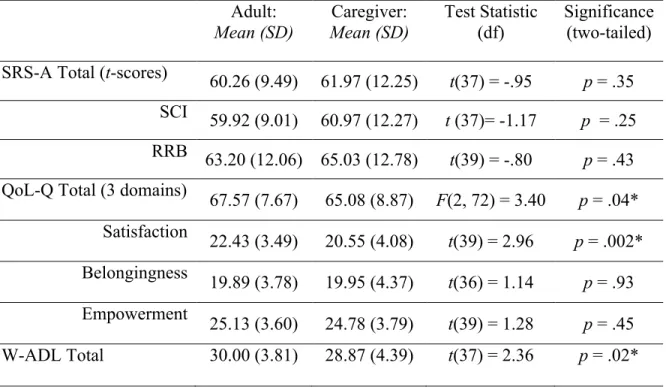
On the SRS-A, there was no significant difference between the mean caregiver-report t-score of 61.97 (SD = 12.25) and the mean self-report t-t-score of 60.26 [SD = 9.49; t(37) = -.95, p = .25, d = .15]. There were also no significant differences between reporters on the SCI [t(37) = -1.52, p = .35, d = .16 or the RRB scales [t(39) = -.804, p = .43, d = .13]. The SRS-A manual indicates that most informants’ scores will be less than 10 t-score points apart. Despite the non-significant difference and the small effect size of the difference between caregiver and self-report t-scores on the SRS, the t-scores for 14 pairs (35%) differed by 10 or more points. For seven
pairs (17.5%), caregivers reported higher symptom severity than the adult with ASD reported. Additionally, scores were examined to determine if clinical classifications differed between self and caregiver reports. Different clinical classification (i.e., “within normal limits,” “mild,” “moderate,” or “severe”) on the SRS-A were found for 19 pairs (47.5%); caregiver scores placed the adult with ASD in a more elevated severity range than did self-report scores for 17
elevated clinical range on the SRS-A while self-report scored classified the adult’s symptoms as sub-threshold (i.e., “within normal limits).
On the W-ADL, there was a statistically significant difference with a small-to-moderate effect size between caregiver-report and self-report of the adult with ASD’s number of daily living skills [t(37) = 2.36, p = .023, d = .38). Caregivers reported that adults with ASD
demonstrated significantly fewer (M = 28.87, SD = 4.39) daily living skills than adults with ASD reported (M = 30.00, SD = 3.81).
Analyses of total scores on the QoL-Q were conducted using scores across the three subdomains of Satisfaction, Belongingness, and Empowerment; analyses excluded the Competence subdomain, as it can only be completed if one is employed. A 3x2 ANOVA indicated an overall effect of reporter moderated by an interaction of scale type [F(2,72) = 3.40, p = .04]. Follow-up t-tests revealed a significant difference with a moderate effect size between
caregiver- and self-report scores on the Satisfaction subdomain of the QoL-Q [t(39) = 2.96, p = .002, d = .55], with caregivers reporting significantly lower satisfaction ratings for the adults with ASD (M = 20.55, SD = 3.49) than adults with ASD reported for themselves (M = 22.43, SD = 4.07). There were no significant differences between reporters on the Belongingness [t(36) = 1.14, p = .93, d = .02] or Empowerment [t(39) = 1.28, p = .45, d = .12] subdomains.
Hypothesis 2: Correlation Between Caregiver-Report and Self-Report
self-report t-scores on the SRS-A total (r = .50, p = .001; see Figure 1). This correlation did not differ significantly from the expected average of r = .45 (Z = .39, p’s = .45) or from the average cross-informant agreement reported in the SRS-A manual (Z = -1.48, p = .14). There was also a significant positive correlation between caregiver- and self-report scores on the W-ADL (r = .75, p < .001; see Figure 2), and the correlation was significantly higher than the expected average of
r = .45 (Z = 2.89, p = .004). For the QoL-Q total scores across the three included subdomains,
there was a significant positive correlation between caregiver- and self-report total scores (r = .78, p < .001; see Figure 3. This correlation were significantly higher than the expected average of r = .45 (Z = 3.28, p = .001).
Although there was no overall difference in reporter discrepancies based on caregiver contact, it is possible that caregiver frequency of contact could influence the strength of the relation between caregiver and self-reports. Therefore, follow-up analyses were conducted to probe for potential interaction effects of caregiver contact. Two-way ANOVAs were used to examine the effect of caregiver frequency of contact (living at home; living away from home) and caregiver SRS-A, W-ADL, and QoL-Q scores on self-report scores. Effect size data is provided using Cohen’s guidelines (i.e., partial eta squared [ηp2] of .01 is a small effect, .06 is a moderate effect, and .14 is a large effect). There was a statistically significant interaction with a moderate-to-large effect size between the influence of caregiver contact and caregiver SRS-A scores [F (1, 34) = 4.38, p = .04, ηp2 = .11]: for adults away from caregivers, SRS-A self-report scores were less correlated with caregiver SRS-A scores than for adults living with the
Hypothesis 3: Relationship to Employment and Independent Living Outcomes
Next, we used hierarchical logistic regression to analyze the predictive value-added of each reporter for correctly predicting objective living and employment outcomes. For these analyses, living situation was used to identify level of daily living supports needed and was classified as either independent (i.e., living along or with a spouse/roommate without supports) or supported (i.e., living with a caregiver or in a supervised setting, such as a group home). Employment outcome was classified as either currently employed or unemployed. We first entered self-report A, W-ADL and QoL-Q scores in block one, followed by caregiver SRS-A, W-ADL, and QoL-Q scores in block two. In this model, the addition of caregiver report significantly increased predictive power (χ2 = 8.99, p = .03) and classification accuracy of employment status increased from 77.8 percent to 88.9 percent. The addition of caregiver report did not significantly increase predictive power of current living situation (supported vs.
unsupported; χ 2 = 4.72, p = .19; classification increase from 77.8 to 80.6%). When done in reverse, with caregiver scores entered in block one and self-report scores entered in block two, the addition of self-report scores significantly increased the predictive power of employment status (χ 2 = 12.19, p = .007). Classification accuracy increased from 75.0 percent in block one to 88.9 percent in step two. The addition of self-report scores also significantly increased predictive power of living situation (χ 2 = 8.50, p = .04), and classification accuracy increased from 75 percent in block one to 80.6 percent in block two.
We then used hierarchical logistic regression to examine the relative value-added of each reporter for each individual measure to identify if overall effects were related to specific
classification increase from 71.1% to 76.3%) or employment status (χ 2 = .10, p = .75;
classification increase from 63.2% to 68.4%). Similarly, adding self-report scores on the SRS-A on top of caregiver scores did not significantly increase the predictive power of the model for either outcome (χ 2 = 3.10, p = .08; χ 2 = 2.08, p = .15; classification increase from 68.4% to 76.3%).
We next examined the relative value-added for each reporter’s measure of daily living skills in predicting living situation and employment. We entered self-report W-ADL scores in block one, followed by caregiver W-ADL scores in block two. In this model, the addition of caregiver-report on top of self-report did not significantly increase predictive power of living situation (χ 2 = .03, p = .87), though classification accuracy increased from 69.2 percent to 74.4 percent. Likewise, the addition of self-report on top of caregiver-report did not significantly increase predictive power of living situation (χ 2 = 1.93, p = .16), though classification accuracy once again increased from 69.2 percent to 74.4 percent. However, the addition of caregiver report significantly increased predictive power (χ 2 = 5.47, p = .019) and classification accuracy of employment status increased from 69.2 percent to 82.1 percent. When done in reverse, with caregiver W-ADL scores entered in block one and self-report scores entered in block 2, the addition of self-report scores did not increase the predictive power of the model (χ 2 = .13, p = .72). Classification accuracy remained stable at 82.1 percent from the addition of caregiver W-ADL scores in block one to the addition of self-report scores in block two.
The addition of caregiver-report or self-report on top of either report independently did not significantly increase predictive power of the QoL-Q for either living situation of
Done in reverse, the addition of self-report on top of caregiver report changed classification accuracy of living situation from 67.6 percent to 64.9 percent, which did not represent a significant change. For employment status, adding caregiver-report onto self-report changed classification accuracy from 67.6 percent to 75.7 percent, which did not represent a significant change. Last, adding self-report onto caregiver-report changed classification accuracy from 73.0 percent to 75.7 percent, which also did not represent a significant change.
Exploratory Hypothesis: Correlation Between SCI and Discrepancy Size
Finally, we conducted correlational analyses to investigate the exploratory hypothesis that Caregiver scores on the SRS-A’s Social Communication Index (SCI) would be significantly negatively associated with the discrepancies between self-report and caregiver scores on the W-ADL and Qol-Q. A positive discrepancy score indicated that the caregiver reported higher numbers of daily living skills and higher quality of life than the adult reported about him or herself, while a negative score indicated that caregivers reported lower numbers of daily living skills and lower quality of life than the adult. Caregiver scores on the SCI were significantly negatively correlated with the discrepancy size between caregiver and self-report scores on the W-ADL (r = -.35, p = .03), indicating that higher caregiver-reported levels of social
DISCUSSION
Overall, results indicated that there were high relationships between caregiver and self-report responses on measures of symptom severity, daily living skills, and quality of life. However, discrepancies between reporters on level of reported symptom severity impacted clinical utility despite the lack of statistically significant differences. Additionally, the combination of self-report and caregiver-report on all measures better predicted employment outcomes than did an individual reporter. In particular, caregiver report of daily living skills was valuable in determining the likelihood that an adult was currently employed. Taken together, these findings suggest that, while self-report is valid for this subset of adults with ASD, a multi-informant approach should be best clinical practice for assessment in this population.
Specifically, the present study investigated whether self-report and caregiver measures of symptom severity, adaptive daily living skills, and quality of life were: (1) significantly
discrepant from one another, (2) significantly positively correlated even if discrepancies existed, and (3) differentially predictive of employment and independent living outcomes. Exploratory analyses examined whether higher caregiver-reported symptom severity in the area of social communication was associated with more disagreement between caregiver-report and self-report on measures of daily living skills and quality of life.
also demonstrated positive significant correlation with one another. The correlation of r = .50 found in the present study was not significantly different from the average cross-informant correlation of r = .66 reported in the original standardization study of the SRS-A (Z = 1.46, p = .07; Constantino & Gruber, 2007). Further, neither self-report nor caregiver report of symptom severity proved more useful in predicting objective measures such as employment or need for daily supports. Although ASD symptom severity scores were, on average, remarkably consistent across reporters, discrepant reports resulted in different clinical classifications for 47.5% of the sample. Further, for 22.5% of pairs, caregiver scores placed the adult with ASD within the clinical range while self-report scores resulted in a sub-threshold classification.
Taken together, the present study indicates that, overall, adults with ASD of average to above average intellectual functioning can serve as reliable and accurate reporters of their own symptoms. These findings contrast with previous research suggesting that poor social insight limits the validity of self-report for this particular population (e.g., Berthoz & Hill, 2005; Bishop & Seltzer, 2012). Exploratory analyses did suggest that higher levels of caregiver-reported difficulties with social communication were associated with adults with ASD reporting more daily living skills and higher quality of life than their caregivers reported about them. While this finding may suggest that higher impairments in social insight in this population may lead to greater difficulties in accurately reporting daily living skills and quality of life, it may also driven by the fact that caregivers who reported higher levels of symptom severity were more likely to report more elevated difficulties in other areas, as well. Knowing that self-report in this
means of measuring intervention effectiveness in research contexts. However, the fact that clinical classifications were not always consistent across reporters suggest that including a caregiver is still important in clinical contexts and a multi-informant approach is likely to
provide the most comprehensive information. These findings also suggest that it may be useful to establish different clinical cut-off scores for self-report measures than for informant-report measures in order to ensure that adults with significant levels of impairment are not being incorrectly disqualified from services.
Accurately assessing daily living skills is also a key part of shaping treatment planning and supporting increased independence for adults with ASD. In the present study, we found that, despite a significant positive correlation between scores, there was a significant discrepancy between caregiver and self-report scores on the W-ADL. Specifically, caregivers reported that the adults with ASD demonstrated fewer daily living skills on average than adults reported about themselves. This discrepancy may be driven in part by the framing of the W-ADL items, which ask about what skills the adult can do as well as what skills the adult does. This difference between what someone “can do” vs. what someone “actually does” may contribute to divergence in reporting between adults with ASD and caregivers. An outside reporter may be better able to objectively monitor what skills are actually conducted on a regular basis. Interestingly, however, the correlation between caregiver and self-report scores on the W-ADL was significantly higher than the average correlation observed in other populations, supporting research indicating that cross-informant agreement is typically higher for more visible or objective constructs
(Achenbach et al., 2005; G. Meyer et al., 2001)
in line with longitudinal data showing that better daily living skills was one of the keys to successfully finding and maintaining employment for adults with ASD (Klinger et al., 2015). Because the addition of caregiver-reported daily living skills resulted in increased prediction of an objective outcome measure compared to self-report scores alone, caregiver-report may be more accurate in comprehensively assessing independence in completing daily living skills. Having accurate information on the W-ADL is essential in both clinical and research contexts, as adaptive behaviors and daily living skills have been consistently shown to be one of the best measures of long-term outcomes. For example, a study of adult outcomes for people with ASD and cognitive functioning in the average range found that adaptive behavior measures –
particularly in the daily living skills domain – were most closely correlated with outcomes in independent living, working, and social functioning (Farley et al., 2009). These findings also support research indicating that IQ scores alone are not always reliable prognostic indicators (Howlin et al., 2004, 2014; Klinger et al., 2015), as individuals with high IQ scores but low daily living skills had poorer independent living outcomes than individuals with relatively low IQs who were able to care for themselves with little assistance. Because our data showed that caregiver-report on the W-ADL provided additional information that was not gathered in the self-report assessment alone, daily living skills may be the area in which it is most essential to involve informant report.
between reporters in our sample was actually higher than would be expected based on such research. Improving quality of life is a primary consideration in interventions and services for adults with ASD (Gerber et al., 2011); as such, an individual’s subjective feelings about one’s own life must be taken into account and, in many cases, may be given higher priority than an informant’s report. However, it is also important to consider the objective factors that influence quality of life, such as independence and success in work or social contexts. Klinger and
colleagues (2015) found that higher daily living skills predicted employment and that
employment was significantly associated with higher quality of in regards to satisfaction, sense of belonging, and empowerment. Because neither self-report nor caregiver report of quality of life proved more useful in predicting employment status, results of the current study do not provide evidence that one reporter is more accurate than another.
While a multi-informant approach has been a standard recommendation in the assessment of psychopathology in children, as well as adults with developmental or personality disorders (Barkley et al., 2011), this approach has not been well-studied for individuals with ASD.
Inclusion of a caregiver or other informant in the assessment of daily living skills is particularly essential, as our data showed that caregivers added significant information that was not provided by adults with ASD themselves. Because we know that daily living skills influence employment outcomes, which in turn have a significant impact on overall quality of life, improving daily living skills should be a primary target of interventions with adults (Duncan & Bishop, 2013; Hume et al., 2009; Klinger et al., 2015). As such, it is imperative to have an accurate picture of what an adult’s daily living skills truly look like.
Limitations and Future Directions
Although this study makes significant strides in improving our understanding of self-report adults with ASD, there are still several limitations. Firstly, while this study was
sufficiently powered to conduct the present analyses, the sample size was still relatively small. Future research examining a larger sample is recommended. Additionally, the full sample was recruited from a pool of adults who were diagnosed as children at the TEACCH Autism
Program. Individuals who received diagnoses as children are often different from those who did not receive diagnoses until later in life, as more substantial symptoms often result in earlier diagnoses. Consequently, our findings may not be representative of self-report capabilities across the full autism spectrum. However, finding that adult self-report of ASD symptoms is consistent with caregiver report doesn’t support these sample concerns.
Future directions for this study include expanding participant range of age and
intellectual functioning. A large proportion of adult assessments for ASD are conducted around the transition age (i.e., late teens to early twenties); the average age in our sample (33.17 years) was older than that time period, and the results presented here may be less applicable to
transition-aged adolescents and young adults. Additionally, because our sample was recruited from childhood records, IQ cutoffs for inclusion were also based on reported childhood IQ; thus, it is difficult to characterize the current cognitive functioning of adults in our sample. Given that there may be larger discrepancies in scores for individuals with lower IQs, future studies would benefit from having access to current IQ scores and should aim to include individuals from a wider range of intellectual functioning.
possible scores, correlation between reporters was likely inflated as both members of adult-caregiver pairs hit ceiling in many instances. Future research including a standardized measure of adaptive behavior/independent living skills is needed to confirm the findings in this study.
Follow-up analyses of the present sample could also include examining the extent to which reporters differ specifically on what adults can do vs. what they actually do.
The overarching goal of this research was to provide a greater understanding of what information different reporters provide on existing measures, as well as how particular measures map onto outcomes in order to help to shape assessment practices and treatment planning.
Moving forward, this research aims to help shape future measures as they are being developed so that clinicians and researchers are able to ascertain the most accurate picture of how an
individual is functioning in the areas of symptom severity, daily living skills, and quality of life. For example, this may mean having different cut-off scores for self-report than for informant report for areas in which we know the reporters differ (such a daily living skills), and next steps include investigating if and how such cut-off scores should be established. In a research context, having access to valid self-report measures is also essential to move forward with
treatment/intervention studies in this population, as such measures are essential reliably
capturing changes from pre- to post-intervention. The present study may serve as a first step in demonstrating the validity of self-report in this population, allowing intervention research to move forward using self-report as a meaningful assessment tool.
Summary
symptomatology, when differences occurred they resulted in different clinical classifications for 47.5% of the sample. Thus, a multi-informant approach is recommended for assessments
Table 1. Demographics for the total sample (n = 40).
Sex (%male) 80% (n = 32)
Mean Age (SD; range) 33.17 (5.54; 23.83 – 47.84)
% Caucasian 87.5% (n = 35)
Employment Status (% employed)
57.5% (n = 23) Living Situation
With Family 57.5% (n = 23) Independently 30% (n = 12) Supervised Housing 12.5% (n = 5) Caregiver (% mothers) 72.5% (n = 29)
*p ≤ .05
Table 2. Differences between self-report and caregiver-report on included measures. Adult: Mean (SD) Caregiver: Mean (SD) Test Statistic (df) Significance (two-tailed) SRS-A Total (t-scores) 60.26 (9.49) 61.97 (12.25) t(37) = -.95 p = .35
SCI 59.92 (9.01) 60.97 (12.27) t (37)= -1.17 p = .25 RRB 63.20 (12.06) 65.03 (12.78) t(39) = -.80 p = .43 QoL-Q Total (3 domains) 67.57 (7.67) 65.08 (8.87) F(2, 72) = 3.40 p = .04*
Figure 1.Correlation between caregiver and self-report total scores (t-scores) on the SRS-A. Higher scores indicate greater symptom severity. A t-score of 59 and below is classified as “within normal limits,” 60 to 65 as “mild range” 66 to 75 as “moderate range,” and 76 or higher as “severe range.” Reference line (red) represents r = 1.00.
Figure 2.Correlation between caregiver and self-report total scores on the W-ADL. Scores range from 0 to 34. Higher scores indicate a greater number of daily living skills used independently. Reference line (red) represents r = 1.00.
Figure 3. Correlation between caregiver and self-report scores on the QoL-Q across three subdomains: Satisfaction, Belongingness, and Empowerment. Higher scores indicate higher quality of life. Reference line (red) represents r = 1.00.
APPENDIX A
APPENDIX B
APPENDIX C
SOCIAL RESPONSIVENESS SCALE, 2ND EDITION: ADULT FORM, CAREGIVER
APPENDIX D
SOCIAL RESPONSIVENESS SCALE – 2ND EDITION: ADULT FORM, SELF-REPORT
APPENDIX E
APPENDIX F