NEGATIVE RAISING IN MANDARIN
Yina Ma
A thesis submitted to the faculty at the University of North Carolina at Chapel Hill in partial fulfillment of the requirements for the degree of Master of Arts in the
Department of Linguistics.
Chapel Hill 2015
Approved by:
Randall Hendrick
Jennifer Smith
ii
© 2015 Yina Ma
iii ABSTRACT
Yina Ma: Negative Raising in Mandarin (Under the direction of Randall Hendrick)
Negative Raising (NR) refers to a construction in which the negation of a main clause
predicate is semantically ambiguous between negating that predicate and negating a predicate of
a subordinate clause. Two approaches to this construction have been pursued in the literature.
One approach is syntactic. From this perspective, the negative in the matrix clause may originate
in the main clause, or it may originate in the embedded clause and then moves (or ‘raises’)
syntactically into the matrix clause. (Fillmore, 1963; Lakoff, 1969; Seuren, 1974; Collins &
Postal, 2014). The semantic/pragmatic approach, on the other hand, argues that NR results from
the Excluded Middle property of main predicates (Jackendoff, 1970; Bartsch, 1973; Horn, 1982,
1989, 2014; Tovena, 2000; Gajewski, 2005, 2007; Bošković, 2008). NR has been widely studied
in numerous languages including English; however, few studies have investigated NR in
Mandarin Chinese. Most of these studies have favored the semantic/pragmatic approach (Shen,
1989; Bošković, 2008; Liu, 2011; Zhang & Liu, 2011; Xiang, 2013, 2014). This may be because
Li (1992) claimed that there is no positive evidence for a syntactic operation of NR in Mandarin.
The semantic study of Bošković (2008) argues against NR in the context of a typology of
nominal phrases cross-linguistically. As a result, it is still controversial whether NR exists in
Mandarin. The existing literature contains no evidence that argues for NR in Mandarin, and there
is also no syntactic analysis that argues explicitly that NR must be a syntactic movement in
iv
This study aims to fill these two gaps. It disposes of the putative evidence provided by
Bošković (2008) against NR, and offers two new empirical arguments that suggest that NR exists
in Mandarin. These arguments are based on the pattern of Negative Polarity Items in the
language. Building on the recent syntactic analysis of English NR in Collins & Postal (2014), it
argues that Mandarin NR is subject to general syntactic constraints such as the C-Command
Condition, the Complex NP Constraint, wh-islands, and clause-internal clefts. In addition, the
few differences between NR in English and Mandarin are attributed to parametric differences in
the Subjacency Principle of Chomsky (1973). Mandarin NR is compared with other syntactic
movements and it is argued that Mandarin NR shares fundamental characteristics with overt
v
ACKNOWLEDGMENT
First, my special thanks go to Randall Hendrick, who is my thesis advisor, for his guidance and encouragement during this study. I am grateful to his insightful comments and
suggestions, and also his patient revisions of my language during the development of this paper.
Many thanks to Jennifer Smith and Katya Pertsova, who are my thesis committee members, for
giving me invaluable feedback and great support. I’m indebted to all my friends, who are also
my consultants, for letting me bother them with endless questions. To my family, I cannot thank
you enough for your love and support. This study cannot be completed without help from all of
vi
TABLE OF CONTENTS
LIST OF TABLES ... x
LIST OF ABBREVIATIONS ... xi
CHAPTER 1: INTRODUCTION ... 1
CHAPTER 2: NEGATIVE RAISING ... 5
2.1 General Description of Negative Raising ... 5
2.2 Syntactic vs. Semantic/Pragmatic Account of Negative Raising ... 7
2.2.1 Syntactic account ... 7
2.2.1.1 Successive-cyclic movement ... 7
2.2.1.2 Syntactic tests... 8
2.2.1.2.1 Strict Negative Polarity Items ... 8
2.2.1.2.2 Tag-questions ... 9
2.2.1.2.3 Pronominalization ... 10
2.2.1.2.4 Subject-auxiliary inversion ... 11
2.2.2 Semantic/Pragmatic account ... 12
2.3 Mandarin Data ... 13
CHAPTER 3: ARGUMENT FOR NEGATIVE RAISING IN MANDARIN ... 17
3.1 Two Arguments against Negative Raising in Mandarin ... 17
3.1.1 Li (1992) ... 17
vii
3.2 New Evidence for Negative Raising in Mandarin ... 22
3.2.1 Renhe ‘any’ ... 22
3.2.2 Minimizers ban-ge/yi-ge ‘half-CL/one-CL’ ... 24
CHAPTER 4: SYNTACTIC ANALYSIS OF NEGATIVE RAISING IN MANDARIN ... 26
4.1 Movements and Constraints in Mandarin ... 26
4.1.1 Movements in Mandarin ... 27
4.1.1.1 Overt movements ... 27
4.1.1.1.1 Topicalization ... 27
4.1.1.1.2 Relativization ... 30
4.1.1.2 Covert movements ... 33
4.1.1.2.1 Wh-movement... 33
4.1.1.2.2 Cleft constructions ... 36
4.1.2 Island constraints in Mandarin ... 37
4.1.2.1 Complex NP Constraint ... 38
4.1.2.2 Sentential Subject Constraint ... 40
4.1.2.3 Left Branch Condition ... 43
4.1.2.4 Adjunct Island Constraint ... 46
4.1.2.5 Coordinate Structure Constraint ... 48
4.1.2.6 Wh-Island Constraint ... 50
4.1.2.7 Focus island ... 53
4.1.3 Subjacency ... 54
4.1.3.1 Island constraints revisited ... 56
viii
4.1.3.1.2 Wh-Island Constraint ... 57
4.1.3.1.3 Sentential Subject Constraint ... 58
4.1.3.1.4 Adjunct Island Constraint ... 59
4.2 Syntactic Analysis of Negative Raising in English: CP (2014) ... 60
4.2.1 General assumption of Negative Raising ... 60
4.2.1.1 Syntactic position of NEG ... 60
4.2.1.2 Successive-cyclic movement ... 64
4.2.2 C-Command Condition ... 65
4.2.3 Island constraints ... 67
4.2.3.1 Complex NP Constraint ... 68
4.2.3.2 Wh-Island Constraint ... 70
4.2.3.3 Clause-internal topics... 71
4.2.3.4 Clause-internal clefts (pseudoclefts) ... 72
4.2.3.5 Clause-internal coordinate structures ... 73
4.2.3.6 Truth predicates ... 73
4.2.3.7 Negative Inversion ... 75
4.2.3.8 Island sensitivity proposal... 76
4.2.3.9 Highest-Operator Constraint ... 77
4.3 Syntactic Analysis of Negative Raising in Mandarin ... 80
4.3.1 C-Command Condition ... 81
4.3.2 Island constraints ... 82
4.3.2.1 Complex NP Constraint ... 82
ix
4.3.2.3 Truth predicates ... 87
4.3.2.4 Left Branch Condition ... 88
4.3.2.5 Adjunct Island Constraint ... 91
4.3.2.6 Coordinate Structure Constraint ... 97
4.3.2.7 Clause-internal topics... 99
4.3.2.8 Wh-Island Constraint ... 101
4.3.2.9 Clause-internal clefts ... 102
CHAPTER 5: CONCLUSIONS, LIMITATIONS, AND IMPLICATIONS... 107
5.1 Summary and Conclusions ... 107
5.2 Limitations and Implications ... 109
x
LIST OF TABLES
Table 1: Previous analyses of NR in Mandarin ... 15
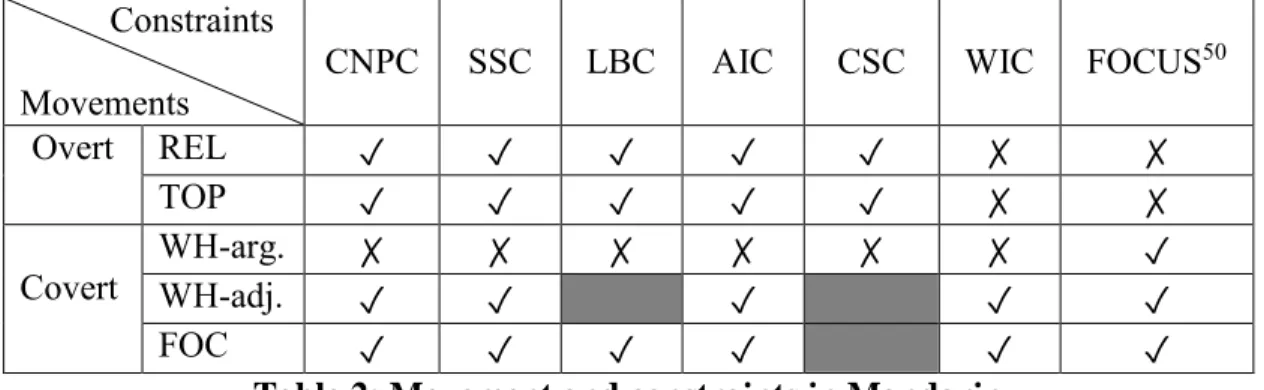
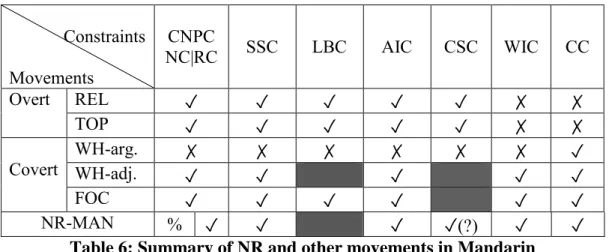
Table 2: Movement and constraints in Mandarin ... 54
Table 3: Island constraints of NR in English: CP (2014) ... 80
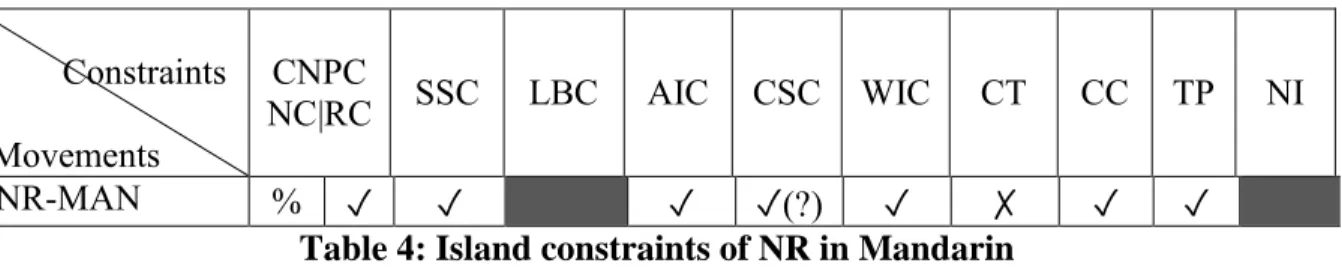
Table 4: Island constraints of NR in Mandarin ... 105
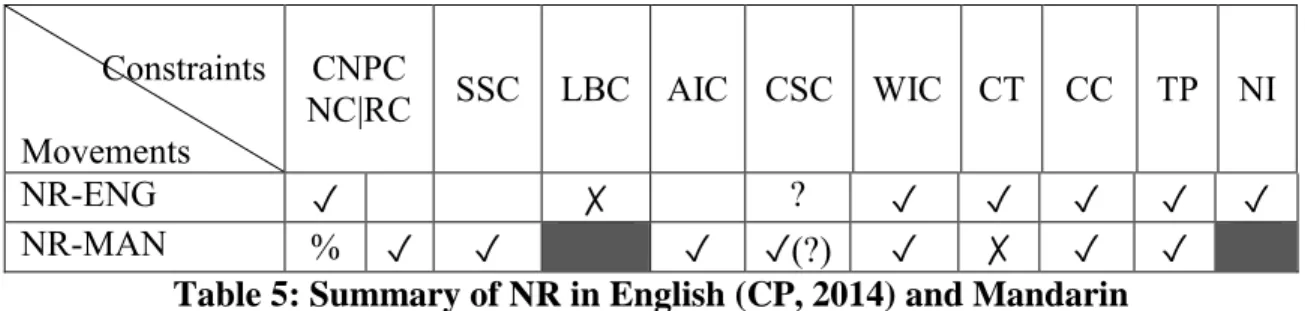
Table 5: Summary of NR in English (CP, 2014) and Mandarin ... 108
xi
LIST OF ABBREVIATIONS
AIC Adjunct Island Constraint
CC clause-internal cleft
CL classifier
CNPC Complex NP Constraint
CSC Coordinate Structure Constraint
CT clause-internal topic
DE modification marker
FOC focus marker
LBC Left Branch Condition
MA question marker
NC noun complement
NEG negative marker
NI Negative Inversion
NR Negative Raising
NR-ENG Negative Raising in English
NR-MAN Negative Raising in Mandarin
OP operator
PRF perfective aspect
RC relative clause
REL relativization
SC small clause
xii
TOP topicalization
TP truth predicate
WH-adj. wh-adjunct
WH-arg. wh-argument
1
CHAPTER 1: INTRODUCTION
Negative Raising (NR) refers to a construction in which the negation of a main clause
predicate is semantically ambiguous between negating that predicate and negating a predicate of
a subordinate clause. Two approaches to this construction have been pursed in the literature. One
approach is syntactic. From this perspective, the negative in the matrix clause may originate in
the main clause, or it may originate in the embedded clause and then moves (or ‘raises’)
syntactically into the matrix clause (Fillmore, 1963; Lakoff, 1969; Seuren, 1974a, b, 1985, 2013;
Collins & Postal, 2014). Various tests have been used to diagnose the initial generation of
negative in the embedded clause (Lakoff, 1969; Lindholm, 1969; Smith, 1975; Horn, 1975), and
it has been observed that NR can be clause unbounded (Fillmore, 1963). However, although NR
has been regarded as a syntactic phenomenon by earlier studies, much of the later literature
adopted a semantic or a pragmatic approach, which argues that NR results from the Excluded
Middle property of main predicates (Jackendoff, 1970; Bartsch, 1973; Horn, 1982, 1989, 2014;
Tovena, 2000; Gajewski, 2005, 2007; Bošković, 2008).
Although NR has been widely studied in numerous languages, few studies have
investigated NR in Mandarin. Mandarin NR is controversial because previous studies have
different opinions on whether the ambiguity in NR is also demonstrated in Mandarin. In addition,
most of the studies have favored the semantic/pragmatic approach (Shen, 1989; Bošković, 2008;
Liu, 2011; Zhang & Liu, 2011; Xiang, 2013, 2014). This may be because Li (1992) claimed that
2
Bošković (2008) argues against NR in the context of a typology of nominal phrases
cross-linguistically. As a result, the existing literature contains no evidence that argues for NR in
Mandarin, and there is also no syntactic analysis that argues explicitly that NR must be a
syntactic movement in Mandarin.
This study aims to fill these two gaps. It disposes of the putative evidence provided by
Bošković (2008) against NR, and offers two new empirical arguments based on the pattern of
two Negative Polarity Items (NPIs) in the language, which are renhe ‘any’ and minimizers
ban-ge/yi-ge ‘half-CL/one-CL’. These NPIs parallel with strict NPIs in English in requiring a local
negative licensor in the same clause domain (Kuo, 2003). I show that these NPIs in the
embedded clause of NR can be licensed by the negative in the matrix clause with predicates that
can trigger NR but not with predicates that cannot trigger NR. Because strict NPIs have been
regarded as one of the most reliable diagnostics for NR, this contrast suggests that NR indeed
exists in Mandarin, contrary to the previous analysis of Li (1992) and Bošković (2008).
I then argue that NR in Mandarin is a syntactic movement by providing evidence that it
is subject to general syntactic constraints. This builds on the recent syntactic analysis of English
NR in Collins and Postal (2014) (henceforth: CP (2014)), which provides compelling evidence
that NR in English is subject to different syntactic constraints that has been generally ignored by
previous studies. I argue that Mandarin NR parallels with English NR in obeying the
C-Command Condition, wh-islands, truth predicates, and clause-internal clefts. In addition, I show
that Mandarin NR also obeys the other two general island constraints of sentential subject and
clausal adjunct. However, unlike English, Mandarin NR exhibits an asymmetry in the two
structural sub-cases of the Complex NP Constraint, and it also does not obey the islandhood of
3
differences in the Subjacency Principle (Chomsky, 1973). Specifically, since the bounding nodes
in English are TP, CP, and DP, while the ones in Mandarin are TP and NP/DP, if we assume that
the landing position in NR is TP/VP, Mandarin NR will only violate Subjacency in the relative
clause but not in the TP complement of complex NP. Similarly, only English NR but not
Mandarin NR will violate Subjacency in the island of clause-internal topics. Furthermore, I
compare NR with other syntactic movements in Mandarin, and claim that NR patterns
fundamentally with other overt movements such as relativization and topicalization. The
difference between NR and the overt movements may be due to the different landing positions of
these movements, and also the association with semantics in NR. In particular, since negative in
NR raises to TP/VP, while other movements target CP, Mandarin NR does not violate
Subjacency in structures involving extraction from complex NP complements. It also cannot
violate wh-island or clefts, contrary to other movements, due to the interaction of wh-operators
and focus operators in the embedded clause, which is accounted for by the Highest-Operator
Constraint in CP (2014).
The thesis is organized as follows. In chapter 2, I introduce the phenomenon of NR in
2.1, and then give a general overview in 2.2 of the competing syntactic and the
semantic/pragmatic analyses of NR as a basis for later discussion. In 2.3, I present the basic
Mandarin data and a brief summary of the previous studies of Mandarin NR. In chapter 3,
section 3.1 critiques the two studies of Li (1992) and Bošković (2008) that argue against
Mandarin NR. Then in 3.2 I provide new evidence based on the distribution of NPIs for the
existence of a syntactic operation of NR in Mandarin. In chapter 4, I summarize patterns of
syntactic movements in Mandarin and how they interact with respect to standard island
4
important defense and resurrection of a syntactic analysis of English NR recently produced by
CP (2014). Building on the spirit of that work, I give in 4.3 my own analysis of Mandarin NR
that highlights how a syntactic analysis can explain the intricate interaction of NPIs with island
constraints in clauses embedded under the class of predicate (e.g., renwei ‘think’) that license
NR. Chapter 5 probes the basis for apparent differences between Mandarin NR and English NR.
It also explores the pattern of Mandarin NR as a syntactic operation with the useful distinction
between phonologically overt and phonologically covert syntactic movements in the language,
5
CHAPTER 2: NEGATIVE RAISING
2.1 General Description of Negative Raising
Negative Raising (NR) refers to a construction like (1a) where negation in the matrix
clause is superficially ambiguous between negating the matrix clause and negating the
subordinate clause.1 Specifically, (1a) has both the reading of (1b) and that of (1c). Unlike (1c),
(1b) can be paraphrased as ‘I don’t think he is coming, but I don’t think he is not coming, either’
in which the speaker simply reserves his opinion on the proposition (Jackendoff, 1970; Klooster,
2003). This ambiguity is not triggered by all main clause predicates. Although (1a) with the
predicate think is ambiguous, (2a) with the predicate know is not: it can only have one reading,
i.e., (2b) but not (2c).
(1) a. I don’t think that he is coming.
b. It’s not the case that I think he is coming.
c. I think that he is not coming.
(2) a. I don’t know that he is coming.
b. It’s not the case that I know he is coming.
c. I know that he is not coming.
1 Most studies use the term NR to refer to both the phenomenon and the syntactic account of such phenomenon. In
6
In the literature, (1c) and (2c) are referred to as NR readings, while (1b) and (2b) are
identified as non-NR readings. Similarly, think and other predicates that can trigger NR such as
believe, suppose, and figure are referred to as NR predicates, whereas other predicates that
cannot trigger NR such as know, claim, and figure out are called non-NR predicates. CP (2014)
gives a list of the standard English NR predicates, as in (3):2
NR has been widely studied and has been documented in many languages other than
English e.g., German, French, and Danish (Lakoff, 1969; Jackendoff, 1970; Seuren 1974a, b,
1985, 2013; Horn, 1978, 1982, 1989; McCawley, 1998; Tovena, 2000; Klooster, 2003; CP,
2014; among others). However, although early studies regarded it as a syntactic phenomenon,
much of the later literature adopted a semantic or a pragmatic approach. For this reason, NR has
received little, if any, attention from syntacticians in recent years until the recent revival in CP
(2014). In section 2.2, I give a brief introduction of the basic syntactic and semantic/pragmatic
analyses of NR, which will serve as a basis for later discussion.
2 Note that the relationship between NR and non-NR predicates is not equivalent to non-factive and factive verbs.
For example, not all non-NR predicates are factive predicates: although hope is not a factive predicate, it is a non-NR predicate in English, since it cannot trigger non-NR, as in (i).
(i) I don’t hope he is coming. ≠ I hope he is not coming.
(3) NR predicates: CP (2014)
7
2.2 Syntactic vs. Semantic/Pragmatic Account of Negative Raising
2.2.1 Syntactic account
A syntactic approach assumes that the negative (NEG) in the matrix clause of NR
structure may originate in the matrix clause, or it may originate syntactically in the embedded
clause. This instance of NEG is then raised into the matrix clause in the course of the syntactic
derivation.3 Collins & Postal (2012) (henceforth CP (2012)) give a formulate of NR as in (4), a
formulation I will accept throughout this work:4
2.2.1.1 Successive-cyclic movement
Fillmore (1963) observes that movement of NEG by NR can be unbounded as long as
the matrix clause contains a NR predicate. For example, in (5a), the NEG in the matrix clause
has a similar interpretation with (5b), where the NEG is in the deepest embedded clause.
(5) a. I do NEGi believe [CPti that [TP he wants [CP ti [TP me to think [CP ti that [TP he did ti it]]]]]]. (Fillmore (1963) with my bracketing)
b. I believe [CP that [TP he wants [CP [TP me to think [CP that [TP he
didn’t do it]]]]]].
3 However, see Klima (1964) and Klooster (2003) for alternative views, which are based on a Negative Concord
analysis that assumes that the NEG in the embedded clause or the embedded clause itself is absorbed to the NEG (NEG projection) in the matrix clause.
4 As mentioned in CP (2012), the above definition is only schematic, which leaves many properties unaddressed. For
example, it does not mention the original position of the raised NEG, nor does it clarify the ‘Aux position’ of the matrix clause, which they assume to be somewhere adjacent to the finite auxiliary. For a refined definition, see Chapter 4.
(4) NR: CP (2012)
8
According to Fillmore, (5) suggests that NR is similar to other syntactic movements
such as wh-movement in that the dislocated phrase can move across clause domains. I will
assume with CP (2012), as shown in (5a), that the NEG from the deepest embedded clause
moves by (4) cyclically to the next clause up, finally ending up in the highest matrix clause after
several applications of (4).
2.2.1.2 Syntactic tests
Various tests have been used to justify generating NEG initially in an embedded clause
under NR predicates. I will outline four of those tests in this section: (strict) NPIs (Jackendoff,
1970; among others), tag-questions (Lakoff, 1969; Smith, 1975), pronomalization (Lindholm,
1969), and subject-auxiliary inversion (Horn, 1978). These tests demonstrate a contrast between
NR and non-NR predicates.
2.2.1.2.1 Strict Negative Polarity Items
One of the most reliable and widely used diagnostics for NR is strict NPIs (Jackendoff,
1970; Seuren 1974a, b; Horn, 1972, 1978, 1989, 2014; CP, 2014; among others). It is well
known that strict NPIs are licensed only by an instance of NEG in the same clause domain
(Giannakidou, 1997) (cf. 6a, b). However, as shown in (6c, d), (6c) with the NR predicate think
is grammatical even though the NPI until in the embedded clause is separated from the NEG in
the matrix clause; in contrast, (6d) with the non-NR predicate know is not.5
(6) a. *He is coming until Tuesday.
5 Note that until can be licensed in a positive sentence with verbs representing durative eventualities, such as states
and activities, as in (ia, b), but not with verbs representing punctual eventualities, such as the examples (6a, b) above (examples (ia, b) are from Gajewski (2005)).
(i) a. Bill was sick until last Friday. (state)
9
b. He is not coming until Tuesday.
c. John doesn’t think [CP that [TP the package will arrive until next
Wednesday]]. (Jackendoff (1970) with my bracketing)
d.*John doesn’t know [CP that [TP the package will arrive until next
Wednesday]].
The same phenomenon is shown in (7) and (8), where the NEG in the matrix clause
can either license the NPI, i.e., at all in the matrix clause, as in (7a), or until in the embedded
clause, as in (7b), but not both of them, as in (7c). This is also the case of ever and until in (8).
These examples show that NEG is either interpreted in the matrix clause, as in the case of a
non-NR reading, or in the embedded clause, as in the case of an non-NR reading.6
(7) a. I don’t at all think [CP that [TP John will leave]].
b. I don’t think [CP [TP John will leave until next week]].
c. *I don’t at all think [CP [TP John will leave until next week]].
(8) *I didn’t ever think [CP that [TP Bill would leave until tomorrow]].
(Lakoff (1969) with my bracketing)
2.2.1.2.2 Tag-questions
Another source of evidence is questions. It is generally the case in English that
tag-questions have the opposite polarity to the host sentences they are adjoined to (leading to the
name reversal tag-questions). For example, when the host question is positive, the tag-question
should be negative, as in (9).
(9) John has left, hasn’t he?
When tag-questions are adjoined to complex sentences containing predicates such as
think and suppose, the tag-questions contrast in polarity with the embedded clause, as in (10).
(10) a. I think [CP [TP the Yankees will win]], won’t they?
10
(Smith (1975) with my bracketing)
b. I suppose [CP [TP the Yankees will win]], won’t they?
When NEG occurs in the matrix clause, tag-questions do not contrast but instead agree
with the polarity of the embedded clause, as in (11).7
(11) a. I don’t think [CP [TP the Yankees will win]], will they?
(Smith (1975) with my bracketing)
b. I don’t suppose [CP [TP the Yankees will win]], will they?
(Lakoff (1969) with my bracketing)
It is surprising that both tag-questions and embedded clauses are positive in (11),
because this runs counter to the polarity reversal property of tag-questions. This surprise
evaporates if one assumes that the NEG of the main clause actually originates in the embedded
clause and that the tag-question is formed or licensed before NR moves NEG to the matrix clause.
2.2.1.2.3 Pronominalization
Lindholm (1969) observes that in structures like (12) where the pronominal it of the
second conjunct refers to the embedded clause of the first conjunct, it refers to the negative
proposition, i.e., ‘Bill didn’t pay his taxes’. This is notable because the embedded clause has no
surface mark of negation, and NEG appears instead in the matrix clause.
(12) I don’t think [CP [TP Bill paid his taxes]]i and Mary is quite sure of iti.
(Lindholm (1969) with my bracketing and indexing)
In addition, Horn (1975) observes infelicitous cases like (13) that superficially parallel
(12) but involve non-NR predicates in the main clause. The reason for the infelicity of (13) is
7 One possibility is that the questions in (11) are reduplicative questions, which, unlike reversal
tag-questions, agree with their host clause in polarity, as in (ia). However, this is impossible because, according to McCawley (1998), reversal tag-questions can allow both rising and falling intonations, while reduplicative tags can only have rising intonations. Therefore, since the tag-questions in (11), as repeated here in (ib), can have both rising and falling intonations, it is argued that they are indeed reversal tag-questions.
(i) a. John has left, has he? (rising intonation)
11
that since the pronoun it in (13) could not denote to the NEG of the embedded clause, the
sentence is not semantically acceptable.
(13) I don’t *claim/know [CP that [TP John paid his taxes]]i, and Mary is
sure of iti. (Horn (1975) with my bracketing and indexing)
Therefore, the different interpretation of the pronominal it can be explained simply if
we argue that the NEG in (12), but not in (13), originates in the embedded clause and is raised by
NR to the matrix clause.
2.2.1.2.4 Subject-auxiliary inversion
Horn (1975) observes additionally that subject-auxiliary inversion can occur in NR and
provides crucial evidence for a syntactic account. Specifically, in English, negative phrases can
be dislocated to the front of a sentence and trigger inversion of subject and auxiliary, as in (14).
(14) [TP [Never before]i have the media ti played such a major role in a
kidnapping].
However, when the similar structure occurs in the embedded clause of structures
undergoing NR, there is no NEG in the fronted phrase, as illustrated by (15). Instead the NEG
that triggers the inversion appears in the matrix clause.
(15) I don’t think [CP that [TP [ever before]i have the media ti played
such a major role in a kidnapping]].
(Horn (1975) with my bracketing and indexing)
This fact suggests that the NEG is originally in the embedded clause, otherwise there is
no trigger for the syntactic movement of subject-auxiliary inversion to occur. More details of this
12
2.2.2 Semantic/Pragmatic account
There is a semantic/pragmatic account of NR, which generally follows from the work
of Bartsch (1973). This kind of analysis assumes that the synonymy between NR and non-NR
reading follows from the Law of the Excluded Middle (Horn, 1978, 1989; Gajewski, 2005, 2007;
among others).
First of all, it is usually the case that contradictory negation is strengthened to contrary
negation in human languages. For example, the negation of the proposition ‘she is happy’ is ‘she
is unhappy/she is not happy’, which is the ‘contradictory negation’ meaning ‘it is not the case
that she is happy’. However, such sentences are usually interpreted as having a stronger ‘contrary
negation’ that asserts her sadness, which is the opposite of her being happy.8 Jackendoff (1970)
claims that NR is simply subsumed in this general phenomenon, where one’s having no belief in
the proposition P licenses the inference that one believes the negative of the proposition P.
Bartsch (1973) calls this the Excluded Middle (EM), which serves as the presupposition of using
NR predicates. The definition of EM is given in (16) below.
8 The difference between contradiction and contrariety is that contradictory expressions are mutually exhaustive and
exclusive in their domain, as in ‘black/not black’, while contrary expressions are not, as in ‘black/white’. As noted in Horn (1989), contrary expressions can both be false, since ‘it can be neither black nor white’, or ‘she can be neither happy nor sad’, while contradictory expressions cannot, since ‘it should either be black or not black’ or ‘she should either be happy or not happy’.
(16) Excluded Middle Presupposition: Bošković & Gajewski (2008) a. F is an NR Predicate
b. Where p is a proposition,
F(p) presupposes: F(p)∨F(~p) c. ~F(p) also presupposes: F(p)∨F(~p)
13
The formula in (16) can be illustrated with the example in (17). Specifically, F(p)
stands for the proposition ‘Mary believes that he is coming’ in (17a), which has the NR predicate
believe. The EM presumption of F(p)∨F(~p) in (16b) means that Mary has certain opinion about
the proposition, that is to say, ‘Mary either believes that he is coming, or believes he is not
coming’. In addition, as shown in (16c), such assumption is preserved under the negation of F(p),
i.e., ‘Mary doesn’t believe that he is coming’, which originally triggers the contradiction ‘it is not
the case that Mary believes that he is coming’, as in (17b).9 Therefore, the assertion (17b)
together with its presupposition of (17a) entail the meaning of (17c), i.e., ‘Mary believes that he
is not coming’, where the negation is interpreted in the embedded clause, as is shown in (16d).
(17) a. Mary believes that he is coming. F(p)
Mary believes that he is coming/he is not coming. F(p)∨F(~p)
b. Mary doesn’t believe that he is coming. ~F(p)
It is not the case that Mary believe that he is coming.
c. Mary believes that he is not coming. F(~p)
Following Bartsch (1973), semantic analyses such as Gajewski (2005, 2007) assume
that NR is resulted from the EM presupposition, which is triggered by the lexical property of NR
predicates.10 We will discuss Gajewski’s semantic analysis in more detail when we look at the
hypothesis of Bošković (2008) in chapter 3.
2.3 Mandarin Data
While NR has been studied in range of languages, its presence in Mandarin has not
received due attention, a descriptive gap that this work is designed to fill. Previous studies have
9 It is well known in semantics that presupposition is preserved under negation.
10 However, Bartsch (1973) holds a pragmatic view of NR that argues that such presupposition is triggered by
14
expressed conflicting views on whether the similar ambiguity of the NR structure in English also
exists in Mandarin.
The counterpart structures in Mandarin are shown in (18).
(18) a. Wo bu renwei [CP [TP ta hui lai]].
I NEG think he will come ‘I don’t think he is coming.’
b. Woi bu renwei [CP [TP ta hui lai]], proi ye bu renwei
I NEG think he will come also NEG think [CP [TP ta bu hui lai]].
he NEG will come
‘I don’t think he is coming, (but) I don’t think he is not coming, either.’
c. Wo renwei [CP [TP ta bu hui lai]].
I think he NEG will come ‘I think he is not coming.’
(18a) is the counterpart of the English NR structure. (18b) is the non-NR reading of
(18a), where speakers lack any opinions of the embedded proposition. (18c) is the NR reading of
(18a), where the embedded proposition is denied.
First of all, Shen (1989) claims that there is a non-NR reading (18b) of (18a), similar to
English, but other studies dispute that claim (e.g., Li, 1992; Bošković, 2008; Xiang, 2013, 2014).
The native speakers I have consulted agree that there is no non-NR reading of (18a).
Second, while Shen (1989), Liu (2011), Zhang & Liu (2011), and Xiang (2013, 2014)
assume that NR exists in Mandarin because (18a) has the NR reading of (18c), Li (1992) and
subsequently Bošković (2008) deny that any such NR construction exists in Mandarin (for an
interpretation of the NR structure in Li (1992) and Bošković (2008), see note (11)).11 12
11 However, although both Li (1992) and Bošković (2008) argue against NR in Mandarin, these two studies are
15
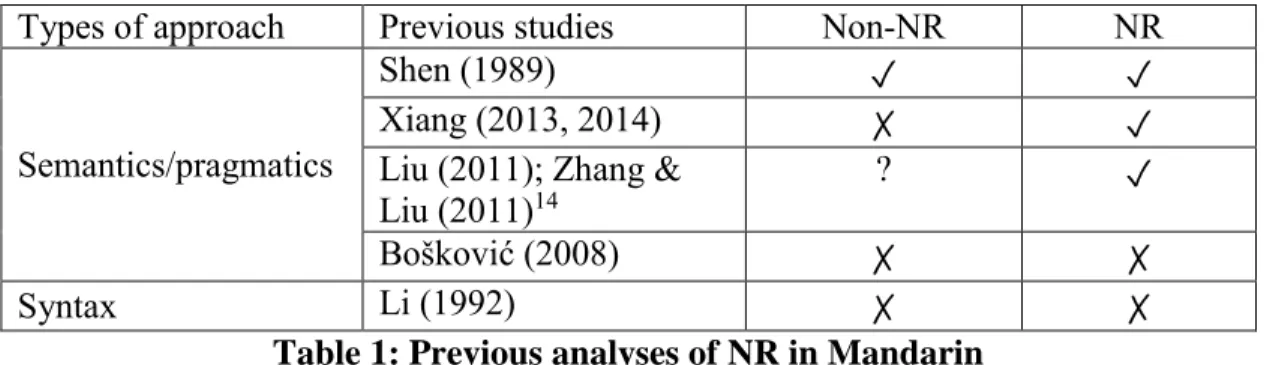
The analyses of Mandarin NR are summarized in Table 1.13
Table 1: Previous analyses of NR in Mandarin
As shown in Table 1, there are two problems of NR studies in Mandarin. First, most of
the studies have adopted a semantic/pragmatic approach with only one study adopting a syntactic
approach. Second, although it is generally agreed that a non-NR reading does not exist in
Mandarin NR structure, it has been unclear whether NR is licensed. In fact, Li’s (1992) syntactic
study argues against NR in Mandarin. Therefore, there is no syntactic analysis to date that argues
for NR in Mandarin.
The current study attempts to fill this gap by providing a comprehensive syntactic
analysis of Mandarin NR. In chapter 3, I first provide evidence that argues for the existence of
argument of a syntactic NR in this paper (I will only use interpretation judgments when NPI licensing is inapplicable and there is a salient contrast in cases where such interpretation is licensed in one case but not in another), I only include the details of Li’s argument of the negative interpretation at the end of this paper in 5.2, which is related to the motivation of a syntactic NR.
12 There are additional two studies of Wu (2000) and Guan (2010) that mention Mandarin NR. However, these
studies only adopt Li’s (1992) proposal that NR does not exist in Mandarin as their assumption without further analysis.
13 In Table 1, ✓means that (non) NR exists in Mandarin; ✗means that (non) NR does not exist in Mandarin. ?
means that the study does not mention explicitly its assumption about (non) NR.
14 Note that in Zhang & Liu (2011), NR is classified into subjective and objective based on a functional approach of
Halliday (2000). The structures that we concern in this paper with respect to NR predicates of think and believe that select a complement clause are classified into subjective NR, while NR predicates such as seem as in the structure of ‘it seems…’ with a expletive it belong to objective NR. According to Zhang & Liu (2011), only subjective NR but not objective NR exists in Mandarin. I will not concern this classification in this paper.
Types of approach Previous studies Non-NR NR
Semantics/pragmatics
Shen (1989) ✓ ✓
Xiang (2013, 2014) ✗ ✓
Liu (2011); Zhang &
Liu (2011)14 ? ✓
Bošković (2008) ✗ ✗
16
NR in Mandarin. In chapter 4, I then provide evidence suggesting that NR in Mandarin is a
syntactic movement.15
15 In line with CP (2014), this study will not consider the trigger of NR. There is an apparent asymmetry between
17
CHAPTER 3: ARGUMENT FOR NEGATIVE RAISING IN MANDARIN
In this chapter, I will first introduce Li’s (1992) argument that there is no evidence for
a syntactic operation of NR in Mandarin and then outline Bošković’s (2008) complementary
semantic argument against NR. I conclude the chapter with a presentation of new evidence that
favors a syntactic account of NR in Mandarin.
3.1 Two Arguments against Negative Raising in Mandarin
3.1.1 Li (1992)
Li (1992) claims that there is no positive evidence that a syntactic NR exists in
Mandarin. Specifically, he argues that the syntactic tests that diagnose NR in English in 2.2.1.2
are not applicable in Mandarin.16 For example, the strict NPI until that could test the presence of
NR has no counterpart in Mandarin.17 The reason is that, as shown in (19), the counterpart of
until, i.e., (zhi)dao…cai cannot co-occur with NEG, in contrast to its English counterpart.
(19). Wo xiang [CP [TP baoguo (*bu) (zhi)dao xia xingqisan
I think package NEG till next Wednesday cai hui lai]].
then will come
‘I don’t think the package will arrive until next Wednesday.’ (Li (1992); modified)
16 Li (1992) does not discuss the pronominalization test discussed in Chapter 2.
18
Moreover, Li argues that tag questions cannot be used as a test for NR in Mandarin. As
shown in (20a, b), the Mandarin tag questions are dui bu dui ‘right not right’ and dui ma ‘right’.
According to Li, these tag questions are not tied to the person, number, or polarity of the host
clause. Therefore, unlike English, these tag questions cannot be used to infer the presence of
NEG in the embedded clause.18
(20) a. Ta renwei /xiangxin [CP [TP wo bu hui ying]], dui bu dui /
he think / believe I NEG will win, right NEG right
dui ma? right MA
‘He thinks/believes I will not win; right?’
b. Ta bu renwei / xiangxin [CP [TP wo hui ying]], dui bu dui /
he NEG think / believe I will win, right NEG right dui ma?
right MA
‘He doesn’t think/believe they will win; right?’
In addition, the subject-auxiliary inversion used by Horn (1975) to probe NR structures
is not applicable simply because no counterpart exists in Mandarin.
Moreover, another problem for the investigation of NR in Mandarin is that most of the
NR predicates in Mandarin cannot be negated. As shown in (21), these include xiang ‘think,
guess, suppose, reckon, hope’, kan ‘think, consider, recon’, cai or caixiang ‘guess, think’, which
are translated to the standard English NR predicates such as think, believe, and suppose.19
(21) a. *Wo bu kan/xiang/cai/caixiang [CP [TP ta mingtian hui lai]].
I NEG think he tomorrow will come ‘I don’t think he is coming tomorrow.’
18 Another problem for tag questions in Mandarin is that they are generally claimed not to modify the embedded
clause but the entire clause.
19 According to Li, the translation of these verbs is based on several dictionaries and other sources. As can be seen,
19
According to Li, this fact rules out most of the possible NR predicates in Mandarin
with only a few exceptions such as renwei and xiangxin ‘think, consider, hold, deem, believe’.
3.1.2 Bošković (2008)
Bošković (2008) proposes a semantic approach to NR that is embedded in a broad
typological generalization about NR that attempts to correlate its presence in a language with
whether the language is a NP or DP language. Generally, DP languages are languages that
contain overt articles (or D’s) such as the in English, while NP languages systematically lack
such articles.20 The class of DP languages includes English, German, and French, while NP
languages include Mandarin, Japanese, Korean, Russian, and Polish. As given in (22) below,
Bošković (2008) hypothesizes that NR only exists in DP languages but not in NP languages.
This hypothesis is based on the similar semantic interpretation between NR
constructions and definite plurals, which according to Bošković & Gajewski (2008) both involve
the EM presupposition, as in (23b, d).21
(23) a. Bill shaved every patient. ∀
b. Bill shaved the patients. ∀
c. Bill didn’t shave every patient. ~ > ∀
20 Alternatively, there are studies that argue for a universal nominal structure of language and thus do not support the
contrast between NP and DP languages. Due to the rather controversial status of noun phrases in Mandarin, I will simply label them as NP/DP throughout the paper.
21 Example (23) is from Bošković & Gajewski (2008).
(22) Hypothesis: Bošković (2008)
20
d. Bill didn’t shave the patients. ∀ > ~ (≈Bill shaved no patients)
Specifically, (23b) is synonymous with (23a), which both have a universal
interpretation, i.e., ‘Bill shaved all patients’; however, the negation of (23a, b), i.e., (23c, d) are
different in the sense that (23d) has a stronger reading than (23c). That is to say, while (23c) is
the contradiction of (23a), meaning ‘it is not the case that Bill shaved all patients’, (23d) is the
contrariety of (23b), which indicates ‘Bill shaved no patients’. In the first case, the NEG has
wide scope over a universal, while in the second case, it instead has narrow scope relative to
NEG. Therefore, the definite plurals in (23b) is similar to NR in the sense that its contradictory
negation infers a contrariety negation, which is unlike universals in (23a) where no such
inference occurs. On this basis, Bošković & Gajewski (2008) argue that definite plurals also
demonstrate the EM presupposition gives rise to the NR construction.
Following Gajewski (2005), Bošković & Gajewski (2008) claim that the EM
presupposition is triggered by a distributive operator, which is involved in the distributive plural
predication of definite plurals. Therefore, they propose that NR predicates that are associated
with the EM are constructed with the definite determiner, as in (24b), while non-NR predicates
that cannot trigger the EM are constructed with the universal quantifier, as in (24a).22
(24) BELa = the world compatible with a’s beliefs; p is a proposition
a. all(BELa) = λp. BELa⊆ p
b. the(BELa) = the sum of a’s belief worlds
(Bošković & Gajewski (2008))
One crucial assumption for the semantic interpretation of (24b) is Bošković &
Gajewski’s (2008) proposal that attitude predicates are not only what traditionally treated as
quantifiers over worlds, but they can also denote the sums of worlds associated in distributive
22 However, a detailed semantic evaluation of (24) is beyond the scope of this paper. I refer the reader to Gajewski
21
plural predication. The NR construction is true if the sum of the worlds compatible with the
subject’s beliefs is a subset of the embedded proposition, false if the sum of them is disjoint from
the proposition.
Since only DP languages have definite determiners, Bošković (2008) proposes that NR
should only exist in these languages but not in NP languages since it depends on (24b) that
makes use of the definite determiner. Since Mandarin does not have definite articles and is
classed as an NP language by Bošković, NR should not exist in the language. Bošković (2008)
offers the evidence of (25) in an attempt to corroborate the prediction. This example involves the
Mandarin counterpart of the strict NPI until, i.e., zhidao in the embedded clause.23
(25) *Yuehan bu xiangxin[CP [TP Mali zhidao mingtian hui likai]].
Yuehan NEG believe Mali until tomorrow will leave ‘John doesn’t believe that Mary will leave until tomorrow.’
However, Bošković’s (2008) argument contains two mistakes. First, the counterpart of
until in Mandarin is (zhi)dao…cai instead of zhidao, where there is an additional adverb cai
‘just’ that cannot be omitted, as in (26).
(26) Mali zhidao mingtian *(cai) hui lai. Mali until tomorrow just will leave ‘Mary won’t come until tomorrow.’
Second, as noted earlier, zhidao…cai cannot co-occur with negation, as in (27).
(27) Mali zhidao mingtian (*bu) cai hui lai. Mali until tomorrow NEG just will leave ‘Mary won’t come until tomorrow.’
Therefore, Bošković’s (2008) evidence does not bear on whether NR exists in
Mandarin.24
23 Example (25) is modified from Bošković (2008).
24 Notice that (25) will be grammatical if the adverb cai is fixed in the embedded clause, as in (ia). However, the
22
In sum, both Li (1992) and Bošković (2008) argue that NR does not exist in Mandarin.
In fact the studies make weaker points: Li (1992) argues that there is no evidence to prove the
existence of NR in Mandarin, and Bošković (2008) offers evidence that is not germane to its
existence. Neither account provides explicit arguments against a syntactic operation of NR in
Mandarin. In the following section, I will present new evidence that suggests NR does in fact
exist in Mandarin.
3.2 New Evidence for Negative Raising in Mandarin
In this section, I will offer two empirical arguments suggesting that NR exists in
Mandarin. The arguments are based on two kinds of NPIs, i.e., renhe ‘any’ and minimizers such
as yi-ge ‘one-CL’ and ban-ge ‘half CL’. I will show that there is a similar two-way contrast
between NR and non-NR predicates in licensing of these NPIs.
3.2.1 Renhe ‘any’
Similar to the strict NPI until, the NPI renhe ‘any’ in Mandarin is licensed by a local
NEG in the same clause domain (Kuo, 2003) (cf. (28)).25
translation in (ib). Therefore, it is not responsible for the licensing of zhidao… cai, and so cannot suggest an NR reading.
(i) a. Yuehan bu xiangxin[CP [TP Mali zhidao mingtian cai hui likai]].
Yuehan NEG believe Mali until tomorrow just will leave ‘John doesn’t believe that it is the case Mary will leave until tomorrow.’
b. Yuehan xiangxin[CP [TP Mali bu shi zhidao mingtian cai hui likai]].
Yuehan believe Mali NEG is until tomorrow just will leave
‘John believes that it is not the case that Mary will leave until tomorrow.’
25 Notice that one possibility that needs to be avoid is that renhe ‘any’ and the minimizers discussed later can be
licensed by non-factive predicates such as think and believe. However, as is seen in (ia, b), this is not the case (Kuo, 2003). This is in contrast to NPIs such as indefinite wh-phrases, which can be licensed by non-factive predicates, as in (ic). Therefore, I do not use them as a test for NR.
(i) a. *Wo renwei/xiangxin [CP [TP ni xihuan renhe dongxi ]].
I think believe you like any thing ‘I think/believe you like anything.’
23
(28) a. Ta *(mei) mai renhe dongxi.26
he NEG bought any thing. ‘He did *(not) buy anything.’
However, as shown by (29), renhe ‘any’ is licensed in the embedded clause with the
NR predicates renwei ‘think’ and xiangxin ‘believe’, despite the absence of a local NEG in that
embedded clause. Instead the presence of NEG in the matrix clause serves to license renhe ‘any’.
(29) Wo bu renwei/xiangxin [CP [TP ta mai le renhe dongxi]].
I NEG think / believe he bought PRF any thing ‘I don’t think/believe he bought anything.’
This behavior is lexically governed. Renhe ‘any’ in the embedded clause cannot be
licensed with non-NR predicates such as zhidao ‘know’ and shengcheng ‘claim’, as in (30).27
(30) *Wo bu zhidao / shengcheng [CP [TP ta mai le
I NEG know / claim he bought PRF renhe dongxi]].
any thing
‘I don’t know/claim he bought anything.’
Therefore, the NPI renhe ‘any’ closely patterns with strict NPIs like English until in
that it can be licensed by NR predicates but not by non-NR predicates.
I think believe you like half-CL thing
‘I think/believe you like half a thing.’
c. Wo renwei/xiangxin [CP [TP ni xihuan shenme dongxi ]].
I think believe you like what thing
‘I think/believe you like something.’
26 The NEG mei is a variant of bu in Mandarin. It is generally agreed that bu does not co-occur with aspect, while
mei has to do with aspect, as it has complimentary distribution with the perfective marker -le. As shown in (i), while
-le can appear in the positive sentence in (ia), it cannot in the negative sentence in (ib). In addition, as mentioned later, mei also optionally co-occurs with the auxiliary you ‘have’.
(i) a. Zhangsan kanjian le ta. Zhangsan saw PRF he Zhangsan has seen him.
b. Zhangsan mei (you) kanjian (*le) ta. Zhangsan NEG have saw PRF he Zhangsan hasn’t seen him.
27Notice that renhe is actually claimed to have more restricted distribution than any (Kuo, 2003). For example,
although renhe cannot be licensed with the non-NR predicate shengcheng ‘claim’ in (30), it is claimed that any can be licensed in such environment, as in (i) (CP, 2014).
24
3.2.2 Minimizers ban-ge/yi-ge ‘half-CL/one-CL’
Another type of NPI in Mandarin is minimizers such as ban-ge ‘half-CL’ or yi-ge
‘one-CL’. These minimizers involve the numeral ban ‘half’ or yi ‘one’, a classifier, and a noun phrase,
e.g., ban-ju hua ‘half-CL sentence’. In the scope of negation, minimizers convey the minimal
quantity, similar to renhe ‘any’. Otherwise, it denotes an exact amount.
For example, in (31) with the minimizer yi-ge ‘one-CL’, (31a) means ‘Zhangsan has
seen exactly one person’, while the negative counterpart (31b) means ‘Zhangsan hasn’t seen any
person’.
(31) a. Zhangsan kanjian le yi-ge ren. Zhangsan saw PRF one-CL person ‘Zhangsan has seen one person.’
b. Zhangsan mei kanjian yi-ge ren. Zhangsan NEG saw one-CL person
‘Zhangsan hasn’t seen one person.’ (‘Zhangsan hasn’t seen any person.’)
As for the NR structure in (32), the NPI reading of minimizer yi-ge can only be
licensed by the NR predicate renwei ‘think’ but not by the non-NR predicate zhidao ‘know’.
(32) a. Wo bu renwei [CP [TP ta kanjian le yi-ge ren]].
I NEG think he saw PRF one-CL person
‘I don’t think he has seen one person.’ (‘I don’t think he has seen any person.’)
b. Wo bu zhidao [CP [TP ta kanjian le yi-ge ren]].
I NEG know he saw PRF one-CL person ‘I don’t know he has seen one person.’
Specifically, while the default or probably the only possible reading of (32a) with the
NR predicate renwei ‘think’ is ‘he hasn’t seen any person’, the counterpart structure (32b) with
the non-NR predicate zhidao ‘know’ could only have the exact amount reading, that is, ‘I don’t
25
The similar pattern is shown in (33) with the minimizer ban-ge ‘half-CL’, where only
(33a) with its NPI reading licensed by the NR predicate renwei ‘think’ is grammatical, since
(33b) where its exact amount of reading is licensed by the non-NR predicate zhidao ‘know’ is
not possible, as one cannot see half a person.
(33) a. Wo bu renwei [CP [TP ta kanjian le ban-ge ren]].
I NEG think he saw PRF half-CL person ‘I don’t think he has seen half a person.’ (‘I don’t think he has seen any person.’)
b. *Wo bu zhidao [CP [TP ta kanjian le ban-ge ren]].
I NEG know he saw PRF half-CL person *‘I don’t know he has seen half a person.’
Therefore, minimizers also demonstrate a similar contrast between NR and non-NR
predicates.
In sum, the licensing of renhe ‘any’ and minimizers ban-ge/yi-ge ‘half-CL/one-CL’ in
the embedded clause of the NR structure with NR predicates are two sources of evidence that NR
can be testable with NPIs in Mandarin, which suggests that NR exists in Mandarin. For this
reason, contrary to Li (1992) and Bošković (2008), I conclude that NR in fact exists in Mandarin.
26
CHAPTER 4: SYNTACTIC ANALYSIS OF NEGATIVE RAISING IN MANDARIN
In this chapter, I will provide an analysis of Mandarin NR and argue that it is properly
regarded as a syntactic operation. As noted in chapter 1, CP (2014) provide compelling evidence
for a syntactic treatment of NR in English in terms of its being subject to syntactic constraints. In
line with CP (2014), I will show that Mandarin NR is also subject to constraints that suggest that
it is a syntactic movement. This evidence has not been previously explored in the context of NR
in Mandarin. As will be made clear, much of my claim accords with the treatment of English in
CP (2014); however, there are still some asymmetries between these two languages that I will
touch on. Moreover, I make use of the Subjacency Principle in my explanation, while CP (2014)
avoid appeal to this restriction on syntactic operations.
The section is organized as follows. Section 4.1 gives a general overview of
movements and island constraints in Mandarin, as well as the unification of these islands under
the Subjacency Principle in Chomsky (1973), and Chomsky (1981). Section 4.2 presents CP
(2014)’s contemporary syntactic treatment of NR in English. Finally, Section 4.3 demonstrates in
detail how NR in Mandarin also should be regarded as syntactic because it is subject to
movement constraints.
4.1 Movements and Constraints in Mandarin
In this section, I will introduce two overt movements and two covert movements in
27
movements involve topicalization and relativization, while the covert movements are wh
-movements and focus constructions.
4.1.1 Movements in Mandarin
4.1.1.1 Overt movements
4.1.1.1.1 Topicalization
Similar to English, topicalization in Mandarin involves movement of the topicalized
phrases to the specifier of CP of the sentence, as in (34).28
(34) a. [CP [nei-ge ren]i, [TP Zhangsan kanjian ei le]].
that-CL person Zhangsan see PRF ‘That person, Zhangsan has seen.’
b. [CP [nei-ge ren]i, [TP Zhangsan shuo [CP [TP Lisi kanjian ei le]]]].
that-CL person Zhangsan say Lisi see PRF
‘That person, Zhangsan said Lisi has seen.’
In (34a), the noun phrase nei-ge ren ‘that-CL person’ is dislocated to the CP of the
sentence, which leaves a gap in the comment sentence. Similarly, in (34b), it is dislocated from
the embedded clause to the CP of the matrix clause. (34b) suggests that topicalization can be
clause unbounded similar to wh-movement. Later in this section, we will see that it is also
subject to Subjacency.
The movement approach of topicalization can be supported by reconstruction effects,
which means that the topicalized phrases can be interpreted as if they were in their original
positions, as in (35)-(36).29
(35) a. [CP Zhangsani , [TP tai zou le]].
Zhangsan he leave PRF
28 Example (34) is from Huang (1984) with my bracketing.
28
‘Zhangsani, hei left.’
b. *[CP Zhangsani, [TP tai bu renshi ei ]].
Zhangsan he NEG know
*‘Zhangsani, hei does not know (himi).’
In (35), the topic phrase Zhangsan is co-indexed with the pronoun he in the comment
sentence. However, although (35a) is grammatical, (35b) is not. The difference between (35a)
and (35b) is that only (35b) but not (35a) involves a trace of Zhangsan. In other words, the topic
in (35a) is base-generated in the topic position, while the topic in (35b) undergoes movement
across the pronoun from TP to CP. On this basis, when Zhangsan is reconstructed to its trace
position in the comment clause, it violates the Binding Principle C in Chomsky (1981) that
requires that a Referential-expression be free, because it is bound by the pronoun he in the same
clause domain (alternatively, this can be ruled out by the Condition B, which says that a
pronominal should be free in its governing category).30
The same reconstruction effect can be shown with idioms. Specifically, since idioms
are considered as one lexicalized unit in the lexicon, the fact that some part of them is separated
from the others in a sentence indicates that they have undergone movement. For example, the
Chinese idiom chi cu ‘eat vinegar’ means being jealous. In (36), the argument cu ‘vinegar’ is in
the topic position, while the verb chi ‘eat’ is in the comment sentence. Therefore, this evidence
suggests that the topic is moved to the CP at some point in the derivation.31
30 Such effect is similar to the strong crossover effect that is typically used to argue for a syntactic movement, as in
(i), where the pronoun he cannot be bound by the variable of the wh-phrase who to its right (Chomsky, 1976). (i) *[CP Whoi did [TP hei say Mary kissed ti ]]?
31 However, it is argued that not all kinds of topics in Mandarin involve movement (Huang, Li & Li, 2009). Unlike
the type of topics mentioned above, which is called the Left Dislocated Topic, there are two other kinds of topics, i.e., Aboutness Topic and Hanging Topic, which are argued to be based-generated in the topic position, as in (ia, b) ((ia, b) are from Huang, Li & Li (2009)).
(i) a. [CP Shuiguo, [TP wo zui xihuan [NP/DP [bu chi (shuiguo zhong de ) xiangjiao
29
(36) [CP zhe zhong cu, [TP ni qianwan chi bu de]].
this kind vinegar you certainly eat NEG obtain
Lit: ‘This kind of vinegar, you definitely should not eat.’ ‘You definitely should not be jealous of this.’
de] ren].
DE person
‘(As for) fruits, I like the most the people who are not afraid to eat bananas (among the fruits).’
b. [CP Zhangsani, [TP [NP/DP piping tai de ren] hen duo ]].
Zhangsan criticize he DE person very many ‘Zhangsani, people who criticize himi are many.’
In (ia), the Aboutness Topic shuiguo ‘fruit’ is the information which the comment clause talks about. It has no gap left in the comment clause; similarly, in (ib), the Hanging Topic Zhangsan has no trace but is bound by a resumptive pronoun he in the remnant clause. The base-generation account of these two kinds of topics is further supported by the fact that both of them are not sensitive to island constraints. As shown in (ia, b), the topicalizations violate the Complex NP Constraint and the Left Branch Condition respectively, and yet the sentences are still grammatical.
Moreover, it is claimed that certain cases in the Left Dislocated topics also involve base-generation and co-indexation with its ‘trace’ in the comment clause. Such claim is based on the subject-object asymmetry observed in Huang (1984). For example, while it is observed that topicalization of Zhangsan is blocked from the Complex NP Constraint when it is moved from an object position, as in (iia), it can be allowed when it is moved from a subject position, as in (iib) ((iia, b) are from Huang (1984)).
(ii) a. *[CP Zhangsani, [TP wo hen xihuan [NP/DP [ ei changge de ] shengyin ]]].
Zhangsan I very like sing DE voice ‘Zhangsani, I like the voice with which [hei] sings.’
b. [CP Zhangsani, [TP [NP/DP [ei changge de ] shengyin ] hen haoting ]].
Zhangsan sing DE voice very good-to-hear
‘Zhangsani, the voice with which [hei] sings is good.’
Huang (1984) hypothesizes that the gap at the subject position in (iib) is not a real trace but an empty pronominal (pro). Unlike English, he claims that languages such as Mandarin can allow an empty pronominal at the subject position in the tensed clause. On this basis, he further proposes a Generalized Control Rule (GCR) based on Chomsky’s (1980) rule of control that unifies PRO and pro, as shown below in (iii).
(iii) Generalized Control Rule (GCR): Huang (1984)
Coindex an empty pronominal with the closest nominal element.
30
4.1.1.1.2 Relativization
Unlike English where the relative head is to the left of the relative clause, as in (37a),
the Mandarin relative head is at the right position with the relative clause and the modification
marker DE adjoined to its left, as in (37b).
(37) a. [[The man]i [that Zhangsan hasn’t seen ei ]].
b. [[Zhangsan mei kanjian ei de] [nei-ge ren]i ].
Zhangsan NEG saw DE that-CL person ‘The person that Zhangsan hasn’t seen.’
Following Aoun & Li (2003), it is generally believed that different Mandarin relative
clauses involve different types of derivation. First, when the relativized nominal is co-indexed
with a gap in the argument position of the relative clause, as in (37b), the nominal nei-ge ren
‘that-CL person’ is claimed to move directly to the head noun position, which leaves a trace in
the argument position.
Similar to topicalization, such movement account can be supported by reconstruction
effects, such as reflexive binding and idioms, as in (38) and (39) respectively.32
(38) a. Wo jiao Zhangsan quan mei-ge reni kai
I ask Zhangsan persuade every-CL person drive
zijii de chezi guolai.
self DE car come
‘I asked Zhangsan to persuade everyone to drive self’s car over.’
b. [[wo jiao Zhangsan quan mei-ge reni kai tj
I ask Zhangsan persuade every-CL person drive guolai de] [zijii de chezi]j ]
come DE self DE car
‘selfi’s car that I asked Zhangsan to persuade everyonei to drive over’
(39) [[ta chi ei de] cui ] bi shei dou da.
he eat DE vinegar compare who all big
Lit: ‘The vinegar he eats is greater than anyone else’s.’ ‘His jealousy is greater than anyone else’s.’
31
In (38a), the reflexive ziji ‘self’ is bound by the c-commanding quantifier pronoun
mei-ge ren ‘every-CL person’ based on the Binding Principle A in Chomsky (1981), which requires
that an anaphor be bound in its local domain. However, when ziji ‘self’ undergoes relativization
in (38b), it can still be bound by the quantifier in the relative clause, as is illustrated in the
grammatical (38b). Therefore, such evidence suggests that ziji moves out of the relative clause to
the nominal head position. Similarly, in (39), the fact that the lexicalized expression chi cu ‘eat
vinegar’ is separated by relativization of the nominal cu ‘vinegar’ also suggests that the
relativized nominal undergoes movement.
Second, there are two cases where relativization does not involve movement of the
noun head but that of a relative operator. First, it is observed that when there is a resumptive
pronoun in the relative clause that is bound by the relativized noun, as in (40), the reconstruction
effects cannot occur.
(40) *[[wo jiao Zhangsan quan mei-ge reni kai
I ask Zhangsan persuade every-CL person drive taj guolai de] [zijii de chezi]j]
it come DE self DE car
‘[selfi’s car]j that I asked Zhangsan to persuade everyonei to drive itj
over’
In (40), the pronoun ta ‘it’ in the relative clause can be bound by the relativized noun
ziji de chezi ‘self’s car’. However, unlike (38b), the reflexive ziji ‘self’ in this relativized noun
can no longer be reconstructed and bound by the quantifier mei-ge ren ‘every-CL person’.
In addition, there is another type of relative clause where gaps are optional. These
relative clauses contain noun heads such as yuanyin ‘reason’ and fangfa ‘method’, which can
co-occur with the resumptive wh-adjuncts such as weishenme ‘why’ and zenme ‘how’ in the relative
clause, as in (41).