IMPROVING INTRODUCTORY COMPUTER SCIENCE EDUCATION WITH DRACO
A Thesis Presented to
the Faculty of California Polytechnic State University, San Luis Obispo
In Partial Fulfillment
of the Requirements of the Degree Master of Science in Computer Science
by
COMMITTEE MEMBERSHIP
TITLE: Improving Introductory Computer Science
Education with DRaCO
AUTHOR: Mike Dongyub Ryu
DATE SUBMITTED: June 2018
COMMITTEE CHAIR: John B. Clements, Ph.D.
Professor of Computer Science
COMMITTEE MEMBER: David S. Janzen, Ph.D.
Professor of Computer Science
COMMITTEE MEMBER: Franz J. Kurfess, Ph.D.
ABSTRACT
Improving Introductory Computer Science Education with DRaCO Mike Dongyub Ryu
Today, many introductory computer science courses rely heavily on a specific programming language to convey fundamental programming concepts. For beginning students, the cognitive capacity required to operate with the syntactic forms of this language may overwhelm their ability to formulate a solution to a program.
ACKNOWLEDGMENTS
I give my utmost thanks to:
• My wife and best friend,Jessica Ryu, for all of her love, patience, support, and sacrifices. I dedicate my work here to you, my love!
• My parents, my sister Joy, and my family-in-law for their never-ending love and support.
• My advisor, Dr. John Clements, for his infinite patience and always telling me exactly what I needed to hear so I may succeed.
• Dr. David Janzen and Dr. Franz Kurfess, for being wonderful teachers and providing much help in and outside of classrooms.
• Professor Kurt Voelker, for his unmatched support and mentorship.
• Professor Paul Hatalsky and Christopher Siu for providing their amazing course material and infrastructure supporting all my work in CPE-101. • All students of my Winter 2018 CPE-101 section who happily partook in my
experiment and made this thesis possible.
• Tobias Bleisch, who is one of the most exemplary graduate students Cal Poly CSSE has ever seen, for all his support and help through my research. • Tram Lai, Vivian Fong, and Jules Sulpico for being amazing friends who
tolerated me.
• Evan Ovadia, for being a fantastic mentor for all of my years at Cal Poly. • Last, but not least – Kyle Mulligan, for an amazing friendship, laughter, and
TABLE OF CONTENTS
Page
LIST OF TABLES ... x
LIST OF FIGURES ... xi
CHAPTER 1. INTRODUCTION ... 1
1.1 Motivation ... 1
1.1.1 An Anecdote on Why ... 1
1.1.1.1 How We All Started ... 1
1.1.1.2 The Fundamental Definition of Programming ... 2
1.1.1.3 The Party Guest List Problem ... 3
1.1.1.4 Our Motivation ... 5
1.1.2 Traditional Computer Science Education and Its Shortcomings ... 6
1.2 Outline of the Following Chapters ... 7
2. RELATED WORK ... 10
2.1 Pseudo-language-based Pedagogy ... 10
2.2 Initial Learning Environments ... 11
2.3 Multilingual Pedagogy ... 13
2.4 Planning-Based Pedagogy ... 14
2.5 Common Shortcomings of the Existing Alternative Methods ... 14
2.5.1 Lack of Capitalization on Students’ Existing Programming Skills ... 15
2.5.2 The Cost of Increase in Cognitive Load ... 16
2.6 Contributions of This Thesis ... 18
3. BACKGROUND ... 20
3.1 Design Recipe... 20
3.2 Short-term Memory ... 21
3.3 Outlining ... 22
3.4 Nomenclature... 24
4. PROPOSAL OF A NEW TEACHING METHOD ... 27
4.1 The Primary Goal of the New Teaching Method ... 27
4.2 Components of the New Teaching Method ... 28
4.2.1 Design Recipe ... 28
4.2.2 Code Outlining ... 32
4.2.3 The DRaCO Workflow ... 41
4.2.4 Peer Review Process... 42
4.2.5 Automatic Code Template Generation ... 45
4.2.6 Automatic Unit Test Generation ... 47
4.3 Summary of the Proposal ... 49
4.3.1.1 New DRaCO-Based Pedagogy for Introductory Computer Science Education ... 49
4.4 Name of the New Teaching Method ... 51
5. IMPLEMENTATION OF THE DRACO-BASED PEDAGOGY ... 52
5.1 Implementation Environment... 52
5.1.1 Introductory Computer Science Courses at Cal Poly SLO ... 52
5.1.3 Seams for the DRaCO-based Pedagogy ... 55
5.2 The DRaCO Workflow ... 56
5.2.1 Implementation of the Design Recipe Process ... 57
5.2.2 Implementation of the Code Outlining Process... 61
5.2.3 Integration of the Workflow ... 62
5.3 Peer Review Process ... 64
5.3.1 Pre-screening and Formatting ... 65
5.3.2 Informal Peer Review Session ... 67
5.3.3 In-depth Peer Review Session ... 68
5.4 Design Recipe and Code Outline Processor (DRCOP) ... 70
5.4.1 Scope of DRCOP ... 70
5.4.2 Usage Pattern of DRCOP ... 72
6. VALIDATION OF THE DRACO-BASED PEDAGOGY ... 74
6.1 Thesis Statement ... 74
6.1.1 Null Hypothesis ... 75
6.1.2 Alternate Hypothesis ... 75
6.2 Experiment Design ... 75
6.2.1 Subjects and Sample Selection ... 75
6.2.2 Execution ... 78
6.3 Data Collection ... 79
6.4 Experiment Schedule ... 85
7. RESULTS AND DISCUSSION ... 86
7.1.1 Statistical Significance ... 89
7.1.2 Effect Size ... 90
7.2 Friction ... 91
7.3 Overall Evaluation of the Thesis Statement... 94
8. THREATS TO VALIDITY ... 96
9. CONCLUSION AND FUTURE WORK ... 98
9.1 Concluding Remarks ... 98
9.2 Future Work ... 98
BIBLIOGRAPHY ... 100
APPENDICES A. Architecture Design of DRCOP ... 107
B. Instructions for DRCOP Usage ... 115
C. Selection of Student-Composed Linear Code Outlines ... 117
D. Project Specifications from CPE-101 ... 120
E. In-Depth Code Review Worksheets ... 124
F. Midterm and Lab Final Exam Problems from CPE-101 ... 128
G. Student Exit Interview Results ... 128
LIST OF TABLES
Table Page
6.1: Summary of exam problems that test students’ ability to program ... 80
6.2: Questions prepared for the student exit interview ... 83
6.3: Experiment schedule in Cal Poly SLO’s CPE 101 ... 85
7.1: Example computation of a single Composite ATP Score ... 86
7.2: Composite ATP scores for all subjects of the experiment ... 87
LIST OF FIGURES
Figure Page
3.1.1: Function definition written in Racket using the design recipe ... 20
4.2.1: Example of a design recipe as a textual artifact... 28
4.2.2: An example of the electronic template for the design recipe ... 30
4.2.3: An example of a paper-based template for the design recipe ... 30
4.2.4: An example code outline for a simple program ... 34
4.2.5: An example code outline for a moderately complex program ... 37
4.2.6: An example function-level code outline with a design recipe ... 40
4.2.7: Design Recipe and Code Outline (DRaCO) workflow ... 41
5.2.1: Population of a design recipe template using auto-advance ... 57
5.2.2: Example design recipes for functions with side-effects ... 58
5.3.1: DRaCO artifact in a Python source code file ... 66
5.3.2: DRaCO artifact in a PDF document after the conversion ... 67
5.4.1: Python function stub generated using DRCOP ... 71
5.4.2: Code template and unit test generation prompts of DRCOP... 73
6.2.1: Subjects’ experience in programming prior to CPE 101 ... 76
6.2.2: Durations of the subjects’ prior programming experience ... 77
6.2.3: Subject’s experience with Python prior to CPE-101 ... 77
7.1.1 Kernel distribution plot of composite ATP scores ... 89
7.2.1 Google Cloud Platform’s classification of sentiment scores ... 94
A.1 Abridged UML of the high-level architecture of DRCOP ... 107
Chapter 1 INTRODUCTION
In this chapter, we introduce our work with an illustration of the personal motivation that drives us to develop and present our work.
1.1 Motivation
Since its emergence as a unique discipline in early 1960s [1], computer science as a field of study never ceased to accelerate its growth. Today, the industry it has spawned is growing faster than all other industries [2]. It is undeniable that the contributions of computer science to the “widespread proliferation of emerging information and communication technologies” accelerated the coming of the Information Age in the early twenty-first century [3]. However, there has been limited advancement in the methods to teach such a discipline, even as other artifacts of computer science research have changed the world many times over within the past half-century.
1.1.1 An Anecdote on Why
To understand our motivation, it’s important to examine how programmers today found their beginning, why that paradigm hasn’t changed, and what programming really means in its most fundamental form.
1.1.1.1 How We All Started
Regardless of whether it all started with a few lines of a C program that displayed out Hello, World! on the computer screen, or a few blocks snapped together in Scratch [4], many will agree that a prominent source of confusion originated from syntactic details of the first programming language they learned. The difference between brackets ([]) and parentheses (()) (in the case of the C program), or how Events blocks cannot be used within Control blocks (in the case of Scratch [5]), or the like, might seem obvious now. However, it’s likely that many of today’s professionals would admit to having had trouble understanding these syntax forms at first.
While the computer science as a field has grown dramatically in complexity over the years, we still observe this pattern of students struggling with the syntax of a programming language in many introductory classrooms. Why is it that the early computing education has not yet escaped the pattern of, as Stephen Bloch has put it, “drowning the students with syntax” [6]?
1.1.1.2 The Fundamental Definition of Programming
introductory programming courses more prominently than they remember the challenges they faced in planning their solutions to algorithmic problems?
With this, we aim to highlight that the beginning computer science students have strong and useful intuitions on algorithmic thinking, but their intuitions are often crippled by traditional teaching methods that inundate students’ cognitive capacities with syntax of an unfamiliar language. We illustrate this issue with an example provided in the following subsection.
1.1.1.3 The Party Guest List Problem
Imagine putting together a guest list for a big party. Perhaps the party we are throwing is very exclusive and we only want certain guests to attend, or we are simply generous hosts who would like to send thank-you notes later. In any case, we would want to make sure that each guest to our party only has one entry in the guest list, assuming no one we invite has the same name. This problem of checking for a duplicate entry in a list of names is simple enough to be asked of any student at a secondary level of education (middle or high school). Nevertheless, we have observed that when such a problem is asked in a programming course, the perceived difficulty of the problem seems to skyrocket.
For instance, consider the following example of a guest list shown below: [Jess, Mike, Joy, Kyle, John, Toby, LaMarion, John, Joy]
some of them will explain how they would look at each of the guest’s name that appears in the list and look for every other guests’ name to see if there is a match for a duplicate, which is a logically sound solution.
However, if we ask the same exact question to introductory programming students who have recently learned about list and strings, we will easily find many of students who struggle to come up with an answer. Perhaps the programming language in use is too low-level to effectively represent the problem, or the students’ lack of proficiency with the language in use hinders their algorithmic thought process. This phenomenon is surprisingly easy to observe when assisting novice computer science students, even when the question does not require them to construct a working program to do so.
Certainly, it is not unnatural for students in a computer programming course to want to jump into practicing the skills they are learning, which is utilizing a syntax of a programming language to construct a working program. Nonetheless, what many students fail to recognize is that prematurely attempting to construct a snippet of code on a computer often hinders the process of planning out stages of execution of a logically sound solution to the given problem.
In terms of didactics in early computer science education, the importance of analytic skills and algorithmic thinking often dwarfs any significance in the act of learning and memorizing the syntax of some programming language. Nevertheless, we continue to observe alarming insufficiency in the efforts to harness the students’ existing intuition to grow into maturely developed analytic skills and algorithmic thinking. The algorithmic problems presented to the students in introductory courses—such as the one illustrated above—are perfect opportunities for the students to apply their intuition on the ‘process of planning out stages of execution for the solution to a given problem’ (the fundamental definition of programming stated earlier). However, many educators fail to make this connection abundantly clear to their pupils as majority of the novice students still continue to perceive any problem given in a programming course as something that must be solved by typing code in some syntax of a programming language they are not yet familiar with.
1.1.1.4 Our Motivation
and refine the core computer programming concepts. With such a framework, teaching and learning computer programming shall be feasible with minimal floundering caused by the syntax of any programming language.
1.1.2 Traditional Computer Science Education and Its Shortcomings
Here, we introduce Sally Fincher’s 1999 publication that inspired our motivation. In it, Fincher briefly describes the origin of traditional computer science education as the acquisition of “the languages and techniques of programming for a specific purpose.” She explains that most of those who initially learned how to program were “scientists, engineers, and mathematicians” [7]. For the most part, they did not care much for the complexities involved in programming as a discipline. They simply wanted to use computer programs as tools to solve their domain-specific problems, and it was sufficient for them to quickly pick up the syntax of a programming language and move on.
As Fincher demonstrates in her work, the limitations of traditional pedagogy in computer science were well recognized nearly three decades ago. However, despite some efforts to address the shortcomings and improve the effectiveness of the traditional methods in the past, mainstream introductory computer science courses at higher education institutions have not yet escaped the curricula that inevitably lead students to flounder, in varying degrees, in the syntax of a language students are not familiar with.
1.2 Outline of the Following Chapters
Here, we outline the subsequent chapters and provide brief previews of their content:
• In Chapter 2 (Related Work), we survey some of the existing alternatives that were proposed as improvements or replacements to the traditional methods and highlight how our contributions presented in this thesis differs. • In Chapter 3 (Background), we present the strategies and concepts that already exist in computer science and non-computer science education we leverage in developing the new teaching method, as well as key definitions of the terms to be used in the following chapters.
• In Chapter 5, (Implementation of the DRaCO-based Pedagogy), we provide details on how we implement the new teaching method to suit the existing introductory computer science course structure and curricula at California Polytechnic State University, San Luis Obispo. The implementation we illustrate in this chapter is used in validating the new teaching method we propose.
• In Chapter 6 (Validation of the DRaCO-based Pedagogy), we describe our execution of an A-B experiment to validate the new teaching methods and our implementation of it. We report whether our new teaching method demonstrates the positive educational impact we expect it to provide to the beginning computer science students, and whether it generates any negative emotional responses from the students.
• In Chapter 7 (Results and Discussion), we refine our thesis statements in order to apply rigorous statistical tests on the data gathered during our A-B experiment. Then, we conduct the analysis on the data to draw a conclusion regarding how effective our new teaching method is, and what negative consequences it may incur when being integrated it into an existing early computer science course.
Chapter 2 RELATED WORK
In this chapter, we survey some of previous efforts that have been extended to improve the early computer science to provide a context for the contribution of this thesis.
2.1 Pseudo-language-based Pedagogy
Despite the seemingly unshakable status quo of the past three decades of computer science education which demands “the vehicle of a single language” [7], many educators have chosen to explore the option of developing an alternative pedagogy that attempt to reduce the reliance on a single programming language. We revisit Fincher’s 1999 publication and her presentation of a few notable implementations of the pseudo-language-based paradigm. Fincher presents these pedagogies as “syntax-free” [7] in her work. However, we recognize that they are not truly syntax-free, as they still utilize the syntax of pseudo-languages as a stepping stone for the syntax of formal programming languages.
programming language. The second method presented by Fincher is Russel Shackelford’s use of pseudocode named RUSCAL as the “teaching vehicle” [7] to instill “algorithmic thinking” [10] in the mindsets of all students at Georgia Institute of Technology. Fincher classifies both of these implementations of “syntax-free” approaches as successful separation of programming from coding [7].
2.2 Initial Learning Environments
With the propagation of computer science education from the higher education institutions down to secondary and primary levels, popularity of Initial Learning Environments (ILEs) increased among introductory computer science educators throughout the past decade. Many of the ILEs answer the difficulties that arise from the syntax of a programming language with high interactivity and, in some cases, tools and environments that can help reduce syntactic mistakes.
In their 2009 paper, Fincher et al., enumerates the following three as the “leading” ILEs: Alice, Greenfoot, and Scratch [11]. Although these three ILEs are developed independently of each other using different technologies and target audiences, they all exhibit interactive graphical programs to engage students with high level of interactivity.
programming language(s) with some graphical element is still employed in recently developed ILEs, such as in Code Combat [13].
However, a survey of more recent developments of ILEs reveals a different trend that started off with Scratch. Developed by MIT for “computer clubhouses” for younger students [11] [14], the programming pattern that Scratch offers stands out from the other ILEs. Instead of relying on a beginning programmer to type or drag-and-drop code into an editor in an error-prone way, it presents snippets of its proprietary syntax wrapped around in puzzle-piece-like blocks, such that the programmer can only put certain snippets together if the snippets belong together. This highly restrictive syntax greatly reduces chances for a novice programmer to make syntactic mistakes. Today, many ILEs utilize this puzzle-piece approach along with the interactive component to appeal to a younger audience. Some examples include Google’s Blockly [15], Made with Code [16], and Disney’s Wayfinding with Moana [17].
languages, but such commitment to connect the ILEs to the next level programming environments is rather difficult to encounter.
Perhaps this is a fair drawback to expect, since the ILEs’ focus is limited at initial learning and not much more. Nevertheless, this drawback may easily be a deal breaker for the higher education instructors, as many of them bear the responsibility of having to prepare their freshman pupils for the rest of their academic and professional programming career. Thus, there is simply no luxury to be able to reside only in the initial learning environments in higher education classrooms.
2.3 Multilingual Pedagogy
The Computer Science Division of University of California, Berkeley takes the opposite approach of the ones taken by syntax-free pedagogy or the ILEs. Instead of attempting to eliminate, minimize, or otherwise simplify the syntax of specific programming languages, they push a multilingual pedagogy that utilizes three different languages: Python, Scheme, and Structured Query Language (SQL).
2.4 Planning-Based Pedagogy
We present a short-term and a long-term planning-based pedagogy here. First of the two is a single-lecture based methods by Castro and Fisler of Brown University. Motivated by the “tasks of developing and integrating programming plans” being “a recurring problem among programming students [19] [20] [21],” Castro and Fisler explore the impact of introducing program planning in a single lecture to the first-year computer science students. They discover that while introducing the concept of program planning in a single lecture may result in improvements in students’ planning behavior, students “need some computing experience before they can embrace planning” [22].
The latter is How to Design Programs (HtDP) [23] by Program by Design [24] project. HtDP is a course curriculum in Racket (a dialect of Scheme) designed around planning using a six-step design recipe process. By introducing the concept of planning with the design recipe early on and reinforcing it throughout the whole curriculum, this pedagogy guides beginning students to design, write, and test their programs more effectively. A significant portion of our work is based on our augmentation of the design recipe from HtDP and its benefits (presented in subsection 4.2.1) in combating some of the shortcoming we discuss in the following section.
2.5 Common Shortcomings of the Existing Alternative Methods
these shortcomings explicitly to distinguish the contributions of this thesis from the existing work on early computer science education.
2.5.1 Lack of Capitalization on Students’ Existing Programming Skills
Many introductory computer science pedagogies are unique in a sense that they often lack a clear attempt to capitalize on the incoming students’ existing knowledge or intuition on programming—something that might help the students connect or relate their previous experience to the new material to be presented. Perhaps this is due to the limited programming curricula that exist as discrete courses in the K-12 education standards. Therefore, it is understandable that many introductory computer science courses focus on starting mostly from scratch.
Calculus course. However, we find referencing practices from completely separate disciplines still proves useful. Further discussion regarding this is presented in section 3.3 and subsection 4.2.2.
2.5.2 The Cost of Increase in Cognitive Load
We argued that the extra cognitive load required to operate with the syntactic forms of specific programming language hinders students’ ability to retain and express their algorithmic thought process. Some approaches like ILEs address this directly by reducing the learning curve of the syntax. However, we expect that the approaches that include additional pseudo-languages (section 2.1) or more programming languages (section 2.3) on top of the single programming language students already struggle with would not reduce the problematic cognitive load.
only noticeable difference between the pseudo-languages and a formal programming language.
Simply taking away the mean-looking syntax error messages may help lower the students’ cognitive load. However, even without the presence of those error messages, we must be careful not to neglect that the degree of newness a novice computer science experiences in an abstract language or pseudocode is often similar to that of any formal programming language. That is, students who have little knowledge of formal programming languages most likely also have little knowledge on any abstract languages or systems of pseudocode, if any. Thus, in order to meaningfully reduce the beginning students’ cognitive load, we must utilize even higher level pseudo-languages. Allowing the pseudo-languages to take form of a natural language like regular English sentences would certainly free students from needing to learn some new elaborate syntax.
2.5.3 Persistence of the Blank Pages
two-First, beginning students are simply too new to the concept of programming. This connects to the point we make in subsection 2.5.1. There exists some pedagogy that alludes to the beginning students’ existing knowledge, such as the aforementioned Bootstrap [25]. However, many mainstream pedagogies attempt to teach computer science as a mostly brand-new discipline without some connections to the students’ past learning experience. This may unnecessarily amplify the learning curve and leave some students completely overwhelmed to even try doing something.
Second, on top the unprecedented learning curve they present, many pedagogies quite literally involve a blank page as a starting point of a students’ programming environment. If the novice students’ encounter of blank pages reliably causes them to feel overwhelmed and lost, why must the educators persist it in their pedagogies? We claim that as long as a programming environment lets a novice student encounter a blank page, its highly polished user experience and ease of use becomes a moot point. This may be analogous to being placed in front of a large blank canvas in an art studio. If you have limited knowledge on how to paint, you are not likely to be comforted just because the paintbrushes given to you are fancy or easy to use. We present our solution to this in subsection 4.2.1.
2.6 Contributions of This Thesis
With many of the work we have cited in this chapter as the inspirational foundations, we propose a new teaching method (presented in detail in Chapter 4). We identify the key contributions of this thesis as the following:
• Proposal of a code outlining process to be combined with the augmented design recipe process.
• Peer review process of students’ design recipe and code outlines. • An experiment to validate the pedagogy we propose.
Chapter 3 BACKGROUND
In this chapter, we introduce a few key concepts that are instrumental in understanding the development of the new teaching method being proposed.
3.1 Design Recipe
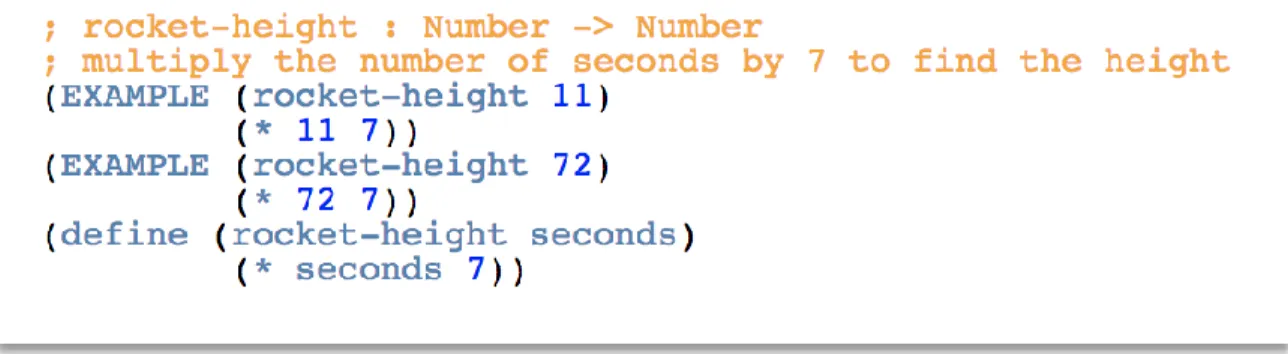
Introduced by Felleisen et al. in How to Design Programs (discussed in 2.4, Planning-Based Pedagogy), design recipe is defined as “a roadmap for defining functions, which programmers use to make sure the code they write does what they want it to do” [26]. The original text presents the “basic steps of a function design recipe” as a six-step process including (1) data definition; (2) signature, purpose, statement, and header; (3) function examples; (4) function template; (5) function definition; and (6) testing [23].
Figure 3.1.1: Function definition written in Racket using the design recipe
(unit) tests for the functions written. Figure 3.1.1 above shows an example of this [26].
One theoretical benefit of using a design recipe as a part of early computer science education is that it can potentially address the “Blank Page Syndrome,” which we have pointed out as a common flaw of existing alternatives in Related Work (Chapter 2). By providing students with a concrete set of steps to follow, the design recipe provides them a viable alternative to blindly attempting “to piece together a program by trial-and-error” and skip the much-needed step to think through a given problem simply by saying, “‘Well, it seems to work...’ for what their program really does” [24].
In this thesis, we use an adaptation of Felleisen et al.’s design recipe in our development of a process that students are instructed to follow when expressing their function designs. Further illustration on developing this adaptation is presented in Chapter 4 (Proposal of a New Teaching Method), subsection 4.2.1 (Design Recipe).
3.2 Short-term Memory
In introductory computer science courses, we observe that students’ cognitive capabilities are often overwhelmed by the particularities of the syntax of a programming language they are not yet accustomed to, regardless of how simple the syntax may seem to the instructor.
well-elementary programming problems have a few steps involved in its solution (which a novice student may take three or four iterations of different approaches to arrive at), we theorize that this limited capacity of short-term memory is often fully utilized once a student is presented with a programming problem.
Our first-hand observations and experiences so far as students and educators in computer science substantiate this theory. As a student begins to engage with a given problem, their mind starts the process of constructing the initial road map on how to navigate the problem. At this point, the student may have developed some intuitions that could eventually lead them to a sound solution. However, once their focus shifts from abstract algorithmic thinking to the concrete implementation on a computer, the high cognitive load required to recall the unfamiliar syntax floods their short-term memory and interrupts the train of thought on the intuitions that were emerging.
Thus, proper externalization of the short-term memory prior to writing any code seems necessary to preserve the abstract algorithmic thinking process and any useful intuition that may result from such processes. In developing the new teaching method, we implement a mechanism that systematically introduces this externalization of short-term memory as part of the programming experience in an introductory computer science course.
3.3 Outlining
only field of study in which students suffer from the negative consequences of failing to properly externalize their initial roadmaps or intuitions on applications of complex logic. In fact, many non-technical disciplines today boast of robust strategies for organizing and externalizing complex logic, developed throughout the much longer history of their existence compared to the relatively brief history of computer science.
Arguably, one of the most prominent fields of study to have invested much effort in externalizing complex thought process is language arts. In composing a piece of writing that is to eventually span multiple pages, or even volumes, outlining is often utilized as the technique for externalizing the content of an author’s short-term memory. Defined to be a practice of “identification of main ideas and supporting details ... and their representation in a specified format,” this simple yet effective technique is “included in most elementary language arts curricula and is often taught” [28].
3.4 Nomenclature
In order to minimize any ambiguity in communicating our intent while presenting this work, we provide specific definitions for the following terms and phrases, to be applied strictly within the context of this thesis:
• Formal Programming Language refers to a general-purpose (as opposed to domain-specific), Turing-complete, and readily available programming language with an evaluator that allows such language to be executed on a computer.
• Implementation Plan refers to a set of steps to implement a particular solution to the given problem in a manner that can be used to compose an executable program in any formal programming language.
• Friction refers to a measure of students' emotional resistance to the teaching method being utilized.
• The Framework refers to the five key components of the new teaching method being developed and proposed in this thesis. The five key components are as follows:
1. Design Recipe refers to our adaptations of the last five steps of the six-step process from How to Design Programs [23] [24], with augmentations to distinguish functional arguments from console and file system I/O’s, as well as some formatting restrictions to allow for code template and unit test generation with a parsing tool.
3. Peer Review Process for students to learn from each other and to practice effectively communicating different ideas for the given problem.
4. Automatic Code Template Generation to reduce some cognitive load spent on familiarizing oneself with the syntactic structure of a formal programming language.
5. Automatic Unit Test Generation to reduce the introductory-level learning curve to test-driven development while still encouraging thinking through the given problem sufficiently prior to implementation.
Further discussion on the specifications and the educational benefits of these components are presented in section 4.2, Components of the New Teaching Method.
• Ability to Program is defined as the ability for a student to adequately perform all of the following tasks:
1. Effectively decompose a given problem into discrete subproblems and externalize them in the form of an implementation plan.
2. Devise solutions to the subproblems in the implementation plan. 3. Communicate the plans of implementation to other students. 4. Devise a range of test values for the program-to-be-implemented. 5. Follow the implementation plan and the test values to compose an
Chapter 4
PROPOSAL OF A NEW TEACHING METHOD
In this chapter, we formally present the contribution of this thesis, which is a new teaching method for early computer science at higher education institutions. Strategies on integrating the new method into an existing introductory computer science course and its evaluations are presented in a later chapter (Chapter 5).
4.1 The Primary Goal of the New Teaching Method
In the previous chapters, we have argued that overreliance on the syntax of a formal programming language or languages is one of the critical issues that requires attention.
We must reiterate that our goal is not to oppose the use of formal programming languages and their syntax in early computer science education. Rather, we primarily intend to lighten the psychological burden placed on the novice students by providing a systematic approach they can utilize to effectively externalize and communicate their algorithmic thinking process. We expect this process to meaningfully reduce the necessity of having to recall syntax of a formal programming language when the students encounter any programming task in an introductory computer science course.
The new method we propose here has the ultimate goal of improving the effectiveness of early computer science courses such that the participating
students’ ability to program is positively impacted in a quantitatively
4.2 Components of the New Teaching Method
The new teaching method we propose is centered around the framework, which contains five key components to be integrated into the existing curricula. The following subsections provide detailed specifications for each component of the framework, along with implementation examples that were used in validating the new method.
4.2.1 Design Recipe
Adapting and augmenting the last five steps (all steps excluding the data definition) of a six-step design recipe process from How to Design Programs [23] [24] (HtDP), we specify the design recipe as the process of determining the name, inputs, outputs, purpose, side effects, and example test cases of a program,
function, or a subroutine and explicitly externalizing them in a specific
format. The term itself (‘design recipe’) is also used to refer to the textual artifact that results from this externalization process, such as a function
documentation block shown in Figure 4.2.1: Example of a design recipe as a textual artifact below.
As part of the framework, the process of constructing a design recipe is devised to serve as a streamlined tool for the students to effortlessly externalize their ideas on how to decompose a larger programming assignment into smaller pieces (namely, functions or subroutines). Naturally, this makes a few fundamental lessons—lessons on concepts regarding datatypes (such as Booleans, numbers, characters, and strings), functions or subroutines as smaller components of a larger program and strategies on unit testing—necessary prerequisites to the introduction of the design recipe process. Ideally, the first or second large programming assignment of the introductory course should be presented to the students along with the presentation of the design recipe process to highlight its application and usefulness. Provisions of a few concrete examples on how a programmer might propose their function designs using the design recipe process is also strongly encouraged.
Figure 4.2.2: An example of the electronic template for the design recipe
Figure 4.2.3: An example of a paper-based template for the design recipe
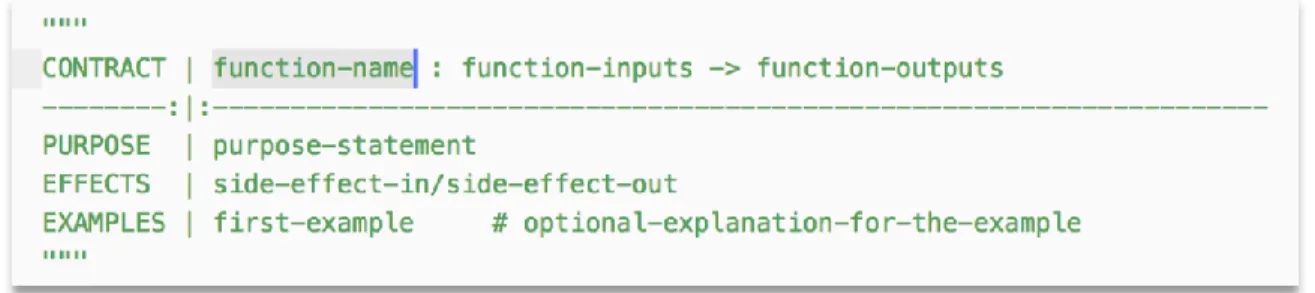
The primary benefit we expect from the design recipe process is almost identical to the motivation of the original design recipe proposed by the Program by Design project: “Addressing the ‘Blank Page Syndrome’” [24]. Unlike passing out a blank sheet of paper or instructing the students to open up a new text document, we expect that exposing the novice students to the template of the design recipe (such as the example shown in Figure 4.2.2 or Figure 4.2.3) will provide a strong sense of direction as to what they are supposed to do next.
We believe this primary benefit of avoiding “Blank Page Syndrome” [24] is absolutely critical. No matter how great the framework may be, if the students feel unsure about what to do at the very beginning of practicing it, only to eventually get lead astray or give up, what value could it possibly deliver? Therefore, in defining the framework, we require the design recipe to be the very first component to be introduced to and practiced by the students, even at the instructor’s cost of having to spend a few days or weeks preparing the students with the fundamental concepts leading up to and including functions and unit testing.
As we discuss later, there are components of the framework (such as code outlining; subsection 4.2.2) that have almost no conceptual prerequisite and thus may be introduced to the students within the first few days of instruction. Nonetheless, our recommendation still stands with the design recipe having the highest topological ordering in relation to all other components, just so we can deliver the primary benefit of providing the students with a clear sense of direction. As similar as it may seem to the original by Felleisen et al. [23], our adaptation of the design recipe process still has a few key differentiating features. The first differentiator is the aforementioned provision of the design recipe templates. (The original specifications of HtDP’s design recipe process do not require templates to be provided to the students [23], although there are implementations of it that do, e.g. Bootstrap [25]).
of interrupting the students’ thought process. Without the need to write the function signature in any formal programming language, the extra effort of having to recall the function header or signature syntax becomes eliminated from the process of problem decomposition and function design. Instead, students may simply state the name of the function, then list the datatypes of the functional arguments and return value in the CONTRACT line.
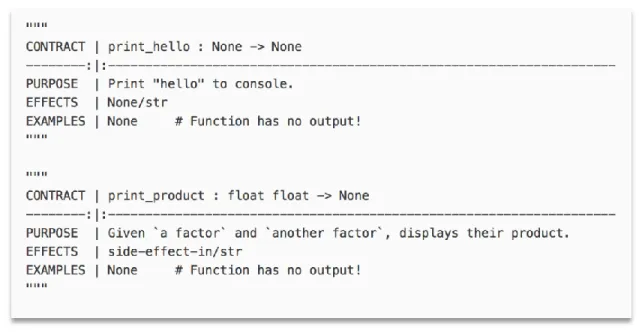
The third and final differentiating factor in our process is that the concept of side-effects is introduced from the very beginning, compared to how HtDP [23] defers introduction of side-effects and its inclusion in the design recipe until very late in its curriculum. Our design recipe process requires any side-effects of the functions to be explicitly stated separately from the functional arguments. This is motivated purely by our observation of novice students throughout the years of interacting with them: a recurring pattern we observe is that students tend to confuse and intermix the functional input/outputs and the system-level input/outputs such as the console outputs or keyboard inputs. Since the system-level input/outputs are often implemented as side-effects within a function, we expect to meaningfully reduce this confusion by letting students explicitly state the side-effects of a function and visually and conceptually distinguish any system-level interactions from the inputs and outputs of a function.
4.2.2 Code Outlining
We want to minimize any extraneous cognitive load that may hinder the expression of the students’ intuitive algorithmic thinking on how the programs, functions, or subroutines may be implemented. Therefore, code outlines are defined relatively broadly and informally. The outlines are to be written in a natural language,in a bullet-point format, with optional utilization of different levels
of bullets and indentation to distinguish the implementation plan within a
control structure from the top-level implementation plans (Figure 4.2.5). In theory, the outlines may be written in any medium, but we recommend instructing students to place the outlines as in-line comments in the source code file where the actual implementation in a formal programming language will eventually be. We make this recommendation to ensure that the efforts put towards composing the outlines contributes to the actual implementation when students begin to code. When students design functions as part of the framework, we suggest that the code outlining practice immediately follow the design recipe process (presented in subsection 4.2.1), so that students may continue the externalization process of their intuitive ideas on functions as components of a larger program. We anticipate the practice of writing down or typing out the implementation plans in a concise format to assist the students in organizing, validating, and improving their initial ideas on how to implement certain componential algorithms of a larger program.
timing of integrating the code outlining process into the course curriculum to be flexible. Here, we provide a few examples of code outlines with varying complexity to illustrate this point.
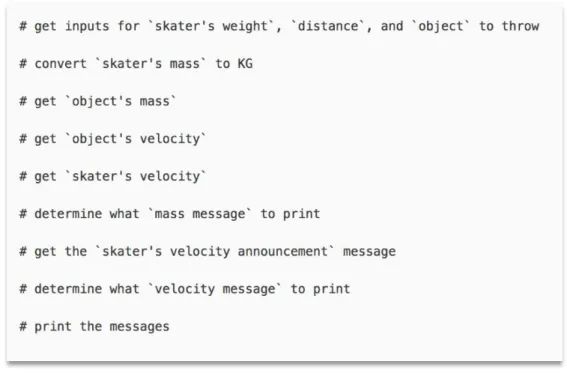
Figure 4.2.4 shown below represents a potential externalization of a student’s initial idea on how to structure a small top-down program as they are reading through the programming assignment specifications.
Figure 4.2.4: An example code outline for a simple program
course quite early on. To substantiate this, we provide a selection of linear code outlines (similar to Figure 4.2.4) written by actual introductory students in Appendix C, Selection of Student-Composed Linear Code Outlines.
With the limited complexity of the logic expressed in the outline, this externalization process may seem too trivial to provide any benefit. However, the benefit this seemingly trivial process provides is more than meets the eye. Unlike any retention of the initial idea in one’s human memory, this once-externalized outline is semi-permanent, relatively free from the risk of being lost or corrupted [29]. Therefore, a novice student who has finished externalizing their initial idea for the program is then free to safely move on to other tasks required to complete the project. Continuing with the running example from Figure 4.2.4, perhaps a student may need to study some of the mathematical formulae to gain better insight on the domain knowledge (physics) required to understand the problem better, or they may desire to consider designing a function to handle detailed tasks like input validations (if the student is familiar with the necessary concepts, of course). Whichever the case may be, the novice student is now at a much lower risk of potentially losing a key insight from their initial brainstorming—for example, needing to perform a unit conversion to KG in the case of this program—than if they had relied on their memory alone.
Figure 4.2.5: An example code outline for a moderately complex program
be able to visually organize the individual pieces of their plan such as strategic placements of control structures and function applications.
One may argue that a novice student is more likely to begin constructing their outline in a purely linear, top-down manner without necessarily thinking about applying any of the relatively complex concepts. We certainly anticipate some students may initially experience difficulties in developing an outline that goes beyond a linear, top-down approach, even for the problems with obvious opportunities to apply more complex logic such as conditionals and loops. However, as they continue the construction of their outline, we expect certain pieces of the outline to stand out as repetitive or particularly refactorable, perhaps motivating them to apply their knowledge of functions or control structures. Even if the original author of an overly simplistic linear outline does not catch certain opportunities to apply higher-order concepts, having a written outline makes pointing out such missed opportunities during a review process (such as the one presented in subsection 4.2.2) much easier.
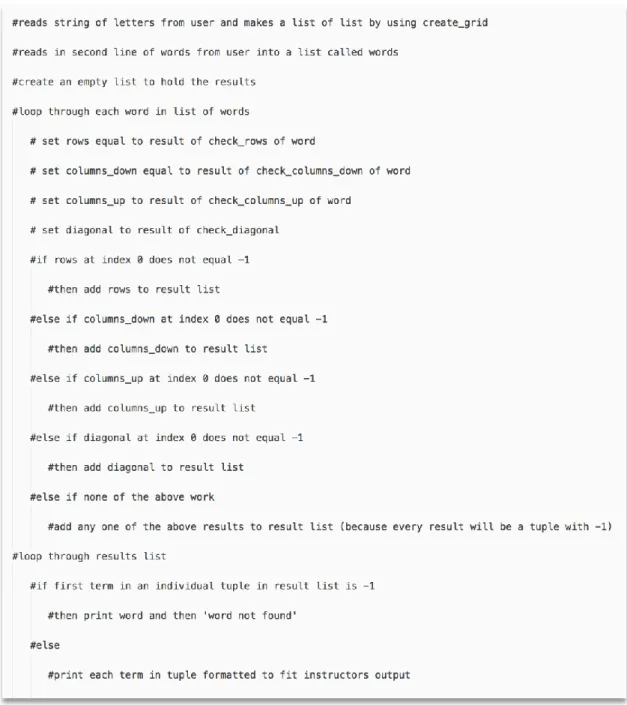
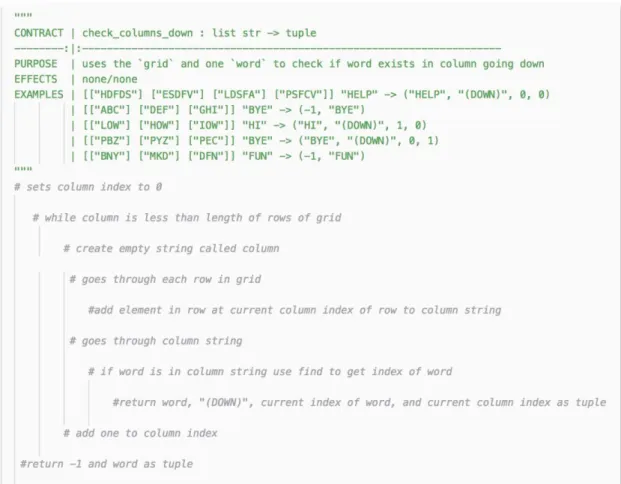
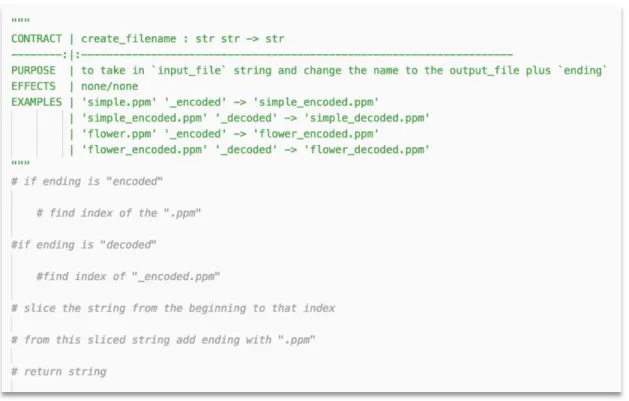
Figure 4.2.6 shows the code outline in a slightly different context, where the outline is used to externalize an implementation plan for a specific function rather than the top-level logic of the whole program. Here, the outline shown is constructed to accompany the design recipe for a function that searches for a possible occurrence of a word in a grid for the word search program, where grid is a two-dimensional matrix of characters.
Figure 4.2.6: An example function-level code outline with a design recipe
4.2.3 The DRaCO Workflow
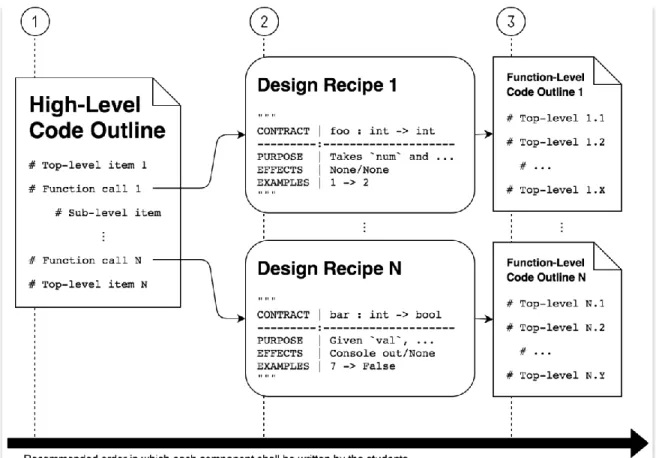
Figure 4.2.7: Design Recipe and Code Outline (DRaCO) workflow
Before we continue on to discuss the remaining components of the framework, we propose an aggregative terminology for the first two components presented so far: DRaCO (Design Recipe and Code Outlines). Figure 4.2.7 above illustrates the process involving the two components (DRaCO) as aworkflow.
packaged workflow to the students, since presentation of a single workflow is likely to minimize any room for confusion and make it more convenient when integrating it into an existing curriculum. Detailed discussion on implementing the DRaCO workflow into the existing assignment structures of an introductory course is presented in Chapter 5, Implementation of the DRaCO-based Pedagogy.
4.2.4 Peer Review Process
Peer code review is a process well known to be an effective tool both in the computing industry [30] and the educational context [31]. However, there are clear difficulties in implementing the process in the introductory courses. According to Busjahn et al, computer science educators report that “understanding the code’s intention from the text surface” is perceived by the learners “as the major challenge in [code] reading” [32]. This is particularly easy to observe at the introductory level where encountering statements such as “I wrote this snippet of code, which does what I want, but I have no idea why it does what it does” are not a rarity. Many students struggle often with the code they have written all by themselves, so we can reasonably see how the magnitude of the struggles would only multiply if they had to read someone else’s code.
is to learn the language, not necessarily learning how to communicate their sentiments with each other.
Unfortunately, the same justification cannot be granted to the students who are taking an introductory computer science course. The primary goal of being in an introductory computer science course shall be, as we and many other educators have argued thus far [7] [6], anything but simply learning a programming language. Therefore, in most introductory courses, letting the algorithmic thought process get ‘lost in translation’ is in no way acceptable, since the part that often gets ‘lost in translation’ is what we care most about in a peer code review process.
Again, we approach this difficulty in integrating the peer code review process into an introductory course with recognition that the students’ lack of proficiency in the formal programming language(s) is the main obstacle. We propose a peer review process that strips away the problematic “text surface” and retains only the “intention” [32], or the algorithmic thought process, behind. We claim that this is not too difficult to achieve with the specifications of DRaCO.
descriptions of different stages of the implementation plan in a natural language, students are effectively reading the original author’s unaltered externalizations of the intentions. We expect this to be far more effective than having to roughly estimate the meaning behind a rather foreign surface syntax of a programming language that is possibly an incorrect translation of the author’s original intentions. Our specifications of the peer review process do not restrict the medium of the review. That is, the instructors implementing the peer review process as part of the framework are not at all discouraged from conducting the review with any electronic tools, including commercial code review tools such as Microsoft’s GitHub [33], Atlassian’s Crucible [34], JetBrains’ Upsource [35], or any proprietary tools. Conducting the review simply with paper-and-pencil also aligns well with our specifications. However, we recommend that the review processes be held in person, such that the reviewer and the author of the DRaCO artifacts are free to verbally communicate while sharing a single copy of the artifact they are sharing.
Consequently, we define the peer review process in the context of the framework as an in-person review process of the artifacts of DRaCO workflow, where the participants shall examine, discuss, and critique each other’s
implementation plans via verbal and written communication.
the students would be still learning how to think algorithmically with the concepts in computer science, we shall rather expect most DRaCO artifacts to lack clarity in many aspects. Since the main goal of the review process is to understand and critique the intentions of the author, we claim that having the author in the flesh to interact directly with is one of the most essential steps in achieving that goal. Especially if the artifact alone proves to be lacking due to the author’s inexperience, the opportunities to freely ask clarifying questions, critique the logic expressed, and listen to the author’s defense of certain choices would unequivocally add significant value to the review process than if the only channel of communication between the author and the reviewer were the DRaCO artifacts.
4.2.5 Automatic Code Template Generation
Primarily, both of the remaining components are included in the framework to dissuade students from simply perceiving the requirements of the framework as ‘extra work’ that is time consuming and offers little benefit.
The first of the two remaining components is automatic code template generation. Not to be confused with the design recipe template from subsection 4.2.1, we define ‘code template’ as some starter code to be generated from the students’ DRaCO artifact, such that the generated code may provide some
guidance to the author of the DRaCO artifact on how one could start
is certainly understandable how a cycle of interaction between a programmer and a computer via a language that both can comprehend may be much more exciting than jotting down one’s thought process in a manner that the computer will never understand. Although often overlooked in higher education, excitement is an important factor in a programming environment’s ability to engage and retain students and their attention, as the developers of Scratch have noted in developing their initial learning environment for a wider range of audiences [14].
Therefore, we have devised automatic code template generation as one of the components of the framework in order to incite some excitement in students. The emphasis here is on the automatic generation of code based on students’ text input. By providing a tool that parses DRaCO artifacts and generates some level of ‘real code’, we are allowing the emulation of the aforementioned cycle of interaction between a programmer and a computer. With this, we are also instilling into students’ minds the idea that following the DRaCO workflow is more than mere notetaking, and that the DRaCO artifacts have some functional aspects similar to formal programming languages. With this, we aim to convince the students that DRaCO has a unique value beyond simply being a format to organize their implementation plan, thus motivating them further to put in sincere efforts into the DRaCO workflow.
code-generating tool may provide to novice students. While we still provide an example implementation of automatic code template generation in the subsequent chapter (Implementation of the DRaCO-based Pedagogy), we are leaving the interpretation of the definition of code template completely up to the discretion of the instructor implementing the framework to their own introductory computer science course.
4.2.6 Automatic Unit Test Generation
Automatic unit test generation in the context of the framework serves as the second component that adds practical benefit of utilizing the DRaCO workflow. It is quite similar to the automatic code template generation (subsection 4.2.5) in the sense that it also generates executable code based on the DRaCO artifacts and allows students to interact with a computer. However, automatic unit test generation is proposed with a much more clear-cut definition and purpose than providing “some guidance” to the students.
Defined as the generation of a working unit test suite written in a formal programming language based on the DRaCO artifact, we propose automatic unit test generation to serve as the training wheels for the novice students to experience the benefit of test-first or test-driven development (TDD).
practices] until they have mastered other basic skills” [39]. In addition, most TDD practices require writing the tests in the testing framework of the formal programing language in use. Since we are proposing an extended deference of any use of the formal programming languages based on the observation we have so far enumerated regarding our inexperienced target audience, it may seem that there exists no plausible avenue of compatibility between the traditional TDD practices and our Framework. While we acknowledge that no traditional TDD practice will organically synergize with the specifications of the framework, we also recognize that some logic to validate the students’ design of the function or subroutines already exists in the form of example test cases within the design recipe component of the DRaCO artifact.
bestowed upon the students at no cost of having to learn any particular testing framework or the language in which the framework is written.
Moreover, we anticipate that the students’ initial interaction with a generated test suite will allow them to realize how a well-written set of test cases is capable of saving them from “forever fussing about what did I miss, what did I forget, what did I just screw up,” as Kent Beck has put it [40]. With this, we assert that motivating the students to put more time and effort into writing good example test cases for the later assignments should not be difficult, especially with some extra guidance from the instructor to reinforce the importance of good test cases. Ultimately, we expect automatic unit test generation to at least cultivate a learning environment in which motivating and introducing more formally established practices of TDD becomes natural.
4.3 Summary of the Proposal
We present the entirety of our new teaching method with verbose philosophical and practical justifications in the earlier portion of the chapter. In this section, we tersely summarize our proposal and reproduce the definitions of the key components of the framework, such that those who intend to develop a proprietary integration strategy for the proposed teaching method may utilize it as a quick reference.
4.3.1.1 New DRaCO-Based Pedagogy for Introductory Computer Science Education
students’ ability to program is positively impacted in a quantitatively verifiable manner.
• The new teaching method is centered around the framework, which contains five key components. They are:
1. Design Recipe: the process of determining the name, inputs, outputs, purpose, side effects, and example test cases of a program, function, or a subroutine and explicitly externalizing them in a specific format.
2. Code Outlining: a process of describing the implementation plan for a program, function, or a subroutine in a natural language, in a bullet-point format, with optional utilization of different levels of bullets and indentations to distinguish the implementation plan within a control structure from the top-level implementation plans.
3. Peer Review Process: an in-person review process of the artifacts of DRaCO workflow (subsection 4.2.3), where the participants shall examine, discuss, and critique each other’s implementation plans via verbal and written communication.
5. Automatic Unit Test Generation: programmatic generation of a working unit test suite written in a formal programming language based on the DRaCO artifact.
4.4 Name of the New Teaching Method
Chapter 5
IMPLEMENTATION OF THE DRACO-BASED PEDAGOGY
In this chapter, we present the details of our implementations in integrating the DRaCO-based pedagogy into an introductory computer science course at California Polytechnic State University, San Luis Obispo (‘Cal Poly SLO’). The proof-of-concept implementation of the framework presented in this chapter serves as a basis for our validation of the new pedagogy (presented in Chapter 6, Validation of the DRaCO-based Pedagogy) and is intended to be a motivating example for any replication studies or future work utilizing the framework.
5.1 Implementation Environment
We begin the illustration of the environment in which we deployed the DRaCO-based pedagogy by explaining the contextual course structures at Cal Poly SLO.
5.1.1 Introductory Computer Science Courses at Cal Poly SLO
At Cal Poly SLO, a majority of the underclassmen in computer science, software engineering, and computer engineering majors begin their major coursework in a sequence of two introductory courses: CPE-123 and CPE-101 (in this order). Each course spans a single academic term, which is a quarter composed of ten instruction weeks and a one final exam week.
varying themes such as computational art, game development, mobile application development, music, robotics, and cybersecurity, in which a beginning student may choose to enroll depending on which subject aligns best with their interests. While all offerings of this course have a common high-level objective such as teaching “core computer science principles and tools, providing a foundation and context for more traditional, introductory CS coursework,” the contents of the differently themed offerings of the course vary depending on the technology stack and the pedagogy employed by the instructor in charge [41].
The latter course in the sequence, CPE-101, or Fundamentals of Computer Science, is the traditional ‘CS1’ course. The university’s catalog specifies the course to provide lessons on the following: “Basic principles of algorithmic problem solving and programming using methods of top-down design, stepwise refinement and procedural abstraction. Basic control structures, data types, and input/output. Introduction to the software development process: design, implementation, testing and documentation. The syntax and semantics of a modern programming language” (Python 3 at the time of this research) [42].
5.1.2 General Structure of the CS1 Course at Cal Poly SLO
An offering of CPE-101 at Cal Poly SLO has a fifty-fifty split between the ‘lecture’ and ‘lab’ hours. With the current configuration of the course where a total of six hours is allotted to an offering of the course per week, three of the six hours are designed as a traditional lecture time during which the instructor of the course will deliver the course content to the students attending. Although most of the lecture hours are spent with the instructor presenting some computer science concept and its applications in front of a traditional classroom with little interaction among students, a small portion of the lecture hours are spent on discussions and opportunities in which students can work on small exercises as a group.
The remaining three hours per week are less structured and scheduled in a computer lab. During these ‘lab’ hours, students are encouraged to work on exercises and assignments for the course and seek the help from an instructor or a teaching assistant as needed. Rarely, some lab hours may be consumed by overflow lectures or exam time. Because the learning that is designed to occur during the lab hours are mostly student-led and not initiated by the instructor’s delivery of new course material, attendance of the lab hours is largely considered optional.
scores students earn from the following items: lab assignments (smaller programming homework to be completed within a short period of time; usually about a week), projects (larger programming assignments that require applying a sizable culmination of concepts, with relatively larger time window for students to work on them), a couple of midterm exams that occur throughout the quarter, and a final exam that is scheduled during the final exam week. In principle, all graded items in the course are to be completed without any collaboration among students.
5.1.3 Seams for the DRaCO-based Pedagogy
With the existing structure of the CPE-101 standing as presented in previous subsections, we identify the a few components of the course as ‘seams,’ or appropriate points in which we may be able to integrate the key components of the framework only with minimal and necessary disruption to the established course structure. These seams are described in the subsequent paragraphs.
First, we find the projects of CPE-101 to be perfect candidates for the students to apply the framework. The level of complexity the projects provide are deemed sufficient to motivate the need for thoughtful decomposition, planning, and testing prior to implementation in code. Also, the wide time window allocated for the projects allow equitable introduction of DRaCO workflow assignments and peer review process as smaller parts of the overall project progression.
course, we see that asking exam questions that are designed to test the students’ ability to program would be appropriate.
Finally, the flexible lab hours that are scheduled in a separate time and physical location from the lectures do not only allow designing an A-B experiment to evaluate the pedagogy we were implementing (presented in Chapter 6) but are also pivotal in finding the extra time to introduce to the students key components of the framework and assist them in getting familiarized with the DRaCO workflow. For the remainder of this chapter, we explain precisely how we integrate the components of the framework into the aforementioned seams on an offering of CPE-101 at Cal Poly SLO. We must note for clarification, however, that the integration techniques we present only apply to the experimental group of the course offering. That is, when we mention integration of certain components of the framework into our course offering of CPE-101, only half of the students (those in the experimental group) from our offering are affected. More details on the structure of the A-B experiment and the different course materials each of the experimental and control groups were exposed to are discussed in section 6.2, Experiment Design.
5.2 The DRaCO Workflow
5.2.1 Implementation of the Design Recipe Process
Before students begin the design recipe process, we guide them to install the Sublime Text 3 text editor. Then, we assist students in configuring its autocomplete feature to provide an electronic template for the design recipe—similar to the one shown in Figure 4.2.2. This configuration of Sublime Text 3 text editor allows students to simply type ‘dr’ in any Python source file and press the tab key on the keyboard to insert the design recipe template at the cursor location.
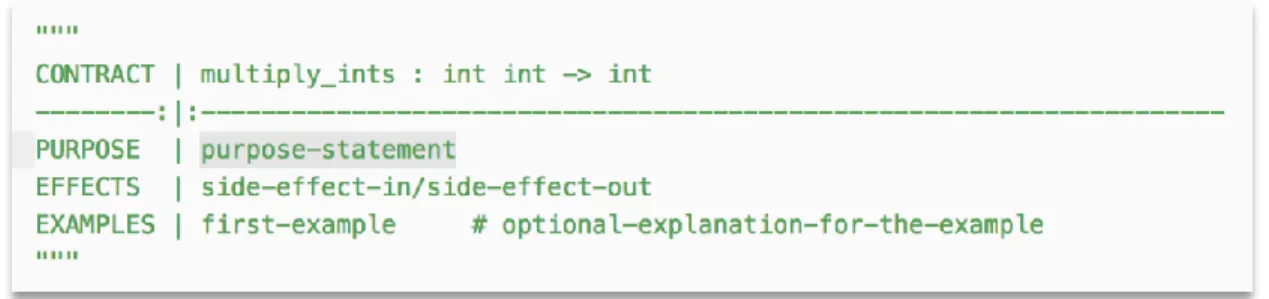
Once the template is inserted, subsequent presses of the tab key auto-advances the cursor and highlights different fields of the design recipe (function name, input argument types, return value type, purpose, and on) to be populated. Figure 5.2.1 is provided below as a snapshot amidst this process, which shows CONTRACT line of the design recipe populated, with the cursor auto-advanced prior to the completion of the PURPOSE line. Dashed texts such as ‘ purpose-statement’ are placeholder strings that get automatically highlighted and eventually replaced as the actual content of the design recipe is typed into the template as part of the process.
Figure 5.2.1: Population of a design recipe template using auto-advance