56 | P a g e
Impact of English as a Foreign Language Students’ Self
-Assessment on their
Writing Skills’ Development
Emine Albayram*
Abstract
The present article concerns one of the most topical issues in teaching English as a foreign language (EFL) - assessment, in particular, formative assessment in teaching one of the most complicated skills for EFL learners - writing. Writing as a skill requires a thorough and highly reflective planning and implementation in order to guarantee that learners achieve a sufficient degree of mastery in this respect. In the article, self-assessment as one of the most innovative methods of assessment of writing skills is analyzed. Its efficiency is confirmed by literature review and an experiment held with 36 secondary school children (Georgian learners of EFL) for one semester. Keywords: Teaching English as a Foreign Language (TEFL) , teaching writing, assessment in TEFL, self-assessment,
self-assessment in EFL writing
Introduction
All learning issues are directly connected to assessment. Language learning necessarily calls for assessment, as learners and teachers wish to measure the outcomes of their performance in order to be able to amend their practices, depending on whether they are consistent with general or specific requirements. Moreover, it is quite
significant to practise it effectively in language classrooms “as language learning and assessment are closely associated and often intertwined in practice” (Oscarson, 2009, p.13).
Writing is of a great significance for language learners. It requires language knowledge, namely of grammar, vocabulary, syntax, cohesion, coherence, etc. In the modern world there is a great need to know how to write efficiently and clearly without causing any misunderstandings, as contemporary life requires various ways of communication via writing for numerous reasons, such as social, academic, business, etc. Language learners need to be aware of the writing process and its assessment specificities. However, students generally completely
depend on teachers’ feedback and correction. If students are taught how to assess themselves, they will learn
how to be independent and competent writers who will in the future successfully deal with writing tasks on their own (Spiller, 2009).
* PrivateDemirel College, Tbilisi, Georgia
57 | P a g e
Self- Assessment in Education
Assessment is defined as judgment of students’ performance by gathering information about it (Spratt,
Pulverness, & Williams, 2011). Students are assessed for different purposes with various tools, such as exams or tests by using a great number of ways like true-false questions, cloze tests, interviews, multiple-choice questions, etc. Assessment determines whether the educational goals are met or not. It has a vital role among learning / teaching goals for the time to be spent on a subject, curriculum, and the method of teaching / learning. When assessment works well, it enables seeing improvement, gives feedback about the process, helps set goals for both teachers and learners, and hence raises the quality of education.
According to Wiliam (2013), “of course, the idea that assessment can help learning is not new, but what is
new is a growing body of evidence that suggests that attention to what is sometimes called formative assessment, or assessment for learning, is one of the most powerful ways of improving student achievement”
(p.1). It was found to be efficient to use and improve assessment for learning activities and goals aiming at
increasing learners’ achievements on standardized tests (Clymer & Wiliam, 2006).
There are various ways of assessing students. In order to activate students in establishing their own knowledge and improving their higher-order skills in order to be successful in academic and social life, educators have felt an increasing need for self-assessment (El-Koumy, 2010). It is one of the efficient methods in formative assessment.
Oscarson (2009) regards the necessity for self-assessment in her study as follows:
Assessment practices should contribute towards learners’ ability to learn, not venture or undermine learning. Students need to be able to appraise their performance accurately for themselves so that they themselves understand what more they need to learn and do not become dependent on their teachers. A fundamental reason for self-assessment is then to help the learner become aware of achievement reached at any given time and over a longer term, and in this way, enhance learning (p.59).
Self-assessment does not mean basically students’ grading themselves, but students assessing themselves as one of the ways to promote their learning, together with teacher feedback. It is quite important to educators who are interested in alternative assessment methods. Andrade and Du (2007) define student self-assessment as
“a process in which students collect information about their own performance and see how it matches their goals
and / or the criteria for their work” (p.161). According to Schimmer (2016), it refers to students eliciting not only
positioning but also differentiating between their product and agreed-on performance benchmark. Gardner
(2000) claims that “self-assessors decide what to assess, when to assess it and how to assess it” (p.51). Therefore,
58 | P a g e Self-assessment has emerged parallel to student-centered classroom approaches. It includes self-monitoring and self-reflection. As students observe themselves and judge their weakness and strength in their learning process based on a performance or product in self-assessment, they can change or reset their goals. This allows them to improve their metacognitive skills and life-long learning skills and finally they become self-regulatory about their learning. Sometimes, self-assessment is used interchangeably with self-evaluation. However, whereas self-assessment refers to formative assessment and usually it is what students do about their performance, self-evaluation is defined by Spiller (2009) as “assessment which builds on a natural tendency to check out the progress of one’s own learning” (p.4).
Oscarson (2009) believes self-assessment as a technique which assists students to improve reflection with the purpose of identifying their achievement in various aspects of learning. McMillan and Hearn (2008) divide self-assessment into two process parts: firstly, students observe and judge attributes of their cognition and performance, and secondly, they specify schemes which develop their comprehension and capabilities.
As foreign language learning has spread all around the world owing to the globalizing / globalized world and its global and local consequences, the need for assessment has increased similarly. English has become a
lingua franca in today’s world due to communication needs, travelling, developments in business, academic
studies, art, etc. People covet to have a good level in English in terms of reading, writing, speaking and listening in order to prevent misunderstandings and possible troubles which may result from miscommunication. When people communicate with each other through letters, e-mails, text messages, they heavily rely on their written skills.
As for students, they depend on teachers while writing. They desire teachers to check their writing
assignments and correct their mistakes. However, it makes a learners’ life hard to always search for someone to
correct their mistakes, which is extremely discouraging. Hence, students must be supported to gain lifelong skills and ability to correct their writings themselves. As a result, there is a great need for self-assessment in developing writing skills of L2 learners.
Benefits of Self-assessment
There are many reasons to implement self-assessment in language learning. These are as follows: • Self-assessments help learners monitor their level of success in specific learning tasks (Gardner, 2000). • Correctly implemented, student self-assessment can promote intrinsic motivation, internally controlled
59 | P a g e • A series of self-assessments will contribute to monitoring progress towards specific learning objectives
(Gardner, 2000).
• Through self-assessment, learners can identify specific areas where they need more support and can seek help from teachers or language counselors. Information about support requirements can enable teachers / counselors to focus on areas where guidance is needed at a time when it is needed (Gardner, 2000). • Self-assessment can promote learner responsibility and independence (Spiller, 2009).
• Self-assessment tasks encourage student ownership of learning (Spiller, 2009).
• Self-assessment tasks shift the focus from something imposed by someone else to a potential partnership (Spiller, 2009).
• Self-assessment emphasizes the formative aspects of assessment (Spiller, 2009). • Self-assessment encourages a focus on process (Spiller, 2009).
• Self-assessment can accommodate diversity of learners’ readiness, experience and backgrounds (Spiller,
2009).
• Self-assessment practices align well with the shift in the higher education literature from a focus on teacher performance to an emphasis on student learning (Spiller, 2009).
The role of writing in EFL
Writing is one of the skills which is vitally important for proper communication. However, it is not easy for EFL students to be competent in it. It takes a long time to learn how to appropriately express opinions and emotions in any sphere of life. Learning how to structure thoughts and to write them down enables people to present facts and real opinions in a rational and calm way.
Writing requires a process to get a successful product. According to Harmer (2004), the writing process is referred to as the phases a writer follows to generate something in its last version. He unfolds such stages as planning, drafting, editing and a final version. He describes the process as recursive, but not linear, as often writers re-plan, re-draft and re-edit their works. Therefore, he describes this aspect of writing process as a
“process wheel”. In this wheel process, writers can amend their writing many times until they make sure that the
60 | P a g e Figure 1. The process writing (Harmer, 2004, p.13)
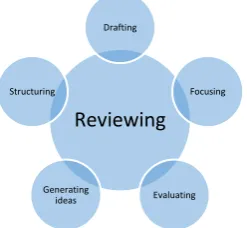
White and Aradith (1991 as in Johnson, 2001, p. 228) exemplify his process writing in the following schemata which are interrelated with each other and in each phase reviewing is made possible.
Figure 2. Self-Assessment in EFL writing (Johnson, 2001, p. 228)
Traditionally, students write on a specific topic during the assigned time and hand in the assignment to their teacher without revising, then the teacher usually reads, evaluates or grades this product with a score and returns it to the student. However, this method may cause students to believe that their teacher has the main responsibility to enhance the quality of the text written by them (Hedge, 2000). Additionally, the text which is generated by EFL students is not of the same quality as the text generated by native students of the same age (Oscarson, 2009). This mainly results from certain difficulties which an EFL student has experienced. First of all, students need to make much effort to decide what and how to write. Then they devote attention to writing organization and structure. Moreover, they try not to make mistakes / errors for a comprehensive writing product, which is rather challenging. To write in any foreign language is far more complicated than L1 writing. Oscarson (2009) claims that even socio-cultural differences between the native language and the foreign language can
affect FL students’ writing in a negative way, the factors which they may not be conscious of.
Taking into consideration the importance and difficulties of writing in a foreign language, students must be given opportunities to comprehend what they need to know in order to write, whether they have enough capability to write in an effective way, which way to follow to generate a quality writing, etc. If teachers enable them to assess their own performance and products, students may have a better understanding of creating a successful piece of writing as they will need to learn assessment criteria. To understand criteria is a way to success for students. Moreover, equipped with criteria they will not completely depend on teachers. Furthermore, Sachs and Polio (2007) indicate that, as students undergo a cognitive process while producing and assessing their written product, their linguistic formulation will improve as well. One of the aims of teaching is to educate students so as to make them ready for further learning and becoming autonomous learners, hence self-assessment gives chances to students to become independent learners and, according to Oscarson (2009), it has
Reviewing
Drafting
Focusing
Evaluating Generating
61 | P a g e the main role in formative assessment. She continues that “It is believed to have the potential to promote
learning, raise learner awareness, underpin learner autonomy in a lifelong perspective, and to be conducive to democratic learning processes and needs analysis ”(p.63).
To get the desired consequence from self-assessment, it is necessary to train students well in advance and let them practise a lot before real application, therefore, teachers must give them a regular and clear feedback for enhancing student self-assessment capabilities.
According to Fahimi and Rahimi (2015), self-assessment in writing indicates any method or incorporation of any activity that causes writers to think about, evaluate and revise their writing, they advocate self-assessment, as it provides “meaningful ways to nurture student writing achievement through reflection and analysis. Self
-assessment includes a wide range of practices and varied terminology” (p. 735).
Methodology
Research question
The study aims at presenting the importance and effectiveness of self-assessment in EFL writing classes at high school level and seeks answer to the following question:
Does self-assessment have a positive impact on general writing ability of high school EFL students? Participants
Thirty-six students in two classes at an intermediate level took part in the study in a private secondary school in the city of Tbilisi, Georgia, in fall semester, 2016. The average age of the learners was 16. The participants were already seeded in two parallel classes randomly. The same instructor conducted the study in both classes. Students were delivered EFL lessons twice a week in 45-minute sessions. The study lasted for one semester.
Instruments
The instruments implemented in the current study include two B1 level Preliminary English Tests of Cambridge Exam, a rating checklist, two writing tests as pre and post-tests. The test was conducted in order to measure the
participants’ writing skill level. The test contained two parts. The first one was compulsory whereas the second part included two parts in which students had a chance to choose one of them. In the first part, students were required to write between 35-40 words while they had to write roughly 100 words in the second part. The students in the experimental group were provided with checklists in order to assess their strengths and
62 | P a g e Procedure
In order to answer the research question, the following procedure was applied. As a first step, a Preliminary English Test (B1 level) was given to the both groups who had been randomly divided as two 10th grade classes. In the control group, nothing new was used as a method in teaching writing, but the traditional way was pursued, while self-assessment and self-editing techniques were implemented in the experimental group. The experimental group was taught correction symbols and then they assessed themselves according to various checklists. The teacher made comments on the writing texts created by the students regarding their weaknesses at the bottom part of the checklist. Furthermore, comments and feedback were given to students individually and in written form. Meanwhile, the control group was not provided with any comment, but just scored in traditional way. After the experiment, a teacher survey and a student interview were conducted in order to confirm and verify results to be obtained.
Results
The starting skill level in both groups is almost the same (7.63/7.78, according to students’ self-assessment and
5.84/5.4, according to teacher’s assessment).
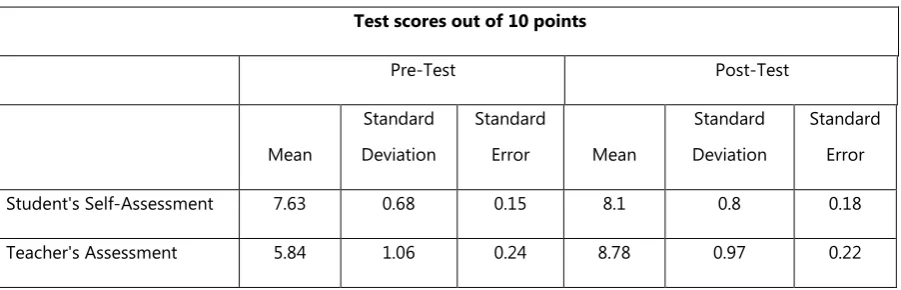
Table 1-Results of pre- and post-tests in the experimental group
Test scores out of 10 points
Pre-Test Post-Test
Mean
Standard Deviation
Standard
Error Mean
Standard Deviation
Standard Error
Student's Self-Assessment 7.63 0.68 0.15 8.1 0.8 0.18
Teacher's Assessment 5.84 1.06 0.24 8.78 0.97 0.22
We can see that the students’ self-assessment increased from 7.63 to 8.1 (by 0.47 or 6.2%). The standard deviation is 0.68 and 0.8, which is reasonable, meaning that the level of writing skills in the group is rather homogeneous, however, according to students, it became less homogeneous, which reveals that not all students have equally benefitted from the treatment. The standard error is within norm.
63 | P a g e less homogeneous. Interestingly, according to the teacher, it became more homogeneous, which reveals that all students have equally benefitted from the treatment. The standard error is a little high.
Although the students’ and teacher’s assessments differ tangibly, in both cases the progress in the writing skill level is visible. Also, due to the treatment, the students’ self-assessments have become closer to the teacher’s
assessments, which means that the students became more aware of the assessment requirements. Table 2-Results of pre- and post-tests in the control group
Test Scores out of 10 points
Pre-Test Post-Test
Mean
Standard Deviation
Standard
Error Mean
Standard Deviation
Standard Error
Student's Self-Assessment 7.78 0.57 0.09 6.2 0.6 0.16
Teacher's Assessment 5.40 1.0 0.20 5.89 0.80 0.20
We can see that the students’ self-assessment decreased from 7.78 to 6.2 (by 0.1.58 or 20.3%). The standard deviation is 0.57 and 0.6, which is reasonable, meaning that the level of writing skills in the group is rather homogeneous throughout the experiment. No changes occur, as no special treatment was applied. The standard error is within norm.
Their assessment by the teacher increased from 5.40 to 5.89 (by 0.49 or 9.1%). The standard deviation is 1.0 and 0.8, which is reasonable, indicating that the level of writing skills in the group was more or less homogeneous and became a little more homogeneous during the experiment. The standard error is within norm.
We can see that in both groups student and teacher assessments differ from each other. The students of the experimental group rate their success much more modestly than the teacher does. The students in the control group have a feeling that their writing skills are decreasing, while the teacher sees a certain progress. The
difference between the teacher’s and the students’ assessment in the control group is not surprising, as the
students have never been taught how to self-assess. On the other hand, there should not have been such a
difference between the students’ and the teacher’s assessments in the experimental group, as the teacher has
64 | P a g e
Teacher survey
For confirmation of the above data concerning the effectiveness of self-assessment in EFL writing and for a better understanding of the specificities of such practice a survey of five EFL teachers was conducted. These were the teachers who applied the above method in their groups (including the experimental group teacher) during the experimental period.The survey comprised two Likert scale, three close-ended and three open-ended questions and statements. The survey revealed that all the teachers assisted their students in understanding goals and aims of self-assessment in writing; moreover, they all provided learners with feedback after self-assessment; they were again unanimous when asked which aspect they focused on during self-assessment tasks. They as teachers embraced both process and product of writing, i.e., they attached equal importance and attention to both.When asked about their students’ behavior, reaction and attitude towards and during self-assessment - three teachers (60 %) stated that students resisted self-assessment, while two teachers (40 %) claimed they did not. It means that
students’ attitude towards self-assessment depends on the personality of the student. When inquired about the
reason of students’ reluctance, the three teachers named three different causes: shyness, laziness, and lack of
knowledge. Concerning the question to what degree objectively critical the learners were during self-assessment, the teachers had various opinions. One of them claimed that the learners were partly critical to themselves in terms of objectivity, one more stated that the learners attempted and made an effort to achieve objectivity, while three teachers (60 %) believed that the learners became critical and objective towards themselves after some practice in self-assessment in writing. To the question on which aspect (mechanics, content, both or any other) students focused while self-assessing,one teacher responded that on the first aspect - mechanics, three teachers (60 %) named both aspects as targets of student self-assessment and one teacher stated that at first the emphasis was on mechanics and later learners concentrated on both aspects equally. Last and most important, all the teachers think that self-assessment practice in writing improved their students’ writing ability - “greatly” according to four teachers (80 %) and “sufficiently” in one teacher’s opinion.
Interview with the experimental group students
65 | P a g e 1. How much did you like the idea of self-assessment in writing?
Student 1 liked the idea very much and it helped him find out in what respects he had problems and how to improve his writing skill.
Student 2 said that self-assessment was a great and interesting idea. He added that it enabled him to find his mistakes and not to repeat them anymore. However, it was challenging at first, but later he managed to discover his mistakes.
Student 3 said that he did not like the idea at first as it seemed difficult, but later on, after teacher explanation, he could see the improvements in his writing and changed his mind.
Student 4 claimed that she did not like the idea as assessing yourself might not be valid or true in reality.
2. To what degree were such activities interesting?
Student 1 explained that it was interesting and challenging for him. He added that he could check his essay after some time and could find simple mistakes like mechanical mistakes in his writing, however, it was challenging to find mistakes in content at first.
Student 2 responded that he got difficulty in finding mistakes at the beginning of the experiment. He stated that, as it sounded interesting, he really enjoyed the activities related to self-assessment, and it was like solving puzzles for him.
Student 3 answered that he was thrilled while waiting for teacher-assessment after he assessed himself to see how much he could manage to evaluate himself like a teacher. When the assessment did not coincide, he clarified with the teacher what was wrong in his writing.
Student 4 stated that she felt really uncomfortable and annoyed in the beginning, nevertheless later she could have fun while doing self-assessment activities. She told that it was really thought-provoking for her as she could observe her improvement in the writing.
3. Did such activities teach you how to write better?
Student 1 said that self–assessment activities taught him how to write better because it enabled him to write more effective and correct essays.
66 | P a g e Student 3 agreed that such activities helped her think more consciously about how to write effectively and
correctly and how not to write. She learned to avoid the vocabulary and grammar she did not know well enough.
Student 4 told that although she felt nervous while writing not to make mistake, she could not deny that these activities enabled her to make fewer mistakes and to write more impressive essays.
4. How much did you improve your writing with the help of self-assessment?
Student 1 responded that he improved his writing with self-assessment a lot and he added that now he feels more comfortable and free while writing some genres in English.
Student 2 said that working and repairing his own mistakes greatly improved his understanding of the main principles of effective writing. Therefore, he said that his writings are quite impressive now, and they include fewer mistakes compared to his previous writings.
Student 3 claimed that he could witness his own development in writing and this situation gave him more comfort and enabled him to compose effective writings in terms of content and mechanical skills such as spelling and punctuation. He also added that he became more careful with his writing and now checks himself in easier ways.
Student 4 stated that she began to write more correctly and comfortably. She said that she gained confidence after self-assessment.
Limitations
The experiment was held for one semester with 36 students in one private school in the capital of Georgia. We cannot say that its results are representative for the Georgian context, but it does give the basis to start a deeper and larger-scale research.
Conclusions and Implications
67 | P a g e Based on the literature analysis, it is possible to conclude that self-assessment in the process of writing has plenty of advantages, such as making the learning process more student-centered, taking individual students’
peculiarities and needs into consideration, more thoughtful writing, increased motivation, improved learning skills, development of mastery goals in learning, and stimulation of learner autonomy.
In Georgia students after finishing high schools are required to take a FL exam at B1 level for being admitted to university. Therefore, they need to be able to write meaningful texts with proper structure, organization and correct spelling and punctuation. They need to be able to forecast their ability to pass the exam and to regulate the preparation for the exam process.
In the research, the scores of the self-assessors and the teacher assessment were compared, and it was found out that there was a gap between the scoring of the self-assessors and the teacher in the first phase. Initially, the students in both groups overestimated their writing skill level. Later on, they started rating themselves more critically, thus the scoring between self-assessors and teachers became closer to each other. We might conclude that, based on the teacher assessment, the control group students started to assess their skills too critically, but a further research is needed to determine the real reasons.
Finally, this paper confirmed that self-assessment was really influential in EFL classes. Furthermore, the findings of the experiment supported the efficacy of self-assessment on students’ writing ability. Nonetheless, this
study was limited to 36 students in Georgian high school context. Therefore, further research in Georgia is needed in order support the effectiveness of self-assessment in EFL writing classes in Georgia.
References
El-Koumy, A S.A.K. (2010). Student self-assessment in higher education: Alone or plus? Paper presented at the CPLA Conference, October 29-30, 2010, Lebanese American University, Lebanon. Retrieved March 10, 2017 from: http://files.eric.ed.gov/fulltext/ED513289.pdf
Andrade, H. & Du, Y. (2007). Student responses to criteria-referenced self-assessment. Assessment and Evaluation in Higher Education, 32 (2), p. 159- 181.
Clymer, J.B. & Wiliam, D. (2006). Improving the way, we grade science. Educational Leadership, 48(7), p. 71‑76. Fahimi, Z. & Rahimi, A. (2015). On the impact of self-assessment practice on writing skill. Procedia - Social and
Behavioral Sciences, 192, 24, p. 730 – 736.
Gardner, D. (2000). Self-assessment for autonomous language learners. Links and Letters, 7, p.49-60. Harmer, J. (2004). How to Teach Writing. London: Pearson.
68 | P a g e Johnson, K. (2001). Introduction to Foreign Language and Teaching. London: Longman.
McMillan, J.H. & Hearn, J. (2008). The key to stronger student motivation and higher achievement. Educational Horizons, 87, 1, p. 40-49.
Oscarson, A. D. (2009). Self-Assessment of Writing in Learning English as a Foreign Language. A Study at the Upper Secondary School Level. Gotegorg, Sweden: Goteborg Universitet.
Sachs, R. & Polio, C. (2007). Learners’ uses of two types of written feedback on a L2 writing revision task. Studies in Second Language Acquisition: Cambridge University Press Publication, 29, 1, p. 67-100.
Schimmer, T. (2016). Self-assessment: Yes, but… Retrieved from http://allthingsassessment.info/2016/02/16/self -assessment-yes-but/ on September 4, 2016.
Spiller, D. (2009). Assessment Matters: Self-Assessment and Peer Assessment. Teaching Development. The University of Waikato. New Zealand. Retrieved from
http://www.waikato.ac.nz/tdu/pdf/8_SelfPeerAssessment.pdf on December 5, 2016.
Spratt, M., Pulverness, A., & Williams, M. (2011). The TKT Teaching Knowledge Test Course. Cambridge: Cambridge University Press.