MD Program Evaluation Plan
(August, 2009)
The Commonwealth Medical College (TCMC) requires its medical students to develop
competency in the areas of patient care, medical knowledge, practice‐based learning and improvement,
interpersonal and communication skills, professionalism, and systems‐based practice. The ACGME’s
Core Competencies were used when the curriculum was originally planned in 2007 and have remained
in the forefront as we revisit the initial curricular vision to make it a reality for our first cohort of
students who arrive in August, 2009. The expected level of competency attained must be sufficient to
allow these new physicians to be successful in graduate medical education programs as well as to reflect
the vision and mission of The Commonwealth Medical College. The MD Curriculum defines the
milestones of competency development. Components of self‐reflection and assessment are important
for both faculty and students. Within each program course, assessment and feedback becomes part of
the culture of professional behavior and develops proclivity toward lifelong learning.
As a new institution, evaluation and assessment are integral parts of curricular development,
linking learning outcomes to authentic forms of assessment that will provide indicators of a student’s
path of accomplishment as they matriculate through their program of study. The course directors and
faculty have committed to designing a program of instruction that incorporates active learning
strategies along with formative and summative assessment opportunities. TCMC has obtained PDE
approval and preliminary accreditation from the LCME to begin offering the medical curriculum to
students beginning in August 2009.
Key components of the MD curriculum include:
The medical school will function with a distributive model of medical education developing
three Regional Campuses (Scranton, Wilkes‐Barre and Williamsport) to provide students
experiences in diverse clinical settings.
Clinical education starts on day 1 with students assigned to a “Learning Community” that
corresponds to their Regional Campus, a family from that Regional Campus to follow for a
continuity experience and a clinical mentor. Additional clinical experiences will provide students
with training in an interdisciplinary setting by working with health professional training
programs at regional colleges and universities.
service. Students will be exposed to community health improvement projects throughout their
medical school experience.
The curriculum is an integrated competency‐based system. Competency‐based implies a
developmental curriculum with multiple measures to document the path to mastery. It is not a
one‐sized fits all course model. Each course has identified key measures that will document the
competencies contained therein. Narrative evaluations by course directors and clinical faculty
are imperative for many of the competencies not measured by traditional examinations. Course
based assessment provides for both formative and summative measures.
Students begin year one with basic science, move through an organ based system in year two,
an integrated clerkship in year three, and subinternships in year four. Years one and two will
occur on the Scranton campus with three one week experiences at the student’s regional
campus (assigned upon entry). Years three and four will occur at the student’s regional campus.
With the distribution of students across three regional campuses, consistency is provided
through the use of the TCMC portal – where technology provides a common opportunity for
academic activities and evaluation procedures. This is imperative in years three and four when
students are at their regional campus.
The LCME Database and PDE Application provide roadmaps for curricular development and
assessment of competencies. Overall Review Process
The MD Program Evaluation Plan covers a four year academic year program delivery cycle with
data collection points throughout the four academic years. Programmatic review occurs in May through
July of each year with an extensive, systemic review occurring the first four year cycle of the program.
This allows for continued development as the first cohort of students matriculates through the program.
After the first cohort completes the four year program cycle, the normal cycle of periodic review of the
four year cycle begins. In addition, student performance is reviewed on an annual basis (at minimum) or
as necessary if the Associate Dean for Academic Affairs or the Associate Dean for Student Affairs
requires review of a student’s record. All students are reviewed annually by the Committee on
Academic and professional Standards (CAPS).
The first four year cycle of the MD program will have full review of each year of the curriculum
each year. The first class arrives in August, 2009 resulting in a complete review of year one in May thru
July, 2010. In August, 2010 the second cohort arrives and the first cohort moves into the second year of
the curriculum. In May, 2011 a full review of the curriculum will be undertaken for both years one and
two. The same process holds for the 2011/2012 academic year when the first three years will be
reviewed. The final full review occurs in 2012/2013 with the graduation of cohort one and the full
review of years one through four. The AAMC Graduation Survey, which is the gold standard for medical
school overall program evaluation, is administered to students upon graduation from the college, will
give us an overall view of the four year program in the summer of 2013. Each subsequent graduating
perspective in addition to the annual data collected internally. Longitudinal data analysis begins in year
five. Five‐ and Ten‐year TCMC Post Graduation Surveys will be sent to graduates beginning in 2018(Five‐
year) and 2023(Ten‐year).
The annual program review process enables the faculty and administration of TCMC to make
corrections to the curriculum long before the first cohort completes the program. The Curriculum
Action Committee (CAC) has overall institutional oversight for the curricula of the college. There is an
MD Committee of the CAC that oversees the MD Curriculum for compliance with LCME and ACGME
competencies. There are four subcommittees of the MD Curriculum Committee: Year One, Year Two,
Clinical Years (3 & 4), and Assessment. Members of the Assessment Subcommittee of the MD
Curriculum Committee are charged with conducting the program review on an annual basis. This is a full
curricular review for the first four years of the program (2009‐2013). After that a periodic review
schedule will be maintained with 25% of the courses in the program undergoing full review each year,
the remaining 75% partial review. The entire program will cycle through complete review every four
years. Full review requires each course director to do a self‐study of their course reviewing learning
outcomes and competency assessment through the review of student data, evaluation data and course
fit within the overall curriculum map. Curriculum maps are reviewed and updated as necessary. Partial
review uses student data and evaluation data such as course evaluations to ensure curriculum
compatibility and student satisfaction.
The Committee on Academic and Professional Standards (CAPS) of TCMC is responsible for the
annual review of all student records. The Associate Dean for Academic Affairs handles the initial review
of student records and preparation of reports for the Committee on Academic and Professional
Standards. At any time, the Associate Dean for Academic Affairs or the Associate Dean for Student
Affairs may request that the group convene if either officer determines that a student is in significant
academic or behavioral difficulty. The CAPS convenes to review student records and suggest a course of
action for remediation or dismissal.
MD Annual Program Evaluation Plan
The Curriculum Action Committee provides oversight for all curricula at TCMC. It currently has
two major curricular committees: the MD and the MBS. (See Figure Two: Curriculum Action
Committee Structure at the end of this document).The MD Curriculum Assessment Sub‐Committee will
meet annually to review the MD Curriculum for the MD Curriculum Committee. A report with
recommendations will be sent to the MD Curriculum Committee. That group will review the report and
suggest program revisions as needed. The MD Subcommittee is comprised of a rotating group of
program course directors. Each year of the program has a sub‐committee within this structure. All
course directors are members of their respective year sub‐committees. The MD Curriculum Committee
will send the report completed by the MD Curriculum Assessment Sub‐Committee and the subsequent
actions taken to the TCMC Curriculum Action Committee (CAC), who has curricular oversight for the
Curriculum Committee in early July to ensure overall impact with all TCMC academic programs (for the
present – MD and MBS). The CAC sends their findings to the Associate Dean for Academic Affairs. In
July, the MD Course Directors and Faculty will make changes to the program recommended by the MD
Curriculum Committee and approved by the CAC. In August, the MD Program Curriculum and Progress
Reports are reviewed by the Dean’s Cabinet (presented by the Associate Dean for Academic Affairs). A
report to the TCMC Board of Trustees follows in September. This process occurs annually in order to
provide students with the most relevant and up‐to‐date program.
Figure One: MD/MBS Program Review Cycle provides an overview of the program evaluation
process. Later tables detail the program and student evaluation process components on an annual
basis.
Figure One: MD Program Review Cycle
The MD Annual Program Evaluation Plan allows for review of program curriculum and student
data. In addition, budget analysis and program unit analysis is completed for all program units who
serve the MD Curriculum such as Student Affairs, Center for Learning Excellence and the Library among
others. This is accomplished as part of the TCMC Institutional Evaluation and Assessment Plan.
MD Program Review (April/May) by Course Directors and MD Assessment Sub‐committee of MD Curriculum Committee
Curriculum Advisory Committee Review of MD Program Evaluations and Recommendations (July)
Leadership Review and Implementation of Curricular
Recommendations (July/August)
MD Curriculum Evaluation and Assessment Cycle Begins
Again (August) MD Curriculum Evaluation
and Assessment Reports to TCMC Board of Trustees
(September) Data Collection throughout
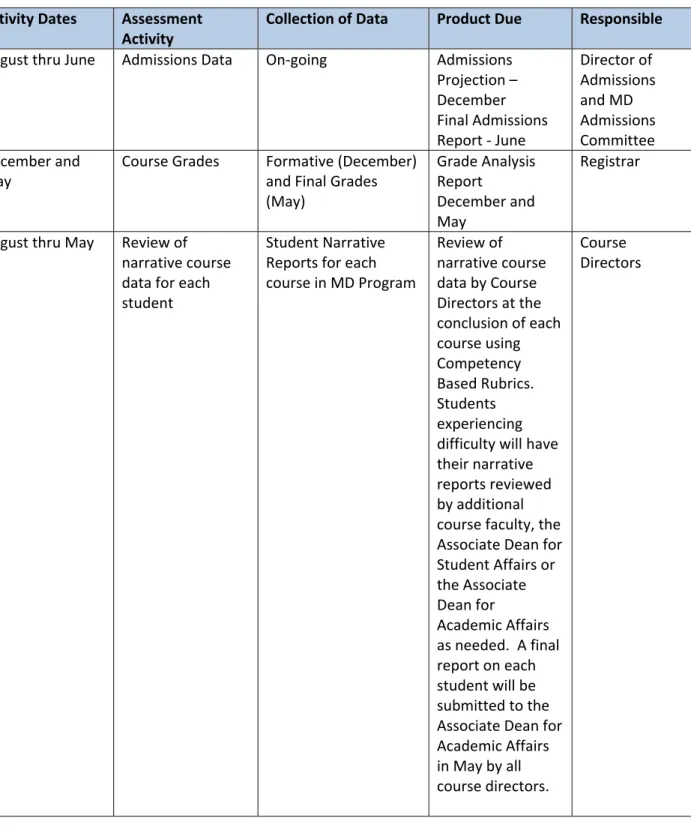
Table One: MD Annual Program Evaluation Plan
Activity Dates Assessment
Activity
Collection of Data Product Due Responsible
August thru June Admissions Data On‐going Admissions
Projection –
December
Final Admissions
Report ‐ June
Director of
Admissions
and MD
Admissions
Committee
December and
May
Course Grades Formative (December)
and Final Grades
(May)
Grade Analysis
Report
December and
May
Registrar
August thru May Review of
narrative course
data for each
student
Student Narrative
Reports for each
course in MD Program
Review of
narrative course
data by Course
Directors at the
conclusion of each
course using
Competency
Based Rubrics.
Students
experiencing
difficulty will have
their narrative
reports reviewed
by additional
course faculty, the
Associate Dean for
Student Affairs or
the Associate
Dean for
Academic Affairs
as needed. A final
report on each
student will be
submitted to the
Associate Dean for
Academic Affairs
in May by all
course directors.
Course
Directors
Activity Dates Assessment Activity
Collection of Data Product Due Responsible
December, May
and June
Review of Student
Records
Review of grades and
student narrative
reports by the
Committee on
Professional and
Academic Standards
Students
experiencing
difficulty will meet
with the Associate
Dean for Academic
Affairs and a
remediation plan
will be put into
place
Associate Dean
for Academic
Affairs,
Director,
Center for
Learning
Excellence, and Associate Dean
for Student
Affairs
March/April Request for
Program Review
MD Curriculum
Committee
Assessment Sub‐
Committee requests a
full or partial review of
Year Based Programs.
First four years of
cycle – all will be full
review, thereafter –
25% of all courses in
each year will be full
review, 75% will be
partial review
MD Program
Report
MD Course
Directors and
MD Curriculum
Committee Assessment Sub‐ Committee Course Conclusion
Course Evaluations
by Students
Student Course
Evaluations
Statistical Analysis
and Qualitative
Comments
Reported to
Course Faculty,
Course Directors,
and Associate
Dean of Academic
Affairs
Office of
Evaluation and
Assessment
Course
Conclusion
Course Evaluations
by Faculty
Faculty Course
Evaluations
Statistical Analysis
and Qualitative
comments
reported to
Program Director
and Associate
Dean of Academic
Affairs
Office of
Evaluation and
Assessment
Activity Dates Assessment Activity
Collection of Data Product Due Responsible
April Advising
Evaluations by
Students
Student Advising
Evaluations
Statistical Analysis
and Qualitative
comments
reported Center
for Learning
Excellence,
Advisors, Program
Director and
Associate Dean of
Academic Affairs
and Associate
Dean of Student
Affairs
Office of
Evaluation and
Assessment
April Advisor Survey Faculty Analysis of
Advisees
Statistical Analysis
and Qualitative
comments
reported Center
for Learning
Excellence,
Advisors, Program
Director and
Associate Dean of
Academic Affairs
Office of
Evaluation and
Assessment
May (prior to May
15)
Program Retreat Associate Dean for
Academic Affairs, MD
Course Directors and
Course Faculty, others
as invited
MD Program
Review Report
and
Recommendations
Compiled and
Reported to MD
Curriculum
Assessment Sub‐
Committee
Associate Dean
for Academic
Affairs
May (after May
15)
Curriculum and
Progress Review
MD Curriculum
Assessment Sub‐
Committee – review of
all related data and
reports
MD Curriculum
Report
MD Curriculum
Assessment
Sub‐Committee
Activity Dates Assessment Activity
Collection of Data Product Due Responsible
June MD Curriculum
Committee of the
Curriculum Action
Committee (CAC)
Review of MD
Program Report
from MD
Assessment Sub‐
Committee and
others as needed
Program is
reviewed at the
MD Curriculum
Committee Level
and
recommendations
forwarded to the
CAC for
institutional
approval
MD Curriculum
Committee of
the CAC
July Curriculum Action
Committee (CAC)
Review of MD
Program Report
from the MD
Curriculum
Committee of the
CAC
Associate Dean
for Academic
Affairs and MD
Curriculum
Committee of
the CAC
July/ August Changes made to
Program as needed
after Curriculum
Action Committee
(CAC) review
Course
Directors and
Faculty
August MD Program
Report Presented
to Cabinet
Review of MD
Program Report
Associate Dean
of Academic
Affairs
September MD Program
Report presented
to TCMC Board of
Trustees
Review of MD
Program Report
Associate Dean
of Academic
Affairs
Table Two: First Five Year Evaluation Process details the MD Curriculum evaluation process over the
next 6 years providing details for the first four year curriculum cycle and subsequent annual reviews.
Table Two: First Five Year Evaluation Process August, 2009
First Cohort (Class of
2013) arrives
MD Program and
Student Evaluation
Process Begins
September, 2009‐ April 2010
Data collected
May, 2010
Full review of Year 1
Courses by MD Course
Directors and MD
Assessment Sub‐
Committee
June, 2010
MD Curriculum
Committee Review
July, 2010
TCMC Curriculum
Action Committee
Review
Program Changes made
as needed
August, 2010
Cohort 2 arrives
Cohort 1 enters Year 2
MD Curriculum Report
and Student Data
Analysis to TCMC
Leadership
September, 2010‐ April 2011
Data collected
September – MD
Curriculum Report and
Student Data Analysis
to TCMC Board of
Trustees
May, 2011
Full review of Year 1
and 2 Courses by MD
Course Directors and
MD Assessment Sub‐
Committee
June, 2011
MD Curriculum
Committee Review
July, 2011
TCMC Curriculum
Action Committee
Review
Program Changes made
as needed
August, 2011
Cohort 3 arrives
Cohort 2 enters Year 2
Cohort 1 enters Year 3
MD Curriculum Report
and Student Data
Analysis to TCMC
Leadership
September, 2011‐ April 2012
Data collected
September – MD
Curriculum Report and
Student Data Analysis
to TCMC Board of
Trustees May, 2012
Full review of Year 1, 2,
and 3 Courses by MD
Course Directors and
MD Assessment Sub‐
Committee
June, 2012
MD Curriculum
Committee Review
July, 2012
TCMC Curriculum
Action Committee
Review
Program Changes made
as needed
August, 2012
Cohort 4 Arrives
Cohort 3 enters Year 2
Cohort 2 enters Year 3
Cohort 1 enters Year 4
MD Curriculum Report
and Student Data
Analysis to TCMC
Leadership September, 2012‐ April
2013
Data collected
September – MD
Curriculum Report and
Student Data Analysis
to TCMC Board of
Trustees
May, 2013
Cohort 1 Graduation
AAMC Graduation
Survey
Full review of Year 1, 2,
3 & 4 Courses by MD
Course Directors and
June, 2013
MD Curriculum
Committee Review
July, 2013
TCMC Curriculum
Action Committee
Review
Program Changes made
as needed
MD Assessment Sub‐
Committee
August, 2013
Cohort 5 Arrives
Cohort 4 enters Year 2
Cohort 3 enters Year 3
Cohort 2 enters Year 4
MD Curriculum Report
and Student Data
Analysis to TCMC
Leadership
September, 2013‐ April 2014
Data collected
September – MD
Curriculum Report and
Student Data Analysis
to TCMC Board of
Trustees
May, 2014
Cohort 2 Graduation
AAMC Graduation
Survey
Regular Annual Review
Cycle Begins by MD
Assessment Committee
of the MD Curriculum
Committee.
25% of courses in the 4
years of the program
are given full review,
remaining 75% receive
partial review. Full
review involves all
facets of curriculum,
compliance with LCME
and ACGME
competencies, student
progress, course
evaluations, sample
student work review,
narrative review, etc.
Partial review is course
evaluations and student
data review.
June, 2014
MD Curriculum
Committee Review
July, 2014
TCMC Curriculum
Action Committee
Review
Program Changes made
as needed
August, 2015
Cohort 6 arrives
Cycle repeats as in
2013/2014
MD Student Data Collection
The MD Program will collect data for each MD student during the four years they are enrolled in
the program. This data is compiled from a variety of sources: 360° Student Evaluation, examination
course directors and faculty, checklist evaluations by clinical faculty, standardized patient and clinical
simulations, objective structured clinical examinations (OSCE), case analysis, oral examinations,
laboratory practical examinations, presentations, preceptor ratings, NBME Subject Exams, essays,
papers, and community research project. 360° Student Evaluation includes advisor and patient surveys,
self and peer assessment along with grades and narrative information from courses. Data collection
varies by course and year in program. All are detailed in the LCME Database. Data collection begins
with pre‐matriculation surveys completed in the summer before the first year classes and concludes
with the AAMC Graduation Survey and 5‐Year and 10‐Year Post Graduation Surveys. (See LCME
Database for details of competencies assessed: medical knowledge, practice based learning and
improvement, interpersonal skills and communication, professionalism, patient care, and systems based
practice.
Questions about the MD Student and Program Evaluation Plan should be directed to Dr. Barry Linger,
Associate Dean for Academic Affairs or Dr. Susan Perlis, Assistant Dean for Evaluation and Assessment.
In addition to the MD Program Evaluation Plan which addresses curricular improvement and student
matriculation progress based upon student outcomes, components of the MD Program are evaluated
through program unit offices that service the program. Student Affairs, Admissions, the Center for
Learning Excellence, among others, all participate in the TCMC Institutional Evaluation and Assessment
Plan at the unit level assuring that all components of the organization that touch the MD Program are
carefully reviewed for mission integration and service to constituents.
Update: August 6, 2009
Figure Two: Curriculum Action Committee Structure
Curriculum
Action
Committee
MD Curriculum
Year 1 Year 2
Clinical
Curriculum Assessment
MBS Curriculum
Assessment