Are you sure that’s
beef in your burger?
Giving you confidence in the
performance of your supply chain
PwC’s supplier riskmanagement services
The recent horse meat substitution scandal is just one example
of what can go wrong when companies fail to properly manage
supplier risk. Today, supply chains typically include multiple
partners, with services and sourcing managed across several
centres/ organisations in different jurisdictions. With this in mind:
Complex
arrangements
realise new
risks
Traditionally, supplier risk
management focused on identifying
and mitigating factors that had the
potential to disrupt the value chain.
However, the extent and complexity
of recent sourcing/outsourcing
arrangements has increased the
likelihood of these risks being realised.
Some of these risks may include:
Corporates are increasing their use of third-party suppliers in the
execution of key strategic imperatives. In many cases, these sourcing
and/or offshoring activities are becoming more extensive and
sophisticated in order to capture the next level of service delivery,
processing efficiency and/or cost savings. However, unless your
supplier risk management framework has also evolved, you could
face unexpected risks and not capitalise on the potential benefits.
How do you achieve confidence
in the performance of your supply
chain through effective supplier
risk management?
Reputational risk. The risk to your organisation’s reputation due to a service or supply interruption, a supplier quality failure, or a supplier’s business practices – for example, an overseas supplier with substandard employment arrangements (ie social or ethical) or involvement with unlawful practices (ie inappropriate commissions or facilitation payments).
Resilience risk. The risk that a supplier failure results in an interruption to customer service, sometimes immediate – for example, an IT failure that prevents customers from placing orders or interacting with your business online or a materials supplier is unable to deliver the purchased materials which prevents the ability to sell the anticipated amount of finished products.
Information security and privacy. The risk that sensitive data, including customer data, is compromised by a cyber security breach or failure in a supplier company (or a supplier’s supplier).
Regulatory risk. The risk of non-compliance with the regulatory requirements and/or commercial undertakings associated with sourcing/outsourcing/offshoring arrangements in the jurisdictions in which you operate.
Commercial risk. The risk of financial loss or cost overruns from poorly managed sourcing/outsourcing arrangements or supplier failures, and inaccurate billing from outsourced parties for the services provided.
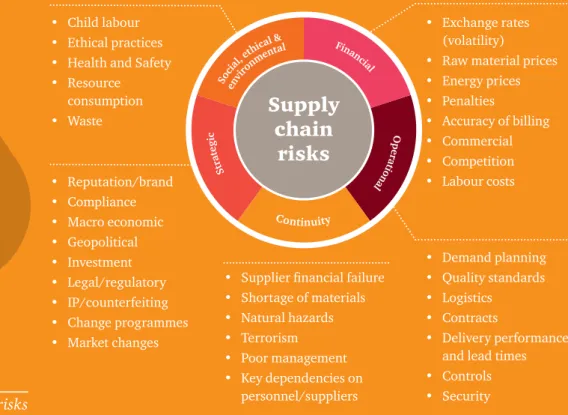
Regardless of the supply, sourcing/outsourcing arrangements can involve multiple supplier relationships that are not visible to the end-client, for example, responsible third parties further sourcing/outsourcing to fourth and fifth parties. While this approach has produced real business benefits, it has also given rise to new exposures to risk in the form of supply chain disruptions and long-lasting financial/reputational damage through supplier failures. Refer to Figure 1.1 for further details.
Suppliers making headlines for the wrong reasons
Regulators in Australia and overseas have responded by intensifying their scrutiny of sourcing/outsourcing arrangements, making it more important than ever to have a comprehensive supplier risk management regime in place. We are continually seeing examples of this in the market place and making headlines for the wrong reasons. For example, data centre outages halt airline check-in and reservations, unethical and inadequate practices at offshore suppliers resulting in criminal investigations, and extensive delays in the supply of goods and services, amongst others.
Managing risk while maximising value
What is needed is an overall framework that enables you to manage supplier risk throughout the sourcing lifecycle. A supplier risk management framework not only offers increased levels of control, it can also help your organisation maximise value by offering:
• a more reliable and consistent process for managing supplier risk
• competitive differentiation through a transparent purchasing policy that supports your corporate social responsibility guidelines
• increased operational efficiency and reduced costs through centralised contract management
• an enhanced ability to outsource non-core activities and partner with strategic suppliers on key activities
• a reduced need to replace failed suppliers.
The objective is to encourage cost effective sourcing while ensuring the risks and accountability for end-to-end sourcing and service delivery are clearly defined, managed, monitored and understood by both your organisation and your suppliers.
Figure 1.1:
Possible supply chain risks
• Supplier financial failure • Shortage of materials • Natural hazards • Terrorism • Poor management • Key dependencies on
personnel/suppliers • Child labour
• Ethical practices • Health and Safety • Resource
consumption • Waste
• Reputation/brand • Compliance • Macro economic • Geopolitical • Investment • Legal/regulatory • IP/counterfeiting • Change programmes • Market changes
• Demand planning • Quality standards • Logistics
• Contracts
• Delivery performance and lead times • Controls • Security • Exchange rates
(volatility)
• Raw material prices • Energy prices • Penalties
• Accuracy of billing • Commercial • Competition • Labour costs
Socia
l, ethi cal &
envi
ronm
ental Financia
l O pe ra tio na l St ra te gi c
Supply
chain
risks
ContinuityHorse meat
crisis hits
food industry
An international FMCG company asked PwC for help in
understanding the key economic, social and environmental risks facing its food (including meat) and commodity supply chains.
Case study:
The client adopted a new approach to supply chain management, redesigning its strategy, structure and processes to create a robust supplier risk management framework. We developed a range of options to mitigate potential risks
and reduce the business’s long-term exposure, including:
• risk profiling and assessing their supply chain to identify and quantify key sources of risk, dependency and vulnerability
• forensic investigations to identify what may have gone wrong and why
• performing controls and supplier audits and due diligence work to provide assurance as required
• deploying risk monitoring solutions to ensure compliance with agreed standards
• redesigning the supply chain structure, strategy and organisation to optimise between cost and resilience.
We also helped the client develop a detailed understanding of retailers’ requirements so they could focus on the key drivers that were pertinent to their relationships.
The client
Our solution
The outcome
The recent horse meat substitution scandal has shaken the global food industry and raised serious questions about supplier risk management in a sector characterised by increasingly complex and internationalised value chains.
To help you create a supplier risk management framework, we offer
the following questions for you to consider throughout the process:
Is your organisation managing
supplier risk effectively?
Getting the
conversation started
• Do you have clear visability of all stages and suppliers in your supply chain? • Does management routinely
require suppliers to provide details of their own sourcing/outsourcing and offshoring arrangements? • Do you regularly
monitor the operational, ethical and financial risk and performance of your suppliers? • How are you assured that
your supply chain complies with the relevant regulatory and legal requirements? • Does management take a risk-based approach to assessing and managing supply chain risk?
• How are you assured by management that you are operating within your supplier/ offshoring/ outsourcing risk appetite? • Are you confident you
can respond to any supply chain disruption without unacceptable loss? • Are you confident that you
are not being defrauded by employees and/or suppliers? • Do you receive robust
assurance that all key risks are managed in your supply chain?
Benefits of getting it right
• Resilience and confidence in your supply chain –
achieved through increased knowledge of supplier risk and performance, and through effective assurance mechanisms.
• Enhancement of quality and reliability of the end product sold, and the ability to identify and remedy problems which may arise within the supply chain.
• Ability to manage crises effectively using streamlined investigative responses and successful claims management.
• Greater knowledge of social and environmental practices and standards throughout your supply chain.
• Ownership of an early warning surveillance system based on forward looking risk indicators to provide predictive risk monitoring and assist with crisis avoidance.
• Compliance with regulatory requirements.
The way forward
There is an expectation by both boards and shareholders that companies be more proactive in response to, and better understand, their supply chain risks. There is also an increasing appetite for a more coordinated, strategic approach to supply chain risk, one which takes a holistic view to identify, monitor, and mitigate weak links in the chain.
Awareness of supplier risk, and the need for a comprehensive framework, presents a great opportunity for organisations to better understand and work with their suppliers.
Sydney
Chelsea Buffam +61 (2) 8266 0347
Adelaide
Kim Cheater +61 (8) 8218 7407 [email protected]
Brisbane
Darren Griffiths+61 (7) 3257 8276
Canberra
Adam Wood +61 (2) 6271 3666 [email protected]
Melbourne
Clare Power +61 (3) 8603 2360 [email protected]
Perth
Cameron Jones +61 (8) 9238 3375
National
Christopher Daniell
National Systems and Process Assurance Leader
+ 61 (2) 8266 1682
Gavin Rosettenstein
National Driver
Supplier Risk Management
+61 (2) 8266 8869
To find out more information on how you can manage your supplier
risk while maximising the value, contact one of our team today.
pwc.com.au
© 2013 PricewaterhouseCoopers. All rights reserved.
PwC refers to the Australian member firm, and may sometimes refer to the PwC network. Each member firm is a separate legal entity. Please see www.pwc.com/structure for further details. This content is for general information purposes only, and should not be used as a substitute for consultation with professional advisors.