Natural Language Web Interface for
Database (NLWIDB)
(1) Faculty of Business Studies, Vavuniya Campus, University of Jaffna, Park Road, Vavuniya, Sri Lanka. (2) Sri Lankan Telecom, Colombo Head Office, Sri Lanka.
(3) Department of Computer Science, University of Jaffna, Sri Lanka. Abstract: It is a long term desire of the computer users
to minimize the communication gap between the computer and a human. On the other hand, almost all ICT applications store information in to databases and retrieve from them. Retrieving information from the database requires knowledge of technical languages such as Structured Query Language. However majority of the computer users who interact with the databases do not have a technical background and are intimidated by the idea of using languages such as SQL. For above reasons, a Natural Language Web Interface for Database (NLWIDB) has been developed. The NLWIDB allows the user to query the database in a language more like English, through a convenient interface over the Internet.
Keywords: Natural Language Processing, Natural Language Web Interface
Introduction
Natural Language Processing (NLP) is interdisciplinary by nature. Linguistics and artificial intelligence can be combined to develop computer programs. It helps to coordinate activities of understanding or producing texts in a natural language. Database Natural Language Processing is an important success in NLP. Asking questions in natural language to get answers from databases is a very convenient and easy method of data access (Androutsopoulos et al., 1995; Siasar djahantighi et al., 2008). The common man does not understand complicated database query languages such as SQL (Structured Query Language) (Siasar djahantighi et al., 2008). Database NLP gives the real-world benefits that can come from these database systems on the one
hand, and it works very well in a single-database domain.
Natural Language Interfaces (NLIs) have undergone considerable development since the 70s, but only with moderate success (Androutsopoulos et al., 1995; Thompson et al., 2005) and interest in the topic has consequently decreased since the 90s. However, the necessity for robust and applicable Natural Language Web Interface has become more acute in recent years as the amount of information on the Internet has grown steadily and immensely, and more people from an ever wider population now access data stored in a variety of formal repositories through web browsers (Katz et al., 2002; Minock, 2005). As such, we have begun to address the task of building a Natural Language Web Interface for database.
Related Work
Databases usually provide small enough domains that ambiguity problem in natural language can be resolved successfully (Gauri, 2010). Here are some examples of database NLP systems:
G LUNAR (Woods, 1973) was involved in a
system that answered questions about rock samples brought back from the moon. Two databases were used, the chemical analyses and the literature references. The program used an Augmented Transition Network (ATN) parser and Woods’ Procedural Semantics. The system was informally demonstrated at the Second Annual Lunar Science Conference in 1971 (Huangi, 2008).
G LIFER/LADDER was one of the first good database language processing systems. It was designed as a natural language interface to a database of information about US Navy ships. This system, as described in by Hendrix (1978), used a semantic grammar to parse questions and query a distributed database. The LIFER/LADDER system could only support simple one-table queries or multiple table queries with easy join conditions (Hendrix, 1978).
G English Wizard is another successful natural language query tool for relational database. It is one of the leading software products that translate ordinary English database requests into Structured Query Language (SQL), and then return the results to the client. English Wizard enables most database reporting tools and client/server applications to understand everyday English requests for information, and also provides graphical user interface (Karande, and Patil, 2009).
System Description
Natural Language Processing can further facilitate human computer interaction through computer program interface (Rao et al., 2010). Our goal is to produce a Natural Language Web Interface for Database (NLWIDB) to minimize the communication gap between the computer and a human. Furthermore, the aim of NLWIDB system is to facilitate the user to computer in a natural way over the Internet. A natural language web interface for accessing information is domain-independent and easy to use without training. The necessity of building the NLWIDB system being able to support users expressing their searching by natural language queries is very important and opens the researching direction with many potential. It combines the traditional methods of information retrieval and the researching of questioning and answering.
A brief description of the NLWIDB system is as follows: consider a database called UNIVERSITY which has been created using MySQL for a University. Within the UNIVERSITY database we create several
tables which are properly normalized. Now if the user in global wishes to access the data from the table in the database, he/she has to be technically proficient in the SQL language to make a query for the UNIVERSITY database. Our system eliminates this part and enables the end user to access the tables in his/her own language. Let us take an example: Suppose we want to view information such as year of establishment of department, and code of department which department name equals “Department of Economics and Management” from the department table of the UNIVERSITY database, we use the following SQL statement (query): SELECT year-of-establishment-of-department, code-of-department FROM department WHERE department-name =’Department of Economics and Management’. But a person, who doesn’t know MySQL database syntax, will not be able to access the UNIVERSITY database unless he/she knows the SQL syntax of firing a query to the database. But using NLP, this task of accessing the database will be much simpler. So the above query will be rewritten using NLP as a question in the web user interface as: What is the year of establishment of the department and code of the department which department name equals “Department of Economics and Management”? Both the SQL statement and NLP statement to access the department table in the UNIVERSITY database would result in the same output by making query not n a SQL like query language, but simply in English like natural language.
Scope of the System
The scope of the proposed system as follows,
G To work with any Relational Database
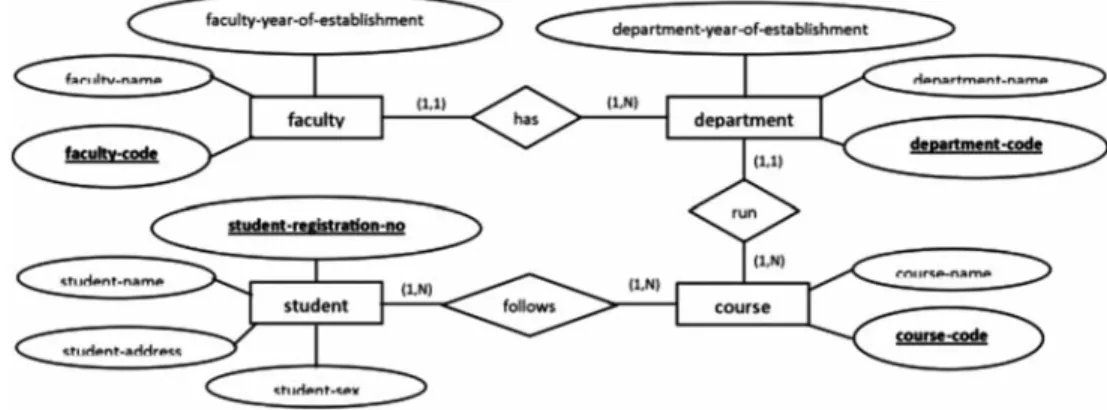
Management System (RDBMS) one should know the syntax of the commands of that particular database software (MySQL). A UNIVERSITY database (Fig 1) has been created to test the system.
G The interface language is chosen to be
English for accommodating wider users.
G Input from the user is taken in the form of questions (like what, who, where).
statement have to be in double quotes which yield to identify the values from the user input statement.
G A limited data dictionary (sample are given in Tab 1) is used where all possible words related to a particular system will be included. The data dictionary of the system must be regularly updated with words that are specific to the particular system.
G Split the question string in tokens and give order number to each token identified.
G To remove excessive words from the user input statement. Escape words have been considered (sample are given in Tab 2) which must be regularly updated with words that are specific to the particular system.
G Rules (Tab 3, Tab 4, Tab 5, Tab 6, and Tab 7) have been created to perform NLP.
G To identify all SQL elements involved in such as tables, attributes, aggregate, interval, values from the user input statement by using rules.
G To develop a SQL Template. The syntax of the SQL template string for construct SQL Template as follows: [number of ATTRIBUTE, number of TABLE, number of AND, number of AGGREGATE, number of INTERVAL, number of VALUE].
G To construct SQL query using SQL elements. An algorithm (Fig 2) has been developed with the use of Tab 8 and Tab 9.
G Ambiguity among the words will be taken care of while processing the natural language. For such, the Tab 8 has been created to store all attributes belongs to each tables.
System Architecture
The NLWIDB is concerned with translating the English query by the user into its corresponding SQL query to retrieve the data from the relational database via the Internet. The result will then be displayed to the user. This NLWIDB system specially develops for
English language as an initial step and other languages will be considered later. An algorithm has developed efficiently to map a natural language question, entered in English, to convert an SQL statement for producing suitable answers. The algorithm has been implemented with PHP, Apache, MySQL and tested successfully. The NLWIDB system architecture is given in Fig. 3, which depicts the layout of the procesrses included in converting user question in NL query into a syntactical SQL query to be fired on the RDBMS and getting answers from the database.
The NLWIDB system includes the following modules:
G Graphical User interface: It allows the user to enter the question as Natural Language Question.
G Word Check: It checks all the words in the user question against the data dictionary for its existence.
G Tokenisation: It split the question string into tokens and gives an order number to each token identified.
G Excess Word Remover: It removes excessive words from the question string.
G Mapping rules: It maps the rules with user input question statement.
G SQL Elements identifier: It identifies all SQL elements involved in the user input statement by using rules and construct the SQL Template String.
G Mapping SQL Template: It identify correct SQL Template String algorithm for generating SQL query.
G SQL Query Generation: It constructs a query in SQL.
G Run the SQL Query: It gives the SQL query generated to the back end database.
G Data Collection: This module collects the output of the SQL statement and places it in the User Interface Screen as a result.
Table 1: List of Data Diconary
Table 2: List of Escape
Table 3: Rules represenng several
different tables in NLWIDB
Table 4: Rules represenng different
aributes of department tables in
NLWIDB system
Table 5: Rules indicang several different
ways to represent an ‘and’ or ‘as well as’
Table 6: Rules for the aggregate
funcon MAX
Table 7: Rules indicang several different
ways to represent interval ‘equal’ concept
a an and are available code departmen
t
equal equals establish ment
exactly faculty for Is Name of student the what which which who whose year
a an are available campus for is the what which who whose
Rule Rule Symbol Rule Description
course table_course rule to represent table course courses table_course rule to represent table course departments table_department rule to represent table department department table_department rule to represent table department faculty table_faculty rule to represent table faculty faculties table_faculty rule to represent table faculty follows table_follows rule to represent table follows
code of department attribute_department_code rule to represent attribute department code department code attribute_department_code rule to represent attribute department code department name attribute_department_name rule to represent attribute department name department names attribute_department_name rule to represent attribute department name name of department attribute_department_name rule to represent attribute department name names of departments attribute_department_name rule to represent attribute department name year of establishment of department
attribute_department_year_of_establis
hment rule to represent attribute department year of establishment year of establishment of departments
attribute_department_year_of_establis
hment rule to represent attribute department year of establishment
follow table_follows rule to represent table follows student table_student rule to represent table student students table_student rule to represent table student
Rule Rule Symbol Rule Description
and and_s rule to represent an and as well as and_s rule to represent an and and also and_s rule to represent an and also and_s rule to represent an and in addition and_s rule to represent an and followed by and_s rule to represent an and next to and_s rule to represent an and
Rule Rule Symbol Rule Description
most aggregate_max rule for aggregate function max() maximum aggregate_max rule for aggregate function max() highest aggregate_max rule for aggregate function max() biggest aggregate_max rule for aggregate function max() maximum
number of aggregate_max rule for aggregate function max() highest number
of aggregate_max rule for aggregate function max() biggest number
of aggregate_max rule for aggregate function max()
Rule Rule Symbol Rule Description
equal interval_= rule for interval equal exactly interval_= rule for interval equal equals interval_= rule for interval equal
Table 8: Database tables and aributes
Table 9: Database default aributesTable
1: List of Data Diconary
Figure 2: Algorithm to construct the SQL query for the
SQL Template String: 020000 Figure 3: Detail Architecture of NLWIDB System
Algorithm used in NLWIDB System
The following are the algorithm for the NLWIDB system
G Check for an input value and if exists remove the value from the question string.
G Check for all words in question string which exists in data dictionary.
G Tokenization (scanning)
o Split the question string in tokens o Give order number to each token
identified Figure 1: The UNIVERSITY
department department department department faculty faculty faculty
Table Name Attribute Name Key department-name department-code department-year-of-establishment faculty-code faculty-code faculty-name faculty-year-of-establishment nil primary nil foreign primary nil nil
Table Default Attribute department department-name'
faculty faculty-name course course-name student student-registration-no'
Being
Store the SQL template string to the variable U If (the value of variable U equals ‘020000’) then
Store the name of the identified tables in array V Do
Begin
Store the value of variable V to T
Get the default attribute for the table name T and store it to the variable A
Construct a SQL query as “SELECT DISTINCT A FROM T” and store it to variable W
G Removing excessive words in question string
G Mapping rules by removing last words from question string. If mapped with a rule, remove the mapped string from the question string and make the rest as the question string. Map the rule until you have question string “”.
G Store the number of identified SQL elements in arrays
G Construct a SQL template string by
considering available number of SQL elements.
Mapping SQL template string with SQL template.
Construct SQL query using SQL elements. Get result set.
Organise the result. Display the result to user.
Results and Discussion
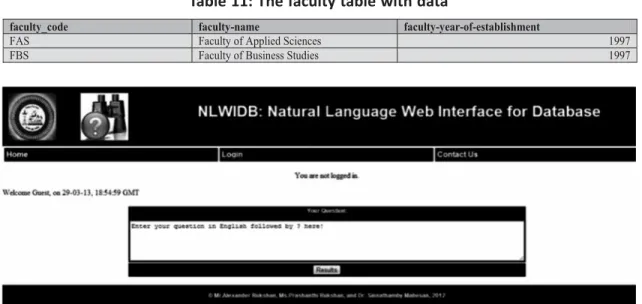
Consider following relations (tables in database) department (Tab 10) and faculty (Tab 11) with data.
Fig 5 indicates that the results which were computed by the NLWIDB system when the user gives the input statement as: What is the year of establishment of department and code of department of which department name equals “Department of Economics and Management”? at the user input text of the NLWIDB (Fig 4). Furthermore, Tab 12 describes the list of variety of questions which our system deals:
Table 10: The department table with data
Table 11: The faculty table with data
department-code
faculty-code department-name department -year-of-establishment
DACF FBS Department of Accountancy and Finance 1997
DECM FBS Department of Economics and Management 1997
DBIS FAS Department of Bio Science 1997
DPHS FAS Department of Physical Science 1997
faculty_code faculty-name faculty-year-of-establishment
FAS Faculty of Applied Sciences 1997
FBS Faculty of Business Studies 1997
Figure 5: Results computed by the NLWIDB
Q No
User Input Question Identified SQL Template
NLWIDB Output
1 What are the available names of departments?
100000
Department Name
Department of Accountancy and Finance Department of Bio Science
Department of Economics and Management Department of Physical Science 2 What are the available
departments?
010000
Department Name
Department of Accountancy and Finance Department of Bio Science
Department of Economics and Management Department of Physical Science
Conclusion
Natural Language Processing can bring powerful enhancements to virtually any web interface, because language is so natural and easy to use for humans. The Natural Language Web Interface for Database (NLWIDB) is no exception because we presented the NLWIDB system which converts a wide range of text queries (English questions) into formal ones that can then be executed against a database by employing robust language processing techniques and methods. This research shows that NLWIDB provides a convenient as well as reliable means of querying access, hence, a realistic potential for bridging the gap between computer and the casual end users. While NLP is a relatively recent area of research and application, as compared to other information technology approaches, there have been sufficient successes to date that suggest that NLP-based information access technologies will continue to be a major area of research and development in information systems now and far into the future. Furthermore, we could bypass a prohibitive formal query language that can only be reasonably managed by experts while still offering rich tools for the composition of complex queries by casual users.
References
Androutsopoulos, I., Ritchie, G.D., and Thanisch, P. (1995). Natural Language Interfaces to Databases – An Introduction. Natural Language Engineering, 1(1):29-81.
Gauri. R., et al., (2010). Natural Language Query Processing Semantic Grammar. (IJCSE) International Journal on Computer Science and Engineering Vol. 02, No. 02, 2010, 219-223. Hendrix. G. G., et al., (1978). Developing a natural
language interface to complex data, in ACM Transactions on database systems, 3(2), pp. 105-147, 1978.
Huangi, et al., (2008). A Natural Language database Interface based on probabilistic context free grammar. IEEE International workshop on Semantic Computing and Systems 2008. Karande, N. D., and Patil, G. A., (2009), Natural
Language Database Interface for Selection of Data Using Grammar and Parsing, World Academy of Science, Engineering and Technology.
Katz, B., et al., (2002). Omnibase: Uniform access to heterogeneous data for question answering. In Proceedings of the 7th International Workshop on Applications of Natural Language to Information Systems (NLDB 2002).
3 What are the available departments and faculties?
0m1000
Department Name
Department of Accountancy and Finance Department of Bio Science
Department of Economics and Management Department of Physical Science
Faculty Name
Faculty of Applied Sciences Faculty of Business Studies 4 What is the maximum year of
establishment of departments?
100100
Department Year of Establishment
1997 5 What are the department names
which year of establishment of department equals "1997"?
110011
Department Name Department Year of Establishment
Department of Accountancy and Finance 1997 Department of Bio Science 1997 Department of Economics and
Management 1997 Department of Physical Science 1997
Minock, M., (2005). A Phrasal Approach to Natural Language Interfaces over Databases, proceedings of the International Conference on Applications of Natural Language to Information Systems (NLDB), pages 333-336.
Rao. G., et al., (2010). Natural language query processing using semantic grammar, International Journal on Computer Science and Engineering (IJCSE),
Vol. 02, No. 02, 219-223
Siasar djahantighi. F., et al., (2008). Using Natural Language Processing in Order to Create SQL Queries,
Proceedings of the International Conference on Computer and Communication Engineering 2008, Kuala Lumpur, Malaysia
Thompson, C.W., Pazandak, P., Tennant, H.R., (2005). Talk to your semantic web. IEEE Internet Computing 9(6), 75–78
Woods, W. A., (1973). Progress in natural language understanding: An application to LUNAR geology.