1
Joint bidding and horizontal
subcontracting
Jan Bouckaert
1and Geert Van Moer
2October 2019
This paper investigates joint bidding when firms, after competing in the main market, can sign subcontracts with each other. We analyze how joint bidding changes the terms of trade on the horizontal subcontracting market. When the subcontracting market is uncompetitive, the changes in terms of trade increase competition in the main market. Consequently, it is too restrictive to always prohibit joint bidding arrangements between parties that could bid solo. Our results also show that joint bidding through a consortium permits more leniency if the consortium dissolves after losing in the main market.
Keywords: joint bidding; horizontal subcontracting; buyer power
JEL-code: D43, L13, L14, L41
Acknowledgments: We are indebted to Patrick Rey for his detailed comments and challenging suggestions. We are also grateful to Roberto Alimonti, Jacques Crémer, Andreas Ehrenmann, Elisabetta Iossa, François Maniquet, Massimo Motta, José Louis Moraga, Jorge Padilla, Joseph Podwol, Rune Stenbacka, and Alicia Van Cauwelaert for their most valuable comments. We also thank seminar participants at the Department of Justice (Washington DC), DG COMP (Brussels), CMA (London), Bundeskartellamt (Bonn), the Finnish Competition and Consumer Authority, the Swedish competition authority, and participants at academic seminar and conference occasions. Bouckaert thanks the Flanders Research Foundation (FWO) for financial support (Grant #G080912N). Van Moer is grateful to FWO for funding Grant #11V5915N. Both authors also thank Engie for financial support (Grant #FFP160134). This paper has previously circulated as “mergers and horizontal subcontracting”.
1Department of Economics, University of Antwerp, and ECARES, Université Libre de Bruxelles. [email protected]
2 Department of Finance and Economics, Hanken School of Economics & Helsinki Graduate School of Economics, [email protected]
2
1.
Introduction
In many procurement industries, competing businesses engage in horizontal agreements with each other. Joint bidding refers to the practice of cooperating in the main market by jointly submitting a single bid. Also, firms can form contractor-subcontractor relations after a winner has been appointed in the main market. Both practices can reduce costs by reallocating production across firms, for example when firms are subject to idiosyncratic cost shocks or capacity constraints. Accordingly, joint bidding and subcontracting are widespread in industries such as, e.g., off-shore oil leases, syndicated loans, or road construction.3
Assessments of joint bidding by competition authorities and courts in the US and in Europe have relied mainly on the following two criteria.4 First, they usually account for whether firms could have bid solo. The reasoning is that, if so, the joint bidding arrangement reduces competition by lowering the number of bidders.5 Second, if parties could bid solo, sufficient offsetting efficiencies are required.6
3 Hendricks and Porter (1992) report on joint bidding for outer continental shelf oil drilling leases in the US, an industry where contracts can be resold after acquisition (see Hendricks et al., 2003, and Haile et al., 2010). Corwin and Schultz (2005) analyze the practice of loan syndication between banks to reduce the cost of issuing capital. Marion (2015) studies horizontal subcontracting in the California highway construction industry. Other examples include Haile (2001) who studies timber auctions with a resale possibility, and the defense industry where competing bidders often team up due to heterogenous specializations (Miller, 2005).
4 In the US, the standards used to determine whether joint bidding violates the antitrust laws are described in the Antitrust guidelines for collaborations among competitors (Federal Trade Commission, 2000, §3.37). In Europe, the TFEU101 and the Guidelines on horizontal cooperation agreements are relevant for assessing joint bidding.
5 This reasoning has already been used in 1975 by the US Congress to prohibit joint bidding arrangements between large oil companies for off-shore oil leases (Hendricks and Porter, 1992). In the EU, the solo bidding criterion has been applied in several recent cases, for example in the Danish road marking industry (see also the Guidelines by the Danish Competition and Consumer Authority on joint bidding under competition law (2018)). Similarly, joint bidding for patient transportation contracts in Norway was regarded by the Supreme Court of Norway as a restriction of competition by object and prohibited since parties could have bid individually (see HR-2017-1229-A case no. 2015/203 and the EFTA Court judgment of 22 December 2016).
6 In the US, joint bidding arrangements between parties that do not integrate their operations are challenged as per se illegal (Federal Trade Commission, 2000). In Italy, the competition authority recently considered economic arguments to permit the joint bidding of two competing pharmaceutical companies who could have bid solo (see https://bit.ly/2FfXToU).
3 This paper points out that joint bidding arrangements between competitors, although reducing the number of bidders, are also likely to reduce the demand for subcontracting. We show that this interaction crucially determines the competitive effects of joint bidding.
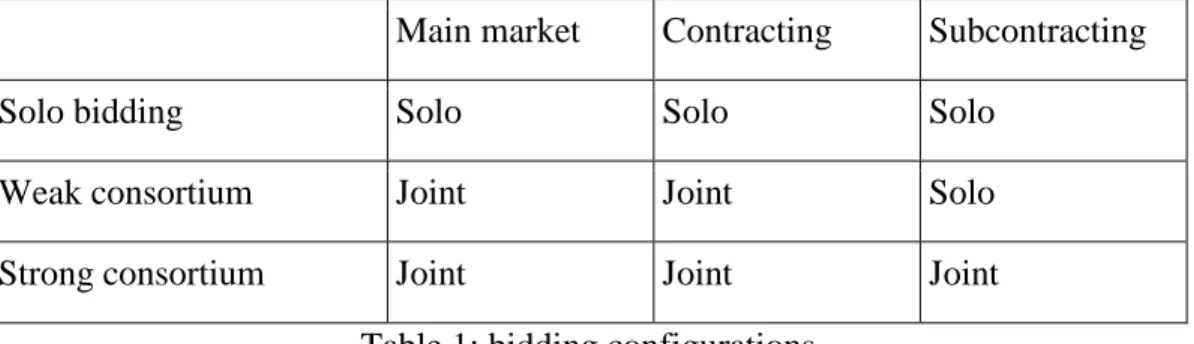
Our analysis compares three bidding configurations, depicted in table 1. Solo bidding happens when firms compete independently in the main market and in the subcontracting market. Next, we investigate bidding consortia which jointly submit a single bid in the main market. We find an important distinction between what we will label a “weak consortium” and a “strong consortium”. If the consortium wins in the main market, its members always jointly decide whether to contract production from non-winning rivals. The weak consortium differs from the strong consortium if another firm is selected as the winner in the main market. Whenever so, a weak consortium dissolves into its original entities. Cooperation thus breaks down and the decisions to act as subcontractor are made separately by the original entities. In contrast, a strong consortium cooperates in the subcontracting market regardless of the outcome in the main market. Our modelling of weak consortia captures cooperation agreements that are ad hoc or temporary in nature, whereas strong consortia cover joint ventures that are longer-lasting and more structural.7
Main market Contracting Subcontracting
Solo bidding Solo Solo Solo
Weak consortium Joint Joint Solo
Strong consortium Joint Joint Joint
Table 1: bidding configurations
We find that joint contracting by the consortium members can create contracting power, resulting in two pro-competitive effects. First, it reduces the cost at which the consortium can contract inputs, thereby allowing it to compete more fiercely in
7 In the EU, a weak consortium is likely to be treated as a “non-full-function joint venture” and would be assessed under TFEU101. A strong consortium, in contrast, could be regarded as a full-function joint venture and accordingly fall under the merger regulation.
4 the main market. Second, increased contracting power by the consortium implies reduced subcontracting profits for outsiders. Outsiders thus forego fewer profits when winning in the main market, leading them to compete more fiercely as well.
Importantly, these pro-competitive effects do not require efficiencies specific to the joint bidding arrangement, nor do they require that firms could not bid solo. Our results thus constitute a departure from current policy views: joint bidding arrangements between competitors who could have bid solo can benefit consumers even in the absence of efficiencies.
When the consortium is strong, joint subcontracting can grant it more subcontracting power. There are two resulting anti-competitive effects. First, outsiders pay more to contract inputs, which weakens their ability to be competitive in the main market. Second, increased subcontracting power makes it more attractive for the consortium to subcontract, and thereby reduces the consortium’s incentives to win in the main market. Since weak consortia do not feature these two anti-competitive effects, they should be assessed with more leniency than strong consortia.
To investigate when these competitive effects occur, we consider three subcontracting market settings that range from maximally to minimally competitive. This approach intends to capture the rich variety of subcontracting institutions in practice. Oftentimes, institutions are intended to improve competition in the subcontracting market. For example, the Federal Acquisition Regulation (FAR, 2005) requires prime contractors to carefully consider whether “adequate price competition [was] obtained or its absence properly justified” (FAR 44.202-2). However, sometimes regulatory frameworks may also hinder competition in the subcontracting market. For example, the California Subcontracting and Subletting Fair Practice Act prohibits the winner to call upon other subcontractors than those declared in the main market bid (See Miller (2014) and Marion (2015)). While such a prohibition may be useful to guarantee that the winner is able to deliver, it can also enable a hold-up strategy by the subcontractor. Finally, industry federations may have incentives to lobby for institutions that reduce competition among subcontractors, to increase the equilibrium bid in the main market.
5 Should authorities be more lenient toward joint bidding? Our analysis shows that the change in competitive conditions in the subcontracting market caused by joint bidding is key. We argue that this change can be inferred from the current competitiveness of the subcontracting market: for joint bidding to have pro-competitive effects, subcontractors must enjoy a substantial amount of market power.
Related literature. The empirical and theoretical literature has treated joint bidding and subcontracting—or resale—mainly separately.8 This is rather surprising since, as also observed by Branzoli and Decarolis (2015), both practices occur frequently in many procurements.
Joint bidding has been previously investigated in the context of off-shore oil leases, an industry with resale after acquisition. It has been documented to stifle competition when reducing the number of bidders (see e.g. Markham (1970) and Hendricks and Porter (1992)). Joint bidding has also received considerable attention because of its role to mitigate asymmetric information (see e.g. Levin (2004)).9 The findings of our paper do not rely on asymmetric information.Finally, the economic analysis of joint bidding also shares similarities with the horizontal merger literature, where the relationship with horizontal subcontracting has also not yet been reported.
Previous work on horizontal subcontracting has not investigated the competitive effects of joint bidding. Kamien et al. (1989) and Spiegel (1993) study horizontal subcontracting between price-competing and quantity-competing firms, respectively. Gale et al. (2000) and Jeziorski and Krasnokutskaya (2016) study sequential procurement auctions with subcontracting. Haile (2001, 2003) offers empirical and theoretical studies of auctions with resale opportunities. Bouckaert
8 An alternative interpretation of our model is to regard the subcontracting market as a resale market. Haile’s (2001) analysis of timber auctions, e.g., also allows both interpretations.
6 and Van Moer (2017) investigate firms’ incentives to invest in production capacity in the presence of a horizontal subcontracting market.
Branzoli and Decarolis (2015) investigate empirically the effect of the auction format on strategic variables including joint bidding choices and subcontracting. Importantly for our purposes, they find evidence that first-price auctions (as opposed to average bid auctions) invite more joint bidding and decrease the prevalence of subcontracting. We offer a competition analysis of joint bidding that accounts for this interaction.
Horizontal subcontracting should be distinguished from vertical subcontracting where the successful bidder contracts a part of the workload from non-competing bidders. We refer to Huff (2012), Lewis and Bajari (2014), and Marion (2015) for empirical analyses of horizontal subcontracting in the US road construction sector, and Marion (2009) and Moretti and Valbonesi (2015) for empirical analyses of vertical subcontracting.
Section 2 presents our main model. Section 3 offers an analysis when all firms bid solo. Sections 4 and 5 study joint bidding through a weak and strong consortium, respectively. Section 6 offers discussion and robustness. Section 7 concludes with policy recommendations.
2.
A model
Three risk-neutral, ex ante symmetric firms i=1, 2,3 can produce a homogeneous good.10 They play a game that consists of two stages. The first stage is the main market. The second stage is the horizontal subcontracting market. We proceed by detailing each stage.
7
2.1. Mainmarket
We normalize market demand to equal one unit. Firms compete by simultaneously handing in price bids. Denote the lowest bid submitted by b. The firm with the lowest bid wins and delivers the unit. When there is a tie, the winning firm is randomly selected.11
After competing in stage one, nature reveals a (constant) unit cost for each firm. A firm’s unit cost can either be zero or equal c0. Denote firm i’s unit cost draw by
0,i
x = c . We denote a state of nature as
x x x1, 2, 3
.12The probability that precisely n firms draw a zero cost is denoted by n, with
0n 1 and
3n=0n =1. This formulation allows for possible correlations between firms’ cost draws. Lemma 1 follows from ex ante symmetry and is a useful ingredient for our analysis.Lemma 1: the probability that a firm
• is among three high-cost firms equals 0
• is the only firm drawing a zero cost equals 1 3 • is among two zero-cost firms equals 22 3 • is among three zero-cost firms equals 3 • draws a zero cost equals 1 3 2+ 2 3+3.
11 The features fixed demand and a winner-take-all tie-breaking rule are common in practice. However, they do not affect our results, as detailed in subsection 6.2.
12 An important empirical motivation for subcontracting is that firms are uncertain about their marginal costs. Haile (2001) reports that contracts to harvest timber are typically executed at the end of the contract term, so that bidding firms are likely to be uncertain about their future cost at the moment of competing in the auction. Cost uncertainty is also important in other procurement industries. For example, large projects in the defense industry are also characterized by a substantial timespan between contract award and execution. Section 6 analyzes an alternative model where subcontracting follows from capacity constraints.
8
2.2. Subcontracting market
In the subcontracting market, the winning firm can contract the unit from its main market rivals. We denote the buying firm as the contractor and the selling firms as
subcontractors. There is an incentive for the winning firm to contract when it draws a high cost and at least one of its former rivals in the main market draws a zero cost. If so, subcontracting enables firms to reduce the production cost from c to zero. We next present the three subcontracting market settings that range from maximal competition to minimal competition among subcontractors.
Monopsonistic subcontracting
Under monopsonistic subcontracting, all rents on the subcontracting market accrue to the contractor,as if the contractor is a monopsonist and makes take-it-or-leave-it offers.
Bertrand subcontracting
Bertrand subcontracting supposes that subcontractors compete as follows. First, each firm’s cost draw becomes common knowledge. Next, each subcontractor simultaneously submits a tariff at which it offers to subcontract. Finally, the contractor selects the lowest-bidding subcontractor, and decides to purchase insofar the tariff is lower than the contractor’s own production cost.13
Monopolistic subcontracting
Under monopolistic subcontracting, all rents on the subcontracting market accrue to the subcontractors, as if subcontractors were monopolists. Monopolistic subcontracting could follow, for example, from search costs incurred by the contractor, resulting in Diamond’s (1971) paradox.
13 Alternatively, the analysis would be equivalent when subcontractors would have private knowledge about their cost draw and the contractor runs an English auction.
9
3.
Solo bidding
3.1. Subcontracting market
First, we will investigate a firm’s direct cost for serving the main market. Firm i’s
direct cost refers to its in-house production cost or the cost of contracting from a non-winning main market rival. It is an expectation and is denoted by DCi. Second, we will investigate firm i’s subcontracting profit if a rival has won in the main
market. It is also an expectation and is denoted by SPi.
Table 2 displays firm 1’s direct cost for the three subcontracting market settings. The probabilities displayed in table 2 follow from Lemma 1. From ex ante symmetry, we do not lose generality by considering firm 1.
States of nature Probability Monopsonistic Bertrand Monopolistic
c c c, ,
0 c c c
c, 0,c
c c, , 0
21 3 0 c c
c, 0, 0
2 3 0 0 c
0,x x2, 3
1 3 2+ 2 3+3 0 0 0 Table 2: direct cost under solo biddingUnder monopsonistic subcontracting, the winner can always contract at a tariff equal to the subcontractor’s unit cost. Therefore, the winner’s direct cost equals zero unless all firms draw a high cost (
c c c, ,
). Under Bertrand subcontracting, the winner also pays a high cost in
c, 0,c
and
c c, , 0
. In these two states, there is only one zero-cost subcontractor, which captures all rents by offering a tariff that undercuts c by the smallest possible amount. In
c, 0, 0
, there are two zero-cost subcontractors who compete against each other, so that the winner’s direct cost equals zero. Finally, under monopolistic subcontracting, the winner has a direct cost equal to zero only if it draws a zero cost. We can summarize that firm i’s direct cost10 (1)
(
)
(
)
0 0 1 0 1 2 monopsonistic) (Bertrand) (m onopolisti 3 ( 2 3 2 3 c). i c DC c c = + + + We now investigate a firm’s profit from subcontracting. In table 3, we consider firm 1’s subcontracting profit when firm 2 wins the unit in the main market (which is without loss of generality).
Probability Monopsonistic Bertrand Monopolistic
0, ,c c
1 3 0 c c
0, , 0c
2 3 0 0 0.5c
c x x, 2, 3
0, 0,x3
1−1 3−2 3 0 0 0 Table 3: subcontracting profit under solo biddingUnder monopsonistic subcontracting, firms never profit from subcontracting because the contractor captures all rents. Under Bertrand subcontracting, firm 1 can only profit from subcontracting in the state where it is the only firm drawing a zero cost (
0, ,c c
). In that state, it offers a tariff that undercuts c by the smallest possible amount. Finally, monopolistic subcontracting differs from Bertrand subcontracting in
0, , 0c
. Firms 1 and 3 are then both zero-cost subcontractors and, under monopolistic subcontracting, share the rents on the subcontracting market symmetrically. They thus earn 0.5c each.14 We can summarize that firm i’s subcontracting profit equals(2)
(
)
(
) (
)
1 1 2 0 p ( 3 monopsonistic) Bertra . ( 3 3 0. nd) (mono olist 5 ic) i SP c c c = + 3.2. Main marketWe now investigate at what bid levels firms prefer to win the unit in the main market or to lose it against a competitor. Firm i’s profits of winning in the main market
14 Two interpretations are convenient. First, firms may toss a coin to decide who subcontracts, in which case 0.5c is the expected subcontracting profit. Second, firms may each serve half a unit.
11 equal b−DCi. If a rival wins in the main market, firm i earns SPi. Figure 1 depicts the equilibrium analysis of solo bidding.
Figure 1: solo bidding analysis
In equilibrium, firms should be indifferent about winning in the main market. The bid at which firm i is indifferent can be written as
(3) bi* =DCi+SPi.
The following reasoning shows that *
i
b is the equilibrium bid. First, a higher bid cannot be an equilibrium because then the non-winning firms would have an incentive to undercut the winning firm’s bid. Second, a lower bid cannot be an equilibrium either because the winning firm would have an incentive to raise its bid and profit from subcontracting. When all firms bid *
i
b , there are no unilateral incentives to deviate.
A comparison between monopolistic, Bertrand, and monopolistic subcontracting delivers the following insight. When the degree of competition among subcontractors is less intense, the equilibrium bid is higher for two reasons. First, contracting is more costly, thereby increasing the direct cost of winning. Second, subcontracting is more attractive. As such, the winning firm foregoes higher profits from subcontracting. This increased opportunity cost also results in a higher equilibrium bid.
12
4.
Weak consortium
Without loss of generality, we consider a weak bidding consortium between firm 1 and firm 2. The weak consortium is denoted by WC. The outsider to the consortium is denoted by \WC.
No efficiencies. We rule out efficiencies such as e.g. scale economies, learning effects, or more efficient management, so that these do not interfere with our results. Formally, we model that the consortium does not affect the production possibilities available in the market, or
1 2
min ,
xWC = x x .
This definition of no efficiencies corresponds to Farrell and Shapiro’s (1990, p. 112) terminology of no synergies.
In our setting, firms reallocate production cost-efficiently using horizontal subcontracts, so that the production cost equals min
xWC,x3
. We can rewrite this expression as min
x x x1, 2, 3
, which equals the production cost incurred under solo bidding. The consortium thus does not affect firms’ production cost.4.1. Subcontracting market
We first investigate the scenario where the consortium wins in the main market. This enables us to analyze the weak consortium’s direct cost and the outsider’s subcontracting profit.
Weak consortium’s direct cost
13 Probability Monopsonistic Bertrand and
Monopolistic
c c c, ,
0 c c
c c, , 0
1 3 0 c
xWC =0,x3
1− 0− 1 3 0 0 Table 4: weak consortium’s direct costUnder monopsonistic subcontracting, the consortium can contract at the outsider’s unit cost. Consequently, it only incurs costs when all cost draws are high (
c c c, ,
). Under Bertrand subcontracting, the consortium also incurs costs when the outsider is the only firm with a zero-cost draw (
c c, , 0
). Since the outsider is the only subcontractor, Bertrand subcontracting coincides with monopolistic subcontracting. We can summarize that the consortium’s direct cost equals(4)
(
00 1)
(
p
monopsonistic)
(Bertrand and mono olist .
3 ic) c DC c = + WC
We are now ready to compare with solo bidding. Using (4) and (1), we obtain that the consortium’s direct cost changes by
(5)
(
)
(
)
1 1 2 (monopsonistic) (Bertrand) (monopoli t 0 3 3 3 sic). i DC DC c c − = − − + WCUnder Bertrand and monopolistic subcontracting, the consortium enjoys a reduced direct cost as compared to solo bidding. This direct cost reduction follows from increased contracting power. When
c, 0,c
, the consortium’s direct cost equalszero, whereas under solo bidding firm 2 would have charged c in the subcontracting market. Moreover, when
c, 0, 0
and subcontracting is monopolistic, forming a consortium reduces the direct cost from c to zero.14 Next, we analyze the outsider’s subcontracting profit SP\WC, depicted in table 5. Under monopsonistic subcontracting, the outsider’s subcontracting profit always equals zero. Under Bertrand and monopolistic subcontracting, the outsider only earns profits if it is the only firm with a zero-cost draw (
xWC =c, 0
). In that event, the outsider charges a tariff (almost) equal to c to the consortium.States of nature Probability Monopsonistic Bertrand and Monopolistic
xWC =c, 0
1 3 0 cOther states 1−1 3 0 0
Table 5: outsider \WC’s subcontracting profit
We can summarize that the outsider’s subcontracting profit equals
(6)
(
1)
monopsonistic) (Bertrand and monopolistic 0 3 ). ( SP c = \WC
We are now ready to compare with solo bidding. Using (6) and (2), we obtain that the consortium changes the outsider’s subcontracting profit by
(7)
(
2)
0 ( n 0 ( monopsonistic) Bertr t 3 0.5 s ) and) (mo opoli ic . i SP SP c − = − \WCUnder monopolistic subcontracting, the consortium reduces the outsider’s subcontracting profit. Specifically, in
c, 0, 0
, the outsider now earns zero profits, whereas it would have earned 0.5c under solo bidding.For our analysis, the consortium’s net gain in contracting power is crucial, i.e., the extra rents the consortium can extract from the outsider through joint contracting.
This net gain occurs when
c, 0, 0
and subcontracting is monopolistic. Comparing with solo bidding, the consortium’s direct cost drops from c to zero and the outsider’s subcontracting profit drops from 0.5c to zero. The following insight serves as the key ingredient for this section’s main result.15
Insight 1: Under monopolistic subcontracting, the weak consortium enjoys a net
gain in contracting power. This effect decreases the consortium’s direct cost and decreases the outsider’s subcontracting profit.
Next, we investigate what happens when the consortium does not win in the main market.
Outsider’s direct cost
Since the consortium dissolves if it does not win in the main market, the outsider’s direct cost DC\WC is invariant to the consortium, or
(8) DC\WC =DCi.
Weak consortium members’ subcontracting profits
Likewise, the subcontracting profit of each consortium member is unaffected by the consortium. Both members’ subcontracting profits sum up to
(9) 2SPi.
4.2. Main market
We subsequently analyze the consortium’s and the outsider’s bidding incentives.
Weak consortium’s bidding incentives
The bid at which the consortium is indifferent about winning the main market equals
(10) bWC* =DCWC+2SPi.
We can now compare the consortium’s bidding incentives to those of a solo bidder. Using (3) and (10), we can write that the bid difference
(11) * * (+) ; opportunity (-) ; direct cost cost increases decreases i i i bWC−b =DCWC−DC + SP .
There are two countervailing forces. First, a direct cost reduction leads to more aggressive bidding. Second, the members of the weak consortium, by winning in the
16 main market, forego the sum of the separate entities’ subcontracting profits under solo bidding. From (5) and (2) we obtain that
(12)
(
)
* * 2 0 ( 0 o monopsonistic) Bertrand) (monop listic) ( 3 0.5 . i b b c − = − WCUnder monopolistic subcontracting, the consortium becomes more aggressive in the main market. The amount by which it is willing to lower its bid is equal to its net gain in contracting power.
Outsider’s bidding incentives
The bid at which the outsider is indifferent about winning in the main market equals
(13) *
b\WC=DC\WC+SP\WC.
From (3) and (13), and using (8), we obtain that the bid difference equals
(14) * * (-) ; opportunity cost decreases i i b\WC−b =SP\WC−SP. Using (7), we obtain (15)
(
)
* * 2 0 ( 0 p monopsonistic) (Bertr ) 3 0.5 t a ) i . nd (mono ol s ic i b b c − = − \WCUnder monopolistic subcontracting, the consortium makes the outsider more aggressive. The amount by which the outsider is willing to lower its bid is equal to its loss in subcontracting profit caused by the consortium’s net gain in contracting power.
The above analysis shows that * *
bWC =b\WC: the bidding incentives of the weak consortium and the outsider are identical. By the same equilibrium argument we
17 used for solo bidding, we find that the equilibrium bid equals * *
bWC =b\WC. We are now ready to state Result 1.
Result 1: When two firms jointly bid through a weak consortium, the equilibrium
bid in the main market
• remains unchanged for monopsonistic subcontracting • remains unchanged for Bertrand subcontracting
• decreases by
(
2 3 0.5)
c for monopolistic subcontracting.When subcontracting is monopolistic, the consortium enjoys a net gain in contracting power that makes both bidders compete more aggressively.
Remark that under monopolistic subcontracting, the weak consortium is not unprofitable, despite the equilibrium-bid decrease. The reason is that the consortium members enjoy reduced direct costs. This effect offsets the profit loss associated with the equilibrium-bid decrease. An infinitesimally small fixed cost saving would not affect bidding though make the consortium strictly profitable. Finally, it can be shown that, when there are more than three firms, a weak consortium that enjoys a net gain in contracting power is always strictly profitable. Section 6 presents the argument.
5.
Strong consortium
This section studies a strong consortium SC between firm 1 and firm 2. The outsider to the strong consortium is denoted by \SC. As before, we rule out efficiencies, so that xSC=min
x x1, 2
.5.1. Subcontracting market
We start with the scenario where the strong consortium wins in the main market.
18 The strong consortium’s direct cost DCSC equals the direct cost of a weak consortium, or
(16) DCSC=DCWC.
Outsider’s subcontracting profit
Similarly, the outsider’s subcontracting profit is equal to the subcontracting profit earned by the outsider to the weak consortium, or
(17) SP\SC=SP\WC.
The following insight is analogous to insight 1.
Insight 2: Under monopolistic subcontracting, the strong consortium enjoys a net
gain in contracting power. This effect decreases the consortium’s direct cost and the outsider’s subcontracting profit.
We next investigate the scenario where the strong consortium does not win in the main market.
Outsider’s direct cost
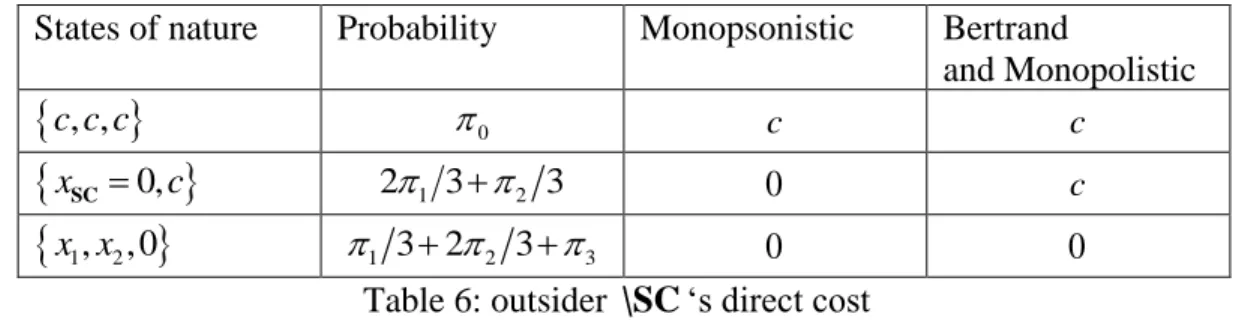
Table 6 depicts the outsider’s direct cost.
States of nature Probability Monopsonistic Bertrand
and Monopolistic
c c c, ,
0 c c
xSC =0,c
21 3+2 3 0 c
x x1, 2, 0
1 3 2+ 2 3+3 0 0 Table 6: outsider \SC‘s direct costUnder monopsonistic subcontracting, the outsider contracts at the best possible terms. Therefore, it only incurs a direct cost if all cost draws are high. Under Bertrand and monopolistic subcontracting, the outsider also incurs a cost c in
19 (18)
(
00 1 2)
o monopsonistic) (Bertrand and m nop( 2 3 3 olistic). c DC c = + + \SC
We are now ready to compare with solo bidding. Using (18) and (1), we obtain
(19)
(
2)
monopsonistic) 3 c (Bertrand) (monop 0 ( o 0 listic). i DC DC − = \SCUnder Bertrand subcontracting, the consortium increases the outsider’s direct cost. The increase occurs when the winning outsider draws a high cost and the consortium members both have favorable cost draws (
0, 0,c
). The consortium then charges cin the subcontracting market, whereas its members would have competed against each other under solo bidding.
Strong consortium’s subcontracting profit
Table 7 depicts the consortium’s subcontracting profit. Under monopsonistic subcontracting, the subcontracting profit equals zero. Under Bertrand and monopolistic subcontracting, if the consortium draws a zero cost and the outsider draws a high cost (
xSC=0,c
), the consortium charges c for its subcontracted unit.States of nature Probability Monopsonistic Bertrand
and Monopolistic
xSC =0,c
21 3+2 3 0 cOther states 1 2− 1 3−2 3 0 0
Table 7: strong consortium’s subcontracting profit
Summarizing, we can write that the consortium’s subcontracting profit equals (20)
(
1 2)
0
o monopsonistic) (Bertrand and monop listi
3 3 c .) ( 2 SP c = + SC
20 (21)
(
2)
monopsonistic) (Bertrand) (mon ( 3 opolistic). i i i i SP SP SP SP SP c − = + SCUnder Bertrand subcontracting, the consortium’s subcontracting profit exceeds the sum of the insiders’ under solo bidding. The following insight is the key ingredient for this section’s main result.
Insight 3: Under Bertrand subcontracting, the strong consortium enjoys more
subcontracting power. This effect increases the outsider’s direct cost and the consortium’s subcontracting profit.
5.2. Main market
Strong consortium’s bidding incentives
The bid at which the consortium is indifferent about winning the main market equals
(22) bSC* =DCSC+SPSC.
We can now compare the bidding incentives of the consortium to those under solo bidding. Using (3) and (22), the bid difference equals
(23) * *
(-) ; direct cost (+) ; opportunity decreases cost increases
i i i
bSC −b =DCSC−DC +SPSC−SP.
Using (16), (4), (21), and (2), we obtain
(24)
(
)
(
)
* * 2 2 0 ( 3 o monopsonistic) Bertr c ( 3 0.5 n and) (mo pol isti ). i b b c c − = − SCThe amount by which the consortium is willing to alter its bid is determined by the changes in its contracting and subcontracting power, as described in insights 2 and 3.
21 Finally, the bid at which the outsider is indifferent about winning the main market equals
(25) *
b\SC =DC\SC+SP\SC. Using (3) and (25), we can write that the bid difference equals
(26) * *
(+) ; direct cost increases (-) ; opportunity cost decreases
i i i
b\SC−b = DC\SC−DC + SP\SC−SP .
Plugging in (19), (17), and (7), we can write that
(27)
(
)
(
)
* * 2 2 0 ( 3 n monopsonistic) (Bertrand) (mo opolis i 3 0.5 t )c . i b b c c − = − \SCThe outsider’s bidding incentives are also determined by the consortium’s changes in contracting and subcontracting power, as described in insights 2 and 3. We obtain that the equilibrium bid equals bSC* =b\SC* and arrive at the following result.
Result 2: When two firms jointly bid through a strong consortium, the equilibrium
bid in the main market
• remains unchanged for monopsonistic subcontracting • increases by
(
2 3)
c for Bertrand subcontracting• decreases by
(
2 3 0.5)
c for monopolistic subcontracting.The bid effect depends on the mode of competition in the subcontracting market. Under Bertrand subcontracting, both the strong consortium and the outsider bid less aggressively because of increased subcontracting power. Under monopolistic subcontracting, in contrast, subcontracting power is already maximal under solo bidding. Both the strong consortium and the outsider then bid more aggressively because the strong consortium enjoys a net gain in contracting power. As before, even if the consortium decreases the equilibrium bid (under monopolistic
22 subcontracting), it is not unprofitable because the insiders to the consortium enjoy reduced direct costs. We refer to section 6 for discussion.
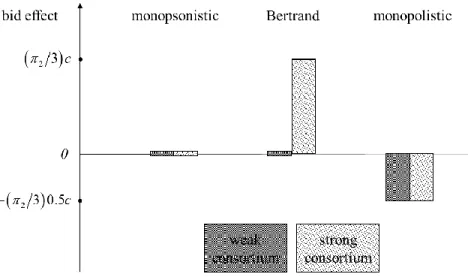
We now compare the bid effect of a weak consortium to the bid effect of a strong consortium.
Result 3. A weak consortium permits more leniency than a strong consortium.
Figure 2 illustrates the comparison.
Figure 2: weak consortium vs. strong consortium
A weak consortium permits more leniency by competition authorities because it cannot lead to increased subcontracting power. This limits the potential opportunity cost increase of the consortium members, and also rules out that the outsider’s direct cost increases.
6.
Discussion and robustness
6.1. Capacity constraints
This section shows that the insights generated by the basic model, where subcontracting follows from idiosyncratic cost shocks, are also valid when
23 subcontracting follows from capacity constraints. To this end, we consider the following illustrative model.
Demand in the main market is fixed and equals two units. Each of the three firms is capacity-constrained and can only produce one unit. The cost of producing that unit is normalized to zero. Bidding occurs as in the basic model: firms simultaneously submit bids and the firm submitting the lowest bid is selected as the winner.
The assumption of one unit capacity simplifies the analysis of the subcontracting market without losing the essentials. In particular, a winning consortium does not need a subcontractor, as it can produce both units in-house. This contrasts with a winning solo bidder, who needs to contract one unit. The tariff depends on the degree of competition in the subcontracting market. When the winner suffers from hold-up, we denote the tariff paid by t .15
Solo bidding
Firm i’s direct cost DCi equals
monopsonistic) 0 (Bertrand) (monopolisti 0 ( c). i D t C =
Under monopsonistic subcontracting, the winner can contract at the subcontractors’ unit costs. Likewise, when subcontractors compete à la Bertrand, all rents accrue to the contractor. Finally, when subcontracting is monopolistic, the winner pays t , and from symmetry the rents are shared equally among the two subcontractors. By the same reasoning, firm i’s subcontracting profit equals
15 Parameter t can be interpreted in three ways. First, it can be interpreted as a price cap. Second, it can be interpreted as the winner’s penalty for not delivering a unit that was promised. Third, the parameter can reflect a firm’s marginal cost of producing units beyond its efficient scale.
24 monopsonistic) 0 (Bertrand) 0.5 (monopolisti 0 ( c). i S t P =
As in the basic model, the equilibrium bid is such that firms are indifferent between winning in the main market or not. Consequently, we find that the equilibrium bid under solo bidding equals
* monopsonistic) 0 (Bertrand) 1.5 (monopolistic 0 ( ). i b t = Weak consortium
If the consortium wins in the main market, it can produce both units in-house at zero cost, without relying on the subcontractor. Its direct cost thus equals DCWC =0 and the outsider to the consortium earns zero subcontracting profits (SP\WC=0). When subcontracting occurs monopolistically, this constitutes a net gain in contracting power.
If the consortium does not win in the main market, it dissolves back into its separate entities. Therefore, the outsider’s direct cost equals DCi and the consortium members’ subcontracting profits sum up to 2SPi.
The equilibrium bids again follow from the condition that firms should be indifferent about winning in the main market, and equal
* * \ monopsonistic) 0 (Bertrand) (monopo 0 ( listic). b t b = = WC WC
In line with Result 1, under monopolistic subcontracting, the weak consortium leads to more aggressive competition in the main market.
25 If the consortium wins in the main market, the profits are as described for the weak consortium.
If it does not win, the consortium enjoys a subcontracting power increase under Bertrand subcontracting: the consortium avoids competition between its members and can charge t . We can write that the outsider’s direct cost and the consortium’s subcontracting profit equal
monopsonistic) (Bertrand) (mo 0 nopolistic). ( DC SP t t = = \SC SC
We find that the equilibrium bids equal
* * monopsonistic) (Bertrand) (mono 0 ( polistic). b t t b = = \SC SC
In line with Result 2, the strong consortium increases the equilibrium bids under Bertrand subcontracting and decreases them under monopolistic subcontracting.
6.2. Main market contract consists of multiple parts
In the basic model, if bidding results in a tie, only one winner is selected to be responsible for delivering the contract. Our analysis, however, would be equivalent when alternatively the contract would be split into multiple parts. To illustrate, imagine a simple model with two firms that are uncertain about who will be the zero-cost firm and who will be the high-cost firm. Under a winner-take-all tie breaking rule, there is a 0.5 probability that subcontracting is needed. If the contract is split into two equal parts, half a unit is subcontracted with certainty. The expected need for subcontracting is the same.
The possibility to have multiple winners allows to extend our analysis to address questions outside procurement. First, an analysis of price-elastic demand is feasible by working out the analysis at the unit level and then aggregating all units up to total demand. Second, it is possible to investigate other modes of competition in the main
26 market as well, such as e.g. price competition with product differentiation, where in equilibrium several firms would be responsible for serving different types of consumers.
This possibility, however, would not hold true in a model where firms are subject to capacity constraints. For example, in the above subsection on capacity constraints, the procurer could eliminate firms’ need for contracting by splitting the contract into two equal parts. Altering the design of the procurement in this way alters the analysis and could be profitable for the procurer. In practice, the procurer would face a tradeoff. On the one hand, reducing the need for subcontracting can reduce the equilibrium bid in the main market. On the other hand, procurers may rather coordinate with just one supplier to avoid moral hazard issues. For example, Sufi (2007) studies the syndicated loans market and reports that, for 69 % of loans in the sample, there is only one lead arranger on the loan.
6.3. Oligopoly
When there are more than three firms, a consortium can, just as in the basic model, enjoy a net gain in contracting power by hiring subcontractors less frequently. For monopolistic subcontracting, this leads to a lower direct cost for the consortium members and lower subcontracting profits for the outsiders. Also, a strong consortium enjoys increased subcontracting power when subcontractors compete à la Bertrand. To see this, consider the state of nature where the strong consortium members would be the only two firms with a zero-cost draw. The strong consortium members then do not compete against each other, whereas they would have competed against each other under solo bidding. Our qualitative insights therefore continue to hold in a model with more than three firms.
We next informally argue why, when there are more than three firms, a consortium that enjoys a net gain in contracting power is strictly profitable. Denote by the total reductionin the outsiders’ subcontracting profits. From ex ante symmetry, each single outsider thus suffers a reduction in subcontracting profit (i.e. opportunity
cost) of
#outsiders
27 their main market bid by
#outsiders
. The consortium is affected differently: is
fully passed through into the bid level at which the consortium is indifferent about
winning in the main market. Since
# outsiders
the weak consortium has incentives to bid more aggressively than each of the outsiders. The consortium then bids as a lowest-cost firm in a homogenous product Bertrand oligopoly: it bids (almost) up to the level at which the outsiders are indifferent about winning in the main market. Doing so yields the consortium a profit bonus, which makes the consortium strictly profitable.
7.
Conclusions
This paper has shed new light on how to assess the competitive effects of joint bidding arrangements between competing firms. Whenever the consortium members could have bid solo, the arrangement decreases the number of bidders and can be anti-competitive. Competition authorities and courts have accordingly challenged joint bidding arrangements between firms capable of bidding solo, unless the arrangement convincingly generates sufficient efficiencies.
We have shown that firms who bid jointly depend less on subcontractors if they win. When the subcontracting market is uncompetitive, such reduced dependence grants the consortium more contracting power. Consequently, the consortium can afford to compete more aggressively to win the procurement. Moreover, increased contracting power by the consortium also makes the outsiders more aggressive in the main market. The reason is that, if they do not win, they have a lower chance of acting as subcontractors. Accordingly, they forego fewer profits from winning in the main market. For these two reasons, when the subcontracting market is uncompetitive, prohibiting joint bidding arrangements between parties who could bid solo is too restrictive.
28 In highlighting these pro-competitive effects, we do not wish to leave the impression that the usual considerations are only of secondary importance. It goes without saying that, e.g., coordinated effects or the presence of an outside bidder should continue to be a crucial part of competition analyses.
Our analysis also calls for reflection on how to distinguish firms who could bid solo from firms who could not: in principle, all firms could bid solo if they have the possibility to hire subcontractors. We have shown that a framework where firms are too capacity-constrained to perform the entire contract in-house delivers the same insights as our basic model where firms are not capacity-constrained.
Finally, we have shown that bidding consortia should receive more lenient treatment when they dissolve if they do not win in the main market. A consortium that would not dissolve can enjoy increased subcontracting power vis-à-vis a winning outsider. If so, it becomes more costly for the outsider to win in the main market, which raises its bid. Moreover, it becomes more attractive for the consortium to act as subcontractor, leading the consortium to raise its main market bid as well.
References
Albano, Gian, Spagnolo, Giancarlo, and Matteo Zanza, 2009, Regulating joint bidding in public procurement, Journal of Competition Law and Economics, 5(2), 335-360.
Bouckaert, Jan and Geert Van Moer, 2017, Horizontal subcontracting and investment in idle dispatchable power plants, International Journal of Industrial Organization, 52, 307-332.
Branzoli, Nicola and Francesco Decarolis, 2015, Entry and subcontracting in public procurement auctions, Management Science, 61(12), 2945-2962.
29 Corwin, Shane A., and Paul Schultz, 2005, The role of IPO underwriting syndicates: Pricing, information production, and underwriter competition, Journal of Finance, 60(1), 443-486.
Danish Competition and Consumer Authority, 2018, Joint bidding under competition law. Retrieved from https://bit.ly/2mFUNCY on October 1 2019.
Diamond, Peter, 1971, A model of price adjustment, Journal of Economic Theory, 3(2), 156-168.
Farrell, Joseph, and Carl Shapiro, 1990, Horizontal mergers: an equilibrium analysis, American Economic Review, 80(1), 107-126.
Federal Trade Commission, 2000, Antitrust guidelines for collaborations among competitors. Retrieved from https://bit.ly/2kKT0Gq on October 8 2019.
Gale, Ian L., Hausch, Donald B. and Mark Stegeman, 2000, Sequential procurement with subcontracting, International Economic Review,41(4), 989-1020.
Haile, Philip A., 2001, Auctions with resale markets: an application to U.S. forest service timber sales, American Economic Review, 91(3), 399-427.
Haile, Philip A., 2003, Auctions with private uncertainty and resale opportunities,
Journal of Economic Theory, 108(1), 72-110.
Haile, Philip A., Hendricks, Kenneth, and Robert H. Porter, 2010, Recent US offshore oil and gas lease bidding: A progress report, International Journal of Industrial Organization, 28(4), 390-396.
Hendricks, Kenneth and Robert H. Porter, 1992, Joint bidding in federal OCS auctions, American Economic Review, 82(2), 506-511.
Hendricks, Kenneth, Pinkse, Joris, and Robert H. Porter, 2003, Empirical implications of equilibrium bidding in first-price, symmetric, common value auctions, Review of Economic Studies, 70(1), 115-145.
Huff, Nancy M. V., 2012, Horizontal subcontracting in procurement auctions
30 Jeziorski, Przemyslaw and Elena Krasnokutskaya, 2016, Dynamic auction environ-ment with subcontracting, RAND Journal of Economics, 47(4), 751-791.
Kamien, Morton I., Li, Lode, and Dov Samet, 1989, Bertrand competition with subcontracting, RAND Journal of Economics, 20(4), 553-567.
Klemperer, Paul, 2007, Bidding markets, Journal of Competition Law and Economics, 3(1), 1-47.
Levin, Dan, 2004, The competitiveness of joint bidding in multi-unit uniform-price auctions, RAND Journal of Economics, 373-385.
Lewis, Gregory, and Patrick Bajari, 2014, Moral hazard, incentive contracts, and risk: evidence from procurement, Review of Economic Studies 81(3), 1201-1228.
Marion, Justin, 2009, How costly is affirmative action? Government contracting and California's Proposition 209, The Review of Economics and Statistics 91(3), 503-522.
Marion, Justin, 2015, Sourcing from the enemy: Horizontal subcontracting in highway procurement, Journal of Industrial Economics, 63(1), 100-128.
Markham, Jesse W., 1970, Competitive effects of joint bidding by oil co.'s for offshore oil leases, Industrial Organization and Economic Development. Boston: Houghton Mifflin.
Miller, Daniel. P., 2014, Subcontracting and competitive bidding on incomplete procurement contracts, RAND Journal of Economics, 45(4), 705-746.
Miller, Jay, 2005, Lockheed Martin F/A-22 Raptor, Stealth Fighter. Hinckley, UK: Midland Publishing, ISBN 1-85780-158-X.
Moretti, Luigi, and Paola Valbonesi, 2015, Firms’ qualifications and subcontracting
in public procurement: an empirical investigation, Journal of Law, Economics, and Organization, 31(3), 568-598.
Sufi, Amir, 2007, Information asymmetry and financing arrangements: Evidence from syndicated loans, Journal of Finance, 62(2), 629-668.
31 Spiegel, Yossi, 1993, Horizontal subcontracting, RAND Journal of Economics, 24(4), 570-590.